MP8D - Power amplifier YORKVILLE - Free user manual and instructions
Find the device manual for free MP8D YORKVILLE in PDF.


| Product Type | Power amplifier with built-in mixing console |
| Number of channels | 8 channels (mic/line) |
| Output power | 215 W (max.) at 8 Ω (channel A), 170 W at 8 Ω (channel B) |
| Microphone inputs | Female XLR, low impedance (1.2 kΩ), balanced |
| Line inputs | 1/4" TRS jack, high impedance (10 kΩ), balanced/unbalanced (channels 1 to 6) |
| Stereo inputs | RCA (phono) jack, impedance 5 kΩ (channels 7 and 8) |
| Phantom power | 24 V DC (switchable) for condenser microphones |
| Channel EQ | 3-band (bass, mid, treble), adjustment ±15 dB |
| Built-in graphic equalizer | 9 bands, range ±12 dB, for main mix |
| Digital effects processor | 5 effect banks (reverbs, delays, special effects) |
| Main outputs | Main Line Out (1/4" TRS jack), speaker 1/4" (2 jacks per amp) |
| Monitor output | Monitor Line Out (1/4" TRS jack) |
| Record output | Record Out (RCA), line level |
| External amp inputs | AMP A/B In (1/4" TRS jack) |
| Power supply | 120 V AC (standard model) or 220-240 V AC (export model) |
| Fuse | 6 A slo-blo (120 V) / T3A slo-blo (220-240 V) |
| Safety | Grounding required, do not obstruct ventilation, avoid moisture |
| Maintenance and cleaning | Clean with a dry cloth, do not use liquid or abrasive products |
| Repairability | Refer all repairs to qualified personnel; replace fuse with same type |
| General information | Use only recommended accessories; keep box for transport |
Frequently Asked Questions - MP8D YORKVILLE
User questions about MP8D YORKVILLE
0 question about this device. Answer the ones you know or ask your own.
Ask a new question about this device
Download the instructions for your Power amplifier in PDF format for free! Find your manual MP8D - YORKVILLE and take your electronic device back in hand. On this page are published all the documents necessary for the use of your device. MP8D by YORKVILLE.
USER MANUAL MP8D YORKVILLE
2 x 160 Watt 8 Channel Powered Mixer
IMPORTANT SAFETY INSTRUCTIONS
INSTRUCTIONS PERTAINING TO A RISK OF FIRE, ELECTRIC SHOCK, OR INJURY TO PERSONS.
CAUTION:
TO REDUCE THE RISK OF ELECTRIC SHOCK, DO NOT REMOVE COVER (OR BACK). NO USER SERVICEABLE PARTS INSIDE.
REFER SERVICING TO QUALIFIED SERVICE PERSONNEL.
Read Instructions:
The Owner's Manual should be read and understood before operation of your unit. Please, save these instructions for future reference.
Packaging:
Keep the box and packaging materials, in case the unit needs to be returned for service.
Warning:
When using electric products, basic precautions should always be followed, including the following:
Power Sources:
Your unit should be connected to a power source only of the voltage specified in the owners manual or as marked on the unit. This unit has a polarized plug. Do not use with an extension cord or receptacle unless the plug can be fully inserted. Precautions should be taken so that the grounding scheme on the unit is not defeated.
Hazards:
Do not place this product on an unstable cart, stand, tripod, bracket or table. The product may fall, causing serious personal injury and serious damage to the product. Use only with cart, stand, tripod, bracket, or table recommended by the manufacturer or sold with the product. Follow the manufacturer's instructions when installing the product and use mounting accessories recommended by the manufacturer.
The apparatus should not be exposed to dripping or splashing water; no objects filled with liquids should be placed on the apparatus.
Terminals marked with the "lightning bolt" are hazardous live; the external wiring connected to these terminals require installation by an instructed person or the use of ready made leads or cords.
No naked flame sources, such as lighted candles, should be placed on the apparatus.
Power Cord:
The AC supply cord should be routed so that it is unlikely that it will be damaged. If the AC supply cord is damaged DO NOT OPERATE THE UNIT.
Service:
The unit should be serviced only by qualified service personnel.
INSTRUCTIONS RELATIVES AU RISQUE DE FEU, CHOC ÉLECTRIQUE, OU BLESSURES AUX PERSONNES.
AVS:
AFIN DE REDUIRE LES RISQUE DE CHOC ELECTRIQUE, N'ENLEVEZ PAS LE COUVERT (OU LE PANNEAU ARRIERE). NE CONTIENT AUCUNE PIECE REPARABLE PAR L'UTILISATEUR.
CONSULTEZ UN TECHNICIEN QUALIFIE POUR L'ENTRETIENT.
We have coupled our extensive experience in the development and production of powered mixers, (with state of the art, computer assisted design technology) to create the smallest, lightest, and most powerful combination mixer/amplifiers available. We at Yorkville Sound are confident that you will find your new MP8D to be an efficient and versatile solution to your mixer needs. This manual contains information to help you get the maximum performance from your MP8D. We hope you'll take the time to read it.
EFX
HIGH
LOW
MON
GAIN
EFX
HIGH
LOW
MON
GAIN





TAPE/CD/LINE IN
INPUT CHANNELS
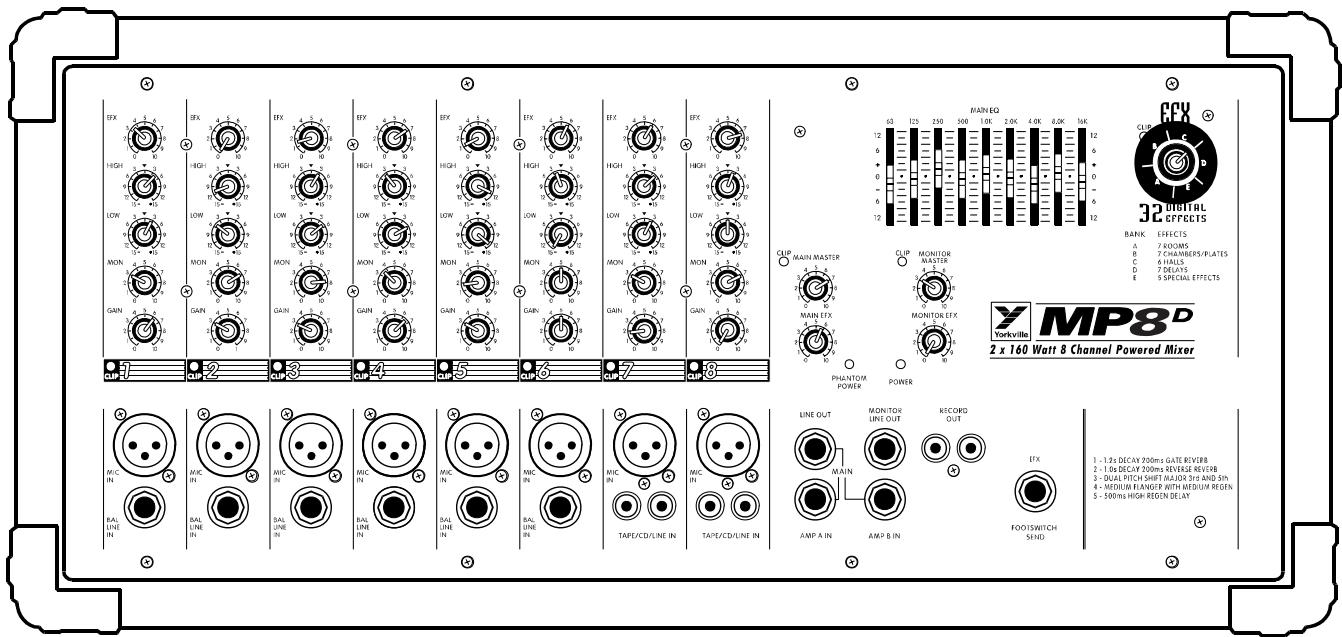
1. MICROPHONE & LINE INPUTS
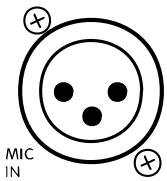
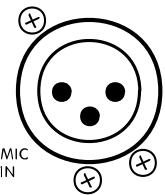
The MP8D features standard XLR type low-impedance MIC IN connectors on all 8 channels. These microphone inputs are electronically balanced for maximum noise suppression and have characteristics matching all low impedance dynamic microphones. 24 Volt DC phantom power is activated via the back-panel PHANTOM push-button, this enables the MP8D to use condenser microphones. (Note: condenser and dynamic mics may be used together with the PHANTOM power activated. It will not affect the performance of the dynamic mics). Additionally, there are high-impedance 1/4'' BAL LINE IN jacks on channels 1 to 6. These are electronically balanced line-level inputs, but will accept either balanced, or unbalanced input cables from high impedance microphones, guitars, amplifier Line outputs, synthesizers, electric pianos, etc. (Note: when connecting a balanced signal, employ balanced patch cables with a ring-tip-sleeve (stereo) 1/4'' plug on the mixer end). Channels 7 and 8 have dual TAPE/CD/LINE RCA-type inputs, (a phono preamplifier must be connected to the MP8D inputs for optimum turntable performance).
Do not connect signals to both types of inputs on any one channel (e.g. the MIC and LINE IN's on channels 1 to 6 or the MIC and TAPE/CD/LINE IN's on channels 7 and 8). To do so will cause improper operation of the input circuit. (Note: you may connect a stereo source to channels 1 through 6 but you must use two channels, one for left and one for right).
2. CHANNEL GAIN CONTROLS & CLIP LEDs
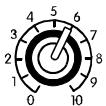
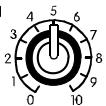
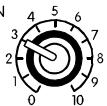
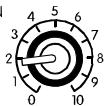
The GAIN control has a range of 40dB. This adjustment determines both the input sensitivity of the channel and the signal level sent to the MAIN mixing bus.* (The MP8D's channel circuitry does not require separate gain and level controls.) The CLIP LED is set to illuminate when the channel's overall signal level is 3dB below the onset of actual clipping distortion. As a result, small amounts of LED activity are acceptable; however, frequent or continuous activity indicates the need to turn down the GAIN control.
In audio terminology, a bus is a mix-down channel where all the signals from the input channels are blended into one signal. The MP8D has three busses, MAIN, MONITOR and EFFECTS.
3. CHANNEL LOW & HIGH EQUALIZATION
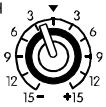
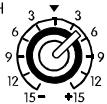
The MP8D's LOW and HIGH EQ controls independently adjust the bass and treble frequencies for each channel. The gain range for each control is plus or minus (+/-) 15dB to provide versatile equalization consistent with the clean simplicity of the MP8D's design. As with all equalizers, boosts at one or more frequencies increase the channel's signal level. If the channel is already at a fairly high operating level, this may cause clipping in which case the CLIP LED will light. Reduce the GAIN setting and/or the EQ boosts if CLIP activity is excessive. (Note: center position reflects a neutral or flat EQ control setting; however, lower EQ control settings may be effectively employed to reduce feedback and/or distortion.)
4. CHANNEL MON CONTROL
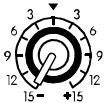
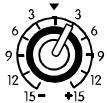
Each channel has a MON (monitor send) control which varies the amount of channel signal being tapped off and sent to the monitor bus in the MP8D. The MON signal is pre-fader and pre-EQ, in other words it is taken before the GAIN and EQ controls so that the main mix can be EQ'd independently of the monitor mix. As a result, channel EQ settings do not affect the sound of the monitor signals, nor do the channel GAIN controls regulate their volume. (Note: with an independent monitor mix, it may be beneficial to connect a graphic equalizer to the MONITOR output for feedback control. Also, remember that to turn a channel off completely, you must turn off both the GAIN and MON controls).
5. CHANNEL EFX CONTROL
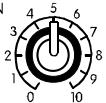
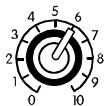
Each channel has an EFX (effects send) control which adjusts the level of the channel signal being tapped off and sent to the MP8D effects bus. This signal is post-fader and post-EQ, in other words it is affected by both the channel EQ controls and the channel GAIN control. Normally, the output signal from the effects bus is internally routed to the DIGITAL EFFECTS PROCESSOR. In this situation, the EFX control would regulate the intensity of the built-in effects as it is heard on that channel's sound through the main PA system and the RECORD OUT jacks. In standard operating mode with the built-in effects working, you would connect a regular on/off footswitch (e.g. Yorkville model IFS-1A) to the EFX FOOTSWITCH/SEND jack to turn the internal effects on and off. See the section on this feature later in the manual for more information. Alternatively, this signal can be connected to the input of an external effects unit and returned via channel to any channel. If the effects unit uses 1/4'' plugs, you would connect the output of the unit to any one of the BALANCED LINE IN jacks. In this mode, the internal effect is not bypassed, so if you are not planning to use an internal effect, you must turn down the MAIN EFFECTS and MONITOR EFFECTS Master controls. Also, if you do not require any effects at all, the effects bus output signal can be connected to the input of an additional monitor system or other at the EFX FOOTSWITCH/SEND jack using a standard shielded patch cord. controls would act as send controls to achieve a semi-separate mix (reme GAIN controls will also affect this signal).
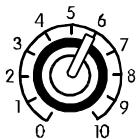
EFX
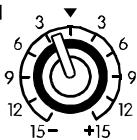
HIGH
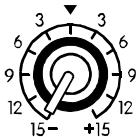
LOW
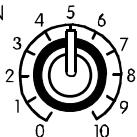
MON
GAIN
MASTER SECTION
1. MAIN MASTER CONTROL & CLIP LED
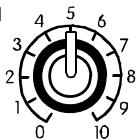
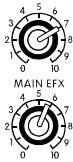
The MAIN MASTER control adjusts the overall level of the main mix, the RECORD OUT, and the PA volume. Beside this control is a CLIP LED that indicates high signal levels within the main mixing bus. Reduce the MAIN MASTER or the channel GAIN settings if the MAIN CLIP LED is more than slightly active. (Note: to ensure maximum signal headroom and clarity, operate the mixer with the MAIN MASTER set at around 7 or so. This way, you will be running the channel GAIN controls at lower settings, which helps to ensure that the channels do not clip).
2. MONITOR MASTER CONTROL
The overall level of the monitor mix is adjusted with the MONITOR MASTER control. Beside it is a CLIP LED that indicates high signal levels within this bus. Reduce the MONITOR MASTER or the channel MON levels if the MONITOR CLIP LED is more than slightly active. (Note: as with the MAIN MASTER, keep the MONITOR MASTER at a relatively high setting to ensure maximum clarity).
3. MAIN EFFECTS MASTER CONTROL
The MAIN EFX master control regulates the amount of signal going from the output of the internal DIGITAL EFFECTS PROCESSOR to the MAIN mixing bus where it is mixed with the dry signals direct from the channels. It controls overall effects intensity on the MAIN LINE OUT signal and RECORD OUT signal, as well through the main PA speakers.
CLIP MAIN MASTER
PHANTOM POWER


MONITOR
MASTER

POWER

2 x 160 Watt 8 Channel Powered Mixer
LINE OUT
AMP AIN
OR RECORD
OUT OUT
MONITOR LINE OUT

FOOTSWITCH
SEND
SPCCIAL EFFECTS

1- 1.2s DEACY 200ms GATE RREVER 2- 1.0s DEACY 200ms REVERSE RVE3-DUAL PITCH SHIFT MAJOR 3rdAt A- MEDIUM FLANGER WITH MEDIUM 5-500ms HIGH REGEN DELAY
4. MONITOR EFFECTS MASTER CONTROL
The MONITOR EFX master control regulates the amount of signal going from the output of the internal DIGITAL EFFECTS PROCESSOR to the MONITOR mixing bus where it is mixed with the dry signals direct from the channel MON send controls. It controls overall effects intensity of the MONITOR LINE OUT signal.
5. MAIN LINE OUT and AMP A & B IN JACKS
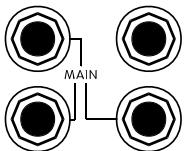
These jacks can serve a variety of patching and routing purposes. They are positioned in the signal path after the MP8D's main graphic equalizer and are therefore regulated by it (i.e. they are post-EQ). The main bus signals are available at line level (not speaker level; use the SPEAKER outputs on the back panel to drive speakers) from the MAIN LINE OUT jack. Taking a signal from this jack has no effect on the operation of the MP8D's dual, built-in power amplifiers. It is therefore possible to feed an external power amplifier or even several, interconnected power amps, with the MAIN output signals while the internal power amplifiers are also functioning (although, it is not necessary to have speakers connected e.g. if you want to use the MP8D strictly as a mixer).
The AMP A and B IN jacks are direct inputs to
the dual, 160 Watt built-in power amplifiers. These are switching jacks, and when you plug into either AMP IN, you interrupt the internal flow of signals going from the outputs of the main mixing bus to the inputs of the built-in power amps. This allows you to employ one of the amplifiers to power your monitors while the other powers the main PA speakers. To accomplish this, simply run a patch cord from the MONITOR LINE OUT jack to either the AMP A or AMP B IN jacks, then connect the monitor speakers to the amp's outputs on the back panel. (The dual power amps are normally both on the output of the MAIN bus). You may also use the AMP A and AMP B IN jacks to insert a speaker processor, another EQ or compressor/limiter into the main (and/or monitor) signal path. This is accomplished by connecting a patch cable from the MAIN (and/or MONITOR) LINE OUT jack to the device's input jack, and one or two patch cables from the device's output jack to either or both of the MP8D's AMP IN jacks. It is even possible to connect another mixer to the MP8D's power amplifiers via the AMP IN jacks. This slaves the amplifiers to that mixer's signals (i.e. it no longer receives the built-in mixer's signals), which means that you could use the built-in mixer to do another, totally separate, mixing job. For example, you could patch the MP8D's LINE OUT signal to an input on another mixer connected to amps driving a PA speaker system while using the MP8D's amplifiers to power control room speakers or monitors.
6. MONITOR LINE OUT JACK
The monitor bus output signal is available at line level (not speaker level) from the MONITOR LINE OUT jack and would normally be patched to the input of a mono power amplifier, or one channel of a stereo amp driving monitor speakers. Keeping in mind that there is no internal equalization for the monitor mix, you might want to patch a graphic equalizer between the MONITOR OUT jack and the input of your monitor power amplifier to help regulate feedback. As mentioned under the previous section, the monitor mix signal can alternately be patched to either of the internal amplifiers via the AMP IN jacks.
Patching something between things, in this case, means connecting the MP8D's MONITOR LINE OUT jack to the input of an EQ and the output of the EQ to the input of a monitor power amp or the AMP A or B IN jack.
7. RECORD OUT JACKS
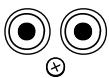
These phono connectors carry the pre-EQ (not affected by the MAIN EQ) main mix signals. RECORD OUT signal levels are regulated by the MAIN master. Using phono-to-phonopatch cords, connect the RECORD OUT jacks to the Aux. (line-level) inputs on the tape deck. Actual recording levels would now be adjusted using the tape deck's record level control/s.
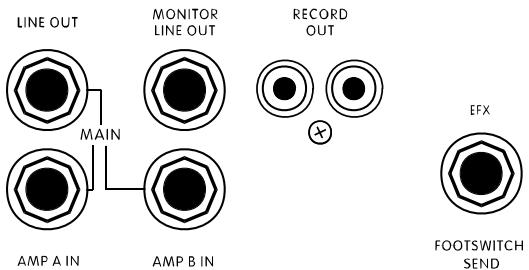
For optimal recording, you may have to set
the MAIN master and channel levels fairly high. So, if you need to record while the MP8D is operating in a PA situation (and set at lower levels, perhaps in a church) you can have a technician make up a couple of short padded patch cables as described below.** This cable would be connected between the MAIN LINE OUT jack and the AMP IN jack(s). The amount of signal going to the power amplifier(s) will be reduced so that the MAIN master and channel levels can be set high enough to provide adequate RECORD OUT signal levels (without the PA system being too loud.) Normally, the MP8D uses both Amp A and Amp B for the mains. If so, you have to pad both amplifiers. The best way to achieve this is to use a "Y" adapter. See diagram below.
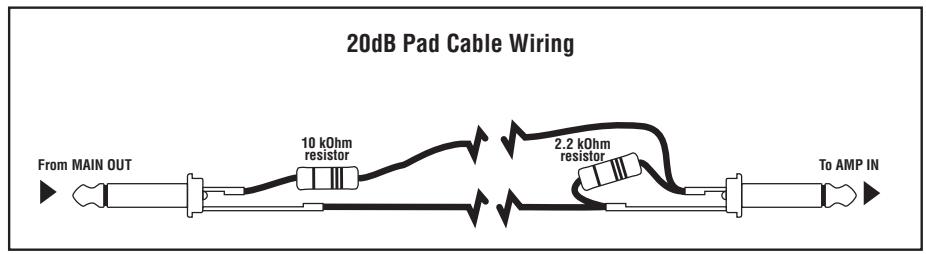
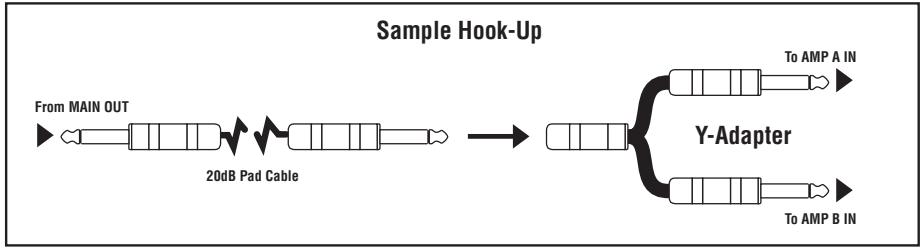
**To fashion the -20dB padded patch cables, start with two short, shielded patch cords. On each cord, solder a 10k Ohm resistor in series with the tip of the plug to be inserted in a LINE OUT jack, then solder a 2.2k Ohm resistor across the plug to be inserted in an AMP IN jack. It would then be advisable to identify either the LINE OUT or AMP IN plugs on both cords perhaps with tape or a dab of paint on the plug jacket.
8. EFX FOOTSWITCH/SEND JACK
This jack may be used to connect a standard on/off footswitch for the internal DIGITAL EFFECTS PROCESSOR or alternately, as an effects send jack. In this latter function, it would send the signal so that you could connect an external effects unit. If it is stereo, you would connect the unit's left and right outputs to the dual RCA inputs on channel 7 or 8 (please note that the channel inputs are not in stereo and that the stereo effect would be summed into a mono mix). Here you would need to keep the GAIN level of that channel fairly low and make sure that its EFX control is turned off. If the effects unit uses 1/4'' plugs, you could connect the output of the unit to any one of the BALANCED LINE IN Jacks. As another alternative, the EFX FOOTSWITCH/SEND jack may be used to deliver line-level signal to the input of an auxiliary amp/speaker system, or a tape deck. Here, the channel EFX controls would act as secondary level controls. Also keep in mind the channel EFX send controls are post-GAIN, so changes in the GAIN settings will affect these levels as well.
9. POWER LED & SWITCH
The POWER LED lets you know that the MP8D is plugged in and turned on. The AC power on/off switch is on the rear panel of the unit.
10. PHANTOM POWER
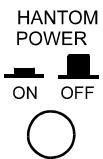
The PHANTOM power LED indicates that 24 volts of DC phantom power is present on all the XLR microphone inputs to power condenser microphones. Regular dynamic mics may be connected while the PHANTOM POWER is activated without encountering problems. The PHANTOM POWER push-button is located on the rear panel.
DIGITAL EFFECTS PROCESSOR
1DIGITAL EFFECTS PROCESSOR SELECT CONTROL
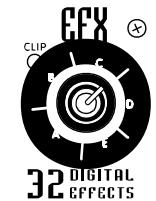
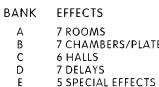
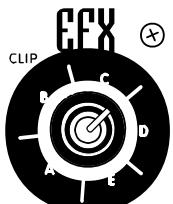
The SELECT control selects from 5 banks of reverb sounds, delays and other effects. Bank A represents room reversals. Bank B are combined chambers/plate effects. Bank C is hall reverberation effects. Bank D are delay effects, and finally Bank E is the special effects. Simply rotate the SELECT control to the basic type of effect you prefer. This is a continuous type of control so you may simply rotate it in either direction to reach the desired setting. Lists of effects banks appear in this manual and on the front panel of the MP8D.
32 DIGITAL EFFECTS
BANK EFFECTS
A 7 ROOMS
B 7 CHAMB
C 6 HALLS
D 7 DELAYS
E 5 SPECIAL EFFECTS
SPECIAL EFFECTS
1-1.2s DECAY 200ms GATE REVERB
2-1.0s DECAY 200ms REVERSE REVERB
3-DUAL PITCH SHIFT MAJOR 3rd AND 5th
4-MEDIUM FLANGER WITH MEDIUM REGEN
5-500ms HIGH REGEN DELAY
NOTE: The signal sent from the Internal Digital Effects Processor to the MONitor mix is independent from the MONitor SEND controls on the channels strips. The channel's GAIN control feeds signal into the Effects bus, the channel's EFX control enables you to mix in the amount of wet signal to your dry mix. Remember, the Internal Digital Effects are heard through the MONitor output only if the channel's GAIN control is feeding signal into the Effects bus.
2. EFFECTS CLIP LED
Situated next the EFX SELECT control, the CLIP LED indicates that the digital processor is receiving an input signal which is too strong, possibly resulting in distortion. For maximum dynamic range, the Clip LED should flash briefly, but only on high-energy transients such as loud snare drum hits. If there is too much CLIP activity, turn down the channel EFX controls.
EFFECTS TABLES
See last page for effects table.
BUILT IN 9 BAND GRAPHIC EQUALIZER
General
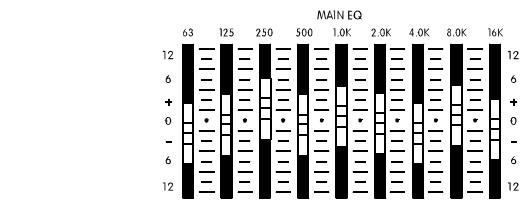
This, like any graphic equalizer, represents a set of limited-range (+/-12dB) gain controls. In this case there are nine sliders, each one operating over a one-octave portion of the overall band of sound frequencies. Please note that equalizers can have an effect on the gain of the main system as well as its frequency response. Once adjusted, you may need to turn down the MAIN MASTER level if the CLIP LED beside it becomes very active.
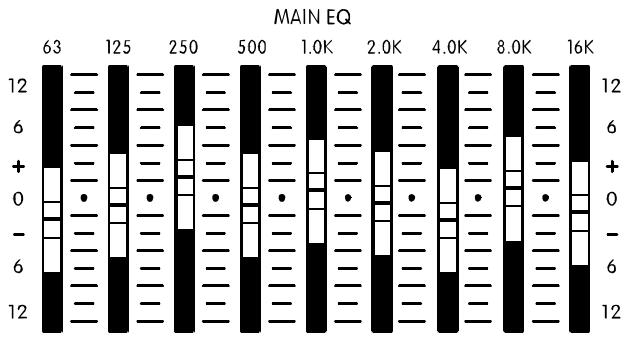
This, like any graphic equalizer, represents a set of limited-range (+/-12dB) gain controls. In this case there are nine sliders, each one operating over a one-octave portion of the overall band of sound frequencies. Please note that equalizers can have an effect on the gain of the main system as well as its frequency response. Once adjusted, you may need to turn down the MAIN MASTER level if the CLIP LED beside it becomes very active.
There Are 3 Main Functions for the Graphic EQ
- To adjust the system for feedback reduction, the normal technique is to turn the main system up to the point of feedback and move the EQ sliders, one at a time, to determine which frequency band is causing the feedback. (Remember to push them back up to center position if they don't stop the feedback). When isolated, the offending band is then pushed down about 3 to 6 dB. Usually only 2 or 3 bands can be reduced before the feedback elimination process begins to affect the sound quality.
- To adjust for deficiencies in the speaker system's bass response, the most common adjustment is to boost the 63 Hz about 6 dB and the 100 Hz about 3 dB. However, use of the graphic EQ to extend the deep bass frequency response of a speaker cabinet does use up a lot of the available system power, so this technique should be used with caution to avoid distortion and possible speaker damage. On the other hand, in applications where it is appropriate to sacrifice deep bass for higher overall sound output, the 63 Hz slider should be taken down 6 dB below centre. You may now increase the MAIN level for added volume.
- The third use of the graphic equalizer is to adjust the sound character for artistic reasons. Each frequency is adjusted until the sound is what the musicians feel sounds best. The best sound system operators, however, usually strive to use a minimum of equalization for this purpose, or for boosting the bass. Instead, they use very minimal sound-shaping adjustments to ensure that the threat of feedback and distortion will also be minimal.
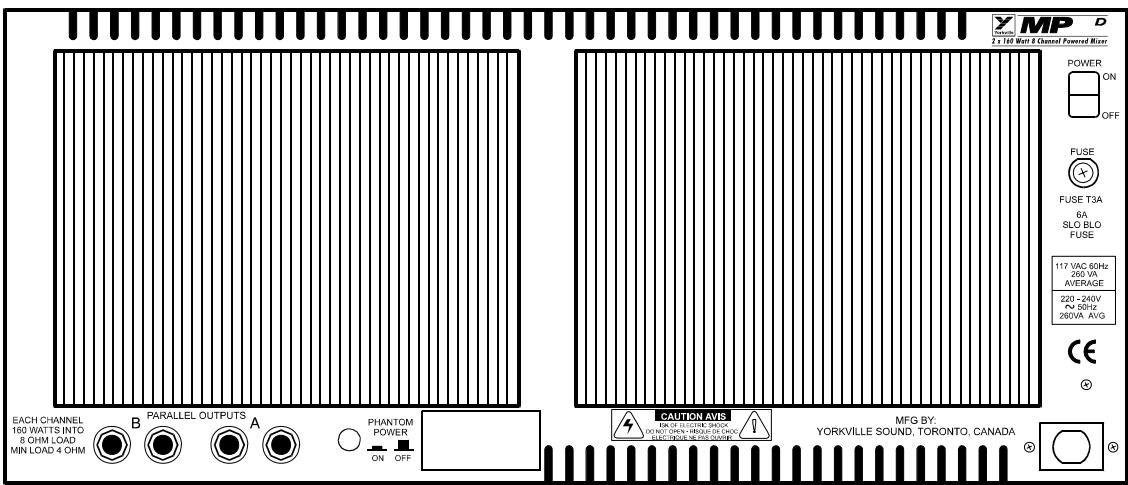
MP8D REAR PANEL
1. AMP A & B SPEAKER OUTPUTS & HEATSINKS
Each of the MP8D's dual power amplifiers has two 1/4'' jacks for speaker connections. You may connect one 8-Ohm speaker cabinet to each jack or a single 4-Ohm speaker to either side. Connecting two 8-Ohm speakers (i.e. a 4-ohm load), to either AMP A or AMP B, will not harm the MP8D, but the output power will be severely limited and is not recommended. If the amp overheats, the built-in thermal protection will cycle the amplifier on and off until it cools down, usually in a few minutes.
Do not obstruct the flow of air around the heatsink fins on the rear of the MP8D as this too may cause the power amplifier to overheat and shut off. After the MP8D cools down, operation will be restored automatically. This should never happen if adequate ventilation is provided at the back of the unit.
2. AC POWER SWITCH & FUSE
The power switch and fuse are located on the back panel. If you must replace the fuse, always replace it with the same type - a 6A slo-blo (T3A slo-blo in 220-240V export models). Do not replace the fuse with the wrong type or wrap foil around the old one, as this may cause serious damage. If replaced fuses keep blowing, take the unit to your Yorkville dealer for service.
GENERAL OPERATING INSTRUCTIONS
- Connect the AC power cord to a 120Volt AC grounded power outlet (220 to 240 Volts in export units).
- Turn the MAIN and MONITOR MASTER controls to 0 for now, then switch on the POWER.
- You can connect low-impedance microphones to the 3-pin XLR type MIC inputs.
- Connect mono, line-level signal sources (i.e. amplifier line outputs, the output of a mono mixer, an electric instrument, an external effects unit, etc.), to the 1/4'' BAL LINE IN jacks on channels 1 to 6. Do not connect more than one signal source to any of these channels, that includes stereo outputs (if you try to connect a stereo source to a mono channel using a Y adapter, you may get distortion).
- Connect stereo sources (tape deck, CD player, stereo keyboard instrument, an external effects unit, etc.) to channels 7 and/or 8 via the dual RCA (phono) type inputs. Once again, connect only one signal source per channel, and use shielded patch cords for all pre-amp connections.
- Using 18-gauge, or heavier, speaker cables (never use shielded patch cords to connect speakers, they cannot handle the high current and will waste power by heating up), connect one or two 8-Ohm main PA speakers to the SPEAKER outputs on the back panel. If you have 4-Ohm speakers, you should connect only one to each amplifier. (Note: to deliver maximum power to a pair of 8-Ohm main PA speakers, connect only one speaker to each amplifier).
6a. If you are employing a separate power amplifier for the monitor speakers, connect the main speakers as in (6) then run a shielded patch cord from the MONITOR LINE OUT jack to the input of the monitor power amp. If you are employing a separate graphic equalizer for the monitors, run a shielded patch cord from the MONITOR OUT jack to the input of the Equalizer. (A good idea: remember there is no channel EQ on the monitor signals and the built-in graphic EQ is only for the main PA sound). Then, another patch cable from the EQ's output to the input of the monitor power amp. If you are using AMP A or B to power monitors, connect an EQ between the MONITOR LINE OUT and the appropriate AMP IN jack. - Position your main PA speakers at the front of the stage, pointing directly out at the audience. Position your monitor speakers on the stage floor, in front of the mic stands, pointing up at the backs of the mics. (Remember to use cardioid or uni-directional mics to reduce the threat of monitor feedback).
- During a sound check, with the band playing, or other sources feeding the mixer inputs, make the following control adjustments:
i. Set the channel LOW and HIGH EQ controls at center. Now, set the channel GAIN, MON, and EFX controls at 0 and the GRAPHIC EQ sliders at center position.
ii. Turn up the MAIN and MONITOR MASTER controls to approximately 7 or 8, the MAIN EFX master to around 7 and MONITOR EFX master to 5.
iii. Turn up the channel GAIN controls slowly until each channel can be heard at the desired volume level through the main PA speakers.
iv. Turn up the channel MON controls until the performers can hear themselves at adequate volume levels without feedback.
v. Turn up the EFX controls on those channels requiring effects. Usually this would be the lead and harmony vocal channels. Reverb may be used on other channels or on recorded music, but at low levels. - Feedback during a performance is usually caused by one of the monitors. The main PA is less likely to feed back because the mics are so far away from the main PA speakers. Therefore, if you are using monitors and feedback occurs, try the following procedures:
i. Turn the MONITOR master down until the feedback stops.
ii. If you have a graphic equalizer patched between the MONITOR output and your monitor power amp, pull down one or two (but not more) of the EQ sliders in the frequency range where the sound seems to be occurring.
iii. Now turn the MONITOR master back up. If the feedback recurs, push the EQ slider(s) back up to center position and try pulling down one or two others.
iv. In the case of main system feedback, follow the above type of procedure, but using the MAIN master and the built in GRAPHIC EQ.

MP8D
2 x 160 Watt 8 Channel Powered Mixer
SPECIFICATIONS
MIXER SECTION
INPUT TO LINE OUT
Input referred noise -122 dB
Max balanced input gain +56 dB
Balanced input impedance 1200 Ohms
Max balanced input gain 1 / 4'' jacks +40 dB
Balanced input impedance at 1/4" jacks 10k Ohms
Unbalanced input impedance at RCA 5k Ohms
Balanced CMRR min. 35dB, typical -50dB
Frequency response at 36 dB gain +/-3 dB, 20 Hz to 20 KHz
Signal path distortion less than 0.1% 20Hz-20KHz
Typical signal level at patch bay 1 VRMS
Channel Clip LED threshold 3 dB before clipping
Channel EQ adjustment range +/- 15 dB
Graphic EQ adjustment range +/- 12 dB
Phantom Voltage 24 V
AMPLIFIER
Frequency response +/-1 dB, 20 Hz to 20 KHz
Gain 28 dB
Input sensitivity 1.4 VRMS
Total Harmonic Distortion 0.05% at 1KHz
Max power into 8 Ohms < 1% THD 215 Watts (one channel driven)
Max power into 8 Ohms <1% THD 170 Watts (both channels driven)
INTRODUCTION
0.8s Warm Small Room
0.8s Bright Small Room + 60ms Doubling Delay
1.0s Bright Small Room + 175ms Regen Delay
1.2s Warm Room + Medium Chorus
1.5s Bright Medium Room
1.5s Bright Medium Room + 80ms Slap Delay
2.5s Warm Large Room
B HALLS
1.5s Warm Medium Hall
2.0s Bright Medium Hall + 50ms Doubling Delay
2.5s Dark Medium Hall
3.0s Warm Hall + Slow Chorus
3.5s Bright Medium Hall
5.0s Dark Large Hall
8.0s Dark Huge Hall
C CHAMBERS·PLATES
0.5s Bright Plate
0.8s Bright Chamber + 125ms Regen Delay
0.8s Bright Plate + 200ms Regen Delay
1.2s Bright Chamber
1.2s Bright Plate
2.5s Warm Chamber
D DELAYS
60ms Slap Delay
100ms Slap Delay + Medium Chorus
150ms Medium Regen Delay
200ms Regen Delay + Slow Chorus
250ms Low Regen Delay
300ms Medium Regen Delay
350ms Regen Delay + Slow Chorus
E SPECIAL EFFECTS
1.2s Decay + 200ms Gate Reverb
1.0s Decay + 200ms Reverse Reverb
2.5s Dark Medium Hall
Dual Pitch Shift \~Major 3rd & 5th Up\~
Medium Flanger w/Medium Regen
500ms High Regen Delay

WEB: www.yorkville.com
Niagara Falls, New York
14305 USA
Voice: (716) 297-2920
Fax: (716) 297-3689