
C 319B - Microphone AKG - Free user manual and instructions
Find the device manual for free C 319B AKG in PDF.


| Product type | Back-electret condenser microphone |
| Brand | AKG |
| Model | C 319 B (C 391 B) |
| Acoustic principle | Pressure gradient microphone |
| Polar pattern | Cardioid (CK 91 capsule included) |
| Frequency range | 20 Hz – 20,000 Hz ±2 dB |
| Sensitivity (at 1 kHz) | 10 mV/Pa ±1 dB, equivalent to -40 dBV/Pa |
| Electrical impedance | ≤200 ohms |
| Recommended load impedance | ≥1000 ohms |
| Equivalent noise (CCIR 468-2) | 26 dB |
| A-weighted equivalent noise | 17 dB-A |
| Signal-to-noise ratio (A-weighted) | 77 dB |
| Maximum SPL (1 kHz, 1% THD) | 132 dB SPL (without pad) / 142 dB SPL (with -10 dB pad) |
| Power supply | Phantom 9 to 52 V per DIN 45596 |
| Power consumption | ≤2 mA |
| Switchable pad | -10 dB |
| Low-cut filter | Switchable, cut-off frequency 75 Hz (-3 dB), slope 12 dB/octave |
| Connector | XLR 3-pin (IEC) |
| Dimensions | 19 mm ø × 147 mm |
| Net weight | Approx. 115 g |
| Housing material | Brass, matte gray finish |
| Operating temperature | -20°C to +60°C |
| Allowable relative humidity | 99% at +20°C, 95% at +60°C |
| Included accessories | SA 40 elastic mount, W 90 foam windscreen |
| Care and cleaning | Clean surfaces with alcohol; windscreen washable in water with mild detergent |
Frequently Asked Questions - C 319B AKG
User questions about C 319B AKG
0 question about this device. Answer the ones you know or ask your own.
Ask a new question about this device
Download the instructions for your Microphone in PDF format for free! Find your manual C 319B - AKG and take your electronic device back in hand. On this page are published all the documents necessary for the use of your device. C 319B by AKG.
USER MANUAL C 319B AKG
The C 390 System is a completely modular system which can be adapted in a very practical and economical way to the always changing requirements encountered in the Recording, Broadcast, Sound Reinforcement, and Motion Picture Industries. The sound engineer has a choice of interchangeable condenser microphone modules which can be mixed and mated in various combinations to create custom studio-quality microphones for any conceivable application.
Description:
The C 390 System consists of a single universal powering/output module, eight different microphone heads and various interchangeable accessory parts to match a great variety of applications. An overview of the complete system is shown at the end of this instruction booklet.
The following main features are provided:
- robust mechanical construction
- low self-noise
- low power consumption
high operating reliability - low impedance capsule connections
will operate up to 60^ and over 95% relative humidity - built-in attenuation switch with 0 and -10 dB position (see fig. 1)
extended long-life stability - transformerless output stage
to be powered from any standard phantom powering source (acc. to DIN 45596) - low distortion even at high sound pressure levels
built-in bass-cut filter with onset at 100Hz (see fig. 1)
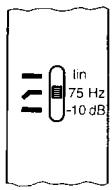
Fig. 1
The C 391 B is delivered with the following modules and accessories:
- SE 300 B powering/output module
CK 91 unidirectional microphone capsule with cardioid response
W 90 foam-type windscreen
SA 40 "quick release" stand adapter
The microphone features extremely low handling noise due to the low-mass diaphragm and smooth body finish, low r.f. interference due to screening- and filtering technique, and will work under almost any condition due to the conservative and reliable design.
The switchable attenuation of the output level by 10dB is especially useful in connection with high sound pressure levels (when used in close proximity to high-energy sound sources) and using input stages of amplifiers or mixing desks with limited input level capabilities. Otherwise, this associated equipment will overload before the maximum overload point of the microphone has been reached. The incorporated bass-cut filter reduces the risk of distortion at low frequencies. This feature ist especially useful in combating wind noise or stage floor vibration. The slope of the bass-cut filter is about 12 dB/octave with the cut-off point at about 75 Hz.
Changing Modules:
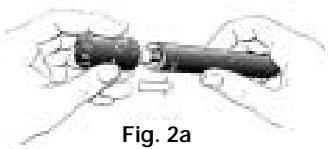
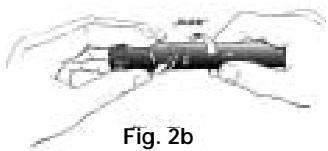
All capsules may be attached to the powering module via a bayonet connection. Consequently, a quick, safe, and easy change of modules even in dark rooms may be made.
The capsules or accessory modules fit to the powering module in only one position. Once the two parts are put together only a short right-hand twist is required until the modul "clicks" into position (see figs. 2a, 2b). The capsule modules may be taken off from the powering module with a left-hand twist.
Applications:
The offered modules and the accessories of the system provide the user with the flexibility to work in a wide range of application areas. We can only list a limited selection because of space.
A) Selection of capsule modules to adjust to different acoustical situations:
CK 91 - Cardioid Microphone Capsule
A classic cardioid capsule suitable for all general purposes where a uniform front-to-back ratio is required.
CK 92 - Omnidirectional Microphone Capsule
This capsule is very suitable for chorus and soloist work in sound and tv studios. Reporters may also benefit from the inherent lack of proximity effect.
CK 93 - Hypercardioid Microphone Capsule
The design and construction is quite similar to the CK 91. The capsule is acoustically tuned to the hypercardioid polar response. The resulting higher directivity offers the advantage of better separation in multi-channel recording work or improved gain before feedback in sound reinforcement situations.
CK 94 - Figure-eight Microphone Capsule
This capsule provides for high rejection of sound from the side (± 90^ off-axis) and is consequently well suited for interviews and dramas. In connection with a second microphone with cardioid, hypercardioid, or omni-directional response, an M/S combination can be easily formed and used.
CK 97-O - Miniature Omni-directional Capsule
A versatile miniature microphone of small dimensions with omnidirectional response. The capsule may be used generally for voice applications, but may also be used to record music instruments.
CK 97-C - Miniature Cardioid Microphone Capsule
This miniature microphone may be used wherever a microphone should not be seen in the recording scene. It has a uniform cardioid response and will provide recordings without excessive portion of reverberation.
It will also provide for additional gain before feedback in sound reinforcement situations.
CK 98 - Short Shotgun Microphone Capsule
This capsule presents a good compromise between required length of the tube and the resulting directivity. The result will justify the operation of this microphone capsule in quite different application areas such as film, tv, stage, and video work. It will also work well where high acoustical separation between different instruments is required without having to erect acoustical dividers.
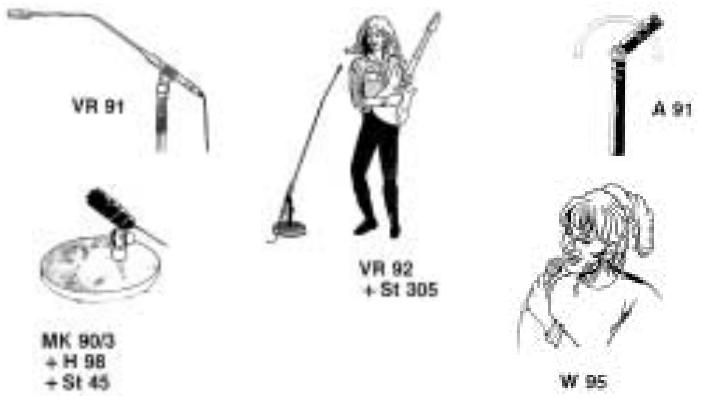
B) Using the cable set MK 90/3 + H 98
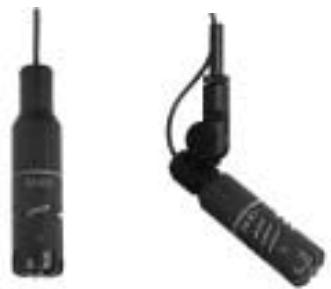
This accessory enables the sound engineer in film, tv, and theatre work to use the relatively small microphone capsules remotely from the substantially larger powering/output module via a highly flexible cable connection. The following illustrations show a few examples of how the cable set can be used.
C) The application of the remaining accessories of the system is shown in the following illustrations
Enclosed Accessories:
SA 40 "quick release" stand adapter
W 90 foam-type windscreen (only provided with the C 391 B)
Optional Accessories:
a) Accessories of the C 390 system:
A 91: All-metal swivel joint with swivel range of ± 90^ from the microphone axis with intermediate stops
MK 90/3 + H 98: 3 m (10 ft.) cable set/stand adapter combination
VR 91: 350 mm (14") angled extension tube
VR 92: 1.2 m (4 ft.) extension tube with short gooseneck at the capsule end. The VR 92 includes the stand adapter SA 18/1 B.
W 95: All-metal wire-mesh windscreen with double foam lining for the capsules CK 91, CK 92, and CK 93
b) Further optional accessories:
B 18: Battery power supply for one microphone
H 10: Metal stereo crossbar with variable distance between the microphones from 35 to 78 mm (1 5/8 " to 3")
H 30: Elastic suspension with very effective damping of low-frequency rumble
H 38: Elastic suspension especially suited for video/film camera mounting
H 52: Stereo mount for inconspicuous operation of two capsules of the system in XY (coincidence), M/S, or ORTF-technique
N 62 E: AC power supply unit to feed two microphones
N 66 E: AC power supply unit to feed six microphones
SA 18/1 B: All-metal stand adapter for specially stable mounting of the microphone
SA 38/H: Swivel stand adapter with integrated H 38
St 45: Slim table stand
St 46: Miniature table stand for microphone capsules
St 305: Heavy-duty, anti-shock table stand with circular base
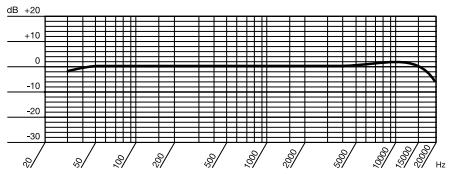
Frequency Response Curve:
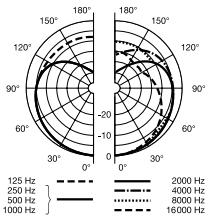
Polar Response:
Powering Technique:
The powering/output module may be powered in phantom power technique according to DIN 45596. These standards specify a positive voltage on the audio lines versus the screen of the audio cable of 12, 24 and 48 volts.
The following wiring methods are suggested:
- Circuitry incorporating an input transformer with centre tap (under-grounded)
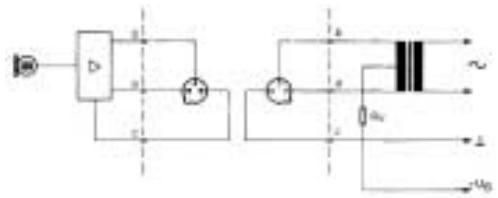
- Circuitry incorporating an input transformer without centre tap (ungrounded)
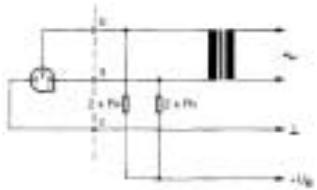
- In case where single ended (grounded) amplifier inputs, or where no input transformers are available, either capacitors or optional transformers have to be wired into the audio lines to prevent any current leakage into the input circuitry.
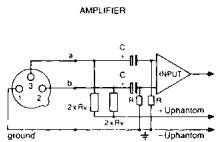
C=100F.R=10kohms
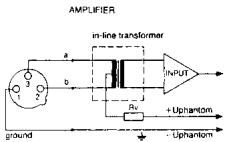
The components in the last figure may be easily and economically added to most existing input circuitries and would save the operation of external powering elements.
The following values for Rv (or 2 × Rv ) are standardized:
+UB
12 V ± 2 V
24V± 4V
48V± 4V
Rv
330 ohms
680 ohms
3300 ohms
2xRv
680 ohms
1200 ohms
6800 ohms
Please note:
The resistors 2 × Rv have to be at least of the 0.5% tolerance type to satisfy the symmetry requirements.
Cleaning Hints:
All surfaces may be safely cleaned from time to time with methylated spirit or alcohol. The foam windscreen should be occasionally soaked in a non-aggressive detergent/water solution and will be ready for use after drying.
Specifications of the C 391 B:
| Electrical working principle: | condenser microphone, self-polarized |
| Acoustical working principle: | pressure gradient receiver |
| Frequency range: | 20-20,000 Hz ±2 dB from nominal frequency curve |
| Open-circuit sensitivity (at 1000 Hz): | 10 mV/Pa△-40 dBV re. 1 V/Pa |
| Electrical impedance: | ≤200 ohms |
| Recommended load impedance: | ≥1000 ohms |
| Weighted sound pressure level acc. to DIN 45405 (CCIR 468-2): | 26 dB |
| Weighted sound pressure level acc. to DIN 45412 (A-weighted): | 17 dB-A |
| S/N ratio in ref. to 1 Pa (A-weighted): | 77 dB |
| Max. sound pressure level: | 80 Pa△132 dB SPL at 1000 Hz, 2000 ohms load imped. and 1 % THD 250 Pa△142 dB SPL with 10 dB pre-attenuation |
| Operating temperature range: | -20°C to +60°C (-4°F to +140°F) |
| Acceptable humidity level: | 99% at +20°C (68°F) 95% at +60°C (140°F) |
| Powering: | 9-52 volts d.c. acc. to DIN 45596 |
| Current consumption: | ≤2 mA |
| Outer dimensions: | 19 mm Ø x 147 mm (3/4 Ø x 5.8 inch) |
| Net weight: | approx. 115 g (4.1 oz) |
| Housing material: | brass |
| Housing finish: | matte-grey |
| Connector: | 3 pin. XLR type |
| Connections: | acc. to IEC |
This product conforms to EN 50 082-1
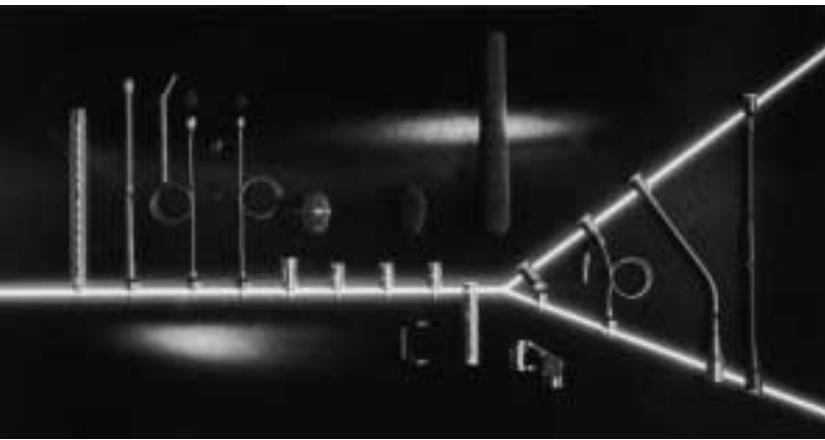
Overview of the Complete System:
Introduction:
Accessoires recommends:
For other distributors worldwide see our website: http://www.akg-acoustics.com

A Harman International Company