
TAYLOR II CLASSIC - Radio transceiver PRESIDENT - Free user manual and instructions
Find the device manual for free TAYLOR II CLASSIC PRESIDENT in PDF.



User questions about TAYLOR II CLASSIC PRESIDENT
0 question about this device. Answer the ones you know or ask your own.
Ask a new question about this device
Download the instructions for your Radio transceiver in PDF format for free! Find your manual TAYLOR II CLASSIC - PRESIDENT and take your electronic device back in hand. On this page are published all the documents necessary for the use of your device. TAYLOR II CLASSIC by PRESIDENT.
USER MANUAL TAYLOR II CLASSIC PRESIDENT
1) MARCHE/ARRET - VOLUME
H Hotel
India
J Juliett
K Kilo
L Lima
M Mike
N November
O Oscar
P Papa
Q Quebec
R Romeo
S Sierra
Tango
U Uniform
V Victor
W Whiskey
X X-ray
Y Yankee
Z Zulu
LANGUAGE TECHNIQUE
TONTON
TPH
TVI
VISU
VX
WHISKY
WX
XYL
H Hotel
I India
J Juliett
K Kilo
L Lima
M Mike
N November
Oscar
P Papa
Q Quebec
R Romeo
Sierra
Tango
U Uniform
V Victor
W Whiskey
X X-ray
YYankee
Z Zulu
TERMINOS DEL ARGOT CEBEISTA
A.L.
ARMONICOS
AVE MARIA
BARBAS
BARRA MOVIL
BASE
BIGOTADA
BREAK
BREAKER
CAJA TONTA
CHICHARRA
CORTINERO
CRUCE DE ANTENAS
DOS METROS HORIZONTALS
ENCENDER FILAMENTOS
ESPIRAS
FOTOCOPIA
FRECUENCIA
KAS
LABORO
Tip: Radio CB TAYLOR II
N^ de Serie:
SIN SELLO DEL DISTRIBUTOR LA GARANTÍA NO SERÁ VALIDÀ
A REMITIR RESPUESTA VIA CORREO
PRESIDENT
ELECTRONICS IBERICA, S.A.
Botanica, 107-109, Pol. Ind. Gran Via Sud
08908 L'HOSPITALET DE LLOBREGAT
BARCELONA
Fecha de compra:
Tip: Radio CB TAYLOR II
N^ de Serie:

SIN SELLO DEL DISTRIBUTOR LA GARANTÍA NO SERÁ VALIDA
CUESTIONARIO CB CONFIDENCIAL
Before using, be careful never to transmit without first having connected the antenna (connection "B" situated on the back panel of the equipment) or without having set the SWR (Standing Wave Ratio)! Failure to do so may result in destruction of the power amplifier, which is not covered by the guarantee.
MULTI-NORMS TRANSCEIVER!
See on page 28 and the Configuration table on page 42.
The warranty is valid in the country of purchase
Welcome to the world of the new generation of CB radios. The new PRESIDENT range gives you access to top performance CB equipment. With the use of up-to-date technology, which guarantees unprecedented quality, your PRESIDENT TAYLOR II Classic is a new step in personal communication and is the surest choice for the most demanding of professional CB radio users. To ensure that you make the most of all its capacities, we advise you to read carefully this manual before installing and using your PRESIDENT TAYLOR II Classic.
A) INSTALLATION
1) WHERE AND HOW TO MOUNT YOUR MOBILE CB RADIO
a) You should choose the most appropriate setting from a simple and practical point of view.
b) Your CB radio should not interfere with the driver or the passengers.
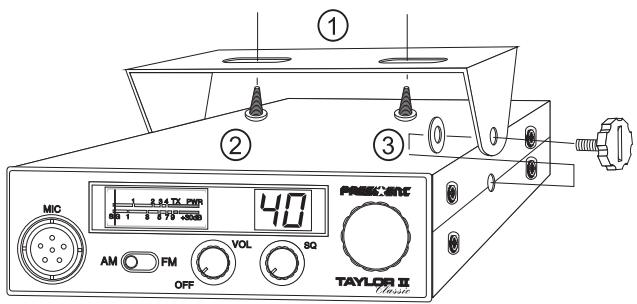
MOUNTING DIAGRAM

c) Remember to provide for the passing and protection of different wires (e.g. power, antenna, accessory cabling) so that they do not in any way interfere with the driving of the vehicle.
d) To install your equipment, use the cradle (1) and the self-tapping screws (2) provided (drilling diameter 3.2mm ). Take care not to damage the vehicle's electrical system while drilling the dash board.
e) Do not forget to insert the rubber joints (3) between the CB and its support as these have a shock-absorbing effect which permits gentle orientation and tightening of the set.
f) Choose where to place the microphone support and remember that the microphone cord must stretch to the driver without interfering with the controls of the vehicle.
- N.B.: As the transceiver has a frontal microphone socket, it can be set into the dash board. In this case, you will need to add an external loud speaker to improve the sound quality of communications (connector EXT.SP situated on the back panel: C). Ask your dealer for advice on mounting your CB radio.
2) ANTENNA INSTALLATION
a) Choosing your antenna
- For CB radios, the longer the antenna, the better its results. Your dealer will be able to help you with your choice of antenna.
b) Mobile antenna
- Must be fixed to the vehicle where there is a maximum of metallic surface (ground plane), away from windscreen mountings.
- If you already have a radio-telephone antenna installed, the CB antenna should be higher than this.
- There are two types of antenna: pre-regulated which should be used on a good ground plane (e.g. car roof or lid of the boot), and
adjustable which offer a much larger range and can be used on a smaller ground plane (see p 27 § 5, Adjustment of SWR). - For an antenna which must be fixed by drilling, you will need a good contact between the antenna and the ground plane. To obtain this, you should lightly scratch the surface where the screw and tightening star are to be placed.
- Be careful not to pinch or flatten the coaxial cable (as this runs the risk of break down and/or short circuiting).
- Connect the antenna (B).
c) Fixed antenna
- A fixed antenna should be installed in a clear space as possible. If it is fixed to a mast, it will perhaps be necessary to stay it, according to the laws in force
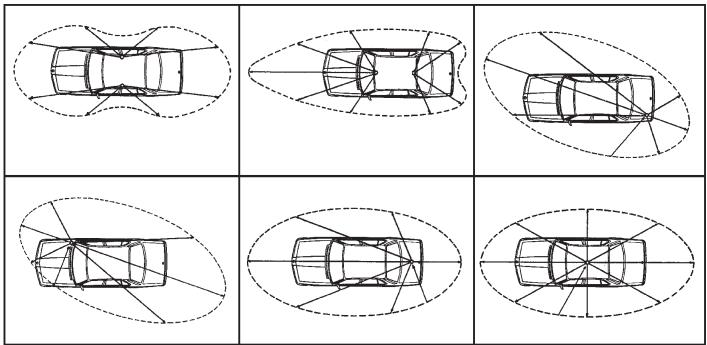
OUTPUT RADIUS PATTERNS
(you should seek professional advice). All PRESIDENTant antennas and accessories are designed to give maximum efficiency to each CB radio within the range.
3) POWER CONNECTION
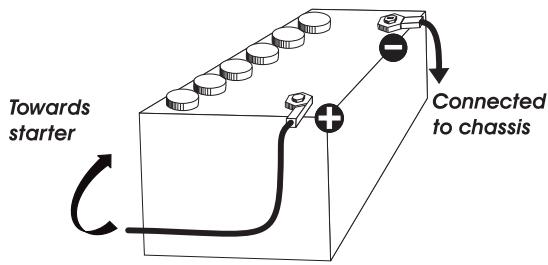
Your PRESIDENT TAYLOR II Classic is protected against an inversion of polarities. However, before switching it on, you are advised to check all the connections. Your equipment must be supplied with a continued current of 12 volts (A). Today, most cars and lorries are negative earth. You can check this by making sure that the negative terminal of the battery is connected either to the engine block or to the chassis. If this is not the case, you should consult your dealer.
WARNING: Lorries generally have two batteries and an electrical installation of 24 volts, in which case it will be necessary to insert a 24/12 volt converter (type CV 24/12 PRESIDENT) into the electrical circuit. The following connection steps should be carried out with the power cable disconnected from the set.
a) Check that the battery is of 12 volts.
b) Locate the positive and negative terminals of the battery (+ is red and - is black). Should it be necessary to lengthen the power cable, you should use the same or a superior type of cable.
c) It is necessary to connect your CB to a permanent (+) and (-). We advise you to connect the power cable directly to the battery (as the connection of the CB cable to the wiring of the car-radio or other parts of the electrical circuit may, in some cases, increase the likelihood of interference).
d) Connect the red wire (+) to the positive terminal of the battery and the black (-) wire to the negative terminal of the battery.
e) Connect the power cable to your CB radio.
WARNING: Never replace the original fuse (2 A) by one of a different value.
4) BASIC OPERATIONS TO BE CARRIED OUT BEFORE USING YOUR SET FOR THE FIRST TIME (without transmitting and without using the “push-to-talk” switch on the microphone)
a) Connect the microphone
b) Check the antenna connections
c) Turn the set on by turning the knob VOLUME clockwise.
d) Turn the SQUELCH knob to minimum (anti-clockwise). Adjust the volume to a comfortable level.
e) Go to Channel 20 using the rotary knob on the front panel.
5) ADJUSTMENT OF SWR (Standing wave ratio)
WARNING: This must be carried out when you use your CB radio for the first time (and whenever you re-position your antenna). The adjustment must be carried out in an obstacle-free area.
- Using an external SWR meter (e.g. SWR 1 or SWR 2)
a) To connect the SWR meter :
- Connect the SWR meter between the CB radio and the antenna as close as possible to the CB (use a maximum of 40~cm cable, type President CA 2C).
b) To adjust the SWR meter:
- Set the CB to channel 20.
- Put the switch on the SWR meter to position CAL or FWD.
- Press the «push-to-talk» switch on the microphone to transmit.
- Bring the index needle to by using the calibration key.
- Change the switch to position SWR (reading of the SWR level). The reading on the V.U. meter should be as near as possible to 1. If this is not the case, re-adjust your antenna to obtain a reading as close as possible to 1. (An SWR reading between 1 and 1.8 is acceptable).
- It will be necessary to re-calibrate the SWR meter after each adjustment of the antenna.
WARNING: In order to avoid any losses and attenuations in cables used for connection between the radio and its accessories, PRESIDENT recommends to use a cable with a length inferior to 3m .
Your CB is now ready for use.
a) To turn the set on, turn the knob (1) clockwise
b) To increase the sound level, turn the same knob further clockwise.
2) SQUEELCH
Suppresses undesirable background noises when there are no communication. Squelch does not effect neither sound nor transmission power, but allows a considerable improvement in listening comfort.
Turn the squelch knob clockwise to the exact point where all back-ground noise disappears. This adjustment should be done with precision as, if set to maximum, (i.e. fully clockwise) only the strongest signals will be received.
3) CHANNEL SELECTOR ROTARY KNOB
Turning this knob allows you to choose a channel (1-40) for transmitting and receiving. A beep is heard every time the channel is changed.
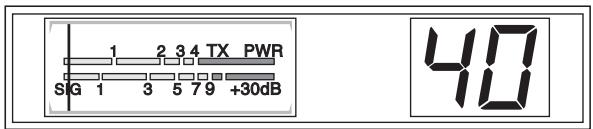
4) DISPLAY
The display shows all the different functions. The S-METER shows the level of reception and the level of power emitted.
5) MODE
Use this key to select AM or FM. The modulation mode must correspond with that of the person with whom you communicate.
A/ Amplitude Modulation (AM) is for communications in areas where there are obstacles and over medium distances.
B/ Frequency Modulation (FM) is for nearby communications in flat, open areas. It gives better quality of communication (squelch adjustment needs more finesse).
6) 6-PIN MICROPHONE PLUG
This plug is situated on the front panel, thereby making it easier to set the equipment into the dashboard. See the cabling diagram on page 41.
7) PTT (push to talk)
Depress this knob to transmit a message and release to listen to an incoming communication.
The frequency bands have to be chosen according to the country of use. Don't use any other configuration. Some countries need a user's licence. See the configurations/ frequency bands table at pages 39 ~ 42.
Proceeding
a) Switch off the CB radio.
b) Press and hold the PTT button of the microphone and then switch on CB radio. The letter corresponding to configuration is blinking.
c) To choose the configuration turn the channel selector rotary knob.
d) Press the PTT button of the microphone one second, until the letter corresponding to configuration stop blinking, to confirm the configuration.
e) Switch the CB radio off in order to save. See table on page 42.
A) DC-POWER TERMINAL (13.2 V)
B) ANTENNA CONNECTOR (SO-239)
C) EXTERNAL SPEAKER JACK (8 Ω, Φ 3.5 mm)
C) TECHNICAL CHARACTERISTICS
1) GENERAL
- Channels
- Modulation modes
Frequency ranges - Antenna impedance
- Power supply
- Dimensions (in mm)
Weight - Accessories supplied
2) TRANSMISSION
- Frequency allowance
- Carrier power
- Transmission interference
- Audio response
- Emitted power in the adj. channel
- Microphone sensitivity
-Drain - Modulated signal distortion
3) RECEPTION
- Maxi. sensitivity at 20 dB sinad
Frequency response - Adjacent channel selectivity
Maximum audio power -
Squelch sensitivity
-
Frequency image rejection rate
- Intermediate frequency rej. rate
-Drain
:40
AM/FM
: from 26.965 MHz to 27.405 MHz
: 50 ohms
: 13.2 V
: 150 (L) x 165 (H) x 45 (D)
: 1.2 kg
: Microphone with support, mountingcradle, screws
:+/-300Hz
: 1 W AM / 4 W FM
: inferior to 4 nW (-54 dBm)
: 300 Hz to 3 kHz in AM/FM
: inferior to 20~ W
: 1.0mV
1.7 A (with modulation)
1.8%
: 0.5 V - 113 dBm (AM/FM)
: 300 Hz to 3 kHz in AM/FM
: 60 dB
:5W
: minimum 0.2 μV - 120 dBmmaximum 1 mV - 47 dBm
: 60 dB
:70dB
: 500 mA nominal800 mA maximum
D) TROUBLE SHOOTING
1) YOUR CB RADIO WILL NOT TRANSMIT OR YOUR TRANSMISSION IS OF POOR QUALITY:
- Check that the antenna is correctly connected and that the SWR is properly adjusted.
- Check that the microphone is properly plugged in.
- Check that the programmed configuration is the correct one (see table p. 42).
2) YOUR CB RADIO WILL NOT RECEIVE OR RECEPTION IS POOR:
- Check that the squelch level is properly adjusted.
- Check that the volume is set to a comfortable listening level.
- Check that the microphone is properly plugged in.
- Check that the antenna is correctly connected and that the SWR is properly adjusted.
- Check that you are using the same modulation mode as your correspondent.
- Check that the programmed configuration is the correct one (see table p. 42).
3) YOUR CB WILL NOT LIGHT UP
- Check the power supply.
- Check the connection wiring.
- Check the fuse.
E) HOW TO TRANSMIT OR RECEIVE AMESSAGE
Now that you have read the manual, make sure that your CB Radio is ready for use (i.e. check that your antenna is connected).
Choose your channel (19, 27).
Choose your mode (AM/FM) which must be the same as that of your correspondent.
Press the "push-to-talk" switch and announce your message "Attention stations, transmission testing" which will allow you to check the clearness and the power of your signal. Release the switch and wait for a reply. You should receive a reply like, "Strong and clear".
If you use a calling channel (19, 27) and you have established communication with someone, it is common practice to choose another available channel so as not to block the calling channel.
F) GLOSSARY
Below you will find some of the most frequently used CB radio expressions. Remember this is meant for fun and that you are by no means obliged to use them. In an emergency, you should be as clear as possible.
INTERNATIONAL PHONETIC ALPHABET
| A | Alpha | H | Hotel | O | Oscar | V | Victor |
| B | Bravo | I | India | P | Papa | W | Whiskey |
| C | Charlie | J | Juliett | Q | Quebec | X | X-ray |
| D | Delta | K | Kilo | R | Romeo | Y | Yankee |
| E | Echo | L | Lima | S | Sierra | Z | Zulu |
| F | Foxtrott | M | Mike | T | Tango | ||
| G | Golf | N | November | U | Uniform |
TECHNICAL VOCABULARY
| DW | : Dual Watch |
| FM | : Frequency Modulation |
| GMT | : Greenwich Meantime |
| HF | : High Frequency |
| LF | : Low Frequency |
| LSB | : Lower Side Band |
| RX | : Receiver |
| SSB | : Single Side Band |
| SWR | : Standing Wave Ratio |
| SWL | : Short Wave Listening |
| SW | : Short Wave |
| TX | : CB Transceiver |
| UHF | : Ultra High Frequency |
| USB | : Upper Side Band |
| VHF | : Very High Frequency |
CB LANGUAGE
| Advertising | : | Flashing lights of police car |
| Back off | : | Slow down |
| Basement | : | Channel 1 |
| Base station | : | A CB set in fixed location |
| Bear | : | Policeman |
| Bear bite | : | Speeding fine |
Bear cage
Big slab
Big 10-4
Bleeding
Blocking the channel
Blue boys
Break
Breaker
Clean and green
Cleaner channel
Coming in loud and proud
Doughnut
Down and gone
Down one
Do you copy?
DX
Eighty eights
Eye ball
Good buddy
Hammer
Handle
Harvey wall banger
How am I hitting you?
Keying the mike
Kojac with a kodak
Land line
Lunch box
Man with a gun
Mayday
Meat wagon
Midnight shopper
Modulation
Negative copy
Over your shoulder
Part your hair
Pull your hammer back
Rat race
Rubberbander
Sail boat fuel
Smokey dozing
Smokey with a camera
Spaghetti bowl
Stinger
Turkey
Police station
Motorway
Absolutely
Signal from an adjacent channel
interfering with the transmission
Pressing the PTT switch without talking
Police
Used to ask permission to join a conversation
A CBer wishing to join a channel
Clear of police
Channel with less interference
Good reception
Tyre
Turning CB off
Go to a lower channel
Understand?
Long distance
Love and kisses
CBers meeting together
Fellow CBer
Accelerator
CBer's nickname
Dangerous driver
How are you receiving me?
Pressing the PTT switch without talking
Police radar
Telephone
CB set
Police radar
SOS
Ambulance
Thief
Conversation
No reply
Right behind you
Behave yourself - police ahead
Slow down
Congested traffic
New CBer
Wind
Parked police car
Police radar
Interchange
Antenna
Dumb CBER
Up one
Wall to wall
What am I putting to you?
Go up one channel
All over/everywhere
Please give me an S-meter reading.
CERTIFICATE OF CONFORMITY
We, GROUPE PRESIDENT ELECTRONICS, Route de Sète, BP 100-34540 Balaruc - FRANCE,
Declare, on our own responsibility that the CB radio-communication transceiver
Brand: PRESIDENT
Model: TAYLOR II
Manufactured in PRC
is in conformity with the essential requirements of the Directive 1999/5/CE (Article 3) adapted to the national law, as well as with the following European Standards:
EN 300 135-2:v1.1.1 (2000)
EN 300 433-2 :v1.1.2 (2000)
EN 301 489-13 v 1.2.1 (2002)
EN 60215 (1996)
Balaruc, the 2004-06-14
Jean-Gilbert MULLER
General Manager
ACHTUNG!
FREQUENCY TABLE for d
Countries in which there are particular restrictions
Countries in which the national regulations authorize a transmission power superior to the limit fixed by the harmonised standard, notified in the 4th paragraph of the preface of the proper harmonised standard EN 300 433.
| IT | ES | PL | |
| 4W AM | ✓ | ✓ | ✓ |
| 12 W pep BLU / SSB | ✓ | ✓ | ✓ |
2018年5月3日
0606/08-04

C∈0341

Groupe PRESIDENT ELECTRONICS
SIEGE SOCIAL/HEAD OFFICE - FRANCE
Route de Sète - BP 100 - 34540 BALARUC
Site Internet : http://www.president-electronics.com
E-mail : groupe@president-electronics.com
UTZZ01369EZ(0)