
CS 1400 - Power amplifier PEAVEY - Free user manual and instructions
Find the device manual for free CS 1400 PEAVEY in PDF.


| Product Type | Professional Power Amplifier |
| Brand | Peavey |
| Model | CS 1400 |
| Output Power (Bridge 4 Ω) | 1400 W @ 1 kHz, <0.1% THD |
| Output Power (2 channels, 2 Ω) | 700 W per channel @ 1 kHz, <0.1% THD |
| Output Power (2 channels, 4 Ω) | 500 W per channel @ 1 kHz, <0.1% THD |
| Output Power (2 channels, 8 Ω) | 330 W per channel @ 1 kHz, <0.1% THD |
| Minimum Impedance | 2 Ω per channel |
| Frequency Response | 10 Hz – 25 kHz (+0 / -1 dB @ 1 W) |
| Total Harmonic Distortion (THD) | <0.20% @ 560 W per channel (20 Hz – 20 kHz, 2 Ω) |
| Damping Factor (8 Ω) | >400:1 (20 Hz – 400 Hz) |
| Input Sensitivity | 0.910 V (2 Ω), 1.13 V (4 Ω), 1.26 V (8 Ω) |
| Input Impedance | 20 kΩ balanced |
| Voltage Gain | ×40 (32 dB) |
| Noise (A-weighted, ref. 4 Ω) | > -107 dB |
| Power Consumption (1/8 power) | 745 W (2 Ω), 505 W (4 Ω), 325 W (8 Ω) |
| Power Consumption (1/3 power) | 1930 W (2 Ω), 1235 W (4 Ω), 815 W (8 Ω) |
| Cooling | 2 variable speed 80 mm fans |
| Controls | 2 front gain attenuators, mode selector (Stereo/Parallel/Bridge), rear DDT™ switch |
| LED Indicators | 2 × PWR, 2 × SIG, 2 × DDT™ (per channel) |
| Protections | Thermal, DC, on/off mute, subsonic, incorrect load, short circuit, DDT™ (anti-clip) |
| Input Connectors | Combo XLR / 6.35 mm jack balanced |
| Output Connectors | Binding posts (banana, bare wire) and Speakon® |
| Power Supply | 120 V~ / 60 Hz (North America); 230-240 V~ / 50-60 Hz (Europe, Asia, Australia) |
| Dimensions (W × D × H) | 482.6 × 408.1 × 88.9 mm (19" × 16.07" × 3.5") incl. handles and supports |
| Net Weight | 14.83 kg (32.7 lbs) |
| Gross Weight | 16.46 kg (36.3 lbs) |
| Construction | 16 ga steel chassis, aluminum front panel and grille |
| Cleaning | Use a dry cloth; do not expose to water or liquids |
| Maintenance | No internal maintenance required; refer repairs to qualified technician |
| Warranty | Contact Peavey customer service (USA: +1 601-483-5365) |
Frequently Asked Questions - CS 1400 PEAVEY
User questions about CS 1400 PEAVEY
0 question about this device. Answer the ones you know or ask your own.
Ask a new question about this device
Download the instructions for your Power amplifier in PDF format for free! Find your manual CS 1400 - PEAVEY and take your electronic device back in hand. On this page are published all the documents necessary for the use of your device. CS 1400 by PEAVEY.
USER MANUAL CS 1400 PEAVEY
Intended to alert the user to the presence of uninsulated "dangerous voltage" within the product's enclosure that may be of sufficient magnitude to constitute a risk of electric shock to persons.

Intended to alert the user of the presence of important operating and maintenance (servicing) instructions in the literature accompanying the product.
CAUTION: Risk of electrical shock — DO NOT OPEN!
CAUTION: To reduce the risk of electric shock, do not remove cover. No user serviceable parts inside. Refer servicing to qualified service personnel.
WARNING: To prevent electrical shock or fire hazard, this apparatus should not be exposed to rain or moisture, and objects filled with liquids, such as vases, should not be placed on this apparatus. Before using this apparatus, read the operating guide for further warnings.

WARNING: When using electrical products, basic cautions should always be followed, including the following:
C E
- Read these instructions.
- Keep these instructions.
- Heed all warnings.
- Follow all instructions.
- Do not use this apparatus near water.
- Clean only with a dry cloth.
- Do not block any of the ventilation openings. Install in accordance with manufacturer's instructions.
- Do not install near any heat sources such as radiators, heat registers, stoves or other apparatus (including amplifiers) that produce heat.
- Do not defeat the safety purpose of the polarized or grounding-type plug. A polarized plug has two blades with one wider than the other. A grounding type plug has two blades and a third grounding plug. The wide blade or third prong is provided for your safety. If the provided plug does not fit into your outlet, consult an electrician for replacement of the obsolete outlet.
- Protect the power cord from being walked on or pinched, particularly at plugs, convenience receptacles, and the point they exit from the apparatus.
- Only use attachments/accessories provided by the manufacturer.
- Use only with a cart, stand, tripod, bracket, or table specified by the manufacturer, or sold with the apparatus. When a cart is used, use caution when moving the cart/apparatus combination to avoid injury from tip-over.
- Unplug this apparatus during lightning storms or when unused for long periods of time.
- Refer all servicing to qualified service personnel. Servicing is required when the apparatus has been damaged in any way, such as power-supply cord or plug is damaged, liquid has been spilled or objects have fallen into the apparatus, the apparatus has been exposed to rain or moisture, does not operate normally, or has been dropped.
- Never break off the ground pin. Write for our free booklet "Shock Hazard and Grounding." Connect only to a power supply of the type marked on the unit adjacent to the power supply cord.
- If this product is to be mounted in an equipment rack, rear support should be provided.
- Note for UK only: If the colors of the wires in the mains lead of this unit do not correspond with the terminals in your plug, proceed as follows:
a) The wire that is colored green and yellow must be connected to the terminal that is marked by the letter E, the earth symbol, colored green or colored green and yellow.
b) The wire that is colored blue must be connected to the terminal that is marked with the letter N or the color black.
c) The wire that is colored brown must be connected to the terminal that is marked with the letter L or the color red.
- This electrical apparatus should not be exposed to dripping or splashing and care should be taken not to place objects containing liquids, such as vases, upon the apparatus.
- Exposure to extremely high noise levels may cause a permanent hearing loss. Individuals vary considerably in susceptibility to noise-induced hearing loss, but nearly everyone will lose some hearing if exposed to sufficiently intense noise for a sufficient time. The U.S. Government's Occupational Safety and Health Administration (OSHA) has specified the following permissible noise level exposures:
| Duration Per Day In Hours | Sound Level dBA, Slow Response |
| 8 | 90 |
| 6 | 92 |
| 4 | 95 |
| 3 | 97 |
| 2 | 100 |
| 1 1/2 | 102 |
| 1 | 105 |
| 1/2 | 110 |
| 1/4 or less | 115 |
According to OSHA, any exposure in excess of the above permissible limits could result in some hearing loss. Ear plugs or protectors to the ear canals or over the ears must be worn when operating this amplification system in order to prevent a permanent hearing loss, if exposure is in excess of the limits as set forth above. To ensure against potentially dangerous exposure to high sound pressure levels, it is recommended that all persons exposed to equipment capable of producing high sound pressure levels such as this amplification system be protected by hearing protectors while this unit is in operation.
SAVE THESE INSTRUCTIONS!
Congratulations on your purchase of a Peavey CS Series power amplifier! Designed for years of reliable operation, CS Series amplifiers offer the sonic superiority and unsurpassed reliability for which Peavey is famous in a rugged, compact unit. Advanced technologies and extensive protection circuitry allow operation with greater efficiency, even under difficult loads and power conditions. The exclusive DDT™ (Distortion Detection Technique) circuit ensures trouble-free operation into loads as low as 2 ohms, protects speakers and ensures sonic integrity even in extreme overload conditions. Peavey's high-efficiency design uses tunnel-cooled heat sinks and dual-speed DC fans for consistent lower overall operating temperature, resulting in longer output transistor life.
Peavey CS Series amplifiers are simple to operate and housed in ultra-strong steel chassis, but improper use can be dangerous. Some CS Series amplifiers are very high powered and can put out high voltages and sizable currents at frequencies up to 30 kHz. Always use safe operating techniques with these amplifiers.

FOR YOUR SAFETY, READ THE IMPORTANT PRECAUTIONS SECTION, AS WELL AS INPUT, OUTPUT AND POWER CONNECTION SECTIONS.
Unpacking
Upon unpacking, inspect the amplifier. If you find any damage, notify your supplier immediately. Only the consignee (the supplier from whom you purchased the amplifier) may institute a claim with the carrier for damage incurred during shipping. Be sure to save the carton and all packing materials. Should you ever need to ship the unit back to Peavey or one of its offices, service centers or the supplier, use only the original factory packing. If the shipping carton is unavailable, contact Peavey to obtain a replacement.
Mounting
CS Series amplifiers will mount in standard 19" racks. Rear mounting ears are also provided for additional support, which is recommended in non-permanent installations like mobile or touring sound systems. Because of the cables and connectors on the rear panel, a right angle or offset screwdriver or hex key will make it easier to fasten the rear mounting ears to the rails.

Cooling Requirements
CS Series amplifiers use a forced-air cooling system to maintain a low, consistent operating temperature. Air is drawn into the amplifier by fans on the back panel and courses through the cooling fins of the tunnel-configured channel heat sinks, then exhausts through the front panel grilles. If either heat sink gets too hot, a sensing circuit will mute the signal for that particular channel. It is important to have an air inlet at the back of the amplifier to allow cooling air to enter. If the amp is rack mounted, do not use doors or covers on the back of the rack, as the intake air must flow without resistance. Make sure that there is one (1) standard rack space opening for every three mounted power amplifiers.
Introduction
Operating Precautions

Make sure the mains voltage is correct and the same as that printed on the rear of the amplifier. Damage caused by connecting the amplifier to improper AC voltage is not covered by any CS® Series warranty. See the Connecting Power section for more information on voltage requirements.

Note: Always turn off and disconnect the amplifier from mains voltage before making audio connections. Also, as an extra precaution, have the attenuators turned down during power-up.
Before powering up, turn the attenuator controls down to prevent speaker damage if there is a high signal level at the inputs. Always use high-quality input and speaker cables to ensure trouble-free operation. Most intermittent problems are caused by faulty cables.
Consult the Wire Gauge Charts (page 9) to determine proper gauges for differing load impedances and cable lengths. Remember that cable resistance robs amplifier power in two ways: power lost directly to resistance (I^2R loss) and by lowering the total load impedance. Also make sure the mode switch is correctly set for the desired application. See sections on Stereo, Parallel and Bridged Mono Operation for more information.
Connecting Inputs
Input connections are made via the three-pin XLR (pin 2+) or 6.3mm plug "combi" connectors on the rear panel of the amplifier. The inputs are actively balanced and the overload point is high enough to accept the maximum output level of virtually any signal source.
Connecting Outputs
All models have two output (speaker) connections per channel. Cables can be connected with banana plugs, spade lugs, or bare wire to the five-way binding posts. The preferred connection method is via the Speakon® connectors. Pin connections are noted on the rear panel.
Connecting Power

CS Series amplifier power requirements are rated at 1/8 power (typical music conditions) and 1/3 power (extreme music conditions). The maximum power current draw rating is limited only by the front panel circuit breaker. Consult the specifications in the Appendices section for figures on the current that each amplifier will demand. Unless otherwise specified when ordered, Peavey amplifiers shipped to customers are configured as follows:
North America - 120VAC/60Hz
Europe, Asia, Australia - 230/240VAC/60-50Hz
South America - 120VAC/60Hz or 240VAC/50Hz

Note: Always turn off and disconnect the amplifier from mains voltage before making audio connections. As an extra precaution, have the attenuators turned down while powering up.
Wire Guage Charts
| Stranded Cable Lgth. (ft.) | Wire Gauge (AWG) | Power Loss (8 ohm load) | Power Loss (4 ohm load) | Power Loss (2 ohm load) |
| 5 | 18 | 0.81% | 1.61% | 3.2% |
| 16 | 0.51 | 1.02 | 2.0 | |
| 14 | 0.32 | 0.64 | 1.28 | |
| 12 | 0.20 | 0.40 | 0.80 | |
| 10 | 0.128 | 0.25 | 0.51 | |
| 10 | 18 | 1.61% | 3.2% | 6.2% |
| 16 | 1.02 | 2.0 | 4.0 | |
| 14 | 0.64 | 1.28 | 2.5 | |
| 12 | 0.40 | 0.80 | 1.60 | |
| 10 | 0.25 | 0.51 | 1.01 | |
| 40 | 18 | 6.2% | 11.9% | 22% |
| 16 | 4.0 | 7.7 | 14.6 | |
| 14 | 2.5 | 5.0 | 9.6 | |
| 12 | 1.60 | 3.2 | 6.2 | |
| 10 | 1.01 | 2.0 | 4.0 | |
| 8 | 0.60 | 1.20 | 2.4 | |
| 80 | 18 | 11.9% | 22% | 37% |
| 16 | 7.7 | 14.6 | 26 | |
| 14 | 5.0 | 9.6 | 17.8 | |
| 12 | 3.2 | 6.2 | 11.8 | |
| 10 | 2.0 | 4.0 | 7.7 | |
| 8 | 1.20 | 2.4 | 4.7 | |
| Stranded Cable Lgth. (m) | Wire Gauge (mm²) | Power Loss (8 ohm load) | Power Loss (4 ohm load) | Power Loss (2 ohm load) |
| 2 | 0.3 | 2.9% | 5.6% | 10.8% |
| 0.5 | 1.74 | 3.4 | 6.7 | |
| 0.75 | 1.16 | 2.3 | 4.5 | |
| 1.5 | 0.58 | 1.16 | 2.3 | |
| 2.5 | 0.35 | 0.70 | 1.39 | |
| 4 | 0.22 | 0.44 | 0.87 | |
| 5 | 0.5 | 4.3% | 8.2% | 15.5% |
| 0.75 | 2.9 | 5.6 | 10.8 | |
| 1.5 | 1.45 | 2.9 | 5.6 | |
| 2.5 | 0.87 | 1.74 | 3.4 | |
| 4 | 0.55 | 1.09 | 2.2 | |
| 6 | 0.37 | 0.73 | 1.45 | |
| 10 | 0.5 | 8.24% | 15.5% | 28% |
| 0.75 | 5.6 | 10.8 | 19.9 | |
| 1.5 | 2.9 | 5.6 | 10.8 | |
| 2.5 | 1.74 | 2.9 | 6.7 | |
| 4 | 1.09 | 1.74 | 4.3 | |
| 6 | 0.73 | 1.09 | 2.9 | |
| 30 | 0.75 | 15.5% | 25% | 45% |
| 1.5 | 8.2 | 15.5 | 28 | |
| 2.5 | 5.1 | 9.8 | 18.2 | |
| 4 | 3.2 | 6.3 | 12.0 | |
| 6 | 2.2 | 4.3 | 8.2 | |
| 10 | 1.31 | 2.6 | 5.1 |
Operation Modes
Stereo Operation
For stereo (dual channel) operation, turn the amplifier OFF and set the mode select switches on the back panel to the out (extended) position. In this mode, both channels operate independently of each other, with their input attenuators controlling their respective levels. Thus, a signal at channel A's input produces an amplified signal at channel A's output, while a signal at channel B's input produces an amplified signal at channel B's output.
Bridged Mono Operation
Both amplifier channels can be bridged together to make a very powerful single-channel monaural amplifier. Use extreme caution when operating in the bridged mode; potentially lethal voltage may be present at the output terminals. To bridge the amplifier, depress the rear panel Bridge switch to the IN position. Direct the signal to channel A's input and connect the speakers across the hot outputs (the “+” binding posts) of channels A and B. Only channel A's input attenuator is active while in Bridge Mono mode.
Unlike the stereo mode, in which one side of each output is at ground, both sides are hot in bridged mode. Channel A's side is the same polarity as its input with the minimum nominal load impedance being 4 ohms (equivalent to driving both channels at 2 ohms) in bridged mode. Driving bridged loads of less than 4 ohms will activate the DDT™ circuitry (see Indicators section), resulting in a loss of power, and may also cause a thermal (overheating) overload.
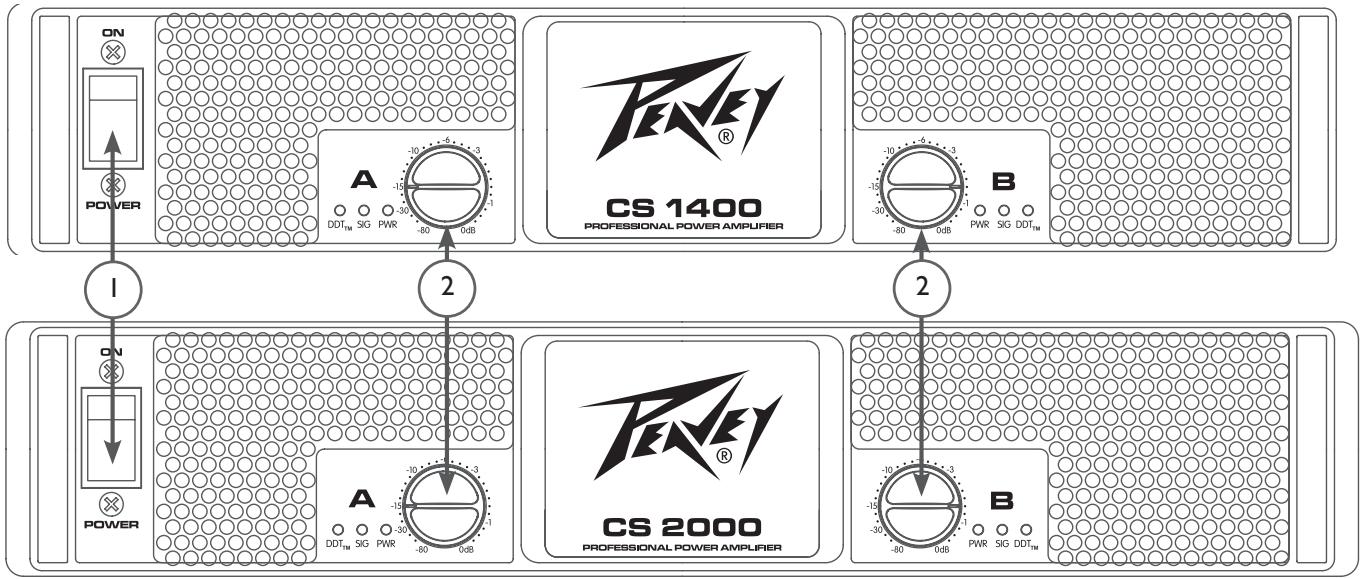
Front Panel
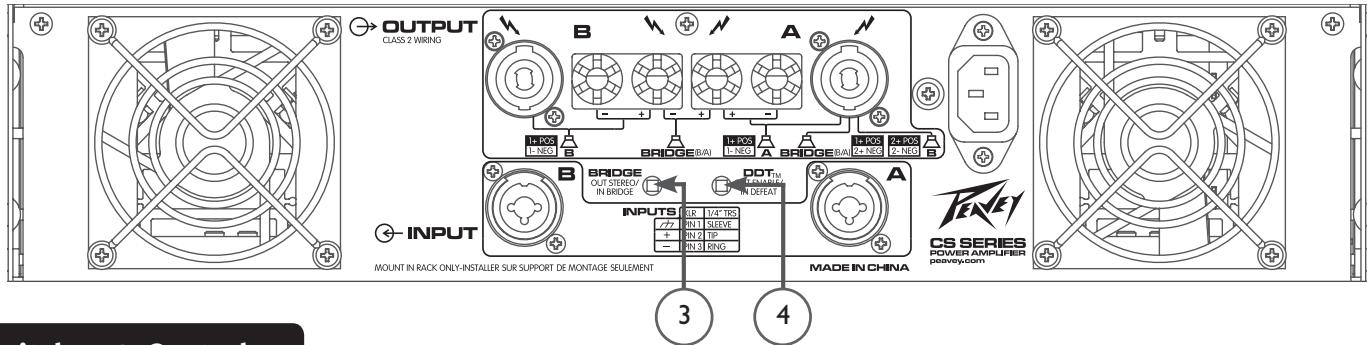
Rear Panel
Switches & Controls
AC Power Switch/Circuit Breaker (1)
The CS® Series amplifiers feature a combination AC switch/circuit breaker on the front panel. If the switch shuts off during normal use, push it back to the ON position once. If the switch will not stay in the ON position, the amplifier needs servicing.
Input Attenuators (2)
Whenever possible, set the attenuators fully clockwise to maintain optimum system headroom. The input attenuator controls (one for channel A, one for channel B) located on the front panel attenuate signal level (decrease gain) for the respective amplifier channels in all modes. See the specifications at the end of this manual for standard voltage gain and input sensitivity information.
Bridge Select Switch (3)
The rear panel Bridge Select switch determines if the amplifier is in stereo (two channels) or in Bridged Mono mode. Do not operate the Bridge Select switch with the amplifier powered on. See the sections on Stereo and Bridged Mono mode for more information.
DDT^TM Defeat Switch (4)
For normal operation, the DDT circuit should remain operational by leaving the DDT Defeat Switch in the extended position. This will prevent excessive distortion and potential speaker damage.
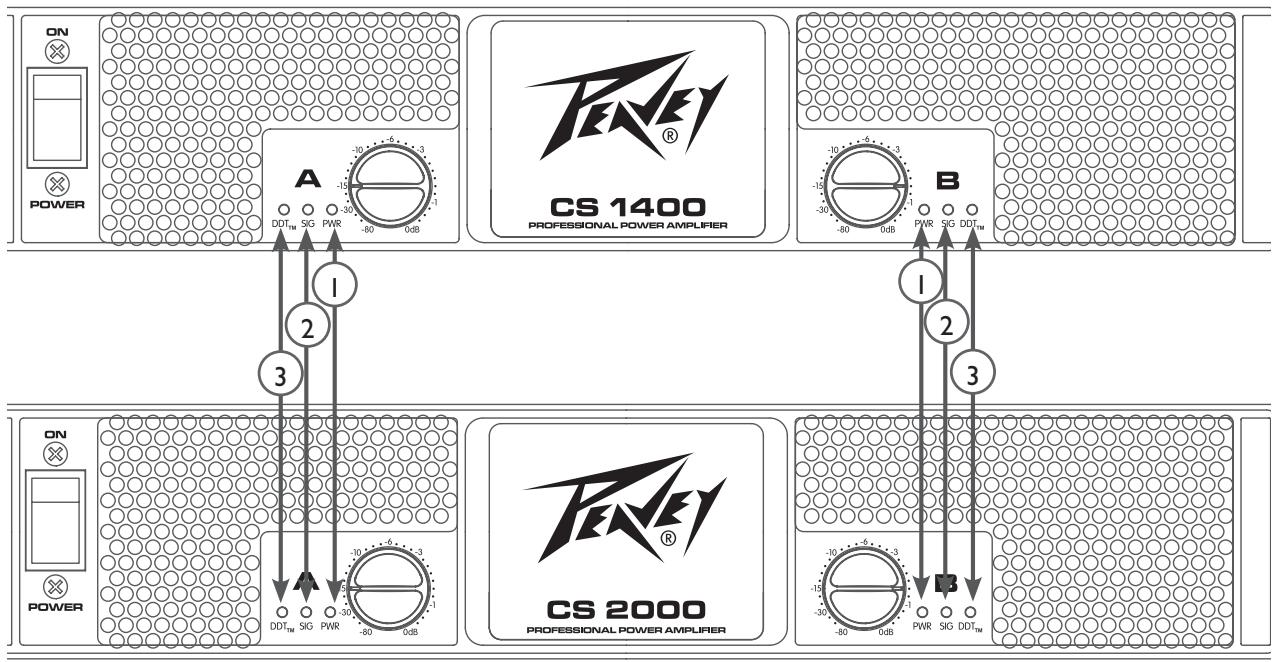
Indicators
CS® Series amplifiers feature three front panel LED indicators per channel: PWR (power), SIG (signal) and DDT™ (Distortion Detection Technique). These LED indicators inform the user of each channel's operating status and warn of possible abnormal conditions.
PWR LED (1)
The Power LED indicates that the channel is operational. It illuminates under normal operation and remains on even when the channel's DDT circuit is activated.
SIGLED(2)
The Signal LED illuminates when its channel produces an output signal of greater than 1 volt RMS or 25mV input with a O dB attenuation of the front panel knobs. This is useful in determining whether a signal is reaching and being amplified by the amplifier. If the Signal LED is illuminated but no sound is present, that means a signal is present at the amplifier but a problem may exist after the amplifier, such as in the cables or speakers.
DDT LED (3)
A channel's DDT LED will illuminate at the onset of clipping. If the LEDs are flashing quickly and intermittently, the channel is just at the clip threshold, while a steady, bright glow means the amp is clip limiting, or reducing gain to prevent severely clipped waveforms from reaching the speakers. See Distortion Detection Technique Limiting under the Protection Features section for more information.
Protection Features
The Peavey CS Series incorporates several circuits to protect the amplifier and speakers under virtually any situation. Peavey has made the amplifiers as foolproof as possible by making them immune to short and open circuits, mismatched loads, DC voltage and overheating. If a channel goes into the DDT™ gain reduction mode, the DDT LED illuminates. The clipping percentage or output power is instantly reduced. When a problem occurs that causes a channel to go into a protection mode, the PWR (Power) LED for that channel will turn off. DC voltage on the output or excessive subsonic frequencies will cause the triac crowbar circuit to activate to protect the speakers. If the amplifier overheats, the signal will be removed from the channel that is at fault until the amplifier cools down, thus protecting the amplifier.
Distortion Detection Technique (DDT) Limiting
Any time a channel is driven into hard, continuous clipping, the DDT circuit will automatically reduce the channel gain to a level just slightly into clipping, guarding the speakers against the damaging, high-power, continuous square waves that may be produced. Situations that may activate the DDT circuit include uncontrolled feedback, oscillations, an improper equipment setting or malfunction upstream from the amplifier. Normal program transients will not trigger DDT; only steady, excessive clipping will cause the DDT LED to illuminate.
LFC Impedance Sensing
CS Series amplifiers feature innovative circuitry for safe operation into any load. When an amplifier senses a load that overstresses the output stage, the Load Fault Correction circuit adjusts the channel gain to a safe level. Extreme load fault under high power levels will cause the signal to be muted for the associated channel. This method of output-stage protection is far more effective than the standard limiting found on conventional power amplifiers. The LFC circuit is sonically transparent in normal use and unobtrusive when activated.
Thermal Protection
The internal fans will keep the amplifier operating well within its intended temperature range under all normal conditions. If a channel's heat sink temperature reaches 85^ C (which may indicate an obstructed air supply), that channel will independently protect itself by muting its input signal and shut down until it has cooled. During this time, the PWR LED will go out and the cooling fans will continue operating at high speed.
Short Circuit
If an output is shorted, the LFC and thermal circuits will automatically protect the amplifier. The LFC circuit senses the short circuit as an extremely stressful load condition and attenuates the signal, protecting the channel's output transistors from over-current stress. If the short circuit remains, the channel will eventually thermally protect itself by muting the input signal.
DC Voltage Protection
If an amplifier channel detects DC voltage or subsonic frequencies at its output terminals, the output triac crowbar circuitry will activate immediately to prevent speaker damage.
Turn-On/Turn-Off Protection
Upon powering up, the amplifier stays in Protect mode, muting the input signal for approximately four seconds while the power supplies charge and stabilize. Also, when power is removed, the input signals are muted so that no thumps or pops are heard.
Speaker Protection
All loudspeakers have electrical, thermal and physical limits that must be observed to prevent damage or failure. Excessive power, low frequencies applied to high frequency drivers, severely clipped waveforms and DC voltage can all be fatal to cone and compression drivers. Peavey CS® Series amplifiers automatically protect speakers from DC voltages and subsonic signals. If using an electronic crossover, be extremely careful that the low and mid bands are connected to the correct amplifiers and drivers and not to those designed for a higher frequency band. An amplifier's clipping point is its maximum peak output power, and some of the higher powered Peavey CS Series amplifiers can deliver more power than many speakers can safely handle. Be sure the peak power capability of the amplifier is not excessive for your speaker system. For more information, see the section on Protection Features.
Fuses may also be used to limit power to speaker drivers, although as current-limiting rather than voltage-limiting devices, they are an imperfect solution, and as the weakest links, they only limit once before needing replacement. Some poor-quality fuses have a significant series resistance that could degrade the amplifier's damping of the speaker's motion and may even deteriorate the system's sound quality. If you elect to use fuses, check with the speaker manufacturer to determine the proper current rating and time lag required.
Do not drive any low frequency speaker enclosure with frequencies lower than its own tuned frequency; the reduced acoustical damping could cause a ported speaker to bottom out even at moderate power. Consult the speaker system specifications to determine its frequency limits.
Amplifier Maintenance and User Responsibility
A CS Series amplifier requires no routine maintenance and should not need internal adjustment during its lifetime. Your CS Series amplifier is very powerful and can be potentially dangerous to loudspeakers and humans alike. It is your responsibility to read the Important Precautions section and to make sure that the amplifier is installed, wired and operated properly as instructed in this manual. Many loudspeakers can be easily damaged or destroyed by overpowering, especially with the high power available from a bridged amplifier. Read the Speaker Protection section and always be aware of the speaker's continuous and peak power capabilities.
Service / Warranty Information
In the unlikely event that your amplifier develops a problem, it must be returned to an authorized distributor, service center or shipped directly to our factory. To obtain service, contact your nearest Peavey Service Center, Distributor, Dealer, or any of the worldwide Peavey offices. For contact information, reach Peavey Inc. Customer Service directly:
Telephone: 601-483-5365 (USA)
Fax Number: 601-486-1278 (USA)
For technical inquiries only, the Peavey Technical Services department can be faxed at 601-486-1361 (USA)
Because of the complexity of the design and risk of electrical shock, all repairs must be performed only by qualified technical personnel. If the unit needs to be shipped back to the factory, it must be sent in its original carton. It is the responsibility of the person shipping the unit to properly package the amplifier. If you need a product shipping carton, please contact Peavey for a replacement.
Please visit the Peavey website at: http://www.peavey.com.
CS® 1400/2000
Power Amplifiers
SPECIFICATIONS
CS 1400
CS 2000
| Rated Power 4 ohms bridged | 1,400 watts @ 1 kHz <0.1% THD | 2,150 watts @ 1 kHz <0.1% THD |
| Rated Power 2 x 2 ohms | 700 watts per channel @ 1 kHz <0.1% THD both channels driven | 1,075 watts per channel @ 1 kHz <0.1% THD both channels driven |
| Rated Power 2 x 4 ohms | 500 watts per channel @ 1 kHz <0.1% THD both channels driven | 760 watts per channel @ 1 kHz <0.1% THD both channels driven |
| Rated Power 2 x 8 ohms | 330 watts per channel @ 1 kHz <0.1% THD both channels driven | 490 watts per channel @ 1 kHz <0.1% THD both channels driven |
| Rated Power 1 x 2 ohms | 785 watts @ 1 kHz at <0.1% THD | 1,200 watts @ 1 kHz at <0.1% THD |
| Rated Power 1 x 4 ohms | 550 watts @ 1 kHz at <0.1% THD | 830 watts @ 1 kHz at <0.1% THD |
| Rated Power 1 x 8 ohms | 345 watts @ 1 kHz at <0.1% THD | 515 watts @ 1 kHz at <0.1% THD |
| Minimum Load Impedance | 2 ohms | 2 ohms |
| Maximum RMS Voltage Swing | 61 volts | 72 volts |
| Frequency Response | 10 Hz - 25 kHz; +0, -1 dB at 1 watt | 10 Hz - 25 kHz; +0, -1 dB at 1 watt |
| Power Bandwidth | 10 Hz - 35 kHz; +0, -3 dB at rated 2 ohm power | 10 Hz - 35 kHz; +0, -3 dB at rated 2 ohm power |
| T.H.D. 2 x 2 ohms | <0.20% @ 560 W per channel from 20 Hz to 20 kHz | <0.2% @ 800 W per channel from 20 Hz to 20 kHz |
| T.H.D. 2 x 4 ohms | <0.20% @ 425 W per channel from 20 Hz to 20 kHz | <0.2% @ 675 W per channel from 20 Hz to 20 kHz |
| T.H.D. 2 x 8 ohms | <0.15% @ 300 W per channel from 20 Hz to 20 kHz | <0.15% @ 440 W per channel from 20 Hz to 20 kHz |
| SMPTE IMD | <0.1% 60 Hz and 7 kHz, 250 W @ 4 ohms | <0.1% 60 Hz and 7 kHz, 250 W @ 4 ohms |
| Slew Rate | 17 V/uS | 17 V/uS |
| Damping Factor (8 ohms) | >400:1 @ 20 Hz - 400 Hz | >400:1 @ 20 Hz - 400 Hz |
| Input CMRR | >-101 dB @ 1 kHz | >-101 dB @ 1 kHz |
| Voltage Gain | x 40 (32 dB) | x 40 (32 dB) |
| Input Sensitivity | 0.910 V @ 2 ohms, 1.13 V @ 4 ohms, 1.26 V @ 8 ohms | 1.14 V @ 2 ohms, 1.35 V @ 4 ohms, 1.54 V @ 8 ohms |
| Input Impedance | 20k ohms, balanced | 20k ohms, balanced |
| Hum and Noise | >-107 dB, “A” weighted referenced to rated 4 ohm power | >-109 dB, “A” weighted referenced to rated 4 ohm power |
CS® 1400/2000
Power Amplifiers
SPECIFICATIONS
CS 1400
CS 2000
| Crosstalk | > -74 dB, "A" weighted referenced to rated 4 ohm power | > -60 dB, "A" weighted referenced to rated 4 ohm power |
| Current Draw @ 1/8 Power | 745 watts @ 2 ohms, 505 watts @ 4 ohms, 325 watts @ 8 ohms | 1,090 watts @ 2 ohms, 745 watts @ 4 ohms, 445 watts @ 8 ohms |
| Current Draw @ 1/3 Power | 1,930 watts @ 2 ohms, 1,235 watts @ 4 ohms, 815 watts @ 8 ohms | 2,715 watts @ 2 ohms, 1765 watts @ 4 ohms, 1,155 watts @ 8 ohms |
| Cooling | Two 80 mm DC fans, dual speed operation | Two 80 mm DC fans, dual speed operation |
| Controls | 2 front panel attenuators, rear panel mode switch, rear panel DDT™ switch | 2 front panel attenuators, rear panel mode switch, rear panel DDT™ switch |
| Indicator LEDs | 2 DDT/clipping, 2 Status/Power, 2 Signal | 2 DDT/clipping, 2 Status/Power, 2 Signal |
| Protection | Temp, DC, turn-on transients, subsonic, improper load or shorts | Temp, DC, turn-on transients, subsonic, improper load or shorts |
| Connectors | Combi XLR & 6.3 mm input, Speakon® and Binding Post speaker output, IEC mains connector | Combi XLR & 6.3 mm input, Speakon® and Binding Post speaker output, IEC mains connector |
| Construction | 16 ga. steel with cast aluminum front panel and steel grille | 16 ga. steel with cast aluminum front panel and steel grille |
| Dimensions | 88.9 mm x 482.6 mm x 376.3 mm + 31.8 mm for rear support ears and connectors (3.5" x 19" x 14.81" + 1.25") (+1.5" for handle depth) | 88.9 mm x 482.6 mm x 376.3 mm + 31.8 mm for rear support ears and connectors (3.5" x 19" x 14.81" + 1.25") (+ 1.5" for handle depth) |
| Gross Weight | 36.3 lbs. (16.46 kg.) | 41.6 lbs. (18.87 kg.) |
| Net Weight | 32.7 lbs. (14.83 kg.) | 36.3 lbs. (16.46 kg.) |
DEUTSCH
CS® 1400/2000
Endstufen
Bridge Select Switch (3)
Interruptor Selector de Bridge (3)
What This Warranty Covers
Your Peavey Warranty covers defects in material and workmanship in Peavey products purchased and serviced in the U.S.A. and Canada.
What This Warranty Does Not Cover
The Warranty does not cover: (1) damage caused by accident, misuse, abuse, improper installation or operation, rental, product modification or neglect; (2) damage occurring during shipment; (3) damage caused by repair or service performed by persons not authorized by Peavey; (4) products on which the serial number has been altered, defaced or removed; (5) products not purchased from an Authorized Peavey Dealer.
Who This Warranty Protects
This Warranty protects only the original retail purchaser of the product.
How Long This Warranty Lasts
The Warranty begins on the date of purchase by the original retail purchaser. The duration of the Warranty is as follows:
| Product Category | Duration |
| Guitars/Basses, Amplifiers, Pre-Amplifiers, Mixers, Electronic Crossovers and Equalizers | 2 years *(+ 3 years) |
| Drums | 2 years *(+ 1 year) |
| Enclosures | 3 years *(+ 2 years) |
| Digital Effect Devices and Keyboard and MIDI Controllers | 1 year *(+ 1 year) |
| Microphones | 2 years |
| Speaker Components (incl. speakers, baskets, drivers, diaphragm replacement kits and passive crossovers) and all Accessories | 1 year |
| Tubes and Meters | 90 days |
[Denotes additional warranty period applicable if optional Warranty Registration Card is completed and returned to Peavey by original retail purchaser within 90 days of purchase.]
What Peavey Will Do
We will repair or replace (at Peavey's discretion) products covered by warranty at no charge for labor or materials. If the product or component must be shipped to Peavey for warranty service, the consumer must pay initial shipping charges. If the repairs are covered by warranty, Peavey will pay the return shipping charges.
How To Get Warranty Service
(1) Take the defective item and your sales receipt or other proof of date of purchase to your Authorized Peavey Dealer or Authorized Peavey Service Center. OR
(2) Ship the defective item, prepaid, to Peavey Electronics Corporation, International Service Center, 412 Highway 11 & 80 East, Meridian, MS 39301 or Peavey Canada Ltd., 95 Shields Court, Markham, Ontario, Canada L3R 9T5. Include a detailed description of the problem, together with a copy of your sales receipt or other proof of date of purchase as evidence of warranty coverage. Also provide a complete return address.
Limitation of Implied Warranties
ANY IMPLIED WARRANTY, INCLUDING WARRANTY OF MERCHANTABILITY AND FITNESS FOR A PARTICULAR PURPOSE, ARE LIMITED IN DURATION TO THE LENGTH OF THIS WARRANTY.
Some states do not allow limitations on how long an implied warranty lasts, so the above limitation may not apply to you.
Exclusions of Damages
PEAVEY'S LIABILITY FOR ANY DEFECTIVE PRODUCT IS LIMITED TO THE REPAIR OR REPLACEMENT OF THE PRODUCT, AT PEAVEY'S OPTION. IF WE ELECT TO REPLACE THE PRODUCT, THE REPLACEMENT MAY BE A RECONDITIONED UNIT. PEAVEY SHALL NOT BE LIABLE FOR DAMAGES BASED ON INCONVENIENCE, LOSS OF USE, LOST PROFITS, LOST SAVINGS, DAMAGE TO ANY OTHER EQUIPMENT OR OTHER ITEMS AT THE SITE OF USE, OR ANY OTHER DAMAGES WHEHTHER INCIDENTAL, CONSEQUENTIAL OR OTHERWISE, EVEN IF PEAVEY HAS BEEN ADVISED OF THE POSSIBILITY OF SUCH DAMAGES.
Some states do not allow the exclusion or limitation of incidental or consequential damages, so the above limitation or exclusion may not apply to you.
This Warranty gives you specific legal rights, and you may also have other rights which vary from state to state.
If you have any questions about this warranty or service received or if you need assistance in locating an Authorized Service Center, please contact the Peavey International Service Center at (601) 483-5365 / Peavey Canada Ltd. at (905) 475-2578.
FEATURES AND SPECIFICATIONS SUBJECT TO CHANGE WITHOUT NOTICE.

Features and specifications subject to change without notice.
Peavey Electronics Corporation • 711 A Street • Meridian, MS 39301
(601) 483-5365 • FAX (601) 486-1278 • www.peavey.com
EX000016
- SAVE THESE INSTRUCTIONS!
- Unpacking
- Mounting
- Cooling Requirements
- Introduction
- Operating Precautions
- Connecting Inputs
- Connecting Outputs
- Connecting Power
- Operation Modes
- Stereo Operation
- Bridged Mono Operation
- Front Panel
- Rear Panel
- Switches & Controls
- AC Power Switch/Circuit Breaker (1)
- Input Attenuators (2)
- Bridge Select Switch (3)
- DDTTM Defeat Switch (4)
- Indicators
- PWR LED (1)
- SIGLED(2)
- DDT LED (3)
- Protection Features
- Distortion Detection Technique (DDT) Limiting
- LFC Impedance Sensing
- Thermal Protection
- Short Circuit
- DC Voltage Protection
- Turn-On/Turn-Off Protection
- Speaker Protection
- Amplifier Maintenance and User Responsibility
- Service / Warranty Information
- CS® 1400/2000
- Power Amplifiers
- SPECIFICATIONS
- DEUTSCH
- Endstufen
- Interruptor Selector de Bridge (3)
- What This Warranty Covers
- What This Warranty Does Not Cover
- Who This Warranty Protects
- How Long This Warranty Lasts
- What Peavey Will Do
- How To Get Warranty Service
- Limitation of Implied Warranties
- Exclusions of Damages
Brand : PEAVEY
Model : CS 1400
Category : Power amplifier