
CRC400E - Rice cooker CUISINART - Free user manual and instructions
Find the device manual for free CRC400E CUISINART in PDF.

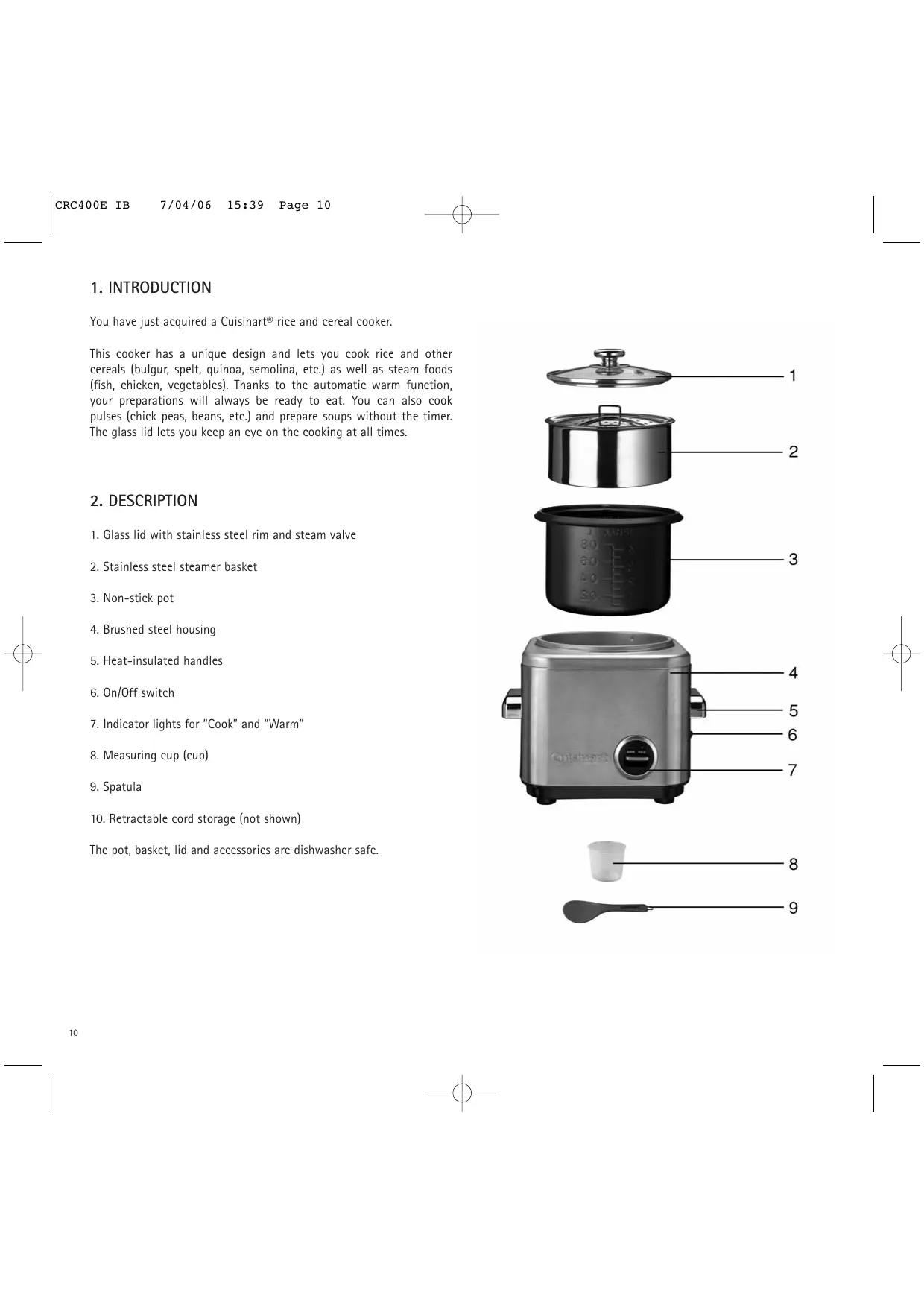


| Product Type | Rice and Grain Cooker |
| Brand | Cuisinart |
| Model | CRC400E |
| Power Supply | 230 V ~ 50 Hz |
| Power | Approximately 450 W |
| Capacity (uncooked rice) | Up to 4 cups (approx. 1.0 L) |
| Body Material | Brushed Steel |
| Lid Material | Glass with stainless steel rim |
| Cooking Bowl Material | Steel with non-stick coating |
| Steamer Basket | Stainless Steel |
| Handles | Insulated |
| Included Accessories | Measuring cup, spatula, steamer basket, retractable power cord |
| Cooking Functions | Automatic rice and grain cooking, manual cooking for dried legumes and soups, steam cooking |
| Automatic Keep Warm | Yes, automatic activation at the end of cooking |
| Automatic Shut-off | Yes, detects complete water absorption |
| Indicator Lights | Cook and Warm |
| Cleaning of bowl, basket, and lid | Dishwasher safe or hot soapy water |
| Body Cleaning | Damp cloth, do not immerse |
| Safety Instructions | Insulated handles, do not immerse, use on stable surface, keep away from children |
| Cord Length | Approximately 1 m (estimation) |
Frequently Asked Questions - CRC400E CUISINART
User questions about CRC400E CUISINART
0 question about this device. Answer the ones you know or ask your own.
Ask a new question about this device
Download the instructions for your Rice cooker in PDF format for free! Find your manual CRC400E - CUISINART and take your electronic device back in hand. On this page are published all the documents necessary for the use of your device. CRC400E by CUISINART.
USER MANUAL CRC400E CUISINART
CRC400E IB 7/04/06 15:39 Page 1
Cuisinart®
A. Assembly 11
B. Operating the appliance - Conversion table for the cup 11
Cooking rice, cereals and pulses 11
Steaming 13
4.Chefs'tipsand hints 14
5. Questions/Answers 14
6. Cleaning and storage 14
7. Safety instructions 15
INHALTSVERZEICHNIS
2. CHARACTERISTIQUES PRODUIT
5. QUESTIONS / REPONSES
You have just acquired a Cuisinart® rice and cereal cooker.
This cooker has a unique design and lets you cook rice and other cereals (bulgur, spelt, quinoa, semolina, etc.) as well as steam foods (fish, chicken, vegetables). Thanks to the automatic warm function, your preparations will always be ready to eat. You can also cook pulses (chick peas, beans, etc.) and prepare soups without the timer. The glass lid lets you keep an eye on the cooking at all times.
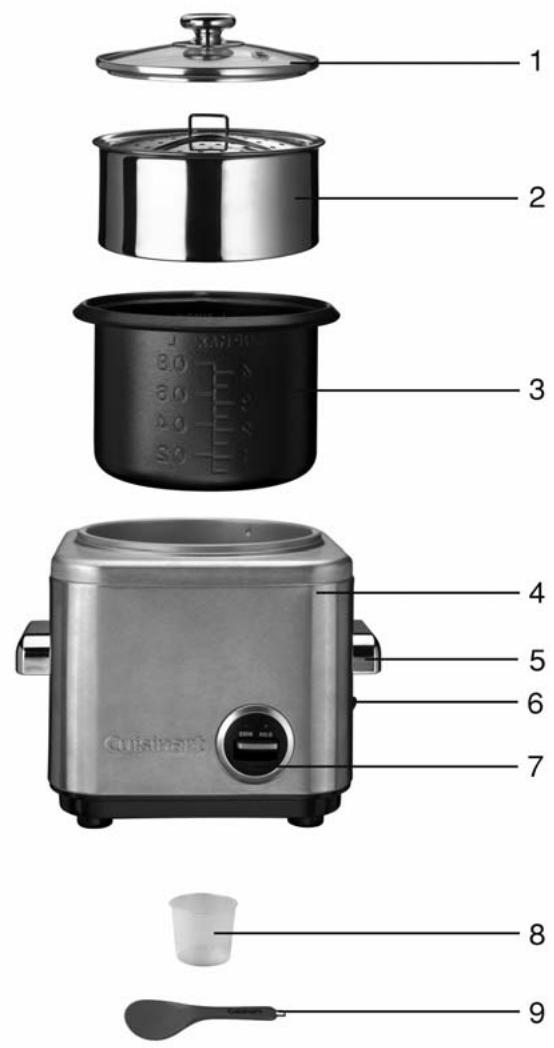
2.DESCRIPTION
- Glass lid with stainless steel rim and steam valve
- Stainless steel steamer basket
- Non-stick pot
- Brushed steel housing
- Heat-insulated handles
- On/Off switch
- Indicator lights for "Cook" and "Warm"
- Measuring cup (cup)
- Spatula
- Retractable cord storage (not shown)
The pot, basket, lid and accessories are dishwasher safe.
3. USE OF THE APPLIANCE
A. ASSEMBLY
Before using the Cuisinart® rice and cereal cooker for the first time, wipe the housing of the appliance with a damp cloth. Wash the lid, the steamer basket, the cooking pot, the measuring cup and the spatula in warm, soapy water or in the dishwasher. Read the section on "cleaning and storage" for more information.
B. OPERATING THE APPLIANCE
The levels printed on the walls of the pot refer only to cooking rice. The word "cup" refers to the measuring cup.
Conversion table for the cup
| Cup | Liquids | Rice |
| 1 | 160 ml | 130 g |
| 3/4 | 120 ml | 100 g |
| 1/2 | 80 ml | 65 g |
| 1/4 | 40 ml | 30 g |
COOKING RICE, CEREALS AND PULSES
Measure about 50g of rice per person for an accompaniment and 100g of rice for a main course. Measure the amount of rice using the glass measuring cup and poor into the pot.
Add water to the corresponding mark (e.g.: 4 cups rice = level 4 for water).
The markings in litres refer to amounts of water.
Put On/Off switch into the "I" position and press the control at the base: the red indicator light for the "Cook" function will light.
The cooking begins...
Cooking table for long-grain white rice
| Long white rice | Cups | Cups water | Servings |
| 130 g | 1 | 1 | 1 to 2 |
| 260 g | 2 | 2 | 2 to 3 |
| 390 g | 3 | 3 | 3 to 4 |
| 520 g | 4 | 4 | 4 to 6 |
Automatic Warm
When cooking has finished, the rice cooker will detect the total water absorbed and automatically switches to "warm". The control returns to the high position and the "warm" indicator light goes on. The rice is, thus, always ready to eat. The rice cooker remains in the "warm" setting until the On/Off switch is put into the "0" position. It is possible to activate the "warm" setting by raising the control and this can be used to reheat food.
Cooking table for various kinds of rice
To cook other kinds of rice perfectly, here are the appropriate amounts of water:
| Basmati, Thai, Surinam rice | Cups | Cups water | Servings |
| 130 g | 1 | 2 | 1 to 2 |
| 260 g | 2 | 3 | 2 to 3 |
| 390 g | 3 | 5 | 3 to 4 |
| 520 g | 4 | 6 | 4 to 6 |
| Round grain sushi rice, sticky rice | Cups | Cups water | Servings |
| 130 g | 1 | 2 | 1 to 2 |
| 260 g | 2 | 3 | 2 to 3 |
| 390 g | 3 | 4 | 3 to 4 |
| 520 g | 4 | 5 | 4 to 6 |
| Wild rice, arborio rice | Cups | Cups water | Servings |
| 130 g | 1 | 2 | 1 to 2 |
| 260 g | 2 | 4 | 2 to 4 |
| 390 g | 3 | 5 | 4 to 6 |
Cooking table for various cereals
| Soft wheat, bulgur, quinoa | Cups | Cups water | Servings |
| 150 g | 1 | 1 | 1 to 2 |
| 300 g | 2 | 2 | 2 to 4 |
| 450 g | 3 | 4 | 4 to 6 |
| Semolina | Cups | Cups water | Servings |
| 120 g | 1 | 1 | 1 to 2 |
| 240 g | 2 | 2 | 2 to 3 |
| 360 g | 3 | 3 | 3 to 4 |
| 480 g | 4 | 4 | 4 to 6 |
N.B. Add one soupspoon of olive oil per cup of semolina.
Cooking table for various pulses
When cooking pulses, the automatic stop function cannot be used because the pulses must soak in their cooking juices to prevent them from drying out. Some pulses should soak in water for 6 to 8 hours before cooking to rehydrate.
For the following tables, the pulses were measured in cups before rehydration. It is better to cook them without the rice cooker lid on to prevent boiling over resulting from the scum produced during cooking.
| Chick peas, lentils | Cups | Cups water | Cooking time | Servings |
| 120 g | 1 | 3 | 40 min | 1 to 2 |
| 260 g | 2 | 5 | 45 min | 2 to 4 |
| 390 g | 3 | 6 | 45 min | 4 to 6 |
| White haricot coco beans | Cups | Cups water | Cooking time | Servings |
| 120 g | 1 | 4 | 1 h | 2 to 3 |
| 260 g | 2 | 5 | 1 h | 3 to 4 |
| 390 g | 3 | 7 | 1 h | 4 to 6 |
| White haricot Soisson beans | Cups | Cups water | Cooking time | Servings |
| 120 g | 1 | 4 | 1 h 30' | 1 to 2 |
| 260 g | 2 | 5 | 1 h 30' | 2 to 4 |
| 360 g | 3 | 7 | 1 h 30' | 4 to 6 |
STEAMING
Pour the desired amount of water into the inner pot. The amount of water determines the cooking time for steaming. (See table opposite) Put the food in the steamer basket and place this on top of the inner pot.
The vegetables should be washed and peeled first.
Place the lid on top, put the On/Off switch into the "l" position and press the control at the base (as described for cooking rice).
When the water has evaporated, the appliance will automatically switch to "warm" and the indicator light will turn on. Use oven gloves to lift the steamer basket. It is possible to steam food while cooking rice. This does require keeping an eye on the food.
Steaming table
The amount of water in the pot determines the cooking time. As a guide, for 160ml water (1 cup), the cooking time will be about 30 minutes, for 80ml (1/2 cup), it will be 15 minutes, etc.
| Food | Amount | Notes | Cups water | Cooking time |
| Asparagus | 125 g | In 10 cm lengths | 50 ml | 12 min |
| Broccoli | 200 g | Florets | 40 ml | 10 min |
| Carrots | 300 g | Cut in pieces | 80 ml | 15 min |
| Cauliflower | 300 g | Florets | 80 ml | 15 min |
| Courgettes | 300 g | Cut in pieces | 50 ml | 12 min |
| Green beans | 200 g | Whole, fine | 80 ml | 15 min |
| Potatoes | 300 g | Cut in half | 100 ml | 20 min |
| Peas | 200 g | Fresh or frozen | 80 ml | 15 min |
| Leeks | 250 g | In 10 cm lengths | 100 ml | 20 min |
| Artichoke | 300 g | Medium sized- hearts | 100 ml | 20 min |
| Fish | 300 g | Average-sized fillets | 80 ml | 15 min |
| Shellfish | 300 g | Cockles, clams,... | 100 ml | 20 min |
| Scallops | 200 g | Fresh | 60 ml | 10 min |
| Shrimp, gambas | 300 g | Shelled | 80 ml | 15 min |
| Hard-boiled eggs | 5 eggs | Fresh, medium | 80 ml | 15 min |
| Soft-boiled eggs | 5 eggs | Fresh, medium | 40 ml | 7 min |
| Chicken | 300 g | Escalopes, filets | 100 ml | 20 min |
| Sausage, black pudding | 400 g | Fresh, whole | 160 ml | 30 min |
| Chinese ravioli | 200 g | Fresh | 80 ml | 15 min |
4. CHEF'S TIPS AND HINTS
- Cooking time for steaming may vary slightly depending on the size of the food. The amount of water will therefore need to be adjusted.
- If the steaming ends before the food is cooked properly, add some cold water to the inner pot, replace the food and cover.
- Smaller foods cook more quickly than larger. We recommend that you cook food of the same size together for even cooking.
- Carefully wash the rice several times in water and drain. Cooking will be perfect.
- At the end of cooking, when the rice is done and the "warm" setting is on, stir the rice and leave in the automatic cooker a few minutes longer for perfect cooking.
- To flavour and add taste to the preparations, add onion, thyme, bay leaves, cloves when cooking white haricot beans, lentils, etc.
5. QUESTIONS/ANSWERS
| What do I do if... | Answers : |
| the preparation boils over dur- ing cooking? | Make sure the ingredients do not exceed the maximum level in the pot. |
| the food isn't cooked enough? | There is not enough water for cooking. Add water and begin cooking again. |
| the rice cooker is still warm after several hours? | As long as the cooker is plugged in, the "warm" function stays on. Unplug the rice cooker after each use. |
| my rice cooker doesn't work? | Make sure the appliance is plugged in and that the pot is in its base, then that the "cook" function is properly engaged. |
| my rice cooker stopped during cooking? | The pot was lifted or taken out while the appliance was operating. Re-set to "cook". |
6. CLEANING AND STORAGE
When you have finished cooking, put the On/Off switch into the "0" position, unplug the cord and allow the appliance to cool completely before cleaning.
- The pot, steamer basket and lid may be washed in warm, soapy water or in the dishwasher.
- If food sticks to the sides, fill the pot and bowl with warm, soapy water and allow to soak before cleaning. Do not use scouring pads or abrasive soaps that could damage the coating.
- To clean the appliance housing, use a damp cloth and a little soft detergent. Do not use scouring pads or abrasive soaps.
DO NOT IMMERSE THE APPLIANCE HOUSING IN WATER OR ANY OTHER LIQUID.
7. SAFETY INSTRUCTIONS
- When using the appliance, wear protective or oven gloves to handle it.
- Handle the cooking bowls with care when they are filled with hot liquids.
- Never place the appliance on or near a source of heat. Do not place it on heat-sensitive surfaces or near inflammable materials.
- Never place anything on the appliance when it is in use.
- The cooker generates steam. Leave enough space between the cooker and walls or furniture. Do not place the cooker below wall-mounted kitchen elements.
- Do not allow the cord to hang over the side of the counter or come in contact with hot surfaces.
- Do not immerse in water or any other liquid.
- Always unplug the appliance after use and before cleaning. Never leave the appliance plugged in and unattended. To unplug, pull on the plug, never on the cord.
- Be particularly careful if the appliance is used in the presence of children. Store outside the reach of children. Do not let children use the cooker.
- Do not use the appliance if it has fallen or if it appears to have been damaged.
- Stop using the appliance immediately if the cord is damaged. The cord must be replaced by a professional.
- Do not repair any part of the appliance yourself.
- Any use of accessories not recommended or not sold by Cuisinart® may cause fire, electrocution and risk of injury.
- This appliance meets the standards recommended under Directives 89/336/EEC (electromagnetic compatibility) and 73/23/EEC (safety of domestic electrical equipment), as amended by Directive 93/68/EEC (CE marking).
-
Only use this appliance for cooking, following the instruction in this booklet.
-
Do not use outdoors.
- This appliance is for household use only.
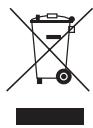
DISCARDING END-OF-LIFE ELECTRICAL AND ELECTRONIC EQUIPMENT In everybody's interest and to participate actively in protecting the environment:
- Do not discard these items with your household waste.
- Use return and collection systems available in your country.
Some materials can in this way be recycled or recovered.
NOTES
1. EINLEITUNG
- Cuisinart®
- INHALTSVERZEICHNIS
- CHARACTERISTIQUES PRODUIT
- QUESTIONS / REPONSES
- 2.DESCRIPTION
- USE OF THE APPLIANCE
- ASSEMBLY
- OPERATING THE APPLIANCE
- COOKING RICE, CEREALS AND PULSES
- Automatic Warm
- Cooking table for various kinds of rice
- Cooking table for various pulses
- STEAMING
- Steaming table
- CHEF'S TIPS AND HINTS
- QUESTIONS/ANSWERS
- CLEANING AND STORAGE
- SAFETY INSTRUCTIONS
- NOTES
- EINLEITUNG
Brand : CUISINART
Model : CRC400E
Category : Rice cooker