
C07873 - Fireplace insert DEVILLE - Free user manual and instructions
Find the device manual for free C07873 DEVILLE in PDF.



User questions about C07873 DEVILLE
0 question about this device. Answer the ones you know or ask your own.
Ask a new question about this device
Download the instructions for your Fireplace insert in PDF format for free! Find your manual C07873 - DEVILLE and take your electronic device back in hand. On this page are published all the documents necessary for the use of your device. C07873 by DEVILLE.
USER MANUAL C07873 DEVILLE
5.1 - Lighting the stove for the first time
5.2 - Fuel
5.2.1 - Recommended Fuel
5.2.2 - Alternative fuels
5.2.3 - Prohibited fuels
5.3 - Use of controls and accessoires
5.4 - Using the appliance
5.4.1 - Lighting the Stove
5.4.2 - Working requirements
5.4.2.1 - Working with door closed
5.4.2.2. - Ash Removal
5.4.2.3 - Safety Rules
6 - SWEEPING AND MAINTENANCE RECOMMANDATIONS STOVE AND SMOKE FLUE. 12
7 - GLOBAL TERMS OF WARRANTY 14
You are advised to road carefully and in full the information provided in order to get the best performance - and the most satisfaction - out of your DEVILLE stove.
Failure to comply with the assembly, installation and operating instructions places all responsibility upon the person(s) concerned.
THIS APPLIANCE MUST BE INSTALLED IN COMPLIANCE WITH CURRENT D.T.U. SPECIFICATIONS. INSTALLATION BY A QUALIFIED TRADESMAN IS RECOMMENDED.
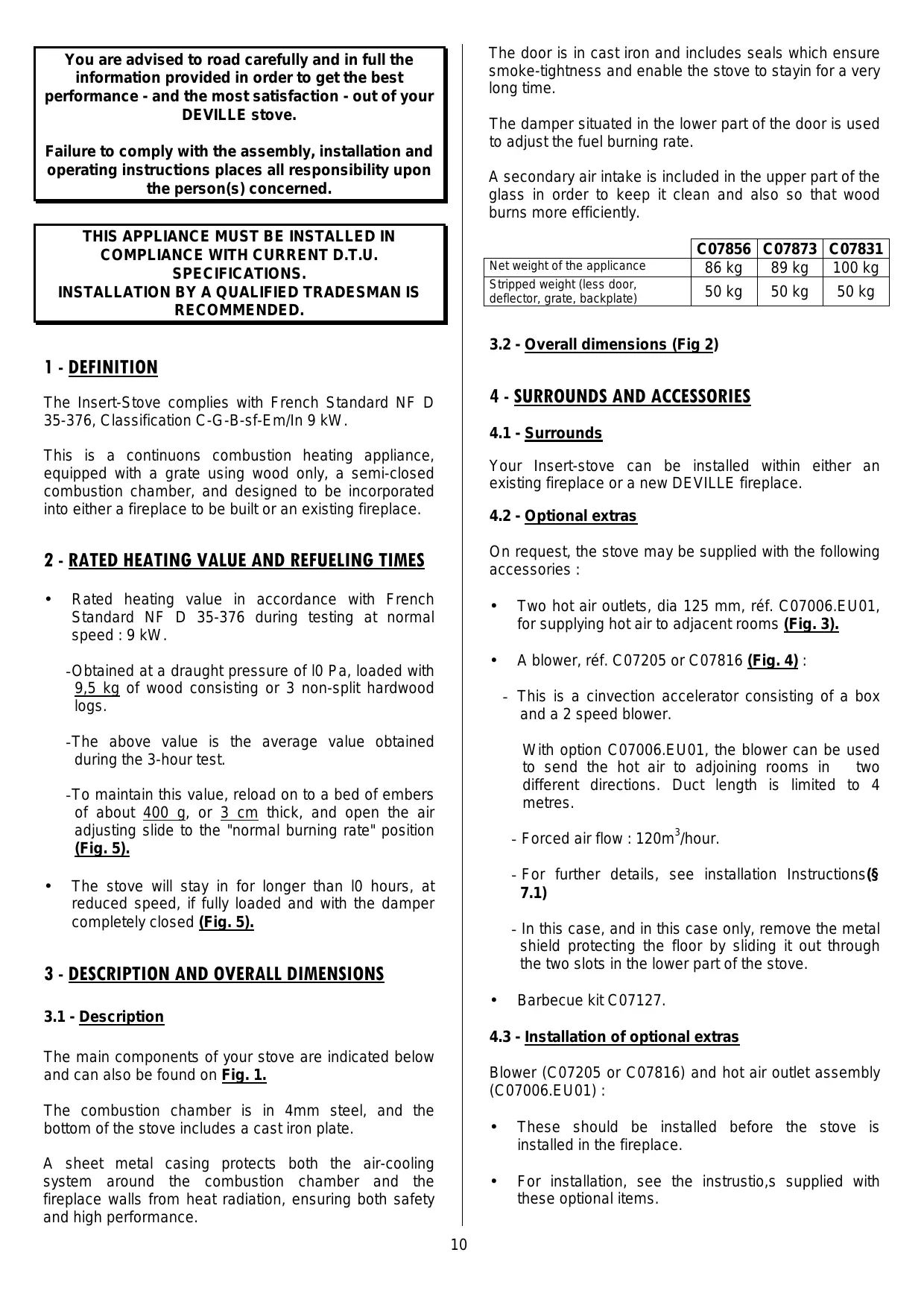
1 - DEFINITION
The Insert-Stove complies with French Standard NF D 35-376, Classification C-G-B-sf-Em/In 9 kW.
This is a continuous combustion heating appliance, equipped with a grate using wood only, a semi-closed combustion chamber, and designed to be incorporated into either a fireplace to be built or an existing fireplace.
2 - RATED HEATING VALUE AND REFUELING TIMES
- Rated heating value in accordance with French Standard NF D 35-376 during testing at normal speed: 9kW .
-Obtained at a draught pressure of 10 Pa, loaded with 9.5kg of wood consisting or 3 non-split hardwood logs. - The above value is the average value obtained during the 3-hour test.
-To maintain this value, reload on to a bed of embers of about 400g , or 3cm thick, and open the air adjusting slide to the "normal burning rate" position (Fig. 5). - The stove will stay in for longer than 10 hours, at reduced speed, if fully loaded and with the damper completely closed (Fig. 5).
3 - DESCRIPTION AND OVERALL DIMENSIONS
3.1 - Description
The main components of your stove are indicated below and can also be found on Fig. 1.
The combustion chamber is in 4mm steel, and the bottom of the stove includes a cast iron plate.
A sheet metal casing protects both the air-cooling system around the combustion chamber and the fireplace walls from heat radiation, ensuring both safety and high performance.
The door is in cast iron and includes seals which ensure smoke-tightness and enable the stove to stay in for a very long time.
The damper situated in the lower part of the door is used to adjust the fuel burning rate.
A secondary air intake is included in the upper part of the glass in order to keep it clean and also so that wood burns more efficiently.
| C07856 | C07873 | C07831 | |
| Net weight of the applicance | 86 kg | 89 kg | 100 kg |
| Stripped weight (less door, deflector, grate, backplate) | 50 kg | 50 kg | 50 kg |
3.2 - Overall dimensions (Fig 2)
4 - SURROUNDSD AND ACCESSORIES
4.1 - Surrounds
Your Insert-stove can be installed within either an existing fireplace or a new DEVILLE fireplace.
4.2 - Optional extras
On request, the stove may be supplied with the following accessories :
- Two hot air outlets, dia 125 mm, ref. C07006.EU01, for supplying hot air to adjacent rooms (Fig. 3).
-
A blower, ref. C07205 or C07816 (Fig. 4):
-
This is a cinvection accelerator consisting of a box and a 2 speed blower.
With option C07006.EU01, the blower can be used to send the hot air to adjoining rooms in two different directions. Duct length is limited to 4 metres.
- Forced air flow : 120 m^3/ hour.
- For further details, see installation Instructions(§ 7.1)
-
In this case, and in this case only, remove the metal shield protecting the floor by sliding it out through the two slots in the lower part of the stove.
-
Barbecue kit C07127.
4.3 - Installation of optional extras
Blower (C07205 or C07816) and hot air outlet assembly (C07006.EU01):
- These should be installed before the stove is installed in the fireplace.
- For installation, see the instrustio,s supplied with these optional items.
5 - REQUIREMENTS
Your "closed Stove" is an extremely efficient heating appliance :
High output
Stays in for a long time at reduced speed
APPLIANCES EQUIPPED WITH A LIGHTING DAMPER
Warning : The air adjusting slide is used to obtain a greater air intake for the purpose of lighting: "Lighting position", see Fig. 6. The "Lighting position" is reserved strictly for lighting and relighting operations and must not be maintained for more than 30 minutes. Otherwise, serious damage may be caused to the appliance and its surroundings. A constant watch must be kept on the appliance when it is used in the "Lighting position".
5.1 - Lighting the stove for the first time
- When fireplace is completed and the appliance in place, give the various building materials time to dry (2 to 3 weeks).
- After lighting the stove for the first time (see § 5.4.1), build a moderate fire for the first few hours using just one log with a diameter of about 15 ~cm , with the damper halfway open (Fig. 5b or 6). This will ensure that the temperature of all the parts of the fireplace increases gradually and that the appliance will expand normally.
- You may find that initially the stove gives off a smell of paint, in wich case simply air the room.
5.2 - Fuel
5.2.1 - Recommended Fuel
Hardwood: oak, honbeam, beech, chesnut, etc.
It is advisable to use only well-seasoned wood with a maximum moisture content of 20% ; that is wood that as been stored under cover for 2 years after being cut, in order to prevent sooting up of the flue and the glass.
Do not use resinous woods (pine, fir, spruce, etc.), which involve more frequent maintenance of the stove and the flue.
5.2.2 - Alternative Fuels
Brown coal briquettes, but only with the door closed, can be used to keep the stove in for long periods at low speed.
Limit the load to 4kg , with the damper halfway open (Fig. 5b or 6).
5.2.3 - Prohibited fuels
All types of fuel other than wood and brown coal briquettes are forbidden, notably coal and coal derivatives.
Flare-ups from small pieces of wood, vine shoots or similar, bits of plank, straw and cardboard are dangerous and these must not be used.
5.3 - Use of controls and accessories
- Damper :
To move the damper, use the poker.
APPLIANCES FITTED WITH A LIGHTING DAMPER
. The "Lighting position" is set by operating the slide directly by hand. This position must only be used when the appliance is "cold" and by performing the following operations :
Operation No. 1 :
Push the air adjusting slide operating knob ② until reaching the "Lighting position" locking stop.
Operation No. 2 :
Raise the unlocking index ① located to the right of the adjusting slide.
Operation No. 3 :
Hold the index in the high position with your right hand while pushing the operating knob ② to the left with your left hand : you have now set the "Lighting position".
After lighting, return to the normal, medium or slow burning rate position (Fig. 6). Use the poker to push the air adjusting slide operating knob as it may be hot.
- Door handle :
Use the poker to open and close the door (Fig. 7).
5.4 - Using the appliance
5.4.1 - Lighting the Stove
- Open the damper.
- Screw up some paper and place it on the grate along with some very dry kindling with some bigger split wood on top (diameter about 3 to 5 centimetres).
- Light the paper and close the door (or leave it slightly ajar so that the fire catches more quickly, but avoiding any discharge of smoke from the appliance).
- When the kindling is alight, open the door and put in the wood recommended above.
5.4.2 - Working Requirements
5.4.2.1 - Closed
- Use the damper to adjust the stove to the rate at which you want the wood to burn (see § 5.3). The amount of wood you put in depends on the heating rate you require:
- For maximum heat, put in 3 logs with a diameter of about 12cm .
- For medium heat, just put in one or two logs.
- For a longer heating period at low heat, put in one or two non-split logs with a diameter greater than 15 cm.
- For a very long heating period at reduced heat, put the logs on top of embers that are giving off very little glow.
- To get the stove going quickly, put in some kindling. If necessary, leave the door ajar for a few minutes (keep an eye on the stove) and then shut the door. This will speed burning up and is especially useful if the wood is at all wet.
- While the embers are recatching, before reloading change the damper control (e.g. normal to low) so that the stove and the smoke flue can gradually adjust.
-
To avoid any smoke being discharged or ash falling into the room when recharging the fire, the following precautions must be taken when opening the door:
-
Switch off the fan to avoid drawing in ash which may then fall from the front of the appliance.
- Open the door slightly, wait a few moments for the draught to be established in open door mode, and then slowly open the door.
- In mild periods and if using wet wood, slow burning at low speed can result in incomplete burning which causes deposits of soot and tar. To avoid this, alternative between low and normal speed.
- When the stove has been working at low speed, the glass may get slightly sooted up. Any soot will usually be burnt off when the stove is working at a higher speed.
5.4.2.2 - Ash Removal
-
The air used for burning the wood comes in under the grate when the damper is open. The incoming air also cools the grate. So in order to ensure the best performance from your stove and prevent damage to the grate through overheating, it is essential to empty out the ash so as to keep the grate clean.
-
Use the scraper to remove ash (Fig. 8).
-
The ash pan, located underneath the grate, is easily removed using the poker.
-
The ash level should never be so high as to reach the cast iron grate.
5.4.2.3 - Safety Rules
- Never try to extinguish the fire with water.
- Be careful of the glass, which gets very hot. Keep children away from it.
- The stove gives out a lot of heat through the glass, so keep materials and heat-sensitive objects at least 1.50 metres away from it.
- Empty the ash pan into a special metal or otherwise inflammable receptacle used only for this purpose. Ashesthat might appearcold can still bevery hot, even if you think they have had enough time to get cold.
- Do not put easily flammable materials near the appliance or in the wood store.
It is especially important not to store wood under the appliance.
6 - SWEEPING AND MAINTENANCE
RECOMMENDATIONS : STOVE AND SMOKE FLUE
Mechanical sweeping of the smoke flue is obligatory. This should be done several times a year and at least once during the heating period. The contractor concerned should provide the necessary certificates.
For sweeping :
-
Remove the deflector :
-
Lift the deflector ① and pull it forwards (Fig. 9 and 10).
- Lower the back of the deflector ① and remove it (Fig. 11).
-
To replace the deflector, follow the same steps in reverse.
-
Carefully check the condition of the appliance, and more especially smoke-tightness : seals, fixings, and door and frame.
- Check the condition of the smoke flue and the connecting pipe; all fittings should be in good mechanical condition and be smoke-tight.
- Clean the extractor fan inside the hood to get rid of any dust and if necessary clearthe hot air convection system.
REGULAR MAINTENANCE
-
Clean the glass with a damp cloth. If necessary, use a household cleaning product provided it complies with user instructions. Wait until the stove is completely cool before cleaning.
Periodically clean the secondary air intake : -
Use the vacuum cleaner ① to remove particles and dust trapped between the air guide and the glazed pane. If necessary, to make cleaning easier, slide a thin blade or a sheet of stiff card ② between the air guide and the pane to free trapped particles (Fig. 13).
- Use the end of some metal object ② to scrape the bottom edge of the damper so as to remove any soot (Fig. 12).
Any soot or other particles are liable to prevent the formation of the secondary film of air protecting the glass from direct contact with the smoke and ensuring full combustion of the wood.
Cleaning should be done as soon as the glass is dirty and in any event must be done when the stove is completely out.
If localized and very obvious traces of soot (Fig. 15) reappear and spread, the air guide must be dismantled for more thorough cleaning (Fig. 16):
Unhinge the door and lay it flat.
Remove the 5 screws.
Remove the air guide A and clean it.
Replace the seal around the pane (6 dia.).
Reinstall the assembly and check that the recommended play on the pane is complied with.
This operation must be performed by a qualified professional servicing agent.
-
Make sure the catch-bolt on the door works properly ; if necessary, adjust as follows (Fig 14) :
-
To tighten the catch:
. Loosen screw ① and tighten screw ②
. Give both screws a quarter turn and repeat ff necessary.
N.B: This will increase the pressure of the sealing strip around the door.
- To slacken the catch :
. Loosen screw ② and tighten screw ①
. Give both screws a quarter turn and repeat if necessary.
N.B.: This will reduce the pressure of the sealing stop around the door.
- Clean the hot air grilles in the hood at regular intervals. How often you do this depends on the grilles: the smaller the holes, the quicker they get clogged up.
7 - GLOBAL TERMS OF WARRANTY
1. TERMS AND CONDITIONS
Apart from the legal warranty, particularly for latent defects, Deville guarantees to deliver the furniture in case of obvious defects or non-conformity to the ordered furniture.
Without prejudice to the provisions that are to be taken concerning the carrier, claims on delivery of furniture concerning the obvious defects or the non conformity, must be issued by the Buyer in writing a registered letter with confirmation of receipt to Deville company with in 5 days after noticing the defect. It is up to the Buyer to prove the reality of the noticed defects and irregularities. The Buyer must let Deville every opportunity of noticing any of those defects and irregularities in order to salute then.
The Buyer must also keep the non standard supplies at the disposal of Deville, according to the instructions of the latter. Prior to any return of supplies an agreement will be issued.
2. EXTEND
The warranty of Deville covers, except for any compensation or for damages, the free replacement or repairing of supplier the part acknowledged as being defected (except for wear and tear parts) by its services to the exclusion of the fees for the workplace, for the removal and for the shipping.
On enamelled equipments, appliances, crackles are never considered as a manufacturing defect. They are due to the difference of expansion of iron enamel or cast-iron enamel and don't alter the adherence.
Paid replacement parts are warranted for a six-month period from the invoicing date, any additional warranty agreed by a retailer from Deville doesn't commit Deville. Whenever claiming under a warranty, the guarantee with the stamp from the retailer Deville is strictly required. The above guarantee must be produced for any demand to repair the appliance under warranty, or a detachable slip or coupon of any such guarantee must, according to the own organisation of Deville, be returned to the latter within the required time. For lack of this, the date on the invoice issued by Deville can't be taken into account. The interventions under warranty can't have the effect of continuing the warranty.
3. WARRANTY PERIOD
The agreed warranty period assured by Deville is the longer of 1 year from the day of the purchase of the appliance, subject to the above terms and conditions are fact that the claims covered by the conditions are requested within the required time. The repairing, the replacement or the alteration of parts under the warranty period can neither have the effect of continuing the period of the latter, not get to any compensation for any fees, for late delivery, accidents or any such damages.
4. EXCLUSION
The warranty is unavailable for the following cases, without this list being exhaustive :
- Fitting out, fitting out and assembling of appliances not due to Deville.
- Consequently Deville can't be considered as responsible for damages or supplies, or accidents to persons due to local laws and regulations (for example the fact that there is no linking to the a earth ground connection, or a wrong drought of a fitting out).
Fair wear and tear of the supplies or abnormal use of the supplies including the case of industrial or trading use or a use of the supplies in different conditions from the ones it was built for. It is, for example, of non respect of the conditions described in the directions issued by Deville : display to outside conditions damaging the appliance ; such as excessive dampness or abnormal change of the electrical tension. Malfunction, damage or accident due to a shock, a drop, a carelessness, a failure of supervision or of service from the Buyer.
Any alteration, change or intervention made by a member of the staff or a company that is not approved by Deville, or manufactured with replacement parts that are not genuine or not approved by the manufacturer.
5. SPECIAL TERMS OF WARRANTY
These terms add and define the above general terms of warranty and come first to the former, refer to the enclosed leaf untitled : "special terms of sales Deville - warranty".
Inhalt
Seite
The descriptions and features described here are given for information only and constitute no liability. In addition, and in line with our policy of quality enhancement, we reserve the right to modify or improve any of our products without notice.
***