KH 368 - Polisher LERVIA - Free user manual and instructions
Find the device manual for free KH 368 LERVIA in PDF.



| Product type | Car polisher |
| Brand | LERVIA |
| Model | KH 368 |
| Power consumption | 230 W |
| No-load speed | 3,000 rpm |
| Movement | Orbital |
| Sound pressure level | 80 dB(A) |
| Hand-arm vibration | 14 m/s² |
| Power supply | 230 V ~ 50 Hz |
| Weight | Approx. 2.0 kg |
| Dimensions (L x W x H) | Approx. 20 x 15 x 18 cm |
| Housing maintenance | Wipe with a damp cloth and mild detergent |
| Pad cleaning | Hand wash with soap detergent |
| Safety instructions | Do not expose to moisture, unplug before cleaning, wear safety goggles |
| Intended use | Wax and polish/sand common car paints |
| Repairability | Repairs exclusively by the after-sales service or a qualified workshop |
| Storage temperature | 0 °C to 50 °C |
| Certifications | CE (98/37 EC, 73/23 EEC, 89/336 EEC) |
Frequently Asked Questions - KH 368 LERVIA
User questions about KH 368 LERVIA
0 question about this device. Answer the ones you know or ask your own.
Ask a new question about this device
Download the instructions for your Polisher in PDF format for free! Find your manual KH 368 - LERVIA and take your electronic device back in hand. On this page are published all the documents necessary for the use of your device. KH 368 by LERVIA.
USER MANUAL KH 368 LERVIA
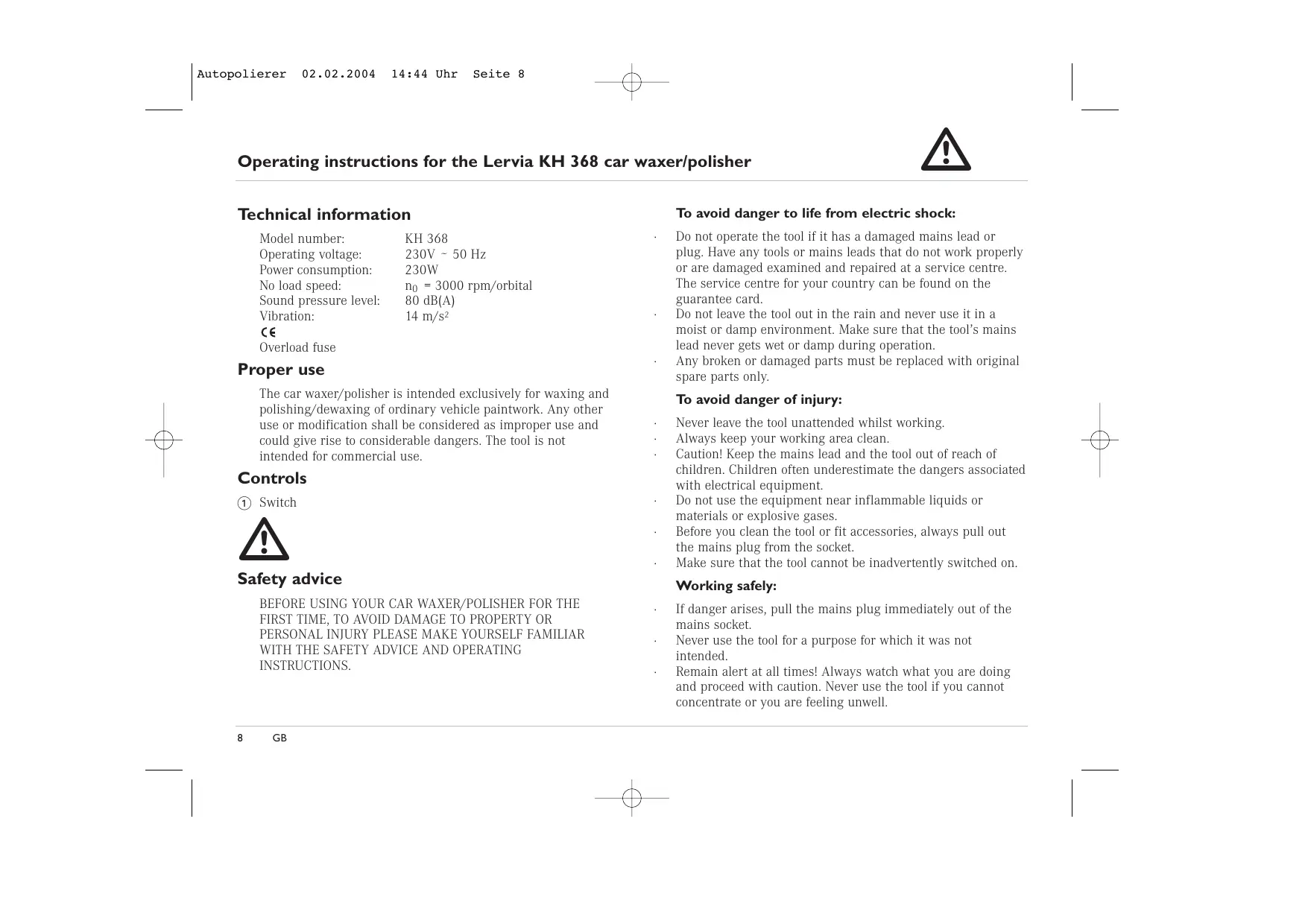
Power consumption: 230W
No load speed: n0 = 3000rpm / orbital
Sound pressure level: 80 dB(A)
Vibration: 14m / s2
C
Overload fuse
Proper use
The car waxer/polisher is intended exclusively for waxing and polishing/dewaxing of ordinary vehicle paintwork. Any other use or modification shall be considered as improper use and could give rise to considerable dangers. The tool is not intended for commercial use.
Controls
① Switch

Safety advice
BEFORE USING YOUR CAR WAXER/POLISHER FOR THE FIRST TIME, TO AVOID DAMAGE TO PROPERTY OR PERSONAL INJURY PLEASE MAKE YOURSELF FAMILIAR WITH THE SAFETY ADVICE AND OPERATING INSTRUCTIONS.
To avoid danger to life from electric shock:
- Do not operate the tool if it has a damaged mains lead or plug. Have any tools or mains leads that do not work properly or are damaged examined and repaired at a service centre. The service centre for your country can be found on the guarantee card.
- Do not leave the tool out in the rain and never use it in a moist or damp environment. Make sure that the tool's mains lead never gets wet or damp during operation.
Any broken or damaged parts must be replaced with original spare parts only.
To avoid danger of injury:
- Never leave the tool unattended whilst working.
Always keep your working area clean. - Caution! Keep the mains lead and the tool out of reach of children. Children often underestimate the dangers associated with electrical equipment.
- Do not use the equipment near inflammable liquids or materials or explosive gases.
- Before you clean the tool or fit accessories, always pull out the mains plug from the socket.
Make sure that the tool cannot be inadvertently switched on.
Working safely:
- If danger arises, pull the mains plug immediately out of the mains socket.
- Never use the tool for a purpose for which it was not intended.
- Remain alert at all times! Always watch what you are doing and proceed with caution. Never use the tool if you cannot concentrate or you are feeling unwell.
If you are not using the tool, pull the plug out of the mains socket.
- Do not carry the tool in such a way that the switch could be inadvertently operated.
Exercise care when using the tool and remain alert. Adopt a safe, stable working position.
Hold the tool firmly when working.
Ensure that you have adequate light.
Always keep the tool in a safe place and under lock and key. Ensure that children cannot get access to it.
- Do not overload the tool. It is only to be used for the specified purpose.
- When using the waxer/polisher, always wear suitable clothing. Wear stout footwear with non-slip rubber soles. Keep long hair out of the way by wearing suitable head-wear.
- Check the tool regularly for damage. Look out in particular for any damage to the mains lead (cracks, exposed wires, breaks).
Always disconnect from the socket by pulling the plug and never the lead itself.
If the original mains lead is not long enough, use an extension cable that is suitable for the purpose, tested and approved, with a current rating of at least 10 A. Look for the presence of an appropriate marking in accordance with the applicable standards on the extension lead.
- Do not repair the tool yourself. Take or send a defective tool to a specialist repair centre or to the importer's service department (see guarantee information).
- Do not store the tool to temperatures below 0ircC or above 50ircC .
- When using the waxer/polisher, always wear protective glasses.
Always make sure that the bonnet used is firmly attached to the cushion. - Do not touch any moving parts. Before you switch on the tool, check that the cushion is not restrained and can move without causing any danger.
Always check that the bonnet is safe to use. Replace a torn or damaged bonnet immediately. - Wait until the cushion is in good contact with the surface to be polished before switching on the waxer/polisher. Be particularly careful when polishing edges and uneven surfaces.
- Do not use any abrasive as this can ruin your paintwork.
First use/ normal use
Always follow this operating advice and keep the operating instructions safe in case you need them later. If you pass the tool on to anyone else, please ensure that you also pass on the instructions.
- Check that the mains voltage corresponds with that given on the rating plate. Devices suitable for 230V supplies can also be used with 220V supplies.
Use
- Placing the bonnet on to the cushion:
- Turn the waxer/polisher over so that the cushion points upwards.
- Place a bonnet on to the cushion. Ensure that the bonnet is central, sits tightly on the cushion and cannot rub on the housing ②.
Applying the wax/polish:
- Always use a high quality product for waxing.
- Follow the working methods given on the packaging.
- Apply the wax/polish directly to the contact surface of the bonnet.
In order to achieve a thin complete covering do not use more material than is absolutely necessary. Too much wax does not achieve a better finish and you will have spent more time later removing the coating. - Spread the wax evenly over the bonnet. It should also cover the bonnet edges.
- Switching on and waxing /polishing the paintwork:
Note: The paintwork to be polished must be first thoroughly cleaned and fully dry.
If necessary use a commercially available paintwork cleaner. Use a product suitable for the demands on and condition of your paintwork. Heavily oxidised paintwork requires a special cleaner. You should use a combined product (cleaner + wax) for this task.
- Turn the waxer/polisher over again and place it on the surface to be polished.
Make sure that the mains lead cannot come into contact with the waxer/polisher. Work more safely by guiding the mains lead over your shoulder.
- Check again that all the safety requirements have been fulfilled.
- Using both hands firmly grasp the two handles and switch on the waxer/polisher by pushing down the switch ① (see Fig. A).
- Guide the waxer/polisher evenly over the paintwork (see Fig. B).
ATTENTION: Do not press on the waxer/polisher! The self-weight of the waxer/polisher applies sufficient pressure for the waxing/polishing process.
Any difficult to reach corners or recesses may have to be completed later by hand. Take the bonnet off the waxer/ polisher and use this bonnet for the corners and recesses.
- Removing wax or polishing:
- Use the second bonnet for final polishing or removing the wax.
- When working, always follow the instructions given for the wax/polish.
Cleaning
Before cleaning the tool, pull out the plug out of the mains socket.
- Clean the housing with a slightly moist cloth. If necessary use a mild cleaning agent.
Clean the bonnet by washing by hand in soapy water.
Disposal
- The packaging consists completely of environmentally-friendly materials. It can be disposed of in your local recycling containers.
- Ask at your local council offices about the disposal of your worn-out tool / bonnet.
Statement of conformity
We, Kompernaß Handelsgesellschaft mbH, Burgstr. 21, D-44867 Bochum, Germany, hereby declare that this product conforms with the following EC regulations:
Machinery Directive: (98/37 EC)
EU Low Voltage Directive: (73/23 EEC)
Electromagnetic compatibility: (89/336 EEC)
Applicable harmonised standards: EN 50144-1, EN 50144-2-3, EN 61000-3-2, EN 61000-3-3
Type/Description: car wax/polisher KH 368 Bochum, 31.01.2004
Hans Kompernaß - Managing Director -
Données techniques
Numero type KH 368
Tension de service 230V 50Hz
Protection surcharge
- C
- Proper use
- Controls
- Safety advice
- To avoid danger to life from electric shock:
- To avoid danger of injury:
- Working safely:
- First use/ normal use
- Use
- - Placing the bonnet on to the cushion:
- Applying the wax/polish:
- - Switching on and waxing /polishing the paintwork:
- - Removing wax or polishing:
- Cleaning
- Disposal
- Statement of conformity
- Données techniques
Brand : LERVIA
Model : KH 368
Category : Polisher