
BRIGGS & STRATTON 1950 PSI - Pressure washer BRIGGS & STRATTON - Free user manual and instructions
Find the device manual for free BRIGGS & STRATTON 1950 PSI BRIGGS & STRATTON in PDF.



| Product Type | High Pressure Washer |
| Brand | BRIGGS & STRATTON |
| Model | 1950 PSI |
| Rated Pressure | 135 bar (1950 PSI) |
| Water Flow Rate | 7.5 L/min (2 gal/min) |
| Power Supply | Unleaded gasoline (4-stroke engine) |
| Shipping Weight | 21 kg (46 lb) |
| Pump Type | Axial cam pump with stainless steel pistons |
| Adjustable Nozzle | Yes, high and low pressure modes, variable spray (fan to narrow jet) |
| Detergent Injection | Integrated system with siphon and filter, low pressure use only |
| High Pressure Hose | 7.60 m (25 ft) durable |
| Automatic Cooling | Yes, discharges hot water between 51 and 68 °C |
| Maximum Water Temperature | 37.7 °C (100 °F) |
| Required Intake Flow | Greater than 11.3 L/min (3 GPM) at 1.38 bar (20 PSI) |
| Sound Level (LwA) | 100 dB(A) |
| Sound Pressure at 7 m | 75 dB(A) |
| Safety | Trigger lock, safety glasses included, emergency stop, splash guard |
| Routine Maintenance | Check engine oil, clean filters (inlet, line, detergent), pump oil change every 50 h |
| Spare Parts Available | O-ring kit, filters, nozzles, high pressure hose, pump oil (ref. 190586GS) |
| Warranty (private use) | 1 year (parts and labor) |
| Usage | Outdoor only, stable surface, safety distance 1.5 m from flammable materials |
| Box Contents | Main unit, HP hose, gun, adjustable nozzle extension, glasses, maintenance kit, manuals |
Frequently Asked Questions - BRIGGS & STRATTON 1950 PSI BRIGGS & STRATTON
User questions about BRIGGS & STRATTON 1950 PSI BRIGGS & STRATTON
0 question about this device. Answer the ones you know or ask your own.
Ask a new question about this device
Download the instructions for your Pressure washer in PDF format for free! Find your manual BRIGGS & STRATTON 1950 PSI - BRIGGS & STRATTON and take your electronic device back in hand. On this page are published all the documents necessary for the use of your device. BRIGGS & STRATTON 1950 PSI by BRIGGS & STRATTON.
USER MANUAL BRIGGS & STRATTON 1950 PSI BRIGGS & STRATTON
BRIGGS & STRATTON POWER PRODUCTS GROUP, LLC
JEFFERSON, WISCONSIN, U.S.A.
TABLE OF CONTENTS
Safety Rules. 2-4
Know Your Pressure Washer. 5
Assembly. 6-7
Operation 8-11
Product Specifications 12
Maintenance 12-14
Storage. 14
Troubleshooting 15
Notes 16
Warranty 17
EQUIPMENT DESCRIPTION

Read this manual carefully and become familiar with your pressure washer. Know its applications, its limitations and any hazards involved.
This manual contains information for a high-pressure washer that operates at 1,950 PSI at a flow rate of 2.0 gallons per minute. This high quality residential system features an axial cam pump with stainless steel pistons, an automatic cool down system, chemical injection system and adjustable spray nozzle. Includes safety goggles, heavy-duty 25^ hose, and more.
Every effort has been made to ensure that information in this manual is accurate and current. However, we reserve the right to change, alter or otherwise improve the product and this document at any time without prior notice.
SAFETY RULES

This is the safety alert symbol. It is used to alert you to potential personal injury hazards.
Obey all safety messages that follow this symbol to avoid possible injury or death.
The safety alert symbol (A) is used with a signal word (DANGER, CAUTION, WARNING), a pictorial and/or a safety message to alert you to hazards. DANGER indicates a hazard which, if not avoided, will result in death or serious injury. WARNING indicates a hazard which, if not avoided, could result in death or serious injury. CAUTION indicates a hazard which, if not avoided, might result in minor or moderate injury. CAUTION, when used without the alert symbol, indicates a situation that could result in equipment damage. Follow safety messages to avoid or reduce the risk of injury or death.
Warning Tag
A warning tag (Figure 1) is provided on your unit to inform you of potential safety hazards. If the tag becomes damaged or illegible, replace it by contacting your local Briggs & Stratton dealer to obtain a new one.
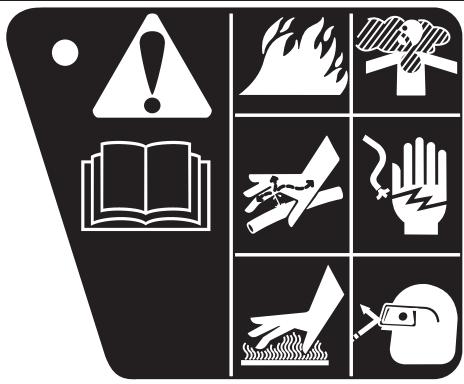
Figure 1 — Warning Label
The icons on the warning tag are shown and described in detail later in the next section.
Hazard Symbols and Meanings

Toxic Fumes
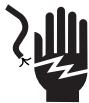
Electrical Shock

Slippery Surface

Fall
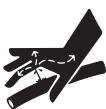
Fluid Injection

Fire

Explosion
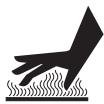
Hot Surface

Moving Parts
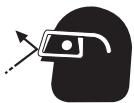
Flying Objects
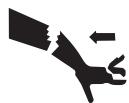
Kickback

WARNING
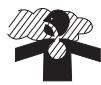
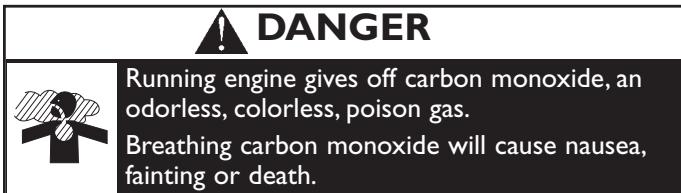
Running engine gives off carbon monoxide, an odorless, colorless, poison gas.
Breathing carbon monoxide will cause nausea, fainting or death.
Some chemicals or detergents may be harmful if inhaled or ingested, causing severe nausea, fainting or poisoning.
- Operate pressure washer ONLY outdoors.
- Keep exhaust gas from entering a confined area through windows, doors, ventilation intakes or other openings.
- DO NOT operate pressure washer inside any building or enclosure.
- Use a respirator or mask whenever there is a chance that vapors may be inhaled.
- Read all instructions with mask so you are certain the mask will provide the necessary protection against inhaling harmful vapors.

WARNING

Use of pressure washer can create puddles and slippery surfaces.

High pressure spray could cause you to fall if you are too close to the cleaning surface.
- Keep spray nozzle between 8 to 24 inches away from cleaning surface.
- Operate this unit on a stable surface.
- The cleaning area should have adequate slopes and drainage to reduce the possibility of a fall due to slippery surfaces.
- Be extremely careful if you must use the pressure washer from a ladder, scaffolding or any other relatively unstable location.
- Firmly grasp spray gun with both hands when using high pressure spray to avoid injury if gun kicks back.

WARNING

Rapid retraction of starter cord (kickback) will pull hand and arm toward engine faster than you can let go.
Broken bones, fractures, bruises or sprains could result.
- When starting engine, pull cord slowly until resistance is felt and then pull rapidly to avoid kickback.
- If engine starts and fails to continue to run or if increased resistance is felt during starting pull attempts, squeeze trigger on spray gun.

WARNING

Fuel and its vapors are extremely flammable an explosive.

Fire or explosion can cause severe burns or death.
WHEN ADDING FUEL
- Turn pressure washer OFF and let it cool at least 2 minutes before removing fuel cap.
- Fill fuel tank outdoors.
- DO NOT overfill tank. Allow space for fuel expansion.
- Keep fuel away from sparks, open flames, pilot lights, heat, and other ignition sources.
DO NOT light a cigarette or smoke.
WHEN OPERATING EQUIPMENT
- DO NOT tip engine or equipment at angle which causes fuel to spill.
- DO NOT spray flammable liquids.
WHEN TRANSPORTING OR REPAIRING EQUIPMENT
- Transport/repair with fuel tank EMPTY or with fuel shutoff valve OFF.
- Secure pressure washer upright when transporting so that it does not tip and spill fuel and oil.
WHEN STORING FUEL OR EQUIPMENT WITH FUEL IN TANK
- Store away from furnaces, stoves, water heaters, clothes dryers or other appliances that have pilot light or other ignition source because they can ignite fuel vapors.

WARNING

The high pressure stream of water that this equipment produces can pierce skin and its underlying tissues, leading to serious injury and possible amputation.
Spray gun retains high pressure when pressure washer is shut down, which can cause injury.
- NEVER aim spray gun at people, animals or plants.
- DO NOT allow CHILDREN to operate pressure washer.
- NEVER repair high pressure hose. Replace it.
- Keep high pressure hose connected to pump and spray gun while system is pressurized.
- Squeeze trigger on spray gun to relieve trapped pressure, every time you stop engine. Engage trigger lock on spray gun.

WARNING

Spray contact with electrical wiring can result in electrocution.
- Keep water spray away from electric wiring or fatal electric shock may result.

WARNING

Running engines produce heat. Temperature of muffler and nearby areas can reach or exceed 150^ (65^) .

Severe burns can occur on contact. Combustible debris, such as leaves, grass, brush, etc. can catch fire.
DO NOT touch hot surfaces.
- Allow equipment to cool before touching.
- The pressure washer must be at least 5 feet from structures having combustible walls and/or other combustible materials.
- Keep at least 3 feet of clearance on all sides of pressure washer for adequate cooling, maintenance and servicing.

WARNING

Starter and other rotating parts can entangle hands, hair, clothing, or accessories.
- DO NOT wear loose clothing, jewelry or anything that may be caught in the starter or other rotating parts.
- Tie up long hair and remove jewelry.

WARNING

High pressure spray can cause paint chips or other particles to become airborne.
- Always wear eye protection when using this equipment or in vicinity of where equipment is in use.

WARNING

Unintentional sparking can result in fire or electric shock.
WHEN ADJUSTING OR MAKING REPAIRS TO YOUR PRESSURE WASHER
- Disconnect spark plug wire from spark plug and place wire where it cannot contact spark plug.

CAUTION
Excessively high or low operating speeds increase risk of injury and damage to pressure washer.
DO NOT tamper with governed speed.
DO NOT operate pressure washer above rated pressure.

CAUTION
A pressure washer produces a high pressure spray which increases risk of injury and damage to unit.
- DO NOT secure spray gun in open position.
- DO NOT leave spray gun unattended while machine is running.
- NEVER use a spray gun which does not have a trigger lock or trigger guard in place and in working order.
- Always be certain spray gun, nozzles and accessories are correctly attached.
CAUTION
High pressure spray may damage fragile items including glass.
- DO NOT point spray gun at glass when in jet spray mode.
- NEVER aim spray gun at plants.
CAUTION
Improper treatment of pressure washer can damage it and shorten its life.
- If you have questions about intended use, ask dealer or contact Briggs & Stratton Power Products.
- NEVER operate units with broken or missing parts, or without protective housing or covers.
- DO NOT by-pass any safety device on this machine.
- Before starting pressure washer in cold weather, check all parts of the equipment to be sure ice has not formed there.
- NEVER move machine by pulling on high pressure hose. Use handle provided on unit.
- Check fuel system for leaks or signs of deterioration, such as chafed or spongy hose, loose or missing clamps, or damaged tank or cap. Correct all defects before operating pressure washer.
- This equipment is designed to be used with Briggs & Stratton Power Products authorized parts ONLY. If equipment is used with parts that DO NOT comply with minimum specifications, user assumes all risks and liabilities.
KNOW YOUR PRESSURE WASHER
Read this owner's manual and safety rules before operating your pressure washer.
Compare the illustrations with your pressure washer to familiarize yourself with the locations of various controls and adjustments. Save this manual for future reference.
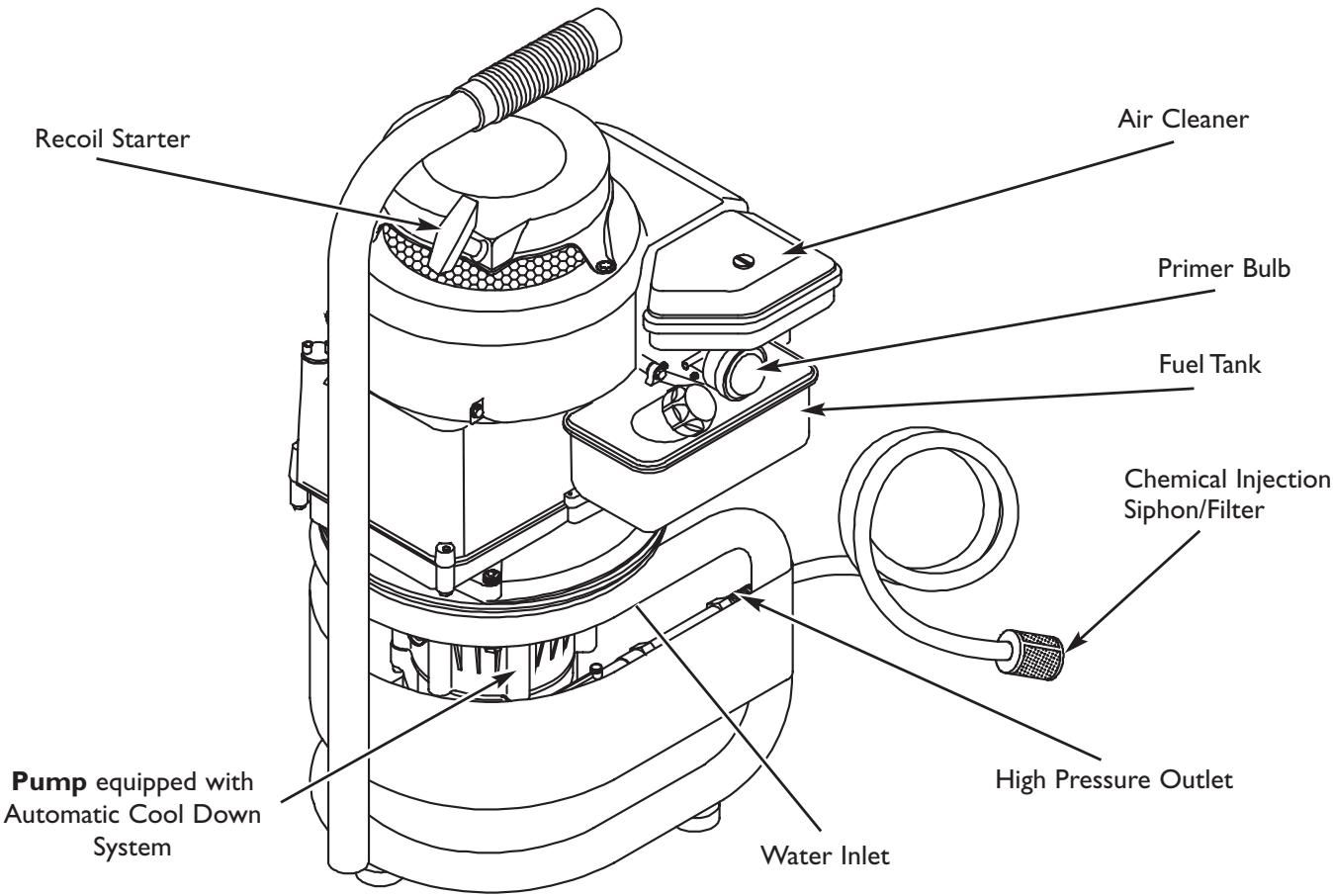
Air Cleaner — Dry type filter element protects engine by filtering dust and debris out of intake air.
Automatic Cool Down System — Cycles water through pump when water reaches 125^ - 155^ F. Warm water will discharge from pump onto ground. This system prevents internal pump damage.
Chemical Injection Siphon/Filter — Use to siphon detergent or other pressure washer chemicals into the low pressure stream.
FuelTank-Fill tank with regular unleaded fuel.
High Pressure Outlet — Connection for high pressure hose.
Primer Bulb — Prepares a cold engine for starting.
Pump - Develops high water pressure.
Recoil Starter - Used for starting the engine manually.
Water Inlet — Connection for garden hose.
ASSEMBLY
IMPORTANT: Read entire owner's manual before you attempt to assemble or operate your new pressure washer.
Remove Pressure Washer From Carton
- Remove the parts bag, accessories, and inserts included with pressure washer.
- Slice two corners at the end of carton from top to bottom so the panel can be folded down flat.
- Remove pressure washer from carton.
Carton Contents
Items in the carton include:
Main Unit
Goggles
High Pressure Hose
Spray Gun
Adjustable Nozzle Extension
- Parts Bag (which includes the following):
Hose Fittings
- Quick Connects
- Maintenance Kit
Owner's Manual
Engine Manual
If parts are missing or damaged, contact the local Briggs & Stratton service center.
PREPARED PRESSURE WASHER FOR USE
To prepare your pressure washer for operation, you will need to perform these tasks:
I. Add oil to engine crankcase.
2. Add fuel to fuel tank.
3. Connect high pressure hose to spray gun and pump.
4. Connect water supply to pump.
5. Attach nozzle extension to spray gun.
Add Engine Oil and Fuel
- Place pressure washer on a level surface.
CAUTION
Any attempt to crank or start the engine before it has been properly filled with the recommended oil will result in equipment failure.
Refer to engine manual for oil and fuel fill information.
- Damage to equipment resulting from failure to follow this instruction will void warranty.
- Refer to engine owner's manual and follow oil and fuel recommendations and instructions.
NOTE: Check oil often during engine break-in. Refer to engine owner's manual for recommendations.
Connect Hose and Water Supply to Pump
IMPORTANT: To avoid pump damage, you must assemble the nozzle extension to the spray gun and attach all hoses before you start the engine.
- Uncoil high pressure hose and attach one end of hose to base of spray gun (Figure 2). Tighten by hand.
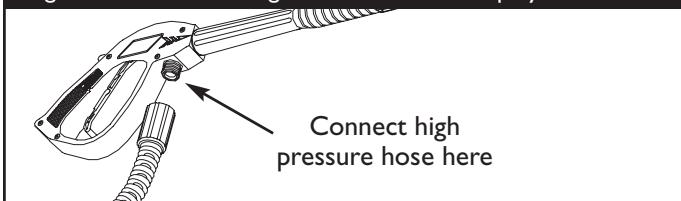
Figure 2 Connect High Pressure Hose to Spray Gun
- Attach other end of high pressure hose to high pressure outlet on pump (Figure 3). Tighten by hand.
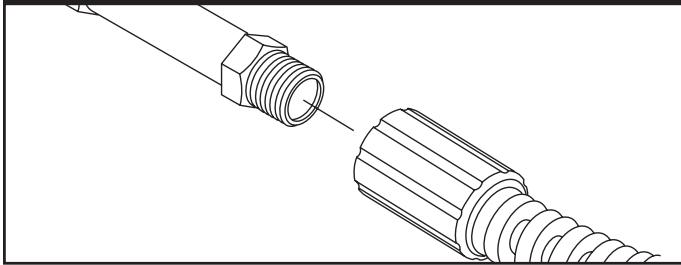
Figure 3 Connect High Pressure Hose to Pump
- Before connecting garden hose to water inlet, inspect inlet screen (Figure 4). Clean screen if it contains debris or replace if damaged. DO NOT RUN PRESSURE WASHER IF SCREEN IS DAMAGED.
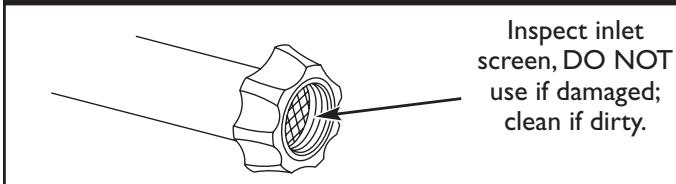
Figure 4 - Inspect Inlet Screen
- Run water through garden hose for 30 seconds to clean out any debris.
IMPORTANT: DO NOT siphon standing water for water supply. Use ONLY cold water (less than 100^ ).
- Attach female quick connect to garden hose. Attach male quick connect to water inlet on pump (Figure 5).
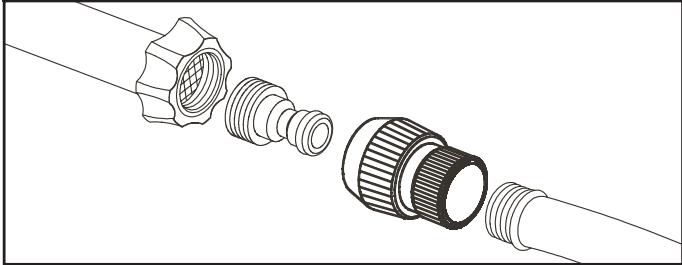
Figure 5 Connect the Garden Hose to Water Inlet
- Connect garden hose (not to exceed 50 feet in length) to water inlet (Figure 5). Pull back on collar of quick connect, slide fitting onto pump and let go of collar. Pull on hose to be sure of a tight connection.
CAUTION
There MUST be at least ten feet of unrestricted garden hose between the pressure washer inlet and any flow shut off device, such as a 'Y' shut-off connector or other convenience-type water shut-off valve.
-
Damage to equipment resulting from failure to follow this instruction will void warranty.
-
Turn ON water and squeeze trigger on gun to purge pump system of air and impurities.

WARNING

High pressure spray can cause paint chips or other particles to become airborne.
- Always wear eye protection when using this equipment or in vicinity of where equipment is in use.
- Before starting the pressure washer, be sure you are wearing adequate eye protection.
Checklist Before Starting Engine
Review the unit's assembly to ensure you have performed all of the following.
- Check that oil has been added to proper level in engine crankcase.
- Add proper fuel to fuel tank.
- Check for properly tightened hose connections (high pressure and water supply) and there are no kinks, cuts, or damage to high pressure hose.
- Provide a proper water supply at an adequate flow.
- Be sure to read "Safety Rules" and "How To Use Pressure Washer" before using pressure washer.
HOW TO USE PRESSURE WASHER
If you have any problems operating your pressure washer, please contact the local Briggs & Stratton service center.
Pressure Washer Location
Pressure Washer Clearance
- Operate pressure washer ONLY outdoors.
- Keep exhaust gas from entering a confined area through windows, doors, ventilation intakes or other openings.
- DO NOT operate pressure washer inside any building or enclosure.
The pressure washer must be at least 5 ft. (152 cm) from structures having combustible walls and/or other combustible materials. Leave at least 3 ft. (92 cm) all around pressure washer including overhead, for adequate cooling, maintenance and servicing.
Place pressure washer in a well ventilated area, which will allow for removal of deadly exhaust gas. DO NOT place pressure washer where exhaust gas could accumulate and enter inside or be drawn into a potentially occupied building. Ensure exhaust gas is kept away from any windows, doors, ventilation intakes or other openings that can allow exhaust gas to collect in a confined area (Figure 6). Prevailing winds and air currents should be taken into consideration when positioning pressure washer.
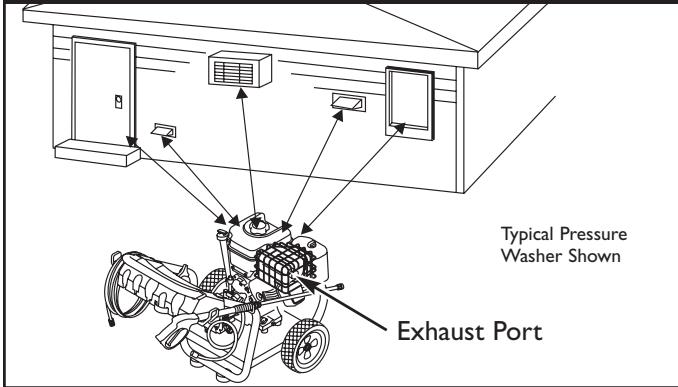
Figure 6 — Pressure Washer Clearance
How To Start Pressure Washer
To start your pressure washer for the first time, follow these instructions step-by-step. This starting information also applies if you have let the pressure washer sit idle for at least a day.
I. Place pressure washer near an outside water source capable of supplying water at a flow rate greater than 3.0 gallons per minute and no less than 20 PSI at pressure washer end of garden hose.
2. Check that high pressure hose is tightly connected to spray gun and to pump. See "Preparing Pressure Washer for Use" for illustrations.
3. Make sure unit is in level position.
4. Connect garden hose to water inlet on pressure washer pump. Turn ON the water.
CAUTION
DO NOT run the pump without the water supply connected and turned on.
- Damage to equipment resulting from failure to follow this instruction will void warranty.
- Attach adjustable nozzle extension to spray gun (Figure 7). Tighten by hand.
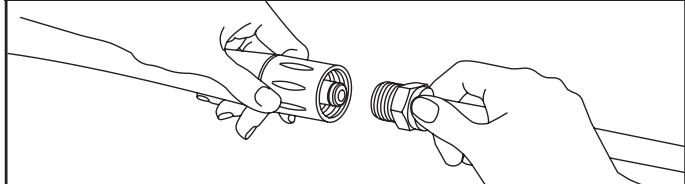
Figure 7 Connect Nozzle Extension to Spray Gun
- Position nozzle in low pressure mode (see "How To Use Adjustable Nozzle") and squeeze trigger on spray gun to relieve air pressure caused by turning ON water. Water will flow out of spray gun in thin stream. Continue to hold trigger until steady stream of water occurs and no air remains in system. This will make it easier to pull start the engine. Release trigger.
- Engage trigger lock to spray gun trigger (Figure 8).
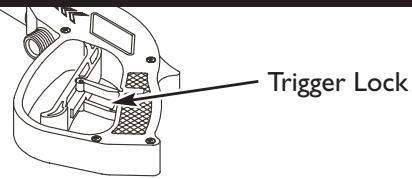
Figure 8 — Spray Gun with Trigger Lock Engaged
- Start engine according to instructions given in engine owner's manual.

WARNING

Rapid retraction of starter cord (kickback) will pull hand and arm toward engine faster than you can let go.
Broken bones, fractures, bruises or sprains could result.
- When starting engine, pull cord slowly until resistance is felt and then pull rapidly to avoid kickback.
- If engine starts and fails to continue to run or if increased resistance is felt during starting pull attempts, squeeze trigger on spray gun.

CAUTION
Avoid fire from equipment tip over.
Always use handle to lift equipment.
- NEVER pull on hoses to move equipment.
NOTE: Always keep the throttle lever in the "Fast" position when operating the pressure washer.

WARNING

Running engines produce heat. Temperature of muffler and nearby areas can reach or exceed 150^ (65^) .

Severe burns can occur on contact. Combustible debris, such as leaves, grass, brush, etc. can catch fire.
DO NOT touch hot surfaces.
- Allow equipment to cool before touching.
- The pressure washer must be at least 5 feet from structures having combustible walls and/or other combustible materials.
- Keep at least 3 feet of clearance on all sides of pressure washer for adequate cooling, maintenance and servicing.
How To Stop Pressure Washer
I. Let engine idle for two minutes.
2. Turn engine off according to instructions given in engine owner's manual.
3. Squeeze trigger on spray gun to relieve trapped pressure in hose to avoid injury.
NOTE: A small amount of water will squirt out when pressure is released.

WARNING

The high pressure stream of water that this equipment produces can pierce skin and its underlying tissues, leading to serious injury and possible amputation.
Spray gun retains high pressure when pressure washer is shut down, which can cause injury.
- Keep high pressure hose connected to pump and spray gun while system is pressurized.
-
Squeeze trigger on spray gun to relieve trapped pressure, every time you stop engine. Engage trigger lock on spray gun.
-
Engage trigger lock on spray gun when not in use.
How To Use Adjustable Nozzle
You now should know how to START your pressure washer and how to STOP it. The information in this section will tell you how to adjust the spray pattern and to apply detergent or other cleaning chemicals.

CAUTION
A pressure washer produces a high pressure spray which increases risk of injury and damage to unit.
- NEVER adjust spray pattern when spraying.
- NEVER put hands in front of nozzle to adjust spray pattern.
I. Slide nozzle forward to adjust spray to low pressure mode (Figure 9). Slide nozzle backward to achieve high pressure.
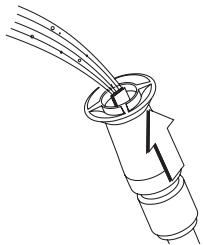
Figure 9 - Adjusting Nozzle for Pressure
Forward = Low Pressure and Detergent Mode
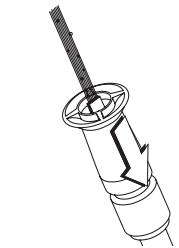
Backward = High Pressure Mode
- Point nozzle towards a firm surface and press trigger to test spray pattern (Figure 10).
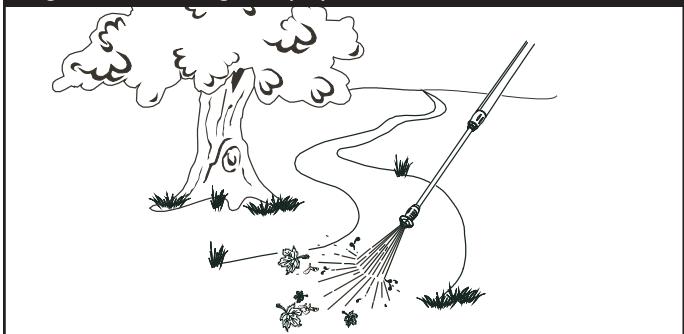
Figure 10 - Testing the Spray Pattern
- Twisting nozzle adjusts spray pattern from a narrow pattern to a fan pattern (Figure 11).
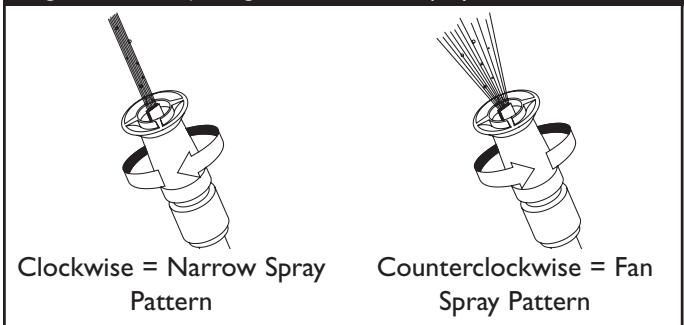
Figure 11 -Adjusting the Nozzle for Spray Pattern
Usage Tips
- For most effective cleaning, keep spray nozzle from 8 to 24 inches away from cleaning surface.
- If you get spray nozzle too close, especially using high pressure mode, you may damage surface being cleaned.
- DO NOT get closer than 6 inches when cleaning tires.
Applying Detergent With Adjustable Nozzle
IMPORTANT: Use soaps designed specifically for pressure washers. Household detergents could damage the pump.
CAUTION
You must attach all hoses before you start the engine.
- Starting the engine without all the hoses connected and without the water turned ON will damage the pump.
- Damage to equipment resulting from failure to follow this instruction will void warranty.
To apply detergent, follow these steps:
I. Review adjustable nozzle use.
2. Prepare detergent solution as required by job.
3. Place filter end of chemical injection hose into detergent container.
CAUTION
Keep the chemical injection tube from coming in contact with the hot exhaust.
-
When inserting the filter into a detergent solution bottle, route the tube so as to keep it from inadvertently contacting the hot exhaust.
-
Slide adjustable nozzle forward to low pressure mode. Detergent cannot be applied with nozzle in high pressure position.
- Make sure garden hose is connected to water inlet. Check that high pressure hose is connected to spray gun and pump; start engine.
- Apply detergent to a dry surface, starting at lower portion of area to be washed and work upward, using long, even, overlapping strokes.
- Allow detergent to "soak in" for 3-5 minutes before washing and rinsing. Reapply as needed to prevent surface from drying. DO NOT allow detergent to dry on (prevents streaking).
IMPORTANT: You must flush the chemical injection system after each use by placing the filter into a bucket of clean water, then run the pressure washer in low pressure for 1-2 minutes.
Pressure Washer Rinsing
For Rinsing:
I. Slide nozzle backward to high pressure, press trigger and wait for detergent to clear.
NOTE: You can also stop detergent from flowing by simply removing chemical injection hose from bottle.
2. Keep spray gun a safe distance from surface.
WARNING

High pressure spray could cause you to fall if you are too close to the cleaning surface.
- Keep spray nozzle between 8 to 24 inches away from cleaning surface.
- Operate this unit on a stable surface.
- Be extremely careful if you must use the pressure washer from a ladder, scaffolding or any other relatively unstable location.
-
Firmly grasp spray gun with both hands when using high pressure spray to avoid injury if gun kicks back.
-
Apply high pressure spray to a small area, then check surface for damage. If no damage is found, it is okay to continue cleaning.
- Start at top of area to be rinsed, working down with same overlapping strokes as used for washing and applying detergent.
Cleaning Chemical Injection Hose
If you used the chemical injection hose, you must flush it with clean water before stopping the engine.
I. Place chemical injection hose in a bucket full of clean water.
2. Slide adjustable nozzle forward to low pressure position. Flush for 1-2 minutes.
3. Shut off engine.
IMPORTANT: Simply shutting OFF engine will not release pressure in the system. When the engine has shut down, squeeze the trigger on the spray gun to relieve the pressure in the hose.
Automatic Cool Down System (Thermal Relief)
If you run the engine on your pressure washer for
3-5 minutes without pressing the trigger on the spray gun, circulating water in the pump can reach temperatures above 125^ . The system engages to cool the pump by discharging the warm water onto the ground.
SPECIFICATIONS
Outlet Pressure 135 bar (1950 psi)
Flow Rate 7.5 litres/minute (2.0 gpm)
Detergent Use detergent approved for pressure washers
Water Supply Not to Exceed 37.7^ (100^)
Temperature
Automatic Cool Will cycle when water
Down System reaches 51-68°C (125°-155°F)
Measured LwA 100 dB(A)/pW
Guaranteed LwA 100 dB(A)/pW
Sound Pressure Level @ 7m .75 dB(A)
Shipping Weight 21 kg (46 lbs.)
GENERAL MAINTENANCE RECOMMENDATIONS
The pressure washer warranty does not cover items that have been subjected to operator abuse or negligence. To receive full value from the warranty, the operator must maintain the pressure washer as instructed in this manual.
NOTE: Should you have questions about replacing components on your BSPP pressure washer, please visit our website at www.briggsandstraton.com.
- Some adjustments will need to be made periodically to properly maintain your pressure washer.
- All maintenance in this manual and the engine owner's manual should be made at least once each season.
- Once a year you should check the spray gun and adjustable nozzle extension assembly for wear. Also clean or replace the spark plug and clean or replace the engine air filter. Please refer to engine owner's manual for more details.
Before Each Use
- Check engine oil level.
- Check water inlet screen for damage.
- Check in-line filter for damage.
- Check high pressure hose for leaks.
- Check chemical injection hose and filter for damage.
- Check spray gun and adjustable nozzle extension assembly for leaks.
- Rinse out garden hose to flush out debris.
PRESSURE WASHER MAINTENANCE
Check and Clean Inlet Screen
Examine the screen on the water inlet. Clean it if the screen is clogged or replace it if screen is damaged.
Check High Pressure Hose
The high pressure hose can develop leaks from wear, kinking, or abuse. Inspect the hose each time before using it. Check for cuts, leaks, abrasions or bulging of cover, damage or movement of couplings. If any of these conditions exist, replace the hose immediately.

WARNING
The high pressure stream of water that this equipment produces can pierce skin and its underlying tissues, leading to serious injury and possible amputation.
- NEVER repair high pressure hose. Replace it.
- Replacement hose rating MUST exceed maximum pressure rating of unit.
Check Chemical Injection Hose
Examine the filter on the detergent tube and clean if clogged. The tube should fit tightly on the barbed fitting. Examine the tube for leaks or tears. Replace the filter or tube if either is damaged.
Check Gun and Adjustable Nozzle Extension
Examine the hose connection to the spray gun and make sure it is secure. Test the trigger by pressing it and making sure it "springs back" into place when you release it. Put the safety latch in the ON position and test the trigger. You should not be able to press the trigger.
Check In-Line Filter
Refer to Figure 12 and service the in-line filter if it becomes clogged, as follows:
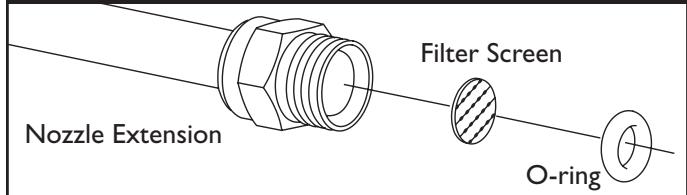
Figure 12 — Clean In-Line Filter
- Detach spray gun and nozzle extension from high pressure hose. Detach nozzle extension from spray gun and remove o-ring and screen from nozzle extension. Flush screen, spray gun, and adjustable nozzle extension with clean water to clear debris.
- If screen is damaged, o-ring kit contains a replacement in-line filter screen and o-ring. If undamaged, reuse screen.
- Place in-line filter screen into threaded end of nozzle extension. Direction does not matter. Push screen in with eraser end of pencil until it rests flat at bottom of opening. Take care to not bend screen.
- Place o-ring into threaded end of nozzle extension. Push o-ring snugly against in-line filter screen.
- Assemble nozzle extension to spray gun, as described earlier in this manual.
Nozzle Maintenance
A pulsing sensation felt while squeezing the spray gun trigger may be caused by excessive pump pressure. The principal cause of excessive pump pressure is a orifice clogged or restricted with foreign materials, such as dirt, etc. To correct the problem, immediately clean the orifice using the tools included with your pressure washer and follow these instructions:
I. Shut off engine and turn off water supply.
2. Detach nozzle extension from spray gun. Twist nozzle clockwise to stream position. Using 2mm (5/64) allen wrench, remove orifice from end of nozzle extension (Figure 13).
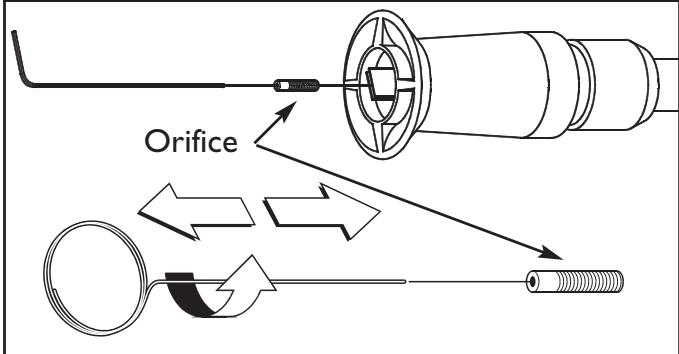
Figure 13 — Removing and Cleaning Orifice
- Remove in-line filter from other end of nozzle extension.
- Use wire (or small paper clip) to free any foreign material clogging or restricting orifice (Figure 13).
- Using garden hose, remove additional debris by back flushing water through nozzle extension (Figure 14). Back flush between 30 to 60 seconds. Turn adjustable nozzle extension to stream spray and move nozzle from low to high while flushing.
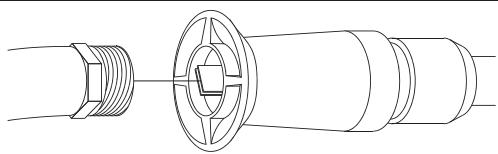
Figure 14 - Backflushing the Nozzle
- Reinstall orifice and in-line filter into nozzle extension. DO NOT overtighten orifice with allen wrench.
- Reconnect nozzle extension to spray gun.
- Reconnect water supply, turn on water, and start engine.
- Test pressure washer by operating with nozzle in high and low positions.
O-Ring Maintenance
Through the normal operation of your pressure washer, o-rings are used to keep the connections of the hoses and spray gun tight and leak-free. These o-rings may become worn or damaged.
An O-Ring Maintenance Kit is provided with your pressure washer which includes replacement o-rings, rubber washer and water inlet filter. Refer to the instruction sheet provided in the kit to service your unit's o-rings. Note that you will not use all of the parts in the kit.
To remove a worn or damaged o-ring; use a small flathead screwdriver to get underneath the o-ring and pry it off.
Pump Maintenance
Changing Pump Oil
Change oil every 50 hours or once yearly, whichever occurs first.
NOTE: You must purchase a premeasured bottle of pump oil, item number 190586GS, by contacting the nearest authorized service center.
Change pump oil as follows:
I. Drain engine oil and fuel from pressure washer.
2. Use 8mm allen wrench to remove black pump oil cap, found between high pressure outlet and garden hose inlet (Figure 15).
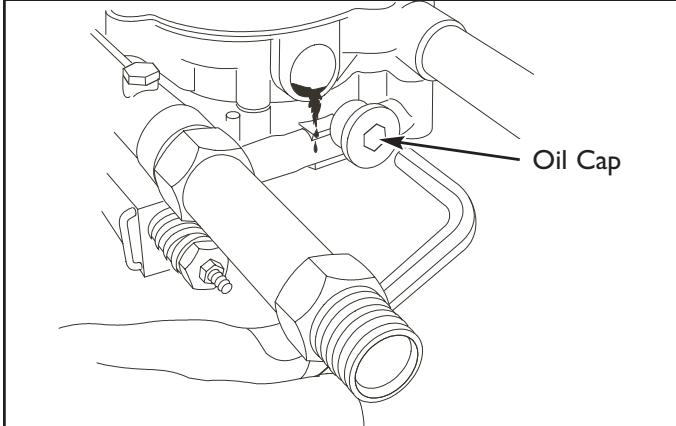
Figure 15 - Changing Pump Oil
- Tilt pressure washer to drain oil into an approved container until it drips slowly from the pump.
- Tilt pressure washer in opposite direction and empty premeasured pump oil bottle into same opening (a small funnel may be helpful).
- Install black pump oil cap and tighten firmly.
- Set pressure washer in upright position.Add fuel and engine oil.
ENGINE MAINTENANCE
See the engine owner's manual for instructions on how to properly maintain the engine.

CAUTION
Avoid prolonged or repeated skin contact with used motor oil.
Used motor oil has been shown to cause skin cancer in certain laboratory animals.
Thoroughly wash exposed areas with soap and water.

KEEP OUT OF REACH OF CHILDREN. DON'T POLLUTE. CONSERVE RESOURCES. RETURN USED OIL TO COLLECTION CENTERS.
PREPARING THE UNIT FOR STORAGE
Water should not remain in the unit for long periods of time. Sediments or minerals can deposit on pump parts and "freeze" pump action. If you do not plan to use the pressure washer for more than 30 days, follow this procedure:
- Flush detergent siphoning tube by placing the filter into a pail of clean water while running pressure washer in low pressure mode. Flush for one to two minutes.
- Shut off the engine and let it cool, then remove all hoses. Disconnect spark plug wire from spark plug.
- Empty the pump of all pumped liquids by pulling the recoil handle about 6 times. This should remove most of the liquid in the pump.
- Draw RV antifreeze (non-alcohol) into the pump by pouring the solution into a 3-foot section of garden hose connected to inlet adapter and pulling recoil handle twice.
If available, use PumpSaver in place of RV antifreeze and follow package instructions.
- Store unit in a clean, dry area.
STORING THE ENGINE
See the engine owner's manual for instructions on how to properly prepare the engine for storage.
TROUBLESHOOTING
| Problem | Cause | Correction |
| Pump has following problems: failure to produce pressure, erratic pressure, chattering, loss of pressure, low water volume. | 1. Nozzle in low pressure mode. | 1. Pull nozzle backward for high pressure mode. |
| 2. Water inlet is blocked. | 2. Clear inlet. | |
| 3. Inadequate water supply. | 3. Provide adequate water flow. | |
| 4. Inlet hose is kinked or leaking. | 4. Straighten inlet hose, patch leak. | |
| 5. Clogged inlet hose strainer. | 5. Check and clean inlet hose strainer. | |
| 6. Water supply is over 100°F. | 6. Provide cooler water supply. | |
| 7. High pressure hose is blocked or leaks. | 7. Clear blocks in outlet hose. | |
| 8. Gun leaks. | 8. Replace gun. | |
| 9. Orifice is obstructed. | 9. Clean orifice. | |
| 10. Pump is faulty. | 10. Contact Briggs & Stratton Power Products service facility. | |
| Detergent fails to mix with spray. | 1. Detergent siphoning tube is not submerged. | 1. Insert detergent siphoning tube into detergent. |
| 2. Chemical filter is clogged. | 2. Clean or replace filter/detergent siphoning tube. | |
| 3. Dirty in-line filter. | 3. See "Check In-Line Filter". | |
| 4. Nozzle is in high pressure mode. | 4. Push nozzle forward for low pressure mode. | |
| Engine runs good at no-load but "bogs" when load is added. | Engine speed is too slow. | Move throttle control to FAST position. If engine still "bogs down", contact engine manufacturer. |
| Engine shuts down during operation. | Out of fuel. | Fill fuel tank. |
NOTES
BRIGGS & STRATTON POWER PRODUCTS GROUP, LLC EQUIPMENT OWNER WARRANTY POLICY
Effective September 1, 2004 replaces all undated Warranties and all Warranties dated before September 1, 2004
LIMITED WARRANTY
Briggs & Stratton Power Products Group, LLC will repair or replace, free of charge, any part(s) of the equipment that is defective in material or workmanship or both. Transportation charges on parts submitted for repair or replacement under this warranty must be borne by purchaser. This warranty is effective for the time periods and subject to the conditions stated below. For warranty service, find the nearest Authorized Service Dealer in our dealer locator map at www.briggspowerproducts.com.
THERE IS NO OTHER EXPRESS WARRANTY. IMPLIED WARRANTY, INCLUDING THOSE OF MERCHANTABILITY AND FITNESS FOR A PARTICULAR PURPOSE, ARE LIMITED TO ONE YEAR FROM PURCHASE, OR TO THE EXTENT PERMITTED BY LAW ANY AND ALL IMPLIED WARRANTY ARE EXCLUDING. LIABILITY FOR INCIDENTAL OR CONSEQUENTIAL DAMAGES ARE EXCLOSED TO THE EXTENT EXCLUSION IS PERMITTED BY LAW. Some states or countries do not allow limitations on how long an implied warranty lasts, and some states or countries do not allow the exclusion or limitation of incidental or consequential damages, so the above limitation and exclusion may not apply to you. This warranty gives you specific legal rights and you may also have other rights which vary from state to state or country to country.
OUR EQUIPMENT*
| OUTBOARD MOTOR | PRESSURE WASHER | WATER PUMP (Not available in the USA) | PORTABLE GENERATOR | HOME STANDBY GENERATOR SYSTEM | ||
| WELDER | Less than 10 KW | 10 KW or greater | Transfer switch | |||
WARRANTY PERIOD**
| Consumer Use | 2 years | 1 year | 1 year | 2 years | 2 years | 3 years or 1500 hours | 3 years |
| Commercial Use | none | 90 days | 90 days | 1 year | none | none | none |
- The engine and starting batteries are warranted solely by the manufacturers of those products.
2 years for all consumer products in the European Union. Parts only on 2nd year for consumer use of Portable Generator and Home Standby Generator System - Less than 10 KW, outside of European Union.
The warranty period begins on the date of purchase by the first retail consumer or commercial end user, and continues for the period of time stated in the table above. "Consumer use" means personal residential household use by a retail consumer. "Commercial use" means all other uses, including use for commercial, income producing or rental purposes. Once equipment has experienced commercial use, it shall thereafter be considered as commercial use for purposes of this warranty. Equipment used for prime power in place of utility are not applicable to this warranty. Electric powered pressure washers used for commercial purposes are not warranted.
NO WARRANTY REGISTRATION IS NECESSARY TO OBTAIN WARRANTY ON BRIGGS & STRATTON PRODUCTS. SAVE YOUR PROOF OF PURCHASE RECEIPT. IF YOU DO NOT PROVIDE PROOF OF THE INITIAL PURCHASE DATE AT THE TIME WARRANTY SERVICE IS REQUESTED, THE MANUFACTURING DATE OF THE PRODUCT WILL BE USED TO DETERMINE THE WARRANTY PERIOD.
ABOUT YOUR WARRANTY
We welcome warranty repair and apologize to you for being inconvenienceed. Any Authorized Service Dealer may perform warranty repairs. Most warranty repairs are handled routinely, but sometimes requests for warranty service may not be appropriate. For example, warranty service would not apply if equipment damage occurred because of misuse, lack of routine maintenance, shipping, handling, warehousing or improper installation. Similarly, the warranty is void if the manufacturing date or the serial number on the equipment has been removed or the equipment has been altered or modified. During the warranty period, the Authorized Service Dealer, at its option, will repair or replace any part that, upon examination, is found to be defective under normal use and service. This warranty will not cover the following repairs and equipment:
- Normal Wear: Outdoor Power Equipment, like all mechanical devices, needs periodic parts and service to perform well. This warranty does not cover repair when normal use has exhausted the life of a part or the equipment.
- Installation and Maintenance: This warranty does not apply to equipment or parts that have been subjected to improper or unauthorized installation or alteration and modification, misuse, negligence, accident, overloading, overspeeding, improper maintenance, repair or storage so as, in our judgment, to adversely affect its performance and reliability. This warranty also does not cover normal maintenance such as adjustments, fuel system cleaning and obstruction (due to chemical, dirt, carbon, lime, etc.).
- Other Exclusions: This warranty excludes wear items such as quick couplers, oil gauges, belts, o-rings, filters, pump packing, etc., pumps that have been run without water supplied or damage or malfunctions resulting from accidents, abuse, modifications, alterations, or improper servicing or freezing or chemical deterioration. Accessory parts such as guns, hoses, wands and nozzles are excluded from the product warranty. This warranty excludes failures due to acts of God and other force majeure events beyond the manufacturers control. Also excluded is used, reconditioned, and demonstration equipment; equipment used for prime power in place of utility power and equipment used in life support applications.
TABLE DES MATIÈRES
Vazão 7,5 litros/min (2,0 gpm)
- TABLE OF CONTENTS
- EQUIPMENT DESCRIPTION
- SAFETY RULES
- Warning Tag
- Hazard Symbols and Meanings
- WARNING
- WHEN ADDING FUEL
- WHEN OPERATING EQUIPMENT
- WHEN TRANSPORTING OR REPAIRING EQUIPMENT
- WHEN STORING FUEL OR EQUIPMENT WITH FUEL IN TANK
- WHEN ADJUSTING OR MAKING REPAIRS TO YOUR PRESSURE WASHER
- CAUTION
- KNOW YOUR PRESSURE WASHER
- ASSEMBLY
- Remove Pressure Washer From Carton
- Carton Contents
- Items in the carton include:
- PREPARED PRESSURE WASHER FOR USE
- Add Engine Oil and Fuel
- Connect Hose and Water Supply to Pump
- Checklist Before Starting Engine
- HOW TO USE PRESSURE WASHER
- Pressure Washer Location
- How To Start Pressure Washer
- How To Stop Pressure Washer
- How To Use Adjustable Nozzle
- Usage Tips
- Applying Detergent With Adjustable Nozzle
- You must attach all hoses before you start the engine.
- Keep the chemical injection tube from coming in contact with the hot exhaust.
- Pressure Washer Rinsing
- For Rinsing:
- Cleaning Chemical Injection Hose
- Automatic Cool Down System (Thermal Relief)
- SPECIFICATIONS
- GENERAL MAINTENANCE RECOMMENDATIONS
- Before Each Use
- PRESSURE WASHER MAINTENANCE
- Check and Clean Inlet Screen
- Check High Pressure Hose
- Check Chemical Injection Hose
- Check Gun and Adjustable Nozzle Extension
- Check In-Line Filter
- Nozzle Maintenance
- O-Ring Maintenance
- Pump Maintenance
- Changing Pump Oil
- Change pump oil as follows:
- ENGINE MAINTENANCE
- PREPARING THE UNIT FOR STORAGE
- STORING THE ENGINE
- TROUBLESHOOTING
- NOTES
- BRIGGS & STRATTON POWER PRODUCTS GROUP, LLC EQUIPMENT OWNER WARRANTY POLICY
- LIMITED WARRANTY
- OUR EQUIPMENT*
- WARRANTY PERIOD**
- ABOUT YOUR WARRANTY
- TABLE DES MATIÈRES
Brand : BRIGGS & STRATTON
Model : BRIGGS & STRATTON 1950 PSI
Category : Pressure washer