USER MANUAL HP2071 MAKITA
GB 2-Speed Hammer Drill
Instruction Manual
The followings show the symbols used for the tool. Be sure that you understand their meaning before use.
Symboles
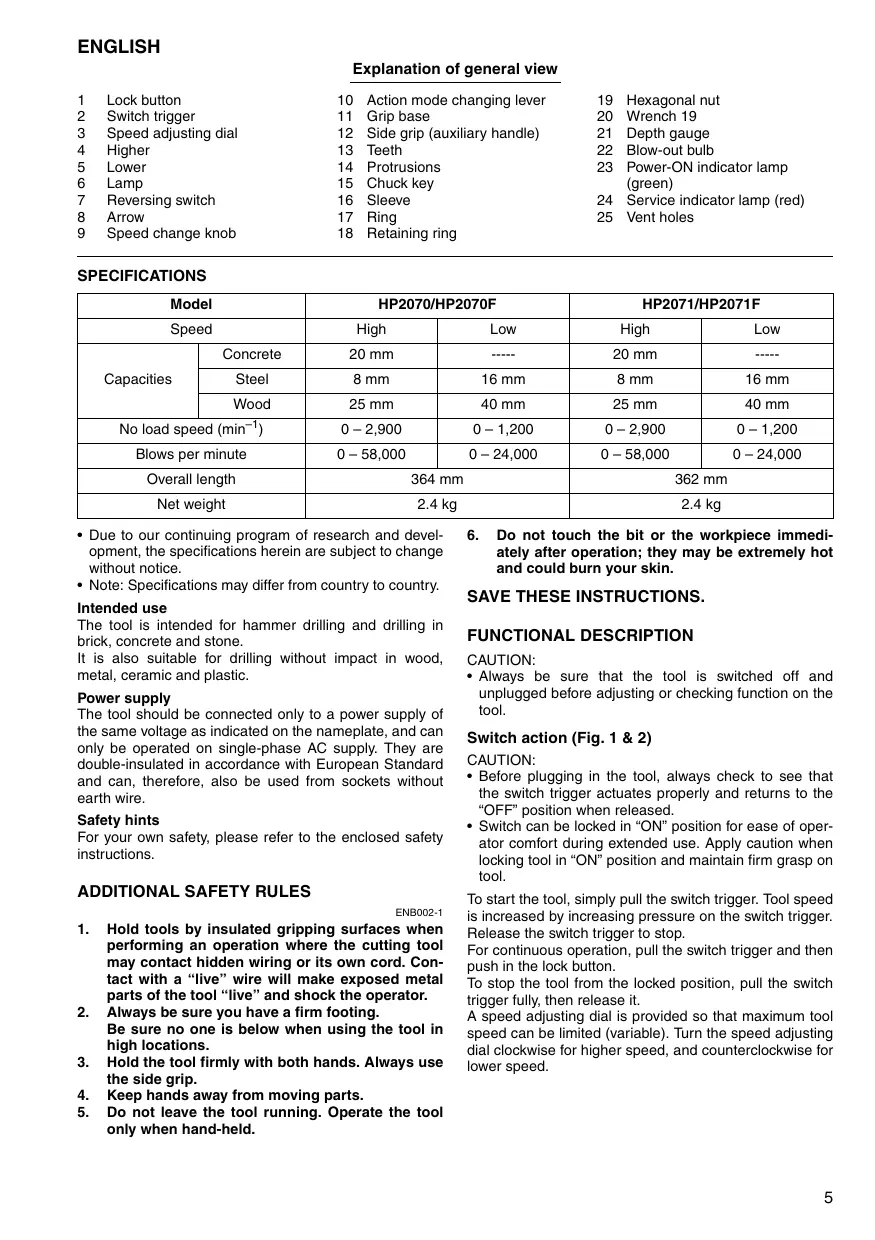
Explanation of general view
| 1 | Lock button | 10 | Action mode changing lever | 19 | Hexagonal nut |
| 2 | Switch trigger | 11 | Grip base | 20 | Wrench 19 |
| 3 | Speed adjusting dial | 12 | Side grip (auxiliary handle) | 21 | Depth gauge |
| 4 | Higher | 13 | Teeth | 22 | Blow-out bulb |
| 5 | Lower | 14 | Protrusions | 23 | Power-ON indicator lamp |
| 6 | Lamp | 15 | Chuck key | green) |
| 7 | Reversing switch | 16 | Sleeve | 24 | Service indicator lamp (red) |
| 8 | Arrow | 17 | Ring | 25 | Vent holes |
| 9 | Speed change knob | 18 | Retaining ring | | |
SPECIFICATIONS
| Model | HP2070/HP2070F | HP2071/HP2071F |
| Speed | High | Low | High | Low |
| Capacities | Concrete | 20 mm | ----- | 20 mm | ----- |
| Steel | 8 mm | 16 mm | 8 mm | 16 mm |
| Wood | 25 mm | 40 mm | 25 mm | 40 mm |
| No load speed (min-1) | 0 - 2,900 | 0 - 1,200 | 0 - 2,900 | 0 - 1,200 |
| Blows per minute | 0 - 58,000 | 0 - 24,000 | 0 - 58,000 | 0 - 24,000 |
| Overall length | 364 mm | 362 mm |
| Net weight | 2.4 kg | 2.4 kg |
- Due to our continuing program of research and development, the specifications herein are subject to change without notice.
Note: Specifications may differ from country to country.
Intended use
The tool is intended for hammer drilling and drilling in brick, concrete and stone.
It is also suitable for drilling without impact in wood, metal, ceramic and plastic.
Power supply
The tool should be connected only to a power supply of the same voltage as indicated on the nameplate, and can only be operated on single-phase AC supply. They are double-insulated in accordance with European Standard and can, therefore, also be used from sockets without earth wire.
Safety hints
For your own safety, please refer to the enclosed safety instructions.
ADDITIONAL SAFETY RULES
ENB002-1
- Hold tools by insulated gripping surfaces when performing an operation where the cutting tool may contact hidden wiring or its own cord. Contact with a "live" wire will make exposed metal parts of the tool "live" and shock the operator.
- Always be sure you have a firm footing. Be sure no one is below when using the tool in high locations.
- Hold the tool firmly with both hands. Always use the side grip.
- Keep hands away from moving parts.
-
Do not leave the tool running. Operate the tool only when hand-held.
-
Do not touch the bit or the workpiece immediately after operation; they may be extremely hot and could burn your skin.
SAVE THESE INSTRUCTIONS.
FUNCTIONAL DESCRIPTION
CAUTION:
Always be sure that the tool is switched off and unplugged before adjusting or checking function on the tool.
Switch action (Fig. 1 & 2)
CAUTION:
- Before plugging in the tool, always check to see that the switch trigger actuates properly and returns to the "OFF" position when released.
- Switch can be locked in "ON" position for ease of operator comfort during extended use. Apply caution when locking tool in "ON" position and maintain firm grasp on tool.
To start the tool, simply pull the switch trigger. Tool speed is increased by increasing pressure on the switch trigger. Release the switch trigger to stop.
For continuous operation, pull the switch trigger and then push in the lock button.
To stop the tool from the locked position, pull the switch trigger fully, then release it.
A speed adjusting dial is provided so that maximum tool speed can be limited (variable). Turn the speed adjusting dial clockwise for higher speed, and counterclockwise for lower speed.
Lighting up the lamps (Fig. 3)
For Model HP2070F, HP2071F
CAUTION:
- Do not look in the light or see the source of light directly.
To turn on the lamp, pull the trigger. Release the trigger to turn it off.
NOTE:
- Use a dry cloth to wipe the dirt off the lens of lamp. Be careful not to scratch the lens of lamp, or it may lower the illumination.
Reversing switch action (Fig. 4)
This tool has a reversing switch to change the direction of rotation. Move the reversing switch to the position (A side) for clockwise rotation or the position (B side) for counterclockwise rotation.
CAUTION:
- Always check the direction of rotation before operation.
- Use the reversing switch only after the tool comes to a complete stop. Changing the direction of rotation before the tool stops may damage the tool.
- If the switch trigger can not be depressed, check to see that the reversing switch is fully set to position (A side) or (B side).
Speed change (Fig. 5)
Two speed ranges can be preselected with the speed change knob.
To change the speed, turn the speed change knob so that the arrow on the tool body points toward the "I" position on the knob for low speed or "II" position for high speed.
If it is hard to turn the knob, first turn the chuck slightly in either direction and then turn the knob again.
CAUTION:
- Use the speed change knob only after the tool comes to a complete stop. Changing the tool speed before the tool stops may damage the tool.
- Always set the speed change knob to the correct position. If you operate the tool with the speed change knob positioned halfway between the "I" and "II" position, the tool may be damaged.
Selecting the action mode (Fig. 6)
This tool has an action mode change lever. For rotation with hammering, slide the action mode change lever to the right (Y symbol). For rotation only, slide the action mode change lever to the left (X symbol).
CAUTION:
- Always slide the action mode change lever all the way to your desired mode position. If you operate the tool with the lever positioned halfway between the mode symbols, the tool may be damaged.
ASSEMBLY
CAUTION:
Always be sure that the tool is switched off and unplugged before carrying out any work on the tool.
Installing side grip (auxiliary handle) (Fig. 7)
Always use the side grip to ensure operating safety. Install the side grip so that the teeth on the grip fit in between the protrusions on the tool barrel.
Then tighten the grip by turning clockwise at the desired position. It may be swung 360^ so as to be secured at any position.
Installing or removing drill bit
For Model HP2070,HP2070F (Fig.8)
To install the bit, place it in the chuck as far as it will go. Tighten the chuck by hand. Place the chuck key in each of the three holes and tighten clockwise. Be sure to tighten all three chuck holes evenly.
To remove the bit, turn the chuck key counterclockwise in just one hole, then loosen the chuck by hand.
After using the chuck key, be sure to return to the original position.
For Model HP2071,HP2071F (Fig.9)
Hold the ring and turn the sleeve counterclockwise to open the chuck jaws. Place the bit in the chuck as far as it will go. Hold the ring firmly and turn the sleeve clockwise to tighten the chuck.
To remove the bit, hold the ring and turn the sleeve counterclockwise.
NOTE:
-
If the keyless drill chuck cannot be loosened because of a drill bit being caught inside the jaws of the chuck, loosen the drill chuck as follows.
-
Hold the sleeve of the drill chuck firmly with water pump pliers or the like (Note: Do not hold the retaining ring portion.)
- Place the wrench 19, adjustable wrench or one of other appropriate wrenches on the hexagonal nut at the front of the drill chuck. Turn the wrench clockwise as shown in the Fig. 10 to loosen the drill chuck.
Depth gauge (Fig. 11)
The depth gauge is convenient for drilling holes of uniform depth. Loosen the side grip and insert the depth gauge into the hole in the side grip. Adjust the depth gauge to the desired depth and tighten the side grip.
NOTE:
- The depth gauge cannot be used at the position where the depth gauge strikes against the tool body.
OPERATION
Hammer drilling operation
CAUTION:
- There is a tremendous and sudden twisting force exerted on the tool/bit at the time of hole breakthrough, when the hole becomes clogged with chips and particles, or when striking reinforcing rods embedded in the concrete. Always use the side grip (auxiliary handle) and firmly hold the tool by both side grip and switch handle during operations. Failure to do so may result in the loss of control of the tool and potentially severe injury.
When drilling in concrete, granite, tile, etc., move the action mode changing lever to the position of symbol to use "rotation with hammering" action.
Be sure to use a tungsten-carbide tipped bit.
Position the bit at the desired location for the hole, then pull the switch trigger. Do not force the tool. Light pressure gives best results. Keep the tool in position and prevent it from slipping away from the hole.
Do not apply more pressure when the hole becomes clogged with chips or particles. Instead, run the tool at an idle, then remove the bit partially from the hole. By repeating this several times, the hole will be cleaned out and normal drilling may be resumed.
Blow-out bulb (optional accessory) (Fig. 12)
After drilling the hole, use the blow-out bulb to clean the dust out of the hole.
Drilling operation
When drilling in wood, metal or plastic materials, move the action mode changing lever to the position of symbol to use "rotation only" action.
Drilling in wood
When drilling in wood, the best results are obtained with wood drills equipped with a guide screw. The guide screw makes drilling easier by pulling the bit into the workpiece.
To prevent the bit from slipping when starting a hole, make an indentation with a center-punch and hammer at the point to be drilled. Place the point of the bit in the indentation and start drilling.
Use a cutting lubricant when drilling metals. The exceptions are iron and brass which should be drilled dry.
CAUTION:
- Pressing excessively on the tool will not speed up the drilling. In fact, this excessive pressure will only serve to damage the tip of your bit, decrease the tool performance and shorten the service life of the tool.
- There is a tremendous force exerted on the tool/bit at the time of hole break through. Hold the tool firmly and exert care when the bit begins to break through the workpiece.
- A stuck bit can be removed simply by setting the reversing switch to reverse rotation in order to back out. However, the tool may back out abruptly if you do not hold it firmly.
- Always secure small workpieces in a vise or similar hold-down device.
When drilling in wood, metal or plastic materials, turn the action mode changing lever to the position of symbol to use "rotation only" action.
MAINTENANCE
CAUTION:
Always be sure that the tool is switched off and unplugged before attempting to perform inspection or maintenance.
Indicator lamp (Fig. 13)
The green power-ON indicator lamp lights up when the tool is switched ON. If the indicator lamp is lit but the tool does not start, the carbon brushes may be worn out, or the electric circuit or the motor may be defective. If the indicator lamp does not light up and the tool does not start, the ON/OFF switch or the mains cord may be defective.
The red service indicator lamp lights up when the tool is excessively loaded. Continued operation under such a condition will result in a failure or breakage of the tool.
At this time, cool down the tool by running the tool under no load.
Cleaning vent holes (Fig. 14 & 15)
The tool and its air vents have to be kept clean. Regularly clean the tool's air vents or whenever the vents start to become obstructed.
To maintain product SAFETY and RELIABILITY, repairs, carbon brush inspection and replacement, any other maintenance or adjustment should be performed by Makita Authorized Service Centers, always using Makita replacement parts.
ACCESSIONS
CAUTION:
- These accessories or attachments are recommended for use with your Makita tool specified in this manual. The use of any other accessories or attachments might present a risk of injury to persons. Only use accessory or attachment for its stated purpose.
If you need any assistance for more details regarding these accessories, ask your local Makita service center.
Tungsten-carbide tipped hammer bit
Hole saws
- Blow-out bulb
- Safety goggles
Keyless drill chuck 13
- Chuck key
Grip assembly
- Depth gauge
- Plastic carrying case
Descriptif
Modelli HP2070F, HP2071F
ATTENZIONE:
Modelli HP2070,HP2070F (Fig.8)
Acender as lampadas (Fig. 3)
Para Modelo HP2070F,HP2071F
PRECAUÇA:
For Model HP2070F, HP2071F
FORSIGTIG:
- Se/DDirekte pà lyset aller lyskilden.
For Model HP2070,HP2070F (Fig.8)
For Model HP2071,HP2071F (Fig.9)
Hold på ringen og drej muffen mod uret for at abne patronens kæber. Sæt boret helt ind i borepatronen. Hold ringen fast, og drej muffen med uret for at stramme patronen til.
Malli HP2070F, HP2071F
VARO:
We declare under our sole responsibility that this product is in compliance with the following standards of standardized documents, HD400, EN50144, EN55014, EN61000
in accordance with Council Directives, 73/23/EEC, 89/336/EEC and 98/37/EC.
FRANÇAISE
HD400, EN50144, EN55014, EN61000.
ITALIANO
de accordo com as directivas 73/23/CEE, 89/336/CEE e 98/37/CE do Conselho.
DANSK
Michigan Drive, Tongwell, Milton Keynes,
Bucks MK15 8JD, ENGLAND
ENGLISH
Noise and Vibration
The typical A-weighted noise levels are
sound pressure level: 97 dB (A)
sound power level: 110 dB (A)
The typical weighted root mean square acceleration value is 9m / s^2
FRANÇAISE
Bruit et vibrations