
ARMONIA - MANUAL 2 - Coffee machine SAECO - Free user manual and instructions
Find the device manual for free ARMONIA - MANUAL 2 SAECO in PDF.
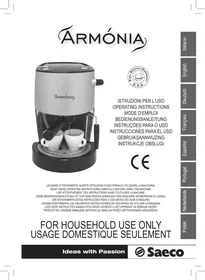


| Product type | Espresso coffee machine |
| Brand | SAECO |
| Model | ARMONIA - MANUAL 2 |
| Dimensions (L x H x D) | 220 x 300 x 270 mm |
| Weight | 4 kg |
| Water tank capacity | 1 liter |
| Pump pressure | 15 bars |
| Boiler | Stainless steel |
| Chassis material | Thermoplastic |
| Power supply | 230 V ~ 50 Hz |
| Nominal power | 1200 W |
| Coffee types | Ground coffee and pods |
| Additional functions | Hot water dispenser, steam for cappuccino |
| Included accessories | Crema filter holder, coffee scoop, pod adapter, pod filter |
| Safety devices | Boiler safety valve, manual reset thermostat |
| Cleaning | Removable drip tray with level indicator |
| Steam wand | Swivel Pannarello for cappuccino |
Frequently Asked Questions - ARMONIA - MANUAL 2 SAECO
User questions about ARMONIA - MANUAL 2 SAECO
0 question about this device. Answer the ones you know or ask your own.
Ask a new question about this device
Download the instructions for your Coffee machine in PDF format for free! Find your manual ARMONIA - MANUAL 2 - SAECO and take your electronic device back in hand. On this page are published all the documents necessary for the use of your device. ARMONIA - MANUAL 2 by SAECO.
USER MANUAL ARMONIA - MANUAL 2 SAECO
CE 73/23, CE 89/336, CE 92/31, CE 93/68.
Gaggio Montano
05/07/2007
IMPORTANT SAFEGUARDS
When using electrical appliances, basic safety precautions should always be followed, including the following:
- Read all instructions.
- Do not touch hot surfaces. Use handles or knobs.
- To protect against fire, electric shock and injury to person do not immerse cord, plugs, or machine in water or other liquid.
- Close supervision is necessary when the appliance is used by or near children.
- Unplug from outlet when not in use and before cleaning. Allow to cool before putting on or taking off parts, and before cleaning the appliance.
- Do not operate any appliance with a damaged cord or plug or after the appliance malfunctions, or has been damaged in any manner. Return appliance to the nearest authorized service facility for examination, repair or adjustment.
- The use accessory attachments not recommended by the appliance manufacturer may result in fire, electric shock or injury to persons.
- Do not use outdoors.
- Do not let cords hang over edge of table or counter, or touch hot surfaces.
- Do not place on or near a hot gas or electric burner, or in a heated oven.
- Always attach plug to appliance first, then plug cord into wall outlet. To disconnect, turn any control to "off", then remove plug from wall outlet.
- Do not use appliance for other than intended use. 13. Save these instructions.
SAVE THESE INSTRUCTIONS
INSTRUCTIONS FOR THE POWER SUPPLY CORD
A. A short power-supply cord (or detachable power-supply cord) is to be provided to reduce risks resulting from becoming entangled in or tripping over a longer cord. B. Longer detachable power-supply cords or extension cords are available and may be used if care is exercised in their use. C. If a long detachable power-supply cord or extension cord is used,
- The marked electrical rating of the detachable power-supply cord or extension cord should be at least as great as the electrical rating of the appliance
- If the appliance is of the grounded type, the extension cord should be a grounding-type 3-wire cord, and
- The longer cord should be arranged so that it will not drape over the counter top or table top where it can be pulled on by children or tripped over.
1 GENERAL INFORMATION
The coffee machine is ideal for brewing 1 or 2 cups of espresso coffee and it is equipped with a swivel steam and hot water wand. The controls on the top of machine are labeled with easy-to-read symbols. The machine has been designed for domestic use and is not suitable for professional, continuous use.

Warning. No liability is held for damage caused by:
Incorrect use not in accordance with the intended purposes; - Repairs not carried out in authorized service centers; Tampering with the power cord; Tampering with any part of the machine; Use of non-original spare parts and accessories; - Failure to descale the machine and storage at temperatures below 0°C / 32°F .
In these cases, the warranty will be invalidated.
1.1 Reading the Manual


The warning triangle indicates the instructions that are important for user's safety. Please carefully
Follow these instructions to avoid serious injury!
References to illustrations, parts of the appliance or controls, etc. are indicated by numbers or letters. Whenever possible, refer to the illustration.

This symbol is used to highlight information that is particularly important to ensure optimal use of the machine.
The illustrations corresponding to the text can be found on the first pages of the manual. Please refer to these pages while reading the operating instructions.
1.2 How to use these Operating Instructions
Keep these operating instructions in a safe place and make them available to anyone who may use the coffee machine.
For further information or in case of problems, please refer to an authorized service center.
2 TECHNICAL SPECIFICATIONS
The manufacturer reserves the right to make changes to the technical specifications of the product.
Nominal Voltage - Power rating - Power supply: See label on the appliance
Housing: Thermoplastic material
Size (w x h x d): 220 x 300 x 270 mm / 8.7 x 11.8 x 10.6 in
Weight: 4 kg / 8.8 lb
Cord length: 1.2 m / 47.2 in
Control panel: top panel
Pressurized portafilter for optimal crema
Pannarello wand for making cappuccino
Water tank 1 lt / 33.8 oz (removable)
Pump pressure 15 bar
Stainless steel boiler
Safety devices: boiler pressure safety valve, manual reset thermostat
3 SAFETY REGULATIONS

Do not put live parts in contact with water: Danger of short circuit! Steam and hot water may cause scalding! Do not direct the steam or hot water jet towards body parts. Handle the steam/hot water spout with care: Danger of scalding!
Intended Use of the Machine
The coffee machine is intended for domestic use only. Do not make any technical changes or use the machine for unlawful purposes since this would create serious hazards! The appliance is not for use by persons (including children) with reduced physical, mental or sensory abilities or with scarce experience and/or competences, unless they are supervised by a person responsible for their safety or they are instructed by him/her to use the machine.
Power Supply
Only connect the coffee machine to a suitable socket. The voltage must correspond to the indication on the machine's label.
Power Cord
Never use the coffee machine if the power cord is defective. If damaged, the power cable must be replaced by the manufacturer or its customer service department. Do not pass the cable around corners, over sharp edges or over hot objects and keep it away from oil. Do not use the power cord to carry or pull the coffee machine. Do not pull out the plug by the power cord or touch it with wet hands.
Do not let the power cord hang freely from tables or shelves.
Personal Safety Guidelines
Make sure that the coffee machine is out of children's reach.
Children are not aware of the risks linked with electrical appliances. Do not leave the coffee machine packaging within the reach of children.
Danger of Burns
Never direct the jet of hot steam and/or hot water towards yourself or others. Always use the handles or knobs provided.
Do not remove the portafilter during coffee brewing. Hot water drips may spill out of the coffee brew unit during the warming phase.
Machine Location
Place the coffee machine in a safe place, where no danger of overturning or injury can be caused. Hot water or steam may spill out: Danger of scalding! Do not keep the machine at a temperature below 0°C / 32°F . Frost may damage the machine. Do not use the coffee machine outdoors. Do not place the machine on very hot surfaces and close to open flames in order to prevent its housing from melting or being damaged.
Cleaning the Machine
Before cleaning the machine, you must deselect all buttons and remove the plug from the socket. Wait for the machine to cool down. Never immerse the machine in water!
It is strictly forbidden to tamper with the internal parts of the machine.
Water left in the tank for several days should not be consumed. Wash the tank and fill it with fresh drinking water.
Suitable Location for Operation and Maintenance
To ensure the machine's best performance, we recommend checking the following:
- Choose a level surface;
- Choose a location that is sufficiently well-lit, clean and near an easily reachable socket;
- Provide for a minimum distance from the sides of the machine as shown in fig. A.
Storing the Machine
In case of inactivity of the machine for an extended period of time, switch it off and unplug it from the socket. Store it in a dry place and out of the reach of children. Keep it protected from dust and dirt.
Servicing / Maintenance
In case of failure, problems or a fault resulting from a suspected fall of the machine, you should immediately remove the plug from the socket. Never attempt to operate a faulty machine. Servicing and repairs may only be carried out by authorized service centers. All liability for damage resulting from work not carried out by professionals is declined.
Fire Safety Precautions
In case of fire, use carbon dioxide (CO2) extinguishers. Do not use water or dry powder extinguishers.
Key to machine components (Page 2)
1 Water tank 2 Power button 3 Power light 4 Brew button 5 Machine ready light 6 Steam button 7 Hot water / steam knob 8 Brew unit 9 Steam wand (Pannarello frother) 10 Power cord 11 Drip tray + grill 12 Full tray indicator 13 Cup stacking surface 14 Portafilter 15 Ground coffee filter basket (for one or two coffees) Ground coffee measuring scoop 17 Pod adapter 18 Pod filter
4 MACHINE INSTALLATION
For your safety and that of others, follow the "Safety Regulations" in section 3 carefully.
4.1 Packaging
The machine's original packaging has been designed to protect it during transportation. We recommend keeping the packaging carton for possible future transportation.
4.2 Installation Instructions
Before installing the machine, read the following safety instructions carefully.
- Place the machine in a safe place;
- Make sure children cannot play with the machine;
- Do not place the machine on hot surfaces or near open flames.
The coffee machine is now ready to be connected to the power supply.
4.3 Machine Connection
Electric power may be very dangerous! It is therefore necessary that the safety regulations be carefully respected. Do not use faulty power cords! Faulty cords and plugs must be replaced immediately in authorized customer service centers.
The voltage of the appliance has been pre-set by the manufacturer. Check that the voltage matches the references on the label, at the bottom of the appliance.
- Make sure that the power button (2) is not pressed before connecting the machine to the power supply.
- (Fig.4A) - Insert the plug into the socket on the back of the machine.
- Insert the plug of the other end of the cable into a wall socket with suitable power voltage.
4.4 Water Tank
- (Fig.1) - Remove the water tank (1). Be careful not to damage the water suction tube.
- (Fig.2) - Rinse and fill it with fresh drinking water, taking care not to overfill it.
- (Fig.3) - Re-insert the tank into its seat and re-position the water suction tube.
Fill the tank with only fresh, non-sparkling, drinking water. Hot water or any other liquid may damage the tank. Do not switch on the machine with an empty tank: Make sure there is enough water in the tank.
4.5 Priming the Water Circuit
Before starting up the machine, after a long period of inactivity and whenever the tank is empty, the machine's water circuit must be primed.
- (Fig.4B) - Press the power button (2). The power light (3) will turn on.
- (Fig.5) - Place a container under the steam spout. Open the hot water/steam knob (7) by turning it counterclockwise.
- (Fig.6) - Press the brew button (4).
- Wait until a steady jet of water flows out of the steam spout (Pannarello).
- Press the brew button (4) again. Close the hot water/steam knob (7) by turning it clockwise (Fig.7). Remove the container.
The machine is now ready to brew coffee and dispense steam. Please see related sections for operating details.
5 COFFEE BREWING
Warning! Never remove the portafilter by manually turning it clockwise while coffee is brewing. Danger of burns.
- During this operation the machine ready light (5) may flash. This should be considered normal.
- Before using the machine, make sure that the hot water/steam knob (7) is closed and that there is enough water in the tank.
- (Fig.4B) - If the machine is off, switch it on by means of the power button (2). The power light (3) will illuminate.
- Wait until the machine ready light (5) comes on. The machine is now ready to brew coffee.
5.1 Using Ground Coffee
- (Fig. 8A) - Insert the ground coffee filter basket (15) into the portafilter (14).
- (Fig. 10) - Insert the portafilter into the brew unit from the bottom (8).
- (Fig.11) - Turn the portafilter to the right, until it locks into place. Release the portafilter grip. The handle will slightly turn to the left. This movement ensures the portafilter's performance.
- (Fig.13) - Preheat the portafilter by pressing the brew button (4) until some water pours out of the portafilter. This operation is only necessary for the first coffee. After some water has flowed out, press the brew button (4) again to stop hot water dispensing.
- (Fig.15) - Remove the portafilter from the machine by turning it from right to left and drain any water remaining in the portafilter. As the machine is fitted with the special portafilter (14), there is no need to change the filter when making one or two coffees.
- (Fig.8B)- Add 1 or 2 scoops of ground coffee to the filter for one or two coffees, respectively. Clean any coffee residues from the edge of the portafilter.
- (Fig.10) - Insert the portafilter (14) into the brew unit from the bottom (8).
- (Fig.11) - Turn the portafilter to the right, until it locks into place.
- (Fig.12) - Take 1 or 2 preheated cups and place them under the portafilter; check that they are correctly placed under the coffee brewing spouts.
- (Fig. 13) - Press the brew button (4).
- When the desired quantity of coffee has been reached,
press the brew button again (4) to stop the coffee brewing and remove the cups of coffee (Fig. 14).
- (Fig.15) - Wait a few seconds after brewing, then remove the portafilter and empty the coffee grounds.

Note: If a small quantity of water remains in the portafilter; this is normal and is due to the filter features.

Note for cleaning: Keep the ground coffee filter basket clean by removing it from the portafilter; rinse it with running water (see Fig. 16).
5.2 Using Coffee Pods
- (Fig.8A) - Remove the ground coffee filter (15) from the portafilter (14) by pulling it upwards.
- (Fig.9) - Insert the rubber pod adapter (17) - with its convex part facing down - into the portafilter (14). Then insert the pod filter (18).
- (Fig.10) - Insert the portafilter into the brew unit from the bottom (8).
- (Fig.11) - Turn the portafilter to the right until it locks into place.
- Release the grip from the portafilter. The handle is automatically slightly turned leftwards.
This movement ensures the portafilter's performance.
- (Fig.13) - Preheat the portafilter by pressing the brew button (4) until some water pours out of the portafilter. This operation is only necessary for the first coffee. After some water has flowed out, press the brew button (4) again to stop hot water dispensing.
- (Fig.15) - Remove the portafilter from the machine, by turning it from right to left and drain the rest of the water.
- Insert single-partion pod into the portafilter; make sure that the paper of the pod does not stick out of the portafilter.
- (Fig.10) - Insert the portafilter into the brew unit from the bottom (8).
- (Fig.11) - Turn the portafilter to the right until it locks into place.
- (Fig.12) - Take one preheated cup and place it under the portafilter. Check that it is correctly placed under the coffee brewing spouts. (Fig. 13) - Press the brew button (4).
- When the desired quantity of coffee has been reached, press the brew button again (4) to stop brewing and remove the cup of coffee (Fig. 14).
- (Fig.15) - Wait a few seconds after brewing, then remove the portafilter and dispose of the used pod.

Note for cleaning: Keep the pod filter clean by removing it from the portafilter; then wash it with warm water (see Fig. 16).
6 TIPS FOR CHOOSING COFFEE
As a general rule, any type of coffee available on the market can be used. However, coffee is a natural product, and its flavour changes according to its origin and blend. Therefore, it is a good idea to try different types of coffee in order to find the most suited to your personal taste. For best results, we recommend using blends which are made especially for espresso coffee machines. Coffee should always flow out of the portafilter, and it should not dispense with a dripping effect. The brewing speed can be modified by slightly changing the amount of coffee in the filter and/or using a different coffee grind.
When making coffee from pods, Saeco recommends using single-dose coffee pods marked E.S.E. for a great-tasting espresso and an easy clean-up.


Danger of burns! Brewing may be preceded by small jets of hot water. The spout can reach high temperatures: Never touch it with bare hands.
- (Fig.4B) - If the machine is off, switch it on by means of the power button (2). The power light (3) will illuminate.
- Wait until the machine ready light (5) turns on.
- (Fig.17) - Place a container or a cup under the steam spout (Pannarello). Open the knob (7).
- (Fig. 18) - Press the brew button (4).
- When the desired amount of hot water has been dispensed, press the brew button (4) again.
- (Fig.19) - Close the knob (7), then remove the hot water container.
8 STEAM/CAPPUCCINO

Danger of burns! Brewing may be preceded by small jets of hot water. The spout can reach high temperatures: Never touch it with bare hands.
- (Fig.4B) - If the machine is off, switch it on by means of the power button (2). The power light (3) will illuminate.
- Wait until the machine ready light (5) turns on.
- (Fig.20) - Press the steam button (6). The machine ready light (5) turns off.
- Wait until the machine ready light (5) turns on again. The machine is now ready to dispense steam.
- (Fig.17) - Insert a container below the steam spout and open the knob (7) for a few seconds, so that any residual water flows out of the steam spout (Pannarello). Wait until there is a steady jet of steam coming out of the spout. (Fig.19) - Close the knob (7) and remove the container.
- Fill 1/3 of a frothing pitcher or large mug with cold milk.
i Use cold milk to get better results when frothing. Milk with higher fat content will produce thicker froth.
- (Fig.21) - Immerse the Pannarello spout in the milk and open the knob (7). Rotate the container with slow upward movements so that it warms evenly.
- (Fig.22) - After frothing the milk, close the knob (7), and remove the pitcher/cup with frothed milk. (Fig.20) - Press the steam button (6) again.
- Prime the circuit as described in section 4.5 to make the machine ready for use.
The same procedure can be used to heat other beverages.
- (Fig.23) - After steaming/frothing, clean the steam spout thoroughly with a wet cloth, as described in the following section.
9 CLEANING THE MACHINE
Maintenance and cleaning can only be carried out when the machine is cold and disconnected from the power supply.
- Do not immerse the machine in water or place any of its parts in a dishwasher.
- Do not use alcohol-based cleansers, solvents and/or aggressive chemical agents. We recommend cleaning the water tank and refilling it with fresh water daily.
- (Fig.23) - After frothing milk, dispense a small quantity of hot water to clean the inside of the steam spout. Use a soft, dampened cloth to clean the outside of the Pannarello frother.
- (Fig.24) - Empty and clean the drip tray daily.
- Use a soft, dampened cloth to clean the appliance. (Fig.16) - To clean the portafilter proceed as follows:
- Remove the filter, wash it thoroughly with hot water.
- Wash the inside of the portafilter thoroughly with running water.
- Do not dry the machine and/or its components using a microwave and/or conventional oven.
10 DESCALING THE MACHINE
Limescale is a result of mineral deposits from water.
This normally builds up with the use of the appliance.
Descaling is necessary every 2-3 working months and/or when you notice any reduction in water flow.
You can use a non-toxic and/or non-harmful descaling product for coffee machines, commonly available in retail stores. We recommend using Saeco descaling solution.
Warning! Do not use vinegar or lemon juice as a descaler.
- Remove and empty the water tank.
- (Fig.2) - Mix the descaling solution with water as specified on the packet of solution, and fill the water tank. Fit the tank into the machine.
- (Fig.4B) - Switch on the machine by pressing the power button (2).
- (Fig.5) - Place a container under the steam spout.
- Open the knob (7) and press the brew button (4) to dispense water at intervals (one cup at a time). Press the button (4) again to stop brewing, then close the knob (7).
- (Fig.4B) - During each interval allow the descaling solution to sit for about 10-15 minutes, switching off the machine by means of the power button (2). Empty the container.
- (Fig.2) - When the descaling solution is finished, remove the water tank, rinse and fill it with fresh drinking water.
- (Fig.3; Fig.5) - Re-insert the tank into its housing. Open the knob (7) and press the button (4) to empty 2/3 of the water. Press the brew button (4) again and close the steam knob (7) clockwise to stop dispensing.
- Let the machine warm up and empty the water tank as described above.
If you are using a descaling product other than the one recommended, it is important that you carefully follow the manufacturer's instructions detailed on the package of the descaling product.
11 MACHINE DISPOSAL
- Put unused appliances out of service.
- Disconnect the plug from the socket and cut the electrical cord.
- At the end of its life, take the appliance to a suitable waste collection site.
This product complies with EU Directive 2002/96/EC.

The symbol on the product or on its packaging indicates that this product may not be treated as household waste. Instead it shall be handed over to the applicable collection point for the recycling of electrical and electronic equipment.
By ensuring this product is disposed of correctly, you will
help prevent potential negative consequences for the environment and human health, which could otherwise be caused by inappropriate waste handling of this product. For more detailed information about recycling
of this product, please contact your local city office, your household waste disposal service or the shop where you purchased the product.
| Problem | Possible cause | Solution |
| The machine does not switch on. | The machine is not connected to the power supply. | Connect the machine to the power supply. |
| The pump is very noisy. | There is no water in the tank. | Refill with water (section 4.4). |
| The coffee is too cold. | The machine ready light (5) was off when the brew button was pressed (4). | Wait until the machine ready light turns on. |
| The portafilter was not preheated (section 5). | Preheat the portafilter. | |
| The cups are too cold. | Preheat the cups with hot water. | |
| The milk does not froth. | The milk is not suitable: powdered milk or low-fat milk has been used. | Use only cold, whole milk. |
| It is not possible to prepare a cappuccino. | The Pannarello and/or steam spout is dirty. | Clean the Pannarello as described in section 9. |
| There is no steam left in the boiler. | Prime the circuit (section 4.5) and repeat the procedure described in section 8. | |
| The coffee is brewed too fast, crema does not form. | There is not enough coffee in the portafilter. | Add coffee (section 5). |
| The grind is too coarse. | Use a different blend or a finer grind of coffee (section 6). | |
| The coffee is old or not suitable. | Use a different blend (section 6). | |
| The pod is old or not suitable. | Use a different, single-dose pod. | |
| Coffee is not brewed or brewed in drips only. | The water tank is empty. | Refill with water (section 4.4). |
| The grind is too fine. | Use a different blend (section 6). | |
| Coffee has been tamped or pressed in the portafilter. | Empty the portafilter and insert only 1-2 doses of coffee (without tamping). | |
| There is too much coffee in the portafilter. | Reduce the quantity of coffee in the portafilter (only 1 - 2 scoops). | |
| The hot water/steam knob (7) is open. | Close the knob (7). | |
| The machine has limescale build-up. | Descale the machine (section 10). | |
| The filter in the portafilter is clogged. | Clean the filter (section 9). | |
| The pod is not suitable (double-dose). | Change the type of pod; use a single-dose pod only (section 6). | |
| Coffee flows out of the edges. | The portafilter is incorrectly inserted in the brew unit. | Insert the portafilter correctly (section 5). |
| The upper edge of the portafilter is dirty. | Clean the edge of the portafilter. | |
| The pod is inserted incorrectly. | Insert the pod correctly. Make sure it does not hang over the edge of the portafilter. | |
| There is too much coffee in the portafilter. | Reduce the quantity of coffee using the measuring scoop (use only 1-2 scoops). |
Please contact an authorized service center for any problems not covered in the above table or when the suggested solutions do not solve the problem.
For assistance in the U.S. or Canada, contact Saeco Customer Service at 1-800-933-7876 (U.S.) or 1-514-385-5551 (Canada).
EC DECLARATION OF CONFORMITY
EC 2006/95, EC 2004/118
EC 1992/31, EC 1993/68
We :
Saeco International Group
Via Torretta, 240
40041 GAGGIO MONTANO (BO)
declare under our responsibility that the product:
COFFEE MAKER
Type: SIN 24XN
to which this declaration relates is in conformity with the following standards or other normative documents:
- Safety of household and electrical appliances - General requirements EN 60335-1(2002) + A1(2004) + A2(2006) + A11(2004) + A12(2006)
- Safety of household and electrical appliances - Part 2-15 Particular requirements for appliances for heating liquids EN 60335-2-15(2002) + A1(2005)
- Household and similar electrical appliances - Electromagnetic fields - methods for evaluation and measurement EN 50366 (2003) + A1 (2006).
- Electromagnetic compatibility (EMC) - Requirements for household appliances, electric tools and similar apparatus - Part 1 Emission EN 55014-1 (2000) + A1 (2001) + A2 (2002).
- Electromagnetic compatibility (EMC) Part 3: Limits - Section 2: Limits for harmonic current emissions (equipment input current ≤ 16A per phase) - EN 61000-3-2 (2000)
- Electromagnetic compatibility (EMC) Part 3: Limits - Section 3: Limitation of voltage changes, voltage fluctuations and flicker in public low-voltage supply systems, for equipment with rated current ≤ 16 A per phase and not subject to conditional connection EN 61000-3-3 (1995) + A1 (2001)
- Electromagnetic compatibility - Requirements for household appliances, electric tools and similar apparatus - Part 2: Immunity - Product family standard EN 55014-2 (1997) + A1 (2001)
following the provisions of the Directives:
EC 73/23, EC 89/336, EC 92/31, EC 93/68.
Gaggio Montano
05/07/2007
1 GENERAL
2006/95/EC, 2004/108/EC
1992/31/EC, 1993/68/EC
We:
Saeco International Group
Via Torretta, 240
40041 GAGGIO MONTANO (BO)
73/23/EC, 89/336/EC, 92/31/EC, 93/68/EC.
Gaggio Montano
05/07/2007
IMPORTANT
EC 1992/31, EC 1993/68
We:
Saeco International Group
Via Torretta, 240
40041 GAGGIO MONTANO (BO)
CE 73/23, CE 89/336, CE 92/31, CE 93/68.
Gaggio Montano
05/07/2007
1 GENERAL INFORMATION
CE 73/23, CE 89/336, CE 92/31, CE 93/68.
Gaggio Montano
05/07/2007
1 GENERAL INFORMATION
CE 73/23, CE 89/336, CE 92/31, CE 93/68.
Gaggio Montano
05/07/2007
1 GENERAL
Material
Thermoplastic
Dimensions (W x H x D) (mm)
220 x 300 x 270
Weight
4 kg
Cable length
1.2 m
Control panel
On top
Filter holder
Crema
Pannarello
EC 73/23, EC 89/336, EC 92/31, EC 93/68.
Gaggio Montano
05/07/2007
1 GENERAL INFORMATION
EC DECLARATION OF CONFORMITY
2006/95/EC, 2004/108/EC,
1992/31/EC, 1993/68/EC
We:
Saeco International Group
Via Torretta, 240
40041 GAGGIO MONTANO (BO)
EC 73/23, EC 89/336, EC 92/31, EC 93/68.
Gaggio Montano
05/07/2007


- IMPORTANT SAFEGUARDS
- SAVE THESE INSTRUCTIONS
- INSTRUCTIONS FOR THE POWER SUPPLY CORD
- GENERAL INFORMATION
- READING THE MANUAL
- HOW TO USE THESE OPERATING INSTRUCTIONS
- TECHNICAL SPECIFICATIONS
- SAFETY REGULATIONS
- INTENDED USE OF THE MACHINE
- POWER SUPPLY
- POWER CORD
- PERSONAL SAFETY GUIDELINES
- DANGER OF BURNS
- MACHINE LOCATION
- CLEANING THE MACHINE
- SUITABLE LOCATION FOR OPERATION AND MAINTENANCE
- STORING THE MACHINE
- SERVICING / MAINTENANCE
- FIRE SAFETY PRECAUTIONS
- KEY TO MACHINE COMPONENTS (PAGE 2)
- MACHINE INSTALLATION
- PACKAGING
- INSTALLATION INSTRUCTIONS
- MACHINE CONNECTION
- WATER TANK
- PRIMING THE WATER CIRCUIT
- COFFEE BREWING
- USING GROUND COFFEE
- USING COFFEE PODS
- TIPS FOR CHOOSING COFFEE
- STEAM/CAPPUCCINO
- I USE COLD MILK TO GET BETTER RESULTS WHEN FROTHING. MILK WITH HIGHER FAT CONTENT WILL PRODUCE THICKER FROTH
- THE SAME PROCEDURE CAN BE USED TO HEAT OTHER BEVERAGES
- DESCALING THE MACHINE
- WARNING! DO NOT USE VINEGAR OR LEMON JUICE AS A DESCALER
- IF YOU ARE USING A DESCALING PRODUCT OTHER THAN THE ONE RECOMMENDED, IT IS IMPORTANT THAT YOU CAREFULLY FOLLOW THE MANUFACTURER'S INSTRUCTIONS DETAILED ON THE PACKAGE OF THE DESCALING PRODUCT
- MACHINE DISPOSAL
- EC DECLARATION OF CONFORMITY
- EC 2006/95, EC
- EC 1992/31, EC
- SAECO INTERNATIONAL GROUP
- VIA TORRETTA
- GAGGIO MONTANO (BO)
- COFFEE MAKER
- TYPE: SIN 24XN
- GENERAL
- EC, 2004/108/EC
- EC, 1993/68/EC
- IMPORTANT
Brand : SAECO
Model : ARMONIA - MANUAL 2
Category : Coffee machine