
NINA CAPPUCCINO - Automatic coffee machine SAECO - Free user manual and instructions
Find the device manual for free NINA CAPPUCCINO SAECO in PDF.
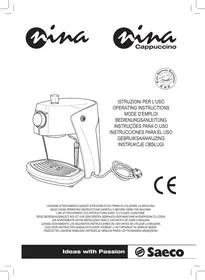



| Product type | Automatic coffee machine |
| Brand | SAECO |
| Model | NINA CAPPUCCINO |
| Chassis material | Plastic |
| Dimensions (W × H × D) | 270 × 350 × 300 mm |
| Weight | 4 kg |
| Water tank capacity | 1.5 liters (removable) |
| Pump pressure | 15 bars |
| Boiler | Stainless steel |
| Portafilter type | Pressurized |
| Pannarello (steam wand) | Yes, special for cappuccinos |
| Control panel | Front |
| Safety devices | Thermal cut-off |
| Intended use | Domestic only |
| Usable coffee types | Ground coffee and ESE pods |
| Functions | Coffee, cappuccino, steam, hot water |
| Cleaning | Daily cleaning of the tank and Pannarello |
| Descaling | Every 3-4 months with Saeco solution |
| Maintenance | Do not immerse, do not wash in dishwasher |
| Repairs | Only by authorized centers |
Frequently Asked Questions - NINA CAPPUCCINO SAECO
User questions about NINA CAPPUCCINO SAECO
0 question about this device. Answer the ones you know or ask your own.
Ask a new question about this device
Download the instructions for your Automatic coffee machine in PDF format for free! Find your manual NINA CAPPUCCINO - SAECO and take your electronic device back in hand. On this page are published all the documents necessary for the use of your device. NINA CAPPUCCINO by SAECO.
USER MANUAL NINA CAPPUCCINO SAECO
The coffee machine is ideal for brewing 1 or 2 cups of espresso coffee and is provided with a swivel steam and hot water spout. The controls on the front side of the machine are labelled with easy-to-read symbols. The machine has been designed for household use only. It is not suitable for professional, continuous use.

Warning. No liability is held for damages caused by:
- Improper and inconsistent use of the machine.
- Repairs carried out by anyone other than authorized service centres. Tampering with the power cord. Tampering with any component of the machine. Use of non-original spare parts and accessories.
- Failed descending and storage at temperatures below 0°C .
In such cases, the warranty is not valid.
1.1 To Facilitate interpretation


The warning triangle indicates the instructions that are important for user's safety. Please follow these
instructions carefully to avoid serious injury!
Illustrations, parts of the machine and control elements are referred to by numbers or letters; in this case please refer to the illustration.

This symbol emphasizes particularly important information to take into greater account for a use of the machine.
The illustrations corresponding to the text can be found on the first pages of the manual. Please refer to this page while reading the operating instructions.
1.2 How to Use These Operating Instructions
Keep these operating instructions in a safe place and make them available to anyone who may use the coffee machine.
For further information or in case of problems, please refer to any authorized service centre.
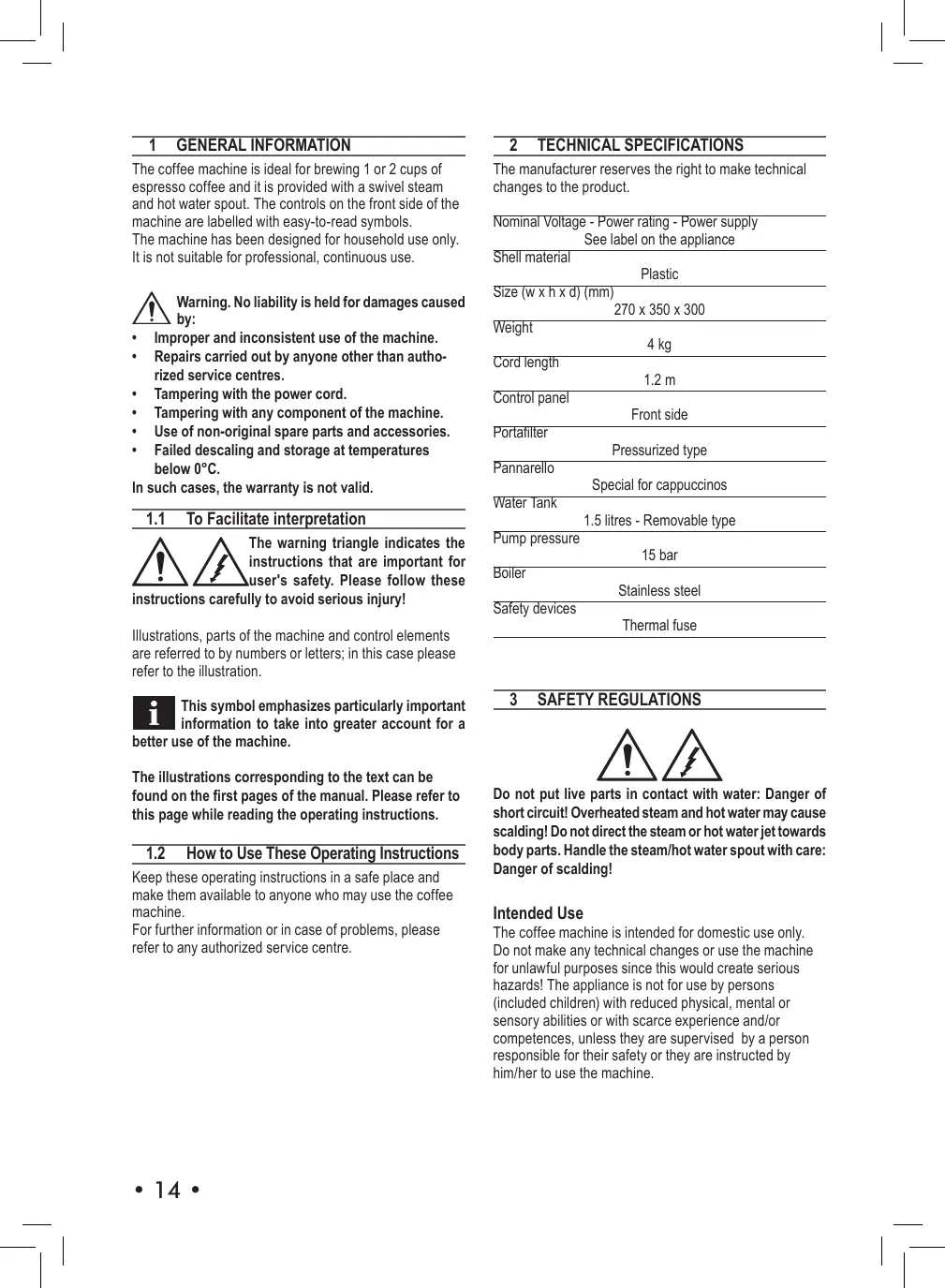
2 TECHNICAL SPECIFICATIONS
The manufacturer reserves the right to make technical changes to the product.
Nominal Voltage - Power rating - Power supply: See label on the appliance
Shell material
Plastic
Size (W x H x D) (mm)
270 x 350 x 300
Weight
4 kg
Cord length
1.2 m
Control panel
Front side
Portafilter
Pressurized type
Pannarello
Special for cappuccinos
Water Tank
1.5 liters - Removable type
Pump pressure
15 bar
Boiler
Stainless steel
Safety devices
Thermal fuse
3 SAFETY REGULATIONS

Do not put live parts in contact with water: Danger of short circuit! Overheated steam and hot water may cause scalding! Do not direct the steam or hot water jet towards body parts. Handle the steam/hot water spout with care: Danger of scalding!
Intended Use
The coffee machine is intended for domestic use only. Do not make any technical changes or use the machine for unlawful purposes since this would create serious hazards! The appliance is not for use by persons (including children) with reduced physical, mental or sensory abilities or with scarce experience and/or competences, unless they are supervised by a person responsible for their safety or they are instructed by him/her to use the machine.
Power Supply
Connect the coffee machine only to a suitable socket. The voltage must correspond to the value shown on the machine's label.
Power Cord
Do not use the coffee machine if the power cord is defective. If damaged, the power cord must be replaced by the manufacturer or its customer service centre. Do not run the cord around sharp corners and edges as well as on hot objects and keep it away from oil.
Do not use the power cord to carry or pull the coffee machine. Do not unplug the machine by pulling the power cord or touch the plug with wet hands.
Do not let the power cord hang freely from tables or shelves.
Protecting Other People
Prevent children from playing with the machine. Children are not aware of the risks stemming from household appliances. Do not leave the coffee machine packaging within the reach of children.
Danger of Burns
Do not direct the jet of overheated steam and/or hot water towards yourself or other people. Always use the special handles or knobs.
Do not disconnect (remove) the pressurized portafilter during coffee brewing. Hot water drops may spill out of the coffee brew unit during the warming up.
Location
Place the coffee machine in a safe place, where nobody may overturn it or be injured.
Hot water or overheated steam may spill out of the machine: Danger of scalding!
Do not keep the machine at a temperature below 0°C; frost may damage the machine.
Do not use the coffee machine outdoors.
Do not place the machine on very hot surfaces or near open flames to prevent its housing from melting or being damaged.
Cleaning
Before cleaning the machine, disconnect it by pressing the ON/OFF button, then pull out the plug from the socket. Wait for the machine to cool down. Do not immerse the machine in water!
It is strictly forbidden to tamper with the internal parts of the machine.
Water left in the tank for several days should not be consumed. Wash the tank and fill it with fresh drinking water.
Space for Operation and Maintenance
To ensure that the coffee machine works properly and efficiently, read the following instructions.
- Choose an even surface.
- Choose an adequately lit and clean location with a socket
within easy reach.
- Allow for a minimum distance from the sides of the machine as shown in Fig. A.
Storing the Machine
If the machine is to remain unused for a long time, turn it off and unplug it from the socket. Keep it in a dry place out of children's reach. Shelter it from dust and dirt.
Repairing / Maintenance
In case of failure, faults or a suspected fault after dropping, remove the plug from the socket immediately. Do not operate a faulty machine. Servicing and repairing should be carried out by authorized service centres only. All liability for damages caused by works not carried out in a professional manner is declined.
Fire Safety
In case of fire, use carbon dioxide (CO2) extinguishers. Do not use water or dry powder extinguishers.
Key to machine components (Page 2)
1 Control panel 2 ON/OFF button 3 Water Tank 4 Hot water/steam knob 5 Drip tray & grill 6 Coffee brew unit 7 Steam spout (Pannarello) 8 Power cord 9 Ground coffee measuring scoop 10 Pressurized portafilter 11 Ground coffee filter
(single piece for 1 or 2 coffee(s))
12 Ground coffee filter adapter 13 Brewing pin 14 Coffee pod filter 15 Coffee/Water light - "Machine ready" 16 Steam ready light 17 Selection knob 18 Cappuccinatore (optional)
4 INSTALLATION
For your and other people's safety, follow the "Safety Regulations" in section 3 carefully.
4.1 Packaging
The original packaging has been designed to protect the machine during transport. We recommend keeping the packaging for future transport.
4.2 Installation Instructions
Before installing the machine, read the following safety instructions carefully.
- Put the machine in a safe place.
- Make sure children cannot play with the machine.
- Do not place the machine on hot surfaces or near open flames.
The coffee machine is now ready to be connected to the power supply.

Note: It is recommended to wash the components before using them for the first time and/or after
they have not been used for a certain period of time.
4.3 Machine Connection

Electric power can be dangerous! It is therefore essential to follow the safety regulations
carefully. Do not use faulty cords! Faulty cords and plugs must be immediately replaced by authorized service centres.
Appliance voltage has been pre-set by the manufacturer. Make sure that the power voltage matches the indications on the identification plate on the bottom of the appliance.
- Make sure that the ON/OFF button (2) is not pressed before connecting the machine to the power supply.
- Fit the plug into a wall socket with suitable power voltage.
4.4 Water Tank
- (Fig.1) - Remove the water tank (3).
- (Fig.2) - Rinse the water tank and fill it with fresh drinking water taking care not to overfill it.
- (Fig.1) - Insert the water tank making sure that it has properly been replaced in its former seat.

Use only fresh, non-sparkling drinking water to fill the tank. Hot water, as well as any other liquid,
may damage the tank. Do not turn on the machine with an empty water tank: make sure there is enough water in the tank.
4.5 Circuit Priming
Before starting the machine after a long period of inactivity and after ejecting steam, the machine circuit needs to be primed.
(Fig.3) - Press the ON/OFF button (2). - (Fig.4) - Place a container under the steam spout. - (Fig.5) - Open the "hot water/steam" knob (4) by turning it anticlockwise. - (Fig.6) - Switch the selection knob to the "position" (17). - Wait until a steady jet of water flows out of the steam spout (Pannarello). - (Fig.6) - Switch the selection knob to the "●" position (17). - Close the "hot water/steam" knob (4) by turning it clockwise. Remove the container.
The machine is now ready to operate. Please see the related sections for coffee brewing operating details.
4.6 Drip Tray Adjustment
The drip tray can be adjusted according to the cup size.
To adjust the drip tray height, do as follows.
(Fig.24) - Lift the drip tray and remove the grill. - (Fig.25) - Remove the support under the drip tray. - (Fig.26 - 27) - Rotate the support and place it in the coffee machine. - (Fig.28) - Put the drip tray on the support and replace the grill.
5 COFFEE BREWING

Warning! During the coffee brewing, do not remove the pressurized portafilter by manually turning it clockwise. Danger of burns.
- During this operation, the "machine ready" light (15) may flash; this is to be considered a standard and not a faulty operating mode. Before using the machine, make sure that the hot water/steam knob (4) is closed and that there is enough water in the tank.
- (Fig.3) - Press the ON/OFF button (2).
- Wait until the "machine ready" light (15) turns on. The machine is now ready for coffee brewing.
5.1 Using Ground Coffee
- (Fig.7) - Insert the pin (13) into the pressurized portafilter (10).
- (Fig.8A) - Insert the adapter (12) into the pressurized portafilter (10), then insert the filter (11).
- (Fig.11) - Insert the portafilter into the brew unit from the bottom (6).
- (Fig.12) - Turn the portafilter from left to right until it locks in place.
- (Fig. 14) - Preheat the pressurized portafilter by switching the selection knob (17) to the " position until some water spills out of it. This is to be done only for the first coffee brewing.
- When 50cc of water have flowed out, switch the selection knob (17) to the "●" position in order to stop brewing.
- (Fig.16) - Remove the portafilter from the machine by turning it from right to left and drain any water left. There is no need to change the filter to make one or two coffees, since the machine is equipped with a special filter (11).
- (Fig.9A) - Add 1- 1.5 measuring scoop for single coffee and 2 measuring scoops for double coffee. Remove any coffee residues from the rim of the filter.
- (Fig.11) - Insert the portafilter (10) into the brew unit from the bottom (6).
- (Fig.12) - Turn the portafilter from left to right until it locks in place.
- (Fig.13) - Take 1 or 2 preheated cups and place them under the pressurized portafilter. Make sure that they are correctly placed under the coffee dispensing holes.
- (Fig.14) - Turn the selection knob (17) to the " position.
- When the desired quantity of coffee has been obtained, turn the selection knob (17) to the "●" position in order to stop coffee brewing. Wait a few second after brewing has stopped, then remove the cups of coffee (Fig. 15).
- (Fig.16) - Remove the pressurized portafilter and empty the remaining coffee residues.
i Note: If a small quantity of water remains in the portafilter; this is absolutely normal and is due to the portafilter features. Note for cleaning: Keep the filter of the pressurized portafilter clean by removing it from its seat and washing it with drinking water (Fig. 17). Wash the adapter and the pin of the portafilter, then wash the portafilter itself.
5.2 Using Coffee Pods
- (Fig.10) - By using a coffee spoon, remove the ground coffee filter (11) and the adapter (12) from the pressurized portafilter (10).
- (Fig.7) - Remove the pin (13) from the pressurized portafilter (10).
- (Fig.9B) - Insert the pod filter (14) into the pressurized portafilter (10).
- (Fig.11) - Insert the portafilter into the brew unit from the bottom (6).
- (Fig.12) - Turn the portafilter from left to right until it locks in place.
- (Fig. 14) - Preheat the pressurized portafilter by switching the selection knob (17) to the " position until some water spills out of it. This is to be done only for the first coffee brewing.
- When 50cc of water have flowed out, switch the selection knob (17) to the "●" position in order to stop hot water dispensing.
- (Fig.16) - Remove the pressurized portafilter from the machine by turning it from right to left. Be careful not to remove the filter.
- (Fig.9B) - Insert the pod into the portafilter and make sure the paper of the pod does not overhang the portafilter.
- (Fig.11) - Insert the portafilter into the brew unit from the bottom (6).
- (Fig.12) - Turn the portafilter from left to right until it locks in place. Take 1 preheated cup and place it under the portafilter; make sure that it is correctly placed under the coffee dispensing holes.
- (Fig.14) - Turn the selection knob (17) to the "$" position.
- When the desired quantity of coffee has been obtained, turn the selection knob (17) to the "●" position to stop coffee brewing, then remove the coffee cup.
- (Fig.16) - Wait a few seconds after brewing, then remove the portafilter and dispose of the used pod.
Note for cleaning: Keep the filter of the pressurized portafilter clean by removing it from its seat and washing it with drinking water (Fig. 17). Then wash the portafilter.
6 TIPS FOR CHOOSING COFFEE
As a general rule, any type of coffee available on the market can be used. However, coffee is a natural product and its flavor changes according to its origin and blend; therefore, it is a good idea to try different types of coffee to find the one most suited to your personal taste.
For optimal results, however, we recommend using espresso machine blends. As a rule, coffee should always come out of the portafilter without any dripping.
The speed of coffee dispensing can be modified by slightly changing the amount of coffee in the filter and/or by using a different coffee grind.
Saeco recommends using single-dose coffee pods marked ESE for a tasty coffee and easier cleaning and preparing.

Danger of scalding! When brewing starts, spurts of hot water may come out. The spout can reach high temperatures: do not touch it with bare hands.
- (Fig.3) - Press the ON/OFF button (2).
- Wait until the "machine ready" light (15) turns on. The machine is now ready.
- (Fig.18) - Place a container or a teacup under the steam spout (Pannarello). (Fig.5) - Open the knob (4).
- (Fig.6) - Switch the selection knob to the "position (17).
- When the desired quantity of hot water has been dispensed, set the selection knob (17) to the "●" position. (Fig.5) - Close the knob (4).
- Remove the container with hot water.
8 STEAM/CAPPUCCINO
Danger of scalding! When brewing starts, spurs of hot water may come out. The spout can reach high temperatures: do not touch it with bare hands.
- (Fig.3) - Press the ON/OFF button (2).
- Wait until the "machine ready" (15) light turns on.
- (Fig.19) - Switch the selection knob (17) to the "小" position.
- Wait until the light (16) turns on. The machine is now ready
for steam ejection.
- (Fig.18) - Place a container under the steam spout.
- (Fig.5) - Open the knob (4) for a few seconds, so that remaining water flows out of the steam spout (Pannarello). In a short time only steam will come out.
- Close the knob (4) and remove the container.
- Fill 1/3 of the container you wish to use to prepare your cappuccino with cold milk.

Use cold milk to get a better result.
- (Fig.20) - Immerse the steam spout in the milk and open the knob (4) by turning it anticlockwise. Turn the milk container with slow upward movements so that it warms up evenly.

A maximum steam brewing of 60 seconds is recommended.
- When brewing ends, close the knob (4) and remove the cup with the frothed milk.
- (Fig.19) - Switch the selection knob (17) to the "●" position.
If both lights are on and the machine has reached a too high temperature to brew coffee, prime the circuit as described in section 4.5 to make the machine ready for use.

Note: The machine is ready when the "machine ready" light (15) is permanently on.

Note: If brewing a cappuccino as described is not possible, prime the circuit as explained in 1.5, then repeat the procedure.

The same procedure can be used to heat other beverages.
After this operation, clean the steam spout with a wet cloth.
9 CLEANING
Maintenance and cleaning may only be carried out when the machine has cooled down and has been disconnected from the power supply.
- Do not immerse the machine in water nor place any of its parts in a dishwasher.
- Do not use spirit, solvents and/or aggressive chemical agents. We recommend cleaning the water tank and filling it up with fresh water daily.
- (Fig.21-22) - Every day, after heating the milk, remove the external part of the Pannarello and wash it with fresh drinking water.
- (Fig.23) - Clean the steam spout weekly. In order to do this, please:
- Remove the external part of the Pannarello (for standard
cleaning).
- Loosen the ring nut (without removing it).
- Remove the upper part of the Pannarello from the steam spout.
- Wash the upper part of the Pannarello with fresh drinking water.
- Wash the steam spout with a wet cloth and remove any milk residue.
- Replace the upper part of the steam spout (make sure it is completely inserted).
- Tighten the previously loosened ring nut. Reassemble the external part of the Pannarello.
(Fig.24) - Empty and clean the drip tray daily - Use a damp and soft cloth to clean the appliance. - (Fig.17) - To clean the pressurized portafilter do as follows:
- Remove the filter, wash it thoroughly with hot water.
- Remove the adapter (if fitted), wash it thoroughly with hot water.
- Remove the pin, wash it thoroughly with hot water.
- Wash the internal part of the pressurized portafilter.
- Do not dry the machine and/or its components in a microwave and/or in a conventional oven.

Note: do not wash the pressurized portafilter in the dishwasher.
10 DESCALING
The formation of limescale inside the appliance is inevitable. It is necessary to descale the machine every 3-4 months of use and/or when you notice a reduction in the water delivery.

If you want to descale the machine yourself, you can use a non-toxic and/or non-harmful
descaling product for coffee machines (commercially available). We recommend using Saeco descaling solution.

Warning! Do not use vinegar as a descaling solution.
- (Fig.1) - Remove and empty the water tank.
- (Fig.2) - Mix the descaling solution with water as specified on the descaling solution box and fill the water tank. Fit the tank into the machine.
- (Fig.3) - Turn on the machine by pressing the ON/OFF button (2). (Fig.4) - Place a container under the steam spout.
- (Fig.5 - 6) To remove at intervals (one cup at a time) all the descaling solution: open the knob (4) and switch the selection knob (17) to the " " position.
To stop brewing, switch the selection knob (17) to the "●" position and close the knob (4).
- (Fig.3) - During each interval disconnect the machine by pressing the ON/OFF button (2) in order to let the descaling solution take effect for about 10-15 minutes. Empty the container.
- (Fig.1 - 2) - When the descaling solution is finished, remove the water tank, rinse it and fill it with fresh drinking water.
- (Fig.1) - Reinsert the tank into the machine. (Fig.4) - Place a container under the steam spout.
- (Fig.5-6) - Open the knob (4) and set the selection knob (17) to the "O" position to empty 2/3 of the water. To stop brewing, switch the selection knob (17) to the "•" position and close the knob (4).
- Let the machine warm up and empty the water tank as described above.
If you are using a product other than the recommended one, it is however important to follow the manufacturer's instructions shown on the descaling solution box.
11 CAPPUCCINATORE (OPTIONAL)
Not all machine models are provided with a cappuccinatore. The cappuccinatore allows you to easily and quickly prepare delicious cappuccinos.
Follow these simple instructions to install it.
1 (Fig.29) - Loosen the ring nut on the upper part of the cappuccinatore. 2 Insert the cappuccinatore completely into the steam spout. 3 (Fig.30) - Tighten the ring nut. To use the cappuccinatore, prepare the machine as described in the related sections.
Before using the accessories, we recommend washing them with water (Fig.31-32), immerse the suction pipe in a fresh water container and eject a small quantity of steam (please refer to the related instructions). In this way, the accessories will be perfectly clean before use.

To clean the cappuccinatore, suck up clean water to clean the suction pipe.
While the machine is getting ready, prepare a special container with milk or use the milk container. Place it beside the machine.
- (Fig.33) - Immerse the suction pipe in the prepared milk.
- (Fig.34) - Eject steam as described in section 8. Turn the pin to modify the milk froth.
Lift the pin gently to obtain more froth.
After preparing the cappuccino, immerse the suction pipe into a container with fresh clean water and eject steam. The cappuccinatore is clean when clean water is dispensed. Clean the suction pipe externally with a damp cloth.

The cappuccinatore must be removed and completely washed once a week.
Wash the cappuccinatore as follows:
- (Fig.35) - Remove the extremity of the cappuccinatore from its seat.
- Separate the cappuccinatore's components.

Warning. Do not use steam when the extremity of the cappuccinatore is not inserted into its seat.
- (Fig.36) - Wash the cappuccinatore extremity with lukewarm water. Make sure no dirt is left inside.
After washing the components of the cappuccinatore, place it back on the coupling located on the machine.
11 DISPOSAL
- Put unused appliances out of service.
- Disconnect the plug from the socket and cut the electrical cord.
- At the end of its life, take the appliance to a suitable waste collection site.
This product complies with EU Directive 2002/96/EC.

The symbol on the product or on its packaging indicates that this product may not be treated as household waste. Instead it shall be handed over to the applicable collection point for the recycling of electrical and electronic equipment.
By ensuring this product is disposed of correctly, you will help prevent potential negative consequences for the environment and human health, which could otherwise be caused by inappropriate waste handling of this product. For more detailed information about recycling of this product, please contact your local city office, your household waste disposal service or the shop where you purchased the product.
| Fault | Possible cause | Solution |
| The machine does not turn on. | Machine not connected to the power supply. | Connect the machine to the power supply. |
| The pump is very noisy. | No water in the tank. | Refill with water. (section 4.4). |
| The coffee is too cold. | The "machine ready" light (15) was off while switching the selection knob (17) to the "▼" position. | Wait until the "machine ready" light (15) turns on. |
| The portafilter is not inserted for preheating (section 5). | Preheat the portafilter. | |
| Cold cups. | Preheat the cups with hot water. | |
| Milk does not froth.It is not possible to prepare a cappuccino. | Not suitable milk: powdered milk, low-fat milk. | Use whole milk. |
| Dirty Pannarello. | Clean the Pannarello as described in section 9. | |
| No steam in the boiler. | Prime the circuit (section 4.5) and repeat the operations described in section 8. | |
| The coffee is dispensed too fast, no foam builds up. | Too little coffee in the portafilter. | Add coffee (section 5). |
| Coffee ground is too coarse. | Use a different blend (section 6). | |
| Coffee is old or not suitable. | Use a different blend (section 6). | |
| Old or not suitable pod. | Change the pod. | |
| One component missing in the portafilter. | Make sure that all components are present and that they have been installed properly. | |
| Coffee is not dispensed or dispensed only in drips. | No water. | Refill with water. (section 4.4). |
| The grind is too fine. | Use a different blend (section 6). | |
| Coffee pressed in the portafilter. | Shake the ground coffee. | |
| Too much coffee in the portafilter. | Reduce the quantity of coffee in the portafilter. | |
| Knob (4) is open. | Close the knob (4). | |
| Traces of limestone. | Descale the machine (section 10). | |
| The filter in the portafilter is clogged. | Clean the filter (Section 9). | |
| Not suitable pod. | Change type of pod. | |
| Coffee drips from the edges. | The portafilter is incorrectly inserted into the brew unit. | Insert the portafilter correctly (Section 5). |
| The upper edge of the portafilter is dirty. | Clean the rim of the portafilter. | |
| Pod wrongly inserted. | Insert the pod correctly. Make sure it does not come out of the portafilter. | |
| Too much coffee in the portafilter. | Reduce the quantity of coffee using the measuring scoop. |
Please contact an authorized service centre for any faults not covered in the above table or when the suggested solutions do not solve the problem.
Dimensions (l x h x d) (mm)
270 × 350 × 300
Weight
4 kg
Cable length
1.2 m
Control panel
On the front part
Filter handle
Special
EC DECLARATION OF CONFORMITY
EC 2006/95, EC 2004/118
EC 1992/31, EC 1993/68
We:
Saeco International Group
Via Torretta, 240
40041 GAGGIO MONTANO (BO)
CE 73/23, CE 89/336, CE 92/31, CE 93/68.
declare under our responsibility that the product:
COFFEE MAKER
Type: SIN 026X
to which this declaration relates is in conformity with the following standards or other normative documents:
- Safety of household and electrical appliances - General requirements - EN 60335-1(2002) + A1(2004) + A2(2006) + A11(2004) + A12(2006)
- Safety of household and electrical appliances - Part 2-15
- Particular requirements for appliances for heating liquids
- EN 60335-2-15(2002) + A1(2005)
- Household and similar electrical appliances - Electromagnetic fields - methods for evaluation and measurement EN 50366 (2003) + A1 (2006).
- Electromagnetic compatibility (EMC) - Requirements for household appliances, electric tools and similar apparatus - Part 1 Emission EN 55014-1 (2000) + A1 (2001) + A2 (2002).
- Electromagnetic compatibility (EMC) - Part 3 limits - Section 2: Limits for harmonic current emissions (equipment input current ≤ 16 A per phase) - EN 61000-3-2 (2000). Electromagnetic compatibility (EMC) Part 3: Limits - Section 3: Limitation of voltage changes, voltage fluctuations and flicker in public low-voltage supply systems, for equipment with rated current ≤ 16 A per phase and not subject to conditional connection EN 61000-3-3 (1995) + A1 (2001)
- Electromagnetic compatibility - Requirements for household appliances, electric tools and similar apparatus - Part 2: Immunity - Product family standard EN 55014-2 (1997) + A1 (2001)
following the provisions of the Directives:
EC 73/23, EC 89/336, EC 92/31, EC 93/68.
2006/95/EC, 2004/108/EC
1992/31/EC, 1993/68/EC
EC Declaration of Conformity
EC 2006/95, EC 2004/108
EC 1992/31, EC 1993/68
We:
Saeco International Group
Via Torretta, 240
40041 GAGGIO MONTANO (BO)
73/23/EEC, 89/336/EEC, 92/31/EEC, 93/68/EEC.
EC 1992/31, EC 1993/68
73/23/EEC, 89/336/EEC, 92/31/EEC, 93/68/EEC.
EC 73/23, EC 89/336, EC 92/31, EC 93/68.
EC DECLARATION OF CONFORMITY
2006/95/EC, 2004/108/EC,
1992/31/EC, 1993/68/EC
We:
Saeco International Group
Via Torretta, 240
40041 GAGGIO MONTANO (BO)
EC 73/23, EC 89/336, EC 92/31, EC 93/68.





- TO FACILITATE INTERPRETATION
- HOW TO USE THESE OPERATING INSTRUCTIONS
- TECHNICAL SPECIFICATIONS
- SAFETY REGULATIONS
- INTENDED USE
- POWER SUPPLY
- POWER CORD
- PROTECTING OTHER PEOPLE
- DANGER OF BURNS
- LOCATION
- CLEANING
- SPACE FOR OPERATION AND MAINTENANCE
- STORING THE MACHINE
- REPAIRING / MAINTENANCE
- FIRE SAFETY
- KEY TO MACHINE COMPONENTS (PAGE 2)
- INSTALLATION
- PACKAGING
- INSTALLATION INSTRUCTIONS
- MACHINE CONNECTION
- WATER TANK
- CIRCUIT PRIMING
- DRIP TRAY ADJUSTMENT
- COFFEE BREWING
- USING GROUND COFFEE
- USING COFFEE PODS
- TIPS FOR CHOOSING COFFEE
- STEAM/CAPPUCCINO
- USE COLD MILK TO GET A BETTER RESULT
- A MAXIMUM STEAM BREWING OF 60 SECONDS IS RECOMMENDED
- NOTE: THE MACHINE IS READY WHEN THE "MACHINE READY" LIGHT (15) IS PERMANENTLY ON
- NOTE: IF BREWING A CAPPUCCINO AS DESCRIBED IS NOT POSSIBLE, PRIME THE CIRCUIT AS EXPLAINED IN 1.5, THEN REPEAT THE PROCEDURE
- THE SAME PROCEDURE CAN BE USED TO HEAT OTHER BEVERAGES
- NOTE: DO NOT WASH THE PRESSURIZED PORTAFILTER IN THE DISHWASHER
- DESCALING
- IF YOU WANT TO DESCALE THE MACHINE YOURSELF, YOU CAN USE A NON-TOXIC AND/OR NON-HARMFUL
- WARNING! DO NOT USE VINEGAR AS A DESCALING SOLUTION
- IF YOU ARE USING A PRODUCT OTHER THAN THE RECOMMENDED ONE, IT IS HOWEVER IMPORTANT TO FOLLOW THE MANUFACTURER'S INSTRUCTIONS SHOWN ON THE DESCALING SOLUTION BOX
- CAPPUCCINATORE (OPTIONAL)
- TO CLEAN THE CAPPUCCINATORE, SUCK UP CLEAN WATER TO CLEAN THE SUCTION PIPE
- THE CAPPUCCINATORE MUST BE REMOVED AND COMPLETELY WASHED ONCE A WEEK
- WARNING. DO NOT USE STEAM WHEN THE EXTREMITY OF THE CAPPUCCINATORE IS NOT INSERTED INTO ITS SEAT
- DISPOSAL
Brand : SAECO
Model : NINA CAPPUCCINO
Category : Automatic coffee machine