
LSPA 720A.1 X/HA - Dishwasher HOTPOINT - Free user manual and instructions
Find the device manual for free LSPA 720A.1 X/HA HOTPOINT in PDF.




| Product type | Dishwasher |
| Brand | HOTPOINT |
| Model | LSPA 720A.1 X/HA |
| Capacity | 10 standard place settings |
| Energy class | A+ (scale A+++ to D) |
| Annual energy consumption | 237 kWh |
| Annual water consumption | 2800 L |
| Drying efficiency class | A |
| Standard program duration (eco) | 180 minutes |
| Noise level | 49 dB(A) |
| Dimensions (W x H x D) | 44.5 x 82 x 57 cm |
| Water supply pressure | 0.5 - 10 bar |
| Built-in | Yes |
| Available programs | Intensive, Normal, Daily, Soak, Eco, Quick, Crystal |
| Options | Half load, Delayed start (depending on model) |
| Safety | Leak protection, child lock |
| Control type | Mechanical buttons and touch controls |
| Built-in water softener | Yes |
| Upper basket height adjustment | Yes |
| Salt and rinse aid indicator | Yes |
| Tub material | Stainless steel |
Frequently Asked Questions - LSPA 720A.1 X/HA HOTPOINT
User questions about LSPA 720A.1 X/HA HOTPOINT
0 question about this device. Answer the ones you know or ask your own.
Ask a new question about this device
Download the instructions for your Dishwasher in PDF format for free! Find your manual LSPA 720A.1 X/HA - HOTPOINT and take your electronic device back in hand. On this page are published all the documents necessary for the use of your device. LSPA 720A.1 X/HA by HOTPOINT.
USER MANUAL LSPA 720A.1 X/HA HOTPOINT
Ecodesign Regulation
Assistance
Precautions and advice, 15
General safety
Disposal
Saving energy and respecting the environment
Installation and Assistance, 16-17
Positioning and levelling
Connecting the water and electricity supplies
Advice regarding the first wash cycle
Technical data
Assistance
Ecodesign Regulation
LSPA+ 720A.1
Description of the appliance, 18
Overall view
Control panel
Loading the racks, 19
Lower rack
Upper rack
Adjusting upper rack
Start-up and use, 20
Starting the dishwasher
Measuring out the detergent
Wash cycles, 21
Table of wash cycles
Rinse aid and refined salt, 22
Measuring out the rinse aid
Measuring out the refined salt
Care and maintenance, 23
Shutting off the water and electricity supplies
Cleaning the dishwasher
Preventing unpleasant odours
Cleaning the sprayer arms
Cleaning the water inlet filter
Cleaning the filters
Leaving the machine unused for extended periods
Troubleshooting, 24
| Product Fiche | |
| Brand | HOTPOINT/ARISTON |
| Model | LSPA+ 720A.1 |
| Rated capacity in standard place settings (1) | 10 |
| Energy efficiency class on a scale from A+++ (low consumption) to D (high consumption) | A+ |
| Energy consumption per year in kWh (2) | 237.0 |
| Energy consumption of the standard cleaning cycle in kWh | 0.81 |
| Power consumption of the off-mode in W | 1.3 |
| Power consumption of the left-on mode in W | 3.0 |
| Water consumption per year in litres (3) | 2800.0 |
| Drying efficacy class on a scale from G (low efficacy) to A (high efficacy) | A |
| Programme time for standard cleaning cycle in minutes | 180' |
| The duration of the left-on mode in minutes | 10 |
| Noise in dB(A) Re 1pW | 49 |
| Built-in model | Yes |
| NOTES | |
| 1) The information on the label and fiche relates to the standard cleaning cycle, this programme is suitable to clean normally soiled tableware and it is the most efficient programme in terms of combined energy and water consumption. The standard cleaning cycle corresponds to the Eco cycle. | |
| 2) Based on 280 standard cleaning cycles using cold water fill and the consumption of the low power modes. Actual energy consumption depends on how the appliance is used. | |
| 3) Based on 280 standard cleaning cycles. Actual water consumption depends on how the appliance is used. | |
Precautions and advice
This appliance was designed and manufactured in compliance with international safety standards. The following information has been provided for safety reasons and should therefore be read carefully.
Keep this instruction manual in a safe place for future reference. If the appliance is sold, given away or moved, please ensure the manual is kept with the machine.
Please read these instructions carefully: they contain important information on installation, use and safety.
This appliance is designed for domestic use or similar applications, for example:
- staff kitchen areas in shops, offices and other work environments; -farmhouses;
- use by guests in hotels, motels and other residential settings;
- bed & breakfasts.
General safety
- The appliance should not be operated by people (including children) with reduced physical, sensory or mental capacities, or by inexperienced people who are not familiar with the product, unless supervision or instructions on how to use it are provided by someone who assumes responsibility for their safety.
- An adult must supervise children at all times to prevent them from playing with the appliance.
- The appliance was designed for domestic use inside the home and is not intended for commercial or industrial use.
- The appliance must be used by adults only to wash domestic crockery in accordance with the instructions in this manual.
- The appliance must not be installed outdoors, even in covered areas. It is extremely dangerous to leave the machine exposed to rain and storms.
- Do not touch the appliance when barefoot.
- When unplugging the appliance always pull the plug from the mains socket. Do not pull on the cable.
- The water supply tap must be shut off and the plug should be removed from the electrical socket before cleaning or maintaining the appliance.
- If the appliance breaks down, do not under any circumstances touch the internal parts in an attempt to perform the repair work yourself.
- Do not lean or sit on the open door of the appliance: this may cause the appliance to overturn.
- The door should not be left open as it may create a dangerous obstacle.
- Keep detergent and rinse aid out of reach of children.
- The packaging material should not be used as a toy for children.
Disposal
- Disposal of packaging material: observe local legislation so that the packaging may be reused.
- The European Directive 2012/19/EU relating to Waste Electrical and Electronic Equipment (WEEE) states that household appliances should not be disposed of using the normal solid urban waste cycle. Exhausted appliances should be collected separately in order to optimise the re-using and recycling rate of the materials inside the machine, while preventing potential damage to the environment and public health. The crossed-out dustbin symbol is marked on all products to remind the owners of their obligations regarding separated waste collection.
For further information relating to the correct disposal of household appliances, owners may contact the relevant public authority or the local appliance dealer.
Saving energy and respecting the environment
Saving water and energy
- Only begin a wash cycle when the dishwasher is full. While waiting for the dishwasher to be filled, prevent unpleasant odours using the Soak cycle (see Wash cycles).
- Select a wash cycle that is suited to the type of crockery and to the soil level of the crockery using the Table of wash cycles:
- for dishes with a normal soil level use the Eco wash cycle, which ensures low energy/water consumption levels.
- If the load is smaller than usual activate the Half Load option* (see Start-up and use).
- If your electricity supply contract gives details of electricity-saving time bands, run wash cycles when electricity prices are lower. The Delayed Start button * (see Start-up and use) helps you organise the wash cycles accordingly.
Phosphate-free and chlorine-free detergents containing enzymes
- We strongly recommend that you use detergents that do not contain phosphates or chlorine, as these products are harmful to the environment.
- Enzymes provide a particularly effective action at temperatures around 50°C. As a result, detergents containing enzymes can be used in conjunction with low-temperature wash cycles in order to achieve the same results as a normal 65°C wash cycle.
- To avoid wasting detergent, use the product in appropriate quantities based on the manufacturer's recommendations, the hardness of the water, the soil level, and the quantity of crockery to be washed. Even if they are biodegradable, detergents contain substances which may alter the balance of nature.
Installation and Assistance
If the appliance must be moved at any time, keep it in an upright position; if absolutely necessary, it may be tilted onto its back.
Positioning and levelling
- Remove the appliance from all packaging and check that it has not been damaged during transportation. If it has been damaged, contact the retailer and do not proceed any further with the installation process.
- Arrange the dishwasher so that its sides or back panel are in contact with the adjacent cabinets or the wall. This appliance can also be recessed under a single worktop (see the Assembly Instruction sheet).
- Position the dishwasher on a level, sturdy floor. If the floor is uneven, the front feet of the appliance should be adjusted until it reaches a horizontal position. If the appliance is levelled correctly, it will be more stable and much less likely to move or cause vibrations and noise while it is operating. To adjust the height of the rear foot, turn the red hexagonal bushing on the lower central part at the front of the dishwasher using a hexagonal spanner with an opening of 8 mm. Turn the spanner in a clockwise direction to increase the height and in an anticlockwise direction to decrease it (see Building-in Instruction sheet attached to the documentation).
Connecting the water and electricity supplies
Connection to the water and electricity supplies should only be performed by a qualified technician. The dishwasher should not stand on the water hoses or electricity supply cable. The appliance must be connected to the water supply network using new hoses.
Do not use old piping.
The water inlet and outlet hoses and the electricity supply cable may be positioned towards the right or the left in order to achieve the best possible installation.
Connecting the water inlet hose
- To a suitable cold water connection point: before attaching the hose, run the water until it is perfectly clear so that any impurities that may be present in the water do not clog the appliance; after performing this operation, screw the inlet hose tightly onto a tap with a 3/4 gas threaded connection.
- To a suitable hot water connection point: your dishwasher may be supplied with hot water from the mains supply (if you have a central heating system with radiators) provided that it does not exceed a temperature of 60°C.
Screw the hose to the tap as described for connection to a cold water supply. If the inlet hose is not long enough, contact a specialist store or an authorized technician (see Assistance). The water pressure must be within the values indicated in the Technical Data table (see adjacent information).
The hose should not be bent or compressed.
Connecting the water outlet hose
Connect the outlet hose (without bending it) to a drain duct with a minimum diameter of 4 cm.
The outlet hose must be at a height ranging from 40 to 80 cm from the floor or surface where the dishwasher rests (A).
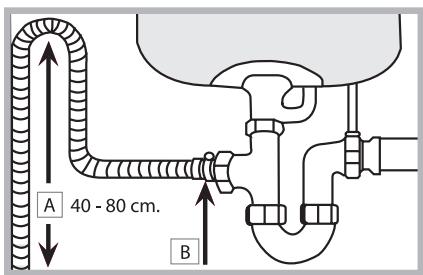
Before connecting the water outlet hose to the sink drain, remove the plastic plug (B).
Anti-flooding protection
To ensure floods do not occur, the dishwasher:
- is provided with a special system which blocks the water supply in the event of anomalies or leaks from inside the appliance.
Some models are also equipped with the supplementary safety device New Acqua Stop*, which guarantees anti-flooding protection even in the event of a supply hose rupture.

Under no circumstances should the water inlet hose be cut, as it contains live electrical parts.
Electrical connection
Before inserting the plug into the electrical socket, make sure that:
- The socket is earthed and complies with current regulations.
- the socket can withstand the maximum load of the appliance, which is indicated on the data plate located on the inside of the door
(see Description of the appliance);
- The power supply voltage falls within the values indicated on the data plate on the inside of the door.
- The socket is compatible with the plug of the appliance. If this is not the case, ask an authorised technician to replace the plug (see Assistance); do not use extension cables or multiple sockets.
Once the appliance has been installed, the power supply cable and the electrical socket should be easily accessible. The cable should not be bent or compressed. If the power supply cable is damaged, it must be replaced by the manufacturer or its Technical Assistance Service in order to prevent all potential hazards (see Assistance.)
- Only available in selected models.
Anti-condensation strip*
After installing the dishwasher, open the door and stick the adhesive transparent strip under the wooden shelf in order to protect it from any condensation which may form.
Advice regarding the first wash cycle
After the installation, remove the stoppers from the racks and the retaining elastic elements from the upper rack, if any. Immediately before the first washing, completely fill the salt dispenser with water and add only then approximately 1 kg of salt (see chapter entitled Rinse aid and refined salt). The water may overflow: this is normal and is not a cause for concern. Select the water hardness value (see chapter entitled Rinse aid and refined salt). - After the salt has been poured into the machine, the LOW SALT indicator light* switches off.
A If the salt container is not filled, the water softener and the heating element may be damaged as a result.
Assistance
Before contacting Assistance:
- Check whether the problem can be resolved using the Troubleshooting guide (see Troubleshooting).
- Restart the programme to check whether the problem has ceased to exist.
- If the problem persists, contact the Authorised Technical Assistance Service.
Never use the services of unauthorised technicians.
Please have the following information to hand:
- The type of malfunction.
- The appliance model (Mod.). The serial number (S/N).
This information can be found on the appliance data plate (see Description of the appliance).
The machine has a buzzer/set of tones (depending on the dishwasher model) to inform the user that a command has been implemented: power on, cycle end etc.
The symbols/indicator lights/LEDs on the control panel/display may vary in colour and may have a flashing or fixed light (depending on the dishwasher model).
The display* provides useful information concerning the type of wash cycle, drying/wash-cycle phase, remaining time, temperature etc.
| Technical data | |
| Dimensions | width 44.5 cm height 82 cm depth 57 cm |
| Capacity | 10 standard place-settings |
| Water supply pressure | 0,05 ÷ 1MPa (0.5 ÷ 10 bar) 7,25 – 145 psi |
| Power supply voltage | See appliance data plate |
| Total absorbed power | See appliance data plate |
| Fuse | See appliance data plate |
| CE | This dishwasher conforms to the following European Community Directives: -2006/95/EC (Low Voltage) -2004/108/EC (Electromagnetic Compatibility) -2009/125/EC (Comm. Reg. 1016/2010) (Ecodesign) -97/17/EC (Labelling) -2012/19/EC (WEEE) |
ECODESIGN REGULATION
ECO wash cycle is the standard cycle to which the energy label data refers; this cycle can be used to wash crockery with a normal soil level and is the most efficient in terms of energy and water consumption for this type of crockery. To reduce consumption even further, only run the dishwasher when it is full.
Standby consumption: Left-on mode consumption: 3 W - Off mode consumption: 1.3 W
Consumption data table for the main cycles
| Standard conditions* | User conditions** | |||||
| Energy consumption (kWh/cycle) | Water consumption (l/cycle) | Duration (min/ cycle) | Energy consumption (kWh/cycle) | Water consumption (l/cycle) | Duration (min/cycle) | |
| INTENSIVE | 1,30 | 14 | 150 | 1,15 | 14 | 140 |
| NORMAL | 1,05 | 14 | 115 | 0,95 | 13 | 110 |
- Cycle data refers to the values recorded in a laboratory, in accordance with European standard EN 50242. ** Data is obtained by recording values when the appliance is operational and loaded with user crockery.
EN
Overall view
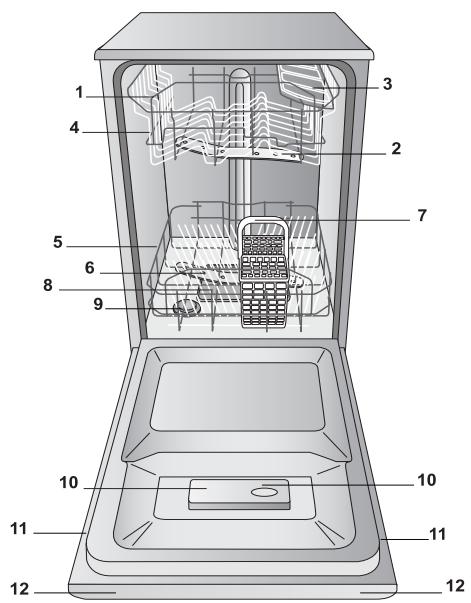
- Upper rack
- Upper sprayer arm
- Tip-up compartments
- Rack height adjuster
- Lower rack
- Lower sprayer arm
- Cutlery basket
- Washing filter
- Salt dispenser
- Detergent and rinse aid dispensers
- Data plate
- Control Panel***
Control panel
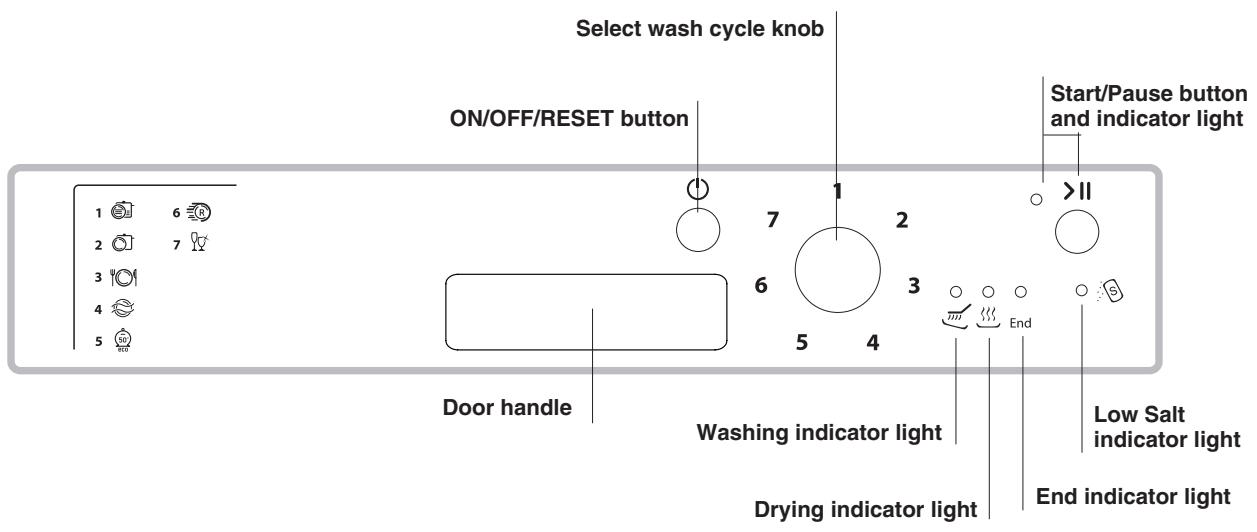
*** Only in completely built-in models. * Only available in selected models.
The number and type of wash cycles and options may vary depending on the dishwasher model.
Before loading the racks, remove all food residues from the crockery and empty liquids from glasses and cups. Arrange the crockery so that it is held in place firmly and does not tip over.
After loading the appliance, check that the sprayer arms can rotate freely.
Lower rack
The lower rack can hold pans, lids, plates, salad bowls, cutlery, etc. as seen in the Loading examples.
Plates and large covers should be placed at the sides of the rack, ensuring that they do not block the rotation of the upper sprayer arm.
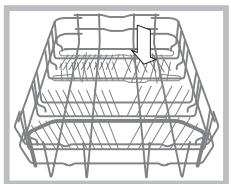
Some dishwasher models are fitted with tip-up sections*, which can be used in a vertical position when arranging plates or in a horizontal position when arranging pans and salad bowls.
Cutlery basket
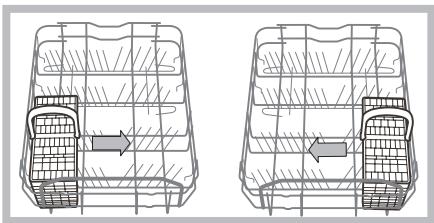
The type of cutlery basket may vary according to the dishwasher model: The cutlery basket should be positioned at the front of the lower rack, by sliding it between the fixed inserts, or on the upper rack when the half load option has been selected (in models featuring this option).
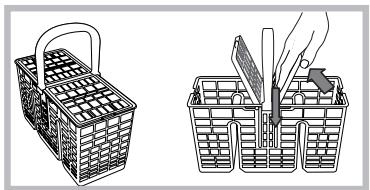
- It has a collapsible sliding system which means the cutlery can be arranged in the best possible way.
Knives and other utensils with sharp edges must be placed in the cutlery basket with the points facing downwards, or they must be positioned horizontally in the tip-up compartments on the upper rack.
Cutlery basket positioning examples
Upper rack
Load this rack with delicate and lightweight crockery: glasses, tea and coffee cups, saucers, small salad bowls, saucepans and small saucepans which are not too soiled, using the Loading examples as a guide. - Mugs and cups, long sharp knives and serving utensils: place these on the tip-up compartments**.
Tip-up compartments with adjustable tilt*
- The tilt feature can be used to increase the space in the upper rack, to position wine glasses with different stem lengths safely and to improve drying performance.
Tilt A, Tilt B, Tilt C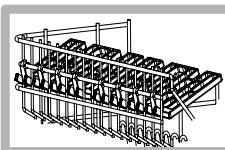
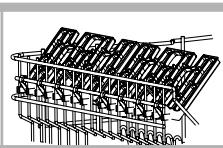
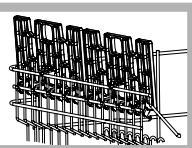
Lift the tip-up compartment, slide it gently, and position it at the desired tilt angle.
Adjusting the height of the upper rack
To make it easier to arrange the crockery, the upper rack can be moved to a higher or lower level.
The height of the upper rack should ideally be adjusted WHEN THE RACK IS EMPTY.
Never lift or lower the rack on one side only.
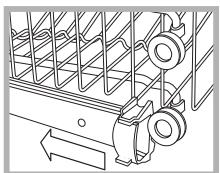
Open the left and right guide rail stops and pull out the rack; position it higher or lower as required, slide it along the guide rails until the front wheels are in place, and close the stops (see figure).
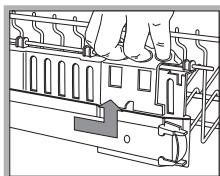
If the rack is fitted with "Dual Space" handles (see figure), pull out the upper rack until it reaches its stop point, grip the handles at the sides of the rack and move it upwards or downwards, then slowly let it fall back into place.
Loading examples for the upper rack
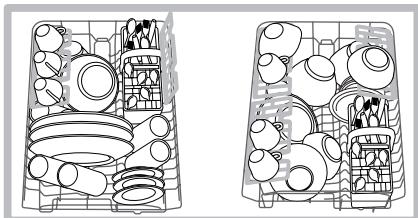
Loading examples for the lower rack
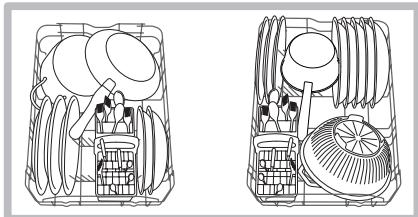
Items which should not be washed in the dishwasher
- Wooden items, objects with wooden or horn handles, or glued-on parts.
- Items made from aluminium, copper, brass, pewter, or tin.
- Items made from plastic material which is not heat-resistant. Antique or hand-painted porcelain.
- Antique silver. Silver which is not antique may, however, be washed in the dishwasher using a delicate wash cycle, provided that it does not come into contact with other metals.
We recommend the use of crockery which is dishwasher safe.
*Only available in selected models. ** The number and position may vary.
Starting the dishwasher
- Turn the water tap on.
- Press the ON/OFF button: all the indicator lights on the control panel will light up for a few seconds.
- Open the door and pour in a suitable amount of detergent (see below).
- Load the racks (see Loading the racks) and shut the door.
- Select the wash cycle by turning the WASH CYCLE SELECT knob in a clockwise direction: align the notch on the knob with the number or symbol representing the desired wash cycle. The START/PAUSE indicator light will flash.
- Select the wash options (see adjacent information).
- Start the cycle by pressing the START button; the indicator light will light up and remain lit in a fixed manner. The indicator light corresponding to the wash phase will switch on, signalling that the wash cycle has begun.
- At the end of the wash cycle the END indicator light will switch on (fixed light). Switch off the appliance by pressing the ON/OFF button, shut off the water valve and unplug the appliance from the electricity socket.
- Wait for a few minutes before removing the crockery, in order to avoid burns. Unload the racks, beginning with the lower level.
A - The machine will switch off automatically during certain periods of inactivity, in order to minimise electricity consumption.
Modifying a wash cycle in progress
If a mistake was made during the wash cycle selection process it is possible to change the cycle, provided that it has only just begun: once the wash cycle has started, switch off the machine by pressing and holding the ON/OFF/Reset button. Switch it back on using the same button and select the desired wash cycle and options.
Adding extra crockery
Press the Start/Pause button (the corresponding indicator light will flash). Open the door, taking care to avoid the escaping steam, and place the crockery inside the appliance. Press the Start/Pause button (fixed light): the cycle starts from the point at which it was interrupted.
If the Start/Pause button is pressed so as to pause the machine, the wash cycle or the Delayed Start* function (if selected) is interrupted.
At this stage it is not possible to change the wash cycle.
Accidental interruptions
If the door is opened during the wash cycle, or if there is a power cut, the cycle stops. It starts again from the point at which it was interrupted once the door has been shut or once the electricity supply is restored.
Measuring out the detergent
A good wash result also depends on the correct amount of detergent being used; exceeding the stated amount does not result in a more effective wash and increases environmental pollution.
Only use detergent which has been specifically designed for dishwashers. DO NOT USE washing up liquid. Using excessive detergent may result in foam residue remaining in the machine after the cycle has ended. The use of tablets is only recommended for models which offer the MULTI-FUNCTIONAL TABLETS option. To achieve the best results from each washing and drying cycle, powder detergent, rinse aid liquid and salt should be used.
Compartment A: Washing detergent
Compartment B: Pre-wash detergent
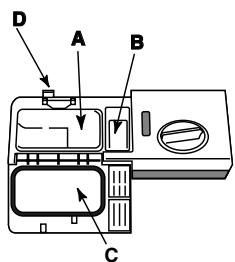
- Open cover C by pressing button D.
- Pour in the detergent after consulting the Table of wash cycles:
- For powder detergent use compartments A and B.
- For detergent in tablet form: when the cycle requires 1 tablet,
place it in compartment A and close the cover; when it requires 2, place the second tablet at the bottom of the appliance. 3. Remove detergent residues from the edges of the compartment and close the cover until it clicks.
If the crockery is only lightly soiled or if it has been rinsed with water before being placed in the dishwasher, reduce the amount of detergent used accordingly.
The number and type of wash cycles and options may vary depending on the dishwasher model.
| Wash cycle selection instructions | Wash cycle | Detergent (A) = compartment A (B) = compartment B | Wash cycles which include drying | Options | Wash cycle duration (tolerance ±10%) Hrs. Min. | ||
| Powder | Liquid | Tablets | |||||
| Heavily soiled dishes and pans (not to be used for delicate items). | 1. Intensive | 25 g (A) | 25 ml (A) | 1 (A) | Yes | No | 2:25' |
| Normally soiled pans and dishes. Standard daily wash cycle. | 2. Normal | 21 g (A) 4 g (B) | 21 ml (A) 4 ml (B) | 1 (A) | Yes | No | 1:50' |
| Limited quantity of daily soiling. (4 place settings + 1 saucepan +1 frying pan). | 3. Daily A 60 | 25 g (A) | 25 ml (A) | 1 (A) | No | No | 1:00' |
| Pre-wash for dishes while awaiting completion of the load with the dishes from the next meal. | 4. Soak | No | No | No | No | No | 0:08' |
| Environmentally-friendly wash cycle with low energy consumption levels, suitable for pans and dishes. | 5. Eco* | 21 g (A) 4 g (B) | 21 ml (A) 4 ml (B) | 1 (A) | Yes | No | 3:00' |
| Economic and fast wash to be used for lightly soiled dishes. (Run cycle immediately after use) (2 plates + 2 glasses + 4 pieces of cutlery + 1 saucepan + 1 small frying pan). | 6. Rapid | 21 g (A) | 21 ml (A) | 1 (A) | No | No | 0:35' |
| Economic and fast wash for delicate items which are sensitive to high temperatures. (Run cycle immediately after use) (glasses upper rack + delicate plates, lower rack). | 7. Crystal | 25 g (A) | 25 ml (A) | 1 (A) | Yes | No | 1:35' |
Notes:
Optimum performance levels when using the "Daily 60" - Rapid wash/Speed" cycles can be achieved by observing the maximum amounts of crockery specified.
To make it easier to measure out the detergent, it is worth remembering that:
1 tablespoon = 15 gr. of powder = approximately 15 ml of liquid - 1 teaspoon = 5 gr. of powder = approximately 5 ml of liquid
- The Eco wash cycle adheres to the regulation EN-50242. Although it has a longer duration than other wash cycles it uses less energy and is less harmful to the environment.
Note for Test Laboratories: for information relating to comparative EN testing conditions, please send an email to the following address: ASSISTENZA_EN_LVS@indesitcompany.com
Rinse aid and refined salt
Only use products which have been specifically designed for dishwashers.
Do not use table salt or industrial salt, or washing up liquid.
Follow the instructions given on the packaging.
If using a multi-functional product, it is not necessary to add rinse aid; however, we recommend that you add salt, especially if you live in an area where the water is hard or very hard. Follow the instructions given on the packaging.
If you do not add salt or rinse aid, the LOW SALT and LOW RINSE AID indicator lights remain lit.
Measuring out the rinse aid
Rinse aid makes it easier for the crockery to dry, as water runs off surfaces more readily and therefore does not leave streaks or marks.
The rinse aid dispenser should be filled:
- When the LOW RINSE AID* indicator light on the control panel/display is illuminated;
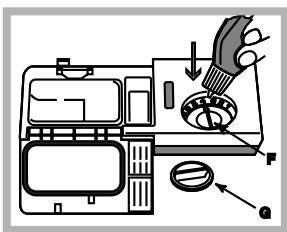
- Open the dispenser by turning the lid (G) in an anticlockwise direction.
- Pour in the rinse aid, making sure it does not overflow from the dispenser. If this happens, clean the spill immediately with a dry cloth.
- Screw the lid back on.
NEVER pour the rinse aid directly into the appliance tub.
Adjusting the amount of rinse aid
If you are not completely satisfied with the drying results, you may adjust the quantity of rinse aid used. Use a screwdriver to turn the dosage adjuster (F) to one of the 6 pre-set positions (the default position is set to 4):
- If there are streaks on the crockery, set the adjustment device to a lower number (1-3).
- If drops of water remain on the crockery or if there are limescale marks present after the cycle has finished, set the adjuster to a higher number (4-6).
Setting the water hardness
Every dishwasher is equipped with a water softener which, by using refined salt designed especially for this type of appliance, supplies water without limescale which is then used to wash the crockery.
This dishwasher offers a setting which helps to reduce pollution and optimises washing performance in accordance with the water hardness level in your area. This information can be obtained from your local water supplier.
- Switch the machine off using the ON/OFF button and open the door.
- Set the SELECT WASH CYCLE knob first to wash cycle 5, then to wash cycle 1, then to wash cycle 5 again.
- Press the ON/OFF button; the wash cycle phase (washing, drying, end) indicator lights will flash. It is now possible to select the water hardness level. There is a water hardness level for
every wash cycle:
E.g.: wash cycle 1, water hardness level 1
wash cycle 2, water hardness level 2, etc. etc., up to a maximum of 5 levels.
(The default water softener setting is level 3).
- To exit the function, wait a few seconds or press one of the option buttons, or switch off the machine using the ON/OFF button.
Even if using multi-functional tablets, the salt dispenser should still be filled.
| Water Hardness Table | Average salt container capacity duration** | |||
| Level | °dH | °FH | mmol/l | months |
| 1 | 0 - 6 | 0 - 10 | 0 - 1 | 7 months |
| 2 | 6 - 11 | 11 - 20 | 1,1 - 2 | 5 months |
| 3 | 12 - 17 | 21 - 30 | 2,1 - 3 | 3 months |
| 4 | 17 - 34 | 31 - 60 | 3,1 - 6 | 2 months |
| 5* | 34 - 50 | 61 - 90 | 6,1 - 9 | 2/3 weeks |
| For values between 0°f and 10°f, we do not recommend the use of salt. * this setting may cause a slight increase in the duration of the cycles. ** for 1 wash cycle per day. | ||||
(°dH) = hardness measured in German degrees - °f = hardness measured in French degrees - mmol/l = millimoles per litre)
Measuring out the refined salt
In order to achieve the best possible results using a wash cycle, make sure that the dispenser is never empty. Refined salt removes limescale from the water, thus avoiding the formation of deposits on crockery.
The salt dispenser is located in the lower part of the dishwasher (see Description) and should be filled:
- When the green float cannot be seen by simply looking at the cap of the salt dispenser.
- When the LOW SALT* indicator light on the control panel/display is illuminated;
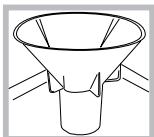
- Remove the lower rack and unscrew the container cap (anticlockwise).
- The first time you do this: fill the water tank right up to its edge.
- Position the funnel (see figure) and fill the salt container right up to its edge (this should hold approximately 1 kg); it is not unusual for a little water to leak out.
should hold approximately 1 kg); it is not unusual for a little water to leak out.
- Remove the funnel and wipe any salt residue away from the opening; rinse the cap under running water and then screw it on, with the head facing downwards so that the water can flow out through the four cracks arranged in a star shape on the lower part of the cap. (Salt cap with green float)
It is advisable to perform this procedure every time you add salt to the container.
Make sure the cap is screwed on tightly, so that no detergent can get into the container during the wash cycle (this could damage the water softener beyond repair). When necessary, measure out the salt before a wash cycle so that any saline solution which has leaked out of the salt dispenser is removed. * Only available in selected models.
Shutting off the water and electricity supplies
Shutting off the water and electricity supplies
- Turn off the water tap after every wash cycle to avoid leaks.
- Always unplug the appliance when cleaning it and when performing maintenance work.
The external surfaces of the machine and the control panel may be cleaned using a non-abrasive cloth which has been dampened with water. Do not use solvents or abrasive products.
- The external surfaces of the machine and the control panel may be cleaned using a non-abrasive cloth which has been dampened with water. Do not use solvents or abrasive products.
- Any marks on the inside of the appliance may be removed using a cloth dampened with water and a little vinegar.
Preventing unpleasant odours
- Always keep the door of the appliance ajar in order to avoid moisture from forming and being trapped inside the machine.
- Clean the seals around the door and detergent dispensers regularly using a damp sponge. This will avoid food becoming trapped in the seals, which is the main cause behind the formation of unpleasant odours.
Cleaning the sprayer arms
Food residue may become encrusted onto the sprayer arms and block the holes used to spray the water. It is therefore recommended that the arms are checked from time to time and cleaned with a small non-metallic brush.
The two sprayer arms may both be removed.
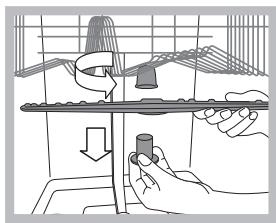
To remove the upper sprayer arm, rotate the locking ring in an anti-clockwise direction.
The upper sprayer arm should be replaced with the holes facing upwards.
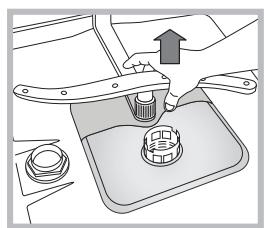
The lower sprayer arm can be removed by pulling it upwards.
Cleaning the water inlet filter*
If the water hoses are new or have not been used for an extended period of time, let the water run to make sure it is clear and free of impurities before performing the necessary connections. If this precaution is not taken, the water inlet could become blocked and damage the dishwasher.
A Clean the water inlet filter at the tap outlet regularly.
- Turn off the water tap.
- Unscrew the end of the water inlet hose, remove the filter and clean it carefully under running water.
- Replace the filter and screw the water hose back into position.
Cleaning the filters
The filter assembly consists of three filters which remove food residues from the washing water and then recirculate the water. They should be cleaned if you wish to achieve the best results in every wash.
Clean the filters regularly.
The dishwasher should not be used without filters, or if the filter is loose.
- After several washes, check the filter assembly and if necessary clean it thoroughly under running water, using a non-metallic brush and following the instructions below:
- Turn the cylindrical filter C in an anti-clockwise direction and pull it out (fig. 1).
- Remove the cup filter B by exerting a slight pressure on the side flaps (fig. 2).
- Slide out the stainless steel plate filter A (fig. 3).
- Inspect the trap and remove any food residue. NEVER REMOVE the wash cycle pump (black detail) (fig. 4).
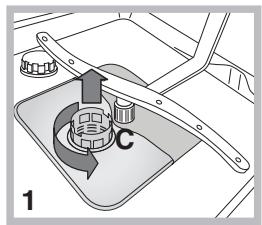
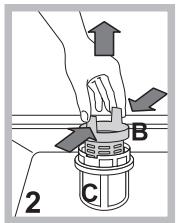
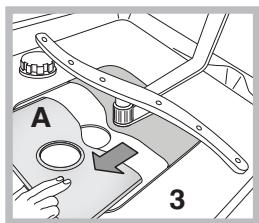
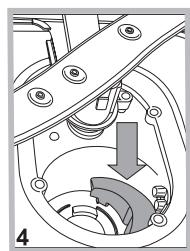
After cleaning the filters, replace the filter assembly and fix it in position correctly; this is essential for maintaining the efficient operation of the dishwasher.
Leaving the machine unused for extended periods
- Disconnect the appliance from the electricity supply and shut off the water tap.
- Leave the door of the appliance ajar.
- When you return, run a wash cycle when the dishwasher is empty.
- Only available in selected models.
Whenever the appliance fails to work, check for a solution from the following list before calling for Assistance.
| Problem: | Possible causes / Solutions: |
| The dishwasher does not start or cannot be controlled | • Switch off the appliance by pressing the ON/OFF button, switch it back on after approximately one minute and reset the program. • The appliance has not been plugged in properly. • The dishwasher door has not been shut properly. |
| The door won't close | • The lock was released. Strongly push the door until a “clacking” noise is heard. |
| No water drains out from the dishwasher. | • The dishwasher cycle has not yet finished. • The water inlet hose is bent (see Installation). • The drain duct is blocked. • The filter is clogged up with food residues. |
| The dishwasher makes excessive noise. | • The dishes are rattling against each other or against the sprayer arms. • An excessive amount of foam has been produced: the detergent has not been measured out correctly or it is not suitable for use in dishwashers (see Start-up and use). |
| The dishes and glasses are covered in a white film or limescale deposits. | • The level of the refined salt is low or the dosage setting is not suited to the hardness of the water (see Rinse aid and salt). • The lid on the salt dispenser is not closed properly. • The rinse aid has been used up or the dosage is too low. |
| The dishes and glasses are streaked or have a bluish tinge. | • The rinse aid dosage is too high. |
| The crockery has not been dried properly. | • A wash cycle without a drying program has been selected. • The rinse aid has been used up or the dosage is too low (see Rinse aid and salt). • The rinse aid dispenser setting is not suitable. • The crockery is made from non-stick material or plastic. |
| The dishes are not clean. | • The racks are overloaded (see Loading the racks). • The crockery has not been arranged well. • The sprayer arms cannot move freely. • The wash cycle is too gentle (see Wash cycles). • An excessive amount of foam has been produced: the detergent has not been measured out correctly or it is not suitable for use in dishwashers (see Start-up and use). • The lid on the rinse aid compartment has not been shut correctly. • The filter is dirty or blocked (see Care and maintenance). • The refined salt level is low (see Rinse aid and salt). |
| The dishwasher does not take any water in - Tap shut-off alarm (several short beeps are emitted*) (the Drying and End indicator lights flash). | • There is no water in the mains supply. • The water inlet hose is bent (see Installation). • Turn on the tap and the appliance will start after a few minutes. • The appliance lock has been activated because no action was taken when the beeps* sounded. Switch off the appliance using the ON/OFF button, turn on the tap and switch the appliance back on after 20 seconds by pressing the same button. Re-program the appliance and restart the wash cycle. |
| Water inlet hose alarm / Water inlet filter blocked (the Washing, Drying and End indicator lights flashes). | • Switch off the appliance by pressing the ON/OFF button. Shut off the water tap to eliminate the risk of flooding and remove the plug from the electrical socket. Make sure the water inlet filter has not become blocked by impurities (see “Care and maintenance” chapter). |
- Only available in selected models.
Français, 25
Sommaire
Ecodesign Regulation
LSPA+ 720A.1
Ecodesign Regulation
LSPA+ 720A.1
Ecodesign Regulation
LSPA+ 720A.1
Opis urzadzenia, 54
General view
Control panel
Ecodesign Regulation
LSPA+ 720A.1
Appliance description, 66
Overview
Control panel
Loading the baskets, 67
Lower basket
- PRECAUTIONS AND ADVICE
- INSTALLATION AND ASSISTANCE
- DESCRIPTION OF THE APPLIANCE
- LOADING THE RACKS
- START-UP AND USE
- WASH CYCLES
- RINSE AID AND REFINED SALT
- CARE AND MAINTENANCE
- GENERAL SAFETY
- DISPOSAL
- SAVING ENERGY AND RESPECTING THE ENVIRONMENT
- SAVING WATER AND ENERGY
- PHOSPHATE-FREE AND CHLORINE-FREE DETERGENTS CONTAINING ENZYMES
- POSITIONING AND LEVELLING
- CONNECTING THE WATER AND ELECTRICITY SUPPLIES
- CONNECTING THE WATER INLET HOSE
- CONNECTING THE WATER OUTLET HOSE
- ANTI-FLOODING PROTECTION
- ELECTRICAL CONNECTION
- ANTI-CONDENSATION STRIP
- ADVICE REGARDING THE FIRST WASH CYCLE
- ASSISTANCE
- BEFORE CONTACTING ASSISTANCE
- PLEASE HAVE THE FOLLOWING INFORMATION TO HAND
- ECODESIGN REGULATION
- OVERALL VIEW
- CONTROL PANEL
- LOWER RACK
- CUTLERY BASKET
- CUTLERY BASKET POSITIONING EXAMPLES
- UPPER RACK
- TIP-UP COMPARTMENTS WITH ADJUSTABLE TILT
- ADJUSTING THE HEIGHT OF THE UPPER RACK
- THE HEIGHT OF THE UPPER RACK SHOULD IDEALLY BE ADJUSTED WHEN THE RACK IS EMPTY
- NEVER LIFT OR LOWER THE RACK ON ONE SIDE ONLY
- LOADING EXAMPLES FOR THE UPPER RACK
- LOADING EXAMPLES FOR THE LOWER RACK
- ITEMS WHICH SHOULD NOT BE WASHED IN THE DISHWASHER
- STARTING THE DISHWASHER
- A - THE MACHINE WILL SWITCH OFF AUTOMATICALLY DURING CERTAIN PERIODS OF INACTIVITY, IN ORDER TO MINIMISE ELECTRICITY CONSUMPTION
- MODIFYING A WASH CYCLE IN PROGRESS
- ADDING EXTRA CROCKERY
- ACCIDENTAL INTERRUPTIONS
- MEASURING OUT THE DETERGENT
- NOTES
- TO MAKE IT EASIER TO MEASURE OUT THE DETERGENT, IT IS WORTH REMEMBERING THAT
- MEASURING OUT THE RINSE AID
- ADJUSTING THE AMOUNT OF RINSE AID
- SETTING THE WATER HARDNESS
- MEASURING OUT THE REFINED SALT
- IT IS ADVISABLE TO PERFORM THIS PROCEDURE EVERY TIME YOU ADD SALT TO THE CONTAINER
- SHUTTING OFF THE WATER AND ELECTRICITY SUPPLIES
- THE EXTERNAL SURFACES OF THE MACHINE AND THE CONTROL PANEL MAY BE CLEANED USING A NON-ABRASIVE CLOTH WHICH HAS BEEN DAMPENED WITH WATER. DO NOT USE SOLVENTS OR ABRASIVE PRODUCTS
- PREVENTING UNPLEASANT ODOURS
- CLEANING THE SPRAYER ARMS
- CLEANING THE WATER INLET FILTER
- CLEANING THE FILTERS
- LEAVING THE MACHINE UNUSED FOR EXTENDED PERIODS
- SOMMAIRE
- APPLIANCE DESCRIPTION
- LOADING THE BASKETS
Brand : HOTPOINT
Model : LSPA 720A.1 X/HA
Category : Dishwasher