
ISG 2000 - Welding machine GUDE - Free user manual and instructions
Find the device manual for free ISG 2000 GUDE in PDF.


| Product Type | Welding Machine |
| Brand | Güde |
| Model | ISG 2000 |
| Supply Voltage | 230 V / 50 Hz |
| Welding Current | 20 - 200 A |
| Duty Cycle | 60% at 200 A |
| Welding Type | MMA (Shielded Metal Arc Welding) |
| Electrode Diameter | 1.6 - 4.0 mm |
| Weight | 15 kg |
| Dimensions (L × W × H) | 50 × 30 × 40 cm |
| Main Functions | Continuous current adjustment, thermal protection, cooling fan |
| Indicators | Power-on indicator, overheating indicator |
| Safety | Thermal circuit breaker, class H insulation, overcurrent protection |
| Maintenance and Cleaning | Regularly clean ventilation grilles with a dry cloth; check cables and connections |
| Spare Parts | Electrode holder, ground cable, ground clamp, welding cable |
| Repairability | Repairability index: 7.5/10 (estimated) |
| General Information | Domestic and light professional use; compatible with rutile, basic, and cellulosic electrodes |
Frequently Asked Questions - ISG 2000 GUDE
User questions about ISG 2000 GUDE
0 question about this device. Answer the ones you know or ask your own.
Ask a new question about this device
Download the instructions for your Welding machine in PDF format for free! Find your manual ISG 2000 - GUDE and take your electronic device back in hand. On this page are published all the documents necessary for the use of your device. ISG 2000 by GUDE.
USER MANUAL ISG 2000 GUDE
natural_image
Icon of an open book inside a black circle (no text or symbols)Deutsch DE - 5
Original Operating Instructions
INVERTER GENERATOR
Français FR - 18
natural_image
Black-and-white line drawing of a portable electronic device with control panel and buttons (no readable text or symbols)
natural_image
Line drawing of a portable electronic device with two buttons and a label (no readable text or symbols)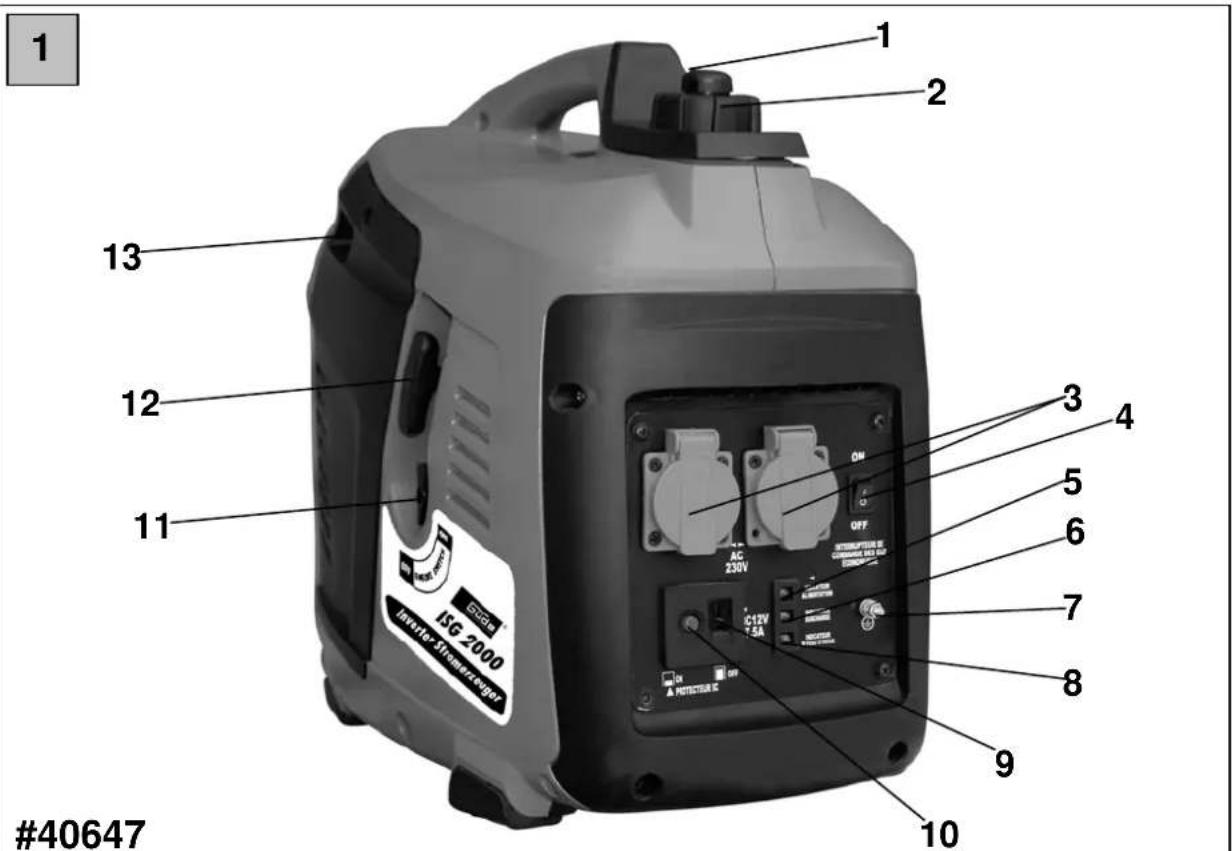


natural_image
Technical line drawing of a portable electronic device with internal components and a base mount (no text or symbols)


natural_image
Abstract wave-like pattern with red, blue, and green curves intersecting a horizontal line (no text or symbols)Inverter
Please read carefully the following Operating Instructions before putting the appliance into operation
A.V. 2 Any reprints, even partial, are subject to approval. Technical changes reserved. Illustrative pictures! Translation of original operating instructions.
Marking:
Product safety:
 | |
| Product corresponds to appropriate EU standards |
Warning:
 | |
| Caution! Read the Operating Instructions before servicing the appliance! | Not to be used in closed rooms. Poison gases may be produced. |
 |  |
| Not to be connected to household network. | Beware of toxic vapours. |
Commands:
 | |
| Unplug the appliance before any servicing or works on the generator |
Prohibitions:
 |  |
| Do not expose the appliance to rain | No fire, open light and smoking |
Environment protection:
 |  | |
| Dispose waste professionally so as not to harm the environment. | Packing cardboard material may be delivered to collection centres for recycling. | |
| Any defective and/or disposed electric or electronic appliances must be delivered to appropriate collection centres. | ||
Package:
 |  | ||
| Protect against moisture This side up | |||
Technical specifications:
 |  | ||
| Engine output Cylinder volume | |||
 |  | ||
| Revolutions per minute Tank capacity | |||
 |  | ||
| Rated power Weight | |||
 |  | ||
| Output voltage Noise | |||
 |  | ||
| Add oil up to the marking.Check regularly the oil leveland add some if necessary. | Press the lever to the rightto close the choke valve. | ||
 |  | A hot exhaust can causeserious burns.Avoid contact if the enginehas been running. | |
| Caution! Prevent any contactwith hot parts. | |||
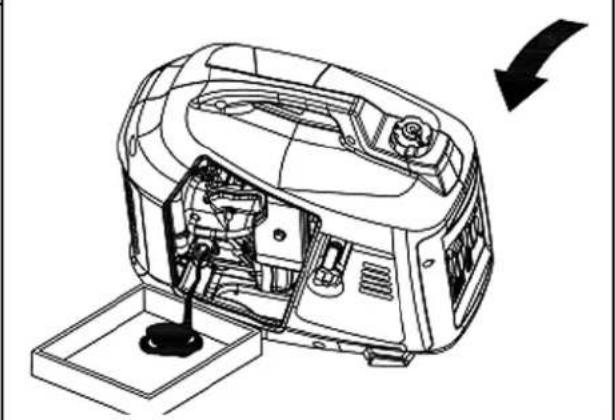
Appliance description (pic. 1+2)
- Fuel tank cap ventilation lever
- Fuel filler cap
- 230V outlet
- ON/OFF switch
- Output power indicator
- Overload indicator
- Engine grounding connection
- Lack of oil indicator
- 12V outlet
- DC circuit breaker
- Ignition switch/fuel tap
- Starter cord
- Choke lever
Supply includes
1 Inverter generator
1 Spark plug spanner
1 Battery pole terminals
1 Servicing kit
1 Operating Instructions and warranty certificate
Warranty
A warranty period of 12 months applies to commercial use and 24 months apply to private use and commences on the day of purchase of the device.
Warranty applies exclusively to failures due to defective material or workmanship. An original sale slip with indication of date of sale must be presented in case of claiming for the warranty rights.
Warranty does not cover unprofessional use such as device overload, violent use, damage caused by third party or foreign materials, failure to comply with operations and assembly manual, and normal wear and tear.
Technical specifications
| ISG 1000 | |
| Output voltage: 1x 230 V/1 x 12V | |
| Frequency: 50 Hz | |
| Constant output 12 V: 90 W | |
| Constant output 230 V: 900 W | |
| Rated power 230 V: 1,000 W | |
| Rated power factor: 1.0 | |
| Engine output: 1,3 kW/1,8 PS at 5500 per min-1 | |
| Idle speed 4200 min-1 | |
| Cylinder volume: 53.5 ccm | |
| Protection type: IP23 | |
| Engine type: 4-stroke air cooled | |
| Assembly dimensions: | 455 mm |
| Tank capacity: | 2.7 l of petrol |
| Consumption: | 0.68 l per hour |
| Noise: | LWA 95 dB |
| Sound pressure at 7 m: | LWA 54 -59 dB |
| Weight: | 14 kg |
| Article No. | 40645 |
| ISG 2000 | |
| Output voltage: 2x 230 V/1 x 12V | |
| Frequency: 50 Hz | |
| Constant output 12 V: 90 W | |
| Constant output 230 V: 1,600 W | |
| Rated power 230 V: 2,000 W | |
| Rated power factor: 1.0 | |
| Engine output: 2.2 kW/3 PS at 4,600 per min-1 | |
| Idle speed 3200 min-1 | |
| Cylinder volume: 105.6 ccm | |
| Protection type: IP23 | |
| Engine type: 4-stroke air cooled | |
| Assembly dimensions: | 530 mm |
| Tank capacity: | 3.5 l of petrol |
| Consumption: | 1 l per hour |
| Noise: | LWA 92 dB |
| Sound pressure at 7m: | LWA 54 -59 dB |
| Weight: | 22 kg |
| Article No. | 40647 |
* Noise information
Measured values detected in accordance with 2000/14/EG (1.60m height, 1m distance) – measurement tolerance +3dB
Appliance
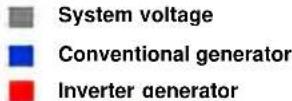
Direct comparison of voltage curves

natural_image
Abstract wave-like line diagram with red, blue, and green curves intersecting a horizontal axis (no text or symbols)Inverter
The current is produced in an absolutely new way with the inverter generator. Due to the small, multi-pole winding inside the appliance, the produced alternating voltage changes to direct-current voltage first and then to alternating current with a clean sine curve using electronic equipment. With this clean sine curve, electronic appliance can be supplied without being damaged.
General safety instructions
The Operating Instructions must be read thoroughly before using the appliance for the first time. If there are any doubts regarding the appliance connection, please contact the manufacturer (service department).
TO ENSURE HIGH SAFETY LEVEL, PLEASE FOLLOW CAREFULLY THESE INSTRUCTIONS:
CAUTION!
- Keep the place of your work clean and tidy. Mess in the place of your work and work-table increases the risk of accidents and injuries.
- Consider carefully the conditions of the environment you are working in. Do not use any electric tools and machine tools in a wet and moist environment. Provide adequate lighting. Do not expose any electric tools to rain or high air humidity. Do not switch electric tools on near highly flammable liquids and gases.
- Do not let other persons get near the appliance. Keep all visitors and bystanders, especially children and ill or weak persons, in a safe distance from the place of your work.
• Make sure tools are kept safe. Keep any tools you are not using in a dry place, elevated if possible, or lock them to prevent other persons accessing them. - Use the right appliance for your work. Do not use e.g. small tools or accessory equipment for works that actually need to be performed by big tools. Use the appliance only for purposes for which it has been designed. Do not overload your appliance!
- Look out for the feeder cable. Do not pull the cable. Do not use the cable to unplug the appliance. Keep the cable out of reach of heat sources, oil and sharp edges.
- Avoid any unintentional switching-on. Before plugging the appliance, make always sure the machine is switched off.
- Be cautious at all times. Pay attention to what you are doing. Use common sense when working. Do not use any electric tools when you are tired.
• Watch for any damaged parts. Inspect the appliance before using it. Are any parts damaged? In case of slight
damage, consider seriously whether the machine can work perfectly and safely.
- Prevent electric shock. Avoid any physical contact with grounded items, e.g. water pipes, heating units, cookers and fridges.
- Approved parts to be used only. Identical spare parts to be used only for any servicing or repair. For that purpose, contact an authorised service centre.
- Caution! Using accessory equipment and extensions not explicitly recommended in these Operating Instructions may pose a risk to persons and property.
- Do not incline from the place of your work Avoid any abnormal body posture. Provide safe posture and keep balance at all times.
Appliance-specific safety instructions
- Protect all cables against excess temperatures, oil and sharp edges.
- Unplug the appliance for any repair and servicing and when not being used.
- Works on the electrical equipment may only be performed by an electrician. Original spare parts to be used only.
- A clean place of work makes your work easier.
- Pay attention to what you are doing. Use common sense when working.
- Use the appliance only in an appropriate environment and do not expose it to wet or moisture.
- Provide adequate lighting for your work.
- Switch the appliance immediately off and unplug it in dangerous situations or when facing any technical failure.
- Tools and accessory equipment included and recommended by the manufacturer to be used only. Using any not approved parts may lead to a significant risk of injury.
- Children and persons lacking the knowledge of and experience in handling the appliance or who are limited by their physical, sensory and mental skills must not use the appliance without the control and supervision by a safety engineer.
- Children must be watched to be prevented from playing with the appliance.
- When connecting the generator to the household power source, a professional electrician must necessarily be invited to provide connection and grounding.
- The generator must always be put on a solid and level surface!
- Combustion gases may be fatal; therefore, the generator must never be used in closed rooms.
- The generator must never be covered.
- Never touch the generator by wet hands.
- Do not work in a wet environment.
- Never put 2 generators together.
Risk of injury or possible damage to electric tools. The technical specifications of the used appliance must always correspond to the generator data and safety instructions (3- to 5-fold rated power of the connected appliance must always be considered for the starting current).
Behaviour in case of emergency
First aid kit must always be available in the place of your work in case of accident in accordance with DIN 13164. Material taken out of the first aid kit needs to be supplemented right away.
If help is needed, please provide the following details:
Place of accident
Accident nature
Number of injured persons
Injury type
Provide necessary first aid treatment corresponding to the injury nature and seek qualified medical help as soon as possible.
Protect the injured person from other injuries and calm him/her down.
Use as designated
This generator has been exclusively designed to drive electric devices with maximum output within the generator output. Higher starting current of inductive appliances must be considered.
This appliance must not be used to perform other works than those for which the appliance has been designed and which are described in the Operating Instructions.
Any other use is conflict with the designation. The manufacturer is not responsible for any indirect damages and injuries. Please be sure to know that our appliances have not been designed to be used for industrial purposes.
Residual risks and protective measures
Direct electrical contact
Direct electrical contact by wet hands may lead to electric shock.
Prevent any contact by wet hands and provide adequate grounding.
Thermal residual risks
Burns, chilblains
A contact with the exhaust may cause burns.
Let the appliance cool down after being used.
Exposure to noise
Hearing damage
Long time in the immediate vicinity of the running generator may damage the hearing.
Ear-protectors must necessarily be worn at all times.
Exposure to materials and other substances Contact, aspiration
Aspiration of combustion gases may be fatal!
The appliance must never be operated in closed rooms.
Fire or explosion
Appliance fuel may catch fire.
The appliance must never be operated in an environment with a risk of fire. Refuel while the engine is stopped. No smoking.
Biological / microbiological threats
Oil or fuel leakage harms the environment.
Other risks
Damage when operated
If the appliance is operated on an inclined surface, lubrication is not provided and the appliance may get damaged.
To be operated on a level surface only.
Disposal
Disposal instructions are illustrated in the form of pictograms on the device or packaging. Description of the pictograms is given in "Identification" chapter.
Disposal of transport packaging
Packaging protects the device against damage during transport. Packaging materials are usually selected according to their effect on environment and disposal methods and can therefore be recycled.
Returning of the packaging back to circulation saves resources and costs for packaging disposal.
Parts of the packaging (e.g. foil, styropor) may be dangerous for children. Risk of suffocation!
Keep these parts of the packaging out of reach of children and dispose as soon as possible.
Waste oil disposal
Put the oil to a sealed container and take it to a waste oil collection centre. Do not throw the waste oil to waste or pour it out.
Operator requirements
The operator must carefully read the Operating Instructions before using the appliance.
Qualification
No special qualification is necessary to use the appliance apart from detailed instructions by an expert.
Minimum age
The appliance may only be operated by persons over 18 years of age who have been instructed in handling and operating the appliance. Young people between 16 and 18 years of age may only work with the appliance when supervised by an adult.
An exception includes youngsters operating the appliance within their professional education to achieve necessary skills under trainer's supervision.
Training
Using the appliance only requires appropriate instructions by an expert or reading the Operating Instructions. No special training necessary.
Transport and storing

The appliance may only be operated in the rating position (level surface), otherwise, fuel or oil leak out or lubrication may not be provided.
- Put the fuel tank cap ventilation lever and the ignition switch to the OFF position. This will prevent fuel leakage during transport or when the appliance is stored.
- Make sure the fuel tank does not overflow.
- The appliance must not be used if in a vehicle. To operate the appliance, the inverter generator must be assembled and installed in a well-ventilated environment.
- Do not store the appliance under direct sun. If the generator is kept in a vehicle, make sure the vehicle temperature is not too high as the fuel would evaporate and the appliance subsequently explode.
- For long storing, the appliance must be cleaned thoroughly and kept out of reach of unauthorised persons. Empty the fuel and keep the appliance in a dry place with no dust.
- Secure the appliance against turnover every time it is to be transported.
Safety instructions for first starting up
- Put the appliance on a level surface. Do not put the appliance on a metal surface.
- Do not expose the appliance to intensive solar radiation. Do not expose the appliance to temperatures exceeding 40 °C.
- Do not store the appliance in a wet environment.
- Before using the appliance, first make sure that the input of the appliance you want to connect to the generator is lower than the output of the generator.
- Connect the appliance to the generator only when the generator is running at full speed. Before switching the generator off, disconnect the appliance first.
-
Do not connect other power sources to the generator. Do not connect the generator to household network.
-
Under the following conditions, the generator must immediately be switched off:
- unsteady or irregular engine running
- electric output decrease
- connected appliance overloading
- excessive generator vibrations
- sparking
- presence of smoke or fire
- Before connecting the generator to an appliance, make sure there is a sufficient amount of fuel in the generator.
- Never refuel when the generator is running. After being operated, let the generator cool down for at least 5 minutes before refuelling.
- Do not touch hot parts of the generator.
- Do not keep fuel near the generator.
- At afterburning, the absorber and air filter act as a flame catcher. Therefore, make sure these parts are fitted properly and are in a perfect technical state.
- In any case, the generator must not be used in a garage, house or near open windows and doors as breathing of combustion gases could result in a state of unconsciousness.
- Refuelling to take place outdoors while the engine is stopped only. No smoking near the appliance. Prevent flames or sparks from being produced near the generator.
- Spilled petrol must be immediately wiped – start the engine after wiping is finished.
Eco throttle valve, pic. 12
Pic. 12
Pos. 1 - OFF
Pos. 2 - ECO
Pos. 3 – ECO throttle valve switch
ECO:
The engine speed will automatically adapt to idle speed when the electric appliance is disconnected. If the electric appliance is reconnected, the engine reassumes speed corresponding to the load. If full output of the generator is not required, the engine speed will automatically reduce. This position is recommended for fuel consumption reduction.

The Eco throttle valve switch must be put to the OFF tion under DC operation.
OFF:
The engine speed is kept at a higher level than the nominal speed.
Operation, pic. 1+2+12+13
Start:
Before starting the engine, the connected electric appliances must be disconnected from the three-phase outlet.
- Put the fuel tank cap ventilation lever to the ON position (pic. 1/1 or 2/1).
- Put the ignition switch to the ON position (pic. 1/11 or 2/11).
- Put the choke lever (pic. 1/13 or 2/13) to the right to the "closed" position.
- Pull slowly the starter cord (pic. 1/12 or 2/12) until resistance can be felt, then pull strongly to start the engine.

Do not let the starter cord to snap back. Instead, it carefully with your hand.
- As soon as the engine gets warm, put the choke lever (pic. 1/13 or 2/13) back to the starting position.
Use:
The inverter generator must necessarily be connected to a chassis ground (pic. 1/7 or 2/7) if the connected appliances are grounded.

Connection to electrical equipment of a building is missible unless a disconnector is installed.

The given maximum input value must not beeded in any connecting plug.
AC operation:
- Start the engine and make sure the indicator (pic. 1/5 or 2/5) is green.
- Make sure that the used appliance is switched off. If so, plug the appliance to a three-phase outlet (pic. 1/3 or 2/3).

Do not exceed the maximum rated power of the rator!
If overload signalling (pic. 1/6 or 2/6) lights up shortly or constantly, the appliance may get damaged. In such a case, the generator switches off while the combustion engine keeps running with no change - replace immediately the consumer with a consumer with safe performance and start the generator again.
DC operation:

The DC outlet may only be used to charge a 12 V
battery.
Under DC operation, the Eco throttle valve switch (pic. 12) must be in the OFF position.
- Connect the feeder cable with the DC outlet and battery terminals (pic. 13). To prevent sparking, the feeder cable must be first connected to the generator and then the battery. To disconnect the feeder cable, release the
battery cables first.

If the generator isdo not start the vehicle
connected to a battery, do not start the vehicle engine.
- Start the engine.
If the DC circuit is overloaded, the safety switch (pic. 1/10 or 2/10) jumps out. In such a case, wait for a few minutes and then press the button inside and continue in your work.
Switching off:
- Switch the connected appliance off and unplug it.
- Put the ignition switch (pic. 1/11 or 2/11) to the OFF position.
- Put the fuel tank cap ventilation lever to the OFF position (pic. 1/1 or 2/1).
Lack of oil signalling:
Before the oil level drops too low, the engine switches automatically off. The indicator (pic. 1/8 or 2/8) is red and the engine is not running when the starter is put into action. In such a case, check the oil level and add some.
Safety instructions for the operator
To put the appliance into operation for the first time, see the General safety instructions, Appliance-specific safety instructions and Safety instructions for first starting up.
- Use the appliance only after careful reading of the Operating Instructions.
- Follow all safety instructions included in the Operating Instructions.
- Behave responsibly to other persons.
Inspections and servicing, pic. 1+2+3+4+5+6+7+9+11
Regular cleaning and servicing are necessary to provide perfect working and long service life of the appliance.

Appliance adjustment to be only performed when appliance is unplugged. Significant risk of injury.
Do not smoke when performing the below-mentioned works.
Never work near sparks, flames or open fire. Regular servicing and inspections
Air filter
The air filter should be cleaned every 50 hours of operation.
- Release the bolt (pic. 3/1) and remove the cover (pic. 3/2).
- Release the air filter cover bolt (pic. 5/1).
- Remove the air filter cover (pic. 5/2).
- Check the external and main filter (pic. 5/3+4) and wash it in non-flammable or little flammable solvent and let it dry out if necessary.
- Drop small amount of oil on the air filter and press it.
- Refit the filter.
- Fasten the air filter cover bolt (pic. 5/1).
- Tighten the cover (pic. 3/2) and the cover bolt (pic. 3/1).

The appliance must never be used without the air as it could quickly wear the engine out.
Spark plug
- Remove the servicing cover off the spark plug (pic. 6/1).
- Remove the socket plug (pic. 6/2).
- Remove any dirt and dust off the bottom of the spark plug.
- Using the spark plug spanner (pic. 7/1), screw the spark plug out.
- Check the spark plug for any cracks and scratches. If the spark plug has any sign of damage, dispose it immediately.
- If the spark plug can still be used, clean it by a wire brush.
- Now check the distance of electrodes by a feeler gauge. Bend the side electrode and provide the proper distance (proper distance: 0.6 to 0.7 mm).
- Refit the spark plug.
- Refit the socket plug (pic. 6/2) on the spark plug.
- Refit the servicing cover (pic. 6/1).
Oil change
Engine oil to be discharged when the engine is warmed up to make sure it is emptied quickly and to the full extent.

Before discharging, make sure the fuel tank cap lation lever (pic. 1/1 or 2/1) is in the OFF position.
- Release the cover bolt (pic. 3/1).
- Remove the left cover (pic. 3/2).
- Remove the oil tank cap (pic. 4/2).
- Discharge the engine oil to an appropriate container (pic. 4)
- Add the recommended engine oil (SAE 10W-30, pic. 10) and check the engine oil level (pic. 4/3).
• Fit the oil tank cap (pic. 4/2). - Refit the cover (pic. 3/2) and tighten the bolt (pic. 3/1).
After coming into contact with the waste oil, hands should be thoroughly washed with water and soap.

Please observe the applicable environment protection visions when disposing the waste oil. We recommend the waste oil to a waste oil collection centre in a bed vessel. Do not put the engine oil to waste and do pour it on the ground.
Noise suppressor check

Let the noise suppressor cool down before any cing.

The spark catcher must be checked every 100 hours operation to make sure it works perfectly.
- Remove the four bolts and the cover.
- Now remove the three 6-mm bolts (pic. 9/1), then the noise suppressor (pic. 9/2), spark catcher (pic. 9/3) and sealing (pic. 9/4).
- Clean the spark catcher (pic. 9/3) by a steel brush. Check the noise suppressor sealing (pic. 9/4) and spark catcher for any holes and cracks. If the spark catcher or sealing is damaged, it must be replaced.
- Refit the parts in a reversed order.
Refuelling
Never refuel when the appliance is running. After using the appliance, let it cool down for at least 5 minutes before refuelling.
Fuel: Unleaded petrol
Never smoke near the appliance and fuel. Never refuel near sparks, flames or open fire.
Important: remove any cables
- Open the fuel tank cap (pic. 1/2 or 2/2).
- Add carefully fuel to the filling opening.
- At all times, refuel the tank not more than up to the maximum marking (pic. 11).
- Refit the cap to the filling opening.
Service
Any technical questions? Complaint? Do you need spare parts or operation manual?
Go to our website www.guede.com and the section Service will help you quickly and without bureaucracy. Please, help us to help you. In order to identify your device in case of complaint, please indicate serial number, order number and year of manufacture. All information is available on the product label. To have all information always at hand, put them down.
Serial number:
Order number:
Year of manufacture:
Phone: +49 (0) 79 04 / 700-360
Fax: +49 (0) 79 04 / 700-51999
E-Mail: support@ts.guede.com
Inspections and servicing plan
Only a regularly serviced and treated appliance may be a satisfactory aid. Insufficient servicing and maintenance may lead to unexpected accidents and injuries.
| Time interval | Description |
| Every time the appliance is to be used | Check the engine oil levelCheck whether the fuel hose has no cracks or other damage. Replace it if necessary.Check the air filterCheck the Bowden starter. Replace it if necessary.Check for any holes in the exhaust system. Seal or replace it if necessary.Check the noise suppressor and clean or replace it if necessary |
| Every 3 months / 50 hours of operation | Check the spark plug state, adjust the distance and clean itClean the air filter or replace it if necessary |
| After 1 month and then after 6 months | Check the engine oil |
| Every 6 months | Clean the fuel tap and filter and replace them if necessaryCheck the bolts and couplers and replace them if necessary |
| Every 12 months | Check the distance of valves and adjust it if necessary (cool engine only)Check the cooling fan |
Failure - cause - removal
| Failure | Cause Removal | |
| Engine not starting | Is there a sufficient amount of fuel in the tank? | Make sure there is a sufficient amount of fuel in the tank. |
| Is the engine control switch on? Turn the engine control switch on | ||
| Is there a sufficient amount of oil in the engine? | Add some oil (SAE 10W-30) | |
| Is the spark plug all right? Clean the spark plug and adjust the distance of electrodes | ||
| Is the fuel tank cap ventilation lever open? Open the fuel tank cap ventilation lever | ||
| No voltage in the DC outlet | Is the DC circuit protection on? Switch the DC circuit protection on | |
| Engine running irregularly | Ignition not all right. Clean the spark plug and adjust the distance of electrodes | |
| Inappropriate fuel Make sure the appropriate fuel has been used | ||
| Appliance not working | Is the overload indicator on? | Check the electric device or appliance for any defects:- Replace the electric device or appliance- Have the electric device or appliance repaired in an electric shop. |


natural_image
Abstract wave-like line diagram with red, blue, and green curves crossing a horizontal axis (no text or symbols)Inverter
natural_image
Abstract wave-like line diagram with red, blue, and green curves intersecting a horizontal axis (no text or symbols)Invertor
natural_image
Abstract wave-like line pattern with red, blue, and green curves crossing a horizontal axis (no text or symbols)Invertor
natural_image
Abstract wave-like pattern with red, blue, and green curves crossing a horizontal line (no text or symbols)Hz Inverter
Brandstof: Loodvrije benzine.
natural_image
Abstract wave-like line diagram with red, blue, and green curves crossing a horizontal axis (no text or symbols)natural_image
Abstract wave-like pattern with red, blue, and green curves intersecting a horizontal line (no text or symbols)Inverter
EC-DECLARATION OF CONFORMITY
We, hereby declare the conception and construction of the below mentioned appliances correspond - at the type of construction being launched - to appropriate basic safety and hygienic requirements of EC Directives. In case of any change to the appliance not discussed with us the Declaration expires.
DECLARATION CE DE CONFORMITE
PROHLASENI O SHODE EU


- Inverter
- Marking:
- Appliance description (pic. 1+2)
- Supply includes
- Warranty
- Appliance
- General safety instructions
- TO ENSURE HIGH SAFETY LEVEL, PLEASE FOLLOW CAREFULLY THESE INSTRUCTIONS:
- CAUTION!
- Appliance-specific safety instructions
- Behaviour in case of emergency
- Injury type
- Use as designated
- Residual risks and protective measures
- Direct electrical contact
- Thermal residual risks
- Burns, chilblains
- Exposure to noise
- Hearing damage
- Exposure to materials and other substances Contact, aspiration
- Fire or explosion
- Biological / microbiological threats
- Other risks
- Damage when operated
- Disposal
- Disposal of transport packaging
- Waste oil disposal
- Operator requirements
- Qualification
- Minimum age
- Training
- Transport and storing
- The appliance may only be operated in the rating position (level surface), otherwise, fuel or oil leak out or lubrication may not be provided.
- Safety instructions for first starting up
- Eco throttle valve, pic. 12
- Pic. 12
- ECO:
- The Eco throttle valve switch must be put to the OFF tion under DC operation.
- OFF:
- Operation, pic. 1+2+12+13
- Start:
- Do not let the starter cord to snap back. Instead, it carefully with your hand.
- Use:
- Connection to electrical equipment of a building is missible unless a disconnector is installed.
- AC operation:
- DC operation:
- battery.
- Switching off:
- Lack of oil signalling:
- Safety instructions for the operator
- Air filter
- Spark plug
- Oil change
- Noise suppressor check
- Refuelling
- Fuel: Unleaded petrol
- Important: remove any cables
- Service
- Any technical questions? Complaint? Do you need spare parts or operation manual?
- Serial number:
- Order number:
- Inspections and servicing plan
- Failure - cause - removal
- Invertor
- Hz Inverter
- Brandstof: Loodvrije benzine.
- EC-DECLARATION OF CONFORMITY
- DECLARATION CE DE CONFORMITE
- PROHLASENI O SHODE EU
Brand : GUDE
Model : ISG 2000
Category : Welding machine