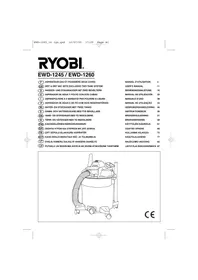
EWD-1245 - Vacuum Cleaner RYOBI - Free user manual and instructions
Find the device manual for free EWD-1245 RYOBI in PDF.


| Product type | Wet and dry vacuum cleaner |
| Brand | RYOBI |
| Model | EWD-1245 |
| Tank system | Separate water and dust tanks (inner for dust, outer for liquids) |
| Main functions | Suction of liquids and dust, blower function |
| Water/dust selector | Yes, to switch between modes |
| Automatic shut-off | Yes, when tank is full or tipped over |
| Reusable cartridge filter | For dust suction (do not rinse) |
| Foam filter | For liquid suction; also includes small foam filter built into inner tank |
| Included accessories | Hose, extension tubes, multi-purpose nozzle, flat water/dust nozzle with squeegee, long nozzle, blower attachment (depending on model) |
| Caster assembly | 4 casters with screw-on brackets |
| Drain plug | Yes, to drain liquids |
| Storage | Power cord hook, extension tube holders |
| Grounding | Plug into a grounded outlet |
| Safety | Do not expose to rain, do not vacuum hot or flammable materials, wear safety glasses when using blower function |
| Filter maintenance | Cartridge filter: tap or brush; foam filter: rinse with water and air dry |
| Warranty | 24 months against manufacturing defects, from date of invoice |
Frequently Asked Questions - EWD-1245 RYOBI
User questions about EWD-1245 RYOBI
0 question about this device. Answer the ones you know or ask your own.
Ask a new question about this device
Download the instructions for your Vacuum Cleaner in PDF format for free! Find your manual EWD-1245 - RYOBI and take your electronic device back in hand. On this page are published all the documents necessary for the use of your device. EWD-1245 by RYOBI.
USER MANUAL EWD-1245 RYOBI
Table of contents 11
Line drawing 1-3
Important safeguards 11
Assembly 12-13
How to use 13-14
Maintenance 14-15
Important notes/troubleshooting 15
INTRODUCTION
This tool has many features for making its use more pleasant and enjoyable. Safety, performance and dependability have been given top priority in the design of this product making it easy to maintain and operate.
IMPORTANT SAFEGUARDS

WARNING
The appliance is not intended for use by young children unless they have been adequately supervised by a responsible person to ensure that they can use the appliance safely.
When using an electrical appliance, always follow basic precautions, including the following.
READ ALL INSTRUCTIONS BEFORE USING THIS APPLIANCE.

WARNING
To reduce the risk of fire, electric shock, or injury:
- Do not expose to rain; store indoors only.
- Connect to a properly grounded outlet only. See Grounding Instructions in the manual.
- Close supervision is necessary when any appliance is used by or near children. Do not allow vacuum cleaner to be used as a toy or to run unattended at any time.
- Keep hair, loose clothing, fingers, feet and all parts of body away from openings, or other moving parts.
- Do not pick up anything that is burning or smoking, such as cigarettes, matches, or hot ashes.
-
Do not use to pick up flammable or combustible liquids such as gasoline or use in areas where they may be present.
-
Do not vacuum or use blower near toxic or health endangering materials such as asbestos, pesticides, fertilizers, or anything that is poisonous.
- Do not vacuum explosive dusts or use cleaner or blower in areas that may contain explosive substances such as coal, grain, or any other fine, combustible material.
- Avoid picking up hard, sharp objects with the cleaner. They may damage the cleaner and the filter.
- Do not use without filters in place. Clean filter frequently when picking up very fine materials such as powder.
Use extra care when cleaning on stairs. - Do not put any object into openings. Do not use with any opening blocked; keep free of dust, lint, hair, or anything that may reduce air flow.
- Do not pull or carry by cord, use cord as a handle, close door on cord or pull cord around sharp edges or corners. Do not run appliance over cord. Keep cord away from heated surfaces.
Always disconnect cord from electrical outlet before servicing the cleaner. - Unplug cleaner when not in use. Turn off all controls before unplugging.
- Do not unplug by pulling on cord. To unplug, grasp the plug, not the cord. Never handle plug or appliance with wet hands.
- Do not use with damaged cord or plug. If appliance is not working as it should, has been dropped, damaged, left outdoors, or dropped into water, take it to a Ryobi Factory Service Center or Authorized Ryobi Warranty Service Dealer.
Use vacuum cleaner only for its intended use as described in the instructions. Use only attachments recommended; others may cause hazards.
English
IMPORTANT SAFEGUARDS
- Ensure that no foreign bodies can get into the openings of the appliance.
- Do not change accessories while the appliance is operating.
Always store the appliance indoors. To avoid accidents, put the appliance away safely after use.
The blower can result in foreign objects being blown into eyes, which can result in eye damage. Always wear eye protection (not provided) when operating the blower. - Do not permanently cover openings of blower accessories.
- Do not point the air outlet openings at people or animals.
Always switch off and unplug Wet/Dry vac from electrical outlet before assembling, opening or emptying the dust container, or connecting/disconnecting the attachments. - Keep the suction intake opening free from obstruction at all times; otherwise the motor will overheat and Wet/Dry vac damage may result.
The Wet/Dry vac is a powerful unit. Before plugging cord into outlet make sure the switch is in the "off" position. Hold the Wet/Dry vac firmly when starting and in use. - Keep the mains cable and appliance away from sources of heat.
SAVE THESE INSTRUCTIONS!
ASSEMBLY
CARTON CONTENTS (Fig. 1)
Remove parts from tank and identify the following:
A. Outer tank
B. Inner tank
C. Cleaner lid and motor housing
D. Caster supports (4)
E. Casters (4)
F. Caster support screws (4)
G. Hose
H. Extension wands
I. Utility nozzle
K. Wet/Dry nozzle
L. Reusable cartridge filter - assembled to cleaner lid
M. Crevice tool
N. Squeegee insert*
O. Small foam filter - assembled to inner tank
P Extension wands
Q. Small float ball
R. Small float cage
S. Outer tank
T. Adapter
U. Wet/Dry nozzle with squeezegee insert*
V. Hose
W. Blower nozzle
X. Large foam filter
Y. Small utility nozzle
Z. Small crevice tool
*Provided with EWD1245
**Provided with EWD1260
Note: One of the tool sets shown (either 5.75cm or 3.17cm diameter) is included with your cleaner.
ATTACH CASTER SUPPORTS AND CASTERS (Fig. 1&2)
- Remove cleaner lid and inner tank. Turn outer tank upside down.
Match letters (A or B) on bottom of caster support with letters on cleaner tank.
Align square tabs (1) on supports with rails (2) on tank. Slide tabs onto rails until caster support (3) snaps in place.
Insert support screw into hole nearest tank. Tighten screw with a Phillips screwdriver.
Repeat with remaining casters and screws. Turn cleaner tank right side up.
ATTACH SMALL FLOAT CAGE (Fig. 3)
Turn inner tank upside down.
Place float ball over round opening in bottom of tank.
Snap tabs (A) on float cage into slots (B) on tank.
Once in place, do not remove the float assembly.
Note: Do not attempt to remove the large filter cage or float ball on cleaner lid. They are not removable parts.
INSERT INNER TANK (Fig. 4)
With inner tank duct toward drain side of outer tank, align tab (C) on inner tank with slot (D) in outer tank; slide inner tank into place.
ATTACH CLEANER LID (Fig. 5)
- Rotate lid latches (E) outward. With wet/dry selector (F) toward drain side of tank align ribs (G) on front of tank with slots (H) on either side of hose inlets; place lid on tank.
English
ASSEMBLY
- Rotate latches inward to lock lid in place.
Note: For convenience in attaching and removing the lid, finger holds are provided.
ATTACH HOSE, WANDS AND CLEANING TOOL (Fig. 6)
Push hose into hose inlet on tank; twist hose to tighten or loosen connection. (See "How to use" section for proper inlet selection.)
The wands and tools attach to hose in the same manner.
Press squeezegee insert firmly into wet/dry nozzle opening (See Fig. 7).
Use squeezegee for wet pick-up only.
ATTACH DRAIN CAP (Fig. 8)
Screw drain cap (I) onto lower, front of tank as shown.
You can use additional tools and accessories that are not included.
HOW TO USE
CLEANER DESCRIPTION (Fig. 9)
The assembled Wet/Dry vac will look like the drawing.
Operate cleaner only at voltage specified on rating label on cleaner lid.
- ON/OFF switch
- Cleaner lid
- Cleaner lid latches
- Carrying handles
- Hose inlet
- Wet/dry selector
- Caster Support
- Casters
- Tank drain cap
- Cleaner tank
- Extension tube storage holders
- Vacuum nozzle
- Cord hook: loop cord over hook for storage
- Blower port
- Crevice tool
- Wet/Dry nozzle with squeegee insert
SEPARATE WET / DRY TANKS
This feature allows the user to change from wet pick-up to dry pick-up without having to empty the tank or change filters. Dry debris will collect in the inner tank and wet debris will collect in the outer tank.
- Wear ear protection if operating cleaner for a prolonged period of time.
Make sure that the small foam and cartridge filters are in place.
DRY PICK-UP (Fig. 10)
- Disconnect cleaner from electrical outlet.
- With hose removed from cleaner, slide wet/dry selector (A) to expose "Dry tank inlet" (B). Selector will snap into place. Insert hose into "Dry tank inlet". Attach the desired tool to hose end.
Make sure cleaner lid is locked in place.
Plug power cord into a properly grounded outlet and turn cleaner on.
WET PICK-UP (Fig. 11)
- Disconnect cleaner from electrical outlet.
- With hose removed from cleaner, slide wet/dry selector (A) to expose "Wet tank inlet" (C). Selector will snap into place. Insert hose into "Wet tank inlet".
- Attach desired tool (with squeezegee if available) to hose end.
Make sure cleaner lid is locked in place.
Plug power cord into a pr operly grounded outlet and turn cleaner on. - Do not use cleaner as a pump to clean out clogged drains, sinks, or other plumbing fixtures. If cleaner will not pick up, check filters. They may need to be cleaned or replaced. (See "Maintenance" section.)
For picking up very large amounts of debris (either wet or dry), the cleaner may also be operated without the inner tank in place.
- Disconnect cleaner from electrical outlet.
Remove inner tank and set aside. - Attach hose to either the wet or dry intake port. Plug power cord into a properly grounded outlet and turn cleaner on.
- When using single tank for dry pick-up, cartridge filter must be in place.
English
HOW TO USE
For best results, when using single tank for wet pick-up, use a foam filter sleeve instead of the cartridge filter. See "Filters" in the Maintenance section for availability of foam filters.
AUTOMATIC WET SHUT-OFF
- When either tank is full of liquid, the automatic shut off mechanism will shut off cleaner pick-up. When this happens, the motor sound will become noticeably higher in pitch.
Turn cleaner off and empty tank to continue use.
The automatic shut-off will also engage if the cleaner has been tipped over. To continue use, turn cleaner off, and set it upright. Wait a few seconds to allow the motor to come to a complete stop.
The automatic shut-off will function for both separate wet/dry tank and single tank operation.
DRY WALL DUST (Fig. 12)
For best results when picking up dry wall dust, slide wet/dry selector (A) to expose "WET/DRY INLET" and make sure no water or moisture is in the Wet Tank (outer tank). Keep inner tank in position. Insert hose into "WET TANK INLET" and attach desired tool to hose end.
BLOWER FEATURE (Fig. 13)
The blower can be used to blow dirt out of areas where it is impossible for suction to reach.
Inside of hose and tools must be free of litter before operating blower.
It is recommended that the filters be in place when operating the blower feature.
- Disconnect cleaner from electrical outlet.
Push hose into blower port (C); twist hose to tighten or loosen connection. Attach blower nozzle (included with some models) or other tool if desired.

CAUTION
Wear safety goggles when using blower feature. Do not blow toward people, animals, or objects that may be damaged by flying debris. Wear ear protection if using the blower for a prolonged period of time. Plug power cord into a properly grounded outlet, grasp free end of hose, and turn cleaner ON.
- Do not use blower to spray paint or any other flammable or combustible materials.
STORAGE (Fig. 14)
Empty tanks (see Maintenance section).
- Rinse inside of tank thoroughly with clean water particularly if spills or other liquid substances other than plain water have been picked up. Wipe inside of tank dry.
- Loop cord over cord storage hook, located on tool rack.
Wands store on rear caster supports as shown. The larger diameter wands fit into outer triangle, the smaller diameter wands store inside the larger wands and over small triangular peg. Tools store on tool rack as shown.
MAINTENANCE
EMPTYING TANKS
AFTER DRY PICK-UP
- Disconnect cleaner from electrical outlet.
- Release lid latches and remove cleaner lid from tank.
To avoid back strain, do not lift a full tank. First, scoop out enough debris to make tank easier to lift.
Empty contents into a suitable receptacle.
Rinse inside of tank with clean water and wipe dry.
Note: If not very full, the inner tank may be easier to empty if it is removed from the outer tank.
- When emptying the inner tank, do not grab onto filter cage.
AFTER WET PICK-UP (Fig.15)
- Disconnect cleaner from electrical outlet.
- Unscrew drain cap (A) from bottom of outer tank.
Empty contents into a suitable drain.
As the liquid level decreases, it may be necessary to tip cleaner to allow remaining liquid to drain out. - Rinse inside of tank thoroughly with clean water particularly if spills or other substances other than water have been picked up.
Wipe inside of tank dry.
FILTERS
Do not operate cleaner without filters in place.
FOAM FILTER (Fig. 16)
- Disconnect cleaner from electrical outlet.
To clean, remove foam filter (B) and rinse with clean water. Let filter air dry.
English
MAINTENANCE
To replace, slide filter completely down over openings on inner tank filter cage (C).
The small foam filter must be in place whenever the inner tank is in use.
If the cleaner is used as a single tank unit for wet pickup, it is best to use a foam filter sleeve instead of the cartridge filter.
REUSABLE CARTRIDGE FILTER
- Disconnect cleaner from electrical outlet.
After dry pick-up, remove filter (D) and gently tap it against inside of cleaner tank or brush off debris with a soft brush. Do not rinse the cartridge filter.
Check filter thoroughly and replace it if there are any tears or holes in it.
Note: Vigorous scrubbing may shorten the life of the cartridge filter.
To replace, slide cartridge filter over filter cage (E) until it will not go on any further.
IMPORTANT NOTES/TROUBLESHOOTING
If the suction is significantly reduced, the filter may require cleaning.
During wet vacuuming, if the float rises and blocks suction, you will notice the change in the sound that the machine makes. This is a safety feature and is intended to prevent continued use when the recovery tank is full of liquid. Switch off the appliance, empty the liquid, reassemble and then restart.
Deutsch
INHALT
Inhalt 16
Abbildungen 1-3
FUNCAOSOPRAGEM (Fig.13)
BINNENBAK PLAATSEN (afb. 4)
BESCHRIJVING VAN HET APPARAAT (afb. 9)
STOF OPZUIGEN (afb. 10)
BLAASFUNCTIE (afb. 13)
TOMNING AF BEHOLDERE EFTER SUGNING AF TORT MATERIAL
TOMMING AV BEHOLDERNE
ETTER TØRRSUGING
TONOETHsH TOY POaON (X.2)
ApaieTe To kaumu TaOounac KaWc Kai To eoWtepiokdoxexio.ToOneTneTo EeWtepiok doxexio avanoda.
AvtioxioTe ta ypaumata (A n B) nou avayapavotai oTo kato w tua twv baoewy ia tic p0e6 ta avayapopmeva oTo Ewepiko doxexio TcOkounac ypaumata.
Euoypauiote ta tepaywva takakia (1) twv β aewy ia TIC pOdec ME TETPAYWvEc EYKONc (2) Tou doxiou. ToOneHTnTe TA Takakia MEOA OTIC EYKONc mExoi i BAoei yia TIC pOdec (3) va evia owota oTpeewveC OTO doxieio.
Eeneita TonoBtneTc Tic BiDcTwv BaOeWv Otic onec nou Bpokovta tO xElaoc Tou Doxxiou. ZpiEte Tc BiDec e tsigmapakotadibo.
EeTaToOnoTheTneMa pOda oKaTe Baon,Ony nio anOpauuEvn ano To doxio onn. EnavaepetE to Ewotepiko doxio ano Tnv kaH.
TONOETHsH TOY MIKPOY AOTEP (x.3)
Toontheta to eowetko doxio avnoba.
TooTheTnOte To mnaaki Tou φ otep oTo OtpoyuAo avoiyma OTOv uOeva Tou doxeiou.
Eeita tootheitote ta takaia (A) tou φ oTep otic ykonec (B) tou doxiou.
Apou tootheTnOeTo ploTeP, mV to EaVaByaTe.
Napatnpn: Mny npoanathetava byaleto yealao oTo mnaakoueayalou oIto kaLmu. Ta tmata auta dEvai aapoueva.
TOnOoEThsH TOY EzOTePIKoy OXeIOy ( ,4)
KATEUoVTeTov aywOToU eowTEpikoDoxeiou ano TnV nEupaTc EKKeVwoCtou EeWTEpikoDoxeiou, EUuypauiTe To Takaki (C) Tou eawTEpiko Doxeiou µ Tn Oxiun (D) Tou EeWTEpiko Doxiou Kau oIoTheTo eawTEpiko Doxieio Wote va aTepeWthetaI 0To EeWTEpiko Doxiio.
ΣTEPEΩΣH TOY KAΛYMMATO Σ (Σχ. 5)
Fupiote ta otoxieia oTepewoc (E) Tou kaUmuato npoC ta E\xw. Tonoetntoe Tou eIauoyea uypov/otepewv (F) ano tn mepi Ta ncs Ekkevwnc Tou doxiou kai uEvuypauiote tic npoeXoxc (G) nou piokovtai ot npootivoo poc Tou doxiou mTic yKoic (H) nou piokovtai ano kahe naEuopa twv onwv eoayyncaepa, eneita oTepeowte to kaluuma oTo doxieio.
FupioTe ta 0toixia stepewonc Tou kaLmuato npoC ta eoa yia va akivtonoioeTo kauuuma. Napatnpn: To kaluuna fepei laebc yia tn dieukoluvon tnc apalpeons kai tnc stepewonc Tou.
EXOPI2TA OXEIA IYYPTA/STEPEA
H λI toupyia autn oac entpeniei va nepaote ano tvn avappoqn on tpeaeac uNs mtnv avappoqn on upvw xwpic va xpeiaetzai va aobiaote to doxio n va aalaeTe to qiatp. Etoi oi kovc evapappooivtai meo sto oawteipko doxieio, evw ta uypa avappopouvtai oTo eEwtepiko doxieio.
ΦopéoTe npoataeutikec wtaonidec av xpoiounoiite tn okaunay iapaatetateevn nepiodo.
Bεβαιωθειτε πως το φιλτρο από αφρολέξ και το φιλτρο με φυσίγνιο εἰναι ωστά τοποθετημενα.
ANAPPOΦH∑KONH∑(∑χ.10)
Anouovdeote nokouna.
Av o eukamptoc oawlvac ivai movtapiouevoc etanaw otn okaouna, aqaipoeote tov kai onpwetotov enuoyea uypw/otepewv (A) npoc ta apiatepa etoi wote vexte npoobaaon tnv iayawyn aepa (B) tou eowtepikou doxieoi. O eniuoyae cavakkivcTnv om Tou Eomegaptikou doxieoi. Tonoctne tov eukamtno owlva onyom Tou eowtepikou doxieoi. Tepeowte to Eaptnua nou ΘeLTe v xpnoumonofoeTe otnv akpn tou eukamptou owlva.
EeEyEeT NwTo KaAumua TnS Oounac Eivaa oot a OTepewevo.
SUVoTe Tn oKoUa Oe mpiCi eYeiwn KaI θoTe Tn oKoUa OE aeitoupyia.
ANAPPOΦHSH YΓPΩN (Σχ.11)
Anouovdeote nokouna.
Av o eukamptoc oawlvac evai movtapiouevoc enavw otn okaun, apaipote tov kai onpewte tov eniaoyea uypw/otepewv (A) npoc ta 8eia etoi wote va exete npoasaon otnv eoaywyn aepa (C) tou ewtepikou doxeiou. O eniaoyacevakaleivei tvn ontou eawteripkou doxeiou. Tonoetneote soekamtno oawlya stnv ontou eEwtepikou doxeiou.
Σεπεωτε Τελαργα Μου θελετεν αρησιομούπεις (με το Εεδιρο, av χερίαζεται) Θόνλακρητοι Σου ευκαμιπου σωλήνα.
EeYTe TWC TO KALUmu TnC OKounac Eivai oOtA OTEPewEvo.
SuvoeTn oKouna eMa npiae yeiowan Ka 0eTe Tn oKouna eAetoupyia.
Mn xpnaiomonoieite tny nAekptipkn oac oKaounta uypw kai stepov aav avtia yia tnv anoppaEn boulawevw aywyv, vepoxutw n awwu ubpauikw otoiexiw. Av n avappoqn anivai anoteleaatikn, eEyTe nTv katataan twviiprwv. Mnopei va xpeiaocovtar kaabapma n avtkataotaon (avatpEte oTo tmjua "Suvtipnon").
XPHSH ME ENA MONO Δ OXEIO
Av npTei va avnpofoe Teyalec nootntec OTepeoc unc n uypwv, mOpoeite enionc va Xpnoutoiofoe Tk oouna xwpiC to Eaowteko doxie.
Anouvdeote nokouna.
Apaipote to eawtepiokofoxio kai taktonoinoteto yia mllovtikxpnon.
Tepewotovukauimaa oanoiadnoeom saiaywnc aepa. suvodote tn okouna oe ma npiae yeiowon kaiote tn okouna oe letoupyia.
Otau xnpoioe iEva mvo doxio ia va avappnoote opea un, to piaItpo e pfouiy npenei va eivai tonoTheuEvO.
Iia kalutepa anoteléouata otav xpoiounoieite eva mvo doxio yia tny avappopnon uypw, ouviotatai npnonpeyalou qilpou ano appoolek kai opiipou me quiyio (avatpeTe 0tnv napaypfo "phi"tou tumuoc "suvtnpnoyn yia nepioooTEpc nnpopopoeic).
AYTOMATO TAMATHMA E INEPINT Ω H IAHP Ω H Δ OXEIOY
Otau eva ano ta doxieia eivai ymuato uypo, evepyonoieitai o nxaovios autoatou otamatnoac. Otau auvaiei auto, o kvnntpacs Eknneimvavnxo aopwc nio oxi.
Staatae toTn oouna kai aediaote to yepato doxieio npiv tn eoetne naI oe aeitoupyia.
EMLVik
XPHSH
O umxaviooac autouatou otauathauotc evepytoieita emionctav n okouna avatpenetai. Tia va Eavapxiete tnv epyaoia, otauathote nokouna kai vavaonkwoTe nTv. NepieveTe epiKa deutepoAenta yia va npolae i kivntpa c va otauatnoeEvteLwC.
O unxaviooc autouo atapntuoc o nepiinwn npwnc doxiou aeitoupei too otav n akouna xpanoioeirai me duo doxieia oo otav xpanoioeirai me eva mvo doxieo.
ANAPPOHsH sKONHs (x.12)
Tia kalutepa anotelaeouata otav avappopate oTepea uIka, too0e1note Tov eIuoyea Uypw/otepewv (A) EEiA, kai 8eBaiowte iE WOETeKO doxieio 8ev npEixkavev aUyo n Uyo oToiExo. Anote to oWOTeKO doxieio ToOnoetne To Eukamto Oawna OTNV OTN TO EWTeKIO DOXeiou kai OTEPEOWTO EApTma NOU eTIoue XpOAMONIOe TOnV AKnTO uEukantou OAWiva.
AEIOTOYPFIA YHMATO (X.13)
O quoantnpaac mtopei va xonaiuantoanthei vta nvy anoakpuovn tnc okovnc anto ta mepn onou dev exouv npooaaon ta puoyx avapopnoqnac.
Baeiowte TWC o eukapntoc oawnyac kai to akpoatouc evai kaopa npiv xnoiopoioe t ne Aetiouy quanpatoc.
ac ouviotoue va povvtioe ta qiaTpa va eiva tonothe na kata tn xpnon tou quantnpa.
Anouvdeote nokouna.
ToOneTneToEukaPToOwIhVaOTNV Edo aepa Tou quanmpa (C) KAI nepiotpeyTe Tov yia va otepewei (nava apaipeei).TePewato AkoptoMu Tou pntpa (To onio npexetai mvo Me oipueMoVTae) n onoiodnote aaLouBATO EApTma OTNV Akpn Tou EukamTou OwIhVa.

IPOEIOHOIHEN
Na opate navta npootateutika yuaia otav xpaonpoie to quontnpa. Mny kateuuvet o akpo tou quontnpa npoc atoma n zwa n akounkai avtikeevaou taopouovav naohounna ano tnpoanokouniow. Fopote npootateutikec wtaonidec av xpaaonoeite to quontnpa yia napateqevn nepiodo. Suvote tn okouna oe ma yieomegaynpica, kpatote tnakpnou eukamtonou ownvaoto xepiaackai thee tn okouna oe aeitoupyia.
Mn xpnouoioite to quonntpa yia va yekaoetex npwma n allo eupkko taauio uiko.
TAKTONOIHsH (x.14)
Aeiaote ta doxeia (AvatpeEte oTo tmu" “Suvtnpnon").
EMLUVEIPOOeKTiKaTOeOWTePIKoTswDoxeiW, IOWc av exouv avappopnEi aAa Upaek ano VEpo. SKouniTe PPOeKTiKaTo eOWTePIKoTsw DoxeiW.
TuIeTe To kaIomega npoxnc pEuaToc yupw ano To yavTo nou npoBAnetai yi auto dinla stny Eayown aepa Tou quontnpa.
Oi oWlnves npoektaonc taktonoiouvtai 8baocic
me pOdec, onwacneikovicietai oTo oxedio 14: ou
paputepoi oWnveC tonotheouvtai oTa
EeWTEPIKA TpiYwA EV WIO IIO AENTOI Owlnvcs
toonoeuvtai mea stouc papoutepouc.
Taktonoiote ta eApntmuata enavw otuokueun
onwc anekovicietai 0x.14.
SYNTHPHZH
EKKENΩΣH TΩN ΔOXEΙΩN
META ANO ANAPPOΦH ΣTEPEΩN YAIKΩN
Anouvdeote nokouna.
Aneueoepwote ta otoixia oTepeowc tou kaUmuatoc kai apaipoeTo kaUmu.
Ia va anopuyete va 1aayete nvy aatn oac, un onkwve to doxio otav eivai yeato. Aoeiaote npota eva depoc tou nepiexoxevou wote va eivau elappuTepo.
Aeiaote to nepiexoevto tou doxiou eoa e evav katalnao nepiEKTn.
EeNluVETo EoWTePiKo Tou BoXeiou M KaApo Vepo KAI OKouniTe To npOeKTiKa.
Napatpon: Av to eawotepiko doxieio dev ivai nolu yepato, 0a evai nio eukolo va to aediaeTe E£o anto to eEwotepko doxieio.
Otau aediaeTe to eawepiko doxio, mnu to kpatate ano to oaoTep.
META ANAPPOHSH YRPQN (X.15)
AnouvdoTe Tn oKaouna.
EeBOWOT To nwa EKKewonc (A) nou Bpioketau OTO kATW ePOs TOU EEWTepiKoDoxieou.
Aeiaote to nepiexoevtooudoxieou eoa e evav katalnao npiektn.
Mnopei va xpeiaotei va yieipeteto doxio yia va aediaoteevteawto nepiexoxevo tou.
Eλnviiká
SYNTHPHzH
EaVte npoaeKtka To eawtepiok Tou doxieoue kaapoe, iowc av exouv avappopn0ei aaaa uypaekoc ano vepo.
Kouniote npoeektka to eowtepiok toou doxeiou.
ΦIATPA
Mn xpoiooioioe Tn oouna aac av ta qiatpa 8ev eivai tonotheeta.
TPO APOAENE (x.16)
Anouovdeote nokouna.
Fia va kathetaiapaTe to piTpo aphiale (B), aphipeoTe to kai eByalte to me Kae kthetaapo vepo. Eneita aphiote to va steywoei.
Ia va to e navatonoeTeoTe, bAte to otyn unoox tonu e o aTo eowetepiko doxio (C).
To μικρο φιλτρο αφρολέξ πρεπαι va εινατο τοῦτημένον έόπεχροισοιείαι το εωτεριδόxειδ.
Av n okouna xpnoiooiietai ue eva movo doxio yia avappoopnon uypw, eivai npotmuotpo va xpnoiointheta iatp o appoale npapilatp o e quaiyio.
EANAXPHESIMOIOMENO FIATPO ME ΦYΣΙΓΙΟ
HOIDKE NEED JUHISED ALLES!
KOKKUPANEK
PAKENDI SISU (joonis 1)
GARANTIE - CONDITIONS
All Ryobi products are guaranteed against manufacturing defects and defective parts for a period of twenty four (24) months from the date stated on the original invoice drawn up by the retailer and given to the end user. Deterioration caused by normal wear and tear, unauthorised or improper use or maintenance, or overload are excluded from this guarantee as are accessories such as battery packs, light bulbs, blades, fittings, bags, etc. In the event of malfunction during the warranty period, please take the NON-DISMANTLED product, along with the proof of purchase, to your retailer or nearest Authorised Ryobi Service Centre.
This warranty in no way affects your legal rights concerning defective products.

DECLARATION OF CONFORMITY
We declare under our sole responsibility that this product is in conformity with the following standards or standardized documents. 73/23/EEC, 89/336/EEC; EN 55014-1:2000+A1+A2, EN 55014-2: 1997+A1, EN 61000-3:2,2000, EN 61000-3:3: 1995+A1, EN 60335-1: 2002+A11, EN 60335-2:2003, EN 50336:2003

Name of company: Address:
Ryobi Technologies FRANCE S.A. Z.I. PARIS NORD II 209, RUE DE LA BELLE ETOILE 95700 ROISSY EN FRANCE FRANCE
Tel: +33-1-49 90 14 14 Fax: +33-1-49 90 14 29
Name of company: Address:
Ryobi Technologies (UK) Limited. ANVIL HOUSE, TUN'S LANE, HENLEY-ON-THAMES, OXFORDSHIRE, RG9 1SA UNITED KINGDOM
Tel: +44-1491-848700 Fax: +44-1491-848701
Name of company: Address:
Ryobi Technologies GmbH
ITTERPARK 7
D-40724 HILDEN GERMANY
Tel: +49-2103-29580 Fax: +49-2103-295829
Name/Title:
Michel Volleau



- INTRODUCTION
- IMPORTANT SAFEGUARDS
- WARNING
- READ ALL INSTRUCTIONS BEFORE USING THIS APPLIANCE
- ENGLISH
- SAVE THESE INSTRUCTIONS
- ASSEMBLY
- CARTON CONTENTS (FIG. 1)
- ATTACH CASTER SUPPORTS AND CASTERS (FIG. 1&2)
- ATTACH SMALL FLOAT CAGE (FIG. 3)
- INSERT INNER TANK (FIG. 4)
- ATTACH CLEANER LID (FIG. 5)
- ATTACH HOSE, WANDS AND CLEANING TOOL (FIG. 6)
- ATTACH DRAIN CAP (FIG. 8)
- HOW TO USE
- CLEANER DESCRIPTION (FIG. 9)
- OPERATE CLEANER ONLY AT VOLTAGE SPECIFIED ON RATING LABEL ON CLEANER LID
- SEPARATE WET / DRY TANKS
- DRY PICK-UP (FIG. 10)
- WET PICK-UP (FIG. 11)
- AUTOMATIC WET SHUT-OFF
- DRY WALL DUST (FIG. 12)
- BLOWER FEATURE (FIG. 13)
- CAUTION
- STORAGE (FIG. 14)
- MAINTENANCE
- EMPTYING TANKS
- AFTER DRY PICK-UP
- AFTER WET PICK-UP (FIG.15)
- FILTERS
- FOAM FILTER (FIG. 16)
- REUSABLE CARTRIDGE FILTER
- IMPORTANT NOTES/TROUBLESHOOTING
- DEUTSCH
- INHALT
- FUNCAOSOPRAGEM (FIG.13)
- BINNENBAK PLAATSEN (AFB. 4)
- BESCHRIJVING VAN HET APPARAAT (AFB. 9)
- STOF OPZUIGEN (AFB. 10)
- BLAASFUNCTIE (AFB. 13)
- TOMNING AF BEHOLDERE EFTER SUGNING AF TORT MATERIAL
- TOMMING AV BEHOLDERNE
- ETTER TØRRSUGING
- TONOETHSH TOY POAON (.2)
- TONOETHSH TOY MIKPOY AOTEP (X.3)
- TONOOETHSH TOY EZOTEPIKOY OXEIOY ( ,4)
- ΣTEPEΩΣH TOY KAΛYMMATO Σ (ΣΧ. 5)
- EXOPI2TA OXEIA IYYPTA/STEPEA
- ANAPPOΦH∑KONH∑(∑Χ.10)
- ANAPPOΦHSH YΓPΩN (ΣΧ.11)
- XPHSH ME ENA MONO Δ OXEIO
- AYTOMATO TAMATHMA E INEPINT Ω H IAHP Ω H Δ OXEIOY
- EMLVIK
- XPHSH
- ANAPPOHSH SKONHS (X.12)
- AEIOTOYPFIA YHMATO (X.13)
- IPOEIOHOIHEN
- TAKTONOIHSH (X.14)
- SYNTHPHZH
- EKKENΩΣH TΩN ΔOXEΙΩN
- META ANO ANAPPOΦH ΣTEPEΩN YAIKΩN
- META ANAPPOHSH YRPQN (X.15)
- EΛNVIIKÁ
- ΦIATPA
- TPO APOAENE (X.16)
- EANAXPHESIMOIOMENO FIATPO ME ΦYΣΙΓΙΟ
- HOIDKE NEED JUHISED ALLES
- KOKKUPANEK
- PAKENDI SISU (JOONIS 1)
- GARANTIE - CONDITIONS
- DECLARATION OF CONFORMITY
Brand : RYOBI
Model : EWD-1245
Category : Vacuum Cleaner