A-50 - Audio Amplifier PIONEER - Free user manual and instructions
Find the device manual for free A-50 PIONEER in PDF.



| Product Type | Integrated Audio Amplifier |
| Brand | PIONEER |
| Model | A-50 |
| Dimensions (W × H × D) | 435 mm × 138,5 mm × 357 mm |
| Weight (without packaging) | 11,1 kg |
| Power Supply | 220-230 V AC, 50 Hz |
| Power Consumption | 72 W (standby 0,2 W) |
| Continuous Power Output | 65 W + 65 W (8 Ω), 90 W + 90 W (4 Ω) |
| Speaker Impedance | 4 Ω to 16 Ω (A or B), 8 Ω to 32 Ω (A+B) |
| Audio Inputs | PHONO (MM), SACD/CD, NETWORK, TUNER, RECORDER, AUX |
| Audio Outputs | Speakers A and B, RECORDER OUT, headphone jack |
| Frequency Response | 5 Hz - 20 kHz ± 2 dB (DIRECT ON) |
| Signal-to-Noise Ratio | 101 dB (SACD/CD, DIRECT ON) |
| Tone Controls | BASS (100 Hz, ±10 dB), TREBLE (10 kHz, ±10 dB) |
| Special Functions | DIRECT, LOUDNESS, BALANCE, POWER AMP DIRECT, APD |
| Supplied Accessories | Remote control, batteries, power cord, short pin plugs, warranty card |
| Maintenance | Dry cloth, avoid chemical products |
| Safety | Do not open, ventilation, avoid liquids |
Frequently Asked Questions - A-50 PIONEER
User questions about A-50 PIONEER
0 question about this device. Answer the ones you know or ask your own.
Ask a new question about this device
Download the instructions for your Audio Amplifier in PDF format for free! Find your manual A-50 - PIONEER and take your electronic device back in hand. On this page are published all the documents necessary for the use of your device. A-50 by PIONEER.
USER MANUAL A-50 PIONEER
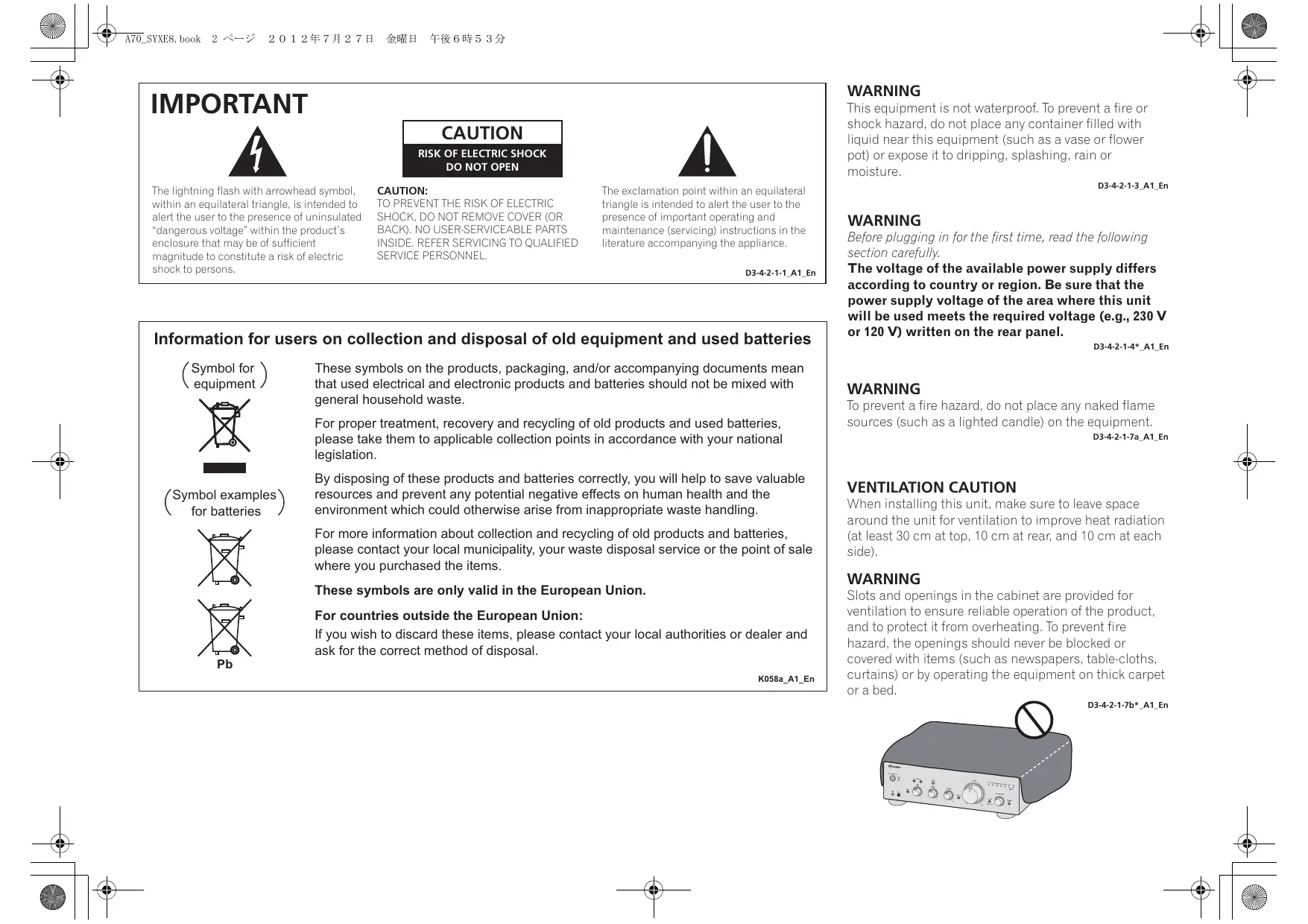
The lightning flash with arrowhead symbol, within an equilateral triangle, is intended to alert the user to the presence of uninsulated “dangerous voltage” within the product’s enclosure that may be of sufficient magnitude to constitute a risk of electric shock to persons.
CAUTION
RISK OF ELECTRIC SHOCK DO NOT OPEN
CAUTION:
TO PREVENT THE RISK OF ELECTRIC SHOCK, DO NOT REMOVE COVER (OR BACK). NO USER-SERVICEABLE PARTS INSIDE. REFER SERVICING TO QUALIFIED SERVICE PERSONNEL.

The exclamation point within an equilateral triangle is intended to alert the user to the presence of important operating and maintenance (servicing) instructions in the literature accompanying the appliance.
D3-4-2-1-1_A1_En
Information for users on collection and disposal of old equipment and used batteries
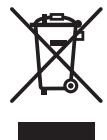
(Symbol for equipment)
(Symbol examples for batteries)
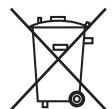
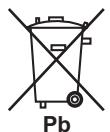
These symbols on the products, packaging, and/or accompanying documents mean that used electrical and electronic products and batteries should not be mixed with general household waste.
For proper treatment, recovery and recycling of old products and used batteries, please take them to applicable collection points in accordance with your national legislation.
By disposing of these products and batteries correctly, you will help to save valuable resources and prevent any potential negative effects on human health and the environment which could otherwise arise from inappropriate waste handling.
For more information about collection and recycling of old products and batteries, please contact your local municipality, your waste disposal service or the point of sale where you purchased the items.
These symbols are only valid in the European Union.
For countries outside the European Union:
If you wish to discard these items, please contact your local authorities or dealer and ask for the correct method of disposal.
K058a_A1_En
WARNING
This equipment is not waterproof. To prevent a fire or shock hazard, do not place any container filled with liquid near this equipment (such as a vase or flower pot) or expose it to dripping, splashing, rain or moisture.
D3-4-2-1-3_A1_En
WARNING
Before plugging in for the first time, read the following section carefully.
The voltage of the available power supply differs according to country or region. Be sure that the power supply voltage of the area where this unit will be used meets the required voltage (e.g., 230 V or 120 V) written on the rear panel.
D3-4-2-1-4*_A1_En
WARNING
To prevent a fire hazard, do not place any naked flame sources (such as a lighted candle) on the equipment.
D3-4-2-1-7a_A1_En
VENTILATION CAUTION
When installing this unit, make sure to leave space around the unit for ventilation to improve heat radiation (at least 30 cm at top, 10 cm at rear, and 10 cm at each side).
WARNING
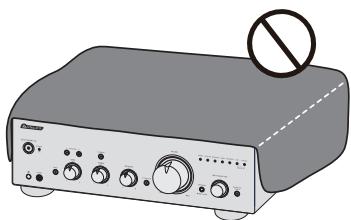
Slots and openings in the cabinet are provided for ventilation to ensure reliable operation of the product, and to protect it from overheating. To prevent fire hazard, the openings should never be blocked or covered with items (such as newspapers, table-cloths, curtains) or by operating the equipment on thick carpet or a bed.
natural_image
Illustration of a portable electronic device with no visible text or symbols on its body, including a prohibition symbol above the top-right circle (no readable text or labels)D3-4-2-1-7b*_A1_En
Operating Environment
Operating environment temperature and humidity: +5 °C to +35 °C (+41 °F to +95 °F); less than 85 %RH (cooling vents not blocked)
Do not install this unit in a poorly ventilated area, or in locations exposed to high humidity or direct sunlight (or strong artificial light)
D3-4-2-1-7c*_A1_En
If the AC plug of this unit does not match the AC outlet you want to use, the plug must be removed and appropriate one fitted. Replacement and mounting of an AC plug on the power supply cord of this unit should be performed only by qualified service personnel. If connected to an AC outlet, the cut-off plug can cause severe electrical shock. Make sure it is properly disposed of after removal. The equipment should be disconnected by removing the mains plug from the wall socket when left unused for a long period of time (for example, when on vacation).
D3-4-2-2-1a_A1_En
CAUTION
The Ⓐ/I STANDBY/ON switch on this unit will not completely shut off all power from the AC outlet. Since the power cord serves as the main disconnect device for the unit, you will need to unplug it from the AC outlet to shut down all power. Therefore, make sure the unit has been installed so that the power cord can be easily unplugged from the AC outlet in case of an accident. To avoid fire hazard, the power cord should also be unplugged from the AC outlet when left unused for a long period of time (for example, when on vacation).
D3-4-2-2-2a* _A1_En
This product is for general household purposes. Any failure due to use for other than household purposes (such as long-term use for business purposes in a restaurant or use in a car or ship) and which requires repair will be charged for even during the warranty period.
K041_A1_En
POWER-CORD CAUTION
Handle the power cord by the plug. Do not pull out the plug by tugging the cord and never touch the power cord when your hands are wet as this could cause a short circuit or electric shock. Do not place the unit, a piece of furniture, etc., on the power cord, or pinch the cord. Never make a knot in the cord or tie it with other cords. The power cords should be routed such that they are not likely to be stepped on. A damaged power cord can cause a fire or give you an electrical shock. Check the power cord once in a while. When you find it damaged, ask your nearest PIONEER authorized service center or your dealer for a replacement.
S002*_A1_En
Thank you for buying this Pioneer product.
Please read through these operating instructions so that you will know how to operate your model properly. After you have finished reading the instructions, put them in a safe place for future reference.
Contents
01 Before you start
What's in the box....4
Loading the batteries in the remote control .....4
Using the remote control....4
Installing the amplifier....4
02 Connecting up
Making cable connections....5
About "Bi-wiring" 5
Connecting speaker cables 6
Connecting audio cables....6
Using centralized control with other Pioneer components 6
Digital audio input connections (A-70 only) .....6
Using a USB cable to connect to a computer (A-70 only)....7
Plugging in 7
03 Controls and displays
Front panel 8
Rear panel....9
Remote control 10
04 Operation
Playback 11
Set the power to Standby....11
When using the unit as a power amplifier .....11
Playing music from a digital audio component (A-70 only)....12
Playing music from a computer (A-70 only) .....12
Making an audio recording .....12
To set for automatic standby status (Auto Power Down) 13
Restoring all the settings to the factory default settings....13
05 Additional information
Troubleshooting....14
Cleaning the unit....14
Specifications 15
Chapter 1:
Before you start
What's in the box
Please confirm that the following accessories are in the box when you open it.
- Remote control
• AAA/IEC R03 dry cell batteries x2 - Short pin plug x 2
(At time of purchase, these plugs have been factory installed in the rear panel's PHONO IN terminals.)
• Power cord (Length: 1.8 m)
- Warranty card
• Caution sheet (To first-time users)
- Operating instructions (This document)

Note
- Illustrations featured in the Operating Instructions may have been modified or simplified for ease of explanation, and may therefore differ from the actual product appearance.
- The illustrations used here are mainly of the A-70.
Loading the batteries in the remote control

1 Open the rear lid.
2 Insert the new batteries, matching the polarities as indicated inside the case.
3 Close the rear lid.
The batteries included with the unit have been provided to allow you check product operation and may not last long. We recommend using alkaline batteries that have a longer life.

WARNING
- Do not use or store batteries in direct sunlight or other excessively hot place, such as inside a car or near a heater. This can cause batteries to leak, overheat, explode or catch fire. It can also reduce the life or performance of batteries.

Caution
Incorrect use of batteries may result in such hazards as leakage and bursting. Observe the following precautions:
- When inserting the batteries, make sure not to damage the springs on the battery's terminals. This can cause batteries to leak or overheat.
- Do not use any batteries other than the ones specified. Also, do not use a new battery together with an old one.
- When loading the batteries into the remote control, set them in the proper direction, as indicated by the polarity marks (⊕ and ⊖).
- Do not heat batteries, disassemble them, or throw them into flames or water.
- Batteries may have different voltages, even if they are the same size and shape. Do not use different types of batteries together.
- To prevent leakage of battery fluid, remove the batteries if you do not plan to use the remote control for a long period of time (1 month or more). If the fluid should leak, wipe it carefully off the inside of the case, then insert new batteries. If a battery should leak and the fluid should get on your skin, flush it off with large quantities of water.
- When disposing of used batteries, please comply with governmental regulations or environmental public institution's rules that apply in your country/area.
Using the remote control
The remote has a range of about 7 m at an angle of about 30^ from the remote sensor.
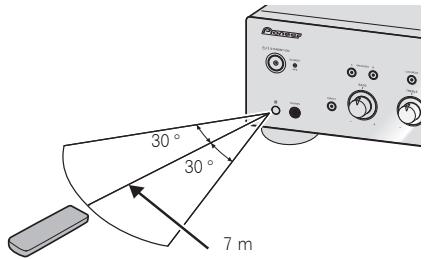
Keep in mind the following when using the remote control:
• Make sure that there are no obstacles between the remote and the remote sensor on the unit.
- Remote operation may become unreliable if strong sunlight or fluorescent light is shining on the unit's remote sensor.
- Remote controllers for different devices can interfere with each other. Avoid using remotes for other equipment located close to this unit.
- Replace the batteries when you notice a fall off in the operating range of the remote.
Installing the amplifier
When installing this unit, make sure to put it on a level and stable surface.
- Don't install it on the following places:
– on a color TV (the screen may distort)
– near a cassette deck (or close to a device that gives off a magnetic field). This may interfere with the sound.
– in direct sunlight
– in damp or wet areas
– in extremely hot or cold areas
– in places where there is vibration or other movement
– in places that are very dusty
– in places that have hot fumes or oils (such as a kitchen) - Do not mount the unit on a sofa or other object or material with absorbent qualities, since sound quality may be adversely affected.
Chapter 2:
Connecting up
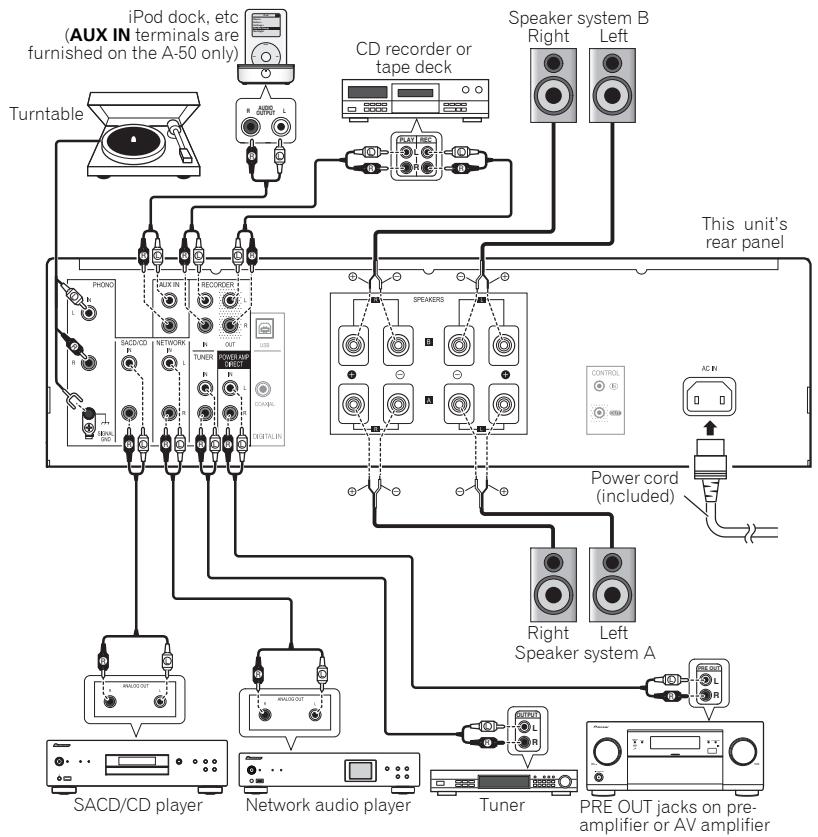
Making cable connections

Caution
- Before making or changing the connections, switch off the power and disconnect the power cord from the AC outlet.
- Connect the power cord after all the connections between devices have been completed.
flowchart
graph TD
    A["Turntable"] --> B["CD recorder or tape deck"]
    B --> C["Speaker system B"]
    C --> D["AC IN"]
    D --> E["Power cord (included)"]
    E --> F["Right Speaker system A"]
    E --> G["Left Speaker system A"]
    H["iPod dock, etc. (AUX IN terminals are furnished on the A-50 only)"] --> I["SACD/CD player"]
    H --> J["Network audio player"]
    H --> K["Tuner"]
    H --> L["PRE OUT jacks on pre-amplifier or AV amplifier"]
    I --> M["SACD/CD player"]
    J --> N["Network audio player"]
    K --> O["Tuner"]
    L --> P["PRE OUT jacks on pre-amplifier or AV amplifier"]
    style A fill:#f9f,stroke:#333
    style H fill:#ccf,stroke:#333
    style B fill:#cfc,stroke:#333
    style C fill:#fcc,stroke:#333
    style D fill:#cff,stroke:#333
    style E fill:#ffc,stroke:#333
    style F fill:#cfc,stroke:#333
    style G fill:#fcc,stroke:#333
    style H fill:#cfc,stroke:#333
    style I fill:#fcc,stroke:#333
    style J fill:#fcc,stroke:#333
    style K fill:#fcc,stroke:#333
    style L fill:#fcc,stroke:#333
    style M fill:#ffc,stroke:#333
    style N fill:#fcc,stroke:#333
    style O fill:#fcc,stroke:#333

Caution
- The SIGNAL GND terminal is provided to reduce noise when connecting the unit to components such as an analog turntable.
- The PHONO IN terminals are factory equipped with short pin plugs. These should not be removed except when connecting a turntable. Be sure to save the short pin plugs in a safe place.
- Do not insert the short pin plugs in any connectors other than the PHONO IN terminals. Connecting them to any other terminals may cause malfunctions.
- Do not connect the PHONO IN terminals to any component other than a turntable; also, do not connect to a turntable equipped with built-in equalizer. An excessively high sound output may be produced, resulting in damage to your speakers or other devices.
- The A-50's PHONO IN terminals are designed to be used only with turntables equipped with MM (moving-magnet) type cartridges. Turntables equipped with MC (moving-coil) cartridges cannot be used.
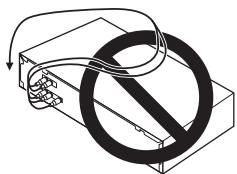
- Make sure not to bend the cables over the top of this unit (as shown in the illustration). If this happens, the magnetic field produced by the transformers in this unit may cause a humming noise from the speakers.
natural_image
Pure electrical circuit lines without any symbols- The unit's POWER AMP DIRECT terminals should never be connected to any other component's connectors except PRE-AMP OUT.
- If your turntable has a grounding wire, secure it to the ground terminal on this amplifier.

Note
- When connecting a tape cassette deck, playback noise may be heard, depending on the installation location. This noise is caused by leakage flux from the amplifier's transformer. In this event, change the installation location, or move the deck farther from the amplifier.
- iPod is a trademark of Apple Inc., registered in the U.S. and other countries.
About "Bi-wiring"
This unit can be used with speakers that support bi-wiring. Be sure to connect the high-frequency and low-frequency connections correctly.
- During playback, be sure that both the SPEAKERS A button and SPEAKERS B button are set to ON (page 8).
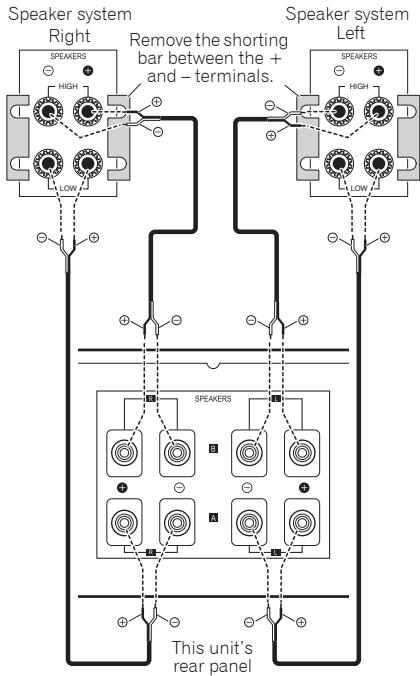

Caution
- When using bi-wiring to connect speakers, avoid adverse affects on the amplifier by being sure to remove the HIGH and LOW short bars provided with the speakers. For detailed information, consult the instructions provided with the speakers.
- When using speakers with removable network circuits, note that if the network is removed, no effect will be produced and damage may be caused to the speaker.
- Another method of connection is to connect the SPEAKERS A terminals to HIGH and the SPEAKERS B terminals to LOW (reverse that shown in the illustration).
Connecting speaker cables
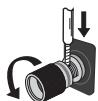
1 Twist the cable cores.
2 Loosen the nut on the SPEAKERS terminal, and insert the speaker cable into the exposed hole in the terminal shaft.
3 Retighten the terminal nut.
1

2
3


Caution
- When using only one set of speaker terminals (SPEAKERS A or SPEAKERS B), or when utilizing bi-wiring connections, the speaker used should have a nominal impedance between 4 Ω and 16 Ω. When using both sets of terminals, the connected speakers should have nominal impedance between 8 Ω and 32 Ω. Consult the instructions accompanying your speakers for details regarding the impedance value.
- Make sure the positive and negative (+/-) terminals on the amplifier match those on the speakers.
- These speaker terminals carry HAZARDOUS live voltage. To prevent the risk of electric shock when connecting or disconnecting the speaker cables, disconnect the power cord before touching any uninsulated parts.
- Make sure that all the bare speaker wire is twisted together and inserted fully into the speaker terminal. If any of the bare speaker wire touches the back panel it may cause the power to cut off as a safety measure.
Connecting audio cables
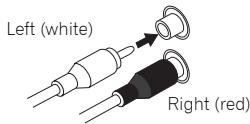
Connect the white plug to the left (L) jack, and the red plug to the right (R) jack. Be sure to insert the plugs fully into the jacks.
Using centralized control with other Pioneer components
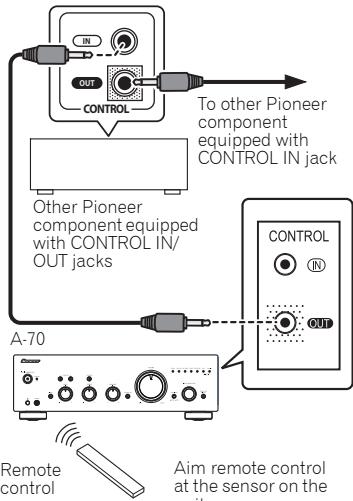
Multiple Pioneer components equipped with CONTROL IN/OUT jacks can be connected to the unit, allowing centralized control of the components via the remote sensor on the unit. This also allows remote control of components not equipped with a remote sensor, or installed in places where the component's remote sensor cannot be accessed.

Note
- For connections use a commercially available monaural miniplug cord (without resistor).
- When connecting the CONTROL IN/OUT jacks, commercially available audio cords must also be used to make analog connections. Merely connecting the CONTROL IN/OUT jacks alone will not allow proper system control.
- When a control cord is connected to the unit's CONTROL IN jack, the unit cannot be controlled by pointing the remote control at the unit (the remote sensor is automatically disabled).
Digital audio input connections (A-70 only)
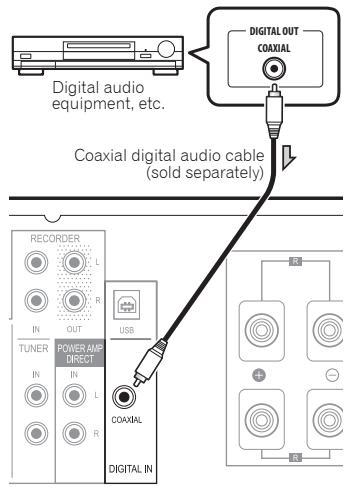
If a coaxial digital cable (sold separately) is used to connect this unit's DIGITAL IN COAXIAL terminal to the digital audio output connector of a digital audio playback component, the playback component can be used to play music through this unit.
For more information regarding the output of audio signals input to the DIGITAL IN COAXIAL terminal, consult page 12.
A-70's rear panel

Note
- Digital signal formats that can be input to this unit include linear PCM signals with sampling rate and quantitative bits up to 192 kHz/32 bits. (Depending on the connected device and environment, operation may not be successful).
Using a USB cable to connect to a computer (A-70 only)
If a USB cable (sold separately) is used to connect this unit's DIGITAL IN USB terminal to a computer's USB port, music files located on the computer can be played through this unit.
For more information regarding the output of audio signals input to the DIGITAL IN USB terminal, consult page 12.

Important
- When using this connection to input audio files from a computer to this unit, it may be necessary to install a special driver on the computer. For details, see the website of Pioneer.
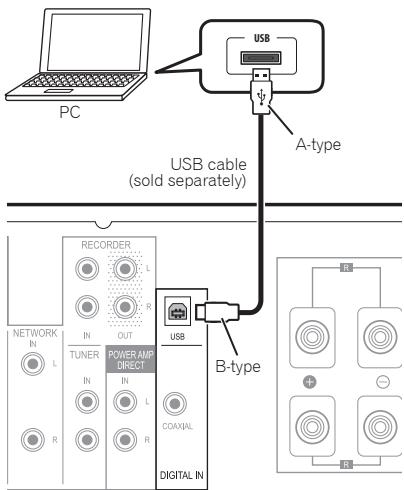
A-70's rear panel

Note
- This unit cannot be used to play audio files from a computer unless Media Player is installed on the connected computer.
Plugging in

Important
- When going on a trip or otherwise not using the unit for an extended period, always disconnect the power cord from its outlet. Note that various internal settings will not be lost even if the power cord is disconnected from its outlet for an extended time.
- If it is necessary to detach the power cord, first be sure to press the ⏻/I STANDBY/ON button on the front panel of the unit so the unit is turned OFF before detaching the cord.

Caution
- The use of a power cord other than the one provided will invalidate the warranty, since Pioneer will not be responsible for any damage incurred. (The power cord provided with the unit has a rated current capacity of 10 A.)
- Do not use any power cord other than the one supplied with this unit.
- Do not use the supplied power cord for any purpose other than that described below.
After you've finished making all connections, plug the unit into an AC outlet.
This unit's rear panel
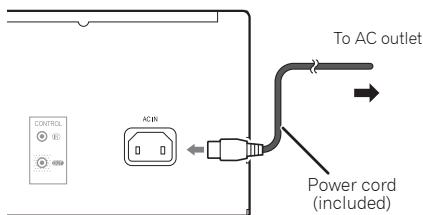
1 Plug the supplied power cord into the AC IN socket on the rear panel of the unit.
2 Plug the other end into an AC outlet.
Chapter 3:
Controls and displays
Front panel
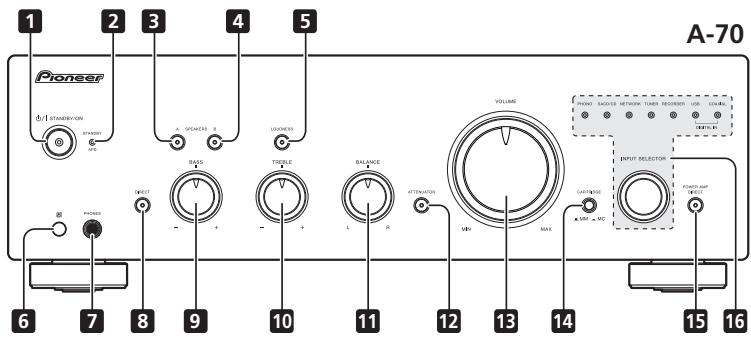
1 ⏻/I STANDBY/ON
Switches the amplifier between off and on.
When power is turned on, the power indicator in the center of the button will light.
2 STANDBY/APD indicator
When power is set to standby, the indicator lights red. When the Auto Power Down (APD) function is on, the indicator lights green (page 13).
3 SPEAKERS A button/indicator
Use this button to listen to the speaker system connected to SPEAKERS A terminals.
On : The indicator lights. Sound is heard from the speaker system. (Sound will also be produced from the PHONES jack.)
Off: The indicator goes off. No sound is heard from the speaker system. Set to this position when listening with headphones.
4 SPEAKERS B button/indicator
Use this button to listen to the speaker system connected to SPEAKERS B terminals.
On : The indicator lights. Sound is heard from the speaker system. (Sound will also be produced from the PHONES jack.)
Off : The indicator goes off. No sound is heard from the speaker system. Set to this position when listening with headphones.
5 LOUDNESS button/indicator
Use when listening at low volume levels.
On : The indicator lights: Boosts low and high frequencies to give added punch to playback even at a low volume level.
Off : The indicator goes off: Should normally be left in this position.
- This button does not operate when the DIRECT button is in the on position.
- When sound volume is raised, the amount of change produced by the LOUDNESS circuit is reduced.
6 Remote sensor
Receives the signals from the remote control (page 4).
7 PHONES jack
Use to connect headphones. No sound is produced when the POWER AMP DIRECT button is ON.
8 DIRECT button/indicator
On: The indicator lights: When this button is set to ON, sound signals are output directly, without being passed through the various adjustment circuits (BASS, TREBLE, BALANCE, LOUDNESS). This allows reproduction of the signals with greater fidelity, but it disables any settings made with the BASS, TREBLE, BALANCE or LOUDNESS controls.
Off : The indicator goes off: The signal passes through the various frequency adjusting circuits. When the indicator is OFF, adjustments can be made with the BASS, TREBLE, BALANCE, and LOUDNESS controls.
9 BASS tone control
Use to adjust the low-frequency tone. The center position is the flat (normal) position. When turned to the right, low-frequency tones are emphasized; when turned to the left, low-frequency tones are de-emphasized.
- This button does not operate when the DIRECT button is in the on position.
10 TREBLE tone control
Use to adjust the high-frequency tone. The center position is the flat (normal) position. When turned to the right, high-frequency tones are emphasized; when turned to the left, high-frequency tones are de-emphasized.
- This button does not operate when the DIRECT button is in the on position.
11 BALANCE control
Should normally be left in the center position. Adjust balance if the sound is louder from one of the speakers. If the right side is louder, turn toward the L (left) position and if the left side is louder, turn toward the R (right) position.
- This button does not operate when the DIRECT button is in the on position.
12 ATTENUATOR button (A-70 only)
Press when you wish to make fine adjustments to the sound volume when playing at very low sound volume levels.
13 VOLUME control
Use to adjust the volume level. (Also allows adjustment of the headphone sound volume.)
14 CARTRIDGE select switch (A-70 only)
Select the type of cartridge used with your turntable.
15 POWER AMP DIRECT button/indicator
Press this button when the unit is to be used as a power amplifier (page 11).
16 INPUT SELECTOR knob/indicators
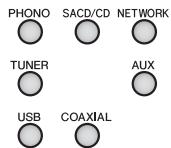
Turn the knob clockwise or counterclockwise so that the indicator lights for your desired input source. Turning the knob clockwise causes the lit indicator to right. Turning counterclockwise causes it to left. When the remote control's MUTE button is pressed to mute the sound, the indicator for the input source selected with the INPUT SELECTOR knob flashes.
Rear panel
See pages 5-7 for details regarding connections.
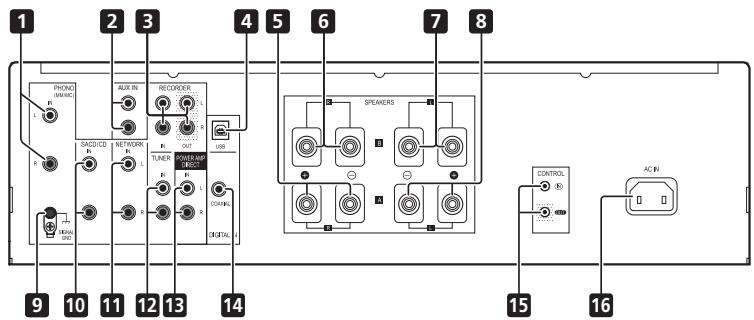
1 PHONO IN (MM/MC) terminals (A-70)
PHONO IN (MM) terminals (A-50)
2 AUX IN terminals (A-50 only)
3 RECORDER IN/OUT terminals
4 DIGITAL IN USB terminal (A-70 only)
5 SPEAKERS A terminals (Right channel)
6 SPEAKERS B terminals (Right channel)
7 SPEAKERS B terminals (Left channel)
8 SPEAKERS A terminals (Left channel)
9 GND (Turntable ground) terminal
This ground terminal is designed to help reduce noise when a turntable is connected. It is not a safety ground.
10 SACD/CD IN terminals
11 NETWORK IN terminals
12 TUNER IN terminals
13 POWER AMP DIRECT IN terminals
When using the unit as a power amplifier, connect the pre-amplifier here (page 11).
14 DIGITAL IN COAXIAL terminal (A-70 only)
15 CONTROL IN/OUT jack
16 AC IN jack
Connect power cord to here and an AC wall socket.
Remote control
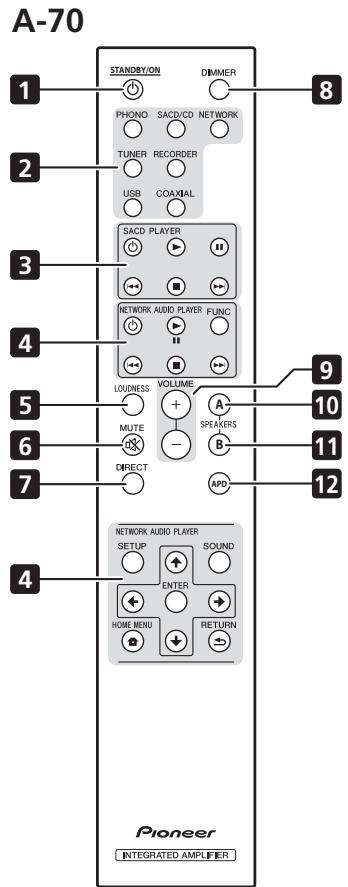
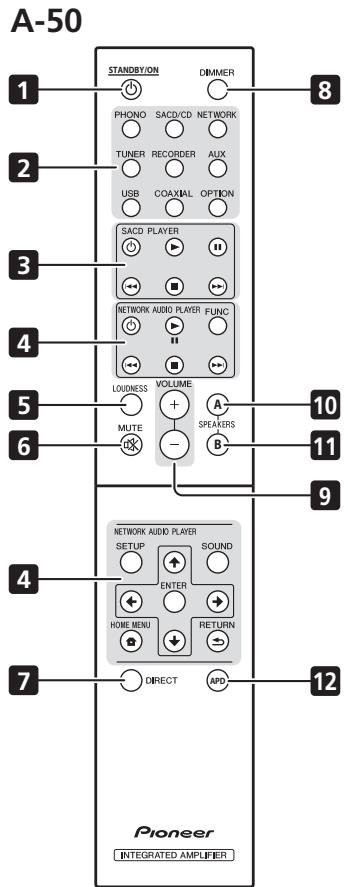
1 ⏻ STANDBY/ON
Switches the amplifier between standby and on.
2 Input selector buttons
Press to select an input source. These select the component connected to the corresponding input on the rear panel.
- When the A-50 is connected, the USB, COAXIAL, and OPTION buttons are disabled.
3 SACD PLAYER control buttons
Use to control Pioneer SACD player.
4 NETWORK AUDIO PLAYER control buttons
Use to control Pioneer network audio player.
5 LOUDNESS
Use to set the loudness circuit ON/OFF (page 8).
6 MUTE
Mutes/unmutes the sound.
7 DIRECT
Press to access Direct listening (page 8).
8 DIMMER
This button allows the illumination of the unit's front panel indicators to be set in three levels (does not affect the STANDBY indicator).
9 VOLUME +/-
Use to set the listening volume.
10 SPEAKERS A button/indicator
Use this button to listen to the speaker system connected to SPEAKERS A terminals.
11 SPEAKERS B button/indicator
Use this button to listen to the speaker system connected to SPEAKERS B terminals.
12 APD
Use to set the Auto Power Down function to ON/OFF (page 13).
Chapter 4:
Operation
Playback
flowchart
graph TD
    A["SACD/CD player"] --> B["Network audio player"]
    B --> C["Turntable"]
    C --> D["Tuner"]
    D --> E["iPod dock, etc"]
    E --> F["CD recorder or tape deck"]
    G["Playback"] --> H["Pioneer"]
    H --> I["6"]
    I --> J["5"]
    J --> K["3"]
    K --> L["Playback"]
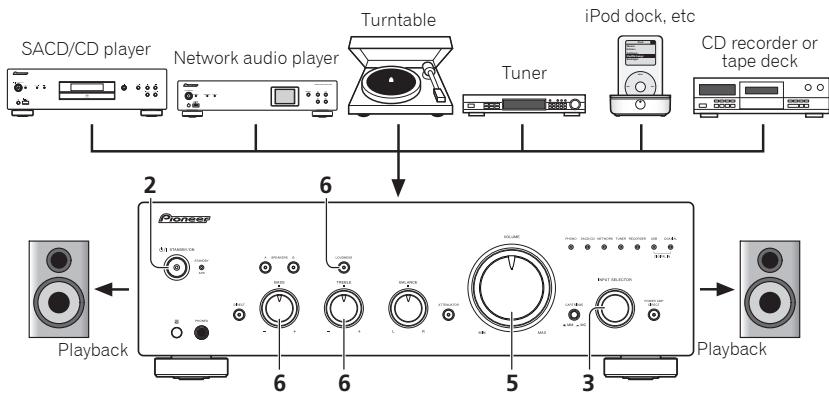
1 Turn on the power of the playback component.
2 Turn power ON to the unit.
- If the unit is in the standby mode, press the remote control's ⏻ STANDBY/ON button.

3 Select the source you want to playback.
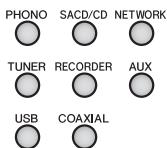
Select the playback component.
- When using the front panel controls, rotate the INPUT SELECTOR knob.
- In the case of the A-70, if PHONO is selected, use the CARTRIDGE select switch to designate the type of cartridge used with your turntable, either MM (■) or MC (■).
4 Start playback of the component you selected in step 1.
5 Adjust playback volume with VOLUME control.
6 Adjust the tone to your preference using the BASS and TREBLE controls, and LOUDNESS button.
If the DIRECT button has been set to ON, these controls are disabled.
Set the power to Standby
1 Press the remote control's ⏻ STANDBY/ON button.

The next time you wish to turn on the power, press the remote control's ⏻ STANDBY/ON button.
- If the front panel's ⏻/I STANDBY/ON button is pressed, the power will be turned off. In this case, if the power is off, pressing the remote control's ⏻ STANDBY/ON button will not turn on the power. To turn on the power again, press the front panel's ⏻/I STANDBY/ON button.
When using the unit as a power amplifier
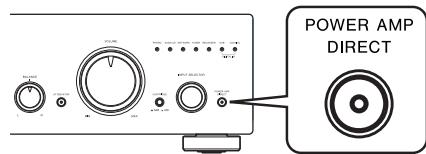
When a pre-amplifier is connected to the unit's POWER AMP DIRECT IN terminals, the unit can be used as a power amplifier.
1 Press the POWER AMP DIRECT button on the front panel of the unit.
The POWER AMP DIRECT indicator will light.

Caution
- When the POWER AMP DIRECT indicator is lighted, operations change as follows:
- The unit's front-panel VOLUME, BASS, TREBLE, and BALANCE controls are disabled. These adjustments are controlled by the component connected to the unit's POWER AMP DIRECT IN terminals.
- The LOUDNESS button and ATTENUATOR button (A-70 only) are disabled.
- When the POWER AMP DIRECT indicator is lighted, sound volume from the unit will automatically be fixed at its maximum output. When using this unit as a power amplifier, check the output level of the component connected to the POWER AMP DIRECT IN terminals and set it to a low level as appropriate before turning on the POWER AMP DIRECT indicator. If the sound volume of the component connected to the POWER AMP DIRECT IN terminals is initially set to a high output level, loud sound may suddenly be output when the POWER AMP DIRECT indicator lights.
- Sound is not produced from the PHONES jack and RECORDER OUT terminals.
- For more information, consult the operating instructions for the component connected to the unit's POWER AMP DIRECT IN terminals.
Playing music from a digital audio component (A-70 only)
Outputs digital signals input to the DIGITAL IN COAXIAL connectors.
1 Make a digital input connection.
• See Digital audio input connections on page 6.
2 Press COAXIAL to select DIGITAL IN COAXIAL as the input source.
- When using the front panel controls, rotate the INPUT SELECTOR knob.
- Sound is produced from the RECORDER OUT terminals.

Note
- Digital signal formats that can be input to this unit include linear PCM signals with sampling rates and quantitative bits up to 192 kHz/32 bits (Depending on the connected device and environment, operation may not be successful).
Playing music from a computer (A-70 only)
Use this function to play digital audio input to the unit's rear panel DIGITAL IN USB port.
1 Connect the unit to a computer via USB cable
- See Using a USB cable to connect to a computer on page 7.
2 Press USB to select DIGITAL IN USB as the input source.
- When using the front panel controls, rotate the INPUT SELECTOR knob.
- Sound is produced from the RECORDER OUT terminals.
3 Begin playback on the computer.

Note
- When using a USB cable to connect this unit to a computer for playing music files, the following linear PCM digital signals are supported:
– Quantitative bits: 16 bit, 24 bit, 32 bit
– Sampling rates: 44.1 kHz, 48 kHz, 88.2 kHz, 96 kHz, 176.4 kHz, 192 kHz - Playback cannot be controlled from this unit during use of this function; use your computer to control playback.
- When disconnecting the USB cable, always stop playback on the computer first.
- Sound may not be produced if your computer does not support USB 2.0 HS.
- This unit does not support use of a USB hub. Always use a USB cable to connect the unit directly to the computer.

Important
- When using the DIGITAL IN USB port to input audio files from a computer to this unit, it may be necessary to install a special driver on the computer. For details, see the website of Pioneer.
Making an audio recording
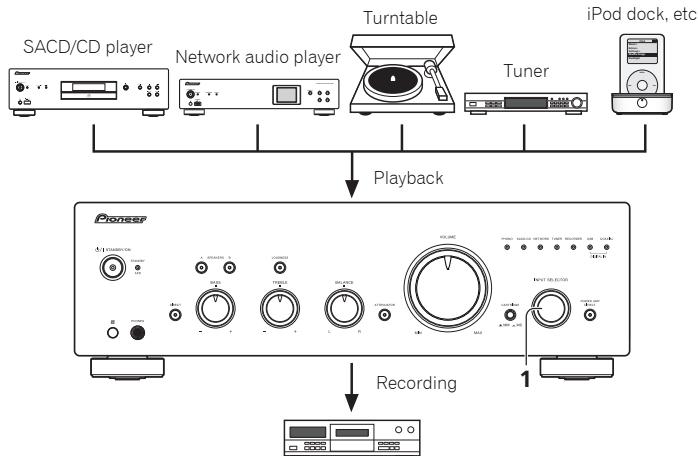
You can make an audio recording from any audio source connected to the amplifier.
flowchart
graph TD
    A["SACD/CD player"] --> D["Playback"]
    B["Network audio player"] --> D
    C["Turntable"] --> D
    E["Tuner"] --> D
    F["iPod dock, etc"] --> D
    D --> G["Recording"]
    G --> H["1"]
Audio recording component (CD recorder, tape deck, etc.)
1 Select the source you want to record.
2 Start recording, then start playback of the source component.

Caution
- Confirm that the short pin plugs are not inserted in the RECORDER OUT terminals, since malfunction will result if they are inserted.
To set for automatic standby status (Auto Power Down)
This function automatically switches the unit to standby mode if no signal or switch operation is detected for 30 minutes.
1 If the unit's power is ON, press the APD button on the remote control.

When this condition is set to ON, the STANDBY/APD indicator on the unit's front panel will light green. Press the buttons again to disable the setting.
- This setting can also be made by pressing the front panel LOUDNESS button and POWER AMP DIRECT button simultaneously and holding them depressed for 3 seconds.
• The factory default setting is ON. - Rotating the TREBLE, BASS, BALANCE, or VOLUME controls will not be counted as a control operation for purposes of resetting the Automatic Power-Down 30-minute timer.

Note
- Depending on the device connected, excessive noise produced by the device may be interpreted as an audio signal, thus preventing the Automatic Power-Down function from operating.
Restoring all the settings to the factory default settings
1 When power is in standby mode, hold the front-panel's SPEAKERS A button and POWER AMP DIRECT button depressed simultaneously for five seconds.
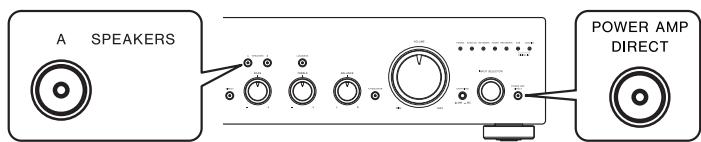
2 Turn power ON to the unit.
Chapter 5:
Additional information
Troubleshooting
Incorrect operations are often mistaken for trouble and malfunctions. If you think that there is something wrong with this component, check the points below. Sometimes the trouble may lie in another component. Investigate the other components and electrical appliances being used. If the trouble cannot be rectified even after exercising the checks listed below, ask your nearest Pioneer authorized service center or your dealer to carry out repair work.
- If the unit does not operate normally due to external effects such as static electricity disconnect the power plug from the outlet and insert again to return to normal operating conditions.
| Problem | Remedy |
| The power does not turn on. | • Is the power plug disconnected from the power outlet? Connect the power plug correctly to its outlet (page 7).• Is the power cord disconnected from the AC IN connector? Connect the power cord correctly (page 7). |
| Power turns off. | • Is the Auto Power Down function turned ON? If you do not want the power to turn off automatically, disable the Auto Power Down function (page 13). |
| During playback, sound stops, and the STANDBY/APD indicator flashes red at about 0.5 second intervals. | • The protection circuit has been activated. This condition will result if a very low-frequency sound is played at a high sound volume level.- Turn the power OFF and wait for at least one minute, then turn the power ON again; play the music at a lower sound volume level.- When power is turned ON again, if the STANDBY/APD indicator flashes red at irregular intervals, the unit's circuitry may be damaged. Disconnect the power cord and consult your dealer or nearest Pioneer service station. |
| During playback, sound stops, and the STANDBY/APD indicator flashes red at about 1 second intervals. | • The unit's internal temperature has risen and the safety circuit has operated.- Turn power OFF and wait for a minute or more, allowing the unit's temperature to cool before turning the power ON again.- Install the unit in a location with better ventilation.- Confirm that the unit is installed correctly; if the unit is turned on again without being allowed to cool, the same symptoms may appear (page 4). |
| During playback, sound stops, and the STANDBY/APD indicator flashes red at about 2 second intervals. | • Are you using speakers with impedance values not supported by this unit? Confirm the speaker's nominal impedance value (page 6).• Are any speaker cables loose from the SPEAKERS terminals and touching other wires or the surface of the rear panel? Disconnect the power cord and reconnect the speaker cables correctly (page 6). |
| During playback, sound stops, and the STANDBY/APD indicator flashes red at about 3 second intervals. | • The protection circuit has been activated. This condition will result if a very high-frequency sound is played at a high sound volume level.- Lower the sound volume and try playing again.- If the same symptom appears when the power is turned OFF then ON again, the unit's circuitry may be damaged. Disconnect the power cord and consult your dealer or nearest Pioneer service station. |
| When power is turned on, the STANDBY/APD indicator flashes at irregular intervals. | • The unit's circuitry is damaged. Disconnect the power cord and consult your dealer or nearest Pioneer authorized service center. |
| Problem | Remedy |
| No sound is output when a function is selected. | A connection cable is disconnected or connected improperly. Check your connections (page 5).Connectors or pin plugs on a cable are dirty. Wipe off any dirt from connectors and pin plugs.Confirm that the unit's input selector is set to the desired playback component. Set selector correctly (page 11).PressMUTEon the remote control to turn muting off (page 10). |
| No sound from one speaker. | Are the connection cables or speaker cables disconnected on one side? Reconnect securely (page 5). |
| Can't operate the remote control. | Replace the battery (page 4).Operate within 7 m, 30° of the remote sensor on the front panel (page 4).Remove the obstacle or operate from another position.Avoid exposing the remote sensor on the front panel to direct light.Is the control cord for one component connected improperly? Confirm correct connections (page 6). |
| Can't change input source. | Check whether POWER AMP DIRECTfunction is ON. If so, press the front panel's POWER AMP DIRECTbutton to turn the function OFF (page 11). |
| No sound is heard when a linear PCM signal with frequency of 96 kHz or more is input to the DIGITAL IN COAXIAL terminal. | Sound may not be output properly depending on the digital coaxial cable used; try replacing the cable (sold separately) with another. |
| When the DIGITAL IN USB port is connected to a computer via USB cable, audio files on the computer cannot be played. | Has the proper device driver been installed on the computer? When using a USB cable to connect the unit's DIGITAL IN USB port to a computer in order to play audio files on the computer, the proper device driver must be downloaded from the Pioneer website and installed on your computer. Consult the Pioneer website for instructions on installing the driver. |
| No sound is produced when attempting to play files on a computer. | Are volume settings correct for the OS and application program? Raise the volume settings as required.Is the OS audio output set to MUTE? Cancel the MUTE setting.Are multiple applications running simultaneously? Try closing applications that are not in use.Has the audio output been set properly within the OS or application used? For audio device select "Pioneer USB Audio Device". |
Cleaning the unit
- Use a polishing cloth or dry cloth to wipe off dust and dirt.
- When the surface is dirty, wipe with a soft cloth dipped in some neutral cleanser diluted five or six times with water, and wrung out well, and then wipe again with a dry cloth. Do not use furniture wax or cleansers.
- Never use thinners, benzine, insecticide sprays or other chemicals on or near this unit, since these will corrode the surface.
Specifications
Amplifier section
Power output specification is for when power supply is 230 V.
• Continuous power output (both channels driven at 20 Hz to 20 kHz)
A-70/A-50....90 W + 90 W
(THD 0.5 %, 4 Ω)
A-70/A-50....65 W + 65 W
(THD 0.5 %, 8 Ω)
Audio section
• Input (Sensitivity/Impedance)
SACD/CD, NETWORK, TUNER, RECORDER, AUX (A-50 only)....200 mV/50 kΩ
POWER AMP DIRECT 1 V/10 kΩ
PHONO (MM) 2.8 mV/50 kΩ
PHONO (MC) 0.24 mV/100 Ω (A-70 only)
COAXIAL 500 mVp-p/75 Ω (A-70 only)
• Output (Level/Impedance)
RECORDER OUT 200 mV/2.2 kΩ
• Frequency response
SACD/CD, NETWORK, TUNER, RECORDER, AUX (A-50 only)....5 Hz to 20 kHz ±2 dB*
PHONO (MM)....20 Hz to 20 kHz ±0.5 dB*
PHONO (MC) .... 20 Hz to 20 kHz ±0.5 dB* (A-70 only)
* Measured with DIRECT button switched on.
- Tone control
(When VOLUME is set to -30 dB)
Bass....± 10 dB (100 Hz)
Treble....± 10 dB (10 kHz)
• Signal-to-Noise Ratio (IHF SHORTED, A-NETWORK)
SACD/CD, NETWORK, TUNER, RECORDER, AUX (A-50 only)....101 dB*
PHONO (MM, 5 mV input)....89 dB*
PHONO (MC, 0.5 mV input)....74 dB* (A-70 only)
* Measured with DIRECT button switched on.
• Speaker load impedance
A, B 4 Ω to 16 Ω
A+B....8Ω to 32Ω
Bi-wiring 4 Ω to 16 Ω
Miscellaneous
Power requirements
AC 220 V to 230 V, 50 Hz
Power consumption
A-70 74 W
A-50 72 W
In standby 0.2 W
Dimensions
A-70 .....435 mm (W) x 141.5 mm (H) x 361.5 mm (D)
A-50 ..... 435 mm (W) × 138.5 mm (H) × 357 mm (D)
Weight (without package)
A-70 17.1 kg
A-50 11.1 kg
Accessories
Remote control....1
AAA/IEC R03 dry cell batteries 2
Short pin plug....2
Power cord
Warranty card
Caution sheet
Operating instructions (This document)

Note
- Specifications and the design are subject to possible modifications without notice, due to improvements.
- Corporation and product names mentioned herein are trademarks or registered trademarks of the respective corporations.
© 2012 PIONEER CORPORATION.
All rights reserved.
IMPORTANT
natural_image
Illustration of a portable electronic device with no visible text or symbols on its body, including a prohibition symbol above it (no readable text or labels)D3-4-2-1-7b*_A1_Fr
natural_image
Pure electrical circuit lines without any symbolsA propos de "bi-câblage (bi-wiring)"
© 2012 PIONEER CORPORATION.
natural_image
Pure electrical circuit lines without any symbols© 2012 PIONEER CORPORATION.
natural_image
Illustration of a portable electronic device with no visible text or symbols on its body, including a prohibition symbol above it (no readable text or labels)natural_image
Pure electrical circuit lines without any symbols3 Pulsante/spia SPEAKERS A
10 Pulsante/spia SPEAKERS A
© 2012 PIONEER CORPORATION.
natural_image
Illustration of a portable electronic device with no visible text or symbols on its body, including a prohibition symbol (no readable text or labels)Gebruiksomgeving
WAARSCHUWING NETSNOER
natural_image
Pure electrical circuit lines without any symbols2 STANDBY/APD-indicator
Audio-opnamecomponent (cd-recorder, cassettedeck,
| Bass | ± 10 dB (100 Hz) |
| Treble | ± 10 dB (10 kHz) |
© 2012 PIONEER CORPORATION.
natural_image
Illustration of a portable electronic device with no visible text or symbols on its body, including a 'D3' label (no readable text or symbols beyond the label)D3-4-2-1-7b*_A1_Es
natural_image
Pure electrical circuit lines without any symbols| Graves | ± 10 dB (100 Hz) |
| Agudos | ± 10 dB (10 kHz) |
© 2012 PIONEER CORPORATION.
natural_image
Illustration of a portable electronic device with no visible text or symbols on its body, featuring a prohibition symbol above the top (no readable text or labels)natural_image
Pure electrical circuit lines without any symbols© PIONEER CORPORATION, 2012.
Все права защищены.
Discover the benefits of registering your product online at http://www.pioneer.co.uk (or http://www.pioneer.eu).
PIONEER ELECTRONICS (USA) INC.
P.O. BOX 1540, Long Beach, California 90801-1540, U.S.A. TEL: (800) 421-1404
PIONEER ELECTRONICS OF CANADA, INC.
340 Ferrier Street, Unit 2, Markham, Ontario L3R 2Z5, Canada TEL: 1-877-283-5901, 905-479-4411
PIONEER EUROPE NV
Haven 1087, Keetberglaan 1, B-9120 Melsele, Belgium TEL: 03/570.05.11
PIONEER ELECTRONICS ASIACENTRE PTE. LTD.
253 Alexandra Road, #04-01, Singapore 159936 TEL: 65-6472-7555
PIONEER ELECTRONICS AUSTRALIA PTY. LTD.
5 Arco Lane, Heatherton, Victoria, 3202, Australia, TEL: (03) 9586-6300
PIONEER ELECTRONICS DE MEXICO S.A. DE C.V.
Blvd.Manuel Avila Camacho 138 10 piso Col.Lomas de Chapultepec, Mexico, D.F. 11000 TEL: 55-9178-4270
K002_B4_Ru
© 2012 PIONEER CORPORATION.
All rights reserved.
© 2012 PIONEER CORPORATION.