 ManualGo.com
AF-S NIKKOR 24MM F-1.4G ED - Camera lens NIKON - Free user manual and instructions
Find the device manual for free AF-S NIKKOR 24MM F-1.4G ED NIKON in PDF.



Download the instructions for your Camera lens in PDF format for free! Find your manual AF-S NIKKOR 24MM F-1.4G ED - NIKON and take your electronic device back in hand. On this page are published all the documents necessary for the use of your device. AF-S NIKKOR 24MM F-1.4G ED by NIKON.
USER MANUAL AF-S NIKKOR 24MM F-1.4G ED NIKON
AF-S NIKKOR 24mm f/1.4G ED
Nano Crystal Coat
使用說明書 P.2
User's Manual P. 10
Touching the internal parts of the camera or lens could result in injury. Repairs should be performed only by qualified technicians. Should the camera or lens break open as the result of a fall or other accident, take the product to a Nikon-authorized service representative for inspection after unplugging the product and/or removing the battery.
Turn off immediately in the event of malfunction
Should you notice smoke or an unusual smell coming from the camera or lens, remove the battery immediately, taking care to avoid burns. Continued operation could result in injury.
After removing or disconnecting the power source, take the product to a Nikon-authorized service representative for inspection.
Do not use the camera or lens in the presence of flammable gas
Operating electronic equipment in the presence of flammable gas could result in an explosion or fire.
Do not look at the sun through the lens or viewfinder
Viewing the sun or other strong light sources through the lens or viewfinder could cause permanent visual impairment.
Keep out of reach of children
Particular care should be taken to prevent infants from putting the batteries or other small parts into their mouths.
Observe the following precautions when handling the camera and lens
- Keep the camera and lens unit dry. Failure to do so could result in fire or electric shock.
- Do not handle or touch the camera or lens unit with wet hands. Failure to do so could result in electric shock.
- When shooting with back-lighting, do not point the lens at the sun or allow sunlight to pass directly down the lens as this may cause the camera to overheat and possibly cause a fire.
- When the lens will not be used for an extended period of time, attach both front and rear lens caps and store the lens away from direct sunlight. Failure to do so could result in a fire, as the lens may focus sunlight onto a flammable object.
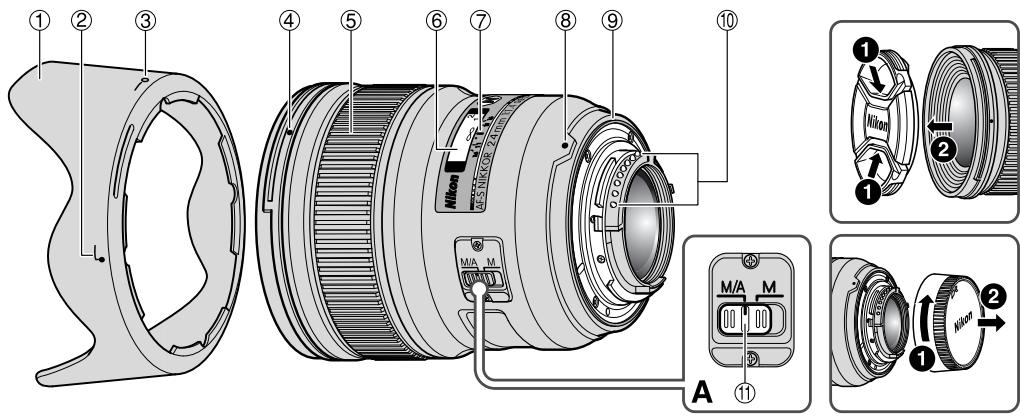
■ Nomenclature
En
① Lens hood (p.14)
(2) Lens hood attachment index (p.14)
③ Lens hood setting index (p.14)
④ Lens hood mounting index (p.14)
⑤ Focus ring (p.13)
⑥ Distance scale (p.14)
⑦ Distance index line (p.14)
⑧ Mounting index
Lens mount rubber gasket (p.15)
10 CPU contacts (p.15)
① Focus mode switch (p.13)
( ) : reference page
Thank you for purchasing the AF-S NIKKOR 24mm f/1.4G ED lens. Before using this lens, please read these instructions and refer to your camera's User's Manual.
En
Major features
- The Nano Crystal Coat deposited on some of the lens elements ensures that fine, clear images can be reproduced under various shooting conditions, from the sunny outdoors to spotlighted interior scenes.
- This lens employs a Silent Wave Motor to drive the focusing mechanism, making autofocusing smooth, silent and almost instantaneous. The focus mode switch is provided for simple selection of autofocus (AF) or manual focus (MF) operation.
- Superior optical performance and rendering characteristics are maximized with the use of two aspherical lens elements and two extra-low dispersion (ED) glass elements, which ensure correction of chromatic aberration. In addition, the rounded aperture produces soft and pleasing blur characteristics in portions of pictures that are out-of-focus.
- The closest focusing distance possible is 0.25 m (0.82 ft.)
Important
- When mounted on Nikon DX format digital SLR cameras, such as the D300-Series and D90, the lens' picture angle becomes 61^ and its 35mm equivalent focal length is approx. 36 mm.
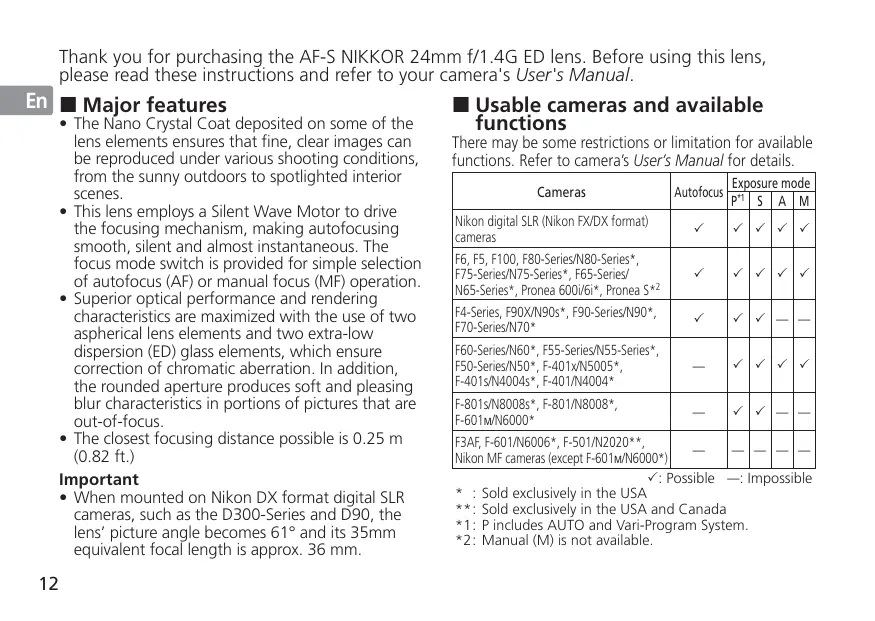
■ Usable cameras and available functions
There may be some restrictions or limitation for available functions. Refer to camera's User's Manual for details.
| Cameras | Autofocus | Exposure mode | |||
| P*1 | S | A | M | ||
| Nikon digital SLR (Nikon FX/DX format) cameras | ✓ | ✓ | ✓ | ✓ | ✓ |
| F6, F5, F100, F80-Series/N80-Series*, F75-Series/N75-Series*, F65-Series/ N65-Series*, Pronea 600i/6i*, Pronea S*2 | ✓ | ✓ | ✓ | ✓ | ✓ |
| F4-Series, F90X/N90s*, F90-Series/N90*, F70-Series/N70* | ✓ | ✓ | ✓ | — | — |
| F60-Series/N60*, F55-Series/N55-Series*, F50-Series/N50*, F-401x/N5005*, F-401s/N4004s*, F-401/N4004* | — | ✓ | ✓ | ✓ | ✓ |
| F-801s/N8008s*, F-801/N8008*, F-601m/N6000* | — | ✓ | ✓ | — | — |
| F3AF, F-601/N6006*, F-501/N2020**, Nikon MF cameras (except F-601m/N6000*) | — | — | — | — | — |
Possible —: Impossible
- : Sold exclusively in the USA
: Sold exclusively in the USA and Canada
1: P includes AUTO and Vari-Program System.
2: Manual (M) is not available.
Focusing (Fig. A)
Set your camera's focus mode selector according to the chart below:
Autofocus with manual override (M/A mode)
1 Set the lens focus mode switch to M/A.
2 Autofocus is enabled, but autofocus operation can be overridden by rotating the separate focus ring while pressing the shutter-release button halfway, or by pressing the AF-ON button on the camera body of cameras so equipped.
Press the shutter-release button halfway or the AF-ON button once again to cancel manual focus and resume autofocus.
Important
When using infrared film, it is necessary to use a red (R60) filter on the lens and compensate focus manually.
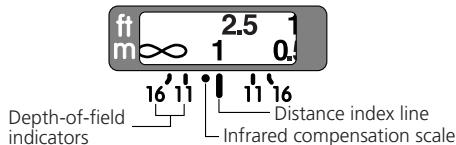
- Focus on the subject. Rotate the focus ring to realign the desired distance scale number ("1 m" in Fig. "Depth of field" on p. 14) to the infrared compensation scale to compensate focus. When done, attach the R60 filter.
| Cameras | Camera focus mode | Lens' focus mode switch | |
| M/A | M | ||
| Nikon digital SLR (Nikon FX/DX format) cameras, F6, F5, F4-Series, F100, F90X/N90s*, F90-Series/N90*, F80-Series/ N80-Series*, F75-Series/N75-Series*, F70-Series/N70*, F65-Series/N65-Series*, Pronea 600i/6i*, Pronea S | AF (C/S) | Autofocus with manual override | Manual focus (Electronic rangefinder can be used.) |
| MF | Manual focus (Electronic rangefinder can be used.) | ||
| F60-Series/N60*, F55-Series/N55-Series*, F50-Series/N50*, F-801s/N8008s*, F-801/N8008*, F-601w/N6000*, F-401x/N5005*, F-401s/N4004s*, F-401/N4004* | AF (C/S) MF | Manual focus (Electronic rangefinder can be used, except with the F-601w/N6000*) | |
- Sold exclusively in the USA
Depth of field
- Approximate depth of field can be determined by checking the depth-of-field indicators.
- If your camera has a depth-of field preview (stop-down) button or lever, depth of field can be previewed through the camera viewfinder.
For more information, see p.116.
Setting the aperture
Use the camera to adjust the aperture setting.
The built-in flash and vignetting
- The built-in flash cannot be used over distances of less than 0.6m (2.0 ft.).
- To prevent vignetting, do not use the lens hood.
| Cameras | Supported shooting distance |
| D5000, D3000, D60, D40-Series | 1 m (3.3 ft.) or greater |
Using the lens hood
Lens hoods minimize stray light and protect the lens.
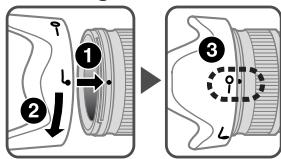
Attaching the hood
-
Be sure that the lens hood mounting index () is aligned with the lens hood setting index (-) .
-
To facilitate attachment or removal of the hood, hold it by the base (near the lens hood attachment index () ) rather than its outer edge.
- If the lens hood is not correctly attached, vignetting may occur.
- To store the lens hood, attach it in the reverse position.
Recommended focusing screens
Various interchangeable focusing screens are available for certain Nikon SLR cameras to suit any picture-taking situation. The ones recommended for use with this lens are:
| Screen Camera | A | B | C | E | EC-B EC-E | G1 | G2 | G3 | G4 | J | L | M | U |
| F6 | ◎ | ◎ | — | ◎ | — | — | — | — | — | ◎ | ◎ | ||
| F5+DP-30 | ◎ | ◎ | ◎ | ◎ | ◎ | ◎ | ◎ | ◎ | |||||
| F5+DA-30 | ◎ | ◎ | ◎ | ◎ | ◎ | ◎ | ◎ | ◎ |
:Excellent focusing
O:Acceptable focusing
Slight vignetting or moiré patterns appear in the viewfinder, but not on the film.
Not available
Blank box means not applicable. Since type M screen can be used for both macrophotography at a magnification ratio of 1:1 or above and for photomicrography, it has different applications than other screens.
Important
-
For F6 cameras, when using screens other than type B or E, "Other screen" must be selected in Custom Setting. Refer to camera's User's Manual for details.
-
For F5 cameras, only EC-B, EC-E, B, E, J, A, L focusing screens are usable in Matrix Metering.
- When using the B and E focusing screens in cameras other than those listed above, refer to the columns for the B and E screens.
Lens care
- Be careful not to allow the CPU contacts to become dirty or damaged.
- If the lens mount rubber gasket is damaged, be sure to visit the nearest Nikon-authorized service representative for repair.
- Clean lens surfaces with a blower brush. To remove dirt and smudges, use a soft, clean cotton cloth or lens tissue moistened with ethanol (alcohol) or lens cleaner. Wipe in a circular motion from the center to outer edge, taking care not to leave traces or touch other parts of the lens.
- Never use organic solvent such as thinner or benzene to clean the lens.
- NC filters are available to protect the front lens element. The lens hood also helps to protect the front of the lens.
- When storing the lens in its flexible lens pouch, attach both the front and rear lens caps.
-
When the lens is mounted on a camera, do not pick up or hold the camera and lens by the lens hood.
-
When the lens will not be used for an extended period of time, store it in a cool, dry place to prevent mold and rust. Be sure to store the lens away from direct sunlight or chemicals such as camphor or naphthalene.
- Do not get water on the lens or drop it in water as this will cause it to rust and malfunction.
- Reinforced plastic is used for certain parts of the lens. To avoid damage, never leave the lens in an excessively hot place.
Standard accessories
- 77mm snap-on Front Lens Cap LC-77
- Rear Lens Cap
Bayonet Hood HB-51 - Flexible Lens Pouch CL-1118
■ Optional accessory
- 77mm screw-on filters
Specifications
| Type of lens: | G-type AF-S NIKKOR lens with built-in CPU and Nikon bayonet mount |
| Focal length: | 24mm |
| Maximum aperture: | f/1.4 |
| Lens construction: | 12 elements in 10 groups (2 ED, 2 aspherical and some Nano Crystal Coat-deposited lens elements) |
| Picture angle: | 84° with 35mm (135) format Nikon film-SLR cameras and Nikon FX format digital SLR cameras61° with Nikon DX format digital SLR cameras71° with IX240 system cameras |
| Distance information: | Output to camera |
| Focusing: | Rear Focusing (RF) system, autofocus using a Silent Wave Motor, manually via separate focus ring |
Shooting Graduated in meters and feet distance scale: from 0.25m (0.82 ft.) to infinity ()
Closest 0.25 m (0.82 ft.) focusing distance:
No.of 9 pcs. (rounded) diaphragm blades:
Diaphragm: Fully automatic
Aperture f/1.4 to f/16 range:
Exposure measurement: Via full-aperture method
77mm (P = 0.75 mm) size:
Dimensions: Approx. 83mm dia. × 88.5mm (extension from the camera's lens-mount flange)
Weight: Approx. 620 g (21.9 oz)
Specifications and designs are subject to change without notice or obligation on the part of the manufacturer.
ACHTUNG
Keinesfalls zerlegen.
| Verre Appareil | A | B | C | E | EC-B EC-E | G1 | G2 | G3 | G4 | J | L | M | U |
| F6 | ◎ | ◎ | — | ◎ | — | — | — | — | — | ◎ | ◎ | ||
| F5+DP-30 | ◎ | ◎ | ◎ | ◎ | ◎ | ◎ | ◎ | ◎ | |||||
| F5+DA-30 | ◎ | ◎ | ◎ | ◎ | ◎ | ◎ | ◎ | ◎ |
| Skärnm Kamera | A | B | C | E | EC-B EC-E | G1 | G2 | G3 | G4 | J | L | M | U |
| F6 | ◎ | ◎ | — | ◎ | — | — | — | — | — | ◎ | ◎ | ||
| F5+DP-30 | ◎ | ◎ | ◎ | ◎ | ◎ | ◎ | ◎ | ◎ | |||||
| F5+DA-30 | ◎ | ◎ | ◎ | ◎ | ◎ | ◎ | ◎ | ◎ |
He pa36npaIte foToHamepy
PINHOCOBENHEK H BHTYPEHHM NCTAHM FOOTOKAmebpI IINI OBEKTINBA MOJET PIBECTN K IIOJIYEHNIO TAPBM. PEMOH TOpJHKEN PON3BOITCBTc TOIbHO BAKINFQUIDPOABAHNBIM CNEUAAHCTAMB.I CUYae NOBpeKdHENI KOPNyCA FOToKApMebpI INI OBEKTINBA B pe3yJIbATE NaDEHNI INI DpyTRO PNOOCHSETB OTHIOUHTe CTeB0B 6bIK NPTAHNIR N/INI 3BNEKHTE 6BaTAE NOTOCTABIE N3dEHEI FnIPOBEPKBr A BTOPTN3OBAHHN CEBPHCNBJCENTP Nikon.
B clyuae HeucnpaBnocTn HemeJeHHo BbIKIOUHTe FOToKaMepy
PnnoBleHnnbIMaHnneObeMbHOro3aNaXa,NCxoJaTeO n3 FOToKampeBnI NmObeHTNBA,HemEJeHNo H3BeVeHteBaTepA, CTapaeB He NOyCTbTHOBcGB.PdoQIOJKeHNe paBoTbI c yctpoiCTbOM MOKeT npHBecTn K NOUeyHNo TpaBM. PocSe n3BLeueHn6BaTepA INOn THIOUeyHnIE NtOCHNYHa pINTAHnIO doCTabBe I3dJIe IAnpOBepRn B 6bnkaiShn ABOTPi3ObaHbNcBepCNbIeCENTKPOMnHNNIKoN
He noIb3yItec b foToHApempo nIIN o6beHTNBOM npn HaNUnn B BO3dyXe JeRKOBCnJaMaHKeIOUxxCra3OB
Pa6Toa c 3eHrpoHHbIM o6OpYoBaHnEM pRi HnAHIuN B Oo3dyKe IeKOBocIpMaHeNIOUxCRA 9O3OB MOKeT pNMBcTNI K B3pbIbI NY noHKAp.
He cmOtpnte Ha coIHnce uepe3 o6bektnB nll BnDOnchateJIb
EcIn CMOTPetb HAOJINH JIIN DpyRNE ICTOUYHKN RPHORO CBeta 1epe36obEHTBNIHN BVDONCKaTeB,TO 3TO MOKeT Bb3BaTb Heo6pATMIOE yUxDHeNE 3PENH.
XpaHnTe B HeoctynHom IaIeTeMeCTe
OCHOBHBIE BO3MOXHOCTN
HaHOKPcTaJIINYeCKoe aHTNbIMKOBoe NOKpbITHe,HaHECEHHOE Ha HEKOTOpBIE 3JIEMeHTbIb OBehtbVa, RaepaHTmpyET NOLUYEHNE cHTHNX CHIMHKOB OTJINHORO KauCTBa BLIObIx YCLOBnIX -OT CbEMHN pRcONJIHhOM OBeueHHN Do CBEMKN B NOMEUeHHNX pRcCBete IPOXeHTOPOB.
JaHbIb 6bEeKTHB HcNtbn3yET 6ecUHMHbB OJIHBOB npHbO Silent Wave Motor dIy ynpabEnHnMexAHmMOM fOKYCUPOBu KTO dJeAET npoeeCABTOfOKycuPBOHnPLaBHbIM,6cUHMbIM n pApKTHueCKHMOHBHeBnIM. PepeJIIOHateJIb peHmOB OFOKYCUPOBHcNpOLe3yETcJRAyD6HORepeHNIOHnEMMeJy ABTomATNUeCKIM (AF) INpyHbIM (MF) peKImAMn fOKycuPBOHn.
Блардя Испль�зоваду Бух acферинх Лими и ртөх
Злэрmetов сбөрхндүхий дүрөрөд (ED), которь
обсячныаот коррөнүхуоматическй aбетраши,
улүшайтся пөвocxODыго отпүсеснгххарakтөрснгхи
востмонночи пөрдаг. Крөтόн төргүнэндүхдүхрмал
обсячныаот сөлүх красьд мэгкн и 퍕сьд очөтэн
TEX чөд ChIMMKA, которь haxoДТСВ BFE Фхук.
MHHMaJIbHoe paCCToHHe oKycnpoBKN - 0,25 M.
BHHMaHHe
YCTaHOBNTe CeJIeHTOp peHIMa FOOKyCUPOBKN KaMepbB B COOTBETCTBNN C HNKePNBeDeHHo Ta6nIeN.
AbtofoKocnpOBKa C Bo3MOxHOCtBIO KoppeuIN BpyHyIO (peHHM M/A)
1 YctaHOBHTepeKIOUaTeIb peKIMOB 0KcNPOBKN B NOJIOKeHne M/A.
2BkHouenHaaFyHKaIaABTOfokcnpOBKn OTMeHaETCnPnBpaueHHnCneuHbHOrKoJIbua FOhycnPOBKn;PN3TOM CnYcKOBaKHONKa 3aTBoPA DOnJHb6bITbHaKaTa HAnOJIOBHy IIN DOnJHb6bITbHaHata KHONKa AF-ON,ecnOHa NMeetcHa Kopnyce foToKamepbl.
3 CHOBA HAnKMnTe CnYCKOBy KHNkY 3aTBopa HANOLOBHy IIN KHNkY AF-ON IJr OTMHeI pyHoi FOKYCnPOBKn IN BO3o6HOBJIeHHA BTOFOKcNPOBKn.
BHHMaHne
Pnpa6oTe c nHfpaKpaCHOI pHeNKO Heo6xOIMo
NCpOJIb3OBAt b CobEeKTHOBm KpaChbIΦnJIbTp (R60)
IN BPuHyU peYrIpnoBaT KoPpeKcHIO fOkyca.
CfoKucpyTecbHa o6bKeTpe. NObepHnte K0JIbOo foKycnPOBn, YTO6bl Bb6paTb Heo6XoDnMbI 3hAmeHaTeJI bMaU7Ba paCtOTHn ( 1 m) Ha pnc. T'fLb6nHa pe3KoCTnHa cTp.54), COOTBeCTbYIOuI uKaIe KoppeKuPi npi HnΦpaKpaCHO bCbeMe I TaKIM o6Pa3OM ChOMneHCNPOBaTb foKyc. PocJe 3ToTO HaJeHbTe PhInbTp R60.
BcTpoeHHa BCnblska N BnHbETnpOBaHne
BCTPOEHNYO BCbIiHKy HeJIb3Y IcNoJIb3OBaTbДЯ CbEMKn CpacCToHm MeHee 0,6 m.
Bo n36eJHHe BnHbTeHpOBaHnHe HcNoJIb3yIte 6JIeHdO6bEKeTnBa.
IcnoJb3OBAHnE 6JeHdbI
BleHda MmHmMn3npyet paccEHHbI CBET 3aunuaeO6beKTHB.
PpncoeHHHeHne 6JIeHdbI
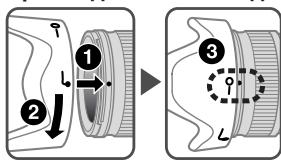
- Y6eIITecb,HTO yCTAHOBOuHЯ MeTka 6JIeHbI (●) COBnJaTe C MeTKOIΦHKcaUNI 6JIeHbI (-O).
ДляоблereнуycTaHOBKиИСНТЯб6leHdbI ydeprKuBaIte ee 3a OCHOBaHne(PraDOM C MTeKHO KpeJIeHn6leHdbI () ),a He 3a BHeUHIOKpOMKy.
- EcnI 6JIeHa yCTaHOBHeHa Ha o6BeKTHB HeHaJIeKaUIM O6pa3OM, MOKeT BO3HNKHyTb 3ΦΦEKNBHbETnPOBaHn.
-ДяхраненябileндьписоевняTe eeвобразнOMПOLJOKeHIN.
PeKOMeHnyembIe fOkyCnpoBOUHbIe 3KpaHbl
CmeHhble fokcnpoBOHbI eKpaHbI,doCTynHbIe IaJn OnpedEnHHbIX 3epKaJIbHbIX fOToKAmep Nikon, nomoraOT ocyueCTBIAITb cEmky npaHTNcEeN BJIb6bIX CNTyaunx.C 3TmM obkTHOBm peKomeHdyETcNIOJIb3ObaTb CJeDyUOune fokcnpoBOHbIe kPaHbI.
| Зндан Фотокамера | A | B | C | E | EC-B EC-E | G1 | G2 | G3 | G4 | J | L | M | U |
| F6 | ◎ | ◎ | — | ◎ | — | — | — | — | — | ◎ | ◎ | ||
| F5+DP-30 | ◎ | ◎ | ◎ | ◎ | ◎ | ◎ | ◎ | ◎ | |||||
| F5+DA-30 | ◎ | ◎ | ◎ | ◎ | ◎ | ◎ | ◎ | ◎ |
@:IcHJIIOHTeJIbHOe KaueCTBO 公 OkyuropBKN
:PnHMeJIeMoE KaucTeBO FOKHyCINPOBHN He6oJIbIooe BnHbEtNtPOBaHne HmMyap MOrYt IMeTb MeTO B BnOIOHCKaTeJe, HO HE Ha IJIeHKe.
Heoctynho
Iyctoe OJle 03Haayet, YTO FOHcyNPOBOHybI
3KpaH nCnOJIb3OBAbHeJIb3A. NsCKoJIbKy 3KpaH
TIna M MoKeT nCnOJIb3OBAbTCa Kd IyI
MAKPOcBEMn pRyBJIeMHN1:1 N bIWe, TaK n
dM NIKPOΦOTOrpAΦIOBAPAH,ero pNIMHeHNE
OTLIuHaETcO TpIMHeHnI DpyrIX 3KpaHOB.
BhimaHne
| Matglazen Camera | A | B | C | E | EC-B EC-E | G1 | G2 | G3 | G4 | J | L | M | U |
| F6 | ◎ | ◎ | — | ◎ | — | — | — | — | — | ◎ | ◎ | ||
| F5+DP-30 | ◎ | ◎ | ◎ | ◎ | ◎ | ◎ | ◎ | ◎ | |||||
| F5+DA-30 | ◎ | ◎ | ◎ | ◎ | ◎ | ◎ | ◎ | ◎ |
| Fotocamera | Autofocus | Modo di esposizione | |||
| P*1 | S | A | M | ||
| Fotocamera reflex digitali Nikon (formato FX/DX) | ✓ | ✓ | ✓ | ✓ | ✓ |
| F6, F5, F100, series F80, series F75,serie F65, Pronea 600i, Pronea S*2 | ✓ | ✓ | ✓ | ✓ | ✓ |
| Serie F4, F90X, series F90, series F70 | ✓ | ✓ | ✓ | — | — |
| Serie F60, series F55, series F50, F-401x,F-401s, F-401 | — | ✓ | ✓ | ✓ | ✓ |
| F-801s, F-801, F-601M | — | ✓ | ✓ | — | — |
| F3AF, F-601, F-501,Nikon MF fotocamere (tranne F-601M) | — | — | — | — | — |
| Schermo Fotocamera | A | B | C | E | EC-B EC-E | G1 | G2 | G3 | G4 | J | L | M | U |
| F6 | ◎ | ◎ | — | ◎ | — | — | — | — | — | ◎ | ◎ | ||
| F5+DP-30 | ◎ | ◎ | ◎ | ◎ | ◎ | ◎ | ◎ | ◎ | |||||
| F5+DA-30 | ◎ | ◎ | ◎ | ◎ | ◎ | ◎ | ◎ | ◎ |
| Matnice Fotoaparát | A | B | C | E | EC-B EC-E | G1 | G2 | G3 | G4 | J | L | M | U |
| F6 | ◎ | ◎ | — | ◎ | — | — | — | — | — | ◎ | ◎ | ||
| F5+DP-30 | ◎ | ◎ | ◎ | ◎ | ◎ | ◎ | ◎ | ◎ | |||||
| F5+DA-30 | ◎ | ◎ | ◎ | ◎ | ◎ | ◎ | ◎ | ◎ |
| Matnica Fotoaparát | A | B | C | E | EC-B EC-E | G1 | G2 | G3 | G4 | J | L | M | U |
| F6 | ◎ | ◎ | — | ◎ | — | — | — | — | — | ◎ | ◎ | ||
| F5+DP-30 | ◎ | ◎ | ◎ | ◎ | ◎ | ◎ | ◎ | ◎ | |||||
| F5+DA-30 | ◎ | ◎ | ◎ | ◎ | ◎ | ◎ | ◎ | ◎ |
@: Vyborné zaostrovanie
| 对焦屏相机 | A | B | C | E | EC-B EC-E | G1 | G2 | G3 | G4 | J | L | M | U |
| F6 | ◎ | ◎ | - | ◎ | - | - | - | - | - | ◎ | ◎ | ||
| F5+DP-30 | ◎ | ◎ | ◎ | ◎ | ◎ | ◎ | ◎ | ◎ | |||||
| F5+DA-30 | ◎ | ◎ | ○ | ◎ | ◎ | ○ | ◎ | ◎ |
①: 对焦效果良好
O: 对焦效果一般
⑪ 垄詠 MoD s/wi' (p.112)
():
3.1: 83 mm × 88.5 mm (LanZs AounTbAHTer the cHd Cll)
月: 620g
| Focused distance | Depth of field | Reproduction ratio | ||||||
| f/1.4 | f/2 | f/2.8 | f/4 | f/5.6 | f/8 | f/11 | f/16 | |
| 0.82 | 9-12/16 in. | 9-12/16 in. | 9-12/16 in. | 9-10/16 in. | 9-10/16 in. | 9-8/16 in. | 9-6/16 in. | 9-2/16 in. |
| — | — | — | 10-1/16 in. | 10-1/16 in. | 10-3/16 in. | 10-7/16 in. | 10-11/16 in. | |
| 9-15/16 in. | 9-15/16 in. | 9-15/16 in. | 10-1/16 in. | 10-1/16 in. | 10-3/16 in. | 10-7/16 in. | 10-11/16 in. | |
| 1 | 11-14/16 in. | 11-14/16 in. | 11-12/16 in. | 11-10/16 in. | 11-8/16 in. | 11-6/16 in. | 11-3/16 in. | 10-13/16 in. |
| — | — | — | 1 ft. | 1 ft. | 1 ft. | 1 ft. | 1 ft. | |
| 1 ft. | 1 ft. | 1 ft. | 6/16 in. | 10/16 in. | 13/16 in. | 1-3/16 in. | 1-13/16 in. | |
| 2/16 in. | 4/16 in. | 4/16 in. | — | — | — | — | — | |
| 1.5 | 1 ft. | 1 ft. | 1 ft. | 1 ft. | 1 ft. | 1 ft. | 1 ft. | 1 ft. |
| 5-10/16 in. | 5-8/16 in. | 5-4/16 in. | 5-1/16 in. | 4-9/16 in. | 4-1/16 in. | 3-8/16 in. | 2-10/16 in. | |
| — | — | — | 1 ft. | 1 ft. | 1 ft. | 1 ft. | 2 ft. | |
| 1 ft. | 1 ft. | 1 ft. | 7-3/16 in. | 7-13/16 in. | 8-10/16 in. | 9-15/16 in. | 8/16 in. | |
| 6-6/16 in. | 6-10/16 in. | 6-13/16 in. | — | — | — | — | — | |
| 2.5 | 2 ft. | 2 ft. | 2 ft. | 2 ft. | 2 ft. | 2 ft. | 1 ft. | 1 ft. |
| 4-11/16 in. | 4-3/16 in. | 3-10/16 in. | 2-12/16 in. | 1-9/16 in. | 2 ft. | 10-9/16 in. | 8-8/16 in. | |
| — | — | — | 2 ft. | 2 ft. | 2 ft. | — | — | |
| 2 ft. | 2 ft. | 2 ft. | 10-7/16 in. | 3 ft. | 3 ft. | 3 ft. | 5 ft. | |
| 7-7/16 in. | 8-1/16 in. | 9 in. | 12/16 in. | 4-13/16 in. | 4-13/16 in. | 11-8/16 in. | 7-3/16 in. | |
| ∞ | 43 ft. | 30 ft. | 21 ft. | 15 ft. | 11 ft. | 7 ft. | 5 ft. | 4 ft. |
| 2-3/16 in. | 3-15/16 in. | 9-4/16 in. | 4-3/16 in. | 13/16 in. | 10-5/16 in. | 9-13/16 in. | 1-5/16 in. | |
| — | — | — | — | — | — | — | — | |
Nikon
No reproduction in any form of this manual, in whole or in part (except for brief quotation in critical articles or reviews), may be made without written authorization from NIKON CORPORATION.

NIKON CORPORATION