
BOT610MXD - Built-in oven THOMSON - Free user manual and instructions
Find the device manual for free BOT610MXD THOMSON in PDF.



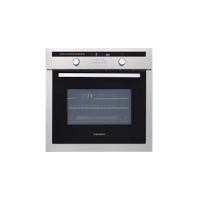
| Product Type | Built-in Oven |
| Brand | THOMSON |
| Model | BOT610MXD |
| Power Supply Voltage | 220-240 V ~ 50/60 Hz |
| Recommended Fuse | 16 A |
| Power Cable Cross-section | 3 x 1.5 mm² |
| Cable Type | H05 RR-F, H05 RN-F or H05 VV-F |
| Cleaning | Pyrolysis with automatic door lock |
| Auto Shut-off | Auto Stop (AS) after 23:30 of operation |
| Lighting | 15 W lamp, 220-240 V, 300 °C, E14 base |
| Supplied Accessories | Safety grid with handle, drip tray, multi-purpose tray 45 mm, sliding tray support |
| Safety Instructions | Hot accessible parts, keep children away |
| After-sales Service | Certified original spare parts, intervention by qualified professional |
| Number of manual pages | 54 |
| Available Languages | French, German, English |
Frequently Asked Questions - BOT610MXD THOMSON
User questions about BOT610MXD THOMSON
0 question about this device. Answer the ones you know or ask your own.
Ask a new question about this device
Download the instructions for your Built-in oven in PDF format for free! Find your manual BOT610MXD - THOMSON and take your electronic device back in hand. On this page are published all the documents necessary for the use of your device. BOT610MXD by THOMSON.
USER MANUAL BOT610MXD THOMSON
Dear Customers, Dear Customer
Attention Note response
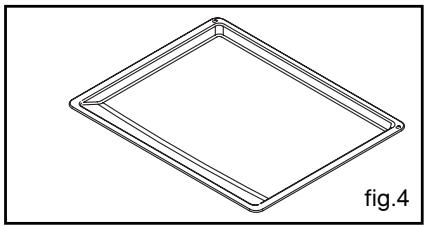
- Multi-purpose plate (fig.4)
You have just acquired a THOMSON oven and we would like to thank you.
We have invested all our dedication and know-how in this appliance so that it would best meet your needs. With innovation and performance, we designed it to be always easy to use.
In the THOMSON product range, you will also find a wide choice of microwaves, cooking hobs, ventilation hoods, that you can coordinate with your new THOMSON oven.
Visit our website where you will find all of our products, as well as useful and complementary information.
THOMSON
As part of our commitment to constantly improving our products, we reserve the right to make changes to them based on technical advances to their technical and functional features and appearance.

Warning: Before installing and using your appliance, please carefully read this Guide to Installation and Use, which will allow you to quickly familiarise yourself with its operation.
TABLE OF CONTENTS
EN
1 / NOTICES TO THE USER
- Safety instructions 4 Caring for the Environment 5
2 / INSTALLING YOUR APPLIANCE
Choice of location 6 Build-in 6 - Electrical connection 7 - Changing the power supply cable 8
3 / DESCRIPTION OF YOUR APPLIANCE
- Accessories 9
4 / CARING FOR AND CLEANING YOUR APPLIANCE
- Cleaning the outer surfaces 11
- Cleaning the door Disassembling the door 11 Reassembling the door 12
- Self-degreasing catalytic 13
- Changing the catalytic panels Dismantling the wire supports 13 What is pyrolysis? 14 In what situations should pyrolysis be used? 14
5 / ADJUSTING YOUR APPLIANCE
- Replacing the oven lamp 15
6/TROUBLESHOOTING 16
7/ AFTER-SALES SERVICE 17
EN 1 / NOTICES TO THE USER
Important: Keep this user guide.
Keep this user guide with your appliance. If the appliance is ever sold or transferred to another person, ensure that the new owner receives the user guide.
Please become familiar with these recommendations before installing and using your oven. They were written for your safety and the safety of others.
SAFETY INSTRUCTIONS
- This oven was designed for use by private individuals in their homes. It is intended solely for cooking foodstuffs. This oven does not contain any asbestos-based components.
- Please make sure children do not play with the appliance.
- When you receive the appliance, unpack it or have it unpacked immediately. Give it an overall inspection. Make note of any concerns or reservations on the delivery slip and make sure to keep a copy of this form.
- Your appliance is intended for standard household use. Do not use it for commercial or industrial purposes or for any other purpose than that for which it was designed.
- Do not modify or attempt to modify any of the characteristics of this appliance. This would be dangerous to your safety.
- WARNING: accessible parts may be hot when in use. It is advisable to keep small children away from the appliance.
- Never pull your appliance by the door handle. Before using your oven for the first time, heat it while empty for approximately 15 minutes. Make sure that the room is sufficiently ventilated. You may notice a particular odour, or a small release of smoke. All of this is normal.
- WARNING: accessible parts may become hot when the grill is used. It is advisable to keep children away from the appliance.
- When in use, the appliance becomes hot. Be careful not to touch the heating elements located inside the oven.
- When placing dishes inside or removing them from the oven, do not place your hands close to the upper heating elements and use heat-protective kitchen gloves.
- During pyrolysis, the exposed surfaces become hotter than during normal use. It is advisable to keep small children away from the oven.
- Before beginning a pyrolysis cleaning cycle in your oven, remove all parts of your grids, trays and accessories and remove major spill residue. During pyrolysis, exposed surfaces become hotter than during normal use. It is advisable to keep small children away from the oven.
- At the end of cooking, do not pick up oven or grill items (grid, rotisserie,...) with your bare hands.
- Never place aluminium foil directly in contact with the floor of the oven (see the chapter on oven description), as accumulated heat may cause deterioration of the enamel.
- Do not place heavy weights on the oven door when open, and make sure that children cannot climb or sit on it.
- The oven must be turned off when cleaning inside the oven.
- This appliance is not intended to be used by persons (including children) with reduced physical, sensory or mental abilities, or persons lacking experience or awareness, unless using it with the help of a person responsible for their safety, or under supervision and with prior instruction in its use.
- In addition to the accessories supplied with your oven, only use dishes capable of withstanding high temperatures (follow the manufacturer's instructions).
- After using your oven, make sure that all the controls are in their stop position.
- Do not use your oven as a larder or to store any items after use.
- Never use steam or high-pressure devices to clean the oven (electrical safety requirement).
- For your safety, your oven is equipped with an AUTOMATIC STOP, if you forget to turn off your oven by mistake. After 23 hours and 30 minutes of continuous use, the AS (Automatic Stop) feature will be activated and your oven will turn itself off. AS or Auto Stop will be displayed instead of the time and a series of successive beeps will be emitted for a short time.
CARING FOR THE ENVIRONMENT
- This appliance's packing materials are recyclable. Recycle them and play a role in protecting the environment by depositing them in local authority containers provided for this purpose.
- Your appliance also contains many recyclable materials. It is therefore marked with this logo to indicate that used appliances
must not be mixed with other waste. Recycling of the appliances organised by your manufacturer will thus be undertaken in optimum conditions, in accordance with European directive 2002/96/CE relating to electrical and electronic
equipment waste. Contact your local council or your retailer to find out the drop-off points for used appliances that are nearest to your home.
- We thank you for your help in protecting the environment.
Warning Installation
Installation should only be performed by qualified installers and technicians.
This appliance complies with the following European directives:
- Low Voltage Directive 2006/95/CE for affixing the CE mark.
- Electromagnetic Compatibility Directive 89/336/CEE modified by directive 93/68/CEE for attaching the CE mark.
- CE regulation 1935/2004 concerning materials and objects intended for contact with food substances.
EN 2 / INSTALLING YOUR APPLIANCE
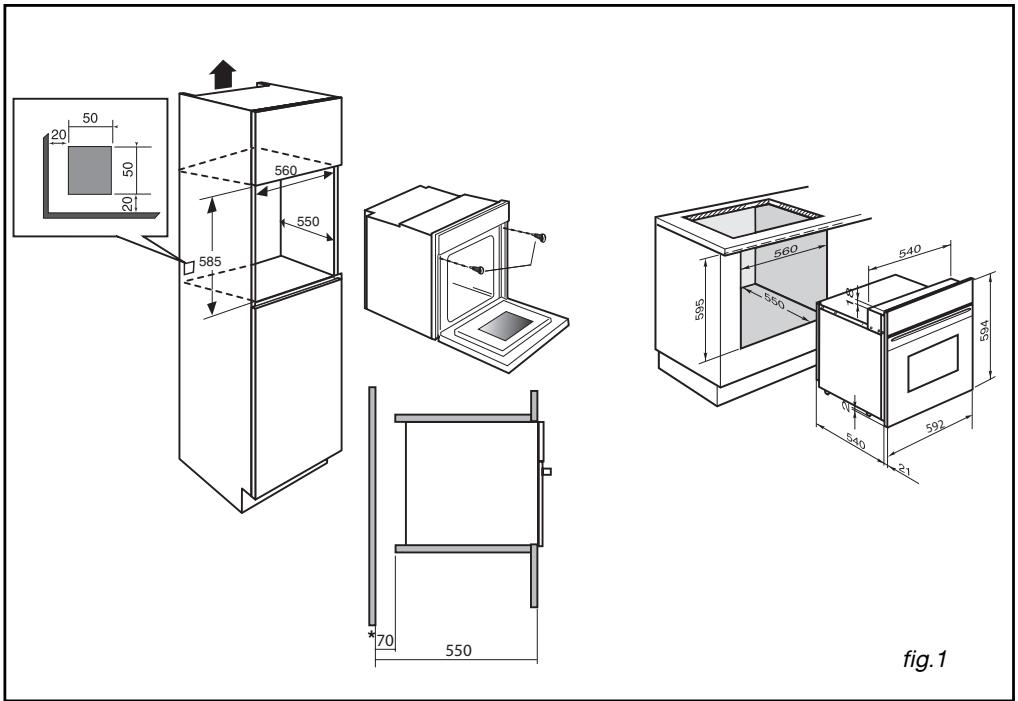
The above diagrams show the dimensions of a cabinet that will be able to hold your oven.
The oven can be installed under a work top or in a column of cabinetry (open* or closed) having the appropriate dimensions for built-in installation (see adjacent diagram).
Your oven has optimised air circulation that allows it to achieve remarkable cooking and cleaning results if the following guidelines are followed:
- Centre the oven in the cabinet so as to guarantee a minimum distance of 5 mm between the appliance and the cabinet beside it.
- The material or coating of the cabinet must be heat-resistant.
- For greater stability, attach the oven in the cabinet with two screws through the holes provided for this purpose on either side of the front inner panel (fig.1).
- BUILD-IN
To do this:
1) Remove the rubber screw covers to access the mounting holes. 2) Drill a hole in the cabinet panel to avoid splitting the wood. 3) Attach the oven with the 2 screws. 4) Replace the rubber screw covers (they also absorb the shock caused by closing the oven door). (*) if the cabinet is open, its opening must be 70 mm (maximum).

Tip
To be certain that you have properly
installed your appliance, do not hesitate to
Call on a household appliance specialist.
2 / INSTALLING YOUR APPLIANCE
EN
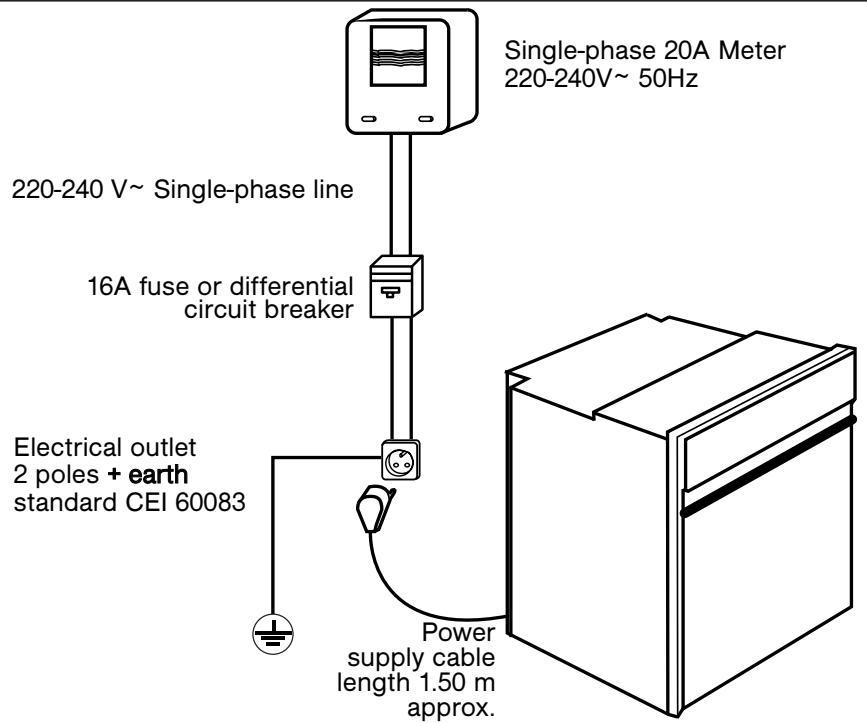
ELECTRICAL CONNECTION
The appliance must be fitted correctly to guarantee electrical safety. During fitting and maintenance operations, the appliance must be unplugged from the electrical grid. Fuses must be switched off or removed.
The electrical connections are made before the appliance is installed in its housing.
Ensure that:
- the electrical installation has sufficient voltage,
- the electrical wires are in good condition,
- the diameter of the wires complies with the installation requirements.
Your oven must be connected with a (standard) power cable with 3 conductors of 1.5 mm² (1 live + 1 neutral + earth) which must be connected to a 220-240V~ single-phase
grid by means of a 1 live + 1 neutral + earth CEI 60083 standard power socket or via an all-poles cut-off device in compliance with the installation rules.

Warning
The safety wire (green-yellow) is connected to the appliance's 1/2 terminal and must be connected to the earth terminal of the electrical set-up.
If the connection is to an electric wall socket, it must remain accessible after installation. The fuse in your set-up must be 16 amperes.
EN 2 / INSTALLING YOUR APPLIANCE
Warning We cannot
We cannot be held responsible for any accident resulting from inexistent, defective or incorrect earthing.
If the electrical installation in your residence requires any changes in order to hook up your appliance, contact a professional electrician.
If the oven malfunctions in any way, unplug the appliance or remove the fuse corresponding to the sector where the oven is hooked up.
- CHANGING THE POWER SUPPLY CABLE
- The power cable (H05 RR-F, H05 RN-F or H05 VV-F) must be of sufficient length to be connected to the build-in oven while it sits on the floor in front of the cabinet. To do this the appliance must be disconnected from the electrical network:
- Open the inspection flap located at the lower right of the back cover by unscrewing the two screws, then pivot the inspection flap.
- Strip 12 mm along each wire of the new power cable.
- Carefully twist the strands together.
- Loosen the screws from the terminal board and remove the power cord to be replaced.
- Insert the power cable through the side of the cover into the cable clip located to the right of the terminal board.
- All the strands of the electrical wires must be secured tightly under the screws.
- The phase wire on the L terminal.
- The green-yellow coloured earth wire should be connected to the terminal.
- The neutral wire (blue) on the N terminal.
- Screw down tightly the screws on the terminal board and check the connection by pulling on each wire.
- Attach the cable with the cable clip located to the right of the terminal board.
- Close the inspection flap using the two screws.
3 / DESCRIPTION OF YOUR APPLIANCE
EN
- ACCESSORIES (depending on the model)
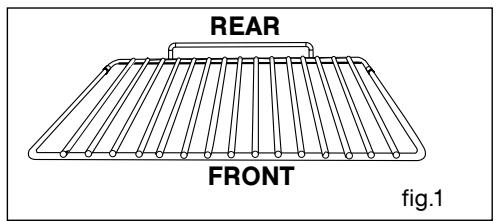
- Anti-tipping safety grid (fig.1)
The grid can be used to hold all dishes and moulds containing foodstuffs to be cooked or browned. It can be used for barbecues (to be placed directly on the grid).
EN 3 / DESCRIPTION OF YOUR APPLIANCE
- ACCESSORIES (depending on the model)
- Multi-purpose dish (fig.4)
This serves as a cake dish and has a sloped edge. It is used for cooking pastries such as cream puffs, meringues, cup cakes, puff pastry, etc.
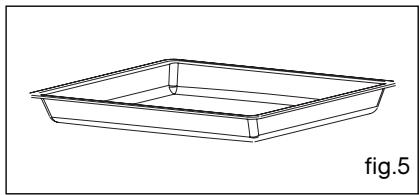
- Multi-purpose 45 mm dish (fig.5)
When inserted in the supports under the grid, it collects juice and fat from grilling, and can be used half-filled with water as a double-boiler.
Avoid placing roasts or meat directly in the dish because this is certain to cause significant spattering on the oven walls.
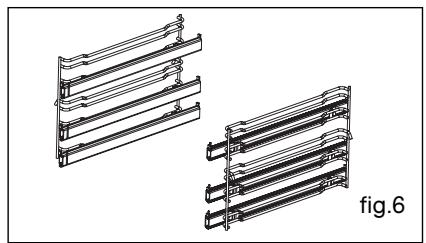
- Dish extracting support (fig.6)
Thanks to this system, you can slide out your enamelled dish all the way and easily access your preparations during cooking.
Remove from the oven before starting pyrolytic cleaning.
4 / CARING FOR AND CLEANING YOUR APPLIANCE
EN
- CLEANING THE OUTER SURFACES
To clean both the electronic programmer window and the oven door, use a window washing product applied to a soft cloth.
Do not use abrasive creams or scouring sponges.
- CLEANING THE DOOR
- Disassembling the door

Warning
Before removing the glass, allow the flame to cool down.
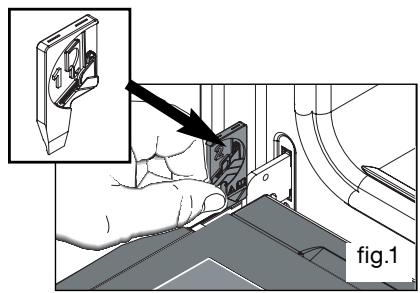
- Open the door completely and block it open using the two red stops (fig.1).
They are supplied with your machine in the plastic pack.
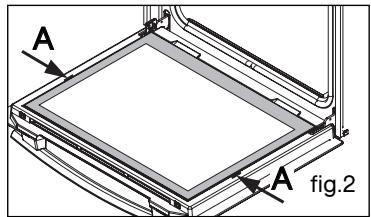
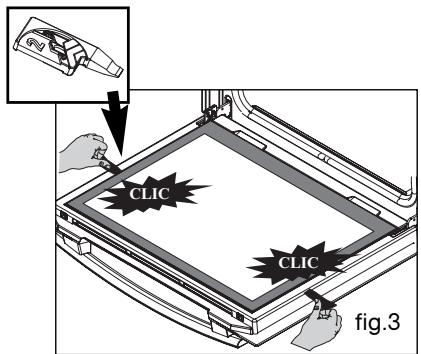
- Remove the first attached window as follows: Insert the two red stops in the A slots designed for this (fig.2).
Lever these parts to release the glass (fig.3).
- Clean the glass using a soft sponge and washing-up liquid.
Do not immerse the glass in water.
Do not use abrasive creams or scouring sponges. Rinse with clean water and dry off with a lint-free cloth.

Warning
Do not use abrasive cleaning
products or hard metallic scrapers for cleaning the oven's glass door, as they could scuff the surface and cause the glass to shatter.
EN 4 / CARING FOR AND CLEANING YOUR APPLIANCE
- Reassembling the door (ALL models)
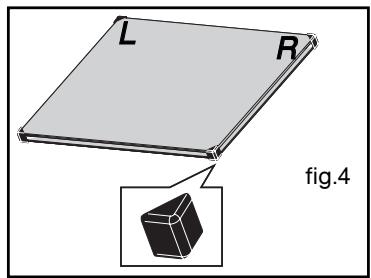
- If necessary, remove the door's inner glass assembly. This assembly is composed of one or two sheets of glass (depending on model), each of which has a black rubber corner pad (fig.4).
- After cleaning, reposition the four rubber pads, taking care to follow the indications on the glass:
- top left: L
- top right: R
Place your inner glass assembly in the door so that L and R are located on the hinge side.
- If your oven is equipped with a single inner sheet of glass, it must be located as close as possible to the clipped glass.
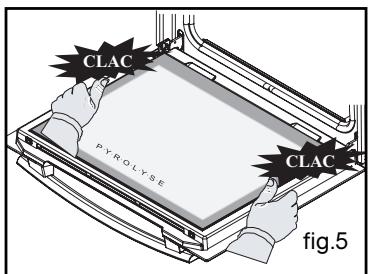
- Clip in your last glass sheet by placing the indication "PYROLYSIS" so that it faces you (fig.5).
- Remove the red plastic stops.
Your appliance is again operational.
Do not use abrasive cleaning products or hard metallic scrapers for cleaning the oven's glass door, as they could scuff the surface and cause the glass to shatter.
4 / CARING FOR AND CLEANING YOUR APPLIANCE
- DISMANTLING THE WIRE SUPPORTS
Before starting to disassemble, allow the appliance to cool down and check that the cooking selector is in the STOP position.

Warning
- The oven must be turned off when heating inside the cavity.
- Side panels with wire supports:
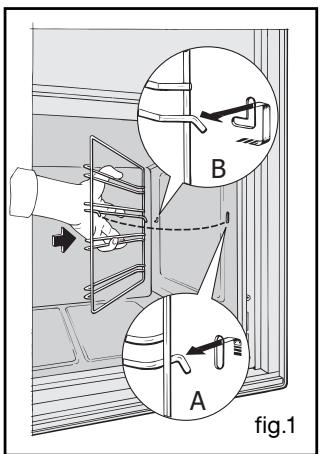
Unhook the wire shelf support (B fig.2) at the front by lifting it (diagram A fig.1). Pull the shelf support structure towards you, lifting it so as to unhook the rear attachment (diagram B fig.1).
EN 4 / CARING FOR AND CLEANING YOUR APPLIANCE
WHAT IS PYROLYSIS?

Tip
Your oven is equipped with enamelled wire shelf supports: these need to be removed before running the pyrolysis cycle.
- Pyrolysis is a cycle during which the oven cavity is heated to a very high temperature in order to eliminate spatters and spills. Smoke and odours released during pyrolysis are destroyed by moving through a catalyzer.
- Pyrolysis is not necessary after each cooking cycle, simply when the degree of soiling warrants it.
- As a safety measure, the cleaning operation only begins after the door has automatically locked. As soon as the internal temperature of the oven exceeds cooking temperatures, it is impossible to unlock the door even if the "function selector" is set to 0.
IN WHAT SITUATIONS SHOULD PYROLYSIS BE USED?
If your oven emits smoke during preheating or releases large amounts of smoke during cooking. If your oven releases an unpleasant odour when cooled after various types of cooking (lamb, fish, grills, etc...).
| Relatively clean cooking operations | Biscuits, vegetables, pastry, quiches, soufflés... | Splatter-free cooking: pyrolysis is not warranted. |
| Messy cooking operations | Meat, fish (in a dish), stuffed vegetables. | Pyrolysis may be warranted after every 3 cooking cycles. |
| Very messy cooking operations | Large cuts of meat on the spit. | Pyrolysis can be performed after one cooking application of this kind, as there is a lot of splattering. |

Tip
You should not wait until the oven is overly coated in grease to initiate a cleaning cycle.
5 / ADJUSTING YOUR APPLIANCE
EN
- REPLACING THE OVEN LAMP

Warning
Make sure the appliance is disconnected from the power before replacing the lamp in order to avoid the risk of electric shock. Change the lamp only when the appliance has cooled down.
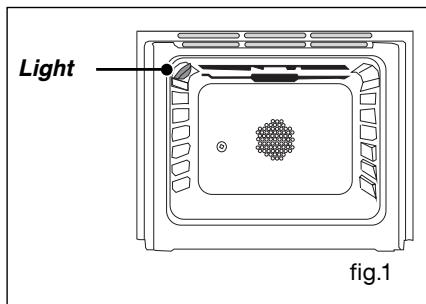
The lamp is accessible:
Inside the oven (fig.1).
The bulb is located on the ceiling of your oven's cavity.
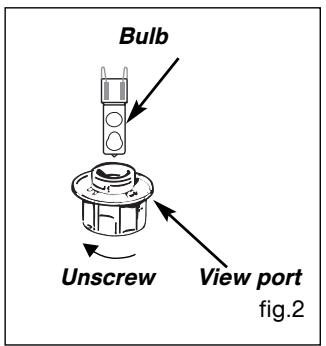
- Unscrew the view port counter-clockwise (fig.2),
- Pull out the bulb.
Bulb specifications:
-15W -220-240V\~ -300°C -E14. - Replace the bulb then replace the view port and reconnect your oven.

Tip
To unscrew the view port and the light, use a rubber glove, which will make disassembly easier.
EN 6/TROUBLESHOOTING
If you have a doubt about the correct functioning of your oven, this does not necessarily mean that there is a malfunction. In any event, check the following points:
| YOU OBSERVE THAT... | POSSIBLE CAUSES | WHAT SHOULD YOU DO? |
| The oven is not heating. | - The oven is not connected to the power supply.- Your fuse is not working.- The selected temperature is too low. | Plug in your oven. Replace the fuse in your electrical set-up and check its capacity (16A). Increase the selected temperature. |
| *The padlock is flashing. | - Problem with the door's locking mechanism. | Call the After-Sales Service Department. |
| The oven light is not working. | - The light is not working.- The oven is not connected or the fuse is not working. | Change the bulb. Plug in your oven or change the fuse. |
| *The pyrolysis cleaning cycle does not begin. | - The door is not properly closed.- The locking system is defective. | Verify that the door is locked. Call the After-Sales Service Department. |
| Your oven is beeping. | - During cooking.- At the end of a cooking cycle. | The temperature recommended for your choice has been reached. Your programmed cooking cycle is finished. |
| The cooling fan continues to operate after the oven stops. | - The fan should work for up to an hour after cooking, or when the oven temperature is greater than 125°C.- If it does not stop after 1 hour. | Open the oven door to cool down the oven faster. Call the After-Sales Service Department. |
- Only for models with the pyrolysis function.

Warning
- Repairs to your appliance should only be performed by professionals. Non-standard repairs may be a source of danger for the user.

Tip
In all circumstances, if your efforts are not sufficient, contact the After-Sales Service
Department without delay.
7 / AFTER-SALES SERVICE
EN
- SERVICE CALLS
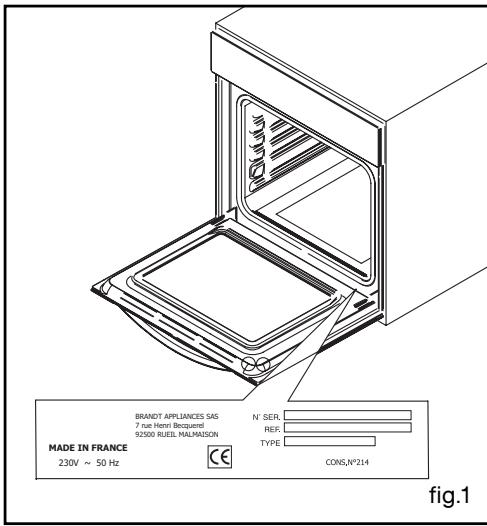
Any repairs that are made to your appliance must be handled by a qualified professional authorised to work on the brand. When you call, mention your appliance's complete reference (model, type, serial number). This information appears on the manufacturer's nameplate (fig.1).
GENUINE REPLACEMENT PARTS
During maintenance work, request that only certified genuine replacement parts are used.


- ATTENTION NOTE RESPONSE
- MULTI-PURPOSE PLATE (FIG.4)
- TABLE OF CONTENTS
- NOTICES TO THE USER
- INSTALLING YOUR APPLIANCE
- DESCRIPTION OF YOUR APPLIANCE
- CARING FOR AND CLEANING YOUR APPLIANCE
- ADJUSTING YOUR APPLIANCE
- TROUBLESHOOTING
- EN 1 / NOTICES TO THE USER
- IMPORTANT: KEEP THIS USER GUIDE
- SAFETY INSTRUCTIONS
- CARING FOR THE ENVIRONMENT
- WARNING INSTALLATION
- EN 2 / INSTALLING YOUR APPLIANCE
- BUILD-IN
- TIP
- ELECTRICAL CONNECTION
- ENSURE THAT
- WARNING
- WARNING WE CANNOT
- CHANGING THE POWER SUPPLY CABLE
- EN 3 / DESCRIPTION OF YOUR APPLIANCE
- ACCESSORIES (DEPENDING ON THE MODEL)
- MULTI-PURPOSE DISH (FIG.4)
- MULTI-PURPOSE 45 MM DISH (FIG.5)
- DISH EXTRACTING SUPPORT (FIG.6)
- CLEANING THE OUTER SURFACES
- CLEANING THE DOOR
- DISASSEMBLING THE DOOR
- EN 4 / CARING FOR AND CLEANING YOUR APPLIANCE
- REASSEMBLING THE DOOR (ALL MODELS)
- DISMANTLING THE WIRE SUPPORTS
- WHAT IS PYROLYSIS
- IN WHAT SITUATIONS SHOULD PYROLYSIS BE USED
- REPLACING THE OVEN LAMP
- INSIDE THE OVEN (FIG.1)
- EN 6/TROUBLESHOOTING
- AFTER-SALES SERVICE
- SERVICE CALLS
- GENUINE REPLACEMENT PARTS
Brand : THOMSON
Model : BOT610MXD
Category : Built-in oven