
EOB3400BOR - Four encastrable ELECTROLUX - Notice d'utilisation et mode d'emploi gratuit
Retrouvez gratuitement la notice de l'appareil EOB3400BOR ELECTROLUX au format PDF.



| Type de produit | Four encastrable |
| Marque | Electrolux |
| Modèle | EOB3400BOR |
| Volume | 72 L |
| Masse | 32.8 kg |
| Alimentation | 230 V, 50 Hz |
| Classe énergétique | A |
| Consommation (mode conventionnel) | 0.93 kWh/cycle |
| Consommation (mode ventilé) | 0.85 kWh/cycle |
| Source de chaleur | Électricité |
| Nombre de cavités | 1 |
| Fonctions de cuisson | Cuisine traditionnelle, Chaleur tournante, Gril, Gril rapide, Turbo gril, Décongélation, Cuisson pizza, Rosolage, Chaleur sole |
| Programmateur | Minuteur analogique avec arrêt automatique (180 min max) |
| Éclairage intérieur | Ampoule halogène remplaçable |
| Nombre de positions de grille | 5 |
| Accessoires fournis | Grille métallique, Lèchefrite, Plaque à pâtisserie |
| Nettoyage | Porte amovible avec vitre interne démontable, supports de grille amovibles |
| Sécurité | Thermostat de sécurité, ventilateur de refroidissement, dispositif de sécurité enfants (recommandé) |
| Pièces détachées | Accessoires et ampoules disponibles via le service agréé Electrolux |
| Réparabilité | Porte, vitre, ampoule, supports de grille remplaçables |
FOIRE AUX QUESTIONS - EOB3400BOR ELECTROLUX
Questions des utilisateurs sur EOB3400BOR ELECTROLUX
0 question sur cet appareil. Repondez a celles que vous connaissez ou posez la votre.
Poser une nouvelle question sur cet appareil
Téléchargez la notice de votre Four encastrable au format PDF gratuitement ! Retrouvez votre notice EOB3400BOR - ELECTROLUX et reprennez votre appareil électronique en main. Sur cette page sont publiés tous les documents nécessaires à l'utilisation de votre appareil EOB3400BOR de la marque ELECTROLUX.
MODE D'EMPLOI EOB3400BOR ELECTROLUX
FOUR
NOTICE D'UTILISATION
2
IT FOUR
MODE D'EMPLOI
25
SOMMAIRE
- INFORMATIONS DE SÉCURITÉ 3 2. CONSIGNES DE SÉCURITÉ 4 3. DESCRIPTION DU PRODUIT 6
- AVANT LA PREMIÈRE UTILISATION 6
- UTILISATION QUOTIDIENNE 7
- FONCTIONS DE L'HORLOGE 8
- FONCTIONS SUPPLÉMENTAIRES 9
- CONSEILS ET ASTUCES 9 9. ENTRETIEN ET NETTOYAGE 18
- DÉPANNAGE 20 11 INSTALLATION 21
- INFORMATIONS TECHNIQUES 22
- EFFICACITÉ ÉNERGÉTIQUE 23
NOUS PENSONS À VOUS
Merci d'avoir acheté un appareil Electrolux. Vous avez choisi un produit qui bénéficie de décennies d'expérience professionnelle et d'innovation. Ingénieux et élégant, il a été conçu en pensant à vous. Ainsi, à chaque utilisation, vous pouvez être sûr d'obtenir d'excellents résultats.
Bienvenue chez Electrolux.
Visitez notre site web pour :

Obtenez des conseils d'utilisation, des brochures, un outil de dépannage, des informations sur le service :
www.electrolux.com

Enregistrez votre produit pour un meilleur service :
www.registerelectrolux.com

Achetez des accessoires, consommables et pièces de rechange d'origine pour votre appareil :
www.electrolux.com/shop
SERVICE CLIENTÈLE ET ASSISTANCE
Utilisez toujours des pièces de rechange d'origine.
Lorsque vous contactez notre centre de service agréé, assurez-vous de disposer des données suivantes : Modèle, PNC, Numéro de série.
Les informations se trouvent sur la plaque signalétique.

Avertissement / Attention - Informations de sécurité

Informations générales et conseils

Informations environnementales
Sous réserve de modifications sans préavis.
1. CONSIGNES DE SÉCURITÉ
Avant l'installation et l'utilisation de l'appareil, lisez attentivement les instructions fournies. Le fabricant n'est pas responsable si une installation et une utilisation incorrectes causent des blessures et des dommages. Conservez toujours les instructions avec l'appareil pour référence future.
1.1 Sécurité des enfants et des personnes vulnérables
- Cet appareil peut être utilisé par des enfants âgés de 8 ans et plus et par des personnes ayant des capacités physiques, sensorielles ou mentales réduites ou manquant d'expérience et de connaissances, si elles ont été supervisées ou instruites quant à l'utilisation de l'appareil en toute sécurité et comprennent les dangers encourus.
- Ne laissez pas les enfants jouer avec l'appareil.
- Gardez tous les emballages hors de portée des enfants.
- Tenez les enfants et les animaux domestiques à l'écart de l'appareil lorsqu'il fonctionne ou lorsqu'il refroidit. Les parties accessibles sont chaudes.
- Si l'appareil est doté d'un dispositif de sécurité enfant, nous vous recommandons de l'activer.
- Le nettoyage et l'entretien par l'utilisateur ne doivent pas être effectués par des enfants sans surveillance. Les enfants de moins de 3 ans doivent être tenus à l'écart, sauf s'ils sont surveillés en continu.
1.2 Sécurité générale
- Seul un professionnel qualifié doit installer cet appareil et remplacer le câble.
- L'intérieur de l'appareil devient chaud en fonctionnement. Ne touchez pas les éléments chauffants situés dans l'appareil. Utilisez toujours des gants de cuisine pour retirer ou mettre en place des accessoires ou des plats.
- Avant toute opération de maintenance, coupez l'alimentation électrique.
- Assurez-vous que l'appareil est éteint avant de remplacer la lampe afin d'éviter tout risque de choc électrique.
- N'utilisez pas de nettoyeur vapeur pour nettoyer l'appareil.
- N'utilisez pas de nettoyants abrasifs agressifs ni de grattoirs métalliques tranchants pour nettoyer la porte en verre, car ils pourraient rayer la surface, ce qui pourrait entraîner le bris du verre.
- Si le cordon d'alimentation est endommagé, il doit être remplacé par le fabricant, son service après-vente agréé ou des personnes qualifiées afin d'éviter tout danger.
- Pour retirer les supports de grille, tirez d'abord sur l'avant du support, puis sur l'arrière pour les éloigner des parois latérales. Installez les supports de grille dans l'ordre inverse.
2. CONSIGNES DE SÉCURITÉ
2.1 Installation

AVERTISSEMENT !
Seul un professionnel qualifié doit installer cet appareil.
- Retirez tout l'emballage.
- N'installez pas et n'utilisez pas un appareil endommagé.
- Respectez les instructions d'installation fournies avec l'appareil. Soyez toujours prudent lors du déplacement de l'appareil car il est lourd. Portez toujours des gants de sécurité.
- Ne tirez pas l'appareil par la poignée.
- Respectez la distance minimale par rapport aux autres appareils et unités.
- Assurez-vous que l'appareil est installé sous et à côté de structures sûres.
- Les côtés de l'appareil doivent rester adjacents à des appareils ou à des unités de même hauteur.
2.2 Connexion électrique

AVERTISSEMENT !
Risque d'incendie et de choc électrique.
- Toutes les connexions électriques doivent être effectuées par un électricien qualifié.
- L'appareil doit être mis à la terre. Assurez-vous que les informations électriques sur la plaque signalétique correspondent
à l'alimentation électrique. Sinon, contactez un électricien.
Utilisez toujours une prise de courant protégée correctement installée. - N'utilisez pas d'adaptateurs multiprises ni de rallonges. - Veillez à ne pas endommager la fiche secteur et le câble d'alimentation. Si le câble d'alimentation doit être remplacé, cela doit être effectué par notre service après-vente agréé. - Ne laissez pas les câbles d'alimentation toucher ou s'approcher de la porte de l'appareil, surtout lorsque la porte est chaude. - La protection contre les chocs des pièces sous tension et isolées doit être fixée de manière à ne pas pouvoir être retirée sans outils. - Connectez la fiche secteur à la prise de courant uniquement à la fin de l'installation. Assurez-vous que la fiche secteur est accessible après l'installation. - Si la prise de courant est desserrée, ne connectez pas la fiche secteur. - Ne tirez pas sur le câble d'alimentation pour débrancher l'appareil. Tirez toujours sur la fiche secteur. - Utilisez uniquement des dispositifs d'isolation corrects : disjoncteurs, fusibles (fusibles à vis retirés du porte-fusible), disjoncteurs différentiels et contacteurs. - L'installation électrique doit comporter un dispositif d'isolation qui permet de débrancher l'appareil du secteur sur tous les pôles. Le dispositif d'isolation
doit avoir une ouverture de contact d'au moins 3 mm.
- Cet appareil est conforme aux directives de la C.E.E.
2.3 Utilisation

AVERTISSEMENT !
Risque de blessure, de brûlure, de choc électrique ou d'explosion.
- Utilisez cet appareil uniquement dans un cadre domestique.
- Ne modifiez pas les spécifications de cet appareil.
- Assurez-vous que les ouvertures de ventilation ne sont pas obstruées.
- Ne laissez pas l'appareil sans surveillance pendant son fonctionnement.
- Désactivez l'appareil après chaque utilisation.
- Soyez prudent lorsque vous ouvrez la porte de l'appareil pendant son fonctionnement. De l'air chaud peut s'échapper.
- Ne faites pas fonctionner l'appareil avec les mains mouillées ou lorsqu'il est en contact avec de l'eau.
- N'appliquez pas de pression sur la porte ouverte.
- N'utilisez pas l'appareil comme surface de travail ou de rangement.
- Ouvrez la porte de l'appareil avec précaution. L'utilisation d'ingrédients contenant de l'alcool peut provoquer un mélange d'alcool et d'air.
- Ne laissez pas des étincelles ou des flammes nues entrer en contact avec l'appareil lorsque vous ouvrez la porte.
- Ne placez pas de produits inflammables ou d'articles imbibés de produits inflammables dans, près ou sur l'appareil.

AVERTISSEMENT !
Risque d'endommagement de l'appareil.
- Pour éviter d'endommager ou de décolorer l'émail :
- ne placez pas de plats allant au four ou d'autres objets directement sur le fond de l'appareil.
- ne placez pas de papier d'aluminium directement sur le fond de l'appareil.
- ne versez pas d'eau directement dans l'appareil chaud.
- ne conservez pas de plats et d'aliments humides dans l'appareil après la cuisson.
- soyez prudent lors du retrait ou de l'installation des accessoires.
- La décoloration de l'émail n'affecte pas les performances de l'appareil. Ce n'est pas un défaut au sens de la garantie légale.
- Utilisez un plat profond pour les gâteaux humides. Les jus de fruits provoquent des taches qui peuvent être permanentes.
- Cet appareil est destiné uniquement à la cuisson des aliments. Il ne doit pas être utilisé à d'autres fins, par exemple pour chauffer une pièce. Faites toujours cuire avec la porte du four fermée.
2.4 Entretien et nettoyage

AVERTISSEMENT !
Risque de blessure, d'incendie ou de dommage à l'appareil.
- Avant toute opération d'entretien, éteignez l'appareil et débranchez la fiche de la prise secteur.
- Assurez-vous que l'appareil est froid. Il y a un risque que les panneaux de verre se brisent.
- Remplacez immédiatement les panneaux de verre de la porte s'ils sont endommagés. Contactez le service après-vente.
- Soyez prudent lorsque vous retirez la porte de l'appareil. La porte est lourde !
- Nettoyez régulièrement l'appareil pour éviter la détérioration du matériau de surface.
- Les graisses ou aliments restants dans l'appareil peuvent provoquer un incendie.
- Nettoyez l'appareil avec un chiffon doux humide. Utilisez uniquement des détergents neutres. N'utilisez pas de produits abrasifs, de tampons à récurer abrasifs, de solvants ou d'objets métalliques.
- Si vous utilisez un spray pour four, respectez les consignes de sécurité sur l'emballage.
- Ne nettoyez pas l'émail catalytique (si applicable) avec un quelconque détergent.
2.5 Éclairage intérieur
- Le type d'ampoule ou de lampe halogène utilisé pour cet appareil est réservé aux appareils électroménagers. Ne l'utilisez pas pour l'éclairage domestique.

AVERTISSEMENT !
Risque de choc électrique.
- Avant de remplacer la lampe, débranchez l'appareil de l'alimentation électrique.
- Utilisez uniquement des lampes ayant les mêmes spécifications.
2.6 Mise au rebut

AVERTISSEMENT !
Risque de blessure ou de suffocation.
3. DESCRIPTION DU PRODUIT
3.1 Vue d'ensemble
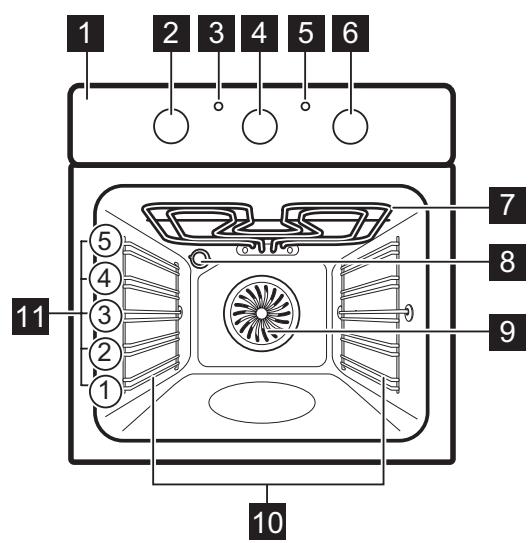
3.2 Accessoires
- Grille métallique Pour ustensiles de cuisson, moules à gâteau, rôtis.
- Plaque de cuisson
4. AVANT LA PREMIÈRE UTILISATION

AVERTISSEMENT !
Reportez-vous aux chapitres sur la sécurité.
4.1 Nettoyage initial
Retirez tous les accessoires et les supports de grille amovibles de l'appareil.

Reportez-vous au chapitre « Entretien et nettoyage ».
Nettoyez l'appareil avant la première utilisation. Remettez les accessoires et les supports de grille amovibles à leur position initiale.
- Débranchez l'appareil de l'alimentation secteur.
- Coupez le câble d'alimentation et jetez-le.
- Retirez la gâche de porte pour empêcher les enfants et les animaux de s'enfermer dans l'appareil.
1 Bandeau de commande 2 Bouton des fonctions du four 3 Voyant / symbole / indicateur de mise sous tension 4 Minuteur analogique 5 Voyant / symbole / indicateur de température 6 Bouton de température 7 Élément chauffant 8 Lampe 9 Ventilateur 10 Support de grille amovible 11 Positions des grilles
Pour les gâteaux et les biscuits.
- Lèchefrite / plat à rôtir
Pour cuire et rôtir ou comme plat pour recueillir la graisse.
4.2 Préchauffage
Préchauffez l'appareil vide pour brûler les graisses résiduelles.
- Réglez la fonction et la température maximale.
- Laissez l'appareil fonctionner pendant 1 heure.
- Réglez la fonction et la température maximale.
- Laissez l'appareil fonctionner pendant 15 minutes.
- Réglez la fonction ° et la température maximale.
- Laissez l'appareil fonctionner pendant 15 minutes.
Les accessoires peuvent devenir plus chauds que d'habitude. L'appareil peut dégager une odeur et de la fumée. C'est normal. Assurez-vous que la ventilation de la pièce est suffisante.
5. UTILISATION QUOTIDIENNE

AVERTISSEMENT!
Reportez-vous aux chapitres concernant la sécurité.
5.1 Activation et désactivation de l'appareil

Selon le modèle, votre appareil peut comporter des symboles sur les boutons, des indicateurs ou des voyants :
- L'indicateur s'allume lorsque le four chauffe.
- Le voyant s'allume lorsque l'appareil fonctionne.
- Le symbole indique si le bouton contrôle les fonctions du four ou la température.
- Tournez le bouton des fonctions du four pour sélectionner une fonction de cuisson.
- Tournez la manette de température pour sélectionner une température.
- Pour éteindre l'appareil, tournez les manettes des fonctions du four et de la température sur la position d'arrêt.
5.2 Fonctions du four
| Oven function | Application | |
| 0 | Off position | The appliance is off. |
| Light | To activate the lamp without a cooking function. | |
| Conventional Cooking | To bake and roast food on 1 shelf position. | |
| Top Heat | To brown bread, cakes and pastries. To finish cooked dishes. | |
| Bottom Heat | To bake cakes with crispy bottom and to preserve food. | |
| Grilling | To grill flat food and to toast bread. | |
| Fast Grilling | To grill flat food in large quantities and to toast bread. | |
| Turbo Grilling | To roast larger meat joints or poultry with bones on 1 shelf position. Also to make gratins and to brown. | |
| True Fan Cooking / Defrost | To bake on up to 3 shelf positions at the same time and to dry food. Set the temperature 20 - 40 °C lower than for Conventional Cooking. To defrost frozen food. | |
| Pizza Setting | To bake food on 1 shelf position for a more intensive browning and a crispy bottom. Set the temperature 20 - 40 °C lower than for Conventional Cooking. | |
6. FONCTIONS DE L'HORLOGE
6.1 Minuteur analogique
Le minuteur a les fonctions suivantes :
Heure - Minuteur + Fin de cuisson.
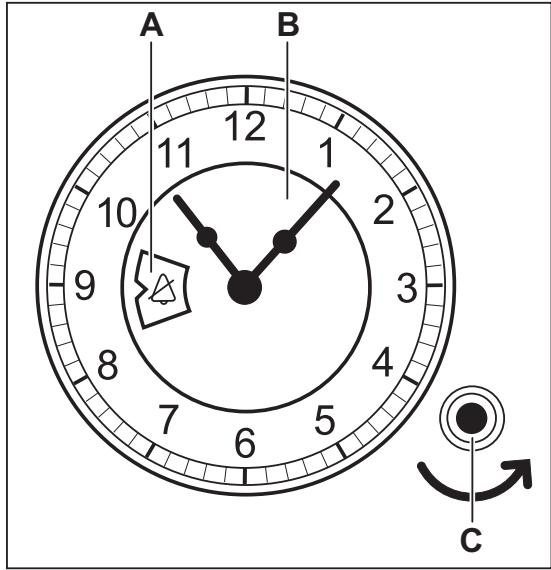
A) Fenêtre B) Molette C) Bouton de réglage
Réglage de l'heure
Pour régler l'heure, poussez et tournez le bouton de réglage dans le sens inverse des aiguilles d'une montre (dans la direction indiquée par la flèche), jusqu'à ce que les aiguilles de l'horloge soient dans la position souhaitée. Ne tournez pas le bouton de réglage dans le sens des aiguilles d'une montre. Après avoir réglé l'heure, laissez le bouton de réglage revenir à sa position initiale ou tirez-le doucement en arrière.
Réglage normal
Tournez le bouton de réglage dans le sens inverse des aiguilles d'une montre, jusqu'à ce que s'affiche dans la fenêtre. Dans cette position, vous utilisez l'appareil manuellement. Les fonctions Minuteur + Fin de cuisson sont désactivées.
Minuteur + Fin de cuisson
Utilisez cette fonction pour régler l'heure d'arrêt automatique d'une fonction de cuisson. Le temps maximal que vous pouvez régler est de 180 minutes.

Utilisez-le uniquement pour des aliments que vous n'avez pas besoin de mélanger ou de surveiller pendant la cuisson.
7. FONCTIONS SUPPLÉMENTAIRES
7.1 Ventilateur de refroidissement
Lorsque l'appareil fonctionne, le ventilateur de refroidissement s'active automatiquement pour maintenir les surfaces de l'appareil au frais. Si vous désactivez l'appareil, le ventilateur de refroidissement peut continuer à fonctionner jusqu'à ce que l'appareil refroidisse.
8. CONSEILS ET ASTUCES

AVERTISSEMENT !
Reportez-vous aux chapitres sur la sécurité.

Les températures et les temps de cuisson dans les tableaux ne sont que des indications. Ils dépendent des recettes et de la qualité et de la quantité des ingrédients utilisés.
Tournez le bouton de réglage dans le sens inverse des aiguilles d'une montre, jusqu'à ce que Δ s'affiche dans la fenêtre. Dans cette position, aucun signal acoustique n'est émis après la désactivation de l'appareil.
- Réglez une fonction du four et la température.
- Tournez le bouton de réglage dans le sens inverse des aiguilles d'une montre, jusqu'à ce que le temps d'arrêt nécessaire (en minutes) s'affiche dans la fenêtre du cadran.
Le compte à rebours démarre. Une fois la période écoulée, un signal acoustique retentit. L'appareil se désactive.

Le signal acoustique peut être désactivé. Tournez le bouton de réglage dans le sens inverse des aiguilles d'une montre, jusqu'à ce que s'affiche dans la fenêtre. Dans cette position, aucun signal acoustique n'est émis après la désactivation de l'appareil.
Pour annuler la fonction Minuteur + Fin de cuisson, tournez le bouton de réglage dans le sens inverse des aiguilles d'une montre jusqu'à ce que s'affiche dans la fenêtre.
7.2 Thermostat de sécurité
Un fonctionnement incorrect de l'appareil ou des composants défectueux peuvent provoquer une surchauffe dangereuse. Pour éviter cela, le four est équipé d'un thermostat de sécurité qui coupe l'alimentation électrique. Le four se réactive automatiquement lorsque la température baisse.
8.1 Informations générales
- L'appareil dispose de cinq niveaux de grilles. Comptez les niveaux de grilles à partir du bas de la cavité de l'appareil.
- L'appareil dispose d'un système spécial qui fait circuler l'air et recycle en permanence la vapeur. Grâce à ce système, vous pouvez cuisiner dans un environnement humide et garder les aliments moelleux à l'intérieur et croustillants à l'extérieur. Cela réduit le
temps de cuisson et la consommation d'énergie au minimum.
- De l'humidité peut se condenser dans l'appareil ou sur les vitres de la porte. C'est normal. Tenez-vous toujours à distance de l'appareil lorsque vous ouvrez la porte pendant la cuisson. Pour réduire la condensation, faites fonctionner l'appareil pendant 10 minutes avant la cuisson.
- Nettoyez l'humidité après chaque utilisation de l'appareil.
- Ne placez pas les objets directement sur le fond de la cavité et ne mettez pas de papier d'aluminium sur les composants pendant la cuisson. Cela peut modifier les résultats de cuisson et endommager l'émail.
8.2 Cuisson des gâteaux
- N'ouvrez pas la porte du four avant que les 3/4 du temps de cuisson réglé ne soient écoulés.
- Si vous utilisez deux plaques de cuisson en même temps, laissez un niveau vide entre elles.
8.3 Cuisson de la viande et du poisson
- Utilisez un plat profond pour les aliments très gras afin d'éviter les taches permanentes dans le four.
- Laissez reposer la viande environ 15 minutes avant de la découper afin que le jus ne s'écoule pas.
- Pour éviter trop de fumée dans le four pendant le rôtissage, ajoutez un peu d'eau dans le plat profond. Pour éviter la condensation de la fumée, ajoutez de l'eau à chaque fois qu'elle s'évapore.
8.4 Temps de cuisson
Les temps de cuisson dépendent du type d'aliment, de sa consistance et de son volume.
Au début, surveillez les performances lorsque vous cuisinez. Trouvez les meilleurs réglages (position de chauffe, temps de cuisson, etc.) pour vos ustensiles, recettes et quantités lorsque vous utilisez cet appareil.
8.5 Tableau de cuisson et de rôtissage
Gâteaux
| Food | Conventional Cooking | True Fan Cooking | Time (min) | Comments | ||
| Tempera-ture (℃) | Shelf po-sition | Tempera-ture (℃) | Shelf po-sition | |||
| Whisked recipes | 170 | 2 | 160 | 3 (2 and 4) | 45 - 60 | In a cake mould |
| Short-bread dough | 170 | 2 | 160 | 3 (2 and 4) | 20 - 30 | In a cake mould |
| Buttermilk cheese-cake | 170 | 1 | 165 | 2 | 60 - 80 | In a 26 cm cake mould |
| Apple cake (Ap-ple pie)1) | 170 | 2 | 160 | 2 (left and right) | 80 - 100 | In two 20 cm cake moulds on a wire shelf |
| Strudel | 175 | 3 | 150 | 2 | 60 - 80 | In a baking tray |
| Food | Conventional Cook-ing | True Fan Cooking | Time (min) | Comments | ||
| Tempera-ture (℃) | Shelf po-sition | Tempera-ture (℃) | Shelf po-sition | |||
| Jam-tart | 170 | 2 | 165 | 2 (left and right) | 30 - 40 | In a 26 cm cake mould |
| Sponge cake | 170 | 2 | 160 | 2 | 50 - 60 | In a 26 cm cake mould |
| Christmas cake / Rich fruit cake1) | 160 | 2 | 150 | 2 | 90 - 120 | In a 20 cm cake mould |
| Plum cake1) | 175 | 1 | 160 | 2 | 50 - 60 | In a bread tin |
| Small cakes - one level | 170 | 3 | 140 - 150 | 3 | 20 - 30 | In a baking tray |
| Small cakes - two levels | - | - | 140 - 150 | 2 and 4 | 25 - 35 | In a baking tray |
| Small cakes - three levels | - | - | 140 - 150 | 1, 3 and 5 | 30 - 45 | In a baking tray |
| Biscuits / pastry stripes - one level | 140 | 3 | 140 - 150 | 3 | 30 - 35 | In a baking tray |
| Biscuits / pastry stripes - two levels | - | - | 140 - 150 | 2 and 4 | 35 - 40 | In a baking tray |
| Biscuits / pastry stripes - three levels | - | - | 140 - 150 | 1, 3 and 5 | 35 - 45 | In a baking tray |
| Meringues - one level | 120 | 3 | 120 | 3 | 80 - 100 | In a baking tray |
| Food | Conventional Cooking | True Fan Cooking | Time (min) | Comments | ||
| Tempera-ture (℃) | Shelf po-sition | Tempera-ture (℃) | Shelf po-sition | |||
| Merin-gues- two levels1) | - | - | 120 | 2 and 4 | 80 - 100 | In a baking tray |
| Buns1) | 190 | 3 | 190 | 3 | 12 - 20 | In a baking tray |
| Eclairs - one level | 190 | 3 | 170 | 3 | 25 - 35 | In a baking tray |
| Eclairs - two levels | - | - | 170 | 2 and 4 | 35 - 45 | In a baking tray |
| Plate tarts | 180 | 2 | 170 | 2 | 45 - 70 | In a 20 cm cake mould |
| Rich fruit cake | 160 | 1 | 150 | 2 | 110 - 120 | In a 24 cm cake mould |
| Victoria sandwich | 170 | 1 | 160 | 2 (left and right) | 50 - 60 | In a 20 cm cake mould |
1) Préchauffez le four pendant 10 minutes.
Pain et pizza
| Food | Conventional Cooking | True Fan Cooking | Time (min) | Comments | ||
| Tempera-ture (℃) | Shelf po-sition | Tempera-ture (℃) | Shelf po-sition | |||
| White bread1) | 190 | 1 | 190 | 1 | 60 - 70 | 1 - 2 pieces, 500 gr per piece |
| Rye bread | 190 | 1 | 180 | 1 | 30 - 45 | In a bread tin |
| Bread rolls1) | 190 | 2 | 180 | 2 (2 and 4) | 25 - 40 | 6 - 8 rolls in a baking tray |
| Pizza1) | 230 - 250 | 1 | 230 - 250 | 1 | 10 - 20 | In a baking tray or a deep pan |
| Temperature (℃) | Shelf position | Temperature (℃) | Shelf position | |||
| Scones1) | 200 | 3 | 190 | 3 | 10 - 20 | In a baking tray |
1) Préchauffez le four pendant 10 minutes.
Flans
| Food | Conventional Cooking | True Fan Cooking | Time (min) | Comments | ||
| Tempera-ture (℃) | Shelf po-sition | Tempera-ture (℃) | Shelf po-sition | |||
| Pasta flan | 200 | 2 | 180 | 2 | 40 - 50 | In a mould |
| Vegetable flan | 200 | 2 | 175 | 2 | 45 - 60 | In a mould |
| Quiches1) | 180 | 1 | 180 | 1 | 50 - 60 | In a mould |
| Lasagne1) | 180 - 190 | 2 | 180 - 190 | 2 | 25 - 40 | In a mould |
| Cannello- ni1) | 180 - 190 | 2 | 180 - 190 | 2 | 25 - 40 | In a mould |
1) Préchauffez le four pendant 10 minutes.
Viande
| Food | Conventional Cooking | True Fan Cooking | Time (min) | Comments | ||
| Tempera-ture (℃) | Shelf po-sition | Tempera-ture (℃) | Shelf po-sition | |||
| Beef | 200 | 2 | 190 | 2 | 50 - 70 | On a wire shelf |
| Pork | 180 | 2 | 180 | 2 | 90 - 120 | On a wire shelf |
| Veal | 190 | 2 | 175 | 2 | 90 - 120 | On a wire shelf |
| English roast beef, rare | 210 | 2 | 200 | 2 | 50 - 60 | On a wire shelf |
| English roast beef, medium | 210 | 2 | 200 | 2 | 60 - 70 | On a wire shelf |
| English roast beef, well done | 210 | 2 | 200 | 2 | 70 - 75 | On a wire shelf |
| Shoulder of pork | 180 | 2 | 170 | 2 | 120 - 150 | With rind |
| Shin of pork | 180 | 2 | 160 | 2 | 100 - 120 | 2 pieces |
| Lamb | 190 | 2 | 175 | 2 | 110 - 130 | Leg |
| Chicken | 220 | 2 | 200 | 2 | 70 - 85 | Whole |
| Turkey | 180 | 2 | 160 | 2 | 210 - 240 | Whole |
| Duck | 175 | 2 | 220 | 2 | 120 - 150 | Whole |
| Goose | 175 | 2 | 160 | 1 | 150 - 200 | Whole |
| Rabbit | 190 | 2 | 175 | 2 | 60 - 80 | Cut in pieces |
| Hare | 190 | 2 | 175 | 2 | 150 - 200 | Cut in pieces |
| Pheasant | 190 | 2 | 175 | 2 | 90 - 120 | Whole |
Poisson
| Food | Conventional Cooking | True Fan Cooking | Time (min) | Comments | ||
| Tempera-ture (℃) | Shelf po-sition | Tempera-ture (℃) | Shelf po-sition | |||
| Trout / Sea bream | 190 | 2 | 175 | 2 | 40 - 55 | 3 - 4 fish |
| Tuna fish / Salmon | 190 | 2 | 175 | 2 | 35 - 60 | 4 - 6 fillets |
8.6 Gril

Préchauffez le four vide pendant 3 minutes avant la cuisson.
| Food | Quantity | Tempera-ture (℃) | Time (min) | Shelf po-sition | ||
| Pieces | (g) | 1st side | 2nd side | |||
| Fillet steaks | 4 | 800 | max. | 12 - 15 | 12 - 14 | 4 |
| Beef steaks | 4 | 600 | max. | 10 - 12 | 6 - 8 | 4 |
| Sausages | 8 | - | max. | 12 - 15 | 10 - 12 | 4 |
| Pork chops | 4 | 600 | max. | 12 - 16 | 12 - 14 | 4 |
| Chicken (cut in 2) | 2 | 1000 | max. | 30 - 35 | 25 - 30 | 4 |
| Kebabs | 4 | - | max. | 10 - 15 | 10 - 12 | 4 |
| Breast of chicken | 4 | 400 | max. | 12 - 15 | 12 - 14 | 4 |
| Hambur-ger | 6 | 600 | max. | 20 - 30 | - | 4 |
| Fish fillet | 4 | 400 | max. | 12 - 14 | 10 - 12 | 4 |
| Toasted sandwiches | 4 - 6 | - | max. | 5 - 7 | - | 4 |
| Toast | 4 - 6 | - | max. | 2 - 4 | 2 - 3 | 4 |
8.7 Rôtissage par air pulsé
Bœuf
| Food | Quantity | Temperature (℃) | Time (min) | Shelf position |
| Roast beef or fillet, rare1) | per cm of thickness | 190 - 200 | 5 - 6 | 1 or 2 |
| Roast beef or fillet, medium1) | per cm of thickness | 180 - 190 | 6 - 8 | 1 or 2 |
| Roast beef or fillet, well done1) | per cm of thickness | 170 - 180 | 8 - 10 | 1 or 2 |
1) Préchauffez le four.
Porc
| Food | Quantity (kg) | Temperature (℃) | Time (min) | Shelf position |
| Shoulder, neck, ham joint | 1 - 1.5 | 160 - 180 | 90 - 120 | 1 or 2 |
| Chop, spare rib | 1 - 1.5 | 170 - 180 | 60 - 90 | 1 or 2 |
| Meat loaf | 0.75 - 1 | 160 - 170 | 50 - 60 | 1 or 2 |
| Pork knuckle (pre-cooked) | 0.75 - 1 | 150 - 170 | 90 - 120 | 1 or 2 |
Veau
| Food | Quantity (kg) | Temperature (℃) | Time (min) | Shelf position |
| Roast veal | 1 | 160 - 180 | 90 - 120 | 1 or 2 |
| Knuckle of veal | 1.5 - 2 | 160 - 180 | 120 - 150 | 1 or 2 |
Agneau
| Food | Quantity (kg) | Temperature (℃) | Time (min) | Shelf position |
| Leg of lamb, roast lamb | 1 - 1.5 | 150 - 170 | 100 - 120 | 1 or 2 |
| Saddle of lamb | 1 - 1.5 | 160 - 180 | 40 - 60 | 1 or 2 |
Volaille
| Food | Quantity (kg) | Temperature (℃) | Time (min) | Shelf position |
| Poultry portions | 0.2 - 0.25 each | 200 - 220 | 30 - 50 | 1 or 2 |
| Chicken, half | 0.4 - 0.5 each | 190 - 210 | 35 - 50 | 1 or 2 |
| Chicken, pou- lard | 1 - 1.5 | 190 - 210 | 50 - 70 | 1 or 2 |
| Duck | 1.5 - 2 | 180 - 200 | 80 - 100 | 1 or 2 |
| Goose | 3.5 - 5 | 160 - 180 | 120 - 180 | 1 or 2 |
| Turkey | 2.5 - 3.5 | 160 - 180 | 120 - 150 | 1 or 2 |
| Turkey | 4 - 6 | 140 - 160 | 150 - 240 | 1 or 2 |
Poisson
| Food | Quantity (kg) | Temperature (℃) | Time (min) | Shelf position |
| Whole fish | 1 - 1.5 | 210 - 220 | 40 - 60 | 1 or 2 |
8.8 Décongélation
| Food | Quantity (g) | Defrosting time (min) | Further defrost-ing time (min) | Comments |
| Chicken | 1000 | 100 - 140 | 20 - 30 | Place the chicken on an upturned saucer placed on a large plate. Turn halfway through. |
| Meat | 1000 | 100 - 140 | 20 - 30 | Turn halfway through. |
| Meat | 500 | 90 - 120 | 20 - 30 | Turn halfway through. |
| Trout | 150 | 25 - 35 | 10 - 15 | - |
| Strawberries | 300 | 30 - 40 | 10 - 20 | - |
| Butter | 250 | 30 - 40 | 10 - 15 | - |
| Cream | 2 x 200 | 80 - 100 | 10 - 15 | Cream can also be whipped when still slightly frozen in places. |
| Gateau | 1400 | 60 | 60 | - |
8.9 Séchage - Cuisson par chaleur tournante
la porte et laissez refroidir pendant une nuit pour terminer le séchage.
- Couvrez les plateaux de papier sulfurisé ou de papier cuisson.
- Pour un meilleur résultat, arrêtez le four à mi-temps du séchage, ouvrez
Légumes
| Food | Temperature (℃) | Time (h) | Shelf position | |
| 1 position | 2 positions | |||
| Beans | 60 - 70 | 6 - 8 | 3 | 1 / 4 |
| Peppers | 60 - 70 | 5 - 6 | 3 | 1 / 4 |
| Vegetables for sour | 60 - 70 | 5 - 6 | 3 | 1 / 4 |
| Mushrooms | 50 - 60 | 6 - 8 | 3 | 1 / 4 |
| Herbs | 40 - 50 | 2 - 3 | 3 | 1 / 4 |
Fruits
| Food | Temperature (℃) | Time (h) | Shelf position | |
| 1 position | 2 positions | |||
| Plums | 60 - 70 | 8 - 10 | 3 | 1 / 4 |
| Apricots | 60 - 70 | 8 - 10 | 3 | 1 / 4 |
| Apple slices | 60 - 70 | 6 - 8 | 3 | 1 / 4 |
| Pears | 60 - 70 | 6 - 9 | 3 | 1 / 4 |
9. ENTRETIEN ET NETTOYAGE

AVERTISSEMENT !
Reportez-vous aux chapitres concernant la sécurité.
9.1 Remarques sur le nettoyage
- Nettoyez la façade de l'appareil avec un chiffon doux imbibé d'eau chaude et d'un produit de nettoyage.
- Pour nettoyer les surfaces métalliques, utilisez un produit de nettoyage courant.
- Nettoyez l'intérieur de l'appareil après chaque utilisation. L'accumulation de graisse ou d'autres résidus alimentaires peut provoquer un incendie. Le risque est plus élevé pour la lèchefrite.
- Nettoyez les saletés tenaces avec un nettoyant spécial pour four.
- Nettoyez tous les accessoires après chaque utilisation et laissez-les sécher. Utilisez un chiffon doux imbibé d'eau chaude et d'un produit de nettoyage.
- Si vous avez des accessoires antiadhésifs, ne les nettoyez pas avec des agents agressifs, des objets tranchants ou au lave-vaisselle. Cela pourrait endommager le revêtement antiadhésif.
9.2 Appareils en acier inoxydable ou en aluminium

Nettoyez la porte du four uniquement avec une éponge humide. Séchez-la avec un chiffon doux.
N'utilisez pas de laine d'acier, d'acides ou de matériaux abrasifs car ils peuvent endommager la surface du four. Nettoyez le panneau de commande du four avec les mêmes précautions.
9.3 Nettoyage du joint de porte
- Vérifiez régulièrement le joint de porte. Le joint de porte se trouve autour du cadre de la cavité du four. N'utilisez pas l'appareil si le joint de porte est
endommagé. Contactez un centre de service agréé.
- Pour nettoyer le joint de porte, reportez-vous aux informations générales sur le nettoyage.
9.4 Retrait des supports de grille
Pour nettoyer le four, retirez les supports de grille.
- Tirez l'avant du support de grille loin de la paroi latérale.
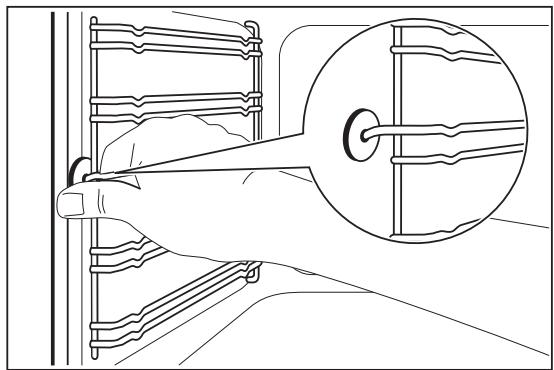
- Tirez l'extrémité arrière du support de grille loin de la paroi latérale et retirez-le.
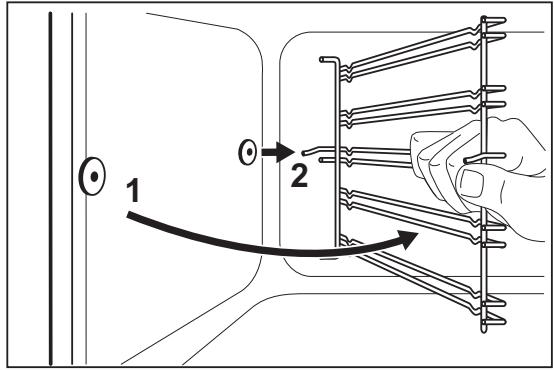
Installez les supports de grille dans l'ordre inverse.
9.5 Nettoyage de la porte du four
La porte du four comporte deux panneaux de verre. Vous pouvez retirer la porte du four et le panneau de verre interne pour le nettoyage.

La porte du four peut se fermer si vous essayez de retirer le panneau de verre interne avant d'avoir retiré la porte du four.

ATTENTION !
N'utilisez pas l'appareil sans le panneau de verre interne.
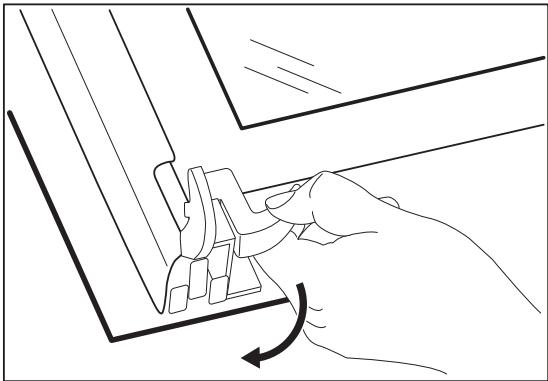
- Ouvrez la porte complètement et tenez les deux charnières de la porte.
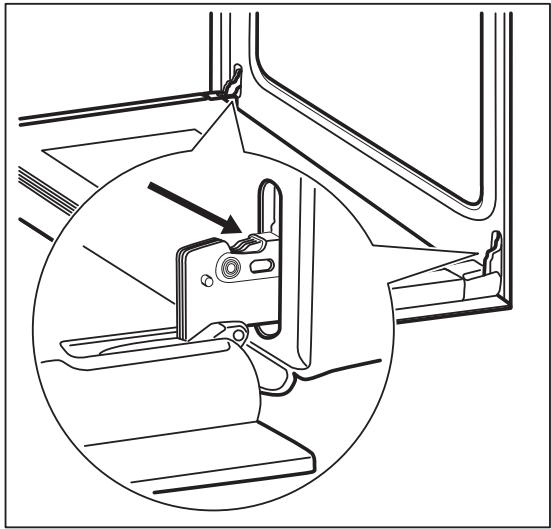
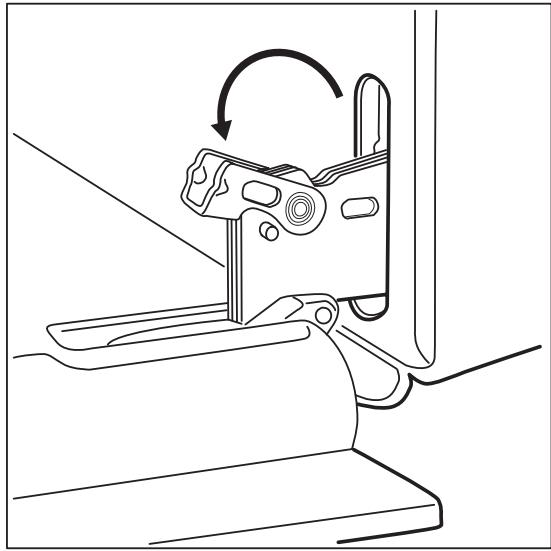
- Soulevez et tournez les leviers sur les deux charnières.
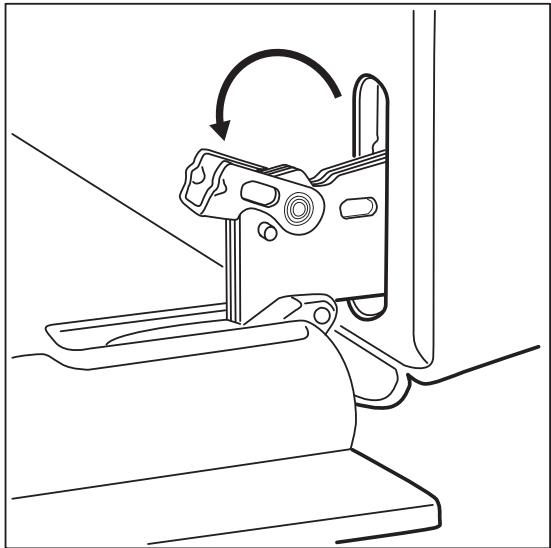
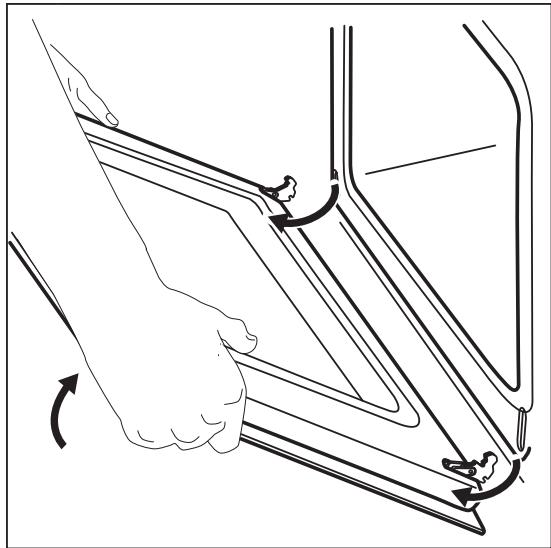
- Fermez la porte du four à moitié jusqu'à la première position d'ouverture. Puis tirez vers l'avant et retirez la porte de son logement.
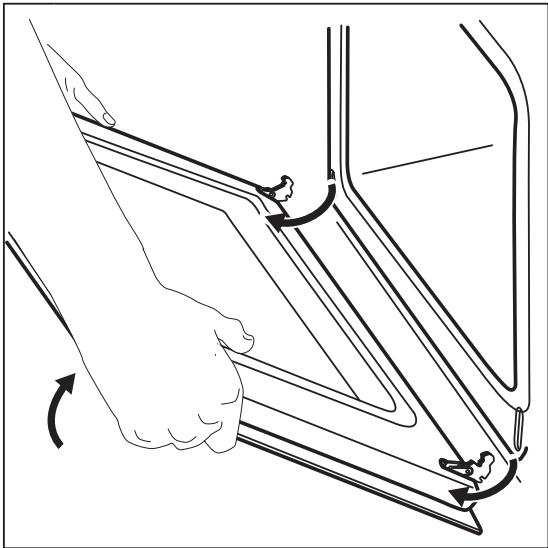
- Placez la porte sur un chiffon doux sur une surface stable.
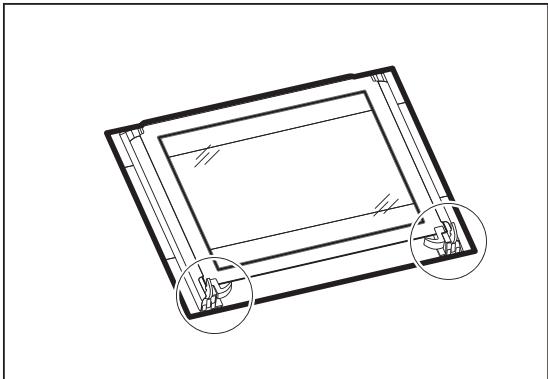
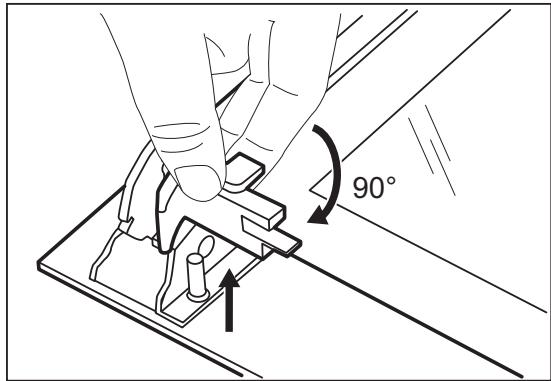
- Déverrouillez le système de verrouillage pour retirer le panneau de verre interne.
- Tournez les deux fixations de 90° et retirez-les de leurs logements.
7. Soulevez d'abord délicatement puis retirez le panneau de verre. 8. Nettoyez le panneau de verre avec de l'eau et du savon. Séchez soigneusement le panneau de verre. Une fois le nettoyage terminé, installez le panneau de verre et la porte du four. Effectuez les étapes ci-dessus dans l'ordre inverse.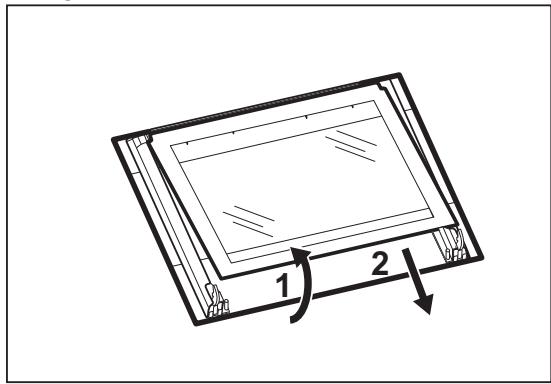
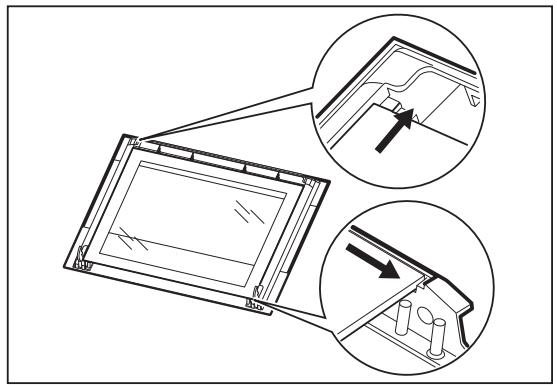
La zone de sérigraphie doit être orientée vers l'intérieur de la porte. Assurez-vous qu'après l'installation, la surface du cadre du panneau de verre sur les zones de sérigraphie n'est pas rugueuse au toucher.
Assurez-vous d'installer correctement le panneau de verre interne dans ses logements.
10. DÉPANNAGE

AVERTISSEMENT ! Reportez-vous aux chapitres sur la sécurité.
9.6 Remplacement de la lampe
Placez un chiffon au fond de l'intérieur de l'appareil. Cela évite d'endommager le verre de la lampe et la cavité.

AVERTISSEMENT ! Danger d'électrocution ! Débranchez le fusible avant de remplacer la lampe. La lampe et le verre de la lampe peuvent être chauds.

ATTENTION ! Tenez toujours la lampe halogène avec un chiffon pour éviter que les résidus de graisse ne brûlent sur la lampe.
- Désactivez l'appareil.
- Retirez les fusibles du boîtier à fusibles ou désactivez le disjoncteur.
La lampe arrière
- Tournez le verre de la lampe dans le sens inverse des aiguilles d'une montre pour le retirer.
- Nettoyez la vitre.
- Remplacez la lampe par une lampe adaptée résistant à la chaleur de 300 °C.
- Installez la vitre.
10.1 Que faire si...
| Problem | Possible cause | Remedy |
| The oven does not heat up. | The oven is deactivated. | Activate the oven. |
| The oven does not heat up. | The Minute Minder + End of Cooking programmer is not set. | Set the Minute Minder + End of Cooking programmer. Refer to the chapter "Clock functions". |
| The oven does not heat up. | The fuse is released. | Make sure that the fuse is the cause of the malfunction. If the fuse releases again and again, contact a qualified electrician. |
| The lamp does not operate. | The lamp is defective. | Replace the lamp. |
| Steam and condensation settle on the food and in the cavity of the oven. | You left the dish in the oven for too long. | Do not leave the dishes in the oven for longer than 15 - 20 minutes after the cooking process ends. |
10.2 Données de service
Si vous ne trouvez pas de solution au problème vous-même, contactez votre revendeur ou un centre de service agréé.
Les données nécessaires pour le centre de service se trouvent sur la plaque signalétique. La plaque signalétique se trouve sur
le cadre avant de la cavité de l'appareil. Ne retirez pas la plaque signalétique de la cavité de l'appareil.
| We recommend that you write the data here: | |
| Model (MOD.) | ...... |
| Product number (PNC) | ...... |
| Serial number (S.N.) | ...... |
11. INSTALLATION

AVERTISSEMENT !
Reportez-vous aux chapitres sur la sécurité.
11.1 Encastrement
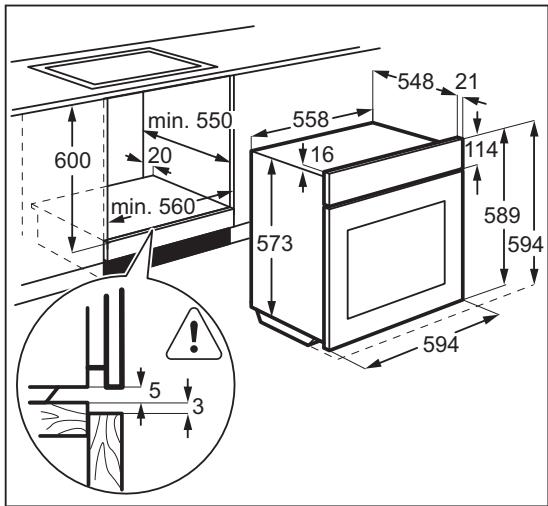
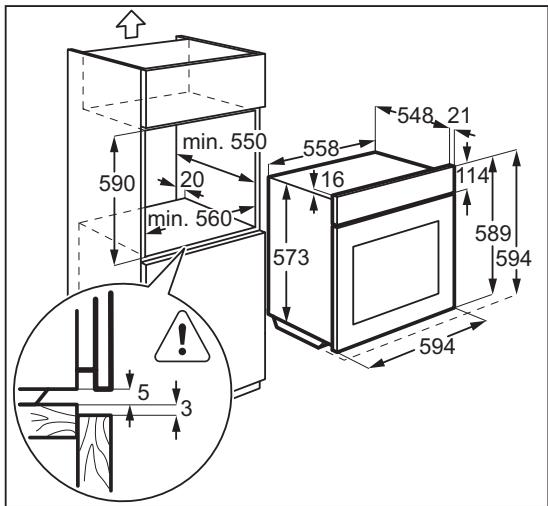
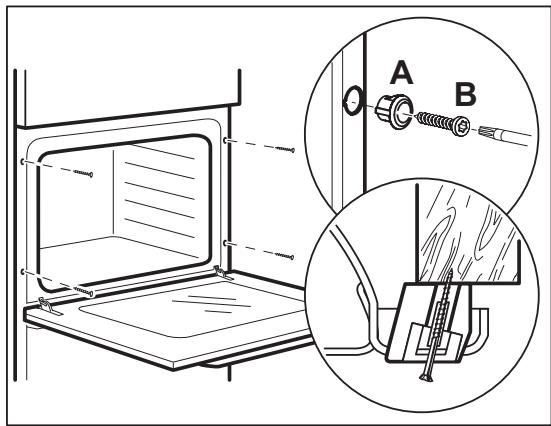
11.2 Fixation de l'appareil au meuble
12. INFORMATIONS TECHNIQUES
12.1 Données techniques
| Voltage | 230 V |
11.3 Installation électrique

Le fabricant n'est pas responsable si vous ne respectez pas les précautions de sécurité des chapitres consacrés à la sécurité.
Cet appareil est fourni avec une fiche secteur et un câble d'alimentation.
11.4 Câble
Types de câbles applicables pour l'installation ou le remplacement :
H07 RN-F, H05 RN-F, H05 RRF, H05 W-F, H05 V2V2-F (T90), H05 BB-F
Pour la section du câble, reportez-vous à la puissance totale indiquée sur la plaque signalétique et au tableau :
| Total power (W) | Section of the cable (mm2) |
| maximum 1380 | 3 x 0.75 |
| maximum 2300 | 3 x 1 |
| maximum 3680 | 3 x 1.5 |
Le fil de terre (câble vert/jaune) doit être plus long de 2 cm que les fils de phase et de neutre (câbles bleu et marron).
Fréquence
50 Hz
13. EFFICACITÉ ÉNERGÉTIQUE
13.1 Fiche produit et informations selon le règlement UE 65-66/2014
| Supplier's name | Electrolux |
| Model identification | EOB3400BOR |
| Energy Efficiency Index | 100.0 |
| Energy efficiency class | A |
| Energy consumption with a standard load, conventional mode | 0.93 kWh/cycle |
| Energy consumption with a standard load, fan-forced mode | 0.85 kWh/cycle |
| Number of cavities | 1 |
| Heat source | Electricity |
| Volume | 72 l |
| Type of oven | Built-In Oven |
| Mass | 32.8 kg |
EN 60350-1 - Appareils électroménagers de cuisson électriques - Partie 1 : Cuisinières, fours, fours à vapeur et grils - Méthodes de mesure des performances.
13.2 Économie d'énergie
L'appareil comporte des fonctions qui vous aident à économiser de l'énergie lors de la cuisson quotidienne.
Conseils généraux
- Assurez-vous que la porte du four est bien fermée lorsque l'appareil fonctionne et maintenez-la fermée autant que possible pendant la cuisson.
- Utilisez des plats en métal pour améliorer les économies d'énergie.
- Dans la mesure du possible, placez les aliments dans le four sans le préchauffer.
- Lorsque la durée de cuisson dépasse 30 minutes, réduisez la température du four au minimum, 3 à 10 minutes avant la fin de la cuisson, selon la durée de cuisson. La chaleur résiduelle à l'intérieur du four continuera la cuisson.
- Utilisez la chaleur résiduelle pour réchauffer d'autres aliments.
- Cuisson avec ventilateur - lorsque c'est possible, utilisez les fonctions de cuisson avec ventilateur pour économiser de l'énergie.
- Garder les aliments au chaud - si vous souhaitez utiliser la chaleur résiduelle pour garder le repas au chaud, choisissez le réglage de température le plus bas possible.
14. PRÉOCCUPATIONS ENVIRONNEMENTALES
Recyclez les matériaux portant le symbole . Déposez les emballages dans les conteneurs appropriés
pour les recycler. Aidez à protéger l'environnement et la santé humaine et à recycler les déchets de
Appareils électriques et électroniques. Ne jetez pas les appareils marqués du symbole avec les déchets ménagers.
Retournez le produit à votre installation de recyclage locale ou contactez votre mairie.
INDICE
- INFORMATIONS DE SÉCURITÉ 26
- CONSIGNES DE SÉCURITÉ 27
- DESCRIPTION DU PRODUIT 30
- PRÉPARATION AVANT LA PREMIÈRE UTILISATION 30
- UTILISATION QUOTIDIENNE 31
- FONCTIONS DE LA MINUTERIE 32
- FONCTIONS SUPPLÉMENTAIRES 33
- CONSEILS ET SUGGESTIONS UTILES 34 9. NETTOYAGE ET ENTRETIEN 42
- RÉSOLUTION DES PROBLÈMES 45
- INSTALLATION 46
- DONNÉES TECHNIQUES 47
- EFFICACITÉ ÉNERGÉTIQUE 47
CONÇUS POUR VOUS
Merci d'avoir acheté un appareil Electrolux. Vous avez choisi un produit qui bénéficie de décennies d'expérience professionnelle et d'innovation. Ingénieux et élégant, il a été conçu en pensant à vous. Ainsi, à chaque fois que vous l'utiliserez, vous pouvez être certain d'obtenir toujours les meilleurs résultats.
Bienvenue chez Electrolux.
Visitez notre site web pour :

Recevoir des conseils, télécharger nos brochures, résoudre d'éventuels problèmes, obtenir des informations sur l'assistance :
www.electrolux.com

Enregistrer votre produit et bénéficier d'un meilleur service :
www.registerelectrolux.com

Acheter des accessoires, des consommables et des pièces détachées d'origine pour votre appareil :
www.electrolux.com/shop
SERVICE CLIENTÈLE ET MAINTENANCE
Nous recommandons toujours l'utilisation de pièces détachées d'origine.
Lorsque vous contactez le centre d'assistance, assurez-vous de disposer des informations suivantes :
Modèle, PNC, numéro de série.
Ces informations se trouvent sur la plaque signalétique.

Avertissement/Attention - Informations importantes pour la sécurité

Informations et conseils généraux

Informations sur l'environnement
Sous réserve de modifications.
1. INFORMATIONS DE SÉCURITÉ
Lire attentivement les instructions fournies avant d'installer et d'utiliser l'appareil. Le fabricant n'est pas responsable si une installation et une utilisation incorrectes de l'appareil provoquent des blessures et des dommages. Garder toujours les instructions à portée de main pour référence future.
1.1 Sécurité des enfants et des personnes vulnérables
- Cet appareil peut être utilisé par des enfants à partir de 8 ans et par des adultes ayant des capacités physiques, sensorielles ou mentales limitées ou manquant d'expérience ou de connaissances sur l'utilisation de l'appareil, uniquement s'ils sont surveillés ou s'ils ont reçu des instructions concernant l'utilisation de l'appareil et s'ils ont compris les risques encourus. Ne pas laisser les enfants jouer avec l'appareil.
- Tenir les matériaux d'emballage hors de portée des enfants.
- Tenir les enfants et les animaux domestiques éloignés de l'appareil pendant son fonctionnement ou son refroidissement. Les parties accessibles sont incandescentes.
- Si l'appareil dispose d'un dispositif de sécurité pour enfants, nous recommandons de l'activer.
- Le nettoyage et les opérations de maintenance ne doivent pas être effectués par des enfants sans surveillance.
- Tenir les enfants de moins de 3 ans à l'écart, sauf s'ils sont constamment surveillés.
1.2 Avertissements de sécurité généraux
- L'installation de l'appareil et le remplacement des câbles doivent être effectués uniquement par du personnel qualifié.
- À l'intérieur, l'appareil chauffe lorsqu'il est en fonctionnement. Ne pas toucher les résistances de l'appareil. Utiliser toujours les gants
thermiques appropriés pour retirer ou insérer des accessoires ou des plats résistants à la chaleur.
- Avant d'effectuer toute opération de maintenance, débrancher l'appareil du réseau électrique.
- S'assurer que l'appareil est éteint avant de remplacer l'ampoule pour éviter tout risque de choc électrique.
- Ne pas utiliser de nettoyeur vapeur pour nettoyer l'appareil.
- Ne pas utiliser de détergents abrasifs ni de grattoirs métalliques pour nettoyer la vitre de la porte afin de ne pas rayer la surface et provoquer la rupture du verre.
- Si le câble d'alimentation est endommagé, il doit être remplacé par le fabricant, un technicien agréé ou une personne qualifiée afin d'éviter tout danger.
- Pour retirer les supports de grille, retirer d'abord la partie avant du support, puis la partie arrière, des parois latérales. Installer les supports de grille en suivant la procédure inverse.
2. INSTRUCTIONS DE SÉCURITÉ
2.1 Installation

ATTENTION !
L'installation de l'appareil doit être effectuée par du personnel qualifié.
- Retirer tous les matériaux d'emballage. Ne pas installer ni utiliser l'appareil s'il est endommagé.
- Respecter les instructions fournies avec l'appareil.
- Faire toujours attention lors du déplacement de l'appareil, car il est très lourd. Porter toujours des gants de sécurité. Ne pas tirer l'appareil par la poignée.
- Il est nécessaire de respecter la distance minimale par rapport aux autres appareils.
- S'assurer que l'appareil est installé à proximité de pièces
correctement mises à la terre et sur une structure fixe.
- Les côtés de l'appareil doivent rester adjacents à des appareils ou unités de même hauteur.
2.2 Raccordement électrique

ATTENTION !
Risque d'incendie et de choc électrique.
- Tous les raccordements électriques doivent être réalisés par un électricien qualifié.
- L'appareil doit être mis à la terre.
- Vérifier que les données électriques indiquées sur la plaque signalétique correspondent à celles de l'installation. Dans le cas contraire, contacter un électricien. Utiliser toujours une prise électrique avec contact de protection correctement installée.
Ne pas utiliser de prises multiples ni de rallonges. - S'assurer de ne pas endommager la fiche et le câble. Si le câble électrique doit être remplacé, l'intervention doit être effectuée par notre centre de service agréé. - Éviter que les câbles entrent en contact ou se trouvent à proximité de la porte de l'appareil, en particulier lorsque la porte est chaude. - Les dispositifs de protection contre les chocs électriques doivent être fixés de manière à ne pas pouvoir être désactivés sans l'utilisation d'outils. - Insérer la fiche d'alimentation dans la prise uniquement à la fin de l'installation. Vérifier que la fiche d'alimentation reste accessible après l'installation. - Si la fiche d'alimentation est desserrée, ne pas la brancher sur la prise. - Ne pas tirer sur le câble d'alimentation pour débrancher l'appareil. Toujours tirer sur la fiche. - Utiliser uniquement des dispositifs d'isolement appropriés : disjoncteurs, fusibles (les fusibles à visser doivent être retirés du porte-fusible), disjoncteurs différentiels et relais. - L'installation électrique doit être équipée d'un dispositif d'isolement permettant de débrancher l'appareil de la prise de courant sur tous les pôles. Le dispositif d'isolement doit avoir une ouverture de contact d'au moins 3 mm. - Cet appareil est conforme aux directives CEE.
2.3 Utilisation

ATTENTION !
Risque de blessures, de brûlures, de choc électrique ou d'explosion.
Utiliser l'appareil exclusivement dans un environnement domestique. Ne pas modifier les spécifications de cet appareil. - S'assurer que les fentes de ventilation ne sont pas obstruées.
Ne laissez jamais l'appareil sans surveillance pendant son fonctionnement. - Éteignez l'appareil après utilisation. - Soyez prudent lors de l'ouverture de la porte de l'appareil lorsqu'il est en fonctionnement. De l'air chaud peut s'en échapper. Ne mettez pas l'appareil en marche avec les mains humides ou lorsqu'il y a un contact avec l'eau. N'exercez pas de pression sur la porte ouverte. N'utilisez pas l'appareil comme surface de travail ou comme plan d'appui. - Ouvrez la porte de l'appareil avec précaution. L'utilisation d'ingrédients contenant de l'alcool peut provoquer un mélange d'alcool et d'air. - Évitez la présence d'étincelles ou de flammes nues à proximité de l'appareil lorsque vous ouvrez la porte. - Ne posez pas et ne conservez pas de liquides ou de matériaux inflammables, ni d'objets facilement inflammables sur l'appareil, à l'intérieur de celui-ci ou à proximité immédiate.

ATTENTION !
Il y a un risque d'endommager l'appareil.
- Pour éviter d'endommager ou de décolorer l'émail :
Ne placez pas de plats résistants à la chaleur ou d'autres objets directement sur la surface inférieure de l'appareil. Ne posez pas de film d'aluminium directement sur la surface inférieure de l'appareil. Ne versez pas d'eau directement à l'intérieur de l'appareil chaud. Ne laissez pas de plats humides et d'aliments à l'intérieur de l'appareil après la fin de la cuisson. - Soyez prudent lors du retrait ou de l'insertion des accessoires.
- La décoloration de l'émail n'affecte pas les performances de l'appareil. Il ne s'agit pas d'une anomalie au sens de la loi.
- Pour les viandes très humides, utilisez une lèchefrite. Les jus de fruits provoquent des taches qui peuvent être permanentes.
- L'appareil est destiné uniquement à la cuisson. Il ne doit pas être utilisé à d'autres fins, par exemple pour chauffer une pièce.
- La cuisson doit toujours être effectuée avec la porte du four fermée.
2.4 Nettoyage et entretien

ATTENTION !
Il y a un risque de blessure, d'incendie ou de dommage à l'appareil.
- Avant d'effectuer toute opération de maintenance, éteignez l'appareil et débranchez la fiche de la prise.
- Vérifier que l'appareil est froid. Il y a un risque que les panneaux en verre se brisent.
- Remplacer immédiatement les panneaux en verre de la porte s'ils sont endommagés. Contacter le Centre d'assistance.
- Faire attention lors du retrait de la porte de l'appareil. La porte est lourde !
- Nettoyer régulièrement l'appareil pour éviter la détérioration des matériaux qui composent la surface.
- Les résidus de graisse ou d'aliments dans l'appareil peuvent provoquer un incendie.
- Nettoyer l'appareil avec un chiffon humide et doux. Utiliser uniquement des détergents neutres. Ne pas utiliser de produits abrasifs, d'éponges abrasives, de solvants ou d'objets métalliques.
- Si vous utilisez un spray pour le four, suivre attentivement les instructions de sécurité sur l'emballage. Ne pas nettoyer l'émail catalytique (si présent) avec un détergent quelconque.
2.5 Éclairage intérieur
- Les ampoules utilisées dans cet appareil sont des lampes spéciales pour électroménagers. Ne pas les utiliser pour l'éclairage de la maison.

ATTENTION !
Risque de choc électrique.
- Avant de remplacer l'ampoule, débrancher l'appareil du réseau électrique. Utiliser uniquement des ampoules ayant les mêmes spécifications techniques.
2.6 Élimination

ATTENTION !
Risque de blessures ou d'étouffement.
- Débrancher la fiche de l'alimentation électrique.
- Couper le câble d'alimentation et le jeter.
- Retirer le blocage de la porte pour éviter que les enfants et les animaux domestiques restent enfermés à l'intérieur de l'appareil.
3. DESCRIPTION DU PRODUIT
3.1 Vue d'ensemble
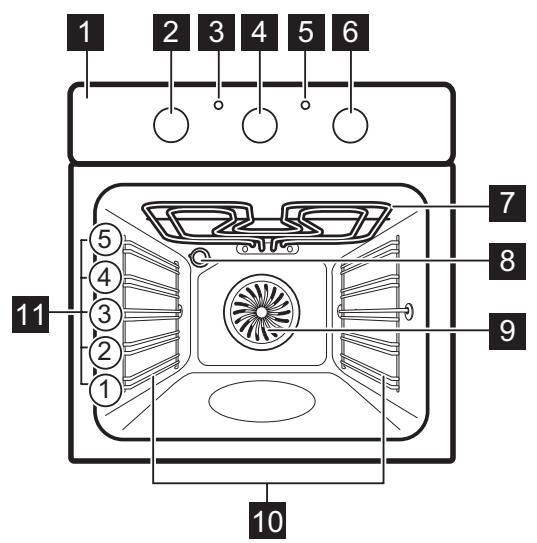
3.2 Accessoires
Grille
Pour casseroles, plats en inox, rôtis. Plaque à pâtisserie
1 Panneau de commande 2 Bouton des fonctions du four 3 Voyant de mise sous tension/symbole/indicateur 4 Minuteur analogique 5 Voyant/symbole/indicateur de température 6 Bouton de température 7 Résistance 8 Ampoule 9 Ventilateur Support de grille, démontable 11 Positions des grilles
Pour la cuisson de gâteaux et de biscuits.
Lèchefrite
Pour cuire au four, rôtir ou comme récipient pour recueillir les graisses.
4. PRÉPARATION AVANT LA PREMIÈRE UTILISATION

ATTENTION !
Se référer aux chapitres sur la sécurité.
4.1 Premier nettoyage
Retirer les accessoires et les supports de grille amovibles de l'appareil.

Se référer au chapitre « Nettoyage et entretien ».
Nettoyer l'appareil avant de l'utiliser pour la première fois.
Remettre les accessoires et les supports de grille amovibles dans leur position initiale.
4.2 Préchauffage
Préchauffer l'appareil vide pour brûler les résidus de graisse.
- Régler la fonction et la température maximale.
- Laisser l'appareil fonctionner pendant une heure.
- Régler la fonction et la température maximale.
- Laisser l'appareil fonctionner pendant 15 minutes.
- Régler la fonction et la température maximale.
- Laisser l'appareil fonctionner pendant 15 minutes.
Les accessoires peuvent chauffer plus que d'habitude. Le four peut produire une odeur désagréable et de la fumée. Ce n'est pas une anomalie. Assurez-vous que la circulation d'air dans la pièce est suffisante.
5. UTILISATION QUOTIDIENNE

ATTENTION !
Reportez-vous aux chapitres sur la sécurité.
four et de la température sur la position d'arrêt.
5.1 Activation et désactivation de l'appareil

La présence de symboles sur les boutons, voyants ou indicateurs dépend du modèle de l'appareil :
L'indicateur s'allume lors du chauffage du four. - Le voyant s'allume lorsque l'appareil se met en marche. Le symbole indique si le bouton contrôle les fonctions du four ou la température.
- Tournez le bouton des fonctions du four pour sélectionner une fonction du four.
- Tournez le bouton de la température pour sélectionner une température.
- Pour désactiver l'appareil, tournez les boutons des fonctions du
5.2 Fonctions du four
| Funzione forno | Applicazione | |
| 0 | Posizione di spegnimento | L'apparecchiatura è spenta. |
| Luce forno | Per accendere la lampadina perché una funzione di cottura. | |
| Cottura tradizio- nale | Per cuocere e arrostire alimenti su una sola posizione della griglia. | |
| Rosolatura | Per dorare pane, torte e dolci. Per completare la cot- tura degli alimenti. | |
| Cottura finale | Per cuocere torte dal fondo croccante e conservare gli alimenti. | |
| Grill | Per grigliare cibi sottili e tostare il pane. | |
| Grill rapido | Per cuocere al grill cibi di ridotto spessore in grande quantità e per tostare il pane. | |
| Doppio grill ven-tilato | Per arrostire grandi tagli di carne o pollame su una sola posizione della griglia. Anche per gratinare e dor-are. | |
| Cottura ventilata/Scongelamento | Per cucinare su un massimo di 3 positizioni della griglia contemporaneamente e per essiccare gli alimenti.Im-postare la temperatura di 20 - 40°C in meno rispetto alla Cottura tradizionale.Per scongelare degli alimenti congelati. | |
| Cottura pizza | Per cuocere gli alimenti su una posizione della griglia e ottenere una cottura più intensa e un fondo cro-cante. Impostare la temperatura di 20 - 40°C in meno rispetto alla Cottura tradizionale. | |
6. FONCTIONS DE LA MINUTERIE
6.1 Minuterie analogique
La minuterie a ces fonctions :
- Réglage de la minuterie - Fin de cuisson.
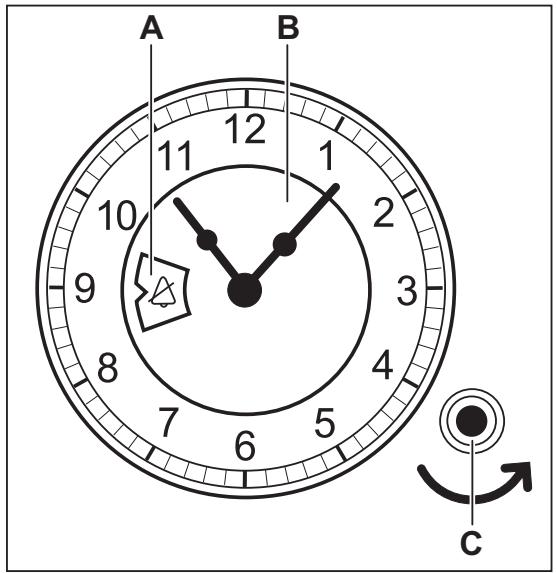
A) Afficheur B) Sélecteur C) Bouton de réglage
Réglage de l'heure
Pour régler l'heure du jour, appuyez et tournez le bouton de réglage dans le sens inverse des aiguilles d'une montre (dans le sens indiqué par la
flèche) jusqu'à ce que les aiguilles de l'horloge soient dans la bonne position. Ne tournez pas le bouton de réglage dans le sens des aiguilles d'une montre.
Après avoir réglé l'heure, laissez le bouton de réglage revenir à sa position initiale ou tirez-le doucement en arrière.
Réglage normal
Tournez le bouton de réglage dans le sens inverse des aiguilles d'une montre jusqu'à ce que le symbole apparaisse dans la fenêtre. Dans cette position, le four fonctionne manuellement. La fonction Minuterie + Fin de cuisson est désactivée.
Minuterie - Fin de cuisson
Pour régler une heure d'arrêt automatique d'une fonction du four. Le temps maximal réglable est de 180 minutes.

Utiliser uniquement pour les aliments qui ne nécessitent pas de mélange ou de surveillance pendant la cuisson.
Tournez le bouton de réglage dans le sens inverse des aiguilles d'une montre jusqu'à ce que le symbole Δ apparaisse dans la fenêtre. Dans cette position, aucun signal sonore n'est émis après la désactivation de l'appareil.
- Réglez une fonction du four et la température.
- Tournez le bouton de réglage dans le sens inverse des aiguilles d'une montre jusqu'à ce que
7. FONCTIONS SUPPLÉMENTAIRES
7.1 Ventilateur de refroidissement
Lorsque le four est en fonctionnement, le ventilateur de refroidissement s'active automatiquement pour maintenir les surfaces du four au frais. Après avoir éteint le four, le ventilateur de refroidissement continue de fonctionner jusqu'à ce que le four ait refroidi.
7.2 Thermostat de sécurité
Une utilisation inappropriée de l'appareil ou des composants
L'heure d'arrêt nécessaire (en minutes) s'affiche à l'écran. Le compte à rebours démarre. Une fois le temps réglé écoulé, un signal sonore est émis. L'appareil s'éteint.

Le signal sonore peut être désactivé. Tourner la manette de réglage dans le sens inverse des aiguilles d'une montre jusqu'à ce que Δ s'affiche dans la fenêtre. Dans cette position, aucun signal sonore n'est émis après l'arrêt de l'appareil.
Pour annuler la fonction Minuteur + Fin de cuisson, tourner la manette de réglage dans le sens inverse des aiguilles d'une montre jusqu'à ce que ne soit plus affiché à l'écran.
défectueux peuvent provoquer une surchauffe dangereuse. Pour éviter cela, le four est équipé d'un thermostat de sécurité qui coupe l'alimentation électrique. Lorsque la température baisse, le four se rallume automatiquement.
8. CONSEILS ET SUGGESTIONS UTILES

ATTENTION !
Se référer aux chapitres sur la sécurité.

La température et les temps de cuisson indiqués dans les tableaux sont des valeurs indicatives.
Ils peuvent varier en fonction des recettes, de la qualité et de la quantité des ingrédients utilisés.
8.1 Informations générales
- L'appareil comporte cinq positions de grille. Compter les positions de grille à partir du bas de l'appareil.
- L'apparecchio è dotato di un sistema speciale che fa circolare l'aria e ricerca costantemente il vapore. Con questo sistema è possibile cucinare in un ambiente pieno di vapore, mantenendo il cibo soffice all'interno e croccante all'esterno. Si riduce il tempo di cottura e si abbatte il consumo di energia.
- L'umidità può condensarsi all'interno dell'apparecchio o sui pannelli in vetro della porta. Non si tratta di un'anomalia. Quando si apre la porta durante la cottura, tenersi sempre a distanza dall'apparecchio. Per ridurre la condensa, prima della cottura accendere l'apparecchio per 10 minuti.
- Quando si è terminato di usare l'apparecchio, eliminare l'umidità. Non posizionare oggetti direttamente sul ripiano dell'apparecchio e non
ricoprire i componenti con pellicola d'alluminio durante la cottura. Così facendo si possono alterare i risultati di cottura e danneggiare lo smalto.
8.2 Cottura di dolci
Non aprire la porta del forno prima che siano trascorsi 3/4 del tempo di cottura. - Se si usano due piastre da forno contemporaneamente, tenere un livello vuoto tra una e l'altra.
8.3 Cottura di carni e pesce
- Usare una leccarda per alimenti ad alto contenuto di grassi, onde evitare che nel forno si formino macchie che non possono più essere rimosse.
- Lasciare riposare la carne per circa 15 minuti prima di tagliarla, in modo da non perdere il sugo.
- Per evitare la formazione di fumo eccessivo nel forno durante la cottura arrosto, aggiungere dell'acqua nella leccarda. Per evitare la condensa di fumo, aggiungere acqua ogni volta che finisce.
8.4 Tempi di cottura
I tempi di cottura dipendono dal tipo, dalla consistenza e dal volume del cibo.
Inizialmente, monitorare i risultati della cottura. Trovare le impostazioni migliori (livello di potenza, tempo di cottura, ecc.) per le proprie pentole, ricette e quantità quando si usa il forno.
8.5 Tabella per la cottura al forno ed arrosto
Torte
| Alimenti | Cottura tradizionale | Cottura ventilata | Tempo (min.) | Commenti | ||
| Tempera-tura (°C) | Posizione della gri-glia | Tempera-tura (°C) | Posizione della gri-glia | |||
| Pietanze frullate | 170 | 2 | 160 | 3 (2 e 4) | 45 - 60 | In uno stampo per dolci |
| Impasto per pasta frolla | 170 | 2 | 160 | 3 (2 e 4) | 20 - 30 | In uno stampo per dolci |
| Torta di ricotta | 170 | 1 | 165 | 2 | 60 - 80 | In uno stampo per dolci da 26 cm |
| Torta di mele1) | 170 | 2 | 160 | 2 (sinistra e destra) | 80 - 100 | In due stampi per dolci da 20 cm su un ripiano a fi-lo |
| Strudel | 175 | 3 | 150 | 2 | 60 - 80 | In una lam-iera dolci |
| Crostata | 170 | 2 | 165 | 2 (sinistra e destra) | 30 - 40 | In uno stampo per dolci da 26 cm |
| Torta con livvito in polvere | 170 | 2 | 160 | 2 | 50 - 60 | In uno stampo per dolci da 26 cm |
| Dolce di Natale/Torta di frutta farci-ta1) | 160 | 2 | 150 | 2 | 90 - 120 | In uno stampo per dolci da 20 cm |
| Plum cake1) | 175 | 1 | 160 | 2 | 50 - 60 | In uno stampo per il pane |
| Pasticcini - un livllo | 170 | 3 | 140 - 150 | 3 | 20 - 30 | In una lam-iera dolci |
| Pasticcini - due livelli | 140 - 150 | 2 e 4 | 25 - 35 | In una lam-iera dolci | ||
| Pasticcini - tre livelli | - | - | 140 - 150 | 1, 3 e 5 | 30 - 45 | In una lam-iera dolci |
| Biscotti/ strisce di pasta - un livello | 140 | 3 | 140 - 150 | 3 | 30 - 35 | In una lam-iera dolci |
| Biscotti/ strisce di pasta - due livelli | - | - | 140 - 150 | 2 e 4 | 35 - 40 | In una lam-iera dolci |
| Biscotti/ strisce di pasta - tre livelli | - | - | 140 - 150 | 1, 3 e 5 | 35 - 45 | In una lam-iera dolci |
| Meringhe - un livello | 120 | 3 | 120 | 3 | 80 - 100 | In una lam-iera dolci |
| Meringhe - due livelli1) | - | - | 120 | 2 e 4 | 80 - 100 | In una lam-iera dolci |
| Panini dol-ci1) | 190 | 3 | 190 | 3 | 12 - 20 | In una lam-iera dolci |
| Pasticcini - un livello | 190 | 3 | 170 | 3 | 25 - 35 | In una lam-iera dolci |
| Pasticcini - due livelli | - | - | 170 | 2 e 4 | 35 - 45 | In una lam-iera dolci |
| Crostatine | 180 | 2 | 170 | 2 | 45 - 70 | In uno stampo per dolci da 20 cm |
| Torta di frutta farci-ta | 160 | 1 | 150 | 2 | 110 - 120 | In uno stampo per dolci da 24 cm |
| Pan di Spagna | 170 | 1 | 160 | 2 (sinistra e destra) | 50 - 60 | In uno stampo per dolci da 20 cm |
1) Préchauffer le four pendant 10 minutes.
Pain et pizza
| Alimenti | Cottura tradizionale | Cottura ventilata | Tempo (min.) | Commen- ti | ||
| Tempera- tura (°C) | Posizione della gri- glia | Tempera- tura (°C) | Posizione della gri- glia | |||
| Pane bian- co1) | 190 | 1 | 190 | 1 | 60 - 70 | 1 - 2 pezzi, ciascuno da 500 g |
| Pane di segale | 190 | 1 | 180 | 1 | 30 - 45 | In uno stampo per il pane |
| Panini 1) | 190 | 2 | 180 | 2 (2 e 4) | 25 - 40 | 6 - 8 pani- ni in una lamiera dolci |
| Pizza1) | 230 - 250 | 1 | 230 - 250 | 1 | 10 - 20 | In una lamiera dolci o in una lec- carda |
| Scones1) | 200 | 3 | 190 | 3 | 10 - 20 | In una lamiera dolci |
1) Préchauffer le four pendant 10 minutes.
Flan
| Alimenti | Cottura tradizionale | Cottura ventilata | Tempo (min.) | Commen- ti | ||
| Tempera- tura (°C) | Posizione della gri- glia | Tempera- tura (°C) | Posizione della gri- glia | |||
| Flan di pasta | 200 | 2 | 180 | 2 | 40 - 50 | In uno stamo |
| Flan di ver- dure | 200 | 2 | 175 | 2 | 45 - 60 | In uno stamo |
| Quiche1) | 180 | 1 | 180 | 1 | 50 - 60 | In uno stamo |
| Lasagne1) | 180 - 190 | 2 | 180 - 190 | 2 | 25 - 40 | In uno stamo |
| Cannello- ni1) | 180 - 190 | 2 | 180 - 190 | 2 | 25 - 40 | In uno stamo |
1) Préchauffer le four pendant 10 minutes.
Viande
| Alimenti | Cottura tradizionale | Cottura ventilata | Tempo (min.) | Commen- ti | ||
| Tempera- tura (°C) | Posizione della gri- glia | Tempera- tura (°C) | Posizione della gri- glia | |||
| Manzo | 200 | 2 | 190 | 2 | 50 - 70 | Su un ri- piano a filo |
| Maiale | 180 | 2 | 180 | 2 | 90 - 120 | Su un ri- piano a filo |
| Vitello | 190 | 2 | 175 | 2 | 90 - 120 | Su un ri- piano a filo |
| Roastbeef inglese, al sangue | 210 | 2 | 200 | 2 | 50 - 60 | Su un ri- piano a filo |
| Roastbeef inglese, cott. me- dia | 210 | 2 | 200 | 2 | 60 - 70 | Su un ri- piano a filo |
| Roastbeef inglese, ben cotto | 210 | 2 | 200 | 2 | 70 - 75 | Su un ri- piano a filo |
| Spalla di maiale | 180 | 2 | 170 | 2 | 120 - 150 | Con cotica |
| Stinco di maiale | 180 | 2 | 160 | 2 | 100 - 120 | 2 pezzi |
| Agnello | 190 | 2 | 175 | 2 | 110 - 130 | Cosciotto |
| Pollo | 220 | 2 | 200 | 2 | 70 - 85 | Intero |
| Tacchino | 180 | 2 | 160 | 2 | 210 - 240 | Intero |
| Anatra | 175 | 2 | 220 | 2 | 120 - 150 | Intera |
| Oca | 175 | 2 | 160 | 1 | 150 - 200 | Intera |
| Coniglio | 190 | 2 | 175 | 2 | 60 - 80 | Tagliato a pezzi |
| Lepre | 190 | 2 | 175 | 2 | 150 - 200 | Tagliata a pezzi |
| Fagiano | 190 | 2 | 175 | 2 | 90 - 120 | Intero |
Poisson
| Alimenti | Cottura tradizionale | Cottura ventilata | Tempo (min.) | Commen- ti | ||
| Tempera- tura (°C) | Posizione della gri- glia | Tempera- tura (°C) | Posizione della gri- glia | |||
| Trota/ Orata | 190 | 2 | 175 | 2 | 40 - 55 | 3 - 4 pesci |
| Tonno/ Salmone | 190 | 2 | 175 | 2 | 35 - 60 | 4 - 6 filetti |
8.6 Gril

Préchauffer le four vide pendant 3 minutes avant la cuisson.
| Alimenti | Quantità | Tempera-tura (°C) | Tempo (min.) | Posizione della gri-glia | ||
| Parti | (g) | 1° lato | 2° lato | |||
| Bistecche di filetto | 4 | 800 | max. | 12 - 15 | 12 - 14 | 4 |
| Bistecche di manzo | 4 | 600 | max. | 10 - 12 | 6 - 8 | 4 |
| Salsicce | 8 | - | max. | 12 - 15 | 10 - 12 | 4 |
| Braciale di maiale | 4 | 600 | max. | 12 - 16 | 12 - 14 | 4 |
| Pollo (ta-gliato a metà) | 2 | 1000 | max. | 30 - 35 | 25 - 30 | 4 |
| Kebab | 4 | - | max. | 10 - 15 | 10 - 12 | 4 |
| Petto di pollo | 4 | 400 | max. | 12 - 15 | 12 - 14 | 4 |
| Hambur-ger | 6 | 600 | max. | 20 - 30 | - | 4 |
| Filetto di pesce | 4 | 400 | max. | 12 - 14 | 10 - 12 | 4 |
| Panini tos-tati | 4 - 6 | - | max. | 5 - 7 | - | 4 |
| Toast | 4 - 6 | - | max. | 2 - 4 | 2 - 3 | 4 |
8.7 Double gril ventilé
Bœuf
| Alimenti | Quantità | Temperatura (°C) | Tempo (min.) | Posizione della griglia |
| Roastbeef o filetto, peu cotto1) | per cm di spessore | 190 - 200 | 5 - 6 | 1 o 2 |
| Roastbeef o filetto, cott. media1) | per cm di spessore | 180 - 190 | 6 - 8 | 1 o 2 |
| Roastbeef o filetto, ben cotto1) | per cm di spessore | 170 - 180 | 8 - 10 | 1 o 2 |
1) Préchauffer le four.
Porc
| Alimenti | Quantità (kg) | Temperatura (°C) | Tempo (min.) | Posizione della griglia |
| Spalla, cotta, tadalafil di prosciutto per arrosto | 1 - 1.5 | 160 - 180 | 90 - 120 | 1 o 2 |
| Braciola, costoletta | 1 - 1.5 | 170 - 180 | 60 - 90 | 1 o 2 |
| Polpettone | 0.75 - 1 | 160 - 170 | 50 - 60 | 1 o 2 |
| Stinco di maiale (precotto) | 0.75 - 1 | 150 - 170 | 90 - 120 | 1 o 2 |
Veau
| Alimenti | Quantità (kg) | Temperatura (°C) | Tempo (min.) | Posizione del-la griglia |
| Arrostò di vitello | 1 | 160 - 180 | 90 - 120 | 1 o 2 |
| Stinco di Vitello | 1.5 - 2 | 160 - 180 | 120 - 150 | 1 o 2 |
Agneau
| Alimenti | Quantità (kg) | Temperatura (°C) | Tempo (min.) | Posizione del-la griglia |
| Cosciotto di ag- nello, arrosto di agnello | 1 - 1.5 | 150 - 170 | 100 - 120 | 1 o 2 |
| Sella d'agnello | 1 - 1.5 | 160 - 180 | 40 - 60 | 1 o 2 |
Pollane
| Alimenti | Quantità (kg) | Temperatura (°C) | Tempo (min.) | Posizione del-la griglia |
| Porzioni di pol-lame | 0,2 - 0,25 cias-cuna | 200 - 220 | 30 - 50 | 1 o 2 |
| Mezzo pollo | 0,4 - 0,5 cias-cuna | 190 - 210 | 35 - 50 | 1 o 2 |
| Pollo, pollastra | 1 - 1.5 | 190 - 210 | 50 - 70 | 1 o 2 |
| Anatra | 1.5 - 2 | 180 - 200 | 80 - 100 | 1 o 2 |
| Oca | 3.5 - 5 | 160 - 180 | 120 - 180 | 1 o 2 |
| Tacchino | 2.5 - 3.5 | 160 - 180 | 120 - 150 | 1 o 2 |
| Tacchino | 4 - 6 | 140 - 160 | 150 - 240 | 1 o 2 |
Pesce
| Alimenti | Quantità (kg) | Temperatura (°C) | Tempo (min.) | Posizione del-la griglia |
| Pesce intero fi-no ad 1 KG | 1 - 1.5 | 210 - 220 | 40 - 60 | 1 o 2 |
8.8 Décongélation
| Alimenti | Quantità (g) | Tempo di scongela-mentedo (min.) | Tempo di scon-gelamento ulte-riore (min.) | Commenti |
| Pollo | 1000 | 100 - 140 | 20 - 30 | Sistemare il pollo su un piattino rovesciato sopra un piatto grande. Girare a metà tempo. |
| Carne | 1000 | 100 - 140 | 20 - 30 | Girare a metà tempo. |
| Carne | 500 | 90 - 120 | 20 - 30 | Girare a metà tempo. |
| Trotta | 150 | 25 - 35 | 10 - 15 | - |
| Fragole | 300 | 30 - 40 | 10 - 20 | - |
| Burro | 250 | 30 - 40 | 10 - 15 | - |
| Panna | 2 x 200 | 80 - 100 | 10 - 15 | È possibile montare bene la pannaanche se ancora leggermente congelata. |
| Gateau | 1400 | 60 | 60 | - |
8.9 Séchage - Cuisson ventilée
- Recouvrir les plaques de papier huilé ou de papier sulfurisé.
- Pour obtenir de meilleurs résultats, éteindre le four à la moitié du temps conseillé, ouvrir la porte et laisser refroidir pendant une nuit pour terminer le séchage.
Légumes
| Alimenti | Temperatura (°C) | Tempo (ore) | Posizione della griglia | |
| 1 posizione | 2 positizioni | |||
| Fagioli | 60 - 70 | 6 - 8 | 3 | 1 / 4 |
| Peperoni | 60 - 70 | 5 - 6 | 3 | 1 / 4 |
| Verdure per minestrone | 60 - 70 | 5 - 6 | 3 | 1 / 4 |
| Funghi | 50 - 60 | 6 - 8 | 3 | 1 / 4 |
| Erbe | 40 - 50 | 2 - 3 | 3 | 1 / 4 |
Fruits
| Alimenti | Temperatura (°C) | Tempo (ore) | Posizione della griglia | |
| 1 posizione | 2 positizioni | |||
| Prugne | 60 - 70 | 8 - 10 | 3 | 1 / 4 |
| Albicocche | 60 - 70 | 8 - 10 | 3 | 1 / 4 |
| Fette di mela | 60 - 70 | 6 - 8 | 3 | 1 / 4 |
| Pere | 60 - 70 | 6 - 9 | 3 | 1 / 4 |
9. NETTOYAGE ET ENTRETIEN

ATTENTION !
Se référer aux chapitres sur la sécurité.
9.1 Remarques sur le nettoyage
- Nettoyer la partie avant de l'appareil avec un chiffon doux humidifié avec de l'eau tiède savonneuse.
- Pour nettoyer les surfaces métalliques, utilisez un détergent normal.
- Nettoyez l'intérieur de l'appareil après des années d'utilisation. De la graisse ou d'autres résidus alimentaires peuvent provoquer un incendie. Le risque est plus élevé pour la plaque de cuisson.
- Éliminez les saletés tenaces avec des détergents spéciaux pour four.
- Après utilisation, nettoyez les accessoires et laissez-les sécher soigneusement.
Utilisez un chiffon doux imbibé d'eau tiède savonneuse.
Ne nettoyez pas les accessoires antiadhésifs avec des détergents agressifs, des objets pointus ou au lave-vaisselle. Cela pourrait endommager le revêtement antiadhésif.
9.2 Appareils en acier inoxydable ou en aluminium

Nettoyez la porte du four exclusivement avec une éponge humide. Séchez-la avec un chiffon doux. Évitez d'utiliser de la laine d'acier, des acides ou des produits abrasifs, qui pourraient endommager la surface du four. Nettoyez le panneau de commandes du four en prenant les mêmes précautions.
9.3 Nettoyage du joint de porte
- Vérifiez régulièrement le joint de porte. Le joint de porte se trouve autour du cadre de la cavité du four. N'utilisez pas l'appareil si le joint de porte est endommagé. Contactez un centre de service agréé.
- Pour nettoyer le joint de porte, veuillez vous référer aux informations générales sur le nettoyage.
9.4 Retrait des supports de grille
Pour nettoyer le four, retirez les supports de grille.
- Tirez d'abord le guide d'extraction de la paroi latérale en le tirant vers l'avant.
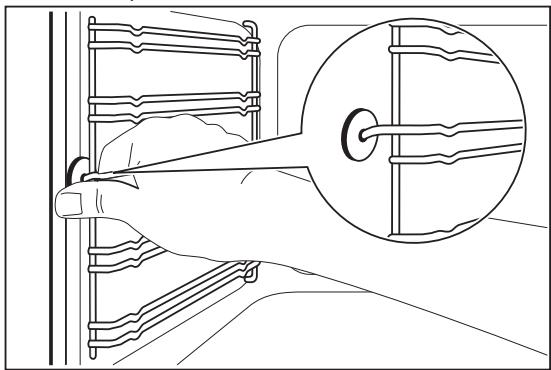
- Retirez la partie arrière du support de grille de la paroi latérale et enlevez-le.
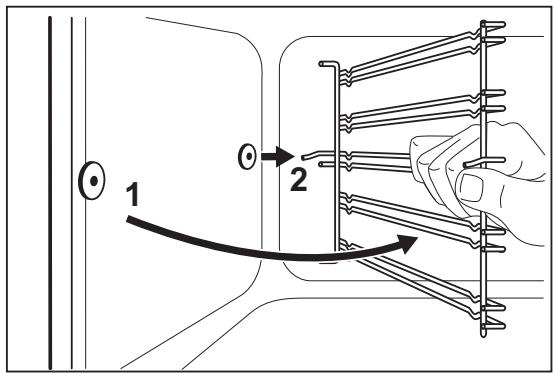
Installer les supports de grille en suivant la procédure indiquée en sens inverse.
9.5 Nettoyage de la porte du four
La porte du four est équipée de deux panneaux en verre. Il est possible de retirer la porte du four et le panneau en verre intérieur pour les nettoyer.

La porte du four pourrait se refermer si l'on tente de retirer les panneaux en verre intérieurs avant d'avoir retiré la porte du four.

AVERTISSEMENT !
Ne pas utiliser l'appareil sans le panneau en verre intérieur.
- Ouvrir complètement la porte et saisir les deux charnières.
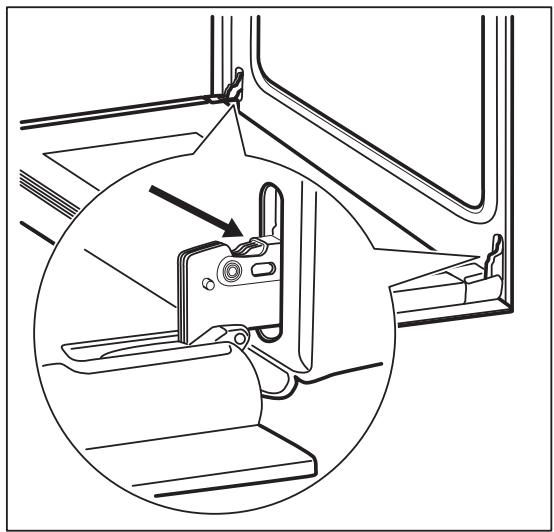
- Soulever et tourner les leviers situés sur les deux charnières.
- Fermer la porte du four jusqu'à la première position d'ouverture (environ à moitié). Tirer la porte vers l'avant, en la sortant de son logement.
- Poser la porte sur une surface stable et recouverte d'un chiffon doux.
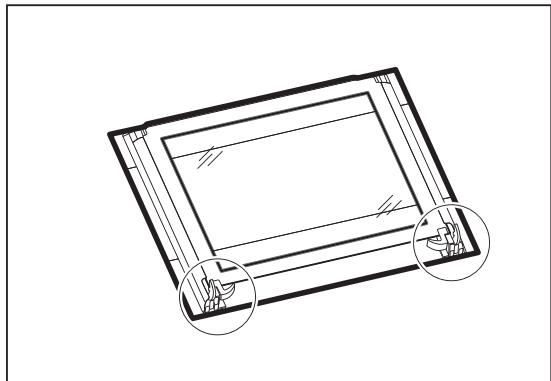
- Décrocher le système de verrouillage pour retirer le panneau en verre intérieur.
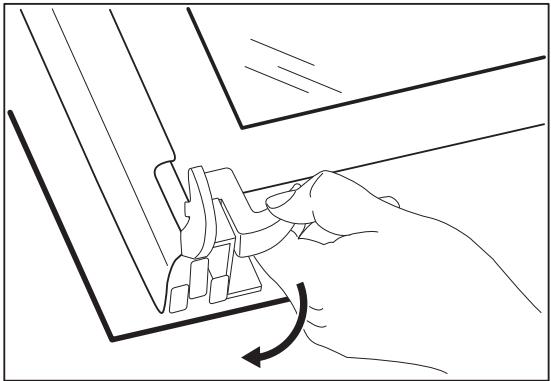
- Tourner les deux fermetures de 90° et les retirer de leurs logements.
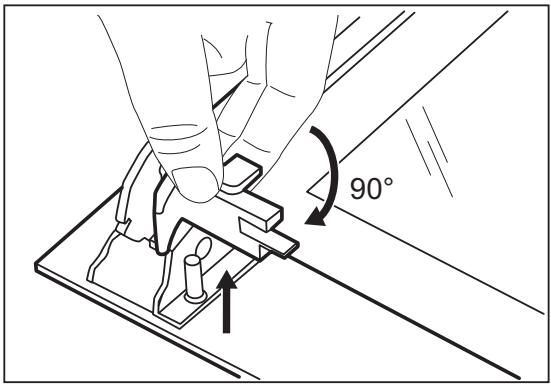
- Tout d'abord soulever avec précaution, puis retirer le panneau en verre.
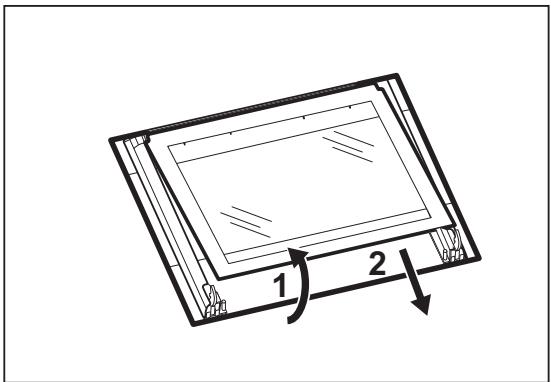
- Nettoyer le panneau en verre avec de l'eau savonneuse. Sécher le panneau en verre avec précaution. Après le nettoyage, remonter le panneau en verre et la porte du four. Exécuter la procédure illustrée précédemment, en suivant la séquence inverse.
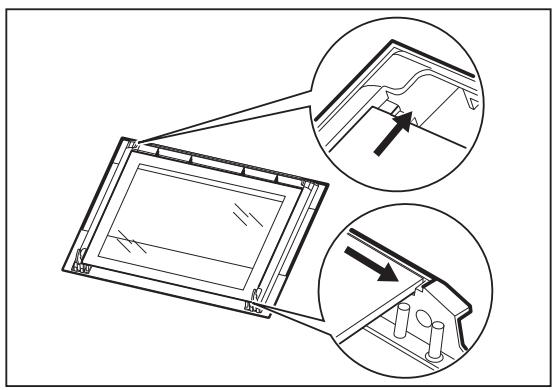
S'assurer que la sérigraphie se trouve sur le côté intérieur de la porte. Vérifier qu'après l'installation, la surface du cadre du panneau en verre, aux endroits des sérigraphies, ne soit pas rugueuse au toucher.
Assurez-vous d'installer le panneau intérieur en verre aux bons emplacements.
9.6 Remplacement de l'ampoule
Placez un chiffon sur la partie inférieure intérieure de l'appareil. Cela évite d'endommager le globe en verre de l'ampoule et la cavité.

ATTENTION !
Risque de choc électrique ! Débranchez le fusible avant de remplacer l'ampoule. L'ampoule et le globe en verre de l'ampoule peuvent être chauds.

AVERTISSEMENT !
Tenez toujours l'ampoule halogène avec un chiffon, pour éviter que des résidus de graisse ne brûlent dessus.
- Désactivez l'appareil.
- Retirez les fusibles du tableau électrique ou éteignez le disjoncteur principal.
L'ampoule arrière
- Tournez le globe en verre dans le sens inverse des aiguilles d'une montre pour le retirer.
- Nettoyez le revêtement en verre.
- Remplacez l'ampoule par une ampoule adaptée, résistante à la chaleur jusqu'à 300°C.
- Montez le globe en verre.
10. DÉPANNAGE

ATTENTION !
Se référer aux chapitres sur la sécurité.
10.1 Que faire si...
| Problema | Causa possibile | Soluzione |
| Il forno non si scalda. | Il forno è spento. | Accendere il forno. |
| Il forno non si scalda. | La funzione Contaminuti + Fine della cottura non è sta- ta impostata. | Impostare la funzione Con- taminuti + Fine della cot- tura. Fare riferimento al capitolo "Funzioni dell'oro- logio". |
| Il forno non si scalda. | È scattato il fusabile. | Verificare se l'anomalia di funzionamento sia dovuta al fusabile. Nel caso in cui il fu- sabile continui a scattare, rivolgersi ad un elettricista qualificato. |
| La lampadina non si ac- cende. | La lampadina è difettosa. | Sostituire la lampadina. |
| Problema | Causa possibile | Soluizione |
| Vapore e acqua di conden-sa si depositano sugli ali-menti e nella cavity del for-no. | Le pietanze sono state las-ciate nelorno troppo a lun-go. | Non lasciare le pietanze nel fornò per più di 15 - 20 minuti dal termine del proc-esso di cottura. |
10.2 Données d'assistance
Si vous ne parvenez pas à résoudre le problème, contactez le revendeur ou le centre de service agréé.
Les informations nécessaires pour le centre de service se trouvent sur la plaque signalétique des
données. La plaque se trouve sur le châssis avant de la cavité de l'appareil. Ne retirez pas la plaque signalétique de la cavité de l'appareil.
| Consigliamo di annotarli in questo spazio: | |
| Modello (MOD.) | ...... |
| Numero Prodotto (PNC) | ...... |
| Numero di serie (S.N.) | ...... |
11. INSTALLATION

ATTENTION !
Se référer aux chapitres sur la sécurité.
11.1 Encastrement
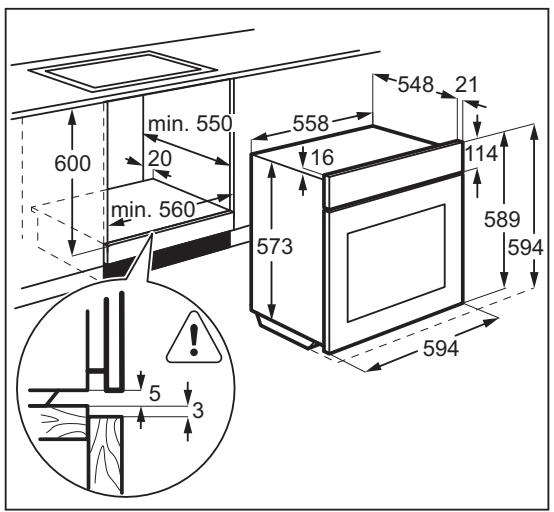
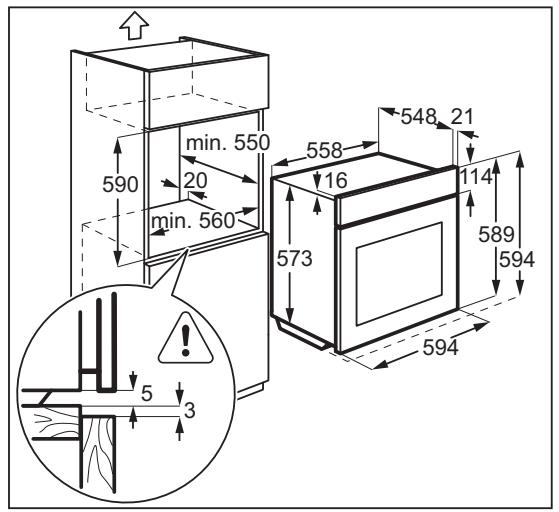
11.2 Fixation dans le meuble
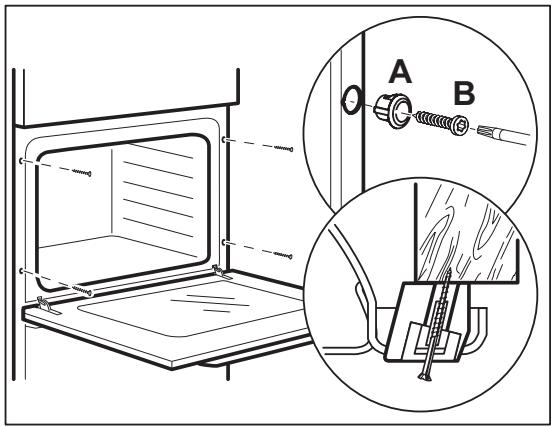
11.3 Installation de l'installation électrique

Le fabricant n'est pas responsable si les précautions du chapitre Informations pour la sécurité ne sont pas appliquées.
L'équipement standard de l'appareil au moment de la
La fourniture comprend une fiche et un câble d'alimentation.
11.4 Câble
Types de câbles disponibles pour l'installation ou le remplacement :
H07 RN-F, H05 RN-F, H05 RRF, H05 VVF, H05 V2V2-F (T90), H05 BB-F
Pour la section du câble, se référer à la puissance totale indiquée sur la plaque signalétique et au tableau :
| Potenza totale (W) | Sezione del cavo (mm2) |
| massimo 1.380 | 3 x 0,75 |
| massimo 2.300 | 3 x 1 |
| massimo 3.680 | 3 x 1,5 |
Le câble de terre (vert/jaune) doit être 2 cm plus long que les câbles de phase et de neutre (respectivement bleu et marron).
12. DONNÉES TECHNIQUES
12.1 Données techniques
| Tensione | 230 V |
| Frequenza | 50 Hz |
13. EFFICACITÉ ÉNERGÉTIQUE
13.1 Fiche produit et informations conformément à la réglementation UE 65-66/2014
| Nome fornitore | Electrolux |
| Identificativo modello | EOB3400BOR |
| Indice di efficienza energetica | 100.0 |
| Classe di efficienza energetica | A |
| Consumo di energia con un carico standard, in mo-dalità tradizione | 0.93 kWh/ciclo |
| Consumo di energia con un carico standard, in mo-dalità ventola forzata | 0.85 kWh/ciclo |
| Numero di cavity | 1 |
| Fonte di calore | Elettricità |
| Volume | 72 l |
| Tipodi forno | Forno a incasso |
| Massa | 32.8 kg |
EN 60350-1 - Appareils électriques de cuisson pour usage domestique - Partie 1 : Cuisinières, fours, fours à vapeur et grils - Méthodes de mesure des performances.
13.2 Économie d'énergie
L'appareil est doté de fonctions qui vous aident à économiser de l'énergie lors des opérations de cuisson quotidiennes.
- Conseils généraux
- Assurez-vous que la porte du four se ferme correctement lorsque l'appareil est en fonctionnement et maintenez-la fermée autant que possible pendant la cuisson.
- Utiliser des plats en métal pour améliorer les économies d'énergie.
- Si possible, disposer les aliments dans le four pour les réchauffer.
- Pour une cuisson de plus de 30 minutes, réduire la température du four au minimum pendant 3 à 10 minutes, selon le temps de cuisson. La chaleur résiduelle à l'intérieur du four poursuivra la cuisson.
- Utiliser la chaleur résiduelle pour réchauffer d'autres aliments.
- Cuisson avec ventilateur - si possible, utiliser les fonctions de cuisson avec ventilateur pour économiser de l'énergie.
- Maintien au chaud des aliments - Si vous souhaitez utiliser la chaleur résiduelle pour maintenir un plat au chaud, choisissez le réglage de température le plus bas possible.
14. CONSIDÉRATIONS SUR L'ENVIRONNEMENT
Recycler les matériaux portant le symbole. Jeter l'emballage dans les conteneurs prévus à cet effet pour le recyclage. Aider à protéger l'environnement et la santé humaine, et à recycler les déchets provenant d'appareils électriques et électroniques.
Ne pas jeter les appareils portant le symbole avec les déchets ménagers ordinaires. Apporter le produit au point de recyclage le plus proche ou contacter la mairie de votre résidence.
- SOMMAIRE
- NOUS PENSONS À VOUS
- SERVICE CLIENTÈLE ET ASSISTANCE
- CONSIGNES DE SÉCURITÉ
- SÉCURITÉ DES ENFANTS ET DES PERSONNES VULNÉRABLES
- SÉCURITÉ GÉNÉRALE
- INSTALLATION
- AVERTISSEMENT
- CONNEXION ÉLECTRIQUE
- UTILISATION
- ENTRETIEN ET NETTOYAGE
- ÉCLAIRAGE INTÉRIEUR
- MISE AU REBUT
- DESCRIPTION DU PRODUIT
- VUE D'ENSEMBLE
- ACCESSOIRES
- AVANT LA PREMIÈRE UTILISATION
- NETTOYAGE INITIAL
- PRÉCHAUFFAGE
- UTILISATION QUOTIDIENNE
- ACTIVATION ET DÉSACTIVATION DE L'APPAREIL
- SELON LE MODÈLE, VOTRE APPAREIL PEUT COMPORTER DES SYMBOLES SUR LES BOUTONS, DES INDICATEURS OU DES VOYANTS
- FONCTIONS DU FOUR
- FONCTIONS DE L'HORLOGE
- MINUTEUR ANALOGIQUE
- RÉGLAGE DE L'HEURE
- MINUTEUR + FIN DE CUISSON
- FONCTIONS SUPPLÉMENTAIRES
- VENTILATEUR DE REFROIDISSEMENT
- CONSEILS ET ASTUCES
- THERMOSTAT DE SÉCURITÉ
- INFORMATIONS GÉNÉRALES
- CUISSON DES GÂTEAUX
- CUISSON DE LA VIANDE ET DU POISSON
- TEMPS DE CUISSON
- TABLEAU DE CUISSON ET DE RÔTISSAGE
- GRIL
- RÔTISSAGE PAR AIR PULSÉ
- DÉCONGÉLATION
- SÉCHAGE - CUISSON PAR CHALEUR TOURNANTE
- LÉGUMES
- FRUITS
- REMARQUES SUR LE NETTOYAGE
- APPAREILS EN ACIER INOXYDABLE OU EN ALUMINIUM
- NETTOYAGE DU JOINT DE PORTE
- RETRAIT DES SUPPORTS DE GRILLE
- NETTOYAGE DE LA PORTE DU FOUR
- ATTENTION
- DÉPANNAGE
- REMPLACEMENT DE LA LAMPE
- LA LAMPE ARRIÈRE
- QUE FAIRE SI
- DONNÉES DE SERVICE
- ENCASTREMENT
- FIXATION DE L'APPAREIL AU MEUBLE
- INFORMATIONS TECHNIQUES
- DONNÉES TECHNIQUES
- INSTALLATION ÉLECTRIQUE
- CÂBLE
- EFFICACITÉ ÉNERGÉTIQUE
- ÉCONOMIE D'ÉNERGIE
- CONSEILS GÉNÉRAUX
- PRÉOCCUPATIONS ENVIRONNEMENTALES
- INDICE
- CONÇUS POUR VOUS
- SERVICE CLIENTÈLE ET MAINTENANCE
- INFORMATIONS DE SÉCURITÉ
- INSTRUCTIONS DE SÉCURITÉ
- RACCORDEMENT ÉLECTRIQUE
- NETTOYAGE ET ENTRETIEN
- ÉLIMINATION
- PRÉPARATION AVANT LA PREMIÈRE UTILISATION
- PREMIER NETTOYAGE
- LA PRÉSENCE DE SYMBOLES SUR LES BOUTONS, VOYANTS OU INDICATEURS DÉPEND DU MODÈLE DE L'APPAREIL
- FONCTIONS DE LA MINUTERIE
- MINUTERIE ANALOGIQUE
- MINUTERIE - FIN DE CUISSON
- CONSEILS ET SUGGESTIONS UTILES
- COTTURA DI DOLCI
- COTTURA DI CARNI E PESCE
- TEMPI DI COTTURA
- TABELLA PER LA COTTURA AL FORNO ED ARROSTO
- DOUBLE GRIL VENTILÉ
- SÉCHAGE - CUISSON VENTILÉE
- REMPLACEMENT DE L'AMPOULE
- L'AMPOULE ARRIÈRE
- DONNÉES D'ASSISTANCE
- FIXATION DANS LE MEUBLE
- INSTALLATION DE L'INSTALLATION ÉLECTRIQUE
- FICHE PRODUIT ET INFORMATIONS CONFORMÉMENT À LA RÉGLEMENTATION UE
- CONSIDÉRATIONS SUR L'ENVIRONNEMENT
Marque : ELECTROLUX
Modèle : EOB3400BOR
Catégorie : Four encastrable