
UA-4FX - Interface audio EDIROL - Notice d'utilisation et mode d'emploi gratuit
Retrouvez gratuitement la notice de l'appareil UA-4FX EDIROL au format PDF.



| Type de produit | Interface audio USB |
| Marque | EDIROL (Roland) |
| Modèle | UA-4FX |
| Convertisseur audio | 24 bits, fréquences d'échantillonnage 44,1/48/96 kHz |
| Entrées analogiques | Jack combo (micro/guitare) avec sélecteur, entrée ligne stéréo (RCA) |
| Sorties analogiques | Sortie ligne stéréo (RCA), sortie casque (jack 6,35 mm) |
| Entrée numérique | Optique (TOSLINK) jusqu'à 96 kHz |
| Sortie numérique | Optique (TOSLINK) jusqu'à 96 kHz, compatible 5.1 canaux |
| Alimentation | Bus USB (alimentation par le port USB de l'ordinateur) |
| Dimensions (approx.) | 200 x 150 x 50 mm |
| Poids (approx.) | 0,5 kg |
| Effets intégrés | Simulateur de lampe, mastering, écoute (avec annulation de la voix centrale), performance (voix FX, distorsion, chorus, delay) |
| Alimentation fantôme | Oui, 48 V DC, 5 mA max |
| Fonctionnalités supplémentaires | Boucle de retour (loop-back) pour enregistrement audio PC, modes avancé et standard, indicateur de niveau entrée/sortie |
| Systèmes d'exploitation compatibles | Windows (XP, etc.), Mac OS (9, X) |
| Entretien et nettoyage | Chiffon doux sec ou légèrement humide ; éviter solvants, alcool, benzène |
| Sécurité | Ne pas ouvrir, ne pas exposer à l'humidité ou aux chocs, débrancher en cas d'anomalie |
| Réparabilité | Confier à un centre agréé Roland ; ne pas tenter de réparation soi-même |
| Informations générales | Notice en français disponible en PDF ; compatibilité SCMS pour copie numérique |
FOIRE AUX QUESTIONS - UA-4FX EDIROL
Questions des utilisateurs sur UA-4FX EDIROL
0 question sur cet appareil. Repondez a celles que vous connaissez ou posez la votre.
Poser une nouvelle question sur cet appareil
Téléchargez la notice de votre Interface audio au format PDF gratuitement ! Retrouvez votre notice UA-4FX - EDIROL et reprennez votre appareil électronique en main. Sur cette page sont publiés tous les documents nécessaires à l'utilisation de votre appareil UA-4FX de la marque EDIROL.
MODE D'EMPLOI UA-4FX EDIROL
USB Audio Capture
24 bit 96 kHz
UA-4FX
Advanced operation
Before using this unit, carefully read the sections entitled: "USING THE UNIT SAFELY" and "IMPORTANT NOTES" (pp. 2-5). These sections provide important information concerning the proper operation of the unit. Additionally, in order to feel assured that you have gained a good grasp of every feature provided by your new unit, Owner's manual should be read in its entirety. The manual should be saved and kept on hand as a convenient reference.
USING THE UNIT SAFELY
INSTRUCTIONS FOR THE PREVENTION OF FIRE, ELECTRIC SHOCK, OR INJURY TO PERSONS
About WARNING and CAUTION Notices
| ▲WARNING | Used for instructions intended to alert the user to the risk of death or severe injury should the unit be used improperly. |
| ▲CAUTION | Used for instructions intended to alert the user to the risk of injury or material damage should the unit be used improperly. * Material damage refers to damage or other adverse effects caused with respect to the home and all its furnishings, as well to domestic animals or pets. |
About the Symbols
| A | The △symbol alerts the user to important instructions or warnings. The specific meaning of the symbol is determined by the design contained within the triangle. In the case of the symbol at left, it is used for general cautions, warnings, or alerts to danger. |
| ◎ | The ⊙symbol alerts the user to items that must never be carried out (are forbidden). The specific thing that must not be done is indicated by the design contained within the circle. In the case of the symbol at left, it means that the unit must never be disassembled. |
| ◆ | The ●symbol alerts the user to things that must be carried out. The specific thing that must be done is indicated by the design contained within the circle. In the case of the symbol at left, it means that the power-cord plug must be unplugged from the outlet. |
ALWAYS OBSERVE THE FOLLOWING
WARNING
- Before using this unit, make sure to read the instructions below, and the Owner's Manual.

- Do not open or perform any internal modifications on the unit.

- Do not attempt to repair the unit, or replace parts within it (except when this manual provides specific instructions directing you to do so). Refer all servicing to your retailer, the nearest Roland Service Center, or an authorized Roland distributor, as listed on the "Information" page.

- Never use or store the unit in places that are:

- Subject to temperature extremes (e.g., direct sunlight in an enclosed vehicle, near a heating duct, on top of heat-generating equipment); or are

- Damp (e.g., baths, washrooms, on wet floors); or are
- Humid; or are
- Exposed to rain; or are
- Dusty; or are
- Subject to high levels of vibration.
WARNING
- Make sure you always have the unit placed so it is level and sure to remain stable. Never place it on stands that could wobble, or on inclined surfaces.

- This unit, either alone or in combination with an amplifier and headphones or speakers, may be capable of producing sound levels that could cause permanent hearing loss. Do not operate for a long period of time at a high volume level, or at a level that is uncomfortable. If you experience any hearing loss or ringing in the ears, you should immediately stop using the unit, and consult an audiologist.

- Do not allow any objects (e.g., flammable material, coins, pins); or liquids of any kind (water, soft drinks, etc.) to penetrate the unit.


WARNING
-
Immediately turn the power off, and request servicing by your retailer, the nearest Roland Service Center, or an authorized Roland distributor, as listed on the "Information" page when:
-
If smoke or unusual odor occurs
- Objects have fallen into, or liquid has been spilled onto the unit; or
- The unit has been exposed to rain (or otherwise has become wet); or
-
The unit does not appear to operate normally or exhibits a marked change in performance.
-
In households with small children, an adult should provide supervision until the child is capable of following all the rules essential for the safe operation of the unit.

- Protect the unit from strong impact. (Do not drop it!)

- DO NOT play a CD-ROM disc on a conventional audio CD player. The resulting sound may be of a level that could cause permanent hearing loss. Damage to speakers or other system components may result.


CAUTION
- Try to prevent cords and cables from becoming entangled. Also, all cords and cables should be placed so they are out of the reach of children.

- Never climb on top of, nor place heavy objects on the unit.

- Disconnect all cords coming from external devices before moving the unit.

- Always turn the phantom power off when connecting any device other than condenser microphones that require phantom power. You risk causing damage if you mistakenly supply phantom power to dynamic microphones, audio playback devices, or other devices that don't require such power. Be sure to check the specifications of any microphone you intend to use by referring to the manual that came with it.

(This instrument's phantom power: 48 V DC, 5 mA Max)
In addition to the items listed under "USING THE UNIT SAFELY" on page 2, please read and observe the following:
Power Supply
- Before connecting this unit to other devices, turn off the power to all units. This will help prevent malfunctions and/or damage to speakers or other devices.
Placement
- Using the unit near power amplifiers (or other equipment containing large power transformers) may induce hum. To alleviate the problem, change the orientation of this unit; or move it farther away from the source of interference.
- This device may interfere with radio and television reception. Do not use this device in the vicinity of such receivers.
- Noise may be produced if wireless communications devices, such as cell phones, are operated in the vicinity of this unit. Such noise could occur when receiving or initiating a call, or while conversing. Should you experience such problems, you should relocate such wireless devices so they are at a greater distance from this unit, or switch them off.
- Do not expose the unit to direct sunlight, place it near devices that radiate heat, leave it inside an enclosed vehicle, or otherwise subject it to temperature extremes. Excessive heat can deform or discolor the unit.
-
When moved from one location to another where the temperature and/or humidity is very different, water droplets (condensation) may form inside the unit. Damage or malfunction may result if you attempt to use the unit in this condition. Therefore, before using the unit, you must allow it to stand for several hours, until the condensation has completely evaporated.
-
Depending on the material and temperature of the surface on which you place the unit, its rubber feet may discolor or mar the surface. You can place a piece of felt or cloth under the rubber feet to prevent this from happening. If you do so, please make sure that the unit will not slip or move accidentally.
Maintenance
- For everyday cleaning wipe the unit with a soft, dry cloth or one that has been slightly dampened with water. To remove stubborn dirt, use a cloth impregnated with a mild, non-abrasive detergent. Afterwards, be sure to wipe the unit thoroughly with a soft, dry cloth.
- Never use benzine, thinners, alcohol or solvents of any kind, to avoid the possibility of discoloration and/or deformation.
Repairs and Data
- Please be aware that all data contained in the unit's memory may be lost when the unit is sent for repairs. Important data should always be written down on paper (when possible). During repairs, due care is taken to avoid the loss of data. However, in certain cases (such as when circuitry related to memory itself is out of order), we regret that it may not be possible to restore the data, and Roland assumes no liability concerning such loss of data.
Additional Precautions
-
Please be aware that the contents of memory can be irretrievably lost as a result of a malfunction, or the improper operation of the unit. To protect yourself against the risk of loosing important data, we recommend that you periodically write down important data you have stored in the unit's memory on paper.
Unfortunately, it may be impossible to restore the contents of data that was stored in the unit's memory once it has been lost. Roland Corporation assumes no liability concerning such loss of data. -
Use a reasonable amount of care when using the unit's buttons, sliders, or other controls; and when using its jacks and connectors. Rough handling can lead to malfunctions.
- When connecting / disconnecting all cables, grasp the connector itself—never pull on the cable. This way you will avoid causing shorts, or damage to the cable's internal elements.
- To avoid disturbing your neighbors, try to keep the unit's volume at reasonable levels. You may prefer to use headphones, so you do not need to be concerned about those around you (especially when it is late at night).
- When you need to transport the unit, package it in the box (including padding) that it came in, if possible. Otherwise, you will need to use equivalent packaging materials.
-
Use a cable from Roland to make the connection. If using some other make of connection cable, please note the following precautions.
-
Some connection cables contain resistors. Do not use cables that incorporate resistors for connecting to this unit. The use of such cables can cause the sound level to be extremely low, or impossible to hear. For information on cable specifications, contact the manufacturer of the cable.
-
Before you open the included CD-ROM, you must read the "license agreement." Opening the CD-ROM will be taken to mean your acceptance of the license agreement.
Handling CD-ROMs
- Avoid touching or scratching the shiny underside (encoded surface) of the disc. Damaged or dirty CD-ROM discs may not be read properly. Keep your discs clean using a commercially available CD cleaner.
Copyright
-
Unauthorized recording, distribution, sale, lending, public performance, broadcasting, or the like, in whole or in part, of a work (musical composition, video, broadcast, public performance, or the like) whose copyright is held by a third party is prohibited by law.
-
When exchanging audio signals through a digital connection with an external instrument, this unit can perform recording without being subjected to some of the restrictions of the Serial Copy Management System (SCMS). This is because the unit is intended solely for musical production, and is designed not to be subject to restrictions as long as it is used to record works (such as your own compositions) that do not infringe on the copyrights of others. (SCMS is a feature that prohibits second-generation and later copying through a digital connection. It is built into MD recorders and other consumer digital-audio equipment as a copyright-protection feature.)
-
Do not use this unit for purposes that could infringe on a copyright held by a third party. We assume no responsibility whatsoever with regard to any infringements of third-party copyrights arising through your use of this unit.
-
Microsoft and Windows are registered trademarks of Microsoft Corporation.
- The screen shots in this document are used in compliance with the guidelines of the Microsoft Corporation.
- Windows® is known officially as: "Microsoft® Windows® operating system."
- Apple, Macintosh, and iTunes are registered trademarks of Apple Computer, Inc.
- Mac OS is a trademark of Apple Computer, Inc.
- Pentium is a registered trademark of Intel Corporation.
- OMS is a registered trademark of Opcode Systems, Inc.
- FreeMIDI is a trademark of Mark of the Unicorn, Inc.
- All product names mentioned in this document are trademarks or registered trademarks of their respective owners.
Features of the UA-4FX. 8
Connections for various setups. 9
Recording a cassette tape or LP into your computer. 9
Recording sound from your computer onto MD or DAT 11
Recording the digital output from a CD/MD/DAT into your computer 12
Recording a guitar or mic. 13
Recording with a phantom-powered condenser mic. 15
Recording Internet radio or other computer sound 17
Playing back 5.1 ch surround from your computer.. 18
Applying effects 19
Advanced effects (three features) 19
Applying effects 22
Using effects 23
APPENDIX 35
Driver settings (ADVANCED switch ON) 36
Driver installation and settings (Mac OS 9) 39
Giving priority to background services 44
Driver Signing Options setting 46
Standard driver mode (ADVANCED switch OFF) 47
Software installation 48
Troubleshooting 53
Specifications 65
UA-4FX Block Diagram 66
INDEX. 67
Features of the UA-4FX .p. 8
Connections for various setups .p. 9
Applying effects .p. 19
Software installation .p. 48
Awesome 24-bit audio quality, and input/output support for a variety of audio formats in both digital and analog
- Capture analog source material (such as records and cassette tapes) into your computer with astounding sound quality.
- 44.1kHz/48kHz/96kHz24 -bit high-quality sound
- Digital (optical) input/output jacks support sampling frequencies of 44.1kHz / 48 kHz / 96 kHz. You can capture audio signals from CD, MD, or DAT with no loss in quality.
Advanced Effect audio processor delivers 24-bit quality effects for recording and playback with simple one-touch operation
- The vacuum tube amp simulator lets you transform sound from a digital source such as an MP3 file or Internet radio, giving it the fat and warm tone that's characteristic of vacuum tubes. Even analog sources can be captured with the distinctively warm tone of vacuum tubes so you preserve the analog character of the sound.
- With a simple operation you can remove hiss noise from an analog source, and restore lost tone or presence to make the sound richer and more brilliant.
- A full range of audio processing for playback is also provided. Clear highs, powerful lows, and deeper reverb for a more spacious sound. The UA-4FX transforms your computer into an AV processor! The Center Cancel effect lets your computer work as a karaoke system!
- The UA-4FX is ideal for recording guitar or vocals. In addition to an audio processor designed for performance, and an FX voice effect that lets you transform the sound into a different vocal character, you can use a variety of effects (such as AMP/ DRIVE) to obtain a range of sounds, from natural-sounding guitar amp distortion to aggressive distortion, as well as chorus and delay, all carefully selected from the BOSS effects processors acclaimed by guitarists everywhere.
Compact size, ideal for desktop use or portability
The UA-4FX is USB bus-powered, taking its power supply from the computer. Since there's no need to connect an AC adaptor, it's ideal for use with a notebook computer.
Powerful impact for game sound playback
The UA-4FX is an ideal way to greatly enhance your computer's audio environment.
Support for Dolby Digital 5.1 channel playback
You can connect an AV amp and enjoy the dynamic sound of a movie theater.
- Supported only on Windows XP.
- 5.1 channel playback requires Intervideo Corporation's WinDVD Version 5 or later, sold separately.
This chapter explains how you can connect the UA-4FX for various setups.
- To avoid speaker damage and/or malfunction, you must turn down the volume on all your audio equipment before making connections with the UA-4FX.
Recording a cassette tape or LP into your computer
Here's how you can record the analog output of an audio device such as a cassette tape or LP (vinyl record) into your computer.
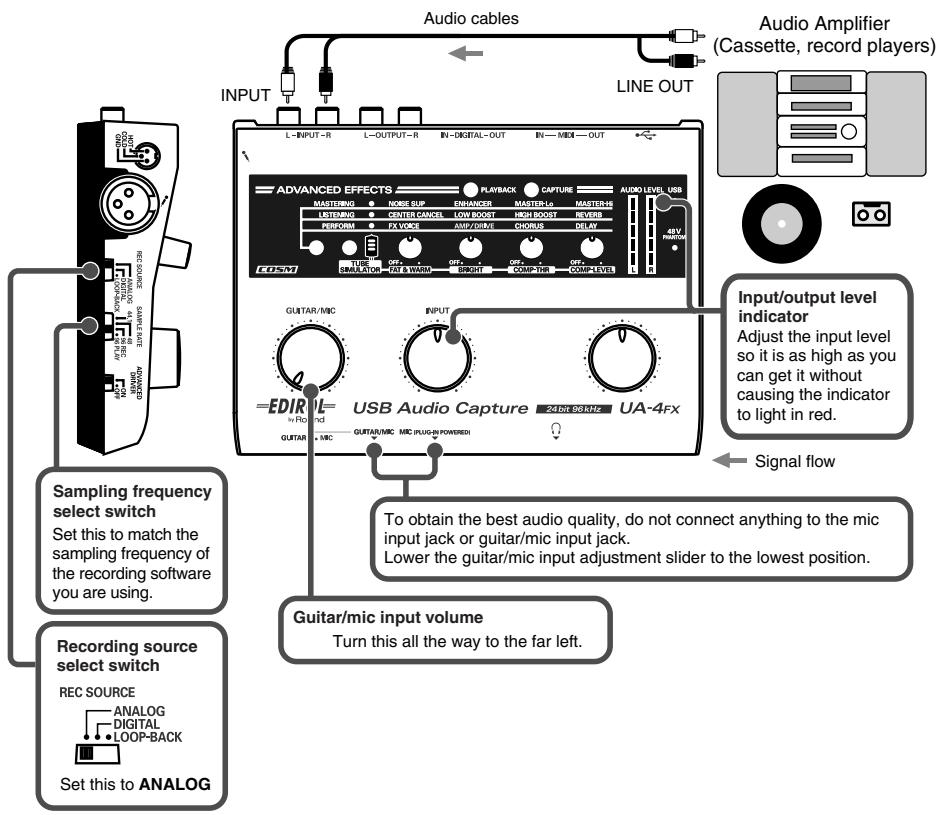
Sampling frequency select switch
Set this to the sampling frequency that is selected in your recording software. After you change the position of the sampling frequency select switch, you will need to disconnect and reconnect the USB cable.
Recording source select switch
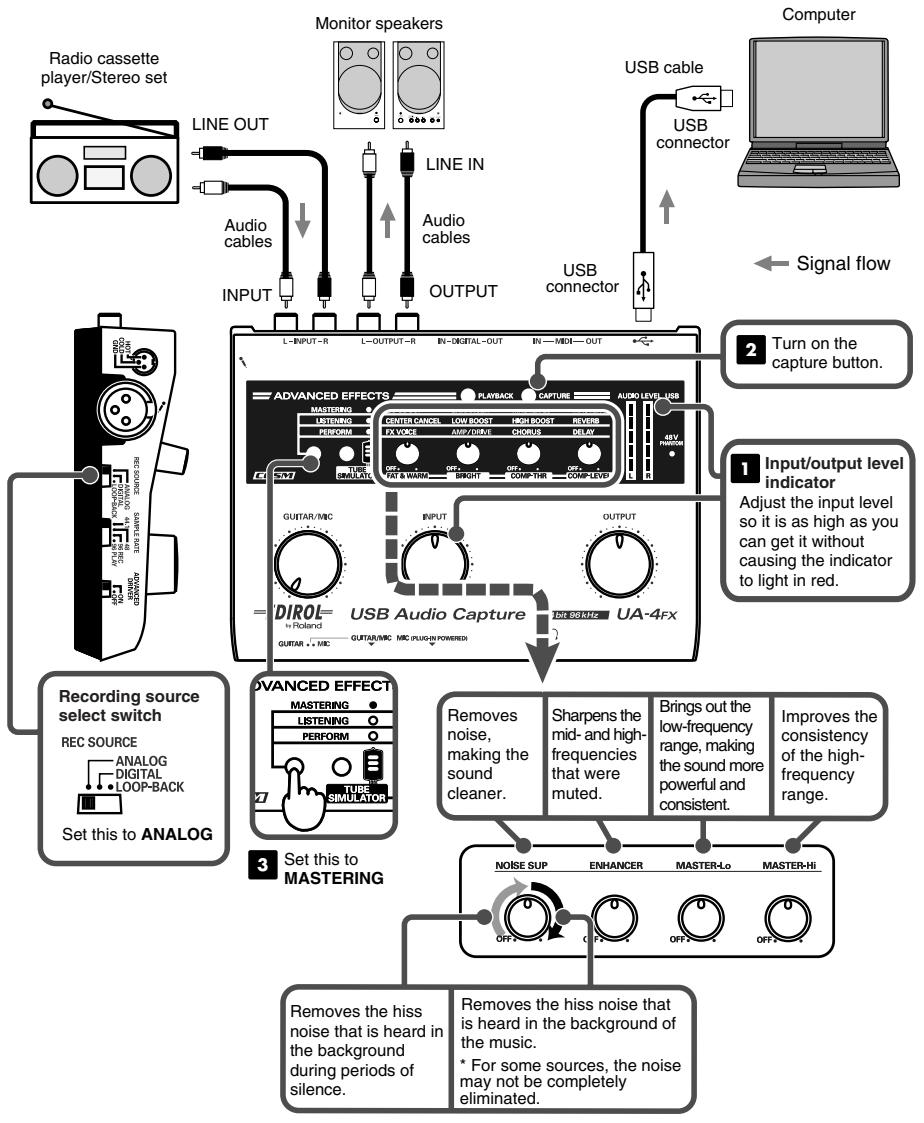
Set this to ANALOG.
Turn down the volume of your connected monitor speakers (or similar equipment) before you change the setting of the recording source select switch.
- Input/output level indicator
Use this to adjust the input level.
To obtain the best-quality recording, use the input volume knob to adjust the level until it is as high as you can get it without causing the input/output level indicator to light in red.
Be careful of looped connections
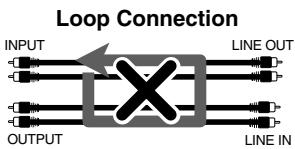
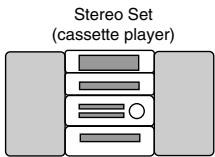
If you connect the UA-4FX as shown in the above diagram with another device that passes the input audio back to the output (e.g., a MD/DAT in recording mode), the sound will loop between the UA-4FX and the other device, causing oscillation and producing an unexpected high volume. Be aware that such connections can cause malfunctions or damage your speakers.
Recording sound from your computer onto MD or DAT
Here's how you can record audio data from your computer onto a digital device such as MD or DAT.
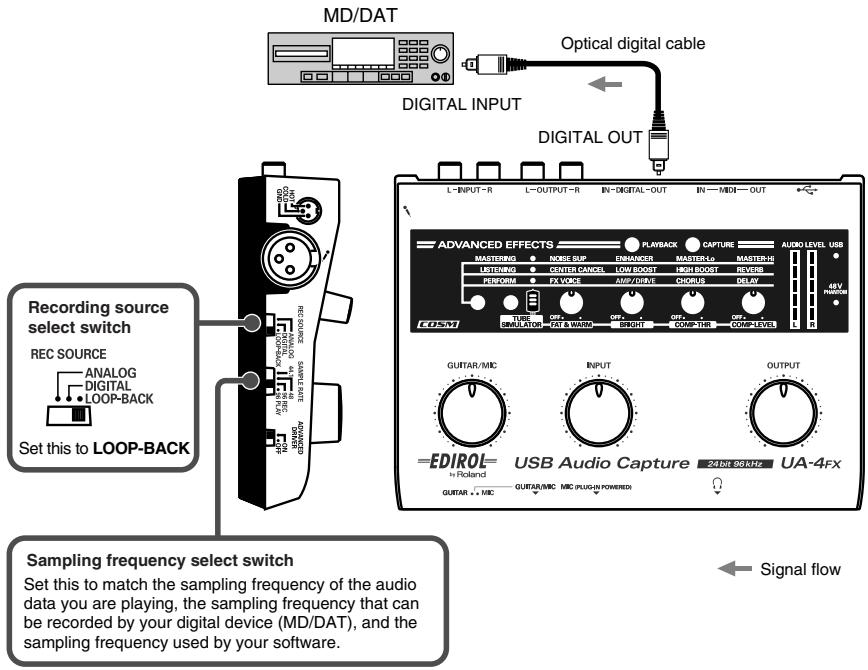
Sampling frequency select switch
Set this to the sampling frequency of the audio data you are playing and the sampling frequency of your recording software.
After you change the position of the sampling frequency select switch, you will need to disconnect and reconnect the USB cable.
Recording source select switch
Set this to LOOP-BACK.
If this is set to LOOP-BACK, signals will no longer be received from the various analog input jacks. This means that only the sound from your computer will be sent to the digital output connector, so that noise or undesired sound will not be present. Turn down the volume of your connected monitor speakers (or similar equipment) before you change the setting of the recording source select switch.
Recording the digital output from a CD/MD/DAT into your computer
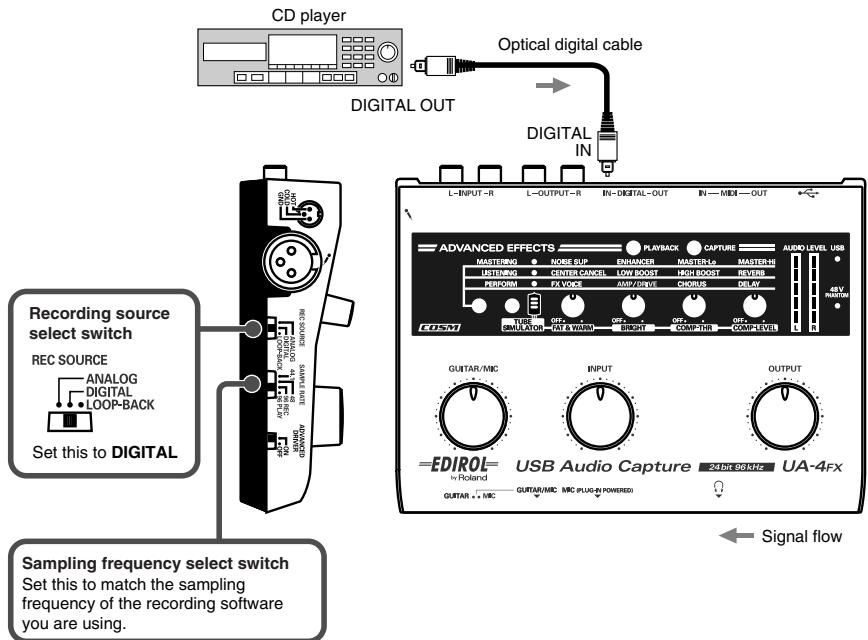
Sampling frequency select switch
Set this to the sampling frequency of your recording software.
Normally, you will select 48kHz or 44.1kHz for DAT, and 44.1kHz for MD or CD.
For details, refer to the owner's manual for your digital audio device and software.
After you change the position of the sampling frequency select switch, you will need to disconnect and reconnect the USB cable.
Recording source select switch
Set this to DIGITAL. Turn down the volume of your connected monitor speakers (or similar equipment) before you change the setting of the recording source select switch.
- The UA-4FX complies with SCMS. If the audio data that is input from the digital audio input connector contains copy-prohibit flags (as will be the case if you recorded an MD from a CD), the UA-4FX will not allow this data to be recorded on your computer. (The sound will be output from the line output jacks and headphone jack.)
- The signal from the line input jacks or mic input jack, the signal from the guitar/mic input jack, and the signal from the digital input connector cannot be mixed and recorded together.
- If no signal is being received from the digital input connector even though the recording source select switch is set to DIGITAL, the UA-4FX will operate in the same way as when the switch is set to ANALOG.
Recording a guitar or mic
Here's how you can play your guitar or sing along with audio data played back from your computer, and use your sequencer or other software to record just the sound of the guitar or mic.
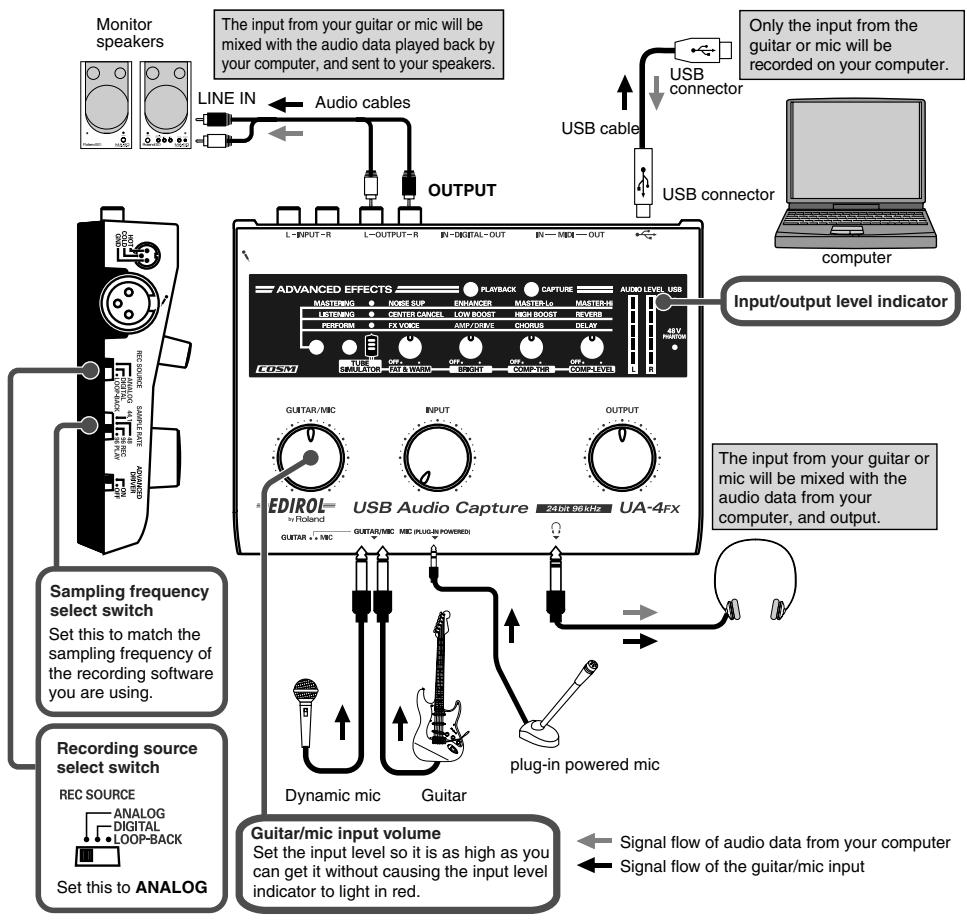
Sampling frequency select switch
Set this to the sampling frequency that is selected on your recording software.
After you change the position of the sampling frequency select switch, you will need to disconnect and reconnect the USB cable.
- The available frequencies will depend on the software you are using. For details, refer to the owner's manual of your application. The available frequencies will also depend on the operating system of your computer.
Recording source select switch
Set this to ANALOG. Turn down the volume of your connected monitor speakers (or similar equipment) before you change the setting of the recording source select switch.
- Input select switch
Set this to MIC if you connect a mic, or to GUITAR if you connect a guitar.
- Guitar/mic input volume
Use this to adjust the input level. If the input/output level indicator is lit red, use this volume control to lower the input level. To obtain the best-quality recording, use this knob to adjust the level so it is as high as you can get it without causing the indicator to light.
-
Howling could be produced depending on the location of microphones relative to speakers. This can be remedied by:
-
Changing the orientation of the microphone(s).
- Relocating microphone(s) at a greater distance from speakers.
- Lowering volume levels.
Recording with a phantom-powered condenser mic
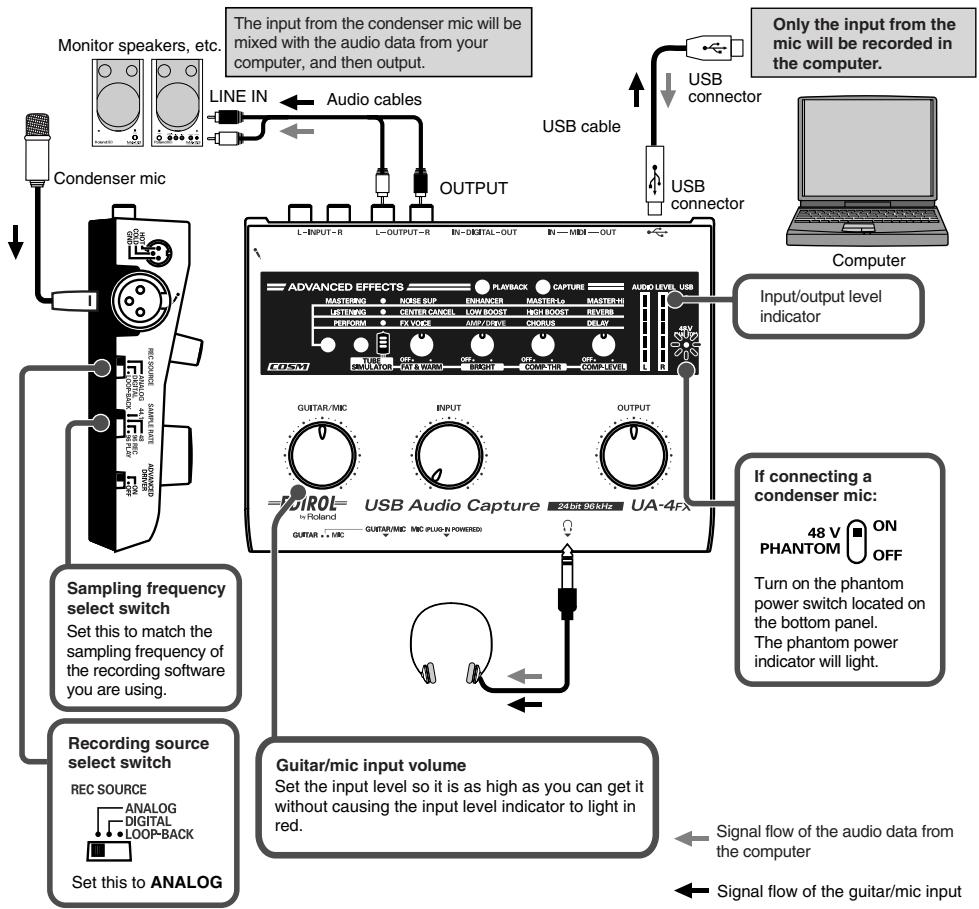
Sampling frequency select switch
Set this to the sampling frequency that is selected in your recording software. After you change the position of the sampling frequency select switch, you will need to disconnect and reconnect the USB cable.
- The frequencies you can select will depend on the software you're using. For details, refer to the owner's manual of the application you're using. The selectable frequencies will also depend on your operating system.
Recording source select switch
Set this to ANALOG. Turn down the volume of your connected monitor speakers (or similar equipment) before you change the setting of the recording source select switch.
- Phantom power switch
Turn ON.
The phantom power indicator on the front panel will light.
- Guitar/mic input volume
Use this to adjust the input level. If the input/output level indicator is lit red, use this volume control to lower the input level. To obtain the best-quality recording, use this knob to adjust the level so it is as high as you can get it without causing the indicator to light.
- Howling could be produced depending on the location of microphones relative to speakers.
This can be remedied by:
- Changing the orientation of the microphone(s).
- Relocating microphone(s) at a greater distance from speakers.
- Lowering volume levels.
- Types of mic
Most mics are either dynamic mics or condenser mics; either type of mic can be connected to the UA-4FX. The UA-4FX also supports "plug-in powered mics," which are small monaural condenser mics designed for connection to the mic input of a computer.
Only a monaural mic that supports plug-in power may be connected to the mic input jack (plug-in powered mic). Connecting any other type of mic or a conventional stereo mini-type plug to this jack may damage the circuitry.
Recording Internet radio or other computer sound
Here's how you can use your computer to record Internet radio or other sound from your computer.
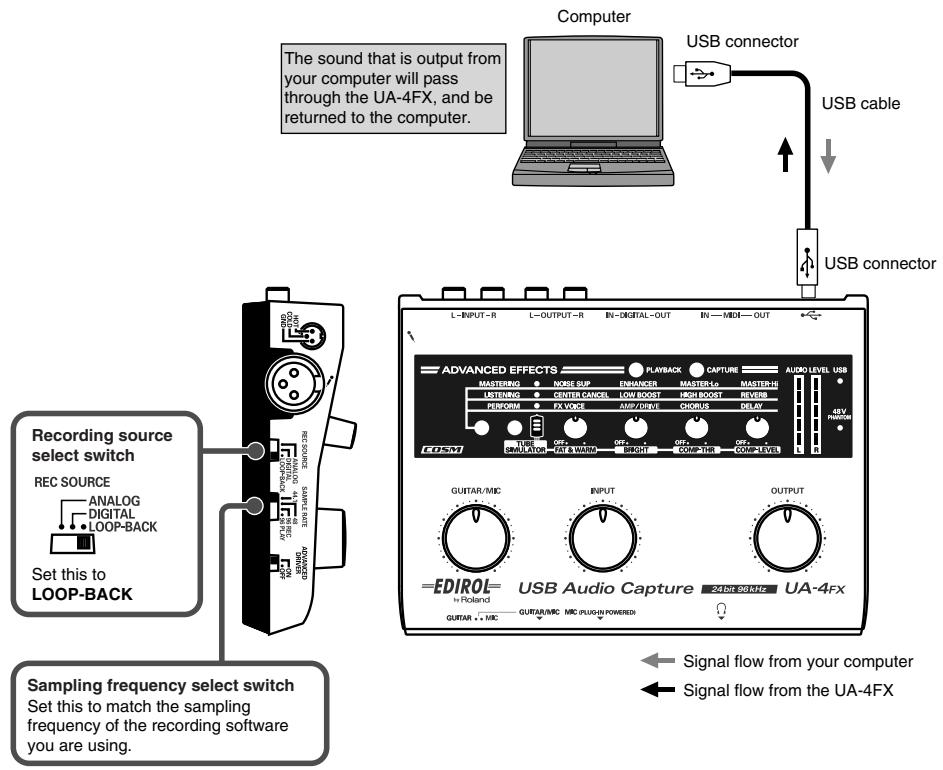
Sampling frequency select switch
Set this to the sampling frequency that is selected on your recording software.
After you change the position of the sampling frequency select switch, you will need to disconnect and reconnect the USB cable.
Recording source select switch
Set this to LOOP-BACK.
Turn down the volume of your connected monitor speakers (or similar equipment) before you change the setting of the recording source select switch.
Playing back 5.1 ch surround from your computer
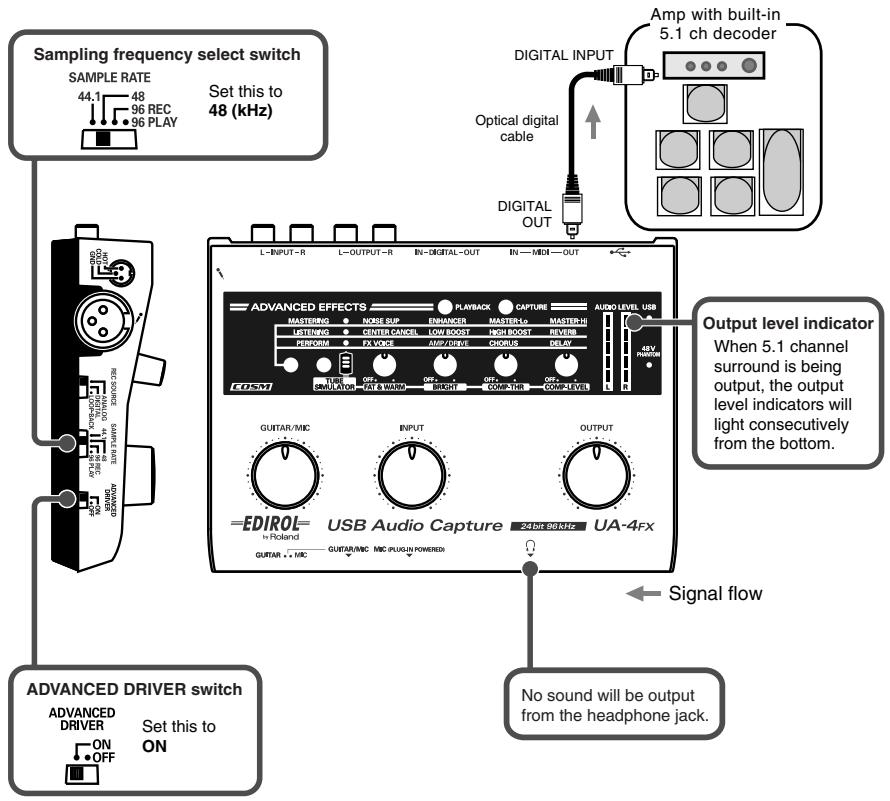
The UA-4FX's 5.1 channel digital output can be played back by an amp that has a built-in 5.1 channel decoder.
- You cannot record audio signals during 5.1 channel playback.
This functionality is available only in Windows. In order to use this in Windows, you will need DVD playback software such as WinDVD. You will need to obtain this separately.
For details on settings, refer to the owner's manual for your software.
- We recommend that you use WinDVD 5 or later.
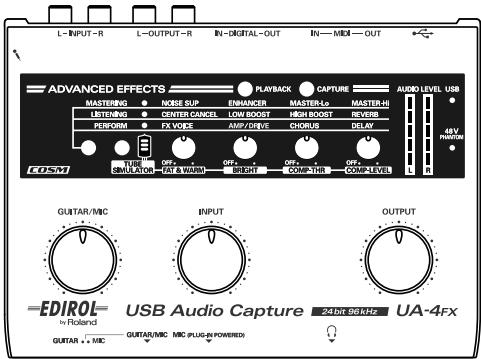
The UA-4FX's advanced effects provide an easy way to change the character of the sound, and are a great convenience for audio editing. Four types of digital effect are provided, and these can be applied while you play back sound or record from a mic or guitar. You can use the four knobs to easily adjust the character of the effect that is applied to the mic, guitar, or the sound from the line inputs or digital input.
Before you continue, make connections and basic settings as described in "Connections for various setups" (p. 9).
Advanced effects (three features)
Advanced 1 Four ways to use
1. Vacuum tube (TUBE) amp simulator
This is a COSM effect that simulates a vacuum tube amp.
It creates the fat, warm sound that is typical of vacuum tubes.
2. MASTERING
Old analog sources such as cassette tape will be given new life by digital technology.
3. LISTENING
This setting is ideal for listening. Your computer becomes an AV processor, allowing you to enjoy karaoke.
4.PERFORM
Enjoy powerful guitar sounds, and seven types of narration voice.
Advanced 2
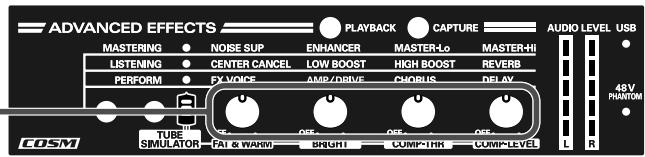
Using the four effect knobs to adjust the sound
Effect knobs
Advanced 3
Applying effects to the recording (capture) or playback
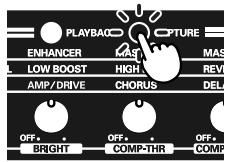
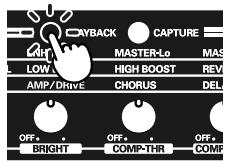
Applying effects to the recording
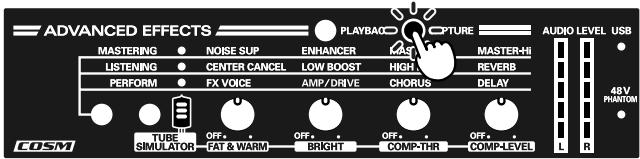
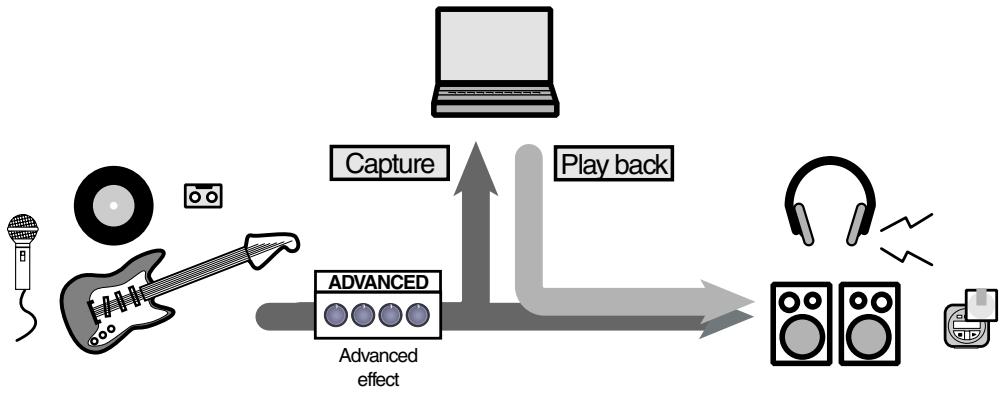
Applying effects to the playback
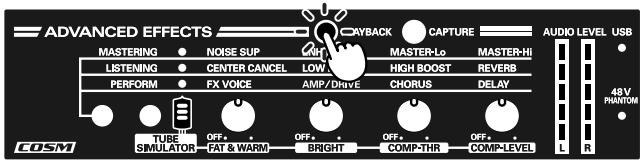
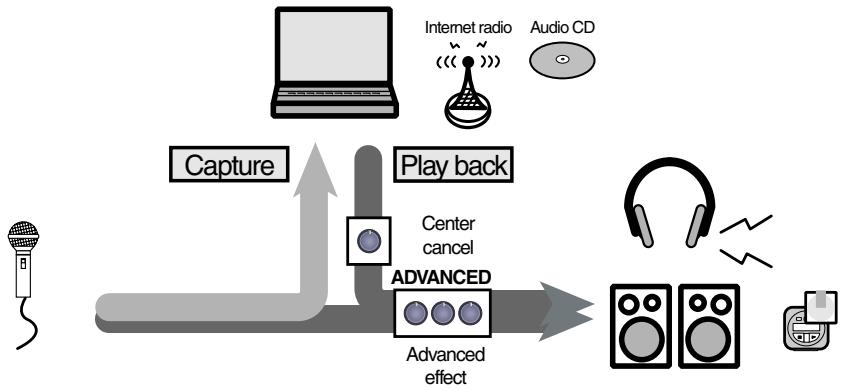
Applying effects

Press the capture button or the playback button.

No effect will be applied if neither the capture button or the playback button are turned on (lit). You cannot turn both buttons on simultaneously.
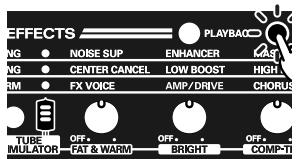
If you want to apply effects to the sound being recording, turn on the capture button.
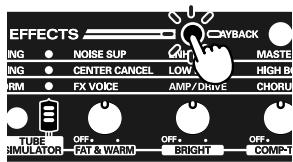
If you want to apply effects to the sound being played back, turn on the playback button.

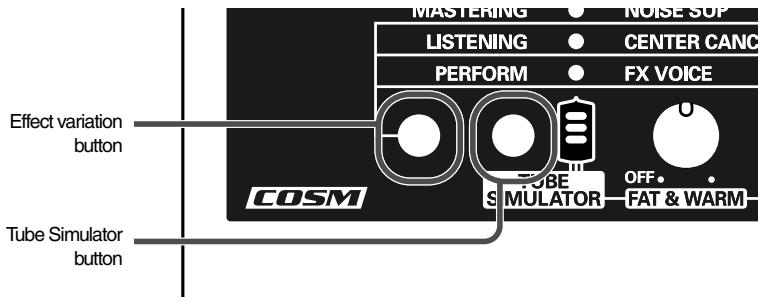
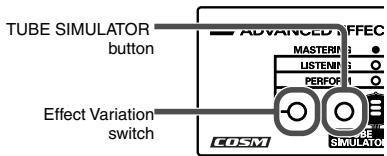
Use the Tube simulator button or Effect variation button to select the desired effect.

Use the effect knobs to adjust the character of the effect.
If an effect knob is set to the OFF position, that effect will not be applied. Gradually turn the effect knob toward the right to adjust the setting to your taste.
- The fat sound produced by the tube simulator will still remain even if the effect knob is turned off.
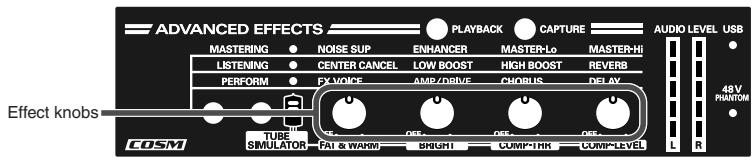
- In some cases, applying the effect too strongly may cause the sound to distort. If this occurs, lower the input level. Alternatively, turn the effect knobs toward the left to reduce the depth of the effect.
Using effects
Tube simulator
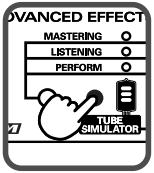
Press the TUBE SIMULATOR button
This is a COSM effect that simulates a vacuum tube amp. It simulates the fat, warm sound that is typical of vacuum tubes.
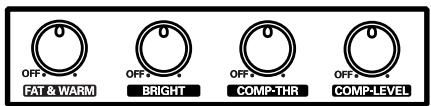
| Effect | Explanation |
| Fatness (FAT & WARM) | Simulates the warm, fat sound that is typical of vacuum tubes. |
| Brightness (BRIGHT) | Simulates a clear and bright vacuum tube sound. |
| Compressor depth (COMP-THR) | Specifies the level at which the compressor will begin operat-ing. As you turn this knob toward the right, the compressor will be applied more deeply, producing a thicker sound. |
| Compressor volume (COMP-LEVEL) | Adjusts the output level of the compressor. Turning this knob toward the right will raise the level. |
- If you increase an effect (turn the knob toward the right) excessively, the sound may distort. If this occurs, you can try lowering the level of the input signal, the volume of the external audio playback device, or the volume of your computer.
Using the tube simulator (1)
Here's how you can record a vocal using the rich sound of the vacuum tube mic preamp.
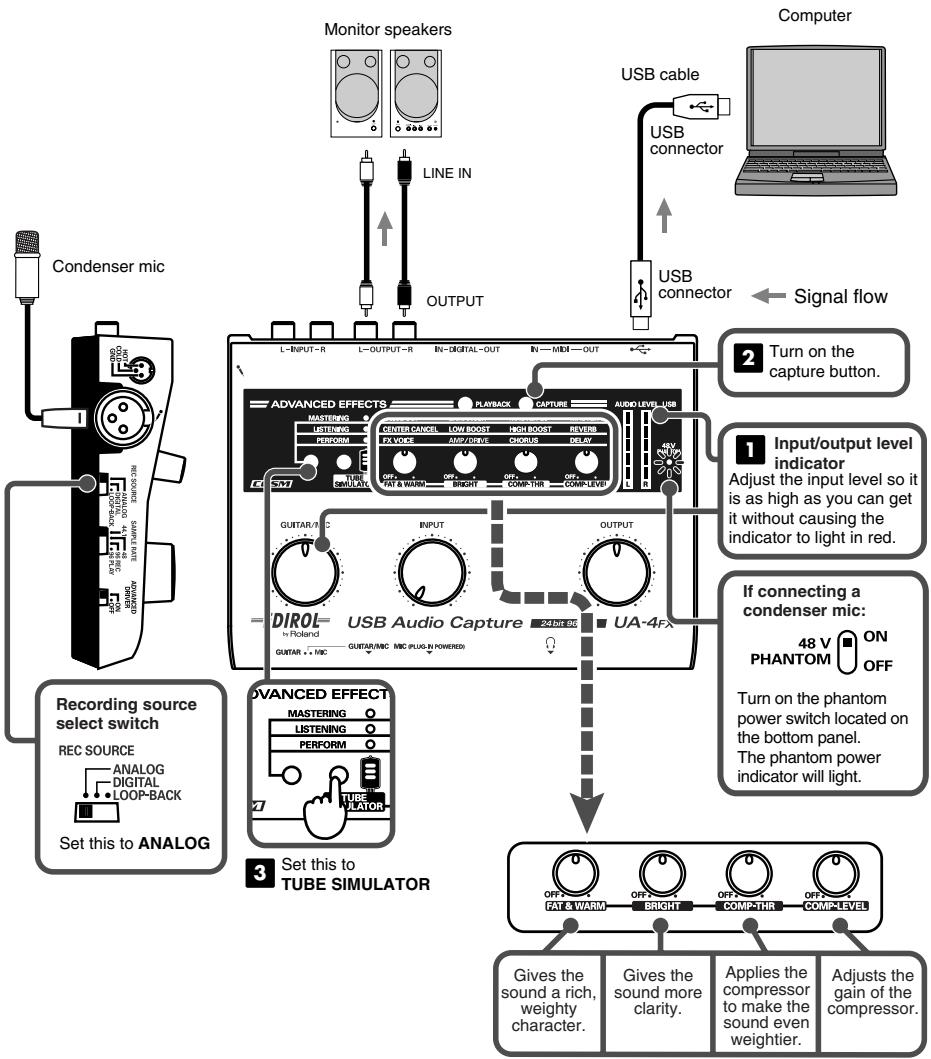
Using the tube simulator (2)
Here's how you can enjoy sound from your computer, enhanced by the warmth of a vacuum tube audio amp.
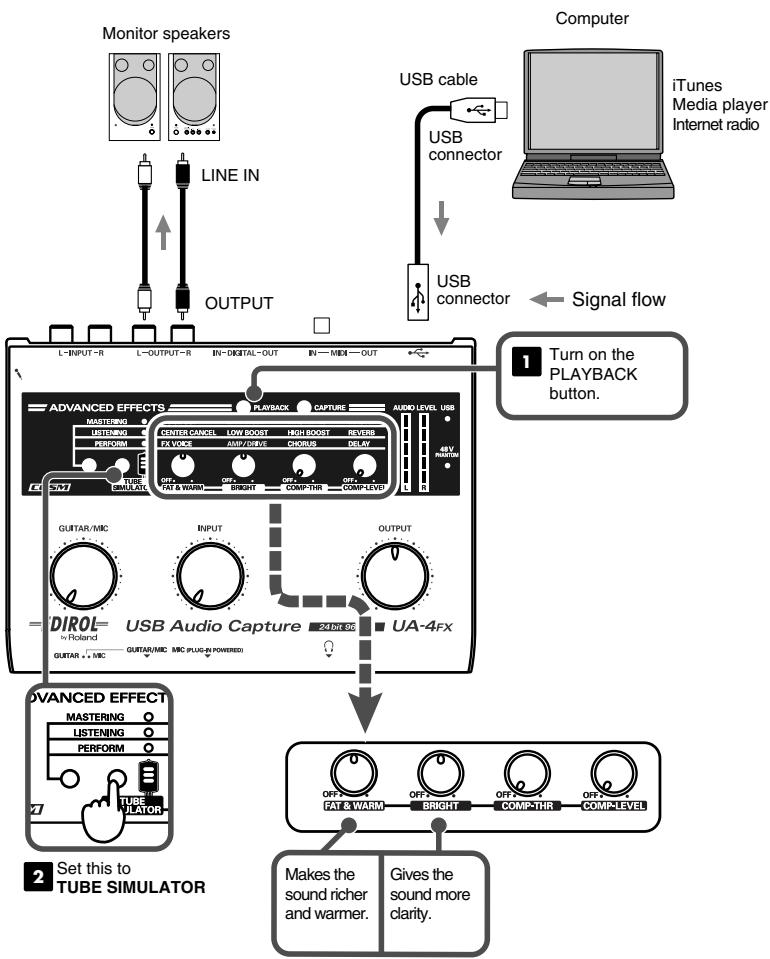
Mastering effect (MASTERING)
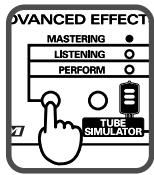
Set this to LISTENING
When capturing audio from a cassette tape or LP (vinyl record), you can use this effect to improve the quality of the audio file that is captured on your computer.
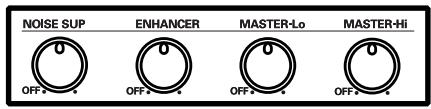
| Effect | Explanation |
| Removing noise (NOISE SUP) | This removes low-level sounds or noise that remain in the background during periods of silence, and removes the noise from an analog source. This will make the sound clearer. * If this effect is applied to an input signal whose volume is extremely low, you may hear no sound at all. |
| Sharpening the sound (ENHANCER) | This sharpens the sound, boosting the high-frequency range to improve the clarity. |
| Boosting the low range (MASTER-Lo) | This suppresses distortion to the low-frequency range (below 220 Hz), making the sound powerful and solid. |
| Boosting the high range (MASTER-Hi) | This suppresses distortion to the high-frequency range (above 2 kHz), making the sound more powerful. |
- If you increase an effect (turn the knob toward the right) excessively, the sound may distort. If this occurs, you can try lowering the level of the input signal, the volume of the external audio playback device, or the volume of your computer. Alternatively, you can turn the effect knob toward the left to decrease the effect.
Using the mastering effect
Here's how you can enhance the sound from a cassette tape to make it sound more like a CD before saving it on your computer.
Examples of effect settings
Removing noise from a cassette tape
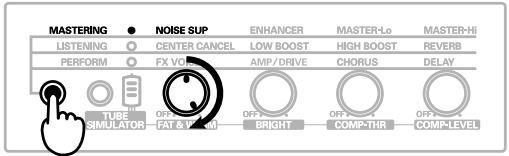
MASTERING
Recording without including extraneous noises from the surroundings
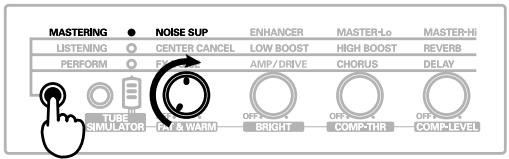
MASTERING
Sharpening the sound from a mic that lacks clarity
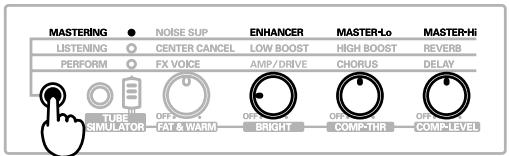
MASTERING
Making a live sound crisper and cleaner
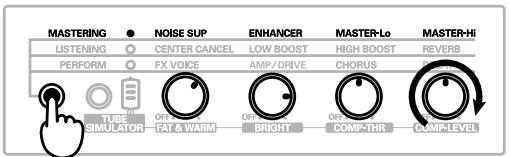
MASTERING
Clarifying the sound of a low-quality MP3
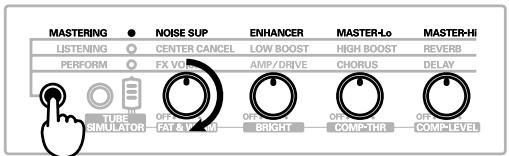
MASTERING
Listening effect (LISTENING)
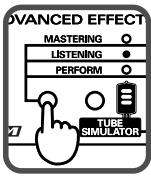
Set this to
LISTENING
You can apply this effect to the playback of a CD, internet radio, or
MP3 to enhance the sound in various ways.
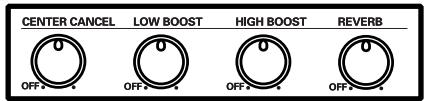
| Effect | Explanation |
| CENTER CANCEL | When you input a stereo source such as a CD, this lets you eliminate sounds that are located in the center of the stereo image, creating a karaoke version. As you turn the effect knob from the OFF position toward the right (maximum), a greater portion of the center will be eliminated. * Applying this to a monaural sound may result in your hearing no sound at all. * If the playback button is on, this center cancel effect will not apply to the input. |
| LOW BOOST | Boosts the low range of the sound, adding impact. |
| HIGH BOOST | Boosts the high range of the sound, adding clarity. |
| REVERB | Adds reverb to create a more spacious sound. |
- If you increase an effect (turn the knob toward the right) excessively, the sound may distort. In this case, try lowering the volume of the application you're using. Also try turning the effect knob toward the left to reduce the depth of the effect.
Using the Listening effect
Here's how you can transform your computer into a karaoke system. You can apply effects to the sound from Internet radio, media player or iTunes.
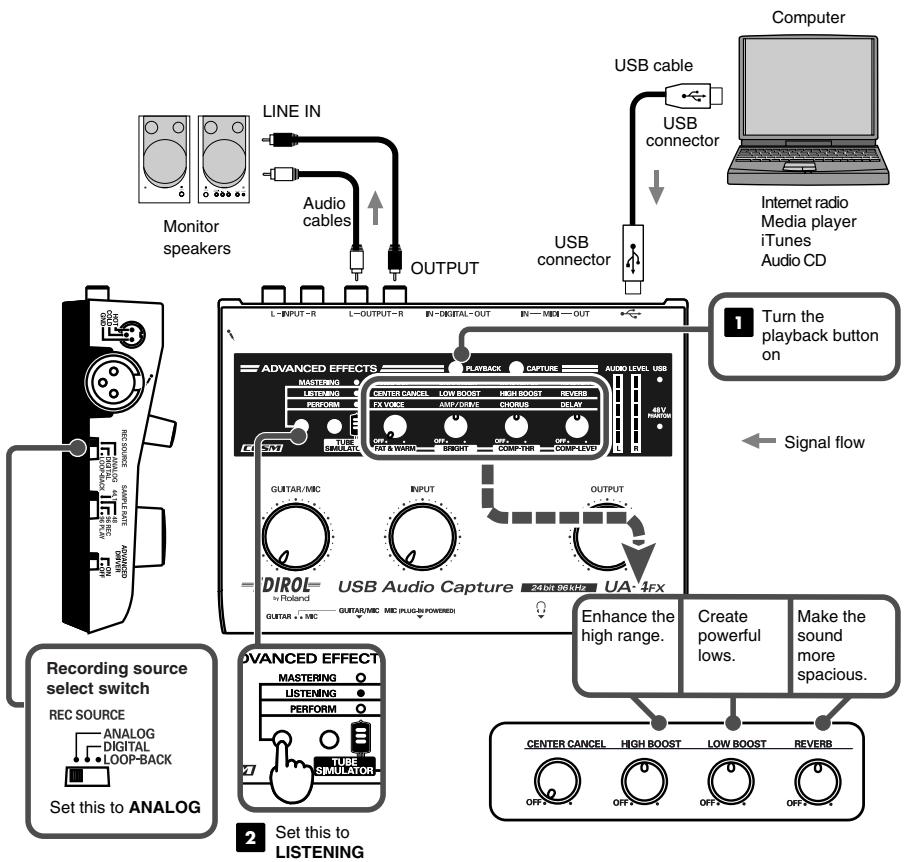
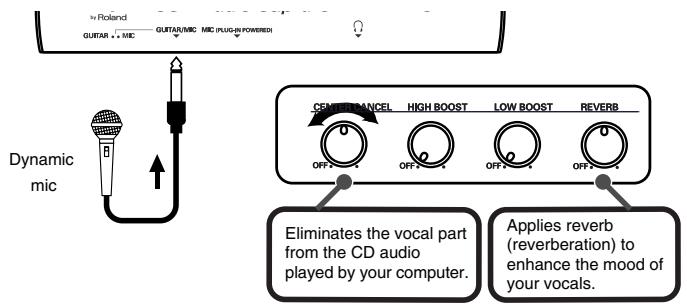
Enjoying karaoke
Center canceling will apply only to the sound played back from your computer.
Performance effect
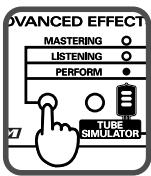
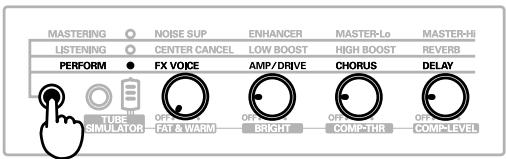
Set this to PERFORM
It is useful to apply this effect when you are recording a mic or guitar.
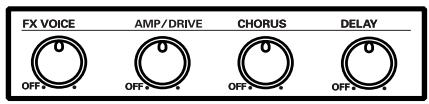
| Effect | Explanation |
| FX VOICE | Modifies the pitch, giving the sound a completely different character. As you turn the effect knob from OFF toward the maximum (far right), the pitch will rise. |
| AMP/DRIVE | Distorts the sound to create guitar tones ranging from tasteful to extreme.Turning the effect knob from OFF toward the center position will produce a mild overdriven sound. Turning the knob from the center to ward the maximum (far right) will produce more extreme distortion. |
| CHORUS | Adds depth and spaciousness to the sound, creating a rich sense of stereo. |
| DELAY | Adds repeated delays to give the sound more depth, or produce an echo-like effect. |
- If you increase an effect (turn the knob toward the right) excessively, the sound may distort. If this occurs, you can try lowering the level of the input signal, the volume of the external audio playback device, or the volume of your computer. Also try turning the effect knob toward the left to reduce the depth of the effect.
- When you turn on a performance effect, a noise suppressor will be activated to reduce the noise from your guitar or mic. You can adjust the level of the noise suppressor by holding down the effect variation button and turning the AMP/DRIVE knob. Turning the knob toward the left will lower the level.
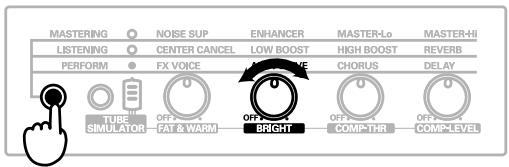
Adding variation to your sound
Here's how you can apply effects to the sound from your guitar or mic.
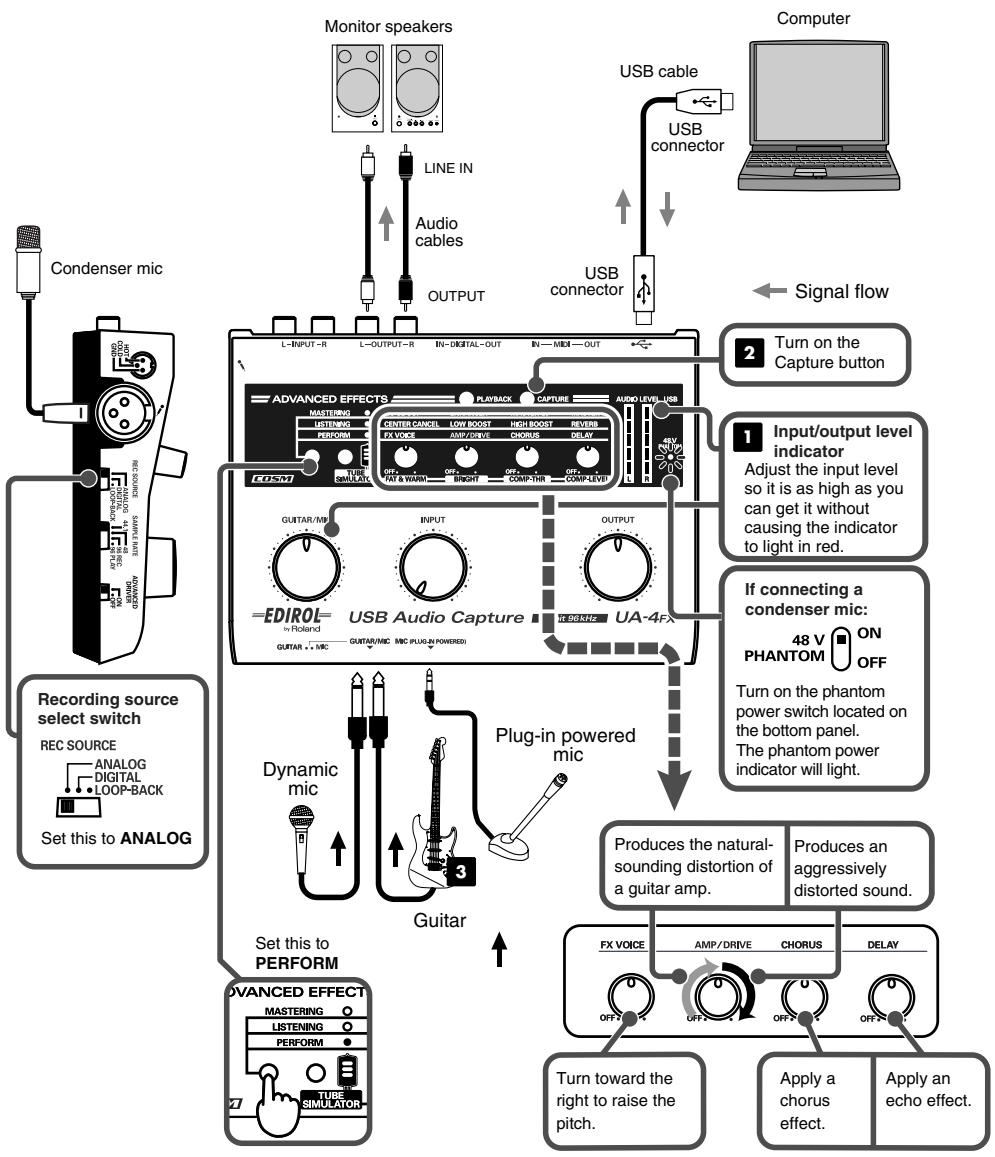
Examples of effect settings
A slightly distorted sound, as if you were speaking through a megaphone
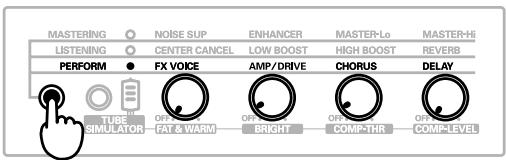
PERFORM
Disguises the voice; useful for anonymous interviews
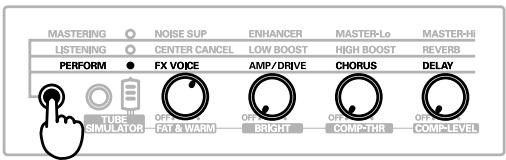
PERFORM
A nice setting for a guitar solo
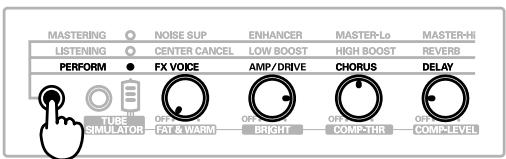
PERFORM
A nice setting for clean guitar
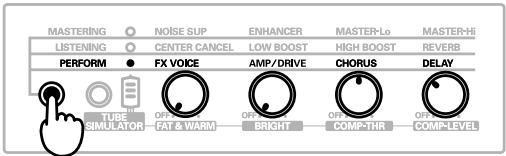
PERFORM
A nice setting for blues guitar
PERFORM
MEMO
APPENDIX
Driver settings (ADVANCED switch ON) .P.36
Driver installation and settings (Mac OS 9).P.39
Giving priority to background services. P.44
Driver Signing Options setting. P.46
Standard driver mode (ADVANCED switch OFF) .....P.47
Software installation.. P.48
Troubleshooting P.53
Specifications .P.65
UA-4FX Block Diagram. P.66
Adjusting the audio latency
When using the UA-4FX in Advanced mode, you can change the driver settings to adjust the latency of the audio. To adjust the latency, change the Buffer Size in the driver settings dialog box.
-
Latency is the time delay from when an sequencer software plays back audio data until the sound is actually heard from an audio device such as the UA-4FX.
-
As described in "Opening the dedicated driver settings dialog box" (p. 36), open the Driver Settings dialog box.
- Adjust the buffer size.
The following settings will produce the shortest latency.
Windows users: Set "Audio Buffer Size" to the far left (Min).
Mac OS X users: Set "Audio Buffer Size" to the far left (Min).
Mac OS 9 users: Set "Buffer Size" to the far left (Min).
- Click [OK] (or in Mac OS X, [Apply]) to close the dialog box.
-
Restart the sequencer software that is using the UA-4FX.
-
If you are using a sequencer software that has a function for testing audio devices, get it to perform its tests.
-
Play back audio data on your sequencer software.
If interruptions occur in the sound, repeat this procedure, and gradually increase the buffer size in step 2 until interruptions no longer occur.
* Depending on the sequencer software you are using, there may be a buffer size or latency adjustment function among the audio settings of the sequencer software as well. For details, refer to the operation manual for your sequencer software.
Opening the dedicated driver settings dialog box
Windows users:
- Click the Windows Start menu, and from the menu that appears, select Settings | Control Panel. (Windows XP: Click the Windows start menu, and from the menu, select Control Panel.)
- In Control Panel, double-click the "EDIROL UA-4FX" icon.
The "Edirol UA-4FX Driver Settings" dialog box will appear.
- In Windows XP, click "Switch to Classic View" to select Classic View on your computer. If you're not in Classic View, the EDIROL UA-4FX icon won't be shown.
- In Windows Me, click "View all Control Panel options."
Mac OS X users: Open "System Preferences" and click the "UA-4FX" icon. "Editol UA-4FX Driver Settings" dialog box will appear.
Mac OS 9 users: Open the ASIO Control Panel from the Audio Settings dialog box of your ASIO-compatible software.
- The name of the Audio Settings dialog box and the procedure for opening the ASIO Control Panel will differ depending on your software. For details, refer to the operation manual for your software.