
CM700D - Spectrophotomètre MINOLTA - Notice d'utilisation et mode d'emploi gratuit
Retrouvez gratuitement la notice de l'appareil CM700D MINOLTA au format PDF.


| Type de produit | Spectrophotomètre portable |
| Marque | MINOLTA (Konica Minolta) |
| Modèle | CM-700d |
| Dimensions (L x H x P) | 73 x 211,5 x 107 mm |
| Poids | Environ 550 g (sans pile ni capot de calibrage) |
| Alimentation | Adaptateur secteur, 4 piles alcalines AA ou rechargeables Ni-MH |
| Autonomie | Environ 2000 mesures (piles alcalines ou Ni-MH 2300 mAh) |
| Source lumineuse | Lampe au xénon pulsée (avec filtre UV) |
| Géométrie de mesure | di:8°, de:8°, commutation automatique SCI/SCE (conforme CIE, ISO, DIN, ASTM, JIS) |
| Ouverture de mesure | MAV: ø8 mm, SAV: ø3 mm (interchangeable via masque) |
| Détecteur | Réseau double de photodiodes silicium (36 éléments) |
| Gamme spectrale | 400 à 700 nm, pas de 10 nm |
| Temps de mesure | Environ 1 seconde |
| Affichage | Écran LCD couleur TFT 2,36 pouces |
| Interfaces | USB 1.1, Bluetooth classe 1 (portée jusqu'à 100 m) |
| Mémoire | 4000 données de mesure, 1000 données de cible |
| Fonctions principales | Mesure colorimétrique, comparaison, jugement PASS/FAIL, graphiques spectraux, pseudo-couleur, évaluation métamérisme |
| Espaces colorimétriques | L*a*b*, L*C*h, Hunter Lab, Yxy, XYZ, Munsell, etc. |
| Indices | MI, WI (ASTM E313), YI (ASTM D1925), ISO Brightness, brillance 8° |
| Température d'utilisation | 5 à 40°C, HR ≤80% (sans condensation) |
| Entretien et nettoyage | Nettoyer avec un chiffon sec et doux. Éviter l'humidité et la condensation. |
| Sécurité | Utiliser uniquement l'alimentation spécifiée et les piles recommandées. |
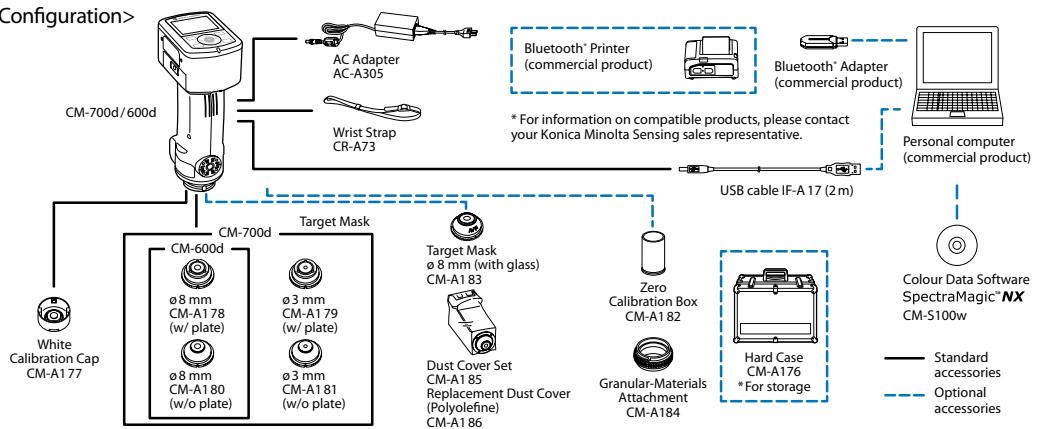
| Pièces détachées | Capot de calibrage blanc, masques de mesure (8 mm et 3 mm), adaptateur secteur, piles |
| Réparabilité | Contacter le service après-vente Konica Minolta pour toute réparation. |
FOIRE AUX QUESTIONS - CM700D MINOLTA
Questions des utilisateurs sur CM700D MINOLTA
0 question sur cet appareil. Repondez a celles que vous connaissez ou posez la votre.
Poser une nouvelle question sur cet appareil
Téléchargez la notice de votre Spectrophotomètre au format PDF gratuitement ! Retrouvez votre notice CM700D - MINOLTA et reprennez votre appareil électronique en main. Sur cette page sont publiés tous les documents nécessaires à l'utilisation de votre appareil CM700D de la marque MINOLTA.
MODE D'EMPLOI CM700D MINOLTA
Spectrophotometer
CM-700d/600d
New Generation Spectrophotometers with
Wireless Communication and Colour LCD Screen
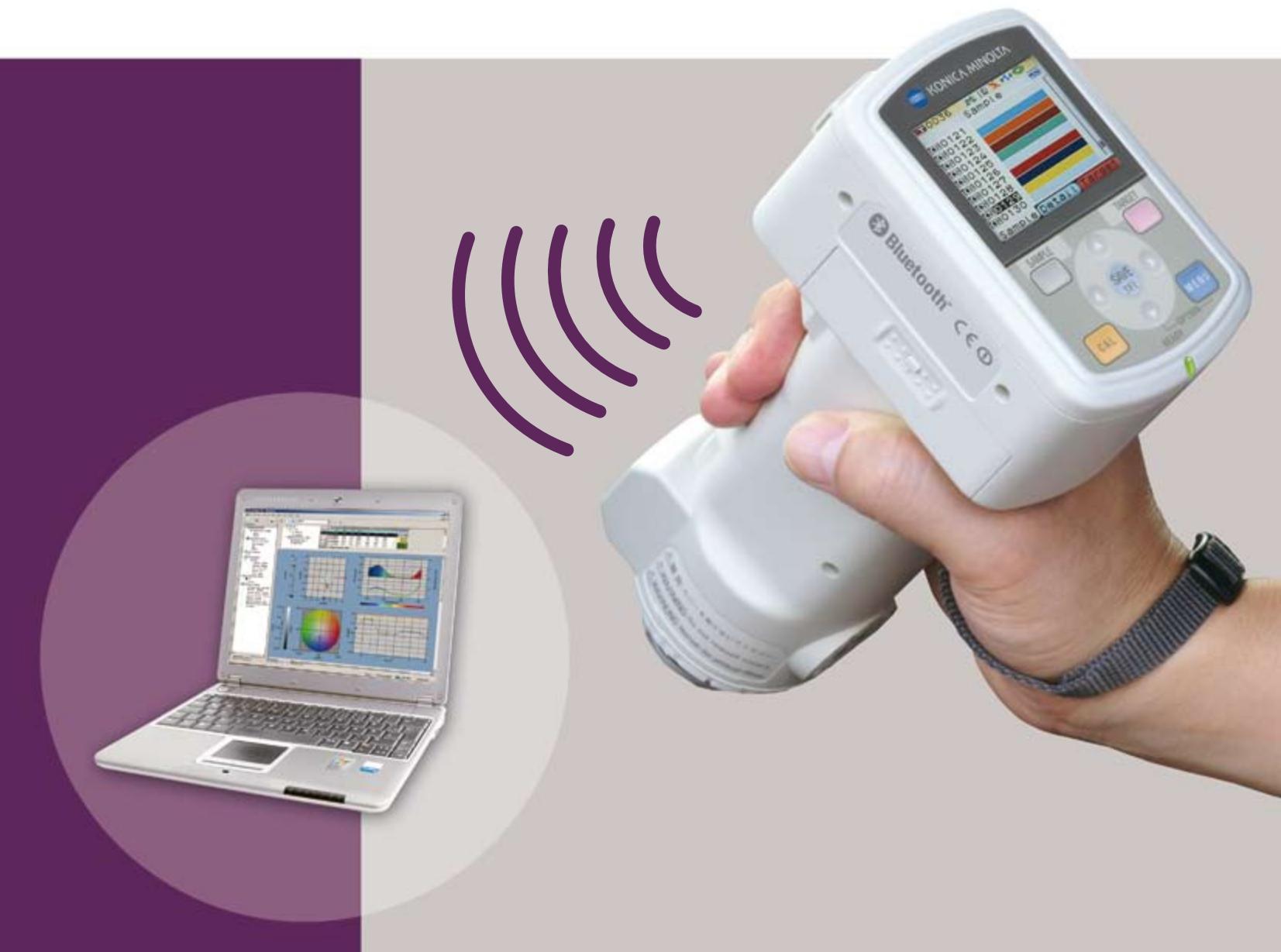



Compact and lightweight spectrophotometer offering new technologies
for perfect handling!
Objective Quality Control of colour by instrumental assessment has proven to be reliable and affordable technology for any products where colour is an important quality criterion, as in the Paints & Coatings-, Plastics-, Automotive-, HomeAppliance-, Ceramics-, Textiles- and many other Industries. In addition, the increasingly global relationship between raw material suppliers, component manufactures, assemblers and buyers make precise colour data communication essential in a world which is ever more colourful.
The new generation of portable spectrophotometers from Konica Minolta offers unprecedented ease of use and perfect handling by utilising new technologies, enhanced ergonomics and applying Konica Minolta's known advanced optical design and signal processing technology. The CM-700d and CM-600d models will change the way portable spectrophotometers are perceived and applied in Research & Development and QualityControl by improving usability and convenience.
Experience
impressive colour measurement!
Measure anything anywhere.
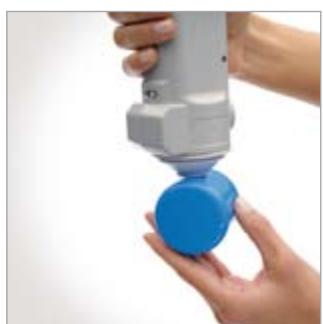
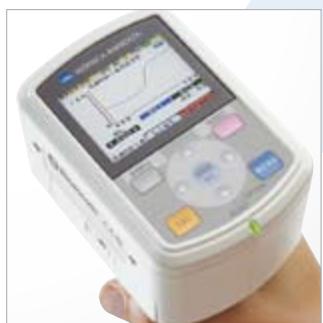
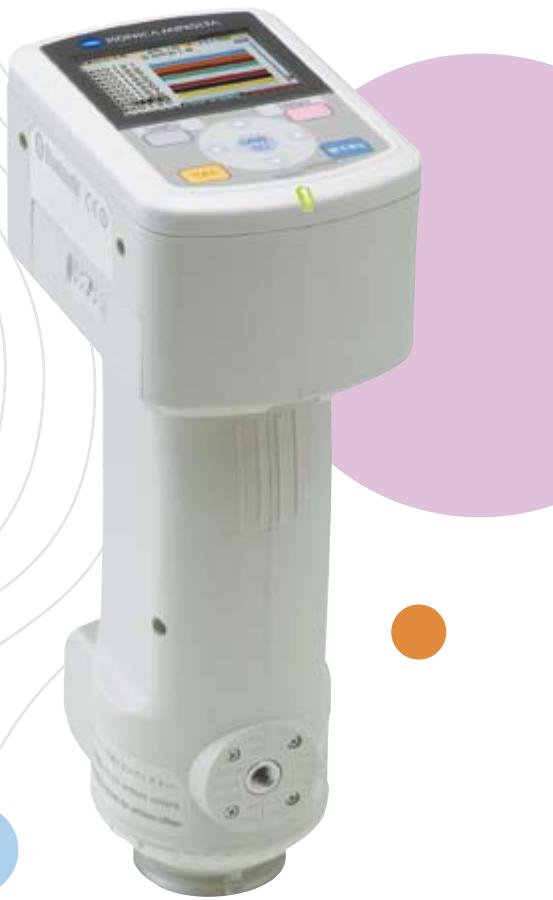
With the CM-700d and CM-600d you can measure any sample anywhere! The ergonomic vertical alignment is perfectly suited to position and measure round or even concave shaped parts and samples with single hand operation. Weighing only 550g , the CM-700d and CM-600d are the most lightweight instruments in their class and thus allow excellent portability for on-site measurement. The measuring aperture is selectable between 8mm and 3mm to measure even small sample sizes (CM-700d only).
Communicate wireless.
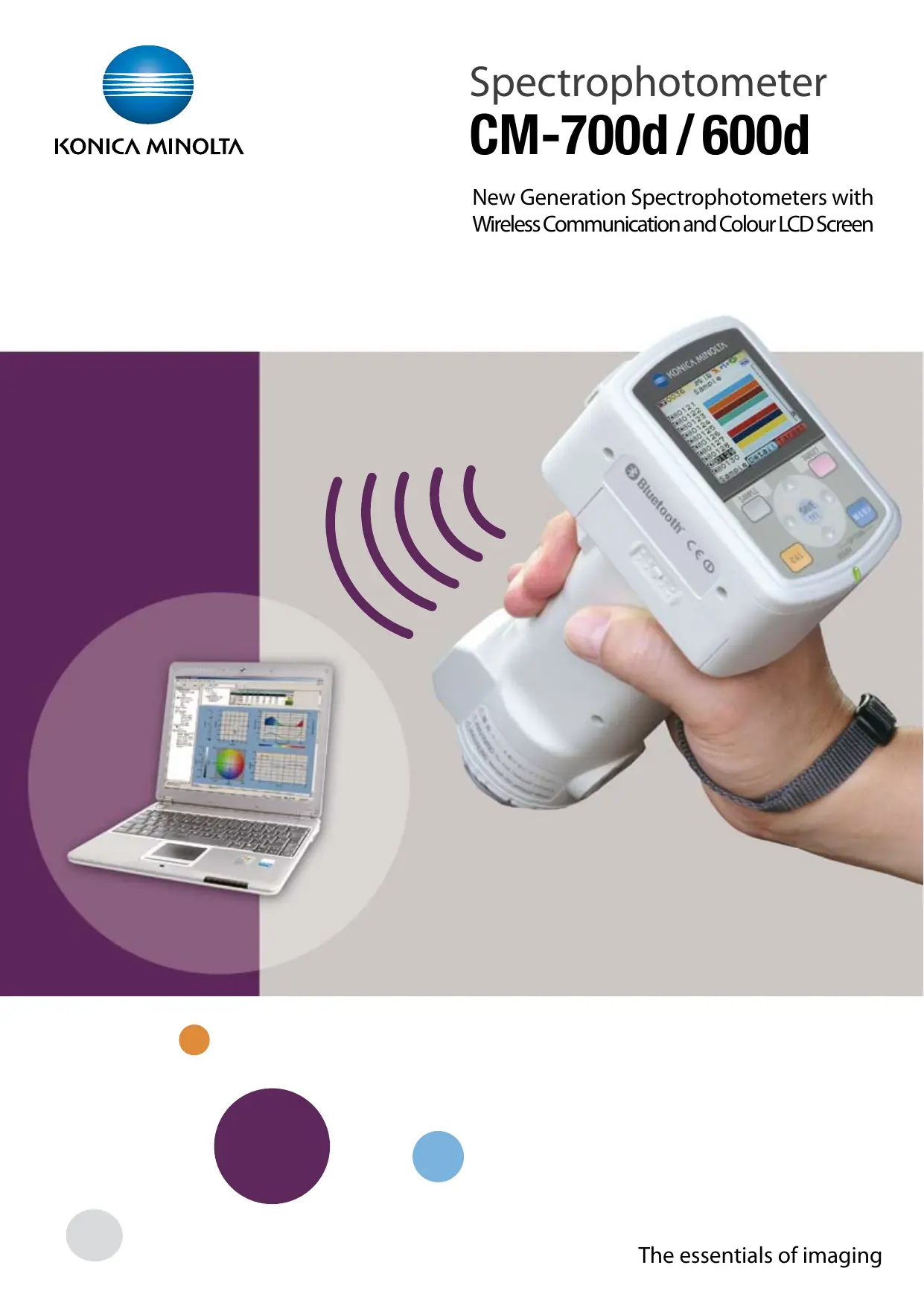
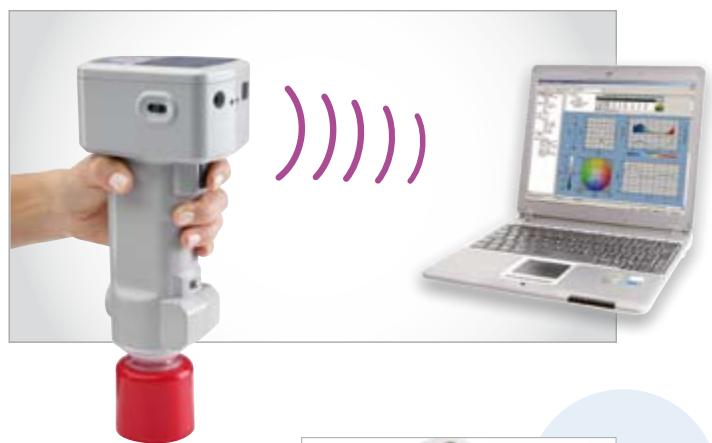
The CM-700d and CM-600d are the world's first portable colour measuring instruments enabling wireless data communications with an external PC or a Printer using Bluetooth class 1 technology. This brings a new dimension of freedom of operation to portable colour measurement in production eliminating the usual cable tangle associated with conventional instruments. Bluetooth data communications with the new models can work at distances up to 100m including bidirectional communications displaying PASS/FAIL message or colorimetric data. In stationary mode, the instruments also offer communications via a USB port.
See colours in colour.
The CM-700d and CM-600d are the world's first portable colour measuring instruments with a colour LCD screen to improve colour data reading & perception. The 2.36-inch bright TFT display shows colour readings both in numerical or graphical mode to improve operability and understanding. Pseudo colour simulations to express colour difference or metamerism are also possible for rapid visual indication.

Easy to operate.
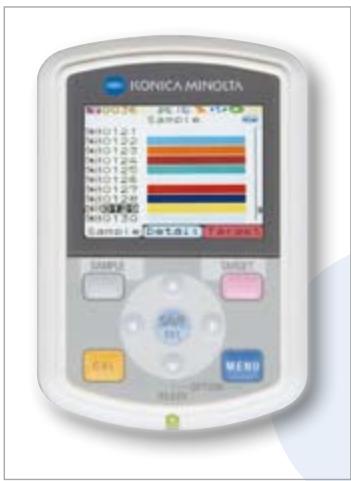
The CM-700d and CM-600d also set new standards in ease of use and intuitive operation. Five dedicated buttons for the most important operations and displayed menu guidance in 6 languages make it easy to navigate through all functions and features. Data memory capacity allows users to store up to 1.000 targets and 4.000 measurement sets. With the "Auto target" function, the instrument searches for the closest target of any measured colour.

Easy to read colour LCD screen.
Abundant information is displayed in colour for easy understanding. Measured colours can also be reproduced as colour patches on the colour LCD, which is useful to check the level of colour difference or to search for colours.
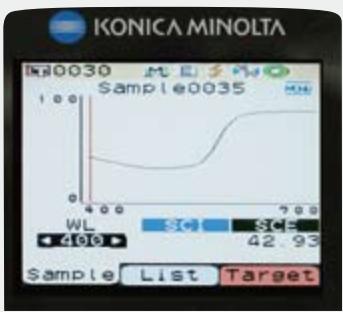
Spectral graph
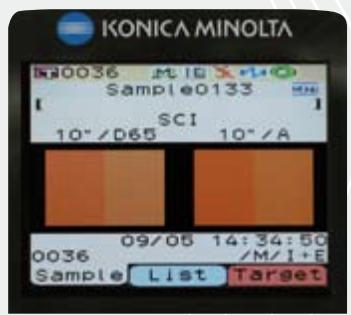
Pseudocolour
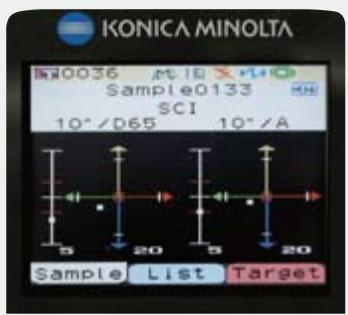
Colour difference graph

More than you expect.
In addition to all the advanced technology, both models come with a full list of features and functions you can expect from the leader and pioneer in portable colour measurement:
- Sphere geometry with simultaneous measurement (automatic switching) of specular components included (di:8°) and excluded (de:8°)
- Powerful and long life Xenon Flash illumination for maximum accuracy even on dark and saturated colours
- Highest levels in Inter-Instrument- and Inter-Model-Agreement, essential for global colour data exchange
- Choice of 3 power supply modes: Dry battery, rechargeable batteries (4 AA size) or AC Adapter for maximum flexibility
- Automatic "Stand-by" power saving function mode
Main specifications
| Model | CM-700d | CM-600d |
| Illumination/viewing system | di: 8°, de: 8° (diffused illumination, 8-degree viewing angle), SCI (specular component included)/SCE (specular component excluded) selectable with automatic switching (Conforms to CIE No. 15, ISO 7724/1, DIN5033 Teil7, ASTM E 1164, and JIS Z 8722) | |
| Size of integrating sphere | ø 40 mm | |
| Detector | Silicon photodiode array (dual 36-element) | |
| Spectral separation device | Diffraction grating | |
| Wavelength range | 400 nm to 700 nm | |
| Wavelength pitch | 10 nm | |
| Half bandwidth | Approx. 10 nm | |
| Reflectance range | 0 to 175%, Display resolution: 0.01% | |
| Light source | Pulsed xenon lamp (with UV cut filter) | |
| Measurement time | Approx. 1 second | |
| Minimum measurement interval | Approx. 2 seconds (in SCI or SCE mode) | |
| Battery performance | With alkaline dry batteries: Approx. 2,000 measurements With nickel-metal-hydride rechargeable batteries (2300 mAh): Approx. 2,000 measurements with full charge * Stand-alone continuous measurement fixed to either SCI or SCE mode at 10-second intervals at 23°C | |
| Measurement/illumination area | MAV:ø 8 mm/ø 11 mm SAV:ø 3 mm/ø 6 mm* Changeable by replacing target mask and selecting lens position | MAV:ø 8 mm/ø 11 mm only |
| Repeatability | Spectral reflectance: Standard deviation within 0.1%, Chromaticity value: Standard deviation within △E*ab 0.04* When a white calibration plate is measured 30 times at 10-second intervals after white calibration | |
| Inter-instrument agreement | Within △E*ab 0.2 (MAV/SCI) * Based on 12 BCRA Series II colour tiles compared to values measured with a master body at 23°C | |
| No. of averaging measurements | 1 to 10 (Auto averaging), 1 to 30 (Manual averaging) | |
| Display | 2.36-inch TFT colour LCD | |
| Interfaces | USB1.1; Bluetooth* standard version 1.2* | |
| Observer | 2° observer or 10° observer | |
| Illuminant | A, C, D50, D65', F2, F6, F7, F8, F10, F11, F12 (Simultaneous evaluation with two light sources possible) | |
| Displayed data | Spectral values/graph, colorimetric values, colour difference values/graph, PASS/FAIL result, pseudochrome, colour assessment | |
| Colour spaces | L*a*b*, L*c*h, Hunter Lab, Yxy, XYZ, Munsell, and colour difference in these spaces (except for Munsell) | |
| Colorimetric data | MI, WI(ASTM E313-73/E313-96), YI(ASTM E313-73/ASTM D1925), ISO Brightness, 8° gloss value | |
| Colour difference formulas | △E*ab (CIE1976), △E*94 (CIE1994), △E*00 (CIE 2000), CMC (l:c) | |
| Storable data sets | Measurement data: 4,000 sets /Target colour difference data: 1,000 sets | |
| Pass/fail judgment | Tolerances can be set to colorimetric values (excluding Munsell), colour difference values, colour values (excluding 8° gloss value) respectively | |
| Power | Special AC adapter; 4 AA-size alkaline dry batteries or nickel-metal-hydride rechargeable batteries | |
| Size | 73 (W) x 211.5 (H) x 107 (D) mm | |
| Weight | Approx. 550 g (without white calibration cap and batteries) | |
| Operating temperature/humidity range | 5 to 40°C, relative humidity 80% or less (at 35°C) with no condensation | |
| Storage temperature/humidity range | 0 to 45°C, relative humidity 80% or less (at 35°C) with no condensation | |
- Applicable Bluetooth' profile; Serial Port Profile, Output: Bluetooth' Power Class 1. The communication distance may vary depending on the obstacles and radio wave conditions between the devices. Successful wireless communication is not guaranteed with all Bluetooth'–ready equipment.
- Bluetooth* is a registered trademark of Bluetooth SIG, Inc. and is used under license agreement.
SAFETY PRECAUTIONS
For correct use and for your safety, be sure to read the instruction manual before using the instrument.

-
Always connect the instrument to the specified power supply voltage. Improper connection may cause a fire or electric shock.
-
Be sure to use the specified batteries. Using improper batteries may cause a fire or electric shock.
The specifications and drawings given here are subject to change without prior notice.
If you have any questions about specifications, please contact your Konica Minolta representative.

Certificate No:YKA 0937 154 Registration Date: March 3, 1995

Certificate No: JQA-E-80027
Registration Date:
March 12, 1997
Konica Minolta Sensing, Inc.
Konica Minolta Sensing Americas, Inc.
Konica Minolta Sensing Europe B.V.
Konica Minolta (CHINA) Investment Ltd.
Konica Minolta Sensing Singapore Pte Ltd.
Konica Minolta Sensing, Inc.
Osaka, Japan
New Jersey, U.S.A.
European Headquarter/BENELUX
German Office
French Office
UK Office
Italian Office
Belgian Office
Swiss Office
Nordic Office
Polish Office
SE Sales Division
SE Beijing Office
SE Guangzhou Office
Singapore
Seoul Office
Nieuwegein, The Netherlands
München, Germany
Roissy CDG, France
Milton Keynes, United Kingdom
Milan, Italy
Zaventem, Belgium
Dietikon, Switzerland
Västra Frölunda, Sweden
Wroclaw, Poland
Shanghai, China
Beijing, China
Guangzhou, China
Seoul, Korea
Phone: 888-473-2656 (in USA),
201-236-4300 (outside USA)
Phone: +31(0)30 248-1193
Phone: +49(0)89 4357 156 0
Phone: +33(0)1 493-82519
Phone: +44(0)1908 540-622
Phone: +39 02 39011.425
Phone: +32 (0)2 7170 933
Phone: +41(0)43 322-9800
Phone: +46(0)31 7099464
Phone: +48(0)71 330 50 01
Phone: +86-021-5489 0202
Phone: +86-010-8522 1551
Phone: +86-020-3826 4220
Phone: +65 6563-5533
Phone: +82(0)2-523-9726
Fax: 201-785-2480
Fax: +31(0)30 248-1280
Fax: +49(0)89 4357 156 99
Fax:+33(0)1493-84771
Fax: +44(0)1908 540-629
Fax:+390239011.223
Fax:+32(0)27170977
Fax: +41(0)43 322-9809
Fax:+46(0)31 474945
Fax: +48(0)71 734 52 10
Fax: +86-021-5489 0005
Fax:+86-010-8522 1241
Fax:+86-020-38264223
Fax:+656560-9721
Fax: +82(0)2-523-9729
- Spectrophotometer
- CM-700d/600d
- Compact and lightweight spectrophotometer offering new technologies
- Experience
- impressive colour measurement!
- Measure anything anywhere.
- Communicate wireless.
- See colours in colour.
- Easy to operate.
- Easy to read colour LCD screen.
- More than you expect.
- SAFETY PRECAUTIONS
Marque : MINOLTA
Modèle : CM700D
Catégorie : Spectrophotomètre