UC250D - Chain saw MAKITA - Free user manual and instructions
Find the device manual for free UC250D MAKITA in PDF.


User questions about UC250D MAKITA
0 question about this device. Answer the ones you know or ask your own.
Ask a new question about this device
Download the instructions for your Chain saw in PDF format for free! Find your manual UC250D - MAKITA and take your electronic device back in hand. On this page are published all the documents necessary for the use of your device. UC250D by MAKITA.
USER MANUAL UC250D MAKITA
| 1 | Lever |
| 2 | Front hand guard |
| 3 | Top handle |
| 4 | Battery cartridge |
| 5 | Carabiner or rope attachment point |
| 6 | Guide bar |
| 7 | Saw chain |
| 8 | Sprocket cover |
| 9 | Chain cover |
| 10 | Lock-off button |
| 11 | Switch trigger |
| 12 | Front handle |
| 13 | Serrated rail (claw stop) |
| 14 | Battery cover |
FRANÇAIS
The followings show the symbols used for the equipment. Be sure that you understand their meaning before use.
Symboles
- Only for EU countries
Do not dispose of electric equipment or battery pack together with household waste material! In observance of European Directive 2002/96/EC on waste electric and electronic equipment, 2006/66/EC on batteries and accumulators and waste batteries and accumulators and their implementation in accordance with national laws, electric equipment and battery pack that have reached the end of their life must be collected separately and returned to an environmentally compatible recycling facility.
- Uniquement pour les pays de l'UE
Explanation of general view
| 1 | Red indicator | 20 | Adjusting pin | 38 | Oil inspection window |
| 2 | Button | 21 | Small hole | (for refilling the tank with oil) | |
| 3 | Battery cartridge | 22 | Tighten | 39 | Oil inspection window |
| 4 | Lock-off button | 23 | Lever | 40 | Lower guide |
| 5 | Switch trigger | 24 | Low | 41 | Felling area |
| 6 | Front hand guard | 25 | High | 42 | Felling direction |
| 7 | Lock | 26 | Guide bar | 43 | Danger zone |
| 8 | Unlock | 27 | Saw chain | 44 | Escape route |
| 9 | Adjusting screw | 28 | Adapter | 45 | Scabbard (chain cover) |
| 10 | Carabiner | 29 | Hook | 46 | File forward stroke |
| (rope attachment point) | 30 | Tool | 47 | 1/5 of the file diameter | |
| 11 | Indicator lamps | 31 | Belt | 48 | Small dust or particles |
| 12 | CHECK button | 32 | Arm cord hook band | 49 | Slotted bit screwdriver |
| 13 | Slightly slide | 33 | Holder | 50 | Locking ring |
| 14 | Move in the upright position | 34 | Extension cord (Battery adapter) | 51 | Limit mark |
| 15 | Press in | 52 | Brush holder cap | ||
| 16 | Loosen | 35 | Adapter (Battery adapter) | 53 | Screwdriver |
| 17 | Sprocket cover | 36 | Oil tank cap | ||
| 18 | Adjusting dial | 37 | Oil tank opening | ||
| 19 | Sprocket |
SPECIFICATIONS
| Model | BUC250 | UC250D | BUC300 | UC300D | |||
| Chain speed per minute | 8.3 m/s (500 m/min) | 8.3 m/s (500 m/min) | 8.3 m/s (500 m/min) | 8.3 m/s (500 m/min) | |||
| Length of guide bar | 250 mm | 250 mm | 300 mm | 300 mm | |||
| Guide bar type | Sprocket nose bar | Carving bar | Sprocket nose bar | Carving bar | Sprocket nose bar | Sprocket nose bar | |
| Saw chain | Type | 91VG/91PX | 25AP | 91VG/91PX | 25AP | 90SG | 90SG |
| Pitch | 3/8" | 1/4" | 3/8" | 1/4" | 3/8" | 3/8" | |
| No. of drive links | 40 | 60 | 40 | 60 | 46 | 46 | |
| Number of teeth | 6 | 9 | 6 | 9 | 6 | 6 | |
| Overall length | 576 mm | 589 mm | 577 mm | 590 mm | 626 mm | 627 mm | |
| Net weight | 4.5 kg | 4.5 kg | 4.6 kg | 4.6 kg | |||
| Rated voltage | D.C. 36 V | D.C. 36 V | D.C. 36 V | D.C. 36 V | |||
- Weight, with battery cartridge, according to EPTA-Procedure 01/2003
ENE031-2
Intended use
The tool is intended for cutting branches.
GEA010-1
General Power Tool SafetyWarnings
WARNING Read all safety warnings and all instructions. Failure to follow the warnings and instructions may result in electric shock, fire and/or serious injury.
Save all warnings and instructions for future reference.
GEB071-6
CORDLESS CHAIN SAW SAFETY WARNING:
-
Keep all parts of the body away from the saw chain when the chain saw is operating. Before you start the chain saw, make sure the saw chain is not contacting anything. A moment of inattention while operating chain saws may cause entanglement of your clothing or body with the saw chain.
-
Always hold the chain saw with your right hand on the rear handle and your left hand on the front handle. Holding the chain saw with a reversed hand configuration increases the risk of personal injury and should never be done.
-
Hold the power tool by insulated gripping surfaces only, because the saw chain may contact hidden wiring. Saw chains contacting a "live" wire may make exposed metal parts of the power tool "live" and could give the operator an electric shock.
-
Wear safety glasses and hearing protection. Further protective equipment for head, hands, legs and feet is recommended. Adequate protective clothing will reduce personal injury by flying debris or accidental contact with the saw chain.
- Do not operate a chain saw in a tree. Operation of a chain saw while up in a tree may result in personal injury.
- Always keep proper footing and operate the chain saw only when standing on fixed, secure and level surface. Slippery or unstable surfaces such as ladders may cause a loss of balance or control of the chain saw.
- When cutting a limb that is under tension be alert for spring back. When the tension in the wood fibres is released the spring loaded limb may strike the operator and/or throw the chain saw out of control.
- Use extreme caution when cutting brush and saplings. The slender material may catch the saw chain and be whipped toward you or pull you off balance.
- Carry the chain saw by the front handle with the chain saw switched off and away from your body. When transporting or storing the chain saw always fit the guide bar cover. Proper handling of the chain saw will reduce the likelihood of accidental contact with the moving saw chain.
- Follow instructions for lubricating, chain tensioning and changing accessories. Improperly tensioned or lubricated chain may either break or increase the chance for kickback.
- Keep handles dry, clean, and free from oil and grease. Greasy, oily handles are slippery causing loss of control.
- Cut wood only. Do not use chain saw for purposes not intended. For example: do not use chain saw for cutting plastic, masonry or nonwood building materials. Use of the chain saw for operations different than intended could result in a hazardous situation.
- Causes and operator prevention of kickback:
Kickback may occur when the nose or tip of the guide bar touches an object, or when the wood closes in and pinches the saw chain in the cut.
Tip contact in some cases may cause a sudden reverse reaction, kicking the guide bar up and back towards the operator.
Pinching the saw chain along the top of the guide bar may push the guide bar rapidly back towards the operator.
Either of these reactions may cause you to lose control of the saw which could result in serious personal injury. Do not rely exclusively upon the safety devices built into your saw. As a chain saw user, you should take several steps to keep your cutting jobs free from accident or injury.
Kickback is the result of tool misuse and/or incorrect operating procedures or conditions and can be avoided by taking proper precautions as given below:
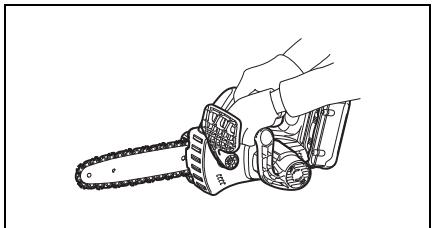
- Maintain a firm grip, with thumbs and fingers encircling the chain saw handles, with both hands on the saw and position your body and arm to allow you to resist kickback forces. Kickback forces can be controlled by the operator, if proper precautions are taken. Do not let go of the chain saw.
011443
- Do not overreach and do not cut above shoulder height. This helps prevent unintended tip contact and enables better control of the chain saw in unexpected situations.
- Only use replacement bars and chains specified by the manufacturer. Incorrect replacement bars and chains may cause chain breakage and/or kickback.
-
Follow the manufacturer's sharpening and maintenance instructions for the saw chain. Decreasing the depth gauge height can lead to increased kickback.
-
Before starting work, check that the chain saw is in proper working order and that its condition complies with the safety regulations. Check in particular that:
-
The chain brake is working properly;
- The run-down brake is working properly;
- The bar and the sprocket cover are fitted correctly;
-
The chain has been sharpened and tensioned in accordance with the regulations;
-
Do not start the chain saw with the chain cover being installed on it. Starting the chain saw with the chain cover being installed on it may cause the chain cover to thrown out forward resulting in personal injury and damage to objects around the operator.
SAVE THESE INSTRUCTIONS.
WARNING:
DO NOT let comfort or familiarity with product (gained from repeated use) replace strict adherence to safety rules for the subject product. MISUSE or failure to follow the safety rules stated in this instruction manual may cause serious personal injury.
IMPORTANT SAFETY INSTRUCTIONS
FOR BATTERY CARTRIDGE
- Before using battery cartridge, read all instructions and cautionary markings on (1) battery charger, (2) battery, and (3) product using battery.
- Do not disassemble battery cartridge.
- If operating time has become excessively shorter, stop operating immediately. It may result in a risk of overheating, possible burns and even an explosion.
- If electrolyte gets into your eyes, rinse them out with clear water and seek medical attention right away. It may result in loss of your eyesight.
- Do not short the battery cartridge:
(1) Do not touch the terminals with any conductive material.
(2) Avoid storing battery cartridge in a container with other metal objects such as nails, coins, etc.
(3) Do not expose battery cartridge to water or rain.
A battery short can cause a large current flow, overheating, possible burns and even a breakdown.
- Do not store the tool and battery cartridge in locations where the temperature may reach or exceed 50^ (122^) .
- Do not incinerate the battery cartridge even if it is severely damaged or is completely worn out. The battery cartridge can explode in a fire.
- Be careful not to drop or strike battery.
- Do not use dropped or struck battery.
SAVE THESE INSTRUCTIONS.
Tips for maintaining maximum battery life
- Charge the battery cartridge before completely discharged.
Always stop tool operation and charge the battery cartridge when you notice less tool power. - Never recharge a fully charged battery cartridge. Overcharging shortens the battery service life.
- Charge the battery cartridge with room temperature at 10^ - 40^ (50^ - 104^) . Let a hot battery cartridge cool down before charging it.
- Charge the battery cartridge once in every six months if you do not use it for a long period of time.
FUNCTIONAL DESCRIPTION
CAUTION:
- Always be sure that the tool is switched off and the battery cartridge is removed before adjusting or checking function on the tool.
Installing or removing battery cartridge (Fig. 1)
CAUTION:
- Always switch off the tool before installing or removing of the battery cartridge.
- Hold the tool and the battery cartridge firmly when installing or removing battery cartridge.
Failure to hold the tool and the battery cartridge firmly may cause them to slip off your hands and result in damage to the tool and battery cartridge and a personal injury.
To remove the battery cartridge, slide it from the tool while sliding the button on the front of the cartridge.
To install the battery cartridge, align the tongue on the battery cartridge with the groove in the housing and slip it into place. Insert it all the way until it locks in place with a little click. If you can see the red indicator on the upper side of the button, it is not locked completely.
CAUTION:
Always install the battery cartridge fully until the red indicator cannot be seen. If not, it may accidentally fall out of the tool, causing injury to you or someone around you.
- Do not install the battery cartridge forcibly. If the cartridge does not slide in easily, it is not being inserted correctly.
Switch action (Fig. 2)
CAUTION:
- Before installing the battery cartridge into the tool, always check to see that the switch trigger actuates properly and returns to the "OFF" position when released.
To prevent the switch trigger from being accidentally pulled, a lock-off button is provided.
To start the tool, depress the lock-off button and pull the switch trigger. Release the switch trigger to stop.
Checking the chain brake (Fig. 3)
NOTE:
- If the chain saw fails to start, the chain brake must be released. Pull the front hand guard backwards firmly until you feel it engage.
Hold the chain saw with both hands when switching it on. Hold the top handle with your right hand, the front handle with your left. The bar and the chain must not be in contact with any object.
First press the lock-off button, then the switch trigger.
The saw chain starts immediately.
Press the front hand guard forwards using the back of your hand. The saw chain must come to an immediate standstill.
CAUTION:
- Should the saw chain not stop immediately when this test is performed, the saw may not be used under any circumstances. Consult a MAKITA specialist repair shop.
Checking the run-down brake
Switch on the chain saw.
Release the switch trigger completely. The saw chain must come to a standstill within one second.
CAUTION:
- Should the saw chain not come to a stop within one second when this test is performed, the saw must not be used. Consult a MAKITA specialist repair shop.
Adjusting the chain lubrication (Fig. 4)
You can adjust the oil pump feed rate with the adjusting screw. The amount of oil can be adjusted using the universal wrench.
Carabiner (rope attachment point) (Fig. 5)
Carabiner (Rope attachment point) is for use of tool hanging. Before using carabiner, pull it out and tie it with a rope.
Battery protection system
Lithium-ion batteries are equipped with a protection system. This system automatically cuts off power to the tool to extend battery life.
The tool will automatically stop during operation if the tool and/or battery are placed under one of the following conditions:
Overloaded:
The tool is operated in a manner that causes it to draw an abnormally high current.
In this situation, release the switch trigger on the tool and stop the application that caused the tool to become overloaded. Then pull the switch trigger again to restart.
If the tool does not start, the battery is overheated. In this situation, let the battery cool before pulling the switch trigger again.
- Low battery voltage:
The remaining battery capacity is too low and the tool will not operate. In this situation, remove and recharge the battery.
Battery remaining capacity indicator (only for models with Battery BL3622A)
Battery BL3622A is equipped with the battery remaining capacity indicator. (Fig. 6)
Press the CHECK button to indicate the battery remaining capacity. The indicator lamps will then light for approx. three seconds.
011713
| Indicator lamps | Remaining capacity | ||
| Lighted Off Blinking | |||
| E F | 70% to 100% | ||
| 45% to 70% | |||
| 20% to 45% | |||
| 0% to 20% | |||
| Charge the battery. | |||
| The battery may have malfunctioned. | |||
- When only the lowermost indicator lamp (next to the "E") blinks, or when none of the indicator lamps light, the battery charge has run out, so the tool does not operate. In these cases, charge the battery or replace the empty battery with a fully charged one.
- When two or more indicator lamps do not light even after charging is complete, the battery has reached the end of its service life.
- When the upper two and lower two indicator lamps light alternately, the battery may have malfunctioned. Contact your local Makita authorized service center.
NOTE:
- The indicated charge may be lower than the actual level during use or immediately after using the tool.
- Depending on the conditions of use and the ambient temperature, the indication may differ slightly from the actual capacity.
ASSEMBLY
CAUTION:
- Always be sure that the tool is switched off and the battery cartridge is removed before carrying out any work on the tool.
Installing or removing saw chain
CAUTION:
- Always be sure that the tool is switched off and the battery cartridge is removed before installing or removing the saw chain.
-
Always wear gloves when installing or removing the saw chain.
-
To remove the saw chain, slightly slide the lever in the direction of arrow so that it can be released from the locked position and move the lever in the upright position as shown in the figure. (Fig. 7)
- Press the lever and with the lever pressed in, turn it counterclockwise to loosen the nut until sprocket cover comes off. (Pressing in the lever leads to the fitting of lever into the nut.) (Fig. 8)
- Turn the adjusting dial counterclockwise to release the saw chain tension.
- Remove the sprocket cover.
- Remove the saw chain and guide bar from the chain saw.
- To install the saw chain, fit in one end of the saw chain on the top of the guide bar and the other end of it around the sprocket. (Fig. 9)
At this time, fit the saw chain as shown in the figure because it rotates in the direction of arrow.
- Rest the guide bar in place on the chain saw.
- Turn the adjusting dial counterclockwise to slide the adjusting pin in the direction of arrow. (Fig. 10)
- Place the sprocket cover on the chain saw so that the adjusting pin is positioned in a small hole in the guide bar. (Fig. 11)
- Press in the lever and with the lever depressed turn it fully clockwise to tighten the nut. Then make it about a quarter turn counterclockwise to loosen the nut lightly. (Fig. 12)
Adjusting saw chain tension
The saw chain may become loose after many hours of use. From time to time check the saw chain tension before use. (Fig. 13)
Move the lever in the upright position.
Press in the lever. With the lever depressed, make a quarter turn on it counterclockwise to loosen the nut lightly. (Pressing in the lever leads to the fitting of lever into the nut.) (Fig. 14)
Turn the adjusting dial to adjust saw chain tension. Grasp the saw chain in the middle of the guide bar and lift up. The gap between the guide bar and the tie strap of the saw chain should be approx. 2 - 4mm . If the gap is not approx. 2 - 4mm , slightly turn the adjusting dial which secures the guide bar. At this time, adjust with the tip of guide bar slightly pointing up. (Fig. 15)
With the lever depressed, turn it fully clockwise to tighten the nut firmly. (Fig. 16)
Return the lever to its original position. (Fig. 17)
CAUTION:
- Excessively high tension of saw chain may cause breakage of saw chain, wear of the guide bar and breakage of the adjusting dial.
- Installing or removing saw chain should be carried out in a clean place free from sawdust and the like.
Battery adapter (Accessory) (Fig. 18 & 19)
CAUTION:
- Before using battery adapter, read all instructions on tools using battery.
- When charging a battery cartridge, first remove it from the battery adapter and then charge it. It is not allowed to charge the battery cartridge while using battery adapter.
Installing or removing battery adapter
- Always switch off the tool before insertion or removal of the battery adapter.
- To remove the battery adapter, slide it from the tool while sliding the button on the adapter.
- To install the battery adapter, align the tongue on the battery adapter with the groove in the housing and slip it into place. Insert it all the way until it locks in place with a little click. If you can see the red indicator on the upper side of the button, it is not locked completely.
CAUTION:
Always install the battery adapter fully until the red indicator cannot be seen. If not, it may accidentally fall out of the tool, causing injury to you or someone around you.
- Do not install the battery adapter forcibly. If the adapter does not slide in easily, it is not being inserted correctly.
- The way of removing or installing a battery cartridge from or on the battery adapter is the same as that of removing or installing it from or on the tools.
- Press down the hook securely as far as it will go when the battery adapter is hooked on the waist belt and similar objects.
Arm cord hook (Accessory) (Fig. 20)
CAUTION:
- Do not attach the holder of arm cord hook to other than the extension cord. Failure to do so may cause an accident or personal injury.
Using the arm cord hook helps to minimize a risk of cutting off the extension cord unexpectedly caused by the loose extension cord.
Attach firmly the arm cord hook band placing around your arm and pass the extension cord through the holder. The length of the arm cord hook band is adjustable.
NOTE:
- Do not pass the extension cord through the band.
- Do not force the opening of the holder. Failure to do so may cause deflection and damage to it.
OPERATION
Lubrication (Fig. 21)
Saw chain is automatically lubricated when the tool is in operation.
Check the amount of remaining oil in the oil tank through the oil inspection window.
To refill the tank, remove the cap from the oil tank opening. The oil tank capacity is 85ml
After refilling the tank, always screw the provided oil tank cap on the chain saw.
CAUTION:
- When filling the chain saw with chain oil for the first time, or refilling the tank after it has been completely emptied, add oil up to the bottom edge of the filler neck. The oil delivery may otherwise be impaired.
- As a saw chain oil, use oil exclusively for Makita chain saws or oil available in market.
- Never use oil including dust and particles or volatile oil.
- When pruning trees, use botanical oil. Mineral oil may harm trees.
- Never force the chain saw when pruning trees.
- Before cutting out, make sure that the provided oil tank cap is screwed in place.
Hold the chain saw away from the tree. Start it and wait until lubrication on saw chain is adequate.
Bring the lower guide into contact with the branch to be cut before switching on. Cutting without bringing the lower guide into contact with the branch may cause the guide bar to wobble, resulting in injury to operator.
Saw the wood to be cut by just moving it down. (Fig. 22)
WORKING WITH THE CHAIN SAW
The first time user should, as a minimum practice, do cutting logs on a saw-horse or cradle.
Pruning trees
CAUTION:
- Keep all parts of the body away from the saw chain when the motor is operating.
- Hold the chain saw firmly with both hands when the motor is running.
- Do not overreach. Keep proper footing and balance at all times.
Bring the lower guide into contact with the branch to be cut before switching on. Cutting without bringing the lower guide into contact with the branch may cause the guide bar to wobble, resulting in injury to operator. (Fig. 23)
When cutting thick branches, first make a shallow undercut and then make the finish cut from the top. (Fig. 24) If you try to cut off thick branches from the bottom, the branch may close in and pinch the saw chain in the cut. If you try to cut off thick branches from the top without a shallow undercut, the branch may splinter. (Fig. 25)
If you cannot cut the timber right through with a single stroke:
Apply light pressure to the handle and continue sawing and draw the chain saw back a little; then apply the spike a little lower and finish the cut by raising the handle.
(Fig. 26)
Bucking
For bucking cuts, rest the serrated rail shown in the figure on the wood to be cut. (Fig. 27)
With the saw chain running, saw into the wood, using the top handle to raise the saw and the front one to guide it. Use the serrated rail as a pivot.
Continue the cut by applying slight pressure to the front handle, easing the saw back slightly. Move the serrated rail further down the timber and raise the front handle again.
When making several cuts, switch the chain saw off between cuts.
CAUTION:
- If the upper edge of the bar is used for cutting, the chain saw may be deflected in your direction if the chain becomes trapped. For this reason, cut with the lower edge, so that the saw will be deflected away from your body. (Fig. 28)
Cut wood under tension on the pressure side (A) first.
Then make the final cut on the tension side (B). This prevents the bar from becoming trapped. (Fig. 29)
Limbing
CAUTION:
- Limbing may only be performed by trained persons. A hazard is presented by the risk of kick-back.
When limbing, support the chain saw on the trunk if possible. Do not cut with the tip of the bar, as this presents a risk of kickback.
Pay particular attention to branches under tension. Do not cut unsupported branches from below.
Do not stand on the felled trunk when limbs.
Burrowing and parallel-to-grain cuts
CAUTION:
- Burrowing and parallel-to-grain cuts may only be carried out by persons with special training. The possibility of kickback presents a risk of injury.
Perform parallel-to-grain cuts at as shallow an angle as possible. Carry out the cut as carefully as possible, as the serrated rail cannot be used. (Fig. 30)
Felling
CAUTION:
- Felling work may only be performed by trained persons. The work is hazardous.
Observe local regulations if you wish to fell a tree.
- Before starting felling work, ensure that: (Fig. 31)
(1) Only persons involved in the felling operation are in the vicinity;
(2) Any person involved has an unhindered path of retreat through a range of approximately 45^ either side of the felling axis. Consider the additional risk of tripping over electrical cables;
(3) The base of the trunk is free of foreign objects, roots and branches;
(4) No persons or objects are present over a distance of 2 1/2 tree lengths in the direction in which the tree will fall.
-
Consider the following with respect to each tree:
-
Direction of lean;
- Loose or dry branches;
- Height of the tree;
Natural overhang; -
Whether or not the tree is rotten.
-
Consider the wind speed and direction. Do not carry out felling work if the wind is gusting strongly.
- Trimming of root swallows: Begin with the largest swellings. Make the vertical cut first, then the horizontal cut. (Fig. 32)
- Cut a scarf: The scarf determines the direction in which the tree will fall, and guides it. It is made on the side towards which the tree is to fall. Cut the scarf as close to the ground as possible. First make the horizontal cut to a depth of 1/5 - 1/3 of the trunk diameter. Do not make the scarf too large. Then make the diagonal cut.
- Cut any corrections to the scarf across its entire width.
- Make the back cut a little higher than the base cut of the scarf. The back cut must be exactly horizontal. Leave approximately 1/10 of the trunk diameter between the back cut and the scarf.
The wood fibers in the uncut trunk portion act as a hinge. Do not cut right through the fibers under any circumstances, as the tree will otherwise fall unchecked. Insert wedges into the back cut in time. (Fig. 33)
- Only plastic or aluminum wedges may be used to keep the back cut open. The use of iron wedges is prohibited.
- Stand to the side of the falling tree. Keep an area clear to the rear of the falling tree up to an angle of 45^ either side of the tree axis (refer to the "felling area" figure (Fig. 31)). Pay attention to falling branches.
- An escape path should be planned and cleared as necessary before cuts are started. The escape path should extend back and diagonally to the rear of the expected line of fall as illustrated in figure. (Fig. 34)
Carrying tool (Fig. 35)
Always remove the battery cartridge from the tool and overlap the guide bar with the scabbard before carrying the tool. Also cover the battery cartridge with the battery cover.
MAINTENANCE
CAUTION:
Always be sure that the tool is switched off and the battery cartridge is removed before attempting to perform inspection or maintenance.
- Always wear gloves when performing any inspection or maintenance.
- Never use gasoline, benzine, thinner, alcohol or the like. Discoloration, deformation or cracks may result.
Sharpening the saw chain
CAUTION:
- Always remove the battery cartridge and wear safety gloves when performing work on the saw chain.
Sharpen the saw chain when:
- Mealy sawdust is produced when damp wood is cut;
- The chain penetrates the wood with difficulty, even when heavy pressure is applied;
- The cutting edge is obviously damaged;
- The saw pulls to the left or right in the wood. The reason for this behaviour is uneven sharpening of the saw chain, or damage to one side only. (Fig. 36)
Sharpen the saw chain frequently, but remove only a little material each time.
Two or three strokes with a file are usually sufficient for routine resharpening. When the saw chain has been resharenped several times, have it sharpened in a MAKITA specialist repair shop.
File and file guiding
-
Use a special round file (optional accessory) for sharpening.
-
Saw chain type 91VG and 91PX: Saw chain round file, diameter 4.0mm
-
Saw chain type 90SG: Saw chain round file, diameter 4.5mm
-
The file should only engage the material on the forward stroke. Lift the file off the material on the return stroke.
- Sharpen the shortest cutter first. The length of this cutter is then the gauge dimension for all other cutters on the saw chain.
- Guide the file as shown in the figure. (Fig. 37)
- The file can be guided more easily if a file holder (accessory) is employed. The file holder has markings for the correct sharpening angle of 30^ (align the markings parallel to the saw chain) and limits the depth of penetration (to 4/5 of the file diameter).
Guide the file as shown in the figure. (Fig. 38)
- After sharpening the chain, check the height of the depth gauge using the chain gauge tool (optional accessory).
- Remove any projecting material, however small, with a special flat file (optional accessory).
- Round off the front of the depth gauge again.
- Wash away dust and particles from saw chain after adjusting the height of depth gauge.
Cleaning guide bar (Fig. 39)
Chips and sawdust will build up in the guide bar groove, clogging it and impairing oil flow. Always clean out the chips and sawdust when sharpening or replacing the saw chain.
Cleaning the oil discharge hole
Small dust or particles may be built up in the oil discharge hole during operation.
Small dust or particles built up in the oil discharge hole may impair the oil discharge flow and cause an insufficient lubrication on the whole saw chain.
When a poor chain oil delivery occurs at the top of guide bar, clean the oil discharge hole as follows.
Remove the battery cartridge from the tool.
Remove the sprocket cover and saw chain from the tool. (Refer to the section titled "Installing or removing saw chain")
Remove the small dust or particles using a slotted bit screwdriver with a slender shaft or the like. (Fig. 40) Insert the battery cartridge into the tool.
Pull the switch trigger to flow built-up dust or particles off the oil discharge hole by discharging chain oil. (Fig. 41)
Remove the battery cartridge from the tool.
Reinstall the sprocket cover and saw chain on the tool.
Replacing the sprocket (Fig. 42 & 43)
Before fitting a new saw chain, check the condition of the sprocket.
CAUTION:
- A worn sprocket will damage a new saw chain. Have the sprocket replaced in this case. The sprocket need to be installed so that it always faces as shown in the figure.
Always fit a new locking ring when replacing the sprocket.
Replacing carbon brushes (Fig. 44 & 45)
Remove and check the carbon brushes regularly. Replace when they wear down to the limit mark. Keep the carbon brushes clean and free to slip in the holders. Both carbon brushes should be replaced at the same time. Use only identical carbon brushes.
Use a screwdriver to remove the brush holder caps. Take out the worn carbon brushes, insert the new ones and secure the brush holder caps.
Storing tool
Clean the tool before storing. Remove any chips and sawdust from the tool after removing the sprocket cover. After cleaning the tool, run it under no load to lubricate the saw chain and guide bar.
Cover the guide bar with the scabbard.
Remove oil from the oil tank to empty it and place the chain saw.
To maintain product SAFETY and RELIABILITY, repairs, any other maintenance or adjustment should be performed by Makita Authorized Service Centres, always using Makita replacement parts.
CAUTION:
- These accessories or attachments are recommended for use with your Makita tool specified in this manual. The use of any other accessories or attachments might present a risk of injury to persons. Only use accessory or attachment for its stated purpose.
If you need any assistance for more details regarding these accessories, ask your local Makita Service Center.
- Makita genuine battery and charger
- Saw chain
Scabbard - Guide bar complete
- File
- Tool bag
- Battery adapter
- Arm cord hook (to be used together with the battery adapter)
NOTE:
- Some items in the list may be included in the tool package as standard accessories. They may differ from country to country.
ENG905-1
Noise
The typical A-weighted noise level determined according to EN60745:
Sound pressure level (L_DA) : 87.3 dB (A)
Sound power level (L_WA) : 95.3 dB (A)
Uncertainty (K): 3.0 dB (A)
Wear ear protection
ENG900-1
Vibration
The vibration total value (tri-axial vector sum) determined according to EN60745:
Model BUC250, UC250D
Work mode: cutting wood
Vibration emission (a_h) .. 7.0~m / s^2
Uncertainty (K): 1.6m / s^2
Model BUC300, UC300D
Work mode: cutting wood
Vibration emission (a_h) .. 6.3~m / s^2
Uncertainty (K): 1.5m / s^2
ENG901-1
- The declared vibration emission value has been measured in accordance with the standard test method and may be used for comparing one tool with another.
- The declared vibration emission value may also be used in a preliminary assessment of exposure.
WARNING:
- The vibration emission during actual use of the power tool can differ from the declared emission value depending on the ways in which the tool is used.
- Be sure to identify safety measures to protect the operator that are based on an estimation of exposure in the actual conditions of use (taking account of all parts of the operating cycle such as the times when the tool is switched off and when it is running idle in addition to the trigger time).
For European countries only
EC Declaration of Conformity
We Makita Corporation as the responsible manufacturer declare that the following Makita machine(s):
Designation of Machine:
Cordless Chain Saw
Model No./ Type: BUC250, UC250D, BUC300, UC300D
Specifications: see "SPECIFICATIONS" table.
are of series production and
Conforms to the following European Directives:
2000/14/EC, 2006/42/EC
And are manufactured in accordance with the following
standards or standardised documents:
EN60745
The EC-Type Examination Certificate No. 4811008.12010
The EC-Type Examination per 2006/42/EC was performed by:
DEKRA Testing and Certification GmbH
Enderstrasse 92b
01277 Dresden
Germany
Identification No. 2140
The technical documentation is kept by:
Makita International Europe Ltd.
Technical Department,
Michigan Drive, Tongwell,
Milton Keynes, Bucks MK15 8JD, England
The conformity assessment procedure required by Directive 2000/14/EC was in Accordance with annex V.
Measured Sound Power Level: 95.2 dB (A)
Guaranteed Sound Power Level: 98.0 dB (A)
31.7.2012

Tomoyasu Kato
Director
Makita Corporation
3-11-8, Sumiyoshi-cho,
Anjo, Aichi, 446-8502, JAPAN
Descriptif
ACCESSIONS EN OPTION
ATTENTION:
Michigan Drive, Tongwell,
Milton Keynes, Bucks MK15 8JD, Angleterre
3-11-8, Sumiyoshi-cho,
Anjo, Aichi, 446-8502, JAPAN
Ubersicht
Michigan Drive, Tongwell,
Milton Keynes, Bucks MK15 8JD, England
3-11-8, Sumiyoshi-cho,
Anjo, Aichi, 446-8502, JAPAN
Visione generale
Incertezza (K): 3,0 dB (A)
Michigan Drive, Tongwell,
Milton Keynes, Bucks MK15 8JD, England
3-11-8, Sumiyoshi-cho,
Anjo, Aichi, 446-8502, JAPAN
OPTIONELE ACCESSOIRES
letOP:
2000/14/EC, 2006/42/EC
Michigan Drive, Tongwell,
Milton Keynes, Bucks MK15 8JD, England
3-11-8, Sumiyoshi-cho,
Anjo, Aichi, 446-8502, JAPAN
Incerteza (K): 3,0 dB (A)
2000/14/EC, 2006/42/EC
Michigan Drive, Tongwell,
Milton Keynes, Bucks MK15 8JD, Inglaterra
3-11-8, Sumiyoshi-cho,
Anjo, Aichi, 446-8502, JAPAN
Explicação geral
2000/14/EC, 2006/42/EC
E está fabricadas de acordo com as següntes normas ou documents normativos: EN60745
Michigan Drive, Tongwell,
Milton Keynes, Bucks MK15 8JD, Inglaterra
3-11-8, Sumiyoshi-cho,
Anjo, Aichi, 446-8502, JAPAN
Michigan Drive, Tongwell,
Milton Keynes, Bucks MK15 8JD, England
3-11-8, Sumiyoshi-cho,
Anjo, Aichi, 446-8502, JAPAN
Iepiypaqni yeviknc aioyns
Evike npoepoonoiaeic aphiiaic yia to nEKTpiko epyaleio
IPOEIAONIOIHs HiaaTe oAe TIC npoeiOnoiaeic aaoaieac kai oAe tic onyiec. H un nponan tw npoeiOnoioewv kai onnyiw evexetai vatahale e nAektpoanxi, npkayia n/kai ooapotpaumatuo.
ΦuaETe oAES TIGPOeIDoONIOeG KAI TIG OBNyIe γia μελλovTik npaponμn.
ANYSONPIONOMIATAPIA NPOEIANOIOIHSEI AZAAMEIAZ:
EPTAIA ME TO AYZONPIONO
Tny npot npoc anokton enlambdaotnc euneipia, o xnoTnc 0a npenei va enixepnoe i kaotei koutoupa nawo e kaaleto n baon otnpieNc.
Kλδεμa δεντρωv
IPOZOXH:
Kpatate ola ta np tou oawaros caaakpi a nToV aluaida npoviou otav to potep aeitoupye.
Kpatata to aluonpiovo yepa ta duo oac xepia otav to potep etioupei.
Mny unoβáλεσe Ε Ε unερπροσηαειa. Kpatáτε navtoε σαθερο nατημα kaiynv Ioopponia oac.
AkoumnotevotkwOnyo naW oTo klaodi npoc Konnpiv ano tnv evpyooinn. Eav enixepnoeTe Konxwpiavkaoumnoetovkatoyno naW OTO klaedi,Evdoxtavpoklambda Kluovioucntkateuuvtniac laaic me anotelaa Tpaumatou Tou xeiupit. (Eik.23)
Otav KoBTe XovTpKa Kaia, npwTa va Kavete eva EtniavEiaKoYmu ano KATW KAe ta oLokpnpwot TnV KOAn to naV w epoC (Eik.24) Av npOanAetaeTv kaoyete XovTpKa Kaia ano To katw epoC, to klaedi mOpei VA KEAioi kai va uoufiei TnV aluaDi npiovoiu eoa stnv konm.Av npOanAetaeTv kaoyete XovTpKa Kaia ano To naV w epoC xwoic To eniavEvaKoYmu ano To katw epoC, to klaedi mOpei VA oxiotei (Eik.25)
Av 6ev mopoeite va kOeTe to Eulo teAeioc me ia npooaBia:
EapuotE eAaepia nTn xeipolaKa uevxioTe To npioviama KAI TpaBnEte To aluaonpiovo liyo npoc Ta niOw, mTa ouvexiote To koiu oLiyo nio Kat kW ai OOKnpoTe Tnv Konu wovnt Nxepoala. (Eik.26)
TeiaiooKopow
Tia topec Teaxiaouo Koprav, akouimote Tny obovtni paya nou urokeivetai otnv eikova naov tso luoc kom. (Eik 27)
Me Tn aluaia npioiu o ae iitoupyia, pioviote to EuAo, xnoiopoioiwvTac nV avw labn ia va avaonkwveTe to aluaonpiivo kai tn nppootivn labn yia va to katueuovte.
Xpnooioe Tnv oovtw npaya wKevtpo nepiopocn.
UvexioTe Tnv Konn aokwvtac mkpn nieon ot nmuoovni kai tpaowts to aluooepiovo eapaa poc ta niaw. MetakivnoTe Tnv obovtwn paia nio kaTOWov KOpko ai vaoankwote EaVa tn nuoovni
Otav ekteleite noaec topec, va antepeytonoeite To auaanopio metaEu tow towouw.
IPOZOxH:
Eav xpnaionoinoTe TnV avw akun tnc laaac yia tvn kon, to aluoonpiivo evdoexetai va ektpanei npoc to epos oac oe nepittwn nayideuanc. Ta to loyo auto, n kon Thea npenei va ekteleita Xpnaionoiowvtae Tny katw akun, wote to aluoonpiivo va ektpenetai aakpiia ano to ouaa oac.(Eik.28)
Kopty evav kopo un oEvtaon, otny nAupa TnC niEONS (A) npota.
Tn ouvexia, kTeAeTe Tny TEaikn KOnn otyn nIeupa Tnc EvtaonC) E. Ta 0 anofoyete Toxov naideouan Tns lacua. (Eik.29)
Anoklaδwo
IPOZOxH:
H epyaia Tns anoklaobowc Ta npen va ekteiaitau movov ano ektnaeduueva atoua. H eikivvovotnta ophielta otov kivduvo avakpouoNC.
Otau divepeite epyaia anoklaodomega, va otpiicte to aluoonpiovo naaw oTov kopo, eav eiva duvatov. Dv th npenei va xpooiopoite to akpo tns laac yia nTv kon, biot unapxiv kivduovos avakouanc.
Na npooexte idaiitepa ta klaia uno evtaon. Mny Koe t n unootnpicova klaia ano to katw eopoc.
Mny otkeote navw oToV teuaxioevo KOpO kata Tnv anoklaowon.
Tpoxia alambdaic npioiu
IPOSOXH:
Na aphiapeite nata tvn kaeta tnatapiac kai va opate yavtia oaaaleiac, kata tn EkTeLeon epyaiaic to tn auoiada npiovioi.
Na troxige Te nV aluaia npioiu oTav:
- NapayéTai aεupδες πριονία κατὰ την κοπη uγρού Σιλου·
-H aIauoia diaenepva to Eulo duokolia,akoun kai otav aoketial eyaan nieon
-Eivai npophiavc otu n akun konnc exei unootei Znmuia
To npiovi othei aipotepa n deEla evto cou Eulou. O yovocou oumaiveu auto eiva to m oiaopp0 troxiaama tnc aluaiodac npioviou n Znlia otmia nAeupa mvo. (Eik. 36)
Na troxicTe Tnv aluoiDi npioviou ouxva, aAa va aphiieTe liyo movo ulko kaOe opa.
uo n tripa nepaumata me tn lja enapkouv ouvnthetayia loyous troxioaatoqoutiac. Otav naulua npioiuexei troxioatei apketec opec, avaote to troxioa oe Eeikueve kataotma eIOKEUW TNS MAKITA.
Aipakaioynyonlaic
- Na xρηομοιοειε εἰδική στρογγυλή λιμα (προαρετικό εξάρτημα) γι ακόνισμα.
-Tuioac aluaoidac npiovio 91VG kai 91PX: Tspovyuln lia aaluoic npiovou, diaetpoc 4,0 xu.
-Tunoc aauoiadac npioviou 90SG: Tpoyyuln iua aauoiadac npioviou, diuetpo4,5xla.
-H iia 0a npenei va epxetai e enaafn m to taaloo mvo kata nyn pootheta kivon. Na avaonkovete n laa ano to mtaaloo kat a nvi niowknon. - Na troxiciTe TO mikpOTePO kOnTn npwTa. To nKoc autou Tou kOnTn anoteAei OTN ouvExia To eTpo ouKyipians yia olouc tou unloaiouc kOnTEC TNC auoiDiac pioiovI.
- Na obnyeite Tn liua onwoc unoBekvuetai otny Eikova. (Eik. 37)
-H oynon nTc liac kaotatai TIO ekoan, evxnaioioie toukykpatntnpa liac (napeAkoevo).O oukykpatntnpac TcN liac diabetet evdeixic yia tvny kataaannywvia tpoxiaatoc 30^ (euoyypamiatc t cEvdiEic npalna 1papalna μe tnv aluoianda piovou) kai nepiopiTe to baoc dieioduaonc (4/5 TNC diapertou nTc liac).
Na oynyeite Tn Iiua onwc unodekvctai otny EIKova.(EIK.38)
MovTeLo BUC250,UC250D
Movi yia xwpe ts Eupwnns
Anawon Suuipopwoanc EK
2000/14/EK, 2006/42/EK
Kai kataokeuacovta ouofova me ta akoloutheta npotuna n eyypaa tunontoinanc: EN60745
To Iiotonoiŋtiko Eεεtaaŋc Túnou EK ap. 4811008.12010
H E E E Taon turok EK 806/42/EK divepyn9nK
DEKRA Testing and Certification GmbH
Enderstrasse 92b
01277 Dresden
Germany (Fερμαvia)
Ap. tauonoinos 2140
To x i p o o p i k o uIko diatnpetai ano:
Makita International Europe Ltd.
Technical Department (Tεχνικό Tμήμα),
Michigan Drive, Tongwell,
Milton Keynes, Bucks MK15 8JD, England
(Ayyia)
H anaiooueyni daiokaia aEioLoynoC OouoPpOwnc Baei nTc Odyia c 2000/14/EK nTav ouoPooyn e To Iapaptnja V.
3-11-8, Sumiyoshi-cho,
Anjo, Aichi, 446-8502, JAPAN
Makita Corporation
Anjo, Aichi, Japan