
NV -U 52F - Gps SONY - Free user manual and instructions
Find the device manual for free NV -U 52F SONY in PDF.



| Product type | Personal navigation GPS |
| Brand | Sony |
| Model | NV-U52F |
| Dimensions (L × H × D) | Approx. 108 × 82 × 48 mm |
| Weight | Approx. 275 g |
| Display | 3.5-inch TFT LCD (4:3), 960 × 240 pixels |
| Power supply | 5-5.2 V DC (12/24 V car adapter, USB cable, optional AC adapter) |
| Battery life | Up to 3.5 hours (depending on usage) |
| Charging time (car adapter) | Approx. 3.5 h (power on) / 2.5 h (standby) |
| Charging time (USB) | Approx. 4 h (standby) |
| GPS antenna | Built-in |
| Main functions | GPS navigation, voice guidance, touch screen, gesture control, address/POI search, Memory Stick Duo, TMC (depending on model) |
| Connections | DC IN 5-5.2 V, USB, TMC antenna (compatible models), Memory Stick Duo slot |
| Speaker | Built-in (oval 20 × 40 mm) |
| Operating temperature | 5 °C to 45 °C |
| Supplied accessories | Car adapter, USB cable, suction cup mount, manual, quick start guide |
| Maintenance | Clean suction cup with a soft damp cloth; screen with a cleaning cloth; replace fuse (2.5 A) |
| Safety | Unobstructed installation, do not look at the screen while driving, stop the vehicle for adjustments |
| Spare parts and repairability | Replaceable fuse; built-in lithium-ion battery not easily replaceable (remove for disposal) |
Frequently Asked Questions - NV -U 52F SONY
User questions about NV -U 52F SONY
0 question about this device. Answer the ones you know or ask your own.
Ask a new question about this device
Download the instructions for your Gps in PDF format for free! Find your manual NV -U 52F - SONY and take your electronic device back in hand. On this page are published all the documents necessary for the use of your device. NV -U 52F by SONY.
USER MANUAL NV -U 52F SONY
Customer Support Portal
If you have any questions or for the latest support information on navigation, visit the website below:
http://www.navu.sony-europe.com/support
Sony Corporation Printed in Thailand
SONY
SONY®
Personal Navigation System Quick Start Guide
nav-u

MEMORY STICK TM
NV-U72T
NV-U52
© 2007 Sony Corporation
3-198-859-21 (1)
Quick Start Guide
GB
Anleitung zur schllen Inbetriebnahme
DE
Guide de démarriage rapide
FR
Beknopte handleiding
NL
Guida rapida all'uso
IT
Guiá de inizio rápido
ES
Snabbstartguide
SE
Guia de iniciação<rapida
PT
How to use this manual
When reading this manual, keep the control layout illustration (on the rear of this page) open for quick reference from any page.
Hinweis zu dieser
Bedienungsanleitung
- This Quick Start Guide contains instructions for basic operations. Before installing and operating this system, read this manual and the supplied "Read This First" (Installation Manual) thoroughly. For more information, see the PDF manual on the supplied Application Disc.
- Illustrations in this manual may differ from the actual device.
- Retain this manual and "Read This First" in a place where you can refer to them at any future time.

Disposal of Old Electrical & Electronic Equipment (Applicable in the European Union and other European countries with separate collection systems)

This symbol on the product or on its
packaging indicates that this product shall not be treated as household waste. Instead it shall be handed over to the applicable collection point for the recycling of electrical and electronic equipment. By ensuring this product is disposed of correctly, you will help prevent potential negative consequences for the environment and human health, which could otherwise be caused by inappropriate waste handling of this product. The recycling of materials will help to conserve natural resources. For more detailed information about recycling of this product, please contact your local Civic Office, your household waste disposal service or the shop where you purchased the product.
Applicable accessory: Car battery adapter

The manufacturer of this product is Sony Corporation, 1-7-1 Konan Minato-ku Tokyo 108-0075 Japan.
The Authorized Representative for EMC and product safety is Sony Deutschland GmbH, Hedelfinger Strasse 61, 70327 Stuttgart, Germany. For any service or guarantee matters please refer to the addresses given in separate service or guarantee documents.
Caution
IN NO EVENT SHALL SONY BE LIABLE FOR ANY INCIDENTAL, INDIRECT OR CONSEQUENTIAL DAMAGES OR OTHER DAMAGES INCLUDING WITHOUT LIMITATION LOSS OF PROFITS, LOSS OF REVENUE, LOSS OF DATA, LOSS OF USE OF THE PRODUCT OR ANY ASSOCIATED EQUIPMENT, DOWNTIME, AND
PURCHASER'S TIME RELATED TO OR ARISING OUT OF THE USE OF THIS PRODUCT, ITS HARDWARE AND/OR ITS SOFTWARE.
On copyrights
The map and POI data may contain copyrighted material. Copyrighted data on a "Memory Stick Duo" should be used within the limits of the copyright law. Do not violate the provisions of the copyright law.
On trademarks
- Microsoft and Windows are registered trademarks of Microsoft Corporation.
"Memory Stick", "Memory Stick Duo", MEMORY STICK DUO, "Memory Stick PRO Duo", MEMORY STICK PRO DUO, "MagicGate", MAGICGATE, "nav-u" and NAV-U are trademarks of Sony Corporation.
"MagicGate" is a generic name of a copyright protection technology, developed by Sony Corporation.
- All other trademarks are trademarks of their respective owners.

vtrafic
V-Trafic Information in France is provided by Mediamobile company.

Traffic Information in the UK is provided by ITIS Holdings Plc.
© 1993 NAVTEQ. All Rights Reserved.
Ausw/Italy © 1994
Austria © 1996
Belgium © 1995
Benelux © 1993
Central Europe © 1993
Czech Republic © 2002
Denmark © 1997
Finland © 2001
France © 1993
Germany © 1993
Great Britain © 1993
Italy © 1994
Luxembourg © 1996
Mediterranean Coast © 1993
Norway © 2001
Portugal © 1997
Spain © 1997
Sweden © 1994
Switzerland © 1996
The Netherlands © 1993
Austria
Croatia, Estonia, Latvia, Lithuania, Poland, Slovenia
© EuroGeographics
France
source: Géoroute® IGN France & BD Carto® IGN France
Germany
Based upon Crown Copyright material
Greece
Copyright Geomatics Ltd.
Hungary
Copyright © 2003; Top-Map Ltd.
Italy
Copyright © 2000; Norwegian Mapping Authority
Portugal
Source: IgeoE - Portugal
Spain
Based upon electronic data © National Land Survey Sweden.
Switzerland
Location of controls. 5
Turning the unit on/off 5
Performing initial setup. 5
Receiving GPS signals 5
Basic Operations 6
Menu operation 6
Gesture Command operation. 6
Keyboard operation 7
Route Searching 7
Setting the destination and starting guidance 7
Setting the destination in other ways. 8
Guidance displays 8
System Settings 10
Using the Supplied Software 10
Contents 10
Connecting to your computer. 10
Additional Information 11
About the "Memory Stick" 11
What is "Memory Stick"? 11
Types of "Memory Stick Duo" that the system can use 11
Note on LCD panel. 12
Maintenance 12
Cleaning 12
Fuse replacement 12
Notes on unit disposal. 12
Specifications 13
Troubleshooting 14
Resetting the unit 14
Warning
PLEASE READ THIS MANUAL AND THE SUPPLIED READ THIS FIRST (INSTALLATION MANUAL) COMPLETELY BEFORE INSTALLING OR OPERATING YOUR PERSONAL NAVIGATION SYSTEM. IMPROPER INSTALLATION OR USE OF THIS DEVICE MAY CAUSE ACCIDENT, INJURY OR DEATH.
On safety
- Be sure to:
- install the navigation system in a safe place where it does not obstruct the driver's view.
not install the unit above an airbag. - place the cables and unit where they do not obstruct driving.
clean the surface of the suction cup and attachment surface before attaching. When installing on the dashboard, clean the surface on which the suction cup will be attached. Also, confirm that the suction cup is securely attached after installation. Otherwise, the unit may fall. Failure to do so may result in unsafe driving conditions. - Do not apply excessive force to the unit as it may fall.
- Comply with local traffic rules, laws and regulations.
- Do not continuously watch the unit while driving. It is dangerous and may cause a traffic accident.
- If you need to operate the navigation system while driving, be sure to stop the car in a safe place before operating.
- Do not modify the unit.
- Do not disassemble the unit except when disposing of it.
On handling
- When the unit is not in use, turn it off by pressing I/O (4). Disconnect the car battery adapter, otherwise battery drain may result. Note the following.
If your car's cigarette lighter socket is not connected to ACC on your ignition switch, power will continue to be supplied to the unit's built-in power supply even when the ignition is off or the unit is not in use.
- Do not connect any accessory other than those supplied or optional.
- Do not expose the unit to fire or water, as it may cause a malfunction.
- To disconnect a cable, pull it out by grasping the plug, not the cable.
- Be sure to remove the unit out of the car when leaving your car to prevent theft or high temperature damage inside the car.
Note that the built-in battery cannot be charged outside the temperature range 5 - 45^ (41 - 113°F). - Do not leave the unit in high ambient temperature as the built-in battery capacity will deteriorate, or it will become unchargeable.
On GPS
As GPS information is obtained from satellites, it may be impossible or difficult to obtain information in locations such as:
- Tunnel or underground
Under a highway - Between high buildings
- Between tall trees with dense foliage
Note
GPS signal reception may be poor depending on the material of the car's windscreen.
On the software
Read the "END-USER LICENSE AGREEMENT" carefully before use.
Location of controls
Refer to the pages listed for details.
1 VOICE/POS. button 6, 7
During route guidance:
To hear the next voice guidance.
In the menu display:
To show the map.
In the map display:
To show your current car position.
2 Display window/touch screen
3 Built-in GPS aerial
4 I/ (on/standby) button 5
To turn the unit on/off.
5 CHG (battery charge) indicator
Lights up in red while charging, and changes to green when fully charged.
When the adapter is disconnected, the indicator goes off.
6 Nameplate
7 TMC antenna (aerial) jack*1
DC IN 5-5.2V jack
To connect to the car battery adapter or AC adapter*2.
9 RESET button 14
10 Memory Stick access indicator
Suction cup
12 Speaker
Outputs guidance and warnings.
USB jack 10
To connect to a computer with the USB cable.
14 Memory Stick Duo slot
For "Memory Stick Duo" insertion for functional expansion.
1 TMC models only
2 Optional accessory
Turning the unit on/off
To turn the unit on/off
Press I/(4).
Note
If you do not use the unit for a long term, the built-in battery may be depleted, and the unit will not turn on. In such a case, connect the car battery adapter and charge the unit.
After you charge the unit, it may take time to receive GPS signals when turning on the unit.
Performing initial setup
Follow the on-screen instructions to perform the setup.
The setting can then be further configured in the setting menu at any time (page 10).
Receiving GPS signals
After the initial installation, park your car in a safe, open place (no high buildings, etc.) for up to 20 minutes to allow for GPS signals to calculate the current car position properly before using the navigation system.
The GPS signal reception condition icon is displayed on the screen. The indicator lights up in red when the signal cannot be received.
Basic Operations
Common procedures to operate the system are explained.
General operations can be performed on the touch screen. Touch the displayed icons with your finger gently.
Note
Do not press the display with excessive force, or use any sharp article, such as a pen, etc., to tap on the display.
Menu operation
The top menu appears when turning on the unit by pressing I/O (except during route guidance, in which case the map appears).
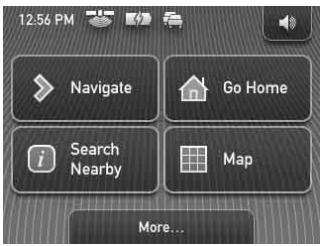
To show the top menu from the map display, touch the map.
To return to the top menu from any menu display, press VOICE/POS., then touch the map.
During menu operation:
To return to the previous display, touch or X.
To cancel the menu selection, press VOICE/POS. (the current car position display appears).
Gesture Command operation
In map displays (except in map scrolling mode), by assigning a screen finger stroke such as line, etc., frequently-used operations can be performed easily.
| To | Draw |
| start navigation to your home | a circumflex |
| start navigation to the nearest POI (Point Of Interest) stored on Quick Links* | Quick Link 1 horizontal line (left to right) |
| Quick Link 2 vertical line (downwards) | |
| Quick Link 3 horizontal line (right to left) |
- For details on Quick Links, see page 8.
Keyboard operation
The keyboard display appears when you need to enter text.
You need only enter characters in upper case, as the system automatically converts them to appropriate characters. You can enter special characters when necessary.
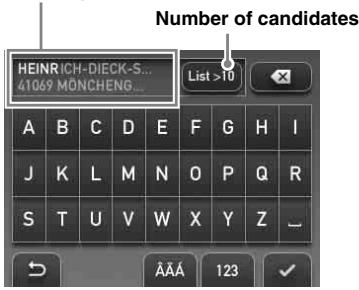
Candidate/entry field
| To | Touch |
| enter an alphabetical character | the desired character key |
| enter a special character | “ÂÄÁ” to switch to the special character keyboard, then the desired character; and “ABC” to switch back |
| enter a number | “123” to switch to the numeric keyboard, then the desired number key; and “ABC” to switch back |
| enter a space | - |
| delete a character | × |
| select a candidate | ✓ or the candidate in the list |
| show the candidate list* | “List” |
- The candidate list automatically appears when candidates are narrowed down as you continue inputting characters.
Route Searching
The system searches for routes automatically after setting the destination.
Before starting, check that GPS signals are sufficient for navigation (page 5).
Setting the destination and starting guidance
The procedure for searching for the route and starting route guidance is explained.
As an example, setting the destination by the address is introduced here.
For details on setting the destination in other ways, see "Setting the destination in other ways" on page 8.
1 Show the top menu.
In the map display, touch the map.
In the menu display, press VOICE/POS., then touch the map.
2 Select "Navigate."
3 Select "Address Input," then input the address details.
Input the items in the order below, and touch or the candidate in the list to proceed.
For details on how to input characters, see "Keyboard operation" on page 7.
"Country"
"Town / Postal Code"
If it is possible to pinpoint the destination by the selected postal code*1, the address confirmation display appears. Select "Calculate Route."
3“Street / Destination”
4 "No." or "Intersection"*2
The address confirmation display appears.
1 Available only in the UK and Netherlands.
2 Selectable only if existent in the selected street.
4 Select "Calculate Route."
The route is calculated, and route guidance starts.
Setting the destination in other ways
You can also set the destination and search for routes by the following methods.
From the top menu, select the items in the following order, then "Calculate Route" (if necessary).
For details, see the supplied PDF manual.
Search Nearby
Searches for routes to a POI, such as restaurant, hotel, etc., near the current car position.
Select "Search Nearby," then any of the following options.
"Quick Link 1 - 3"
Searches for routes to the nearest POI of the category stored on Quick Links. Categories on Quick Links can be customized in the setting menu.
"Search by Name"
Enter the name of the POI directly.
"Search by Category"
Select the desired POI category from the list.
Go Home
Searches for routes to your home when it is registered.
Navigate
Select "Navigate," then any of the following options.
"POI Search Nationwide"
Set a wide search area but with limited search categories. Suitable when searching big landmarks such as an airport.
"POI Search Town"
Set a narrow search area but all categories become the target of the search. Suitable when searching small places such as a petrol station and restaurant.
"Address Book"
Searches for routes to a saved destination point. "Recent Destinations"
Searches for routes to recently searched destinations.
Guidance displays
Once a route has been calculated, visual guidance navigates you to the destination along with voice guidance.
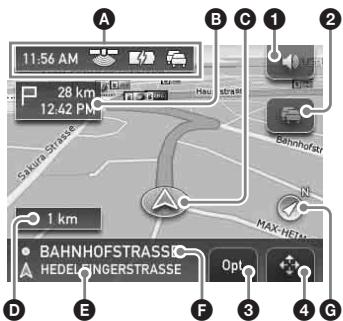
Information on map tool menu
To adjust the volume.
To view detailed TMC information.*1*2
3 To show option menu.
4 To switch to map scrolling mode.
1 When the TMC model is used, this appears only when the route that has been found is congested.
2 iTMC (UK) and v-trafic (France) are optional. To subscribe the service(s), please visit our website. http://www.navu.sony-europe.com
Map display
Straight-ahead driving
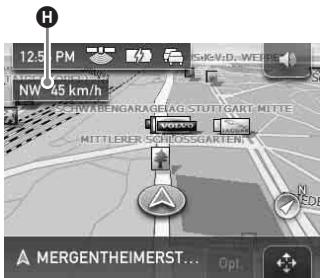
Approaching an intersection
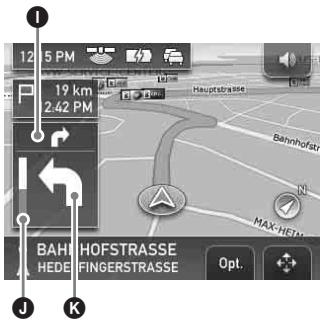
A Current time/GPS status/Battery condition/ TMC status
For details, see the supplied PDF manual.
Distance/ETA (Estimated Time of Arrival) to destination
Current position
Distance to next turn
Current street name
F Next street name
North indicator
Current direction/Current speed
Instruction after next
Bar indicator of the distance to next turn
Next turn instruction
Dynamic Route Information
This display shows the distance to the destination, POI information, etc.
To view, from map display, select "Options" "Dynamic Route Info."
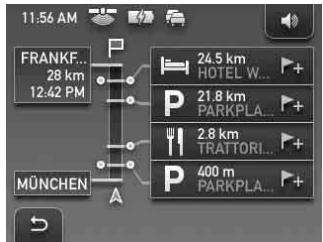
Route display
You can view the entire route to the destination.
To view, from map display, select "Options"
"Show Route."
Map scrolling mode
You can switch to map scrolling mode from map display by touching , whether during route guidance or not.
In map scrolling mode, the crosshair is displayed on the map, and you can drag the screen to scroll the map.
Touch / to adjust map scale.
Place the intersection of the crosshair on a desired point, then touch to show the map scrolling mode menu, where you can set the point as a destination, etc.
Touch - to return to the current car position display.
System Settings
Various settings related to the system and memory are configurable.
From the top menu, select "More..." "Settings" the desired category the desired item to make each setting.
Using the Supplied Software
The major functions of the software on the supplied disc are introduced below.
If you insert the disc into your computer, the screen appears automatically. Follow the on-screen instructions.
Contents
Install PC Connection Software
PC connection software (ActiveSync) can be installed. Be sure to log on as administrator when installing this software.
Language Manager
Language data for on-screen display and voice guidance can be added to the unit, and unnecessary language data can be deleted from the unit.
Read the Manual
You can read the PDF manual which contains further information on operations available.
Support Link
Easy access to the Sony navigation support site is available.
Visit this site for technical support, such as software updates, FAQs, etc.
Map Manager*
Map data can be added to the unit or "Memory Stick" (not supplied) from the supplied disc.
When adding, you may need to delete unnecessary map data to free up memory space.
Connecting to your computer
Before connecting to your computer, install the PC connection software (ActiveSync) to your computer.
1 Connect the unit to your computer with the USB cable.
Notes when transferring data
During transfer, do not
- disconnect the USB cable.
- enter unit standby mode, or reset the unit.
- shut down the computer, enter computer standby mode, or restart the computer.
Additional Information
About the "Memory Stick"
What is "Memory Stick"?
"Memory Stick" is a compact-size IC recording medium with a large capacity. It has been designed not only for exchanging/sharing digital data among "Memory Stick" compatible products, but also for serving as an insertable/ removable external storage medium that can save data.
Types of "Memory Stick Duo" that the system can use
With the system, you can use the following types of "Memory Stick Duo."
-
Memory Stick Duo (Not compatible with MagicGate)
MagicGate Memory Stick Duo
Memory Stick PRO Duo -
The system has been demonstrated as operable with a "Memory Stick Duo" with a capacity of 4 GB or smaller. However, we do not guarantee the operations of all the "Memory Stick Duo" media.
Notes
- This system supports only the reading of data on a "Memory Stick Duo." "Memory Stick Duo" formatting and writing cannot be performed.
- This system does not support parallel high-speed data transfer.
- Standard-size "Memory Stick" cannot be used in this system.
- When using a "Memory Stick Duo," make sure to check correct insertion direction. Wrong usage may cause trouble with the system.
- Do not place the "Memory Stick Duo" within the reach of a small child to prevent him from swallowing it by accident.
- Avoid removing the "Memory Stick Duo" from the system while the system is reading data.
Data may be damaged in such occasions:
- "Memory Stick Duo" is removed or the system is turned off during a read operation.
-
"Memory Stick Duo" is used in a location subject to static electricity or electrical noises.
-
We recommend that you save backup of the important data.
- Do not bend, drop or apply strong shock to the "Memory Stick Duo."
- Do not disassemble or modify the "Memory Stick Duo."
- Do not allow the "Memory Stick Duo" to get wet.
-
Do not use or store the "Memory Stick Duo" in a location that is subject to:
-
Extremely high temperature, such as in a car parked in the sun
-
Direct sunlight
- High humidity or places with corrosive substances
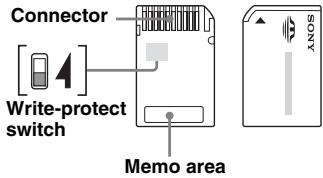
- Do not touch the "Memory Stick Duo" connector with your finger or metallic objects.
- You cannot record, edit or delete data if you slide the write-protect switch to LOCK.
- When you slide the write-protect switch of the "Memory Stick Duo," use a thin-pointed device.
- When you use a "Memory Stick Duo" without the write-protect switch, be careful not to edit or delete the data by accident.
- When you write on the memo area of the attached label, do not write forcefully.
- When you carry or store the "Memory Stick Duo," put it in the case supplied with it.
Note on LCD panel
Some stationary blue, red or green dots may appear on the monitor. These are called "bright spots," and can happen with any LCD. The LCD panel is precision-manufactured with more than 99.99% of its segments functional. However, it is possible that a small percentage (typically 0.01 % ) of the segments may not light up properly. This will not, however, interfere with your viewing.
Maintenance
Cleaning
- Clean the surface of the suction cup with a soft, wet lint-free cloth if it becomes dirty and attachment strength weakens.
Be sure to dry the suction cup before reattaching. - Clean the display window with a commercially available cleaning cloth.
Note
If the suction cup leaves a trace on the windscreen, wipe with water.
Fuse replacement
When replacing the fuse in the car battery adapter, be sure to use one matching the amperage rating stated on the original fuse (2.5 A). If the fuse blows, check the power connection and replace the fuse. If the fuse blows again after replacement, there may be an internal malfunction. In such a case, consult your nearest Sony dealer.
Warning
Never use a fuse with an amperage rating exceeding the one supplied with the unit as this could damage the unit.
Notes on unit disposal
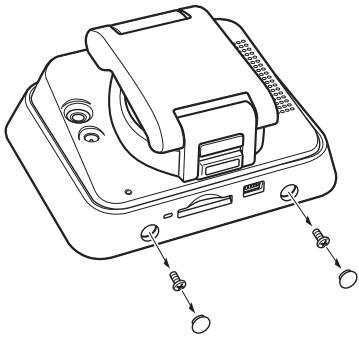
Remove the built-in lithium-ion battery when disposing of the unit, and return the battery to a recycling location.
The procedure for removing the battery is explained below.
Note
Never disassemble the unit except when disposing of it.
1 Press the RESET button to turn off the unit.
2 Remove the 2 rubber plugs on the underside of the unit, then remove the 2 screws using a screwdriver.
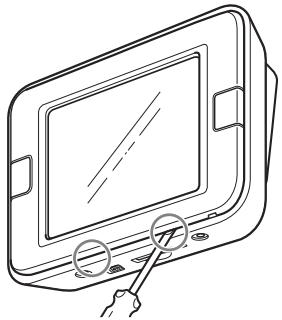
3 Detach the claws with a sharpened object, such as a flat headed driver, then remove the rear cover.
4 Remove the battery.
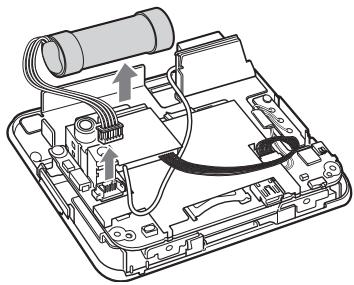
5 Insulate the connector terminal by wrapping with a tape.
Notes on the lithium-ion battery
- Keep the battery out of the reach of children.
- Do not hold the battery with metallic tweezers, otherwise a short-circuit may occur.
WARNING
Battery may explode if mistreated.
Do not recharge, disassemble, or dispose of in fire.
Specifications
Main unit
Operating temperature: 5 - 45^ (41 - 113^)
Power requirements: DC 5 - 5.2 V
(from supplied 12V / 24V car battery adapter (negative ground (earth))/USB cable/AC adapter*)
Connection terminals:
DC IN 5-5.2V jack
USB jack
TMC aerial jack (TMC models only)
Memory card slot:
Memory Stick Duo slot
Reception frequency: 87.5 - 108.0MHz
Speaker: 20 × 40 ~mm ( 0.8 × 1.6 in) oval speaker
Consumption current: Approx. 0.5 A
Dimensions: Approx. 108 × 82 × 48 ~mm
(4.3× 3.2× 1.9 in)
(w× h× d , protruding parts excluded)
Mass: Approx. 275g (9.7 oz)
Monitor
System: Transmissive liquid crystal display
Drive system: a-Si TFT active matrix system
Dimensions: 3.5 in (4:3)
Approx. 70 × 53, 88 ~mm
(2.8× 2.1 3.5 in (h× v,d)
Segment: 230,400 (960 × 240) dots
Built-in battery charging time/usage time
Charging time
With the supplied car battery adapter/AC adapter*:
Approx. 3.5 hours (with unit turned on), or 2.5 hours (in standby mode)
With the supplied USB cable:
Approx. 4 hours (in standby mode)
Usage time
Up to 3.5 hours (depending on usage)
Optional accessories
Car Install Kit:XA-49FM
AC adapter:XA-AC13
Car battery adapter:XA-DC3
- Optional accessory
Design and specifications are subject to change without notice.
continue to next page
- Halogenated flame retardants are not used in the certain printed wiring boards.
- Use of rechargeable lithium ion batteries.
- Corrugated cardboard is used for the packaging cushions.
VOC (Volatile Organic Compound)-free vegetable oil based ink is used for printing the carton.
Troubleshooting
The following checklist will help you remedy problems you may encounter with your unit.
Before going through the checklist below, check the connection and operating procedures.
The unit does not turn on.
Charge the built-in battery.
Check that the car battery adapter is securely inserted into the cigarette lighter socket.
The built-in battery cannot be charged.
Press I/ to turn on the unit, then press it again to turn off the unit.
If the car battery adapter is being used, disconnect it from the cigarette lighter socket, then reconnect.
The built-in lithium-ion battery can be charged at temperatures between 5 - 45^ (41 - 113^) . The battery may not be charged if the temperature inside the unit increases because of direct sunlight exposure, etc. This is not a malfunction.
Turn on the computer during USB charge.
GPS signal cannot be received.
Firstly, read the GPS overview (page 4), then check the GPS status by selecting "More..." in the top menu "GPS Status."
- The system cannot receive GPS signals due to an obstruction.
Move your car to a place where signals can be received clearly. - There is an obstacle in front of the GPS aerial.
Install the unit where the signal is not interrupted by the body of the car, etc.
The car position on the map does not match the current road.
The error margin of the signal from the GPS satellites is too large. A maximum error margin of a few hundred metres can exist.
Voice guidance cannot be heard.
The volume is set too low.
Raise the volume (page 8).
The LCD is not displayed normally.
In high temperatures, the LCD may darken and not display clearly. In low temperatures, afterimage may occur on the LCD. These are not malfunctions, and the LCD will return to normal when the temperature returns to within the specified operating range.
The suction cup comes off the attachment surface.
Attachment strength weakens if the surface of the suction cup or attachment surface becomes dirty.
Clean the surface of the suction cup and the attachment surface with a soft, wet lint-free cloth (page 12).
The demonstration mode starts automatically even if no operation is performed.
Turn off the auto demonstration mode by selecting "More..." in the top menu "Settings" "General Settings" "Demo Mode." Then, confirm that "Demo Mode" is set to off.
Resetting the unit
If the navigation software freezes, try resetting the unit.
Press the RESET button, then press I/O to turn on the unit.
Note
After you reset the unit, it may take time to receive GPS signals when turning on the unit.
Wichtig!
2 Selecteer "Navigeren".
"Snelkoppeling 1 - 3"
Dukommen latt at Sonys supportsida for navigating.
Den hare sidan kan du anvanda nar du behoverteknisk support, uppatering av programvaran, svar på ofta forekomande fragor (FAQ) m.m.
Kartassistent*
Characteristicas techniques
Unidade principal
Temperatura de funciona: 5 - 45^
Alimentacao: CC 5-5,2 V



- Customer Support Portal
- SONY
- SONY®
- Personal Navigation System Quick Start Guide
- nav-u
- How to use this manual
- Hinweis zu dieser
- Bedienungsanleitung
- Disposal of Old Electrical & Electronic Equipment (Applicable in the European Union and other European countries with separate collection systems)
- Caution
- On copyrights
- On trademarks
- vtrafic
- Austria
- Croatia, Estonia, Latvia, Lithuania, Poland, Slovenia
- France
- Germany
- Greece
- Hungary
- Italy
- Portugal
- Spain
- Switzerland
- Basic Operations 6
- Route Searching 7
- System Settings 10
- Using the Supplied Software 10
- Additional Information 11
- Warning
- On safety
- On handling
- On GPS
- Note
- On the software
- Location of controls
- Turning the unit on/off
- To turn the unit on/off
- Performing initial setup
- Receiving GPS signals
- Basic Operations
- Menu operation
- Gesture Command operation
- Keyboard operation
- Route Searching
- Setting the destination and starting guidance
- Show the top menu.
- Select "Navigate."
- Select "Address Input," then input the address details.
- Select "Calculate Route."
- Setting the destination in other ways
- Search Nearby
- Go Home
- Navigate
- "POI Search Nationwide"
- "POI Search Town"
- "Address Book"
- Guidance displays
- Map display
- Dynamic Route Information
- Route display
- Map scrolling mode
- System Settings
- Using the Supplied Software
- Contents
- Install PC Connection Software
- Language Manager
- Read the Manual
- Support Link
- Map Manager*
- Connecting to your computer
- Connect the unit to your computer with the USB cable.
- Notes when transferring data
- Additional Information
- About the "Memory Stick"
- What is "Memory Stick"?
- Types of "Memory Stick Duo" that the system can use
- Notes
- Note on LCD panel
- Maintenance
- Cleaning
- Fuse replacement
- Notes on unit disposal
- Remove the battery.
- Insulate the connector terminal by wrapping with a tape.
- Notes on the lithium-ion battery
- Specifications
- Main unit
- Monitor
- Built-in battery charging time/usage time
- Charging time
- Usage time
- Optional accessories
- Troubleshooting
- The unit does not turn on.
- The built-in battery cannot be charged.
- GPS signal cannot be received.
- The car position on the map does not match the current road.
- Voice guidance cannot be heard.
- The LCD is not displayed normally.
- The suction cup comes off the attachment surface.
- The demonstration mode starts automatically even if no operation is performed.
- Resetting the unit
- Wichtig!
- Selecteer "Navigeren".
- "Snelkoppeling 1 - 3"
- Kartassistent*
- Characteristicas techniques
- Unidade principal
Brand : SONY
Model : NV -U 52F
Category : Gps