721-485 - Log splitter Meec Tools - Free user manual and instructions
Find the device manual for free 721-485 Meec Tools in PDF.


| Product Type | Log Splitter |
| Brand | Meec Tools |
| Model | 721-485 |
| Rated Voltage | 230 V ~50 Hz |
| Power Output | 1500 W |
| Splitting Force | 4 tons |
| Max Splitting Length | 370 mm |
| Splitting Diameter | 50–250 mm |
| Piston Stroke | 300 mm |
| Cylinder Diameter | 60 mm |
| Hydraulic Oil Volume | 2.2 L |
| Dimensions (W x H x D) | 800 x 280 x 460 mm |
| Weight | 30 kg |
| Protection Rating | IP54 |
| Sound Pressure Level (LpA) | 80 dB(A), k=3 dB(A) |
| Sound Power Level (LwA) | 92 dB(A), k=3 dB(A) |
| Vibration Level | ≤2.5 m/s², k=1.5 m/s² |
| Key Components | Splitting wedge, pressure plate, transport wheels, control lever with guard, lifting handle, power switch |
| Usage Orientation | Horizontal, on a stable bench at least 60 cm high |
| Recommended Oil Change Interval | Every 150 hours of operation |
| Safety Features | RCD protection (30 mA), earthing requirement, control lever guard, emergency stop via power switch |
| Included Accessories | Wheels, axle, lock washers, nuts, legs, control lever guard, handle |
Frequently Asked Questions - 721-485 Meec Tools
User questions about 721-485 Meec Tools
0 question about this device. Answer the ones you know or ask your own.
Ask a new question about this device
Download the instructions for your Log splitter in PDF format for free! Find your manual 721-485 - Meec Tools and take your electronic device back in hand. On this page are published all the documents necessary for the use of your device. 721-485 by Meec Tools.
USER MANUAL 721-485 Meec Tools
natural_image
Red and black industrial machine with visible wheels and a motor, no text or symbols present.EN - Operating instructions (Translation of the original instructions)
Jula reserves the right to make changes. In the event of problems, please contact our service department.
www.jula.com
Tillverkare/ Produsent / Produenci/ Manufacturer
Jula AB, Box 363, 532 24 SKARA
Importör/ Importör/ Importer/ Importer
Care for the environment!
Must not be discarded with household waste! This product contains electrical or electronic components that should be recycled. Leave the product for recycling at the designated station e.g. the local authority's recycling station.
SVENSKA....5
SÄKERHETSANVISNINGAR....5
TEKNISKA DATA....10
BESKRIVNING 11
MONTERING 11
HANDHAVANDE 11
UNDERHÄLL 12
NORSK 14
SIKKERHETSANVISNINGER 14
TEKNISKE DATA 19
BESKRIVELSE....20
MONTERING 20
BRUK....21
VEDLIKEHOLD 22
POLSKI 23
ZASADY BEZPIECZEŃSTWA 23
DANE TECHNICZNE 28
OPIS 29
MONTAZ 29
OBSLUGA 30
KONSERWACJA 31
ENGLISH 32
SAFETY INSTRUCTIONS....32
TECHNICAL DATA....37
DESCRIPTION 38
ASSEMBLY 38
USE....39
MAINTENANCE 40
SÄKERHETSANVISNINGAR
- Klyvekile
- lappeplugg
-
Läftehändlak
4 Strömbryter -
Transporthjul
- Beskyttelse for
betjeningsspak - Trykkplate
MONTERING
- Plasser enden med betjeningsspaken på et underlag som tåler vedkjøverens vekt, og för hjulakseren inn i hullene.
- Monter hjulene på akselen med låseskiver og muttere.
- Monter benet med medfølgerde mutter og skiver
- Monter beskyttelsen for beljeningsspaken med de medfölgende skruere.
- Skru på håndtaket på beljeningsspaken.
BRUK
Read the operating instructions carefully before use.
Save these instructions for future reference.
- Read all warnings, safety instructions and other directives carefully before use. Do not use the log splitter for any other purpose than the one it is intended to be used for. Failure to follow all the instructions and safety instructions can result in a risk of personal injury and/or material damage. Save these instructions for future reference.
- The log splitter is not intended to be used by persons (children or adults) with any form of functional disorders, or by persons who do not have sufficient experience or knowledge on how to use it, unless they have received instructions concerning the use of the log splitter by someone who is responsible for their safety. Keep children under supervision to make sure they do not play with the log splitter. Do not allow children to use, clean or maintain the log splitter without supervision.
- Read all the instructions and warning labels on the log splitter before using it, to understand its application, limitations and potential risks.
- Never use the log splitter if you are tired or under the influence of drugs, alcohol or medication. Stay alert at all times. Use your common sense.
- Place the log splitter on a flat, stable, horizontal surface with plenty of space for the user to handle the logs. Fasten the log splitter to the substrate if it does not remain still.
- Keep the work area clean and well lit. Dark and cluttered work areas increase the risk of accidents and injuries. Do not use the log splitter in damp or wet areas. Do not expose the log splitter to rain. The surface must not be slippery. Select a flat, dry surface without high grass or other obstacles.
-
Keep the work area free of tools, pieces of wood and the like. Clean regularly removing shavings and pieces of wood from the work area. Do not use the log splitter in explosive environments, such as in the vicinity of flammable liquids,
-
Do not wear loose-fitting clothes, jewellery, or watches etc. that can fasten in moving parts. They can get caught in moving parts. We recommend wearing safety gloves that are not electrically conductive and non-slip shoes. Wear a hair net if you have long hair.
- The log splitter can eject objects that can cause permanent eye injuries. Wear safety glasses. Normal glasses only have shock-resistant lenses, they are not protective glass. Do not use the log splitter with it placed on the floor or the ground. This will result in an incorrect working position, where the user's face comes close to the log splitter – risk of being hit by splinters etc.
- Unsuitable extension cords can cause a fire and/or electric shock. Do not use extension cords longer than 10 m. Extension cords must have a conductor cross-section of at least 1.5 mm ^2 to withstand the motor's power supply. Do not use insufficiently insulated connections. Connections must be designed for outdoor use.
- Check that the mains voltage corresponds to the rated voltage on the type plate and that the circuit is correctly fuse protected. Check that the cable is earthed or grounded and fitted with an RCD. The log splitter must only be connected to a correctly earthed mains outlet. Avoid body contact with earthed surfaces such as pipes, radiators, cookers and refrigerators. Never open the log splitter's switch. The power switch may only be opened by authorised electricians. Electrical connections and other electrical work must only be carried out by an authorised electrician. Do not touch metal parts of the plug when connecting or disconnecting it.
- The log splitter must only be used by one person at once. Keep onlookers at a safe distance when using the log splitter. Never allow anyone to help you release logs that have got stuck.
- Check that there are no nails or other foreign objects in the logs. The ends of the logs must be cut at right angles. Branches must be cut off flush with the log. Never attempt to cut logs across the grain. Never attempt to split two or more logs at the same time. Never try to split a log that is not properly positioned on the work table.
• Always maintain a firm footing and good balance. Never stand on the log splitter. You could be seriously injured if the log splitter tips over, or if you come
EN
- Keep your hands at a safe distance from cracks that open up in the log wood. These cracks can suddenly close, and seriously crush your hands. Do not attempt to release a log that has got stuck with your hands.
- The log splitter will work better and more safely at the load for which it is intended. Do not try to split logs larger than the log splitter is designed for. This could result in a risk of serious personal injury and/or material damage. Do not use the log splitter for any other purpose than the one it is intended to be used for.
- Do not leave the log splitter until it has come to a complete standstill.
- Switch off the motor when the log splitter is not used and before carrying out any adjustments, replacing parts, cleaning or doing maintenance work. Read these instructions before servicing.
• Used oil must be disposed of in accordance with local regulations. - Keep the log splitter clean and in good condition for better and safer work.
- Store the log splitter out of the reach of children and unauthorised persons. Never allow children, or anyone who is unfamiliar with the log splitter and these instructions, to use it. The log splitter is dangerous if used by inexperienced people.
Safety instructions for use
- Switch off the log splitter and unplug the power cord before adjusting.
- Always check that hex keys/spanners etc. have been removed from the log splitter before switching it on.
- This log splitter must only be connected to a properly earthed power socket to prevent the risk of electric shock.
- If using an extension cord, the conductor cross section must be dimensioned for the power supply to the motor. An extension cord must not be longer than 7.5 m. The maximum permitted cross sectional area is 2.5 mm ^2 .
- Do not use the log splitter near flammable liquids or gases.
- The hydraulic fluid is flammable and can explode. Always keep a fire extinguisher handy when working near flammable substances.
• Always check the level of the hydraulic fluid before using. Never run the log solution with a low level of hydraulic fluid, this could decrease the load solution
- Place the log splitter in a suitable working area, free from obstacles.
- Clear away wood and splinters etc. regularly, to keep the working area free.
- Run the log splitter unloaded to check that it is working properly. If the log splitter's noise level increases or the piston moves unevenly, this could mean that the hydraulic fluid level is too low. Check and top up if necessary.
- Place the log splitter at least 3 metres from the mains outlet, to protect the outlet from dust.
- Never allow children, or anyone who is unfamiliar with the log splitter and these instructions, to use it.
- Familiarise yourself with the controls on the log splitter and how to use them. Learn how to stop the log splitter quickly in an emergency.
- Never use the log splitter if you are tired or under the influence of drugs, alcohol or medication.
- The log splitter must only be used by one person at once. Keep onlookers, especially children, and pets at a safe distance.
- Never attempt to press the power switch or control handles with an object, or with any part of the body apart from your hands, and never attempt to bind or force down the control handles – risk of serious personal injury and/or death.
- Do not allow any part of your body to come between the splitting wedge and the pressure pad.
- Do not lean over, or try to step over the log splitter when it is switched on.
- Only split logs parallel to the direction of the grain. Some types of wood can burst and/or be ejected when splitting across the direction of the grain – risk of personal injury.
- Release the control handles if the log splitter cannot split the log. Release both handles to run back the piston. If the control handles are kept pressed down after the piston has stopped, the piston will not go back when you release the handles. In which case, switch off the motor and then switch it on again to continue.
- Release the control handles immediately, switch off the log splitter and unplug the power cord if the log fastens in the blade. Tap the log loose with a hammer.
EN
- Regularly check that all the screw and hydraulic connections are correctly tightened.
- Never use the log splitter on slippery or unsafe surfaces – risk of personal injury.
- Never leave the log splitter unattended when running.
- Do not expose the log splitter to rain or moisture – risk of electric shock.
• Make sure the work area is well lit. - Never modify the motor speed. The maximum motor speed is set at the factory to comply with the applicable safety regulations.
- Switch off the log splitter immediately and unplug the power cord in the event of a fault or abnormal function. Example: If the log splitter's noise level increases or the piston moves unevenly, this could mean that the hydraulic fluid level is too low. Check and top-up when necessary according to the instructions in the maintenance section.
- Do not pull the power cord to unplug the plug.
SYMBOLS
| Read the operating instructions carefully before use. | |
| Wear safety gloves. | |
| Wear ear protection and safety glasses. | |
| Wear safety shoes. | |
| IMPORTANT: Risk of pinch injury. | |
| WARNING: Moving parts. Do not allow any part of your body to come |

Observe the safety distance.

Remove the plug from the power outlet when the work is finished and before starting repairs or maintenance work.

Protect the environment. Always recycle used oil. Do not pour oil into drains, soil or water.

Do not touch moving parts.

Inspect the log splitter. Check the log splitter before use. Make sure all parts are complete and in working order, and that there are no tools or other items on the work bench. Replace damaged or missing parts before use.
TECHNICAL DATA
| Rated voltage 230 VA | ≈ 50 Hz |
| Output 1500 W | |
| Splitting force 4 lonnes | |
| Protection rating IPS4 | |
| Splitting length Max. 370 mm | |
| Splitting diameter 50-250 mm | |
| Piston movement Max. 300 mm | |
| Cylinder diameter 60 mm | |
| Hydraulic oil volume 2.2 l | |
| Dimensions 80 x 28 x 46 mm | |
| Weight 3/ kg | |
| Sound pressure level, LpA 80 dB(A), k = 3 dB( A) | |
| Sound power level, LwA | 92 dB(A), k = 3 dB( A) |
| Vibration | ≤ 2.5 m^2/s^2,k = 1.5 m^2/s^2 |

WARNING: The actual vibration level when using power tools may differ from the specified maximum value, depending on how the tool is used. It is therefore necessary to determine which safely precautions are required to protect the user, based on an estimate of exposure in actual operating conditions (taking into account all stages of the work cycle, e.g., the time when the tool is switched off and when it is idling, in addition to the start-up time).
DESCRIPTION
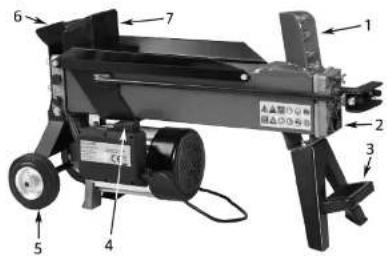
-
Wedge
-
Transport wheel
2 Oil drain plug
-
Control lever guard
-
Lifting handle
-
Pressure plate
4 Power switch
ASSEMBLY
- Place the end with the control lever on a surface that is capable of supporting the weight of the log splitter and insert the wheel axle in its hole.
- Fit the wheels on the axle with lock washers and nuts.
- Fit the legs using the supplied nuts and washers.
- Fit the control lever guard the using the supplied screws.
- Screen the handle on the control layer
USE
Preparations before use.
- Place the log splitter on a flat, stable bench, at least 60 cm high.
- Lock the wheels so that the log splitter cannot move when in use.
- Apply a little oil on the splitting wedge and the bed to facilitate the work.
- Make sure that all the screw connections and hydraulic connections are properly tightened to keep the machine in safe condition.
- Check that the mains voltage corresponds to the rated voltage on the type plate.
- The log splitter should be connected to the mains supply with a residual current device with a maximum tripping current of 30 mA and with protection for overvoltage and undervoltage.
- Always check before using that the power cord, plug and power switch are undamaged. Do not use the log splitter if the power cord, plug, power switch or any other parts are damaged – risk of short circuiting and/or electric shock.
- Always check that all the safety devices are correctly fitted and in working order before use.
- Always wear suitable clothing, safety gloves, approved safety glasses and non-slip shoes. Do not wear loose-fitting clothing or jewellery.
- Cut the logs at right angles to a suitable length. Never attempt to split uneven, knotty or bent logs.
Use
- Connect the log splitter to the mains supply.
- Make sure that power cord is not positioned over the bed or wedge.
- Place a log on the bed. Check that the log is dimensioned in accordance with that specified in the technical data.
- Stand next to the appliance so that you can reach the controls with both hands. Remain in this position until the log has been split and the pressure plate returns.
- Press the control lever. Hold until the log has been split.
- Release the power switch and then the control lever. The pressure plate returns to the home position.
- Release the control lever if the pressure plate stops moving before the log has been split, otherwise the hydraulic fluid can overheat, which may damage the pump.
- Turning the log 90° and repeat.
- Repeating the above steps until the log has been split to the required size.

MAINTENANCE
Replacing the hydraulic fluid
Replace the hydraulic fluid after approximately 150 hours of operation.
- Turn off the log splitter and disconnect it from the mains supply.
- Unscrew and remove the drain plug.
- Place a suitable container, which holds about 3 litres, under the drain hole.
- Carefully tip the log splitter and allow all the hydraulic fluid to flow into the container. Make
sure not to spill any hydraulic fluid onto the ground.
S. Position the log splitter vertically on the motor end and fill with fresh hydraulic fluid. - Only fill with hydraulic fluid of the intended type and with the correct viscosity. NOTE: Used
hydraulic fluid must be recycled in accordance with local regulations.
Maintenance and storage
• Always disconnect the log splitter from the mains supply before working on the splitting wedge.
- Brush off the chip and the like from the log splitter after use.
- When not in use, store the log splitter in a dry place out of the reach of children.
Transport
• The log splitter can be transported in the boot of a car.
- Use the transport handle for short distances.
NOTE:
- Never lift or carry the log splitter while running.
• Exercise care when moving the log splitter on uneven or unstable surfaces. - Make sure that the log splitter does not till, tip over or drop down.
- Never allow anyone to sit on the log splitter when moving it.

EC DECLARATION OF CONFORMITY EG FÖRSÄKRAN OM ÖVERENSSTÄMMELSE EF SAMSVARSERKLÆRING DEKLARACJA ZGODNOŚCI WE

Jula AB, Box 363, SE-532 24 SKARA, SWEDEN
RoHS Directive 2011/65/EU EN 62321:2009
This product was CE marked in year -16
Brand : Meec Tools
Model : 721-485
Category : Log splitter