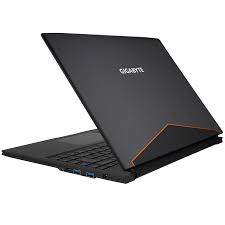
AERO 14W V7 B40W10P-FR - Laptop GIGABYTE - Free user manual and instructions
Find the device manual for free AERO 14W V7 B40W10P-FR GIGABYTE in PDF.



| Product type | Laptop |
| Brand | GIGABYTE |
| Model | AERO 14W V7 B40W10P-FR |
| Screen | 14 inches (estimated) |
| Dimensions (estimated) | 335 x 250 x 19 mm |
| Weight (estimated) | 1.9 kg |
| Power supply | AC adapter, DC-in jack |
| Battery | Lithium-ion, not user-replaceable |
| Wireless connectivity | WiFi, Bluetooth |
| Ports | 1x HDMI, 1x Mini-DisplayPort, 3x USB 3.0, 1x USB 3.1 (charging compatible), combo audio jack, SD card reader, Kensington lock |
| Webcam | Integrated with LED indicator |
| Microphone | Dual built-in microphone |
| Speakers | Built-in |
| Touchpad | Built-in touchpad |
| Keyboard | Backlit with macro keys (G1-G5) |
| Special features | Smart Manager, Macro Hub, Windows 10 system recovery |
| Pre-installed operating system | Windows 10 (depending on model) |
| Storage temperature | Do not exceed 45°C |
| Security | Kensington lock, do not open battery, keep ventilation clear |
| Maintenance | Clean with a dry soft cloth, avoid moisture |
Frequently Asked Questions - AERO 14W V7 B40W10P-FR GIGABYTE
User questions about AERO 14W V7 B40W10P-FR GIGABYTE
0 question about this device. Answer the ones you know or ask your own.
Ask a new question about this device
Download the instructions for your Laptop in PDF format for free! Find your manual AERO 14W V7 B40W10P-FR - GIGABYTE and take your electronic device back in hand. On this page are published all the documents necessary for the use of your device. AERO 14W V7 B40W10P-FR by GIGABYTE.
USER MANUAL AERO 14W V7 B40W10P-FR GIGABYTE
Congratulations on your purchase of the GIGABYTE Notebook.
This manual will help you to get started with setting up your notebook. The final product configuration depends on the model at the point of your purchase. GIGABYTE reserves the right to amend without prior notice. For more detailed information, please visit our website at www.gigabyte.com
Using GIGABYTE Notebook for the First Time
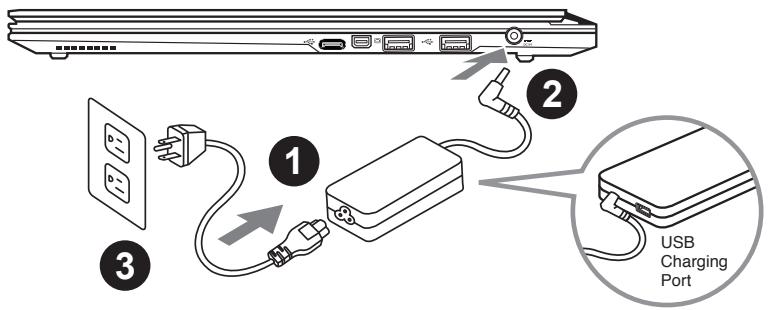
1 Connect the power cord to the AC adapter.
2 Connect the AC adapter to the DC-in jack on the right side of the notebook.
3 Connect the power cord to the power outlet.

IMPORTANT
- Ensure that your Notebook PC is connected to a grounded power adapter before turning it on for the first time.
- When using your Notebook PC on power adapter mode, the socket outlet must be near to the unit and easily accessible.
- Locate the input/output rating label on your Notebook PC and ensure that it matches the input/output rating information on your power adapter. Some Notebook PC models may have multiple rating output currents based on the available SKU.
- Power adapter information: Input voltage: 100-240Vac, - Input frequency: 50-60Hz, - Rating output voltage: 19.5V,7.7A
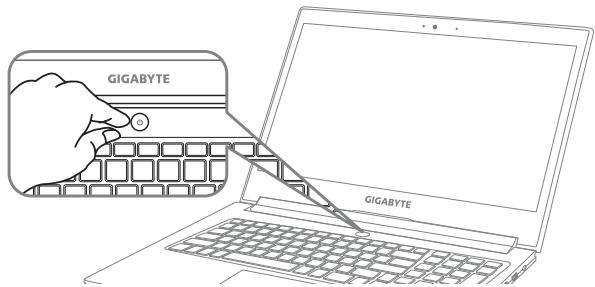
Switching on the Power
After you turn on the Notebook for the very first time, do not turn it off until the operating system has been configured. Please note that the volume for the audio will not function until Windows® Setup has completed.
Booting Up the Notebook for the First Time
Depending on your configuration, the Microsoft® Windows® Boot Screen will be the first screen that you will see as the notebook starts up. Follow the on-screen prompts and instructions and enter your personal information to complete the setup of the Windows® Operating System.
Top View
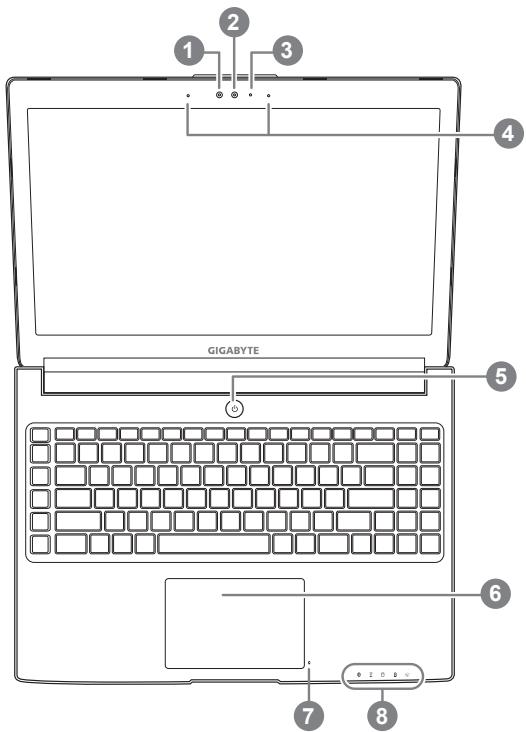
1 Light sensor
2 Webcam
3 Webcam Status LED Indicator
4 Microphone x2
5 Power Button
6 TouchPad
7 Battery Indicator Button 1
8 LED Indicators 2
1 Press the right button of touchpad to check the remaining battery power. Right-click to show the remaining power percentage. As shown below, the battery life indicator is available when the laptop is shut down, in stand-by or hibernation.(Battery mode)
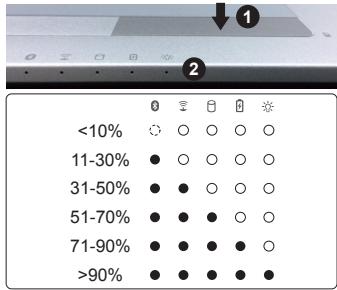
Bluetooth Status LED
Wireless Lan Status LED
HDD Status LED
Battery Status LED
Power Status LED
Left View
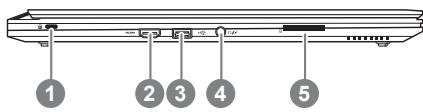
1 Kensington Lock Slot
2 HDMI Port
3 USB 3.0
4 Combo Audio Jack
5 SD Card Reader
Right View
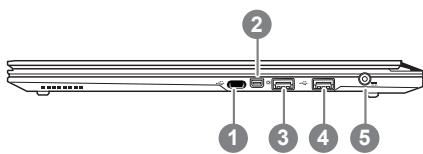
1 USB 3.1
2 Mini Displayport
3 USB 3.0(Support USB Charge)
4 USB 3.0
5 DC-in Jack

Warning:
DO NOT remove the built-in lithium battery. For any service needs, please contact your local GIGABYTE Authorized Service Center.
- Do not install the Notebook PC on a slant or a place prone to vibrations, or avoid using the Notebook PC in that location for a long time. This increases the risk that a malfunction or damage to the product will occur.
- Do not store and use Notebook PC in direct sunlight or the location where temperatures exceed 112^ ( 45^ ) such as inside a vehicle. There is a danger of Lithium-ion battery expansion and aging.
- Do not use the Notebook PC in a badly ventilated location such as on bedding, on a pillow or cushion, etc, and do not use it in a location such as room with floor heating as it may cause the computer to overheat. Take care that the Notebook PC vents (on the side or the bottom) are not blocked especially in these environments. If the vents are blocked, it may be dangerous and cause the Notebook PC to overheat.
The computer employs hotkeys or key combinations to access most of the computer's controls like screen brightness and volume output. To activate hotkeys, press and hold the
| Hotkey | Function | Description |
| Fn+F1 z² | Sleep | Put the computer in Sleep mode. |
| Fn+F2 | Wireless LAN | Enables/disable the Wireless LAN function. |
| Fn+F3 | Brightness Down | Decrease the screen brightness. |
| Fn+F4 | Brightness Up | Increase the screen brightness. |
| Fn+F5 LCD/ | Display Toggle | Switche display output between the display screen, external monitor (if connected) and both. |
| Fn+F6 | Screen Display Toggle | Turn the screen display on and off. |
| Fn+F7 | Speaker Toggle | Turn the speaker on and off. |
| Fn+F8 | Volume Down | Decrease the sound volume. |
| Fn+F9 | Volume Up | Increase the sound volume. |
| Fn+F10 | Touchpad Toggle | Turn the internal touchpad on and off. |
| Fn+F11 | Bluetooth | Enable/disable the Bluetooth function. |
| Fn+F12 | Webcam | Turn the internal webcam on and off. |
| Fn+Space | Keyboard Backlight Toggle | Turn the keyboard backlight on and off. |
Macro key
Macro keys can be set via Macro Hub, setting combination keys for complicated and/or general operation.
| Macro key | Macro key | Description |
| G | G | Macro group switch, press around 3 seconds as hardware switch on/off. |
| G1 | G1 | User Programmable Macro key |
| G2 | G2 | User Programmable Macro key |
| G3 | G3 | User Programmable Macro key |
| G4 | G4 | User Programmable Macro key |
| G5 | G5 | User Programmable Macro key |
Welcome to use Macro Hub! Macro Hub makes it much easier for you to control your Macro Key. You can deal with complex key stroke combination by just one press on macro key, which brings you benefits both in work and game. Before using Macro Hub, please read following guide, thanks.
1 Launch Macro Hub

You can find the shortcut of Macro Hub on desktop. Just double click it.
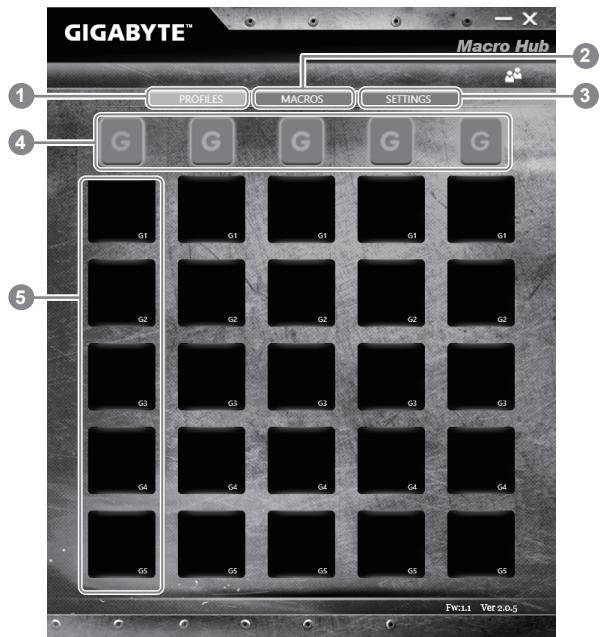
2 The overview of Macro Hub
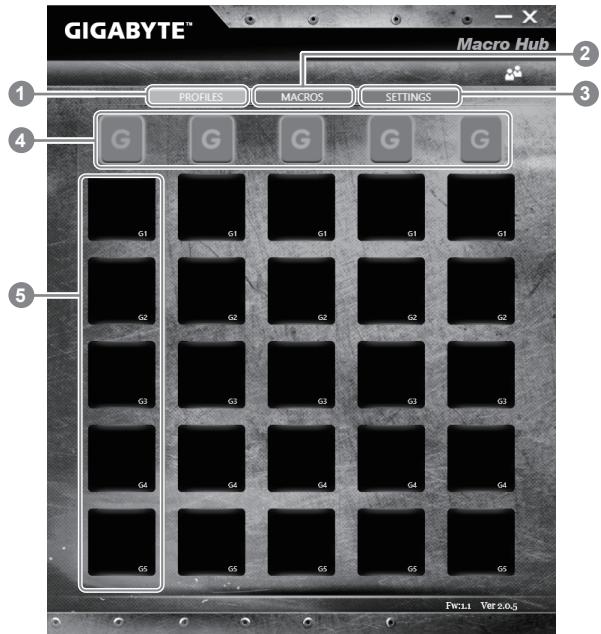
1 Profiles: View your current macro command settings.
2 Macros: Edit macro command funtions and settings.
3 Settings: Update Macro Hub version or renew macro hub settings.
4 Macro Key Group Indicators: Indicate the activated Macro Key Group (the atcivated group indicator will light up)
5 Macro Key Function: Show the programmed Macro functions under the Macro Key Group, from G1 to G5.
3 Using Macro Hub
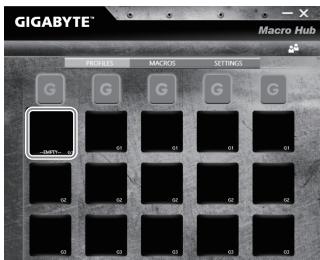
1 Set Macro Key to basic function
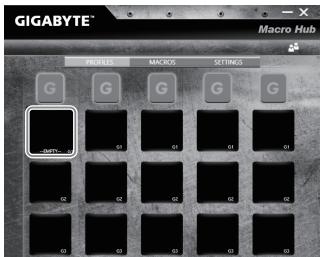
a. Click the G button on the left-top of the keyboard to switch to the Macro Key group you would like to use
b. Click the Macro Key function brick
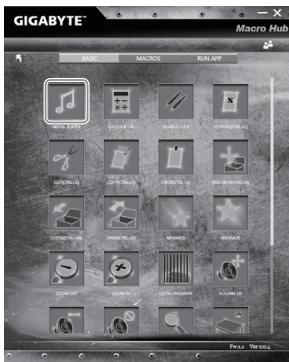
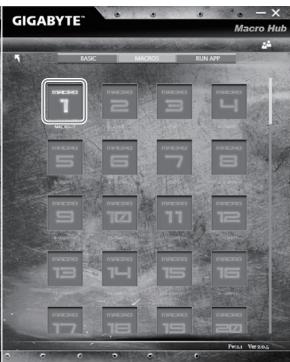
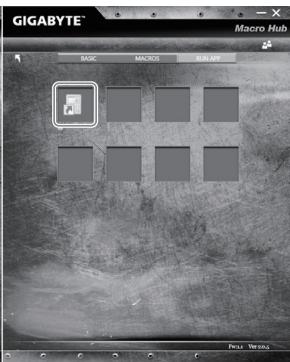
c. Double-click the function you would like to use(ex. Media Player) in the Basic or Macros function area.
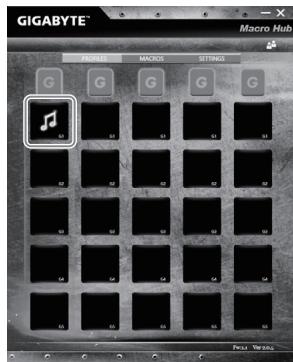
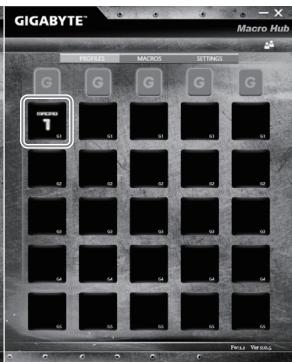
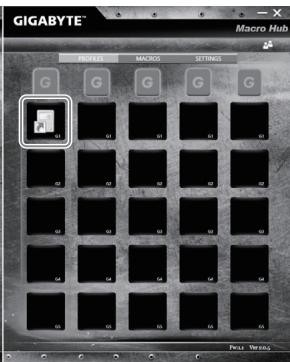
d. Complete the setting
2 Edit macro command funtions anf settings.
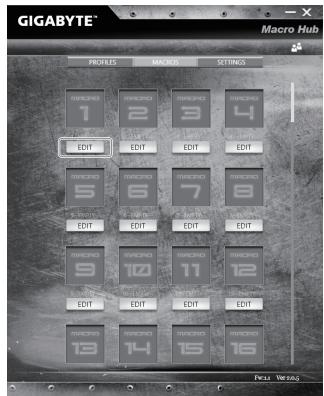
a. Click "Macros" (you can set up to 100 sets of macro)
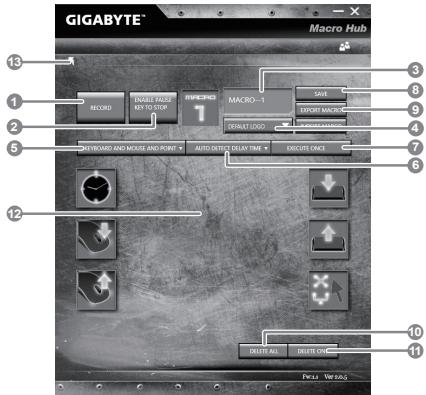
b. Overview of macro record panel (you can record your own macro here)
- Start recording: Click when you're about to record the macro
- Pause key Switch: Enable/Disable Pause key to stop recording.
- Macro Name: Set the name of this macro
- Import icon: Set icon for this macro. You can use default icon or upload your own icon
- Record type: You can choose to record only mouse(or keyboard) movement, or record both. You can also decide to or not to record mouse position.
- Record interval: You can decide to or not to record the interval of each movement(or You can set fixed interval time between every movement)
- Execution way: You can set the macro execution way (execution once, repeat execution or repeat execution with deep press)
- Export macro: Export your macro
- Import macro: Import the macro
-
Delete all: Delete all movement in this macro
-
Delete selected: Delete selected movement
12.Movement list: it shows all movement you record
13.Exit: The system will inquire you if to save the recorded macro
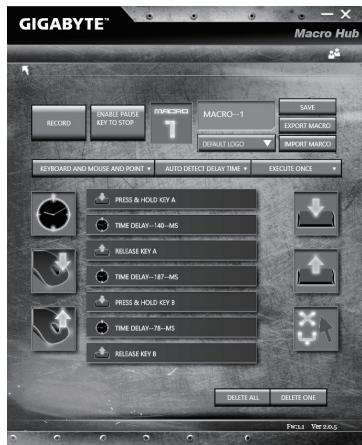
c. Start to record macro: When you click start button, the macro engine will start to record macro. All movement you made (mouse/keyboard) will be shown in the movement list. You can decide to use "pause" key or mouse click on stop button to stop recording based on your record range. Finishing recording: When you have done all movement, click exit button. The Macro Engine will inquire you if you want to save the macro. Click Yes then you can finish the record of your own macro.
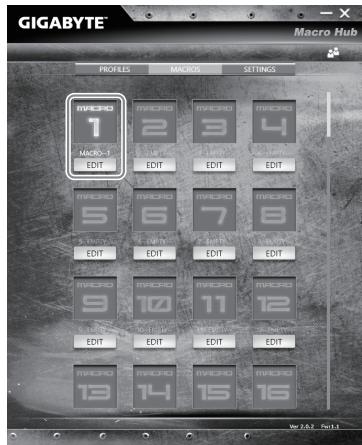
d.Complete the setting.
3 Edit "Settings" of Macro Hub
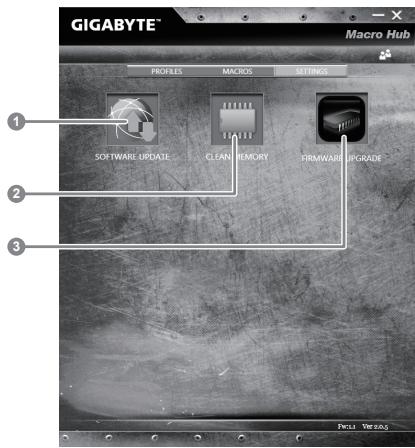
- Software update: Update latest version of GIGABYTE Macro Hub
- Clean memory: Erase current Macro Hub settings
- Firmware Upgrade: Upgrade Macro Key firmware
GIGABYTE Software Application
GIGABYTE Smart Manager
You can activate GIGABYTE Smart Manager by double clicking on the shortcut icon on the desktop if the machine you purchased has the operation system built-in. GIGABYTE Smart Manager is an icon-based control interface, enabling users to intuitionally access common system setup as well as GIGABYTE exclusive utilities. Please be noted that the GIGABYTE Smart Manager interface, icons, utilities and software versions may vary based on the purchased models. Please operate GIGABYTE Smart Manager according to the actual version built-in.

WARNING
- You can backup original recovery image through this application in case of losing by device damage.
- You can backup original recovery image to USB disk and restore the system if any storage system replacement with the recovery USB disk.
- Before you restore the system through the recovery USB disk, please make sure that you have already made the backup of your data.
- Please DO NOT shut down or un-plug the system when performing backup through recovery USB disk.
1
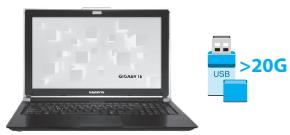
- Please plug in the USB disk which is at least 20GB in capacity to make the original image (backup the data in USB first. All data will be eliminated during the creation of recovery USB disk)
2
- Insert the driver disk to your optical drive and run the install of "Smart USB Backup" (for none-ODD model, please use USB ODD device or download from http://www.gigabyte.com
3
- Run the "Smart USB Backup" after finishing the install.
4
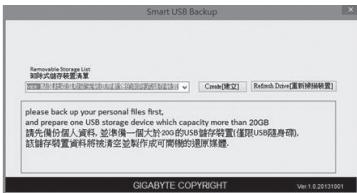
- Select your USB disk from the dropdown list and start to create the recovery USB disk.
5
- The window will pop out when the creation of recovery disk is done.
- Please press F12 on starting the system when you need to restore the system. Select "boot from recovery USB disk" and the system will be restored.
- The time needed for restore will be around 30 mins(time needed may vary by USB disk model).
System Recovery (Restore your laptop operating system)
When something is going wrong with the laptop operating system, the storage of the laptop has a hidden partition containing a full back up image of the operating system that can be used to restore the system to factory default settings.

Note
- If the storage has been switched or the partition deleted, the recovery option will no longer be available and a recovery service will be needed.
- The recovery function is only available on devices with O/S preinstalled. Devices with DOS do not have the recovery function.
Launch System Recovery
The system recovery feature is preinstalled before the laptop is shipped from the factory. The option menu allows you to launch the Windows recovery tool to reinstall the operating system to factory default.
The brief introduction below will show you how to start the recovery tool and restore your system.

All ready to go
Make sure your PC is plugged in. This will take a few minutes.
Windows 10 Recovery Guide
1 Turn off and restart the laptop.

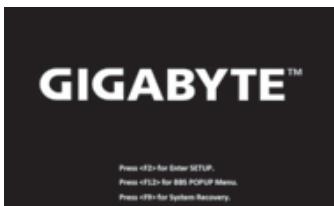
During the laptop turn on process, press and hold F9 key to launch the tool.


Choose "Troubleshoot" to enter the recovery settings. (Also you can choose "Continue" to exit recovery system and continue to Windows 10 for files or data backup.)

There are two options for system recovery
- Reset this PC
You can choose to keep or remove your files and then reinstalls Windows without losing your files.
GIGABYTE Smart Recovery
Your PC settings will be restored to factory default settings.
Caution: All personal data and files will be lost.
4

Choose "Reset this PC"
>Keep my files
Choose an account to continue. All apps will be removed, and settings will back to pure O/S (without GIGABYTE app), but your personal files will be kept.
Remove everything
All apps, setting and personal files will be removed.
Just remove my files
Only personal data and files will be removed, but computer settings will be kept.
Fully clean the drive
The drive will be completely restored to factory default settings. It takes more time. > [Click on "Reset" to execute recovery function.]

Here are what will happen
- All of your personal files and apps will be removed.
- Your PC settings will be restored to pure O/S (without GIGABYTE app).

GIGABYTE Smart Recovery
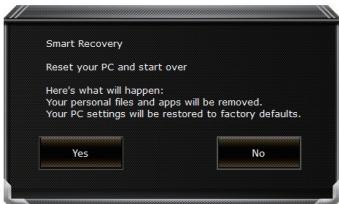
The recovery will be activated and you will see the option buttons on the window. Click on "Yes" to start it.

Caution
- Once the "Recovery" is selected, your personal data and files will be deleted after the laptop starts restoring, and the operating system will be reset to factory default settings.
- A progress indicator bar will show on the window when the recovery process is running. Please make sure the AC-adapter is plugged in and do not turn off the laptop.
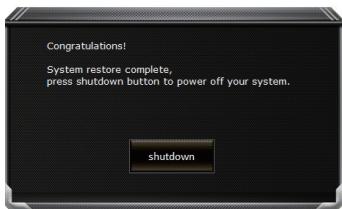
After the system recovery is completed, you will see the option button on the window, please click on "Shutdown".

Advanced options

System Restore Use a restore point recorded on your PC to restore Windows.

System Image Recovery Recover Windows using a specific system image file.

Startup Repair Fix problems that keep Windows from loading.

Command Prompt Use the Command Prompt for advanced trobleshooting.

UEFI Firmware Settings Change settings in your PC's UEFI firmware.

Startup Settings Change Windows Startup behavior.
Appendix
■ Warranty & Service:
Warranty and service and related information please refer to the warranty card or GIGABYTE service website as the below link:
http://www.gigabyte.com/support-downloads/technical-support.aspx
FAQ:
FAQ (Frequent Asked Questions) please refer to the below link: http://www.gigabyte.com/support-downloads/faq.aspx
感謝您選擇技嘉筆記型電腦!
From 12-For Enter STUP
Press eFB for System Recovery.


1 StartendesMakroHubs

b. Overview of macro record panel (you can record your own macro here)
■ Foire Aux Questions:
2 Ikhtisar Hub Makro
1 Profil: Lihat pengaturan makro saat yang berlangsung
2 Macro: Edit FUNGSI perintah makro pengaturan anf.
3 Pengaturan: Perbahirui versi Hub Makro atau memperbarui pengaturan hub makro.
4 Kelompok Makro Indikator Kunci: Tunjukkan diaktifkan Makro Key Group (indicator kelompok atcivated akan menjal)
5 Makro Function Key: Tampikan fungsi Makro yang diprogram bawah Makro Key Group, dari G1 ke G5.
3 Mengungakan Hub Makro
1 Mengatur fungsi dasar Key Makro
Caution: All personal data and files will be lost.

Recover Windowsffectivean system file image.


- Congratulations on your purchase of the GIGABYTE Notebook.
- Using GIGABYTE Notebook for the First Time
- IMPORTANT
- Switching on the Power
- Booting Up the Notebook for the First Time
- Top View
- Left View
- Right View
- Warning:
- Macro key
- Launch Macro Hub
- The overview of Macro Hub
- Using Macro Hub
- Set Macro Key to basic function
- Edit macro command funtions anf settings.
- Edit "Settings" of Macro Hub
- GIGABYTE Software Application
- GIGABYTE Smart Manager
- WARNING
- System Recovery (Restore your laptop operating system)
- Note
- Launch System Recovery
- All ready to go
- Windows 10 Recovery Guide
- There are two options for system recovery
- - Reset this PC
- GIGABYTE Smart Recovery
- 4
- Choose "Reset this PC"
- >Keep my files
- Remove everything
- Just remove my files
- Fully clean the drive
- Here are what will happen
- Caution
- Advanced options
- Appendix
- ■ Warranty & Service:
- FAQ:
- 感謝您選擇技嘉筆記型電腦!
- StartendesMakroHubs
- ■ Foire Aux Questions:
- Ikhtisar Hub Makro
- Mengungakan Hub Makro
- Mengatur fungsi dasar Key Makro
Brand : GIGABYTE
Model : AERO 14W V7 B40W10P-FR
Category : Laptop