
VPW 380 - Car speakers BLAUPUNKT - Free user manual and instructions
Find the device manual for free VPW 380 BLAUPUNKT in PDF.



| Product type | Car subwoofer |
| Brand | Blaupunkt |
| Model | VPW 380 |
| Series | Velocity |
| Usage | Deep bass reproduction in a car audio system |
| Compatible enclosure types | Infinite baffle, sealed enclosure, bass-reflex, bandpass (single or dual vented) |
| Isobaric configuration | Possible (two woofers in opposition, volume reduced by 50%) |
| Recommended enclosure material | MDF or high-quality birch plywood, thickness 19-25 mm |
| Bass-reflex port diameter | 10-15 cm (PVC pipe recommended) |
| Minimum cable cross-section | 4 mm² (copper) |
| Acoustic damping material | Sheep wool or polyester fleece 5-10 cm, covering at least 50% of interior walls |
| Safety precautions | Disconnect the negative battery terminal before installation; avoid damaging cables, airbag, etc. |
| Warranty | Valid in the European Union (conditions at www.blaupunkt.de) |
| Customer service | Blaupunkt GmbH, Hotline, Robert Bosch Str. 200, 31139 Hildesheim, Germany |
| Website | www.blaupunkt.de |
| Recommended installation | By an authorized Blaupunkt dealer |
| Active crossover | Use the crossovers built into Velocity amplifiers |
Frequently Asked Questions - VPW 380 BLAUPUNKT
User questions about VPW 380 BLAUPUNKT
0 question about this device. Answer the ones you know or ask your own.
Ask a new question about this device
Download the instructions for your Car speakers in PDF format for free! Find your manual VPW 380 - BLAUPUNKT and take your electronic device back in hand. On this page are published all the documents necessary for the use of your device. VPW 380 by BLAUPUNKT.
USER MANUAL VPW 380 BLAUPUNKT
Congratulations on your purchase of your new Blaupunkt Velocity-Series subwoofoers. We have invested tremendous effort in the design process of the new Blaupunkt Velocity-Series subwoofoers. Reference series, in order to achieve superior musical performance.
For maximum performance and reliability we highly recommend that your new Blaupunkt Velocity-Series subwoofer be installed by an authorised Blaupunkt dealer. By using our Blaupunkt Velocity-Series component speakers and amplifiers you can be assured of making the best out of your high-quality audio hi-fi system without spoiling the sound by using components of inferior quality.
For additional information on the Blaupunkt Product Line (technical data, user notes and soon also a simulation programme for subwoofer housings) visit our Internet site at: http://www.blaupunkt.de
We provide a manufacturer guarantee for our products bought within the European Union. You can view the guarantee conditions at www.blaupunkt.de or ask for them directly at:
Blaupunkt GmbH
Hotline
Robert Bosch Str. 200
31139 Hildesheim
Germany
Safety precautions
Before starting to mount your speakers, please read carefully the instructions on installation and connection.
Disconnect the negative terminal of the battery before carrying out installation and connection work. Observe the vehicle manufacturer's safety instructions (regarding airbags, alarm systems, trip computers, vehicle immobilisers).
When drilling holes, take care to avoid damage to vehicle components (battery, cables, fuse boxes). Do not mount the subwoofer onto flexible rear decks (hatchback vehicles) or anywhere where they may fall forward.
SUBWOOFER ENCLOSURE TYPES
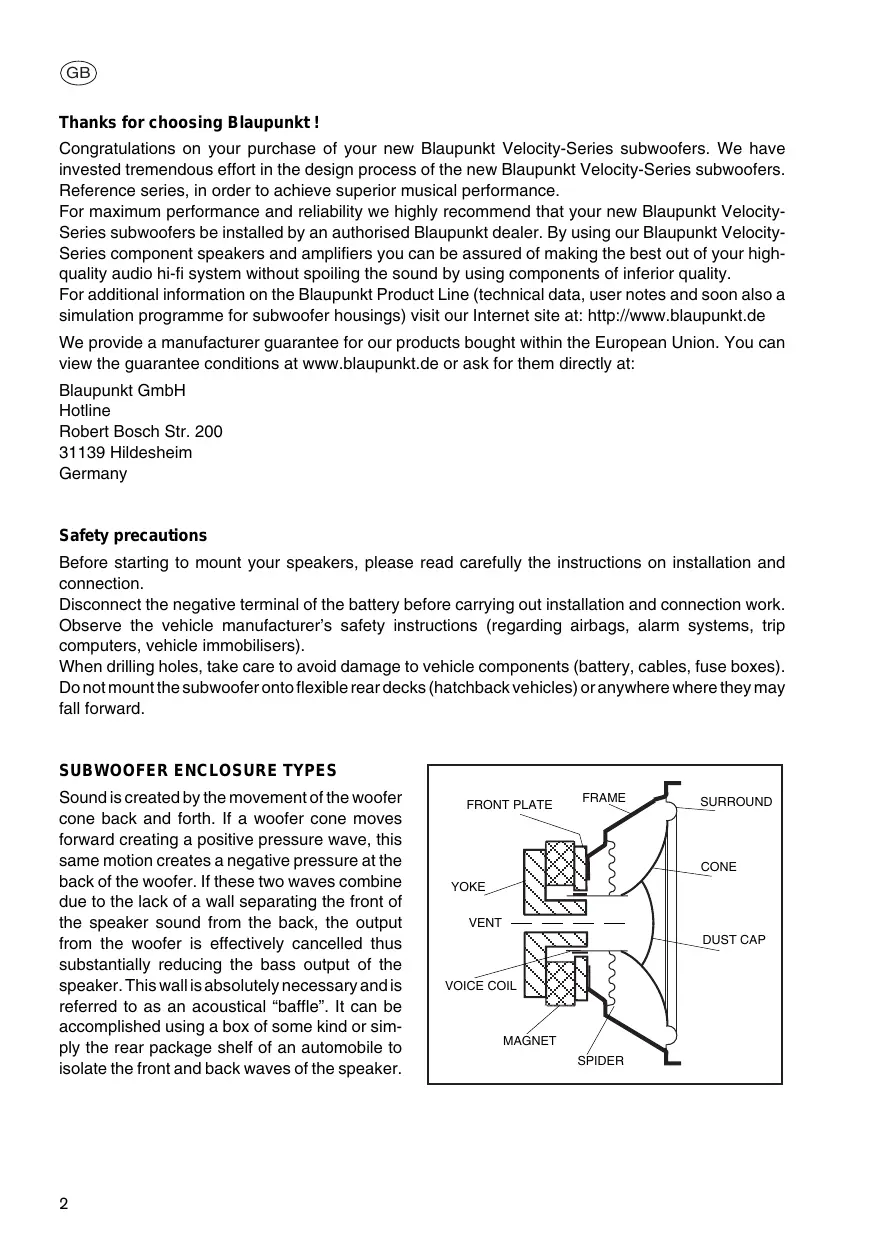
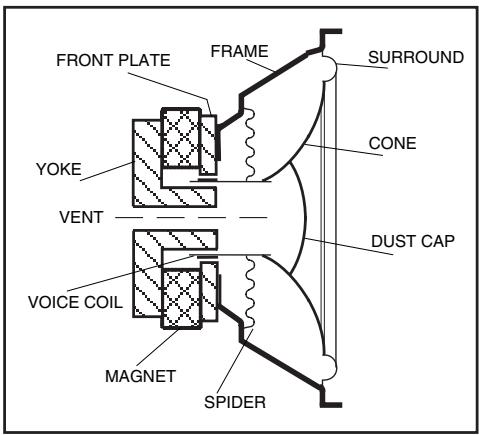
Sound is created by the movement of the woofer cone back and forth. If a woofer cone moves forward creating a positive pressure wave, this same motion creates a negative pressure at the back of the woofer. If these two waves combine due to the lack of a wall separating the front of the speaker sound from the back, the output from the woofer is effectively cancelled thus substantially reducing the bass output of the speaker. This wall is absolutely necessary and is referred to as an acoustical "baffle". It can be accomplished using a box of some kind or simply the rear package shelf of an automobile to isolate the front and back waves of the speaker.
COMMON ENCLOSURE TYPES
In the car audio world there are five types of subwoofer enclosures commonly used: INFINITE BAFFLE, SEALED BOX (closed box), VENTED BOX (bass reflex), SINGLE-VENTED BANDPASS (often incorrectly referred to as "5th" order), DUAL-VENTED BANDPASS (often incorrectly referred to as "7th" order). No single design is superior because each has its own compromise in performance, power handling and design complexity. The bandpass name implies a "built-in" acoustical response which has a natural highpass response (30 Hz for example) but also a lowpass response suppressing high frequencies (e.g., > 80 Hz).
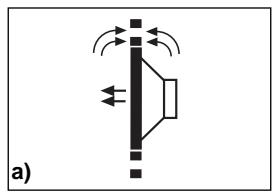
INFINITE BAFFLE (fig. a) designs simply use the trunk of the car for its acoustical enclosure and the rear deck to isolate the front and rear sound paths. Advantages include simple installation and adequate performance for most systems. Disadvantages include poor power handling capacity and substandard transient response.
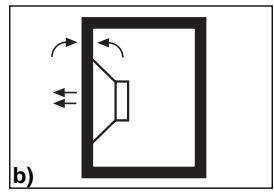
SEATED boxes (fig. b) offer one of the best compromises in power handling and performance. Because of the "air spring" provided by the box the advantages include simple box construction, higher power handling, excellent transient response, and smooth low frequency rolloff. Disadvantages include only moderate efficiencies at low frequencies and the need for large box volumes.
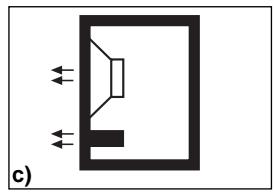
VENTED boxes (fig. c) extend the low frequency response below that of the sealed box by using a port tube. Advantages include extended low frequency response, lower distortion due to smaller cone movements in its passband, good efficiency, good transient response, moderate size boxes and higher power capacity. Disadvantages include increased complexity in box design and possible woofer damage due to over-excision of the woofer cone below the cut-off frequency of the vented box.
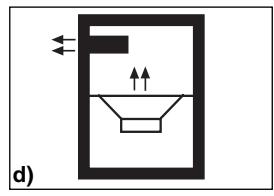
SINGLE-VENTED BANDPASS boxes (fig. d) are relatively new (about 5 years in the car) but offer some advantages of both the sealed and vented designs. Advantages include reasonable efficiency, small box volumes, good transient response, extended low frequency performance and can be used with very high power amplifiers. Disadvantages include slightly lower efficiency compared to a vented box and increased complexity in box design and construction.
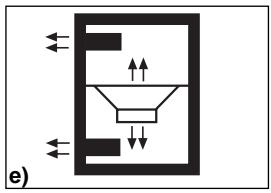
DUAL-VENTED BANDPASS boxes (fig. e) vent the sound from the front and back of the woofer through individually tuned enclosure on the front and rear of the woofer. The advantage of this design is its high efficiency over a narrow frequency band. Disadvantages include complex design and construction, large box volumes, poor transient response and susceptibilities to cone over-excursions (damage) for sound outside its primary frequency band.
ISOBARIC WOOFER CONFIGURATIONS
Increasing in popularity in recent years is the compound woofer design, more commonly known as the "Isobaric" design. Isobaric actually means "constant pressure" which is the case having two woofers moving an encapsulated pocket of air between them in the same direction.
This arrangement acts like a single speaker which effectively reduces the required box volumes for a subwoofer system by 50% which is substantial if you are space-limited. Unfortunately, the trade-off for space is the 3 dB loss in efficiency but this is usually recovered with increased amplifier power. Care must be taken to avoid air leaks between the two woofers and final speaker wiring and impedance loads must be carefully watched.
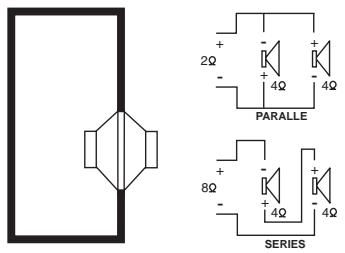
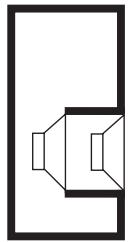
ISOBARIC CONFIGURATION (TANDEM)
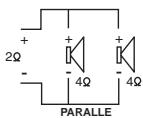
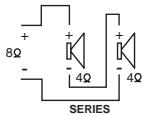
SUBWOOFER ENCLOSURE CONSTRUCTION
Before starting final box assembly some basic construction issues should be mentioned:
- Infinite baffle construction in a car is done by simply cutting a piece of wood which will act as an acoustical divider isolating the front and rear sound of the woofer. This piece of wood is mounted inside the trunk of the car under the rear deck, or against the back of the rear seat, and should have some kind of caulking to seal off all residual air leaks.
- Box construction can take on nearly any shape since we are dealing with low frequencies. Odd shapes that are difficult to cut and glue should be avoided.
- Particle board, MDF, or high grade birch plywood are good materials to build boxes of thicknesses of 19 to 25mm .
- All seams in the box should be glued, screwed and caulked to prevent wall separation over time due to vibration and environmental changes within the car.
- Cross bracing is important for large boxes to prevent wall vibration.
- Acoustical damping material (sheep wool or fiberglass batting 5 to 10cm thick), attached to 50% or more of the interior walls helps reduce box noise and also increases the box volume seen by the woofer by 10 - 20% . The application of self-adhesive damping mats to the inside walls also helps to eliminate wall resonances.
- The cables running from the amplifier to the subwoofer should be as short as possible with a cable cross section of at least 4 mm2.
- The final box should be rock solid and air tight but should also remain serviceable should a woofer be damaged for any reason.
- When possible, use 10 to 15 cm diameter port tubes to avoid wind noise from smaller diameter sizes. PVC plumbing pipe in various diameters is available at most hardware stores with „elbow“ pipes allowing you to bend the tubes inside the box.
- Try to always use active (electronic) crossovers, such as those built into our Velocity amps, for example.
TYPEN SUBWOOFER-BOXEN
TYPEP AFBUBWOOFER-BOKSE
Pá CarAudio-området anvendes hovedsageligt fem forskellige subwoofer-kabinetter: HÖJTALERE MED UENDELIG LYDSKÄERM, LUKKEDE KABINETTER, BASSREFLEX-KABINETTER, VENTILERDE BANDPASS-KABINETTER (betegnes tit forkert som "5. ordens kabinet") og DOBBELT VENTILERET BANDPASS-KABINETTER (betegnes tit forkert som "7. ordens
SUBWOOFER-KABINETTERS OPBYGNING
| 12" SUBWOOFER • TECHNICAL DATA | |
| Nominal diameter | 12.0 in (300 mm) |
| Nominal impedance | 2/2 Ω (ea. coil) |
| DC resistance (Re) | 2 Ω (ea.) |
| Resonance frequency (fs) | 42 Hz |
| Frequency Response | 40-200 Hz |
| Total Q factor (Qts) | 0.48 |
| Mechanical Q (Qms) | 4.3 |
| Electrical Q (Qes) | 0.54 |
| Equivalent air volume (Vas) | 13.5 ltr's |
| Effective cone area (Sd) | 41,5 in² |
| Voice coil diameter | 75,5 mm |
| Voice coil former material | Carbon, Fiberglass (CFG) |
| Linear excursion (Xmax) | ±15 mm |
| Continuous power (Pe) | 1200 W (3600 peak) |
| Sensitivity (SPL) | 93 dB |
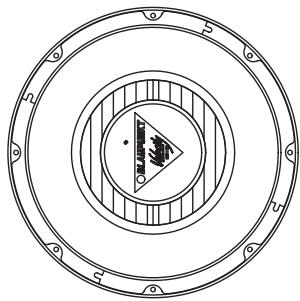
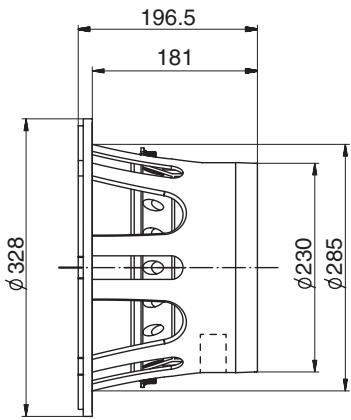
VPw 300
Recommended box designs • Boxenempfehlung • Conception recommandée des enceintes • Box raccomandati • Aanbevolen boxer • Rekommendationer • Recomendaciones de cajas de altavoz • Caivas recomendadas • Anbefaling af bokse
| Sealed: | no recommendation |
| Vented: | 30 liters Port: D = 10 cm, L = 60 cm rounded on both sides |
| Bandpass: | no recommendation |
VPw 380
Specifications • Technische Daten • Caracteristiques techniques • Specifiche • Specificaties • Specifikationer • Especificaciones • Especificações • Specifikationer
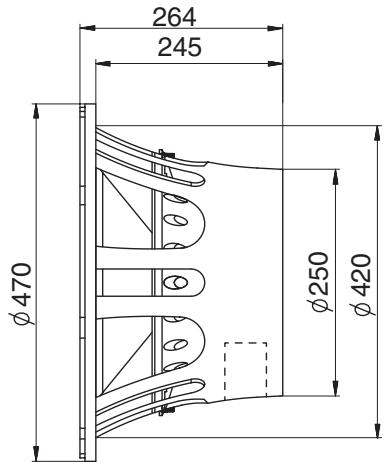
| 15" SUBWOOFER • TECHNICAL DATA | |
| Nominal diameter | 15.0 in (380 mm) |
| Nominal impedance | 2/2 Ω (ea. coil) |
| DC resistance (Re) | 2 Ω (ea.) |
| Resonance frequency (fs) | 28 Hz |
| Frequency Response | 25-200 Hz |
| Total Q factor (Qts) | 0.37 |
| Mechanical Q (Qms) | 3.6 |
| Electrical Q (Qes) | 0.37 |
| Equivalent air volume (Vas) | 60.6 ltr's |
| Effective cone area (Sd) | 73 in² (0.051 m²) |
| Voice coil diameter | 100.0 mm |
| Voice coil former material | Carbon, Fiberglass (CFG) |
| Linear excursion (Xmax) | ±15 mm |
| Continuous power (Pe) | 1500 W (4.500 peak) |
| Sensitivity (SPL) | 93 dB |
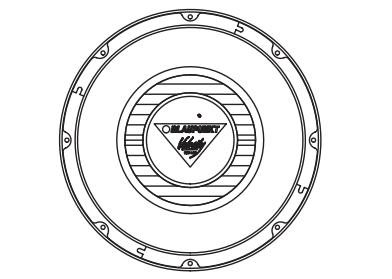
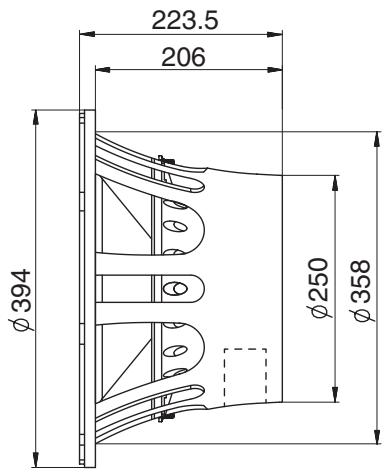
VPw 380
Recommended box designs • Boxenempfehlung • Conception recommandée des enceintes • Box raccomandati • Aanbevolen boxer • Rekommendationer • Recomendaciones de cajas de altavoz • Caivas recomendadas • Anbefaling af bokse
| Sealed: | no recommendation |
| Vented: | 45 liters Port: D = 10 cm, L = 65 cm rounded on both sides |
| Bandpass: | no recommendation |
VPw 460
Specifications • Technische Daten • Caracteristiques techniques • Specifiche • Specificaties • Specifikationer • Especificaciones • Especificações • Specifikationer
| 18" SUBWOOFER • TECHNICAL DATA | |
| Nominal diameter | 18.0 in (460 mm) |
| Nominal impedance | 2/2 Ω (ea. coil) |
| DC resistance (Re) | 2 Ω (ea.) |
| Resonance frequency (fs) | 37 Hz |
| Frequency Response | 20-200 Hz |
| Total Q factor (Qts) | 0.60 |
| Mechanical Q (Qms) | 3.8 |
| Electrical Q (Qes) | 0.71 |
| Equivalent air volume (Vas) | 36,7 ltr's |
| Effective cone area (Sd) | 113 in² |
| Voice coil diameter | 100.0 mm |
| Voice coil former material | Carbon, Fiberglass (CFG) |
| Linear excursion (Xmax) | ±15 mm |
| Continuous power (Pe) | 1800 W (5.400 peak) |
| Sensitivity (SPL) | 94 dB |
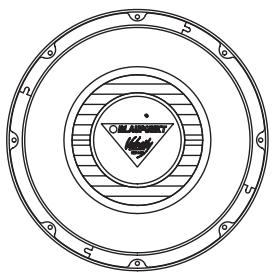
VPw 460
Recommended box designs • Boxenempfehlung • Conception recommandée des enceintes • Box raccomandati • Aanbevolen boxer • Rekommendationer • Recomendaciones de cajas de altavoz • Caivas recomendadas • Anbefaling af bokse
| Sealed: | no recommendation |
| Vented: | 60 liters 2x Port: D = 10 cm, L = 80 cm rounded on both sides |
| Bandpass: | no recommendation |
Service numbers / Service-Nummern / Numeros du service après-vente / Numeri del servizio di assistenza / Servicenummers / Telefonnummer für service / Númoses deServiço / Número deServiço / Servicenumre
| Country: | Phone: | Fax: | WWW: | |
| Germany | (D) | 0180-5000225 | 05121-49 4002 | http://www.blaupunkt.com |
| Austria | (A) | 01-610 390 | 01-610 393 91 | |
| Belgium | (B) | 02-525 5444 | 02-525 5263 | |
| Denmark | (DK) | 44 898 360 | 44-898 644 | |
| Finland | (FIN) | 09-435 991 | 09-435 99236 | |
| France | (F) | 01-4010 7007 | 01-4010 7320 | |
| Great Britain | (GB) | 01-89583 8880 | 01-89583 8394 | |
| Greece | (GR) | 210 94 27 337 | 210 94 12 711 | |
| Ireland | (IRL) | 01-4149400 | 01-4598830 | |
| Italy | (I) | 02-369 62331 | 02-369 62464 | |
| Luxembourg | (L) | 40 4078 | 40 2085 | |
| Netherlands | (NL) | 023-565 6348 | 023-565 6331 | |
| Norway | (N) | 66-817 000 | 66-817 157 | |
| Portugal | (P) | 01-2185 00144 | 01-2185 11111 | |
| Spain | (E) | 902-120234 | 916-467952 | |
| Sweden | (S) | 08-7501500 | 08-7501810 | |
| Switzerland | (CH) | 01-8471644 | 01-8471650 | |
| Czech. Rep. | (CZ) | 02-6130 0441 | 02-6130 0514 | |
| Hungary | (H) | 01-333 9575 | 01-324 8756 | |
| Poland | (PL) | 0800-118922 | 022-8771260 | |
| Turkey | (TR) | 0212-3350677 | 0212-3460040 | |
| USA | (USA) | 800-2662528 | 708-6817188 | |
| Brasil(Mercosur) | (BR) | +55-19 3745 2769 | +55-19 3745 2773 | |
| Malaysia(Asia Pacific) | (MAL) | +604-6382 474 | +604-6413 640 | |
- Safety precautions
- SUBWOOFER ENCLOSURE TYPES
- COMMON ENCLOSURE TYPES
- ISOBARIC WOOFER CONFIGURATIONS
- SUBWOOFER ENCLOSURE CONSTRUCTION
- TYPEN SUBWOOFER-BOXEN
- TYPEP AFBUBWOOFER-BOKSE
- SUBWOOFER-KABINETTERS OPBYGNING
- VPw 300
- VPw 380
- VPw 460
- Service numbers / Service-Nummern / Numeros du service après-vente / Numeri del servizio di assistenza / Servicenummers / Telefonnummer für service / Númoses deServiço / Número deServiço / Servicenumre
Brand : BLAUPUNKT
Model : VPW 380
Category : Car speakers