
CR-10 - Coffee machine FAGOR - Free user manual and instructions
Find the device manual for free CR-10 FAGOR in PDF.



| Product type | Espresso coffee machine |
| Brand | FAGOR |
| Model | CR-10 |
| Supply voltage | 230 V ~ 50 Hz |
| Water tank capacity | 1.2 L |
| Power | 1200 W (estimate) |
| Pressure | 15 bar (estimate) |
| Main functions | Espresso, cappuccino, steam for heating milk |
| Included filters | 1 or 2 cup filter, E.S.E. pod filter, measuring scoop |
| Filter holder | With locking, compatible with soft pods and E.S.E. |
| Steam nozzle | Rotating, for frothing and heating milk |
| Drip tray | Removable, with grid |
| Indicator lights | Red (power on), green (ready) |
| Maintenance and cleaning | Clean exterior with a damp cloth; periodically clean the tank, tray, filter holder and filters with warm soapy water; descale at least every 3 months |
| Safety | Automatic shut-off not specified but safety instructions: do not leave unattended, use on stable surface, unplug before maintenance |
| Spare parts and repairability | Filters and filter holder commercially available; for repairs, contact an authorized service center |
| General information | Domestic use; compliant with EC directives; 25-page manual |
Frequently Asked Questions - CR-10 FAGOR
User questions about CR-10 FAGOR
0 question about this device. Answer the ones you know or ask your own.
Ask a new question about this device
Download the instructions for your Coffee machine in PDF format for free! Find your manual CR-10 - FAGOR and take your electronic device back in hand. On this page are published all the documents necessary for the use of your device. CR-10 by FAGOR.
USER MANUAL CR-10 FAGOR
The manufacturer reserves the right to modify the models described in this User's Manual.
Dear Customer:
At first, preparing an espresso coffee requires a little skill and patience. Take all the time you need to find out how your espresso coffee machine works and how to make a good espresso coffee. Read the instructions for use carefully before using the appliance and keep them for future consultation.
1. TECHNICAL DATA
Voltage: 230 V ~ / 50 Hz.
Wattage: 1000 W
Deposit capacity: 1.2 L
This coffee machine is adapted to EU directives 89 / 336 / CEE related to electromagnetic compatibility and 73 / 23 / CEE on electrical appliance safety.
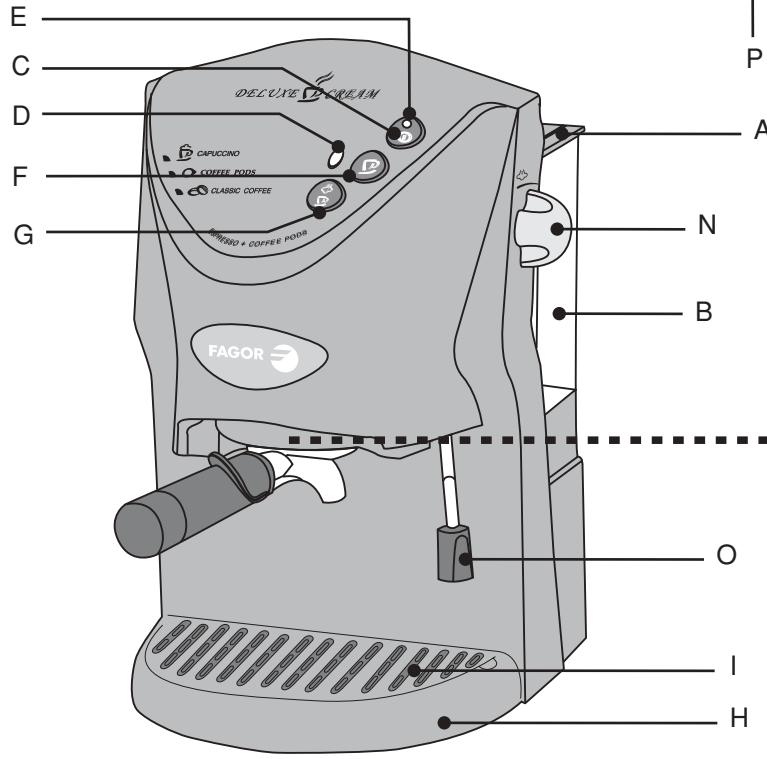
2. DESCRIPTION OF THE PRODUCT (FIG. 1)
A. Deposit lid B. Water deposit C. Red light D. Green light E. On / off switch F. Coffee outlet switch G. Steam outlet switch H. Tray support I. Drip tray J. Filter for 1 or 2 cups K. E. S. E Coffee measure L. Filter holder M. Steam regulator N. Steamer O. Top filter P. Head Q. Close filter
3. SAFETY RECOMMENDATIONS
The instructions contain important information on safety and on correct operation of the appliance. Read the instructions, keep them in a safe place and transfer them to the coffee machine's next owner.
Safety instructions which must be observed when connecting the appliance
- If the cable for this appliance is damaged, please consult an authorised technical Assistance Centre for a replacement.
- Make sure that the mains voltage in your home corresponds to that indicated on the coffee machine.
- Connect the appliance to an efficient earth installation. If in doubt, consult a qualified professional.
- Do not let the cable rub against sharp edges or let it hang down. Do not leave the cable in a hot or damp place.
- Put the coffee machine on a flat stable surface, away from hot places or heat sources.
- Unplug the cable at the socket when the coffee machine is switched off.
- Do not use or place any part of this appliance on or close to hot surfaces (gas or electric cooker hobs or ovens).
Safety instructions which should be observed when the coffee machine is switched on.
- Do not leave the coffee machine unattended when in operation. Keep out of reach of children.
- People with nervous dysfunctions should not use the appliance if they are unaccompanied.
- Before switching the appliance on, fill the deposit with water.
- The drip tray and the grille must be correctly fitted before switching the coffee machine on.
- Do not expose it to the elements (rain, wind, etc.)
- When closing the control lever, take care not to put your hands in the filter holder.
- Caution! The steam duct and the filter holder heat up whilst the coffee machine is working and there is a risk of burning.
- Warning! Whilst the coffee machine is working under pressure there is a danger of burning. When you prepare coffee, the control lever must be completely closed as shown in the OPERATION section.
- Do not heat inflammable liquids with the steamer.
- Only clean the steamer when the coffee machine is disconnected.
Safety instructions for cleaning and maintenance tasks
- In the event of a fault and/or poor operation, switch the appliance off, unplug it and do not try to repair it. Go to an authorised technical Assistance Centre and request that original spares and accessories are used.
- Do not use the coffee machine if the cable or the plug is damaged.
- Do not attempt to substitute the cable as this can be dangerous. Send it to an authorised technical Assistance Centre immediately.
- Disconnect the appliance from the network after each use and before any maintenance and cleaning.
- Never plug in or unplug the appliance with wet hands.
- Do not unplug the coffee machine by pulling on the cable.
- Do not allow the coffee machine, the cable or the plug to get damp.
- Never submerge the appliance in water or any other liquid.
- The coffee machine can only be used to make coffee, to froth milk or heat water according to these instructions.
- This coffee machine is only for domestic use. Responsibilities will not be accepted for damage caused by using the appliance for other ends, incorrect use or repairs by who are not experts.
4. APPLICATION
The coffee machine has been designed for several applications depending on the different types of coffee available on the market. Consequently, it can be used to prepare exquisite espresso coffee, white coffee, espresso coffee with frothy milk, or any other type of coffee drink.
The taste of the coffee will always depend on several factors which should always be taken into account when selecting the coffee, namely:
- The origin of the coffee
- The type of grinding
- The type of measure. Other aspects which should be considered when preparing coffee are:
- Use an appropriate measure of coffee
- Press the coffee properly
- Use good quality water. Combine these factors according to your taste.
You can also prepare a cappuccino or heat a drink with the steamer.
Below there are a few suggestions which we're sure you'll love.
ITALIAN "STRETO" ESPRESSO: 1 cup
- Coffee:
- 1 measure of ground coffee, well pressed, or
- 1 single weak measure, or
- 1 hard single measure (E.S.E)
- Water: 30-40ml
"STRETO" ESPRESSO: 1 cup
- Coffee:
- 1 measure of ground coffee, well pressed, or
- 1 single weak measure, or
- 1 hard single measure (E.S.E)
- Water: 40-50ml
"STRETO" ESPRESSO: 2 cups
- Coffee:
- 2 measures of ground coffee, medium pressed, or
- 2 single weak measures, or
- 2 hard single measures (E.S.E)
- Water: 40-50ml / per cup
"LUNGO" ESPRESSO: 2 cups
- Coffee:
- 2 measures of ground coffee, medium pressed, or
- 2 single weak measures,
- Water: 80ml
WHITE COFFEE: 1/2 cups
- Coffee:
- 1/2 measures of ground coffee, without pressing or
- 1/2 weak measures,
• Water: 100-120 ml / per cup
"LATTE" ESPRESSO COFFEE: 1/2 cups
- Coffee:
- 1/2 measures of ground coffee, medium pressed or
- 1/2 weak measures,
• Water: 80ml / per cup
- Hot milk to taste
CAPPUCCINO: 1 cup
- Coffee:
- 1 measure of ground coffee, well pressed
- Water: 30-40 ml
- 100ml skimmed milk
5. ADJUSTMENT
Before using the coffee machine for the first time, clean the filters with water. It is also necessary to clean the coffee machine inside. To do this, fill the deposit with water and run it through without coffee until the deposit is empty. Do this twice.
Method:
- Remove the deposit to fill it with cold water and fit it back in the coffee machine (Fig 2).
- Plug in the coffee machine and switch it on using the on / off switch (E). The red light (C) will come on to show that the coffee machine is on.
- Fit the empty filter holder (M) in the head (Q) and turn it from left to right (Fig 3).
- When the green light (D) comes on the coffee machine will have reached the correct temperature and it will be ready. Place an empty container under the
filter holder to collect the water.
- Press the switch (F) (Fig 4) for the water to start coming out of the head (Q). Let most of the water out the deposit connecting and disconnecting the coffee switch (F) at regular intervals.
- Place the steamer (O) inside an empty container. Press the switch again (F) (Fig 4) and open the regulator (N) turning it to the ⏻ position (Fig. 5) to clean inside the steamer.
- Let the remaining water out of the deposit at regular intervals by opening and closing the steam regulator (N).
- Repeat the entire process twice and the coffee machine will be ready to use.
NOTE: This adjustment must also be done when first using the coffee machine for a long period.
6. OPERATION
- Fill the deposit with water and fit it in place. Plug the coffee machine in and move the switch (E). The light will come on (C) to show that the coffee machine is on. • Make sure that the switch (G) is in the √
- Select the filter depending on the type of coffee you are going to prepare, remembering that:
- Filter for 1 or 2 measures of coffee (J) (Fig 6):
1 measure of coffee: one slightly rounded coffee measure (L).
1 single weak measure. 2 measures of coffee: two slightly rounded coffee measures (L). 2 single weak measures.
- Filter for single coffee measure (K) (Fig 7):
1 single hard measure (E.S.E.)
- Move the filter lock (R) backwards and fit the chosen filter into the filter holder (M) (Fig. 8) and insert the quantity of coffee or your chosen measure in the filter. IMPORTANT
- Press the coffee with the measurer (L). Once pressed, the level must be below the maximum level indicated inside the filter for 1 or 2 cups.
- Clean off any coffee remaining on the edge of the filter holder. (Fig 9).
- Add the single weak measure using the coffee measure (L)
- Once the filter holder has been fitted into the head, turn it to the right (Fig. 3).
- Put one or two cups under the filter holder (M) and when the green light (D) comes on, press the coffee switch (F). The coffee will start to come out of the filter holder (M) (Fig. 10). When there is sufficient coffee, press the switch (F) again and the coffee flow will stop.
- Remove the filter holder (M) from the block and keep the filter lock (R) forward, clean out the used coffee (Fig. 11)
- When you have finished using the coffee machine, turn off the switch (E) and unplug the coffeemaker from the mains.
7. PREPARING HOT DRINKS
In order to heat liquid, you must follow these steps:
- Fill the water deposit and plug the coffee machine in and press the switch (E).
- Put the steam switch (G) to the 🌐 position (Fig. 12). When the green light (D) comes on, turn the steam regulator (N) to the 🐐 position (Fig. 5) to release the steam. The light (D) will go out whilst the steam regulator is open. Note: At first only water will come out of the steamer so it is advisable to have a container to hand to collect the water.
- When steam starts to come out, close the steam vapour momentarily (N), insert the steamer (O) around 3 cm into the liquid which you wish to heat (Fig. 13) and then open the steam regulator again (Q). Make sure that the steamer does not touch the bottom of the container directly so that the steam outlet is not obstructed.
- When the chosen temperature has been reached, close the steam regulator (N) and remove the steamer (O) from the container, placing it on the drip grille (H).
- Put the switch (G) in the √ position (Fig 14).
To prepare a cappuccino you must:
• Use cold skimmed milk. - Insert the steamer (O) approximately 3 cm into the milk and hold it in this position.
8. SECRETS FOR PREPARING GOOD COFFEE
- Use good quality coffee which has been properly ground. You can also use weak single measures and ESE type hard single measures • Pre-heat the filter and the cups. • Use good quality water.
- As coffee is a natural product, the flavour will vary according to its origin, mixture and degree of toasting. Try different mixtures of special coffee for espresso coffee machines until you find the one which best suits your taste.
- Keep open packets of coffee in a container in the fridge.
- Put an appropriate quantity of coffee in the filter and press it down properly.
- A small variation in the measure of coffee and in the degree of grinding, as well as pressing it down more or less will alter the intensity of the coffee and its aroma.
- The greater the quantity of coffee, the finer it is ground and the better it is packaged, the slower the coffee machine will dispense it. If the coffee comes out very quickly, change the type of coffee and use one which is finer ground.
- The coffee should come out evenly and not in drips.
9. CLEANING AND MAINTENANCE
Periodic maintenance must be done on the coffee machine to keep it in good condition.
Important: Before any type of cleaning and maintenance task, turn off the switch (E), unplug the coffee maker and let it cool.
Cleaning
- Clean the outside of the coffee machine with a soft damp cloth and dry it afterwards. Do not use solvents or abrasive products.
- Regularly clean the water deposit (B), the drip tray (I), the drip grille (H), the filter holder (M) and the filters (J and K) with warm water and neutral soap. After cleaning them, rinse them carefully with clean water and dry them.
- Every time you use the coffee machine, clean off any coffee remains. To do this, follow these steps:
- Fit the empty filter holder (M) (Fig. 3).
- Switch the coffee maker on by pressing the on/off switch (E).
- Press the coffee switch (F) and let the water circulate for several seconds.
Clean the steamer (O) with a damp cloth.
Maintenance
- Periodically, or whenever necessary, clean the coffee outlet and inside the filter holder (M).
- If necessary, also clean the top filter (Fig. 15). Do this in the following way:
- Turn off the on/off switch (E) and unplug from the mains.
- Wait for the coffee maker to cool.
- Loosen the top filter (P) with an appropriate tool (Fig. 16).
- Clean the filter with running water and fit it back in the coffee maker.
If you do not plan to use the coffee maker for a long period of time, do not fit the filter holder in the head or only insert it in the central position to lengthen the appliance life.
Cleaning scale
Clean the limescale off the coffee machine from time to time. The frequency will depend on the hardness of the water (ask your supply company). Normally it should be cleaned every three months at least. Use normal water softening products on the market for coffee machines (follow the instructions on the packet) or dissolve two
teaspoons of tartaric acid or citric acid in half a litre of lukewarm water.
Do not use vinegar as it will reduce the life of the appliance.
How to remove limescale from the coffee machine
- Fill the deposit with a descaling solution. Then place a container which is large enough on the drip grille (H) under the filter holder (M).
- Plug the coffee machine in.
- Press the switch (E) to turn the coffee maker on and press the button (F). Let around 1/3 of the deposit flow out through the coffee outlet.
- Then let the solution work for around 15 minutes with the coffeemaker switched off.
- Connect the coffeemaker again, and with the switch (G) on position D and let the rest of the water run out at regular intervals.
- In order to descale the steamer (O), from time to time position the switch (G) on 🐘 and insert the steamer (O) into an empty container and open the steamer.
- Repeat the process as many times as necessary.
- When the descaling process has finished, clean the water deposit (B) thoroughly.
- Fill the deposit with drinking water and let it circulate through the coffeemaker until it has completely emptied twice.
10. TROUBLE SHOOTING
- The coffee does not come out or drips slowly
- No water in the deposit
- The coffee is ground too finely
- Coffee too pressed
- Too much coffee in the filter holder (M)
- Steam switch (G) connected
- Calcification in the coffeemaker
- The coffee comes out very fast and does not form cream
- The coffee is ground too roughly
- Coffee not pressed enough
- Little coffee in the filter holder
- Coffee is out of date or inappropriate
- The coffee flows over the top of the filter
- The filter holder is badly fitted
- The top edge of the filter holder has not been cleaned
- The filter holder seal is not clean or has been damaged
• Coffee comes out cold
- The temperature indicator (D) is not already on when the coffee is being prepared.
• The pump makes a lot of noise
- Lack of water in the deposit
- Insufficient pressure in the filter holder due to a low quantity of coffee or rough grinding
• The milk does not foam when preparing a cappuccino
- Inappropriate milk (check the fat content)
For any other operation problem or in the event of a fault, request help from an Authorised Technical Assistance Service or your local supplier.
11. INFORMATION FOR THE CORRECT DISPOSAL OF ELECTRICAL AND ELECTRONIC APPLIANCES
At the end of its working life, the product must not be disposed of as urban waste. It must be taken to a special local authority differentiated waste collection centre or to a dealer providing this service. Disposing of a household appliance separately avoids possible negative consequences for the environment and health deriving from inappropriate disposal and enables the constituent materials to be recovered to obtain significant savings in energy and resources.
To remind you that you must collaborate with a selective collection scheme, the symbol shown appears on the product warning you not to dispose of it in traditional refuse containers.
For further information, contact your local authority or the shop where you bought the product.
Dear customer,
WHITE COFFEE: 1/2 cup
"LATTE" ESPRESSO COFFEE: 1/2 cup
- Coffee:
ESPRESSO "STRETO": 1 cup
- Coffee:
ESPRESSO "STRETO": 2 cups
- Coffee:
CAFÉ CREME: 1/2 cups
- Coffee:
- TECHNICAL DATA
- DESCRIPTION OF THE PRODUCT (FIG. 1)
- SAFETY RECOMMENDATIONS
- SAFETY INSTRUCTIONS WHICH MUST BE OBSERVED WHEN CONNECTING THE APPLIANCE
- SAFETY INSTRUCTIONS WHICH SHOULD BE OBSERVED WHEN THE COFFEE MACHINE IS SWITCHED ON
- SAFETY INSTRUCTIONS FOR CLEANING AND MAINTENANCE TASKS
- APPLICATION
- ITALIAN "STRETO" ESPRESSO: 1 CUP
- STRETO" ESPRESSO: 1 CUP
- STRETO" ESPRESSO: 2 CUPS
- LUNGO" ESPRESSO: 2 CUPS
- WHITE COFFEE: 1/2 CUPS
- LATTE" ESPRESSO COFFEE: 1/2 CUPS
- CAPPUCCINO: 1 CUP
- ADJUSTMENT
- METHOD
- OPERATION
- FILTER FOR 1 OR 2 MEASURES OF COFFEE (J) (FIG 6)
- FILTER FOR SINGLE COFFEE MEASURE (K) (FIG 7)
- PREPARING HOT DRINKS
- SECRETS FOR PREPARING GOOD COFFEE
- CLEANING AND MAINTENANCE
- CLEANING
- MAINTENANCE
- CLEANING SCALE
- HOW TO REMOVE LIMESCALE FROM THE COFFEE MACHINE
- TROUBLE SHOOTING
- INFORMATION FOR THE CORRECT DISPOSAL OF ELECTRICAL AND ELECTRONIC APPLIANCES
- WHITE COFFEE: 1/2 CUP
- LATTE" ESPRESSO COFFEE: 1/2 CUP
- ESPRESSO "STRETO": 1 CUP
- ESPRESSO "STRETO": 2 CUPS
- CAFÉ CREME: 1/2 CUPS
Brand : FAGOR
Model : CR-10
Category : Coffee machine