
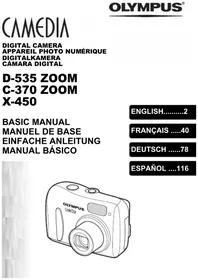
C-50 ZOOM - Digital Camera OLYMPUS - Free user manual and instructions
Find the device manual for free C-50 ZOOM OLYMPUS in PDF.


| Product Type | Compact digital camera |
| Brand | OLYMPUS |
| Model | C-50 ZOOM |
| Resolution | 5 megapixels (2560 x 1920 pixels) |
| Sensor | CCD 1/1.76" (5.36 MP gross) |
| Lens | 7.8 – 23.4 mm (equiv. 38-114 mm in 35 mm), f/2.8-4.8 |
| Optical zoom | 3x |
| Digital zoom | Up to 12x (combined) |
| Shooting modes | Auto, Program (P), Aperture Priority (A), Shutter Priority (S), Manual (M), Portrait, Landscape, Sport, Night Scene, Self-Portrait, Movie, My Mode |
| File types | JPEG (DCF/Exif 2.2), TIFF (uncompressed), QuickTime Motion JPEG (movies) |
| Storage media | xD-Picture Card (16 to 128 MB) |
| LCD screen | 1.5" TFT LCD, 134,000 pixels |
| Viewfinder | Real-image optical |
| Flash | Built-in, modes: auto, red-eye reduction, fill-in, off, slow synchro |
| ISO sensitivity | 80, 160, 320 |
| Shutter speed | 1/2 to 1/1000 s (M mode: 8 to 1/1000 s) |
| Aperture | W: f/2.8 – f/8.0, T: f/4.8 – f/8.0 |
| Power supply | Lithium-ion battery LI-10B (included); AC adapter D-7AC (optional) |
| Dimensions (W x H x D) | 99.5 x 58.5 x 41.5 mm (excluding protrusions) |
| Weight | 194 g (without battery or card) |
| Connectivity | USB (mini-B), video output (VIDEO OUT), DC input (DC-IN) |
| Maintenance and cleaning | Clean the lens with a soft, dry cloth; avoid humidity and dust; remove the battery if not used for extended periods |
| Safety | Do not expose to water, do not disassemble, use only Olympus accessories |
| Spare parts and repairability | Battery LI-10B, charger LI-10C, xD card, AC adapter D-7AC; repairs by Olympus authorized service center |
Frequently Asked Questions - C-50 ZOOM OLYMPUS
User questions about C-50 ZOOM OLYMPUS
0 question about this device. Answer the ones you know or ask your own.
Ask a new question about this device
Download the instructions for your Digital Camera in PDF format for free! Find your manual C-50 ZOOM - OLYMPUS and take your electronic device back in hand. On this page are published all the documents necessary for the use of your device. C-50 ZOOM by OLYMPUS.
USER MANUAL C-50 ZOOM OLYMPUS
ENGLISH
FRANÇAIS
DEUTSCH
ESPAÑOL
■ Before using your camera, read this manual carefully to ensure correct use.
■ We recommend that you take test shots to get accustomed to your camera before taking important photographs.
■ Avant d'utiliser votre appareil photo, veuillez lire attentivement ce mode d'emploi, de manière à obtenir les meilleurs résultats possibles.
■ Avant d'effectuer des prises de vues importantes, nous vous conseillons par ailleurs de faire quelques essais afin de vous familiariser avec le maniement de l'appareil photo.
■ Bitte lesen Sie vor Gebrauch dieser Kamera sorgfältig diese Bedienungsanleitung, um optimale Ergebnisse beim Fotografieren zu erzielen.
■ Wir empfehlen, vor wichtigen Aufnahmen Probeaufnahmen durchzuführen, um sich mit der Bedienung und den Funktionen der Kamera vertraut zu machen.
■ Antes de usar su cámara lea este manual detalladamente para asegurar el uso correcto.
■ Nosotros le recomendamos que tome fotografías de prueba para familiarizarse con su cámara antes de tomar fotografías importantes.
En
Thank you for purchasing an Olympus digital camera. Before you start to use your new camera, please read these instructions carefully to enjoy optimum performance and a longer service life. Keep this manual in a safe place for future reference.
CONTENTS/TABLE DES MATIÈRES/ INHALT/CONTENIDO
ENGLISH....2
FRANÇAIS 40
DEUTSCH 78
ESPAÑOL 116
CONTENTS
Names of parts 4
Monitor indications 6
How to use this manual 10
Getting started 11
Shooting 18
Playback 30
Formatting cards 33
Transferring pictures to a computer 34
Error codes 36
Specifications 38
These instructions are only for quick reference. For more details on the camera functions described in this manual, refer to the camera Reference Manual on the CD-ROM enclosed in the camera package.
For customers in North and South America
For customers in USA
Declaration of Conformity
Model Number : C-50 ZOOM
Trade Name : OLYMPUS
Responsible Party : Olympus America Inc.
Address : 2 Corporate Center Drive, Melville, New York 11747-3157 U.S.A.
Telephone Number : 1-631-844-5000
Tested To Comply With FCC Standards FOR HOME OR OFFICE USE
This device complies with Part 15 of the FCC rules. Operation is subject to the following two conditions:
(1) This device may not cause harmful interference.
(2) This device must accept any interference received, including interference that may cause undesired operation.
For customers in Canada
This Class B digital apparatus meets all requirements of the Canadian Interference-Causing Equipment Regulations.
For customers in Europe

“CE” mark indicates that this product complies with the European requirements for safety, health, environment and customer protection. “CE” mark cameras are intended for sales in Europe.
Trademarks
- Microsoft and Windows are registered trademarks of Microsoft Corporation.
• Macintosh is a trademark of Apple Computer Inc. - All other company and product names are registered trademarks and/or trademarks of their respective owners.
- The standards for camera file systems referred to in this manual are the “Design Rule for Camera File System/DCF” standards stipulated by the Japan Electronics and Information Technology Industries Association (JEITA).
Names of parts
En
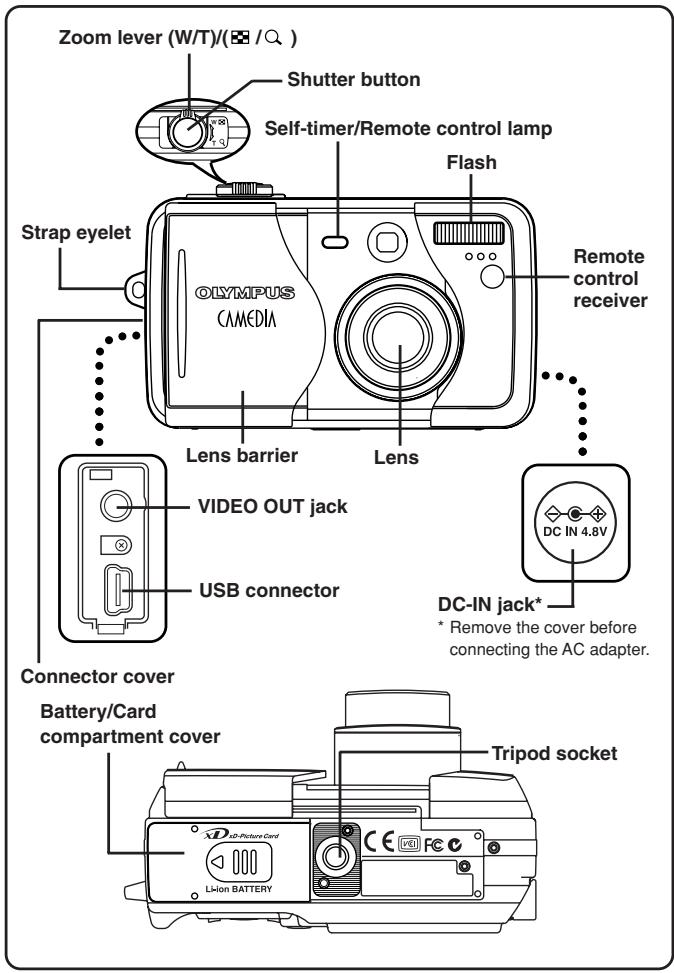
Names of parts
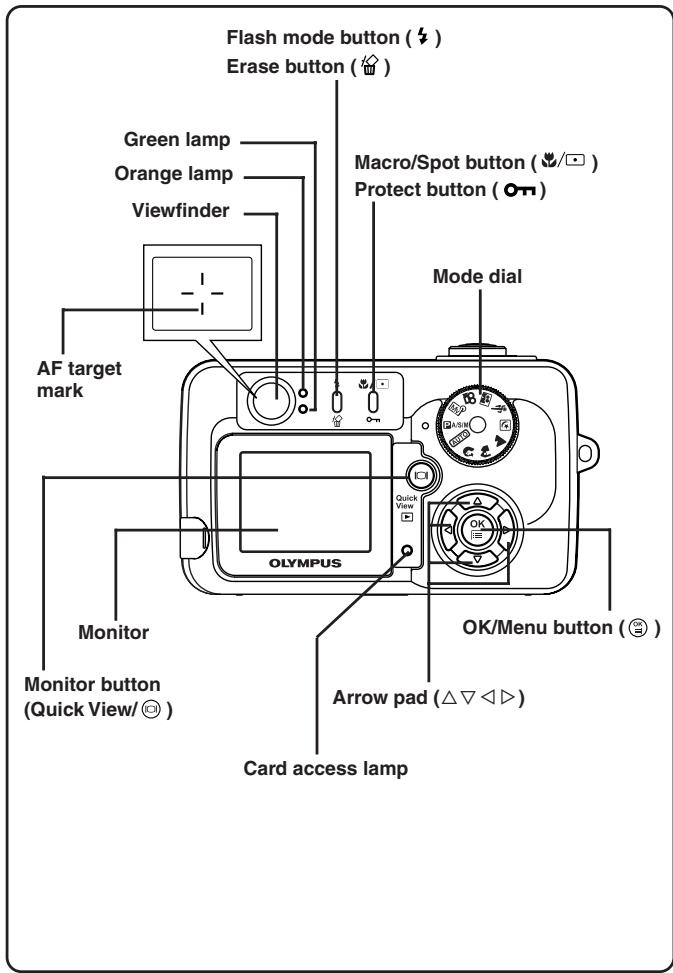
Monitor indications
En
Indications during shooting
![P F2.8 1/300 0.0 [1] HQ](/content/2019/11/84411/images/8b631a36d027f815991aa12508d06f8ba332cbcf9d72f8e734ff6fb04bd90e06.jpg)
When INFO is set to OFF
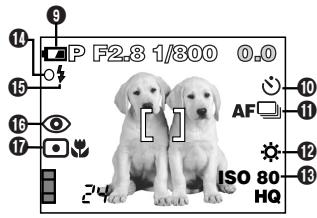
When INFO is set to ON
Indications during still picture playback
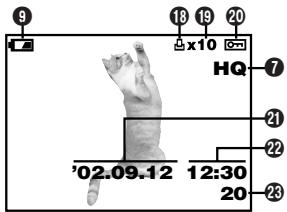
When INFO is set to OFF
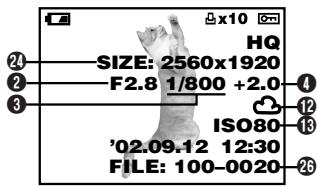
When INFO is set to ON
Indications during movie playback
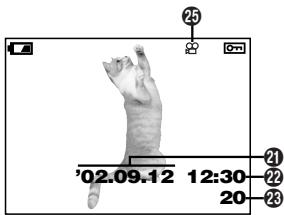
When INFO is set to OFF
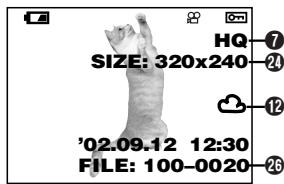
When INFO is set to ON
Monitor indications
| Items | Indications |
| 1 Shooting mode | AUTO, P, A, S, M, ☑, ☑, ▲, ☎, ☎, ☎, ☎ |
| 2 Aperture value | F2.8 – F8.0 |
| 3 Shutter speed | 8 – 1/1000 |
| 4 Exposure compensationExposure variance | -2.0 – +2.0-3.0 – +3.0 |
| 5 AF target mark | [ ] |
| 6 Number of storablestill pictures/Seconds remaining | 2424" |
| 7 Record mode | TIFF, SHQ, HQ, SQ1, SQ2 |
| 8 Memory gauge | |
| 9 Battery check | |
| 10 Self-timer/Remote control | |
| 11 Drive mode | |
| 12 White balance | |
| 13 ISO | ISO80, ISO160, ISO320 |
| 14 Green lamp | O |
| 15 Flash stand-by mark | |
| 16 Flash mode | |
| 17 Spot metering/Macro mode |
En
Monitor indications
En
| Items | Indications |
| 18 Print reserve | |
| 19 Number of prints | x2 – x10 |
| 20 Protect | |
| 21 Date | '02. 12. 24, '03. 01. 12 |
| 22 Time | 07:15, 12:30, 17:45 |
| 23 Frame number | 20 |
| 24 Pixel resolution | 2560 x 1920, 1600 x 1200 |
| 25 Movie mark | |
| 26 File number/Recording time | FILE:100 – 00200"/15" (during movie playback)Playing time Total recording time |
Note
- The monitor indications differ depending on the camera's settings.
- You can select the amount of information displayed on the monitor.
Monitor indications
Memory gauge
The memory gauge lights when you take a picture. When the gauge is lit, the camera is storing a picture on the card (xD-Picture Card). The memory gauge indication changes as shown below depending on the shooting status. When the memory gauge is full, wait until the light goes out before you take any more shots.
When taking still pictures
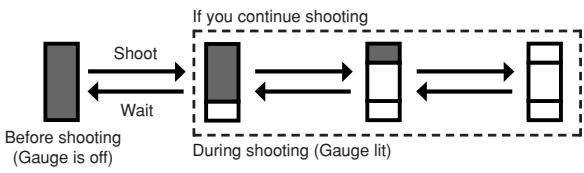
flowchart
graph LR
    A["Before shooting\n(Gauge is off)"] -->|Shoot| B["After shooting"]
    B -->|Wait| A
    style A fill:#f9f,stroke:#333
    style B fill:#bbf,stroke:#333
    subgraph "If you continue shooting"
        C["After shooting"]
        D["During shooting"]
    end
When recording movies
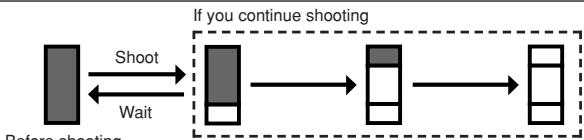
flowchart
graph LR
    A["Before shooting"] -->|Shoot| B["After shooting"]
    B -->|Wait| A
    style A fill:#999
    style B fill:#ccc
    style_C["If you continue shooting"] -.-> D["After shooting"]
Before shooting (Gauge is off)
During shooting (Gauge lit)
● Shooting is not possible until the light goes out completely.
- Movie recording finishes automatically when the memory gauge is fully lit.
Battery check
If the remaining battery power is low, the battery check indication changes as follows when the camera is turned on or while the camera is in use.

Lights
(green)
Ready for shooting.


Lights
(red)
Remaining power level: low. If you plan to use the camera for a long time, charge the battery soon.

No indication
(The green lamp and orange lamp next to the viewfinder blink.)
Remaining power level: exhausted. Replace with a charged battery.
How to use this manual
En
Set the camera to any of the modes shown.
Aperture setting (Aperture priority shooting)
Available modes
PA/S/M
M
1 In the top menu, select MODE MENU → CAMERA → P/A/S/M → A. Press 📞. Press 📍 again to cancel the menu.
2 Set the aperture value. To increase the aperture value To decrease the aperture value
(F-number), press △. (F-number), press ∇.
3 Take the picture.
Step through the menus in the order of the arrows.
If a button is shown in gray, press it as part of the step.
3
Press ▽ in the arrow pad to select ⏻
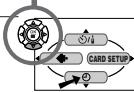
4
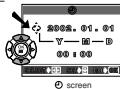
When is selected on the screen, press to select the date format.
- Select any one of the following formats: D-M-T (Day/Month/Year) M-D-T (Month/Day/Year) Y-M-T (Year/Month/Day)
- The following instructions show the procedure used when the date and time settings are set to Y-M-D.
, , and used in instructions correspond to the buttons on the arrow pad as shown.
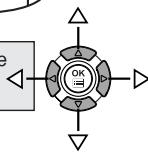
flowchart
graph TD
    A["Start"] --> B{Decision}
    B -->|OK| C["End"]
    B -->|Down| D["Right"]
    B -->|Down| E["Left"]
    B -->|Down| F["Right"]
    B -->|Down| G["Left"]
Getting started
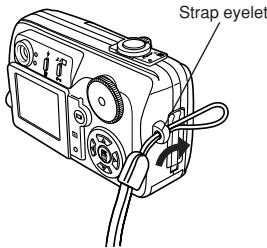
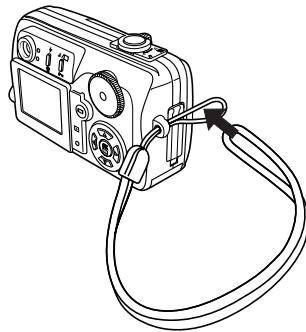
Attaching the strap
1 Thread the end (small loop) of the strap through the strap eyelet.
En
2 Thread the rest of the strap through the small loop that you threaded through the eyelet.
3 Pull on the strap to make sure it is securely fastened.
natural_image
Line drawing of a digital camera with attached cable and connector (no text or symbols)Note
- Be careful with the strap when you carry the camera, as the strap can easily catch on stray objects, causing serious damage.
- Attach the strap correctly as shown so that the camera does not fall off. If the strap is attached incorrectly and the camera falls off the strap, Olympus is not responsible for any damages.
Getting started
En
Battery/Card basics
Battery basics
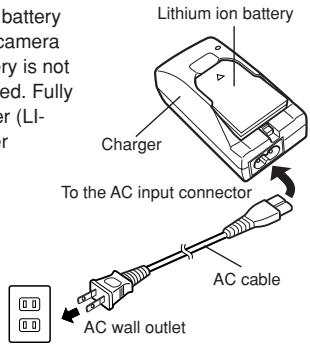
This camera uses an Olympus lithium ion battery (LI-10B). This battery is dedicated to this camera and other batteries do not work. The battery is not fully charged when the camera is purchased. Fully charge the battery on the specified charger (LI-10C) before first use. Do not use any other chargers. For details, read the charger's instructions (provided).
Card basics
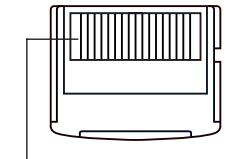
This camera uses an xD-Picture Card to record pictures. This manual uses the term “card” when referring to an xD-Picture Card. Images recorded and stored on an xD-Picture Card can easily be deleted, overwritten, and/or edited on a computer.
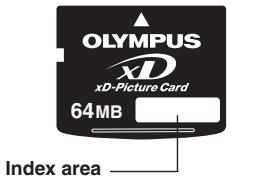
Write the card's contents here.
natural_image
Simple line drawing of a rectangular device with a horizontal panel and base (no text or symbols)Contact area
The camera reads the card here. Do not touch.
Compatible xD-Picture Card: xD-Picture Card (16 - 128 MB)
Loading/Unloading the battery/card
En
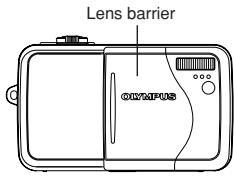
1 Make sure the camera is turned off:
● The lens barrier is closed.
● The monitor is turned off.
- The green lamp is off.
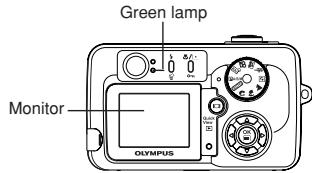
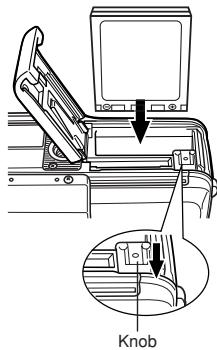
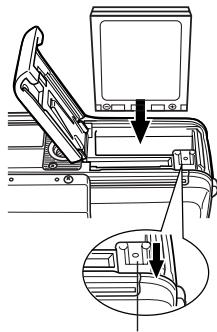
2 Slide the battery/card compartment cover in the direction of the arrow A and open it in the direction of the arrow B.
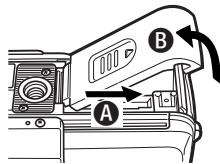
3 ■ Loading the battery Insert the battery in the correct direction in the battery/card compartment.
- Make sure the knob is locked securely. If the knob is not locked, the battery may pop out when opening the battery/card compartment cover.
■ Unloading the battery Slide the knob in the direction of the arrow. The battery pops out. Remove it.
Getting started
En
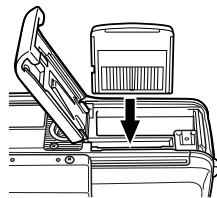
- Loading the card
Face the card the correct way and insert it into the battery/card compartment.
- Insert the card while keeping it straight.
- Inserting the card the wrong way or at an angle, could damage the contact area or cause the card to jam.
- If the card is not inserted all the way, data may not be written to the card.
■ Unloading the card
Push the card slowly toward the inside of the card slot with your finger until it stops. Continue to hold the card so that it does not forcibly eject, then remove the card from the slot by pulling it straight out.
natural_image
Diagram of a mechanical device with an open lid and a downward arrow indicating a process (no text or symbols present)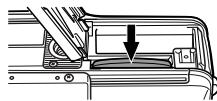
natural_image
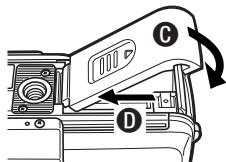
Mechanical component diagram showing a bracket with an arrow indicating direction (no text or symbols present)4 Close the battery/card compartment cover in the direction of the arrow C, then slide it in the direction of the arrow D.
Using an optional AC adapter
In addition to the provided battery, an optional Olympus CAMEDIA-brand D-7AC AC adapter can be used.
An AC adapter is useful when performing time-consuming tasks such as downloading images to a computer. Use an AC adapter designed to operate on the AC voltage in the region the camera is being used. Consult your nearest Olympus dealer or service center for details.
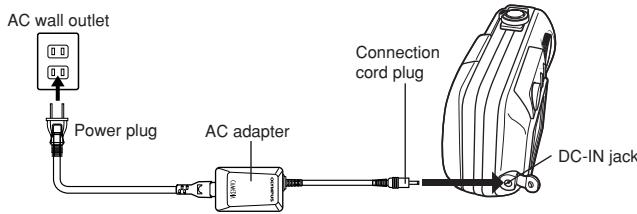
Getting started
Power on/off
Shooting mode
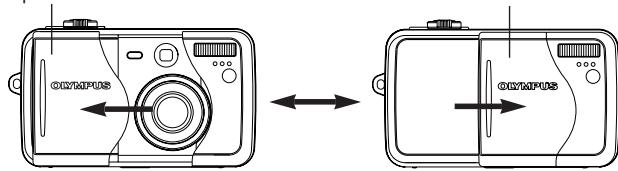
Power on: Open the lens barrier. The camera turns on in the shooting mode.
Power off: Partly close the lens barrier to turn the camera off (about halfway across the lens). Wait until the lens is fully retracted. Close the lens barrier all the way. The camera turns off.
Turning the camera on
Open the lens barrier.
Playback mode
Power on: Press Ⓞ with the lens barrier closed. The camera turns on in the playback mode (the monitor turns on).
Power off: Press ☐. The camera turns off (the monitor turns off).
Turning the camera on
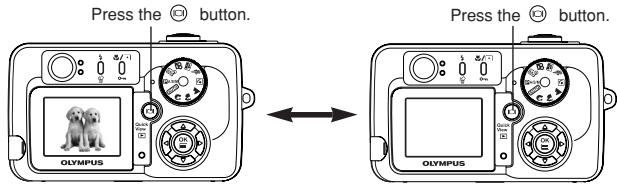
Getting started
En
Date/time setting
Set the date/time. Because the date and time are saved with the recorded pictures, be sure to set them correctly.

Examples of settings available in the AUTO mode.
1 Set the mode dial to AUTO, then open the lens barrier.
- The camera turns on and the lens extends.
- If the lens does not extend, the lens barrier is not fully open.
2 Press OK.
- The monitor turns on automatically and the top menu appears.
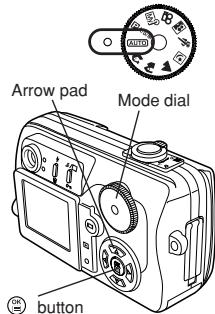
3 Press ▽ on the arrow pad to select ⊕.
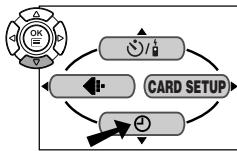
flowchart
graph TD
    A["OK/≡"] --> B["Card Setup"]
    B --> C["Control Icon"]
    C --> D["Feedback Arrow"]
    D --> E["Back to Card Setup"]
    E --> F["Control Icon"]
    F --> G["Back to Card Setup"]
    G --> H["Feedback Arrow"]
    H --> I["Back to Card Setup"]
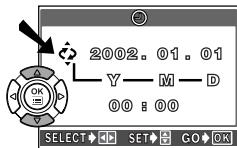
4 When is selected on the screen, press to select the date format.
- Select any one of the following formats:
D-M-Y (Day/Month/Year)
M-D-Y (Month/Day/Year)
Y-M-D (Year/Month/Day)
- The following instructions show the procedure used when the date and time settings are set to Y-M-D.
screen
Getting started
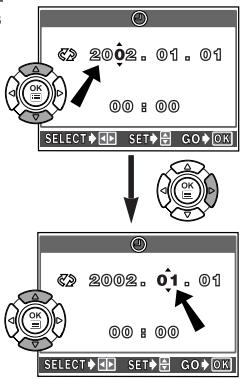
5 Press ▷ to move to the year setting.
6 Press △▽ to set the year. When the year is set, press ▷ to move to the month setting.
- Repeat this procedure until the date and time are completely set.
- To move back to the previous setting, press ◀.
- The camera can only display the time in "number of hours", or what is commonly known as military time. Consequently, 2 p.m. would be 14:00 hours, or 12:00 hours + 2:00 hours = 14:00 hours.
- The first two digits of the year cannot be changed.

flowchart
graph TD
    A["OK"] --> B["2002. 01. 01"]
    B --> C["00:00"]
    C --> D["SELECT"]
    D --> E["SET"]
    E --> F["GO"]
    F --> G["OK"]
    H["OK"] --> I["2002. 01. 01"]
    I --> J["00:00"]
    J --> K["SELECT"]
7 Press OK.
- For a more accurate setting, press OK when the clock hits 00 seconds. The clock starts when you press the button.
8 To turn the camera off, close the lens barrier.

Shooting
En
Shooting modes
Select the shooting mode that's appropriate for the type of photograph or the shooting conditions. Set the mode dial and shoot.
AUTO Full-auto shooting
Easy to use automatic mode selecting the optimal exposure and focus for general photography. In full Auto, special functions and controls such as Flash intensity control or drive modes cannot be set by the user. This is the simplest of all shooting modes.
Portrait shooting
Suitable for shooting a portrait-style image of a person. This mode features an in-focus subject against a blurred background. The camera automatically sets the optimal shooting settings.
Landscape+Portrait shooting
Suitable for taking photos of both your subject and the background. The picture is taken with the background as well as the subject in the foreground in focus. The camera automatically sets the optimal shooting settings.
▲ Landscape+Scene shooting
Suitable for taking pictures of landscapes and other outdoor scenes. This mode produces clear, sharp pictures with excellent detail, making it ideal for shooting natural scenery. The camera automatically sets the optimal shooting settings.
Shooting
Night-Scene shooting
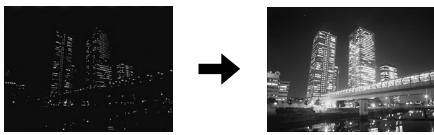
Suitable for shooting pictures of outdoor scenes in the evening or at night. For example, if you take a picture of a street at night in other modes, the lack of brightness will result in a dark picture with only the sparkle of lights such as street lamps appearing. In the Night Scene shooting mode, the true appearance of the street can be captured. The camera automatically selects the optimal settings for this type of shooting condition. Since the shutter speed is slow, make sure you stabilize the camera by using a tripod.
natural_image
Night cityscape with illuminated skyscrapers and waterfront, showing a cityscape before and after a transformation (no text or symbols visible)En
Sports shooting
Suitable for capturing fast-moving action without blurring. The camera automatically sets the optimal shooting conditions.
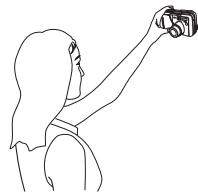
Self Portrait shooting
Enables you to take a picture of yourself while holding the camera. Point the lens towards you and take a shot. The focus is locked on you (shooter). The camera automatically selects the optimal settings for this type of shooting condition. Zooming is not possible in this mode.
natural_image
Line drawing of a person holding a camera, viewed from the side (no text or symbols)Movie recording
Allows you to record movies. The camera sets the aperture and shutter speed automatically.
My Mode
Your favorite settings can be saved. Customized settings are activated in the mode. Settings such as aperture value, zoom position, etc. can be customized.
Shooting
En
PA/S/M
Program/Aperture priority/Shutter priority/Manual shooting
• P (Program shooting)
Allows you to shoot using an aperture and shutter speed that the camera sets.
●A (Aperture priority shooting)
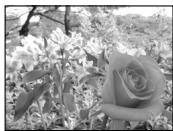
Allows you to set the aperture manually. The camera sets the shutter speed automatically. By decreasing the aperture value (F-number), the camera will focus within a smaller range, producing a picture with a blurred background. Increasing the value will let the camera focus over a wider range in the forward and backward directions, resulting in a picture in which both the subject and the background are in focus.
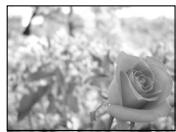
natural_image
Black and white close-up of a blooming rose with blurred foliage background (no text or symbols)Aperture (F-number) is decreased.

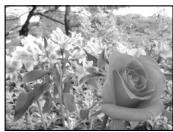
natural_image
Black and white close-up of a blooming rose surrounded by flowers (no text or symbols)Aperture (F-number) is increased.
•S (Shutter priority shooting)
Allows you to set the shutter speed manually. The camera sets the aperture automatically. Set the shutter speed according to the subject and the type of effect you want.
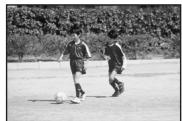
natural_image
Two children playing soccer on a field, one kicking the ball (no text or symbols visible)Setting the shutter speed higher lets you capture fast-moving action without blur. The subject will be clear and sharp, as if it is not moving.
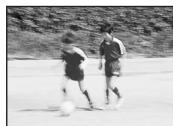
natural_image
Two people playing soccer on a field, one kicking the ball (no visible text or symbols)Setting the shutter speed lower blurs a moving subject, giving the impression of movement.
●M (Manual shooting)
Allows you to set the aperture and shutter speed manually. To check the exposure, refer to the exposure differential. This mode gives you more creative control, allowing you to make the settings you need to get the type of picture you want, regardless of optimum exposure.
Shooting
How to press the shutter button
1 Point the camera towards the subject. Place the AF target mark on the subject. Press the shutter button slowly and gently (halfway).
- When the focus and exposure (brightness) are locked, the green lamp next to the viewfinder lights steadily.

Half press
2 Press the shutter button all the way (fully).
- Shooting starts and the card access lamp blinks.
- mode: The camera starts recording a movie and the orange lamp lights.

Full press
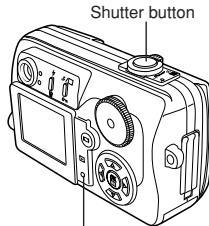
Card access lamp
Focusing
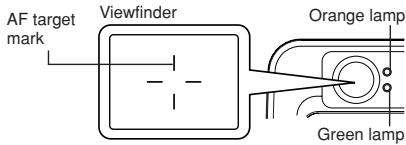
When you place the AF target mark on a subject and press the shutter button halfway, the green lamp lights up. This means that focusing has been performed automatically.
If the green lamp blinks, focusing is not correct. If this happens, use Focus lock.
When you are too close to a subject, the green lamp blinks. If this happens, try macro mode shooting.
Shooting
En
Taking pictures while looking through the viewfinder
Available modes


1 Open the lens barrier.
2 Position your subject within the AF target mark while looking through the viewfinder.
3 Take the picture.
- The card access lamp blinks while pictures are being stored on the card.
- Number of still pictures that can be stored on a 32 MB card: HQ record mode (2560 x 1920): Approx. 26 SQ2 record mode (640 x 480): Approx. 199
Aperture setting (Aperture priority shooting)
Available modes


In the top menu, select MODE MENU → CAMERA → P/A/S/M → A. Press OK. Press OK again to cancel the menu.
2 Set the aperture value.
To increase the aperture value (F-number), press .
To decrease the aperture value (F-number), press .
3 Take the picture.
■ The aperture value is displayed in green The aperture you have set will provide optimum exposure.
■ The aperture value is displayed in red The aperture you have set is unsuitable for the conditions.
▼ appears: Press ▽ to decrease the aperture value.
▲ appears: Press △ to increase the aperture value.
Shooting
Shutter speed setting (Shutter priority shooting)
Available modes


In the top menu, select MODE MENU → CAMERA → P/A/S/M → S. Press OK. Press OK again to cancel the menu.
2 Set the shutter speed.
To set a faster shutter speed, press .
To set a slower shutter speed, press .
3 Take the picture.
■ The shutter speed is displayed in green
The shutter speed you have set will provide optimum exposure.
■ The shutter speed is displayed in red
The shutter speed you have set is unsuitable for the conditions.
▼ appears: Press ▽ to set the shutter speed slower.
▲ appears: Press △ to set the shutter speed faster.
Aperture & Shutter speed setting (Manual shooting)
Available modes


In the top menu, select MODE MENU → CAMERA → P/A/S/M → M. Press OK. Press OK again to cancel the menu.
2 Set the aperture value and shutter speed.
To set a faster shutter speed, press △.
To set a slower shutter speed, press ▽.
To increase the aperture value (F-number), press ◀.
To decrease the aperture value (F-number), press ▷.
3 Take the picture.
Shooting
En
Movie recording
Available modes

1 Point the camera towards a subject, and place the subject on the AF target.
- The total possible recording time and the 🔒 mark are displayed on the monitor.
- Focus locks when the shutter button is pressed halfway.
2 Press the shutter button all the way to start recording.
● The number of seconds remaining appear.
- During movie recording, 📄 lights in red.
3 Press the shutter button all the way to stop recording.
- The card access lamp blinks and the camera begins storing the movie on the card. You cannot record another movie as long as the card access lamp is blinking.
- When the card access lamp stops blinking, the camera has finished writing the movie to the card. If there is any space left on the card, the number of seconds remaining is displayed. You can start recording another movie.
- If the displayed seconds remaining reach "0", shooting finishes automatically and the camera starts writing the movie to the card.
Shooting
Zoom (Telephoto/Wide-angle shooting)
Telephoto/Wide-angle shooting is possible at up to 3x magnification (optical zoom limit, equivalent to 38 mm – 114 mm on a 35 mm film). By combining the digital zoom with the optical zoom, zoom magnification can be extended to a maximum of approximately 12x.
Shoot a wider view picture (wide-angle): Press the zoom lever toward W to zoom out.
Zoom in on a subject (telephoto): Press the zoom lever toward T to zoom in.
Digital zoom

1
In the top menu, select DIGITAL ZOOM → ON. Press OK = .
PA/S/M [My] :
In the top menu, select MODE MENU → CAMERA → DIGITAL ZOOM → ON. Press OK.
- Press OK again to cancel the menu.
2 Press the zoom lever towards T.
- The zoom bar appears.
- When Ⓑ is pressed, the monitor turns off and DIGITAL ZOOM becomes set to OFF. If Ⓑ is pressed again, DIGITAL ZOOM becomes set to ON.
Flash shooting
You can select a flash mode appropriate to the lightning conditions and the effect you want to achieve. You can also adjust the amount of light emitted using the flash intensity control.
The flash modes are as follows:
Auto-flash
Automatically fires in low-light and backlight conditions.
Shooting
En
Red-eye reduction flash
This mode significantly reduces the “red-eye” phenomenon by emitting several pre-flashes before firing the regular flash. This mode works the same as the auto-flash except for the pre-flashes.
Fill-in flash ↓
The flash fires regardless of available light. This mode is useful for eliminating shadows on the subject's face or for correcting the color shift produced by artificial lighting (especially fluorescent light).
Flash off
Set the flash to this mode when you do not want to use the flash. Use this mode in situations where flash photography is not desired or is prohibited, or when you want to shoot a natural-looking twilight or night scene.
Slow synchronization ↘ SLOW Ⓞ ↘ SLOW
The Slow Synchronization flash is designed for slow shutter speeds. Normally, when shooting with a flash, shutter speeds cannot go below a certain level to prevent camera movement. But when shooting a night scene background, fast shutter speeds can make the background too dark. Slow Synchronization flash allows both a slow shutter speed for the background and a flash for the subject. Since the shutter speed is slow, make sure you stabilize the camera by using a tripod. Otherwise, camera movement may cause the image to be blurred.
SLOW:
Slow synchronization
Regardless of the shutter speed, the flash fires right after the shutter fully opens.
SLOW:
Slow synchronization with red-eye reduction
This is for when you want to use Slow Synchronization yet also reduce red-eye. For instance, when shooting a person against a brightly lit night background. A normal flash might make the person's eyes red, but slow synchronization with red-eye reduction lets you capture the background correctly and reduce red-eye at the same time.
Shooting
Using the flash

1 Press ↩ repeatedly until the desired flash mode indication appears.
- If is not pressed for 2 seconds, the selection screen disappears.
2 Take the picture.
- When the flash is ready to fire, the orange lamp next to the viewfinder lights up and the (flash stand-by) mark is displayed on the monitor. When is blinking, the flash is charging. When stops blinking, the camera is ready to shoot.
Spot metering (Selecting the metering area)
There are 2 metering methods: Digital ESP metering and spot metering.
Digital ESP metering: Meters the center of the frame and the area around it separately to determine the optimal exposure.
Spot metering: Meters within the AF target mark to determine exposure. A subject can be shot with optimal exposure regardless of the background light (such as when the subject is dark due to back lighting.) When ☐ is set, you can use spot metering when shooting up close to a subject.

1 Press 🎨/☐ repeatedly until ☐ (spot metering) or ☐ (spot metering+ macro mode) appears.
- If 📋/☐ is not pressed for 2 seconds, the selection screen disappears.
2 Take a picture.
Shooting
En
Macro mode shooting (Taking close-up pictures)

Macro shooting allows you to shoot from as close as 30 cm (1 ft) to a subject while the zoom lever is pressed to the maximum T position. You can fill the entire frame with a very small subject. As the center of the frame (within the AF target mark) is metered and optimal exposure is obtained when ☐ is set, the picture turns out well.

flowchart
graph LR
    A["Available modes"] --> B["AUTO"]
    A --> C["P A/S/M"]
    A --> D["My"]
    A --> E["Camera icon"]
1 Press 🎨/☐ repeatedly until ⚪ (macro mode) or ☐ (spot metering+ macro mode) appears.
- If 📋/☐ is not pressed for 2 seconds, the selection screen disappears.
2 Take a picture while observing your subject on the monitor.
Shooting
Sequential shooting
There are 3 sequential shooting modes: sequential shooting (☐), AF sequential shooting (AF☐) and auto bracketing (BKT). Sequential shooting modes can be selected from the DRIVE mode menu.
Drive mode
☐ : Shoots 1 frame.
: Shoots a maximum number of 3 frames (in the HQ mode) sequentially at approximately 1 frame/sec. Focus, exposure and white balance are locked at the first frame.
AF : Shoots pictures sequentially. Focus is locked for each frame automatically. The AF sequential shooting speed is lower than normal sequential shooting.
BKT : Auto bracketing

In the top menu, select MODE MENU → CAMERA → DRIVE → AF or BKT. Press 📄. Press 📍 again to cancel the menu.
2 Take pictures.
- Press the shutter button all the way and keep it pressed. The camera will take pictures in sequence until you release the button.
Playback
En
Playing back still pictures
1 Press Ⓜ with the lens barrier closed.
- The monitor turns on and displays the last picture taken.
2 Use the arrow pad to play back other pictures.
- The 🔗 mark is displayed on movies.
△: Jumps to the picture 10 frames behind.
∇: Jumps to the picture 10 frames ahead.
◀:Displays the previous picture.
▷:Displays the next picture.
3 Press Ⓞ to cancel playback.
● The monitor and camera turn off.
Playing back movies (MOVIE PLAY)
1 Display a picture with 🎨 using the arrow pad.
2 Press OK to display the top menu.
3 Press △.
● The MOVIE PLAY screen is displayed.
4 Press △ to select MOVIE PLAYBACK.
5 Press OK to start playback.
- When movie playback ends, the display automatically returns to the beginning of the movie.
6 Press OK.
● The MOVIE PLAYBACK screen is displayed.
7 Press △▽ to select items.
PLAYBACK: Plays back the entire movie again.
FRAME BY FRAME: Plays back the movie manually one frame at a time.
EXIT: Cancels movie playback.
Playback
8 Press OK to start your choice.
- When FRAME BY FRAME is selected, follow the instructions below.
- When EXIT is selected, the MOVIE PLAY screen appears. To exit, press ◀.
■ Displaying movie frames using the arrow pad
△: Displays the first frame of the movie.
∇: Displays the last frame of the movie.
▷: Every time you press the button, the next frame appears. The movie can be displayed continuously by holding the button down.
◀: Every time you press the button, the previous frame appears. The movie can be displayed continuously in reverse by holding the button down.
OK : Displays the MOVIE PLAYBACK screen.
Protect
It is highly recommended that you protect important pictures to avoid accidentally erasing them. Protected pictures cannot be erased by the single-frame/all-frame erase function.
1 Display the picture you want to protect.
2 Press ON. The picture is now protected.
- The protect mark appears on the protected picture.
- To cancel protection, press 📄 again.
Playback
En
Erasing pictures

Recorded pictures can also be erased. You can choose between single-frame erase or all-frame erase.
Single-frame erase
1 Display the picture you want to erase.
- If the picture is protected, cancel the protection first.
2 Press 📋.
● The ERASE screen is displayed.
3 Press △ to select YES.
- To cancel erasing, select NO and press OK.
4 Press Ⓞ to erase the picture.
All-frame erase
This function erases all still pictures and movies on the card, except protected ones.
1 In the top menu, select MODE MENU → CARD → CARD SETUP.
2 Press ▷.
- The CARD SETUP screen is displayed.
3 Press △ to select 📋 ALL ERASE, then press ⏻.
● The 🏠 ALL ERASE screen is displayed.
4 Press △ to select YES.
- To cancel erasing, select NO and press OK twice.
5 Press OK to start erasing.
● A bar is displayed to show the progress of erasing.
Formatting cards

This function lets you format a card. Formatting prepares cards to receive data. Olympus CAMEDIA-brand cards are highly recommended for use with this camera. If you are going to use non-OLYMPUS cards or cards formatted by other devices such as a computer, you must format them with the camera before use.

1 AUTO : In the top menu, select CARD SETUP.
A / A / [ ] [ ] [ ] [ ] : In the top menu, select MODE MENU → CARD → CARD SETUP. Press ▷.
☐ : In the top menu, select MODE MENU → CARD → CARD SETUP. Press ▷. Press ▽ to select FORMAT. Press Ⓞ.
2 Press △ to select YES.
- To cancel formatting, select NO and press OK.
3 Press OK to start formatting.
● A bar is displayed to show the progress of formatting.
Transferring pictures to a computer
En
By connecting the camera to a computer with the provided USB cable, images on a card can be transferred to the computer. Some OS's (operating systems) may need a special setup when connecting to the camera for the first time. Follow the chart below. For details on the procedures in the chart, refer to the “Reference Manual” on the CD-ROM and the “Software Installation Guide” (included in the CD-ROM package).
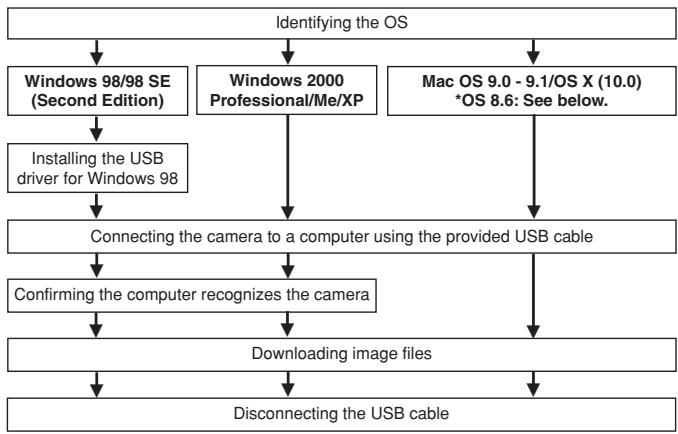
flowchart
graph TD
    A["Identifying the OS"] --> B["Windows 98/98 SE (Second Edition)"]
    A --> C["Windows 2000 Professional/Me/XP"]
    A --> D["Mac OS 9.0 - 9.1/OS X (10.0) *OS 8.6: See below."]
    B --> E["Installing the USB driver for Windows 98"]
    C --> F["Connecting the camera to a computer using the provided USB cable"]
    D --> G["Confirming the computer recognizes the camera"]
    F --> H["Downloading image files"]
    G --> H
    H --> I["Disconnecting the USB cable"]
* Even if your computer has a USB connector, data transfer may not function correctly if you are using one of the operating systems listed below or if you have an add-on USB connector (extension card, etc.).
● Windows 95/NT 4.0
● Windows 98/98 SE upgrade from Windows 95
●Mac OS 8.6 or lower (except Mac OS 8.6 equipped with USB MASS Storage support 1.3.5 installed at the factory)
● Data transfer is not guaranteed on a home-built PC system or PCs with no factory installed OS.
■ You can view images using: graphics applications that support the JPEG file format (Paint Shop Pro, Photoshop, etc.); Internet browsers (Netscape Communicator, Microsoft Internet Explorer, etc.); CAMEDIA Master software; or other software. For details on using commercial graphics applications, refer to their instruction manuals.
Transferring pictures to a computer
For other OS users
Users running other OS cannot connect the camera directly to a computer.
● Windows 95 ● Windows NT ● Mac OS before OS 9
You can download images directly to your computer using an optional USB reader/writer or PC card adapter.
Does your computer have a USB interface? Is there a port marked 📌 on your computer?
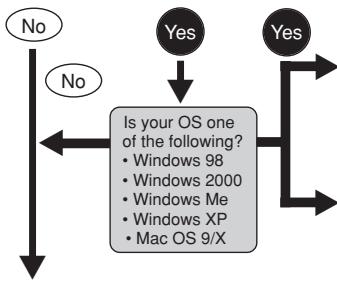
flowchart
graph TD
    A["No"] --> B{Is your OS one of the following?}
    B --> C["Windows 98"]
    B --> D["Windows 2000"]
    B --> E["Windows Me"]
    B --> F["Windows XP"]
    B --> G["Mac OS 9/X"]
    H["Yes"] --> I["Is your OS one of the following?"]
    I --> J["Windows 98"]
    I --> K["Windows 2000"]
    I --> L["Windows Me"]
    I --> M["Windows XP"]
    I --> N["Mac OS 9/X"]
    O["Yes"] --> P["Is your OS one of the following?"]
    P --> Q["Windows 98"]
    P --> R["Windows 2000"]
    P --> S["Windows Me"]
    P --> T["Windows XP"]
    P --> U["Mac OS 9/X"]
Connect the camera directly to your computer using the provided USB cable.
Use an optional USB reader/writer. * Certain card readers may not be compatible with Mac OS X. Check the Olympus website for the most up-to-date compatibility information.
Does your computer have a built-in PC card slot?
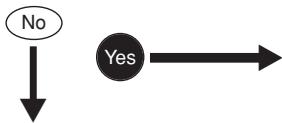
flowchart
graph TD
    A["No"] --> B["Yes"]
Use the optional PC card adapter. * Not supported by Windows NT4.0 or lower
Consult your nearest Olympus representative.
For more details on the camera functions described in this manual, refer to the camera Reference Manual on the CD-ROM enclosed in the camera package. For more details on PC connections, refer to the "Software Installation Guide" (included in the CD-ROM package).
Error codes
En
If there is a problem with your camera, one of the error codes below will appear.
| Indications | Possible causes | Corrective action |
| The card is not inserted, or it cannot be recognized. | Insert a card, or reinsert the card correctly. | |
| No more pictures can be taken. | Replace the card or erase unwanted pictures. | |
| Cannot record, play back or erase pictures on this card. | Wipe the gold contacts with a piece of cleaning paper (commercially available) and insert the card again. If the problem is still not corrected, format the card. If the card cannot be formatted, this card cannot be used. | |
| The recorded image cannot be played back with this camera. | Download the image to a computer and use image processing software to view it. If that cannot be done, the image file is damaged. | |
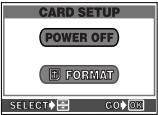 | The card is not formatted. | Format the card. |
Error codes
| Indications | Possible causes | Corrective action |
 NO PICTURE NO PICTURE | There are no pictures on the card, so there is nothing to play back. | Shoot, then play back recorded pictures, or insert a card that contains images. |
| [6+7]CARD FULL | There is no empty space on the card, so it cannot record new information such as print data. | Replace the card or erase unneeded pictures. |
 CARD-COVER OPEN CARD-COVER OPEN | The battery/card compartment cover is open. | Close the battery/card compartment cover. |
Specifications
En
| Product type | Digital camera (for shooting and displaying) |
| Recording systemStill | Digital recording, JPEG (in accordance with Design rule for Camera File system (DCF)), TIFF (non-compression), Exif 2.2, Digital Print Order Format (DPOF) |
| Movie | QuickTime Motion JPEG support |
| Memory | xD-Picture Card, 16 MB – 128 MB |
| No. of storable pictures(When a 32 MB card is used) | Approx. 2 frames (TIFF: 2560x1920)Approx. 13 frames (SHQ: 2560x1920)Approx. 26 frames (HQ: 2560x1920)Approx. 30 frames (SQ1: 2048x1536)Approx. 199 frames (SQ2: 640x480) |
| No. of effective pixels | 5,000,000 pixels |
| Image pickup device | 1/1.76" CCD solid-state image pickup5,360,000 (gross) |
| Recording image resolutions | 2560 x 1920 pixels (TIFF/SHQ/HQ)2048 x 1536 pixels (SQ1)1600 x 1200 pixels (SQ2)1280 x 960 pixels (SQ2)1024 x 768 pixels (SQ2)640 x 480 pixels (SQ2) |
| Lens | Olympus lens 7.8 mm to 23.4 mm, f2.8 to f4.8,7 elements in 6 groups (equivalent to 38 mm to 114 mm lens on 35 mm camera) |
| Photometric system | Digital ESP metering, Spot metering system |
| Aperture | W : f2.8 to f8.0T : f4.8 to f8.0 |
| Shutter speedStill | Used with mechanical shutter1/2 to 1/1000 sec. (M mode: 8 to 1/1000 sec.; during night scene shooting or when slow synchronization is used: 4 to 1/1000 sec.) |
| Movie | 1/30 to 1/8000 sec. |
| Viewfinder | Optical real image viewfinder |
| Monitor | 1.5" TFT color LCD displayApprox. 134,000 pixels |
Specifications
| Battery charging time for flash | Approx. 5 sec. (at normal temperature with a charged battery) |
| Autofocus | TTL system autofocus,Contrast detection system,Focusing range: 0.5 m to ( 1.6 ft to )(normal shooting) 0.2 m (W)/0.3 m (T) to 0.5 m(0.7 ft (W)/1.0 ft (T) to 1.6 ft)(macro shooting) |
| Outer connector | DC-IN jack, USB connector (mini-B),VIDEO OUT jack |
| Automatic calendar system | Up to 2099 |
| Operating environmentTemperatureHumidity | 0^ to 40^ (32^ to 104^) (operation) -20^ to 60^ (-4^ to 140^) (storage) 30% to 90% (operation) 10% to 90% (storage) |
| Power supply | Only an Olympus LI-10B lithium-ion batteryAC adapter specified by Olympus (optional) |
| Dimensions(W) X (H) X (D) | 99.5 mm x 58.5 mm x 41.5 mm(3.9" × 2.3" × 1.6") (excluding protrusions) |
| Weight | 194 g (6.84 oz) (without battery/card) |
En
SPECIFICATIONS ARE SUBJECT TO CHANGE WITHOUT ANY NOTICE OR OBLIGATION ON THE PART OF THE MANUFACTURER.
Partie responsible : Olympus America Inc.
Adresse : 2 Corporate Center Drive, Melville, New York 11747-3157 U.S.A.
natural_image
Line drawing of a digital camera with attached cable and connector (no text or symbols)Remarque
natural_image
Simple line drawing of a rectangular device with internal grating and base (no text or symbols)Zone de contact
natural_image
Line drawing of a vintage OLYAFUS portable radio device (no text or symbols on body)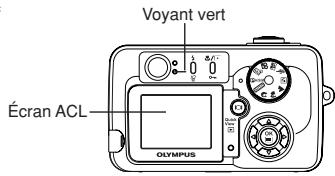
natural_image
Diagram of a mechanical assembly with an open chair and a monitor, showing a close-up of the mechanism (no text or symbols present)Bouton
Préparatifs
natural_image
Diagram of a mechanical device with an open lid and arrow indicating direction (no text or symbols)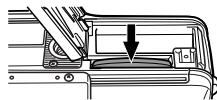
natural_image
Mechanical component diagram showing a lever and bracket assembly (no text or symbols)Mode d'affichage
Écran
Préparatifs
natural_image
Night cityscape with illuminated skyscrapers and a bridge, no visible text or symbolsnatural_image
Line drawing of a person holding a camera, viewed from the side (no text or symbols)natural_image
Two children playing soccer on a field, one kicking the ball (no visible text or symbols)natural_image
Two people playing soccer on a field, one kicking the ball (no visible text or symbols)flowchart
graph TD
    A["Non"] --> B["Oui"]
natural_image
Line drawing of a digital camera with attached cable and scroll (no text or symbols)Hinweis
natural_image
Line drawing of a rectangular electronic device with internal grating and base (no text or symbols)Kontaktbereich
natural_image
Technical line drawing of a mechanical assembly with an open chair and a close-up inset showing a detail (no text or symbols)Riegel
Vorbereitung
De
natural_image
Diagram of a mechanical device with an open lid and a downward arrow indicating a process (no text or symbols present)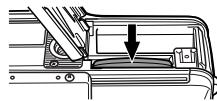
natural_image
Technical diagram of a mechanical component with an arrow indicating a downward force or assembly (no text or symbols present)Wiedergabemodus
Menü
Vorbereitung
natural_image
Night cityscape with illuminated skyscrapers and a bridge, no visible text or symbolsSportaufnahmen
natural_image
Line drawing of a person taking a selfie with one arm raised (no text or symbols)Movie-Aufnahmen
natural_image
Black and white close-up of a blooming rose with blurred floral background (no text or symbols)natural_image
Black and white close-up of a blooming rose surrounded by flowers (no text or symbols)Größere Blendenzahl
natural_image
Two boys playing soccer on a field, one kicking the ball (no visible text or symbols)natural_image
Two people playing soccer on a field, one kicking the ball (no visible text or symbols)Responsible : Olympus America Inc.
Dirección : 2 Corporate Center Drive, Melville, New York 11747-3157 U.S.A.
natural_image
Line drawing of a digital camera with attached cable and scroll (no text or symbols)Nota
natural_image
Simple line drawing of a rectangular device with internal grating and base (no text or symbols)natural_image
Diagram of a mechanical device with an open lid and a downward arrow indicating a process or operation (no text or symbols present)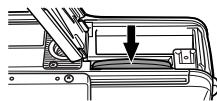
natural_image
Mechanical component diagram showing a lever and bracket assembly (no text or symbols)flowchart
graph TD
    A["OK"] --> B["Card Setup"]
    B --> C["Directional Indicator"]
    C --> D["Back to Card Setup"]
    D --> E["Arrow pointing inward"]
Pantalla
Preparativos
natural_image
Night cityscape with illuminated skyscrapers and a bridge, no visible text or signageSp
Toma deportiva
natural_image
Line drawing of a person holding a camera, viewed from the side (no text or symbols)natural_image
Black and white close-up of a blooming rose with blurred background foliage (no text or symbols)La abertura (Número F) es disminuida.

natural_image
Black-and-white close-up of a blooming rose surrounded by white flowers (no text or symbols)natural_image
Two children playing soccer on a field, one kicking the ball (no text or symbols visible)natural_image
Two people playing soccer on a field, one kicking the ball (no visible text or symbols)flowchart
graph TD
    A["No"] --> B["Sí"]
San-Ei Building, 22-2, Nishi Shinjuku 1-chome, Shinjuku-ku, Tokyo, Japan Customer support (Japanese language only): Tel. 0426-42-7499 Tokyo
OLYMPUS AMERICA INC.
Two Corporate Center Drive, Melville, NY 11747-3157, U.S.A. Tel. 1-631-844-5000
Technical Support (USA)
24/7 online automated help: http://support.olympusamerica.com/
Phone customer support: Tel. 1-888-553-4448 (Toll-free)
Our phone customer support is available from 8 am to 10 pm
(Monday to Friday) ET
E-Mail: distec@olympus.com
Olympus software updates can be obtained at: http://olympus.com/digital/
OLYMPUS OPTICAL CO. (EUROPA) GMBH.
Premises/Goods delivery: Wendenstrasse 14-18, 20097 Hamburg, Germany
Tel. 040-23 77 30
Letters: Postfach 10 49 08, 20034 Hamburg, Germany
Hotline Numbers for customers in Europe:
Tel. 0 18 05-67 10 83 for Germany
Tel. 0 08 00-67 10 83 00 for Austria, Belgium, Denmark, France,
Netherlands, Norway, Sweden, Switzerland,
United Kingdom
Tel. +49 18 05-67 10 83 for Finland, Italy, Luxembourg, Portugal,
Spain, Czech Republic
Tel. +49 40-23 77 38 99 for Greece, Croatia, Hungary, and the rest of
Europe
Our Hotline is available from 9 am to 6 pm (Monday to Friday)
E-Mail: di.support@olympus-europa.com
- En
- CONTENTS/TABLE DES MATIÈRES/ INHALT/CONTENIDO
- CONTENTS
- For customers in North and South America
- For customers in USA
- For customers in Canada
- For customers in Europe
- Trademarks
- Names of parts
- Monitor indications
- Indications during shooting
- Indications during still picture playback
- Indications during movie playback
- Note
- Memory gauge
- When taking still pictures
- When recording movies
- Battery check
- How to use this manual
- Aperture setting (Aperture priority shooting)
- Getting started
- Attaching the strap
- Battery/Card basics
- Battery basics
- Card basics
- Loading/Unloading the battery/card
- Make sure the camera is turned off:
- Slide the battery/card compartment cover in the direction of the arrow A and open it in the direction of the arrow B.
- ■ Loading the battery Insert the battery in the correct direction in the battery/card compartment.
- - Loading the card
- ■ Unloading the card
- Using an optional AC adapter
- Power on/off
- Shooting mode
- Playback mode
- Date/time setting
- Press ▷ to move to the year setting.
- Press △▽ to set the year. When the year is set, press ▷ to move to the month setting.
- Press OK.
- To turn the camera off, close the lens barrier.
- Shooting
- Shooting modes
- AUTO Full-auto shooting
- Portrait shooting
- Landscape+Portrait shooting
- ▲ Landscape+Scene shooting
- Night-Scene shooting
- Sports shooting
- Self Portrait shooting
- Movie recording
- My Mode
- PA/S/M
- Program/Aperture priority/Shutter priority/Manual shooting
- • P (Program shooting)
- ●A (Aperture priority shooting)
- •S (Shutter priority shooting)
- ●M (Manual shooting)
- How to press the shutter button
- Focusing
- Taking pictures while looking through the viewfinder
- Shutter speed setting (Shutter priority shooting)
- Aperture & Shutter speed setting (Manual shooting)
- Available modes
- Zoom (Telephoto/Wide-angle shooting)
- Digital zoom
- 1
- Press the zoom lever towards T.
- Flash shooting
- Auto-flash
- Red-eye reduction flash
- Fill-in flash ↓
- Flash off
- Slow synchronization ↘ SLOW Ⓞ ↘ SLOW
- SLOW:
- Slow synchronization
- Slow synchronization with red-eye reduction
- Using the flash
- Spot metering (Selecting the metering area)
- Macro mode shooting (Taking close-up pictures)
- Sequential shooting
- Drive mode
- Take pictures.
- Playback
- Playing back still pictures
- Press Ⓜ with the lens barrier closed.
- Use the arrow pad to play back other pictures.
- Press Ⓞ to cancel playback.
- Playing back movies (MOVIE PLAY)
- Display a picture with 🎨 using the arrow pad.
- Press OK to display the top menu.
- Press △.
- Press △ to select MOVIE PLAYBACK.
- Press OK to start playback.
- Press OK.
- Press △▽ to select items.
- Press OK to start your choice.
- ■ Displaying movie frames using the arrow pad
- Protect
- Display the picture you want to protect.
- Press ON. The picture is now protected.
- Erasing pictures
- Single-frame erase
- Display the picture you want to erase.
- Press 📋.
- Press △ to select YES.
- Press Ⓞ to erase the picture.
- All-frame erase
- In the top menu, select MODE MENU → CARD → CARD SETUP.
- Press ▷.
- Press △ to select 📋 ALL ERASE, then press ⏻.
- Press △ to select YES.
- Press OK to start erasing.
- Formatting cards
- Transferring pictures to a computer
- For other OS users
- Error codes
- Specifications
- Remarque
- Préparatifs
- Mode d'affichage
- Hinweis
- Kontaktbereich
- Vorbereitung
- Wiedergabemodus
- Sportaufnahmen
- Movie-Aufnahmen
- Nota
- Preparativos
- Toma deportiva
- OLYMPUS AMERICA INC.
- Technical Support (USA)
- OLYMPUS OPTICAL CO. (EUROPA) GMBH.
- Hotline Numbers for customers in Europe:
Brand : OLYMPUS
Model : C-50 ZOOM
Category : Digital Camera