HVA WR 250 2006 - Motorcycle HUSQVARNA - Free user manual and instructions
Find the device manual for free HVA WR 250 2006 HUSQVARNA in PDF.


| Product type | Road-legal off-road motorcycle (WR) |
| Brand | HUSQVARNA |
| Model | HVA WR 250 2006 |
| Dimensions (L x W x H) | 2230 mm x 840 mm x 1310 mm |
| Seat height | 975 mm |
| Curb weight | 108.3 kg |
| Fuel tank capacity | 9.5 L (reserve 1.8 L) |
| Engine type | Single-cylinder 2-stroke, liquid-cooled |
| Displacement | 249.3 cm³ |
| Bore x stroke | 66.4 mm x 72 mm |
| Compression ratio | 8.4:1 |
| Carburetor | MIKUNI TMX 38 (Ø 38 mm) |
| Engine oil (mixture) | 98 octane unleaded gasoline + 2% oil (3% break-in) |
| Transmission oil | 0.80 L |
| Coolant | 1.1 to 1.3 L |
| Transmission | 5 gears |
| Clutch | Multi-disc in oil bath |
| Front suspension | Telescopic fork ∅45 mm, travel 300 mm, adjustable |
| Rear suspension | Progressive monoshock, travel 320 mm, adjustable |
| Front brake | Fixed disc ∅260 mm, hydraulic control, floating caliper |
| Rear brake | Floating disc ∅220 mm, hydraulic control, floating caliper |
| Rims | Front 1.6"x21", rear 2.15"x18" light alloy |
| Ignition | Capacitive discharge electronic, variable advance |
| Spark plug | NGK BR8 EG, gap 0.6-0.7 mm |
| Tire pressure (cold, sport) | Front 0.9-1.0 kg/cm², rear 0.9-1.0 kg/cm² |
Frequently Asked Questions - HVA WR 250 2006 HUSQVARNA
User questions about HVA WR 250 2006 HUSQVARNA
0 question about this device. Answer the ones you know or ask your own.
Ask a new question about this device
Download the instructions for your Motorcycle in PDF format for free! Find your manual HVA WR 250 2006 - HUSQVARNA and take your electronic device back in hand. On this page are published all the documents necessary for the use of your device. HVA WR 250 2006 by HUSQVARNA.
USER MANUAL HVA WR 250 2006 HUSQVARNA
MV AGUSTA MOTORCYCLES S.P.A.
To the best knowledge of MV Agusta Motorcycles S.p.A. - Varese, Inc. the material contained herein is accurate as of the date this publication was approved for printing. Cagiva Motor S.p.a. - Varese, Inc. reserves the right to change specifications, equipment, or designs at any time without notice and without incurring obligation. Illustrations in this manual are merely for demonstration purposes and could not exactly match the detail described. No part of this manual can be reproduced without permission in writing of the copyright holder.
1 ^st Edition (07-05)
natural_image
Side view of a black and white off-road motorcycle with visible tracks and wheels (no text or symbols)
Husqvarna
WR 250/2006
Unless specified, data and prescription are referred to all t he models.
Welcome to the Husqvarna motorcycling Family!
Your new Husqvarna motorcycle is designed and manufactured to be the finest in its field. The instructions in this book have been prepared to provide a simple and understandable guide for your motorcycle's operation and care.
Follow the instructions carefully to obtain maximum performance and your personal motorcycling pleasure. Your owner's manual contains instructions for owner care and maintenance. Information covering repair of major units such as engine, transmission, etc. is provided in the Husqvarna Service Manual. The information concerning details or main work of repair or maintenance are described in the Husqvarna Service Manual. This manual is available upon request by stating the code number set on pages 262. Work of this kind requires the attention of a skilled mechanic and the use of special tools and equipment. Your Husqvarna dealer has the facilities, experience and original parts necessary to properly render this valuable service.
This use and maintenance manual is part and parcel of the motorcycle, hence, it has to remain with the motorcycle even when sold to another user.
This motorcycle uses components designed thanks to systems and state of the art technologies which are thereafter tested in competition.
In competition motorcycles, every detail is verified after each race in order to always guarantee better performance. For correct functioning of the vehicle, it is necessary to follow the maintenance and control table found on page 282.
PRESENTATION
natural_image
Side view of a black and white DMC scooter with visible tracks and wheels (no text or symbols)WR are STREET LEGAL motorcycles (with LIMITED POWER ENGINE); they are guaranteed exempt from functional defects and covered with legal guarantee, if the STANDARD CONFIGURATION is maintained and the suggested maintenance table, shown on page 292, is observed.
If WR are transformed in COMPETITION MOTORCYCLES (with FULL POWER ENGINE), the suggested maintenance table for competition use is shown on page 282.
IMPORTANT
The reference for recognition of the guarantee will be the MOTORCYCLE CONFIGURATION, as shown below:
A) - STANDARD MOTORCYCLE, STREET LEGAL: with LIMITED POWER ENGINE
B) - COMPETITION MOTORCYCLE, RACING USE: with FULL POWER ENGINE
natural_image
Black-and-white photo of a person riding a dirt bike with visible tire number 20 and 'Rogers' branding, no text or symbols on the bike itself.This motorcycles was not designed for long trips with the engine always at maximum rpm as can occur whilst travelling on roads or highways. Long trips at full throttle can cause severe damage to the engine.
This motorcycles was not designed for urban use and is not equipped with a cooling fan and thermostat. Long stops at the traffic lights can cause overheating and the boiling of radiator water.
This motorcycles is setup for competition use and therefore guarantees maximum performance with the rider alone. It is thereby not recommended to use the vehicle on circuits or off-road with a passenger.
ALWAYS keep in mind that these motorcycles have been designed strictly for competition use, that is, for conditions of usage very different from those presented on the road.
In order to maintain the vehicle's “Guarantee of Functionality”, the client must follow the maintenance program indicated in the user's manual by carrying out maintenance checks at authorized HUSQVARNA dealers. The cost for substituting parts and for the labour necessary in order to respect the maintenance plan, is charged to the client. NOTE: the guarantee is EXTINGUISHED in the case where the motorcycle is rented.
- References to the "left" or "right" of the motorcycle are in the sense of a person facing forwards.
● Z: number of teeth
● A: Austria
AUS: Australia
B: Belgium
BR: Brazil
CDN: Canada
CH: Switzerland
D: Germany
E: Spain
F: France
FIN: Finland
GB: Great Britain
I: Italy
J: Japan
USA: United States of America
- Where not specified, alla the data and the instructions are referred to any and all Countries.
Avis
IMPIANTO ACCENSIONE/
IMPIANTO ELETTRICO ......226
ATTREZZI SPECIALI....242
LUBRICATION TABLE, SUPPLIES......36
CONTROLS 38
RIDING 72
SERVICE LIMIT 182
IGNITION SYSTEM/
ELECTRICAL SYSTEM ......226
SPECIAL TOOLS....242
TIGHTENING TORQUES 244
OPTIONAL PARTS LIST......262
APPENDIX....264
NOTE FOR USA/CDN-AUS MODELS ....272-276
PERIODIC MAINTENANCE/
ADJUSTMENT....282
ALPHABETICAL INDEX ......292
RESUME Page
PRESENTATION......4
AVIS IMPORTANT 6
ELEMENTS D'IDENTIFICATION....12
DONNEES TECHNIQUES ......24
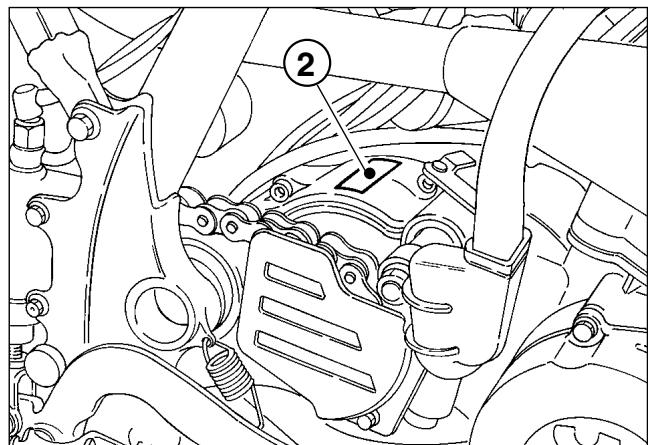
The engine number is printed on the upper side of the engine case, whereas the frame number is printed on the steering tube.(see on page 18).
Always state the number stamped on the frame (and write it on this booklet), when placing orders for spare parts, or when asking for information on your motorcycle.
FRAME NUMBER
ELEMENTS D'IDENTIFICATION
Read this manual carefully and pay special attention to statements preceded by the following words:
WARNING*: Indicates a possibility of severe personal injury or loss of life if instructions are not followed.
CAUTION*: Indicates a possibility of personal injury or equipment damage if instructions are not followed.
Note*: Gives helpful information.
Parts Replacement
When parts replacement is required, use only Husqvarna ORIGINAL parts.
Préliminaires
WARNING*: After an upset, inspect the motorcycle carefully. Make sure that the throttle, brake, clutch and all other systems are undamaged. Riding with a damaged motorcycle can lead to a serious crash.
WARNING*: Never attempt to start or operate your motorcycle unless you are wearing appropriate protective clothing. Always wear a motorcycle helmet, motorcycle boots, gloves, goggles and other appropriate protective clothing.
WARNING*: This motorcycle is a state of the art competition bike. Do not attempt to start or ride this motorcycle until you have received expert instruction and are in excellent physical condition.
PRECAUTIONS FOR CHILDREN WARNING
● Park the vehicle where it is unlikely to be bumped into or damaged. Even slight or involuntary bumps can cause the vehicle to topple over, with subsequent risk of serious harm to people or children.
● To prevent the vehicle from tipping over, never park it on soft or uneven ground, nor on asphalt strongly heated by the sun.
● Engine and exhaust pipes become very hot during riding. Always park your motorcycle where people or children can not easily reach these parts, in order to avoid serious burns.
The full 17 digit serial, or Vehicle Identification Number, is stamped on the steering head tube (R.H. side).
NUMERO D'IDENTIFICATION DU MOTOCYCLE (V.I.N.)
UBICAZIONE COMANDI
1- Front brake lever
2- Throttle grip
3- Engine stop button. (L.H. side WR-USA/CDN; for WR, USA/CDN excluded, see page 65).
4- Rear brake pedal
5- Kickstarter
6- Clutch lever
7- Fuel tank filler cap
8- Gear change pedal. The gearbox has five gears. Depress the pedal to shift into 1st gear. Raise the pedal to shift into 2nd, 3rd, 4th, 5th.
POSITION DES COMMANDES
9-Choke (L.H. side) When starting a cold engine, raise the choke knob
10- Fuel valve. When the fuel valve is turned to "OFF" fuel cannot flow from the fuel tank to the carburetor. When the fuel valve is turned "ON", fuel will flow the tank to the carburetor.
11- Air release plug
12- Compression damper adjustment (bottom side)
13- Extension damper adjustment (top side)
14- Spring preload adjustment
15- Compression damper adjustment (low and high damping speeds)
16- Extension damper adjustment
DATI TECNICI
MOTORE
Tipo......monocilindrico a 2 tempi
Raffreddamento ......a liquido
Type....2-stroke single cylinder
Cooling......by liquid
Bore 2.61 in.
Stroke 2.83 in.
Capacity 15.21 cu.in.
Compression ratio (with closed ports)....8,4:1
Starting ......kick starter
VALVE GEAR
Type......lamellar valve on suction H.T.S. valve with mechanical control on the exhaust
DONNEES TECHNIQUES
MOTEUR
Anlassen ......kick starter
VENTILSTEUERUNG
Engine....3% (1:32) of oil-gasoline mix during running in; NOT LESS than 2% (1:50) when running in is over
Primary drive transmission/
Gearbox ....by the oil contained in the crankcase
IGNITION
Type..electronic analogic capacitor-discharge type, with variable advance
Ignition timing ......see page 106
Spark plug type ....NGK" BR8 EG
Gap....0.0236÷0.0275 in.
CARBURETOR
Type ...... "MIKUNI" TMX 38
Venturi diameter....1.49 in.
Main jet....400
Idle jet 15
Starter jet 80
Throttle piston....4.0
Metering pin 6DJ8-61
Metering pin slot ....3rd
Main nozzle ....R.5
Float (n° 2) ......g 6,1
Idle mixture adjusting
screw (turns) 3
LUBRIFICATION
Drive pinion gear ......z 27
Clutch ring gear....z 69
Ratio....2,555
CLUTCH
Type ....multidisk in oil bath
TRANSMISSION
Constant mesh gear type
Ratios:
1st....2,142 (Z 30/14)
2nd 1,750 (Z 28/16)
3rd 1,437 (Z 23/16)
4th 1,210 (Z 23/19)
5th 1,053 (Z 20/19)
TRANSMISSION PRINCIPALE
Type....Single-beam with circular steel tubes; light alloy rear frame
FRONT SUSPENSION
Type.....“Upside Down” forkrod telehydraulic fork with advanced pin (adjustable in compression and rebound shake); forkrods ∅ 1.77 in. dia.
Legs axis stroke.... 11.8 in.
REAR SUSPENSION
Type ....progressive with hydraulic single shock absorber
Wheel stroke....12.6 in.
FRONT BRAKE
Type ....floating disc 10.24 in. dia. with hydraulic control; floating caliper
REAR BRAKE
Type....floating disc 8.66 in. dia. with hydraulic control; floating caliper
RIMS
Front ....TAKASAGO "Excel" in light alloy. Size: 1,6"x21"
Rear ....TAKASAGO "Excel" in light alloy. Size: 2,15"x18"
CADRE
a freddo (anteriore- WR) ....0,9÷1,0 Kg/cm2
Rear......Michelin ENDURO
COMP. 3 or Pirelli MT 83 SCORPION;
140/80x18"
(*) Cold tire pressure (front- WR) 0,9÷1,0 Kg/cm2;
12.8÷14.2 psi
(*) Cold tire pressure
(rear- WR)....0,8÷0,9 Kg/cm2;
11.4÷12.8 psi
() Cold tire pressure
(front- WR)....1,1 Kg/cm2; 15.6 psi
() Cold tire pressure
(rear- WR)....1,0 g/cm2; 14.2 psi
(*): Racing use
(): Road use
DIMENSION, WEIGHT, CAPACITY
Wheelbase 57.7in.
Overall leghth 87.79 in.
Overall leghth
(WR 250-USA/CDN)....86 in.
Overall width 33.07 in.
Overall height 51.8 in.
Saddle height. .. 38.4 in.
Minimum ground clearance 13.58 in.
Wet weight....238.7 lb
Wet weight (WR 250-USA/CDN)....236.1 lb
Fuel tank capacity, 1.58 Imp. Quarts reserve
included 2.9 Imp. Gall.
Transmission oil 0,70 Imp.Quarts
Coolant 2,0÷2,4 Imp. Pints
PNEUS
Avant....Michelin ENDURO COMP. 3 ou Pirelli MT 83
SCORPION;
90/90x21"
Arrière..... ...Michelin ENDURO COMP. 3 ou Pirelli
MT 83 SCORPION ;
140/80x18"
DIMENSIONS, POIDS, CAPACITE
Empattement ......mm 1465
() Kaltlufdruck (Hinter- WR).....1,0 g/cm2
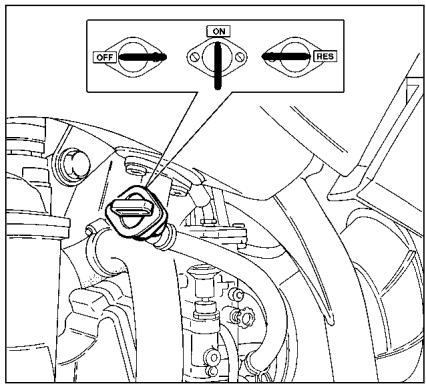
The cock set on left side of tank has three positions:
OFF - closed; no fuel outlet; ON - open; fuel outflows from the main flow;
RES - reserve; fuel outflows from the reserve flow.
When running, should feed problem ensue, set cock lever on RES position. After filling up, take the cock in ON position again.
WARNING\*: Be careful not to touch the hot engine while operating the fuel valve.
A fuel filter is incorporated in the fuel valves. Accumulation of dirt in the filter will restrict the flow of the fuel to the carburetor. Therefore, the fuel filter should be serviced periodically.
To service:
1- Drain the fuel from the fuel tank. Disconnect the fuel line.
2- Remove the fuel valve by removing the screws. Wash the fuel screen filter in cleaning solvent.
3- Reassemble the fuel valve in the reverse order of removal. Turn the fuel valve "ON" and check for leaks.
COMMANDES
ROBINETS CARBURANT
natural_image
Pure electrical circuit symbol diagram without any text or labels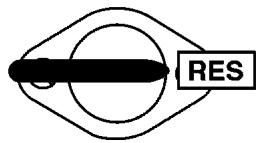
SIDESTAND A sidestand (1) is supplied with every motorcycle.
WARNING*: The stand is designed to support the weight of the MOTORCYCLE ONLY. Do not sit on the motorcycle using the stand for support as this could cause structural failure to the stand and could cause serious bodily injury.
Periodically check the side stand (see “Periodical maintenance card”); check that the springs are not damaged and that the side stand freely moves. If the side stand is noisy, lubricate the fastening pivot (A).
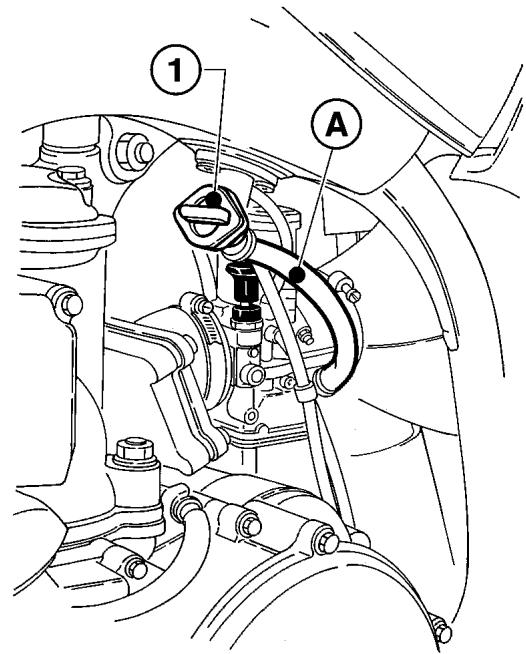
The motorcycle is equipped with 2 stroke engine that requires a gasoline-oil mixture. Recommended fuel: premium grade unleaded fuel (R.O.N. 98).
Note*: Do not continue operation if the engine pings or knocks. The engine will be damaged and could seize.
WARNING*: If "knocking" or "pinging" occurs, try a different brand of gasoline or higher octane grade.
Note*: Do not mix synthetic and mineral based oils.
WARNING*: Gasoline is extremely flammable and can be explosive under certain conditions. Always stop the engine and do not smoke or allow flames or sparks in the area where the motorcycle is refueled or gasoline is stored.
WARNING*: Do not overfill the tank. After refueling, make sure the tank cap (1) is closed securely.
CARBURANT
Start knob (1) set on the carburettor is used to enrich the mixture when starting the engine. Pull knob highwards to activate the starter, push lever downwards to deactivate the starter.
DEMARREUR
natural_image
Technical line drawing of a mechanical assembly with no visible text or symbolsSTRUMENTO DIGITALE, SPIE (WR)
DIGITAL INSTRUMENT, WARNING LIGHTS (WR)
The motorcycle is equipped with a digital instrument; on the instrument are located 3 warning lights too: high beam, lights (with display lighting), blinkers and neutral.
1- BLUE warning light "HIGH BEAM"
2- GREEN warning light "LIGHTS"
3- GREEN warning light "BLINKERS"
NOTES
- After the engine starting, for the first 2 seconds, the instrument shows the version of the checking SW; after the check, the instrument shows the last planned function.
- When the motorcycle engine is OFF, the instrument doesn't also show its functions.
- To select the instrument functions and to set to zero the functions, use the SCROLL knob (A).
INSTRUMENT DIGITAL, VOYANTS (WR)
INSTRUMENTO DIGITAL, TESTIGOS (WR)
- The instrument functions are the following, as shown below.
2- SPEED / H (figure 2)
3- SPEED / CLOCK (figure 3)
4- SPEED / TRIP 1 (figure 4)
5- SPEED / STP 1 (figure 5)
6- SPEED / AVS 1 (figure 6)
7- SPEED / SPEED MAX (figure 7)
8- SPEED / TRIP 2 (figure 8)
9- SPEED / TRP 2 / CLOCK (figure 9)
10- SPEED / RPM (engine r.p.m. numerical value) (figure 10)
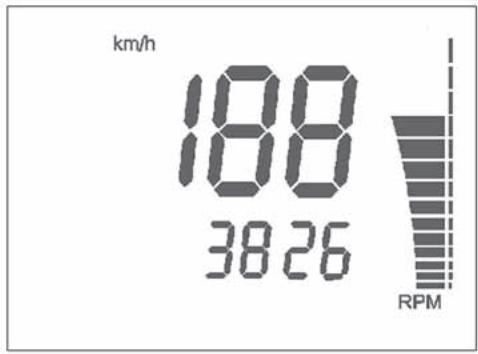
1- SPEED / ODO (figure 1)
NOTE
The RPM function, shown on the vertical LED indicator, is ALWAYS on.
natural_image
Close-up of a motorcycle's front-mounted control panel with display and adjustment knobs (no readable text or symbols)1- SPEED (kmh o mph) / ODO / RPM (figura 1)
- SPEED: motorcycle speedmaximum value: 299 kmh or 299 mph;
- ODO: odometer- maximum value:
99999 km; - RPM: engine r.p.m. shown on the vertical LED indicator.
To replace kilometers with miles or miles with kilometers proceed as follows: - start the engine and push for 3 seconds the knob SCROLL (A). After the kilometers-miles or mileskilometers setting operation, for 3 seconds, "SET" and miles/mph or km/kmh will be on.
NOTE
After the previously described operation, the ODO setting will be convert and all the others data will be reseted (the H Counter is unchanged).
1- SPEED (kmh o mph) / ODO / RPM (figure 1)
- SPEED: motorcycle speedmaximum value: 299 kmh or 299 mph;
- H: shows the running hours of the engine (data are saved in permanent memory every 10 minutes)- Maximum value: 9999:59;
- RPM: engine r.p.m. shown on the vertical LED indicator.
3- SPEED / CLOCK / RPM (figure 3)
- SPEED: motorcycle speedmaximum value: 299 kmh or 299 mph;
- CLOCK: clock- Reading from 0:00 to 23:59:59 (the data will be lost after battery detachment).
To reset the clock, push the knob SCROLL (A) for more than 3 seconds in order to increase the hours; release the knob and then, after 3 seconds, it is possible to increase the minutes; - RPM: engine r.p.m. shown on the vertical LED indicator.
2- SPEED / H / RPM (figure 2)
- SPEED: motorcycle speedmaximum value: 299 kmh or 299 mph;
- TRIP 1: distance- maximum value: 999.9 km (the data will be lost after battery detachment). If the STP 1 will be set to zero, the functions TRIP 1 and AVS 1 will be set to zero too..
The function TRIP 1 is ON unitedly with the function STP 1 (*). - RPM: engine r.p.m. shown on the vertical LED indicator.
(*): see figure 5
4- SPEED / TRIP 1 / RPM (figure 4)
- SPEED: motorcycle speedmaximum value: 299 kmh or 299 mph;
- STP 1: miles/kilometers covered time- Reading from 0:00 to 23:59:59 (the data will be lost after battery detachment).
To activate the function STP 1, push the knob SCROLL (A) for more than 3 seconds. - 1st step: function ON;
- 2nd step: stop to the counters;
- 3rd step: STP 1 zero-setting; TRIP 1 and AVS 1 data zero-setting;
- 4th step: function ON;
- 5th step: stop to the counters;
and so following
NOTE
STP 1 data+TRIP 1 data=AVS 1 (*).
- RPM: engine r.p.m. shown on the vertical LED indicator.
(*): see figure 6
5- SPEED / STP 1 / RPM (figure 5)
- SPEED: motorcycle speedmaximum value: 299 kmh or 299 mph;
- AVS 1: shows the covered average speed of the motorcycle, according with a distance (TRIP 1) and a miles/kilometers covered time (STP 1) (the data will be lost after battery detachment).
NOTE
If the STP 1 will be set to zero, the TRIP 1 and AVS 1 functions will be set to zero too.
- RPM: engine r.p.m. shown on the vertical LED indicator.
6- SPEED / AVS 1 / RPM (figure 6)
- SPEED: motorcycle speedmaximum value: 299 kmh or 299 mph;
- V MAX: shows the motorcycle MAXIMUM speed (reached MAX speed), kmh or mph. Maximum value: 299 kmh or 299 mph.
To set to zero V MAX, push the knob SCROLL (A) for more than 3 seconds;
- RPM: engine r.p.m. shown on the vertical LED indicator.
8- SPEED / TRIP 2 / RPM (figure 8)
- SPEED: motorcycle speedmaximum value: 299 kmh or 299 mph;
- TRIP 2: distance- maximum value: 999, 9 km / miles (the data will be lost after battery detachment).
To set to zer seconds;
- RPM: engine r.p.m. shown on the vertical LED indicator.
7- SPEED / V MAX / RPM (figure 7)
- TRIP 2: distance- Max value: 999.9 km / miles (the data will be lost after battery detachment).
To set to zero TRIP 2, push the knob SCROLL (A) for more than 3 seconds; - CLOCK: clock- Reading from 0:00 to 23:59:59 (the data will be lost after battery detachment). To reset the clock, push the knob SCROLL (A) for more than 3 seconds in order to increase the hours; release the knob then, after 3 seconds, it is possible to increase the minutes;
- RPM: engine r.p.m. shown on the vertical LED indicator.
10- SPEED /RPM (engine r.p.m. numerical value) (figure 10)
- SPEED: motorcycle speedmaximum value: 299 kmh or 299 mph;
- RPM: engine r.p.m.; both vertical LED indicator and numerical value are on.
9- TRP 2 / CLOCK / RPM (figure 9)
10
COMANDO GAS
The throttle (1) knob, located on the right-hand side of the handlebar. The position on the handlebar can be adjusted by loosening the two fixing screws.
POIGNEE DES GAZ
Do not forget to tighten the screws (A) after the adjustment.
ATTENTION
The brake control lever (2) is situated on the right-hand side of the handlebar and controls the front wheel brake. The position on the handlebar can be adjusted by loosening the two fixing screws.
COMMANDE
FREIN AVANT
Do not forget to tighten the screws (B) after the adjustment.
ATTENTION
The motorcycle is equipped with a steering lock (3) on the right-hand side of the steering head tube. To lock it, proceed as follows:
- place key in lock and turn anti-clockwise;
- push key inwards (if necessary, turn to and from);
- turn key clockwise and remove it from lock.
To unlock the steering lock, reverse the above procedure.
BLOC DE DIRECTION
(USA/CDN exclu)
natural_image
Mechanical assembly diagram showing a motor with attached components and labeled parts (1, 3), no readable text or symbols beyond labels.COMMUTATORE SUL
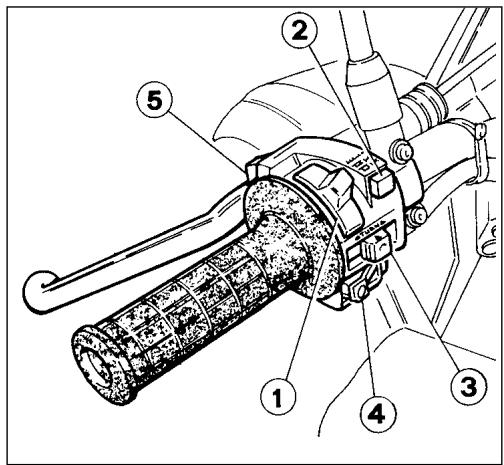
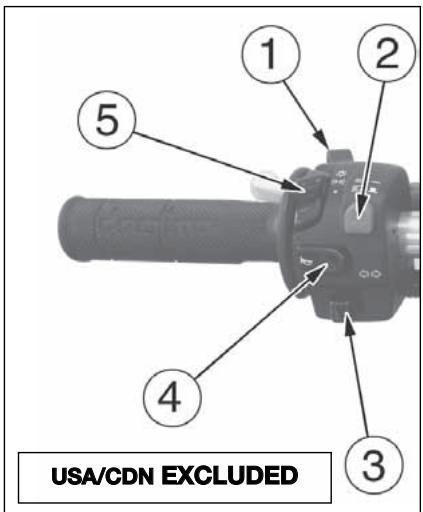
2) HI = ( D) Selection control High beam LO = ( D) Selection control of Low beam
3) TURN
← = Activation of left turn indicators (self cancelling)
→ = Activation of right turn indicators (self cancelling)
To deactivate the indicator, press the control lever after its returning to center.
4) HORN = ( ) Warning horn
5) LIGHTS
☀️ = Lighting control of low-beams and high beam.
≥ 00 ≤ = Lighting control of position lights.
● = Off
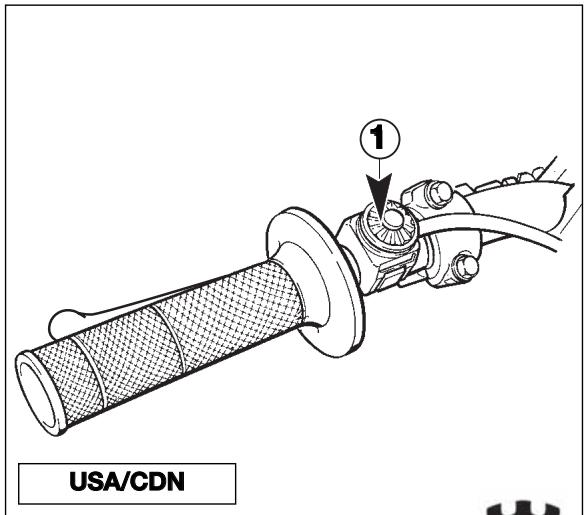
ENGINE STOP BUTTON (USA/CDN)
On the left side of handlebar, near clutch control, the engine sto button (1) is set.
COMMUTATEUR SUR LE
GUIDON (exclu USA/CDN)
BOUTON D'ARRET MOTEUR (USA/CDN)
DRUCKKNOPF MOTORAN-HALTEN (USA/CDN)
1: Plug
2 Lights selection control
3: Turn indicators
4: Horn
5: Passing
COMANDO FRIZIONE
The clutch lever is located on the left-hand side of the handlebar and is protected against dirt filtering in. The lever support is provided with adjusting screw (1) to regulate clutch wire free play (see on page 98). The clutch lever can be adjusted to suit your driving position.
CAUTION
Do not forget to tighten the screws (C) after the adjustment.
COMMANDE DE L'EMBRAYAGE
The rear brake control (1) is placed on the right-hand side of the motorcycle. A stop switch (USA-CDN excluded) during braking action, causes the rear light to come on.
natural_image
Technical line drawing of a mechanical assembly with labeled parts (no text or symbols present)COMANDO CAMBIO
The lever (1) is placed on the left-hand side of the engine. After every shift, the lever automatically returns to its central position. First gear is engaged by pushing the lever downwards; all the other gears are engaged, by pushing the lever upwards.
The position of the gear shift lever on the shaft can be varied by:
- loosening screw;
- pulling lever out;
- placing lever in new position on the shaft whom the operation is over tighten the screw and then tightening the screw.
CAUTION*: Do not shift gears without disengaging the clutch and closing the throttle. The engine could be damaged by overspeed and shock.
WARNING*: Do not downshift when traveling at a speed that would force the engine to overrev in the next lower gear, or cause the rear wheel to lose traction.
KICKSTART PEDAL
The kickstart pedal (1) is situated on the right-hand side of the motorcycle.
COMMANDE DU
CHANGEMENT DE VITESSES
natural_image
Technical line drawing of a car engine bay with labeled component (1), no readable text or symbols present.ISTRUZIONI PER L'USO DEL MOTOCICLO
Before each ride, to prevent accidents or failures during ride, make sure to go through following list.
CAUTION\*: Don't start the engine while voltage regulator is disconneted from main wiring harness (WR; Enduro USA/CDN)
- Check all fluids
A. transmission oil level
B. fuel level
C. coolant level
Make sure all caps are properly adjusted.
WARNING\*: Don't remove radiator cap when hot!
- Check all controls
A. Throttle handgrip
B. Clutch lever device
Make sure cables are not damaged and turn smoothly.
- Check brakes
Look for brake fluid leaks and worn cables.
Check for proper functioning.
- Check suspensions
Compress fork and rear suspensions. Look for oil leaks and ensure proper functioning.
MODE D'EMPLOI DE LA MOTO
CONTROLES PRELIMINAIRES ATTENTION!
Check spokes and look for worn bearings. Check rims and tyres. Check tyre pressure.
- Check chain rollers and sprockets
Check wear on chain rollers and sprockets Ensure chain is correctly adjusted and lubricated.
- Check air filter and intake system
Check that air filter is clean Check all rubber connections and clamps.
- Check exhaust system
Check hook up, look for cracks Check muffler.
- Check torque
A. Spark plug
B. Cylinder-head nuts
C. General check of torque
- Check steering action
Check bearing play.
- Check the electric system (USA/CDN Enduro)
Start the engine and check that the phares, the stop light, the turn indicators (USA excluded), the instrument panel pilot lights (USA/CDN excluded), and the horn, are working correctly.
WARNING*: Failure to perform these checks every day before you ride may result in serous damage or a severe. ENGINE STARTING
- Contrôle des roues
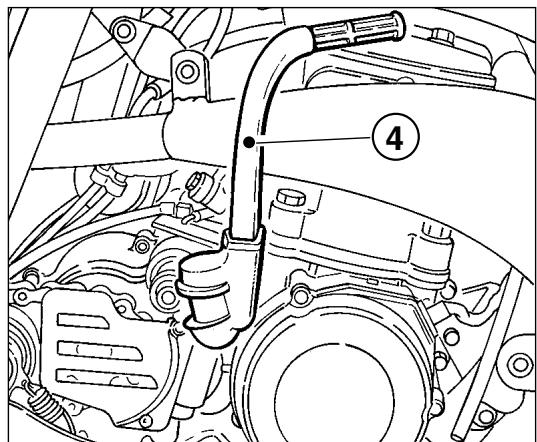
For the correct start of a cold engine proceed as follows:
- shift the transmission into neutral;
- set fuel valve (1) in ON position;
- lift the knob lever (3) on the carburetor.
Leaving the throttle in closed position operate kick-start (4).
Take the knob lever in its initial position as soon as the engine is idling.
When starting with an already warmed up engine DO NOT USE the starter. You can start the engine with the gear inserted, after disconnecting of the clutch.
If the carburetor is flooded, shut
DEMARRAGE DU MOTEUR
natural_image
Technical line drawing of a mechanical assembly with no visible text or symbols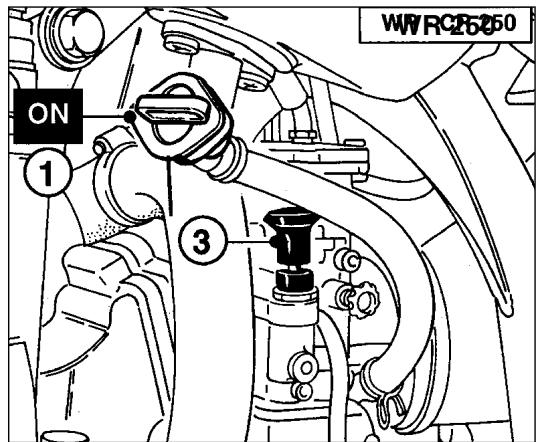
natural_image
Technical line drawing of a mechanical assembly with numbered component (no text or symbols)fuel supply and the starter and operate the crank lever or the kick-start until the engine starts. If necessary, remove the spark plug and dry it.
IMPORTANT NOTE IN CASE OF COLD STARTS AT LOW TEMPERATURES
It is recommended to briefly warm-up the engine at idle until, after having disengaged the starter, there is a normal response from the engine when opening the throttle. This will enable the lubricant to reach the correct working temperature thereby guaranteeing a correct functioning of all engine parts.
WARNING*: Exhaust contains poisonous carbon monoxide gas. Never run the engine in a closed garage or in a confined area.
WARNING*: This high performance motorcycle can some times «kick back» strongly when you are starting it. Do not attempt to start this motorcycle unless you are wearing high top heavy sided riding boots. You could seriously hurt you leg if the kickstarter kicked back and your foot slipped.
STOPPING THE MOTORCYCLE
- Close the throttle completely leaving the clutch engaged (except when shifting gears) so that the engine will help slow down the motorcycle.
- For normal braking, gradually apply both front and rear brakes while down shifting.
- For maximum deceleration apply the front and rear brakes firmly.
- When stopped, fully disengage the clutch and shift to neutral as necessary to keep the engine from stalling.
WARNING*: independent use of the front or rear brake maybe advantageous under certain conditions. Use caution when using the front brake, especially on slippery surfaces. Improper use of the brakes can lead to a serious crash.
ARRET DU MOTOCYCLE
- Put gear lever in neutral position.
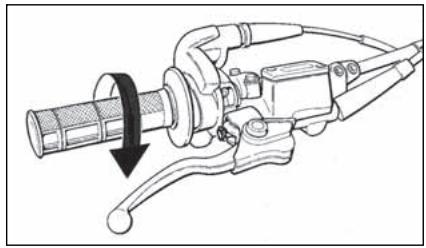
● Turn twist grip against stop. - Press the engine stop button (1).
- Close hand fuel tap.
NOTE
If the fuel tap is not tight, the carburetor could flood, and fuel will get into the crankcrase. The engine will be impossible to start until the fuel is drained out.
WARNING*: In the event of stuck throttle or other malfunction which causes the engine to run uncontrollably, IMMEDIATELY depress the engine stop button and hold it down. Control the motorcycle by normal use of the brakes and steering while holding the engine stop button down.
ARRET MOTEUR
natural_image
Mechanical assembly diagram showing internal components and a labeled component (N), no readable text or symbols present.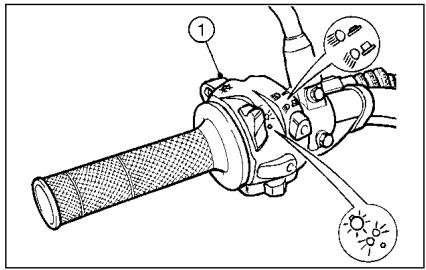
natural_image
Mechanical device diagram showing a lever mechanism with a black arrow indicating rotational motion (no text or symbols present)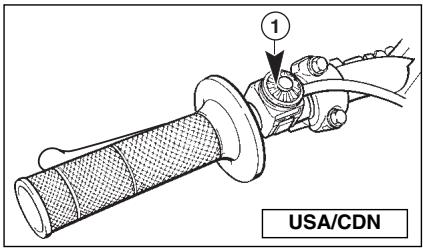
RODAGGIO
To obtain the best settling of the engine moving elements, for driving your motorcycle to the best of your capability, run in the engine for several hours, following these procedures:
- FROM STOP POSITION. Start the engine and run at idle, but open the throttle periodically and briefly until the engine is thoroughly warmed up. Within 3-4 minutes the coolant temperature will have reached approximately 60^ C/ 140^ F. (Do not ride the motorcycle).
- Stop the engine, and let it cool down naturally until its temperature is equal to the ambient air temperature. This will allow the piston to align itself to any imperfections which might exist at the cylinder wall.
- Repeat steps 1 and 2. (Do not ride the motorcycle).
- Bring the engine up to normal running temperature. Ride the motorcycle approximately 10 minutes at moderate speeds. Then repeat cool down procedure. AVOID HARD ACCELERATIONS.
- Bring engine up to normal temperature. Ride motorcycle approximately 15 minutes at moderate to high speeds. Again avoid hard accelerations.
- Repeat cool down procedure.
- Full throttle operation must be avoided until the engine has reached operating temperature, even after the break in process is completed.
When the above procedure is followed correctly, engine durability and performance will be greatly enhanced.
RODAGE
CHECKS WHILE RUNNING IN When running in, the following should be checked out:
- WHEELS SPOKES TENSION (224);
- TIGHTENING OF WHEELS (see page 258-260);
- FORK PIN TIGHTENING (see page 254);
- CHAIN ADJUSTMENT (see page 142);
- STEERING BEARING PLAY (see page 116);
- HANDLEBAR TIGHTENING (see page 254);
- ENGINE GRIP TO FRAME (see page 250-252);
- SUCTION FITTING GRIP (see page 244);
- HEAD AND CYLINDER NUTS GRIP (see page 244).
Note*: After break in, install a new spark plug and change the transmission oil.
TRANSMISSION OIL LEVEL CHECKING
By keeping the motorcycle on a flat surface and in vertical position, remove the control screw (C), and check the level through the hole in the screw.
CONTROLE DU NIVEAU D'HUILE DU BOITE DE VITESSE
Note\*: Have this operation made with warmed-up engine.
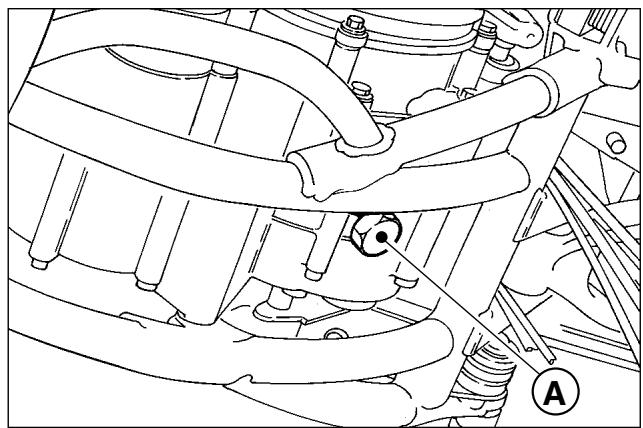
A Draining plug
B Filling cap
C Levelling screw
natural_image
Technical line drawing of a mechanical assembly with no visible text or symbolsTRANSMISSION OIL CHANGE To completely replace the oil, unscrew the plug (A) under the oil sump and let oil come out, then screw the plug again with its gasket and pour fresh oil from the hole of the loading plug. Use only the prescribed quantity and type of oil (see on page 34,36).
Note*: Have this operation made with warmed-up engine.
A Draining plug
natural_image
Technical line drawing of a mechanical assembly with no visible text or symbolsCheck level (A) in right-hand radiator when engine is cold (place the motorcycle so that it is perpendicular to the ground). The coolant should be approximately 10 mm above cells.
WARNING
Avoid removing radiator cap when engine is hot, as coolant may spout out and cause scalding. NOTE
Difficulties may arise in eliminating coolant from varnished surfaces. If this occurs, wash off with water.
REPLACEMENT OF COOLING FLUID
The filling of cooling fluid is carried out through the radiator cap; about the fluid quantity to be filled, see page 30.
For draining, a) remove the pump cover by loosening the two screws (1), or: b) the draining screw (2) set on the pump cover.
Let the fluid drain fully, then reassemble the pump cover or the screw previously removed.
WARNING\*: Coolant on tires will make them slippery and can cause an accident or injury.
Periodically check the connecting hoses (see "Periodical maintenance card"): this will avoid coolant leakages and consequent engine seizure: If hoses show cracks, swelling or hardenings due to sheats desiccation, their replacement shall be advisable.
Check the correct tightening of the clamps.
CONTROLE DU NIVEAU REFRIGERANT
natural_image
Technical line drawing of a mechanical assembly with labeled component (1), no readable text or symbols present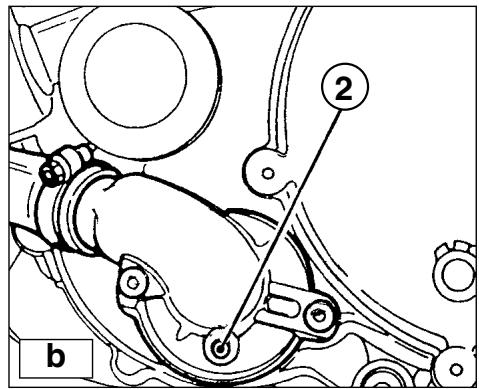
REGOLAZIONE CAVO COMANDO GAS
THROTTLE CABLE ADJUSTMENT
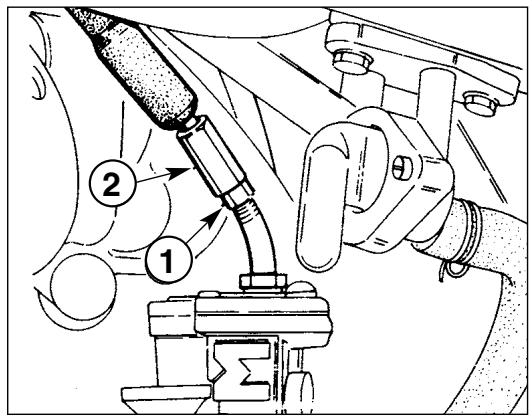
The throttle cable can be adjusted using the screw set on the throttle, or using the adjusting screw set on the carburettor cover. To check for proper adjustment of throttle cable, proceed as follows:
- remove rubber cap;
- move transmission sheath to and fro to ensure a play of approx. 1 mm;
- should play be greater than 1 mm, loosen lock nut (1) and register (2); should play less than 1 mm, then tighten lock nut and register;
- if register (2) should not provide sufficient movement to allow for correct adjustment, then adjust register placed on carburetor. There should be approx. 1 mm play on latter register; should this not be the case, then loosen lock nut (1), and loosen or tighten screw (2), to respectively increase or decrease the play.
WARNING*: Operation with damaged throttle cable could result in an unsafe riding condition.
REGLAGE DU CABLE DE COMMANDE DES GAZ
REGISTRAZIONE MINIMO
Idling should be adjusted only when the engine is hot and throttle is closed, as follows:
- turn idle adjusting screw (1) so as to increase rpm (turn clockwise to increase rpms, counterclockwise to decrease rpm);
- turn fuel mixture adjusting screw (2) clockwise or anticlockwise until engine runs smoothly;
- gradually loosen screw (1) to ensure that engine runs properly.
REGLAGE DU RALENTI
WARNING*: Exhaust gas contains poisonous carbon monoxide gas. Never run the engine in a closed area or in a confined area.
The clutch is adjusted by stretching the cable using the adjusting unit positioned on the handlebar.
As a rule it is sufficient to operate on the handlebar register to restore the clearance due to the flexible transmission stretch.
The control lever must always have an empty stroke C (3 mm) before starting clutch disengagement. To adjust this clearance, act on register 2 after taking out rubber cap 1; turn the register in the direction indicated by arrow A to reduce the clearance C; turn it in the direction indicated by arrow B to increase the clearance.
The adjustment can be also effected with tightener (1) set on the right of the frame.
Take care to tighten properly the lock nut. If the clutch slips under load or drags in disengaged position after play has been adjusted, it must be taken apart for inspection. For this operation apply to a Dealer.
REGLAGE DE L'EMBRAYAGE
Either drain the oil (as shown on page 90), or lay down the motorcycle on the right side without draining the oil.
Remove the screws (C) and the clutch cover.
Use a wrench to loosen the screws which fasten the clutch springs. Remove the washers, the springs, the pressure plate and the disks. In the event the disks have been removed, the 1-2 mm idle stroke of the control rod on the engine must be restored; for this, proceed as follows:
- remove the clutch cable from the lever;
- match the niches on the pressure plate and on the plate;
- insert a screwdriver blade, loosen the lock nut and turn the adjusting screw to set the above mentioned play; then tighten the lock nut.
Reassemble the clutch cover with a new gasket.
Turn adjusting screw (1) to adjust the play on the lever set on the handlebar. The play must be approx. 3 mm.
DEMONTAGE DISQUES D'EMBRAYAGE
A. To decrease clearance
B. To increase clearance
natural_image
Technical line drawing of a mechanical component with no visible text or symbols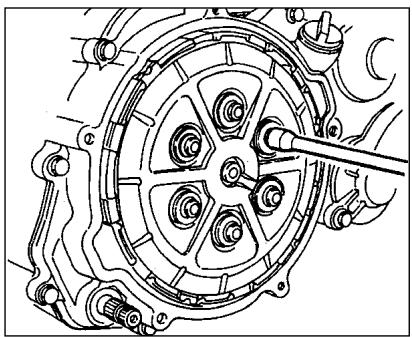
natural_image
Technical line drawing of a mechanical assembly with gears and shafts (no text or symbols)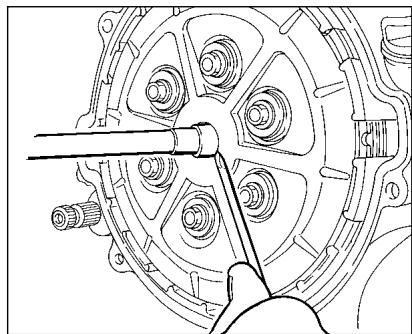
natural_image
Technical line drawing of a mechanical assembly with gears and shafts (no text or symbols)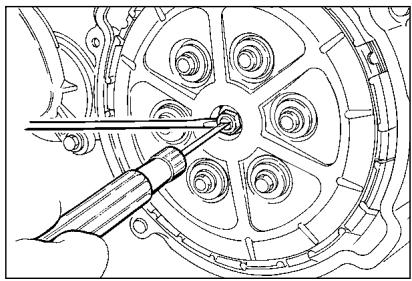
natural_image
Technical line drawing of a mechanical assembly with two tools working on a circular component (no text or symbols visible)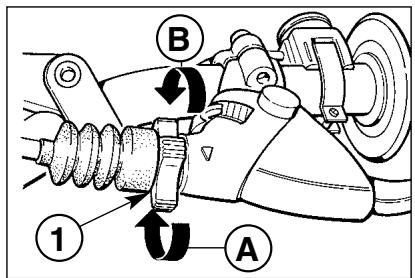
CONTROLLO CANDELA
If standard spark plug is to be replaced, it is important that new spark plug have the same heat range and thread length.
Correct heat grade:
The tip of the insulator should be dry and the colour should be light brown or grey.
High heat grade:
In this case, the insulator tip is dry and covered with dark deposits.
Low heat grade:
In this case, the spark plug is overheated and insulator tip is vitreous, white or grey in colour.
Check distance between
electrodes using a thickness gauge, and adjust distance “A” according to the type of spark plug, as shown on page 26.
A wider gap may cause difficulties in starting engine and in overloading coil.
CONTROLE DE LA BOUGIE
A gap that is too narrow may cause difficulties when accelerating, when idling the engine or when performing at low speeds.
CAUTION*: Select a spark plug with a colder or hotter heat range carefully and cautiously.
A spark plug with too hot a heat range may lead to preignition and possible engine damage.
A spark plug with too cold a heat range may foul as the result of too much carbon buildup.
Before mounting spark plug, carefully clean electrodes and insulator with a metallic brush.
CAUTION*: Never use a spark plug of an improper heat range.
CAUTION*: The spark plug must be securely tightened. An improperly tightened plug can become very hot and possibly damage the engine.
VOLTAGE REGULATOR
The voltage regulator (1) is located on the steering tube, behind the headlamp holder.
natural_image
Technical line drawing of a mechanical assembly with labeled component (1), no readable text or symbols presentCONTROLLO ANTICIPO ACCENSIONE
The spark advance is factory set and must be checked either when replacing the ignition system, or whenever the engine assembly is inaccurate. For this check, make sure that the reference point stamped on the base be aligned with the one stamped on the stator, (either matched with the upper fastening; fig. A).
When replacing the half-casings, reset the accurate spark advance as follows, without reassembling the stator:
a) Remove the spark plug and introduce a comparator into its seat;
b) Fit special tool (cod. n° 8 pag. 242) on the crankshaft and take the piston to T.D.C. and zeroset the comparator in this position (fig. B);
CONTROLE DE L'AVANCE A L'ALLUMAGE
natural_image
Mechanical assembly diagram showing a gear and housing component (no text or labels)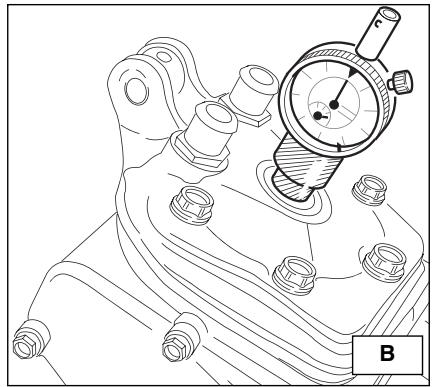
natural_image
Technical line drawing of a mechanical gauge or dial assembly with bolts and nuts (no text or symbols)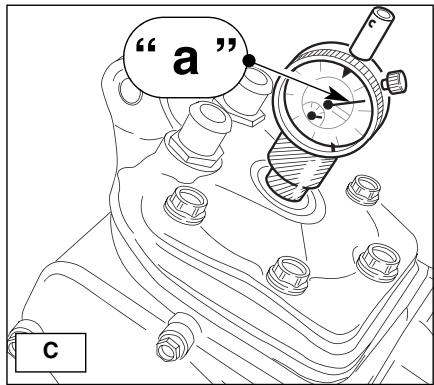
natural_image
Technical line drawing of a mechanical assembly with numbered components (no readable text or symbols)Anticipo “a”/Ignition advance “a”/Avance à l'allumage “a”/Zündvorvestellung
"a"/Avance del encendido "a"
8^ (0,5 mm / 0.0197 in.)
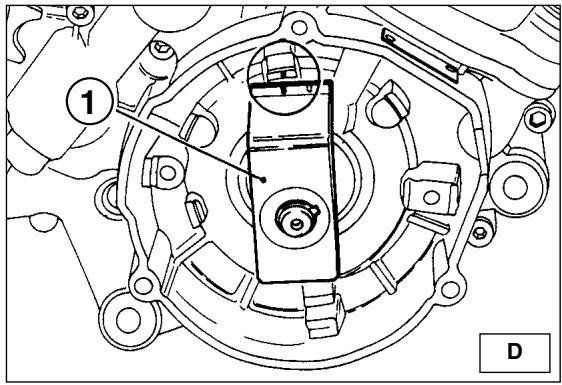
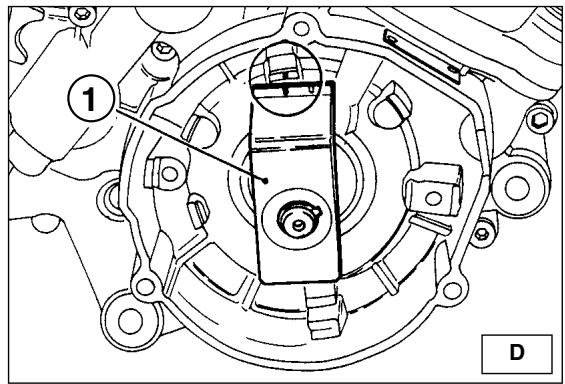
c) Turn the tool anticlockwide until the spark advance “a” is reached (fig.. C), and mark a reference point of the pin set on the tool, matched with the notch obtained on the tool (fig. D);
d) Remove the tool and fit the stator, matching the reference point stamped on it with the one obtained on the base;
e) Tighten then the stator screws and refit the rotor (for the tightening torque, see on page 246).
natural_image
Mechanical assembly diagram showing a central gear mechanism with mounting flanges and a black arrow indicating a specific component (no text or labels present)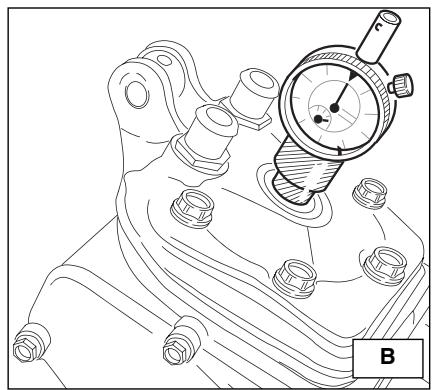
natural_image
Technical line drawing of a mechanical gauge or dial assembly with bolts and a central knob (no text or symbols)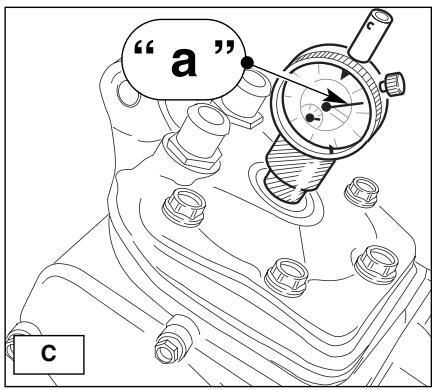
natural_image
Technical line drawing of a mechanical assembly with numbered components (no readable text or symbols)Anticipo “a”/Ignition advance “a”/Avance à l’allumage “a”/Zündvorvestellung
EXHAUST VALVES "H.T.S."
The cylinder features a central valve (A), connected to two side valves (B) on the “Booster” by means of gears. This system is driven by a centrifugal regulator placed on the left of the engine. The regulator opens the valves when the engine turns at approx. 6,200 rpm.
In this way all engine output is obtained even when the engine is revved up.
When closing, the central valve stroke is adjusted by a plate fastened to the rack, and when opening, the stroke is adjusted by another plate fastened near the "Booster". To adjust the stroke, remove the cylinder head, the exhaust pipe and the timing covers as described on page 112.
SOUPAPE D'ÉCHAPPEMENT "H.T.S."
- Adjusting the central valve when closing (fig. A, B and C). Loosen screw (1) (fig.A) and adjust the valve position in a way that the clearance between the face where the head rests and the valve lower profile is 48 mm (1.89 in) (fig.B); then tighten screw (1). Remove valve unit (9) (fig.a), from rod (3), and set the two side valves on "full open" position (see fig. "c"), taking care that the two side valves are not moved. Reassemble the valve unit (9) in "full open" position, moved, keeping always the whole system in "full open" position, then proceed to:
- Adjustment of the central valve in the opening phase (alignment of the side valve with the duct, as shown on fig. C) (figs. "a" and "c"):
Loosen screw (6) and press the plate (4) so as it beats against rack (5); then tighten screw (6). Turn the central valve and check that benchmarks (7) on the racks and those on the side valves (8), are drawn up.
natural_image
Technical drawing of a mechanical assembly with cross-section hatching (no text or symbols)CONTROLLO FILTRO ARIA
Turn rear pin (1) anticlockwise, remove the saddle from the front fixing screw.
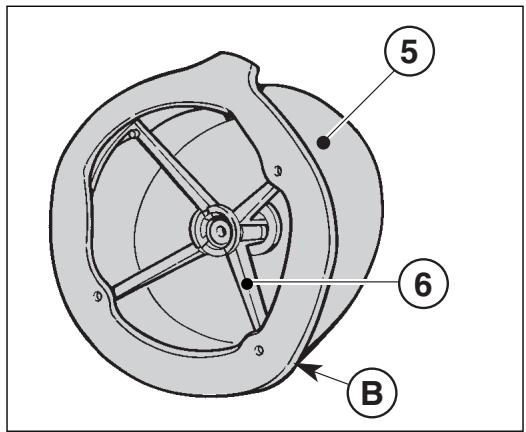
Remove screw (3). Remove air filter (4). Separate filter (5) from frame (6).
AIR FILTER AND CLEANING
Wash the filter with a specific detergent (AGIP" Filter clean foam air detergent fluid" or similar) then dry it fully (wash filter with gasoline only in case of necessity).
Plunge the filter in special oil for filters (AGIP "Foam air filter protection oil" or similar), then wring it to drain superfluous oil.
CAUTION*: Do not use gasoline or a low flash-point solvent to clean the element. A fire or explosion could result.
CAUTION*: Clean the element in a well ventilated area, and do not allow sparks or flames anywhere near the working area.
ASSEMBLY
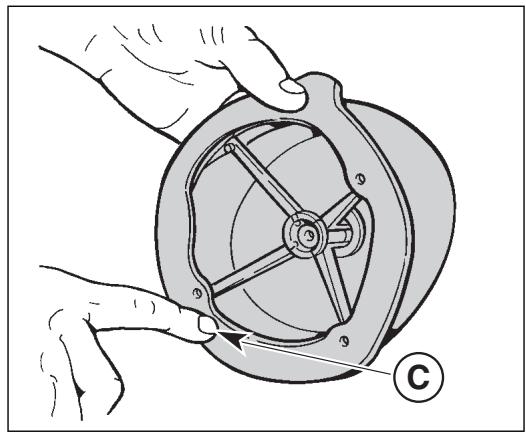
To ensure tight fit, slightly (C) grease filter edge on side facing filter housing.
While re-inserting the filter into its housing, make surs that piece A is turned upwards and edge B is on the left lower side of the filter case.
Reassemble the parts previously removed (battery: connect the positive cable first).
CAUTION*: If the element assembly is not installed correctly, dirt and dust may enter and the engine resulting in rapid wear of the piston rings and cylinder.
CONTROLE FILTRE A AIR
natural_image
Diagram of a car wheel with a head and gear, showing motion lines (no text or symbols)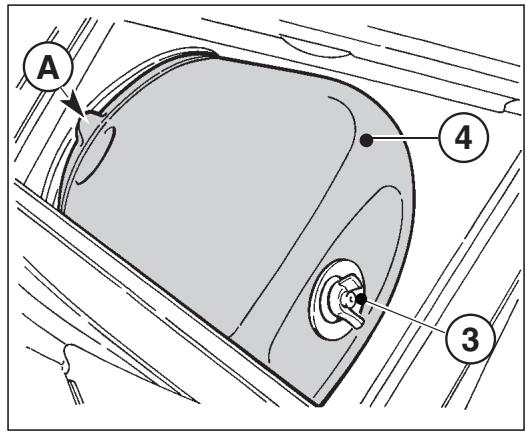
natural_image
Illustration of hands assembling a mechanical component with a labeled section (C), no text or symbols present.NOTA
When running on dusty roads clean the filter every 30 minutes.
STEERING WHEEL BALL PLAY ADJUSTMENT
To ensure maximum safety, the steering wheel should always be regulated so that the handlebars steering the motorcycle rotate freely without play. To check steering wheel adjustment, place kick stand or other support under the engine so that the front wheel is raised from ground. Place slight pressure on the tips of the handlebars to rotate steering wheel; the handlebars should also rotate without effort. Stand in front of the motorcycle and grasp the lower end of the fork rods sliders moving them in the direction of their axis.
NOTE
natural_image
Side view of a WAB30 off-road motorcycle with visible tracks and wheels (no text or symbols)If play is noticed, proceed with adjustment as follows:
- loosen steering sleeve nut (1);
- loosen four screws that fix steering head to fork rods (3);
- Turn the steering ring nut (2) clockwise of the steering sleeve proper tool, to adjust play properly;
- tighten steering sleeve nut (1) to a torque setting of 57,9÷65,1 Lb/ft (78,4÷88,3 Nm);
- tighten four screws on the steering head (3) to a torque of 17.3 ÷ 18.8 Lb/ft (22,5÷26,5 Nm).
CAUTION*: Do not ride a motorcycle with damaged steering stem bearings. An unsafe handling condition can result.
natural_image
Technical line drawing of mechanical components with no visible text or symbols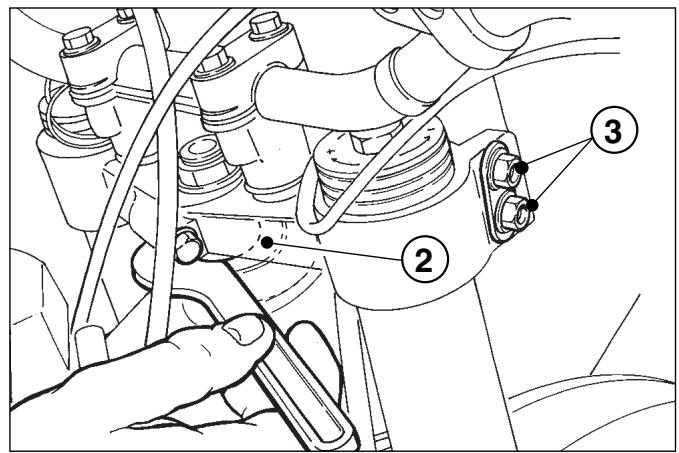
REGOLAZIONE LEVA COMANDO E CONTROLLO LIVELLO FLUIDO FRENO ANTERIORE
The adjuster (2), located on the control lever, allows adjusting of the free play (a). Free play (a) must be at least 3 mm (0.1 in.).
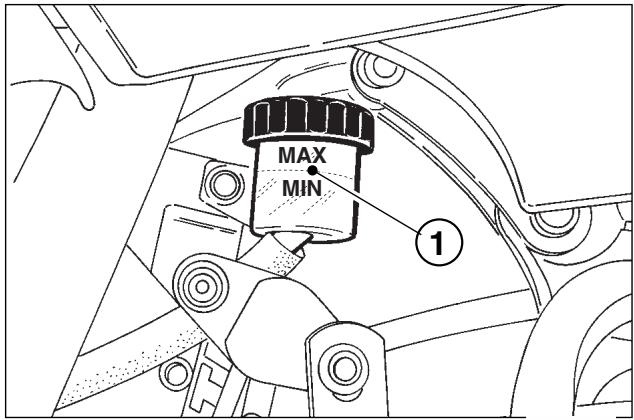
The level of the fluid in pump tank must never be below the minimum value (1), which can be seen from the window on the pump body.
A decrease of the fuel level will let air into the system, hence an extension of the level stroke.
REGLAGE DU LEVIER ET CONTROLE DU NIVEAU FLUIDE FREIN AVANT
WARNING*: If the brake lever feels mushy when it is applied, there may be air in the brake lines or the brake may be defective. Since it is dangerous to operate the motorcycle under such conditions, have the brake checked immediately by an authorized HUSQVARNA dealer.
CAUTION*: Do not spill brake fluid on to any painted surface or lenses.
CAUTION*: Do not mix two brands of fluid. Change the brake fluid in the brake line if you wish to switch to another fluid brand.
A: to encrease clearance
B: to decrease clearance
CAUTION*: Brake fluid may cause irritation. Avoid contact with skin or eyes. In case of contact, flush thoroughly with water and call a doctor if your eyes were exposed.
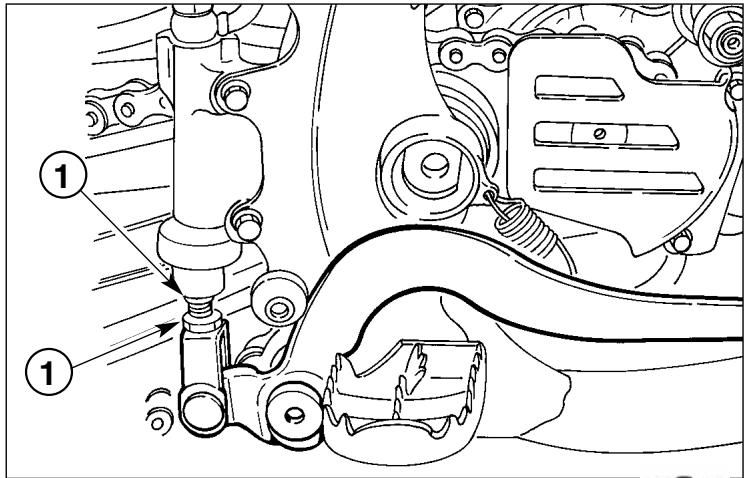
REAR BRAKE PEDAL POSITION ADJUSTMENT The position of the rear foot brake pedal as to the footrest may be adjusted according to the individual needs. For the adjusting proceed as follows: - loosen the screw (1); - turn the cam (2) for lowering or rising the pedal; - the operation done, tighten the screw (1). The adjusting operation carried out, adjust the idle stroke “A” of the pedal as indicated in page 124.
The rear brake foot pedal should have a (A) 5 mm idle stroke before starting the true braking action. Should this not happen as follows:
- loosen nut (3);
- operate the pump rod (4) to increase or decrease the idle stroke;
- tighten nut (3) at the end of the operation.
RÉGLAGE DE LA COURSE À VIDE DU FREIN ARRIERE
When the idle stroke figures are not met, the brake pads will be subjected to a fast wear that may bring to the TOTAL
CHECKING THE FLUID LEVEL The level (1) must be set between the pump tank notches of MIN and MAX.
ATTENTION
ADJUSTING THE SUSPENSIONS ACCORDING TO PARTICULAR TRACK CONDITIONS
The following information is a useful guide for setting up the suspensions according to the road conditions.
Always start from the standard calibration before making any change on the suspensions. Afterwards, increase or decrease the adjusting clicks one at a time.
HARD GROUND
Fork: softer compression adjustment.
Shock absorber: softer compression adjustment.
The softer adjustment for the two suspensions is also used both in compression and in extension when driving at top speed, in order to have better grip of the tires.
SANDY GROUND
Fork: have a harder compression adjustment, or replace the standard spring with a harder one, and make a softer compression adjustment and a harder extension adjustment at the same time.
Shock absorber: have a harder compression, and especially a harder extension adjustment. Work on the spring preload to lower the motorcycle rear side.
REGLAGE DES SUSPENSION PAR RAPPORT AUX CONDITIONS DE LA PISTE
Fork: have a harder compression adjustment, or replace the standard spring with a harder one.
Shock absorber: have a harder compression and extension adjustments, or replace the standard spring with a harder one. Work on the spring preload to lift the motorcycle rear side. We advise replacing the springs of both suspensions to compensate the weight increase due to the piling of the mud.
NOTE:
When the fork results as either too soft or too hard for any adjustment conditions, check the oil level inside the forkrod. The level can either be too low or too high. Remember that too much oil inside the fork will involve a more frequent air drainage. When the suspensions do not react to the changes of calibration, check that the adjusting units are not blocked.
The standard calibrations and the adjustment procedures are shown on the next pages. The springs available upon request, together with the preload spacers, are shown on pages 262-264.
TERREIN BOUEUX
natural_image
Black-and-white photo of a rider on a dirt bike during a race, kicking up dust with no visible text or symbols.REGOLAZIONE FORCELLA a) COMPRESSIONE (REGISTRO INFERIORE)
Standard calibration: -23 clicks. Remove plug (B) and turn register (A) clockwise until the position of fully closed is reached then, turn back by the mentioned clicks. To obtain a smoother braking action, turn the register anticlockwise.
Reverse the operation in order to obtain a harder action.
b) EXTENSION (UPPER REGISTER)
Standard calibration: - 10 clicks. To reset standard calibration turn register (C) clockwise to reach the position of fully closed; then, turn back by the mentioned clicks. To obtain a smoother braking action, turn the register anticlockwise. Reverse the operation in order to obtain a harder action.
c) AIR VENT (to carry out after each competition, or monthly). Set the motorcycle on a central stand and release the fork fully and loosen the air vent valve (D). Once this operation is over, tighten the valve.
REGLAGE FOURCHE AVANT a) COMPRESSION (REGISTRE INFÉRIEUR)
chemical
Diagram of electron transfer with positive and negative charges, showing a hexagonal ring structure with a central atom and electron configuration.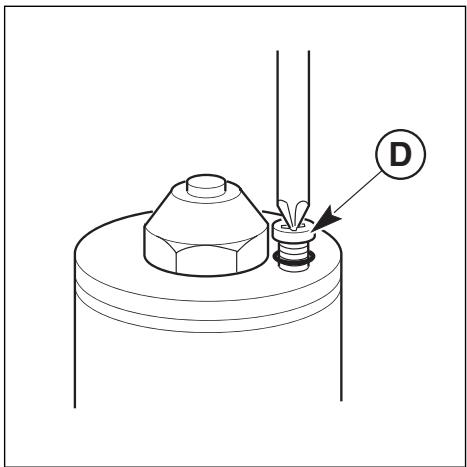
LIVELLO OLIO FORCELLA
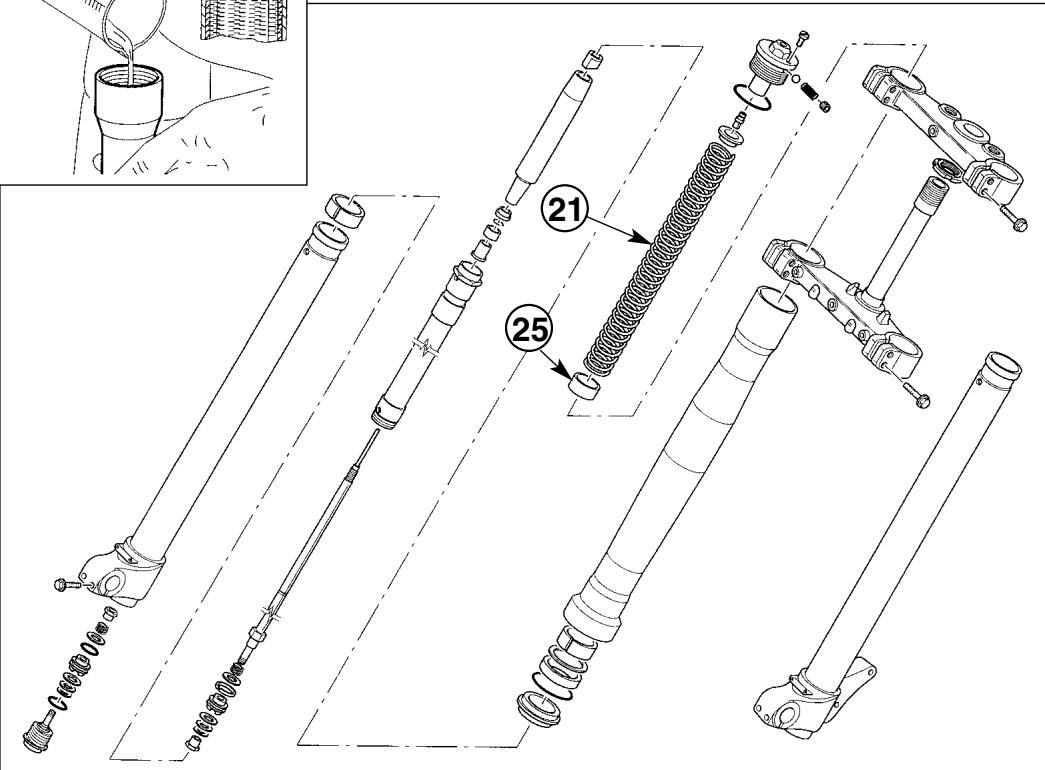
For the regular fork operation, both legs must be provided with the necessary oil quantity.
Remove the forkrods form the fork to check the oil level inside the forkrods. Work as follows:
- remove the power rod caps;
- remove springs from the stems letting the oil drop into the latter;
- bring forks to stroke end;
- check that the level is at distance "A" below the upper limit of rods.
NOTE
Besides the serial spring (21) with flexibility index K=4,2 N/mm preload (25) spacer harder or softer springs, together with spacers are abailable upon request. See the list OPTIONAL PARTS on page 262.
NOTE
Always replace both the spring and the spacers to keep the preload value unchanged.
NIVEAU D'HUILE DE LA FOURCHE
A = 80 mm (3.15 in.)
MODIFICA POSIZIONE ED ALTEZZA MANUBRIO
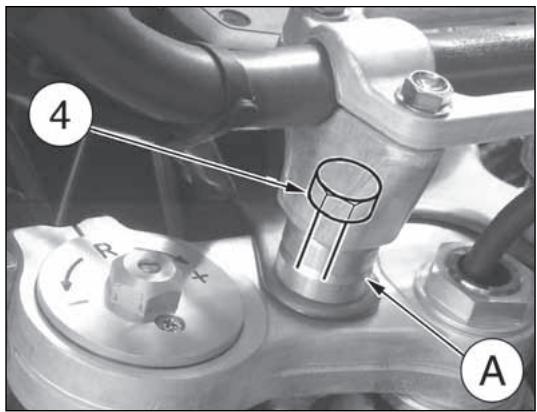
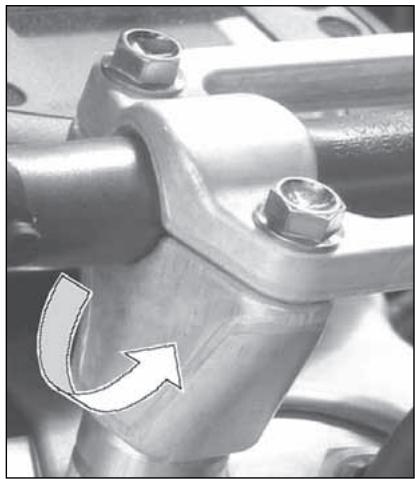
The handlebar position (a) and height (b) can be changed for better suiting Your driving requirements. To effect these operations, remove the upper screw (3), upper clamp (1), lower screw (4) then lower clamp (2).
a) Handlebar position change Turn the lower clamp (2) 180° to move forward or backward (10mm- 0.04in.) the handlebar position with respect to the original setup.
b) Handlebar height change Remove the lower spacer (A) then replace the screw (4) with a new one of L=65 mm (2.56 in.) height.
Once these operations are completed, tighten the screws (3) to 2,75-3,05 kgm (27-30 Nm; 19.9-22 Lb/fts) and the screws (4) to 2,0-2,2 kgm (19,6-21,6 Nm; 14.5-15.9 Lb/fts).
MODIFICATION DE LA POSITION ET DE L'HAUTEUR DU GUIDON
natural_image
Close-up of a mechanical coupling with bolts and a curved arrow indicating rotational motion (no text or symbols)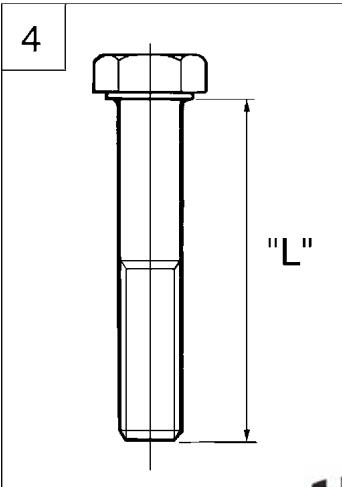
REGISTRAZIONE AMMORTIZZATORE
The rear shock absorber must be adjusted according to the rider weight and track conditions.
Proceed as follows:
- With motorcycle on the stand, measure distance (A).
- Take the normal riding position on the motorcycle with all your riding apparel.
- With somebody's help, take the new distance (A).
- The difference between these two measurements constitutes the "SAG" of the motorcycle's rear end.
Suggested SAG: 4 in. with cold shock absorber. 3.7 in. with warmed up shock absorber. - To get the right SAG according to your weight, adjust the shock absorber spring preload.
WARNING*: Never disassemble shock absorber, which contains highly compressed nitrogen. Contact your Dealer for such major service. Do not incinerate.
ADJUSTING THE SHOCK ABSORBER SPRING PRELOAD Proceed as follows:
- Clean ringnut (1) and adjusting nut (2) of the spring (3).
- Either with a hook wrench or an aluminium punch, loosen the ringnut.
- Turn the adjusting nut as required.
- When the adjusting operation is over (according to your weight and riding style), tighten the ringnut. (Torque for both ringnuts: 5 Kgm).
WARNING*:Be careful not to touch hot exhaust pipe while adjusting the shock abosrber.
Adjustment of the compression stroke is independent from the rebound stroke.
A) COMPRESSION - Standard calibration:
1) Low damping speed: -15 clicks (register 4)
2) Hight damping speed: maximum open (register 6) To reset the standard calibration, turn upper registers (4) and (6) clockwise until reaching fully closed position. Return then back for the mentioned clicks. In order to obtain a smooth braking action, turn the registers anticlockwise. Reverse the operation in order to obtain a harder braking action.
B) EXTENSION - Standard calibration: -15 clicks.
To reset the standard calibration, turn lower register (5) clockwise until reaching fully closed position. Return then back for the mentioned clicks. In order to obtain a smooth braking action, turn the register anticlockwise.
Reverse the operation in order to obtain a harder braking action.
REGISTRAZIONE CATENA
Chain should be checked, adjusted and lubricated as per the Maintenance Chart to ensure security and prevent excessive wear. If the chains becomes badly worn or is poorly adjusted (i.e., if it is too loose or too taught), it could escape from sprocket or break.
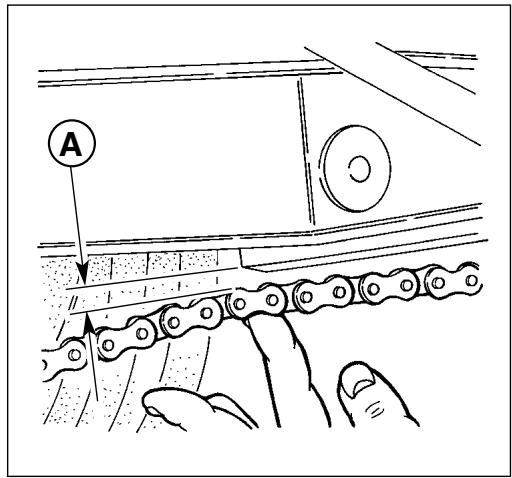
To adjust the rear chain it is necessary to lower the rear part of motorcycle so to line up the drive sprocket axle, the rear swing arm axle and the rear wheel axle as shown on drawing. Than let turn three times the rear wheel. Now the chain should not be tight. (Fig. A).
Fast adjustment (Fig. B.). Push the chain towards the final part of runner and check that between the two elements a distance "A" from 0 to 2 mm is present. If this is not the case, go on as follows:
- Unloose the fastening nut of the wheel pin (1) on the right side;
- Unloose the lock nuts (2) on both chain adjusters and turn the screws (3) to obtain the correct tension value;
- Tighten the lock nuts. After adjustment check that the wheel is lined up and tighten its axle.
CONTROLLO USURA CATENA, PIGNONE, CORONA
CHECKING THE WEAR OF CHAIN, PINION AND SPROCKET
Proceed as follows:
- Fully stretch the chain with the adjusting screws.
- Mark 20 chain links.
- Measure the distance between 1st pin center and 21st pin center.
| STANDARD | WEAR LIMIT |
| 317,5 mm | 323 mm |
Check the pinion damages or wear and replace it should the wear degree be as the one shown in figure.
Remove the wheel and check the wear of the rear sproket teeth. The figure shows the outline of teeth in normal and excessive wear. Should the sprocket be badly worn out, replace it by loosening the six fastening screws to the hub.
WARNING*: Misalignment of the wheel will result in abnormal wear and may result in an unsafe riding condition.
Note*: In muddy and wet conditions, mud sticks to the chain and sprockets resulting in an overtight chain. The pinion, the chain, and the rear sprocket wheel wear increases when running on muddy ground.
CONTROLE USURE CHAINE, PIGNON ET COURONNE
Agir comme suit:
natural_image
Black and white geometric shape resembling a stylized gear or sprocket (no text or symbols)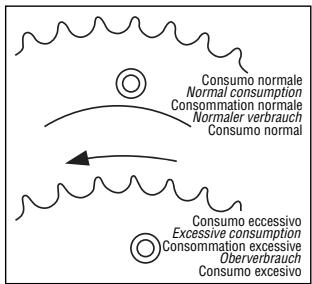
flowchart
graph TD
    A["Consumo normal"] --> B["Consumo normale"]
    B --> C["Normal consumption"]
    C --> D["Consommation normale"]
    D --> E["Normaler verbrauch"]
    E --> F["Consumo normal"]
    G["Consumo excessive"] --> H["Excessive consumption"]
    H --> I["Consommation excessive"]
    I --> J["Oberverbrauch"]
    J --> K["Consumo excessive"]
LUBRICATING THE CHAIN
The chain should be checked, adjusted and lubricated as shown on the "Maintenance Chart".
WARNING * : Never use grease to lubricate the chain. Grease helps to accumulate dust and mud, which act as abrasive and hepl to rapidly wear out the chain, the sprocket, and the crown.
Disassembling and cleaning
When particularly dirty, remove and clean the chain before lubrication.
Work as follows:
Set a stand or a block under the engine and see that the rear wheel is lifted from the ground.
1 -Remove the sprocket guard (3), the spring (1), the joint (2) and the chain.
2 - Check that the chain is neither worn out nor damaged. If the rollers or the links are damaged, replace the chain by following the instructions given in the Periodical Maintenance Table.
3 -Check that neither the sprocket nor the crown are damaged.
4 -Wash and clean the chain as described hereunder.
Washing the chain without OR
Wash using either oil or diesel oil. When using gasoline or tricloroetilene, clean and lubricate the chain to prevent oxidation.
Washing the chain with OR
Wash using oil, diesel oil, or paraffin oil. Never use gasoline, tricloroetilene, or solvents, as the OR may suffer damages. Use instead special sprays for chains with OR.
Lubricating the chain without OR
First dry, then plunge the chain in a bisulphide molybdenum lubricant, or in high viscosity engine oil. Warm up the oil before use.
LUBRIFICATION CHAINE
natural_image
Close-up of a motorcycle's front wheel and suspension mechanism (no text or symbols visible)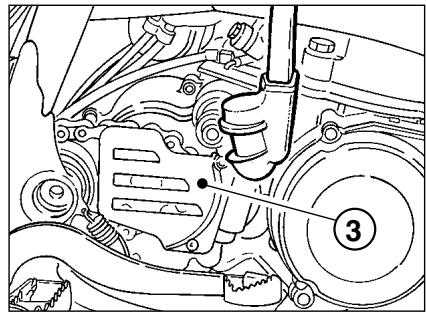
natural_image
Mechanical assembly diagram showing internal components and a numbered label (3), no readable text or symbols present.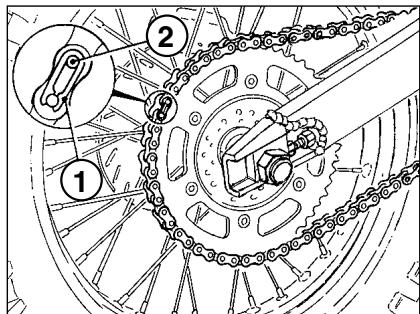
Lubricating the chain with OR
Lubricate all metallic and rubber (OR) elements using a brush, and use engine oil with SAE 80-90 viscosity for the internal and external parts.
5 - If the chain has been cut, reassemble using a joint.
6 - Assemble the joint spring by turning the closed side to the chain direction of rotation as shown in figure.
NOTE * : Even if all the joints are reusable when in good conditions, for safety purposes we advise using new joints when reassembling the chain.
6 -Accurately adjust the chain as described on page 142
WARNING: The chain oil has NEVER to get in contact with the tires or the rear brake disk.
Chain tension rollers, chain driving roller, chain guide, chain runner
Check the wear of the above mentioned elements and replace them when necessary.
WARNING * : Check the chain guide alignment, and remember that a bent element can cause a rapid wear of the chain. In this case, a chain fleeting from the sprocket may ensue.
1- Rullo tendicatena
2- Rullo guidacatena
3- Guidacatena
4- Pattino catena
1- Chain tension roller
2- Chain driving roller
3- Chain guide
4- Chain slider
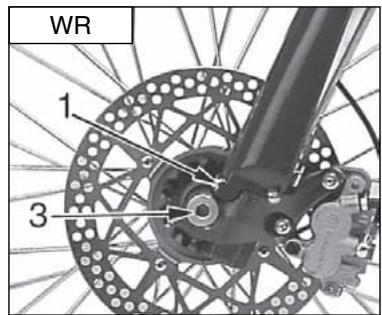
Removing the front wheel
Set a stand or a block under the engine and see that the front wheel is lifted from the ground. Loosen the bolts (1) holding the wheel axle (2) to the front fork stanchions.
Hold the head of the wheel axle (3) in place, unscrew the bolt (3) on the opposite side; draw the wheel axle out.
To reassemble, reverse the above procedure remembering to insert the disc into the caliper.
Do not operate the front brake lever when the wheel has been removed; this causes the caliper piston to move outwards.
After removal, lay down the wheel with brake disc on top. After reassembly, pump the brake control lever until the pads are against the brake disc.
AVIS
natural_image
Close-up of a motor with visible tire, gear assembly, and mounting base (no text or symbols)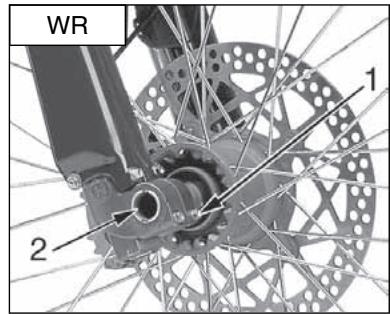
Removing the rear wheel
Set a stand or a block under the engine and see that the rear wheel is lifted from the ground. Unscrew the nut (1) of the wheel pin and extract it. It is not necessary to unloose the chain adjusters (2); in this way, the chain tension will remain unchanged after the reassembly. Extract the complete rear wheel, by taking care of the spacers located at the hub sides. To reassemble, reverse the above procedure remembering to insert the disc into the caliper.
NOTES
Do not operate the rear brake pedal when the wheel has been removed; this causes the caliper piston to move outwards. After removal, lay down the wheel with brake disc on top. After reassembly, pump the brake control pedal until the pads are against the brake disc.
natural_image
Close-up of a motorcycle's front wheel and suspension system (no visible text or symbols)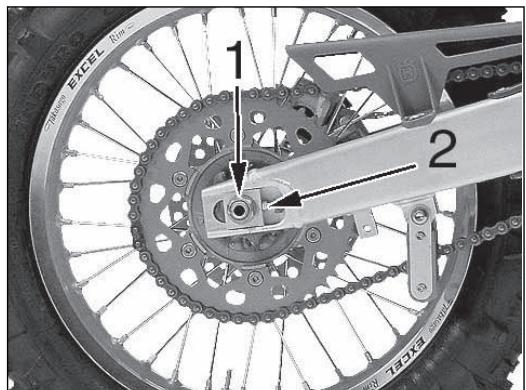
FRENI
Hydraulic disc brakes with floating calipers are used on both wheels for superior braking performance. The mayor components are brake master cylinder with its lever (front) or pedal (rear), brakeline, caliper assembly and disc.
LEGENDA
1 - Front brake control lever
2 - Front brake pump with oil tank
3 - Front piping
4 - Front caliper
5 - Front disc
6 - Rear brake oil tank
7 - Rear piping
8 - Rear caliper
9 - Rear disc
10 - Rear brake pump
11 - Rear brake control pedal
FREINS
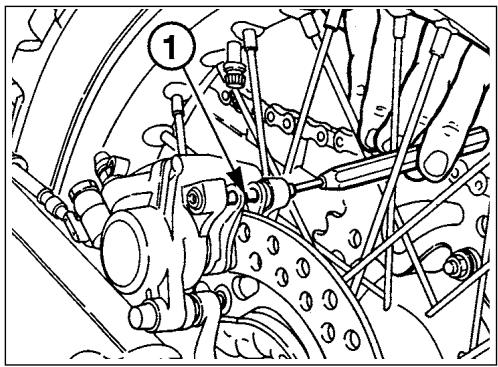
SMONTAGGIO PASTIGLIE FRENO
Don't operate the brake lever or pedal while removing the pads.
PADS WEAR
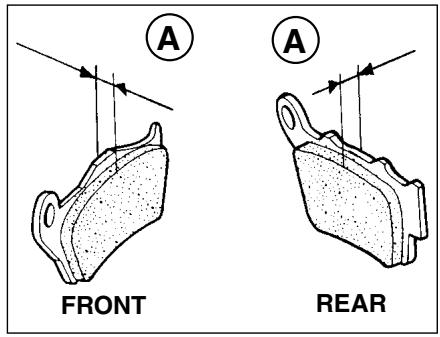
Inspect pads for wear. Service limit "A" is: 3,8 mm (0.15 in.). If service limit is exceeded, always replace the pads in pairs.
DEMONTAGE DES PASTILLES DU FREIN
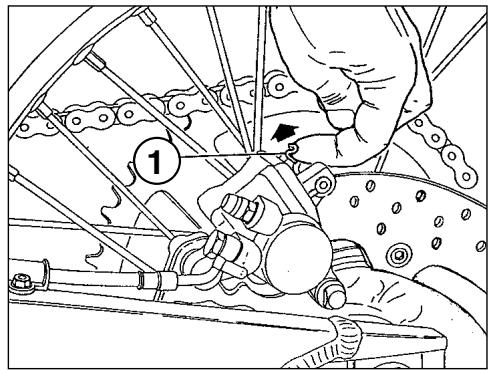
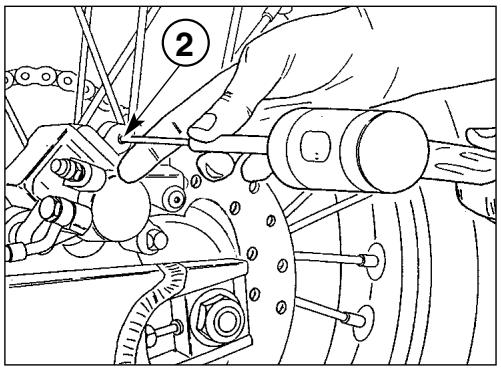
- Enlever les ressorts (1).
- Enlever les pivots (2).
- Enlever les pastilles.
ATTENTION!
natural_image
Technical line drawing of a mechanical assembly with hands adjusting parts (no text or symbols)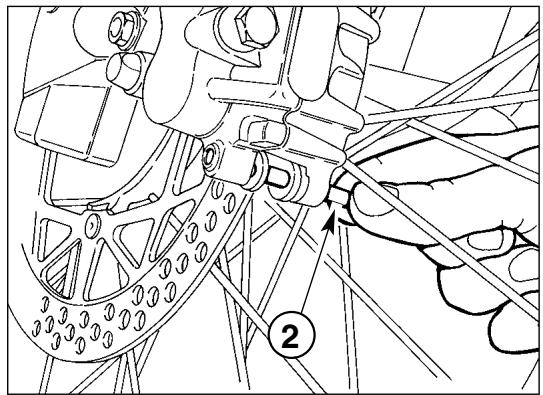
natural_image
Mechanical assembly diagram showing a hand operating a gear with a numbered component (no text or symbols present)POSTERIORE - REAR - ARRIERE - HINTERE - TRASERO
PULIZIA PASTIGLIE
Be careful that no disc brake fluid or any oil gets on brake pads or discs. Clean off any fluid or oil that inadvertently gets on the pads or disc with alcohol. Replace the pads with new ones if they cannot be cleaned satisfactorily.
NETTOYAGE DES PASTILLES
- Install new brake pads.
- Reassemble the two pins (1) and the springs (2).
MONTAGE DES PASTILLES
natural_image
Technical line drawing of a mechanical assembly with no visible text or symbols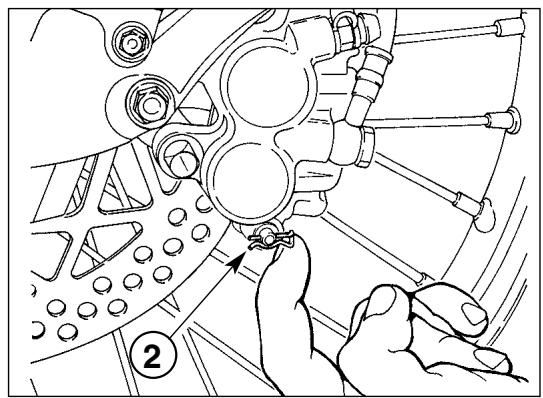
natural_image
Technical line drawing of a mechanical assembly with hands adjusting parts (no text or symbols)POSTERIORE - REAR - ARRIERE - HINTERE - TRASERO
natural_image
Mechanical assembly diagram showing components like gears, springs, and linkages (no text or labels)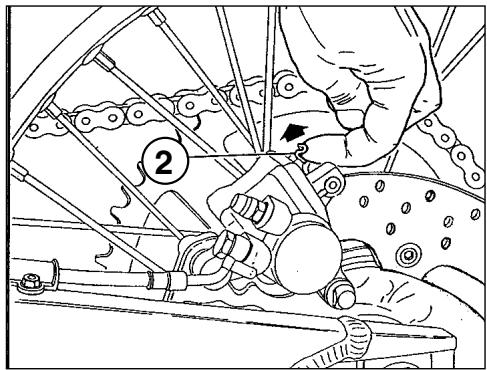
ATTENZIONE!
Do not attempt to ride the motorcycle until the brake lever or pedal are fully effective. Pump the brake lever or pedal until the pads are against the discs. The brake will not function on the first application of the lever or pedal.
- Attach a clear plastic hose to the bleed valve on the caliper and turn the other end of the hose into a container.
- Loosen bleed valve so fluid begin to drain.
- Remove master cylinder cap and rubber.
- Pump with brake lever to push brake fluid out of line.
ATTENTION!
natural_image
Close-up of a bicycle wheel with visible tire, disc, and gear assembly (no text or symbols)SCARICO FLUIDO FRENO POSTERIORE
- Attach a clear plastic hose to the bleed valve on the caliper and turn the other end of the hose into a container.
- Loosen bleed valve so fluid begins to drain.
- Remove reservoir cap and rubber.
- Pump with brake pedal to push brake fluid out of line.
WARNING!
Brake fluid quickly ruins painted surfaces; any spilled fluid should be completely wiped up immediately. * Brake fluid may cause irritation. Avoid contact with skin or eyes. In case of contact, flush thoroughly and call a doctor if your eyes were exposed.
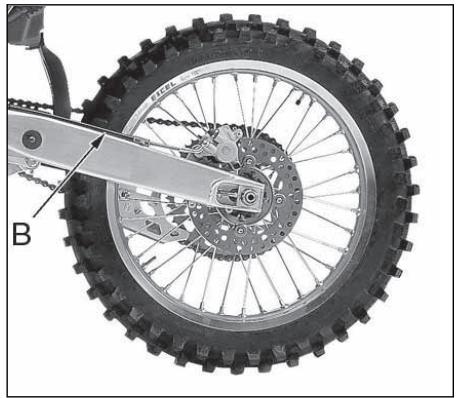
Periodically check the connecting hoses (see "Periodical maintenance card"): if the hoses (A) and (B) are worried or cracked, their replacement is advised.
VIDANGE FLUIDE FREIN ARRIERE
natural_image
Mechanical assembly diagram showing a motor drive system with tire, wheel, and suspension components (no text or labels)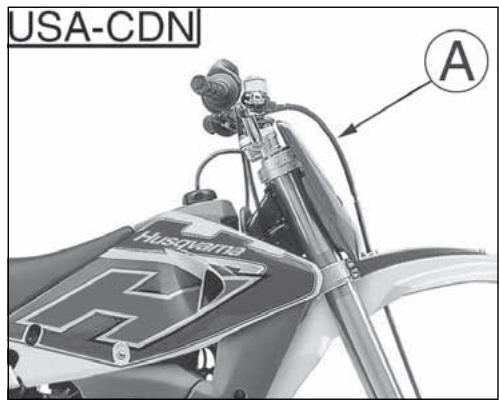
natural_image
Mechanical assembly diagram showing a wheel with labeled component B (no text or symbols beyond label)USURA DISCO FRENO
Measure the thickness of each disc at the point where it has worn the most. Replace the disc if it has worn past the service limit.
Disc Thickness
| DISC | STANDARD | SERVICE LIMIT |
| Front | 3 mm(0.118 in.) | 2,5 mm(0.098 in.) |
| Rear | 4 mm(0.157 in.) | 3,5 mm0.138 in.) |
DISC WARPAGE
Measure disc warpage. Service limit for both discs is 0,15 mm (0.006 in.) Replace the disc if warpage is more than service limit.
natural_image
Technical line drawing of a bicycle wheel assembly with suspension components (no text or labels)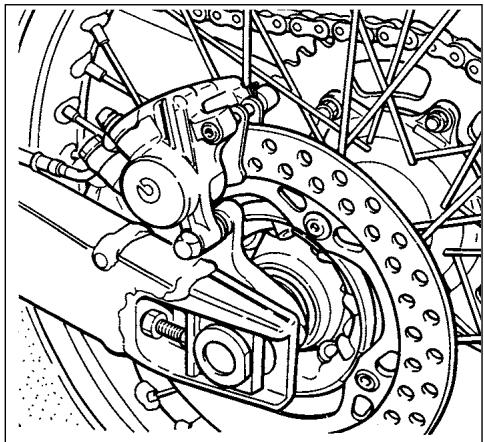
natural_image
Technical line drawing of a bicycle brake system with suspension components (no text or labels)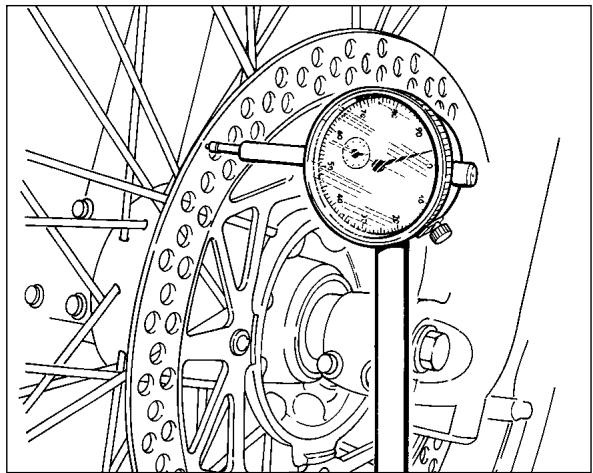
natural_image
Technical line drawing of a mechanical gauge or dial assembly (no text or symbols)PULIZIA DISCO
Poor braking can also be caused by oil on the disc. Oil or grease on the disc must be cleaned off with a high flash-point oil free solvent, such as acetone or lacquer thinner.
NETTOYAGE DU DISQUE
natural_image
Technical line drawing of a bicycle wheel assembly with visible gears and hub (no text or symbols)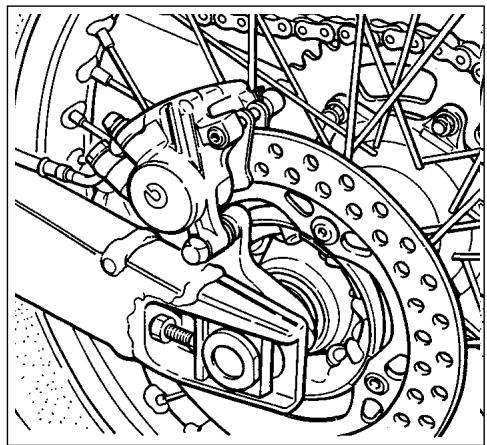
natural_image
Technical line drawing of a mechanical assembly with springs, gears, and a central rotating component (no text or symbols)SOSTITUZIONE FLUIDO
The brake fluid should be checked and changed in accordance with the Periodic Maintenance Chart or whenever it is contaminated with dirt or water. Don't change the fluid in the rain or when a strong wind is blowing.
CAUTION!
* Use only brake fluid from a sealed container (DOT 4). Never use old brake fluid.
* Never allow contaminants (dirt, water, etc.) to enter the brake fluid reservoir.
* Don't leave the reservoir cap off any length of time to avoid moisture contamination of the fluid.
* Handle brake fluid with care because it can damage paint.
* Don't mix two types of fluid for use in the brake. This lowers the brake fluid boiling point and could cause the brake to be ineffective. It may also cause the rubber brake part to deteriorate.
REMPLACEMENT DU FLUIDE
To replace the fluid, proceed as follows:
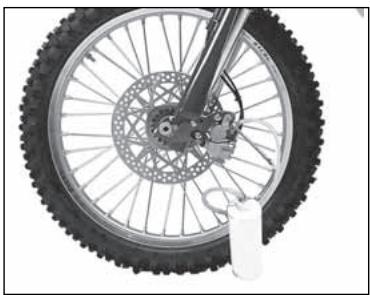
- Remove the rubber cap on the bleeding valve (1) or (1A).
- Attach a clear plastic hose to the bleeding valve on the brake caliper and turn the other end of the hose into a container.
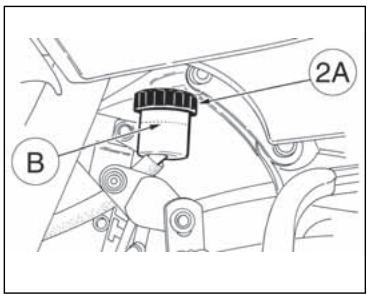
- Remove fluid reservoir cap (2) or (2A) and the rubber.
- Loosen bleeding valve on the brake caliper.
- Pump with brake lever (3) or brake pedal (3A) in order to push brake fluid out of line.
- Close the bleeding valve and fill the reservoir with fresh brake fluid.
- Open the bleeding valve, apply the brake using the brake lever or pedal, close the bleeding valve with the brake lever or pedal applied and then quickly release the lever or pedal.
- Repeat this operation until the brake line is filled and clear fluid starts coming out of the plastic hose: now close the bleeding valve.
natural_image
Mechanical diagram of a bicycle wheel with visible spokes and gear (no text or labels)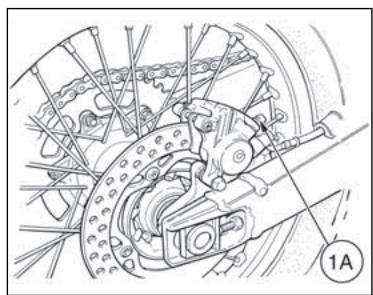
natural_image
Close-up of a bicycle wheel with tire, disc, and handle (no text or symbols visible)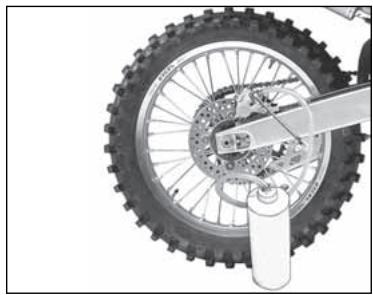
natural_image
Close-up of a bicycle wheel with visible tracks and gear assembly (no text or symbols)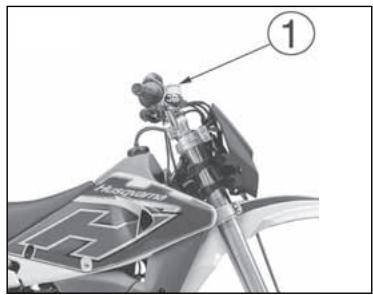

natural_image
Technical line drawing of a vehicle's internal components and suspension system (no text or labels)- Restore the brake fluid level (A) or (B) then reassemble the rubber and the fluid reservoir cap (pag. 171).
After the brake fluid replacement, it is necessary to operate the braking system bleeding (see pages 172 and 176).
Brake fluid quickly ruins painted surfaces; any spilled fluid should be completely wiped up immediately. * Brake fluid may cause irritation. Avoid contact with skin or eyes. In case of contact, flush thoroughly and call a doctor if your eyes were exposed.
Periodically check the connecting hoses (see "Periodical maintenance card"): if the hoses (A) and (B) are worried or cracked, their replacement is advised.
ATTENTION!
natural_image
Close-up of a motorcycle's front wheel and tire assembly, showing tread pattern and mounting bracket (no text or symbols)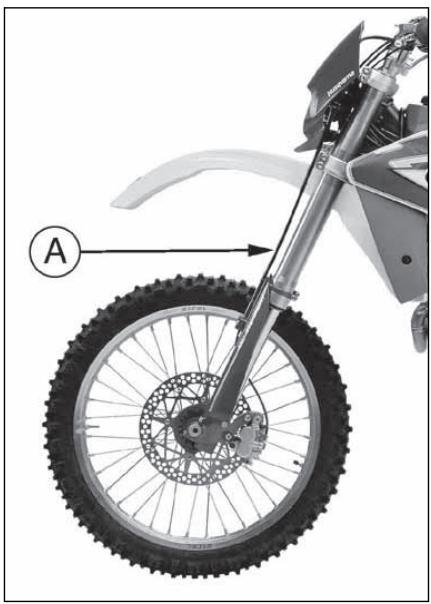
natural_image
Close-up of a bicycle's front wheel and steering wheel assembly, labeled with component A (no text or symbols on the diagram itself)SPURGO IMPIANTO FRENANTE ANTERIORE
The braking system must be bled when, due to air in the circuit, the lever stroke is long and spongy. To bleed the system:
- Disconnect the brake caliper and position it so that the pipe fitting (pump to caliper) is perpendicular to the ground.
- Remove the pump body cover (1).
- Remove the anti-emulsion disc and fill up the tank with new fluid (DOT 4).
- Attach a clear hose to bleed the valve and run into a clear glass container as shown in figure. Make sure that the end of the hose is submerged in brake fluid during the entire bleeding operation.
- Open the bleed valve on the caliper and pump the lever. Allow the pads to contact the disc.
CURAGE DU SYSTEME DE FREINAGE AVANT
natural_image
Close-up of a bicycle wheel with visible tire, disc brake, and bucket (no text or symbols)- During this operation, you'll notice that air bubbles will come out of the brake pump reservoir. This is normal. Watch the hose. When new, clear fluid, without bubbles, come out, close the bleed valve.
- Carefully pry the pads apart, using a soft pry bar, forcing them back into the caliper housing.
Repeat the entire sequence until no bubbles are seen at the hose or in reservoir.
During bleeding the motorcycle handlebar must be turned left. Thus, the pump tank will be higher, making the braking system bleeding easier
Tightening torque for bleed valve is 1,2÷1,6 Kgm (12÷16 Nm; 8.8÷11.8 ft/lb).
ATTENTION!
natural_image
Close-up of a bicycle wheel with visible tire, disc brake, and washer (no text or symbols)SPURGO IMPIANTO FRENANTE POSTERIORE
The braking system must be bled when, due to air in the circuit, the pedal stroke is long and spongy. To bleed the system:
- Remove the reservoir cover rubber boot and top up with (DOT 4) brake fluid.
- Attach a clear plastic hose to the bleed valve on the caliper and turn the other end of the hose into a container.
- Depress the pedal and keep it full down.
- Loosen the bleed union letting out fluid (at first, only air will come out), then, closing the union slightly.
- Release the pedal and wait for a few seconds before repeating the operation until only fluid come out of the tube.
- Close the bleed union to the prescribed torque and check the fluid level inside the reservoir before replacing the cap.
CURAGE DU SYSTEME DE FREINAGE ARRIERE
natural_image
Close-up of a bicycle tire with visible tracks and wheel assembly (no text or symbols)If the bleeding operation has be done correctly, the pedal will have no mushy feel. If not, repeat the operation.
NOTE
Should the motorcycle, due to a fall during a competition or shop repairs, show some elasticity of the brake lever stroke, with a subsequent braking efficiency decrease, you'll to repeat the circuit bleeding as above described. Brake lever and pedal include adjusting unit (2) and (1) for increasing or decreasing clearance between lever and floating pedal. This adjustment is made according to the exigency of each driver. A screw to increase or decrease the clearance between lever and pump cylinder is contained in the brake lever; this adjustment is subjective and you'll use it according to your requirements (see on page 120 and 122).
WARNING!
During the bleed operation the fluid level inside the reservoir must never be lower than the minimum level. Tightening torque for bleed valve is 1,2 ÷ 1,6 kgm ( 12 ÷ 16 Nm; 8.8 ÷ 11.8 ft-lb).
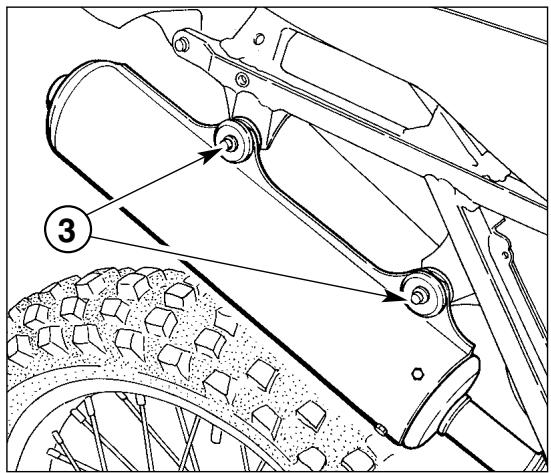
The silencer reduces the exhaust noise but it is also part of the exhaust system and its condition will also affect the performance of the motorcycle. CAUTION*: Check the packing every race and repack it if necessary.
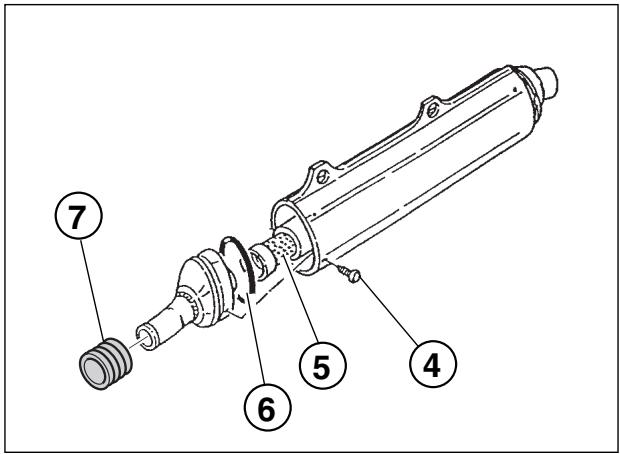
REPLACING MUFFLER DEADENING MATERIAL Loosen the screws (1) then remove the right side panel (2). Remove the two exhaust silencer fastening screws (3). Extract the silencer from the union manifold to the exhaust pipe. Remove the screws (4), the inner tube (5) and replace the old silencer packing. Check the O-Ring (6) for wear and replace it, if necessary. Cheek the manifold (7) for wear and replace it, if necessary.
Note*: If silencer or exhaust are difficult to remove, help to slide them apart by tapping gently with a rubber or plastic hammer.
LIMITI DI USURA
NOTA
This chapter shows the main checks to be carried out when the engine and some parts of the byke must be overhauled. More detailed information, together with the disassembly/reassembly procedures are carried in the Husqvarna's Workshop Manual.
LIMITE D'USURE
AVIS
The cylinder and piston are supplied matched; if by chance cylinders and pistons become mismatched then measure their diameters as follows: DN- Cylinder bore Use an internal micrometer and take the reading at of 10 mm (0.4 in.) distance from the top.
ACCOUPLEMENT CYLINDRE- PISTON
ACOPLAMIENTO
CILINDRO-PISTON
D1- Piston diameter Take the piston diameter at 24 mm (0.945 in.) distance from the base. The coupling play will be DN-D1.
natural_image
Cross-sectional technical drawing of an internal combustion engine cylinder (no text or labels)PISTON RING/PISTON RINGS GROOVE CLEARANCE Use a feeler gauge to check the axial play of the rings in the groove.
natural_image
Pure mechanical cross-section diagram without any text, numbers, or symbolsPISTON RING/CYLINDER CLEARANCE
Insert the piston ring into the cylinder bottom (where wearing is the lowest) and position it well in "square" and measure the distance between the two piston ring ends.
The max. limit of wear must not overcome 0.6 mm (0.0236 in.)
COUPLAGE SEGMENTS-CYLINDRE
natural_image
Pure technical drawing of a circular mechanical part with centerlines and dimension lines, no text or symbols present.The table hereunder shows the possible coupling which allows to abtain a radial clearance of 0.000078÷0.000393 in.
C: rod selection colour.
When should a radial clearance greater than the consented limit of 0.00059 in. be noticed and the colour mark under the connecting small end is no more visible, collect the connecting rod small end "A" diameter and assemble the right cage according to it.
NOTE
When requesting the cage, specify the selection.
ACCOUPLEMENT AXE - PISTON - PIEDS DE BIELLE
natural_image
Pure mechanical diagram showing a shaft, housing, and gauges without any text or symbolsnatural_image
Technical line drawing of a mechanical component with symmetrical features and a central shaft (no text or symbols)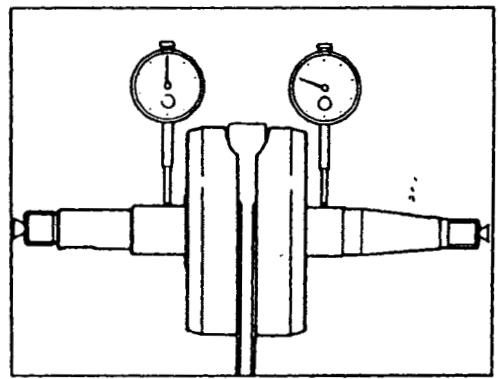
natural_image
Technical line drawing of a mechanical device with two pressure gauges (no text or symbols)DISCHI FRIZIONE
The clutch plates should not be burnt or scored.
Check the thickness of the clutch lining plate.
Thickness of new plate: 0.118 in.
Wear limit 0.114
GROUPE D'EMBRAYAGE
natural_image
Illustration of two hands using calipers to measure a mechanical component (no text or symbols present)Check the distorsion of each plate (both lined and unlined) by resting on a flat surface; use a feeler gauge. Wear limit: 0,2 mm (0.00078 in.).
natural_image
Illustration of hands operating a mechanical component with a tool, no text or symbols present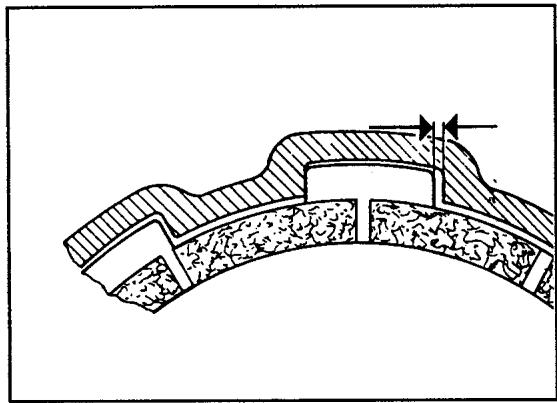
natural_image
Cross-sectional diagram of a mechanical component with hatched areas and arrows indicating direction (no text or symbols)MOLLA FRIZIONE
Check the free lenght "L" of each spring with a gauge.
New spring:
1.80 in.
Wear limit
1.69 in.
Replace any spring which does not meet with this specification.
RESSORT EMBRAYAGE
To check if the compression ratio is correct, proceed as follows;
a) remove the cylinder together with the head from the block;
b) remove the piston from the connecting rod, properly clean it, insert it in the cylinder till it touches the corresponding profile on the explosion chamber (this chamber too must be free from incrustations);
c) screw a comparator in the sparking plug hole and reset it on the piston position as decribed at fig. A;
d) remove the piston and reassemble it on the connecting rod;
e) remount the cylinder together with the head by placing a 0.0197 in. gasket on the block;
f) place the piston at the top dead center and control the reading on the comparator, which must be: 0.055÷0.059 in. (g) in case of different readings, reset the right condition by using a cylinder base gasket having the right thickness.
CONTROLE RAPPORT DE COMPRESSION
natural_image
Technical line drawing of a mechanical component with a dial and bolted base (no text or symbols)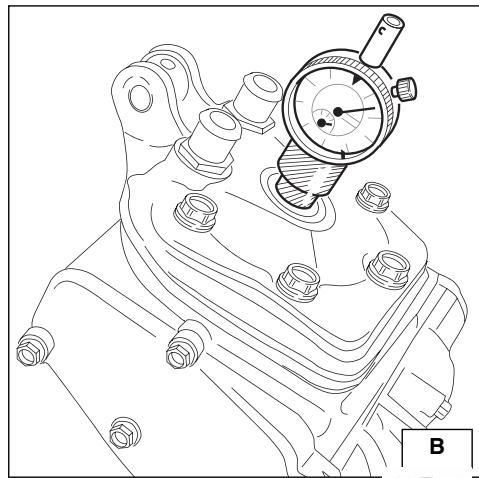
natural_image
Technical line drawing of a mechanical component with bolts and a dial (no text or symbols)The manufacturer has determined the carburetor setting after several and extensive tests; therefore, the standard carburetion has not to be changed. Using the bike in particular environmental conditions, may be necessary to change the standard tuning. This operation must be performed by Husqvarna Dealer. The following instructions inform about the carburetor basic knowledge and setting change.
The exploded view show the main carburetor parts. The parts which meter air and fuel are precisely machined and vary for the size. These elements belong to the three main circuits for supplying the mixture to the several openings of the gas valves.
REVISION, REGLAGE ET ENTRETIEN DU CARBURATEUR "MIKUNI" (MOTOCYCLE DE COMPÉTITION)
COME EFFETTUARE LA MESSA A PUNTO
CARBURETOR ADJUSTMENT
The above instructions show how to change the standard carburetor setting.
Before change the carburetion, ride the bike and observe the engine response at the various gas throttle opening, the acceleration etc..
Before change the carburetion, it is necessary to start with standard carburetion setting.
Standard carburetor setting is the following:
COMMENT EFFECTUER LA MISE AU POINT
For reasons of safety, should height and temperature be included between two series of values of the side diagram, select jets of greater dimensions. (The list of jets supplied on request is found on pages 208-212).
EXAMPLE: With the temperature at 12^ C ( 54^ F), and at 1,100 metres (3,600 ft) height, select the 380 full-power jet and the 30 idling jet.
VARIATION DES GICLEURS PRINCIPAUX ET DE RALENTI SELON L'ALTITUDE ET LA TEMPERATURE DE L'AIR
IDLE CIRCUIT ADJUSTMENT
- Adjust the idle air screw as indicated at page 96.
- Judge if the pilot jet is correct. If mixture is rich, use a smaller jet; if is lean, use a larger jet.
Example: With standard pilot jet size 40, if mixture is rich, mount a jet size 35. If mixture is lean, mount a jet size 45.
REGLAGE DU CIRCUIT DE RALENTI
natural_image
Pure horizontal line pattern with evenly spaced vertical tick marks (no text or symbols)MAIN CIRCUIT ADJUSTMENT
With throttle control opened from 3/4 to full, adjust the main circuit after idle circuit adjustment.
- If the jet size is between two values (see diagram at page 207), choose the larger jet not to damage the piston.
- Adjust the main circuit before intermediate circuit adjustment.
Example: When using the 400 start jet and the mix is too rich, replace these jets with and the 390 jet If the mix is too lean, use 410 jet.
REGLAGE DU CIRCUIT PRINCIPAL
THROTTLE VALVE REPLACEMENT
The throttle valve cutaway size is stamped on the top of the valve; if the throttle valve has to be changed, make throttle valve increments of 0.5 (a larger cutaway provides a leaner mixture and a smaller cutaway make the mixture richer).
REEMPLACEMENT DE LA SOUPAPE DES GAZ
natural_image
Technical line drawing of a mechanical component with a cross-shaped top and base (no text or symbols)REGOLAZIONE FINALE DEL CIRCUITO INTERMEDIO
INTERMEDIATE CIRCUIT FINAL ADJUSTMENT
Adjust the intermediate circuit by changing the jet needle retainer groove.
Jet needle
| Size | Code |
| J8.6DJ8-59 | 8A0086920 |
| J8.6DJ8-60 (standard) | 800086920 |
| J8.6DJ8-61 | 8B0086920 |
NOTE: for carburetor overhauling are available the following spare parts:
| Name | CodeNumber |
| THROTTLE CABLE | |
| ADJUSTING SET | 800072318 |
| FLOAT SET WITH | |
| NEEDLE VALVE | 800086933 |
| GASKET SET | 800086929 |
REGLAGE FINAL DU CIRCUIT INTERMEDIAIRE
The lists below show the standard carburetor setting in different environmental and riding conditions; refer to this list when change the carburetor setting.
NORMAL TRACK CONDITIONS AND TEMPERATURE FROM 10°C (76°F) TO 25°C (103°F) (Standard setting)
Part
| - main jet | 400 |
| -- jet needle (groove) | J8.6DJ8-60 (3rd) |
| - pilot jet | 35 |
| - idle air screw (turns) | 1 -1/2 |
| NORMAL TRACK CONDITIONS AND TEMPERATURE BELOW 10°C (76°F) | |
Part
| - main jet | 410 |
| - jet needle (groove) | J8.6DJ8-60 (4th) |
| -- pilot jet | 35 |
| - idle air screw (turns) | 1 -3/4 |
| NORMAL TRACK CONDITIONS AND TEMPERATURE OVER 25°C (103°F) | |
Part
| -- main jet | 390 |
| - jet needle (groove) | J8.6DJ8-60 (3rd) |
| - pilot jet | 35 |
| - idle air screw (turns) | 1 -1/2 |
- main jet 420
- jet needle (groove) J8.6DJ8-60 (5th)
- pilot jet 35
- idle air screw (turns) 1 -3/4
SAND TRACK CONDITIONS AND TEMPERATURE OVER 25°C (103°F)
Part
-- main jet 400
- jet needle (groove) J8.6DJ8-60 (3rd)
- pilot jet 35
- idle air screw (turns) 1 -1/2
CONDITIONS DE TERRAIN SABLEUX AVEC TEMPERATURE DE 10 A 25°C
Particulier
OVERHAULING THE WHEELS
The tables hereunder show the type of control the rim and wheel axle are to be submitted to.
REVISION DES ROUES
Note*: if the rim is badly, it should be replaced.
natural_image
Technical line drawing of a mechanical device with dual scales and adjustment knobs (no text or symbols)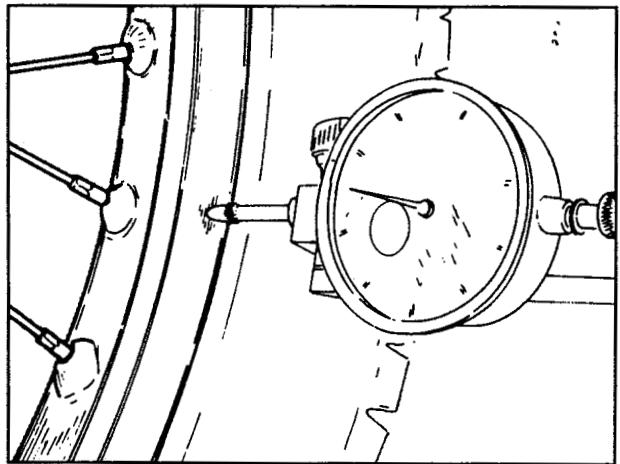
natural_image
Technical line drawing of a pressure gauge mounted on a mechanical component (no text or symbols)WHEEL RIM AXLE BENDING If the bending figure is over the allowable max. limit, straighten or replace the axle. If the wheel axle cannot be straightened within the max. limits (0,2 mm - 0.008 in.) stated, replace it.
WHEEL SPOKES Check to make sure that all the nipples are tight; tighten them if necessary. Remember that an insufficient stretch jeopardizes the motorcycle stability. For an instant check, use a metal point (for instance, a screwdriver) to beat the spokes with. A live sound accounts for an accurate tightening, while a dull sound means that a new tightening is necessary.
natural_image
Illustration of a hand using a mechanical testing setup to measure a dial indicator (no text or symbols visible)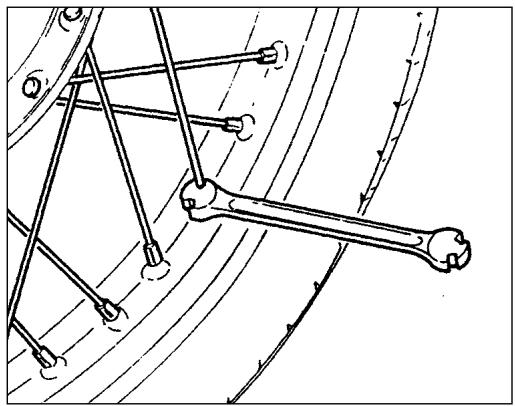
natural_image
Technical line drawing of mechanical linkage components (no text or symbols)IMPIANTO ACCENSIONE IMPIANTO ELETTRICO (escluso USA/CDN- "Enduro" USA/CDN)
The ignition system include the following:
- Generator (1) on the inner side of R.H. crankcase cover
- Electronic coil/Electronic power unit (2) under the fuel tank
- Voltage regulator (3) located on the steering tube, behind the headlamp holder.
- Spark plug (4) The electric system includes the following elements:
- Headlamp with two filament halogen bulb of 12V-35/35W, and parking light bulb of 12V-3W.
- Rear lights with stop bulb of 12V-21W, and parking light bulb of 12V-5W. ("Enduro" USA/CDN: rear parking light bulbs of 12V-3W
- Pilot lights bulb of 12V-1,2W.
- Turn indicators bulb of 12V-10W (*);
- Instrument bulb of 12V-2W.
SYSTEMED'ALLUMAGE SYSTEME ÉLECTRIQUE (exclu USA/CDN- "Enduro" USA/CDN)
(*) "Enduro" USA/CDN excluded
(*) Exclu "Enduro" USA/CDN
(*) Excludido "Enduro" USA/CDN
Legenda colore cavi / Cable colour coding/Legende couleur câbles / Kabelfarben / Referencias colores de los cables (escluso USA/CDN- "Enduro" USA/CDN) (USA/CDN - "Enduro" USA/CDN excluded) (exclu USA/CDN) - "Enduro" USA/CDN) (nuhr USA/CDN- "Enduro" USA/CDN) (escluido USA/CDN- "Enduro" USA/CDN)
| Pos. Pos. | Colore Colour |
| B | Blu /Blue /Bleu /Blau /Azul |
| R | Rosso /Red /Rouge /Rot /Rojo |
| Bk | Nero /Black /Noir /Schwarrz /Negro |
| G | Verde /Green /Vert /Grün /Verde |
| Sb | Azzurro /L.T. Blue /Azur /Hellblau /Celeste |
| W | Bianco /White /Blanc /Weiss /Blanco |
| Y | Giallo /Yellow /Jaune /Gelb /Amarillo |
| Gr | Grigio /Grey /Gris /Grau /Gris |
| P | Rosa /Pink /Rose /Rosa /Rosa |
| V | Viola /Violet /Violette / Veilchen /Violeta |
| O | Arancio /Orange /Orange /Orange /Naranjado |
| Br | Marrone /Brown /Maron /Braun /Marren |
(escluso USA/CDN- "Enduro" USA/CDN) (USA/CDN - "Enduro" USA/CDN excluded) (exclu USA/CDN) - "Enduro" USA/CDN) (nuhr USA/CDN- "Enduro" USA/CDN) (escluido USA/CDN- "Enduro" USA/CDN)
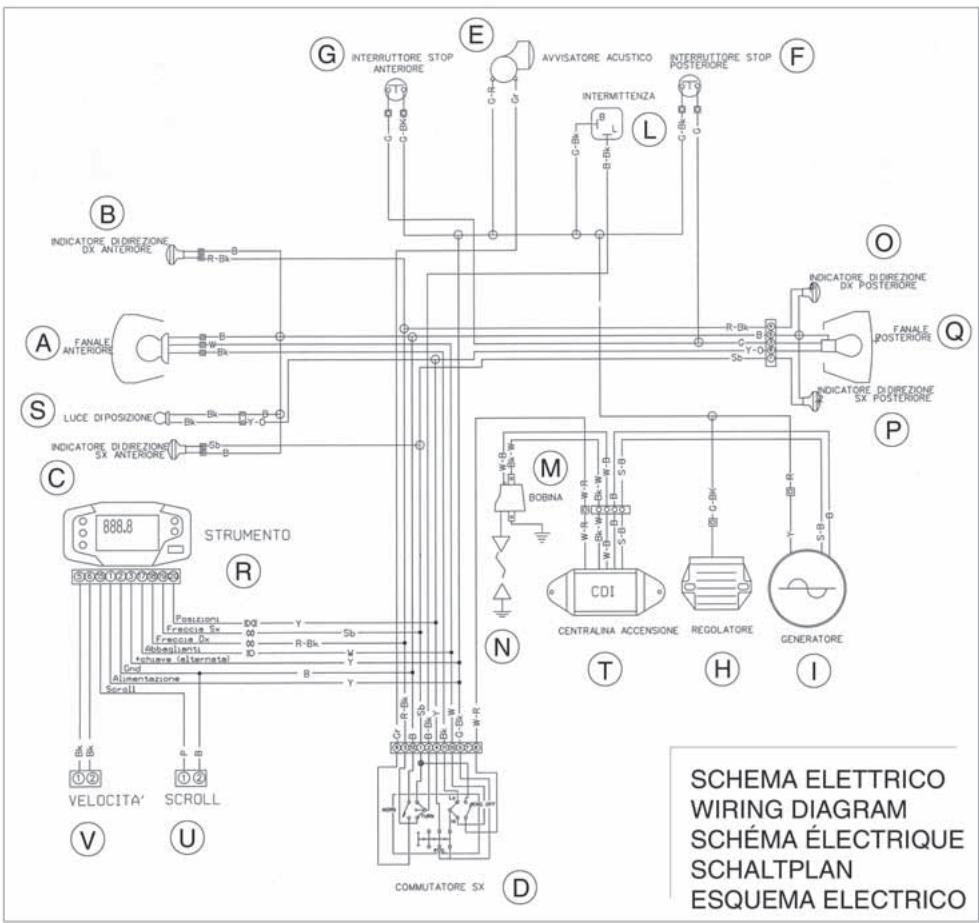
LEGENDA SCHEMA ELETTRICO (WR, escluso USA/CDN "Enduro" USA/CDN)
KEY TO WIRING DIAGRAM (WR, USA/CDN excluded- "Enduro" USA/CDN)
A. Headlamp
B. RH front indicator
C. LH front indicator
D. Left switch
E. Horn
F. Rear stop switch
G. Front stop switch
H. Regulator
I. Alternator
L. Turn signal flash device
M. H.T. coil
N. Spark plug
O. RH rear indicator
P. LH rear indicator
Q. Rear light
R. Instrument lighting
S. Parking light.
T. Electronic module
U. Scroll
V. Speed
LEGENDE SCHEMA ELECTRIQUE (WR, exclu USA/CDN- "Enduro" USA/CDN)
A Generator
B Pick up
© Electronic power unit
D Electronic coil
E Engine stop switch
F Spark plug
G Voltage regulator
| Pos. | Colour |
| 1 | White |
| 2 | L.T. Blue |
| 3 | Blue |
| 4 | White - Blue |
| 5 | Black - White |
| 6 | Yellow |
USA/CDN
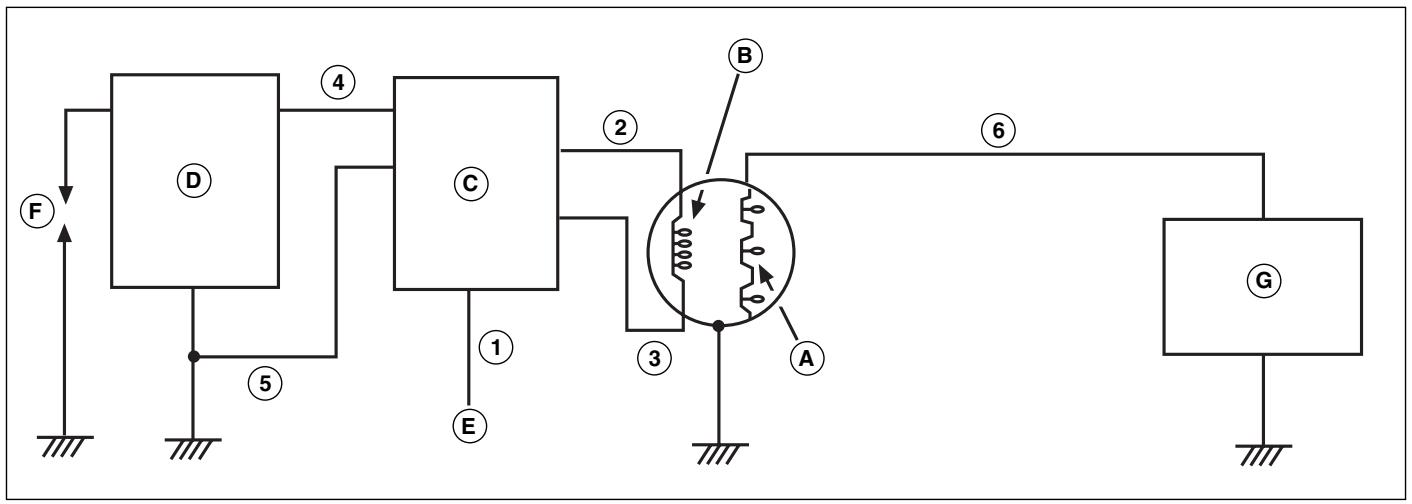
flowchart
graph TD
    A["①"] --> B["②"]
    B --> C["③"]
    C --> D["④"]
    D --> E["⑤"]
    E --> F["⑥"]
    F --> G["⑦"]
    G --> H["⑧"]
    style A fill:#f9f,stroke:#333
    style B fill:#ccf,stroke:#333
    style C fill:#cfc,stroke:#333
    style D fill:#fcc,stroke:#333
    style E fill:#cff,stroke:#333
    style F fill:#ffc,stroke:#333
    style G fill:#cfc,stroke:#333
SOSTITUZIONE LAMPADINE PROIETTORE (WR, "Enduro" USA/CDN)
REPLACEMENT (WR, "Enduro" USA/CDN)
To gain access to the healamp bulbs, proceed as follows:
- remove the two fastening elastics (1) and the headlamp holder;
- remove the two filaments bulb connector; (2) and the boot (3)
- release the bulb holding spring (4) and then the bulb itself.
To replace the parking light bulb, (5) extract it from the inside cover. After replacement, reverse operations for reassembly.
REEMPLACEMENT DES
AMPOULES DU PHARE AVANT (WR, "Enduro" USA/CDN)
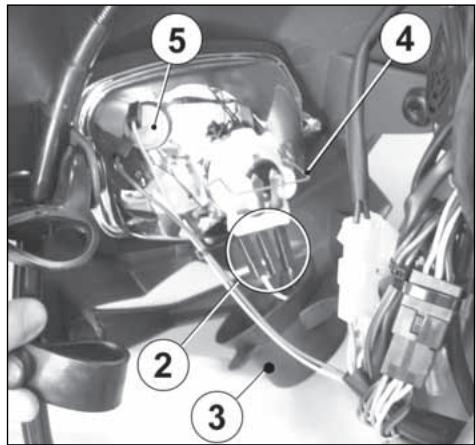
SOSTITUZIONE LAMPADA FANALE POSTERIORE (WR)
REAR TAIL LIGHT BULB REPLACEMENT (WR)
Remove the two fastening screws (1) in the inner side of the rear fender and the lens (2). Pull the lamp (3) inside, turn it counterclockwise then remove it from the lamp holder.
After replacement, reverse operations for reassembly.
NOTES: make sure not to tighten the screws excessively.
REEMPLACEMENT DES AMPOULES DU PHARE ARRIÈRE (WR)
natural_image
Close-up of a metallic mechanical component with a numbered annotation (1) pointing to a specific feature, no readable text or symbols present.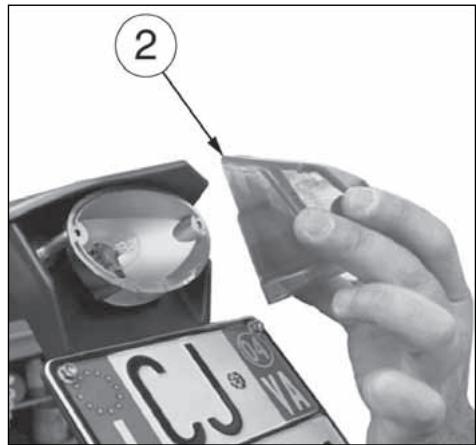
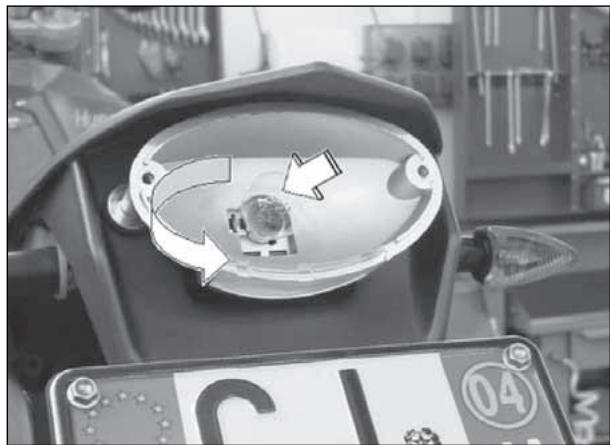
natural_image
Close-up of a motorcycle's front bumper with a circular component and directional arrows indicating motion (no readable text or symbols)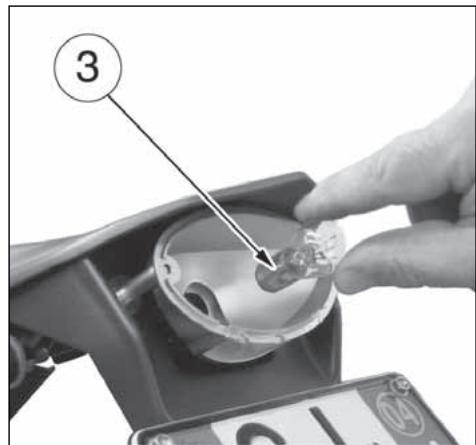
ADJUSTMENT OF HEADLIGHT
When checking the proper orienting of headlight, inflate tires at right pressure, sat a person on the saddle and place the motorcycle perpendicular with its longitudinal axis 10 meters from a wall or screen. Then trace an horizontal line equal to the height of headlight center and a vertical one in line with its longitudinal axis.
If possible, execute this operation in a shadowy place. When the low beam is on, the upper boundary limit between dark and lit zone should be 9/10 th of headlight center from ground.
Adjust the preadlamp aiming by turning screw (1) to lower or lift the lifht beam.
REGLAGE DU PHARE
natural_image
Close-up of a motorcycle's front view showing the blade and seat assembly (no text or symbols visible)The motorcycle comes with the following tools:
1-800066802
Box wrench 15x27 mm
2-800070836
Spark plug wrench
3-800096997
Front wheel axle wrench
4-800056920
Front wheel axle screw Allen wrench
DOTATION D'OUTILS
ATTREZZI SPECIALI
| 1 - 8000 60516 | Rotor puller |
| 2 - 8000 58256 | Installing tool, crankshaft left |
| 3 - 8000 58258 | Crankcase splitting tool |
| 4 - 8000 43720 | Tool for bearing |
| 5 - 8000 43824 | Extractor for roller bearing bushing valve drive gear, bushing water pump and valve drive gear |
| 7 - 8000 39524 | Clutch hub retaining wrench |
| 8 - 8000 75579 | Tool for checking the phase |
| 9 - 8000 90659 | Extractor for booster valve |
| 10 - 8000 43823 | Extractor for roller bush |
OUTILS SPECIAUX
COPPIE DI SERRAGGIO / TIGHTENING TORQUES / COUPLES DE SERRAGE
| ApplicazioneApplicationApplication | FilettaturaThreadingFiletate | Nm | Kgm | Lb/ft |
| Dado fiss. cilindroCylinder nutEcrou de fixage cylindre | M10x1,25 | 21,6÷24,5 | 2,2÷2,5 | 15,9÷18,1 |
| Vite fiss. testaCylinder head nutVis de fixage tête | M8x1,25 | 17,6÷19,6 | 1,8÷2,0 | 13÷14,5 |
| Vite fiss. valvola aspirazioneInlet valve screwVis de fixage soupape d'aspiration | M6x1 | 7,8÷8,7 | 0,81÷0,89 | 5,8÷6,4 |
| Vite fiss. inserto albero motoreEngine shaft fixing screwVis de fixation insert arbre moteur | M6x1(●) | 12,2÷13,6 | 1,25÷1,39 | 9÷10 |
| Dado fiss. pignone trasm. primariaPrimary drive pinion nutEcrou de fixage pignon transmission primaire | M18x1 | 51÷56,9 | 5,2÷5,8 | 37,6÷41,9 |
| Dado fiss. leva rinvio distribuzioneTiming system lever fixing nutEcrou de fixation levier transmission distribution | M5x0,8 | 5,1÷5,7 | 0,52÷0,58 | 3,8÷4,2 |
| Vite fiss. ingranaggi valvole di scaricoExhaust valve gear fixing screwVis de fixation engrenages soupapes d'échappement | M6x1 | 7,8÷8,8 | 0,8÷0,9 | 5,8÷6,5 |
| Vite fiss. piastrina cuscinetto valvole di scaricoExhaust valve bearing plate fixing screwVis de fixation plaque palier soupapes d'échappement | M5x0,8 (☐) | 5,1÷5,7 | 0,52÷0,58 | 3,8÷4,2 |
| Vite fiss. forcella comando valvola di scaricoScrew fixing exhaust valve control forkVis de fixation fourche de contrôle soupape d'échappement | - | - | - | - |
| Prigioniero fiss. cilindroCylinder stud boltPrisonniers cylindre | M10x1,5 | 19,6÷21,6 | 2,0÷2,2 | 14,4÷15,8 |
| Vite fiss. perno rinvio avviamentoStart transmission pin fixing screwVis de fixation pivot transmission starter | M6x1 | 7,9÷8,7 | 0,81÷0,89 | 5,8÷6,4 |
| Dado fiss. piastrina cuscinetto albero primarioMain shaft bearing plate fixing nutEcrou de fixation plaque palier arbre primaire | M6x1(☐) | 7,9÷8,7 | 0,81÷0,89 | 5,8÷6,4 |
| Vite fiss. pignone catenaScrew chain pinionVis pignon chaîne | - | - | - | - |
| Viti fiss. piastrine cuscinetti carterCase bearing plate fixing screwVis de fixation plaques paliers carter | M6x1(☐) | 7,9÷8,7 | 0,81÷0,89 | 5,8÷6,4 |
| Vite fiss. piastrine cavo alternatoreAlternator plate cable fixing screwVis de fixation plaque câble alternateur | M5x0,8 | 5,1÷5,7 | 0,52÷0,58 | 3,8÷4,2 |
(□) "LOCTITE 243" (●) "LOCTITE 270"
VERSCHRAUBUNGSMOMENTE / PATAS DE TORSION
| AnwendungAplicacion | GewindeFileteado | Nm | Kgm | Lb/ft |
| ZylinderfestigungsmutterTuerca cilindro | M10x1,25 | 21,6÷24,5 | 2,2÷2,5 | 15,9÷18,1 |
| Schraube des ZylinderkopfesTornillo culata | M8x1,25 | 17,6÷19,6 | 1,8÷2,0 | 13÷14,5 |
| Feststellschraube EinlassventilTornillo válvula de aspiración | M6x1 | 7,8÷8,7 | 0,81÷0,89 | 5,8÷6,4 |
| Befestigungsschraube MotorwelleneinsatzTornillo fijac. inserto eje motor | M6x1(●) | 12,2÷13,6 | 1,25÷1,39 | 9÷10 |
| Ritzelfestigungsmutter des PrimárantriebesTuerca pinón transmisión primaria | M18x1 | 51÷56,9 | 5,2÷5,8 | 37,6÷41,9 |
| Befestigungsmutter Verteilung VorgelegehebelTuerca fijac. palanca transmisión distribución | M5x0,8 | 5,1÷5,7 | 0,52÷0,58 | 3,8÷4,2 |
| Befestigungsschraube Ablaßventil ZahnräderTornillo fijac. engranajes válvulas de descarga | M6x1 | 7,8÷8,8 | 0,8÷0,9 | 5,8÷6,5 |
| Befestigungsschraube Ablaßventil LagerplatteTornillo fijac. placa cojinete válvulas de descarga | M5x0,8 (☐) | 5,1÷5,7 | 0,52÷0,58 | 3,8÷4,2 |
| Befestigungsschraube Steuerung AuslassventilTornillo fijación horquilla mando válvula de escape | - | - | - | - |
| ZylinderstiftschraubenPrisionero cilindro | M10x1,5 | 19,6÷21,6 | 2,0÷2,2 | 14,4÷15,8 |
| Befestigungsschraube Anlassung VorgelegezapfenTornillo fijac. perno transmisión encendido | M6x1 | 7,9÷8,7 | 0,81÷0,89 | 5,8÷6,4 |
| Befestigungsmutter Primarwellen LagerplatteTuerca fijac. placa cojinete eje motor | M6x1(☐) | 7,9÷8,7 | 0,81÷0,89 | 5,8÷6,4 |
| Befestigungsschraube TriberitzelTuerca fijac. piñon cadena | - | - | - | - |
| Befestigungsschraube Abdeckung LagerplatteTornillo fijac. placas cojinetes cárter | M6x1(☐) | 7,9÷8,7 | 0,81÷0,89 | 5,8÷6,4 |
| Befestigungsschraube Alternator KabelplatteTornillo fijac. placas cable alternador | M5x0,8 | 5,1÷5,7 | 0,52÷0,58 | 3,8÷4,2 |
(□) "LOCTITE 243" (●) "LOCTITE 270"
COPPIE DI SERRAGGIO / TIGHTENING TORQUES / COUPLES DE SERRAGE
| ApplicazioneApplicationApplication | FilettaturaThreadingFiletate | Nm | Kgm | Lb/ft |
| Tappo scarico olioPlug discharged oilBouchon écoulement huile | M20x1,5 | 19,6 ÷ 23,5 | 2 ÷ 2,4 | 14,5 ÷ 17,3 |
| Vite fiss. piastre statoreStator plate fastening screwVis de fixation plaque stator | M6x1 | 3,7 ÷ 4,1 | 0,38 ÷ 0,42 | 2,7 ÷ 3,0 |
| Dado fiss. rotoreRotor nutEcrou de fixage roteur | M12x1,25 | 73,5 ÷ 83,3 | 7,5 ÷ 8,5 | 54,2 ÷ 61,5 |
| Vite fiss. piastra statoreStator plate clamp screwVis de fixage plaque du stator | M4x0,7 | 2,75 ÷ 2,95 | 0,28 ÷ 0,30 | 2,0 ÷ 2,2 |
| Vite fiss. pignone catenaScrew chain pinionVis pignon chaîne | - | - | - | - |
| Candela accensioneSpark plugBougie d'allumage | M14x1,25 | 23,5 ÷ 25,5 | 2,4 ÷ 2,6 | 17,3 ÷ 18,8 |
VERSCHRAUBUNGSMOMENTE / PATAS DE TORSION
| Anwendung Aplicacion | Threading Filetado | Nm | Kgm | Lb/ft |
| Entleerungsschraube Öl Tapón descargado aceite | M20x1,5 | 19,6÷23,5 | 2÷2,4 | 14,5÷17,3 |
| Befestigungsschraube Platten-Stator Tornillo sujecion planchas-estator | M6x1 | 3,7÷4,1 | 0,38÷0,42 | 2,7÷3,0 |
| Festigungsmutter Schwungradläufer Tuerca rotor | M12x1,25 | 73,5÷83,3 | 7,5÷8,5 | 54,2÷61,5 |
| Feststellschraube Statorplatte Tornillo placa estator | M4x0,7 | 2,75÷2,95 | 0,28÷0,30 | 2,0÷2,2 |
| Schraube ritzel Tornillo pininón cadena | - | - | - | - |
| Zündkerze Bujía encendido | M14x1,25 | 23,5÷25,5 | 2,4÷2,6 | 17,3÷18, |
COPPIE DI SERRAGGIO / TIGHTENING TORQUES / COUPLES DE SERRAGE
| ApplicazioneApplicationApplication | FilettaturaThreadingFiletate | Nm | Kgm | Lb/ft | FilettaturaThreadingFiletate |
| Dado fiss. mozzo frizioneClamp nut for clutch hubEcrou de fixage moyeu de l'embrayage | M18x1 | 29,4÷32,4 | 3÷3,3 | 21,7÷23,9 | M18x1 |
| Vite fiss. molle frizioneClamp screw for clutch spring discVis de fixage disque d'arrêt ressorts de l'embrayage | M6x1 | 6,8÷7,8 | 0,7÷0,8 | 5,0÷5,8 | M6x1 |
| Dado vite registro frizioneClutch adjusting screw fixing nutÉcrou de fixation vis de réglage embrayage | M6x1 | 5,1÷5,7 | 0,52÷0,58 | 3,8÷4,2 | M6x1 |
| Vite fiss. piastrine disinnesto avviamentoStart disengaging plate fixing screwVis de fixation plaques de débrayage starter | M6x1 | 9,3÷10,3 | 0,95÷1,05 | 6,9÷7,6 | M6x1 |
| Dado fiss. leva avviamentoStarter shaft clamp nutEcrou de fixage moyeu arbre demarrage | M10x1,25 (☐) | 21,6÷23,6 | 2,2÷2,4 | 15,9÷17,3 | M10x1,25 (☐) |
| Vite fiss. roccchetto albero comando cambioGearbox main shaft reel fixing screwVis de fixation rochet arbre de commande boîte de vitesse | M5x0,8 | 5,1÷5,7 | 0,52÷0,58 | 3,8÷4,2 | M5x0,8 |
| Vite fiss. saltarello cambioGearbox pawl fixing screwVis de fixation cliquet boîte de vitesse | M6x1 (*) | 8,8÷8,9 | 0,9÷1,0 | 6,5÷7,2 | M6x1(*) |
| Perno termo selettoreLock selector pinTourillon arrêt sélecteur | M10x1,25 | 26,5÷29,5 | 2,7÷3,0 | 19,5÷21,7 | M10x1,25 |
| Raccordo acquaWater unionRaccord eau | M16x1 | 40÷45 | 4÷4,6 | 28,9÷33,3 | M16x1 |
(□) "LOCTITE 243" (*) "LOCTITE 242"
VERSCHRAUBUNGSMOMENTE / PATAS DE TORSION
| Anwendung Aplicacion | Gewinde Filetado | Nm | Kgm | Lb/ft | Gewinde Fileteado |
| Festigungsmutter Nabe KupplungTuerca cubo embrague | M18x1 | 29,4÷32,4 | 3÷3,3 | 21,7÷23,9 | M18x1 |
| Feststellschraube Rückhaltscheibe KupplungsfedernTornillo disco resorte fricción | M6x1 | 6,8÷7,8 | 0,7÷0,8 | 5,0÷5,8 | M6x1 |
| Mutter KupplungsregisterschraubeTuerca tornillo ajuste embrague | M6x1 | 5,1÷5,7 | 0,52÷0,58 | 3,8÷4,2 | M6x1 |
| Befestigungsschraube Anlassung AusschaltungsplatteTornillo fijac. placas desacoplamiento encendido | M6x1 | 9,3÷10,3 | 0,95÷1,05 | 6,9÷7,6 | M6x1 |
| Festigungsmutter Nabe KickstarterwelleTuerca cubo eje arranque | M10x1,25 (☐) | 21,6÷23,6 | 2,2÷2,4 | 15,9÷17,3 | M10x1,25 (☐) |
| Befestigungsschraube Gangschaltung WellenkleinradTornillo fijac. bobina eje mando cambio | M5x0,8 | 5,1÷5,7 | 0,52÷0,58 | 3,8÷4,2 | M5x0,8 |
| Befestigungsschraube Gang SperrnockenTornillo fijac. trinquete cambio | M6x1 (*) | 8,8÷8,9 | 0,9÷1,0 | 6,5÷7,2 | M6x1(*) |
| Bolzen Schaltwelle FestEje parada selector | M10x1,25 | 26,5÷29,5 | 2,7÷3,0 | 19,5÷21,7 | M10x1,25 |
| Anschluss WasserEmpalmadura agua | M16x1 | 40÷45 | 4÷4,6 | 28,9÷33,3 | M16x1 |
(□) "LOCTITE 243" (*) "LOCTITE 242"
COPPIE DI SERRAGGIO / TIGHTENING TORQUES / COUPLES DE SERRAGE
| ApplicazioneApplicationApplication | FilettaturaThreadingFiletate | Nm | Kgm | Lb/ft |
| Vite fiss. rullo catenaNut fixing chain rollerEcrou de fixation rouleau chaîne | M8x1,25 | 25,5÷28,5 | 2,6÷2,9 | 18,8÷21 |
| Vite fiss. inferiore telaio posterioreNut fixing lower rear frameEcrou de fixation inférieure cadre arrière | M8x1,25 | 24,5÷26,5 | 2,5÷2,7 | 18,1÷19,5 |
| Vite fiss. superiore telaio posterioreNut fixing upper rear frameEcrou de fixation supérieur cadre arrière | M8x1,25 | 24,5÷26,5 | 2,5÷2,7 | 18,1÷19,5 |
| Vite fiss. anteriore motoreNut fixing engine frontEcrou de fixation avant moteur | M8x1,25 | 33,3÷37,3 | 3,4÷3,8 | 24,5÷27,5 |
| Vite fiss. inferiore motoreNut fixing engine low sideEcrou de fixation inférieur moteur | M8x1,25 | 33,3÷37,3 | 3,4÷3,8 | 24,5÷27,5 |
| Vite fiss. piastra attacco sup. motore al telaioScrew for fixing the plate for upper connection to the frameVis de fixation plaque de connexion supérieure moteur au cadre | M8x1,25 | 24,5÷26,5 | 2,5÷2,7 | 18,1÷19,5 |
| Vite rotazione cavalletto lateraleScrew for rotation of side standVis de rotation béquille latérale | M8x1,25 (●) | 11,7÷11,9 | 1,19÷1,21 | 8,60÷8,75 |
(*) "LOCTITE 243" (**) "LOCTITE 270" (●) "LOCTITE 242"
VERSCHRAUBUNGSMOMENTE / PATAS DE TORSION
| Anwendung Aplicacion | Gewinde Fileteado | Nm | Kgm | Lb/ft |
| Befestigungsschraube KettenrolleTornillo fij. rodillo cadena | M8x1,25 | 25,5÷28,5 | 2,6÷2,9 | 18,8÷21 |
| Untere Befestigungsschraube HinterrahmenTornillo fij. inferior bastidor trasero | M8x1,25 | 24,5÷26,5 | 2,5÷2,7 | 18,1÷19,5 |
| Obere Befestigungsmutter HinterrahmenTuerca fij. superior bastidor trasero | M8x1,25 | 24,5÷26,5 | 2,5÷2,7 | 18,1÷19,5 |
| Vordere Befestigungsschraube MotorTornillo fij. delantera motor | M8x1,25 | 33,3÷37,3 | 3,4÷3,8 | 24,5÷27,5 |
| Untere Befestigungsschraube MotorTornillo fij. inferior motor | M8x1,25 | 33,3÷37,3 | 3,4÷3,8 | 24,5÷27,5 |
| Schraube zur Befestigung der oberen Motor-Anschlussplatte am RahmenTornillo fij. placa union superior del motor al chassis | M8x1,25 | 24,5÷26,5 | 2,5÷2,7 | 18,1÷19,5 |
| Schraube seitlicher FussrastendrehungTornillo rotacion soporte lateral | M8x1,25 (●) | 11,7÷11,9 | 1,19÷1,21 | 8,60÷8,75 |
(*) "LOCTITE 243" (**) "LOCTITE 270" (●) "LOCTITE 242"
COPPIE DI SERRAGGIO / TIGHTENING TORQUES / COUPLES DE SERRAGE
| ApplicazioneApplicationApplication | FilettaturaThreadingFiletate | Nm | Kgm | Lb/ft |
| Vite fiss. superiore motoreScrew fixing engine upper sideVis de fixation supérieure moteur | M10x1,25 | 26,5÷29,4 | 2,7÷3 | 19,5÷21,7 |
| Vite fiss. cavallotto frizioneScrew fixing clutch connec tionVis de fixation crampillon embrayage | M6x1 | 4,7÷5,1 | 0,48÷0,52 | 3,5÷3,8 |
| Vite fiss. cavallotto freno anterioreScrew fixing front brake connectionVis de fixation crampillon frein avant | M6x1 | 4,7÷5,1 | 0,48÷0,52 | 3,5÷3,8 |
| Vite fiss. tubazione freno ant. sulla pompa frenoScrew for fixing the front brake pipes on brake pumpVis de fixation tuyauterie frein avant sur la pompe frein | M10x1 | 18,1÷20,1 | 1,85÷2,05 | 13,4÷14,8 |
| Vite fiss. pedale freno posterioreScrew fixing rear brake pedalVis de fixation pédale frein arrière | M10x1,25 (*) | 39÷44 | 4,0÷4,5 | 29÷32,5 |
| Vite fiss. pompa freno posterioreScrew fixing rear brake pumpVis de fixation pompe frein arrière | M6x1 | 9,8÷10,8 | 1,0÷1,1 | 7,2÷8,0 |
| Vite fiss. tubazione freno posterioreScrew fixing rear brake pipeVis de fixation tuyauterie frein arrière | M10x1 | 18,1÷20,1 | 1,85÷2,05 | 13,4÷14,8 |
| Vite fiss. serbatoio fluido frenoScrew fixing brake fluid tankVis de fixation reservoirs fluide des freins | M6x1 | 2,35÷2,55 | 0,24÷0,26 | 1,73÷1,88 |
| Interruttore stop posterioreRear light switchInterrupteur feux de stop | M10x1 | 13,8÷15,7 | 1,4÷1,6 | 10,1÷11,6 |
| Vite fiss. gamma regolazione pedale frenoScrew for fixing the brake pedal adjusting camVis de fixation came de réglage pédale du frein | M6x1 | 12,2÷13,3 | 1,24÷1,36 | 9÷9,8 |
| Vite fiss. steli forcellaScrew fixing forkrodsVis de fixation tiges fourche | M8x1,25 | 23,5÷25,5 | 2,4÷2,6 | 17,3÷18,8 |
| Vite fiss. perno ruota anterioreScrew fixing front wheel axleVis de fixation pivot roue avant | M10x1,5 | 44÷55 | 5,0÷5,5 | 36,2÷39,8 |
| Ghiera reg. cuscinetti sterzo (1° avvitamento)Ring nut for handlebar bearing adjustment (1st turn)Collier de réglage paliers de direction (1ère vissage) | M25x1 | 3,2÷3,6 | 0,33÷0,37 | 2,4÷2,7 |
| Dado perno di sterzoNut for handlebar pinEcrou pivot de direction | M24x1 | 79÷87 | 8,1÷8,9 | 58÷64 |
(*): "LOCTITE 242"
VERSCHRAUBUNGSMOMENTE / PATAS DE TORSION
| Anwendung Aplicacion | Gewinde Fileteado | Nm | Kgm | Lb/ft |
| Obere Befestigungsschraube MotorTornillo fij. superior motor | M10x1,25 | 26,5÷29,4 | 2,7÷3 | 19,5÷21,7 |
| Befestigungsschraube KupplunsbügelTornillo fij. abrazadera embrague | M6x1 | 4,7÷5,1 | 0,48÷0,52 | 3,5÷3,8 |
| Befestigungsschraube VorderradbremsbügelTornillo fij. abrazadera freno delantero | M6x1 | 4,7÷5,1 | 0,48÷0,52 | 3,5÷3,8 |
| Befestigungsschraube der vorderen Bremsleitung auf der BremspumpeTornillo fij. tubería freno anterior en la bomba freno | M10x1 | 18,1÷20,1 | 1,85÷2,05 | 13,4÷14,8 |
| Befestigungsschraube Fusshebel HinterradbremseTornillo fij. pedal freno trasero | M10x1,25 (*) | 39÷44 | 4,0÷4,5 | 29÷32,5 |
| Befestigungsschraube HinterradbremspumpeTornillo fij. bomba freno trasero | M6x1 | 9,8÷10,8 | 1,0÷1,1 | 7,2÷8,0 |
| Befestigungsschraube HinterradbremsleitungTornillo fij. tubería freno trasero | M10x1 | 18,1÷20,1 | 1,85÷2,05 | 13,4÷14,8 |
| Befestigungsschraube BremsflüssigkeitsbehälterTornillo fij. déposito fluido freno | M6x1 | 2,35÷2,55 | 0,24÷0,26 | 1,73÷1,88 |
| Hintere Stop-SchalterInterruptor stop trasero | M10x1 | 13,8÷15,7 | 1,4÷1,6 | 10,1÷11,6 |
| Befestigungsschraube Bremspedal-Einstellnocken.Tornillo fij. excéntrica ajuste pedal freno | M6x1 | 12,2÷13,3 | 1,24÷1,36 | 9÷9,8 |
| Befestigungsschraube GabelschäfteTornillo fij. tijas horquilla | M8x1,25 | 23,5÷25,5 | 2,4÷2,6 | 17,3÷18,8 |
| Befestigungsschraube VorderradzapfenTornillo fij. perno rueda delantera | M10x1,5 | 49÷55 | 5,0÷5,5 | 36,2÷39,8 |
| Einstellzwinge Lenkungslager (1° Verschraubung)Virola ajuste coijnetes viraje (1° atornillado) | M25x1 | 3,2÷3,6 | 0,33÷0,37 | 2,4÷2,7 |
| Mutter LenkungszapfenTuerca perno de viraje | M24x1 | 79÷87 | 8,1÷8,9 | 58÷64 |
(*): "LOCTITE 242"
COPPIE DI SERRAGGIO / TIGHTENING TORQUES / COUPLES DE SERRAGE
| ApplicazioneApplicationApplication | Flettatura Threading Filetate | Nm | Kgm | Lb/ft |
| Vite fiss. supporto manubrio (inferiore)Screw fixing handlebar supports (lower)Vis de fixation supports guidon (inferieur) | M10x1,5 | 19,6÷21,6 | 2,0÷2,2 | 14,5÷15,9 |
| Vite fiss. morsetto manubrio (superiore)Screw fixing handlebar supports (opper)Vis de fixation supports guidon (superieur) | M8x1,25 | 27÷30 | 2,75÷3,05 | 20÷22 |
| Vite protezione steli forcellaScrew protecting forkrodsVis de protection tiges fourche | M5x0,8 | 7,4÷8,2 | 0,76÷0,84 | 5,5÷6,1 |
| Vite fiss. anello protezione steliScrew fixing rod ringVis de fixation bague de protection tiges | M5x0,8 | 2,3÷2,6 | 0,24÷0,26 | 1,7÷1,9 |
| Vite fiss. passatubazione freno posterioreScrew fixing rear brake pipe clampVis de fixation tuyautene frein arrière | M5x0,8 | 5,6÷6,2 | 0,57÷0,63 | 4,1÷4,5 |
| Perno forcelloneFork pinPivot fourche | M16x1,5 | 117,7÷127,; | 12÷13 | 86,8÷94 |
| IngrassatoreGrease nippleGraisseur | M6x1 | 3,0÷3,04 | 0,29÷0,31 | 2,1÷2,2 |
| Vite fiss. tirante sosp. post. al telaioScrew fixing rear suspension rod to the frameVis de fixation tirant suspension arrière au cadre | M10x1,25 | 69,5÷77,5 | 7,1÷7,9 | 51,3÷57,1 |
| Vite fiss. tirante sosp. post. al bilanciereScrew fixing rear suspension rod to the rocker armVis de fixation tirant suspension arrière au balancier | M12x1,25 | 76,5÷84,3 | 7,8÷8,6 | 56,4÷62,2 |
| Vite fiss. bilanciere sosp. post. al forcelloneScrew fixing rear suspension rocker arm to the forkVis de fixation balancier suspension arrière à la fourche | M12x1,25 | 76,5÷84,3 | 7,8÷8,6 | 56,4÷62,2 |
| Vite fiss. ammortizzatore al bilanciereScrew fixing shock absorber to the rocker armVis de fixation amortisseur au balancier | M10x1,25 | 50÷55 | 5,1÷5,6 | 36,9÷40,5 |
| Vite fiss. ammortizzatore al telaioScrew fixing shock absorber to the frameVis de fixation amortisseur au cadre | M10x1,25 | 50÷55 | 5,1÷5,6 | 36,9÷40,5 |
| Vite fiss. guidacatenaScrew fixing chain guideVis de fixation guide-chaine | M6x1 | 4,7÷5,1 | 0,48÷0,52 | 3,5÷3,8 |
VERSCHRAUBUNGSMOMENTE / PATAS DE TORSION
| Anwendung Aplicacion | Gewinde Fileteado | Nm | Kgm | Lb/ft |
| Befestigungsschraube Lenkerstützen (untere)Tornillo fij. soportes manillar (inferior) | M10x1,5 | 19,6÷21,6 | 2,0÷2,2 | 14,5÷15,9 |
| Befestigungsschraube Lenkerklemme (obere)Tornillo fij. grapa manillar (superior) | M8x1,25 | 27÷30 | 2,75÷3,05 | 20÷22 |
| Schraube Schutz GabelschäfteTornillo protección tijas horquilla | M5x0,8 | 7,4÷8,2 | 0,76÷0,84 | 5,5÷6,1 |
| Befestigungsschraube SchaftschutzringTornillo fij. anillo protección tijas | M5x0,8 | 2,3÷2,6 | 0,24÷0,26 | 1,7÷1,9 |
| Befestigungsschraube Leitungsdurchgang HinterradbremseTornillo fij. pasatubos freno trasero | M5x0,8 | 5,6÷6,2 | 0,57÷0,63 | 4,1÷4,5 |
| Zapfen grosse GabelPerno horquilla trasera | M16x1,5 | 17,7÷127,5 | 12÷13 | 86,8÷94 |
| SchmiemippelEngrasador | M6x1 | 3,0÷3,04 | 0,29÷0,31 | 2,1÷2,2 |
| Befestigungsschraube Zugstange Hinteraufhängung am RahmenTornillo fij. tirante susp. trasera en el bastidor | M10x1,25 | 69,5÷77,5 | 7,1÷7,9 | 51,3÷57,1 |
| Befestigungsschraube Zugstange Hinteraufhängung am KipphebelTornillo fij. tirante susp. trasera en el basculante | M12x1,25 | 76,5÷84,3 | 7,8÷8,6 | 56,4÷62,2 |
| Befestigungsschraube Kipphebel Hinteraufhängung an GrossgabelTornillo fij. basculante susp. trasera en la horquilla tras. | M12x1,25 | 76,5÷84,3 | 7,8÷8,6 | 56,4÷62,2 |
| Befestigungsschraube Stossdämpfer am KipphebelTornillo fij. amortiguador en el basculante | M10x1,25 | 50÷55 | 5,1÷5,6 | 36,9÷40,5 |
| Befestigungsschraube Stossdämpfer am RahmenTornillo fij. amortiguador en el bastidor | M10x1,25 | 50÷55 | 5,1÷5,6 | 36,9÷40,5 |
| Befestigungsschraube KettenführungTornillo fij. guia de cadena | M6x1 | 4,7÷5,1 | 0,48÷0,52 | 3,5÷3,8 |
COPPIE DI SERRAGGIO / TIGHTENING TORQUES / COUPLES DE SERRAGE
| ApplicazioneApplicationApplication | Filettatura Threading Filetate | Nm | Kgm | Lb/ft |
| Vite fiss. superiore guidacatenaScrew fixing upper chain giuideVis de fixation supérieure guide-chaine | M8x1,25 | 23,3÷26,5 | 2,4÷2,7 | 17,3÷19,5 |
| Vite fiss. pattinoScrew fixing sliderVis de fixation patin | M5x0,8 | 4,4 | 0,45 | 3,2 |
| Vite fiss. parafango anterioreScrew fixing front mudguardVis de fixation garde-boue avant | M6x1 | 10,3÷11,3 | 1,05÷1,15 | 7,6÷8,3 |
| Vite fiss. parafango posterioreScrew fixing rear mudguardVis de fixation garde-boue arrière | M6x1 | 10,3÷11,3 | 1,05÷1,15 | 7,6÷8,3 |
| Vite fiss. posteriore copricatenaScrew fixing rear chain coverVis de fixation arrière carter chaine | M5x0,8 | 4,4 | 0,45 | 3,2 |
| Vite fiss. convogliatori ariaScrew fixing air conveyorsVis de fixation convoyeurs d'air | M6x1 | 5,6÷6,2 | 0,57÷0,63 | 4,1÷4,5 |
| Vite fiss. anteriore pannelli lateraliScrew for fixing the side panels on the frontVis de fixation antérieure panneaux latéraux | M6x1 | 3,2÷3,6 | 0,33÷0,37 | 2,4÷2,7 |
| Vite fiss. portanumero laterale (posteriore)Screw for fixing the side number-holder (rear)Vis de fixation porte-numéro latéral (arrière) | M6x1 | 5,6÷6,2 | 0,57÷0,63 | 4,1÷4,5 |
(*): "LOCTITE 242"
VERSCHRAUBUNGSMOMENTE / PATAS DE TORSION
| Anwendung Aplicacion | Gewinde Fileteado | Nm | Kgm | Lb/ft |
| Obere Befestigungsschraube KettenführungTornillo fij. superior guia de cadena | M8x1,25 | 23,3÷26,5 | 2,4÷2,7 | 17,3÷19,5 |
| Befestigungsschraube GleitschuhTornillo fij. patin | M5x0,8 | 4,4 | 0,45 | 3,2 |
| Befestigungsschraube hinteres KotblechTornillo fij. guardabarros trasero | M6x1 | 10,3÷11,3 | 1,05÷1,15 | 7,6÷8,3 |
| Befestigungsschraube VorderkotblechTornillo fij. guardabarros delantero | M6x1 | 10,3÷11,3 | 1,05÷1,15 | 7,6÷8,3 |
| Hintere Befestigungsschraube KettenabdeckungTorn illo fij. trasera cubrecadenas | M5x0,8 | 4,4 | 0,45 | 3,2 |
| Befestigungsschraube LuftleitclecheTornillo fij. transportadores de aire | M6x1 | 5,6÷6,2 | 0,57÷0,63 | 4,1÷4,5 |
| Vordere Befestigungsschraube der SeitenpaneeleTornillo fij. panelos laterales | M6x1 | 3,2÷3,6 | 0,33÷0,37 | 2,4÷2,7 |
| Befestigungsschraube des seitlichen Nummerträgers (hinterer)Tornillo fij. portanúmero lateral (posterior) | M6x1 | 5,6÷6,2 | 0,57÷0,63 | 4,1÷4,5 |
(*): "LOCTITE 242"
COPPIE DI SERRAGGIO / TIGHTENING TORQUES / COUPLES DE SERRAGE
| ApplicazioneApplicationApplication | Filettatura Threading Filetate | Nm | Kgm | Lb/ft |
| Vite fiss. copricatenaScrew fixing chain coverVis de fixation carter chaine | M5x0,8 | 5,6 ÷ 6,2 | 0,57 ÷ 0,63 | 4,1 ÷ 4,5 |
| Vite fiss. protezione ammortizzatoreScrew fixing shock absorber guardVis de fixation protection amortissuer | M6x1 | 5,6 ÷ 6,2 | 0,57 ÷ 0,63 | 4,1 ÷ 4,5 |
| Vite fiss. avvisatore acusticoScrew for fixing the hornVis de fixation avertisseur acoustique | M6x1 | 10,3 ÷ 11,3 | 1,05 ÷ 1,15 | 7,6 ÷ 8,3 |
| Vite fiss. tampone anteriore serbatoioScrew for fixing the tank front padVis de fixation tampon antérieur réservoir | M8x1,25 | 21,6 ÷ 23,3 | 2,2 ÷ 2,4 | 16 ÷ 17,3 |
| Vite fiss. rubinetto carburanteScrew for fixing the fuel cockVis de fixation robinet carburant | 5,5 | 2,35 ÷ 2,55 | 0,24 ÷ 0,26 | 1,73 ÷ 1,88 |
| Vite fiss. posteriore serbatoioScrew fixing rear tankVis de fixation arrière réservoir | M6x1 | 10,3 ÷ 11,3 | 1,05 ÷ 1,15 | 7,6 ÷ 8,3 |
| Vite fiss. anteriore sellaScrew for fixing the saddle on the frontVis de fixation antérieure selle | M6x1 | 5,6 ÷ 6,2 | 0,57 ÷ 0,63 | 4,1 ÷ 4,5 |
| Vite fiss. scatola filtroScrew for fixing the filter boxVis de fixation boîte à filtre | M6x1 | 10,3 ÷ 11,3 | 1,05 ÷ 1,15 | 7,6 ÷ 8,3 |
| Vite fiss. perno ruota anterioreScrew fixing front wheel axleVis de fixation pivot roue avant | M10x1,5 | 49 ÷ 54 | 5,0 ÷ 5,5 | 36,2 ÷ 39,8 |
| Vite fiss. pinza freno ant.RScrew fixing front brake caliperVis de fixation étrier frein avant | M8x1,25 | 23,3 ÷ 26,5 | 2,4 ÷ 2,7 | 17,3 ÷ 19,5 |
| Vite fiss. tubazioni freni sulle pinzeScrew for fixing the brake pipes on the calipersVis de fixation tuyauterie freins sur les étriers | M10x1 | 18,1 ÷ 20,1 | 1,85 ÷ 2,05 | 13,4 ÷ 14,8 |
| Vite fiss. disco freno anterioreScrew fixing front brake discVis de fixation disque frein avant | M6x1 (*) | 13,7 ÷ 15,7 | 1,4 ÷ 1,6 | 10,1 ÷ 11,6 |
(*): "LOCTITE 243"
VERSCHRAUBUNGSMOMENTE / PATAS DE TORSION
| Anwendung Aplicacion | Gewinde Fileteado | Nm | Kgm | Lb/ft |
| Befestigungsschraube des vorderen TankstopfensTornillo fij. grifo carburante | M5x0,8 | 5,6 ÷ 6,2 | 0,57 ÷ 0,63 | 4,1 ÷ 4,5 |
| Befestigungsschraube StossdamferschutzTornillo fij. proteccion amortiguador | M6x1 | 5,6 ÷ 6,2 | 0,57 ÷ 0,63 | 4,1 ÷ 4,5 |
| Befestigungsschraube der HupeTornillo fij. indicador acústico | M6x1 | 10,3 ÷ 11,3 | 1,05 ÷ 1,15 | 7,6 ÷ 8,3 |
| Befestigungsschraube KettendeckelTornillo fij. cubrecaddenas | M8x1,25 | 21,6 ÷ 23,3 | 2,2 ÷ 2,4 | 16 ÷ 17,3 |
| Vordere Befestigungsschraube des SattelsTornillo fij. anterior paneles laterales | 5,5 | 2,35 ÷ 2,55 | 0,24 ÷ 0,26 | 1,73 ÷ 1,88 |
| Befestigungsschraube des TreibstoffhahnsTornillo fij. tampón anterior depósito | M6x1 | 10,3 ÷ 11,3 | 1,05 ÷ 1,15 | 7,6 ÷ 8,3 |
| Befestigungsschraube des FiltergehäusesTornillo fij. anterior sillín | M6x1 | 5,6 ÷ 6,2 | 0,57 ÷ 0,63 | 4,1 ÷ 4,5 |
| Vite fiss. scatola filtroTornillo fij. caja filtro | M6x1 | 10,3 ÷ 11,3 | 1,05 ÷ 1,15 | 7,6 ÷ 8,3 |
| Befestigungsschraube VorderradbremsenscheibeTornillo fij. freno delantero | M10x1,5 | 49 ÷ 54 | 5,0 ÷ 5,5 | 36,2 ÷ 39,8 |
| Befestigungsschraube VorderradbremszangeTornillo fij. pinza freno delantero | M8x1,25 | 23,3 ÷ 26,5 | 2,4 ÷ 2,7 | 17,3 ÷ 19,5 |
| Befestigungsschraube der Bremsleitungen auf den ZangenTornillo fij. tuberías frenos sobre las zapatas | M10x1 | 18,1 ÷ 20,1 | 1,85 ÷ 2,05 | 13,4 ÷ 14,8 |
| Hintere TankbefestigungsschraubeTornillo fij. trasera deposito | M6x1 (*) | 13,7 ÷ 19,6 | 1,4 ÷ 1,6 | 10,1 ÷ 11,6 |
(*): "LOCTITE 243"
COPPIE DI SERRAGGIO / TIGHTENING TORQUES / COUPLES DE SERRAGE
| ApplicazioneApplicationApplication | FilettaturaThreadingFiletate | Nm | Kgm | Lb/ft |
| Nipplo fiss. raggi ruoteNipple fixing wheel spokeNipple de fixation rayons roue | M4x0,75 | 4,2÷4,6 | 0,43÷0,47 | 3,1÷3,4 |
| Vite fiss. disco freno posterioreScrew fixing rear brake discVis de fixation disque frein arrière | M6x1 (*) | 13,7÷15,7 | 1,4÷1,6 | 10,1÷11,6 |
| Dado fiss. corona posterioreNut fixing rear sprocket wheelEcrou de fixage couronne arrière | M8x1,25(*) | 32÷36 | 3,3÷3,7 | 2,4÷2,7 |
| Perno ruota posterioreRear wheel axlePivot roue arrière | M20x1,5 | 135,3÷149 | 13,8÷15,2 | 100÷110 |
| Vite fiss. antivibrante tubo di scarico al telaioScrew fixing exhaust pipe vibration-damper to the frameVis de fixation antivibratoire tuyau d'échappement au cadre | M6x1 | 10,3÷11,3 | 1,05÷1,15 | 7,6÷8,3 |
| Vite fissaggio silenziatore di scaricoScrew fixing exhaust mufflerVis de fixation silencieux d'échappement | M6x1 | 10,3÷11,3 | 1,05÷1,15 | 7,6÷8,3 |
| Vite fissaggio antivibrante al tubo di scaricoScrew fixing vibration-damper to the exhaust pipeVis de fixation antivibratoire au tuyau d'échappement | M6x1 | 10,3÷11,3 | 1,05÷1,15 | 7,6÷8,3 |
| Vite fiss. indicatori di direzioneScrew for fixing the turn indicatorsVis de fixation indicateurs de direction | M6x1 | 5,6÷6,2 | 0,57÷0,63 | 4,1÷4,5 |
| (*) “LOCTITE 243”“LOCTITE 243”“LOCTITE 243” | ||||
| NOTA - Dove non diversamente indicato coppie di serraggio standard per le seguenti filettature:NOTE - If not otherwise specified, standard tightening torques for the following thread:NOTE - Sinon différemment spécifié, couples de serrage standard pour les filetages suivant: | M5x0,8M6x1M8x1,25 | 4,9÷6,98,8÷9,821,6÷23,3 | 0,5÷0,70,9÷12,2÷2,4 | 3,6÷56,5÷7,216÷17,3 |
VERSCHRAUBUNGSMOMENTE / PATAS DE TORSION
| Anwendung Aplicacion | Gewinde Fileteado | Nm | Kgm | Lb/ft |
| BefestigungsnippleNiple fij. radio rueda | M4x0,75 | 4,2 ÷ 4,6 | 0,43 ÷ 0,47 | 3,1 ÷ 3,4 |
| Befestigungsschraube HinterradbremsscheibeTornillo fij. disco freno trasero | M6x1 (*) | 13,7 ÷ 15,7 | 1,4 ÷ 1,6 | 10,1 ÷ 11,6 |
| Befestigungsmutter HinterkrankTuerca fij. corona trasera | M8x1,25 | 32 ÷ 36 | 3,3 ÷ 3,7 | 2,4 ÷ 2,7 |
| HinterradzapfenPerno rueda trasera | M20x1,5 | 135,3 ÷ 149 | 13,8 ÷ 15,2 | 100 ÷ 110 |
| Befestigungsschraube Schwingungsdampfer Auspuffrohr am RahmenTornillo fij. antivibrador colector de escape en el bastidor | M6x1 | 10,3 ÷ 11,3 | 1,05 ÷ 1,15 | 7,6 ÷ 8,3 |
| Befestigungsschraube AuspuffrohrTornillo fij. antivibrador en el tubo de escape | M6x1 | 10,3 ÷ 11,3 | 1,05 ÷ 1,15 | 7,6 ÷ 8,3 |
| Befestigungsmutter Schwingungsdampfer am AuspuffrohrTornillo fij. antivibrador en el tubo de escape | M6x1 | 10,3 ÷ 11,3 | 1,05 ÷ 1,15 | 7,6 ÷ 8,3 |
| Befestigungsschraube der FahrtrichtungsanzeigerTornillo fij. indicadores de dirección | M6x1 | 5,6 ÷ 6,2 | 0,57 ÷ 0,63 | 4,1 ÷ 4,5 |
| (*) “LOCTITE 243”“LOCTITE 243” | ||||
| MERKUNG: Wenn nicht anders angegeben gelten für die Standard - Befestigungspare die folgenden Gewinde:NOTAS: Donde no diversamente indicado pares de torsion standard para la siguiente fileteado:M6x1 | M5x0,8M6x1M8x1,25 | 4,9 ÷ 6,9 8,8 ÷ 9,8 21,6 ÷ 23,3 | 0,5 ÷ 0,7 0,9 ÷ 1 2,2 ÷ 2,4 | 3,6 ÷ 5 6,5 ÷ 7,2 16 ÷ 17,3 |
PARTI OPTIONAL
These optional parts may be ordered from your Dealer:
PART
1 - Engine seal set
2 - Service manual
3 - Rear sprocket
Husqvarna Code number
800099893
8000 A5854
8A0096837 (Z47) 8B0096837 (Z48)* 8C0096837 (Z49) 8D0096837 (Z50)
4 - Gearbox outlet pinion (13 teeth) Gearbox outlet pinion (14 teeth) Gearbox outlet pinion (15 teeth)
5 - Rear sinterd pad couple (for sandy and muddy grounds)
6 - Front fork oil (1000 cc container)
7 - Rear shock absorber oil (500 cc container)
8 - Spring kit K=3,8 Kg/mm (softer) + spacer Spring kit K=4,0 Kg/mm (softer) + spacer Spring kit K=4,2 Kg/mm (*)+ spacer Spring kit K=4,5 Kg/mm (harder) + spacer Spring kit K=4,8 Kg/mm (harder) + spacer
9 - Rear sychock absorber spring K=4,8 Kg/mm (softer) Rear sychock absorber spring K=5,0 Kg/mm (softer) Rear sychock absorber spring K=5,2 Kg/mm (softer) Rear sychock absorber spring K=5,4 Kg/mm (*) Rear sychock absorber spring K=5,6 Kg/mm (harder)
10 - Parts catalog
11 - Brakes oil (250 cc container)
12 - Gasket set
Code number
800099893
3000 A5854
[Non-Text]
ELEMENTS EN OPTION
Kit muelle K= 4,0 Kg/mm
[Non-Text]
AFTER-RACE CHECK POINTS
After racing, first clean the motorcycle and then inspect the entire motorcycle, with special attention to the items listed in «MAINTENANCE», such as the air cleaner, carburetor, brakes, etc. Carry out general lubrication, and make adjustment as necessary.
STORAGE
When the motorcycle is to be stored for any length of time, is should be prepared for storage as follows:
- Clean the entire motorcycle thoroughly.
- Empty the fuel from the fuel tank, and empty the carburetor float bowl. (If left in for a long time, the fuel will deteriorate).
- Lubricate the drive chain and all the cables.
- Spray oil on all unpainted metal surfaces to prevent rusting. Avoid getting oil on rubber parts or in the brakes.
- Set the motorcycle on a box or stand so that both wheels are raised off the ground. (If this cannot be done, put boards under the front and rear wheels to keep dampness away from the tire rubber).
APPENDICE
CONTROLES APRES CHAQUE COMPETITION
To put the motorcycle back into the use after storage.
1) Preparation for washing Before washing, precautions must be taken to keep water out of the following places:
● Rear opening of the muffler :
- Cover with a plastic bag secured with rubber bands.
- Clutch and brake levers, hand grips, engine stop button:
- Cover with plastic bags.
● Air cleaner intake:
- Close up the opening with tape, or stuff in rags.
2) Where to be careful Avoid spraying water with any great force near the following places:
● Air cleaner
● Under the fuel tank: If water gets into the ignition coil or into the spark plug cap, the spark will jump through the water and be grounded out. When this happens, the motorcycle will not start and the affected parts must be wiped dry.
● Fork head, wheel bearings.
● Transmission chain.
● Digital instrument.
NETTOYAGE
- Remove the plastic bags, and clean the air cleaner intake.
- Lubricate the points listed in the Periodic maintenance schedule (page 282).
- Start the engine and run it for 5 minutes.
- Test the brakes before riding the motorcycle.
WARNING*: Never wax or lubricate the brake disc. Loss of braking and an accident could result. Clean the disc with an oilless solvent such as acetone. Observe the solvent warnings.
3) Après le lavage
natural_image
Side view of a WASER off-road motorcycle with visible tracks and wheels (no text or symbols on the bike body)DISCLAIMER OF WARRANTY
IN ACCEPTING DELIVERY OF THIS MOTORCYCLE THE BUYER OR TRANSFEREE ACKNOWLEDGES THAT HE HAS THOROUGHLY INSPECTED THE MOTORCYCLE, AND FURTHER AGREES TO ACCEPT THE MOTORCYCLE AS IS WITH ALL DEFECTS OR FAULTS, CONCEALED OR OBVIOUS. HE FURTHER AGREES THAT NO WARRANTIES ATTACH, EXPRESS OR IMPLIED, INCLUDING ANY WARRANTY OF MERCHANTABILITY OR FITNESS FOR ANY PARTICULAR PURPOSE. THE BUYER OR TRANSFEREE INDEMNIFIES AND HOLDS HARMLESS CAGIVA U.S.A., MV Agusta Motorcycles S.p.A., THEIR AGENTS AND EMPLOYEES. FOR ANY FAILURE OF PERFORMANCE, COST OF SERVICE, OR REPAIR. THE BUYER FURTHER ACKNOWLEDGES THAT THIS MOTORCYCLE IS NOT INTENDED FOR USE ON PUBLIC STREETS, ROADS, HIGHWAYS, OR TRAILS UNDER PUBLIC JURISDICTION AND THAT USE ON SUCH MAY VIOLATE STATE AND FEDERAL LAW.
Noise emission warranty
MV Agusta Motorcycles S.p.A. warrants that this exhaust system, at the time of sale, meets all applicable U.S. EPA Federal noise standards. This warranty extends to the first person who buys this exhaust system for purposes other than resale, and to all subsequent buyers. Warranty claims should be addressed to Cagiva U.S.A. 2300 MARYLAND ROAD.
WILLOW GROVE, PA 19090-4193
215-830-3300
Tampering warning
Tampering with Noise Control System Prohibited.
Federal law prohibits the following acts or causing thereof:
(1) The removal or rendering inoperative by any person other than for purposes of maintenance, repair, or replacement, of any device or element of design incorporated into any new vehicle for the purpose of noise control prior to its sale or delivery to the ultimate purchaser or while it is in use, and
(2) the use of the vehicle after such device or element of design has been removed or rendered inoperative by any person.
Among those acts presumed to constitute tampering are the acts listed below.
1) Removal of, or puncturing the muffler, baffles, header pipes or any other component which conducts exhaust gases.
2) Removal or puncturing of any part of the intake system.
3) Lack of proper maintenance.
4) Replacing any moving part of the vehicle, or parts of the exhaust or intake system, with parts other than those specified by the manufacturer.
Warning statement
This product should be checked for repair or replacement if the motorcycle noise has increased significantly through use.
Otherwise, the owner may become subject to penalties under state and local ordinances.
SPARK ARRESTER
The WR model is equipped with a U.S. Forest Service approved spark arrester for maximum efficiently and performance.
"SPARK ARRESTER" MAINTENANCE AND CLEANOUT INSTRUCTIONS
Proceed as follows:
A: Remove the screws (1) and the R.H. side panel (2).
B: Remove the two screws (3) fastening the muffler to the rear frame. Extract the silencer from the union manifold to the exhaust pipe.
Note*: If silencer or exhaust are difficult to remove, help to slide them apart by tapping gently with a rubber or plastic hammer.
C: remove the four screws (4) and the endcap (5) from silencer's body;
D: examine SPARK ARRESTER conditions and remove, if necessary, carbon particles from the SPARK ARRESTER screen;
E: if necessary, inflate air on the SPARK ARRESTER screen, in the opposite direction in respect of the exhausted gas flow;
F: assemble the front endcap on the silencer's body, mounting the screws in the correct position, providing a tight connection between endcap and silencer's body, using, if necessary, a silicone paste;
G: re-assemble the silencer on motorbike.
Due to the SPARK ARRESTER position on the silencer, if you need only to check the SPARK ARRESTER conditions you can:
A: disassemble the silencer from motorbike;
B: check SPARK ARRESTER conditions simply looking into the silencer from front endcap opening;
C: if the check is positive, you can proceed in re-assembling the silencer on the motorbike;
D: if the check is negative, proceed with the maintenance and cleanout procedure.
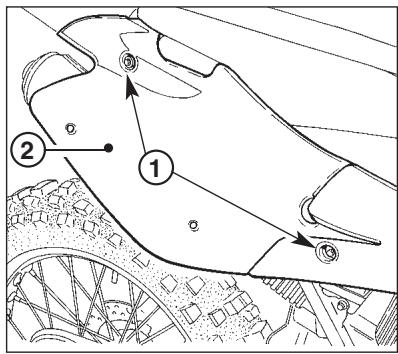
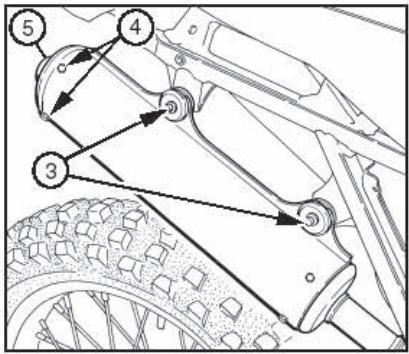
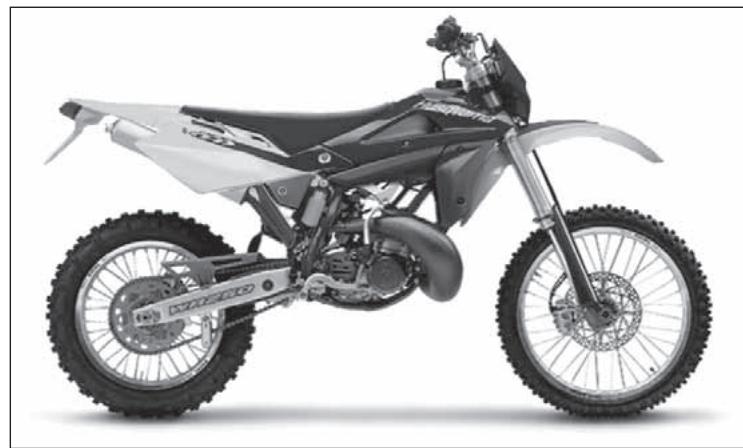
natural_image
Side view of a black and white semi-truck with visible tracks and wheels (no text or symbols)AUS
Tampering Warning:
Tampering with Noise Control System Prohibited. Federal law prohibits the following acts or causing therefor:
1) The removal or rendering inoperative by any person other than for purposes of maintenance, repair, or replacement, of any device or element of design incorporated into any new vehicle for the purpose of noise control prior to its sale or delivery to the ultimate purchaser or while it is in use, and
2) the use of the vehicle after such device or element of design has been removed or rendered inoperative by any person.
Among those acts presumed to constitute tampering are the acts listed below.
1) Removal of, or puncturing the muffler, baffles, header pipes or any other component which conducts exhaust gases.
2) Removal or puncturing of any part of the intake system.
3) Lack of proper maintenance.
4) Replacing any moving part of the vehicle, or parts of the exhaust or intake system, with parts other than those specified by the manufacturer.
This product should be checked for repair or replacement if the motorcycle noise has increased significantly through use.
Otherwise, the owner may become subject to penalties under state and local ordinances.
| Description | Operation | Pre-delivery | Description | Operation | Pre-delivery |
| Engine oil | Check level | ☐ | Side stand switch | Check operation | ☐ |
| Two-stroke mix oil level | Check level | ☐ * | Electrical equipment | Check operation | ☐ |
| Coolant | Check / Restore level | ☐ | Instrument panel | Check operation | ☐ |
| Cooling system | Check for leakage | ☐ | Lights / Visual signals | Check operation | ☐ |
| Electric fans | Check operation | ☐ * * | Horn | Check operation | ☐ |
| Spark plugs | Check / Replace | ☐ | Headlight | Check operation | ☐ |
| Throttle body / Carburettor | Check and adjust | ☐ | Ignition switch | Check operation | ☐ |
| Brakes / Clutch fluid | Check level | ☐ | Locks | Check operation | ☐ |
| Brakes / Clutch | Check operation | ☐ | Screws and nuts | Check / Tighten | ☐ |
| Brakes / Clutch | Check lines for leakage | ☐ | Hose clamps | Check / Tighten | ☐ |
| Throttle control | Check operation | ☐ | General lubrication | ☐ | |
| Throttle control | Check / Adjust play | ☐ | General test | ☐ | |
| Choke control | Check operation | ☐ | |||
| Flexible controls and transm. | Check / Adjust | ☐ | |||
| Drive chain | Check / Adjust | ☐ | ※ : only for motorcycles with 2 stroke engine | ||
| Tyres | Check pressure | ☐ | ※※ : only for some models | ||
| Side stand | Check operation | ☐ | |||
natural_image
Pure horizontal line pattern with evenly spaced vertical black bars (no text or symbols)

| WR 250/2006- MOTOCICLO DA COMPETIZIONE, PER USO AGONISTICO: A PIENA POTENZA- COMPETITION MOTORCYCLE, RACING USE: with FULL POWER ENGINE- MOTOCYCLE DE COMPÉTITION, POUR USAGE SPORTIF: AVEC LA PLEINE PUISSANCE | SCHEMA DI MANUTENZIONE PERIODICA (DA EFFETTUARE PRESSO IL CONCESSIONARIO HUSQVARNA PERIODIC MAINTENANCE SCHEDULE (SEE YOUR HUSQVARNA DEALER FOR THESE SERVICES)ESQUEME ENTRETIEN PERIODIQUE (EFFECTUER PAR LE VOTRE CONCESSIONAIRE HUSQVARNA) | |||||||
| TAGLIANDO-COUPON-COUPON | TAGLIANDO-COUPON-COUPON | TAGLIANDO-COUPON-COUPON | TAGLIANDO-COUPON-COUPON | TAGLIANDO-COUPON-COUPON | VEDERE A PAGINA- SEE PAGE- VOIR PAGE | |||
| PARTICOLARE- ITEM- PARTICULAIRE | DOPO LE PRIME 4ORE-AFTER FIRST4 hours-APRÈSLES PREMIER 4 | OGNI-EV-ERY-TOUS | OGNI-EVERY-TOUS | OGNI-EVERY-TOUS | OGNI-EVERY-TOUS | OGNI-EVERY-TOUS | SOSTITUIRE SE NECESSARIO-RE-PLACE IF NECES-SARY-REEMPLACER SI | |
| 4h MX/8h EN | 8h Mx/16h EN | 16h MX/32h EN | 32h MX/64h EN | 40h MX/80h EN | ||||
| MOLLA FRIZIONE- CLUTCH SPRING- RESSORT EMBRAYAGE | C | X | 198 | |||||
| CAMPANA FRIZIONE- CLUTCH DISCS HOUSING- CAGE EMBRAYAGE | C | X | # | |||||
| ASTINA DISINNESTO FRIZIONE- CLUTCH DISENGAGEMENT ROD- BILLE COILES-SAU DÉBRAYAGE EMBRAYAGE | C | X | # | |||||
| ALBERO COMANDO FRIZIONE- CLUTCH CONTROL SHAFT- ARBRE COMMANDEEMBRAYAGE | C | X | # | |||||
| PIATTELLO FRIZIONE- CLUTCH SPRING PLATE- PLATEAU RESSORT EMBRAYAGE | C | X | # | |||||
| PIGNONE USCITA CAMBIO- DRIVE SPROCKET- PIGNON CHAÎNE TRANSMISSION | C | X | 144 | |||||
| PEDALE AVVIAMENTO- STARTING PEDAL- LEVIER DÉMARRAGE | L | # | ||||||
| PEDALE COMANDO CAMBIO- GEAR CONTROL PEDAL- LEVIER COMM. DEVITESSE | C | X | # | |||||
| CANDELA ACCENSIONE- SPARK PLUG- BOUGIE D'ALLUMAGE | S | 104 | ||||||
| PIPETTA CANDELA- SPARK PLUG CAP- PIPETTE BOUGIE D'ALLUMAGE | C | X | # | |||||
| CARBURATORE COMPLETO- CARBURETOR ASSY.- CARBURATEUR COMPL. | P | R | 202 | |||||
| FILTRO ARIA (C/P OGNI 30')- AIR FILTER (C/P EVERY 30')- FILTRE À AIR (C/PTOUS LES 30') | • | 114 | ||||||
| RACCORDO SCATOLA FILTRO ARIA/ CARBURATORE- AIR FILTER BOX/ CARBURE-TOR MANIFOLD- RACCORD BOÎTE FILTRE AIRE/ CARBURATEUR | C | X | # | |||||
| RADIATORI ACQUA- RADIATORS- RADIATEURS | C | X | " | |||||


| WR 250/2006- MOTOCICLO DA COMPETIZIONE, PER USO AGONISTICO: A PIENA POTENZA- COMPETITION MOTORCYCLE, RACING USE: with FULL POWER ENGINE- MOTOCYCLE DE COMPÉTITION, POUR USAGE SPORTIF: AVEC LA PLEINE PUISSANCE | SCHEMA DI MANUTENZIONE PERIODICA (DA EFFETTUARE PRESSO IL CONCESSIONARIO HUSQVARNA PERIODIC MAINTENANCE SCHEDULE (SEE YOUR HUSQVARNA DEALER FOR THESE SERVICES)ESQUEME ENTRETIEN PERIODIQUE (EFFECTUER PAR LE VOTRE CONCESSIONAIRE HUSQVARNA) | |||||||
| TAGLIANDO-COUPON-COUPON | TAGLIANDO-COUPON-COUPON | TAGLIANDO-COUPON-COUPON | TAGLIANDO-COUPON-COUPON | TAGLIANDO-COUPON-COUPON | VEDERE A PAGINA- SEE PAGE- VOIR PAGE | |||
| PARTICOLARE- ITEM- PARTICULAIRE | DOPO LE PRIME 4 ORE-AFTER FIRST 4 hours-APRÈS LES PREMIER 4 heures | OGNI- EVERY-TOUS | OGNI- EVERY-TOUS | OGNI- EVERY-TOUS | OGNI- EVERY-TOUS | OGNI- EVERY-TOUS | SOSTITUIRE SE NECESSARIO-RE-PLACE IF NECESSARY-REPLACER SI | |
| 4h MX/8h EN | 8h Mx/16h EN | 16h MX/32h EN | 32h MX/64h EN | 40h MX/80h EN | ||||
| TUBAZIONI ACQUA E FASCETTE- COOLANT HOSES AND CLAMPS- TUYAU EAU ET COLLIER | C | X | 94 | |||||
| FLUIDO REFRIGERANTE- COOLANT- RÉFRIGÉRANT | C | X | 94 | |||||
| PEDANE APPOGGIAPIEDI, PERNI, MOLLE- FOOTRESTS, FOOTREST PINS AND SPRINGS- REPOSE PIEDS, PIVOTS, RESSORTS | C | X | # | |||||
| PERNI FISS. TELAIETTO, PERNI FISS. MOTORE- SADDLE FRAME FASTENING BOLTS, ENGINE FASTENING BOLTS- PIVOTS DE FIXATION CADRE SIEGE, PIVOTS DE FIXATION MOTEUR | C | C | # | |||||
| CAVALLETTO LATERALE- SIDE STAND- BEQUILLE LATÉRALE | C | 42 | ||||||
| RULLO GUIDACATENA, CUSCINETTO- CHAIN GUIDE ROLLER, BEARINGS- AI-GUILLE GUIDE-CHAINE, ROULEMENT | C | 148 | ||||||
| TESTA DI STERZO, BASE DI STERZO CON PERNO- STEERING HEAD, STEERING CROWN WITH PIN- TÊTE DIRECTION, SOCLE DE DIRECTION AVEC PIVOT | L | # | ||||||
| FORCELLA ANTERIORE- FRONT FORK- FOURCHE AVANT | R | # | ||||||
| ATTACCHI MANUBRIO E FISSAGGI- HANDLEBAR HOLDERS AND FASTENING SET- DEMI-PALIERS GUIDON AVEC FIXAGE | C | C | 134- 252 | |||||
| BUSSOLA FORCELLONE POSTERIORE- REAR SWING ARM BUSHINGS- DOUILLE FOURCHE ARRIÈRE | C | # | ||||||
| PATTINO CATENA POSTERIORE- REAR CHAIN SLIDER- GLISSIÈRE CHAINE ARRIÈRE | C | X | 148 | |||||
| BUSSOLE LEVERAGGI SOSPENSIONE POST.- REAR SUSPENSION LINKS BUSH-INGS- DOUILLES LEVIER SUSPENSION ARRIÈRE | C | # | ||||||

natural_image
Pure horizontal line pattern with evenly spaced vertical black bars (no text or symbols)

| WR 250/2006- MOTOCICLO DA COMPETIZIONE, PER USO AGONISTICO: A PIENA POTENZA- COMPETITION MOTORCYCLE, RACING USE: with FULL POWER ENGINE- MOTOCYCLE DE COMPÉTITION, POUR USAGE SPORTIF: AVEC LA PLEINE PUISSANCE | SCHEMA DI MANUTENZIONE PERIODICA (DA EFFETTUARE PRESSO IL CONCESSIONARIO HUSQVARNA PERIODIC MAINTENANCE SCHEDULE (SEE YOUR HUSQVARNA DEALER FOR THESE SERVICES)ESQUEME ENTRETIEN PERIODIQUE (EFFECTUER PAR LE VOTRE CONCESSIONAIRE HUSQVARNA) | |||||||
| TAGLIANDO-COU-PON-COUPON | TAGLIANDO-COUPON-COUPON | TAGLIANDO-COUPON-COUPON | TAGLIANDO-COUPON-COUPON | TAGLIANDO-COU-PON-COUPON | VEDERE A PAGINA- SEE PAGE- VOIR PAGE | |||
| PARTICOLARE- ITEM- PARTICULAIRE | DOPO LE PRIME 4 ORE-AFTER FIRST 4 hours-APRES LES PREMIER 4 | OGNI- EVERY-TOUS | OGNI- EVERY-TOUS | OGNI- EVERY-TOUS | OGNI- EVERY-TOUS | OGNI- EVERY-TOUS | SOSTITUIRE SE NECESSARIO-REPLACE IF NECESSARY- | |
| 4h MX/8h EN | 8h Mx/16h EN | 16h MX/32h EN | 32h MX/64h EN | 40h MX/80h EN | ||||
| GUIDACATENA/COPRICATENA- REAR CHAIN GUIDE/ REAR CHAIN GUARD-GUIDE CHAINE/ CARTER DE CHAINE | C | X | 148 | |||||
| GABBIE A RULLI PERNO FORCELLONE- REAR SWING ARM PIVOT NEEDLE BEARINGS- CAGE À AIGUILLES PIVOT FOURCHE ARRIÈRE | L | # | ||||||
| AMMORTIZZATORE POSTERIORE- REAR SHOCK ABSORBER- AMMORTISSEUR ARRIÈRE | R | # | ||||||
| GABBIE A RULLI, SPINOTTI LEVERAGGI SOSPENSIONE POSTERIORE- REAR SUSPENSION LINKS NEEDLE BEARINGS AND GUDGEON PIN- CAGE À AIGUILLES, AXES LEVIER SUSPENSION ARRIÈRE | L | # | ||||||
| COMANDO GAS COMPLETO- THROTTLE CONTROL ASSY.- COMMANDE GAZ COMPL. | C, L | 96 | ||||||
| COMANDO FRIZIONE COMPLETO- CLUTCH CONTROL ASSY.- COMMANDE EMBRAYAGE COMPL. | C | 100 | ||||||
| CAVI COMANDO GAS E FRIZIONE- THROTTLE AND CLUTCH CABLES- CÂBLES GAZ ET EMBRAYAGE | C | L | X | 96- 100 | ||||
| DISCO FRENO ANTERIORE- FRONT BRAKE DISC- DISQUE FREIN AVANT | C | X | 164 | |||||
| FLUIDO IMPIANTO FRENANTE ANTERIORE- FRONT BRAKE SYSTEM FLUID-FLUIDE SYSTÈME DE FREINAGE AVANT | C | S | 120- 168 | |||||
| DISCO FRENO POSTERIORE- REAR BRAKE DISC- DISQUE FREIN ARRIÈRE | C (*) | X | . 164 | |||||
| FLUIDO IMPIANTO FRENANTE POSTERIORE- REAR BRAKE SYSTEM FLUID-FLUIDE SYSTÈME DE FREINAGE ARRIÈRE | C | S | 124- 168 | |||||
| PASTIGLIE FRENI- BRAKE PADS- PASTILLES DU FREINS | C | X | 156 | |||||
| TUBAZIONI POMPA/ PINZA IMPIANTI FRENANTI- BRAKE SYSTEM PUMP/CALIPER HOSES- TUYAU POMPE -ETRIER SYSTÈME DE FREINAGE | C | 162 | ||||||
| TUBAZIONI CARBURANTE- FUEL HOSES- TUYAU CARBURANT | C | S | X | # | ||||




| WR 250/2006- MOTOCICLO DA COMPETIZIONE, PER USO AGONISTICO: A PIENA POTENZA- COMPETITION MOTORCYCLE, RACING USE: with FULL POWER ENGINE- MOTOCYCLE DE COMPÉTITION, POUR USAGE SPORTIF: AVEC LA PLEINE PUISSANCE | SCHEMA DI MANUTENZIONE PERIODICA (DA EFFETTUARE PRESSO IL CONCESSIONARIO HUSQVARNA PERIODIC MAINTENANCE SCHEDULE (SEE YOUR HUSQVARNA DEALER FOR THESE SERVICES)ESQUEME ENTRETIEN PERIODIQUE (EFFECTUER PAR LE VOTRE CONCESSIONAIRE HUSQVARNA) | |||||||
| TAGLIANDO-COUPON-COUPON | TAGLIANDO-COUPON-COUPON | TAGLIANDO-COUPON-COUPON | TAGLIANDO-COUPON-COUPON | TAGLIANDO-COUPON-COUPON | VEDERE A PAGINA-SEE PAGE- VOIR PAGE | |||
| PARTICOLARE- ITEM- PARTICULAIRE | DOPO LE PRIME 4 ORE-AFTER FIRST 4 hours-APRÈS LES PREMIER 4 heures | OGNI-EV-ERY-TOUS | OGNI-EVERY-TOUS | OGNI-EVERY-TOUS | OGNI-EVERY-TOUS | OGNI-EVERY-TOUS | SOSTITUIRE SE NECESSARIO-REPLACE IF NECESSARY-REPLACER SI | |
| 4h MX/8h | 8h Mx/16h EN | 16h MX/32h EN | 32h MX/64h EN | 40h MX/80h EN | ||||
| MATERIALE FONOASSORBENTE SILENZIATORE- EXHAUST SILENCER PACKING-MATERIAL INSONORISANT SILENCIEUX D'ECHAPPEMENT | C | X | 180 | |||||
| TUBO DI SCARICO E SILENZIATORE- EXHAUST PIPE AND SILENCER- TUYAU ET SILENCIEUX D'ECHAPPEMENT | C | X | # | |||||
| TENSIONE RAGGI RUOTE-WHEEL SPOKES TENSION-TENSION BRAS RUOES | C | C | 224 | |||||
| CUSCINETTI MOZZI RUOTE-WHEEL HUB BEARINGS- ROULEMENTS MOYEAUS RUOES | S | # | ||||||
| CORONA POSTERIORE- REAR DRIVEN SPROCKET- COURONNE ARRIÈRE | S | 144 | ||||||
| SERRAGGIO VITI CORONA- REAR DRIVEN SPROCKET SCREWS TIGHTENING-SERRAGE VIS COURONNE ARRIÈRE | C | C | 144- 258 | |||||
| CATENA TRASMISSIONE SECONDARIA- REAR TRANSMISSION CHAIN- CHAINE ARRIÈRE | C, L | S | X | 144 | ||||
| SERRAGGIO BULLONERIA- BOLTS AND NUTS TIGHTNESS- SERRAGE DES BOULONS | C | C | 244 | |||||
| LEGENDA- KEY FOR MAINTENANCE SCHEDULE- LEGENDEh: ORE-HOURS- HEURESS: SOSTITUZIONE- REPLACEMENT- REMPLACEMENTC: CONTROLLO-CHECK- CONTRÔLEP: PULIZIA-CLEANING- NETTOYAGER: REVISIONE-OVERHAUL- REVISIONL: INGRASSAGGIO/LUBRIFICAZIONE-GREASING/LUBRIFICATION-LUBRIFICATION-GRAISSAGE(**): SOSTITUIRE L'OR INTERNO AD OGNI SMONTAGGIO DELLA TESTA- EVERY CYLINDER HEAD REMOVAL, REPLACE THE INNER O-RING- TOUTES LE DÉMONTAGE DE LA CULASSE,REMPLACER LE GARNITURE O-RING INTÉRIEUR(*): RUOTARE DI 45° LE BUSSOLE DI FISSAGGIO- ROTATE 45° THE FASTENING BUSHES- TOURNER DE 45° LES DOUILLES DE FIXATIONMX: MOTOCROSSEN: ENDURO | NOTE- NOTE-NOTESOSTITUIRE LE GUARNIZIONI IN OCCASIONE DI OGNI SMONTAGGIO- EVERY REMOVAL REPLACE ALL GASKETS- TOUTES LES DÉMONTAGES,REEMPLACER LES GARNITURES SOSTITUIRE LA VITERIA IN CASO DI DETERIORAMENTO- REPLACE SCREWS AND NUTS IF WORN- AU CAS DE DÉTÉRIO-RATION,REEMPLACER LES BOULONSDOPO PERCORRENZE SU FANGO O SABBIA EFFETTUARE UNA VERIFICA GENERALE- GENERAL CHECK AFTER RACING USE ON MUDDY OR SANDY GROUNDS- APRÈS USAGE SUR DES TERREINS BOUEUX OU SABLEUX,EFFECTUER UN CONTRÔLEGENERAL | |||||||


| WR 250/2006WETTBEWERB-MOTORRAD, das Machen EINEN WETTKAMPF MIT von der VERWENDUNG: mit VOLLEM Macht-MOTOR MOTOCICLO DE COMPETICIÓN, PARA USO AGONÍSTICO: A LLENA POTENCIA | WARTUNGSTABELLE(FÜR DIESE KONTROLLEN WENDEN SIE SICH AN IHREN VERTRAGSHÄNDLER HUSQVARNA)ESQUEMA DE MANTENIMIENTO PERIODICO(PARA EFECTUAR ESTAS OPERACIONES DIRÍJASE A SU CONCESIONARIO HUSQVARNA) | |||||||
| COUPON-CUPÓN | COUPON-CUPÓN | COUPON-CUPÓN | COUPON-CUPÓN | COUPON-CUPÓN | SIEHE SEITE-VER PAGINA | |||
| TEILE- PARTICULAR | NACH DER ERSTEN 4 STUNDEN-DESPUÉS DE LAS PRIMERAS 4 horas | ALLE-CADA | ALLE-CADA | ALLE-CADA | ALLE-CADA | ALLE-CADA | WECHSELN WENN NÓTIG-SUBSTITUÍR SI NECESARIO | |
| 4h MX/8h EN | 8h Mx/16h EN | 16h MX/32h EN | 32h MX/64h EN | 40h MX/80h EN | ||||
| ZYLINDER KPL. (**)- CILINDRO COMPLETO (**) | C | X | # | |||||
| EINLASSVENTIL- VÁLVULA DE ASPIRACIÓN | C | X | # | |||||
| KOLBEN KPL.- PISTÓN COMPLETO | S | # | ||||||
| PLEUELSTANGE KPL.- BIELA MOTOR COMPLETA | S | # | ||||||
| REGLER FÜR ABZAPVENTIL- REGULADOR MANDO VÁLVULA DE ESCAPE | C | # | ||||||
| GABEL FÜR ABZAPVENTIL- HORQUILLA VÁLVULA DE ESCAPE | S | # | ||||||
| VORGELEGEWELLE FÜR ABZAPVENTIL- EJE DE REENCÍO VÁLVULA DE ESCAPE | S | # | ||||||
| HEBEL FÜR ABZAPVENTIL STEUERSTANGE- PALANCA POR VARÍLLA VÁLVULA DE ESCAPE | S | # | ||||||
| ABZAPVENTIL- VÁLVULA DE ESCAPE | P | # | ||||||
| GETRIEBEÓL- ACEITE CAMBIO | S | S | 92- 93 | |||||
| STIRNRADERPAAR- GRUPO ENGREN. TRANSM. PRIMARIA | C | X | # | |||||
| KUPPLUNGSCHEIBENHALTERNABE- CUBO PORTA DISCOS EMBRAGUE | C | X | # | |||||
| KUPPLUNGSCHEIBE- DISCOS EMBRAGUE | C | X | 102- 103 | |||||
| KUPPLUNGDRUCKPLATTE- PLATO EMPUJA DISCOS EMBRAGUE | C | X | # | |||||
| KUPPLUNGFEDER- RESORTE EMBRAGUE | C | X | 198- 199 | |||||


| WR 250/2006WETTBEWERB-MOTORRAD, das Machen EINEN WETTKAMPF MIT von der VERWENDUNG: mit VOLLEM Macht-MOTOR MOTOCICLO DE COMPETICIÓN, PARA USO AGONÍSTICO: A LLENA POTENCIA | WARTUNGSTABELLE(FÜR DIESE KONTROLLEN WENDEN SIE SICH AN IHREN VERTRAGSHÄNDLER HUSQVARNA)ESQUEMA DE MANTENIMIENTO PERIODICO(PARA EFECTUAR ESTAS OPERACIONES DIRÍJASE A SU CONCESIONARIO HUSQVARNA) | |||||||
| COUPON-CUPÓN | COUPON-CUPÓN | COUPON-CUPÓN | COUPON-CUPÓN | COUPON-CUPÓN | SIEHE SEITE-VER PAGINA | |||
| TEILE- PARTICULAR | NACH DER ERSTEN 4 STUNDEN-DESPUES DE LAS PRIMERAS 4 horas | ALLE-CADA | ALLE-CADA | ALLE-CADA | ALLE-CADA | ALLE-CADA | WECHSELN WENN NÓTIG-SUBSTITUÍR | |
| 4h MX/8h EN | 8h Mx/16h EN | 16h MX/32h EN | 32h MX/64h EN | 40h MX/80h EN | ||||
| KUPPLUNGKORB- CAMPANA EMBRAGUE | C | X | # | |||||
| KUPPLUNGSTEUERSTANGE- VARILLA DESEMBRAGUE | C | X | # | |||||
| KUPPLUNGSWELLE- EJE MANDO EMBRAGUE | C | X | # | |||||
| KUPPLUNGSTELLER- PLACA EMBRAGUE | C | X | # | |||||
| RITZEL- PIÑÓN CADENA | C | X | 144- 145 | |||||
| ANLASSERHEBEL- PALANCA ARRANQUE | L | # | ||||||
| GANGSCHALTUNGHEBEL- PEDAL MANDO CAMBIO | C | X | # | |||||
| ZÜNDKERZE- BUJIA ENCENDIDO | S | 104- 105 | ||||||
| ZÜNDKERZESTECKER- PIPA BUJIA ENCENDIDO | C | X | # | |||||
| VERGASER KPL.- CARBURADOR COMPL. | P | R | 202- 203 | |||||
| LUFTFILTER (C/P ALLE 30')- FILTRO AIRE (C/P CADA 30') | • | 114- 115 | ||||||
| LUFTFILTER- VERGASER ANSCHLUSS- EMPALME CAJA FILTRO AIRE - CAR-BURADOR | C | X | # | |||||
| KÜHLER- RADIADORES | C | X | # | |||||
| WASSERROHR UND SCHELLEN- TUBOS AGUA Y BANDAS | C | X | 94- 95 | |||||
| KÜHLFLÜSSIGKEIT- LIQUIDO DE ENFRIAMIENTO | C | X | 94- 95 | |||||
| FUSSRASTER, BOLZEN, FEDER- POSAPIES, PERNOS, RESORTES | C | X | # | |||||
| HINTERRAHMENBOLZEN, MOTORBOLZEN- TORNILLOS FIJACIÓN BASTIDOR TRASERO, TORNILLOS FIJACIÓN MOTOR | C | C | # | |||||


| WR 250/2006WETTBEWERB-MOTORRAD, das Machen EINEN WETTKAMPF MIT von der VERWENDUNG: mit VOLLEM Macht-MOTOR MOTOCICLO DE COMPETICIÓN, PARA USO AGONÍSTICO: A LLENA POTENCIA | WARTUNGSTABELLE(FÜR DIESE KONTROLLEN WENDEN SIE SICH AN IHREN VERTRAGSHÄNDLER HUSQVARNA)ESQUEMA DE MANTENIMIENTO PERIODICO(PARA EFECTUAR ESTAS OPERACIONES DIRÍJASE A SU CONCESIONARIO HUSQVARNA) | |||||||
| COUPON-CUPÓN | COUPON-CUPÓN | COUPON-CUPÓN | COUPON-CUPÓN | COUPON-CUPÓN | SIEHE SEITE- VER PAGINA | |||
| TEILE- PARTICULAR | NACH DER ERSTEN 4 STUNDEN-DESPUÉS DE LAS PRIMERAS | ALLE-CADA | ALLE-CADA | ALLE-CADA | ALLE-CADA | ALLE-CADA | WECHSELN WENN NÓTIG-SUBSTITUIR SI NECESARIO | |
| 4h MX/8h EN | 8h Mx/16h EN | 16h MX/32h EN | 32h MX/64h EN | 40h MX/80h EN | ||||
| SEITENSTÄNDER- HORQUILLA LATERAL | C | 42- 43 | ||||||
| KETTENFÜHRUNGROLLE, LAGER- RODILLO GUÍA-CADENA, COJÍNETE | C | 148- 149 | ||||||
| VORDERGABELLENKKOPF, GABELBRÜCKE MIT BOLZEN- CABEZA DE DIREC- CIÓN, BASE DE DIRECCIÓN CON PERNÓ | L | # | ||||||
| VORDERGABEL- FRONT FORK- HORQUILLA DELANTERA | R | # | ||||||
| LENKERBÜGELBOLZEN- CABALLETES DEL MANILLAR CON PERNOS FIJACIÓN | C | C | 134/135- 252/253 | |||||
| HINTERGABELBUCHSE- MANGUITOS HORQUILLA TRASERA | C | # | ||||||
| KETTENGLEITBAHN- PLATO CADENA TRASERA | C | X | 148- 149 | |||||
| BUCHSE FÜR HEBELWERKHINTERHAUFHANGUNG- MANGUITOS PALANCAS SUSPENSION TRASERA | C | # | ||||||
| KETTENFÜHRUNG/ KETTENKASTEN- GUÍA-CADENA/ CUBRE-CADENA | C | X | 148- 149 | |||||
| NADELKAFIG FÜR HINTERGABELBOLZEN- COJÍNETE DE RODILLOS PERNÓ HORQUILLA TRASERA | L | # | ||||||
| HINTERSTOSSDAMPFER- AMORTIGUADOR TRASERO | R | # | ||||||
| NADELKAFIG UND BOLZEN FÜR HEBELWERKHINTERHAUFHANGUNG- COJÍNETE DE RODILLOS, PERNOS PALANCAS HORQUILLA TRASERA | L | # | ||||||
| COMAGASGRIFF KPL.- MANDO GAS COMPLETO | C, L | 96- 97 | ||||||


| WR 250/2006WETTBEWERB-MOTORRAD, das Machen EINEN WETTKAMPF MIT von der VERWENDUNG: mit VOLLEM Macht-MOTOR MOTOCICLO DE COMPETICIÓN, PARA USO AGONÍSTICO: A LLENA POTENCIA | WARTUNGSTABELLE(FÜR DIESE KONTROLLEN WENDEN SIE SICH AN IHREN VERTRAGSHÄNDLER HUSQVARNA)ESQUEMA DE MANTENIMIENTO PERIODICO(PARA EFECTUAR ESTAS OPERACIONES DIRÍJASE A SU CONCESIONARIO HUSQVARNA) | |||||||
| COUPON-CUPÓN | COUPON-CUPÓN | COUPON-CUPÓN | COUPON-CUPÓN | COUPON-CUPÓN | SIEHE SEITE-VER PAGINA | |||
| TEILE- PARTICULAR | NACH DER ERSTEN 4 STUNDEN-DESPUÉS DE LAS PRIMERAS 4 horas | ALLE-CADA | ALLE-CADA | ALLE-CADA | ALLE-CADA | ALLE-CADA | WECHSELN WENN NÓTIG-SUBSTITUÍR SI NECESARIO | |
| 4h MX/8h EN | 8h Mx/16h EN | 16h MX/32h EN | 32h MX/64h EN | 40h MX/80h EN | ||||
| C | 100- 101 | |||||||
| KUPPLUNGSKABEL UND GASGKABEL- CABLES DECOMPRESSOR Y EMBRAGUE | C | L | X | 96/97- 100/101 | ||||
| VORDERE BREMSSCHEIBE- DISCO FRENO DELANTERO | C | X | 164- 165 | |||||
| VORDERBREMSFLÜSSIGKEIT- FLUIDO INSTALACIÓN FRENANTE DELANTERA | C | S | 120/121- 168/169 | |||||
| HINTERE BREMSSCHEIBE- DISCO FRENO TRASERO | C (*) | X | 164- 165 | |||||
| HINTERBREMSFLÜSSIGKEIT- FLUIDO INSTALACIÓN FRENANTE TRASERA | C | S | 124/125- 168/169 | |||||
| BREMSBELAEGE- PASTILLAS FRENOS | C | X | 156- 157 | |||||
| BREMSPUMPE/BREMSSÄTTEL SCHLAUCH- TUBERÍAS BOMBA/PINZA INSTA-LACIÓNES FRENANTES | C | 162- 163 | ||||||
| TREIBSTOFFROHR- TUBERÍAS CARBURANTE | C | S | X | # | ||||
| GERÄUSCHDÄMPFENDES MATERIAL FÜR AUSPUFF- MATERIAL FONOABSOR-BENTE SILENCIADOR | C | X | 180-181 | |||||
| AUSPUFFROHR UND SCHALLDÄMPFER- TUBO DE ESCAPE Y SILENCIADOR | C | X | # | |||||
| RADSPEICHENSSPANNUNG- TENSION RADIOS RUEDAS | C | C | 224- 225 | |||||
| RADNABENLAGER- COJÍNETES CUBOS RUEDAS | S | # | ||||||
| KRANZ- CORONA TRASERA | S | 144- 145 | ||||||
| SCHRAUBENANZIEHUNG FÜR HINTERKRANZ- TORSION TORNILLOS CORONA TRASERA | C | C | 144/145- 258/259 | |||||

natural_image
Pure horizontal line pattern with no text, numbers, or symbols| WR 250/2006WETTBEWERB-MOTORRAD, das Machen EINEN WETTKAMPF MIT von der VERWENDUNG: mit VOLLEM Macht-MOTOR MOTOCICLO DE COMPETICIÓN, PARA USO AGONÍSTICO: A LLENA POTENCIA | WARTUNGSTABELLE(FÜR DIESE KONTROLLEN WENDEN SIE SICH AN IHREN VERTRAGSHÄNDLER HUSQVARNA)ESQUEMA DE MANTENIMIENTO PERIODICO(PARA EFECTUAR ESTAS OPERACIONES DIRÍJASE A SU CONCESIONARIO HUSQVARNA) | ||||||||||||
| COUPON-CUPÓN | COUPON-CUPÓN | COUPON-CUPÓN | COUPON-CUPÓN | COUPON-CUPÓN | SIEHE SEITE- VER PAGINA | ||||||||
| TEILE- PARTICULAR | NACH DER ERSTEN 4 STUNDEN-DESPUÉS DE LAS PRIMERAS | ALLE-CADA | ALLE-CADA | ALLE-CADA | ALLE-CADA | ALLE-CADA | WECHSELN WENN NÓTIG-SUBSTITUIR SI NECESARIO | ||||||
| 4h MX/8h EN | 8h Mx/16h EN | 16h MX/32h EN | 32h MX/64h EN | 40h MX/80h EN | |||||||||
| SEKUNDÄRE ÜBERTRAGUNGSKETTE- CADENA TRANSMISIÓN SECUNDARIA | C, L | S | X | 144- 145 | |||||||||
| KONTROLLE VERSCHRAUBUNG KALTGESENKBOLZEN- CONTROL GENERAL AJUSTE TUERCAS | C | C | 244- 245 | ||||||||||
| LEGENDE- LEYENDA | ANMERKUNG- NOTASDICHTUNGWECHSE: BEI JEDEM DEMONTAGE- SUBSTI-TUIR LAS EMPACURAS EN EL CASO DE DESMONTAJESCHRAUBEN VERSCHLEISS: WECHSELN- SUBSTITUIR TORNILLOS Y TUERCAS EN EL CASO DE DESGASTESCHLAMMIGES UND SANDIGES GELÄNDEN: EIN ALLGE-MEINE KONTROLLE DURCHFÜHREN- DESPUÉS DE LA CARRERA SOBRE UN TERRENO FANGOSO O ARENOSO, EFECTUAR UN CONTROL GENERAL(**): INNERE O- RING AUSWECHSELN: BEI JEDEM ZYLINDERKOPF DEMONTAGE- TOUTES LE DÉMONTAGE DE LA CULASSE, REMPLACER LE GARNITURE O- RING INTÉRIEUR(*): ROTIEREN 45° BEFESTIGUNGBUCHSEN- GIRAR DE 45° LOS MANGUITOS DE FIJACIÓNMX: MOTOCROSSEN: ENDURO | ||||||||||||
| WR 250/2006- MOTOCICLO DI SERIE, PER USO STRADALE (A POTENZA LIMITATA)- STANDARD MOTORCYCLE, STREET LEGAL (with LIMITED POWER ENGINE)- MOTOCYCLE DE SÉRIE, POUR USAGE ROUTIER (AVEC LA PUISSANCE LIMITÉ) | SCHEMA DI MANUTENZIONE PERIODICA (DA EFFETTUARE PRESSO IL CONCESSIONARIO HUSQVARNA PERIODIC MAINTENANCE SCHEDULE (SEE YOUR HUSQVARNA DEALER FOR THESE SERVICES)ESQUEME ENTRETIEN PERIODIQUE (EFFECTUER PAR LE VOTRE CONCESSIONAIRE HUSQVARNA) | ||||||||||||
| TAGLIANDO-COUPON-COUPON | TAGLIANDO-COUPON-COUPON | TAGLIANDO-COUPON-COUPON | TAGLIANDO-COUPON-COUPON | TAGLIANDO-COUPON-COUPON | VEDERE A PAGINA- SEE PAGE- VOIR PAGE | ||||||||
| PARTICOLARE- ITEM- PARTICULAIRE | DOPO I PRIMI 1000Km AFTER FIRST 1000 Km APRÈS LES PREMIERS 1000 Km | OGNI 1500 KM EVERY 1500 Km TOUS LES 1500 Km | OGNI 3000 KM EVERY 3000 Km TOUS LES 3000 Km | OGNI 7000 KM EVERY 7000 Km TOUS LES 7000 Km | OGNI 10000 KM EVERY 10000 Km TOUS LES 10000 Km | SOSTITUIRE SE NECESSARIO-RE-PLACE IF NECES-SARY-REEMPLACER SI NÉCESSAIRE | |||||||
| CILINDRO COMPLETO (**)- CYLINDER ASSY. (**)- CYLINDRE COMPL. (**) | C | X | # | ||||||||||
| VALVOLA DI ASPIRAZIONE- REED VALVE- SOUPAPE D'ASPIRATION | C | X | # | ||||||||||
| PISTONE COMPLETO- PISTON ASSY.- PISTON COMPL. | S | # | |||||||||||
| BIELLA MOTORE COMPLETA- CONNECTING ROD ASSY.- BIELLE COMPL. | S | # | |||||||||||
| REGOLATORE CENTRIFUGO COMANDO VALVOLA DI SCARICO- EXHAUST VALVE DRIVE REGULATOR-REGULATEUR COMMANDE SOUPAPE D'ECHAPPEMENT | C | # | |||||||||||
| ASTINA LEVA VALVOLA DI SCARICO- EXHAUST VALVE CONTROL ROD- COULIS-SEAU POUR LEVIER SOUPAPE D'ECHAPPEMENT | S | # | |||||||||||
| VALVOLA DI SCARICO- EXHAUST VALVE- SOUPAPE D'ECHAPPEMENT | C | # | |||||||||||
| OLIO CAMBIO- TRANSMISSION OIL- HUILE BOITE DE VITESSE | S | S | 92 | ||||||||||
| COPPIA INGRANAGGI TRASM. PRIMARIA- SET OF MATCHED PRIMARY- ENGRE-NAGES TRANSM. PRIMARIE | C | X | # | ||||||||||
| MOZZO FRIZIONE- CLUTCH DISCS HOUSING- MOYEAU PORTE/ DISQUE EMBRAYAGE | C | X | # | ||||||||||
| DISCHI FRIZIONE- CLUTCH DISCS- DISQUES EMBRAYAGE | C | X | 102 | ||||||||||
| PIATTO SPINGIDISCHI FRIZIONE- CLUTCH DISCS PRESSURE PLATE- POUSSE DISQUES EMBRAYAGE | C | X | # | ||||||||||
| WR 250/2006- MOTOCICLO DI SERIE, PER USO STRADALE (A POTENZA LIMITATA)- STANDARD MOTORCYCLE, STREET LEGAL (with LIMITED POWER ENGINE)- MOTOCYCLE DE SÉRIE, POUR USAGE ROUTI-ER (AVEC LA PUISSANCE LIMITÉ) | SCHEMA DI MANUTENZIONE PERIODICA (DA EFFETTUARE PRESSO IL CONCESSIONARIO HUSQVARNA PERIODIC MAINTENANCE SCHEDULE (SEE YOUR HUSQVARNA DEALER FOR THESE SERVICES)ESQUEME ENTRETIEN PERIODIQUE (EFFECTUER PAR LE VOTRE CONCESSIONAIRE HUSQVARNA) | ||||||||||||
| TAGLIANDO-COUPON-COUPON | TAGLIANDO-COUPON-COUPON | TAGLIANDO-COUPON-COUPON | TAGLIANDO-COUPON-COUPON | TAGLIANDO-COUPON-COUPON | VEDERE A PAGINA- SEE PAGE- VOIR PAGE | ||||||||
| PARTICOLARE- ITEM- PARTICULAIRE | DOPO I PRIMI 1000KmAFTER FIRST 1000 KmAPRÈS LES PREMIERS 1000 Km | OGNI 1500 KMEVERY 1500 KmTOUS LES 1500 Km | OGNI 3000 KMEVERY 3000 KmTOUS LES 3000 Km | OGNI 7000 KMEVERY 7000 KmTOUS LES 7000 Km | OGNI 10000 KMEVERY 10000 KmTOUS LES 10000 Km | SOSTITUIRE SE NECESSARIO-RE-PLACE IF NECES-SARY-REEMPLACER SI | |||||||
| MOLLA FRIZIONE- CLUTCH SPRING- RESSORT EMBRAYAGE | C | X | 198 | ||||||||||
| CAMPANA FRIZIONE- CLUTCH DISCS HOUSING- CAGE EMBRAYAGE | C | X | # | ||||||||||
| ASTINA DISINNESTO FRIZIONE- CLUTCH DISENGAGEMENT ROD- BILLE COILES-SAU DÉBRAYAGE EMBRAYAGE | C | X | # | ||||||||||
| ALBERO COMANDO FRIZIONE- CLUTCH CONTROL SHAFT- ARBRE COMMANDE EMBRAYAGE | C | X | # | ||||||||||
| PIATTELLO FRIZIONE- CLUTCH SPRING PLATE- PLATEAU RESSORT EMBRAYAGE | C | X | # | ||||||||||
| PIGNONE USCITA CAMBIO- DRIVE SPROCKET- PIGNON CHAÎNE TRANSMISSION | C | C | X | 144 | |||||||||
| PEDALE AVVIAMENTO- STARTING PEDAL- LEVIER DÉMARRAGE | L | # | |||||||||||
| PEDALE COMANDO CAMBIO- GEAR CONTROL PEDAL- LEVIER COMM. DE VITESSE | C | C | X | # | |||||||||
| CANDELA ACCENSIONE- SPARK PLUG- BOUGIE D'ALLUMAGE | S | C | 104 | ||||||||||
| PIPETTA CANDELA- SPARK PLUG CAP- PIPETTE BOUGIE D'ALLUMAGE | C | C | X | # | |||||||||
| CARBURATORE COMPLETO- CARBURETOR ASSY.- CARBURATEUR COMPL. | P | 202 | |||||||||||
| FILTRO ARIA (C/P OGNI 30')- AIR FILTER (C/P EVERY 30')- FILTRE À AIR (C/P TOUS LES 30') | • | P | 114 | ||||||||||
| RACCORDO SCATOLA FILTRO ARIA/ CARBURATORE- AIR FILTER BOX/ CARBURE-TOR MANIFOLD- RACCORD BOÎTE FILTRE AIRE/ CARBURATEUR | C | X | # | ||||||||||
| RADIATORI ACQUA- RADIATORS- RADIATEURS | C | X | # | ||||||||||
| WR 250/2006- MOTOCICLO DI SERIE, PER USO STRADALE (A POTENZA LIMITATA)- STANDARD MOTORCYCLE, STREET LEGAL (with LIMITED POWER ENGINE)- MOTOCYCLE DE SÉRIE, POUR USAGE ROUTIER (AVEC LA PUISSANCE LIMITÉ) | SCHEMA DI MANUTENZIONE PERIODICA (DA EFFETTUARE PRESSO IL CONCESSIONARIO HUSQVARNA PERIODIC MAINTENANCE SCHEDULE (SEE YOUR HUSQVARNA DEALER FOR THESE SERVICES)ESQUEME ENTRETIEN PERIODIQUE (EFFECTUER PAR LE VOTRE CONCESSIONAIRE HUSQVARNA) | ||||||||||||
| TAGLIANDO-COUPON-COUPON | TAGLIANDO-COUPON-COUPON | TAGLIANDO-COUPON-COUPON | TAGLIANDO-COUPON-COUPON | TAGLIANDO-COUPON-COUPON | VEDERE A PAGINA- SEE PAGE- VOIR PAGE | ||||||||
| PARTICOLARE- ITEM- PARTICULAIRE | DOPO I PRIMI 1000KmAFTER FIRST 1000 KmAPRÈS LES PREMIERS 1000 Km | OGNI 1500 KMEVERY 1500 KmTOUS LES 1500 Km | OGNI 3000 KMEVERY 3000 KmTOUS LES 3000 Km | OGNI 7000 KMEVERY 7000 KmTOUS LES 7000 Km | OGNI 10000 KMEVERY 10000 KmTOUS LES 10000 Km | SOSTITUIRE SE NECESSARIO-RE-PLACE IF NECESSARY-REMLACER SI | |||||||
| TUBAZIONI ACQUA E FASCETTE- COOLANT HOSES AND CLAMPS- TUYAU EAU ET COLLIER | C | X | 94 | ||||||||||
| FLUIDO REFRIGERANTE- COOLANT- RÉFRIGÉRANT | C | C | X | 94 | |||||||||
| PEDANE APPOGGIAPIEDI, PERNI, MOLLE- FOOTRESTS, FOOTREST PINS AND SPRINGS- REPOSE PIEDS, PIVOTS, RESSORTS | C | X | # | ||||||||||
| PERNI FISS. TELAIETTO, PERNI FISS. MOTORE- SADDLE FRAME FASTENING BOLTS, ENGINE FASTENING BOLTS- PIVOTS DE FIXATION CADRE SIEGE, PIVOTS DE FIXATION MOTEUR | C | C | # | ||||||||||
| CAVALLETTO LATERALE- SIDE STAND- BEQUILLE LATÉRALE | 42 | ||||||||||||
| RULLO GUIDACATENA, CUSCINETTO- CHAIN GUIDE ROLLER, BEARINGS- AI-GUILLE GUIDE-CHAINE, ROULEMENT | 148 | ||||||||||||
| TESTA DI STERZO, BASE DI STERZO CON PERNO- STEERING HEAD, STEERING CROWN WITH PIN- TÊTE DIRECTION, SOCLE DE DIRECTION AVEC PIVOT | L | # | |||||||||||
| FORCELLA ANTERIORE- FRONT FORK- FOURCHE AVANT | R | # | |||||||||||
| ATTACCHI MANUBRIO E FISSAGGI- HANDLEBAR HOLDERS AND FASTENING SET- DEMI-PALIERS GUIDON AVEC FIXAGE | C | C | 134- 252 | ||||||||||
| BUSSOLA FORCELLONE POSTERIORE- REAR SWING ARM BUSHINGS- DOUILLE FOURCHE ARRIÈRE | C | # | |||||||||||
| PATTINO CATENA POSTERIORE- REAR CHAIN SLIDER- GLISSIÈRE CHAINE ARRIÈRE | C | X | 148 | ||||||||||
| BUSSOLE LEVERAGGI SOSPENSIONE POST.- REAR SUSPENSION LINKS BUSH-INGS- DOUILLES LEVIER SUSPENSION ARRIÈRE | C | # | |||||||||||
| WR 250/2006- MOTOCICLO DI SERIE, PER USO STRADALE (A POTENZA LIMITATA)- STANDARD MOTORCYCLE, STREET LEGAL (with LIMITED POWER ENGINE)- MOTOCYCLE DE SÉRIE, POUR USAGE ROUTI-ER (AVEC LA PUISSANCE LIMITÉ) | SCHEMA DI MANUTENZIONE PERIODICA (DA EFFETTUARE PRESSO IL CONCESSIONARIO HUSQVARNA PERIODIC MAINTENANCE SCHEDULE (SEE YOUR HUSQVARNA DEALER FOR THESE SERVICES)ESQUEME ENTRETIEN PERIODIQUE (EFFECTUER PAR LE VOTRE CONCESSIONAIRE HUSQVARNA) | ||||||||||||
| TAGLIANDO-COUPON-COUPON | TAGLIANDO-COUPON-COUPON | TAGLIANDO-COUPON-COUPON | TAGLIANDO-COUPON-COUPON | TAGLIANDO-COUPON-COUPON | VEDERE A PAGINA- SEE PAGE- VOIR PAGE | ||||||||
| PARTICOLARE- ITEM- PARTICULAIRE | DOPO I PRIMI 1000KmAFTER FIRST 1000 KmAPRÈS LES PREMIERS 1000 Km | OGNI 1500 KMEVERY 1500 KmTOUS LES 1500 Km | OGNI 3000 KMEVERY 3000 KmTOUS LES 3000 Km | OGNI 7000 KMEVERY 7000 KmTOUS LES 7000 Km | OGNI 10000 KMEVERY 10000 KmTOUS LES 10000 Km | SOSTITUIRE SE NECESSARIO-REPLACEIF NECESSARY-REMLACER SI | |||||||
| GUIDACATENA/COPRICATENA- REAR CHAIN GUIDE/ REAR CHAIN GUARD-GUIDE CHAINE/ CARTER DE CHAINE | X | 148 | |||||||||||
| GABBIE A RULLI PERNO FORCELLONE- REAR SWING ARM PIVOT NEEDLE BEARINGS- CAGE À AIGUILLES PIVOT FOURCHE ARRIÈRE | L | # | |||||||||||
| AMMORTIZZATORE POSTERIORE- REAR SHOCK ABSORBER- AMMORTISSEUR ARRIÈRE | R | # | |||||||||||
| GABBIE A RULLI, SPINOTTI LEVERAGGI SOSPENSIONE POSTERIORE- REAR SUSPENSION LINKS NEEDLE BEARINGS AND GUDGEON PIN- CAGE À AIGUILLES, AXES LEVIER SUSPENSION ARRIÈRE | # | ||||||||||||
| COMANDO GAS COMPLETO- THROTTLE CONTROL ASSY.- COMMANDE GAZ COMPL. | 96 | ||||||||||||
| COMANDO FRIZIONE COMPLETO- CLUTCH CONTROL ASSY.- COMMANDE EMBRAYAGE COMPL. | 100 | ||||||||||||
| CAVI COMANDO GAS E FRIZIONE- THROTTLE AND CLUTCH CABLES- CÂBLES GAZ ET EMBRAYAGE | L | X | 96- 100 | ||||||||||
| DISCO FRENO ANTERIORE- FRONT BRAKE DISC- DISQUE FREIN AVANT | C | X | 164 | ||||||||||
| FLUIDO IMPIANTO FRENANTE ANTERIORE- FRONT BRAKE SYSTEM FLUID-FLUIDE SYSTÈME DE FREINAGE AVANT | S | 120- 168 | |||||||||||
| DISCO FRENO POSTERIORE- REAR BRAKE DISC- DISQUE FREIN ARRIÈRE | C (*) | X | . 164 | ||||||||||
| FLUIDO IMPIANTO FRENANTE POSTERIORE- REAR BRAKE SYSTEM FLUID-FLUIDE SYSTÈME DE FREINAGE ARRIÈRE | S | 124- 168 | |||||||||||
| PASTIGLIE FRENI- BRAKE PADS- PASTILLES DU FREINS | X | 156 | |||||||||||
| TUBAZIONI POMPA/ PINZA IMPIANTI FRENANTI- BRAKE SYSTEM PUMP/CALIPER HOSES- TUYAU POMPE -ETRIER SYSTÈME DE FREINAGE | 162 | ||||||||||||
| TUBAZIONI CARBURANTE- FUEL HOSES- TUYAU CARBURANT | S | X | # | ||||||||||


| WR 250/2006- MOTOCICLO DI SERIE, PER USO STRADALE(A POTENZA LIMITATA)- STANDARD MOTORCYCLE, STREET LEGAL(with LIMITED POWER ENGINE)- MOTOCYCLE DE SÉRIE, POUR USAGEROUTIER (AVEC LA PUISSANCE LIMITÉ) | SCHEMA DI MANUTENZIONE PERIODICA (DA EFFETTUARE PRESSO IL CONCESSIONARIO HUSQVARNA PERIODIC MAINTENANCE SCHEDULE (SEE YOUR HUSQVARNA DEALER FOR THESE SERVICES)ESQUEME ENTRETIEN PERIODIQUE (EFFECTUER PAR LE VOTRE CONCESSIONAIRE HUSQVARNA) | ||||||
| TAGLIANDO-COUPON-COUPON | TAGLIANDO-COUPON-COUPON | TAGLIANDO-COUPON-COUPON | TAGLIANDO-COUPON-COUPON | TAGLIANDO-COUPON-COUPON | VEDERE A PAGINA-SEE PAGE- VOIR PAGE | ||
| PARTICOLARE- ITEM- PARTICULAIRE | DOPO I PRIMI 1000KmAFTER FIRST 1000 KmAPRÈS LES PREMIERS1000 Km | OGNI 1500 KMEVERY 1500 KmTOUS LES1500 Km | OGNI 3000 KMEVERY 3000 KmTOUS LES3000 Km | OGNI 7000 KMEVERY 7000 KmTOUS LES7000 Km | OGNI 10000 KMEVERY 10000 KmTOUS LES10000 Km | SOSTITUIRE SENECSSARIO-REPLACEIF NECESSARY-REMLACER SI | |
| MATERIALE FONOASSORBENTE SILENZIATORE- EXHAUST SILENCER PACKING-MATERIAL INSONORISANT SILENCIEUX D'ECHAPPEMENT | C | X | 180 | ||||
| TUBO DI SCARICO E SILENZIATORE- EXHAUST PIPE AND SILENCER- TUYAU ET SILENCIEUX D'ECHAPPEMENT | X | # | |||||
| TENSIONE RAGGI RUOTE- WHEEL SPOKES TENSION- TENSION BRAS RUOES | C | C | 224 | ||||
| CUSCINETTI MOZZI RUOTE- WHEEL HUB BEARINGS- ROULEMENTS MOYEAUS RUOES | S | # | |||||
| CORONA POSTERIORE- REAR DRIVEN SPROCKET- COURONNE ARRIÉRE | S | 144 | |||||
| SERRAGGIO VITI CORONA- REAR DRIVEN SPROCKET SCREWS TIGHTENING-SERRAGE VIS COURONNE ARRIÉRE | C | C | 144- 258 | ||||
| CATENA TRASMISSIONE SECONDARIA- REAR TRANSMISSION CHAIN- CHAINEARRIÉRE | C, L | S | X | 144 | |||
| SERRAGGIO BULLONERIA- BOLTS AND NUTS TIGHTNESS- SERRAGE DES BOULONS | C | C | 244 | ||||
| LEGENDA- KEY FOR MAINTENANCE SCHEDULE- LEGENDES: SOSTITUZIONE- REPLACEMENT- REMPLACEMENTC: CONTROLLO- CHECK- CONTRÔLEP: PULIZIA- CLEANING- NETTOYAGER: REVISIONE- OVERHAUL- REVISIONL: INGRASSAGGIO/ LUBRIFICAZIONE- GREASING/ LUBRIFICATION- LUBRIFICATION-GRAISSAGE(**): SOSTITUIRE L'OR INTERNO AD Ogni SMONTAGGIO DELLA TESTA- EVERY CYLINDER HEAD REMOVAL, REPLACE THE INNER O-RING- TOUTES LEDÉMONTAGE DE LA CULASSE, REMPLACER LE GARNITURE O- RING INTÉRIEUR(*): RUOTARE DI 45° LE BUSSOLE DI FISSAGGIO- ROTATE 45° THE FASTENING BUSHES- TOURNER DE 45° LES DOUILLES DE FIXATION | NOTE- NOTE- NOTESOSTITUIRE LE GUARNIZIONI IN OCCASIONE DI Ogni SMONTAGGIO- EVERY REMOVAL REPLACE ALL GASKETS- TOUTESLES DÉMONTAGES, REMPLACER LES GARNITURESSOSTITUIRE LA VITERIA IN CASO DI DETERIORAMENTO- REPLACE SCREWS AND NUTS IF WORN- AU CAS DE DÉTÉRIO-RATION, REMPLACER LES BOULONSDOPO PERCORRENZE SU FANGO O SABBIA EFFETTUARE UNAVERIFICA GENERALE- GENERAL CHECK AFTER RACING USEON MUDDY OR SANDY GROUNDS- APRÈS USAGE SUR DESTERREINS BOUEUX OU SABLEUX, EFFECTUER UN CONTRÔLEGENERAL | ||||||


| WR 250/2006- ÜBLICHES MOTORRAD, STRAße GESETZLICH (mit beschränktem Macht-MOTOR)- MOTOCICLO DE SERIE, PARA USO VIAL (A POTENCIA LIMITADA) | WARTUNGSTABELLE(FÜR DIESE KONTROLLEN WENDEN SIE SICH AN IHREN VERTRAGSHÄNDLER HUSQVARNA)ESQUEMA DE MANTENIMIENTO PERIODICO(PARA EFECTUAR ESTAS OPERACIONES DIRÍJASE A SU CONCESIONARIO HUSQVARNA) | ||||||
| COUPON-CUPÓN | COUPON-CUPÓN | COUPON-CUPÓN | COUPON-CUPÓN | COUPON-CUPÓN | SIEHE SEITE-VER PAGINA | ||
| TEILE- PARTICULAR | NACH DEN ERSTEN1000Km- DESPUES LOS PRIMEROS1000Km | ALLE 1500 KMCADA 1500 KM | ALLE 3000 KMCADA 3000 KM | ALLE 7000 KMCADA 7000 KM | ALLE 10000 KMCADA 10000 KM | WECHSELN WENNNÖTIG-SUBSTITUIR SINECESARIO | |
| ZYLINDER KPL. (**)- CILINDRO COMPLETO (**) | C | X | # | ||||
| EINLASSVENTIL- VÁLVULA DE ASPIRACIÓN | C | X | # | ||||
| KOLBEN KPL.- PISTÓN COMPLETO | S | # | |||||
| PLEUELSTANGE KPL.- BIELA MOTOR COMPLETA | S | # | |||||
| REGLER FÜR ABZAPVENTIL- REGULADOR MANDO VÁLVULA DE ESCAPE | C | # | |||||
| HEBEL FÜR ABZAPVENTIL STEUERSTANGE- PALANCA POR VARÍLLA VÁLVULA DE ESCAPE | S | # | |||||
| ABZAPVENTIL- VÁLVULA DE ESCAPE | C | # | |||||
| GETRIEBEÖL- ACEITE CAMBIO | S | S | 92- 93 | ||||
| STIRNRADERPAAR- GRUPO ENGREN. TRANSM. PRIMARIA | C | X | # | ||||
| KUPPLUNGSCHEIBENHALTERNABE- CUBO PORTA DISCOS EMBRAGUE | C | X | # | ||||
| KUPPLUNGSCHEIBE- DISCOS EMBRAGUE | C | X | 102- 103 | ||||
| KUPPLUNGDRUCKPLATTE- PLATO EMPUJA DISCOS EMBRAGUE | C | X | # | ||||
| KUPPLUNGFEDER- RESORTE EMBRAGUE | C | X | 198- 199 | ||||


| WR 250/2006- ÜBLICHES MOTORRAD, STRAße GESETZLICH (mit beschränktem Macht-MOTOR)- MOTOCICLO DE SERIE, PARA USO VIAL (A POTENCIA LIMITADA) | WARTUNGSTABELLE(FÜR DIESE KONTROLLEN WENDEN SIE SICH AN IHREN VERTRAGSHÄNDLER HUSQVARNA)ESQUEMA DE MANTENIMIENTO PERIODICO(PARA EFECTUAR ESTAS OPERACIONES DIRÍJASE A SU CONCESIONARIO HUSQVARNA) | ||||||
| COUPON-CUPÓN | COUPON-CUPÓN | COUPON-CUPÓN | COUPON-CUPÓN | COUPON-CUPÓN | SIEHE SEITE-VER PAGINA | ||
| TEILE- PARTICULAR | NACH DEN ERSTEN1000Km- DESPUES LOS PRIMEROS1000Km | ALLE 1500 KMCADA 1500 KM | ALLE 3000 KMCADA 3000 KM | ALLE 7000 KMCADA 7000 KM | ALLE 10000 KMCADA 10000 KM | WECHSELN WENNNÖTIG-SUBSTITUIRSI NECESARIO | |
| KUPPLUNGKORB- CAMPANA EMBRAGUE | C | X | # | ||||
| KUPPLUNGSTEUERSTANGE- VARILLA DESEMBRAGUE | C | X | # | ||||
| KUPPLUNGSWELLE- EJE MANDO EMBRAGUE | C | X | # | ||||
| KUPPLUNGSTELLER- PLACA EMBRAGUE | C | X | # | ||||
| RITZEL- PIÑÓN CADENA | C | C | X | 144- 145 | |||
| ANLASSERHEBEL- PALANCA ARRANQUE | L | # | |||||
| GANGSCHALTUNGHEBEL- PEDAL MANDO CAMBIO | C | C | X | # | |||
| ZÜNDKERZE- BUJIA ENCENDIDO | S | C | 104- 105 | ||||
| ZÜNDKERZESTECKER- PIPA BUJIA ENCENDIDO | C | C | X | # | |||
| VERGASER KPL.- CARBURADOR COMPL. | P | C | 202- 203 | ||||
| LUFTFILTER (C/P ALLE 30')- FILTRO AIRE (C/P CADA 30') | • | P | 114- 115 | ||||
| LUFTFILTER- VERGASER ANSCHLUSS- EMPALME CAJA FILTRO AIRE - CAR-BURADOR | C | X | # | ||||
| KÜHLER- RADIADORES | C | X | # | ||||
| WASSERROHR UND SCHELLEN- TUBOS AGUA Y BANDAS | C | X | 94- 95 | ||||
| KÜHLFLÜSSIGKEIT- LIQUIDO DE ENFRIAMIENTO | C | C | X | 94- 95 | |||
| FUSSRASTER, BOLZEN, FEDER- POSAPIES, PERNOS, RESORTES | C | X | # | ||||
| HINTERRAHMENBOLZEN, MOTORBOLZEN- TORNILLOS FIJACIÓN BASTIDOR TRASERO, TORNILLOS FIJACIÓN MOTOR | C | # | |||||


| WR 250/2006- ÜBLICHES MOTORRAD, STRAße GESETZLICH (mit beschränktem Macht-MOTOR)- MOTOCICLO DE SERIE, PARA USO VIAL (A POTENCIA LIMITADA) | WARTUNGSTABELLE(FÜR DIESE KONTROLLEN WENDEN SIE SICH AN IHREN VERTRAGSHÄNDLER HUSQVARNA)ESQUEMA DE MANTENIMIENTO PERIODICO(PARA EFECTUAR ESTAS OPERACIONES DIRÍJASE A SU CONCESIONARIO HUSQVARNA) | ||||||
| COUPON-CUPÓN | COUPON-CUPÓN | COUPON-CUPÓN | COUPON-CUPÓN | COUPON-CUPÓN | SIEHE SEITE- VER PAGINA | ||
| TEILE- PARTICULAR | NACH DEN ERSTEN 1000Km- DESPUES LOS PRIMEROS 1000Km | ALLE 1500 KM CADA 1500 KM | ALLE 3000 KM CADA 3000 KM | ALLE 7000 KM CADA 7000 KM | ALLE 10000 KM CADA 10000 KM | WECHSELN WENN NÓTIG-SUBSTITUÍR SI NECESARIO | |
| SEITENSTÄNDER- HORQUILLA LATERAL | 42- 43 | ||||||
| KETTENFÜHRUNGROLLE, LAGER- RODILLO GUÍA-CADENA, COJÍNETE | 148- 149 | ||||||
| VORDERGABELLENKKOPF, GABELBRÜCKE MIT BOLZEN- CABEZA DE DIRECCIÓN, BASE DE DIRECCIÓN CON PERNOS | L | # | |||||
| VORDERGABEL- FRONT FORK- HORQUILLA DELANTERA | R | # | |||||
| LENKERBÜGELBOLZEN- CABALLETES DEL MANILLAR CON PERNOS FIJACIÓN | C | C | 134/135- 252/253 | ||||
| HINTERGABELBUCHSE- MANGUITOS HORQUILLA TRASERA | C | # | |||||
| KETTENGLEITBAHN- PLATO CADENA TRASERA | C | X | 148- 149 | ||||
| BUCHSE FÜR HEBELWERKHINTERHAUFHANGUNG- MANGUITOS PALANCAS SUSPENSION TRASERA | C | # | |||||
| KETTENFÜHRUNG/ KETTENKASTEN- GUÍA-CADENA/ CUBRE-CADENA | X | 148- 149 | |||||
| NADELKAFIG FÜR HINTERGABELBOLZEN- COJÍNETE DE RODILLOS PERNOS HORQUILLA TRASERA | L | # | |||||
| HINTERSTOSSDAMPFER- AMORTIGUADOR TRASERO | R | # | |||||
| NADELKAFIG UND BOLZEN FÜR HEBELWERKHINTERHAUFHANGUNG- COJÍNETE DE RODILLOS, PERNOS PALANCAS HORQUILLA TRASERA | # | ||||||
| COMAGASGRIFF KPL.- MANDO GAS COMPLETO | 96- 97 | ||||||


| WR 250/2006- ÜBLICHES MOTORRAD, STRAße GESETZLICH (mit beschränktem Macht-MOTOR)- MOTOCICLO DE SERIE, PARA USO VIAL (A POTENCIA LIMITADA) | WARTUNGSTABELLE(FÜR DIESE KONTROLLEN WENDEN SIE SICH AN IHREN VERTRAGSHÄNDLER HUSQVARNA)ESQUEMA DE MANTENIMIENTO PERIODICO(PARA EFECTUAR ESTAS OPERACIONES DIRÍJASE A SU CONCESIONARIO HUSQVARNA) | ||||||
| COUPON-CUPÓN | COUPON-CUPÓN | COUPON-CUPÓN | COUPON-CUPÓN | COUPON-CUPÓN | SIEHE SEITE-VER PAGINA | ||
| TEILE- PARTICULAR | NACH DEN ERSTEN1000Km- DESPUES LOS PRIMEROS1000Km | ALLE 1500 KMCADA 1500 KM | ALLE 3000 KMCADA 3000 KM | ALLE 7000 KMCADA 7000 KM | ALLE 10000 KMCADA 10000 KM | WECHSELN WENN NÖTIG-SUBSTITUIRSI NECESARIO | |
| 100- 101 | |||||||
| KUPPLUNGSKABEL UND GASGKABEL- CABLES DECOMPRESSOR Y EMBRAGUE | L | X | 96/97- 100/101 | ||||
| VORDERE BREMSSCHEIBE- DISCO FRENO DELANTERO | C | X | 164- 165 | ||||
| VORDERBREMSFLÜSSIGKEIT- FLUIDO INSTALACIÓN FRENANTE DELANTERA | S | 120/121- 168/169 | |||||
| HINTERE BREMSSCHEIBE- DISCO FRENO TRASERO | C (*) | X | 164- 165 | ||||
| HINTERBREMSFLÜSSIGKEIT- FLUIDO INSTALACIÓN FRENANTE TRASERA | S | 124/125- 168/169 | |||||
| BREMSBELAEGE- PASTILLAS FRENOS | X | 156- 157 | |||||
| BREMSPUMPE/BREMSSÄTTEL SCHLAUCH- TUBERÍAS BOMBA/PINZA INSTA-LACÍONES FRENANTES | 162- 163 | ||||||
| TREIBSTOFFROHR- TUBERÍAS CARBURANTE | S | X | # | ||||
| GERÄUSCHDÄMPFENDES MATERIAL FÜR AUSPUFF- MATERIAL FONOABSOR-BENTE SILENCIADOR | C | X | 180-181 | ||||
| AUSPUFFROHR UND SCHALLDÄMPFER- TUBO DE ESCAPE Y SILENCIADOR | X | # | |||||
| RADSPECHENSSPANNUNG- TENSION RADIOS RUEDAS | C | C | 224- 225 | ||||
| RADNABENLAGER- COJÍNETES CUBOS RUEDAS | S | # | |||||
| KRANZ- CORONA TRASERA | S | 144- 145 | |||||
| SCHRAUBENANZIEHUNG FÜR HINTERKRANZ- TORSION TORNILLOS CORONA TRASERA | C | C | 144/145- 258/259 | ||||

natural_image
Pure horizontal line pattern with no text, numbers, or symbols

| WR 250/2006- ÜBLICHES MOTORRAD, STRAße GESETZLICH (mit beschränktem Macht-MOTOR)- MOTOCICLO DE SERIE, PARA USO VIAL (A POTENCIA LIMITADA) | WARTUNGSTABELLE(FÜR DIESE KONTROLLEN WENDEN SIE SICH AN IHREN VERTRAGSHÄNDLER HUSQVARNA)ESQUEMA DE MANTENIMIENTO PERIODICO(PARA EFECTUAR ESTAS OPERACIONES DIRÍJASE A SU CONCESIONARIO HUSQVARNA) | ||||||
| COUPON-CUPÓN | COUPON-CUPÓN | COUPON-CUPÓN | COUPON-CUPÓN | COUPON-CUPÓN | SIEHE SEITE- VER PAGINA | ||
| TEILE- PARTICULAR | NACH DEN ERSTEN 1000Km- DESPUES LOS PRIMEROS 1000Km | ALLE 1500 KM CADA 1500 KM | ALLE 3000 KM CADA 3000 KM | ALLE 7000 KM CADA 7000 KM | ALLE 10000 KM CADA 10000 KM | WECHSELN WENN NÖTIG-SUBSTITUIR SI NECESARIO | |
| SEKUNDÄRE ÜBERTRAGUNGSKETTE- CADENA TRANSMISIÓN SECUNDARIA | C, L | S | X | 144- 145 | |||
| KONTROLLE VERSCHRAUBUNG KALTGESENKBOLZEN- CONTROL GENERAL AJUSTE TUERCAS | C | C | 244- 245 | ||||
| LEGENDE- LEYENDAS: WECHSELN- SUBSTITUCIÓNC: KONTROLLIEREN- CONTROLP: REINIGEN- LIMPIEZAR: REVISION- REVISIONL: SCHMIERUNG/BESCHMEIREN- ENGRESAJE/LUBRICACIÓN(**): INNERE O- RING AUSWECHSELN: BEI JEDEM ZYLINDERKOPF DEMONTAGE- TOUTES LE DÉMONTAGE DE LA CULASSE, REMPLACER LE GARNITURE O- RING INTÉRIEUR(*): ROTIEREN 45° BEFESTIGUNGBUCHSEN- GIRAR DE 45° LOS MANGUITOS DE FIJACIÓN | ANMERKUNG- NOTASDICHTUNGWECHSE: BEI JEDEM DEMONTAGE- SUBSTITUIR LAS EMPACURAS EN EL CASO DE DESMONTAJESCHRAUBEN VERSCHLEISS: WECHSELN- SUBSTITUIR TORNILLOS Y TUERCAS EN EL CASO DE DESGASTESCHLAMMIGES UND SANDIGES GELÄNDEN: EIN ALLGE-MEINE KONTROLLE DURCHFÜHREN- DESPUÉS DE LA CARRERA SOBRE UN TERRENO FANGOSO O ARENOSO, EFECTUAR UN CONTROL GENERAL | ||||||
INDICE ALFABETICO
Pagina
A
Accensione 26
Adjusting the clutch 98
Adjusting the driven transmission .....142
Adjusting the fork....130
Adjusting the front brake control lever ....120
Adjusting the headlamp....238
Adjusting the idle 96
Adjusting the rear brake idle stroke....124
Adjusting shock absorber hydraulic brake 140
Adjusting shock absorber preload spring 138
Adjusting the rear brake pedal position 122
Adjusting the steering bearing play ....116
Adjusting the suspensions according to the track special conditions ....126
Adjusting the throttle cable .....94
Assembling brake pads 152
B
Brakes 154
Brake disc cleaning 166
Brake disc warpage....164
Brake disc wear....164
Brake pad assembly 152
Brake pad disassembly 152
Brake pad wear 156
C
Carburettor 26
Carburettor choke 40
INDEX ALPHABETIQUE
Page
A
Digital instruments 46
E
Einfahrzeit 85
INDICE ALFABÉTICO
Página
A
Chain lubrication 146
Checks after every competition .....264
Checks during running in....86
Check of air filter 114
Check of chain, pinion, crown wear....144
Check of compression ratrio ....196
Check of cooling fluid 92
Check of exhaust valve position .....110
Check of front brake fluid level......120
Check of gearbox oil 88
Check of rear brake fluid level ......124
Cleaning the air filter 114
Clutch 28
Clutch control....66
Clutch disc disassembly ....100
Cooling fluid replacement .....92
Control location 20-22
D
Digital instrument......46
Draining the brake fluid ....170
Draining the front brake fluid ....160
Draining the rear brake fluid ....162
Driven transmission chain ....30
E
Engine couplings....182
Electric elements ......226
Engine lubrication....34-36
Exhaust valve 24
Engine start....76
Engine stop 82
Engine stop button 64
F
Filling the braking system ....166
Fork oil level....132
Front brake control....60
Front braking system bleeding......172
Front suspension 32
G
Gearbox controls ....70
Gearbox outlet pinion....30
General cleaning 268
H
Handlebar position modification .....134
/
Ignition 26
Important notice 14
L
Long inactivity 264
M
Motorcycle identification number......18
Motorcycle stop 80
Muffler on the exhaust....180
O
Overhauling, adjusting, maintenance of "Mikuni" carburettor 202
Overhauling the wheels....222
P
Pad cleaning 158
Preliminary checks 72
R
Rear brake control....68
Rear braking system bleeding....176
Rear crown 30
Rear suspension 28
Removing the front wheel 150
Removing the rear wheel....152
Running in 84
S
Steering lock 62
Side stand 40
Spark advance check ....106
Spark-arrester 275
Spark plug 26
Spark plug check....102
Start pedal 70
T
Throttle control....60
Transmission oil change .....90
Tool outfit 240
V
Vehicle identification number......14
Voltage regulator 104
W
Wheel pin bending....224
Wheel spokes ......224
Wheels 32-34
Wiring diagram ......229-232-233
Usure plaquettes frein ....156
V
natural_image
Pure horizontal line pattern with evenly spaced vertical tick marks (no text or symbols)MEMORANDUM
MEMORANDUM
MEMORANDUM
MEMORANDUM