
SM 400-450 R - Motorcycle HUSQVARNA - Free user manual and instructions
Find the device manual for free SM 400-450 R HUSQVARNA in PDF.


| Product type | Competition supermoto bike |
| Brand | HUSQVARNA |
| Model | SM 400-450 R |
| Engine | Single-cylinder 4-stroke, liquid cooling |
| Displacement | 399.5 cm³ (400) / 449 cm³ (450) |
| Bore x stroke | 91.5 x 60.76 mm (400) / 97 x 60.76 mm (450) |
| Compression ratio | 12:1 |
| Starting | Electric with automatic decompressor |
| Fuel supply | Mikuni TMR 38 carburetor (400) or TMR 41 (450) |
| Ignition | Capacitive discharge digital electronic |
| Spark plug | NGK CR8EB, gap 0.7 mm |
| Transmission | 6-speed, chain 5/8 x 1/4 |
| Clutch | Multi-disc in oil bath, hydraulic actuation |
| Front suspension | Upside-down telescopic hydraulic fork Ø 45 mm, travel 250 mm |
| Rear suspension | Progressive with hydraulic monoshock, travel 290 mm |
| Front brake | Floating disc Ø 320 mm, fixed caliper |
| Rear brake | Fixed disc Ø 220 mm, floating caliper |
| Front wheel | Alloy rim 3.50 x 17", tire 120/70-17 |
| Rear wheel | Alloy rim 4.25 x 17", tire 150/60-17 |
| Tire pressure (road, rider only) | Front 1.8 kg/cm², rear 2.0 kg/cm² |
| Dimensions (L x W x H) | 2190 x 845 x 1250 mm |
| Seat height | 910 mm |
| Dry weight | 121.5 kg (400) / 122 kg (450) |
| Tank capacity | 7.7 L (including 1.5 L reserve) |
| Coolant | 1.1 to 1.3 L |
| Engine oil | 1.4 L |
| Battery | 12V 6Ah (sealed maintenance-free type) |
| Instrumentation | Digital display with speed, odometer, timer, etc. |
| Recommended fuel | Unleaded gasoline 98 octane |
Frequently Asked Questions - SM 400-450 R HUSQVARNA
User questions about SM 400-450 R HUSQVARNA
0 question about this device. Answer the ones you know or ask your own.
Ask a new question about this device
Download the instructions for your Motorcycle in PDF format for free! Find your manual SM 400-450 R - HUSQVARNA and take your electronic device back in hand. On this page are published all the documents necessary for the use of your device. SM 400-450 R by HUSQVARNA.
USER MANUAL SM 400-450 R HUSQVARNA
natural_image
Blue and white stylized logo resembling a shield or badge with a white letter 'H' (no text or symbols beyond the graphic design)Husqvarna
natural_image
Black-and-white photo of a DDTR motorcycle with visible wheels and front wheel (no text or symbols on the bike body)
natural_image
Black-and-white photo of a camouflaged off-road motorcycle with visible wheels and engine components (no text or symbols)
natural_image
Black-and-white photo of a four-wheeled motor with visible wheels and front wheel (no text or symbols on the vehicle itself)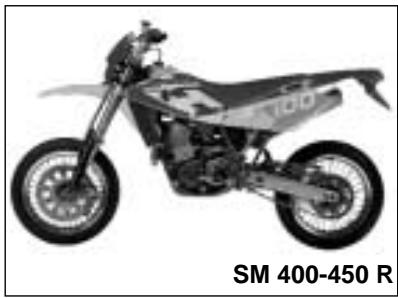
natural_image
Side view of a semi-truck motorcycle with visible dynamics and wheels (no text or symbols on the bike body)
TC 250-450, TE 250-450, SM 400-450R/2004
CARATTERISTICHE - USO - MANUTENZIONE SPECIFICATIONS - OPERATION - MAINTENANCE CARACTERISTIQUES - UTILISATION - ENTRETIEN MERKMALE - GEBRAUCH - WARTUNG CARACTERISTICAS - USO - MANTENIMIENTO
Unless specified, data and prescription are referred to all t he models.
PLEASE SEE IMPORTANT NOTICES ON PAGE 6
Welcome to the Husqvarna motorcycling Family!
Your new Husqvarna motorcycle is designed and manufactured to be the finest in its field. The instructions in this book have been prepared to provide a simple and understandable guide for your motorcycle's operation and care.
Follow the instructions carefully to obtain maximum performance and your personal motorcycling pleasure. Your owner's manual contains instructions for owner care and maintenance. Information covering repair of major units such as engine, transmission, etc. is provided in the Husqvarna Service Manual. The information concerning details or main work of repair or maintenance are described in the Husqvarna Service Manual. This manual is available upon request by stating the code number set on pages 262, 264, 266. Work of this kind requires the attention of a skilled mechanic and the use of special tools and equipment.
Your Husqvarna dealer has the facilities, experience and original parts necessary to properly render this valuable service.
This “Owner’s Manual” and the “Purchase Registration Booklet” are parts and parcels of the motorcycle, hence, they have to remain with the motorcycle even when sold to another user. This motorcycle uses components designed thanks to systems and state of the art technologies which are thereafter tested in competition.
In competition motorcycles, every detail is verified after each race in order to always guarantee better performance. For correct functioning of the vehicle, it is necessary to follow the maintenance and control table found on page 286-292.
PRESENTATION
natural_image
Side profile of a black-and-white photo of a four-wheeled motor with visible wheels and suspension (no text or symbols)natural_image
Side view of a black-and-white photo of a camouflaged four-wheeled motor with visible tracks and wheels (no text or symbols)natural_image
Side profile of a standard off-road motorcycle with visible dynamics and wheelbase (no text or symbols)I modelli SM 400-450R possono essere utilizzati, in alternativa:
The SM 400-450R models can be used, alternatively:
Les modèles SM 400 - 450R peut être utilisé, en alternative:
natural_image
Person riding a motorcycle in a desert landscape with mountains in the background (no visible text or symbols)
natural_image
Black-and-white photo of a person riding a dirt bike with visible tracks and equipment (no text or symbols)Anders Eriksson "450 class-enduro" WORLD CHAMPION
natural_image
Black-and-white photo of a person riding a motorcycle on a paved surface (no visible text or symbols)natural_image
Black-and-white photo of a motorcyclist mid-jump, wearing helmet and gear (no visible text or symbols)MOTOCROSS
a) as a guaranteed COMPETITION motorcycle exempt from functional defects, the suggested maintenance table for competition use is shown on page 292 or
b) as a ROAD motorcycle and thus COVERED by guarantee on the condition that the prescribed maintenance table on page 292 is EXACTLY respected.
This motorcycles was not designed for long trips with the engine always at maximum rpm as can occur whilst travelling on roads or highways. Long trips at full throttle can cause severe damage to the engine.
This motorcycles was not designed for urban use and is not equipped with a cooling fan and thermostat. Long stops at the traffic lights can cause overheating and the boiling of radiator water.
This motorcycles is setup for competition use and therefore guarantees maximum performance with the rider alone. It is thereby not recommended to use the vehicle on circuits or off-road with a passenger.
ALWAYS keep in mind that these motorcycles have been designed strictly for competition use, that is, for conditions of usage very different from those presented on the road.
In order to maintain the vehicle's “Guarantee of Functionality”, the client must follow the maintenance program indicated in the user's manual by carrying out maintenance checks at authorized HUSQVARNA dealers. The cost for substituting parts and for the labour necessary in order to respect the maintenance plan, is charged to the client.
NOTE: the guarantee is EXTINGUISHED in the case where the motorcycle is rented.
Note
- References to the "left" or "right" of the motorcycle are in the sense of a person facing forwards.
● Z: number of teeth
● A: Austria
AUS: Australia
B: Belgium
BR: Brazil
CDN: Canada
CH: Switzerland
D: Germany
E: Spain
F: France
FIN: Finland
GB: Great Britain
I: Italy
J: Japan
USA: United States of America
- Where not specified, alla the data and the instructions are referred to any and all countries.
This motorcycle is equipped with an electric start and it is manufactured in two different versions.
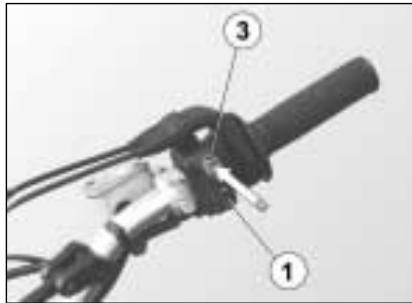
"A" VERSION : motorcycle equipped with engine start button (1) and engine stop button (2) (TC; TE-SMR); "B" VERSION : motorcycle equipped with engine start button (1) and engine start - stop switch (3) (TE-SMR).
VERSION "A": please follow the instructions herewith: This motorcycle DOES NOT HAVE AN IGNITION SWITC H, therefore when working on the vehicle, there is the danger of engine startup if the starter switch is inadvertently touched. Consequently, FOR ALL THOSE OPERATIONS WHICH MAY EVEN HAVE A MINIMAL CHANCE OF ACCIDENTALLY STARTING-UP THE ENGINE, IT IS ABSOLUTELY ESSENTIAL TO DISCONNECT THE BATTERY by following the instructions herewith.
To gain access to the battery (3):
- first turn counterclockwise fastening rear pin (1) then remove the saddle;
2) ATTENTION\*
● release elastic (2);
- first remove the BLACK negative cable, then the RED positive cable (when reassembling, first connect the RED positive cable, then the BLACK negative cable);
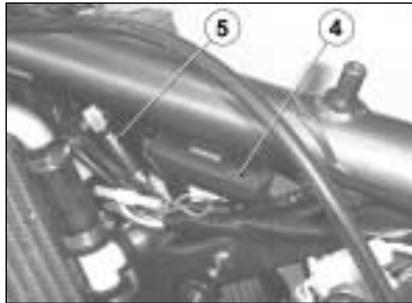
- remove the battery (3) from its housing. After battery removal, push ONCE THE ENGINE START BUTTON in order to discharge the condenser (4) fastened near the H.T. coil (5).
CAUTION*: after battery disassembly, DO NOT REMOVE the condenser from the frame: in case of engine starting in this condition, the voltage regulator will be damaged.
VERSION "B": in order to start the engine, it is necessary push the switch (3) then press the start button (1).
Premessa importante
Read this manual carefully and pay special attention to statements preceded by the following words:
WARNING*: Indicates a possibility of severe personal injury or loss of life if instructions are not followed.
CAUTION*: Indicates a possibility of personal injury or equipment damage if instructions are not followed.
Note*: Gives helpful information.
Parts Replacement
When parts replacement is required, use only Husqvarna ORIGINAL parts.
Préliminaires
WARNING*: After an upset, inspect the motorcycle carefully. Make sure that the throttle, brake, clutch and all other systems are undamaged. Riding with a damaged motorcycle can lead to a serious crash.
WARNING*: Never attempt to start or operate your motorcycle unless you are wearing appropriate protective clothing. Always wear a motorcycle helmet, motorcycle boots, gloves, goggles and other appropriate protective clothing.
WARNING*: This motorcycle is a state of the art competition bike. Do not attempt to start or ride this motorcycle until you have received expert instruction and are in excellent physical condition.
PRECAUTIONS FOR CHILDREN WARNING
● Park the vehicle where it is unlikely to be bumped into or damaged. Even slight or involuntary bumps can cause the vehicle to topple over, with subsequent risk of serious harm to people or children.
● To prevent the vehicle from tipping over, never park it on soft or uneven ground, nor on asphalt strongly heated by the sun.
● Engine and exhaust pipes become very hot during riding. Always park your motorcycle where people or children can not easily reach these parts, in order to avoid serious burns.
LUBRICATION TABLE, SUPPLIES......44
CONTROLS 46
RIDING....80
SERVICE LIMITS....198
EQUIPMENT KITS....260
OPTIONAL PARTS LIST......262,264,266
APPENDIX 268
NOTE FOR USA- AUS MODELS.....276-280
PRE-DELIVERY INSPECTION....282
PERIODIC MAINTENANCE
ADJUSTMENT....286-292
ALPHABETICAL INDEX ......298
IDENTIFICATION DATA
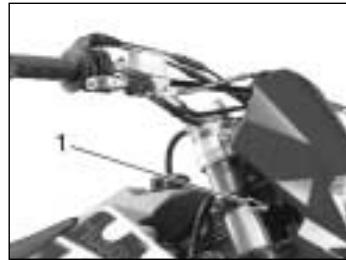
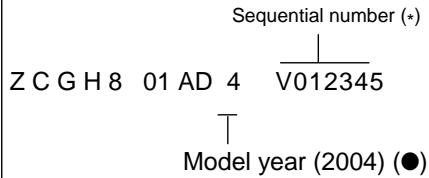
The engine number is printed on the upper side of the engine case, whereas the frame number is printed on the steering tube (see on page 20).
Always state the number stamped on the (and write it on this booklet), when placing orders for spare parts, or when asking for information on your motorcycle.
FRAME NUMBER
RESUME
Page
PRESENTATION......4
AVIS IMPORTANT 6
ELEMENTS D'IDENTIFICATION......18
DONNEES TECHNIQUES ......26
ELEMENTS EN OPTION ......262,264,266
APPENDICE....268
NOTE POUR LES MODELES USA- AUS .....276-280
OPERATIONS DE PRE LIVRAISON......283
ENTRETIEN PERIODIQUE
REGLAGES....286-292
INDEX ALPHABETIQUE ....298
ELEMENTS D'IDENTIFICATION
The full 17 digit serial, or Vehicle Identification Number, is stamped on the steering head tube (R.H. side).
NUMERO
D'IDENTIFICATION DU
MOTOCYCLE (V.I.N.)
* Varies-Can be 0 thru 9 or X (check digit for factory use)
4
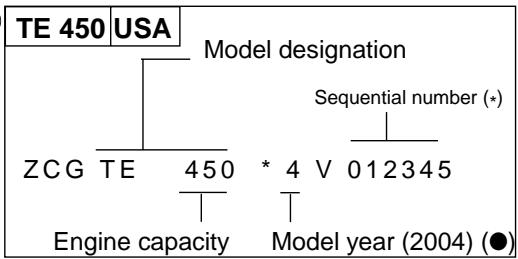
flowchart
graph TD
    A["TE 450 USA"] --> B["Model designation"]
    B --> C["ZCG TE 450"]
    B --> D["* 4 V 012345"]
    B --> E["Sequential number (*)"]
    B --> F["Engine capacity"]
    B --> G["Model year (2004) (●)"]
* Varies-Can be 0 thru 9 or X (check digit for factory use)
(*): N° progressivo
(*): Progressiv nr.
(*): N° progressive
(*): N° progressive
(*): Nr. progresivo
* Varies-Can be 0 thru 9 or X (check digit for factory use)
⑥
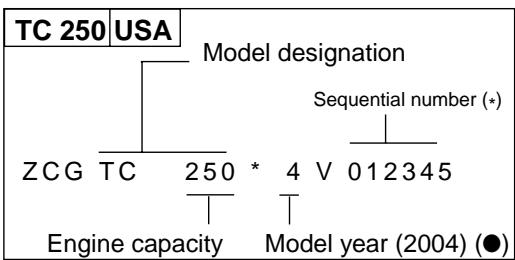
flowchart
graph TD
    A["TC 250 USA"] --> B["Model designation"]
    B --> C["ZCG TC 250 * 4 V 012345"]
    B --> D["Sequential number (*)"]
    C --> E["Engine capacity"]
    D --> F["Model year (2004) (●)"]
* Varies-Can be 0 thru 9 or X (check digit for factory use)
⑨
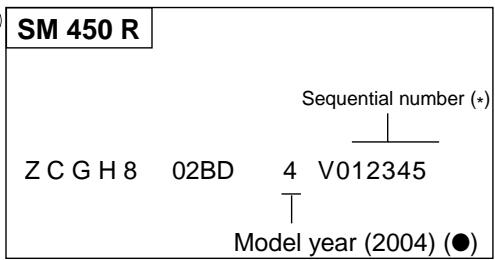
* Varies-Can be 0 thru 9 or X (check digit for factory use)
⑦
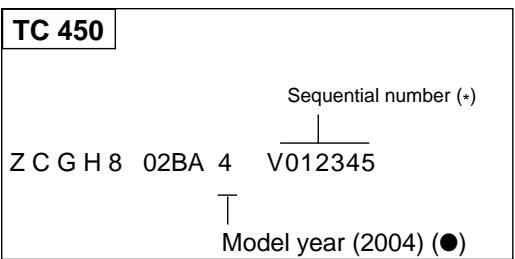
10
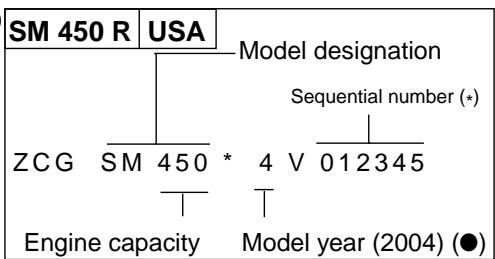
flowchart
graph TD
    A["SM 450 R"] --> B["USA"]
    B --> C["Model designation"]
    C --> D["Sequential number (*)"]
    D --> E["ZCG SM 450 * 4 V 012345"]
    E --> F["Engine capacity"]
    F --> G["Model year (2004) (●)"]
natural_image
Close-up of a hand operating a motorcycle with visible engine and wheel (no text or symbols)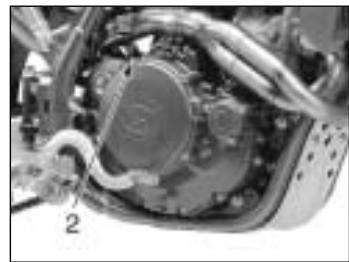
natural_image
Close-up of a mechanical component with visible gears and tubing (no text or symbols)- Matricola telaio
- Matricola motore
- Frame serial number
-
Engine serial number
-
Matricule cadre
- Matricule moteur
- Rahmen Nr.
- Motor Nr.
- Matrìcule bastidor
- Matricule motor
11
SM 400R
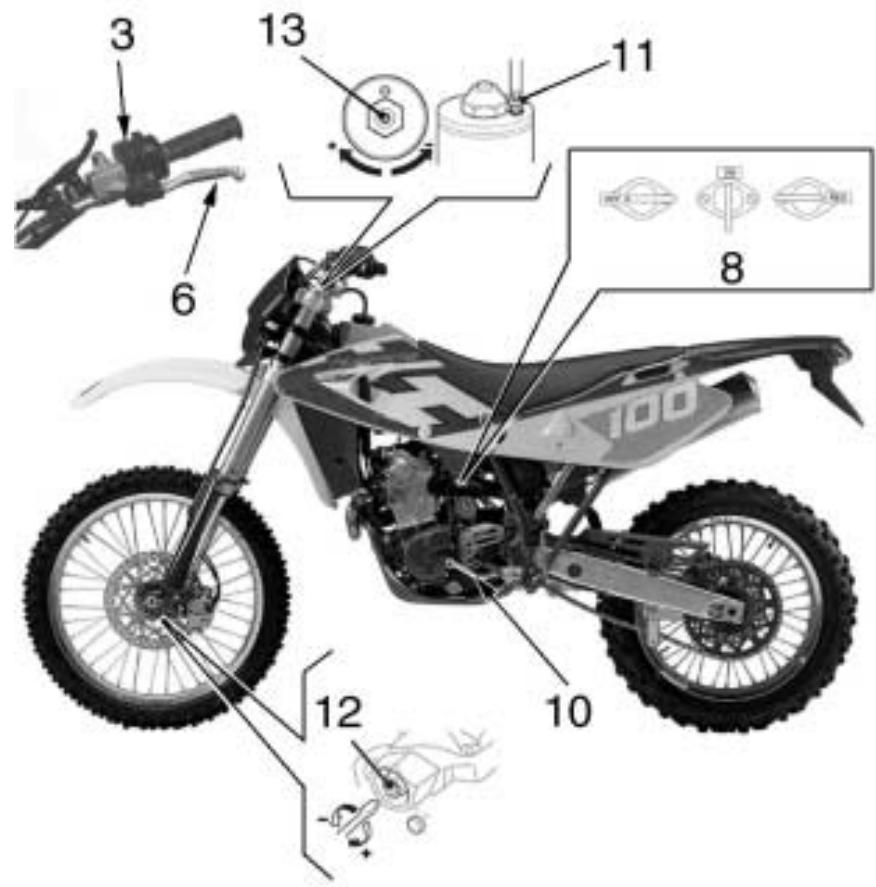
UBICAZIONE COMANDI
- Front brake lever
- Throttle grip
- L.H. commutator (TE, SMR);
- Engine stop button (USA and TC)
- Rear brake control pedal
- Choke (R.H. side)
- Clutch control lever
- Fuel tank filler cap
- Fuel cock
POSITION DES COMMANDES
- Commutatore destro (avviamento elettrico motore)
- Pedale comando cambio
- Vite scarico aria per stelo forcella
- Registrazione compressione per stelo forcella
- Registrazione estensione per stelo forcella
- Registrazione precarico molla ammortizzatore
- Registrazione compressione ammortizzatore (bassa ed alta velocità di ammortizzazaione)
-
Registrazione estensione ammortizzatore
-
R.H. commutator (engine electric start)
- Gearbox control pedal
- Air bleeding screw on front fork leg
- Compression damper adjustment (front fork leg bottom side)
- Extension damper adjustment (front fork leg top side)
- Rear shock absorber spring preload adjustment
- Rear shock absorber compression damper adjustment (low and high damping speeds)
-
Rear shock absorber extension damper adjustment
-
Commutateur droite (démarrage électrique moteur)
- Pédale de commande boîte des vitesses
- Vis de sortie d'air pour tige fourche
- Réglage compression pour tige fourche
- Réglage extension pour tige fourche
- Réglage précharge ressort amortisseur
- Réglage compression amortisseur (basse et haute vitesses d' amortissement)
-
Réglage extension amortisseur
-
R. Umschalter (Electrisch Motoranlassknopf)
- Gangschaltungspedal
- Ablaßschraube für Gabelschaft
- Kompressions-Einstellung für Gabelschaft
- Einstellung der
Ausfederung des Gabelschafts - Einstellung der
Federvorladung des Stoßdämpfers - Einstellung der
Kompression des
Stoßdämpfers (niedrige und hohe Geschwindigkeit der Dämpfung) -
Einstellung der
Ausfederung des Stoßdämpfers -
Conmutador derecho (arranque electrico del motor)
- Pedal mando cambio de marchas
- Tornillo descarga aire para vástago horquilla
- Ajuste compresión para vástago horquilla
- Ajuste extensión para vástago horquilla
- Ajuste precarga muelle amortiguador
- Ajuste compresión amortiguador (baja y alta velocidad de amortiguación)
- Ajuste extensión amortiguador
DATI TECNICI
MOTORE
Tipo.....monocilindrico a 4 tempi
Raffreddamento ......a liquido
Type......single cylinder, 4 stroke
Cooling ....liquid
Bore (250)....2.99 in.
Bore (400)....3.6 in.
Bore (450)....3.81 in.
Stroke (250)....2.17 in.
Stroke (400-450)......2.39 in.
Displacement (250)....15.22 cu. in.
Displacement (400)......24.37 cu. in.
Displacement (450)......27.39 cu. in.
Compression ratio (250)....12,5:1
Compression ratio (400-450) ......12:1
Starting.....electric (with automatic decompressor)
TIMING SYSTEM
Type ......double overhead camshaft; 4 valve
Tappet clearance with engine cold
Intake....0,006 in.
Exhaust 0,008 in.
DONNEES TECHNIQUES
MOTEUR
Type....Dry sump with two oil pump rotor and cartridge filter
IGNITION
Type ....C.D.I. electronic, with variable advance (digital control)
Spark plug type ......NGK CR8EB
Spark plug gap....0.027 in.
LUBRIFICATION
Type (TE 250) ......“Mikuni” TMR 36 with acceleration pump and T.P.S. (Throttle Position Sensor)
Type (TC 250-SM 400 R) "Mikuni" TMR 38 with acceleration pump and T.P.S. (Throttle Position Sensor)
Type (450)...“Mikuni” TMR 41 with acceleration pump and T.P.S. (Throttle Position Sensor)
Venturi diameter (TE 250 ....1.42 in.
Venturi diameter (TC 250-SM 400 R)....1.50 in.
Venturi diameter (450)......1.61 in.
High speed jet (TE 250)....150
High speed jet (TC 250) 155
High speed jet (SM 400 R)....165
High speed jet (450) 175
Low speed jet (250) 22,5
Low speed jet (SM 400R)....25
Low speed jet (TE, SMR 450)....30
Low speed jet (TC 450)....32,5
Throttle piston....1.0
Metering pin....52
Metering pin groove
(TE 250, TE-TC-SM 450 R)....3rd
Metering pin groove
(TC 250 - SM 400 R)......4th
Main nozzle ......P4
Idle mixture adjusting screw (250-400) (turns)..2
Idle mixture adjusting screw (450) (turns). 1+3/4
Acceleration pump jet (TE 250, TE 450, TC
450, SMR 450-SMR 400)....30
Acceleration pump jet (TC 250)....35
PRIMARY DRIVE
Drive pinion gear (250) ......z 24
Drive pinion gear (400-450)......z 27
Clutch ring gear (250)......z 88
Clutch ring gear (400-450)......z 85
Transmission ratio (250) 3,667
Transmission ratio (400-450) 3,148
CARBURATEUR
Gicleur principal (SM 400 R)....165
Gicleur principal (450)....175
Gicleur ralenti (250)......22,5
Gicleur ralenti (SM400 R)......25
Gicleur ralenti (TE, SMR 450) 30
Gicleur ralenti (TC 450).... 32,5
Şoupape gaz....1.0
Epingle conique....52
Type.....oil bath multiple disc clutch, hydraulic control
TRANSMISSION
Type ....constant mesh gear type Transmission ratio (TE-SMR)
1st gear 2,000 (z 28/14)
2nd gear....1,611 (z 29/18)
3rd gear....1,315 (z 25/19)
Transmission ratio (TC)
Transmission ratio (TC-TE 250)....3,846
Transmission ratio (TE 450)....3,571
Transmission ratio (TC 450)......3,333
Transmission ratio (SMR 400-450) ......3,000
Rear chain size....5/8"x1/4"
(* SMR 450: OUTFIT Z=16 : in case of racing use).
EMBRAYAGE
| 1st gear (TE 250) | 28,205 |
| 1st gear (TC 250) | 26,325 |
| 1st gear (TE 450) | 22,487 |
| 1st gear (TC 450) | 19,588 |
| 1st gear (SMR 400-450) | 18,889 |
| 2nd gear (TE 250) | 22,721 |
| 2nd gear (TC 250) | 21,569 |
| 2nd gear (TE 450) | 18,114 |
| 2nd gear (TC 450) | 16,049 |
| 2nd gear (SMR 400-450) | 15,216 |
| 3rd gear (TE 250) | 18,556 |
| 3rd gear (TC 250) | 17,814 |
| 3rd gear (TE 450) | 14,794 |
| 3rd gear (TC 450) | 13,255 |
| 3rd gear (SMR 400-450) | 12,427 |
| 4th gear (TE 250) | 15,329 |
| 4th gear (TC 250) | 15,329 |
| 4th gear (TE 450) | 12,221 |
| 4th gear (TC 450) | 11,406 |
| 4th gear (SMR 400-450) | 10,266 |
| 5th gear (TE 250) | 12,974 |
| 5th gear (TC 250) | 13,461 |
| 5th gear (TE 450) | 10,344 |
| 5th gear (TC 450) | 10,017 |
| 5th gear (SMR 400-450) | 8,689 |
| 6th gear (TE 250) | 11,491 |
| 6th gear (TE 450) | 9,161 |
| 6th gear (SMR 400-450) | 7,695 |
RAPPORTS TOTAUX DE TRANSMISSION
Type ....Single-beam with circular steel tubes; light alloy rear frame
FRONT SUSPENSION
Type .... "Upside-Down" telescopic hydraulic front fork with advanced axle (adjustable in compression and rebound stroke); stanchions tubes ∅ 1.77 in.
Legs axis stroke(TE, TC) 11.8 in.; (SMR) 9.84 in.
REAR SUSPENSION
Type......progressive with hydraulic single shock absorber
Wheel stroke (TE, TC) 12.6 in.
Wheel stroke (SMR)....11.4 in.
FRONT BRAKE
Type....fixed disc 10.24 in. dia (TE, TC). floating disc 12.6 in. dia (SMR)
with hydraulic control; floating caliper (TE, TC) or fixed caliper (SMR)
REAR BRAKE
Type..floating disc (TE, TC), fixed disc (SMR); 8.66 in. with hydraulic control and floating caliper
RIMS
Front (TE, TC) TAKASAGO "Excel" in light alloy: 1,6x21"
Front (SMR)......BEHR in light alloy: 3,50x17"
Rear (TE)......TAKASAGO "Excel" in light alloy: 2,15x18"
Rear (TC) ..... TAKASAGO "Excel" in light alloy: 1,85x19"(250); 2,15x19"(450)
Rear (SMR) ......BEHR in light alloy: 4,25x17"
CADRE
a freddo (anteriore TE, TC)....0,9÷1,0 Kg/cm²
pressure (front TE, TC)....0,9÷1,0 Kg/cm² Cold tire
pressure (rearTE, TC)..... 0,8÷0,9 Kg/cm2
(*)Cold tire pressure
(front SMR).... 1,4 kg/cm²
(●)Cold tire pressure
(front SMR).... 1,8 kg/cm² rider only
(●)Cold tire pressure
(front SMR)....2,0 kg/cm² passenger
(*)Cold tire pressure
(rear SMR).... 1,6kg/cm²
(●)Cold tire pressure
(rear SMR) 2,0 kg/cm ^4 rider only
(●)Cold tire
(rear SMR) 2,2 kg/cm ^2 rider and passenger
(●) Road use
(*) in case of racing use
PNEUS
Avant
(TE) ......Michelin ENDURO COMP. 3 ou Pirelli MT 83 Scorpion; 90/90x21"
(TC)....Pirelli 51R-MT 32A; 80/100 x 21"
(SMR)......Pirelli MTR 21 DRAGON-EVO; 120/70-17"
Arrière
(TE) Michelin ENDURO COMP. 3 ou Pirelli MT 83 Scorpion; 120/90x18" (250); 140/80x18" (450)
(TC)Pirelli NHS (62) MT 32; 100/90x19" (250); 110/90x19" (450)
(SMR) Pirelli MTR 22 DRAGON-EVO; 150/60x17"
(vorder TE, TC)....0,9÷1,0 Kg/cm²
Kaltlufdruck
(hinter TE, TC).... 0,8÷0,9 Kg/cm²
(*)Kaltlufdruck
(vorder SMR).... 1,4 kg/cm²
(●)Kaltlufdruck
(delantero TE, TC)....0,9÷1,0 Kg/cm²
(traseroTE, TC).... 0,8÷0,9 Kg/cm²
DIMENSION, WEIGHT, CAPACITY
Wheelbase (TC 250)....58.46 in.
Wheelbase (TC 450)....58.07 in.
Wheelbase (TE 250)....57.87 in.
Wheelbase (TE 450)....57.48 in.
Wheelbase (SMR 400-450)....58.86 in.
Overall length (TC 250)......86.61 in.
Overall length (TC 450)......85.63 in.
Overall length (TE 250)......88.19 in.
Overall length (TE 450)......87.2 in.
Overall length (SMR 400-450)......86.22 in.
Overall width (TC, TE) ......32.28 in.
Overall width (SMR)....33.27 in.
Overall height (TC 250)....50 in.
Overall height (TC 450)....50.39 in.
Overall height (TE 250)....50.39 in.
Overall height (TE 450)....50.79 in.
Overall height (SMR 400-450)......49.21 in.
Saddle height (TC 250)....38 in.
Saddle height (TC 450)....38.38 in.
Saddle height (TE 250)....38 in.
Saddle height (TE 450)....38.38 in.
Saddle height (SMR 400-450)......35.83 in.
Minimum ground clearance (TC 250) ..13.19 in.
Minimum ground clearance (TC 450) 3.38 in.
Minimum ground clearance (TE 250) 3.19 in.
Minimum ground clearance (TE 450) 3.38 in.
Minimum ground clearance
(SMR 400-450)....10.63 in
DIMENSIONS, POIDS, CAPACITE
Empattement (TC 250) ......mm 1485
Empattement (TC 450) ......mm 1475
Empattement (TE 250) ......mm 1470
Empattement (TE 450) ......mm 1460
Empattement (SMR 400-450).....mm 1495
Dry weight (TC 250) ......229.3 lb
Dry weight (TC 450) ......233.7 lb
Dry weight (TE 250)....232.6 lb
Dry weight (SMR 400)....245.2 lb
Dry weight (TE 450)....237.1 lb
Dry weight (SMR 450)....246 lb
Fuel tank capacity, 1.58 Quarts reserve included.... Gall. 2.03
Coolant capacity..... Quarts 1.6÷1.4
Transmission oil..... Quarts 1.48
The cock, placed on the left side, has three positions:
OFF - Closed; the fuel does not come out;
ON - Open; the fuel flows from the main flux;
RES - Reserve; the fuel flows from the reserve flux.
When difficulties in flowing arise while running, set the right cock lever on RES position.
After filling up, take the cock on ON position again.
WARNING\*: Be careful not to touch the hot engine while operating the fuel valve.
A fuel filter is incorporated in the fuel valves. Accumulation of dirt in the filter will restrict the flow of the fuel to the carburetor. Therefore, the fuel filter should be serviced periodically. To service:
WARNING: BEFORE the following operation, please see the IMPORTANT NOTICE 2) on page 12
1 - Unscrew the filler cap (1) on the fuel tank then place the fuel cock (2) on OFF position;
2 - remove the fuel hose (3) from the carburetor and insert the hose in a vessel;
COMMANDES
ROBINETS CARBURANT
3 - place the fuel cock (2) on ON position in order to eliminate the fuel from the tank;
4 - Remove the fuel valve by removing the screws. Wash the fuel screen filter in cleaning solvent.
5 - Reassemble the fuel valve in the reverse order of removal. Turn the fuel valve "ON" and check for leaks.
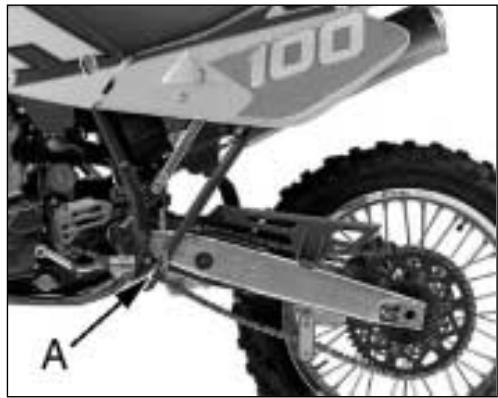
SIDESTAND A sidestand (1) is supplied with every motorcycle.
WARNING*: The stand is designed to support the weight of the MOTORCYCLE ONLY. Do not sit on the motorcycle using the stand for support as this could cause structural failure to the stand and could cause serious bodily injury.
Periodically check the side stand (see “Periodical maintenance card”); check that the springs are not damaged and that the side stand freely moves. If the side stand is noisy, lubricate the fastening pivot (A).
natural_image
Close-up of a motorcycle's front wheel and suspension components, labeled with 'A' and number '100' (no readable text beyond labels)CARBURANTE
Recommended fuel: premium grade unleaded fuel. (R.O.N. 98).
Note*: Do not continue operation if the engine pings or knocks. The engine will be damaged and could seize.
WARNING*: If "knocking" or "pinging" occurs, try a different brand of gasoline or higher octane grade.
WARNING*: Gasoline is extremely flammable and can be explosive under certain conditions. Always stop the engine and do not smoke or allow flames or sparks in the area where the motorcycle is refueled or gasoline is stored.
WARNING*: Do not overfill the tank. After refueling, make sure the tank cap (1) is closed securely.
CARBURANT
natural_image
Close-up of a camouflaged off-road motorcycle with visible tracks and gear (no text or symbols)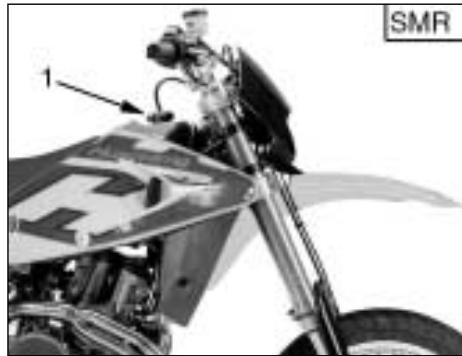
natural_image
Close-up of a motorcycle's front wheel and suspension system, labeled 'SMR' in top right corner (no other text or symbols visible)CARBURETOR CHOKE The starter knob (1), located on the right side of the carburetor, is used to enrich the mixture during the engine start. Pull out the knob to open the starter, and pull the lever upwards to close it.
natural_image
Close-up mechanical assembly of a motorcycle's front wheel and drivetrain, showing engine components and wiring (no text or symbols visible)STRUMENTO DIGITALE, SPIE
DIGITAL INSTRUMENT, WARNING LIGHTS
The motorcycle is equipped with a digital instrument; on the instrument holder are assembled 3 warning lights too: high beam, lights and blinkers.
1- BLUE warning light "HIGH BEAM"
2- GREEN warning light "LIGHTS"
3- GREEN warning light "BLINKERS"
Instrument functions:
- KMH/MPH Speed up to 270 km/h-168 mp/h;
- TRP Trip distance accurate to 10 m-33 ft
(if max values are exceeded, restart from 0);
- AVS average speed, automatic start/stop function (after 10 hours or 1000 km-620 mi, you have to RESET)
- STP stopwatch, starts at the start of journey (maximum 10 hours; if max values are exceeded, restart from 0);
- MAX maximum speed (since last RESET);
- DST total distance up to 99.999 km-62,150 (if max values are exceeded, restart from 0);
- CLK clock.
INSTRUMENT DIGITAL, VOYANTS
(to select the functions, push the RIGHT button)
1) SÉLECTION DE LES
FONCTIONS
( to reset the functions, push the LEFT button approx. 5 seconds)
2) ZÉROTAGE DE LES FONCTIONS
NOTE GENERALI
1) DST and the first figure of total distance are flashing (the power supply has been interrupted due to severe jarring)
- Remove the batteries (see instructions on the next pages), check contacts and clean, if necessary.
- RE-enter DST, WS and CLK (see instructions on the next pages).
2) No speed display
- Check the correct instrument-holding plate fastening.
- Check distance and position of the magnet (see instructions on the next pages).
NOTE: The distance magnet-sensor on the brake caliper must be 2-4 mm/0.08-0.16 in. (otherwise malfunctions on the speedometer might occur). To adjust the distance, screw or unscrew the sensor on the brake caliper.
- Check contacts, clean and bend, if necessary.
- Check the cable for damage.
3) Blackening of the LCD display
- Possible at temperatures above 60^ C- 140^ F.
4) LCD display is sluggish
- Possible at temperatures under 0^ C- 32^ F.
The last two points 3 and 4 not impair the operation of the bike computer: between 1°C and 60°C (34°F-140°F) the display return to normal.
REMARQUES GÉNÉRALES
From "KMH" to "MPH" (MPH=KMH:1.61) procedure
NOTE: before batteries replacement, take note of WS and DST.
Replace batteries (1,5 V- SR 44, D 357) approx. 2 years or as soon as the display fades. To gain access to the instrument, remove the front headlight fairing, the holder fastening screws then the instrument holder.
Open the battery compartment cover with a screwdriver. When changing batteries, please note:
- Observe plus and minus poles. When battery copmartment is open, you shall see PLUS pole.
- After batteries replacement, DST, WS e CLK must be re-entered (see instructions on the next pages). DST is shown as first value on the display.
REEMPLACEMENT DE LES PILES DU COMPTEUR
natural_image
Close-up of a motorcycle's front bumper with a white and black flag, no visible text or symbolsSET WS (setting the wheel circumference)
NOTE: when entering the wheel circumference, CLK must NOT be displayed. Wheel circumference (mm):
WR, TE Models (Enduro): 2223 mm;
SMR Models (Supermotard): 1889 mm.
To reassemble the instrument, reverse the operations.
WR, TE Models (Enduro): 2223 mm;
SMR Models (Supermotard): 1889 mm.
SET WS (setting the wheel circumference)
SET "WS"- WHEEL CIRCUMFERENCE
PROGRAMMATION "WS"- DÉVELOPPEMENT DE LA ROUE
AUSWAHL "WS" - KREISUMFANG RAD
2) PROCEDURA PER PASSARE DA 2155 A 2176
2) FROM 2155 TO 2176 PROCEDURE
2) PROCÉDURE POUR PASSER DE 2155 À 2176
2) PROZEDUR, UM VON 2155 Á. 2176 ZU REICHEN,
2) PROCEDIMIENTO PARA DAR DE 2155 A 2176
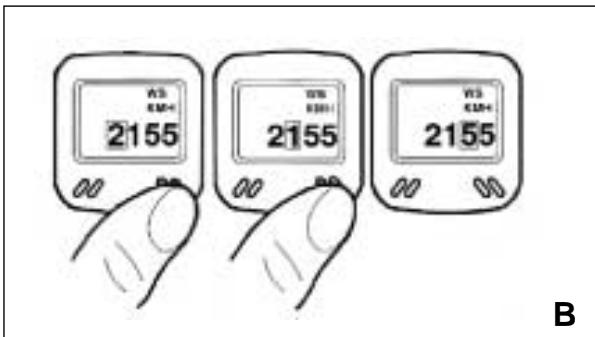
a) Controllare che sia selezionata l'opzione "TRP"e, tenendo premuto per 5 secondi circa il pulsante posteriore, verificare che compaia l'opzione "WS".
a) Make sure that option "TRP" is active then push the REAR button approx. 5 seconds: "WS" appears.
a) S'assurer que l'option "TRP" apparaît bien et appuyer sur la touche ARRIERE durant environ 5 secondes: "WS" apparaît alors.
a) Kontrollieren, daß die Option "TRP"e wird gewählt, da hält es etwa gedrückt pro 5 Sekunden der Hinter Druckknopf, prüfen, daß die Option "WS" erscheint.
a) Controlar que sea seleccionada la opción "TRP" y, teniendo comprimido por 5 segundos acerca la tecla TRASERA, averiguar que comparezca la opción "WS."
b) Passare alla posizione successiva premendo sul pulsante DESTRO
b) Push the RIGHT button to select the next position.
b) En appuyant sur la touche DROITE ou saute au position suivant.
b) zur folgenden Position auf dem RECHTEN Druckknopf drückend, Reichen.
b) Pasar a la posición siguiente comprimiendo sobre la tecla DERECHA.
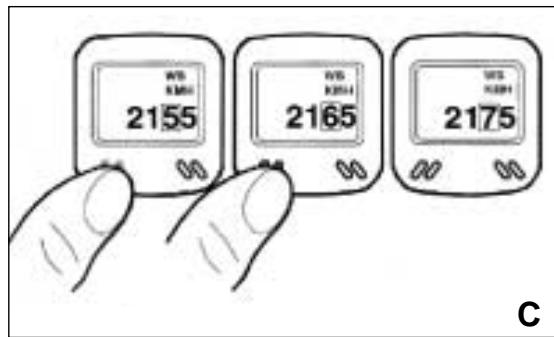
c) Selezionare il dato premendo sul pulsante SINISTRO.
c) Push the LEFT button to select the figure.
c) Appuyer sur la touche GAUCHE pour sélectionner la chiffre
c) das Datum auf dem LINKEN Druckknopf drückend, Wählen.
c) Seleccionar el dato comprimiendo sobre la tecla IZQUIERDA.
D
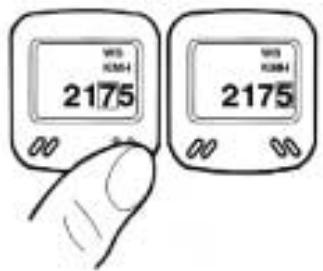
d) Passare alla successiva posizione da modificare premendo sul pulsante DESTRO.
d) Push the RIGHT button to select the next position to be changed.
d) En appuyant sur la touche DROITE on saute au chiffre suivant.
d) zur folgenden Position Reichen auf dem RECHTEN Druckknopf drückend, ändern.
d) Dar a la siguiente posición que modificar comprimiendo sobre la tecla DERECHA.
1 sec
natural_image
Simple line drawing of a square electrical outlet with a circular component and a hanging pin (no text or symbols)F
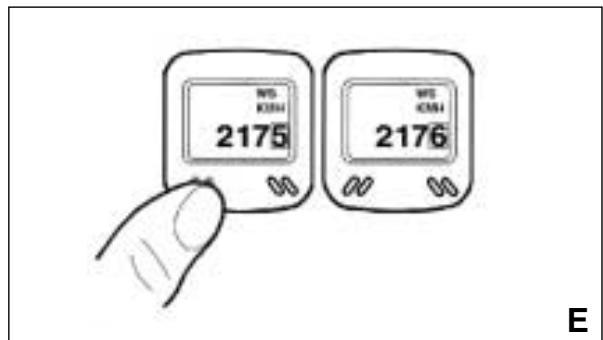
e) Ripetere le istruzioni "b+c" fino ad ottenere la circonferenza ruota corretta (vedi pag 50) premendo sul pulsante DESTRO.
e) Pushing the RIGHT button, repeat "b+c" points until correct wheel circumference is obtained (see page 50).
e) En appuyant sur la touche DROITE, répéter les operations "b+c" jusqu'à ce que soit affichée la valeur correcte du développement (voir page 50).
e) auf dem RECHTEN Druckknopf drückend, die Ausbildungen dünnen "b+c" wiederholen es schwingt im Kreise korrekt, den Kreisumfang zu erhalten (du siehst Seite 51).
e) Repetir las instrucciones "b+c" fino a conseguir la circunferencia correcta de la rueda (ves pág 51) comprimiendo sobre la tecla DERECHA.
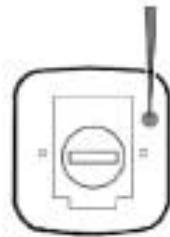
f) Per completare l'operazione tenere premuto per 1 secondo circa, con l'ausilio di una punta, il pulsante posteriore.
f) Push the REAR button for approx. 1 second (using a point) to complete the setting procedure.
f) Terminer l'opération en appuyant durant une seconde environ sur la touche ARRIERE.
f) Um die Operation gedrückt für 1 zu halten zu vervollständigen nach etwa, mit der Hilfe von einer Spitze, der Hinter Druckknopf.
f) Para completar la operación tener comprimido por 1 según acerca, con el auxilio de una punta, el pulsante TRASERO.
2) PROCEDURA PER PASSARE DA 04:15 A06:45
2) FROM 04:15 TO 06:45 PROCEDURE
2) PROCÉDURE POUR PASSER DE 04:15 À 06:4
2) PROZEDUR, UM VON 04:15 Á. 06:45 ZU REICHEN,
2) PROCEDIMIENTO PARA DAR DE 04:15 A06:45
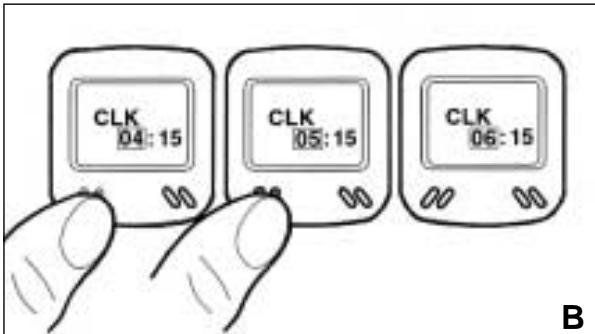
PROGRAMMATION "CLK"-HEURE
AUSWAHL "CLK" - JETZT
SET "DST"- TOTAL MILEAGE
PROGRAMMATION "DST"- KILOMÉTRAGE TOTAL
AUSWAHL "DST" - GESAMTE LEKTÜRE
SELECCION "DST" - LECTURA TOTAL
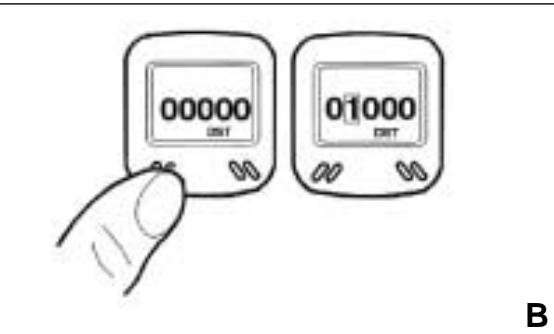
a) Selezionare la posizione da modificare premendo sul pulsante DESTRO.
a) Push the RIGHT button to select the position to be changed
a) En appuyant sur la touche DROITE, sélectionner la position de modifier.
a) die Position Wählen auf dem RECHTEN Druckknopf drückend, ändern.
a) Seleccionar la posición que modificar comprimiendo sobre la tecla DERECHA.
b) Selezionare il dato premendo sul pulsante SINISTRO.
b) Push the LEFT button to select the figure.
b) En appuyant sur la touche GAUCHE, sélectionner la chiffre.
b) das Datum auf dem LINKEN Druckknopf drückend, Wählen.
b) Seleccionar el dato comprimiendo sobre la tecla IZQUIERDA.
C
c) Passare alla successiva posizione da modificare premendo sul pulsante DESTRO.
c) Push the RIGHT button to select the next position to be changed.
c) En appuyant sur la touche DROITE on saute au chiffre suivant.
c) zur folgenden Position Reichen auf dem RECHTEN Druckknopf drückend, ändern.
c) Dar a la siguiente posición que modificar comprimiendo sobre la tecla DERECHA.
1 sec
natural_image
Simple line drawing of a button or switch inside a rounded square frame (no text or symbols)E
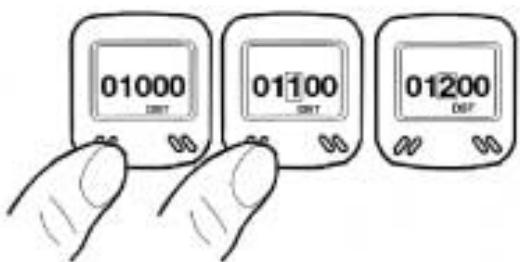
D
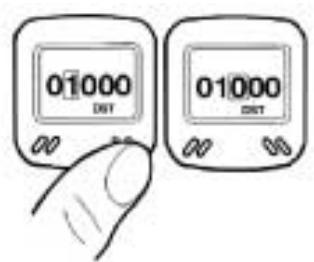
d) Ripetere le istruzioni "b+c" fino a raggiungere la lettura totale registrata in precedenza premendo sul pulsante SINISTRO.
d) Pushing the LEFT button, repeat "b+c" points until previously noted total mileage is obtained.
d) En appuyant sur la touche GAUCHE, répéter les operations"b+c" jusqu'à affichage complet du kilométrage
d) auf dem LINKEN Druckknopf die Ausbildungen "b+c" zu wiederholen drückend, bis zu die gesamte Lektüre eingetragen in Vorrang erreichen.
d) Repetir las instrucciones "b+c" hasta alcanzar la lectura total registrada en precedencia comprimiendo sobre la tecla IZQUIERDA.
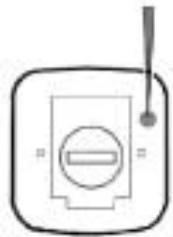
e) Per completare l'operazione tenere premuto per 1 secondo circa, con l'ausilio di una punta, il pulsante posteriore.
e) Push the REAR button for approx. 1 second (using a point) to complete the setting procedure.
e) En appuyant sur la touche ARRIERE durant une seconde environ (avec une pointe) pour terminer l'opération.
e) Um die Operation gedrückt für 1 zu halten zu vervollständigen nach etwa, mit der Hilfe von einer Spitze, der Hinter Druckknopf.
e) Para completar la operación tener comprimido por 1 según acerca, con el auxilio de una punta, el pulsante TRASERO.
COMANDO GAS
The throttle knob (1), is located on the right hand side of the handlebar. The position of the throttle control can be adjusted by loosening the two fastenig screws (*).
POIGNEE DES GAZ
Do not forget to tighten the screws after the adjustment.
ATTENTION
The brake control lever (2) is located on the right hand side of the handlebar. The position of the throttle control can be adjusted by loosening the two fastenig screws (*).
COMMANDE FREIN AVANT
Do not forget to tighten the screws after the adjustment.
ATTENTION
(*) ATTENTION: BEFORE the following operation, please see the IMPORTANT NOTICE on page 12.
(TE, SMR, USA excluded)
The motorcycle is equipped with a steering lock (1) on the R.H. side of the steering head tube.
To lock it, proceed as follows: turn the handlebar leftwards, place the key in lock and turn counterclockwise. Push the key inwards (if necessari, turn to and from). Turn the key clockwise and remove it from the lock.
To unlock the steering lock, reverse the above procedure.
BLOC DE DIRECTION
(TE, SMR, USA exclu)
natural_image
Mechanical assembly diagram showing a motor with attached hoses and gears, no visible text or symbolsVERSIONE "A"
COMMUTATORE DESTRO
SUL MANUBRIO
(TE, SMR, escluso USA)
R.H. HANDLEBAR COMMUTATOR (TE, SMR, USA excluded)
The right switch has the following controls:
1) Engine start button
2) Engine stop button
"B" VERSION
R.H. HANDLEBAR COMMUTATOR (TE, SMR, USA excluded)
The right commutator has the following controls:
1) Engine start button
3) Engine start - stop switch
L.H. HANDLEBAR COMMUTATOR (TE, SMR, escluso USA)
CONTROLS:
1) D^High beam flash (self canceling)
2) D Selection control High beam

Selection control Low beam
3) Left turn signals (automatic return)
→ Right turn signals (automatic return)
To deactivate the turn signals, press the control lever after its returning to center.
4) Warning horn
5) Lighting control of Low beams and High beam

Lighting control of Position light
• Off
VERSION "A"
COMMUTATEUR DROITE SUR LE GUIDON (TE, SMR, USA exclu)
natural_image
Mechanical device with labeled component (1) and handle, no visible text or symbols beyond the number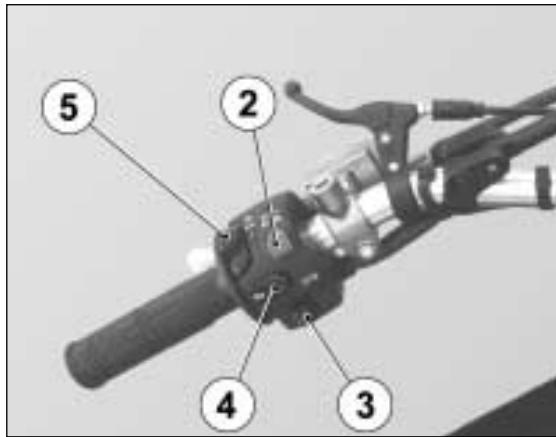
PULSANTE AVVIAMENTO MOTORE (TC, TE-USA)
On the right side of the handlebar, near the front brake control, is located the engine start button (1).
ENGINE STOP BUTTON (TC, TE USA)
On the left side of the handlebar, near the clutch control, is located the engine stop button.
CLUTCH CONTROL
The hydraulic clutch control lever is located on the left-hand side of the handlebar and is protected against dirt with a rubber guard. The clutch control position on the handlebar can be adjusted by loosening the lower fastening screw (A).
CAUTION
Do not forget to tighten the screw after the adjustment.
BOUTON DEMARRAGE MOTEUR (TC, TE-USA)
The rear brake control (1) is placed on the right-hand side of the motorcycle. On models TE, SMR as stop switch, during the braking action, causes the rear light to come on.
natural_image
Close-up of a motorcycle's front wheel and drivetrain assembly, showing tracks, motors, and suspension components (no text or symbols visible)COMANDO CAMBIO
The lever (1) is placed on the left-hand side of the engine. After every shift, the lever automatically returns to neutral position. First gear is engaged by pushing the lever downwards; all the other gears are engaged, by pushing the lever upwards. The position of the gear shift lever on the shaft can be varied by:
- loosening screw;
- pulling lever out;
- placing lever in new position on the shaft when the operation is over tighten the screw and then tightening the screw.
CAUTION*: Do not shift gears without disengaging the clutch and closing the throttle. The engine could be damaged by overspeed and shock.
WARNING*: Do not downshift when traveling at a speed that would force the engine to over-rev in the next lower gear, or cause the rear wheel to lose traction.
COMMANDE DU CHANGEMENT DE VITESSES
Before each ride, to prevent accidents or failures during ride, make sure to go through following list.
ATTENTION: BEFORE the following operation, please see the IMPORTANT NOTICE 2) on page 12
1. Check all fluids
A. Engine-transmission oil level
B. fuel level
C. coolant level
Make sure all caps are properly adjusted.
WARNING\*: Don't remove radiator cap when hot!
2. Check all controls
A. Throttle handgrip
B. Clutch lever device
Make sure cables are not damaged and turn smoothly.
3. Check brakes
Look for brake fluid leaks and worn cables. Check for proper functioning.
4. Check suspensions
Compress fork and rear suspensions. Look for oil leaks and ensure proper functioning.
MODE D'EMPLOI DE LA MOTO
CONTROLES PRELIMINAIRES ATTENTION!
Check spokes and look for worn bearings.
Check rims and tyres.
Check tyre pressure.
- Check chain rollers and sprockets
Check wear on chain rollers and sprockets Ensure chain is correctly adjusted and lubricated.
- Check air filter and intake system
Check that air filter is clean Check all rubber connections and clamps.
- Check exhaust system
Check hook up, look for cracks Check muffler.
- Check torque
A. Spark plug
B. Cylinder-head nuts
C. General check of torque
- Check steering action
Check bearing play.
- Check the electric system (TE, SMR, Enduro USA). Start the engine and check that the front and rear lamps, the stop light, the turn signals (Enduro USA excluded), the cluster warning lights and the horn (Enduro USA excluded) are working correctly.
WARNING*: Failure to perform these checks every day before you ride may result in serous damage or a severe accident.
- Contrôle des roues
With cold engine, as after a prolonged inactivity of the motorcycle or in presence of a low external temperature, proceed as follows:
1) set fuel cock (1) on ON position;
2) shift the transmission into neutral position;
3) pull the starter knob (2);
4) turn twice completely the throttle control grip (3);
5) while maintaining slowly open the throttle control grip, press the start button (4).
"A" VERSION
-press the start button (4).
"B" VERSION
- press the engine start-stop switch (B) then the start button (4).
WITH WARM ENGINE, DO NOT CARRY-OUT ITEMS no. 3 AND 4.
DÉMARRAGE DU MOTEUR
natural_image
Close-up of a motorcyclist's front wheel and suspension system, showing gear and wheelbase components (no text or symbols visible)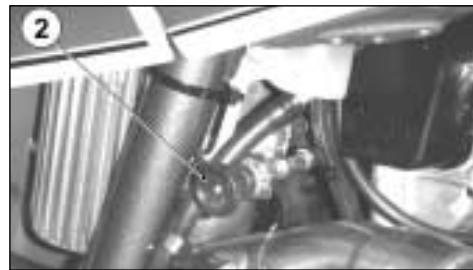
natural_image
Close-up of mechanical components with no visible text or symbols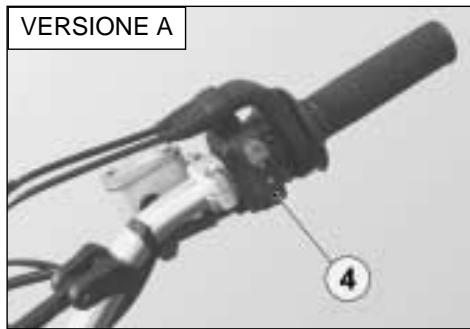
VERSIONE "A"
natural_image
Top-down view of a motorcycle's front wheel and side-mounted sensors (no visible text or symbols)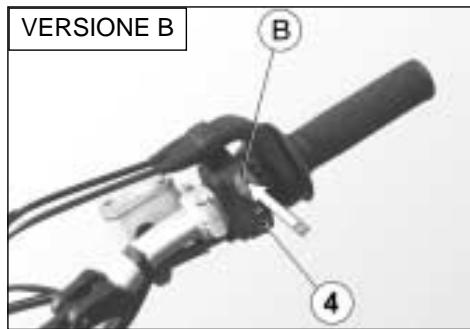
Starting decompressor
Though the engine is provided with an automatic decompressor, can be necessary, in some cases (carburetor flooding or starting difficulties due to a battery inadequate charge), to use the manual starting decompressor on the L.H. side of the handlebar. In these cases, pull the lever (5) whilst simultaneously pressing the starter button, release the lever (5) keeping the button pressed and afterwards release the latter as well.
In order to adjust the lever decompressor free play (approximately 3 mm-0.12 in.), the lever holder is provided with the adjuster (6); the adjustment can be also effected with the tightener (7) on the R.H. side of the engine (use this tightener if it is not possible to obtain the correct free play with the adjuster on the handlebar).
natural_image
Close-up of mechanical components including hoses and a valve, no visible text or symbols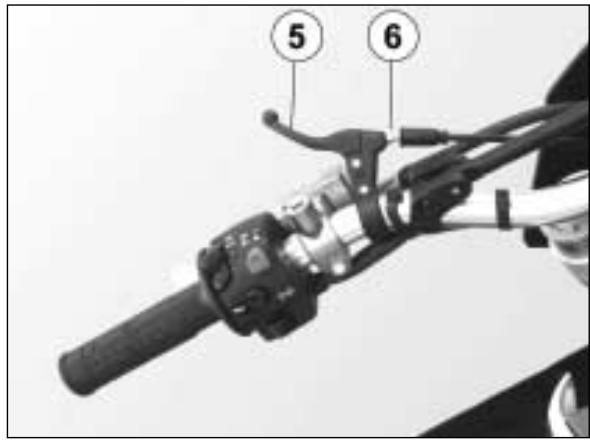
NOTA IMPORTANTE IN CASO DI AVVIAMENTO A FREDDO A BASSE TEMPERATURE
It is recommended to briefly warm-up the engine at idle until, after having disengaged the starter, there is a normal response from the engine when opening the throttle. Avoid overheating the engine.
In this way the oil can reach all the surfaces needing lubrication and the coolant will reach the necessary temperature for correct engine function.
IMPORTANT
Never accelerate the engine after a cold start.
WARNING*: Exhaust contains poisonous carbon monoxide gas. Never run the engine in a closed garage or in a confined area.
In the case of using a kick-starter supplied by KIT, keep in mind the undermentioned note.
WARNING*: This high performance motorcycle can some times «kick back» strongly when you are starting it.
Do not attempt to start this motorcycle unless you are wearing high top heavy sided riding boots. You could seriously hurt you leg if the kickstarter kicked back and your foot slipped.
NOTE IMPORTANT DANS LE CAS DE LA MISE EN ROUTE A' FROID ET TEMPERATURES BAS
STOPPING THE MOTORCYCLE AND THE ENGINE
- Close the throttle (1) completely so that the engine will help slow down the motorcycle.
- For normal braking, gradually apply both front and rear brakes while down shifting (for maximum deceleration, apply the front and rear brakes firmly).
- When stopped, pull the clutch lever and shift gear lever (2) in neutral position.
- Press the engine stop RED button (3).
- Close the fuel cock (4).
ARRET DU MOTOCYCLE ET DU MOTEUR
WARNING*: Independent use of the front or rear brake maybe advantageous under certain conditions. Use caution when using the front brake, especially on slippery surfaces. Improper use of the brakes can lead to a serious crash.
natural_image
Close-up of a motorcycle's front wheel and side-mounted lever mechanism (no visible text or symbols)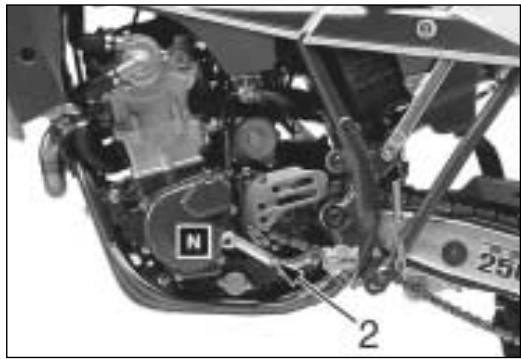
natural_image
Close-up mechanical assembly of a motorcycle's wheel and suspension system (no visible text or symbols)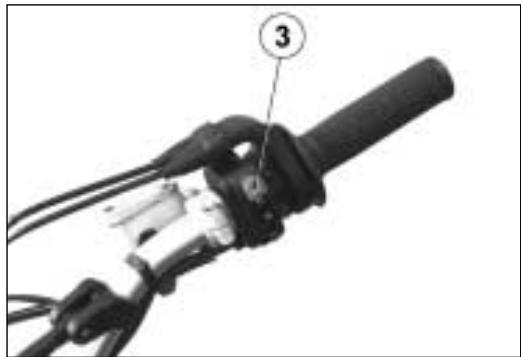
natural_image
Close-up of a mechanical tool with labeled component (3), no visible text or symbols beyond the number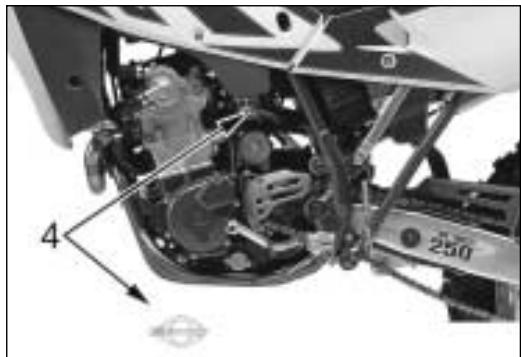
natural_image
Close-up mechanical assembly diagram showing internal components and a numbered label (4), no readable text or symbols present.NOTA
If the fuel tap is not tight, the carburetor could flood, and fuel will get into the crankcrase.
The engine will be impossible to start until the fuel is drained out.
WARNING*: In the event of stuck throttle or other malfunction which causes the engine to run uncontrollably, IMMEDIATELY depress the engine stop button and hold it down. Control the motorcycle by normal use of the brakes and steering while holding the engine stop button down.
AVIS
Before using the motorcycle for sporting activities run in the engine for two hours at least to increase the life and the performance of the engine.
During the first half-hour of driving we advise keeping a low speed and avoiding sudden accelerations. Never open the throttle fully.
Change the oil and carry out all the necessary maintenance operations. After the first half-hour of driving, lightly increase the rev number, but never run the engine at full throttle. Never keep low speeds when the high gears are inserted. Slowly drive the motorcycle for two hours before using it for sporting activities.
RODAGE
CHECKS WHILE RUNNING IN
ATTENTION: BEFORE the following operation, please see the IMPORTANT NOTICE 2) on page 12
- SPOKE TENSION OF WHEELS (see page 224);
- TIGHTENING OF WHEELS (see page 254-258);
- FORK PIN TIGHTENING (see page 254);
- CHAIN ADJUSTMENT (see page 150);
- STEERING BEARING PLAY (see page 120);
- HANDLEBAR TIGHTENING (see page 254);
- ENGINE GRIP TO FRAME (see page 254);
- SUCTION FITTING GRIP (see page 252);
- HEAD AND CYLINDER NUTS GRIP (see page 252)
- OFTEN CHECK THE BATTERY CHARGE CONDITION (see page 236.)
CONTROLES PENDANT LE RODAGE
CHECKING THE OIL LEVEL ATTENTION: BEFORE the following operation, please see the IMPORTANT NOTICE 2) on page 12
By keeping the motorcycle on a flat surface, in vertical position, remove the control screw (1) and check the oil should just barely escape from the hole on the R.H. cover. To fill up, remove the filler cap (2).
CONTROLE DU NIVEAU DE L'HUILE
Note*: Have this operation made with warmed-up engine.
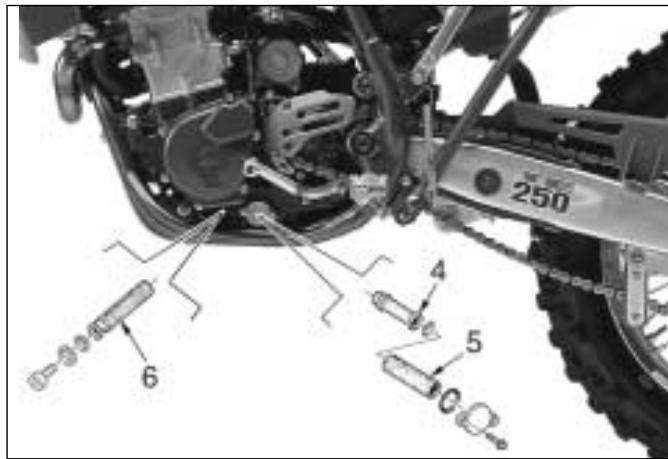
SOSTITUZIONE OLIO MOTORE E PULIZIA- SOSTITUZIONE FILTRI METALLICI ED A CARTUCCIA
ENGINE OIL REPLACEMENT AND BAG FILTERS-FILTER CARTRIDGE CLEANING OR REPLACEMENT
(BEFORE the following operation, please see the IMPORTANT NOTICE 2) on page 12)
Drain the oil with WARM ENGINE; proceed as follows:
- remove oil filler cap (1);
- remove the engine guard (A);
● place an oil drain pan under the engine block;
- remove the oil drain cap (2), drain the used oil completely then clean the magneto on the cap;
VIDANGE D'HUILE MOTEUR ET NETTOYAGE-
REEMPLACEMENT DES FILTRES A TAMIS ET DE LA CARTOUCHE FILTRANTE
- rimuovere i tre filtri metallici (4), (5) e (6) sulla sinistra del motore, controllare le condizioni degli anelli OR ed effettuare la pulizia dei filtri con benzina; procedere inversamente per il rimontaggio;
- per sostituire la cartuccia filtro (3) è necessario svitare le tre viti di fissaggio e rimuovere il coperchietto;
-
una volta sostituiti i filtri, rimontare il tappo di scarico (2), la protezione del motore (A) e versare la prevista quantità di olio.
-
remove the three filters (4), (5) and (6) on the L.H. side of the engine, check O-Rings for wear then clean filters with fuel; reassemble using the reverse procedure;
-
in order to replace the filter cartridge (3), unscrew the three fastening screws then the filter cartridge cover;
● after filters replacement, reassemble the drain cap (2), the engine guard (A) then pour the recommended oil quantity. -
ôter les trois filtres (4), (5) et (6) placés sur le côté gauche du moteur, contrôler les bagues OR et nettoyer les filtres par l'essence, remonter les parties dans l'ordre inverse du démontage;
- pour remplacer la cartouche filtre (3), il faut dévisser les trois vis de fixation et retirer le couvercle de la cartouche filtre;
-
après la substitution des filtres, remonter le bouchon de vidange (2), la protection moteur (A) et remplir avec la juste quantité d'huile.
-
die drei Metall Filter (4), (5) und (6), die auf der Linke des Motors sind, zur Sauberkeit der Filter mit Benzin voranzugehen und die Bedingungen der Ringe OR kontrollieren; zum Anbauen ist in umgekehrter Reinhenfolge zu verfahren;
- zum Wechsel (3) Filtereinsatze drei Befestigungschraube abschrauben und den Deckel abnehmen;
- nach dem Filterswechsel, die Abläßstopfen (2), des Motorschutzes (A) anbauen und durch die Einfüllbohrung die vorgeschriebene Ölmenge einfüllen.
COOLANT LEVEL CHECK ATTENTION: BEFORE the following operation, please see the IMPORTANT NOTICE 2) on page 12
Check level (1) in right-hand radiator when engine is cold (place the motorcycle so that it is perpendicular to the ground). The coolant should be approximately 10 mm above cells.
The radiator cap is provided of two unlocking positions, the first being for the previous pressure discharge in the cooling system.
WARNING
Avoid removing radiator cap when engine is hot, as coolant may spout out and cause scalding.
NOTE
Difficulties may arise in eliminating coolant from varnished surfaces. If this occurs, wash off with water.
REPLACEMENT OF COOLING FLUID
ATTENTION: BEFORE the following operation, please see the IMPORTANT NOTICE 2) on page 12
Place a vessel on the R.H. side of the cylinder, under the coolant drain screw (1).
FIRST remove the screw (1) then SLOWLY open the R.H. radiator
CONTROLE DU NIVEAU REFRIGERANT
natural_image
Close-up of a mechanical assembly showing internal components and a numbered annotation (1), no readable text or symbols present.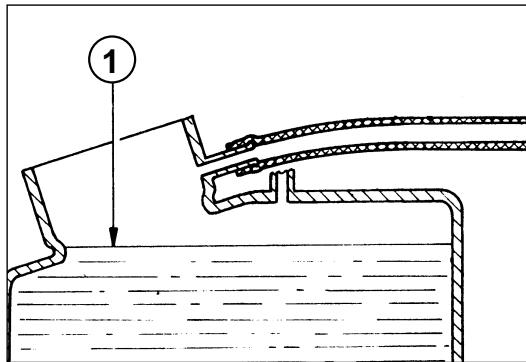
NOTA
natural_image
Close-up of a motorcycle's front wheel and side-mounted sensors (no visible text or symbols)cap; slope the motorcycle on the right side to drain the coolant easily in the vessel. Reassemble the screw (1).
Pour the necessary quantity of coolant in the radiator then warm up the engine in order to eliminate any possible air bubble. Periodically check the connecting hoses (see "Periodical maintenance card"): this will avoid coolant leakages and consequent engine seizure: If hoses (A) show cracks, swelling or hardenings due to sheats desiccation, their replacement shall be advisable.
Check the correct tightening of the clamps (B).
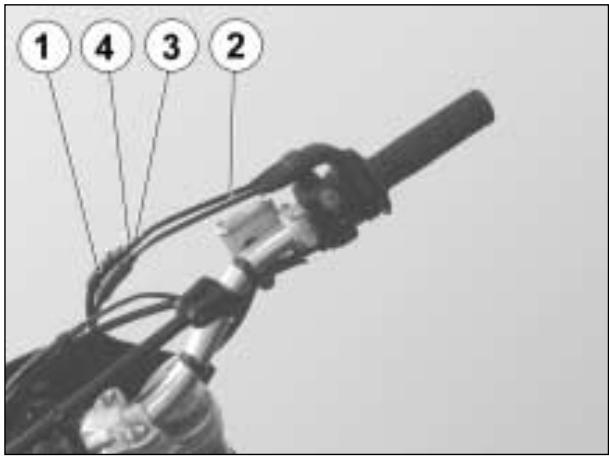
THROTTLE CABLE ADJUSTMENT To check the correct adjustment of the throttle operate as follows:
- remove the upper rubber cap (1);
- by moving cable (2) back and forth check for 2 mm. clearance;
- should the clearance be incorrect, unblock the counter ring-nut (3) and turn the adjusting screw (4) (by unscrewing it, the clearance is reduced, while by screwing screw (4) it is increased);
- tighten the counter ring-nut again (3).
WARNING*: Operation with damaged throttle cable could result in an unsafe riding condition.
REGISTRAZIONE CARBURATORE
Adjust the carburettor with warm engine and with the throttle in closed position.
Work as follows:
- Turn slow running adjusting screw (1) on the left side of the bike, near the fuel cock (turn the screw clockwise to increase the rpm, and anticlockwise to decrease the rpm). - Turn the mix strength adjusting screw (2) either clockwise or anticlockwise to have the engine running as regularly as possible;
STANDARD adjustment: turn adjusting screw clockwise until the fully closed position is reached then turn back of 2 turns (250-400) or 1+3/4 turns (450).
- progressively loosen adjusting screw (1) to obtain the slow running required.
ADJUSTING THE IDLE
Adjust the carburetor with warm engine and with the throttle control in closed position. Proceed as follows:
- Turn slow running adjusting screw (1) on the left side of the bike, near the fuel cock (turn the screw clockwise to increase the rpm, and anticlockwise to decrease the rpm).
natural_image
Close-up of a mechanical assembly with hoses and valves, no visible text or symbols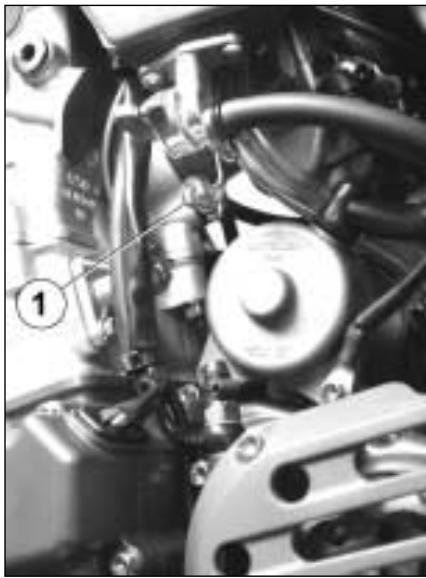
natural_image
Close-up mechanical assembly showing hoses, gears, and a central component (no visible text or symbols)WARNING\*: Exhaust gas contains poisonous carbon monoxide gas. Never run the engine in a closed area or in a confined area.
SPARK PLUG CHECK
If standard spark plug (1) s to be replaced, it is important that new spark plug have the same heat range and thread length.
Correct heat grade:
The tip of the insulator should be dry and the colour should be light brown or grey.
High heat grade:
In this case, the insulator tip is dry and covered with dark deposits.
Low heat grade:
In this case, the spark plug is overheated and insulator tip is vitreous, white or grey in colour.
Check distance between electrodes using a thickness gauge, and adjust distance "A" according to the type of spark plug, as shown on page 28
A wider gap may cause difficulties in starting engine and in overloading coil.
A gap that is too narrow may cause difficulties when accelerating, when idling the engine or when performing at low speeds.
natural_image
Close-up of a motorcycle's internal engine and drivetrain components, showing hoses, gears, and a plug (no text or symbols visible)CAUTION*: Select a spark plug with a colder or hotter heat range carefully and cautiously.
A spark plug with too hot a heat range may lead to preignition and possible engine damage.
A spark plug with too cold a heat range may foul as the result of too much carbon buildup.
Before mounting spark plug, carefully clean electrodes and insulator with a metallic brush.
CAUTION*: Never use a spark plug of an improper heat range.
CAUTION*: The spark plug must be securely tightened. An improperly tightened plug can become very hot and possibly damage the engine.
VOLTAGE REGULATOR
The voltage regulator (1) is fastened on the right side of the frame at the back of the steering sleeve (TE 250, TE-TC-SMR 400-450) or in the lower steering tube zone, behind the front number holder (TC 250).
natural_image
Close-up of a motorcycle's front wheel and suspension system (no visible text or symbols)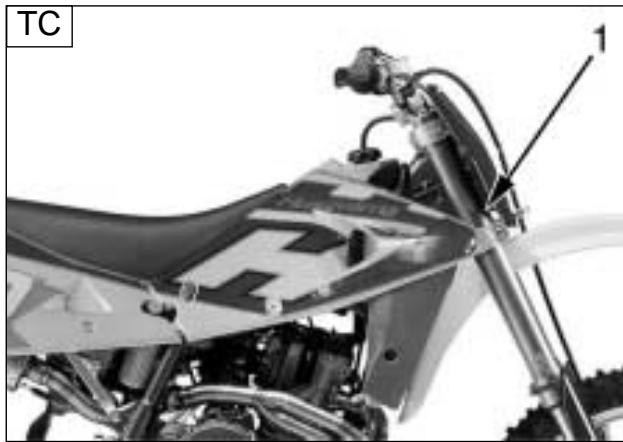
natural_image
Close-up of a motorcycle's front wheel and suspension system (no visible text or symbols)"A" VERSION MOTOCICYCLE DISCONNECT THE BATTERY FROM THE ELECTRIC SYSTEM as described on page. 12 To check the valve clearance, proceed as follows, WITH COLD ENGINE:
First turn counterclockwise fastening rear pin (1) then remove the saddle; Remove vent hose (2) from handlebar; Set the fuel cock (3) on OFF position then loosen clamp (4) on the carburettor fuel hose; remove the hose from the fuel cock. Remove the eight screws (5) which fix the conveyors to fuel tank and recover the bushes under the screws; Remove the conveyors, the four screws (6) which fix the spoilers to the radiators and recover the bushes under the screws; Remove the spoilers, the fuel tank fastening screw (A) and the fuel tank.
REGLAGE DU JEU DES SOUPAPES
natural_image
Close-up of a mechanical component with a labeled bolt and mounting bracket (no readable text or symbols)Remove the spark plug (7), the four cylinder head cover fastening screws (8) and the cylinder head cover; Engage second gear and, moving the vehicle forwards and backwards, bring the piston to Top Dead Center (in this position, the markings on the cylinder head coincide with those placed on the mechanisms of both camshafts, as illustrated in the figure); Check, by means of a feeler gauge, that the valve clearance is 0,15 mm (0.006 in.) for INTAKE and 0,20 mm (0.008 in.) for exhaust;
Otherwise, lift the retaining clip (9) using a hook, let the rocker arm slide to one side, extract the pad with a pair of pliers and check the thickness;
Depending on the result, fit a new pad (as spare parts, pads are supplied ranging from 1.60 mm to 2.60 mm in steps of 0.05 mm) and return the clip and rocker arm;
Check the valve clearance again and, if it's correct, reassembly the removed parts using the reverse procedure.
natural_image
Close-up of a mechanical assembly with numbered components (8 and 7) and no visible text or symbols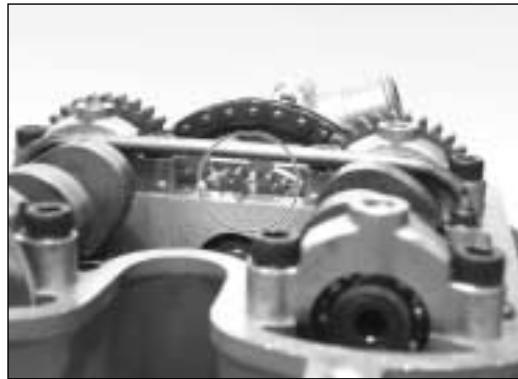
natural_image
Close-up of a mechanical gear assembly with multiple gears and housing (no visible text or symbols)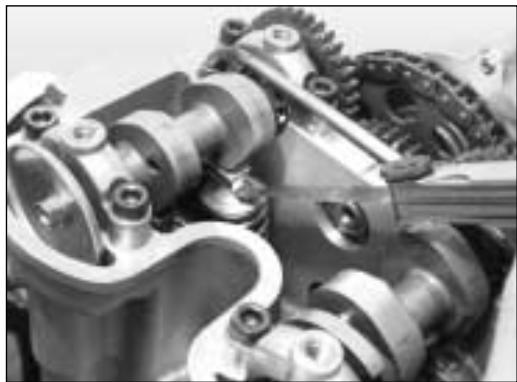
natural_image
Close-up of mechanical gears and shafts in a vehicle (no visible text or symbols)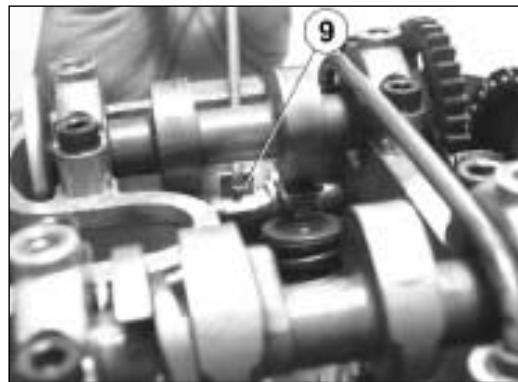
natural_image
Close-up of mechanical components with no visible text or symbolsTurn rear pin (1) counterclockwise, remove the saddle from the front afstening screw.
"A" VERSION MOTOCICYCLE (Page 12) DISCONNECT THE BATTERY FROM THE ELECTRIC SYSTEM as described on page 12.
Turn forward the housing box complete with the battery (1) (it is not necessary to remove the battery from its housing box).
To gain access to the air filter, lift a little the electronic power unit (2).
Remove screw (3) and the filter (4). Separate filter (5) from frame (6).
AIR FILTER AND CLEANING
Wash filter with gasoline and dry it fully. Plunge filter in special oil for filters, then wring it to drain superfluous oil.
CAUTION*: Do not use gasoline or a low flash-point solvent to clean the element. A fire or explosion could result.
CAUTION*: Clean the element in a well ventilated area, and do not allow sparks or flames anywhere near the working area.
ASSEMBLY
To ensure tight fit, slightly (C) grease filter edge on side facing filter housing. While re-inserting the filter into its housing, make surs that piece A is turned upwards and edge B is on the left lower side of the filter case. Reassemble the parts previously removed (battery: connect the positive cable first).
CAUTION*: If the element assembly is not installed correctly, dirt and dust may enter and the engine resulting in rapid wear of the piston rings and cylinder.
CONTROLE FILTRE A AIR
natural_image
Close-up of a mechanical assembly with numbered components (1 and 2), no visible text or symbols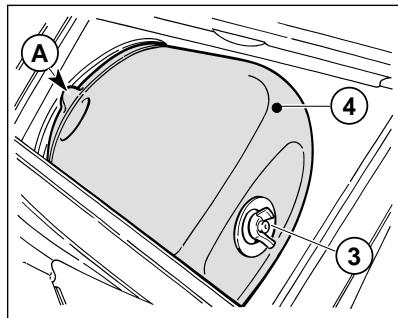
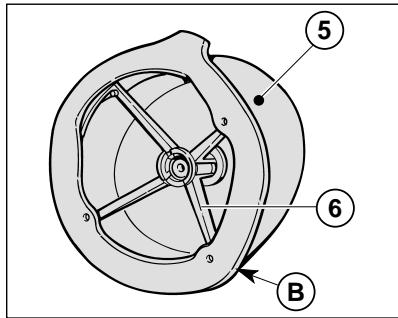
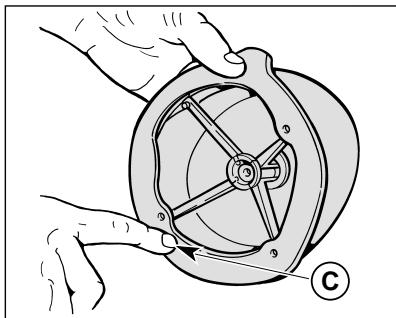
natural_image
Illustration of hands holding a mechanical component with a labeled section (C), no text or symbols present.To ensure maximum safety, the steering wheel should always be regulated so that the handlebars steering the motorcycle rotate freely without play. To check steering wheel adjustment, place kick stand or other support under the engine so that the front wheel is raised from ground. Place slight pressure on the tips of the handlebars to rotate steering wheel; the handlebars should also rotate without effort. Stand in front of the motorcycle and grasp the lower end of the fork rods sliders moving them in the direction of their axis.
REGLAGE DU JEU DES PALIERS DU GUIDON
natural_image
Black-and-white photo of a modified off-road motorcycle with visible tracks, wheels, and a small emblem (no text or symbols)If play is noticed, proceed with adjustment as follows:
- loosen steering sleeve nut (1);
- loosen four screws that fix steering head to fork rods (3);
- Turn the steering ring nut (2) clockwise of the steering sleeve proper tool, to adjust play properly;
- tighten steering sleeve nut (1) to a torque setting of 57,9÷65,1 Lb/ft; (78,4÷88,3 Nm)
- tighten four screws on the steering head (3) to a torque of 22,5÷26,5 Nm (16.6÷19.5 Lb/ft).
CAUTION*: Do not ride a motorcycle with damaged steering stem bearings. An unsafe handling condition can result.
REGOLAZIONE LEVA COMANDO (TE, TC) E CONTROLLO LIVELLO FLUIDO FRENO ANTERIORE (TE, TC, SMR)
BEFORE the following operation, please see the IMPORTANT NOTICE on page 12.
The driver will set the adjustment according to his needs.
Note: free play must be at least 3 mm (0.1 in.).
Turn adjusting nut (2) for the adjustment. The level of the fluid in pump reservoir must never be below the minimum value (1), which can be checked from the window on the rear side of the pump body (TE, TC). For SMR model, check the level on the fluid reservoir.
A decrease of the fuel level will let air into the system, hence an extension of the level stroke.
WARNING*: If the brake lever feels mushy when it is applied, there may be air in the brake lines or the brake may be defective. Since it is dangerous to operate the motorcycle under such conditions, have the brake checked immediately by an authorized HUSQVARNA dealer.
REGLAGE DU LEVIER DU FREIN AVANT (TE, TC) ET CONTRÔLE DU NIVEAU FLUIDE FREIN AVANT (TE, TC, SMR)
natural_image
Close-up of a motorcycle's handle and cable assembly (no visible text or symbols)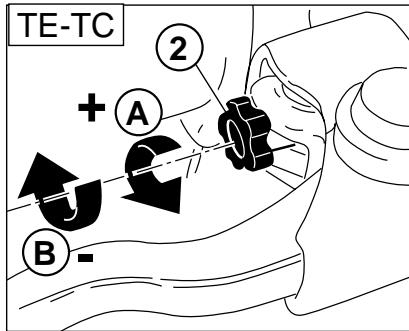
A: to encrease clearance
B: to decrease clearance
natural_image
Close-up of a motorcycle's front wheel assembly with a labeled component (no text or symbols beyond 'SMR')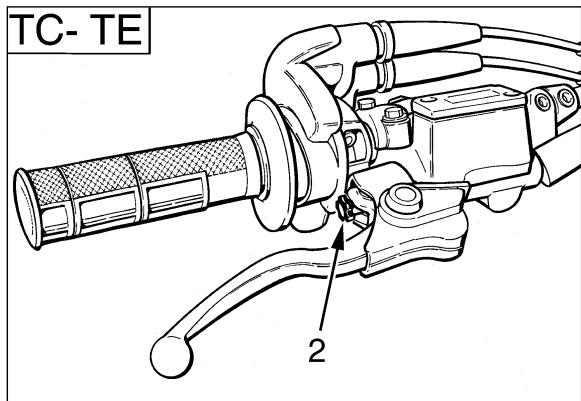
CAUTION*: Do not spill brake fluid on to any painted surface or lenses.
CAUTION*: Do not mix two brands of fluid. Change the brake fluid in the brake line if you wish to switch to another fluid brand.
CAUTION*: Brake fluid may cause irritation. Avoid contact with skin or eyes. In case of contact, flush thoroughly with water and call a doctor if your eyes were exposed.
REAR BRAKE PEDAL POSITION ADJUSTMENT
The position of the rear foot brake pedal as to the footrest may be adjusted according to the individual needs. For the adjusting proceed as follows:
- loosen the screw (1);
- turn the cam (2) in order to adjust the brake pedal idle stroke (A);- the operation done, tighten the screw (1).
The adjusting operation carried out, adjust the idle stroke of the pedal as indicated in page 128.
The rear brake foot pedal should have a (B) 5 mm (0.2 in.) idle stroke before starting the true braking action. Should this not happen as follows:
- loosen nut (3);
- operate the pump rod (4) to increase or decrease the idle stroke;
- tighten nut (3) at the end of the operation.
WARNING
When the idle stroke figures are not met, the brake pads will be subjected to a fast wear that may bring to the TOTAL
CHECKING THE FLUID LEVEL The level (A) must be set between the pump tank notches of MIN and MAX.
RÉGLAGE DE LA COURSE À VIDE DU FREIN ARRIERE
natural_image
Close-up of a mechanical assembly with hoses and components, no visible text or symbolsADJUSTMENT OF THE CONTROL LEVER AND CHECK OF THE HYDRAULIC CLUTCH FLUID LEVEL
The driver will set the adjustment according to his needs.
Note: free play must be at least 3 mm (0.1 in.).
Turn adjusting nut (B) for the adjustment.
To check the fluid level, proceed as follows:
- remove screws (1), cover (2) and rubber pump diaphragm on the handlebar clutch control;
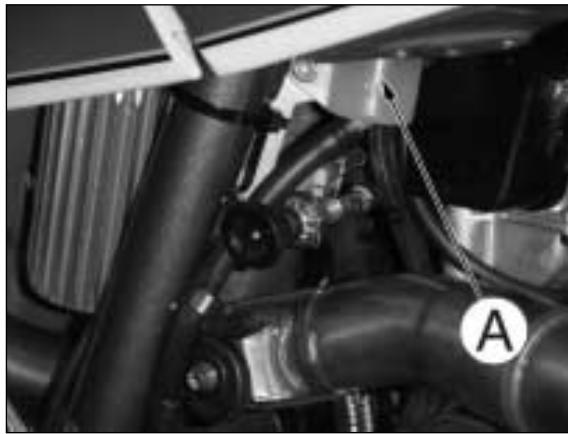
- by keeping the master cylinder (3) in horizontal position, check the fluid level is NOT BELOW 4 mm (0.16 in.) from the upper surface (A) of the pump body;
- if necessary, add fluid until the correct level is reached (see
TABLE FOR LUBRICATION-SUPPLIES for the fluid type page 44)
CAUTION *: NEVER use brake fluid.
Reassembly the removed parts using the reverse procedure.
Periodically check the connecting hose (see “Periodical maintenance card”): if the hose (C) show is bent or cracked, its replacement is advised,
REGLAGE DU LEVIER DE COMMANDE ET CONTRÔLE DU NIVEAU FLUIDE DE
HYDRAULIC CLUTCH BLEEDING
Proceed as follows:
- remove screws (1), cap (2) and rubber pump diaphragm;
- remove the bleeding nipple (3);
- mount a syringe in the bleeding nipple hole, then refill with fresh fluid (see LUBRICATION TABLE on page 44).
CAUTION *: NEVER use brake fluid.
Refill until fluid is discharged from the lower hole (B) on the pump body WITHOUT BUBBLES. The fluid level MUST NEVER BE below 4 mm from the top (A) of the clutch pump body (see picture). Reassemble the removed parts.
PURGE DE L'EMBRAYAGE HYDRAULIQUE
Agir comme suit:
natural_image
Close-up of mechanical components including gears and a valve assembly (no visible text or symbols)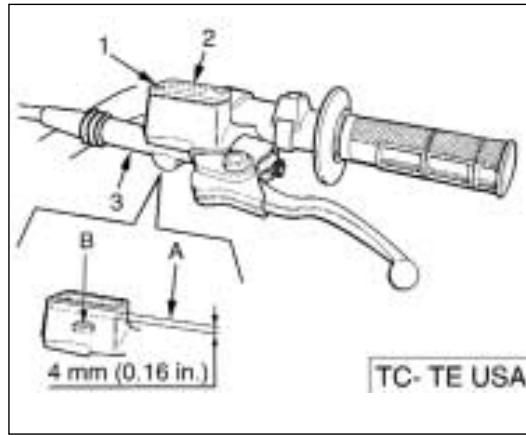
ADJUSTING THE SUSPENSIONS ACCORDING TO PARTICULAR TRACK CONDITIONS
The following information is a useful guide for setting up the suspensions according to the road conditions.
Always start from the standard calibration before making any change on the suspensions. Afterwards, increase or decrease the adjusting clicks one at a time.
HARD GROUND
Fork: softer compression adjustment.
Shock absorber: softer compression adjustment.
The softer adjustment for the two suspensions is also used both in compression and in extension when driving at top speed, in order to have better grip of the tires.
SANDY GROUND
Fork: have a harder compression adjustment, or replace the standard spring with a harder one, and make a softer compression adjustment and a harder extension adjustment at the same time.
Shock absorber: have a harder compression, and especially a harder extension adjustment. Work on the spring preload to lower the motorcycle rear side.
REGLAGE DES SUSPENSION PAR RAPPORT AUX CONDITIONS DE LA PISTE
Fork: have a harder compression adjustment, or replace the standard spring with a harder one.
Shock absorber: have a harder compression and extension adjustments, or replace the standard spring with a harder one. Work on the spring preload to lift the motorcycle rear side. We advise replacing the springs of both suspensions to compensate the weight increase due to the piling of the mud.
NOTE:
When the fork results as either too soft or too hard for any adjustment conditions, check the oil level inside the forkrod. The level can either be too low or too high. Remember that too much oil inside the fork will involve a more frequent air drainage. When the suspensions do not react to the changes of calibration, check that the adjusting units are not blocked.
The standard calibrations and the adjustment procedures are shown on the next pages. The springs available upon request, together with the preload spacers, are shown on pages 262, 264, 266.
TERREIN BOUEUX
natural_image
Black-and-white photo of a motorcyclist mid-jump, wearing helmet and number 52, with 'orcross' visible in background (no readable text on cyclist or terrain)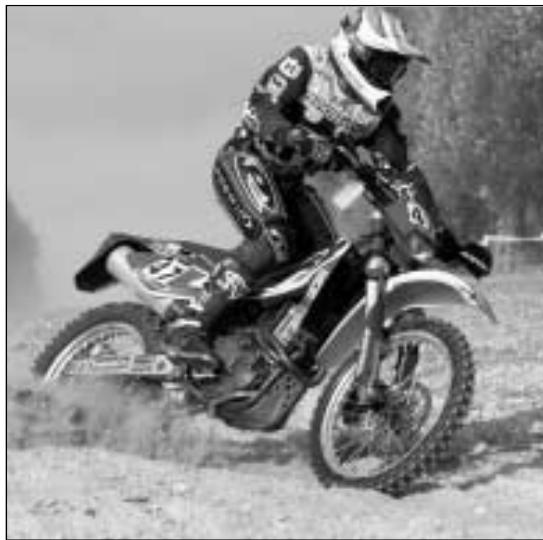
natural_image
Black-and-white photo of a motorcyclist in action on a dirt track, kicking up the tire (no visible text or symbols)
natural_image
Black-and-white photo of a motorcyclist in action on dusty terrain, wearing helmet and number 10 (no visible text or symbols)
natural_image
Black-and-white photo of a motorcyclist in action on a track, wearing helmet and number 100 (no visible text or symbols)Standard calibration: -23 clicks.
Remove plug (B) and turn register (A) clockwise until the position of fully closed is reached then, turn back by the mentioned clicks. To obtain a smoother braking action, turn the register anticlockwise. Reverse the operation in order to obtain a harder action.
b) EXTENSION (UPPER REGISTER)
Standard calibration: - 10 clicks.
To reset standard calibration turn register (C) clockwise to reach the position of fully closed; then, turn back by the mentioned clicks. To obtain a smoother braking action, turn the register anticlockwise. Reverse the operation in order to obtain a harder action.
c) AIR VENT (to carry out after each competition, or monthly). Set the motorcycle on a central stand and release the fork fully and loosen the air vent valve (D). Once this operation is over, tighten the valve.
REGLAGE FOURCHE A COMPRESSION
a) COMPRESSION (REGISTRE INFERIEUR)
chemical
Diagram of electron transfer with positive and negative charges, showing electron movement in a hexagonal ring structure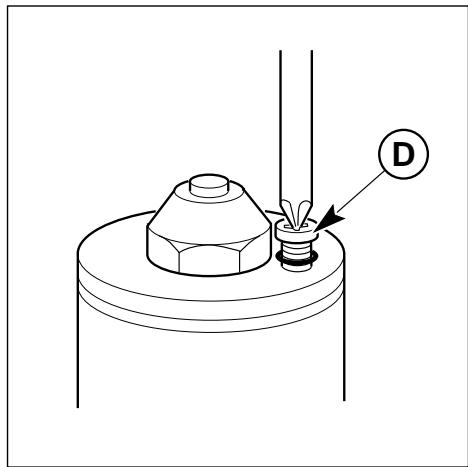
(BEFORE the following operation, please see the IMPORTANT NOTICE 2) on page 12).
For the regular fork operation, both legs must be provided with the necessary oil quantity.
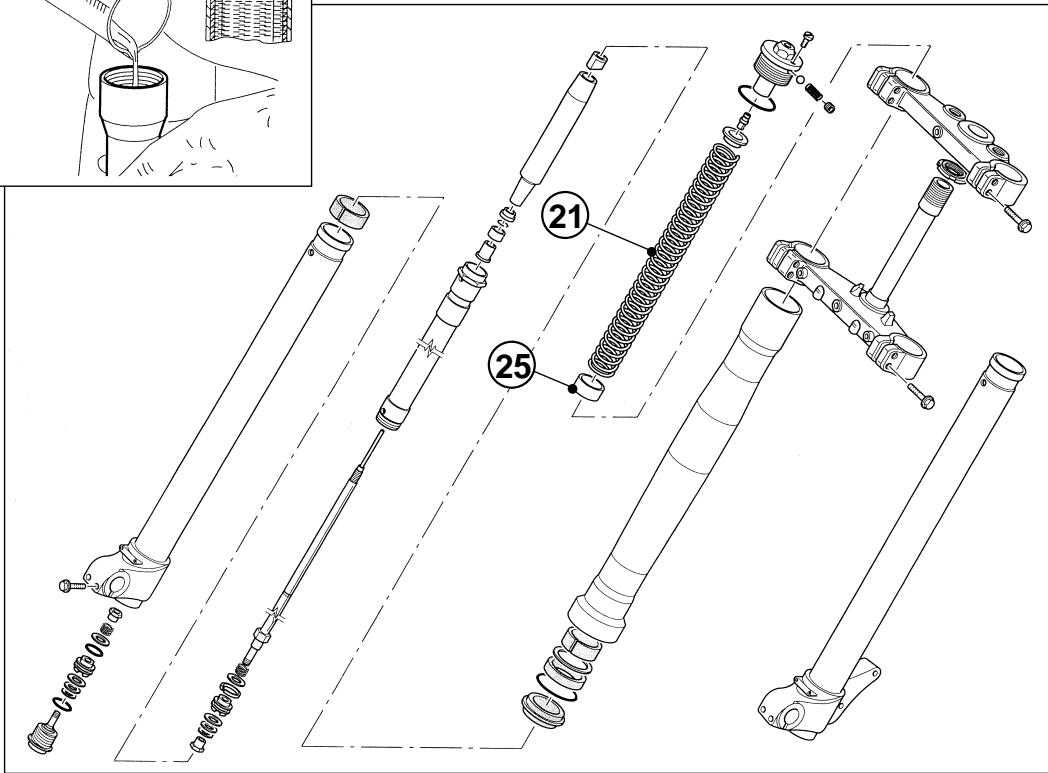
Remove the forkrods form the fork to check the oil level inside the forkrods. Work as follows:
- remove the power rod caps;
- remove springs from the stems letting the oil drop into the latter;
- bring forks to stroke end;
- check that the level is at distance "A" below the upper limit of rods.
NOTE
Besides the serial spring (21) with flexibility index K=4,8 N/mm (TC), K=4,5 (TE), K=5 (SMR) and relevant preload (25) spacer harder or softer springs, together with spacers are abailable upon request. See the list OPTIONAL PARTS on page 262, 264, 266.
NOTE
Always replace both the spring and the spacers to keep the preload value unchanged.
NIVEAU D'HUILE DE LA FOURCHE
A = 80 mm (3.15 in.)
(BEFORE the following operation, please see the IMPORTANT NOTICE 2) on page 12)
The handlebar position can be changed for better suiting Your driving requirements.
To effect the operation, remove the upper screw (3), upper clamp (1), lower screw (4) then lower clamp (2).
Turn the lower clamp (2) 180° to move forward or backward (10mm- 0.04in.) the handlebar position with respect to the original setup.
Once this is completed, tighten the screws (3) to 2,75-3,05 kgm (27-30 Nm; 19.9-22 Lb/fts) and the screws (4) to 2,0-2,2 kgm (19,6-21,6 Nm; 14.5-15.9 Lb/fts).
MODIFICATION DE LA POSITION DU GUIDON
REGISTRAZIONE
AMMORTIZZATORE
The rear shock absorber must be adjusted according to the rider weight and track conditions.
Proceed as follows:
- With motorcycle on the stand, measure distance (A).
- Take the normal riding position on the motorcycle with all your riding apparel.
- With somebody's help, take the new distance (A).
- The difference between these two measurements constitutes the "SAG" of the motorcycle's rear end.
Suggested SAG: 4 in. with cold shock absorber. 3.7 in. with warmed up shock absorber. - To get the right SAG according to your weight, adjust the shock absorber spring preload.
WARNING*: Never disassemble shock absorber, which contains highly compressed nitrogen. Contact your Dealer for such major service. Do not incinerate.
REGLAGE DE
L'AMORTISSEUR
ADJUSTING THE SHOCK ABSORBER SPRING PRELOAD Proceed as follows:
- Clean ringnut (1) and adjusting nut (2) of the spring (3).
- Either with a hook wrench or an aluminium punch, loosen the ringnut.
- Turn the adjusting nut as required.
- When the adjusting operation is over (according to your weight and riding style), tighten the ringnut. (Torque for both ringnuts: 5 Kgm; 49 Nm; 36.2 ft/lb).
WARNING*:Be careful not to touch hot exhaust pipe while adjusting the shock abosrber.
REGISTRAZIONE FRENO IDRAULICO AMMORTIZZATORE
(BEFORE the following operation, please see the IMPORTANT NOTICE 2) on page 12
Adjustment of the compression stroke is independent from the rebound stroke.
A) COMPRESSION - Standard calibration:
1) Low damping speed:
● TE 450: -12 clicks (± 2 clicks)
● TE 250 - SMR 400, 450 - TC 250 - TC 450: -15 clicks (± 2 clicks) (register 4)
2) High damping speed:
● TE 250 - TE 450 - TC 250 - TC 450: -12 clicks (± 2 clicks)
● SMR 400-450: maximum open (register 6)
To reset the standard calibration, turn upper registers (4) and (6) clockwise until reaching fully closed position. Return then back for the mentioned clicks. In order to obtain a smooth braking action, turn the registers anticlockwise. Reverse the operation in order to obtain a harder braking action.
B) EXTENSION - Standard calibration:
● TE 250 - TC 250 - TE 450: -20 clicks (± 2 clicks)
● TE 450: -16 clicks (± 2 clicks)
- SMR 400-450: -12 clicks (± 2 clicks) To reset the standard calibration, turn lower register (5) clockwise until reaching fully closed position. Return then back for the mentioned clicks. In order to obtain a smooth braking action, turn the register anticlockwise. Reverse the operation in order to obtain a harder braking action.
● TE 450: -12 clicks (± 2 clicks)
● TE 250 - SMR 400, 450 - TC 250 - TC 450:-15 clicks (± 2 clicks) (registre 4)
● TE 450: -16 clicks (± 2 clicks)
● TE 450: -12 Klicks (± 2 Klicks)
● TE 250 - SMR 400, 450 - TC 250 - TC 450 15 clicks (± 2 clicks) (Eintellschraube 4)
● TE 450: -16 Klicks (± 2 Klicks)
CHAIN ADJUSTMENT (BEFORE the following operation, please see the IMPORTANT NOTICE 2) on page 12) Chain should be checked, adjusted and lubricated as per the Maintenance Chart to ensure security and prevent excessive wear. If the chains becomes badly worn or is poorly adjusted (i.e., if it is too loose or too taught), it could escape from sprocket or break. To adjust the rear chain it is necessary to lower the rear part of motorcycle so to line up the drive sprocket axle, the rear swing arm axle and the rear wheel axle as shown on drawing. Than let turn three times the rear wheel. Now the chain should not be tight. (Fig. A).
Fast adjustment (Fig. B.). Push the chain towards the final part of runner and check that between the two elements a distance "A" from 0 to 2 mm (0.08 in.) is present.
If this is not the case, go on as follows:
- unloose the fastening nut (1) of the wheel axle on the R.H. side;
- Unloose the lock nuts (2) on both chain adjusters and turn the screws (3) to obtain the correct tension value;
- Tighten the lock nuts.
After adjustment check that the wheel is lined up and tighten its axle.
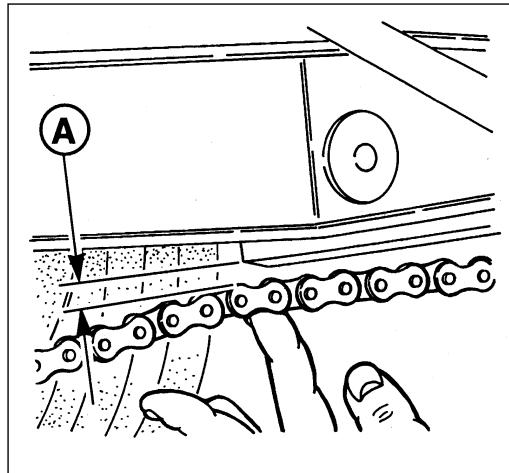
CONTROLLO USURA CATENA, PIGNONE, CORONA
CHECKING THE WEAR OF CHAIN, PINION AND SPROCKET
Proceed as follows:
- Fully stretch the chain with the adjusting screws.
- Mark 20 chain links.
- measure the distance "A" between 1st pin center and 21 st pin center.
| STANDARD | WEAR LIMIT |
| 317,5 mm(12.5 in.) | 323 mm(12.7 in.) |
Check the pinion damages or wear and replace it should the wear degree be as the one shown in figure.
Remove the wheel and check the wear of the rear sproket teeth. The figure shows the outline of teeth in normal and excessive wear. Should the sprocket be badly worn out, replace it by loosening the six fastening screws to the hub.
WARNING*: Misalignment of the wheel will result in abnormal wear and may result in an unsafe riding condition.
Note*: In muddy and wet conditions, mud sticks to the chain and sprockets resulting in an overtight chain. The pinion, the chain, and the rear sprocket wheel wear increases when running on muddy ground.
CONTROLE USURE CHAINE, PIGNON ET COURONNE
Agir comme suit:
natural_image
Close-up of a motorcycle's wheel and suspension components (no text or symbols visible)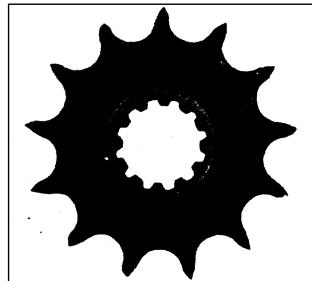
natural_image
Black and white abstract geometric shape resembling a stylized gear or sprocket (no text or symbols)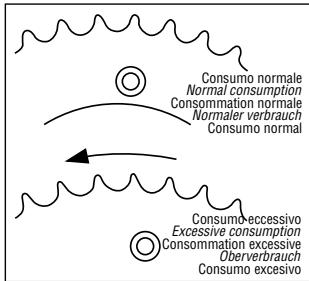
LUBRICATING THE CHAIN ATTENTION: BEFORE the following operation, please see the IMPORTANT NOTICE 2) on page 12.
Lubricate the chain every 300 Km (185 mi.), following these instructions:
WARNING * : Never use grease to lubricate the chain. Grease helps to accumulate dust and mud, which act as abrasive and hepl to rapidly wear out the chain, the sprocket, and the crown.
Disassembling and cleaning When particularly dirty, remove and clean the chain before lubrication.
Work as follows:
Set a stand or a block under the engine and see that the rear wheel is lifted from the ground.
Remove: screws (1), transmission sprocket guard (2), clip (3), master link (4) and transmission chain (5); To reassemble, reverse the above procedure.
natural_image
Side view of a modified electric motor with visible wheels and front-mounted components (no text or symbols)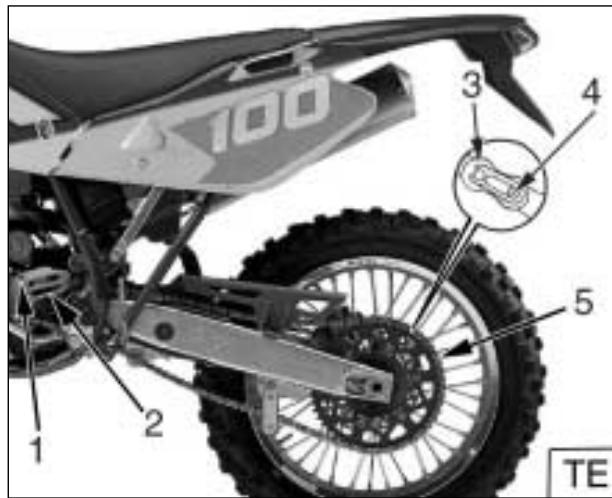
2 - Check that the chain is neither worn out nor damaged. If the rollers or the links are damaged, replace the chain by following the instructions given in the Periodical Maintenance Table.
3 -Check that neither the sprocket nor the crown are damaged.
4 -Wash and clean the chain as described hereunder.
Washing the chain without OR
Wash using either oil or diesel oil. When using gasoline or tricloroetilene, clean and lubricate the chain to prevent oxidation.
Washing the chain with OR
Wash using oil, diesel oil, or paraffin oil. Never use gasoline, tricloroetilene, or solvents, as the OR may suffer damages. Use instead special sprays for chains with OR.
Lubricating the chain without OR
First dry, then plunge the chain in a bisulphide molybdenum lubricant, or in high viscosity engine oil. Warm up the oil before use.
Lubricating the chain with OR
Lubricate all metallic and rubber (OR) elements using a brush, and use engine oil with SAE 80-90 viscosity for the internal and external parts.
5 - If the chain has been cut, reassemble using a joint.
6 -Assemble the joint spring by turning the closed side to the chain direction of rotation as shown in figure.
NOTE * : Even if all the joints are reusable when in good conditions, for safety purposes we advise using new joints when reassembling the chain.
6 -Accurately adjust the chain as described on page 150.
WARNING: The chain oil has NEVER to get in contact with the tires or the rear brake disk.
Chain tension rollers, chain driving roller, chain guide, chain runner
Check the wear of the above mentioned elements and replace them when necessary.
WARNING * : Check the chain guide alignment, and remember that a bent element can cause a rapid wear of the chain. In this case, a chain fleeting from the sprocket may ensue.
1- Rullo tendicatena
2- Rullo guidacatena
3- Guidacatena
4- Pattino catena
1- Chain tension roller
2- Chain driving roller
3- Chain guide
4- Chain slider
Removing the front wheel
Set a stand or a block under the engine and see that the front wheel is lifted from the ground.
Loosen the bolts (1) holding the wheel axle (2) to the front fork stanchions.
Hold the head of the wheel axle (3) in place, unscrew the bolt (3) on the opposite side; draw the wheel axle out.
To reassemble, reverse the above procedure remembering to insert the disc into the caliper.
Do not operate the front brake lever when the wheel has been removed; this causes the caliper piston to move outwards.
After removal, lay down the wheel with brake disc on top. After reassembly, pump the brake control lever until the pads are against the brake disc.
AVIS
natural_image
Close-up of a bicycle wheel with visible components and no text or symbols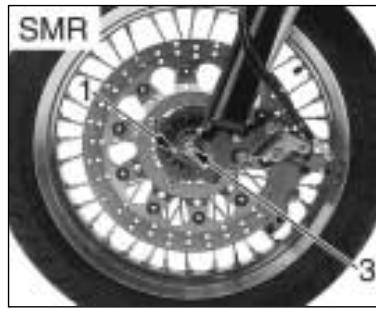
natural_image
Close-up of a bicycle wheel with visible track and hub, labeled 'SMR' and numbered parts 1 and 3 (no text beyond labels)NOTAS
Removing the rear wheel
Unscrew the nut (1) of the wheel pin (3) and extract it. It is not necessary to unloose the chain adjusters (2); in this way, the chain tension will remain unchanged after the reassembly. Extract the complete rear wheel, by taking care of the spacers located at the hub sides. To reassemble, reverse the above procedure remembering to insert the disc into the caliper.
Do not operate the rear brake pedal when the wheel has been removed; this causes the caliper piston to move outwards.
After removal, lay down the wheel with brake disc on top. After reassembly, pump the brake control pedal until the pads are against the brake disc.
AVIS
natural_image
Mechanical assembly diagram showing a wheel and gear mechanism with numbered components (no readable text or symbols)NOTE
Care should be taken to keep the tires properly inflated. See tire data for correct tire inflation pressure (38). Replace the tire if its wear exceeds what is shown on the table below.
PNEUS
| FRONT | 0.12 in. (TC,TE); 0.08 in.(SMR) |
| REAR | 0.12 in. (TC,TE); 0.08 in.(SMR) |
HAUTEUR MINIMALE DE LA BANDE (H)
| AVANT | 3 mm (TC,TE); 2 mm (SMR) |
| ARRIERE | 3 mm (TC,TE); 2 mm (SMR) |
REIFEN
natural_image
Close-up of a mechanical tire assembly with visible teeth and wheel (no text or symbols)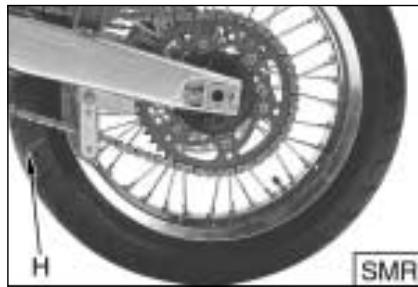
natural_image
Close-up of a motorcycle wheel with visible mechanical components and labeled parts (H, SMR), no readable text or symbols beyond labels.FRENI
ATTENTION: BEFORE the following operation, please see the IMPORTANT NOTICE 2) on page 12.
FREINS
The mayor components are brake master cylinder with its lever (front) or pedal (rear), brakeline, caliper assembly and disc.
- Front brake control lever
- Front brake pump with oil reservoir (TE, TC)
- Front brake pump (SMR)
2A. Oil reservoir (SMR) - Front brake hose
- Front brake caliper
- Front brake disc
- Rear brake oil tank
- Rear brake hose
- Rear brake caliper
- Rear brake disc
- Rear brake pump
- Rear brake control pedal
LEGENDE
USURA PASTIGLIE (TE)
USURA PASTIGLIE (SMR)
Don't operate the brake lever or pedal while removing the pads.
PADS WEAR (TE)
Inspect pads for wear. Service limit "A" is: 3,8 mm (0.15 in.). If service limit is exceeded, always replace the pads in pairs.
PADS WEAR (SMR)
a) In front: thickness "A" must never be lower than the one pointed out by the wear control notches. b) At the back: thickness "A" must never be lower than 3,8 mm. If service limit is exceeded, always replace the pads in pairs.
DEMONTAGE DES PASTILLES DU FREIN
- Enlever les ressorts (1).
- Enlever les pivots (2).
- Enlever les pastilles.
ATTENTION!
PULIZIA PASTIGLIE
Be careful that no disc brake fluid or any oil gets on brake pads or discs. Clean off any fluid or oil that inadvertently gets on the pads or disc with alcohol. Replace the pads with new ones if they cannot be cleaned satisfactorily.
NETTOYAGE DES PASTILLES
- Install new brake pads.
- Reassemble the two pins (1) and the springs (2).
MONTAGE DES PASTILLES
ATTENZIONE!
Do not attempt to ride the motorcycle until the brake lever or pedal are fully effective. Pump the brake lever or pedal until the pads are against the discs. The brake will not function on the first application of the lever or pedal.
ATTENTION!
- Attach a clear plastic hose to the bleed valve on the caliper and turn the other end of the hose into a container.
- Loosen bleed valve so fluid begin to drain.
- Remove master cylinder cap and rubber.
- Pump with brake lever to push brake fluid out of line.
VIDANGE FLUIDE FREIN AVANT
natural_image
Close-up of a bicycle wheel with visible tire, hub, and mechanical components (no text or symbols)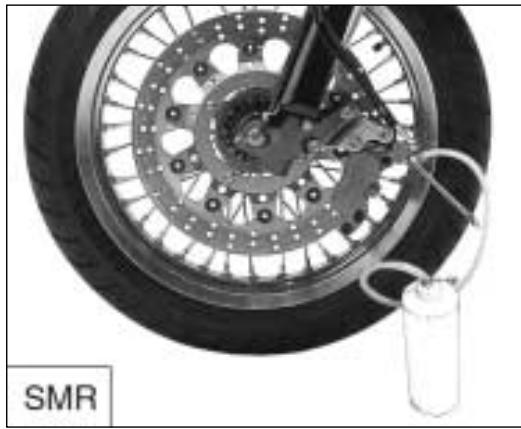
natural_image
Close-up of a motorcycle wheel with visible brake disc and suspension ring, labeled 'SMR' (no other text or symbols)SCARICO FLUIDO FRENO POSTERIORE
- Attach a clear plastic hose to the bleed valve on the caliper and turn the other end of the hose into a container.
- Loosen bleed valve so fluid begins to drain.
- Remove reservoir cap and rubber.
- Pump with brake pedal to push brake fluid out of line.
WARNING!
Brake fluid quickly ruins painted surfaces; any spilled fluid should be completely wiped up immediately.
* Brake fluid may cause irritation. Avoid contact with skin or eyes. In case of contact, flush thoroughly and call a doctor if your eyes were exposed.
Periodically check the connecting hoses (see "Periodical maintenance card"): if the hoses (A) and (B) are worried or cracked, their replacement is advised.
VIDANGE FLUIDE FREIN ARRIERE
natural_image
Mechanical assembly diagram showing a wheel with gear and a shaft, no visible text or symbols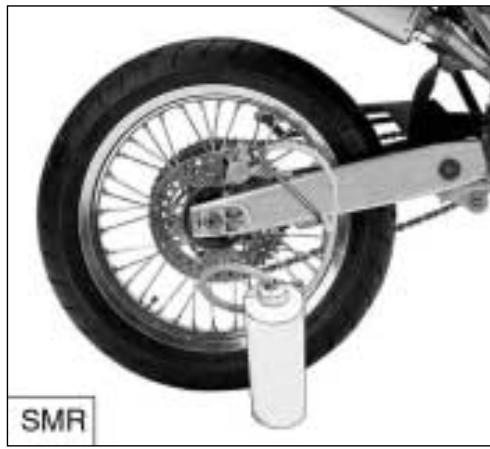
natural_image
Close-up of a motorcycle's wheel and suspension mechanism, showing tire, disc, and brake assembly (no text or symbols)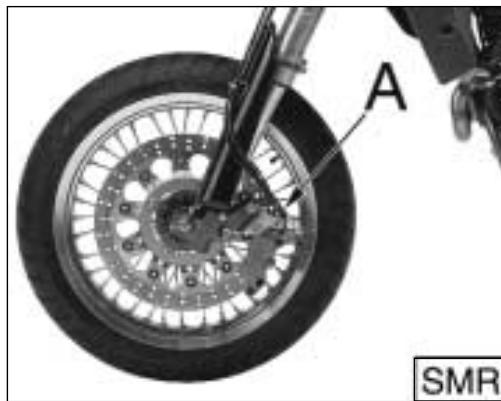
natural_image
Close-up of a motorcycle wheel assembly with labeled component A and SMR watermark (no text or symbols on the diagram itself)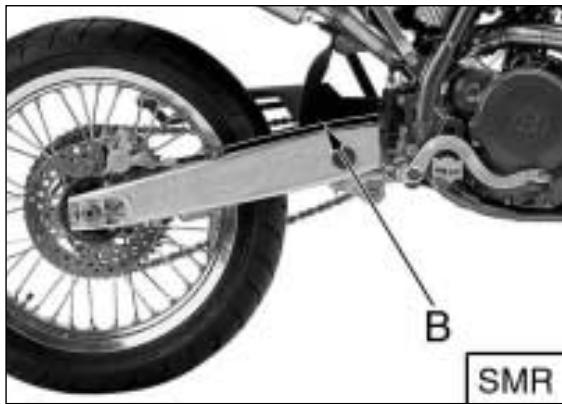
natural_image
Close-up of a motorcycle's wheel and suspension components, labeled B, with SMR watermark (no text beyond labels)USURA DISCO FRENO
Measure the thickness of each disc at the point where it has worn the most. Replace the disc if it has worn past the service limit.
Disc Thickness
| DISC | STANDARD | SERVICE LIMIT |
| Front (TE) | 3 mm(0.118 in.) | 2,5 mm(0.098 in.) |
| Front (SMR) | 4 mm (0.157 in.)or5 mm (0.197 in.) | 3,5 mm (0.157 in.)or4,5 mm (0.177 in.) |
| Rear | 4 mm(0.157 in.) | 3,5 mm0.138 in.) |
Measure disc warpage. Service limit for both discs is 0,15 mm (0.006 in.)
Replace the disc if warpage is more than service limit.
DISQUE PAPILLOTANT
natural_image
Technical line drawing of a bicycle wheel assembly with visible gears and levers (no text or symbols)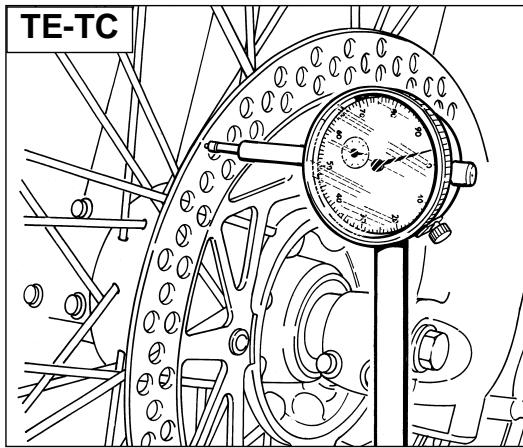
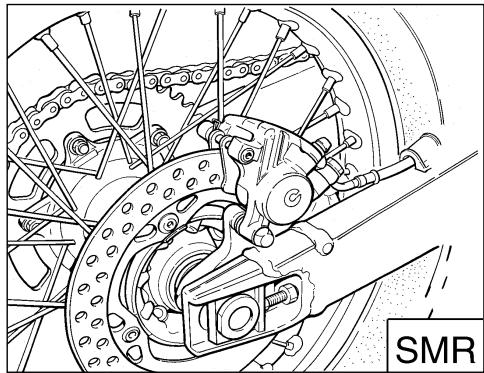
natural_image
Technical line drawing of a bicycle brake system with components like brake calipers and suspension components (no text or labels)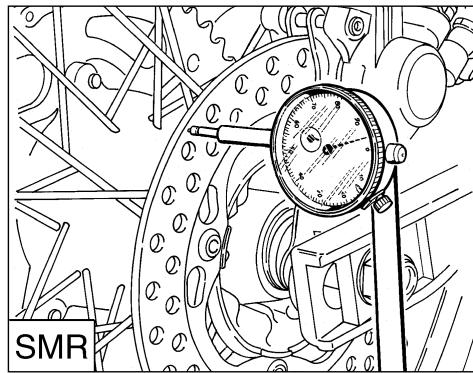
natural_image
Technical line drawing of a mechanical gauge mounted on a rotating component (no text or symbols)PULIZIA DISCO
Poor braking can also be caused by oil on the disc. Oil or grease on the disc must be cleaned off with a high flash-point oil free solvent, such as acetone or lacquer thinner.
NETTOYAGE DU DISQUE
natural_image
Technical line drawing of a bicycle wheel assembly with visible gears and levers (no text or symbols)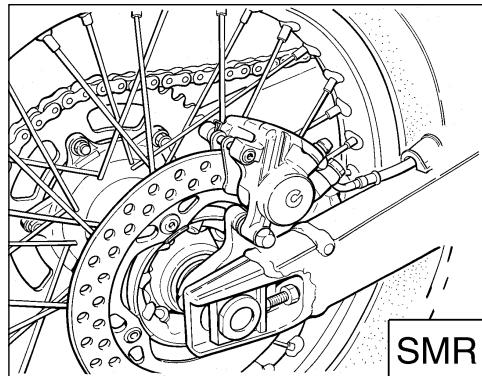
natural_image
Technical line drawing of a mechanical assembly with brake and suspension components (no text or symbols)SOSTITUZIONE FLUIDO
The brake fluid should be checked and changed in accordance with the Periodic Maintenance Chart or whenever it is contaminated with dirt or water. Don't change the fluid in the rain or when a strong wind is blowing.
CAUTION!
* Use only brake fluid from a sealed container (DOT 4). Never use old brake fluid.
* Never allow contaminants (dirt, water, etc.) to enter the brake fluid reservoir.
* Don't leave the reservoir cap off any length of time to avoid moisture contamination of the fluid.
* Handle brake fluid with care because it can damage paint.
* Don't mix two types of fluid for use in the brake. This lowers the brake fluid boiling point and could cause the brake to be ineffective. It may also cause the rubber brake part to deteriorate.
REPLACEMENT DU FLUIDE
- Remove the rubber cap on the bleed valve.
- Attach a clear plastic hose to the bleed valve on the caliper and turn the other end of the hose into a container.
- Open the bleed valve (counterclockwise to open), and pump brake lever or pedal until all the fluid is drained from the line.
- Close the bleed valve and fill the reservoir with fresh brake fluid.
- Open the bleed valve, apply the brake using the brake lever or pedal, close the valve with the brake lever or pedal applied, and then quickly release the lever or the pedal. Repeat this operation until the brake line is filled and fluid starts coming out of the plastic hose.
REMLISSAGE DES SYSTEMES DE FREINAGE
natural_image
Close-up of a bicycle wheel with visible tire, disc, and gear (no text or symbols)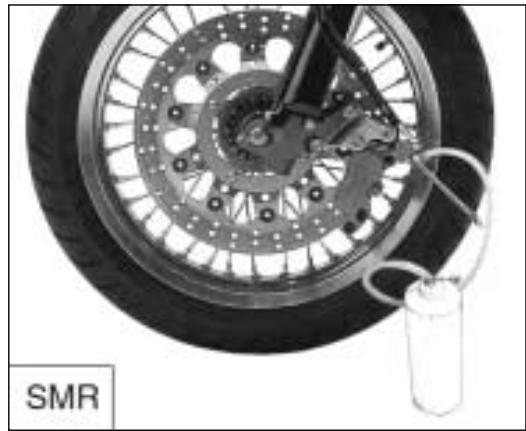
natural_image
Close-up of a bicycle wheel with visible brake disc and suspension ring, labeled 'SMR' (no other text or symbols)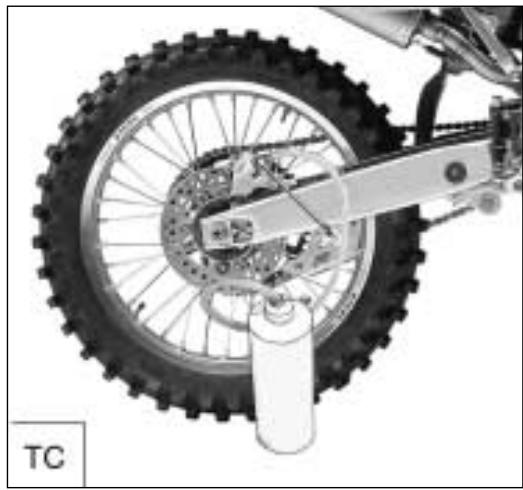
natural_image
Close-up of a bicycle's front wheel and suspension mechanism, showing tire tracks and gear assembly (no text or symbols)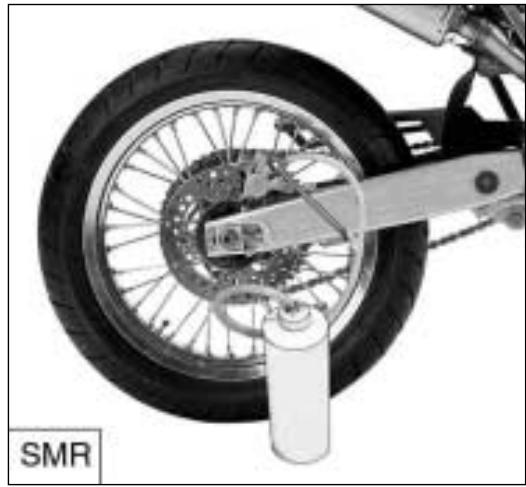
natural_image
Close-up of a motorcycle wheel assembly with visible tire, brake, and suspension components (no text or symbols)SPURGO IMPIANTO FRENANTE ANTERIORE (TE, TC)
The braking system must be bled when, due to air in the circuit, the lever stroke is long and spongy. To bleed the system:
- Disconnect the brake caliper and position it so that the pipe fitting (pump to caliper) is perpendicular to the ground.
- Remove the pump body cover (1).
- Remove the anti-emulsion disc and fill up the tank with new fluid (DOT 4).
- Attach a clear hose to bleed the valve and run into a clear glass container as shown in figure. Make sure that the end of the hose is submerged in brake fluid during the entire bleeding operation.
- Open the bleed valve on the caliper and pump the lever. Allow the pads to contact the disc.
- During this operation, you'll notice that air bubbles will come out of the brake pump reservoir. This is normal. Watch the hose. When new, clear fluid, without bubbles, come out, close the bleed valve.
- Carefully pry the pads apart, using a soft pry bar, forcing them back into the caliper housing.
Repeat the entire sequence until no bubbles are seen at the hose or in reservoir.
Reassemble the front disc brake guard in the reverse order as was shown for dismalting.
NETTOYAGE DU SYSTEME DE FREINAGE (TE, TC)
natural_image
Close-up of a motorcycle's front wheel and handle assembly (no visible text or symbols)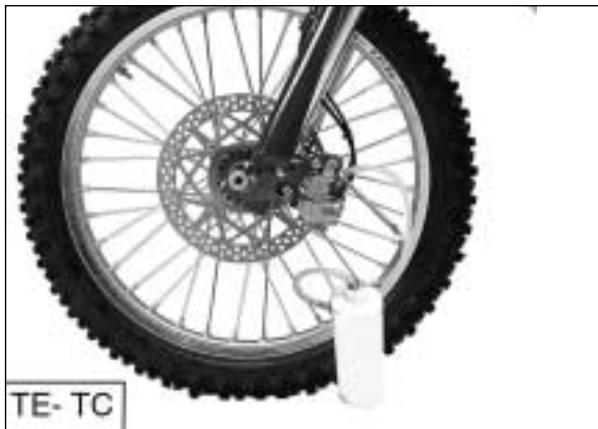
natural_image
Close-up of a bicycle wheel with visible tire, disc, and head assembly (no text or symbols)
WARNING: During bleeding the motorcycle handle bar must be turned left. Thus, the pump tank will be higher, making easier the braking in bleeding.

N.B. Should the motorcycle, due to a fall during a competition or shop repairs, feature some elasticity of the brake lever stroke, with aquent braking efficiency decrease, have to repeat the circuit bleeding as described.

A screw to increase or decrease the clearance between lever and pump cylinder is contained in the brake lever: this adjustment is subjective you'll use it according to your ements.

Bleed the braking circuit when the lever stroke gets stretchy due to the presence of air inside the circuit.
Work as follows:
- Remove the caliper and fit a 4 mm shim in place of the disc, fastening it by an elastic;
- Fit the caliper and the pipe fastening unit perpendicular to the ground, and support it conveniently;
- Remove pump cap (1) on the handlebar and fill up with the new fluid DOT4;
- Fit a transparent plastic pipe on the bleed valve of the caliper and plunge the other end of the pipe into a basin (check to make sure that, during the whole operation, the end of the pipe is fully plunged into the fluid);
- Open the bleed valve on the caliper and move the lever several times until the fluid, clear and without bubbles, comes out of the pipe; now close the bleed valve:
- Reassemble the pump cap on the handlebar and the brake caliper;
- Remove the brake pump from the handlebar and place it in vertical position, in line with the piping;
- Reassemble the pump on the handlebar, carry our another bleeding action, fill up with fluid, and tighten the valve on the caliper to the prescribed torque.
NETTOYAGE DU SYSTEME DE FREINAGE (SMR)
natural_image
Close-up of a motorcycle's front wheel assembly with a labeled component (SMR) and arrow indicator (no readable text or symbols beyond label)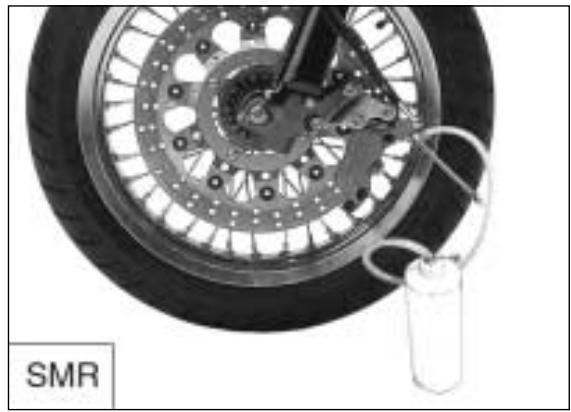
natural_image
Close-up of a bicycle wheel with visible brake and suspension components, labeled 'SMR' (no other text or symbols)
As the braking fluid is a very corrosive substance, in the case it comes in contact with your eyes wash them abundantly with water.

During the bleeding of the braking circuit keep the handlebar turned leftwards. This is the way to lift the pump tank and to make easier the ring of the braking system.

If the lever stroke gets stretchy and the braking action results as poor in the case of falls during competitions, or after repair work in a repeat the bleeding operation bed above.

As the bleeding operation does not fully eliminate the air inside the circuit, the small quantity of air remaining inside will be eliminated after a short time of use of the brake. In this case however, the action of the lever will be harder and the stroke shorter.

The braking system must be bled when, due to air in the circuit, the pedal stroke is long and spongy. To bleed the system:
- Remove the reservoir cover rubber boot and top up with (DOT 4) brake fluid.
- Attach a clear plastic hose to the bleed valve on the caliper and turn the other end of the hose into a container.
- Depress the pedal and keep it full down.
- Loosen the bleed union letting out fluid (at first, only air will come out), then, closing the union slightly.
- Release the pedal and wait for a few seconds before repeating the operation until only fluid come out of the tube.
- Close the bleed union to the prescribed torque and check the fluid level inside the reservoir before replacing the cap.
If the bleeding operation has be done correctly, the pedal will have no mushy feel. If not, repeat the operation.
CURAGE DU SYSTEME DE FREINAGE ARRIERE
natural_image
Close-up of a bicycle wheel with visible tire, hub, and disc (no text or symbols)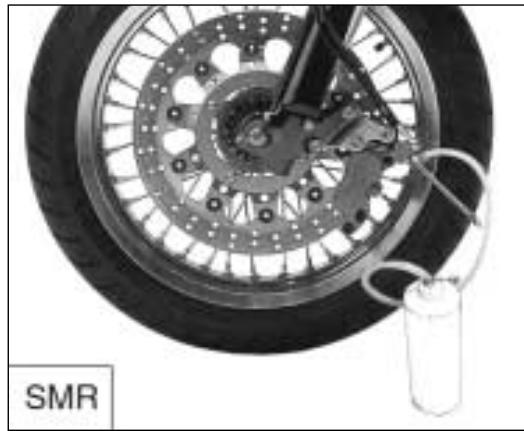
natural_image
Close-up of a motorcycle wheel with visible brake disc and suspension ring, labeled 'SMR' (no other text or symbols)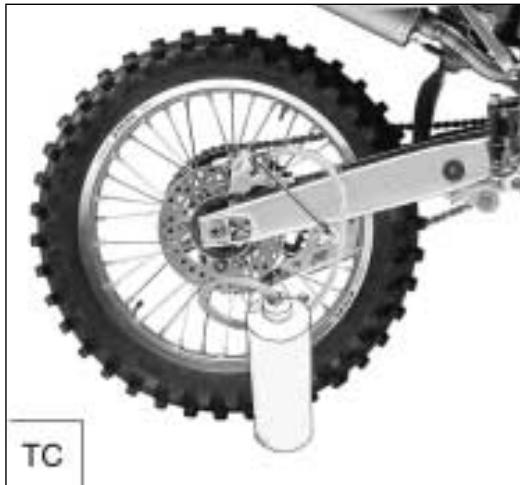
natural_image
Close-up of a bicycle wheel with visible track and suspension components (no text or symbols)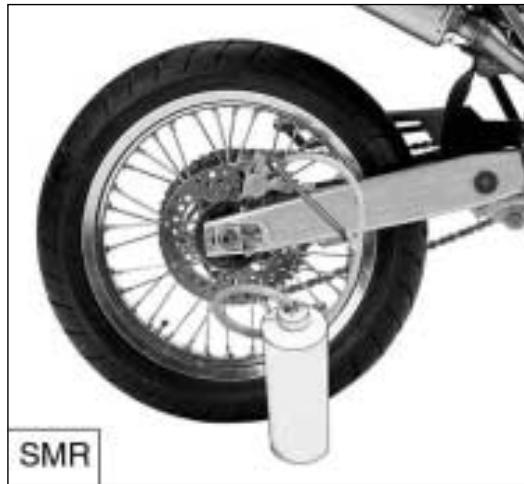
natural_image
Close-up of a motorcycle wheel assembly with visible brake and suspension components (no text or symbols)NOTA
Should the motorcycle, due to a fall during a competition or shop repairs, show some elasticity of the brake lever stroke, with a subsequent braking efficiency decrease, you'll to repeat the circuit bleeding as above described. Brake lever and pedal include adjusting unit (2) and (1) for increasing or decreasing clearance between lever (TE) and floating pedal. This adjustment is made according to the exigency of each driver. A screw to increase or decrease the clearance between lever and pump cylinder is contained in the brake lever; this adjustment is subjective and you'll use it according to your requirements (see on page 124 and 128).
WARNING!
During the bleed operation the fluid level inside the reservoir must never be lower than the minimum level. Tightening torque for bleed valve is 1,2 ÷ 1,6 kgm ( 12 ÷ 16 Nm; 8.8 ÷ 11.8 ft-lb).
AVIS
natural_image
Close-up of a motorcycle's internal components including suspension frame, drivetrain, and engine (no visible text or symbols)SILENZIATORE DI SCARICO
The muffler reduces the noise of the exhaust gases, but it is an integral part of the exhaust as well. As such, its conditions affect the motorcycle performance. When the noise on the exhaust is too high, it means that the deadening material set on the holed tube inside the muffler is deteriorated.
WARNING: Check the deadening material after every competition and replace it if necessary.
REPLACING THE MUFFLER DEADENING MATERIAL
Remove the screws (1) and the R.H. side panel (2). Unhook springs (3) fastening the muffler (4) to the exhaust pipes. Remove the two screws fastening the muffler to the rear frame. Remove inner pipe (5) and replace the deadening material. Remove the six rear rivets (5), clamp and the exhaust terminal (6).
NOTE: When difficulties are found in removing the muffler, lightly beat with a rubber or plastic hammer.
SILENCIEUX D'ECHAPPEMENT
This chapter shows the main checks to be carried out when the engine and some parts of the byke must be overhauled. More detailed information, together with the disassembly/reassembly procedures are carried in the Husqvarna's Workshop Manual.
CYLINDER-PISTON FITTING
The cylinder and piston are supplied matched; if by chance cylinders and pistons become mismatched then measure their diameters as follows: a) Cylinder bore (Dc) Use an internal micrometer and take the reading “A” at 20 mm-0.8 in. (250 cm ^3 ) or 10 mm-0.4 in. (400-450 cm ^3 ) distance from the top.
LIMITE D'USURE
AVIS
b) Piston diameter (Dp) Take the piston diameter at "B" distance of 6 mm/0.24 in. (250), 8mm./0.31in. (400) or 11 mm/0.43 in. (450) from the base.
PISTON RING/PISTON RINGS GROOVE CLEARANCE
Use a feeler gauge to check the axial play of the rings in the groove.
The “TOP” marking should always be uppermost.
ACCOUPLEMENTS
SEGMENTS-RAINURE SUR LE PISTON
PISTON RING/CYLINDER CLEARANCE
Insert the piston ring into the cylinder bottom (where wearing is the lowest) and position it well in "square" and measure the distance between the two piston ring end gap.
COUPLAGE SEGMENTS-CYLINDRE
When assembling, the coupling play must be 0.012÷0.027 mm.
The maximum wear limit
allowed is 0.055 mm.
ACCOUPLEMENT GOUJON- PIED DE BIELLE
natural_image
Technical mechanical drawing of a valve assembly (no text or labels)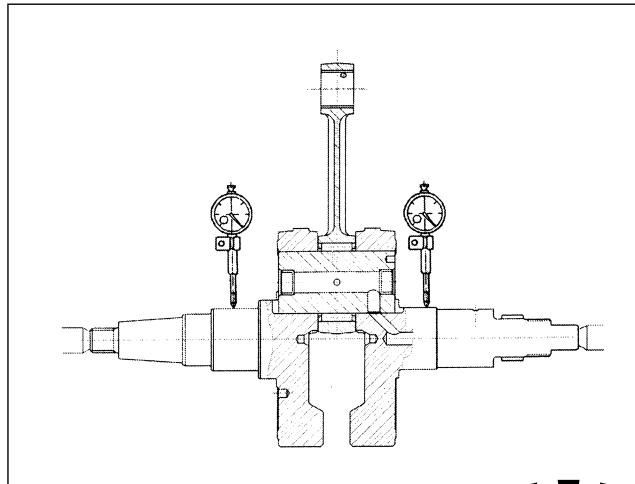
natural_image
Technical line drawing of a mechanical assembly with two pressure gauges and a central component (no text or symbols)DISCHI FRIZIONE
The clutch plates should not be burnt or scored.
Check the thickness of the clutch lining plate.
Thickness of new plate: 3 mm (0.118 in.).
Wear limit
2,9 mm (0.114 in.)
GROUPE D'EMBRAYAGE
natural_image
Illustration of two hands using calipers to measure a mechanical component (no text or symbols present)Check the distortion of each plate (both lined and unlined) by resting on a flat surface; use a feeler gauge.
Wear limit: 0,2 mm (0.00078 in.).
natural_image
Illustration of hands assembling a circular mechanical component with a tool (no text or symbols)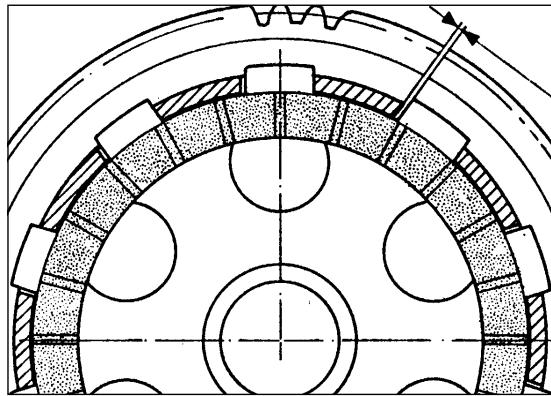
natural_image
Technical cross-sectional diagram of a mechanical component with concentric rings and internal cavities (no text or labels)MOLLA FRIZIONE
Measure the free length "L" of each spring using a gauge. "L" new spring = 41 mm/ 1.61 in. Service limit: 39 mm/ 1.53 in.
VALVE GUIDE
Accurately check the valve guide. A dial comparator set in a way to determine the play in both "X" and "Y" directions, which are perpendicular to one another, is used to detect the wear on the coupling between the guide and the valve. New intake valve standard play: 0,008-0,035 mm/ 0.00031-0.00138 in. Service limit: 0,05 mm/ 0.002 in.
New exhaust valve standard play: 0,018-0,045 mm/ 0.0007-0.00177 in. Service limit: 0,08 mm/ 0.003 in.
RESSORT D'EMBRAYAGE
VALVOLA
Check that the valve shank and the contact surface with the valve seat are in perfect conditions. Pittings, cracks, or any other deformation or wear must not appear on these elements.
Carry out the following checks: - deformation of the valve shank by setting the shank on a "V" striker, and measuring the extent of the deformation by a comparator. Working limit: 0.05 mm (0.00197 in.).
SOUPAPE
natural_image
Line drawing of a mechanical device with a dial and lever (no text or symbols)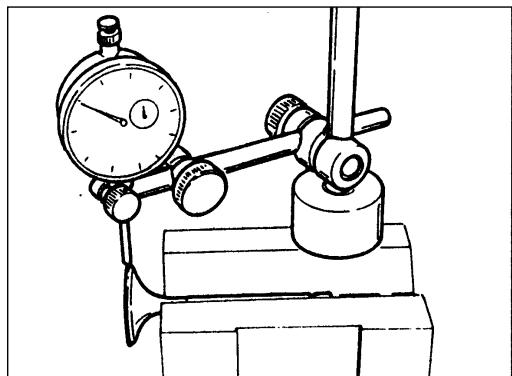
natural_image
Technical line drawing of a mechanical testing apparatus with a dial and lever (no text or symbols)MOLLA VALVOLA
The weakening of the springs causes a decrease of the engine power and it often is responsible of the noise and the vibrations coming from the valves.
In this case, check the free length “L”. When the working limit indicated has been overcomed, replace the springs.
"L" new spring = 35 mm/ 1.38 in. (250); 43,4 mm/ 1.71 in. (400-450)
Service limit: 33 mm/ 1.3 in. (250); 41 mm/ 1.6 in. (400-450)
RESSORT DE SOUPAPE
Replace all the spring valves when even one of these has overcomed the the working limit.
Check the spring valve squareness. Error limit not above 1.5 mm (0.059 in.) on each side.
natural_image
Technical line drawing of a mechanical component with threaded sections and a L-shaped outline (no text or symbols)ALBERO A CAMME
Check that cam surfaces are scored, stepped, grooved etc. Excessively worn cams are often the cause of bad engine timing thus reducing engine power. Insert the camshaft between two references and then check deviation using two comparators. Wear limit: 0.0039 in. Measure the cam height "H" using a micrometer "H"-INTAKE (new) = 36,57 mm/1.44 in. Service limit: 36,25 mm/1.43 in.
"H"- EXHAUST (new) = 35,94 mm/ 1.41 in. Service limit: 35,6 mm/ 1.40 in.
ARBRE A CAMES
natural_image
Technical line drawing of a mechanical assembly with two pressure gauges (no text or symbols)EXHAUST
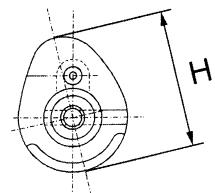
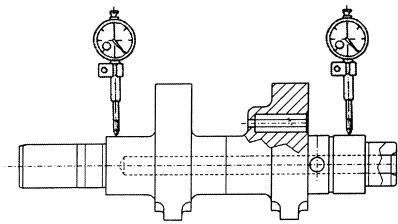
natural_image
Technical line drawing of a mechanical assembly with two pressure gauges and a central shaft (no text or symbols)REVISIONE RUOTE
OVERHAULING THE WHEELS
The tables hereunder show the type of control the rim and wheel axle are to be submitted to.
Note*: if the rim is badly, it should be replaced.
REVISION DES ROUES
natural_image
Technical line drawing of a mechanical gauge or dial assembly with no visible text or symbols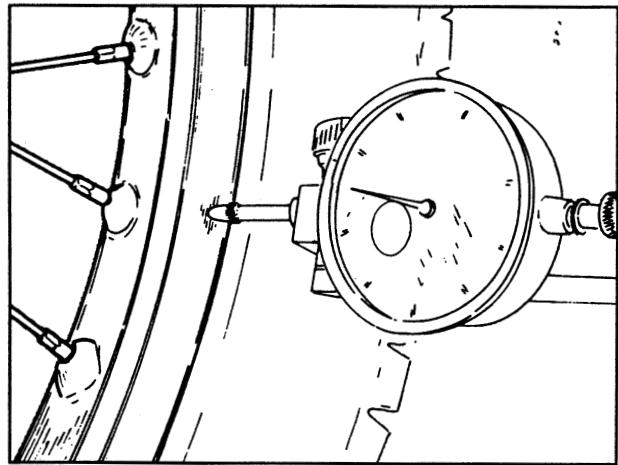
natural_image
Technical line drawing of a pressure gauge mounted on a mechanical component (no text or symbols)WHEEL RIM AXLE BENDING If the bending figure is over the allowable max. limit, straighten or replace the axle. If the wheel axle cannot be straightened within the max. limits (0,2 mm - 0.008 in.) stated, replace it.
WHEEL SPOKES
Check to make sure that all the nipples are tight; tighten them if necessary. Remember that an insufficient stretch jeopardizes the motorcycle stability. For an instant check, use a metal point (for instance, a screwdriver) to beat the spokes with. A live sound accounts for an accurate tightening, while a dull sound means that a new tightening is necessary.
COURBURE PIVOT ROUE
natural_image
Illustration of a hand using a mechanical testing setup with a dial and test tube (no text or symbols)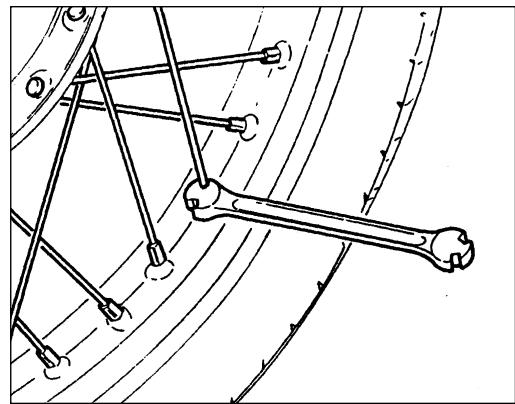
natural_image
Technical line drawing of a mechanical linkage system with no visible text or symbolsIMPIANTO ACCENSIONE (TE-SMR)-IMPIANTO ELETTRICO (TE-SMR-"Enduro" USA)
The ignition system includes the following elements:
- Generator (1) on the inner side of L.H. crankcase cover;
- Electronic coil (2) under the fuel tank;
- Electronic power unit (3) under the saddle;
- Voltage regulator (4) on the right side of the frame at the back of the steering sleeve;
- Spark plug (5) on the R.H. side of cylinder head;
- Starting motor 12V-450W (6) behind the cylinder;
- Electric start remote control switch (8) under the saddle.
The electric system includes the following elements: - Headlamp with two filaments bulb of 12V-35/35W and parking light bulb of 12V-3W;
- Rear lights with stop bulbs of 12V-21W and parking light bulb of 12V-5W ("Enduro" USA: rear parking light bulb of 12V-3W);
- Pilot lights bulb of 12V-1,2W;
- Turn signals bulb of 12V-10W ("Enduro" USA excluded);
- Instrument bulb of 12V-2W;
- Three15 A fuses (9) (one of them is a spare fuse), under the saddle;
- Battery 12V-6Ah (7) under the saddle.
SYSTEME D'ALLUMAGE (TE-SMR)- SYSTEME ÉLECTRIQUE (TE-SMR- "ENDURO" USA)
- Electronic power unit
- Alternator
- Voltage regulator
- Rear stop switch
- Front stop switch
- Condenser
- Instrument
- R.H. front turn indicator
- Front headlamp
- Parking lights
- L.H. front turn indicator
- Horn
- L.H. commutator
- Turn indicators flasher
- Tail light
- Battery
- Electric start remote control switch
- Starting motor
- Spark plug
- R.H. rear turn indicator
- L.H. rear turn indicator
- Gear shift position sensor
- Electronic coil
- Carburetor throttle position sensor
- Engine stop
- Engine start
LÉGENDE DU SCHÉMA ÉLECTRIQUE (TE 250-450, SMR 400-450; EXCLU U.S.A.)
The ignition system- electric system includes the following elements:
- Generator (1) on the inner side of L.H. crankcase cover;
- Electronic coil (2) under the saddle;
- Electronic power unit (3) under the fuel tank;
- Voltage regulator (4) on the right side of the frame at the back of the steering sleeve (TC 450);
- Voltage regulator (4) in the lower steering tube zone, behind the front number holder (TC 250);
- Spark plug (5) on the R.H. side of cylinder head;
- Starting motor 12V-450W (6) behind the cylinder;
- Electric start remote control switch (8) under the saddle;
- Three15 A fuses (9) (one of them is a spare fuse), under the saddle;
- Battery 12v-2,3Ah (7) under the saddle(250);
- Battery 12v-6Ah (7) under the saddle (450).
SYSTEME D'ALLUMAGE-SYSTEME ÉLECTRIQUE (TC-TE USA)
- Electronic power unit
- Alternator
- Voltage regulator
- Condenser
- Battery
- Electric start remote control switch
- Starting motor
- Spark plug
- Gear shift position sensor
- Electronic coil
- Carburetor throttle position sensor
- Engine stop
- Engine start
| Pos. Pos. | Colore Colour |
| R | Rosso /Red /Rouge /Rot /Rojo |
| W | Bianco /White /Blanc /Weiss /Blanco |
| G | Verde /Green /Vert /Grün /Verde |
| Bk | Nero /Black /Noir /Schwarz /Negro |
| R-W | Rosso-Bianco /Red-White/ Rouge-Blanc /Rot-Weiss /Rojo-Blanco |
| Y | Giallo /Yellow /Jaune /Gelb /Amarillo |
| BI | Blu /Blue /Bleu /Blau /Azul |
| W-Bk | Bianco-Nero /White-Black /Blanc-Noir /Weiss-Schwarrz /Blanco-Negro |
LÉGENDE DU SCHÉMA ÉLECTRIQUE (TC 250-450, TE 250-450 USA)
The sealed battery does not require any maintenance work. When electrolyte leaks, or other failures to the electrical system are detected, apply to the HUSQVARNA Dealer. If the vehicle remains unused for long periods, it is recommended to remove battery from electrical system and store it in a dry place.
- After an intensive use of the battery, it's advisable a standard low charge (12V-6Ah battery: 0.6A for 8 hours; 12V-2.3Ah battery: 0.4A for 8 hours).
- Rapid recharging is advised only in situations of extreme necessity since the life of lead elements is drastically reduced (6A for 0.5 hours with 12V-6Ah batteries; 4A for 0.5 hours with 12V-2.3Ah batteries).
BATTERY CHARGER
To gain access to the battery (3):
- first turn counterclockwise fastening rear pin (1) then remove the saddle;
● release elastic (2); - first remove the BLACK negative cable, then the RED positive cable (when reassembling, first connect the RED positive cable, then the BLACK negative cable);
- remove the battery (3) from its housing.
BATTERIE
natural_image
Diagram of a mechanical component with a labeled part '1' and curved lines, no readable text or symbols present.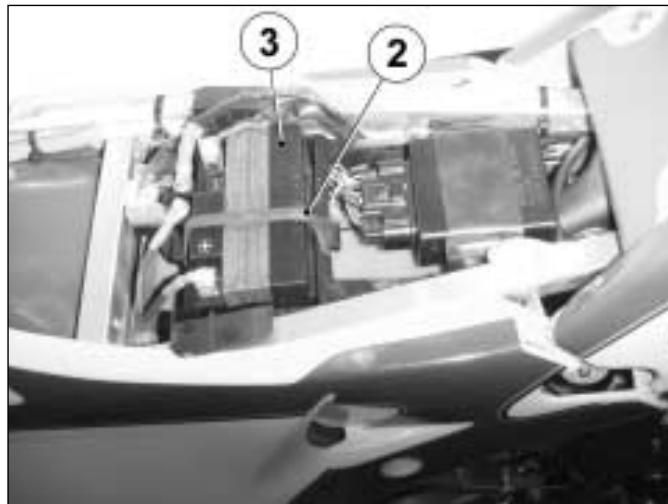
Check, using a voltmeter, that battery voltage is not less than 12.5 V. If not, the battery needs to be charged.
Using a battery charter with a constant voltage, first connect the RED positive cable to the battery's positive terminal then the BLACK negative cable to the battery's negative terminal.
Apply to the constant voltage of 14,4 V a current of "x" Ampere as results in the below diagram (depending on the amount of charging required).
The voltage reaches a constant value only after a few hours, therefore it is suggested NOT to measure it immediately after having charged or discharged the battery.
Always check the charge level before reinstalling it on the vehicle.
The battery should be kept clean and the terminals coated with grease.
WARNING*: The battery contains sulfuric acid. Avoid contact with skin, eyes or clothing. Antidote: EXTERNAL - Flush with water. INTERNAI - Drink large quantities of water or milk. After milk take magnesia, beaten eggs or vegetable oil. Call physician immediately. Eyes: Flush with water for no less than 15 minutes and get prompt medical attention.
WARNING*: Batteries produce explosive gas, ventilate when charging or using in enclosed space. When using a battery charger before turning on the charger. This procedure prevents sparks at the battery terminals which could ignite any battery gases.
natural_image
Close-up of an automotive battery pack assembly inside a vehicle (no visible text or symbols)SOSTITUZIONE LAMPADINE PROIETTORE (TE- SMR)
REPLACEMENT (TE- SMR)
To gain access to the healamp bulbs, proceed as follows:
- remove the two fastening elastics (1) and the headlamp holder;
- remove the two filaments bulb connector; (2) and the boot (3)
- release the bulb holding spring (4) and then the bulb itself.
REEMPLACEMENT DES
AMPOULES DU PHARE AVANT (TE- SMR)
To replace the parking light bulb, (5) extract it from the inside cover. After replacement, reverse operations for reassembly.
natural_image
Close-up of a motorcycle's front wheel and suspension components (no visible text or symbols)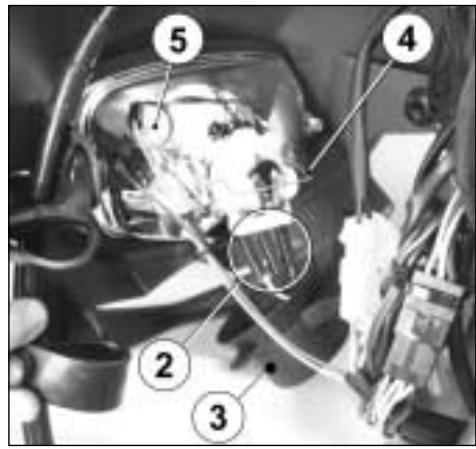
SOSTITUZIONE LAMPADA FANALE POSTERIORE (TE- SMR)
To gain access to the tail light bulb, proceed as follows:
- remove the two fastening screws (1) and the rear lens (2);
- extract the bulb holding inner cover, (3) turn the bulb (4) counterclockwise, remove and replace it.
After replacement, reverse operations for reassembly.
NOTES: make sure not to tighten the screws excessively.
REEMPLACEMENT DES AMPOULES DU PHARE ARRIÈRE (TE- SMR)
natural_image
Close-up of a metallic mechanical component with two marked points (numbered 1 and numbered 2), no visible text or symbols.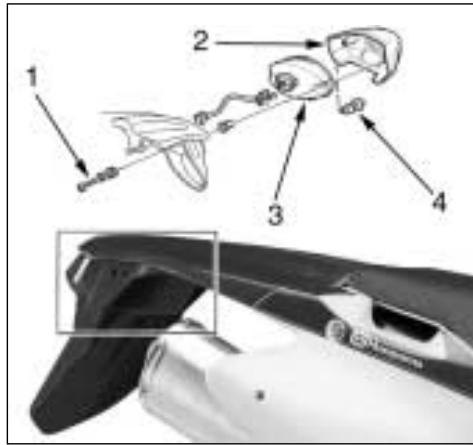
When checking the proper orienting of headlight, inflate tires at right pressure, sat a person on the saddle and place the motorcycle perpendicular with its longitudinal axis 10 meters (33 ft) from a wall or screen. Then trace an horizontal line equal to the height of headlight center and a vertical one in line with its longitudinal axis. If possible, execute this operation in a shadowy place. When the low beam is on, the upper boundary limit between dark and lit zone should be 9/10 th of headlight center from ground.
REGLAGE DU PHARE
(TE, SMR, Enduro USA)
Adjust the preadlamp aiming by turning screw (1) to lower or lift the high beam.
The motorcycle comes with the following tools:
1-8000 66802
Box wrench 15x27mm
2-8000 96997
Front wheel axle wrench
3-8000 56920
Front wheel axle screw Allen wrench
DOTATION D'OUTILS
Clef polygonal 15x27mm
2-8000 96997
Ringschlüssel15x27mm
2-8000 96997
natural_image
Close-up of a motorcycle's front wheel and side-mounted sensors, labeled with number 1 (no text or symbols on the main body)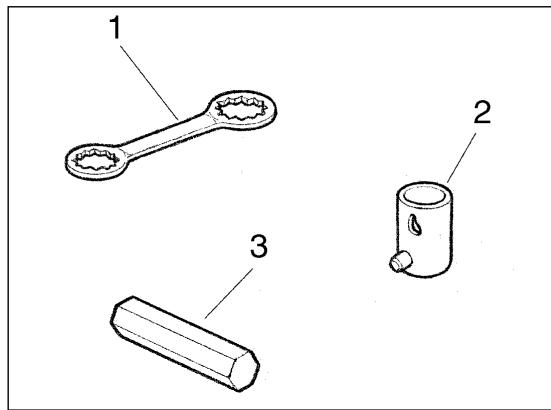
| ATTREZZI SPECIALI | SPECIAL TOOLS | OUTILS SPECIAUX | SONDERWERKZEUGE | HERRAMIENTAS ESPECIALES | ||
| 1 | 1517 94702 | Estrattore basamento | Crankcase puller | Extracteur carter | Kurbelgehäuse-Auszieher | Extractor cárter |
| 2 | 8000 A1580 | Protezione alb. motore | Crankshaft guard | Protection vilebrequin | Schutz für Kurbewelle | Protección por cigueñal |
| 3 | 8000 A1559 | Estrattore volano | Flywheel extractor | Extracteur pour volant | Auszieher für Schwungrad | Extractor volante |
| 4 | 8000 A1512 | Attrezzo contr. accensione | Ignition checking tool | Outil contrôle allumage | Kontrollwerkzeug für Zundung | Herramienta |
| 5 | 8A00 90622 | Supporto per montaggio | Support for assy | Support pour montage | Halterung für Montage | control encendidoSoporte por el montaje |
| 6 | 8000 A1576 | Attrezzo mont. semiconi | Half cone assembling tool | Outil montage demi-cône | Werkzeug für montage | Herramienta |
| 7 | 8000 A1625 | Attrezzo portacomparatore | Dial gauge holding tool | Outil support comparateur | Werkzeug Komparatorhalter | porta comparadorHerramienta |
| 8 | 8000 A1579 | Attrezzo smont. semiconi | Half cone disassembling tool | Outil demontage demi-cône | Werkzeug für Ausbauder Half-Kebel | porta comparadorHerramienta desmontaje semi-conos |
| 9 | 8000 79015 | Chiave di fermo mozzo frizione | Clutch hub retaining wrench | Cléf d'arret moyeau embrayage | Halterungsschlussel der | Llave bloquear cubo |
| 10 | 1519 84701 | Gancio per molle | Spring hook | Crochet pour ressort | Federhaken | Gancho para resorte |
| 11 | 8000 95749 | Chiave candela | Spark plug wrench | Cléf bougie | Zündkerzeschlüssel | Llave bujia |
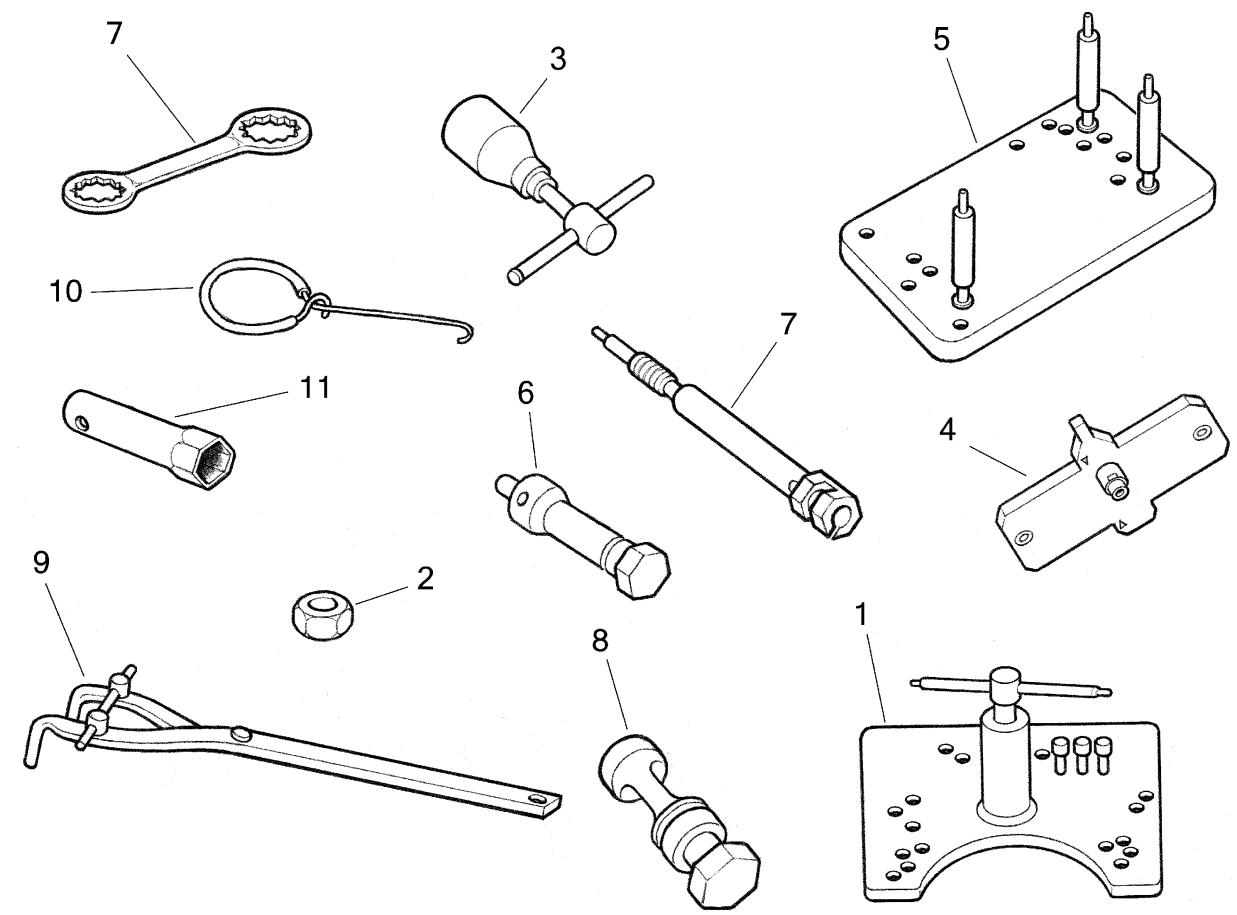
COPPIE DI SERRAGGIO / TIGHTENING TORQUES / COUPLES DE SERRAGE
MOTORE
| Applicazione | Application | Application |
| Vite fiss. cappello albero a camme | Camshaft cap fastening screw | Vis de fixation capuchon arbre distribution |
| Tappo perno bilanciere | Rocker arm axle plug | Bouchon axle culbuteur |
| Vite fiss. coperchio testa | Cylinder head cover fastening screw | Vis de fixation couvercle culasse cylindre |
| Dado fiss. testa | Cylinder head fastening nut | Ecrou de fixation culasse cylindre |
| Dado fiss. testa e cilindro | Cylinder head and cylinder fastening nut | Ecrou de fixation culasse et cylindre |
| Vite fiss. tubo olio sulla testa cilindro | Oil hose to cylinder head fastening screw | Vis de fixation tuyau huile sur la culasse cylindre |
| Tappo foro olio su perno di biella | Oil hole plug on conrod pin | Bouchon pour trou huile sur pivot de bielle |
| Dado fiss. ingr. conduttore trasm. primaria | Primary drive driving gear fastening nut | Ecrou de fixation engrenage conducteur transm. primaire |
| Vite fiss. disco centrifugo su albero a camme ASPIRAZIONE | Centrifugal disc on INTAKE CAMSHAFT fastening screw | Vis de fixation disque sur arbre distribution (ADMISSION) |
| Vite fiss. pattino catena distribuzione | Timing chain slider fastening screw | Vis de fixation glissière chaine distribution |
| Vite fiss. piastrine ritegno cuscinetti basamento | Crankcase bearings plates fastening screw | Vis de fixation plaquettes roulements carters |
| Tappo scarico olio motore | Engine oil drain plug | Bouchon de vidange huile moteur |
| Tappo filtro olio motore | Engine oil filter plug | Bouchon filtre huile moteur |
| Vite fiss. coperchio filtro olio | Engine oil filter cartridge cover fastening screw | Vis de fixation couvercle filtre huile |
| Vite fiss. cornetto carburatore | Carburetor union fastening screw | Vis de fixation manchon carburateur |
| Dado fiss. alternatore | Alternator fastening nut | Ecrou de fixation alternateur |
| Vite fiss. statore | Stator plate fastening screw | Vis de fixation stator |
| Candela accensione | Spark plug | Bougie d'allumage |
| Vite fiss. pick-up | Pick-up fastening screw | Vis de fixation pick-up |
| Dado fiss. mozzo e campana frizione | Clutch hub and disc housing fastening nut | Ecrou de fixation moyeau et cage embrayage |
| Vite fiss. piastra ritegno ingranaggi avviamento | Starting gears stop plate fastening screw | Vis de fixation plaque engrenage démarrage |
| Vite fiss. tamburo selettore | Gearbox forks driving shaft fastening screw | Vis de fixation tambour selecteur |
| Vite fiss. saltarello e piastra comando cambio | Gear control click and plate fastening screw | Vis de fixation cliquet et plaque commande de vitesse |
| Vite fiss. segnalatore marce | Gear shift position sensor fastening screw | Vis de fixation signaleur de vitesse |
| Dado fiss. girante pompa acqua | Water pump rotor fastening nut | Ecrou de fixation couronne pompe eau |
| Vite fiss. corpo pompa acqua | Water pump body fastening screw | Vis de fixation corps pompe eau |
ENGINE
MOTEUR
VERSCHRAUBUNGSMOMENTE / PATAS DE TORSION
| MOTOR | Filettatura Threading Filetate Gewinde Filetado | ||||
| Anwendung | Aplicación | ||||
| Befestigungsschraube Nockenwelle Kappe | Tuerca fijación caballete eje distribución | M6x1 | 12 Nm | 1,2 Kgm | 8.7 ft/lb |
| Kipphebelachse Verschluss | Tapón perno balancin | M14x1,5 (+LOCTITE 243) | 25 Nm | 2,55 Kgm | 18.4 ft/lb |
| Befestigungsschraube Zylinderdeckel | Tornillo fijación tapa culata | M6x1 | 8 Nm | 0,8 Kgm | 5.8 ft/lb |
| Befestigungsmutter Zylinderkopf | Tuerca fijación culata | M8x1,25 | 15 Nm | 1,5 Kgm | 10.8 ft/lb |
| Befestigungsmutter Kopf und Zylinder | Tuerca fijación culata y cilindro | M10x1,5 (+MOLIKOTE HSC) | 37 Nm+90° | 3.8 Nm+90° | 27.5 ft/lb+90° |
| Befestigungsschraube Ölrohr-Zylinderkopf | Tornillo fijación tubo aceite en la culata | M10x1 | 15 Nm | 1,5 Kgm | 10.8 ft/lb |
| Ölstopfen auf der Kurbelzapfen | Tapón oroficio aceite su perno de biela | M14x1 (+LOCTITE 243) | 20 Nm | 2 Kgm | 14.5 ft/lb |
| Befestigungsmutter Antriebsrad | Tuerca fijación engranaje conductor transm. primaria | M18x1,25 | 150 Nm | 15 Kgm | 108 ft/lb |
| Befestigungsschraube Scheibe für Nockenwelle (ANSAUGSEITE) | Tornillo fijación disco en el eje distribución (ASPIRACION) | M6x1 (+LOCTITE 243) | 8 Nm | 0,8 Kgm | 5.8 ft/lb |
| Befestigungsschraube Ventilsteuerungkette Gleitbahn | Tornillo fijación plado cadena distribución | M8x1,25 | 12 Nm | 1,23 Kgm | 8.9 ft/lb |
| Befestigungsschraube Gehauselager Platte | Tornillo fijación placa cojinete de carter | M6x1 (+LOCTITE 272) | 11 Nm | 1,1 Kgm | 7.9 ft/lb |
| Motorölablaßstopfen | Tapón vaciado aceite motor | M16x1,5 | 25 Nm | 2,55 Kgm | 18.4 ft/lb |
| Motorölfilter Verschluss | Tapón filtro aceite motor | M14x1,5 | 25 Nm | 2,55 Kgm | 18.4 ft/lb |
| Befestigungsschraube Wechselfilterdeckel | Tornillo fijación tapa filtro aceite | M6x1 | 8 Nm | 0,8 Kgm | 5.8 ft/lb |
| Befestigungsschraube Vergasermuffe | Tornillo fijación tubo toma aire carburador | M4x0,7 (+LOCTITE 272) | 3 Nm | 0,3 Kgm | 2.2 ft/lb |
| Befestigungsmutter Alternator | Tuerca fijación alternador | M12x1 | 75 Nm | 7,65 Kgm | 55.3 ft/lb |
| Befestigungsschraube Stator | Tornillo fijación estator | M6x1 (+LOCTITE 272) | 8 Nm | 0,8 Kgm | 5.8 ft/lb |
| Zündkerze | Bujia de encendido | M10x1 | 12 Nm | 1,23 Kgm | 8.9 ft/lb |
| Befestigungsschraube Pick-up | Tornillo fijación pick-up | M5x0,8 (+LOCTITE 272) | 6 Nm | 0,6 Kgm | 4.3 ft/lb |
| Befestigungsmutter Kupplungscheibenhalternabe und Kupplungkorb | Tuerca fijación cubo y campana embrague | M18x1 | 75 Nm | 7,6 Kgm | 55 ft/lb |
| Befestigungsschraube Anlasserantriebsrad Platte | Tornillo fijación placa engrenaje de arranque | M6x1 (+LOCTITE 243) | 8 Nm | 0,8 Kgm | 5.8 ft/lb |
| Befestigungsschraube Trommel | Tornillo fijación. tambor selector | M8x1,25 (+LOCTITE 243) | 20 Nm | 2 Kgm | 14.5 ft/lb |
| Befestigungsschraube Strumhaken und Gangschaltung Platte | Tornillo fijación saltarelo y placa mando cambio | M6x1 (+LOCTITE 243) | 8 Nm | 0,8 Kgm | 5.8 ft/lb |
| Befestigungsschraube Gangkontrol | Tornillo fijación señalador velocidad | M5x0,8 | 6 Nm | 0,6 Kgm | 4.3 ft/lb |
| Befestigungsmutter Wasserpumprotor | Tuerca fijación rotor bomba agua | M5x0,8 (+LOCTITE 243) | 3,9 Nm | 0,4 Kgm | 2.9 ft/lb |
| Befestigungsschraube Wasserpumpkörper | Tornillo fijación corpo bomba agua | M6x1(+LOCTITE 542) | 8 Nm | 0,8 Kgm | 5.8 ft/lb |
COPPIE DI SERRAGGIO / TIGHTENING TORQUES / COUPLES DE SERRAGE
MOTOTELAIO
| Applicazione | Application | Application |
| Vite fiss. inferiore telaio posteriore | Rear frame lower fastening screw | Vis de fixation inferieur cadre arrière |
| Vite fiss. protezione motore | Engine guard fastening screw | Vis de fixation protection moteur |
| Vite fiss. rullo catena | Rear chain roller fastening screw | Vis de fixation rouleau chaine |
| Vite fiss. cavalletto laterale | Side stand fastening screw | Vis de fixation bequille lateral |
| Vite fiss. superiore telaio posteriore | Rear frame upper fastening screw | Vis de fixation superieur cadre arrière |
| Vite fiss.telaio-piastra motore | Frame to engine plate fastening screw | Vis de fixation cadre - plaque moteur |
| Vite fiss. inferiore motore | Engine lower fastening screw | Vis de fixation inferieur moteur |
| Vite fiss. cavallotti frizione e freno anteriore | Clutch and front brake controls clamp fastening screw | Vis de fixation cavaliers embrague et frein avant |
| Vite fiss. supporti comando gas | Throttle control holders fastening screw | Vis de fixation supports commande gaz |
| Vite fiss. superiore tubazione freno anteriore (TE, SMR) | Front brake hose upper fastening screw (TE, SMR) | Vis de fixation superieur tuyau frein avant (TE, SMR) |
| Vite fiss. superiore tubazione freno anteriore (TC) | Front brake hose upper fastening screw (TC) | Vis de fixation superieur tuyau frein avant (TC) |
| Vite fiss. pedale freno posteriore | Rear brake control pedal fastening screw | Vis de fixation pédale frein arrière |
| Vite fiss. pompa freno posteriore | Rear brake pump fastening screw | Vis de fixation pompe frein arrière |
| Vite fiss. piastrina pompa freno anteriore (SMR) | Front brake pump plate fastening screw (SMR) | Vis de fixation plaque pompe frein avant (SMR) |
| Vite fiss. serbatoio liquido freno posteriore | Rear brake fluid tank fastening screw | Vis de fixation réservoir liquide frein arrière |
| Interruttore stop posteriore (TE, SMR) | Rear stop control switch (TE, SMR) | Interrupteur stop arrière (TE, SMR) |
| Vite fiss. connettore interruttore stop anteriore (SMR) | Front control switch connector fastening screw (SMR) | Vis de fixation connecteur Interrupteur stop avant (SMR) |
| Vite fiss. camma pedale freno posteriore | Rear brake pedal adjusting cam fastening screw | Vis de fixation came pédale frein arrière |
| Vite fiss. piastrina guidatubazione freno anteriore | Front brake hose guide plate fastening screw | Vis de fixation plaque guide tuyau frein avant |
| Vite fiss. tappo serbatoio freno anteriore (SMR) | Front brake tank cap fastening screw (SMR) | Vis de fixation bouchon réservoir frein avant (SMR) |
| Vite fiss. gambe forcella | Front fork legs fastening screw | Vis de fixation tige fourche avant |
| Vite fiss. perno ruota anteriore | Front wheel axle fastening screw | Vis de fixation piovot roue avant |
| Ghiera registro cuscinetti di sterzo | Steering bearings adjusting ring nut | Collier de réglage roulement guidon |
| Dado perno di sterzo | Steering pivot fastening nut | Ecrou de fixation pivot guidon |
| Vite fiss. morsetto superiore manubrio | Handlebar upper clamp | Vis de fixation etau superieur guidon |
| Vite fiss. supporto manubrio | Handlebar holder fastening screw | Vis de fixation support guidon |
| Vite fiss. protezioni steli forcella | Front fork legs guard fastening screw | Vis de fixation protection tige fourche avant |
| Vite fiss. anelli protezioni steli forcella | Front fork legs ring guard fastening screw | Vis de fixation bague protection tige fourche avant |
| Dado fiss. perno forcellone | Rear swing arm axle fastening nut | Ecrou de fixation pivot fourche |
| Dado fiss. bilanciere-forcellone | Rear swing arm to rocker arm fastening nut | Ecrou de fixation balancier- fourche arrière |
| Dado fiss. tirante-bilanciere | Tie rod to rocker arm fastening nut | Ecrou de fixation tirant- balancier |
CHASSIS
CHASSIS
VERSCHRAUBUNGSMOMENTE / PATAS DE TORSION
| CHASSIS | |||||
| Aplicación | CHASSIS Aplicación | Filettatura Threading Filetate Gewinde Filetado | |||
| Befestigungsschraube Hinterrahmen (untere) | Tornillo fijación inferior bastidor trasero | M8x1,25 | 25,5 Nm | 2,6 Kgm | 18.8 ft/lb |
| Befestigungsschraube Motorschutz | Tornillo fijación protección motor | M6x1 | 14,7 Nm | 1,5 Kgm | 10.8 ft/lb |
| Befestigungsschraube Kettenrolle | Tornillo fijación rodeta cadena | M8x1,25 | 26,95 Nm | 2,75 Kgm | 19.9 ft/lb |
| Befestigungsschraube Seitenständer | Tornillo fijación caballete lateral | M8x1,25 (+LOCTITE 243) | 11,75 Nm | 1,2 Kgm | 8.7 ft/lb |
| Befestigungsschraube Hinterrahmen (obere) | Tornillo fijación superior bastidor trasero | M8x1,25 | 25,5 Nm | 2,6 Kgm | 18.8 ft/lb |
| Befestigungsschraube Rahmen-Motorplatte | Tornillo fijación bastidor -placa motor | M8x1,25 (+LOCTITE 270 | 35,3 Nm | 3,6 Kgm | 26 ft/lb |
| Befestigungsschraube Motor (untere) | Tornillo fijación inferior motor | M8x1,25 | 35,3 Nm | 3,6 Kgm | 26 ft/lb |
| Befestigungsschraube Kupplunghalter und Vorderbremse | Tornillo fijación conexiones embrage y freno delantero | M6x1 | 4,9 Nm | 0,5 Kgm | 3.6 ft/lb |
| Befestigungsschraube Gasgriffhalter | Tornillo fijación suportes mando gas | M6x1 | 4,9 Nm | 0,5 Kgm | 3.6 ft/lb |
| Obere Befestigungsschraube Vorderbremserohr (TE, SMR) | Tornillo fijación superior tuberia freno delantero (TE, SMR) | M10x1 | 19 Nm | 1,95 Kgm | 14 ft/lb |
| Obere Befestigungsschraube Vorderbremserohr (TC) | Tornillo fijación superior tuberia freno delantero (TC) | M10x1 | 24,7 Nm | 2,5 Kgm | 18.2 ft/lb |
| Befestigungsschraube Hinterbremsenpedal | Tornillo fijación pedal freno trasero | M10x1,25 (+LOCTITE 243) | 41,65 Nm | 4,25 Kgm | 30.7 ft/lb |
| Befestigungsschraube Hinterbremsenpumpe | Tornillo fijación bomba freno trasero | M6x1 | 10,4 Nm | 1,05 Kgm | 7.7 ft/lb |
| Befestigungsschraube Vorderbremsenpumpeplatte (SMR) | Tornillo fijación placa bomba freno delantero (SMR) | M6x1 | 10,4 Nm | 1,05 Kgm | 7.7 ft/lb |
| Befestigungsschraube Hinterbremseöltank | Tornillo fijación deposito líquido freno trasero | M6x1 | 2,45 Nm | 0,25 Kgm | 1.8 ft/lb |
| Schalter Hinterradbremslicht (TE, SMR) | Interruptor stop trasero (TE, SMR) | M10x1 | 19 Nm | 1,95 Kgm | 14 ft/lb |
| Befestigungsschraube Verbinder für Schalter Vorderradbremslicht (SMR) | Tornillo fijación conector interruptor stop delantero (SMR) | M2x0,4 | 0,8 Nm | 0,1 Kgm | 0,6 ft/lb |
| Befestigungsschraube Hinterbremse Pedalnocken | Tornillo fijación excéntrico pedal freno trasero | M6x1 | 14,7 Nm | 1,4 Kgm | 10.8 ft/lb |
| Befestigungsschraube Rohrplatte Vorderbremse | Tornillo fijación placa guía-tuberia freno delantero | M6x1 | 6 Nm | 0,6 Kgm | 4.4 ft/lb |
| Befestigungsschraube Vorderbremse Öltankstöpsel (SMR) | Tornillo fijación tapón deposito freno delantero (SMR) | M6x1 | 4,9 Nm | 0,5 Kgm | 3.6 ft/lb |
| Befestigungsschraube Vordergabelschafte | Tornillo fijación varillas horquilla delantera | M8x1,25 | 25 Nm | 2,5 Kgm | 18.4 ft/lb |
| Befestigungsschraube Vorderradzapfen | Tornillo fijación perno rueda delantera | M6x1 | 10,4 Nm | 1,05 Kgm | 7.7 ft/lb |
| Einstellzwinge Lenkungslager | Virola aiuste cojinetes de la guia | M25x1 | 3,45 Nm | 0,35 Kgm | 2.5 ft/lb |
| Befestigungsmutter Lenkbolzen | Tuerca eje de la guia | M24x1 | 83,3 Nm | 8,5 Kgm | 61.4 ft/lb |
| Befestigungsschraube Obere Lenkerklemme | Tornillo fijación abrazadera superior del manillar | M8x1,25 | 28,4 Nm | 2,9 Kgm | 20.9 ft/lb |
| Befestigungsschraube Lenkerhalterung | Tornillo fijación suporte del manillar | M10x1,5 | 21,1 Nm | 2,15 Kgm | 15.6 ft/lb |
| Befestigungsschraube Vordergabelstangen | Tornillo fijación protección varillas horquilla delantera | M5x0,8 | 7,85 Nm | 0,8 Kgm | 5.8 ft/lb |
| Befestigungsschraube Schutzring für Vordergabelstangen | Tornillo fijación anillo protecciones varillas horquilla delantera | M5x0,8 | 2,45 Nm | 0,25 Kgm | 1.8 ft/lb |
| Befestigungsmutter Hintergabelzapfen | Tuerca fijación perno horquilla trasera | M16x1,5 (+LOCTITE 243) | 122,5 Nm | 12,5 Kgm | 90.3 ft/lb |
| Befestigungsmutter Kipphebel-Hintergabel | Tuerca fijación balancín- horquilla trasera | M12x1,25 | 80 Nm | 8,2 Kgm | 59 ft/lb |
| Befestigungsmutter Spannstange- Kipphebel | Tuerca fijación tirante- balancín | M12x1,25 | 80 Nm | 8,2 Kgm | 59 ft/lb |
COPPIE DI SERRAGGIO / TIGHTENING TORQUES / COUPLES DE SERRAGE
MOTOTELAIO
| Applicazione | Application | Application |
| Dado fiss. telaio-tirante | Frame to tie rod fastening nut | Ecrou de fixation cadre- tirant |
| Ingrassatore | Rocker arm to tie rod lubricator | Graisseur |
| Vite fiss. ammortizzatore-telaio | Rear shock absorber to frame fastening pivot | Vis de fixation amortisseur-cadre |
| Vite fiss. bilanciere- telaio | Rocker arm to frame fastening pivot | Vis de fixation balancier - cadre |
| Vite fiss. guidacatena-forcellone (TE-SMR) | Chain guide to rear swing arm fastening screw (TE-SMR) | Vis de fixation guide-chaine/fourche arrière (TE-SMR) |
| Vite fiss. anteriore guidacatena-forcellone (TC) | Chain guide to rear swing arm front fastening screw (TC) | Vis de fixation avant guide-chaine/fourche arrière (TC) |
| Vite fiss. posteriore guidacatena-forcellone (TC) | Chain guide to rear swing arm rear fastening screw (TC) | Vis de fixation arrière guide-chaine/fourche arrière (TC) |
| Vite fiss. staffa-guidacatena (TE-SMR) | Bracket to chain guide fastening screw (TE-SMR) | Vis de fixation etrier/guide-chaine (TE-SMR) |
| Vite fiss. inf. pattino catena e passatubazione freno posteriore | Chain slider and rear brake hose clamp lower fastening screw | Vis de fixation inf. glissière chaine et passe-tuyau frein arrière |
| Vite fiss. post. pattino catena e passatubazione freno posteriore (TC) | Chain slider and rear brake hose clamp rear fastening screw | Vis de fixation arrière glissière chaine et passe-tuyau frein arrière (TC) |
| Vite fiss. copricatena (TE-SMR) | Chain guard fastening screw (TE-SMR) | Vis de fixation carter de chaine (TE-SMR) |
| Dado fiss. tendicatena | Chain adjuster fastening nut | Ecrou de fixation tendeur de chaine |
| Vite fiss. spoiler a serbatoio | Spoiler to fuel tank fastening screw | Vis de fixation spoiler-réservoir |
| Vite fiss. superiore portanumero anteriore (TC) | Front number holder upper fastening screw (TC) | Vis de fixation superieur porte-numero avant (TC) |
| Vite fiss. inferiore portanumero anteriore (TC) | Front number holder lower fastening screw (TC) | Vis de fixation inferieur porte-numero avant (TC) |
| Vite fiss. protezione ammortizzatore | Rear shock absorber guard fastening screw | Vis de fixation protection amortisseur arrière |
| Vite fiss. anteriore parafango posteriore | Rear fender front fastening screw | Vis de fixation avant garde-bouie arrière |
| Vite fiss. posteriore parafango posteriore | Rear fender rear fastening screw | Vis de fixation arrière garde-bouie arrière |
| Vite fiss. parafango anteriore | Front fender fastening screw | Vis de fixation garde-bouie avant |
| Vite fiss. protezione radiatore | Radiator guard fastening screw | Vis de fixation protection radiateur |
| Vite fiss. pannello laterale | Side panel fastening screw | Vis de fixation panneau lateral |
| Vite fiss. portatarga | License plate fastening screw | Vis de fixation porte-balai |
| Dado fiss. catadiottro posteriore | Rear reflector fastening nut | Ecrou de fixation catadioptrique arrière |
| Vite fiss. anello passatubazione freno al cupolino | Brake hose ring to front fairing fastening screw | Vis de fixation bague passe-tuyau frein au carenage avant |
| Vite fiss. indicatori direzione | Turn signals fastening screw | Vis de fixation clignotant |
| Vite fiss. gruppo ottico anteriore | Front headlamp fastening screw | Vis de fixation gruppo phare avant |
| Vite fiss. cavi teleruttore | Electric start remote control switch cables fastening screw | Vis de fixation cable telerupteur |
| Vite fiss. tampone anteriore serbatoio carburante | Fuel tank front rubber pad fastening screw | Vis de fixation tampon avant réservoir essence |
| Vite fiss. rubinetto serbatoio carburante | Fuel cock fastening screw | Vis de fixation robinet réservoir essence |
| Vite fiss. posteriore serbatoio carburante | Fuel tank rear fastening screw | Vis de fixation arrière réservoir essence |
| Vite fiss. anteriore scatola filtro | Air filter box front fastening screw | Vis de fixation avant scatola filtro |
CHASSIS
CHASSIS
VERSCHRAUBUNGSMOMENTE / PATAS DE TORSION
CHASSIS
| Aplicación | Aplicación | gewinne Filetado | |||
| Befestigungsmutter Rahmen- Kipphebel | Tuerca fijación bastidor -tirante | M12x1,25 | 80 Nm | 8,2 Kgm | 59 ft/lb |
| Fettbüchse | Lubricador suspension trasera | M6x1 | 2,95 Nm | 0,3 Kgm | 2,2 ft/lb |
| Befestigungsschraube Stossdämpfer-Rahmen | Tornillo fijación amortiguador- bastidor | M10x1,25 | 52,4 Nm | 5,35 Kgm | 38,6 ft/lb |
| Befestigungsschraube Kipphebel - Rahmen | Tornillo fijación balancín - bastidor | M10x1,25 | 52,4 Nm | 5,35 Kgm | 38,6 ft/lb |
| Befestigungsschraube Kettenführung- Hintergabel (TE-SMR) | Tornillo fijación guia-cadena- horquilla trasera (TE-SMR) | M8x1,25 | 25 Nm | 2,5 Kgm | 18.4 ft/lb |
| Befestigungsschraube Vordere Kettenführung - Hintergabel (TC) | Tornillo fijación delantera guia-cadena/horquilla trasera (TC) | M8x1,25 (+LOCTITE 243) | 10,4 Nm | 1,05 Kgm | 7.7 ft/lb |
| Befestigungsschraube Hintere Kettenführung - Hintergabel (TC) | Tornillo fijación trasero guia-cadena/horquilla trasera (TC) | M6x1 (+LOCTITE 243) | 10,4 Nm | 1,05 Kgm | 7.7 ft/lb |
| Befestigungsschraube Buegel-Kettenführung (TE-SMR) | Tornillo fijación brida/guia-cadena (TE-SMR) | M6x1 (+LOCTITE 243) | 2 Nm | 0,2 Kgm | 1.5 ft/lb |
| Befestigungsschraube Untere Gleitbahn und Rohrführung für Hinterbremse | Tornillo fijación inferior plato cadena y guía-tuberia freno trasero | M5x0,8 | 4,4 Nm | 0,45 Kgm | 3.2 ft/lb |
| Befestigungsschraube Hintere Gleitbahn und Rohrführung für Hinterbremse (TC) | Tornillo fijación trasero plato cadena y guía-tuberia freno trasero (TC) | M5x0,8 | 4,4 Nm | 0,45 Kgm | 3.2 ft/lb |
| Befestigungsschraube Kettenkasten (TE-SMR) | Tornillo fijación cubre-cadena (TE-SMR) | M5x0,8 | 4,4 Nm | 0,45 Kgm | 3.2 ft/lb |
| Befestigungsmutter Kettenspanner | Tuerca fijación tensor de cadena | M8x1,25 | 4,4 Nm | 0,45 Kgm | 3.2 ft/lb |
| Befestigungsschraube Spoiler-Kraftstoffbehälter | Tornillo fijación spoiler-deposito gasolina | M6x1 | 6 Nm | 0,6 Kgm | 4.4 ft/lb |
| Befestigungsschraube Obere Vordernummerträge (TC) | Tornillo fijación superior portanumero delantero (TC) | M6x1 | 6 Nm | 0,6 Kgm | 4.4 ft/lb |
| Befestigungsschraube Untere Vordernummerträger (TC) | Tornillo fijación inferior portanumero delantero (TC) | M6x1 | 10,4 Nm | 1,05 Kgm | 7.7 ft/lb |
| Befestigungsschraube Stossdämpferschutz | Tornillo fijación protección amortiguador | M6x1 | 6 Nm | 0,6 Kgm | 4.4 ft/lb |
| Befestigungsschraube Vordere Hinterkotflügel | Tornillo fijación delantero guarda-barros delantero | M6x1 | 10,4 Nm | 1,05 Kgm | 7.7 ft/lb |
| Befestigungsschraube Hintere Hinterkotflügel | Tornillo fijación trasero guarda-barros delantero | M6x1 | 6 Nm | 0,6 Kgm | 4.4 ft/lb |
| Befestigungsschraube Vorderkotflügel | Tornillo fijación guarda-barros delantero | M6x1 | 10,4 Nm | 1,05 Kgm | 7.7 ft/lb |
| Befestigungsschraube Kühlerschutz | Tornillo fijación protección radiator | M6x1 | 6 Nm | 0,6 Kgm | 4.4 ft/lb |
| Befestigungsschraube Streifen | Tornillo fijación panel latera | M6x1 | 6 Nm | 0,6 Kgm | 4.4 ft/lb |
| Befestigungsschraube Schildtraeger | Tornillo fijación porta-matrícula | M6x1 | 6 Nm | 0,6 Kgm | 4.4 ft/lb |
| Befestigungsmutter Rückstrahler | Tuerca fijación catafaros trasero | M4x0,7 | 1,9 Nm | 0,2 Kgm | 1.4 ft/lb |
| Befestigungsschraube Bremsenrohrführung für Verkleidung | Tornillo fijación anillo guía-tuberia freno-cúpula delantera | ø 3,5 | 1,9 Nm | 0,2 Kgm | 1.4 ft/lb |
| Befestigungsschraube Blinker | Tornillo fijación intermitentes | M6x1 | 6 Nm | 0,6 Kgm | 4.4 ft/lb |
| Befestigungsschraube Vordere optische Gruppe | Tornillo fijación grupo óptico delantero | ø 3,9 | 1,45 Nm | 0,15 Kgm | 1 ft/lb |
| Befestigungsschraube Kabel für Fernschalter Anlasser | Tornillo fijación cable teleruptor | M6x1 | 10,4 Nm | 1,05 Kgm | 7.7 ft/lb |
| Befestigungsschraube für Kraftstoffbehälter Vordere Stopfen | Tornillo fijación tampón delantero deposito gasolina | M6x1 | 10,4 Nm | 1,05 Kgm | 7.7 ft/lb |
| Befestigungsschraube Treibstoffhahn | Tornillo fijación grifo deposito gasolina | ø5,5 | 2,45 Nm | 0,25 Kgm | 1.8 ft/lb |
| Hinterbefestigungsschraube Kraftstoffbehälter | Tornillo fijación trasero deposito gasolina | M6x1 | 10,4 Nm | 1,05 Kgm | 7.7 ft/lb |
| Befestigungsschraube Vorderfiltergehäuse | Tornillo fijación delantera caja filtro aire | M6x1 | 10,4 Nm | 1,05 Kgm | 7.7 ft/lb |
CHASSIS
Filettatura
Threading
Filetate
Gewinde
Filetado
COPPIE DI SERRAGGIO / TIGHTENING TORQUES / COUPLES DE SERRAGE
MOTOTELAIO
| Applicazione | Application | Application |
| Dado fiss. flangia scatola filtro | Air filter box flange fastening nut | Ecrou de fixation flangia bôte filtre à air |
| Vite fiss. pinza freno | Front brake caliper fastening screw | Vis de fixation etrier frein |
| Vite fiss. inferiore tubazioni freni | Brake hoses lower fastening screw | Vis de fixation inferieur tuyau freins |
| Vite fiss. perno ruota anteriore (SMR) | Front wheel axle fastening screw (SMR) | Vis de fixation pivot roue |
| Vite fiss. pinza freno | Front brake caliper to caliper holding plate fastening screw (SMR) | Vis de fixation etrier frein |
| Vite fiss. piastra pinza freno alla forcella (SMR) | Brake caliper holding plate to front fork (SMR) | Vis de fixation plaque etrier frein –fourche avant (SMR) |
| Vite fiss. perno ruota (TE-TC) | Front wheel axle fastening screw (TE-TC) | Vis de fixation pivot roue |
| Vite fiss. disco freno anteriore (TE-TC) | Front brake disc fastening screw (TE-TC) | Vis de fixation disque frein |
| Vite fiss. disco freno anteriore (SMR) | Front brake disc fastening screw (SMR) | Vis de fixation disque frein |
| Vite fiss. disco freno posteriore (TE-TC) | Rear brake disc fastening screw (TE-TC) | Vis de fixation disque frein |
| Nipplo per raggio ruota anteriore | Front wheel nipple | Nipplo per raggio roue |
| Nipplo per raggio ruota posteriore | Rear wheel nipple | Nipplo per raggio roue |
| Dado fiss. corona | Rear wheel sprocket fastening nut | Ecrou de fixation couronne arrière |
| Dado perno ruota posteriore | Rear wheel axle fastening nut | Ecrou de fixation pivot roue |
| Perno ruota anteriore | Front wheel axle | Pivot roue avant |
| Vite fiss. coperchio pignone cambio al carter sinistro | Drive sprocket cover fastening screw | Vis de fixation couvercle pignon-carter gauche |
| Vite fiss. silenziatore di scarico | Exhaust silencer fastening screw | Vis de fixation silencieux d'echappement |
| Vite fiss. tubi di scarico alla testa cilindro | Exhaust pipes to cylinder head fastening screw | Vis de fixation tuyau d'echappement au culasse cylindre |
| Vite fiss. strumento | Instrument fastening screw | Vis de fixation instrument |
| Vite fiss. radiatore | Radiator fastening screw | Vis de fixation radiateur |
CHASSIS
CHASSIS
VERSCHRAUBUNGSMOMENTE / PATAS DE TORSION
| CHASSIS | |||||
| Aplicación | CHASSIS | Filettatura Threading Filetate Gewinde Filetado | |||
| Aplicación | |||||
| Befestigungsmutter Flansch Filtergehäuse | Tuerca fijación brida caja filtro aire | M5x0,8 | 3,45 Nm | 0,35 Kgm | 2.5 ft/lb |
| Befestigungsschraube Vorderradsattel | Tornillo fijación zapata freno delantero | M8x1,25 | 25,5 Nm | 2,6 Kgm | 18.8 ft/lb |
| Untere Befestigungsschraube für Bremsrohr | Tornillo fijación inferior tuberias frenos | M10x1 | 19 Nm | 1,95 Kgm | 14 ft/lb |
| Befestigungsschraube Vorderradzapfen (SMR) | Tornillo fijación perno rueda delantera (SMR) | M10x1,5 | 51,45 Nm | 5,25 Kgm | 38 ft/lb |
| Befestigungsschraube Vorderradbremssattel-Platte (SMR) | Tornillo fijación zapata freno delantero-placa (SMR) | M10x1,5 | 25,5 Nm | 2,6 Kgm | 18.8 ft/lb |
| Befestigungsschraube Vorderradbremssattelplatte-Vordergabel (SMR) | Tornillo fijación placa zapata freno- horquilla (SMR) | M10x1,5 | 25,5 Nm | 2,6 Kgm | 18.8 ft/lb |
| Befestigungsschraube Vorderradzapfen (TE-TC) | Tornillo fijación perno rueda delantera (TE-TC) | M20x1,5 | 51,45 Nm | 5,25 Kgm | 38 ft/lb |
| Befestigungsschraube Vorderradbremsscheibe (TE-TC) | Tornillo fijación disco freno delantero (TE-TC) | M6x1 (LOCTITE 243) | 14,7 Nm | 1,5 Kgm | 10.8 ft/lb |
| Befestigungsschraube Vorderradbremsscheibe (SMR) | Tornillo fijación disco freno delantero (SMR) | M8x1,25 | 34,7 Nm | 3,54 Kgm | 25.6 ft/lb |
| Befestigungsschraube Hinterradbremsscheibe (TE-TC) | Tornillo fijación disco freno trasero (TE-TC) | M6x1 (LOCTITE 243) | 14,7 Nm | 1,5 Kgm | 10.8 ft/lb |
| Befestigungsnippel Vorderrad | Nipple por radio rueda delantera | M4,07x0,75 | 4,4 Nm | 0,45 Kgm | 3.2 ft/lb |
| Befestigungsnippel Hinterrad | Nipple per radio rueda trasera | M4,5x0,75 | 4,4 Nm | 0,45 Kgm | 3.2 ft/lb |
| Befestigungsmutter Hinterkranz | Tuerca fijación corona trasera | M8x1,25 (+LOCTITE 243) | 34,3 Nm | 3,5 Kgm | 25.3 ft/lb |
| Befestigungsmutter Hinterradzapfen | Tuerca fijación perno rueda trasera | M20x1,5 | 142,1 Nm | 14,5 Kgm | 104.8 ft/lb |
| Vorderradzapfen | Perno rueda delantera | M20x1,5 | 142,1 Nm | 14,5 Kgm | 104.8 ft/lb |
| Befestigungsschraube Deckel Ritzel-L. Gehause | Tornillo fijación tapa piñón cambio-carter izquierdo | M6x1 | 10,4 Nm | 1 Kgm | 7.7 ft/lb |
| Befestigungsschraube Abgasschalldämpfer | Tornillo fijación silenciador de escape | M6x1 | 10,4 Nm | 1 Kgm | 7.7 ft/lb |
| Befestigungsschraube Ausapuffrohr-Zylinderkopf | Tornillo fijación tubos de escape alla culata cilindro | M6x1 | 10,4 Nm | 1 Kgm | 7.7 ft/lb |
| Befestigungsschraube Instrumente | Tornillo fijación instrumento | ø4,8 | 3,45 Nm | 0,35 Kgm | 2.5 ft/lb |
| Befestigungsschraube Kühler | Tornillo fijación radiator | M6x1 | 7 Nm | 0,72 Kgm | 5.2 ft/lb |
KIT IN DOTAZIONE- EQUIPMENT KITS- KITS EN NECESSAIRE- AUSRUDTUNGSTEILE KIT- KIT EN DOTACION
| Code No.Nr. CodeCode NrN. Cod. | DENOMINAZIONEKit cablaggio RACING | NAMERACING main wiring harness | DESIGNATIONKit cables RACING | BESHREIBUNGRACING Kabel Kit | DENOMINACIONKit grupo cables RACING | ||
| 1 | 8000 A1882 | 1 | |||||
| (TE 250, TE- 450) | (TE 250, TE- 450) | (TE 250, TE- 450) | (TE 250, TE- 450) | (TE 250, TE- 450)1 | |||
| 2 | 8000 A1427 | 1 | Protezione carter destro(TE-TC 250, 450) | R.H. crankcase guard(TE-TC 250, 450) | Protection couvercle carter D.(TE-TC 250, 450) | R. Gehausedeckel Schutz(TE-TC 250, 450) | Protección tapabancada der.(TE-TC 250, 450) |
| 3 | 8000 A1822 | 1 | Kit carburat. MIKUNI TMR 36(TE 250) | Carburetor kit(TE 250) | Kit carburateur(TE 250) | Vergaser Kit(TE 250) | Kit carburador(TE 250) |
| 3 | 8000 A1823 | 1 | Kit carburat. MIKUNI TMR 38(TC 250) | Carburetor kit(TC 250) | Kit carburateur(TC 250) | Vergaser Kit(TC 250) | Kit carburador((TC 250) |
| 3 | 8000 A3091 | 1 | Kit carburat. MIKUNI TMR 38(SMR 400) | Carburetor kit(SMR 400) | Kit carburateur(SMR 400) | Vergaser Kit(SMR 400) | Kit carburador(SMR 400) |
| 3 | 8000 A1824 | 1 | Kit carburat. MIKUNI TMR 41(450) | Carburetor kit(450) | Kit carburateur(450) | Vergaser Kit(450) | Kit carburador(450) |
| 4 | 8000 A0742 | 1 | Kit avviamento a pedale | Kick starter kit | Kit démarrage à pédale | Kit Kickstarter | Kit arranque a pedal |
| 5 | 8000 96606 | 1 | Serbatoio espansione | Tank | Réservoir | Tank | Depósito |
| (TE 250, TE- SMR 450) | (TE 250, TE- SMR 450) | (TE 250, TE- SMR 450) | (TE 250, TE- SMR 450) | (TE 250, TE- SMR 450) | |||
| 6 | 8000 A0865 | 1 | Paramotore | Engine guard | Garde moteur | Motorschutz | Para motor |
| 7 | 8000 A0677 | 1 | Kit compl. poggiapiedi(TE 250, TE- SMR 450) | Compl. footrest Kit(TE 250, TE- SMR 450) | Appui-pied complet(TE 250, TE- SMR 450) | kompl. Fussraster-Kit(TE 250, TE- SMR 450) | Kit compl. apoyapiés(TE 250, TE- SMR 450) |
| 8 | 8B00 A0226 | 1 | Kit indicatori di direzione | Blinkers Kit | Kit clignotants | Blinkers Kit | Kit intermitentes |
| (TE 250, TE- SMR 450) | (TE 250, TE- SMR 450) | (TE 250, TE- SMR 450) | (TE 250, TE- SMR 450) | (TE 250, TE- SMR 450) | |||
| 9 | 8000 A3191 | 1 | Kit gancio per la fase di partenza della gara (TC) | Hook Kit for race starting phase (TC) | Kit crochet pour phase de départ de la compétition (TC) | Kit Haken für die Phase von Abreise des Wettkampfes (TC) | Kit gancho por fase de salida de la competición (TC) |
*:Non per U.S.A. - Not for U.S.A. - Ne pas pour U.S.A.-Keine für U.S.A. - No por U.S.
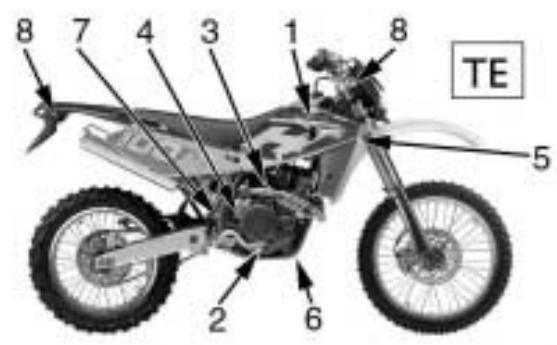
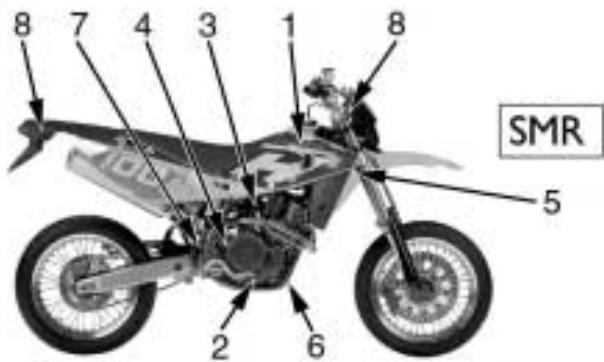
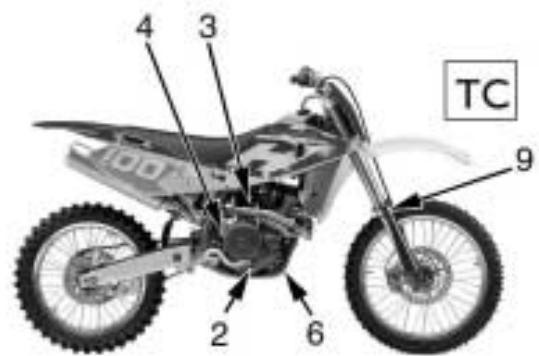
PARTI OPTIONAL (TE)
| 1- Gruppo anelli di tenuta motore | 8000 99923 |
| 2- Kit ENDURO (U.S.A.) | 8000 A0396 |
| 3- Corona posteriore | |
| 8G00 96837 (Z=45) | |
| 8000 96837 (Z=46) | |
| 8A00 96837 (Z=47) | |
| 8B00 96837 (Z=48) | |
| 8C00 96837 (Z=49) | |
| 8D00 96837 (Z=50)* |
§: STANDARD on 250 model
&: STANDARD on 450 model
ELEMENTS EN OPTION (TE)
| 1- Groupe bague moteur | 8000 99923 |
| 2- Kit ENDURO (U.S.A.) | 8000 A0396 |
| 3- Couronne arrière | |
| 8G00 96837 (Z=45) | |
| 8000 96837 (Z=46) | |
| 8A00 96837 (Z=47) | |
| 8B00 96837 (Z=48) | |
| 8C00 96837 (Z=49) | |
| 8D00 96837 (Z=50)* | |
| 4- Pignon sortie boîte des vitesses | |
| 8000 63827 (Z=12) | |
| 8000 63828 (Z=13) § | |
| 8000 63829 (Z=14) & | |
| 8000 63830 (Z=15) | |
| 8000 63831 (Z=16) | |
| 5- Couple de pastilles arrière frittées(terreins boueux et sableux) | 8A00 79072 |
| 6- Huile fourche avant(bidonde 1000 cm3) | 8000 80260 |
| 7- Huile amortisseur(bidonde 500 cm3)8000 88231 | |
| 8- Kit ressort fourche avant(ressort K=3,8 N/mm+entretoise) | 8000 91607 |
| Kit ressort fourche avant(ressort K=4,0 N/mm+entretoise) | 8000 91608 |
| Kit ressort fourche avant(ressort K=4,2 N/mm+entretoise) | 8000 91609 |
| Kit ressort fourche avant(ressort K=4,5 N/mm+entretoise) | 8000 91610 * |
| Kit ressort fourche avant(ressort K=4,8 N/mm+entretoise) | 8000 91611 |
| 9- Ressort amortisseur(K=4,8 Kg/mm) | 8000 98567 |
| Ressort amortisseur §(K=5,0 Kg/mm) | 8000 98568 |
| Ressort amortisseur &(K=5,2 Kg/mm) | 8000 98569 |
| Ressort amortisseur(K=5,4 Kg/mm) | 8000 98570* |
| Ressort amortisseur(K=5,6 Kg/mm) | 8000 98571 |
| 10- Catalogue pieces de rechange | 8000 A2926 |
| 11- Huile freins (bidon de 250 cm3) | 8000 71445 |
| 12- Joints moteur (250) | 8000 99922 |
| Joints moteur (450) | 8000 A1315 |
| 13- Manuel d'atelier | 8000 A2925 |
*: STANDARD
OPTIONAL PARTS LIST (TC)
| 1. Engine seals kit | 8000 99923 |
| 2. Workshop manual | 8000 A2925 |
| 3. Rear sprocket | |
| 8G00 96837 (Z=45) | |
| 8000 96837 (Z=46) | |
| 8A00 96837 (Z=47) | |
| 8B00 96837 (Z=48) | |
| 8C00 96837 (Z=49) | |
| 8D00 96837 (Z=50)* | |
| 4. Drive sprocket | |
| 8000 63827 (Z=12) | |
| 8000 63828 (Z=13) | |
| 8000 63829 (Z=14) § | |
| 8000 63830 (Z=15) & | |
| 8000 63831 (Z=16) | |
| 5. Rear sintered pad couple(for sandy and muddy grounds) | 8A00 79072 |
| 6. Front fork oil(1000 cm3 container) | 8000 80260 |
| 7. Rear shock absorber oil(500 cm3 container) | 8000 88231 |
| 8. Front fork spring+spacer kit(K=3,8 N/mm) | 8000 91607 |
| Front fork spring+spacer kit(K=4,0 N/mm) | 8000 91608 |
| Front fork spring+spacer kit(K=4,2 N/mm) | 8000 91609 |
| Front fork spring+spacer kit(K=4,5 N/mm) | 8000 91610 |
| Front fork spring+spacer kit(K=4,8 N/mm) | 8000 91611* |
| 9. Rear shock absorber spring(K=4,8 Kg/mm) | 8000 98567 |
| Rear shock absorber spring §(K=5,0 Kg/mm) | 8000 98568 |
| Rear shock absorber spring &(K=5,2 Kg/mm) | 8000 98569* |
| Rear shock absorber spring(K=5,4 Kg/mm) | |
| Rear shock absorber spring(K=5,6 Kg/mm) | 8000 98570 |
| 10. Spare parts catalogue | 8000 A2926 |
| 11. Brake fluid (250 cm3 container) | 8000 71445 |
| 12. Engine basket kit (250) | 8000 99922 |
| Engine basket kit (450) | 8000 A1315 |
*: STANDARD
| §: STANDARD on 250 model |
| &: STANDARD on 450 model |
ELEMENTS EN OPTION (TC)
| 1- 1Groupe bague moteur | |
| 2- Manuel d'atelier | 8000 99923 |
| 8000 A2925 | |
| 3- Couronne arrière | |
| 8G00 96837 (Z=45) | |
| 8000 96837 (Z=46) | |
| 8A00 96837 (Z=47) | |
| 8B00 96837 (Z=48) | |
| 8C00 96837 (Z=49) | |
| 8D00 96837 (Z=50) * | |
| 4- Pignon sortie boîte des vitesses | |
| 8000 63827 (Z=12) | |
| 8000 63828 (Z=13) | |
| 8000 63829 (Z=14) § | |
| 8000 63830 (Z=15) & | |
| 8000 63831 (Z=16) | |
| 5- Couple de pastilles arrière frittées(terreins boueux et sableux) | 8A00 79072 |
| 6- Huile fourche avant(bidonde 1000 cm3) | 8000 80260 |
| 7- Huile amortisseur(bidonde 500 cm3) | 8000 88231 |
| 8- Kit ressort fourche avant(ressort K=3,8 N/mm+entretoise) | 8000 91607 |
| Kit ressort fourche avant(ressort K=4,0 N/mm+entretoise) | 8000 91608 |
| Kit ressort fourche avant(ressort K=4,2 N/mm+entretoise) | 8000 91609 |
| Kit ressort fourche avant(ressort K=4,5 N/mm+entretoise) | 8000 91610 |
| Kit ressort fourche avant(ressort K=4,8 N/mm+entretoise) | 8000 91611 * |
| 9- Ressort amortisseur(K=4,8 Kg/mm) | 8000 98567 |
| Ressort amortisseur §(K=5,0 Kg/mm) | 8000 98568 |
| Ressort amortisseur &(K=5,2 Kg/mm) | 8000 98569 * |
| Ressort amortisseur(K=5,4 Kg/mm) | 8000 98570 |
| Ressort amortisseur(K=5,6 Kg/mm) | 8000 98571 |
| 10- Catalogue pieces de rechange | 8000 A2926 |
| 11- Huile freins (bidon de 250 cm3) | 8000 71445 |
| 12- Joints moteur (250) | 8000 99922 |
| Joints moteur (450) | 8000 A1315 |
*: STANDARD
natural_image
Simple 3D diagram of a rectangular block with an arrow labeled '2' pointing to its edge (no text or symbols on the block itself)
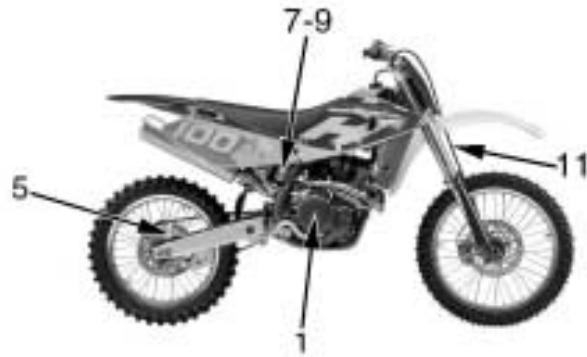
PARTI OPTIONAL (SMR)
AFTER-RACE CHECK POINTS
After racing, first clean the motorcycle and then inspect the entire motorcycle, with special attention to the items listed in «MAINTENANCE», such as the air cleaner, carburetor, brakes, etc. Carry out general lubrication, and make adjustment as necessary.
STORAGE
When the motorcycle is to be stored for any length of time, is should be prepared for storage as follows: - Clean the entire motorcycle thoroughly. - FIRST carry out the operation mentioned hereunder, then fill the tank with fuel mixed with a stabilizer:
place the pipe in a basin, loosen the exhaust screw set on the lower side of the basin, then drain the fuel and tighten the screw again.
WARNING
Never litter the environment with fuel, and let the engine running in open air, never in closed rooms.
APPENDICE
CONTROLES APRES CHAQUE COMPETITION
- Lubricate the drive chain and all the cables.
- Spray oil on all unpainted metal surfaces to prevent rusting. Avoid getting oil on rubber parts or in the brakes.
- Set the motorcycle on a box or stand so that both wheels are raised off the ground. (If this cannot be done, put boards under the front and rear wheels to keep dampness away from the tire rubber).
- Tie a plastic bag over the exhaust pipe to prevent moisture from entering.
- Put a cover over the motorcycle to keep dust and dirt from collecting on it.
To put the motorcycle back into the use after storage.
1) Preparation for washing Before washing, precautions must be taken to keep water out of the following places:
● Rear opening of the muffler :
- Cover with a plastic bag secured with rubber bands.
- Clutch and brake levers, hand grips, engine stop button:
- Cover with plastic bags.
● Air cleaner intake: - Close up the opening with tape, or stuff in rags.
2) Where to be careful Avoid spraying water with any great force near the following places:
● Air cleaner
● Under the fuel tank: If water gets into the ignition coil or into the spark plug cap, the spark will jump through the water and be grounded out. When this happens, the motorcycle will not start and the affected parts must be wiped dry.
● Fork head, wheel bearings.
NETTOYAGE
- Remove the plastic bags, and clean the air cleaner intake.
- Lubricate the points listed in the General Lubrication Section (P. 286-292).
- Start the engine and run it for 5 minutes.
- Test the brakes before riding the motorcycle.
WARNING*: Never wax or lubricate the brake disc. Loss of braking and an accident could result. Clean the disc with an oilless solvent such as acetone. Observe the solvent warnings.
3) Après le lavage
natural_image
Black-and-white photo of a four-wheeled motor with visible wheels and front wheel (no text or symbols on the bike itself)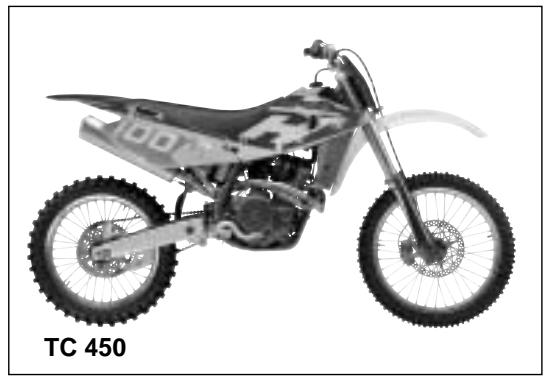
natural_image
Black-and-white photo of a four-wheeled motorcycle with visible tracks and wheels, labeled 'TC 450' (no other text or symbols)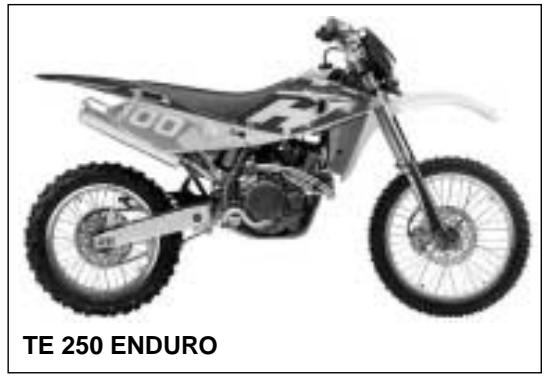
natural_image
Side view of a Te 250 Enduro motorcycle with visible dynamics and wheels (no text or symbols on the bike body)DISCLAIMER OF WARRANTY
IN ACCEPTING DELIVERY OF THIS MOTORCYCLE THE BUYER OR TRANSFEREE ACKNOWLEDGES THAT HE HAS THOROUGHLY INSPECTED THE MOTORCYCLE, AND FURTHER AGREES TO ACCEPT THE MOTORCYCLE AS IS WITH ALL DEFECTS OR FAULTS, CONCEALED OR OBVIOUS. HE FURTHER AGREES THAT NO WARRANTIES ATTACH, EXPRESS OR IMPLIED, INCLUDING ANY WARRANTY OF MERCHANTABILITY OR FITNESS FOR ANY PARTICULAR PURPOSE. THE BUYER OR TRANSFEREE INDEMNIFIES AND HOLDS HARMLESS CAGIVA U.S.A., MV Agusta Motorcycles S.p.A., THEIR AGENTS AND EMPLOYEES. FOR ANY FAILURE OF PERFORMANCE, COST OF SERVICE, OR REPAIR. THE BUYER FURTHER ACKNOWLEDGES THAT THIS MOTORCYCLE IS NOT INTENDED FOR USE ON PUBLIC STREETS, ROADS, HIGHWAYS, OR TRAILS UNDER PUBLIC JURISDICTION AND THAT USE ON SUCH MAY VIOLATE STATE AND FEDERAL LAW.
Noise emission warranty
MV Agusta Motorcycles S.p.A. warrants that this exhaust system, at the time of sale, meets all applicable U.S. EPA Federal noise standards. This warranty extends to the first person who buys this exhaust system for purposes other than resale, and to all subsequent buyers. Warranty claims should be addressed to Cagiva U.S.A. 2300 MARYLAND ROAD.
WILLOW GROVE, PA 19090-4193
215-830-3300
Tampering warning
Tampering with Noise Control System Prohibited.
Federal law prohibits the following acts or causing thereof:
(1) The removal or rendering inoperative by any person other than for purposes of maintenance, repair, or replacement, of any device or element of design incorporated into any new vehicle for the purpose of noise control prior to its sale or delivery to the ultimate purchaser or while it is in use, and
(2) the use of the vehicle after such device or element of design has been removed or rendered inoperative by any person.
Among those acts presumed to constitute tampering are the acts listed below.
1) Removal of, or puncturing the muffler, baffles, header pipes or any other component which conducts exhaust gases.
2) Removal or puncturing of any part of the intake system.
3) Lack of proper maintenance.
4) Replacing any moving part of the vehicle, or parts of the exhaust or intake system, with parts other than those specified by the manufacturer.
Warning statement
This product should be checked for repair or replacement if the motorcycle noise has increased significantly through use.
Otherwise, the owner may become subject to penalties under state and local ordinances.
SPARK ARRESTER
The TE/SMR models are equipped with a U.S. Forest Service approved spark arrester for maximum efficiency and performance.
"SPARK ARRESTER" MAINTENANCE AND CLEANOUT INSTRUCTIONS
Proceed as follows:
A: Remove the screws (1) and the R.H. side panel (2). Unhook springs (3) fastening the muffler (4) to the exhaust pipes.
B: Remove the two screws fastening the muffler to the rear frame.
Note*: If silencer or exhaust are difficult to remove, help to slide them apart by tapping gently with a rubber or plastic hammer.
C: remove the six rivets (5) and the endcap (6) from silencer's body;
D: examine SPARK ARRESTER conditions and remove, if necessary, carbon particles from the SPARK ARRESTER screen;
E: if necessary, inflate air on the SPARK ARRESTER screen, in the opposite direction in respect of the exhausted gas flow;
F: assemble the front endcap on the silencer's body, mounting the screws in the correct position, providing a tight connection between endcap and silencer's body, using, if necessary, a silicone paste;
G: re-assemble the silencer on motorbike.
Due to the SPARK ARRESTER position on the silencer, if you need only to check the SPARK ARRESTER conditions you can:
A: disassemble the silencer from motorbike;
B: check SPARK ARRESTER conditions simply looking into the silencer from front endcap opening;
C: if the check is positive, you can proceed in re-assembling the silencer on the motorbike;
D: if the check is negative, proceed with the maintenance and cleanout procedure.
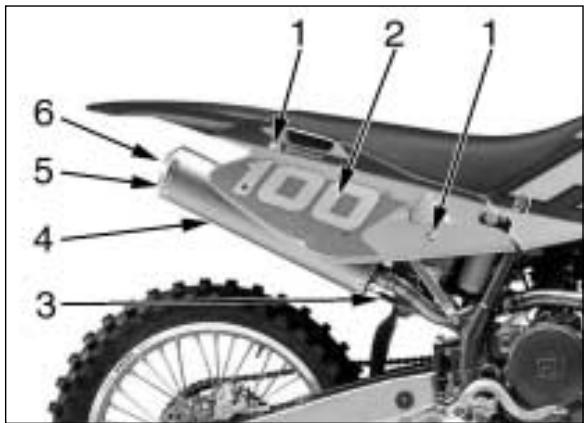
NOTES FOR "AUS" MODEL
natural_image
Black-and-white photo of a semi-truck motorcycle with visible wheels and front wheel (no text or symbols on the bike itself)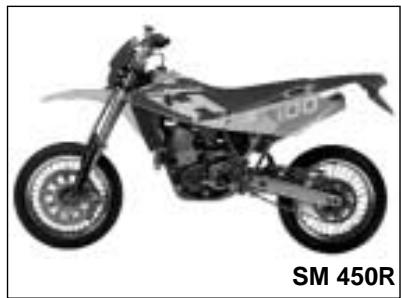
natural_image
Side view of a modified 450R motorcycle with visible dynamics and wheels (no text or symbols on the bike body)Tampering Warning:
Tampering with Noise Control System Prohibited. Federal law prohibits the following acts or causing therefor:
1) The removal or rendering inoperative by any person other than for purposes of maintenance, repair, or replacement, of any device or element of design incorporated into any new vehicle for the purpose of noise control prior to its sale or delivery to the ultimate purchaser or while it is in use, and
2) the use of the vehicle after such device or element of design has been removed or rendered inoperative by any person.
Among those acts presumed to constitute tampering are the acts listed below.
1) Removal of, or puncturing the muffler, baffles, header pipes or any other component which conducts exhaust gases.
2) Removal or puncturing of any part of the intake system.
3) Lack of proper maintenance.
4) Replacing any moving part of the vehicle, or parts of the exhaust or intake system, with parts other than those specified by the manufacturer.
This product should be checked for repair or replacement if the motorcycle noise has increased significantly through use. Otherwise, the owner may become subject to penalties under state and local ordinances.
| Description | Operation | Pre-delivery | Description | Operation | Pre-delivery |
| Engine oil | Check level | ☐ | Side stand switch | Check operation | ☐ |
| Two-stroke mix oil level | Check level | ☐ * | Electrical equipment | Check operation | ☐ |
| Coolant | Check / Restore level | ☐ | Instrument panel | Check operation | ☐ |
| Cooling system | Check for leakage | ☐ | Lights / Visual signals | Check operation | ☐ |
| Electric fans | Check operation | ☐ ** | Horn | Check operation | ☐ |
| Spark plugs | Check / Replace | ☐ | Headlight | Check operation | ☐ |
| Throttle body / Carburettor | Check and adjust | ☐ | Ignition switch | Check operation | ☐ |
| Brakes / Clutch fluid | Check level | ☐ | Locks | Check operation | ☐ |
| Brakes / Clutch | Check operation | ☐ | Screws and nuts | Check / Tighten | ☐ |
| Brakes / Clutch | Check lines for leakage | ☐ | Hose clamps | Check / Tighten | ☐ |
| Throttle control | Check operation | ☐ | General lubrication | ☐ | |
| Throttle control | Check / Adjust play | ☐ | General test | ☐ | |
| Choke control | Check operation | ☐ | |||
| Flexible controls and transm. | Check / Adjust | ☐ | |||
| Drive chain | Check / Adjust | ☐ | * : only for motorcycles with 2 stroke engine | ||
| Tyres | Check pressure | ☐ | **: only for some models | ||
| Side stand | Check operation | ☐ | |||
SOSTITUIRE LA VITERIA IN CASO DI DETERIORAMENTO- REPLACE SCREWS AND NUTS IF WORN- AU CAS DE DÉTERIORATION, REMPLACER LES BOULONS
DOPO PERCORRENZE SU FANGO O SABBIA EFFETTUARE UNA VERIFICA GENERALE- GENERAL CHECK AFTER RACING USE ON MUDDY OR SANDY GROUNDS- APRÈS USAGE SUR DES TERREINS BOUEUX OU SABLEUX, EFFECTUER UN CONTRÔLE GENERAL
| TE-TC 250, 450 | WARTUNGSTABELLE (FÜR DIESE KONTROLLEN WENDEN SIE SICH AN IHREN VERTRAGSHÄNDLER HUSQVARNA)- ESQUEMA DE MANTENIMIENTO PERIODICO (PARA EFECTUAR ESTAS OPERACIONES DIRÍJASE A SU CONCESIONARIO HUSQVARNA) | |||||||
| COUPON-CUPÓN | COUPON-CUPÓN | COUPON-CUPÓN | COUPON-CUPÓN | COUPON-CUPÓN | ||||
| TEILE- PARTICULAR | NACH DER ERSTEN 3 STUNDEN-DESPUÉS DE LAS PRIMERAS 3 horas | ALLE-CADA | ALLE-CADA | ALLE-CADA | ALLE-CADA | ALLE-CADA | WECHSELN WENN NÓTIG- SUBSTITUIR SI NECESARIO | SIEHE SEITE- VER PAGINA |
| 4h MX/8h EN | 8h Mx/16h EN | 16h MX/32h EN | 32h MX/64h EN | 40h MX/80h EN | ||||
| HINTERE BREMSSCHEIBE- DISCO FRENO TRASERO | C (*) | x | 176-177 | |||||
| HINTERBREMSFLÜSSIGKEIT- FLUIDO INSTALACIÓN FRENANTE TRASERA | C | S | 128-129, 192-193 | |||||
| BREMSBELAEGE- PASTILLAS FRENOS | C | x | 168-169 | |||||
| BREMSPUMPE/BREMSSÄTTEL SCHLAUCH- TUBERÍAS BOMBA/PINZA INSTALACÍONES FRENANTES | C | 174-175 | ||||||
| TREIBSTOFFROHR- TUBERÍAS CARBURANTE | C | S | x | # | ||||
| GERÄUSCHDÄMPFENDES MATERIAL FÜR AUSPUFF- MATERIAL FONOABSORBENTE SILENCIADOR | S | x | 196-197 | |||||
| AUSPUFFROHR UND SCHALLDÄMPFER- TUBO DE ESCAPE Y SILENCIADOR | C | x | # | |||||
| RADSPEICHENSSPANNUNG- TENSION RADIOS RUEDAS | C | C | 224 | |||||
| RADNABENLAGER- COJÍNETES CUBOS RUEDAS | S | x | # | |||||
| KRANZ- CORONA TRASERA | S | x | # | |||||
| SCHRAUBENANZIEHUNG FÜR HINTERKRANZ- TORSION TORNILLOS CORONA TRASERA | C | C | 152-153, 258-259 | |||||
| SEKUNDÄRE ÜBERTRAGUNGSKETTE- CADENA TRANSMISIÓN SECUNDARIA | C, L | S | x | 152-153 | ||||
| KONTROLLE VERSCHRAUBUNG KALTGESENKBOLZEN- CONTROL GENERAL AJUSTE TUERCAS | C | C | # | |||||
LEGENDE- LEYENDA
h: STUNDEN- HORAS
S: WECHSELN- SUBSTITUCIÓN
C: KONTROLLIEREN- CONTROL
P: REINIGEN- LIMPIEZA
R: REVISION- REVISION
L: SCHMIERUNG/BESCHMEIREN- ENGRESAJE/LUBRICACIÓN
MX: MOTOCROSS
EN: ENDURO
: SIEHE WERKSTATTHANDBUCH- VER MANUAL DE OFICINA
(*) ROTIEREN 45° BEFESTIGUNGBUCHSEN - GIRAR DE 45° LOS MANGUITOS DE FIJACIÓN
ANMERKUNG- NOTAS
DICHTUNGWECHSE: BEI JEDEM DEMONTAGE- SUBSTITUIR LAS EMPACURAS EN EL CASO DE DESMONTAJE
SCHRAUBEN VERSCHLEISS: WECHSELN- SUBSTITUIR TORNILLOS Y TUERCAS EN EL CASO DE DESGASTE
SCHLAMMIGES UND SANDIGES GELÄNDEN: EIN ALLGEMEINE KONTROLLE DURCHFÜHREN- DESPUÉS DE LA CARRERA SOBRE UN TERRENO FANGOSO O ARENOSO, EFECTUAR UN CONTROL GENERAL
| SMR 450 | SCHEMA DI MANUTENZIONE PERIODICA (DA EFFETTUARE PRESSO IL CONCESSIONARIO HUSQVARNA PERIODIC MAINTENANCE SCHEDULE (SEE YOUR HUSQVARNA DEALER FOR THESE SERVICES) ESQUEME ENTRETIEN PERIODIQUE (EFFECTUER PAR LE VOTRE CONCESSIONAIRE HUSQVARNA) | ||||
| PARTICOLARE- ITEM- PARTICULAIRE | TAGLIANDO COUPON COUPON | TAGLIANDO COUPON- COUPON | TAGLIANDO COUPON COUPON | ||
| USO STRADALE ROAD UTILISE ROUTIER | DOPO I PRIMI 1000Km AFTER FIRST 1000 Km APRÈS LES PREMIERS 1000 Km | OGNI 5000 KM EVERY 5000 Km TOUS LES 5000 Km | OGNI 10000Km EVERY 10000 Km TOUS LES 10000 Km | SOSTITUIRE SE NECESSARIO REPLACE IF NECESSARY REMPLACER SI NÉCESSAIRE | VEDERE PAGINA SEE PAGE VOIR PAGE |
| USO AGONISTICO COMPETITION UTILISE COMPÉTITIONS | DOPO LE PRIME 3 ORE AFTER FIRST 3 hours APRÈS LES PREMIERS 3 heures | OGNI 5 ORE EVERY 5 hours TOUS LES 5heures | OGNI 15 ORE EVERY 15 hours TOUS LES 15 heures | ||
| VALVOLE- VALVE- SOUPAPES | C (GIOCO CLEARANCE- JEAU) (*) | C (GIOCO- CLEARANCE- JEAU) (*) | S (#) | (*): 114 | |
| MOLLE VALVOLE- VALVE SPRING- RESSORTS SOUPAPES | C | X | # | ||
| SCODELLINI, SEMICONI VALVOLE- VALVE CUP, VALVE HALF CONE- CUVETTES, DEMI-CÔNE SOUPAPES | C | X | # | ||
| BILANCIERI DI ASPIRAZIONE/SCARICO-ROCKER ARM (INTAKE-EXHAUST)- CULBUTEURS D'ASPIRATION ET D'ÉCHAPPEMENT | C | X | # | ||
| ALBERO A CAMME- CAMSHAFT- ARBRE DISTRIBUTION | C | # | |||
| CATENA DISTRIBUZIONE- VALVE TIMING CHAIN- CHAINE DISTRIBUTION | S | # | |||
| PATTINO CATENA DISTRIBUZIONE- VALVE TIMING CHAIN SLIDER- GLISSIÈRE CHAINE DISTRIBUTION | C | S | # | ||
| INGRANAGGIO CONDOTTO DISTRIBUZIONE- VALVE TIMING DRIVEN GEAR- ENGRENAGE CONDIUT DISTRIBUTION | C | X | # | ||
| INGRANAGGIO CONDUTTORE DISTRIBUZIONE- VALVE TIMING DRIVING GEAR- ENGRENAGE CONDUCTEUR DISTRIBUTION | C | # | |||
| TENDITORE CATENA DISTRIBUZIONE- VALVE TIMING CHAIN TENSIONER- TENDEUR CHAINE DISTRIBUTION | C | # | |||
| SISTEMA DECOMPRESSORE- STARTER DECOMPRESSOR SYSTEM- SYSTÈME DECOMPRESSEUR DÉMARRAGE | C | X | 86 | ||
| RACCORDO DI ASPIRAZIONE- INTAKE MANIFOLD- RACCORD ADMISSION | C | S | X | # | |
| CILINDRO COMPLETO- CYLINDER ASSY.- CYLINDRE COMPL. | C | X | # | ||
| PISTONE COMPLETO- PISTON ASSY.- PISTON COMPL. | S | # | |||
| BIELLA MOTORE COMPLETA- CONNECTING ROD ASSY.- BIELLE COMPL. | S | # | |||
| CUSCINETTI BASAMENTO- CRANKCASE BEARINGS- ROULEMENTS CARTERS | S | # | |||
| OLIO MOTORE E FILTRO OLIO- ENGINE OIL/OIL FILTER CARTRIDGE- HUILE MOTEUR/FILTRE HUILE | S | S | S | 100 | |
| POMPA OLIO- OIL PUMP- POMPE HUILE | C | # | |||
| TUBAZIONE LUBRIFICAZIONE POMPA OLIO/BASAMENTO- OIL PUMP/CRANKCASE HOSE- TUYAU POMPE HUILE- CARTERS | C | # | |||
| COPPIA INGRANAGGI TRASM. PRIMARIA- SET OF MATCHED PRIMARY- ENGRENAGES TRANSM. PRIMARIE | C | X | # | ||
| MOZZO FRIZIONE- CLUTCH HUB- MOYEAU PORTE-DISQUE EMBRAYAGE | C | X | # | ||
| DISCHI FRIZIONE- CLUTCH DISCS- DISQUES EMBRAYAGE | C | S | X | # | |
| PIATTO SPINGIDISCHI FRIZIONE- CLUTCH DISCS PRESSURE PLATE- POUSSE DISQUES EMBRAYAGE | C | # | |||
| MOLLE FRIZIONE- CLUTCH SPRING- RESSORT EMBRAYAGE | C | X | # | ||
| CAMPANA FRIZIONE- CLUTCH DISCS HOUSING-CAGE EMBRAYAGE | C | X | # | ||
| SMR 450 | WARTUNGSTABELLE (FÜR DIESE KONTROLLEN WENDEN SIE SICH AN IHREN VERTRAGSHÄNDLER HUSQVARNA) ESQUEMA DE MANTENIMIENTO PERIODICO(PARA EFECTUAR ESTAS OPERACIONES DIRÍJASE A SU CONCESIONARIO HUSQVARNA) | ||||
| TEILE- PARTICULAR | COUPON- CUPÓN | COUPON- CUPÓN | COUPON- CUPÓN | ||
| STRASSE- USO VIAL | NACH DEN ERSTEN 1000Km- DESPUES LOS PRIMEROS 1000Km | ALLE 5000 KM CADA 5000 KM | ALLE 10000Km CADA 10000Km | WECHSELN WENN NÓTIG- SUBSTITUÍR SI NECESARIO | SIEHE SEITE VER PAGINA |
| RACING- USO AGONISTICO | NACH DEN ERSTEN 3 STUNDEN- DESPUES LAS PRIMERAS 3 HORAS | ALLE 5 STUNDEN CADA 5 HORAS | ALLE 15 STUNDEN CADA 15 HORAS | ||
| VENTIL- VÁLVULAS | C (BETRIEBSSPIEL- JUEGO) (*) | C (BETRIEBSSPIEL- JUEGO) (*) | S (#) | (●): -114-115 | |
| VENTILFEDER- RESORTES VÁLVULAS | C | X | # | ||
| TELLER, HALB KEGEL- CUBETAS, SEMI-CONOS VÁLVULAS | C | X | # | ||
| KIPPHEBEL (ANSAUGEN-AUSPUFFROHR)- BALANCIN DE ASPIRACIÓN –ESCAPE | C | X | # | ||
| NOCKENWELLE- EJE DISTRIBUCIÓN | C | # | |||
| VENTILSTEUERUNGKETTE- CADENA DISTRIBUCIÓN | S | # | |||
| VENTILSTEUERUNGKETTEGLEITBAHN- PLATO CADENA DISTRIBUCIÓN | C | S | # | ||
| VENTILSTEUERUNGZAHNRAD- ENGRENAJE CONDUCTO DISTRIBUCIÓN | C | X | # | ||
| VENTILSTEUERUNGANTRIEBSRAD- ENGRENAJE CONDUCTOR DISTRIBUCIÓN | C | # | |||
| VENTILSTEUERUNGKETTESPANNER- TENSOR CADENA DISTRIBUCIÓN | C | # | |||
| DEKOMPRESSOR- GRUPO DECOMPRESSOR | C | X | 86-87 | ||
| ANSCHLUSS- EMPALME DE ASPIRACIÓN | C | S | X | # | |
| ZYLINDER KPL.- CILINDRO COMPLETO | C | X | # | ||
| KOLBEN KPL.- PISTÓN COMPLETO | S | # | |||
| PLEUELSTANGE KPL.- BIELA MOTOR COMPLETA | S | # | |||
| GEHAUSELAGER- COJINETE DE CARTER | S | # | |||
| MOTORÓL/WECHSELFILTER- ACEITE MOTOR/FILTRO ACEITE MOTOR | S | S | S | 100-101 | |
| ÖLPUMPE- BOMBA ACEITE | C | # | |||
| SCHMIERUNGROHR FÜR ÖLPUMPE/GEHAUSE- TUBO LUBRICACIÓN BOMBA ACEITE/BANCADA | C | # | |||
| STIRNRADERPAAR- GRUPO ENGREN. TRANSM. PRIMARIA | C | X | # | ||
| KUPPLUNGSCHEIBENHALTERNABE- CUBO PORTA DISCOS EMBRAGUE | C | X | # | ||
| KUPPLUNGSCHEIBE- DISCOS EMBRAGUE | C | S | X | # | |
| KUPPLUNGDRUCKPLATTE- PLATO EMPUJA DISCOS EMBRAGUE | C | # | |||
| KUPPLUNGFEDER- RESORTE EMBRAGUE | C | X | # | ||
| KUPPLUNGKORB- CAMPANA EMBRAGUE | C | X | # | ||
| KUPPLUNGSTEUERSTANGE- VARILLA DESEMBRAGUE | C | # | |||
| RITZEL- PIÑÓN CADENA | C | S | 152-153 | ||
| ANLASSERANTRIEBSRAD- ENGRENAJE DE ARRANQUE | C | X | # | ||
| ANLASSERHEBEL- PALANCA ARRANQUE | L | v | |||
| GANGSCHALTUNGHEBEL- PEDAL MANDO CAMBIO | X | 78-79 | |||
| ZÜNDKERZE- BUJIA ENCENDIDO | P | S | 110-111 | ||
| ZÜNDKERZESTECKER- PIPA BUJIA ENCENDIDO | C | C | X | # | |
| VERGASER- CARBURADOR | P | # | |||
| SMR 450 | SCHEMA DI MANUTENZIONE PERIODICA (DA EFFETTUARE PRESSO IL CONCESSIONARIO HUSQVARNA PERIODIC MAINTENANCE SCHEDULE (SEE YOUR HUSQVARNA DEALER FOR THESE SERVICES) ESQUEME ENTRETIEN PERIODIQUE (EFFECTUER PAR LE VOTRE CONCESSIONAIRE HUSQVARNA) | ||||
| PARTICOLARE- ITEM- PARTICULAIRE | TAGLIANDOCOUPONCOUPON | TAGLIANDOCOUPON- COUPON | TAGLIANDOCOUPONCOUPON | ||
| USO STRADALEROADUTILISE ROUTIER | DOPO I PRIMI 1000KmAFTER FIRST 1000 KmAPRÈS LES PREMIERS 1000 Km | OGNI 5000 KMEVERY 5000 KmTOUS LES 5000 Km | OGNI 10000KmEVERY 10000 KmTOUS LES 10000 Km | SOSTITUIRE SE NECESSARIO REPLACE IF NECESSARY REMPLACER SI NÉCESSAIRE | VEDERE PAGINA SEE PAGE VOIR PAGE |
| USO AGONISTICOCOMPETITIONUTILISE COMPÉTITIONS | DOPO LE PRIME 3 ORE AFTER FIRST 3 hoursAPRÈS LES PREMIERS 3 heures | OGNI 5 OREEVERY 5 hoursTOUS LES 5heures | OGNI 15 OREEVERY 15 hoursTOUS LES 15 heures | ||
| ASTINA DISINNESTO FRIZIONE- CLUTCH DISENGAGEMENT ROD- BILLE COILESSAU DÉBRAYAGE EMBRAYAGE | C | # | |||
| PIGNONE USCITA CAMBIO- DRIVE SPROCKET- PIGNON CHAÎNE TRANSMISSION | C | S | 152 | ||
| INGRANAGGI AVVIAMENTO- STARTING GEARS- ENGRENAGE DÉMARRAGE | C | X | # | ||
| PEDALE AVVIAMENTO- STARTING PEDAL- LEVIER DÉMARRAGE | L | # | |||
| PEDALE COMANDO CAMBIO- GEAR CONTROL PEDAL- LEVIER COMM. DE VITESSE | X | 78 | |||
| CANDELA ACCENSIONE- SPARK PLUG- BOUGIE D'ALLUMAGE | P | S | 110 | ||
| PIPETTA CANDELA- SPARK PLUG CAP- PIPETTE BOUGIE D'ALLUMAGE | C | C | X | # | |
| CARBURATORE- CARBURETOR- CARBURATEUR | P | # | |||
| VALVOLA GAS CARBURATORE- CARBURETOR THROTTLE VALVE- SOUPAPE DE GAZ DU CARBURATEUR | C | X | # | ||
| FILTRO ARIA- AIR FILTER- FILTRE À AIR | PL | PL | X | 118 | |
| RADIATORI- RADIATORS- RADIATEURS | C | # | |||
| TUBAZIONI ACQUA E FASCETTE- COOLANT HOSES AND CLAMPS- TUYAU EAU ET COLLIER | C | C | 106 | ||
| TUBAZIONE RADIATORI/POMPA ACQUA- RADIATORS HOSE/WATER PUMP- TUYAU RADIATEURS/POMPE EAU | C | C | 106 | ||
| PEDANE APPOGGIAPIEDI, PERNI, MOLLE- FOOTRESTS, FOOTREST PINS AND SPRINGS- REPOSE PIEDS, PIVOTS, RESSORTS | X | # | |||
| PERNI FISS. TELAIETTO, PERNI FISS. MOTORE- SADDLE FRAME FASTENING BOLTS, ENGINE FASTENING BOLTS- PIVOTS DE FIXATION CADRE SIEGE, PIVOTS DE FIXATION MOTEUR | C | C | # | ||
| CAVALLETTO LATERALE- SIDE STAND- BEQUILLE LATÉRALE | C | 48 | |||
| RULLO GUIDACATENA, CUSCINETTO- CHAIN GUIDE ROLLER, BEARINGS- AIGUILLE GUIDE-CHAINE, ROULEMENT | C | C | X | 158 | |
| TESTA DI STERZO, BASE DI STERZO CON PERNO- STEERING HEAD, STEERING CROWN WITH PIN- TÊTE DIRECTION, SOCLE DE DIRECTION AVEC PIVOT | L | # | |||
| FORCELLA ANTERIORE- FRONT FORK- FOURCHE AVANT | R | # | |||
| ATTACCHI MANUBRIO CON FISSAGGI- HANDLEBAR HOLDERS AND FASTENING SET- DEMI-PALIERS GUIDON AVEC FIXAGE | C | C | 142 | ||
| BUSSOLA FORCELLONE POSTERIORE- REAR SWING ARM BUSHINGS- DOUILLE FOURCHE ARRIÉRE | C | # | |||
| PATTINO CATENA POSTERIORE- REAR CHAIN SLIDER- GLISSIÈRE CHAINE ARRIÉRE | C | X | 158 | ||
| BUSSOLE LEVERAGGI SOSPENSIONE POST.- REAR SUSPENSION LINKS BUSHINGS- DOUILLES LEVIER SUSPENSION ARRIÉRE | C | X | # | ||
| GUIDACATENA/COPRICATENA- REAR CHAIN GUIDE/ REAR CHAIN GUARD- GUIDE CHAINE/ CARTER DE CHAINE | C | C | X | 158 | |
| SMR 450 | WARTUNGSTABELLE (FÜR DIESE KONTROLLEN WENDEN SIE SICH AN IHREN VERTRAGSHÄNDLER HUSQVARNA) ESQUEMA DE MANTENIMIENTO PERIODICO(PARA EFECTUAR ESTAS OPERACIONES DIRÍJASE A SU CONCESIONARIO HUSQVARNA) | ||||
| TEILE- PARTICULAR | COUPON- CUPÓN | COUPON- CUPÓN | COUPON- CUPÓN | ||
| STRASSE- USO VIAL | NACH DEN ERSTEN 1000Km- DESPUES LOS PRIMEROS 1000Km | ALLE 5000 KM CADA 5000 KM | ALLE 10000Km CADA 10000Km | WECHSELN WENN NÓTIG- SUBSTITUIR SI NECESARIO | SIEHE SEITE VER PAGINA |
| RACING- USO AGONISTICO | NACH DEN ERSTEN 3 STUNDEN- DESPUES LAS PRIMERAS 3 HORAS | ALLE 5 STUNDEN CADA 5 HORAS | ALLE 15 STUNDEN CADA 15 HORAS | ||
| VERGASERDROSSELKLAPPE- VALVUÁLA GAS CARBURADOR | C | X | # | ||
| LUFTFILTER- FILTRO AIRE | PL | PL | X | 118-119 | |
| KÜHLER- RADIADORES | C | # | |||
| WASSERROHR UND SCHELLEN- TUBOS AGUA Y BANDAS | C | C | 106-107 | ||
| ROHR FÜR KÜHLER/WASSERPUMPE- TUBO RADIADORES/BOMBA AGUA | C | C | 106-107 | ||
| FUSSRASTER, BOLZEN, FEDER- POSAPIES, PERNOS, RESORTES | X | # | |||
| HINTERRAHMENBOLZEN, MOTORBOLZEN- TORNILLOS FIJACIÓN BASTIDOR TRASERO, TORNILLOS FIJACIÓN MOTOR | C | C | # | ||
| SEITENSTÄNDER- HORQUILLA LATERAL | C | 48-49 | |||
| KETTENFÜHRUNGROLLE, LAGER- RODILLO GUÍA-CADENA, COJÍNETE | C | C | X | 158-159 | |
| VORDERGABELLENKKOPF, GABELBRÜCKE MIT BOLZEN- CABEZA DE DIRECCIÓN, BASE DE DIRECCIÓN CON PERNO | L | # | |||
| VORDERGABEL- HORQUILLA DELANTERA | R | # | |||
| LENKERBÜGELBOLZEN- CABALLETES DEL MANILLAR CON PERNOS FIJACIÓN | C | C | 142-143 | ||
| HINTERGABELBUCHSE- MANGUITOS HORQUILLA TRASERA | C | # | |||
| KETTENGLEITBAHN- PLATO CADENA TRASERA | C | X | 158-159 | ||
| BUCHSE FÜR HEBELWERKHINTERHAUFHANGUNG- MANGUITOS PALANCAS SUSPENSION TRASERA | C | X | # | ||
| KETTENFÜHRUNG/ KETTENKASTEN- GUÍA-CADENA/ CUBRE-CADENA | C | C | X | 158-159 | |
| NADELKAFIG FÜR HINTERGABELBOLZEN- COJÍNETE DE RODILLOS PERNOS HORQUILLA TRASERA | L | L | # | ||
| HINTERSTOSSDAMPFER- AMORTIGUADOR TRASERO | C | # | |||
| NADELKAFIG UND BOLZEN FÜR HEBELWERKHINTERHAUFHANGUNG- COJÍNETE DE RODILLOS, PERNOS PALANCAS HORQUILLA TRASERA | L | # | |||
| GASGRIFF KPL.- MANDO GAS COMPLETO | CL | 106-107 | |||
| KUPPLUNGSTEUERUNG KPL.- MANDO EMBRAGUE COMPLETO | C (...) | R (#) | (●): -130-131 | ||
| DECOMPRESSORKABEL UND GASGKABEL- CABLES DECOMPRESSOR Y GAS | C | L | X | 86-87, 106-107 | |
| VORDERE BREMSSCHEIBE- DISCO FRENO DELANTERO | C | X | 176-177 | ||
| VORDERBREMSFLÜSSIGKEIT- FLUIDO INSTALACIÓN FRENANTE DELANTERA | C | S | 124-125, 188-189 | ||
| HINTERE BREMSSCHEIBE- DISCO FRENO TRASERO | C | X | 176-177 | ||
| HINTERBREMSFLÜSSIGKEIT- FLUIDO INSTALACIÓN FRENANTE TRASERA | C | S | 128-129, 192-193 | ||
| BREMSBELAEGE- PASTILLAS FRENOS | C | C | C | X | 168-169 |
| BREMSPUMPE –BREMSSÄTTEL SCHLAUCH- TUBERÍAS BOMBA -PINZA INSTALACIÓNES FRENANTES | C | X | 174-175 | ||
| SMR 450 | SCHEMA DI MANUTENZIONE PERIODICA (DA EFFETTUARE PRESSO IL CONCESSIONARIO HUSQVARNA PERIODIC MAINTENANCE SCHEDULE (SEE YOUR HUSQVARNA DEALER FOR THESE SERVICES) ESQUEME ENTRETIEN PERIODIQUE (EFFECTUER PAR LE VOTRE CONCESSIONAIRE HUSQVARNA) | ||||
| PARTICOLARE- ITEM- PARTICULAIRE | TAGLIANDOCOUPONCOUPON | TAGLIANDOCOUPON- COUPON | TAGLIANDOCOUPONCOUPON | ||
| USO STRADALEROADUTILISE ROUTIER | DOPO I PRIMI 1000KmAFTER FIRST 1000 KmAPRÈS LES PREMIERS 1000 Km | OGNI 5000 KMEVERY 5000 KmTOUS LES 5000 Km | OGNI 10000KmEVERY 10000 KmTOUS LES 10000 Km | SOSTITUIRE SE NECESSARIO REPLACE IF NECESSARYREEMPLACER SI NECESSAIRE | VEDERE PAGINASEE PAGEVOIR PAGE |
| USO AGONISTICOCOMPETITIONUTILISE COMPÉTITIONS | DOPO LE PRIME 3 ORE AFTER FIRST 3 hoursAPRÈS LES PREMIERS 3 heures | OGNI 5 OREEVERY 5 hoursTOUS LES 5heures | OGNI 15 OREEVERY 15 hoursTOUS LES 15 heures | ||
| GABBIE A RULLI, SPINOTTI LEVERAGGI SOSPENSIONE POST.- REAR SUSPENSION LINKS NEEDLE BEARINGS AND GUDGEON PIN - CAGE À AIGUILLES, AXES LEVIER SUSPENSION ARRIÉRE | L | # | |||
| AMMORTIZZATORE POSTERIORE-REAR SHOCK ABSORBER-AMMORTISSEUR ARRIÉRE | C | # | |||
| COMANDO GAS COMPLETO- THROTTLE CONTROL ASSY.- COMMANDE GAZ COMPL. | CL | 106 | |||
| COMANDO FRIZIONE COMPLETO- CLUTCH CONTROL ASSY.- COMMANDE EMBRAYAGE COMPL. | C (*) | R (#) | (●): 130 | ||
| CAVI DECOMPRESSORE E GAS- THROTTLE AND STARTING DECOMPRESSOR CABLES- CÂBLES DECOMPRESSEUR ET GAZ | C | L | X | 86-106 | |
| DISCO FRENO ANTERIORE- FRONT BRAKE DISC- DISQUE FREIN AVANT | C | X | 176 | ||
| FLUIDO IMPIANTO FRENANTE ANTERIORE- FRONT BRAKE SYSTEM FLUID- FLUIDE SYSTÈME DE FREINAGE AVANT | C | S | 124-188 | ||
| DISCO FRENO POSTERIORE- REAR BRAKE DISC- DISQUE FREIN ARRIÉRE | C | X | 176 | ||
| FLUIDO IMPIANTO FRENANTE POSTERIORE- REAR BRAKE SYSTEM FLUID- FLUIDE SYSTÈME DE FREINAGE ARRIÉRE | C | S | 128-192 | ||
| PASTIGLIE FRENI- BRAKE PADS- PASTILLES DU FREINS | C | C | C | X | 168 |
| TUBAZIONI POMPA/PINZA IMPIANTI FRENANTI- BRAKE SYSTEM PUMP-CALIPER HOSES- TUYAU POMPE/ETRIER SYSTÈME DE FREINAGE | C | X | 174 | ||
| TUBAZIONI CARBURANTE- FUEL HOSES- TUYAU CARBURANT | C | X | # | ||
| MATERIALE FONOASSORBENTE SILENZIATORE- EXHAUST SILENCER PACKING- MATERIAL INSONORISANT SILENCIEUX D'ECHAPPEMENT | X | 196-279 | |||
| TUBO DI SCARICO E SILENZIATORE- EXHAUST PIPE AND SILENCER- TUYAU ET SILENCIEUX D'ECHAPPEMENT | C | X | # | ||
| TENSIONE RAGGI RUOTE- WHEEL SPOKES TENSION- TENSION BRAS RUOES | C | C | 224 | ||
| CUSCINETTI MOZZI RUOTE- WHEEL HUB BEARINGS- ROULEMENTS MOYEATUS RUOES | C | X | # | ||
| CORONA POSTERIORE- REAR DRIVEN SPROCKET- COURONNE ARRIÉRE | S | # | |||
| SERRAGGIO VITI CORONA- REAR DRIVEN SPROCKET SCREWS TIGHTENING- SERRAGE VIS COURONNE ARRIÉRE | C | C | C | 152-158 | |
| CATENA TRASMISSIONE SECONDARIA- REAR TRANSMISSION CHAIN- CHAINE ARRIÉRE | CL | CL | S | 152 | |
| SERRAGGIO BULLONERIA- BOLTS AND NUTS TIGHTNESS GENERAL CHECK - CONTRÔLE SERRAGE DES BOULONS | C | C | # | ||
LEGENDA- KEY FOR MAINTENANCE SCHEDULE- LEGENDE
S: SOSTITUZIONE- REPLACEMENT- REMPLACEMENT
C: CONTROLLO- CHECK- CONTRÔLE
P: PULIZIA- CLEANING- NETTOYAGE
R: REVISIONE- OVERHAUL- REVISION
L: INGRASSAGGIO/LUBRIFICAZIONE- GREASING/LUBRICATION- LUBRIFICATION/GRAISSAGE
: VEDERE IL MANUALE DI OFFICINA- SEE WORKSHOP MANUAL- VOIR MANUAL D'ATELIER
NOTE- NOTE- NOTE
SOSTITUIRE LE GUARNIZIONI IN OCCASIONE DI OGNI SMONTAGGIO- EVERY REMOVAL REPLACE ALL GASKETS- TOUTES LES DÉMONTAGES, REMPLACER LES GARNITURES
SOSTITUIRE LA VITERIA IN CASO DI DETERIORAMENTO- REPLACE SCREWS AND NUTS IF WORN- AU CAS DE DÉTÉRIORATION, REMPLACER LES BOULONS
DOPO PERCORRENZE SU FANGO O SABBIA EFFETTUARE UNA VERIFICA GENERALE- GENERAL CHECK AFTER RACING USE ON MUDDY OR SANDY GROUNDS- APRÈS USAGE SUR DES TERREINS BOUEUX OU SABLEUX, EFFECTUER UN CONTRÔLE GENERAL
| SMR 450 | WARTUNGSTABELLE (FÜR DIESE KONTROLLEN WENDEN SIE SICH AN IHREN VERTRAGSHÄNDLER HUSQVARNA) ESQUEMA DE MANTENIMIENTO PERIODICO(PARA EFECTUAR ESTAS OPERACIONES DIRÍJASE A SU CONCESIONARIO HUSQVARNA) | ||||
| TEILE- PARTICULAR | COUPON- CUPÓN | COUPON- CUPÓN | COUPON- CUPÓN | ||
| STRASSE- USO VIAL | NACH DEN ERSTEN 1000Km- DESPUES LOS PRIMEROS 1000Km | ALLE 5000 KM CADA 5000 KM | ALLE 10000Km CADA 10000Km | WECHSELN WENN NÓTIG- SUBSTITUÍR SI NECESARIO | SIEHE SEITE VER PAGINA |
| RACING- USO AGONISTICO | NACH DEN ERSTEN 3 STUNDEN- DESPUES LAS PRIMERAS 3 HORAS | ALLE 5 STUNDEN CADA 5 HORAS | ALLE 15 STUNDEN CADA 15 HORAS | ||
| TREIBSTOFFROHR- TUBERÍAS CARBURANTE | C | X | # | ||
| GERÁUSCHDÄMPFENDES MATERIAL FÜR AUSPUFF- MATERIAL FONOABSORBENTE SILENCIADOR | X | 196-197, 279 | |||
| AUSPUFFROHR UND SCHALLDÄMPFER- TUBO DE ESCAPE Y SILENCIADOR | C | X | # | ||
| RADSPECHENSSPANNUNG- TENSION RADIOS RUEDAS | C | C | 224-225 | ||
| RADNABENLAGER- COJÍNETES CUBOS RUEDAS | C | X | # | ||
| KRANZ- CORONA TRASERA | S | # | |||
| SCHRAUBENANZIEHUNG FÜR HINTERKRANZ- TORSION TORNILLOS CORONA TRASERA | C | C | C | 152-153, 158-159 | |
| SEKUNDÄRE ÜBERTRAGUNGSKETTE- CADENA TRANSMISIÓN SECUNDARIA | CL | CL | S | 152-153 | |
| KONTROLLE VERSCHRAUBUNG KALTGESENKBOLZEN- CONTROL GENERAL AJUSTE TUERCAS | C | C | # | ||
LEGENDE- LEYENDA
S: WECHSELN- SUBSTITUCIÓN
C: KONTROLLIEREN- CONTROL
P: REINIGEN- LIMPIEZA
R: REVISION- REVISION
L: SCHMIERUNG-BESCHMEIREN- ENGRESAJE-LUBRICACIÓN
: SIEHE WERKSTATTHANDBUCH- VER MANUAL DE OFICINA
ANMERKUNG- NOTAS
DICHTUNGWECHSE: BEI JEDEM DEMONTAGE- SUBSTITUIR LAS EMPACURAS EN EL CASO DE DESMONTAJE
SCHRAUBEN VERSCHLEISS: WECHSELN- SUBSTITUIR TORNILLOS Y TUERCAS EN EL CASO DE DESGASTE
SCHLAMMIGES UND SANDIGES GELÄNDEN: EIN ALLGEMEINE KONTROLLE DURCHFÜHREN- DESPUÉS DE LA CARRERA SOBRE UN TERRENO FANGOSO O ARENOSO, EFECTUAR UN CONTROL GENERAL
INDICE ALFABETICO
Pagina
A
Accensione 28
Adjusting the carburetor 108
Adjusting the clutch....130
Adjusting the driven transmission 150
Adjusting the fork 138
Adjusting the front brake control lever 124
Adjusting the headlamp 246
Adjusting the idle 108
Adjusting the rear brake idle stroke 128
Adjusting shock absorber hydraulic brake....148
Adjusting shock absorber preload spring 146
Adjusting the rear brake pedal position 126
Adjusting the steering bearing play....120
Adjusting the suspensions according to the track special conditions....134
Adjusting the throttle cable 106
Adjusting the valve play 114
B
Battery 236
Brakes....166
Brake disc cleaning....178
Brake disc warpage 176
Brake disc wear 176
Brake pad assembly 170
Brake pad wear 168
Brake pad disassembly....168
C
Carburettor 30
Carburettor starter 52
Chain lubrication....154
Checks after every competition....268
Checks during running in 96
Check of air filter....118
Check of chain, pinion, crown wear .....152
Check of clutch fluid level 130
Check of cooling fluid 104
Check of front brake fluid level 124
Check of engine oil 98
Check of rear brake fluid level....128
Cleaning the air filter 118
Clutch 32
Clutch control 74
INDEX ALPHABETIQUE
Page
A
Coolant replacement 104
Cooling fluid 42, 44
Control position....22
D
Digital instrument ....54
Draining the front brake fluid....172
Draining the rear brake fluid 174
Driven transmission chain....32
E
Engine assembling fits 198
Electric diagram ......229, 231, 235
Electric elements 226
Engine lubrication....42, 44
Engine oil replacement 100,
Engine start 84
Engine stop....90
F
Filling the braking system....182
Fluid change 180
Fork oil level 140
Fuel 50
Fuel cock....46
Front brake control 68
Fraont brake fluid drain 172
Front braking system bleeding 168
Front fork....36
G
Gearbox control....78
Gearbox outlet pinion 32
General cleaning 272
H
Handlebar commutators 72
Handlebar position change 142
Headlamp bulbs replacement 242
Hydraulic clutch bluding 132
|
Ignition 28
Important notice 14
L
Long inactivity 268
E
Embrayage 32
Nettoyage plaquettes ....170
Oil filters replacement 100
Overhauling the wheels....222
P
Pad cleaning 170
Parts replacement 14
Pilot lights 54
Preliminary checks 80
R
Rear brake control....76
Rear crown 32
Rear fork....36
Rear brake fluid drain 174
Rear taillight bulb replacement 244
Running in 94
Rear braking system bleeding 192
Removing the front wheel 160
Removing the rear wheel 162
S
Steering lock 70
Side stand....48
Spark-arrester....279
Spark plug....28
Spark plug check 110
Special tools 250
Starting decompressor 86
T
Throttle control 68
Tires 38,164
Tool outfit 248
V
Vehicle identification number 20
Voltage regulator....112
W
Wheel pin bending 224
Wheel spokes 224
Wheels 36
secondaire 150
- TC 250-450, TE 250-450, SM 400-450R/2004
- PRESENTATION
- Note
- 2) ATTENTION\*
- Premessa importante
- Parts Replacement
- Préliminaires
- PRECAUTIONS FOR CHILDREN WARNING
- IDENTIFICATION DATA
- RESUME
- ELEMENTS D'IDENTIFICATION
- NUMERO
- D'IDENTIFICATION DU
- MOTOCYCLE (V.I.N.)
- UBICAZIONE COMANDI
- POSITION DES COMMANDES
- DATI TECNICI
- MOTORE
- TIMING SYSTEM
- DONNEES TECHNIQUES
- MOTEUR
- IGNITION
- LUBRIFICATION
- PRIMARY DRIVE
- CARBURATEUR
- TRANSMISSION
- Transmission ratio (TC)
- EMBRAYAGE
- FRONT SUSPENSION
- REAR SUSPENSION
- FRONT BRAKE
- REAR BRAKE
- RIMS
- CADRE
- PNEUS
- WARNING\*: Be careful not to touch the hot engine while operating the fuel valve.
- WARNING: BEFORE the following operation, please see the IMPORTANT NOTICE 2) on page 12
- COMMANDES
- ROBINETS CARBURANT
- CARBURANTE
- CARBURANT
- STRUMENTO DIGITALE, SPIE
- DIGITAL INSTRUMENT, WARNING LIGHTS
- INSTRUMENT DIGITAL, VOYANTS
- NOTE GENERALI
- REMARQUES GÉNÉRALES
- REEMPLACEMENT DE LES PILES DU COMPTEUR
- SET WS (setting the wheel circumference)
- SET "WS"- WHEEL CIRCUMFERENCE
- PROGRAMMATION "WS"- DÉVELOPPEMENT DE LA ROUE
- AUSWAHL "WS" - KREISUMFANG RAD
- PROGRAMMATION "CLK"-HEURE
- AUSWAHL "CLK" - JETZT
- SET "DST"- TOTAL MILEAGE
- PROGRAMMATION "DST"- KILOMÉTRAGE TOTAL
- AUSWAHL "DST" - GESAMTE LEKTÜRE
- SELECCION "DST" - LECTURA TOTAL
- COMANDO GAS
- POIGNEE DES GAZ
- ATTENTION
- COMMANDE FREIN AVANT
- (TE, SMR, USA excluded)
- BLOC DE DIRECTION
- (TE, SMR, USA exclu)
- VERSIONE "A"
- "B" VERSION
- L.H. HANDLEBAR COMMUTATOR (TE, SMR, escluso USA)
- VERSION "A"
- PULSANTE AVVIAMENTO MOTORE (TC, TE-USA)
- ENGINE STOP BUTTON (TC, TE USA)
- CLUTCH CONTROL
- CAUTION
- BOUTON DEMARRAGE MOTEUR (TC, TE-USA)
- COMANDO CAMBIO
- COMMANDE DU CHANGEMENT DE VITESSES
- ATTENTION: BEFORE the following operation, please see the IMPORTANT NOTICE 2) on page 12
- Check all fluids
- WARNING\*: Don't remove radiator cap when hot!
- Check all controls
- Check brakes
- Check suspensions
- MODE D'EMPLOI DE LA MOTO
- CONTROLES PRELIMINAIRES ATTENTION!
- "A" VERSION
- DÉMARRAGE DU MOTEUR
- Starting decompressor
- NOTA IMPORTANTE IN CASO DI AVVIAMENTO A FREDDO A BASSE TEMPERATURE
- IMPORTANT
- NOTE IMPORTANT DANS LE CAS DE LA MISE EN ROUTE A' FROID ET TEMPERATURES BAS
- STOPPING THE MOTORCYCLE AND THE ENGINE
- ARRET DU MOTOCYCLE ET DU MOTEUR
- NOTA
- AVIS
- RODAGE
- CHECKS WHILE RUNNING IN
- CONTROLES PENDANT LE RODAGE
- SOSTITUZIONE OLIO MOTORE E PULIZIA- SOSTITUZIONE FILTRI METALLICI ED A CARTUCCIA
- ENGINE OIL REPLACEMENT AND BAG FILTERS-FILTER CARTRIDGE CLEANING OR REPLACEMENT
- (BEFORE the following operation, please see the IMPORTANT NOTICE 2) on page 12)
- VIDANGE D'HUILE MOTEUR ET NETTOYAGE-
- REEMPLACEMENT DES FILTRES A TAMIS ET DE LA CARTOUCHE FILTRANTE
- WARNING
- REPLACEMENT OF COOLING FLUID
- CONTROLE DU NIVEAU REFRIGERANT
- THROTTLE CABLE ADJUSTMENT To check the correct adjustment of the throttle operate as follows:
- REGISTRAZIONE CARBURATORE
- Work as follows:
- ADJUSTING THE IDLE
- WARNING\*: Exhaust gas contains poisonous carbon monoxide gas. Never run the engine in a closed area or in a confined area.
- SPARK PLUG CHECK
- Correct heat grade:
- High heat grade:
- Low heat grade:
- Check distance between electrodes using a thickness gauge, and adjust distance "A" according to the type of spark plug, as shown on page 28
- REGLAGE DU JEU DES SOUPAPES
- AIR FILTER AND CLEANING
- ASSEMBLY
- CONTROLE FILTRE A AIR
- REGLAGE DU JEU DES PALIERS DU GUIDON
- REAR BRAKE PEDAL POSITION ADJUSTMENT
- RÉGLAGE DE LA COURSE À VIDE DU FREIN ARRIERE
- ADJUSTMENT OF THE CONTROL LEVER AND CHECK OF THE HYDRAULIC CLUTCH FLUID LEVEL
- TABLE FOR LUBRICATION-SUPPLIES for the fluid type page 44)
- REGLAGE DU LEVIER DE COMMANDE ET CONTRÔLE DU NIVEAU FLUIDE DE
- HYDRAULIC CLUTCH BLEEDING
- PURGE DE L'EMBRAYAGE HYDRAULIQUE
- ADJUSTING THE SUSPENSIONS ACCORDING TO PARTICULAR TRACK CONDITIONS
- HARD GROUND
- SANDY GROUND
- REGLAGE DES SUSPENSION PAR RAPPORT AUX CONDITIONS DE LA PISTE
- NOTE:
- TERREIN BOUEUX
- b) EXTENSION (UPPER REGISTER)
- REGLAGE FOURCHE A COMPRESSION
- a) COMPRESSION (REGISTRE INFERIEUR)
- NIVEAU D'HUILE DE LA FOURCHE
- MODIFICATION DE LA POSITION DU GUIDON
- REGISTRAZIONE
- AMMORTIZZATORE
- REGLAGE DE
- L'AMORTISSEUR
- REGISTRAZIONE FRENO IDRAULICO AMMORTIZZATORE
- CONTROLLO USURA CATENA, PIGNONE, CORONA
- CHECKING THE WEAR OF CHAIN, PINION AND SPROCKET
- CONTROLE USURE CHAINE, PIGNON ET COURONNE
- Washing the chain without OR
- Washing the chain with OR
- Lubricating the chain without OR
- Lubricating the chain with OR
- Chain tension rollers, chain driving roller, chain guide, chain runner
- Removing the front wheel
- NOTAS
- Removing the rear wheel
- REIFEN
- FRENI
- FREINS
- LEGENDE
- USURA PASTIGLIE (TE)
- USURA PASTIGLIE (SMR)
- PADS WEAR (TE)
- PADS WEAR (SMR)
- DEMONTAGE DES PASTILLES DU FREIN
- ATTENTION!
- PULIZIA PASTIGLIE
- NETTOYAGE DES PASTILLES
- MONTAGE DES PASTILLES
- ATTENZIONE!
- VIDANGE FLUIDE FREIN AVANT
- SCARICO FLUIDO FRENO POSTERIORE
- WARNING!
- VIDANGE FLUIDE FREIN ARRIERE
- USURA DISCO FRENO
- DISQUE PAPILLOTANT
- PULIZIA DISCO
- NETTOYAGE DU DISQUE
- SOSTITUZIONE FLUIDO
- CAUTION!
- REPLACEMENT DU FLUIDE
- REMLISSAGE DES SYSTEMES DE FREINAGE
- SPURGO IMPIANTO FRENANTE ANTERIORE (TE, TC)
- NETTOYAGE DU SYSTEME DE FREINAGE (TE, TC)
- NETTOYAGE DU SYSTEME DE FREINAGE (SMR)
- CURAGE DU SYSTEME DE FREINAGE ARRIERE
- SILENZIATORE DI SCARICO
- REPLACING THE MUFFLER DEADENING MATERIAL
- SILENCIEUX D'ECHAPPEMENT
- CYLINDER-PISTON FITTING
- LIMITE D'USURE
- PISTON RING/PISTON RINGS GROOVE CLEARANCE
- ACCOUPLEMENTS
- SEGMENTS-RAINURE SUR LE PISTON
- PISTON RING/CYLINDER CLEARANCE
- COUPLAGE SEGMENTS-CYLINDRE
- ACCOUPLEMENT GOUJON- PIED DE BIELLE
- DISCHI FRIZIONE
- GROUPE D'EMBRAYAGE
- MOLLA FRIZIONE
- VALVE GUIDE
- RESSORT D'EMBRAYAGE
- VALVOLA
- SOUPAPE
- MOLLA VALVOLA
- RESSORT DE SOUPAPE
- ALBERO A CAMME
- ARBRE A CAMES
- REVISIONE RUOTE
- OVERHAULING THE WHEELS
- REVISION DES ROUES
- WHEEL SPOKES
- COURBURE PIVOT ROUE
- IMPIANTO ACCENSIONE (TE-SMR)-IMPIANTO ELETTRICO (TE-SMR-"Enduro" USA)
- SYSTEME D'ALLUMAGE (TE-SMR)- SYSTEME ÉLECTRIQUE (TE-SMR- "ENDURO" USA)
- LÉGENDE DU SCHÉMA ÉLECTRIQUE (TE 250-450, SMR 400-450; EXCLU U.S.A.)
- SYSTEME D'ALLUMAGE-SYSTEME ÉLECTRIQUE (TC-TE USA)
- LÉGENDE DU SCHÉMA ÉLECTRIQUE (TC 250-450, TE 250-450 USA)
- BATTERY CHARGER
- BATTERIE
- SOSTITUZIONE LAMPADINE PROIETTORE (TE- SMR)
- REPLACEMENT (TE- SMR)
- REEMPLACEMENT DES
- AMPOULES DU PHARE AVANT (TE- SMR)
- SOSTITUZIONE LAMPADA FANALE POSTERIORE (TE- SMR)
- REEMPLACEMENT DES AMPOULES DU PHARE ARRIÈRE (TE- SMR)
- REGLAGE DU PHARE
- (TE, SMR, Enduro USA)
- DOTATION D'OUTILS
- AFTER-RACE CHECK POINTS
- STORAGE
- APPENDICE
- CONTROLES APRES CHAQUE COMPETITION
- NETTOYAGE
- 3) Après le lavage
- DISCLAIMER OF WARRANTY
- Noise emission warranty
- Tampering warning
- Warning statement
- "SPARK ARRESTER" MAINTENANCE AND CLEANOUT INSTRUCTIONS
- NOTES FOR "AUS" MODEL
- Tampering Warning:
- : SIEHE WERKSTATTHANDBUCH- VER MANUAL DE OFICINA
- : VEDERE IL MANUALE DI OFFICINA- SEE WORKSHOP MANUAL- VOIR MANUAL D'ATELIER
- INDICE ALFABETICO
- A
- B
- C
- INDEX ALPHABETIQUE
- D
- E
- F
- G
- H
- |
- L
- P
- R
- S
- T
- V
- W
Brand : HUSQVARNA
Model : SM 400-450 R
Category : Motorcycle