
CS 2512 - Concrete saw HUSQVARNA - Free user manual and instructions
Find the device manual for free CS 2512 HUSQVARNA in PDF.



| Product type | Hydraulic concrete diamond wire saw |
| Brand | HUSQVARNA |
| Model | CS 2512 |
| Drive power (with PP 455) | 20 kW |
| Hydraulic oil flow | 65 l/min (17 gal/min) |
| Max. allowed hydraulic pressure | 230 bars (3400 psi) |
| Recommended hydraulic pressure for cutting | 130 bars (1900 psi) |
| Max. cable length in the magazine | 12 m (2.4 m per wheel pair) |
| Dimensions (L x W x H) | 1150 x 750 x 980 mm |
| Cable speed (ratio 1) | 20 m/s (66 ft/s) |
| Cable speed (ratio 2) | 25 m/s (82 ft/s) |
| Drive wheel diameter | 400 mm |
| Magazine capacity | Up to 12 m of cable |
| Hydraulic connections | 2 thick hoses (motor) + 2 thin hoses (magazine cylinder) |
| Cooling | Cooling water via lance and integrated nozzles |
| Power supply | Husqvarna PP 455E or RC 455 hydraulic power pack |
| Cut materials | Reinforced concrete, mortar, limestone, steel (with appropriate cable) |
| Recommended cables | Husqvarna C710C, C750C, C760C, C790C, C575J, C1200M |
| Number of adjustment feet | 10 (6 for horizontal cuts, 4 for vertical cuts) |
| Guards | Fixed sheet metal part + foldable plastic/metal guard |
| Cleaning | Rinse with fresh water, cleaning brush provided |
| Lubrication of magazine shafts | Every 5 to 10 hours of operation |
| Professional maintenance | Every 100 hours at an authorized Husqvarna workshop |
| Included accessories | Water lance, shear wheels, cleaning brush, pressure reducing block |
Frequently Asked Questions - CS 2512 HUSQVARNA
User questions about CS 2512 HUSQVARNA
0 question about this device. Answer the ones you know or ask your own.
Ask a new question about this device
Download the instructions for your Concrete saw in PDF format for free! Find your manual CS 2512 - HUSQVARNA and take your electronic device back in hand. On this page are published all the documents necessary for the use of your device. CS 2512 by HUSQVARNA.
USER MANUAL CS 2512 HUSQVARNA
natural_image
Icon of an open book enclosed in a circle (no text or symbols)
Operator's manual p. 3
Please read the operator's manual carefully and make sure you understand the instructions before using the machine.

natural_image
Simple line drawing of a car with open trunk and dashed circular path (no text or symbols)EN ES FR PT
English
Contents
Key to symbols......5
Safety Instructions 7
Introduction......9
What is what.... 11
Technical data 15
Assembling/Installing equipment 17
Connection to the hydraulic unit 18
Threading the wire.... 18
Placement of the cooling water.... 19
Operation 21
Sawing.... 21
Finishing sawing 21
Cleaning.... 22
Maintenance 22
Key to symbols
The symbols below are used on the machine and in this Operator's Manual. It is important that the user understands the significance of these in order to work with the machine safely.
Manual
Please read the Operator's Manual carefully and understand the contents before the machine is started.

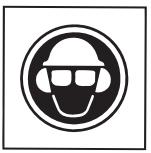
Protective equipment
Always wear:
• Approved protective helmet.
• Approved hearing protection.
- Approved protective glasses or a visor, and other essential safety equipment.
Warning
A large warning triangle with the text “Warning” signifies that there is a risk of serious personal injury or even death.

Caution
A smaller warning triangle with the text “Note” signifies that there is a risk of minor personal injury or damage to the machine.

Remark
A hand with a raised index finger with the text “Attention” signifies that a described element demands extra attention.
CE
This symbol indicates that the machine conforms to applicable EU directives.

Safety Instructions
During the design and production of Husqvarna products, great importance is placed on safety, as well as effectiveness and ease of use. To ensure that the machine remains safe you must pay attention to the following points:

WARNING!
This machine is only intended for use together with a Husqvarna PP 455E or a unit connected to Husqvarna RC 455. All other use is forbidden.

CAUTION
Under no circumstances may the machine be started without observing the safety instructions. Should the user fail to comply with these, Husqvarna Construction Products Sweden AB or its representatives are free from all liability both directly and indirectly. Read through these operating instructions and make sure that you understand the contents before starting to use the machine. Should you, after reading these safety instructions, still feel uncertain about the safety risks involved you must not use the machine Please contact your dealer for more information.
- Check that all couplings, connections and hydraulic hoses are in full working order.
- Make sure that all hoses are connected to the machine correctly before you start the machine.
- Make sure that there are no persons or animals in the working area.
- Check that the guard is not broken and that it is fitted correctly.
• Never cut without using the guard. - Never disconnect the hydraulic hoses without first shutting off the hydraulic unit and ensuring the motor has stopped completely.
- Check the machine, couplings and hydraulic hoses daily for leakage. A rupture or leak can cause a "hydraulic fluid injection" in the body or result in other serious physical injury.
-
Do not exceed the specified hydraulic fluid flow or pressure for the tool being used. Too high pressure can result in rupturing.
-
Do not misuse hoses.
- Do not use hoses that are distorted, worn, or damaged.
- Check that the hoses are connected correctly to the machine and that the hydraulic couplings lock as intended before pressurising the hydraulic system. The couplings are locked by turning the outer sleeve on the female coupling so that the slot moves away from the ball.
- Keep the hydraulic hoses and couplings free from dirt.
- Always switch off the power to the hydraulic unit before moving equipment.
- Always saw in a manner that permits easy access to the emergency stop.
- Never leave the machine unsupervised with the motor running.
- Clearly mark out all cuts to be made before you start sawing, plan these so they can be carried out without danger to persons or the machine.
- Check with building drawings whether electrical cables, water pipes, gas pipes or sewage pipes have been routed within the working area.
- Always check and mark out where gas pipes are routed. Cutting close to gas pipes always entails danger. Make sure that sparks are not caused when cutting in view of the risk of explosion. Remain concentrated and focused on the task. Carelessness can result in serious personal injury or death.
- Check that electrical cables within the working area are not live.
- Hoses that are marked and approved as electrically non conductive must be used when using hydraulic tools on or in the vicinity of electrical cables. The use of other types of hoses can result in serious physical injury or even death.
- Observe care when lifting. You are handling heavy parts, which implies the risk of pinch injuries or other injuries.
- Personal protective equipment and protective clothing as set out in the Operator's manual must always be worn. Never wear loose fitting clothes that can catch in moving parts.
- Only use wire recommended by the manufacturer.
- Never cut without using the cooling water. A poorly cooled wire can result in the segments overheating, which results in greater wear. In the worst case scenario, segments can come loose from the wire and injure persons close to the saw.
Introduction
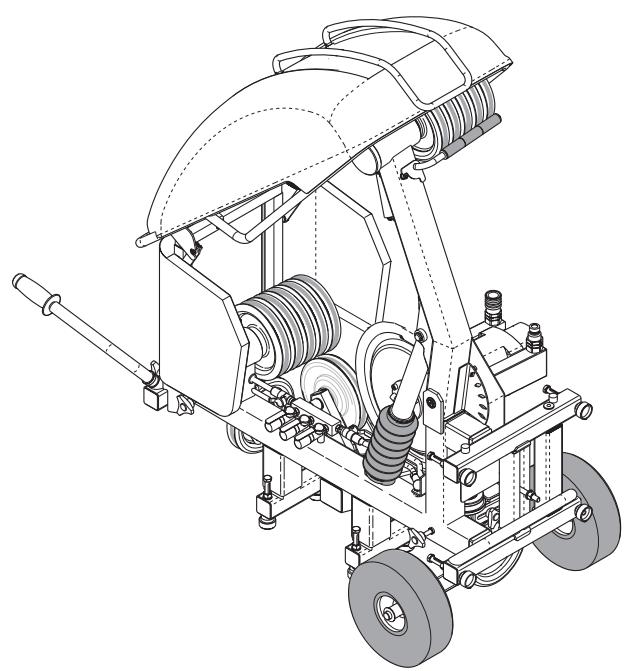
Husqvarna CS 2512 is designed for use together with the hydraulic unit PP 455 E or Husqvarna RC 455. Husqvarna CS 2512 is a powerful and easy to use wire saw with a capacity for really large work, yet at the same time sufficiently compact and mobile for small work. It can be used in many different ways, both on the ground and fitted to the wall.
The well thought-out design of the CS 2512, where the drive wheel is placed on the machine's output side means that the wire is always under tension even when the feed force is low. Combined with the adjustable pressure valve this gives exact control of cutting and unbeatable performance.
The machine can be rigged both vertically and horizontally and many cuts can be made directly without external idler wheels.
Complete saw equipment consists of:
1 x saw unit
1 x accessory box
1 x 18 mm wrench
1 x pressure reduction block
1 x extra wear rubber for the magazine wheel
1 x cleaning brush
natural_image
Technical line drawing of a mechanical vehicle with springs, wheels, and suspension components (no text or symbols)What is what
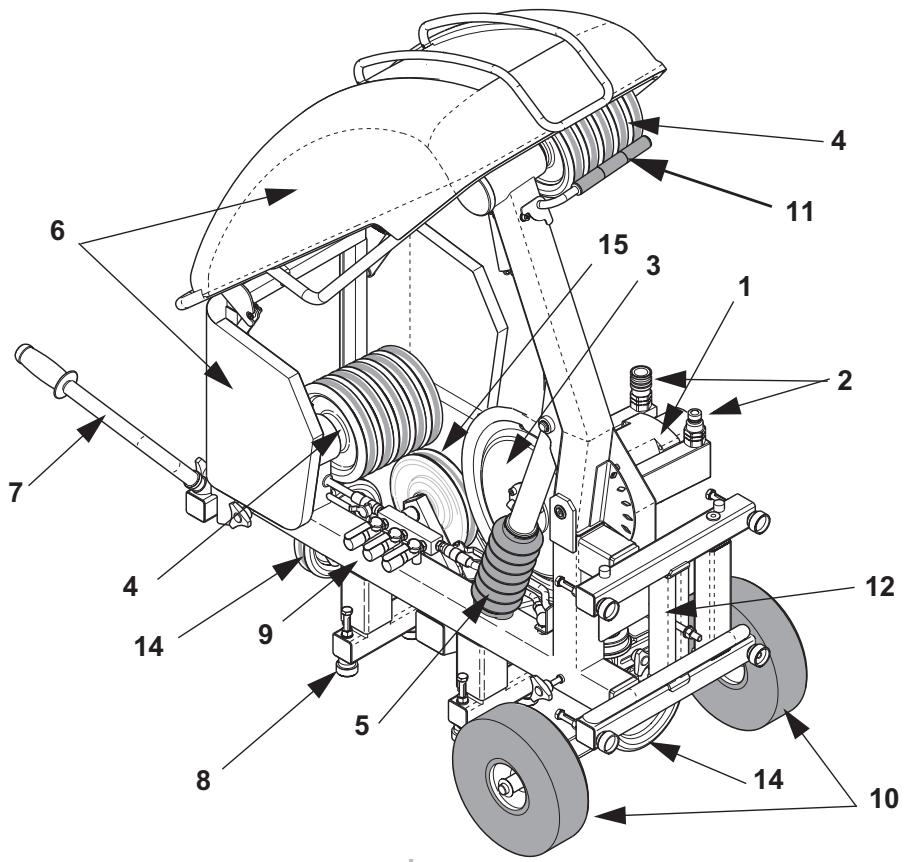
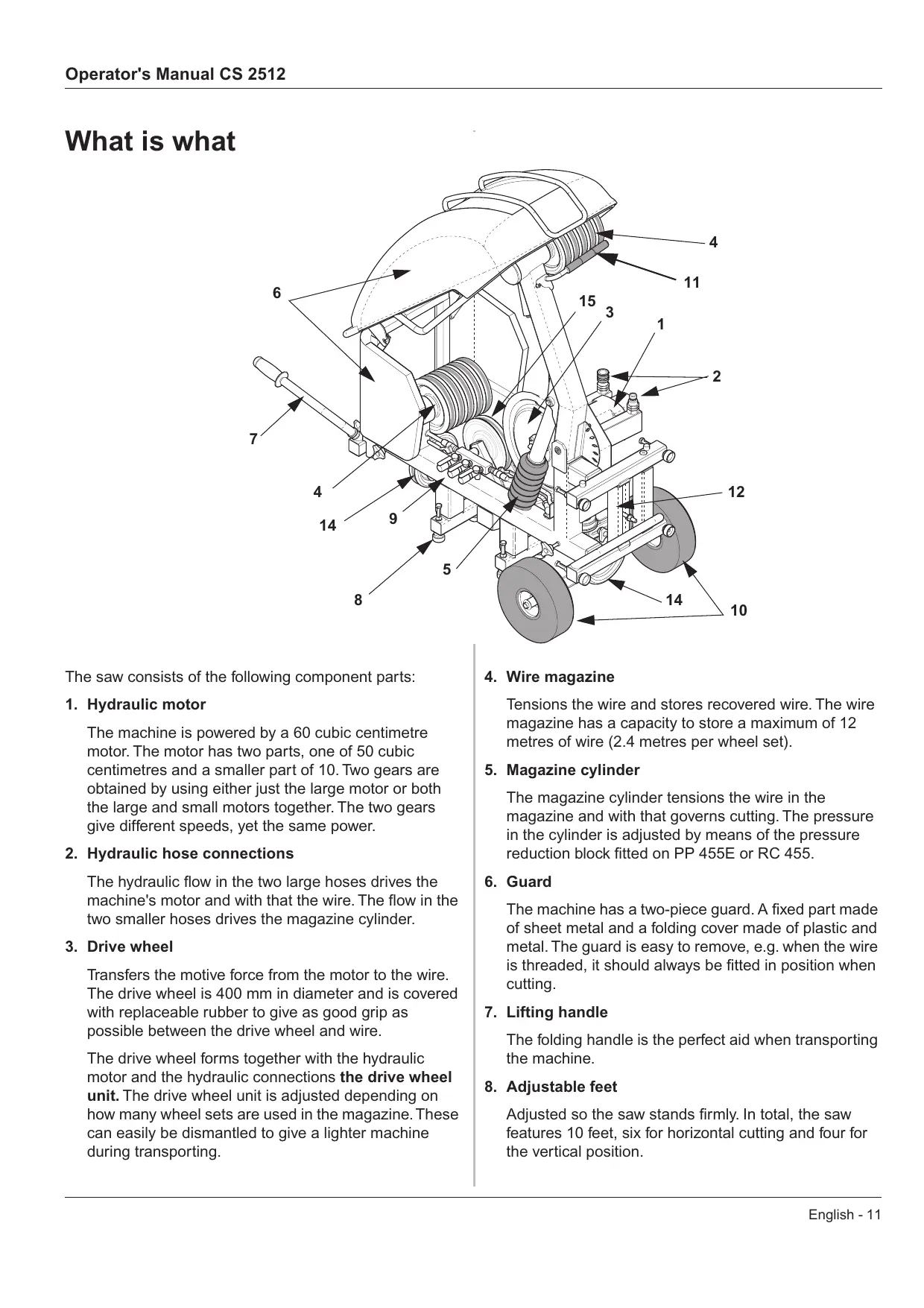
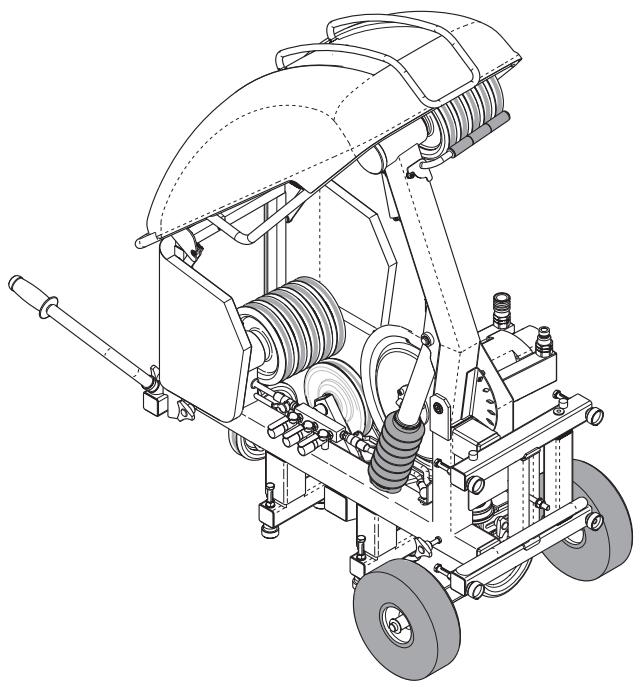
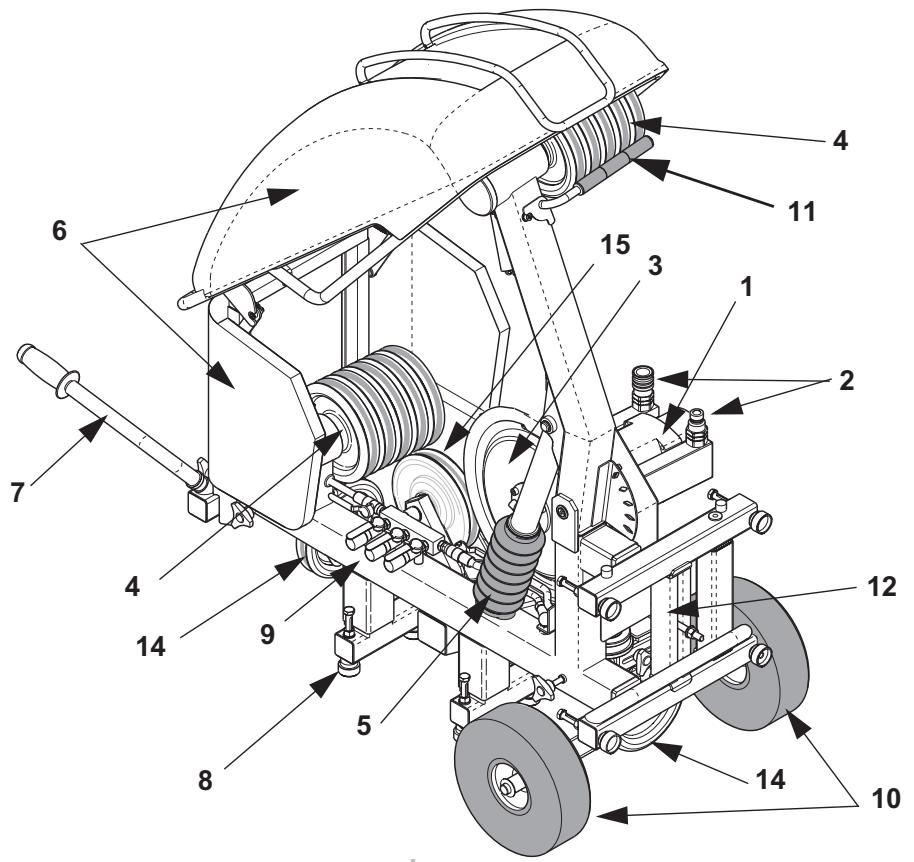
The saw consists of the following component parts:
1. Hydraulic motor
The machine is powered by a 60 cubic centimetre motor. The motor has two parts, one of 50 cubic centimetres and a smaller part of 10. Two gears are obtained by using either just the large motor or both the large and small motors together. The two gears give different speeds, yet the same power.
2. Hydraulic hose connections
The hydraulic flow in the two large hoses drives the machine's motor and with that the wire. The flow in the two smaller hoses drives the magazine cylinder.
3. Drive wheel
Transfers the motive force from the motor to the wire. The drive wheel is 400 mm in diameter and is covered with replaceable rubber to give as good grip as possible between the drive wheel and wire.
The drive wheel forms together with the hydraulic motor and the hydraulic connections the drive wheel unit. The drive wheel unit is adjusted depending on how many wheel sets are used in the magazine. These can easily be dismantled to give a lighter machine during transporting.
4. Wire magazine
Tensions the wire and stores recovered wire. The wire magazine has a capacity to store a maximum of 12 metres of wire (2.4 metres per wheel set).
5. Magazine cylinder
The magazine cylinder tensions the wire in the magazine and with that governs cutting. The pressure in the cylinder is adjusted by means of the pressure reduction block fitted on PP 455E or RC 455.
6. Guard
The machine has a two-piece guard. A fixed part made of sheet metal and a folding cover made of plastic and metal. The guard is easy to remove, e.g. when the wire is threaded, it should always be fitted in position when cutting.
7. Lifting handle
The folding handle is the perfect aid when transporting the machine.
8. Adjustable feet
Adjusted so the saw stands firmly. In total, the saw features 10 feet, six for horizontal cutting and four for the vertical position.
9. Cooling water connections
There are two connections on the machine for water spears and one for the incoming water. Besides cooling the wire with these, the wire is also rinsed when it returns to the machine and when it leaves the machine by small nozzles.
10.Rubber wheels
To facilitate transport. The wheels can be dismantled in some situations to facilitate access on certain jobs. This is done by removing the split pins that lock the wheels on the wheel axle.
11.Wire boom
Holds the wire in against the magazine when the magazine is run in. This prevents the wire tangling when not tensioned, e.g. when changing the wire or when changing the number of wheels used in the magazine.
12. Anchor beam
Adjustable beam with a longitudinal slot. By moving this beam sideways, you can position the anchor bolt in a suitable position without the need of moving the entire saw when anchoring the saw before cutting.
An additional anchor beam is placed under the saw. The anchor bolt is secured in this beam when horizontal cutting.
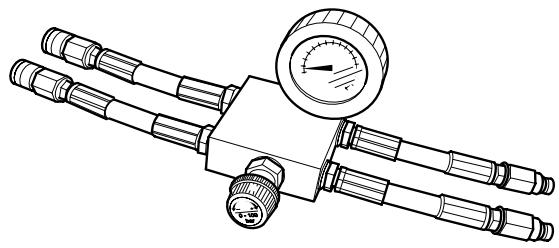
13. Pressure reduction block
The pressure reduction block is fitted between the hydraulic unit and the hydraulic hoses for the input supply. There is a valve located on the pressure reduction block, this is used to control the magazine tension.
natural_image
Technical line drawing of a mechanical pressure regulator with three actuators and a dial (no text or symbols)14. Swivel wheels
The swivel wheels supported on bearings are located where the wire enters the saw and out through the saw. The swivel wheels help to guide the wire so it is positioned correctly in the saw and can either be locked in a fixed position or used in the unlock position so that the wheels follow the wire.
15. Guide wheel
Guides the wire from the magazine to the drive wheel.
When the drive wheel unit is adjusted, the guide wheel is set automatically depending on the number of
magazine wheels used.
Accessories
1. Water spear
Connected to the water connections on the saw and used to guide cooling water into the cut to cool the wire and to bind the concrete dust.

natural_image
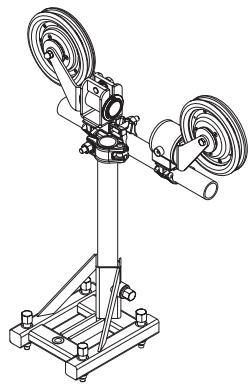
Line drawing of a mechanical tool or device with no visible text, numbers, or symbols2. Idler wheels
Husqvarna idler wheels are designed to smoothly guide the wire as efficiently as possible. By using idler wheels the number of sharp corners to cut around can be reduced, which means that more of the cutting capacity is used for material removal.
natural_image
Technical line drawing of a mechanical device with wheels and a stand (no text or symbols)3. Cleaning brush
Can be connected to the water hose and then used to clean the machine after use.

natural_image
Technical line drawing of a hairbrush tool with textured bristles and a central handle (no text or symbols)Technical data
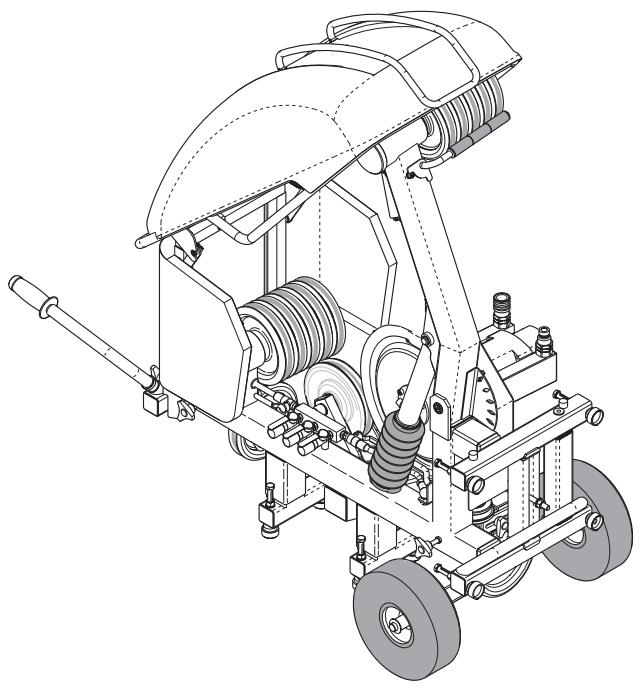
natural_image
Technical line drawing of a mechanical vehicle with springs, wheels, and suspension components (no text or symbols)Power on drive wheel (with PP 455): ____ 20 kW
Hydraulic oil flow: ____ 65l/min (17gal/min)
Max permitted hydraulic pressure ____ 230 bar (3400 psi)
Max recommended hydraulic
pressure when cutting: ____ 130 bar (1900psi)
Maximal wire length in the magazine: ____ 12 m
(2.4 m/wheel set)
Dimensions, handle folded in and
the guard folded down (L x W x H) ____ 1150x750x980 mm
Weight: ____ 150 kg (330 lbs)
Wire speed gear 1 ____ 20 m/s (66 ft/s)
Wire speed gear 2 ____ 25 m/s (82 ft/s)

WARNING
Under no circumstances may modifications be made to the machine without written permission from Husqvarna Construction Products Sweden AB. Non approved modifications put you and others at risk of serious or fatal injuries. Husqvarna Construction Products Sweden AB bears no responsibility for operations that do not conform to these instructions.
Recommended wires:
Husqvarna recommends that the following wires are used:
- Husqvarna C710C
Husqvarna C710C is a galvanised wire developed for use when cutting concrete with a great deal of reinforcement. The segments have a great number of diamonds and a smaller diameter (9.5mm) which means the wire cuts very efficiently. The smaller diameter also means that C710C can be used to finish difficult cuts.
- Husqvarna C750C
Husqvarna C750C is an all round wire developed for use when cutting reinforced concrete. The wire has been designed for use with saws with an output power between 10 and 25 kW.
• Husqvarna C760C
This is the Husqvarna premium wire: long life, high cutting rate and high power resistance characterize this wire. Husqvarna C760C can be used to cut all types of reinforced concrete, even when the work places high demands on the wire, for example when cutting bridges.
• Husqvarna C790C
The segment strength on this wire makes Husqvarna C790C the best choice when cutting soft materials such as mortar, and lightly reinforced limestone concrete.
- Husqvarna C575J
Husqvarna C575J is a wire with galvanised 15 mm segments.
• Husqvarna C1200M
Husqvarna C1200M is a wire developed for use when cutting steel. The wire has been designed for use in extremely demanding situations. The use of the latest sintering technique has given enormous advantages with regard to cutting rates and life span. The wire can be supplied with either joined or loose ends.
For further information about different tools from Husqvarna, contact your Husqvarna dealer.
Assembling/Installing equipment
Cutting needs to be planned carefully before assembling the saw so that it can be performed as easily as possible.
Husqvarna CS 2512 can be assembled to make either horizontal or vertical cuts. The saw is assembled standing when you wish to make vertical cuts.
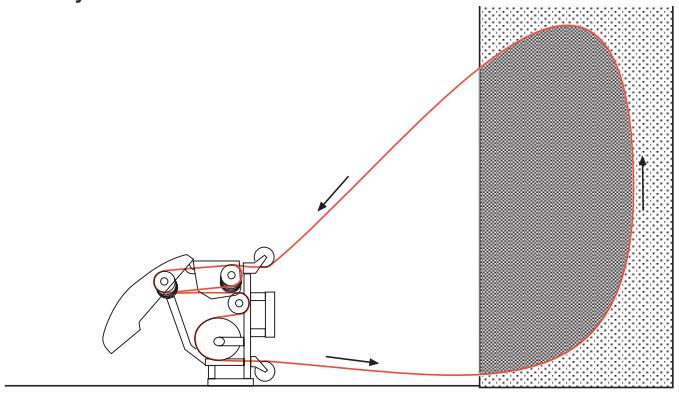
natural_image
Diagram of a mechanical device emitting a red beam through a shaded circular area, with directional arrows indicating motion (no text or symbols present)The saw is assembled horizontally when the cut is to be made at floor height and when the cut is made in the floor.
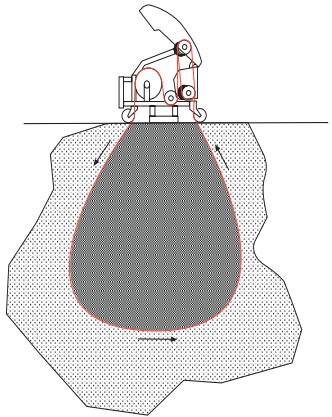
natural_image
Diagram of a mechanical device positioned above a shaded circular area with directional arrows, no text or symbols present.It may be necessary to drill holes to thread the wire through the material to be cut.
Position the saw in an appropriate position in front of the planned cut. When the saw is in position, secure it by screwing down the anchor bolt.
When the saw is anchored to the floor, screw down the adjuster feet so that the saw stands firmly.
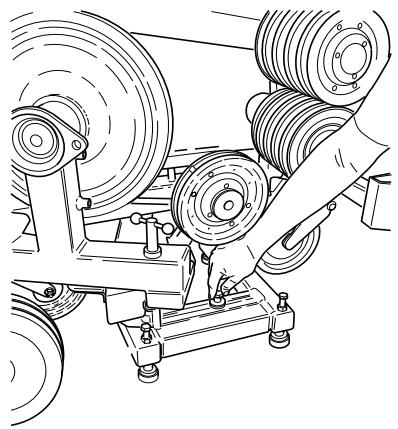
natural_image
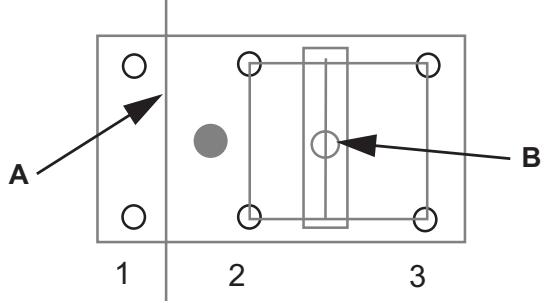
Technical line drawing of a mechanical assembly with rollers and levers (no text or symbols)Remember that the machine's centre of gravity (the grey circle) is positioned between the first and second pairs of adjuster feet (the adjuster feet pairs are marked 1-3) with a horizontal cut (A). When cutting under the machine, it is important that the saw is anchored well with the anchor bolt (b) as the adjuster feet pairs 2 and 3 must be used. (Adjuster feet pair 1 may rest on the sawn off section.) If the saw is not anchored well it will overturn when the material supporting adjuster feet pair 1 has been cut through.
If necessary, fit idler wheels to assist the cutting process. Using the idler wheels allows the number of sharp corners that the wire must be pulled around can be reduced, which results in less wear to the wire at the same time as cutting is made easier. Using the idler wheels also lets the wire be guided in different directions without the need of moving the saw unit.
Also, use the idler wheels to capture the wire when finishing the cut.

WARNING!
Always position the saw so that you can stand without the risk of being hit by a broken wire. Ensure that no unauthorised persons can access the working area while cutting. Being hit by a broken wire can result in death or serious personal injury.
Connection to the hydraulic unit
When the saw is assembled appropriately, it should be connected to a hydraulic unit. Husqvarna CS 2512 is designed for use with Husqvarna PP 455 or Husqvarna RC 455.
- Check that the hydraulic unit is connected to the power.
- Connect the cooling water to the motor on the hydraulic unit.
- Check that the display on the remote control shows "CONNECT HOSE BUNDLE". If not follow the instructions in the Operator's manuals for PP 455E or RC 455.
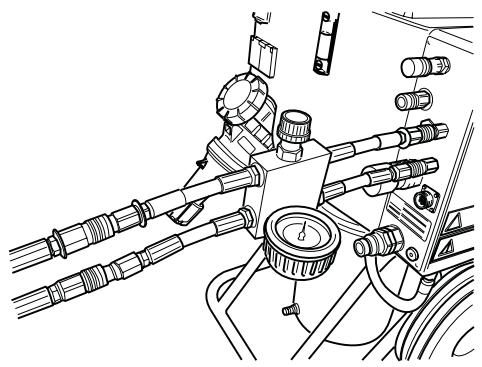
- Fit the two large hydraulic hoses on the unit first and then to the saw motor connections. Lock the couplings by turning the sleeve on the coupling so that the slot moves away from the ball.
- Fit the pressure reduction block on the hydraulic unit as set out in the instructions on the block.
- Connect the two smaller hydraulic hoses to the pressure reduction block. The hoses in the hose bundle marked with a red disc by the coupling shall be connected to the hose on the pressure reduction block that is also fitted with a disc.
natural_image
Technical line drawing of a mechanical assembly with hoses and gauges (no text or symbols)Lock the couplings by turning the sleeve on the coupling so that the slot moves away from the ball.
-
Fit the two hoses connected on the pressure reduction block to the hoses to the feed cylinder on the saw. The hoses in the hose bundle marked with a red disc by the coupling shall be connected to the hose on the saw that is also fitted with a disc.
-
Connect the water hose to the incoming water on the saw.
If the couplings jam when assembling, they should be removed completely before being refitted.
Make sure that the couplings on the hoses not in use do not lie directly on the ground.
Always keep the couplings as clean as possible. A clean coupling lasts longer.
Threading the wire
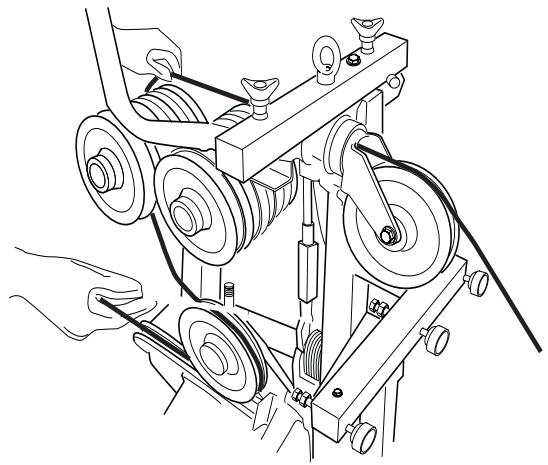
The guard can easily be lifted off to facilitate fitting wire. Now thread the wire as follows:
- Make sure the magazine is in the min position.
- Place the wire around the work piece, possibly through the predrilled holes and back to the saw.
- Thread the wire through the hole by the swivel wheel and around a suitable number of wheel sets in the magazine.
natural_image
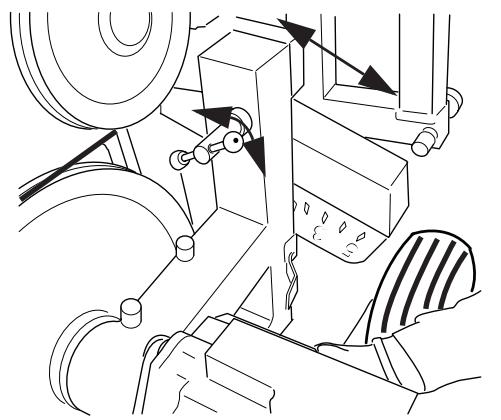
Technical line drawing of a mechanical assembly with hands operating it (no text or symbols present)- Adjust the drive wheel unit according to the number of wheel sets used in the magazine:
Loosen the arm by screwing out the knob anti-clockwise. Now turn the drive wheel unit so that the arm is aligned with the markings on the saw. Lock the drive wheel unit by turning back the knob.
Usually only one wheel set is used in the first stage of cutting.
natural_image
Technical line drawing of a mechanical assembly with rotating components and directional arrows (no text or symbols)□ □ □ □ □ □ □
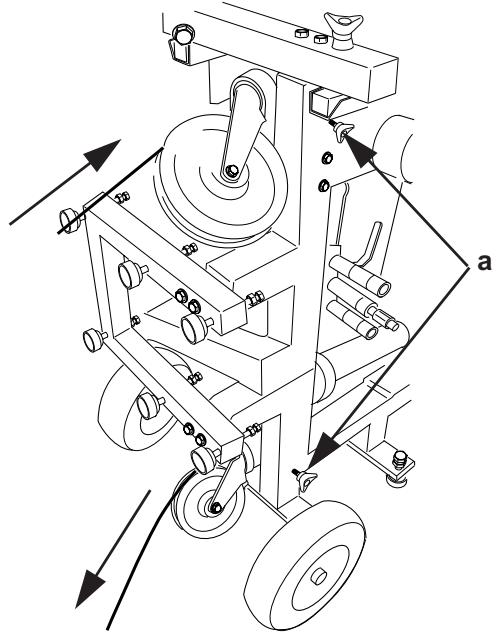
- Thread the wire around the drive wheel and out through the hole by the second swivel wheel. The swivel wheel can rotate and be locked in the required position by turning the marked (A) knobs.
natural_image
Technical line drawing of a mechanical device with wheels and components, no visible text or symbols- Before the joints on the wire are connected, the wire should be twisted 1 to 2 turns per metre wire used. It is important to twist the wire in the same direction as it is spun. This is to give as even wear as possible on the wire's diamond segments.
- Lock the wire with a pin. If there are no end sleeves on the wire, these must be spliced on to the wire. A special pair of wire pliers must be used. If you are unsure about which model you should use, contact your Husqvarna dealer.
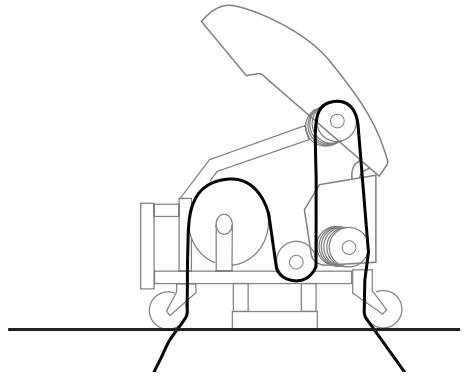
- When the wire is routed correctly it should run through the machine as in the figure below:
natural_image
Technical line drawing of a mechanical device with rollers and a handle (no text or symbols)
CAUTION
A used wire must always be run in the same direction, as it was previously run in order to prevent unnecessary wear.
Placement of the cooling water
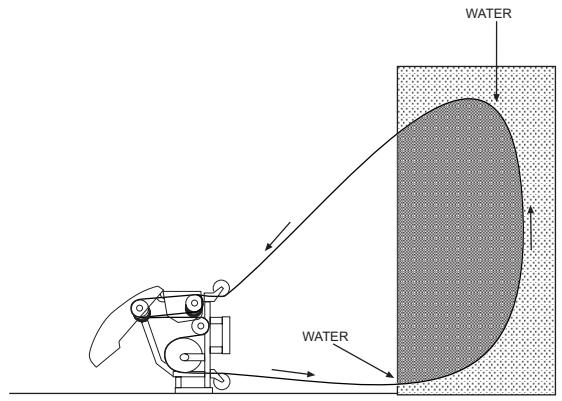
Husqvarna CS 2512 is equipped with two outlets for the cooling water. Ideally, Husqvarna water spears can be connected to these. The water spears are then placed where the wire enters the concrete. In this way the wire takes water with it into the cut, which results in the concrete dust binding and that the wire is cooled efficiently.

CAUTION
In order for the water to cool the wire as intended during cutting, it is essential to adjust the position of the cooling water as the material is cut. Remember to always stop the machine when you do this.
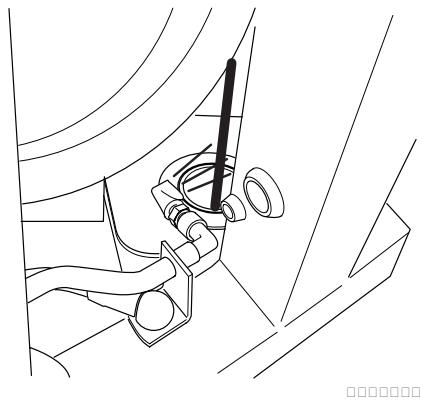
In addition to the cooling water from the water spear, the wire is rinsed by the two swivel wheels on the machine. This is to keep the wire as clean as possible, which means that the saw can work with less friction losses and greater efficiency as the wire becomes cleaner.
natural_image
Line drawing of a mechanical assembly with a tool inserted, no text or symbols presentOperation
Sawing
When all the equipment has been assembled cutting can start. In order for the saw to cut as efficiently as possible it should be started as follows:
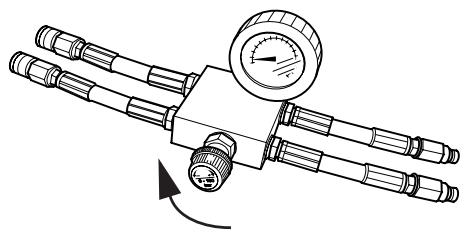
- Close the valve on the pressure reduction block by turning the knob anti-clockwise until it stops and then two turns back.
- Start the hydraulic unit.
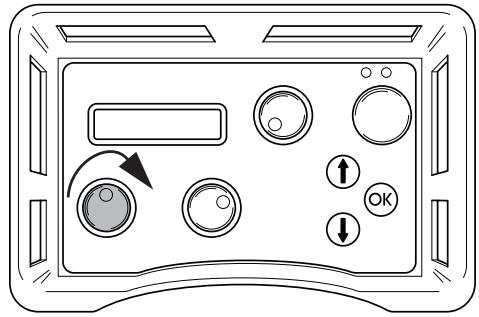
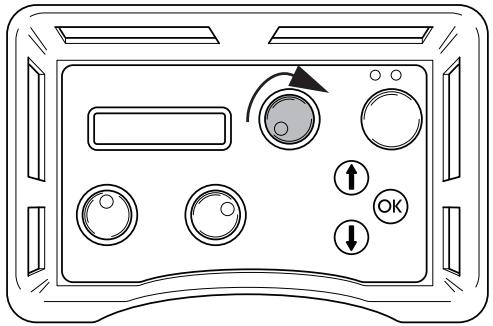
- Set the feeding flow on the unit to max by turning the control on the remote control clockwise.
- Tension the wire by carefully turning the knob on the pressure reduction block clockwise until the wire is tensioned sufficiently. Make sure to always check that the wire is seated correctly in all the wheels on the saw.
natural_image
Technical line drawing of a mechanical pressure regulator with dual shafts and a dial (no text or symbols)- Start the motor's rotation by turning the control for motor rotation on the remote control clockwise.
natural_image
Front view of a microwave oven with control panel and buttons (no text or symbols)- Carefully increase the motor speed by turning the control for motor rotation. A suitable working pressure when cutting usually lies between 100 and 130 bar, but varies depending on how many wheel sets are used in the magazine, how much wire is in use and the hardness of the material to be cut.
- As the material is cut away the working pressure drops, which is shown on the display, and the magazine must then be tensioned. Do this by turning the knob on the pressure reduction block clockwise.
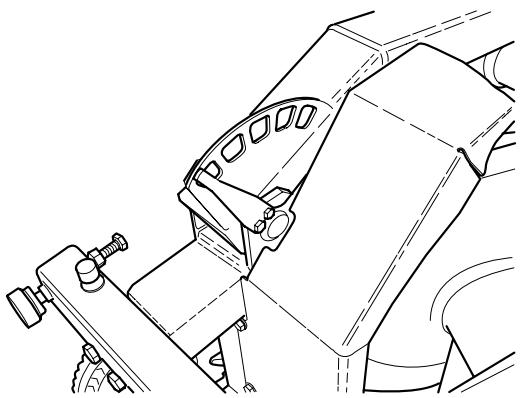
- The output tension on the magazine is shown by an indicator on the machine (shown in the min position). When the magazine cylinder is fully tensioned, the machine must be stopped and the wire must be wound around a new wheel set. Then continue to cut as above.
natural_image
Technical line drawing of a mechanical assembly with no visible text or symbols
CAUTION
In order for the water to cool the wire as intended during cutting, it is essential to adjust the position of the cooling water as the material is cut. Remember to always stop the machine when you do this.
Finishing sawing
- Lower the speed on the wire and allow the motor to stop completely.
- Fold up the magazine arm.
- Disconnect the incoming mains cable from the hydraulic unit.
- Disconnect the hydraulic hoses and the water hose from the saw unit.
- Other steps are done in the reverse order.
Cleaning
The saw should be cleaned once cutting is finished. It is important to clean all the saw equipment. It is a good idea to disconnect the water hose from the pivot arm and use this to wash down the saw unit. If necessary, you can also use the supplied cleaning brush or the like to clean the equipment. Do not use a high pressure washer to clean the saw.
Maintenance
In addition to the daily maintenance such as cleaning and lubrication, the machine must be serviced. After 50 hours of cutting, the machine should be serviced at an accredited Husqvarna workshop. The saw should then be serviced after every 100 hours of operation. The service is important so that as the user you have a machine that works as effectively as possible for a long time.
Lubrication
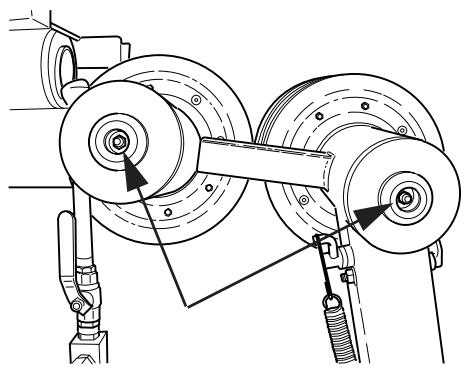
In order for the wire to run as friction free as possible, the magazine axles must be filled with grease. Fill with grease after every 5 -10 hours of operation. Use Canadian Petroleum OG2 or similar grease.
The bearings on the magazine axles also need to be lubricated regularly, but not as often as the magazine axles.
natural_image
Technical line drawing of a mechanical assembly with pulleys and a belt drive (no text or symbols)Español
Índice
natural_image
Technical line drawing of a mechanical vehicle with springs, wheels, and suspension components (no text or symbols)natural_image
Technical line drawing of a mechanical pressure regulator with three cylindrical actuators and a pressure gauge (no text or symbols)natural_image
Line drawing of a mechanical tool with cylindrical body and attached clamped shaft (no text or symbols)natural_image
Technical line drawing of a mechanical device with two wheels and a support frame (no text or symbols)natural_image
Technical line drawing of a hairbrush tool with bristles and handle (no text or symbols)Datos técnicos
natural_image
Technical line drawing of a mechanical vehicle with springs, wheels, and suspension components (no text or symbols)natural_image
Diagram of a mechanical device emitting a red beam through a shaded circular area, with directional arrows indicating motion (no text or symbols present)natural_image
Diagram of a mechanical device interacting with a shaded ground surface, showing no text or symbols.natural_image
Technical line drawing of a mechanical assembly with rollers and brackets (no text or symbols)natural_image
Technical line drawing of a mechanical assembly with hoses and gauges (no text or symbols)natural_image
Technical line drawing of a mechanical assembly with hands operating a tool (no text or symbols present)natural_image
Technical line drawing of a mechanical assembly with gears and a lever (no text or symbols)□□□□□□□□
natural_image
Technical line drawing of a mechanical device with wheels and components, no visible text or symbolsnatural_image
Line drawing of a mechanical device with gears and a handle, no text or symbols present
¡ATENCIÓN!

¡ATENCIÓN!
natural_image
Line drawing of a mechanical assembly with a tool inserted, no text or symbols present□□□□□□□
Manejo
Corte
natural_image
Technical diagram of a pressure regulator with three tubes and a dial, showing rotational motion (no text or labels)natural_image
Front view of a microwave oven control panel with buttons and indicators (no text or symbols)natural_image
Technical line drawing of a mechanical assembly with no visible text or symbols
¡ATENCIÓN!
natural_image
Technical line drawing of a mechanical assembly with pulleys and a lever (no text or symbols)Français
Sommaire
natural_image
Technical line drawing of a mechanical vehicle with springs, wheels, and suspension components (no text or symbols)natural_image
Technical line drawing of a mechanical pressure regulator with dual actuators and a dial (no text or symbols)natural_image
Line drawing of a mechanical tool with cylindrical shaft and multiple bolts (no text or symbols)natural_image
Technical line drawing of a mechanical device with pulleys and a base platform (no text or symbols)natural_image
Technical line drawing of a hairdryer tool with bristles and handle (no text or symbols)natural_image
Technical line drawing of a mechanical vehicle with springs, wheels, and suspension components (no text or symbols)Poids : ____ 150 kg (330lbs)
natural_image
Diagram of a mechanical device emitting a fan-like structure with directional arrows, next to a shaded circular area (no text or symbols)natural_image
Diagram of a mechanical device interacting with a shaded ground surface, showing no text or symbols.natural_image
Technical line drawing of a mechanical assembly with rollers and brackets (no text or symbols)natural_image
Technical line drawing of a mechanical assembly with hoses and gauges (no text or symbols)natural_image
Technical line drawing of a mechanical assembly with hands operating it (no text or symbols present)natural_image
Technical line drawing of a mechanical assembly with rotating components and directional arrows (no text or symbols)□□□□□□□□
natural_image
Technical line drawing of a mechanical device with wheels and components, no visible text or symbolsnatural_image
Technical line drawing of a mechanical device with no visible text or symbols
ATTENTION

ATTENTION!
natural_image
Line drawing of a mechanical assembly with a tool inserted, no text or symbols present□□□□□□□
Utilisation
Sciage
natural_image
Line drawing of a device control panel with buttons and indicators (no text or symbols)natural_image
Technical line drawing of a mechanical pressure regulator with dual shafts and a pressure gauge (no text or symbols)natural_image
Front view of a microwave oven control panel with buttons and indicators (no text or symbols)natural_image
Technical line drawing of a mechanical assembly with no visible text or symbolsATTENTION!
natural_image
Technical line drawing of a mechanical assembly with rollers and levers (no text or symbols)Português
Índice
natural_image
Technical line drawing of a mechanical vehicle with springs, wheels, and suspension components (no text or symbols)Como se chama
natural_image
Technical line drawing of a mechanical pressure regulator with three actuators and a dial (no text or symbols)natural_image
Line drawing of a mechanical tool or device with no visible text, numbers, or symbolsnatural_image
Technical line drawing of a mechanical device with two wheels and a support frame (no text or symbols)natural_image
Line drawing of a hairdryer tool with bristles and handle (no text or symbols)Dados técnicos
natural_image
Technical line drawing of a mechanical vehicle with springs, wheels, and suspension components (no text or symbols)natural_image
Diagram of a mechanical device positioned above a dotted ground surface with directional arrows indicating motion or flow (no text or symbols present)natural_image
Diagram of a robotic arm projecting a curved surface with directional arrows, no text or symbols presentnatural_image
Technical line drawing of a mechanical assembly with rollers and levers (no text or symbols)natural_image
Technical line drawing of a mechanical assembly with hoses and components (no text or symbols)natural_image
Technical line drawing of a mechanical assembly with hands operating it (no text or symbols present)- Ajustar a unidade motriz de acordo com o número de pares de roldanas usados no carregador:
natural_image
Technical line drawing of a mechanical assembly with gears and a lever (no text or symbols)natural_image
Technical line drawing of a mechanical device with wheels and components, no visible text or symbolsnatural_image
Technical line drawing of a mechanical device with no visible text or symbolsNOTA
NOTA
natural_image
Line drawing of a mechanical assembly with no visible text or symbols□□□□□□□
Procedimento
Serragem
natural_image
Front view of a microwave oven control panel with buttons and indicator lights (no text or symbols)natural_image
Technical line drawing of a mechanical pressure regulator with dual shafts and a dial (no text or symbols)natural_image
Front view of a microwave oven control panel with buttons and indicators (no text or symbols)natural_image
Technical line drawing of a mechanical assembly with no visible text or symbols
NOTA
natural_image
Technical line drawing of a mechanical assembly with rollers and a belt drive (no text or symbols)
Husqvarna
www.husqvarnacp.com