
YT-09910 - Hammer Yato - Free user manual and instructions
Find the device manual for free YT-09910 Yato in PDF.


| Product Type | Needle Scaler |
| Brand | Yato |
| Model | YT-09910 |
| Weight | 1.02 kg |
| Air Inlet Diameter | 6.3 mm (1/4") |
| Hose Inner Diameter | 10 mm (3/8") |
| Impact Frequency | 4500 min⁻¹ |
| Number of Needles | 19 |
| Needle Diameter | 3 mm |
| Holder Diameter | 10 mm |
| Maximum Working Pressure | 0.63 MPa |
| Required Air Flow (at 0.63 MPa) | 113 l/min |
| Sound Pressure | 100 ± 3 dB(A) |
| Sound Power | 111 ± 3 dB(A) |
| Vibration | 13 ± 1.5 m/s² |
| Power Source | Compressed Air |
| Main Applications | Rust removal, descaling, cleaning welds, bricks, stones |
| Maintenance | SAE 10 oil for lubrication, WD-40 for cleaning |
| Recommended Safety Equipment | Safety glasses, ear protection, gloves |
Frequently Asked Questions - YT-09910 Yato
User questions about YT-09910 Yato
0 question about this device. Answer the ones you know or ask your own.
Ask a new question about this device
Download the instructions for your Hammer in PDF format for free! Find your manual YT-09910 - Yato and take your electronic device back in hand. On this page are published all the documents necessary for the use of your device. YT-09910 by Yato.
USER MANUAL YT-09910 Yato
natural_image
Black YATO 3D-printed manual oil spray gun with extended bundle of bristles (no visible text or symbols)CE
PL EN DE RU UA LT LV CZ SK HU RO ES FR IT NL GR
natural_image
Close-up of a hand holding a wrench and a metallic tool with threaded connectors (no visible text or symbols)
natural_image
Close-up of hands holding a cylindrical mechanical component with visible steel rods (no text or symbols)- air inlet
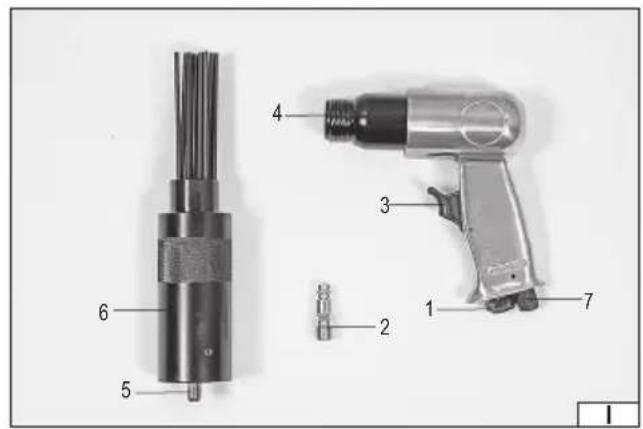
- air inlet connector
- trigger
- tool holder
- attachment axis
- needle attachment
- pressure adjustment
- tool
- hose socket
- hose
- hose connector
- lubricator
- reducer
- fi lter
- compressor
DE
Read the operating instruction
Maximum air pressure
Max. Betriebsdruck
Air connection diameter
Wear protective goggles
Schutzbrille tragen
Wear hearing protectors
Gehörschutz tragen
The pneumatic scaler is a tool which uses compressed air to operate. With the help of many needles it is possible to carry out many sheet metal work, e.g. removing rust, scale, cleaning welds. The tool can also be used to clean bricks and stones. The tool is suitable for indoor use and should not be exposed to moisture or precipitation. Proper, reliable and safe operation of the tool depends on appropriate use, that is why you should
read and keep the entire instruction manual before the first use of the tool.
The supplier shall not be held liable for any damage or injury resulting from improper use of the tool, failure to observe the safety regulations and recommendations of this manual. Use of the tool for purposes other than those for which it was intended shall cause the loss of the user's rights to the warranty, as well as under inconsistencies with the agreement.
ACCESSORIES
The scaler is equipped with a connector to connect to the pneumatic system and an adapter equipped with needles.
TECHNICAL DATA
| Parameter Measure Unit Value | ||
| Catalogue No. YT-09910 | ||
| Weight [kg] 1.02 | ||
| Diameter of air connector (PT) [” / mm] 6.3 / 1/4 | ||
| Diameter of air supply hose (internal) [” / mm] 10 / 3/8 | ||
| Frequency of impact [min] | ^-1 4500 | |
| Number of needles 19 | ||
| Needle diameter | [mm] | 3 |
| Tool holder diameter | [mm] | 10 |
| Maximum work pressure | [MPa] | 0.63 |
| Required air flow (at 0.63 MPa) | [l/min] | 113 |
| Sound pressure (EN ISO 3744) | [dB(A)] | 100 ± 3 |
| Sound power (EN ISO 3744) | [dB(A)] 111 ± 3 | |
| Vibrations (ISO 28927-10) | [m/s ^2 ] | 13 ± 1.5 |
GENERAL SAFETY CONDITIONS
WARNING! When operating a pneumatic tool, it is recommended that you always observe basic safety principles, including those listed below, in order to reduce the risk of fire, electric shock and injury.
Please read and keep the entirety of this instruction manual before using the tool.
CAUTION! Read all of the following instructions. Failure to do so may result in electric shock, fire, or personal injury. The term "pneumatic tool" used in these instructions refers to all tools operating by means of a compressed air stream at the correct pressure.
PLEASE OBSERVE THE FOLLOWING INSTRUCTIONS
General safety conditions
Due to multiple hazards, read and understand the safety instructions before starting installation, operation, repair, maintenance and alteration of accessories or when working in the vicinity of a pneumatic tool. Failure to do so may result in serious injury. Pneumatic tools may only be installed, adjusted and assembled by qualified and trained personnel. Do not modify the pneumatic tool. Modifications can reduce efficiency and safety and increase the risk for the tool operator. Do not throw away the safety instructions, they should be handed over to the tool operator. Do not use the pneumatic tool if it is damaged. The tool must be periodically inspected for the visibility of information required by the ISO 11148 standard. The employer/user should contact the manufacturer to replace the nameplate whenever necessary.
Hazards connected with ejected parts
Disconnect the tool from the power supply before replacing the inserted tool or accessory. Damage to the workpiece, accessories or even to the inserted tool can result in parts being ejected at high speeds. Always use impact-resistant eye protection. The degree of protection must be selected according to the works carried out. Make sure that the workpiece is securely clamped. Use
EN
a safety helmet when working over the head. Risk to bystanders should also be taken into account. Make sure that the workpiece is securely clamped. Do not operate the tool without making sure that an inserted tool stop is installed. To avoid injury, replace the stop when it is worn, cracked, or deformed. Apply the tool securely to the workpiece before starting work.
Hazards connected with work
Using the tool can expose the operator's hands to hazards such as crushing, impact, cutting, abrasion and heat. Wear suitable gloves to protect your hands. The operator and the maintenance personnel should be physically able to cope with the quantity, weight and power of the tool. Hold the tool correctly. Keep your feet in balance and in a safe position. The pressure on the starter and stop device shall be released in the event of a power failure. Use only the lubricants recommended by the manufacturer. Avoid direct contact with the tool during and after work, as it can be hot. Protective goggles must be worn, and we recommend wearing suitable gloves and protective clothing.
Hazards connected with repetitive movements
When using a pneumatic tool for work entailing repetitive movements, the operator is exposed to the discomfort of hands, arms, shoulders, neck or other parts of the body. When using a pneumatic tool, the operator should take a comfortable posture to ensure the feet are correctly positioned and avoid strange or unbalanced postures. The operator should change the posture over a long period of time to avoid discomfort and fatigue. If the operator experiences symptoms such as persistent or repeated discomfort, pain, pulsating pain, tingling, numbness, burning or stiffness, the operator is required to report the symptoms to the doctor. The operator should not ignore them, should tell the employer about it and consult a doctor.
Hazards connected with accessories
Disconnect the tool from the power source before changing the inserted tool or accessory. Use accessories and consumables only in the sizes and types recommended by the manufacturer. In the case of scalers, never use any chisels as hand tools, where appropriate. They have been specially designed and heat-treated for use with non-rotating impact tools only. In the case of and crushers, never use dull chisels where appropriate, as they are subject to heavy loads and may break due to wear. Using a blunt tool can increase vibration and therefore sharpened tools should always be used. In the case of scalers, where appropriate, never cool hot tools in water, this may result in brittleness and premature wear. In the case of scalers, damage or breakage of the tool, as appropriate, may result from misuse of the tool as a lever, e.g. when leveraging. It is better to work by removing smaller pieces to avoid jams. Avoid direct contact with the inserted tool during and after work, it can be hot or sharp.
Hazards connected with the workplace
Slips, stumbles and falls are the main causes of injury. Beware of slippery surfaces caused by using the tool, as well as tripping hazards caused by the air installation. Handle with care in an unfamiliar environment. There may be hidden hazards, such as electricity or other utility lines. The pneumatic tool is not intended for use in potentially explosive zones and is not insulated from contact with electricity. Make sure that there are no electric cables, gas pipes, etc. which could pose a risk in the case of damage with the tool.
Fumes and dust hazards
Dust and fumes from pneumatic tools can cause ill health (e.g. cancer, congenital malformations, asthma and/or dermatitis), it is necessary to: assess the risks and implement appropriate control measures with regard to these risks. The risk assessment shall include the impact of the dust generated by the tool and the possibility of existing dust disruption. The air outlet shall be so directed as to minimise the disruption of dust in a dusty environment. Where dust or fumes are generated, priority should be given to controlling them at the source of the emission. All integrated functions and accessories for collecting, extracting or reducing dust or fumes should be properly operated and maintained according to the manufacturer's recommendations. Use respiratory protection in accordance with the employer's instructions and in accordance with hygiene and safety requirements. The operation and maintenance of the pneumatic tool must be carried out in accordance with the instructions in the instructions manual in order to minimise the emission of fumes and dust. Select, maintain and replace tools to be inserted in accordance with the instructions in order to prevent the increase of fumes and dust.
Noise pollution
Exposure to high levels of noise can cause permanent and irreversible hearing loss and other problems such as tinnitus (ringing, buzzing, whistling or buzzing in ears). A risk assessment and the implementation of appropriate control measures for these risks are necessary. Appropriate controls to reduce the risk may include measures such as silencing materials to prevent the workpiece from “ringing”. Use hearing protectors in accordance with the employer's instructions and in accordance with hygiene and safety requirements. The operation and maintenance of the pneumatic tool must be carried out in accordance with the instructions in the manual in order to avoid an unnecessary increase in noise levels. If the pneumatic tool has a silencer, always make sure that it is installed correctly when using the tool. Select, maintain and replace worn inserted tools in accordance with the instructions in the manual. This will help avoid an unnecessary increase in noise.
Vibration hazard
Although the tools were designed to minimise the risks associated with vibration emission, it was not possible to completely
EN
eliminate the vibrations which remain as residual risks. Improper use of the tool may result in exposure to vibration. The value of the vibrations specified in the manual may not adequately represent the vibration level of the intended use. Exposure to vibration can cause permanent damage to the nerves and blood supply of the hands and arms. Wear warm clothes when working at low temperatures and keep your hands warm and dry. If numbness, tingling, pain or bleaching occurs in your fingers or hands, stop using the pneumatic tool, then inform your employer and consult your doctor. The operation and maintenance of the pneumatic tool in accordance with the operating instructions will prevent unnecessary increases in vibration levels. Do not hold the tool with your free hand, this increases the exposure to vibrations. Hold the tool with a light but secure grip, taking into account the required reaction forces, as the risk of vibration is usually higher when the clamping force is higher. Hold the additional handles in a central position and avoid pressure on the handle until the device stops. In the case of crushers, remove smaller pieces of concrete to prevent the tool from jamming. In the case of crushers, move the tool every few seconds. The tool must be stopped during moving because vibrations reach a high level if the inserted tool is not supported by the workpiece.
Additional safety instructions for pneumatic tools
Pressurised air can cause serious injury:
- always disconnect the air supply, release the air pressure from the hose and disconnect the tool from the air supply when not in use, before changing accessories or carrying out repairs;
- never point the air stream at yourself or anyone else.
Hitting with the hose can cause serious injury. Always check for damaged or loose hoses and connectors. Keep cold air away from hands.
Whenever universal screwed connections (dog connections) are used, safety pins and safety connectors must be used to prevent damage to the connections between the hoses and between the hose and the tool. Do not exceed the maximum air pressure specified for the tool.
Never carry the tool while holding the hose.
OPERATING CONDITIONS
Make sure that the compressed air source generates the correct working pressure and provides the required airflow. If the supply air pressure is too high, a pressure reducer with a safety valve must be used. The pneumatic tool must be fed through the filter and lubricator system. This will ensure that the air is both clean and moistened with oil. Check the condition of the filter and lubricator before each use and clean the filter if necessary or make up for oil shortage in the lubricator. This will ensure the correct operation of the tool and extend its service life.
In the case of heavy loads, a recoil force may be generated towards the tool operator. It is necessary to adopt such a posture during work to be able to counteract these forces effectively.
If you move the tool unexpectedly or break the inserted tool, you may be injured.
When using additional holders or support racks, make sure that the tool is correctly and securely attached.
Keep body parts and clothing away from the working tool. There is a risk of being pulled in or caught. Always make sure that all keys and tools used for adjusting and attaching other tools to the pneumatic scaler are removed before starting work.
During operation, dust can be generated which, depending on the workpiece, can be harmful to the operator.
During cutting or demolition work, workpiece elements can be ejected.
Do not hold the inserted tool with an unprotected hand. This can cause injuries due to vibration.
TOOL USE
Before each use of the tool, make sure that no parts of the pneumatic system are damaged. If you notice damage, immediately replace the components with new, undamaged ones.
Dry condensed moisture inside the tool, compressor and hose before each use of the pneumatic system.
Connecting the tool to the pneumatic system
The figure shows the recommended way to connect the tool to the pneumatic system. This will ensure the most efficient use of the tool and also prolong the tool's service life.
Apply a few drops of SAE 10 viscous oil into the air inlet.
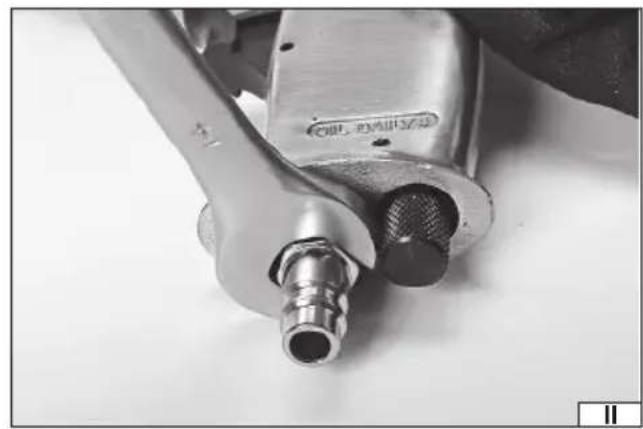
Screw a suitable nozzle to the air inlet thread firmly and securely to connect the air hose (II).
Secure a suitable nozzle to the tool driver. Only use accessories which are suitable for use with impact tools when working with pneumatic tools.
Set the correct direction of rotation. The letter F stands for clockwise rotation and the letter R for counter-clockwise movement.
Wherever possible, adjust the pressure (torque).
Connect the tool to the pneumatic system using a hose with an internal diameter of 10 / 3/8". Make sure the hose has a strength of at least 1.38 MPa. (III)
Start the tool for a few seconds, making sure that there are no suspicious sounds or vibrations.
EN
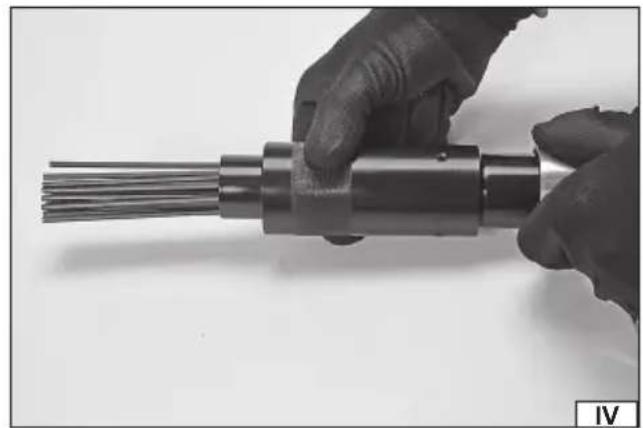
Installation of accessories (IV)
Screw the needle attachment onto the socket so that the axis of the attachment hits the tool holder. Then firmly and securely screw the attachment onto the tool holder thread, tightening as much as possible.
Do not use any tools when tightening, tighten by hand.
Working with the scaler
Always hold the tool with both hands while working. When working, apply only such pressure on the tool which is required for the given task. Do not exert excessive pressure on the workpiece, this can lead to needle breaks and serious injuries. Attention should also be paid to any fragments that may become detached during work. They must not be allowed to cause hazards in the workplace.
MAINTENANCE
Never use petrol, solvent, or any other flammable liquid to clean the tool. Vapours may ignite, causing the explosion of the tool and serious injury.
The solvents used to clean the tool holder and the body may soften the seals. Thoroughly dry the tool before starting work. If you notice any malfunction of the tool, immediately disconnect the tool from the pneumatic system.
All components of the pneumatic system shall be protected against contamination. Contaminants entering the pneumatic system can damage the tool and other components of the pneumatic system.
Maintenance of the tool before each use
Disconnect the tool from the pneumatic system.
Before each use, introduce a small amount of preservative (e.g. WD-40) through the air inlet.
Connect the tool to the pneumatic system and run it for approx. 30 seconds. This will allow you to spread the preservative through the inside of the tool and clean it.
Disconnect the tool from the compressed air system again.
Insert a small amount of SAE 10 oil into the tool via the air inlet opening and the holes designed for that purpose. The use of SAE 10 is recommended for the maintenance of pneumatic tools. Connect the tool and run it briefly.
Caution! WD-40 cannot be used as a proper lubricating oil.
Wipe off any excess oil that may have escaped through the outlet openings. The oil left can damage the tool seals.
Other maintenance activities
Before each use of the tool, make sure that there are no signs of damage to the tool. Keep drivers, tool holders and spindles clean. Have the tool inspected by a qualified workshop personnel every 6 months or after 100 operating hours. If the tool has been used without the recommended air supply, increase the inspection intervals of the tool.
Removing defects
Stop using the tool as soon as you detect any defect. Use of a defective tool may result in injury. Any repairs or replacements to the tool components must be carried out by qualified personnel at an authorised repair shop.
| Defect Possible solution | |
| The tool rotation is too slow or does not start up | Apply a small amount of WD-40 through the air inlet opening. Activate the tool for a few seconds. The blades could stick to the rotor. Activate the tool for approx. 30 seconds. Lubricate the tool with a small amount of oil. Caution! Excess oil can cause the tool to lose power. In this case, clean the drive. |
| The tool starts up and then slows down | The compressor does not provide an adequate supply of air. The tool is activated by the air accumulated in the compressor tank. As the tank empties, the compressor does not keep up with filling in the air shortages. Connect the device to a more efficient compressor. |
| Insuffi cient power | Make sure that the hoses have an internal diameter at least as specified in the table in item 3. Check the pressure setting to ensure that it is set to the maximum value. Make sure that the tool is properly cleaned and lubricated. If there are no results, have the tool repaired. |
Spare parts
A detailed list of product spare parts can be found in the “Download” section, in the product data sheet, on the TOYA SA website: www.toya.pl.
After work has been finished, clean the housing, ventilation slots, switches, additional handle grip and guards using e.g. a jet of air (pressure not more than 0.3 MPa), or a brush or dry cloth without the use of chemicals or cleaning liquids. Clean the tools and holders with a clean, dry cloth.
Used tools are recyclable materials - they cannot be thrown into household waste containers as they contain substances dangerous to human health and the environment! Please actively help us to conserve natural resources and protect the environment by handing over used equipment to a waste equipment storage point. In order to reduce the amount of waste disposed of, it is necessary to reuse, recycle or recover it in another form.
GERÄTEBESCHREIBUNG
CONDITIONS D'EXPLOITATION
DEKLARACJA ZGODNOŚCI DECLARATION OF CONFORMITY DECLARATIE DE CONFORMITATE
0925/YT-09910/EC/2025
We declare and guarantee with full responsibility that the following products:
meet requirements of the following European Standards / Technical Specifications:
and fulfill requirements of the following European Directives:
2006/42/EC Machinery and safety elements
Serial number: concern all serials numbers of item(s) mentioned in this declaration
The person authorized to compile the technical file:

