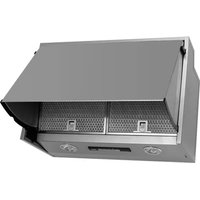
WI6111CM - Basket Atag - Free user manual and instructions
Find the device manual for free WI6111CM Atag in PDF.


User questions about WI6111CM Atag
0 question about this device. Answer the ones you know or ask your own.
Ask a new question about this device
Download the instructions for your Basket in PDF format for free! Find your manual WI6111CM - Atag and take your electronic device back in hand. On this page are published all the documents necessary for the use of your device. WI6111CM by Atag.
USER MANUAL WI6111CM Atag
instructions for use extractor hood
ATAG
WI6111CM
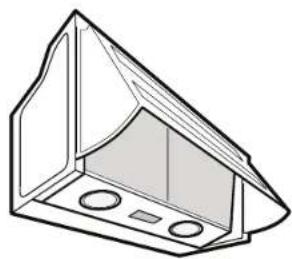
natural_image
Line drawing of a 3D geometric structure with internal components (no text or symbols)Uw afzuigkap
natural_image
Mechanical diagram showing a rotating component inside a housing, with a sphere attached to the side (no text or symbols)Deur verwijderen
Verlichting

natural_image
Diagram of a scientific apparatus with a lid, scale, and directional arrows (no text or symbols)text_image
Diagram illustrating a mechanical or electrical setup with labeled components and directional arrows, likely for system or control analysis.Montagevoorbereiding
text_image
16mm O 16mm N1 19mm 19mm N2 N2text_image
Technical diagram showing a structural assembly with labeled components and a force indicator Qtext_image
Technical diagram showing mechanical assembly with labeled components R and Q, including a close-up of a mechanical component with motion arrows.text_image
Ø 2,5mm x 6mm max N3 K 6mm !Afvoeren
natural_image
Symbol of a trash bin with crossed lines indicating no waste or discharge (no text or numbers present)text_image
Technical diagram showing a 3D object with labeled sections H1 and H2, including directional arrows indicating movement or orientation.natural_image
Mechanical diagram showing a rotating component with a circular housing and an arrow indicating rotation direction (no text or symbols)natural_image
Diagram of a scientific apparatus with a lid, scale, and directional arrow (no text or labels)text_image
Diagram illustrating a mechanical or electrical setup with labeled components and directional arrows, likely for system or control analysis.text_image
16mm O 16mm N1 19mm 19mm N2 N2text_image
Technical diagram showing a structural connection with labeled components and a force vector Q acting downward.Montage mural de la hotte aspirante
text_image
Technical diagram showing mechanical assembly with labeled components R and Q, including a close-up of a mechanical component with motion arrows.text_image
Ø 2,5mm x 6mm max N3 K 6mm !Mise au rebut
natural_image
Symbol of a trash bin with crossed lines indicating no waste or discharge (no text or numbers present)natural_image
Mechanical diagram showing a rotating component with a circular element inside, no text or symbols presentEntfernen der Tür
Lampen

natural_image
Diagram of a scientific apparatus with a lid, scale, and directional arrows (no text or symbols)text_image
Diagram illustrating a mechanical or electrical setup with labeled components and directional arrows, likely for electrical or mechanical analysis.Montagevorbereitung
text_image
16mm O 16mm N1 19mm 19mm N2 N2text_image
Technical diagram showing a structural assembly with labeled components and a force indicator Qtext_image
Technical diagram showing mechanical assembly with labeled components R and Q, including a magnified view of a device with rotating mechanism.text_image
Ø 2,5mm x 6mm max N3 K 6mm !Entsorgung
text_image
Warning symbol for a trash bin with crossed lines indicating no waste or discharge, and a blank rectangular area below.| Description | 4 | |
| Introduction | 4 | |
| Safety | ||
| Precautions you must take 5 | ||
| Extraction systems | ||
| Use | ||
| Controls | 7 | |
| Maintenance | ||
| Cleaning | 8 | |
| Grease filters | ||
| Carbon filter | ||
| Removing the door 9 | ||
| Light bulbs | ||
| Installation | ||
| General | 10 | |
| Connection | 11 | |
| Mounting preparation | ||
| Mounting | 12 | |
| Appendix | ||
| Disposal | 15 | |
Description
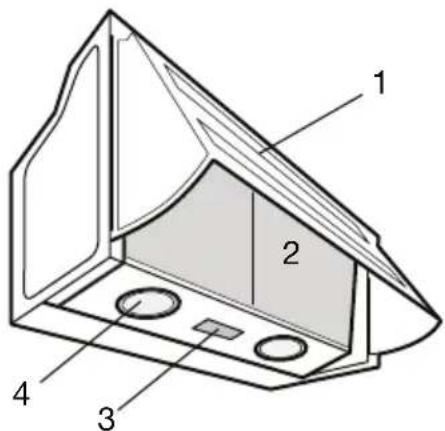
text_image
1 2 3 4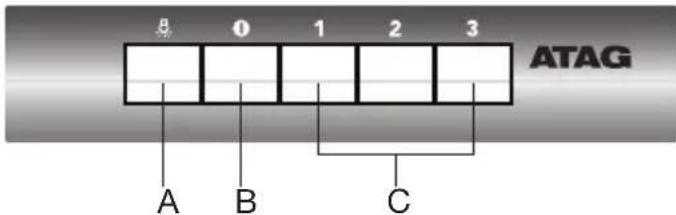
text_image
B 0 1 2 3 ATAG A B C- Moisture collector
- Grease filter
- Control panel
A. lighting on/off
B. off switch
C. fan switches
- Light bulbs
Introduction
This user manual gives you a quick overview of all the possibilities offered by the appliance. You will find information on safety measures and maintaining the appliance.

Please retain this user manual and the installation guide.
They may be of use to future users of the appliance.
Precautions you must take

Make sure the appliance is installed by an authorised installer (see “Installation” chapter). Do not connect the appliance to the mains before completing the installation.
- Connect the appliance in accordance with the applicable regulations in your area.
- We advise you to wear protective work gloves during the installation of the cooker hood because of possible sharp edges.
- The appliance has been manufactured in accordance with the latest safety standards. However we do advise that persons with a mental or motor impairment do not use this appliance without the proper supervision of a competent person. The same applies to children.
- Never use the cooker hood if the grease filter has not been properly installed!
• Do not lean against the cooker hood. - Never place objects on the hood unless specifically indicated.
- Make sure there is sufficient ventilation when you use the cooker hood on a gas cooker.
- The exhaust must never be connected to a flue that is also used for other heating appliances.
- Never flambé under the cooker hood and always clean the filters promptly. Never leave frying pans unattended during use, as the heated fat may catch fire.
- The cooker hood needs to be cleaned regularly (at least once a month) on the inside as well as on the outside. Insufficient cleaning or late replacement of filters may pose a fire hazard.
- If the connection cable becomes damaged, it should be replaced by the manufacturer's service department or by a person with equivalent qualifications, in order to prevent dangerous situations from arising.
Precautions you must take
- When replacing the lights, first disconnect the appliance from the mains! Only use identical lamps with the wattage indicated. Only use the cooker hood with lamps installed, in order to reduce the risk of electric shock.
- Accessible parts may become hot when used with cooking appliances.
- The grease filters become hot during operation. Wait a minimum of 30 minutes after cooking before cleaning the filters.
- The power must be switched off during repairs or cleaning. Remove the plug from the mains socket or turn the switch in the meter cupboard to zero.
- Grease and oil are flammable when they are overheated. Stay in the vicinity of the cooker when preparing food.
- We will not accept any responsibility for any faults, damage to the appliance, or fires resulting from non-observance of the instructions included in this manual.
Extraction systems
Depending on the type, the cooker hoods can be connected in one of two ways:
- To a duct. The cooking vapours extracted by suction are carried outside, once the grease particles have been filtered, via either the top (B1) or the back (B2). This is the best method.
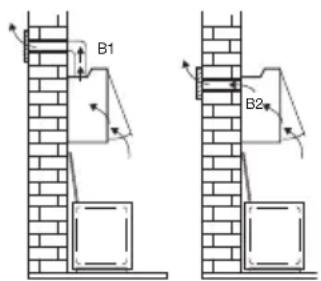
text_image
B1 B2- Recirculation hood. When the hood is connected as a recirculation hood, the grease particles and odour in the extracted vapours are filtered.
The extracted air is not carried outside but recirculates in the kitchen (B3). In this case you must have a carbon filter fitted.
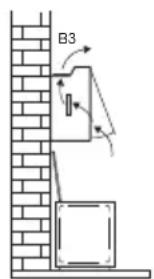
text_image
B3
Attention! The carbon filter needs to be ordered separately.
Controls
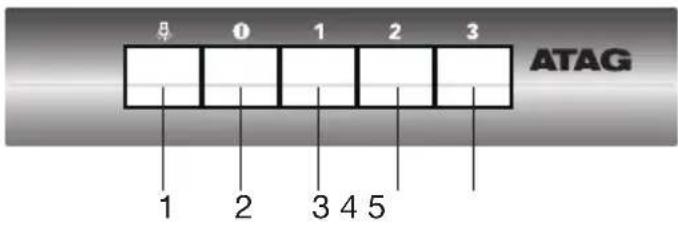
text_image
4 0 1 2 3 ATAG 1 2 3 4 5The cooker hood switches on at setting 1.
Press fan button 2.
The cooker hood switches off.
Increasing the speed
The fan switches on at the selected setting.
Switching lighting on and off
Press the lighting button 1.
The lighting switches on.
Press the lighting button 1 again.
The lighting switches off.
Cleaning

Attention! Before performing any maintenance operation, isolate the hood from the electrical supply by unplugging the appliance or switching off your household's master switch. The cooker hood should be cleaned regularly (at least as frequently as the grease filters are cleaned) both internally and externally. Do not use abrasive products.
Do not use alcohol!
Attention! Failure to comply with the basic recommendations for cleaning the cooker hood and cleaning/replacing the filters may lead to a fire. Therefore, we recommend that you observe these instructions. The manufacturer declines all responsibility for any damage to the motor or any fire damage linked to inappropriate maintenance or failure to observe the above safety recommendations.
Cooker hood
Clean the cooker hood with soapy water and a soft cloth. Then wipe with clean water to rinse. Do not apply aggressive cleaning agents such as caustic soda. The paintwork on the cooker hood will remain shiny if it is periodically rubbed with wax.

Stainless steel canopy hoods
Do not use any sort of scourer. Treat with a stainless steel care product and polish with the structure of the stainless steel.
Metal grease filters
These must be cleaned once a month (or when indicated by the filter saturation indication system, if present on your model) using non-aggressive detergents, either by hand or in the dishwasher, which must be set to a low temperature and a short cycle. The openings must be placed downwards to let the water run out of the filters. When washed in a dishwasher, aluminium grease filters may be discoloured slightly. This is normal and does not affect their filtering capacity.
Grease filters
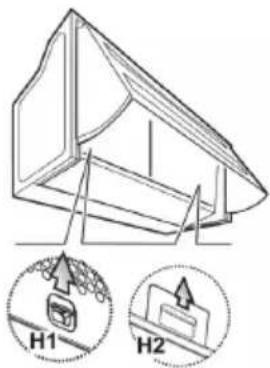
text_image
H1 H2Carbon filter
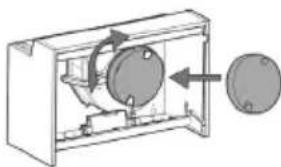
natural_image
Mechanical diagram showing a rotating component with a circular housing and a separate spherical component (no text or symbols)Removing the door
Light bulbs

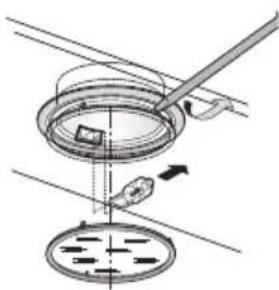
natural_image
Diagram of a mechanical or electrical setup with a lever and rotating components (no text or symbols)Removing the grease filters
Open the lock on the filters and remove the filters.
- Attention! Clean the grease filters each month with soapy water. When washed in a dishwasher, the grease filter may be discoloured slightly. This is normal and does not affect its filtering capacity.
Replacing the carbon filter
The saturation of the filter depends on the intensity of use. However, the carbon filter needs to be replaced at least every four months.
- Attention! The carbon filter cannot be washed for reuse. Saturated carbon is not environmentally friendly. Change the filter regularly.
- Open the door and push the brackets on the side of the door inwards. Pull the door out of the guide.
- Place the panel door on the cooker hood again, first at the top and then at the bottom.
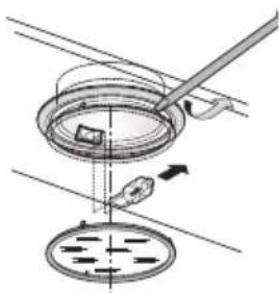
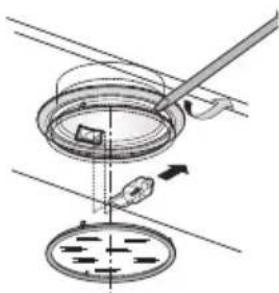
Changing the light bulbs
Disconnect the hood from the electricity. Attention! Prior to touching the light bulbs, ensure that they have cooled down.
- Using a small screwdriver or equivalent tool, carefully pry loose the light cover.
- Remove the damaged light bulb
- and replace with a 12V 20W (max) G4 halogen lamp. Ensure that you do not touch the light bulbs with bare hands.
- Close the light cover (it will snap shut).
If the lights do not work, make sure that the lamps are fitted properly into their housings before you call for technical assistance.
General
This appliance must be connected to the electric mains by an authorised installer who is familiar with the safety precautions and will carry them out. The appliance is in compliance with European guidelines.
Important information:
- The distance between the lowest point of the cooker hood and a gas hob must be at least 70 cm. If using an electric, ceramic or induction hob, this distance must be at least 65 cm.
- If the cooker hood is connected to an existing exhaust duct, no other appliance must be connected to the duct (such as a hot water heater or a stove).
- Consider local regulations with respect to the ventilation of gas appliances.
- The shorter the duct, and the fewer bends in it, the better the cooker hood will work.
- Check before you start drilling that no installation pipe(s) is/are present.
- The connection pipe to the cooker hood has a diameter of 120 mm. We recommend that the exhaust pipe has the same diameter.
- The enclosed installation materials are suitable for reinforced concrete and brick walls. For some types of wall you may need special plugs and screws.
Connection
Electrical connection
The mains power supply must correspond to the rating indicated on the plate situated inside the hood.
If provided with a plug, connect the hood to a socket in compliance with current regulations and positioned in an accessible area.
If not fitted with a plug (direct mains connection) or if the plug is not located in an accessible area, fit a double pole switch that will allow complete disconnection from the mains under the conditions of overvoltage category III, in accordance with installation instructions.

Attention! Before re-connecting the hood circuit to the mains supply and checking that it works correctly, always check that the mains cable is properly fitted.
The hood is provided with a special power cable; if the cable is damaged, request a new one from our technical services department.
max 90 cm

text_image
Diagram illustrating a mechanical or electrical setup with labeled components and directional arrows, likely for system or control analysis.Mounting preparation
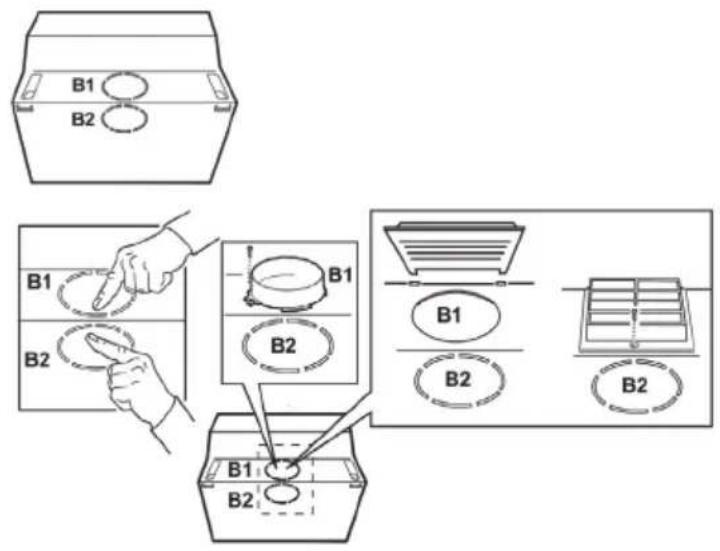
- Choose the desired exhaust outlet (B1 or B2) and open it up by removing the perforated plate.
- Attach the plastic connecting piece to the opened exhaust outlet. The connecting piece has a bayonet joint.
text_image
B1 B2 B1 B2 B1 B2 B1 B2 B2Mounting
Mounting the cooker hood on the side walls
- Check that the cupboards are sufficiently stable.
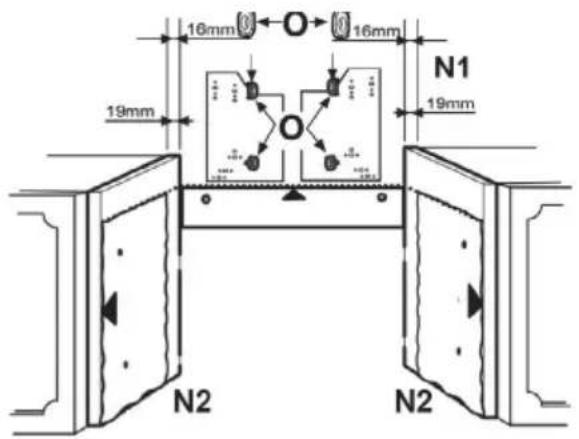
- Use drilling jig N2 to determine the position of the mounting holes. The top of the jig is level with the top of the cooker hood. The front of the jig is level with the front of the cooker hood excluding the door panel.
text_image
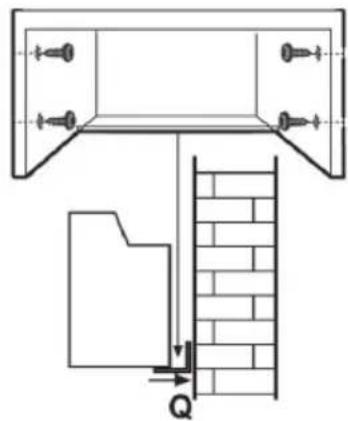
16mm O 16mm N1 19mm 19mm N2 N2- Drill the mounting holes in the cupboards. Filler pieces are supplied for fixing the cooker hood to cupboards with a wall thickness of 16 mm. The supplied angle iron (Q) can be used to fill in the space at the back between the cooker hood and the wall.
text_image
Technical diagram showing a structural assembly with labeled components and a force indicator QMounting the cooker hood on the wall
Use drilling jig N1 to determine the position of the mounting holes. The top of the jig is level with the top of the cooker hood.
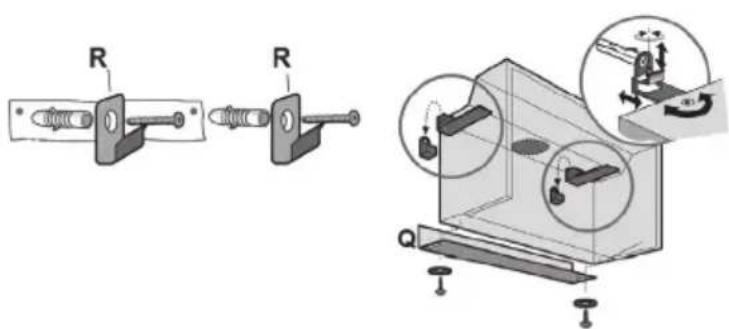
- Drill the holes and attach the wall brackets (R) to the wall using plugs and screws.
- Slide the suspension brackets into the cooker hood from the back.
- Secure the bracket using the supplied screws and locking rings.
- Turn a socket screw in the suspension brackets. You can use this later to adjust the height.
- Hang the hood on the wall brackets. The height and depth of the hood can be adjusted using the set screws or by sliding the brackets inwards or outwards.
text_image
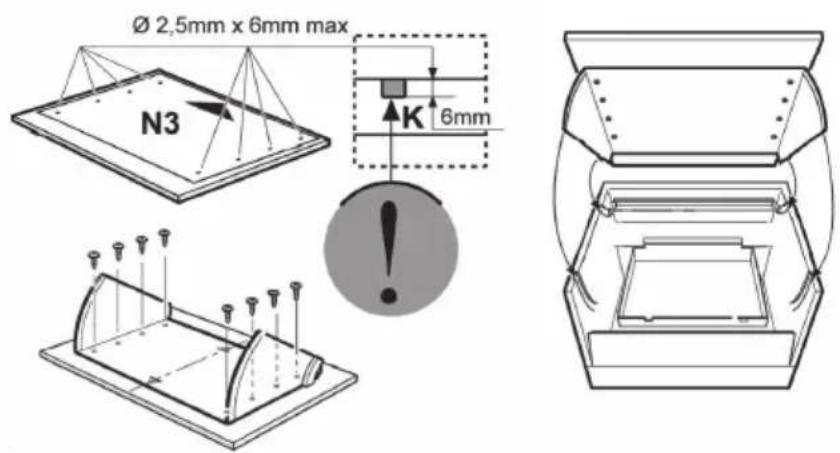
Technical diagram showing mechanical assembly with labeled components R and Q, including a close-up of a mechanical component with internal features.Fitting the door panel
- Open the door, push the brackets in and remove the door.
- Place the door panel on a flat surface with the back facing upwards.
- Position the drilling jig (N3) on the back of the door panel. The arrow on the jig should point upwards.
- Drill mounting holes (K) with a depth of between 2.5 mm and 6 mm.
- Attach the metal panel with the 8 supplied screws.
- Place the panel door on the cooker hood again, first at the top and then at the bottom.
- Check that the door opens and shuts properly.
text_image
Ø 2,5mm x 6mm max N3 K 6mm !Disposal
Disposal of appliance and packaging
This appliance was manufactured using sustainable materials. It must be disposed of responsibly at the end of its life cycle. The local authorities can provide you with the relevant information.
The packaging of this appliance is recyclable. It may have been made from:
- cardboard;
• polythene film (PE);
• CFRP-free polystyrene (PS hard foam).
You need to dispose of these materials responsibly in accordance with official regulations.
natural_image
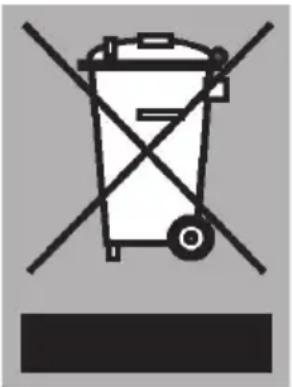
Symbol of a trash bin with crossed lines indicating no waste or discharge (no text or numbers present)To draw attention to the fact that the segregated processing of household electrical appliances is compulsory, this appliance carries the symbol of a crossed-out dustbin. This means that you may not dispose of the appliance as household refuse at the end of its useful life. Instead, it should be taken to a special segregated refuse collection centre run by the local authority or to a dealer providing this service.
Segregated processing of household appliances prevents any negative impact on the environment and public health that might otherwise arise. It allows the recovery of the materials used to manufacture this appliance, thus generating considerable savings in terms of raw materials and energy.