
68270 - Food Dehydrator Lund - Free user manual and instructions
Find the device manual for free 68270 Lund in PDF.


| Product type | Food dehydrator |
| Brand | Lund |
| Model | 68270 |
| Dimensions (W x D x H) | 29-32 x 34 x 32 cm |
| Net weight | 1.2 kg |
| Power supply | 220-240 V~, 50-60 Hz, 420-500 W |
| Insulation class | II |
| Number of trays | At least 3 (not specified exactly) |
| Tray dimensions | 31.5 x 29.5 cm |
| Maximum load per tray | 0.5 kg |
| Temperature range | Not specified precisely (adjustable via knob) |
| Main functions | Hot air dehydration, temperature adjustment, high and low tray positions, switch with indicator light |
| Care and cleaning | Trays and lid washable with water (not dishwasher-safe), wipe base with damp cloth, do not immerse base |
| Safety | Hot surface, not for use by children under 8 years, minimum distance 10 cm, do not use extension cord, unplug after use |
| Spare parts and repairability | Repairs by authorized service center only, do not disassemble yourself |
| Intended use | Household only, indoor, dehydration of food on trays |
| Recommended storage | In original packaging, protected from dust and moisture, do not stack anything on top |
| Ambient operating temperature | +10°C to +38°C, humidity <90% |
| Included accessories | Trays, lid, base with switch and temperature regulator |
Frequently Asked Questions - 68270 Lund
User questions about 68270 Lund
0 question about this device. Answer the ones you know or ask your own.
Ask a new question about this device
Download the instructions for your Food Dehydrator in PDF format for free! Find your manual 68270 - Lund and take your electronic device back in hand. On this page are published all the documents necessary for the use of your device. 68270 by Lund.
USER MANUAL 68270 Lund
natural_image
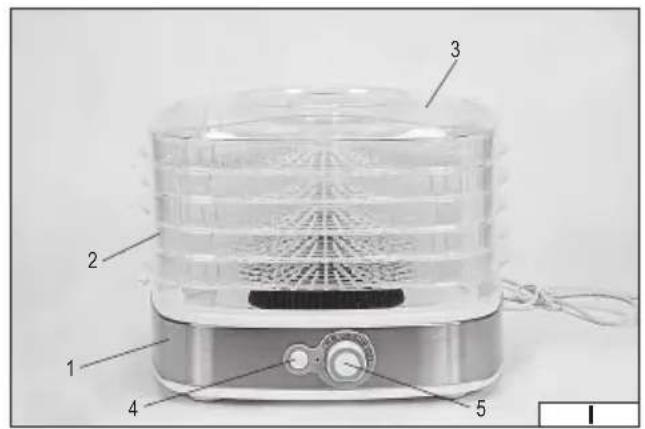
Exterior view of a modern LUND food heater with tiered transparent dish holders and control panel (no text or symbols on the device itself)CE
PL EN DE RU UA LT LV CZ SK HU RO ES FR IT NL GR
natural_image
Close-up of a stainless steel electric heater with a transparent cover and cooling fan (no visible text or symbols)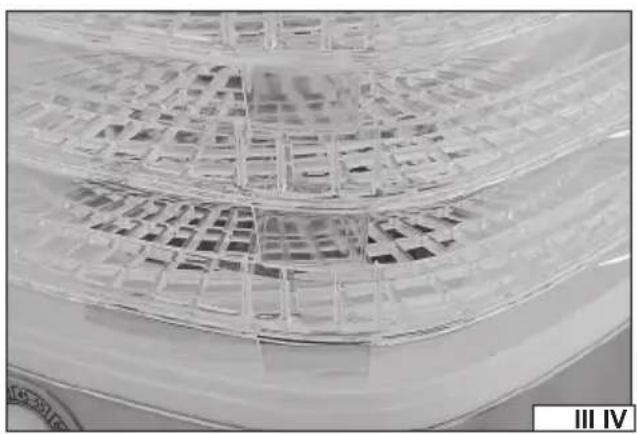
natural_image
Architectural model of a modern building facade with grid-like structure (no visible text or symbols)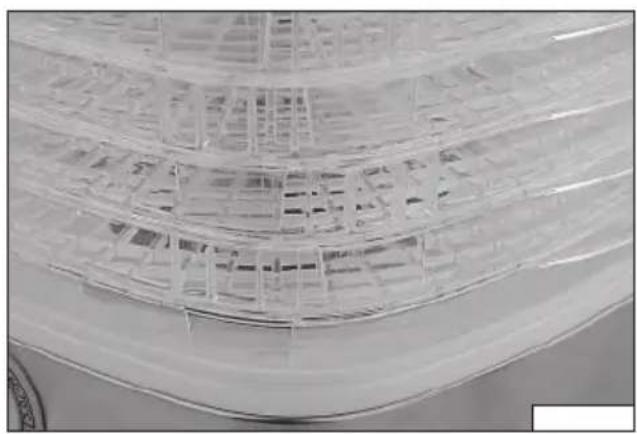
natural_image
Close-up of a transparent plastic architectural structure with curved and rectangular elements (no text or symbols visible)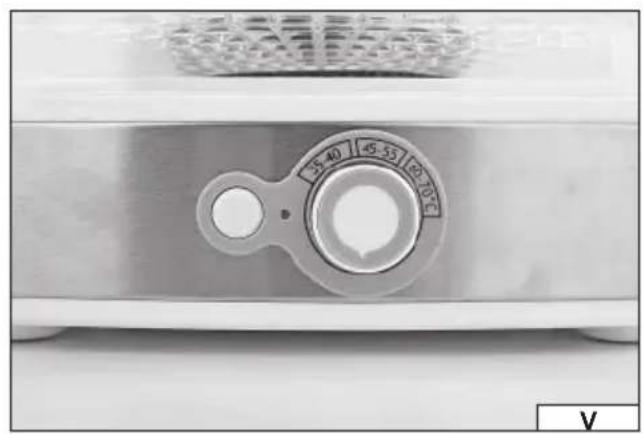
natural_image
Close-up of a kitchen appliance's door dial with no visible text or symbols on the main body (pure technical diagram)PL EN
Read the operating instruction
Safe contact with food
Note! Hot surface. Do not touch.
This symbol indicates that waste electrical and electronic equipment (including batteries and storage cells) cannot be disposed of with other types of waste. Waste equipment should be collected and handed over separately to a collection point for recycling and recovery, in order to reduce the amount of waste and the use of natural resources. Uncontrolled release of hazardous components contained in electrical and electronic equipment may pose a risk to human health and have adverse effects for the environment. The household plays an important role in contributing to reuse and recovery, including recycling of waste equipment. For more information about the appropriate recycling methods, contact your local authority or retailer.
APPLIANCE CHARACTERISTICS
The food dehydrator is an appliance designed for drying food by means of forced circulation of warm air. Thanks to the wide range of temperature adjustment, you can adjust the operating parameters of the appliance to your needs and to the type of dried food. Many sieves allow for efficient operation. The appliance is not intended for commercial use. Proper, reliable and safe operation of the appliance depends on appropriate use, that is why you should
Read and keep the entire manual before the first use of the appliance.
The supplier shall not be held liable for any damage or injury resulting from improper use of the appliance or failure to observe the safety regulations and recommendations of this manual. Use of the appliance for purposes other than those for which it was intended shall cause the loss of the user's rights to the guarantee and also under warranty.
ACCESSORIES
The appliance is supplied complete and does not require assembly. However, before using the appliance, remove all packaging and transport protection elements. Preparatory activities described later in this manual are also required.
GENERAL INSTRUCTIONS FOR USE
The appliance has been designed for home use and is not allowed to be used in commercial applications, e.g. in catering facilities.
The appliance is intended for indoor use only. Do not expose the appliance to rain or other precipitation.
The appliance can be used only for heat processing of food placed directly on the sieves. It is forbidden to use the appliance in any other way, for example as a heater for the products inside a dish.
It is forbidden to repair, disassemble or modify the appliance on one's own. All repairs to the appliance must be carried out by an authorised service centre.
The appliance must be kept under supervision at all times during operation.
WARNING! The appliance may become hot during operation, take special care when touching the appliance during operation and immediately after operation, as this may cause burns. The appliance is not intended for use by children under at least 8 years of age and by persons with reduced physical and/or mental abilities and by persons without experience in or understanding of the operation of the appliance. Unless they will be supervised or instructed to use the appliance safely, in a manner ensuring that the risks involved are understood. Children should not play with the appliance. Unattended children should not be allowed to perform the cleaning and maintenance of the appliance.
Recommendations concerning transport and installation of the appliance
The appliance may only be placed on a hard, flat, level and non-flammable surface. The surface should be able to withstand the weight of the appliance itself and of the food it contains. Ensure that there is a minimum distance of 10 cm around the side walls of the appliance, and do not place non-high temperature resistant materials above the appliance. This will allow for the proper ventilation of the appliance. Do not place near edges of, e.g., a table. Do not place the appliance near flammable materials, e.g. curtains or drapes.
The appliance should be used in a place where the air is free of contaminants and odours. During food drying, any contaminants can remain on the dried products due to the air flow.
EN
Do not place any electrical equipment above the appliance. During operation, hot and humid air is released, which can cause a short circuit in the electrical system and lead to electric shock.
It is forbidden to drill any holes in the product, as well as making any other modifications of the appliance not described in the manual.
Move the appliance only when cooled, grasping the housing. Do not move the appliance by pulling on the power cord.
The temperature at the place of installation and use of the appliance must be within the range of +10°C ÷ +38°C, and the relative humidity must be below 90% without water vapour condensation.
Recommendations for connecting the appliance to the power supply
Before connecting the appliance to the power supply, make sure that the voltage, frequency and performance of the power supply corresponds to the values shown on the appliance's rating plate. The plug must fit into the socket. It is forbidden to modify the plug in any way.
The appliance must be connected directly to a single power supply socket. It is forbidden to use extension cords, adapters or double sockets. The power supply circuit must be fitted with a protective conductor and at least a 16 A protective device.
Avoid contact of the power cord with sharp edges, hot objects or surfaces. During operation, the power cord must always be fully extended and the position of the power cord must be set so that it does not become an obstacle during operation. The power cord shall not be placed in a manner that would pose a risk of tripping. The power supply socket should be located in a place where it is always possible to quickly remove the appliance power cord plug. Always pull the power cord by the plug housing when unplugging it, never by the cord.
If the power cord or the plug are damaged, immediately disconnect it from the power supply and contact an authorised service centre of the manufacturer for replacement. Do not use the appliance with a damaged power cord or plug. The power cord or plug cannot be repaired and must be replaced with a new one that is free of defects if these components are damaged. Replacement of the power cord and plug must be carried out by an authorised service centre of the manufacturer.
Instructions for the use of the appliance
WARNING! The appliance housing can be hot during and shortly after use. Do not touch it, as it may cause burns. Allow the appliance housing to cool down.
Food should be cut into small pieces before placing it on sieves. The smaller the pieces of food, the faster they can be dried and the lower the drying temperature required.
Food should always be placed starting from the bottom sieve. Do not arrange the products too tightly to allow air circulation. Only one layer of food should be placed on one sieve.
Products placed on the sieve should not touch the sieve or the housing placed above them. Make sure that the floor near the appliance is not slippery. This will prevent slipping, which can cause serious injuries.
The appliance must be kept under supervision at all times during operation. Before checking the degree of drying of food, stop appliance operation, unplug the power cord from the sock-
EN
et, wait until the product housing cools down and then open it.
If, after drying, food residues remain on the sieves or housing, they should be removed before new food is placed on the sieves. If food residues remain on the sieves and/or housing, air circulation may be impaired and the appliance may overheat. Overheating can lead to damage to the appliance or cause fire or electric shock. Clean the appliance according to the instructions in section: "Appliance maintenance"
APPLIANCE OPERATION
Installation, start-up and operation of the appliance
The appliance must be unpacked and all parts of the packaging completely removed. It is recommended to keep the packaging, as it can be helpful for further transport and storage of the appliance.
Prepare the appliance according to the instructions specified in the "Appliance maintenance" section.
Placing the sieves
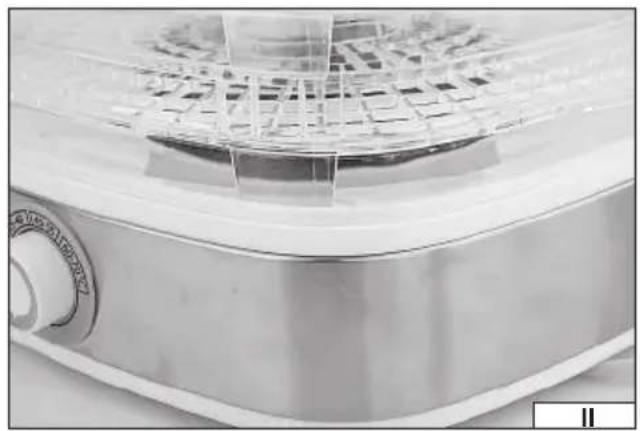
The lowest sieve should be mounted on the base so that the edge of the sieve lies on the base around the entire circumference (II). The sieves can be placed in two positions: high and low. When placed in the high position, the distance between the sieves is larger. When placed in the low position, the distance between the sieves is smaller. This allows to adjust the space between the sieves to the size of food pieces and the drying efficiency. Greater space between the sieves improves air circulation and drying efficiency. In the set of sieves arranged on the base of the dehydrator, the space can be arranged freely, depending on the needs. It is recommended to use at least three sieves, regardless of whether they contain food or not. The sieves should always be covered with a lid. The use of the lid forces proper air circulation inside the appliance.
In order to place the sieves in the high position, the sieve should be turned horizontally by 180 degrees in the direction of the "Tall" mark placed on the sieve handles. In this position, the guides of the top sieve will rest on the guides of the bottom sieve (III). In order to place the sieves in the low position, the sieve should be turned horizontally by 180 degrees in the direction of the "Short" mark placed on the sieve handles. In this position, the guides of the top sieve will be next to the guides of the bottom sieve (IV).
The sieves must be parallel to each other and to the base.
Caution! It is recommended to test the position of the sieves before placing food on them. This will allow to gain experience and make it easier to place sieves with food on them.
Sieve handles should be in line and always placed on the sides of the base. The shape of the sieves was made so that it is possible to place them only in the correct position.
Placing food on the sieves
Caution! It is recommended to place food on sieves disassembled from the base. Place the products in one layer. Do not place food on the base or lid. Do not cover the central opening in the sieves. Mount the sieve with food on the base, place the sieves on the lower sieves in the high or low position so that the food placed on the lower sieve does not come into contact with the upper sieve.
St arting and stopping the appliance
Make sure that the base switch is not pressed and that the temperature adjustment knob is turned counterclockwise as far as it will go (V).
Put the power cord plug in the socket. Press the ON/OFF switch, the indicator will light up, which means that the appliance has been started. The sound of a working fan should also be heard.
Set the drying temperature by turning the temperature adjustment knob. If the knob remains in its initial position, the air flowing through the dehydrator will not be heated.
Drying can take up to several hours.
Switch off the unit by pressing and releasing the ON/OFF switch. Turn the temperature adjustment knob counterclockwise as far as it will go. Remove the power cord plug from the socket. Allow the sieves to cool down and proceed with their disassembly, starting with the lid and gradually disassembling the sieves one by one from the highest to the lowest.
After removing the food from the sieves, proceed with the maintenance of the sieves, lid and base.
Recommendations for the food drying
Dried pieces of fruit and vegetables can be used as snacks or as food additives. Dried products retain their taste and nutritional values. Dried food may differ in appearance or taste from products available in shops because preservatives and dyes are not added during drying.
Before drying, it is recommended to note the weight of the products and then the time and temperature of drying. This will make it
EN
easier to determine operating conditions in the future.
The drying time of the products depends on: - the thickness or size of the pieces, - the number of sieves used for drying, - the number of products placed in the dehydrator, - the humidity of the air around the dehydrator, - personal preference for drying effects. If during the drying process uneven effects are observed, the position of the sieves should be periodically changed if the construction of the appliance allows it.
Dried food should be placed in containers only after it has completely cooled down. The container for storing dried food products should be tight. It is recommended to use vacuum containers. After placing the products in the container, seal the container tightly and then extract as much air as possible. Store food in containers in dark and cool rooms. The storage temperature should not exceed 15^ C. Do not place dried food directly in metal containers. Periodically check the condition of dried food.
If, for any reason, it is necessary to interrupt the drying process, food should be removed from the sieves and placed in plastic bags or containers and then stored in the freezer. Before resuming drying, the products should be defrosted. Do not refreeze products that have already been defrosted.
Appliance maintenance
CAUTION! All maintenance must be carried out with the appliance switched off. To do this, unplug the power cord from the socket.
The appliance is used to prepare food placed directly on the sieves, therefore care must be taken to maintain proper hygiene so that the preparation of food is safe.
Sieves and lid should be washed with a jet of running water or by immersing it in water. Use a mild dishwashing detergent. Clean with a soft cloth, a soft sponge or a soft brush. Do not use aggressive or abrasive cleaning agents due to the risk of the sieve and lid surfaces dulling.
After cleaning is finished, dry the sieve and the lid thoroughly before placing them on the base.
Sieves and the lid are not suitable for cleaning in mechanical dishwashers or with high-pressure water jet.
Clean the base / housing with a slightly damp cloth, then dry with a clean, dry cloth.
Caution! Never immerse the electric appliance (base) in water or any other liquid.
Do not use solvents, caustics, alcohol, petrol or abrasives for cleaning.
Clean the ventilation openings with a vacuum cleaner.
Before using the appliance for the first time, after cleaning the sieves, lid and base / housing, run the dehydrator for thirty minutes at its maximum temperature without placing any food inside. During this time, it is possible that smoke or odour may be emitted from the appliance. After finished operation, allow the appliance to cool down and then wash the sieves and lid again and clean the base. This will allow to remove the remains of chemical agents used in the appliance components manufacture.
Appliance storage
If the appliance will not be used for an extended period of time, disconnect it from the socket.
During storage, keep the appliance indoors, and make sure it is not exposed to dust, dirt, or moisture. It is recommended to store the appliance in its original packaging.
Store the appliance in operating position. Do not stack products in layers. Do not place anything on the product during storage.
SPECIFICATION
| Parameter Unit Value | ||
| Catalogue No. 68270 | ||
| Rated voltage [V~] 220 – 240 | ||
| Rated frequency [Hz] 50 - 60 | ||
| Rated power [W] 420 - 500 | ||
| Protection class II | ||
| Sieve dimensions [cm] 31.5 x 29.5 | ||
| Max. load per sieve [kg] | 0.5 | |
| Appliance dimensions (H x W x D) | [cm] | 29-32 x 34 x 32 |
| Net weight | [kg] | 1.2 |
GERÄTEBESCHREIBUNG


- PL EN
- APPLIANCE CHARACTERISTICS
- ACCESSORIES
- GENERAL INSTRUCTIONS FOR USE
- EN
- Recommendations for connecting the appliance to the power supply
- Instructions for the use of the appliance
- APPLIANCE OPERATION
- Placing the sieves
- Placing food on the sieves
- St arting and stopping the appliance
- Recommendations for the food drying
- Appliance maintenance
- Appliance storage
- GERÄTEBESCHREIBUNG
Brand : Lund
Model : 68270
Category : Food Dehydrator