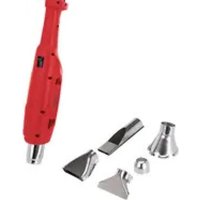
HAW2000 - Electric weed remover SCHEPPACH - Free user manual and instructions
Find the device manual for free HAW2000 SCHEPPACH in PDF.


| Product Type | Electric Weed Burner |
| Brand | Scheppach |
| Model | HAW2000 |
| Power Consumption | 2000 W |
| Mains Voltage | 230-240 V ~ 50 Hz |
| Temperature Level 1 | 50 °C |
| Temperature Level 2 | 600 °C |
| Air Flow | 500 l/min |
| Protection Class | II |
| Weight | 0.95 kg |
| Number of Levels | 3 (0, I, II) |
| Nozzles Included | Conical, large area, reduction, spatula, barbecue (5 nozzles) |
| Main Functions | Thermal weeding, paint removal, defrosting, stripping, barbecue lighting |
| Safety Instructions | Wear gloves and goggles, do not expose to rain, allow to cool before storage |
| Maintenance | Clean with damp cloth and black soap, no solvents |
| Storage | Dry place, frost-free, out of reach of children, temperature 5-30°C |
| Spare Parts | Available from Scheppach after-sales service |
| Warranty | Legal, defective parts replaced free of charge |
| Intended Use | Weed removal, paint removal, defrosting, barbecue lighting |
Frequently Asked Questions - HAW2000 SCHEPPACH
User questions about HAW2000 SCHEPPACH
0 question about this device. Answer the ones you know or ask your own.
Ask a new question about this device
Download the instructions for your Electric weed remover in PDF format for free! Find your manual HAW2000 - SCHEPPACH and take your electronic device back in hand. On this page are published all the documents necessary for the use of your device. HAW2000 by SCHEPPACH.
USER MANUAL HAW2000 SCHEPPACH
natural_image
Product photo of a handheld electric shaver with various metal components (no visible text or labels)
HAW2000
| DE | Heißluft-UnkrautvernichterOriginalbedienungsanleitung | 4 |
| GB | Hot air weed burnerTranslation of original instruction manual | 17 |
| FR | Désherbeur thermique électriqueTraduction des instructions d'origine | 28 |
1
2
natural_image
Technical line drawing of a mechanical tool with labeled parts (no text or symbols on the diagram itself)
Günzburger Straße 69
D-89335 Ichenhausen
Verehrter Kunde
Homepage: https://www.scheppach.com/de/service
Explanation of the symbols on the device
Symbols are used in this manual to draw your attention to potential hazards. The safety symbols and the accompanying explanations must be fully understood. The warnings themselves will not rectify a hazard and cannot replace proper accident prevention measures.
 | WARNING: Non-adherence poses a risk of death, danger of injury or the risk of damage to the device! |
 | Warning - read the instruction manual to reduce the risk of injury. |
 | Wear protective gloves! |
 | Wear safety goggles! |
 | Do not expose the machine to rain. The product may only be stationed, stored and operated in dry ambient conditions. |
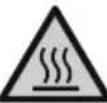 | Warning against hot parts! |
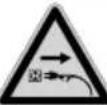 | If the mains cable is damaged or torn, it must be disconnected from the power supply immediately. |
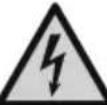 | Warning against electrical voltage |
 | Protection class II |
 | The product complies with the applicable European directives. |
| △ Attention! | We have marked points in this operating manual that impact your safety with this symbol. |
Table of contents: Page:
- Introduction.... 19
- Device description (Fig. 1).... 19
- Scope of delivery 19
- Proper use 19
- General safety information 20
- Residual risks 22
- Technical data....22
- Unpacking 23
- Assembly 23
- Disassembly 23
- Using the adapter nozzle (fig. 8)....23
- Commissioning 24
- Weed killing....24
- Additional work examples.... 24
- Electrical connection 25
- Cleaning 25
- Storage 25
- Transport....25
- Maintenance 26
- Disposal and recycling.... 26
- Troubleshooting 27
1. Introduction
Manufacturer:
Scheppach GmbH
Günzburger Straße 69
D-89335 Ichenhausen
Dear Customer
We hope your new tool brings you much enjoyment and success.
Note:
In accordance with the applicable product liability laws, the manufacturer of this device assumes no liability for damage to the device or caused by the device arising from:
- Improper handling,
• Non-compliance with the operating manual, - Repairs carried out by third parties, unauthorised specialists.
• Installing and replacing non-original spare parts,
• Application other than specified.
Please consider:
Read through the complete text in the operating manual before installing and commissioning the device.
The operating manual is intended to help the user to become familiar with the machine and take advantage of its application possibilities in accordance with the recommendations.
The operating manual includes important instructions for safe, proper and economic operation of the device, for avoiding danger, for minimising repair costs and downtimes, and for increasing the reliability and extending the service life of the device.
In addition to the safety instructions in this operating manual, you must also observe the regulations applicable to the operation of the device in your country. Keep the operating manual package with the machine at all times and store it in a plastic cover to protect it from dirt and moisture. They must be read and carefully observed by all operating personnel before starting the work.
The device may only be used by personnel who have been trained to use it and who have been instructed with respect to the associated hazards.
The required minimum age must be observed.
In addition to the safety instructions in this operating manual and the separate regulations of your country, the generally recognised technical rules relating to the operation of identical devices must also be observed.
We accept no liability for accidents or damage that occur due to a failure to observe this manual and the safety instructions.
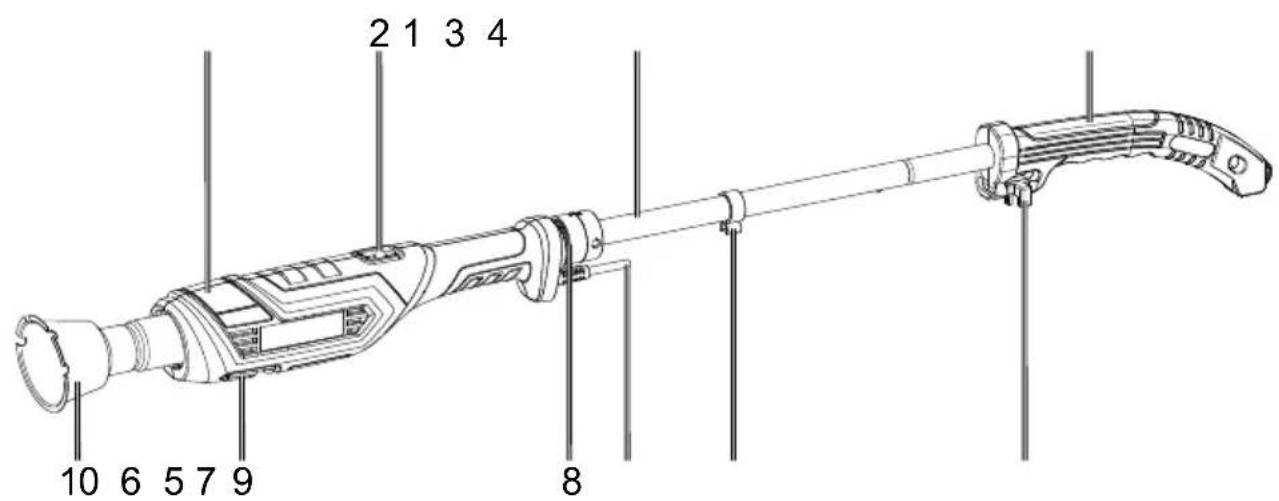
2. Device description (Fig. 1)
- Hot air fan
- 3 stage on/off switch (0/I/II)
- Handle extension
- Handle
- Strain relief
- Cable clip
- Mains cable
- Lock ring
- Stand
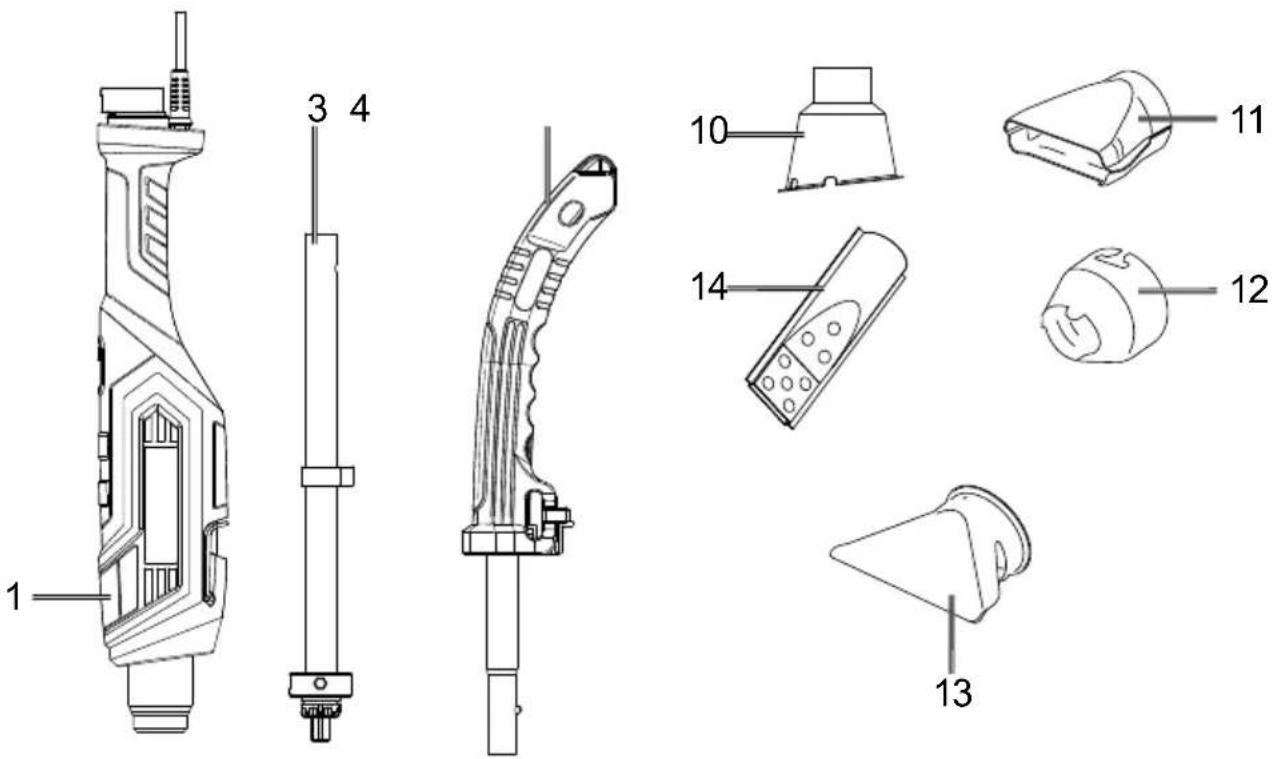
- Cone nozzle
- Flat nozzle
- Reduction nozzle
- Spatula nozzle
- Grill nozzle
3. Scope of delivery
- 1 hot air fan
- 1 handle
- 1 handle extension
- 1 stand
- 1 cone nozzle
- 1 spatula nozzle
- 1 flat nozzle
- 1 reduction nozzle
- 1 grill nozzle
• 1 Operating manual
4. Proper use
The device is suitable for the removal of uncontrolled growth between paving slabs, on paved surfaces, on masonry, in flower beds as well as in lawn surfaces during the growth period, for the removal of paint, for heating (e.g. for heat-shrink tubes) and for the deformation and welding of plastics.
It can also be used to loosen adhesive joints, thaw water pipes and ignite the barbecue.
Any other use or modification shall be deemed to be improper use and could give rise to considerable risk of accident.
The device may only be used in the intended manner. Any use beyond this is improper. The user/operator, not the manufacturer, is responsible for damages or injuries of any type resulting from this.
An element of the intended use is also the observance of the safety instructions, as well as the assembly instructions and operating information in the operating manual.
Persons who operate and maintain the device must be familiar with the manual and must be informed about potential dangers.
In addition, the applicable accident prevention regulations must be strictly observed.
Other general occupational health and safety-related rules and regulations must be observed.
The liability of the manufacturer and resulting damages are excluded in the event of modifications of the device.
The device may only be operated with original parts and original accessories from the manufacturer.
The safety, operating and maintenance specifications of the manufacturer, as well as the dimensions specified in the technical data, must be observed.
Please observe that our equipment was not designed with the intention of use for commercial or industrial purposes. We assume no guarantee if the equipment is used in commercial or industrial applications, or for equivalent work.
The device is intended for use by adults. The manufacturer is not liable for damage caused by an improper use or incorrect operation of this device.
5. General safety information
⚠ WARNING - Read all safety information, instructions, illustrations and technical data for this electric tool.
Failure to follow all instructions listed below may result in electric shock, fire and/or serious injury.
Save all warnings and instructions for future reference.
The term “power tool” used in the safety instructions refers to mains-powered electrical tools (with a mains cable) and battery-powered electrical tools (without a mains cable).
1) Work area safety
a) Keep work area clean and well lit. Cluttered or dark areas invite accidents.
b) Do not operate power tools in explosive atmospheres, such as in the presence of flammable liquids, gases or dust. Power tools create sparks which may ignite the dust or fumes.
c) Keep children and bystanders away while operating a power tool. Distractions can cause you to lose control.
2) Electrical safety
a) Power tool plugs must match the outlet. Never modify the plug in any way. Do not use any adapter plugs with earthed (grounded) power tools. Unmodified plugs and matching outlets will reduce risk of electric shock.
b) Avoid body contact with earthed or grounded surfaces, such as pipes, radiators, ranges and refrigerators. There is an increased risk of electric shock if your body is earthed or grounded.
c) Do not expose power tools to rain or wet conditions.
Water entering a power tool will increase the risk of electric shock.
d) Do not abuse the cord. Never use the cord for carrying, pulling or unplugging the power tool. Keep cord away from heat, oil, sharp edges or moving parts. Damaged or entangled cords increase the risk of electric shock.
e) When operating a power tool outdoors, use an extension cord suitable for outdoor use. Use of a cord suitable for outdoor use reduces the risk of electric shock.
f) If operating a power tool in a damp location is unavoidable, use a residual current device (RCD) protected supply. Use of an RCD reduces the risk of electric shock.
3) Personal safety
a) Stay alert, watch what you are doing and use common sense when operating a power tool. Do not use a power tool while you are tired or under the influence of drugs, alcohol or medication. A moment of inattention while operating power tools may result in serious personal injury.
b) Use personal protective equipment. Always wear eye protection. Protective equipment such as a dust mask, non-skid safety shoes, hard hat or hearing protection used for appropriate conditions will reduce personal injuries.
c) Prevent unintentional starting. Ensure the switch is in the off-position before connecting to power source and/or battery pack, picking up or carrying the tool. Carrying power tools with your finger on the switch or energising power tools that have the switch on invites accidents.
d) Remove any adjusting key or wrench before turning the power tool on. A wrench or a key left attached to a rotating part of the power tool may result in personal injury.
e) Do not overreach. Keep proper footing and balance at all times. This enables better control of the power tool in unexpected situations.
f) Dress properly. Do not wear loose clothing or jewellery. Keep your hair and clothing away from moving parts. Loose clothes, jewellery or long hair can be caught in moving parts.
g) If devices are provided for the connection of dust extraction and collection facilities, ensure these are connected and properly used. Use of dust collection can reduce dust-related hazards.
h) Do not let familiarity gained from frequent use of tools allow you to become complacent and ignore tool safety principles. A careless action can cause severe injury within a fraction of a second.
4) Power tool use and care
a) Do not force the power tool. Use the correct power tool for your application. The correct power tool will do the job better and safer at the rate for which it was designed.
b) Do not use the power tool if the switch does not turn it on and off. Any power tool that cannot be controlled with the switch is dangerous and must be repaired.
c) Disconnect the plug from the power source and/or remove the battery pack, if detachable, from the power tool before making any adjustments, changing accessories, or storing power tools. Such preventive safety measures reduce the risk of starting the power tool accidentally.
d) Store idle power tools out of the reach of children and do not allow persons unfamiliar with the power tool or these instructions to operate the power tool. Power tools are dangerous in the hands of untrained users.
e) Maintain power tools and accessories. Check for misalignment or binding of moving parts, breakage of parts and any other condition that may affect the power tool's operation. If damaged, have the power tool repaired before use. Many accidents are caused by poorly maintained power tools.
f) Keep cutting tools sharp and clean. Properly maintained cutting tools with sharp cutting edges are less likely to bind and are easier to control.
g) Use the power tool, accessories and tool bits etc. in accordance with these instructions, taking into account the working conditions and the work to be performed. Use of the power tool for operations different from those intended could result in a hazardous situation.
h) Keep handles and grasping surfaces dry, clean and free from oil and grease. Slippery handles and grasping surfaces do not allow for safe handling and control of the tool in unexpected situations.
5) Service
a) Have your power tool serviced by a qualified repair person using only identical replacement parts. This will ensure that the safety of the power tool is maintained.
Warning! This power tool generates an electromagnetic field during operation. This field can impair active or passive medical implants under certain conditions. In order to prevent the risk of serious or deadly injuries, we recommend that persons with medical implants consult with their physician and the manufacturer of the medical implant prior to operating the power tool.
General safety instructions for the hot air weed burner
- Make sure that the on/off switch (2) is in the 0 (off) switch setting before inserting the mains plug into the socket.
- This device can be used by children from 8 years of age as well as by persons with reduced physical, sensory or mental capabilities or with a lack of experience or knowledge, if they are supervised or if they have been trained in the safe use of the device and understand the resultant hazards.
Children may not play with the device. Cleaning and user maintenance must not be carried out by children unsupervised.
- If the mains connection cable of this device is damaged, it must be replaced by the manufacturer, their service department or a similarly qualified person to avoid dangers.
Safety instructions for the hot air weed burner ⚠ATTENTION!
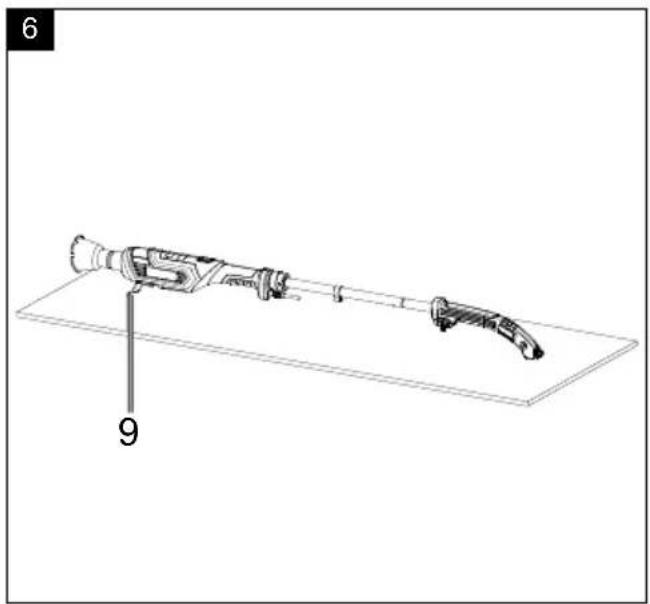
This device must be placed on its stand (9), when not in use. (Fig. 6)
- A fire may occur if the device is not handled carefully.
- Be careful when using the device in the vicinity of combustible materials.
- Do not point at the same place for a long time.
- Do not use in an explosive atmosphere.
- Heat can be conducted to combustible materials that are concealed.
- Place on the stand (9) after use and allow to cool before packing it away.
- Do not leave the device unattended while it is in operation.
Safety instructions for the solid fuel lighter
- Check that the solid fuel lighter is in the correct position.
- Disconnect from the mains before removing from the fire.
- Allow the solid fuel igniter to cool before packing it away.
- The connection cable or other combustible materials must not come into contact with the hot parts of the solid fuel igniter.
Additional safety instructions
CAUTION!
Avoid the risk of injury, fire and health hazards: Pull the mains plug out of the socket immediately in the event of danger.
CAUTION!
RISK OF INJURY!
- Never use the device as a dryer.
- Never point the hot air stream at people or animals.
- Do not look directly into the nozzle opening on the blow-off pipe.
⚠️ CAUTION!
DANGER OF BURNING!
- Do not touch the hot nozzle.
- Wear protective gloves.
- Wear eye protection.
• Always disconnect the mains plug from the socket during breaks in work, before carrying out any work on the device (e.g. changing the adapter nozzle) and when it is not in use. - Maintain a distance to the workpiece or the surface to be processed with the nozzle outlet. An air jam can lead to overheating of the device.
- The device must always be clean, dry and free of oil or grease.
- Never misuse the device.
6. Residual risks
The electric tool has been built according to state-of-the-art and the recognised technical safety rules. However, individual residual risks can arise during operation.
• Health hazard due to electrical power, with the use of improper electrical connection cables.
• Furthermore, despite all precautions having been met, some non-obvious residual risks may still remain.
- Residual risks can be minimised if the “Safety information” and the “Proper use” together with the operating manual as a whole are observed.
- Avoid accidental start-ups of the device: The operating button may not be pressed when inserting the plug in a socket. Use the tool attachment that is recommended in this operating manual. This is how to ensure that your device provides optimum performance.
- Keep your hands away from the working area when the device is in operation.
7. Technical data
Mains voltage 230-240 V \~ 50 Hz
| Power consumption 2000W | |
| Temperature | Level 1: 50°CLevel 2: 600°C |
| Air quantity 500 l/min | |
| Protection class II | |
| Weight 0.95 kg | |
Technical changes reserved!
8. Unpacking
- Open the packaging and carefully remove the device.
- Remove the packaging material, as well as the packaging and transport safety devices (if present).
- Check whether the scope of delivery is complete.
- Check the device and accessory parts for transport damage. In the event of complaints the carrier must be informed immediately. Later claims will not be recognised.
- If possible, keep the packaging until the expiry of the warranty period.
- Familiarise yourself with the product by means of the operating instructions before using for the first time.
- With accessories as well as wearing parts and replacement parts use only original parts. Replacement parts can be obtained from your dealer.
- When ordering please provide our article number as well as type and year of manufacture for your equipment.
⚠ WARNING!
The device and the packaging material are not children's toys! Do not let children play with plastic bags, films or small parts! There is a danger of choking or suffocating!
9. Assembly
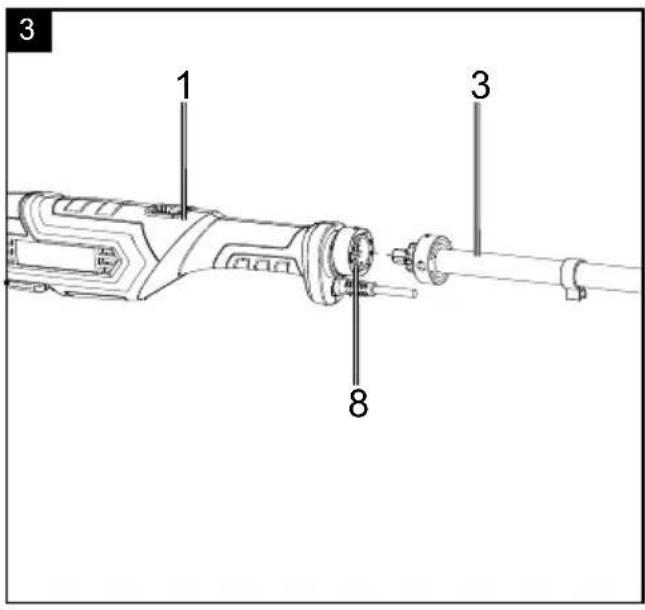
9.1 Fitting the handle extension, fig. 3
- Insert the handle extension (3) into the rear end of the hot air fan (1).
- Ensure that the arrows on the lock rings (8) face each other.
- The handle extension (3) engages with a click.
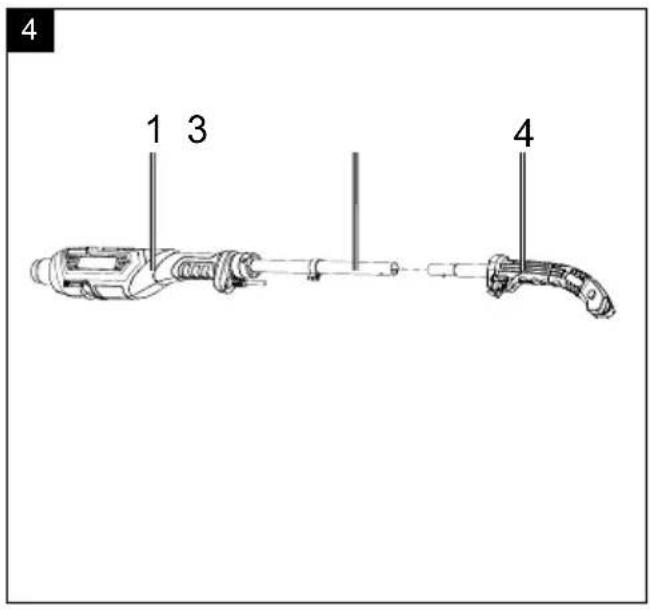
9.2 Fitting the handle, fig. 4
- Insert the handle (4) into the end of the handle extension (3).
- In the tube of the handle (4), there is a groove for guidance.
- Push until the spring-mounted locking pin engages in the handle extension (3).
10. Disassembly
10.1 Disassembling the handle (4)
- Push on the spring-mounted locking pin and pull the handle (4) out.
- Remove the lock ring (8) in the direction of the hot air fan (1).
- Pull the handle extension (3) out of the hot air fan (1).
10.2 Disassembling the handle extension (3)
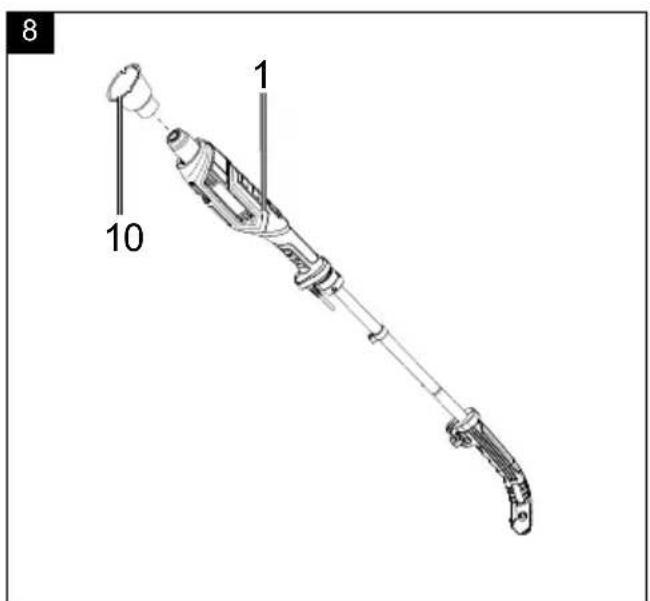
11. Using the adapter nozzle (fig. 8)
⚠ WARNING!
Before changing the nozzle, you must ensure that the nozzle has cooled in order to avoid burns.
Cone nozzle (10) – Weed killing
- Fit the cone nozzle (10) to the blow-off pipe.
Reduction nozzle (12) – Welding plastic:
- Fit the reduction nozzle (12) to the blow-off pipe.
- Use the reduction nozzle (12) for heat-shrink tubes and films.
Flat nozzle (11) – Loosen adhesive, soften paints:
- Fit the flat nozzle (11) to the blow-off pipe.
- Avoid exposing to heat for too long as burnt paint can be very difficult to remove. Many adhesives can be softened by heat. The adhesive joints can then be separated and excess adhesive removed.
Spatula nozzle (13) – Remove paints and coatings:
- Fit the spatula nozzle (13) to the blow-off pipe.
- The spatula shape of this nozzle is used for targeted hot air supply.
Grill nozzle (14) – Igniting charcoal
⚠ WARNING!
Do not use any methylated spirits.
- Fit the grill nozzle (14) to the blow-off pipe.
- Insert the grill nozzle (14) into the charcoal. Ensure that the last three grill nozzle holes remain free.
- Switch the device to level II.
- As soon as the charcoal has embers, remove the device from the charcoal.
12. Commissioning
⚠ Attention!
Always make sure the device is fully assembled before commissioning!
⚠ Attention!
Some smoke can come out of the device after its first use. However, this is normal.
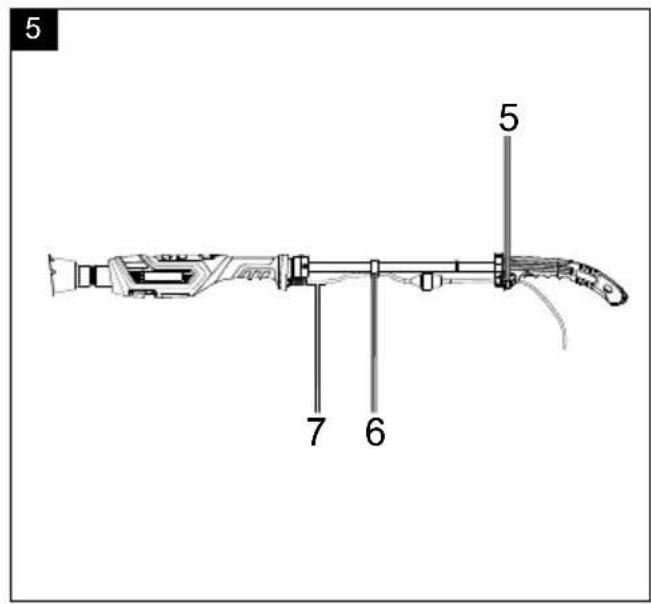
12.1 Connecting the cable, fig. 5
- Push the extension cable into the intended strain relief (5) in the handle (4). To do this, form a loop, guide the loop through the opening and hook it to the other side.
- Fix the mains cable (7) into the intended cable clip (6).
- Connect the device to a socket (230 V alternating current) using an extension cable.
12.2 Switching the device on, fig. 7
- Select the desired working temperature and air quantity using the on/off switch (2):
Switch setting 0:
Device is switched off.
Switch setting 1:
- Level - 50°C
Switch setting 2:
-
Level - 600°C
-
The device reaches the working temperature in a very short time.
12.3 Switching the device off, fig. 6, 7
- Set the on/off switch (2) to the I position. The device then cools down.
- To finally switch the device off, set the on/off switch (2) to the 0 position.
- After use, always place the device with the stand (9) on a flat, fireproof surface until the hot device parts have cooled.
13. Weed killing
- The device is particularly suitable for the removal of weeds.
• To remove weeds, place the cone nozzle (10) on the plants to be treated for approx. 5-10 sec. depending on the type of plant. -
With taller plants, first heat only the upper area of the plant and then place the cone nozzle (10) on the shrivelled plant for approx. 5-10 sec.
-
Weed removal is most effective at an early stage of vegetation growth.
• The most suitable time is spring. - Treatment is most intensive the younger the plant is. However, the success of the measure is not immediately apparent.
- The visible part of the plant can also be burned due to a long exposure time/treatment.
- The plants do not react immediately to the heat rays at the recommended exposure duration. In principle:
Young, smooth leaved plants are most sensitive to the treatment. They are however no longer viable. - Older plants with harder leaves, such as thistles, must be treated more often at an interval of approx. 1 - 2 weeks so that they dry up.
Hard-leaved grasses are very robust and need to be treated for longer. - At the start, the treatment of overgrown areas must be repeated several times at short notice so that lasting success is achieved. Then treatment at longer intervals is sufficient.
- Burning the plant is not absolutely necessary. When heated up, the cells of the leaves dry up and the weeds die.
• Repeated treatment of certain types of weeds may be necessary.
14. Additional work examples
14.1 Defrosting of water pipes
NOTE
- PVC tubes must not be defrosted.
- Externally, water pipes are often indistinguishable from gas pipes. If in doubt, always ask a specialist.
• Copper pipes are connected with tin and must not be heated over 200^ C.
14.2 Loosening screw connections
- Heat up the screw connection carefully with hot air. The screws can then usually be loosened easily.
14.3 Dewaxing
- Free skis / snowboard or a candlestick from residual wax, with the care appropriate to the product.
15. Electrical connection
The electrical motor installed is connected and ready for operation. The connection complies with the applicable VDE and DIN provisions.
The customer's mains connection as well as the extension cable used must also comply with these regulations.
Damaged electrical connection cable
The insulation on electrical connection cables is often damaged.
This may have the following causes:
- Pressure points, where connection cables are passed through windows or doors.
- Kinks where the connection cable has been improperly fastened or routed.
- Places where the connection cables have been cut due to being driven over.
- Insulation damage due to being ripped out of the wall outlet.
- Cracks due to the insulation ageing.
Such damaged electrical connection cables must not be used and are life-threatening due to the insulation damage.
Check the electrical connection cables for damage regularly. Ensure that the connection cables are disconnected from electrical power when checking for damage.
Electrical connection cables must comply with the applicable VDE and DIN provisions. Only use connection cables of the same designation.
The printing of the type designation on the connection cable is mandatory.
Connection type Y
If the mains connection cable of this device is damaged, it must be replaced by the manufacturer, their service department or a similarly qualified person to avoid dangers.
16. Cleaning
⚠ WARNING!
RISK OF INJURY!
Always pull the mains plug out of the socket and allow the device to cool before carrying out work on the device.
- Keep protective devices, air vents and the motor housing as free of dust and dirt as possible. Rub the device clean with a clean cloth or blow it off with compressed air at low pressure.
• We recommend that you clean the device directly after every use. - Clean the device at regular intervals using a damp cloth and a little soft soap. Do not use any cleaning products or solvents; they could attack the plastic parts of the device. Make sure that no water can penetrate the device interior. Water entering a power tool will increase the risk of electric shock.
17. Storage
Store the device and its accessories in a dark, dry and frost-free place that is inaccessible to children. The optimum storage temperature lies between 5 and 30°C. Store the power tool in its original packaging. Cover the power tool to protect it from dust or moisture. Store the operating manual with the power tool.
18. Transport
⚠ WARNING!
RISK OF INJURY!
Always unplug the mains plug from the socket before moving the device.
Allow the device to cool down before transporting or loading to avoid burns and to prevent fire hazards.
19. Maintenance
Connections and repairs
Connections and repair work on the electrical equipment may only be carried out by electricians.
Please provide the following information in the event of any queries:
• Type of current for the motor
• Device type plate data
• Data of motor type plate
Spare parts and accessories can be obtained from our service centre. To do this, scan the QR code on the cover page.
20. Disposal and recycling

The device is supplied in packaging to avoid transport damages. This packaging is raw material and can thus be used again or can be reintegrated into the raw material cycle.

The device and its accessories are made of different materials, such as metals and plastics. Take defective components to special waste disposal sites. Check with your specialist dealer or municipal administration!
Old devices must not be disposed of with household waste!
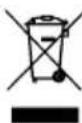
This symbol indicates that this product must not be disposed of together with domestic waste in compliance with the Directive (2012/19/EU) pertaining to waste electrical and electronic equipment (WEEE). This product must be handed over at the intended collection point. This can be done, for example, by returning it when purchasing a similar product or delivering it to an authorised collection point for the recycling of old electrical and electronic devices. Improper handling of waste equipment may have negative consequences for the environment and human health due to potentially hazardous substances that are often contained in electrical and electronic equipment. By properly disposing of this product, you are also contributing to the effective use of natural resources. You can obtain information on collection points for waste equipment from your municipal administration, public waste disposal authority, an authorised body for the disposal of waste electrical and electronic equipment or your waste disposal company.
21. Troubleshooting
The following table shows fault symptoms and describes remedial measures in the event of your device fails to work properly. If you cannot localise and rectify the problem with this, please contact your service workshop.
| Fault Possible cause Remedy | ||
| Device does not start | Damaged mains cable | Switch the device off and disconnect from the mains. Check for mains connection cable for damage. If necessary, have the mains connection cable replaced by an authorised specialist. |
| On/off switch defective Repair | by an authorised service centre | |
| Engine defective Repair by an authorised service centre | ||
| Motor stops during operation | Overheating protection active | Switch the device off and disconnect from the mains. Allow the device to cool and then start the work process again |
| Engine defective Repair by an authorised service centre | ||
| Damaged mains cable | Switch the device off and disconnect from the mains. Check for mains connection cable for damage. If necessary, have the mains connection cable replaced by an authorised specialist. | |
Günzburger Straße 69
D-89335 Ichenhausen
Cher client,
• 1 buse grande surface
EC Declaration of Conformity
| 2000/14/EG_2005/88/EG | |
| Annex V | |
| Annex VINoise: measured L_WA = xx dB(A); guaranteed L_WA = xx dB(A)P = xx KW; L/∅ = cmNotified Body: Notified Body No.: | |
| 2010/26/EU | |
| Emission. No: | |
| 2006/42/EG | |
| Annex IVNotified Body:Notified Body No.:Certificate No.: | |
Standard references:
EN 60335-2-45:2002+A1:2008+A2:2012; EN 60335-1:2012+AC:2014+A11:2014+A13:2017+A1:2019+A14:2019+ A2:2019; EN 62233:2008; EN IEC 55014-1:2021; EN IEC 55014-2:2021; EN IEC 61000-3-2:2019/+A1:2021; EN 61000-3-3:2013+A1:2019
This declaration of conformity is issued under the sole responsibility of the manufacturer.
The object of the declaration described above fulfils the regulations of the directive 2011/65/EU of the European Parliament and Council from 8th June 2011, on the restriction of the use of certain hazardous substances in electrical and electronic equipment.
Subject to change without notice
Documents registrar: Tobias Ihle
Günzburger Str. 69, D-89335 Ichenhausen
Garantie DE
Apparent defects must be notified within 8 days from the receipt of the goods. Otherwise, the buyer is rights of claim due to such defects are invalidated. We guarantee for our machines in case of proper treatment for the time of the statutory warranty period from delivery in such a way that we replace any machine part free of charge which provably becomes unusable due to faulty material or defects of fabrication within such period of time. With respect to parts not manufactured by us we only warrant insofar as we are entitled to warranty claims against the upstream suppliers. The costs for the installation of the new parts shall be borne by the buyer. The cancellation of sale or the reduction of purchase price as well as any other claims for damages shall be excluded.