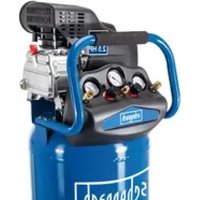
HC80V - Compressor SCHEPPACH - Free user manual and instructions
Find the device manual for free HC80V SCHEPPACH in PDF.


| Brand | Scheppach |
| Model | HC80V |
| Product type | Air compressor |
| Motor power | 1800 W |
| Tank volume | 80 litres |
| Max. operating pressure | 10 bar |
| Intake capacity | 310 l/min |
| Theoretical power (flow rate) | 180 l/min |
| Weight | 51.6 kg |
| Power supply | 230 V ~ 50 Hz |
| Protection type | IP20 |
| Sound pressure level (LpA) | 73.7 dB(A) |
| Guaranteed sound power level (LwA) | 97 dB(A) |
| Service mode | S1 (continuous) |
| Rotation speed | 2850 min⁻¹ |
| Recommended oil | SAE 15W 40 or equivalent |
| Oil capacity (first fill) | Approx. 0.3 L (according to manual) |
| Oil change interval | Every 50 operating hours |
| Air filter cleaning | Every 300 operating hours |
| Safety valve | Actuate every 30 h or at least 3 times per year |
| Ambient operating temperature | +5°C to +40°C |
| Maximum installation height | 1000 m above sea level |
| Supplied accessories | 2 wheels, air filter, oil cap, 2 support feet, mounting hardware |
Frequently Asked Questions - HC80V SCHEPPACH
User questions about HC80V SCHEPPACH
0 question about this device. Answer the ones you know or ask your own.
Ask a new question about this device
Download the instructions for your Compressor in PDF format for free! Find your manual HC80V - SCHEPPACH and take your electronic device back in hand. On this page are published all the documents necessary for the use of your device. HC80V by SCHEPPACH.
USER MANUAL HC80V SCHEPPACH
natural_image
Exterior view of a black industrial air compressor with wheels and control panel (no visible text or symbols)
HC80V
| DE | KompressorOriginalbedienungsanleitung | 6 |
| GB | CompressorTranslation of original instruction manual | 21 |
| FR | CompresseurTraduction des instructions d'origine | 33 |
| IT | CompressoreLa traduzione dal manuale di istruzioni originale | 46 |
| NL | CompressorVertaling van de originele gebruikshandleiding | 59 |
| ES | CompresorTraducción del manual de instrucciones original | 71 |
| PT | CompressorTradução do manual de operação original | 84 |
1
natural_image
Close-up of a mechanical device with visible wiring and a numbered label '8' (no readable text or symbols beyond the number)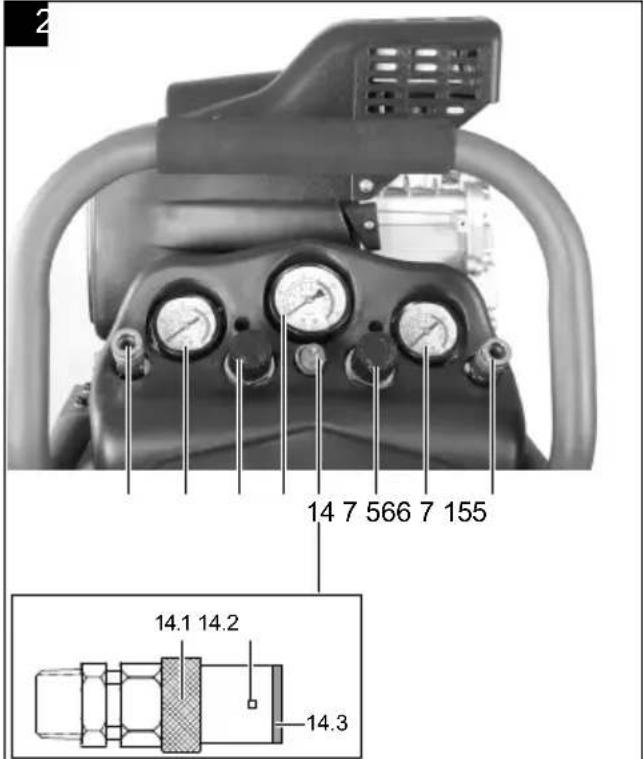
3
natural_image
Top-down view of a wheeled cart with four tires, labeled with numbers 1, 4, and 4 (no text or symbols on the vehicle itself)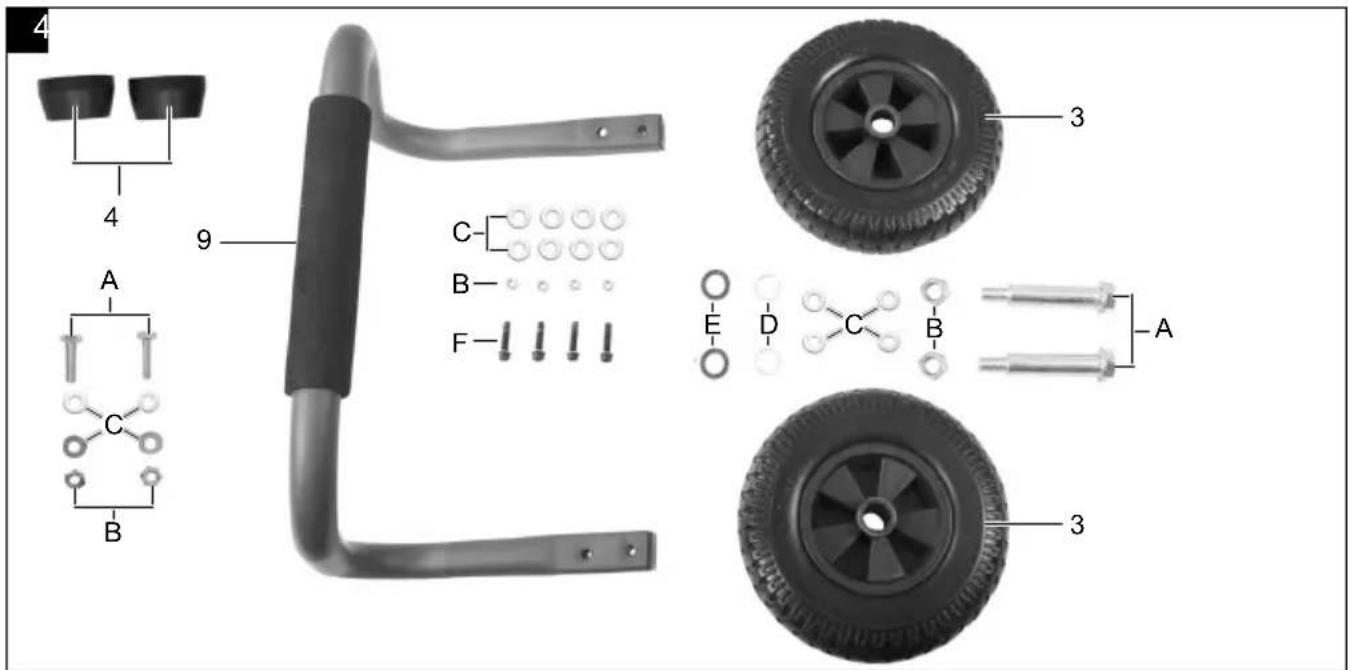
natural_image
Mechanical assembly diagram showing a tire mounted on a bracket with mounting holes and a bolt, no readable text or symbols present.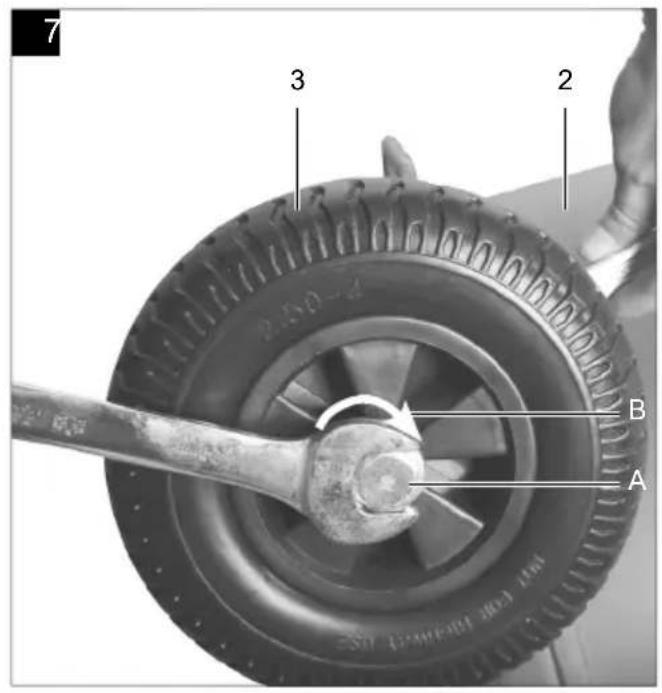

natural_image
Close-up of a hand pressing down on a mechanical component with a numbered arrow pointing to the part (no text or symbols visible)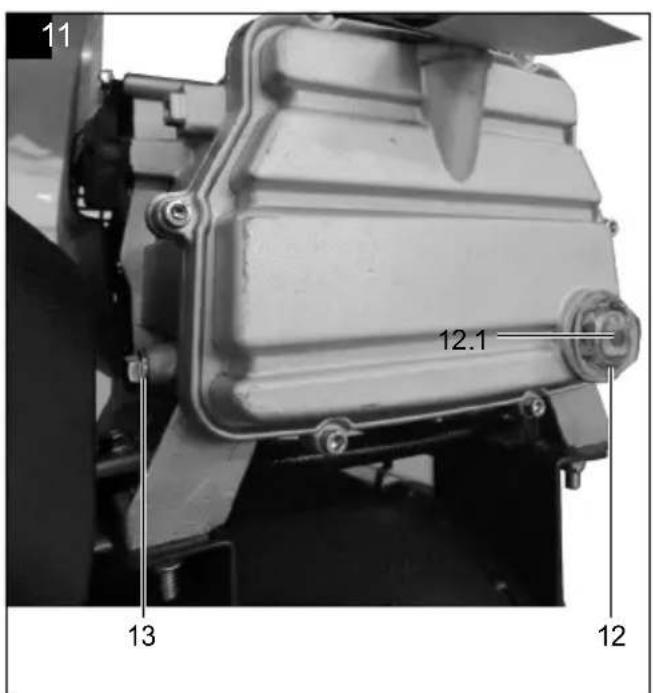
natural_image
Close-up of a black industrial machine with labeled parts (P, O) and a finger pointing to the component (no readable text or symbols beyond labels)Günzburger Straße 69
D-89335 Ichenhausen
Verehrter Kunde,
10.8 Transport (Abb. 1)
Homepage: https://www.scheppach.com/de/service
Explanation of the symbols on the equipment
 | Read and follow the operating and safety instructions before you start working with this tool. |
 | Wear respiratory protection. |
 | Wear ear-muffs. The impact of noise can cause damage to hearing. |
 | Warning of hot parts |
 | Warning of electrical voltage |
 | Warning of automatic start-up |
 | Caution! Before using for the first time, check the oil level and replace the oil sealing plug! |
 | Setzen Sie die Maschine nicht dem Regen aus. Das Gerät darf nur unter trockenen Um-gebungsbedingungen stationiert, gelagert und betrieben werden. |
 | Sound power level specified in dB |
Table of contents: Page:
- Introduction....23
- Device description 23
- Scope of delivery 24
- Proper use 24
- Safety instructions 24
- Technical data.... 26
- Before starting the equipment 27
- Attachment and operation 27
- Electrical connection 28
- Cleaning, maintenance, storage and transport....29
- Spare-part ordering 31
- Disposal and recycling.... 31
- Troubleshooting 32
1. Introduction
Manufacturer:
Scheppach GmbH
Günzburger Straße 69
D-89335 Ichenhausen
Dear customer,
We hope your new tool brings you much enjoyment and success.
Note:
According to the applicable product liability laws, the manufacturer of the device does not assume liability for damages to the product or damages caused by the product that occurs due to:
- Improper handling
• Non-compliance of the operating instructions - Repairs by third parties, not authorized service technicians
• Installation and replacement of non-original spare parts
• Application other than specified - A breakdown of the electrical system that occurs due to the non-compliance of the electric regulations and VDE regulations 0100, DIN 57113 / VDE0113
Please observe the following:
Read through the complete text in the operating instructions before installing and commissioning the device.
The operating instructions are intended to help the user to become familiar with the machine and take advantage of its application possibilities in accordance with the recommendations.
The operating instructions contain important information on how to operate the machine safely, professionally and economically, how to avoid danger, costly repairs, reduce downtimes and how to increase reliability and service life of the machine.
In addition to the safety regulations in the operating instructions, you have to meet the applicable regulations that apply for the operation of the machine in your country.
Keep the operating instructions package with the machine at all times and store it in a plastic cover to protect it from dirt and moisture. Read the instruction manual each time before operating the machine and carefully follow its information.
The machine can only be operated by persons who were instructed concerning the operation of the machine and who are informed about the associated dangers. The minimum age requirement must be complied with.
In addition to the safety instructions contained in this operating manual and the specific regulations of your country, the technical rules generally accepted for the operation of machines of the same type must be observed.
We accept no liability for damage or accidents which arise due to non-observance of these instructions and the safety information.
2. Device description
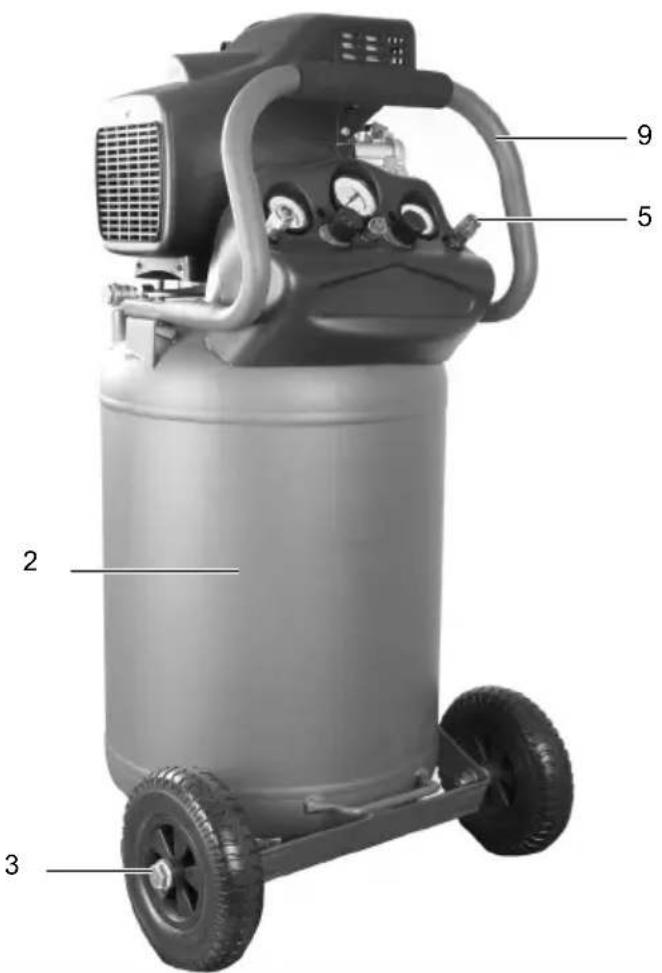
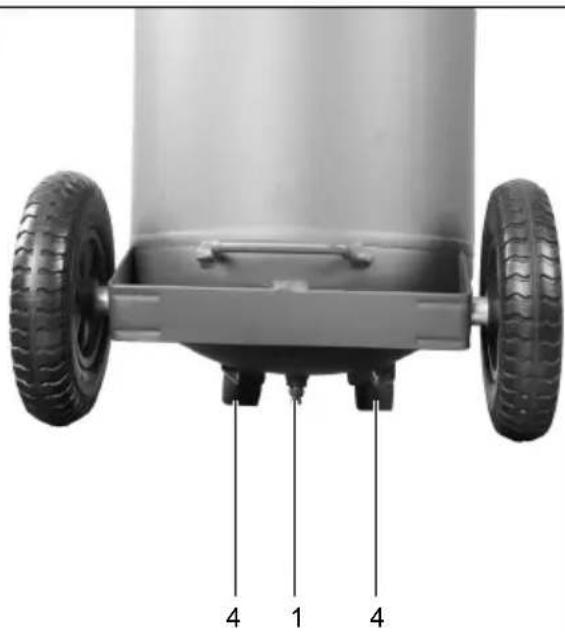
- Drain plug for condensation water
- Pressure vessel
- Wheel
- Supporting foot
- Quick-lock coupling (regulated compressed air)
- Pressure gauge (for reading the present vessel pressure)
- Pressure regulator
- ON/OFF switch
- Transport handle
- Air filter
- Oil closing plug
- Oil level sight glass
- Oil drain plug
- Safety valve
- Pressure gauge (for reading the vessel pressure)
A. Hex bolt
B. Nut
C. Washer
D. Sleeve
E. Spring washer
F. Hexagon socket screw
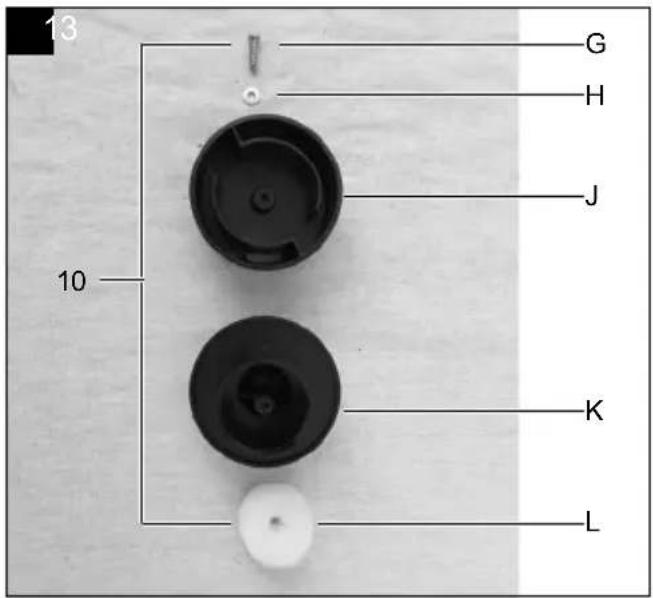
G. Screw
H. Washer
J. Air filter cover
K. Air filter housing
L. Filter element
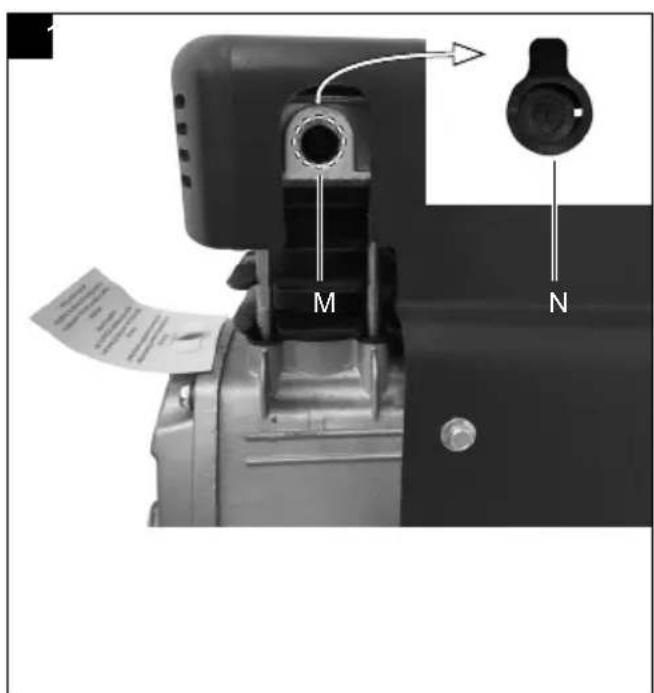
M. Air filter connection point
N. Safety plug
3. Scope of delivery
- Compressor
- 2 wheels
- Air filter
- Oil closing plug
• 2 supporting feet
• Assembly material (shown in fig. 4)
• Translation of original instruction manual
4. Proper use
The compressor is designed to generate compressed air for compressed-air driven tools which can be driven with an air volume of up to approx. 180 l/min (e.g. tire inflator, blow-out pistol and paint spray gun). Due to the limited air output it is not possible to use the compressor to drive tools with very high air consumption (for example orbital sanders, rod grinders and hammer screwdrivers).
The compressor may only be operated in a dry and well ventilated indoor space.
The equipment is to be used only for its prescribed purpose. Any other use is deemed to be a case of misuse. The user / operator and not the manufacturer will be liable for any damage or injuries of any kind caused as a result of this.
Please note that our equipment has not been designed for use in commercial, trade or industrial applications. Our warranty will be voided if the equipment is used in commercial, trade or industrial businesses or for equivalent purposes.
5. Safety instructions
Warning
The following basic safety measures must be observed when using electric tools for protection against electric shock, and the risk of injury and fire. Read all these notices before using the electric tool and keep the safety instructions for later reference.
Warning
This electric tool generates an electromagnetic field during operation. This field can impair active or passive medical implants under certain conditions. In order to prevent the risk of serious or deadly injuries, we recommend that persons with medical implants consult with their physician and the manufacturer of the medical implant prior to operating the electric tool.
Safe work
- Keep the work area orderly
-
Disorder in the work area can lead to accidents.
-
Take environmental influences into account
- Do not expose electric tools to rain.
- Do not use electric tools in a damp or wet environment. There is a risk of electric shock!
- Make sure that the work area is well-illuminated.
-
Do not use electric tools where there is a risk of fire or explosion.
-
Protect yourself from electric shock
-
Avoid physical contact with earthed parts (e.g. pipes, radiators, electric ranges, cooling units).
-
Keep children away
-
Do not allow other persons to touch the equipment or cable, keep them away from your work area.
-
Securely store unused electric tools
-
Unused electric tools should be stored in a dry, elevated or closed location out of the reach of children.
-
Do not overload your electric tool – They work better and more safely in the specified output range.
-
Wear suitable clothing
- Do not wear wide clothing or jewellery, which can become entangled in moving parts.
- Rubber gloves and non-slip shoes are recommended when working outdoors.
-
Tie long hair back in a hair net.
-
Do not use the cable for purposes for which it is not intended
-
Do not use the cable to pull the plug out of the outlet. Protect the cable from heat, oil and sharp edges.
-
Take care of your tools
- Keep your compressor clean in order to work well and safely.
- Follow the maintenance instructions.
- Check the connection cable of the electric tool regularly and have it replaced by a recognised specialist when damaged.
- Check extension cables regularly and replace them when damaged.
- Pull the plug out of the outlet
– During non-use of the electric tool or prior to maintenance and when replacing tools such as saw blades, bits, milling heads.
- Avoid inadvertent starting
- Make sure that the switch is switched off when plugging the plug into an outlet.
- Use extension cables for outdoors
- Only use approved and appropriately identified extension cables for use outdoors.
- Only use cable reels in the unrolled state.
- Remain attentive
- Pay attention to what you are doing. Remain sensible when working. Do not use the electric tool when you are distracted.
- Check the electric tool for potential damage
- Protective devices and other parts must be carefully inspected to ensure that they are fault-free and function as intended prior to continued use of the electric tool.
- Check whether the moving parts function faultlessly and do not jam or whether parts are damaged. All parts must be correctly mounted and all conditions must be fulfilled to ensure fault-free operation of the electric tool.
- Damaged protective devices and parts must be properly repaired or replaced by a recognised workshop, insofar as nothing different is specified in the operating manual.
– Damaged switches must be replaced at a customer service workshop.
- Do not use any faulty or damaged connection cables.
- Do not use any electric tool on which the switch cannot be switched on and off.
- Have your electric tool repaired by a qualified electrician
- This electric tool conforms to the applicable safety regulations. Repairs may only be performed by an electrician using original spare parts. Otherwise accidents can occur.
- Important
- For your own safety you must only use the accessories and additional units listed in the operating instructions or recommended or specified by the manufacturer. The use of mounted tools or accessories other than those recommended in the operating instructions or catalog may place your personal safety at risk.
- Noise
- Wear ear muffs when you use the compressor.
- Replacing the power cable
- To prevent hazards, leave the replacement of damaged power cables strictly to the manufacturer or a qualified electrician. There is a risk of electric shock!
- Inflating tires
- Directly after inflating tires, check the pressure with a suitable pressure gauge, for example at your filling station.
- Roadworthy compressors for building site operations
- Make sure that all lines and fittings are suitable for the maximum permissible operating pressure of the compressor.
- Place of installation
- Set up the compressor on an even surface.
-
Supply hoses at pressures above 7 bar should be equipped with a safety cable (e.g. a wire rope).
-
Avoid over-stressing the piping system by using flexible hose connections to prevent kinking.
-
Use a residual current circuit breaker with a trigger current of 30 mA or less. Using a residual current circuit breaker reduces the risk of an electric shock.
ADDITIONAL SAFETY INSTRUCTIONS
Observe the corresponding operating manuals of the respective compressed air tools / compressed air attachments! The following general warnings must also be observed.
Safety instructions for working with compressed air and blasting guns
- Ensure there is sufficient distance to the product, at least 2.50 m, and keep the compressed air tools / compressed air attachments away from the compressor during operation.
- The compressor pump and lines can become very hot during operation. Touching these parts will burn you.
- The air which is sucked in by the compressor must be kept free of impurities that could cause fires or explosions in the compressor pump.
- When releasing the hose coupling, hold the hose coupling piece with your hand. This way, you can protect yourself against injury from the rebounding hose.
- Wear safety goggles and a respirator when working with the compressed air pistol. Dusts are harmful to health! Injuries can be easily caused by foreign objects and blown away parts.
- Do not blow at people with the blow-out pistol and do not clean clothes while being worn. Risk of injury!
Safety instructions when using spraying attachments (e.g. paint sprayers)
- Keep the spray attachment away from the compressor when filling so that no liquid comes into contact with the compressor.
- Never spray in the direction of the compressor when using the spraying attachments (e.g. paint sprayers). Moisture can lead to electrical hazards!
- Do not process any paints or solvents with a flash point below 55 °C. Risk of explosion!
- Do not heat up paints or solvents. Risk of explosion!
- If hazardous liquids are processed, wear protective filter units (face guards). Also, adhere to the safety information provided by the manufacturers of such liquids.
- The details and designations of the Ordinance on Hazardous Substances, which are displayed on the outer packaging of the processed material, must be observed. Additional protective measures are to be undertaken if necessary, particularly the wearing of suitable clothing and masks.
- Do not smoke during the spraying process and/or in the work area. Risk of explosion! Paint vapours are easily combustible.
- Never set up or operate the equipment in the vicinity of a fire place, open lights or sparking machines.
- Do not store or eat food and drink in the work area. Paint vapours are harmful to your health.
- The work area must exceed 30 m ^3 and sufficient ventilation must be ensured during spraying and drying.
- Do not spray against the wind. Always adhere to the regulations of the local police authority when spraying combustible or hazardous materials.
- Do not process media such as white spirit, butyl alcohol and methylene chloride with the PVC pressure hose. These media will destroy the pressure hose.
- The work area must be separated from the compressor so that it cannot come into direct contact with the working medium.
Operating pressure vessels
- You must keep your pressure vessel in good working order, operate the vessel correctly, monitor the vessel, carry out necessary maintenance and repair work immediately and meet the relevant safety precautions.
- The supervisory authority may enforce essential control measures in individual cases.
- A pressure vessel is not allowed to be used if it has faults or deficiencies that can endanger workers or third parties.
- Check the pressure vessel for signs of rust and damage each time before using. Do not use the compressor with a damaged or rusty pressure vessel. If you discover any damage, then please contact the customer service workshop.
Do not lose these safety instructions.
6. Technical data
Mains connection 230 V\~ / 50 Hz
| Motor rating 1800 W | |
| Operating mode S1 | |
| Compressor speed 2850 min | -1 |
| Pressure vessel capacity 80 l | |
| Operating pressure approx. 10 bar | |
| Theoretical intake capacity approx. 310 l/min | |
| Theoretical delivery rate approx. 180 l/min | |
| Protection type IP20 | |
| Weight of the unit 51.6 kg | |
| Max. altitude (above mean sea level) | 1000 m |
| Pressure ratio | 2,23 |
Noise and vibration
Total vibration values determined in accordance with EN ISO 3744.
Wear hearing protection.
The effects of noise can cause a loss of hearing.
⚠ Warning: Noise can have serious effects on your health. If the machine noise exceeds 85 dB (A), please wear suitable hearing protection.
| Sound power level L_wA | 97 dB(A) |
| Sound pressure level L_pA | 73,7 dB(A) |
| Uncertainty K_wA/pA | 2,37 dB(A) |
Warning
The vibration emission value can vary from the specified value during actual use of the electric tool, depending on the way it is used.
Try to keep exposure to vibrations as low as possible. Measures to reduce exposure to vibration are, for example, wearing gloves when using the machine, or by reducing the work time.
All parts of the operating cycle must be considered for this (for example: times during which the electric tool is switched off and times when it is turned off but runs without load).
Reduce noise generation and vibration to a minimum!
- Use only equipment that is in perfect condition.
- Maintain and clean the equipment regularly.
- Adapt your working method to the machine.
- Do not overload the equipment.
- Have the equipment checked if necessary.
- Switch off the equipment when not in use.
7. Before starting the equipment
- Open the packaging and remove the device carefully.
- Remove the packaging material as well as the packaging and transport bracing (if available).
- Check that the delivery is complete.
- Check the device and accessory parts for transport damage.
- If possible, store the packaging until the warranty period has expired.
ATTENTION!
The device and packaging materials are not toys! Children must not be allowed to play with plastic bags, film and small parts! There is a risk of swallowing and suffocation!
- Before you connect the equipment to the mains supply make sure that the data on the rating plate are identical to the mains data.
-
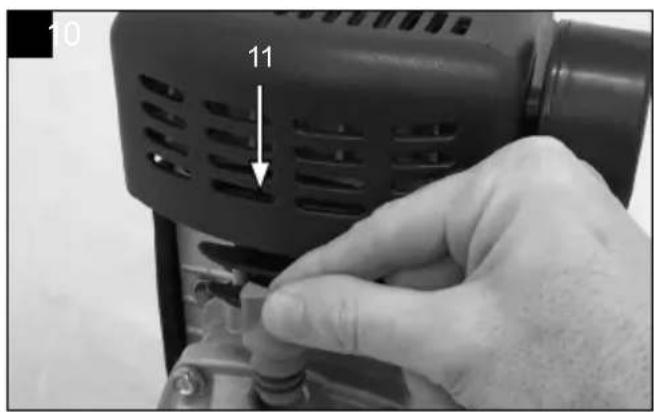
Prior to initial commissioning, remove the transport plug (11) and fill the crank housing with oil as described in 8.6.
-
Check the equipment for damage which may have occurred in transit. Report any damage immediately to the transport company which was used to deliver the compressor.
• Install the compressor near the point of consumption. - Avoid long air lines and supply lines (extension cables).
• Make sure that the intake air is dry and dustfree. - Do not install the compressor in a damp or wet room.
- The compressor may only be used in suitable rooms (with good ventilation and an ambient temperature from +5 °C to 40 °C). There must be no dust, acids, vapors, explosive gases or inflammable gases in the room.
- The compressor is designed to be used in dry rooms. It is prohibited to use the compressor in areas where work is conducted with sprayed water.
- The compressor may only be used outdoor briefly when the ambient conditions are dry.
- The compressor must always be kept dry and must not be left outdoors after work is complete.
8. Attachment and operation
⚠️ Important!
You must fully assemble the appliance before using it for the first time!
You will require the following tools for assembly and installation:
- 2 open-ended wrenches size 24 and 22 mm (not supplied)
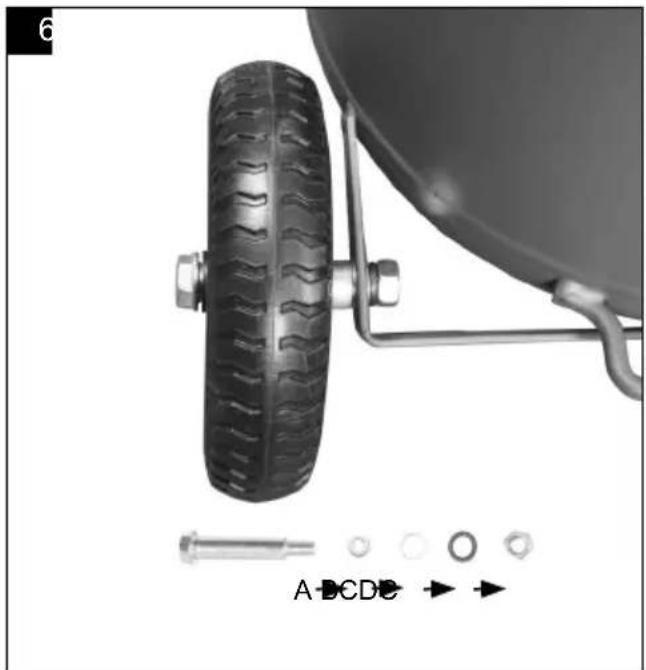
8.1 Fitting the wheels (fig. 6, 7)
- Screw a washer (C) on to the hex bolt (A) and pass it through the enclosed wheel (3).
- Push a sleeve (D) onto the shaft and push it through the wheel holder at the bottom of the pressure vessel.
- Screw 1 washer and 1 nut each on to the threaded wheels.
- Mount the wheels (3) on the wheel holders at the bottom of the pressure vessel (2): To do this, use a wrench to hold the hex bolt (A) at the wheel (3) in place and tighten the washer (C) and the nut (B).
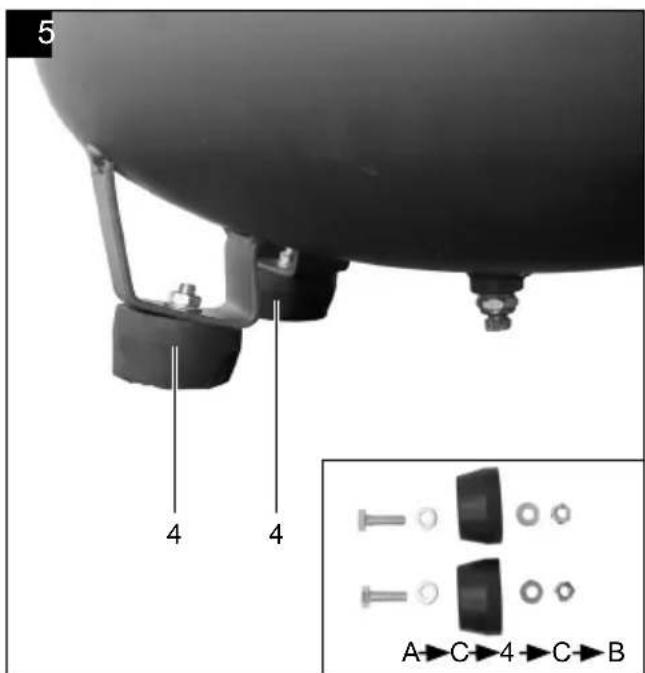
8.2 Fitting the supporting foot (fig. 5)
- Mount the enclosed supporting foot (4) using 2 hex bolts (A), 4 washers (C) and 2 nuts (B), as shown in figure 5.
8.3 Fitting the handle (fig. 8)
- Insert the 4 hexagon socket screws (F), each with a washer, into the threaded holes on the right and left of the transport handle (9) at the vessel.
- Secure the handle (9) with a washer (C) and a nut (B).
8.4 Installing the air filter (10) (fig. 12 - 14)
- Remove the transport plug (fig. 12 pos. N).
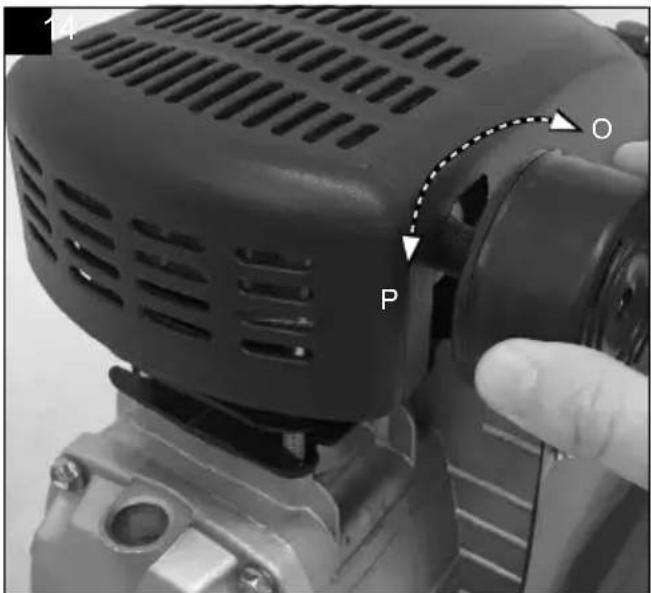
- Attach the air filter (fig. 13/14) on the unit by turning it clockwise (O) (fig. 14).
- For maintenance purposes, loosen the air filter by turning it counter-clockwise (P) (fig. 14).
8.5 Fitting the compressed air hose
- A compressed air hose (not included in the scope of supply*) can be used for work that takes place at greater distances from the compressor. For this purpose, connect the plug-in fitting of the compressed air hose to one of the quick couplings (5). Then connect the compressed air tool to the quick coupling of the compressed air hose.
*Ask your compressor vendor, if you need compressed air accessories for your device.
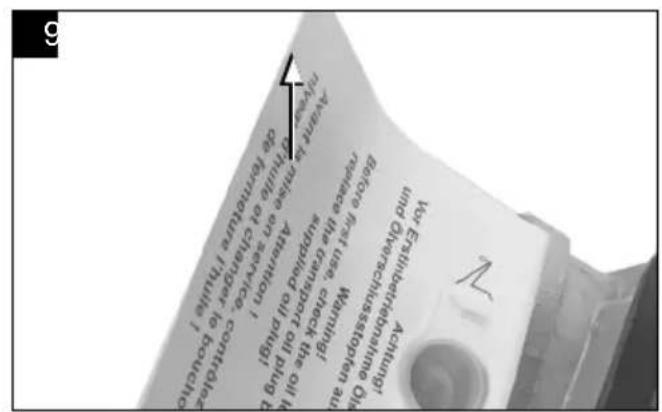
8.6 Changing the transportation cover (fig. 9 - 11)
- Remove the transport lid (12) of the oil filling opening.
- Fill the included compressor oil into the crank housing and insert the included oil sealing plug into the oil filling opening.
8.7 Checking the oil level (fig. 9 - 11)
Important!
For the first use, check the oil level of the compres-
sor. Operating the machine without oil will cause irreparable damage and render the warranty invalid.
- Remove the plastic oil inlet plug on top of the crank box of the compressor casing (fig. 9).
- Check the oil level in the sight glass (12). The oil level should be in the centre of the red circle. (fig. 11 pos. 12.1)
- Attach the supplied oil closing plug (11) and pull it tight.
8.8 Mains connection
- The compressor is equipped with a mains cable with shock-proof plug. This can be connected to any 230 V\~ / 50 Hz shock-proof socket which is protected by a 8 A fuse.
- Before you use the machine, make sure that the mains voltage is the same as the operating voltage (see the rating plate).
- Long supply cables, extensions, cable reels etc. cause a drop in voltage and can impede motor start-up.
- At low temperatures below +5 °C, sluggishness may make starting difficult or impossible.
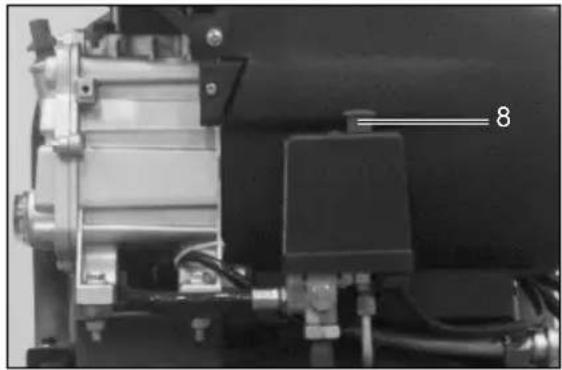
8.9 Switching ON/OFF (fig. 1)
- To switch on the compressor, pull the ON/OFF switch (8) upwards.
- To switch off the compressor, press the ON/OFF switch (8) down.
8.10 Setting the pressure (fig. 2)
- You can adjust the pressure on the pressure gauge (6) using the pressure regulator (7).
- The set pressure can be taken from the quick lock coupling (5).
Setting the pressure switch
- The pressure switch is set at the factory. Cut-in pressure approx. 8 bar Cut-out pressure approx. 10 bar.
It is strictly forbidden to remove protective devices, pressure regulators or electrical components from your device.
9. Electrical connection
The electrical motor installed is connected and ready for operation. The connection complies with the applicable VDE and DIN provisions. The customer's mains connection as well as the extension cable used must also comply with these regulations.
When working with spray attachments and during temporary use outdoors, the device must be connected to a residual current circuit breaker with a trigger current of 30 mA or less.
Damaged electrical connection cable
The insulation on electrical connection cables is often damaged.
This may have the following causes:
• Passage points, where connection cables are passed through windows or doors.
- Kinks where the connection cable has been improperly fastened or routed.
- Places where the connection cables have been cut due to being driven over.
• Insulation damage due to being ripped out of the wall outlet.
- Cracks due to the insulation ageing.
Such damaged electrical connection cables must not be used and are life-threatening due to the insulation damage.
Check the electrical connection cables for damage regularly. Make sure that the connection cable does not hang on the power network during the inspection. Electrical connection cables must comply with the applicable VDE and DIN provisions. Only use connection cables with the marking H05VV-F.
The printing of the type designation on the connection cable is mandatory.
- The product meets the requirements of EN 61000-3-11 and is subject to special connection conditions. This means that use of the product at any freely selectable connection point is not allowed.
- Given unfavorable conditions in the power supply the product can cause the voltage to fluctuate temporarily.
- The product is intended solely for use at connection points that
a. do not exceed a maximum permitted supply impedance "Zmax = 0.382 Ω", or
b. have a continuous current-carrying capacity of the mains of at least 100 A per phase. - As the user, you are required to ensure, in consultation with your electric power company if necessary, that the connection point at which you wish to operate the product meets one of the two requirements, a) or b), named above.
AC motor
• The mains voltage must be 230 V\~
- Extension cables up to 25 m long must have a cross-section of 1.5 mm ^2 .
Connections and repairs of electrical equipment may only be carried out by an electrician.
Please provide the following information in the event of any enquiries:
• Type of current for the motor
• Machine data - type plate
• Motor data - type plate
10. Cleaning, maintenance, storage and transport
Warning
Pull out the power plug before doing any cleaning and maintenance work on the equipment. Risk of injury from electric shock!
Warning
Wait until the equipment has cooled down completely! Risk of burns!
Warning
Always depressurize the equipment before carrying out any cleaning and maintenance work! Risk of injury!
10.1 Cleaning
- Keep the equipment free of dirt and dust as far as possible. Wipe the equipment with a clean cloth or blow it down with compressed air at low pressure.
• We recommend that you clean the equipment immediately after you use it. - Clean the equipment regularly with a damp cloth and some soft soap. Do not use cleaning agents or solvents; these may be aggressive to the plastic parts in the equipment. Ensure that no water can get into the interior of the equipment.
- You must disconnect the hose and any spraying tools from the compressor before cleaning. Do not clean the compressor with water, solvents or the like.
- Clean the fan with compressed air at low pressure.
10.2 Maintenance work on the pressure vessel (fig. 3)
Important
To ensure a long service life of the pressure vessel (2), drain off the condensed water by opening the drain plug (1) each time after using.
10.2.1 Draining condensed water
- First release the vessel pressure (see 10.7.1).
- Open the drain plug by turning counter-clockwise (looking at the plug from the bottom of the compressor) so that all the condensed water can run out of the pressure vessel.
- Then close the drain plug again (turn it clockwise).
10.2.2 Checking the pressure vessel
- Check the pressure vessel for signs of rust and damage each time before using.
- Do not use the compressor with a damaged or rusty pressure vessel.
- If you discover any damage, then please contact the customer service workshop.
10.3 Safety valve (fig. 2/14)
The safety valve (14) has been set for the highest permitted pressure of the pressure vessel. It is not permitted to adjust the safety valve or remove the connection lock (14.2) between the exhaust nut (14.1) and its cap (14.3).
Actuate the safety valve every 30 operating hours but at least 3 times a year, to ensure that it works when required. Turn the perforated exhaust nut (14.1) counterclockwise to open it and use your hands to pull the valve rod outwards over the perforated exhaust nut (14.1) to open the safety valve outlet. Now, the valve audibly releases air. Then, tighten the exhaust nut clockwise again.
10.4 Checking the oil level at regular intervals (fig. 11)
- Place the compressor on a level and straight surface.
- The oil level must be between the MAX and MIN marks on the oil level sight glass (12).
10.5 Changing the oil (fig. 11)
The original oil filling must be changed after 10 hours in operation. Thereafter the oil must be drained and replaced with new oil after every 50 hours in operation. We recommend SAE 15W 40 or equivalent.
10.5.1 Draining oil
- Switch off the engine and pull the mains plug out of the socket.
• After releasing any air pressure you can unscrew the oil drain plug (13) from the compressor pump.
- To prevent the oil from running out in an uncontrolled manner, hold a small metal chute under the opening and collect the oil in a vessel. If the oil does not drain out completely, we recommend tilting the compressor slightly.
- When the oil has drained out, re-fit the oil drain plug (13).
- Dispose of the old oil at a drop-off point for old oil.
10.5.2 Filling in oil
- To fill in the correct quantity of oil, make sure that the compressor stands on an even surface.
- Fill new oil through the oil filler opening (11) until it comes up to the maximum level. This is marked with a red dot on the oil level sight glass (12) (fig. 11 pos. 12.1). Do not exceed the maximum filling quantity. Overfilling the equipment may result in damage.
- Reinsert the oil closing plug (11) into the oil filler opening.
10.6 Cleaning the intake filter (fig. 13, 14)
The intake filter prevents dust and dirt being drawn in. It is essential to clean this filter after at least every 300 hours in service. A clogged intake filter will decrease the compressor's performance dramatically.
- Remove the intake filter by opening the crosshead screw (G).
- Then pull off the filter cover (J). Now you can remove the air filter (L) and the filter housing (K).
- Carefully tap out the air filter, filter cover and filter housing.
- Blow out these parts with compressed air (approx. 3 bar) and reinstall in reverse order.
10.7 Storage
Caution
Pull out the mains plug and ventilate the equipment and all connected pneumatic tools. Switch off the compressor and make sure that it is secured in such a way that it cannot be started up again by any unauthorized person.
⚠️ Important
Store the compressor only in a dry location which is not accessible to unauthorized persons. Always store upright, never tilted!
10.7.1 Releasing excess pressure
Release the excess pressure by switching off the compressor and using the compressed air which is still left in the pressure vessel, e.g. with a compressed air tool running in idle mode or with a blow-out pistol.
10.8 Transport (fig. 1)
The compressor can be transported by tilting to the wheels.
11. Spare-part ordering
Please quote the following in your order for spare parts:
- Type of device
• Article number of the device
• Identification number of the device - Spare part number of the required spare part
Service information
Please note that the following parts of this product are subject to normal or natural wear and that the following parts are therefore also required for use as consumables.
Wear parts*: Ribbed belt, piston, cylinder, carbon brushes
* Not necessarily included in the scope of delivery!
Spare parts and accessories can be obtained from our service centre. To do this, scan the QR code on the cover page.
12. Disposal and recycling
Notes for packaging


The packaging materials are recyclable. Please dispose of packaging in an environmentally friendly manner.
Notes on the electrical and electronic equipment act [ElektroG]
Waste electrical and electronic equipment does not belong in household waste, but must be collected and disposed of separately!
- Old batteries or rechargeable batteries that are not permanently installed in the old unit must be removed before handing them in! Their disposal is regulated by the battery act.
- Owners or users of electrical and electronic devices are legally obliged to return them after use.
- The end user is responsible for deleting their personal data from the old device being disposed of!
- The symbol of the crossed-out dustbin means that waste electrical and electronic equipment must not be disposed of with household waste.
- Waste electrical and electronic equipment can be handed in free of charge at the following places:
- Public disposal or collection points (e.g. municipal works yards)
- Points of sale of electrical appliances (stationary and online), provided that dealers are obliged to take them back or offer to do so voluntarily.
- Up to three waste electrical devices per type of device, with an edge length of no more than 25 centimetres, can be returned free of charge to the manufacturer without prior purchase of a new device from the manufacturer or taken to another authorised collection point in your vicinity.
- Further supplementary take-back conditions of the manufacturers and distributors can be obtained from the respective customer service.
- If the manufacturer delivers a new electrical appliance to a private household, the manufacturer can arrange for the free collection of the old electrical appliance upon request from the end user. Please contact the manufacturer's customer service for this.
• These statements only apply to devices installed and sold in the countries of the European Union and which are subject to the European Directive 2012/19/EU. In countries outside the European Union, different regulations may apply to the disposal of waste electrical and electronic equipment.
13. Troubleshooting
| Fault Possible cause Remedy | ||
| The compressor does not start. | No supply voltage. | Check the supply voltage, the power plug and the socket-outlet. |
| Insufficient supply voltage. | Make sure that the extension cable is not too long. Use an extension cable with large enough wires. | |
| Outside temperature is too low. | Never operate with an outside temperature of below +5°C. | |
| Motor is overheated. | Allow the motor to cool down. If necessary, remedy the cause of the overheating. | |
| The compressor starts but there is no pressure. | The non-return valve leaks. | Have a service center replace the non-return valve. |
| The seals are damaged. | Check the seals and have any damaged seals replaced by a service center. | |
| The drain plug for condensation water (1) leaks. | Tighten the screw by hand. Check the seal on the screw and replace if necessary. | |
| The compressor starts, pressure is shown on the pressure gauge but the tools do not start. | The hose connections have a leak. | Check the compressed air hose and tools and replace if necessary. |
| A quick-lock coupling has a leak. | Check the quick-lock coupling and replace if necessary. | |
| Insufficient pressure set on the pressure regulator (7). | Increase the set pressure with the pressure regulator. | |
Günzburger Straße 69
D-89335 Ichenhausen
Cher Client,
10.8 Transport (fig. 1)
Günzburger Straße 69
89335 Ichenhausen, Germania
Egregio cliente,
Günzburger Straße 69
D-89335 Ichenhausen
Geachte klant,
8.10 Drukinstelling (afb. 2)
10.8 Transport (afb. 1)
Günzburger Straße 69
D-89335 Ichenhausen
Estimado cliente:
Günzburger Straße 69
D-89335 Ichenhausen
Estimado cliente,
8.1 Montar as rodas (Fig. 6 - 7)
EC Declaration of Conformity
| X 2006/42/EG | |
| Annex IV Notified Body: Notified Body No.: Certificate No.: | |
Standard references:
EN 1012-1: 2010; EN 60204-1:2018; EN 55014-1:2017; EN 55014-2:2015; EN 61000-3-2:2014;
EN 61000-3-11:2000
This declaration of conformity is issued under the sole responsibility of the manufacturer.
The object of the declaration described above fulfils the regulations of the directive 2011/65/EU of the European Parliament and Council from 8th June 2011, on the restriction of the use of certain hazardous substances in electrical and electronic equipment.
Subject to change without notice
Documents registrar: Ann-Katrin Bloching
Günzburger Str. 69, D-89335 Ichenhausen
Garantie DE
Apparent defects must be notified within 8 days from the receipt of the goods. Otherwise, the buyer's rights of claim due to such defects are invalidated. We guarantee for our machines in case of proper treatment for the time of the statutory warranty period from delivery in such a way that we replace any machine part free of charge which provably becomes unusable due to faulty material or defects of fabrication within such period of time. With respect to parts not manufactured by us we only warrant insofar as we are entitled to warranty claims against the upstream suppliers. The costs for the installation of the new parts shall be borne by the buyer. The cancellation of sale or the reduction of purchase price as well as any other claims for damages shall be excluded.