
CGP1200 - Sander SCHEPPACH - Free user manual and instructions
Find the device manual for free CGP1200 SCHEPPACH in PDF.



| Product type | Wall, floor and ceiling sander |
| Brand | Scheppach |
| Model | CGP1200 |
| Power supply | 230 V ~, 50 Hz |
| Power consumption | 1050 W |
| No-load speed (variable) | 410 - 1,900 rpm |
| Grinding disc diameter | 180 mm |
| Spindle thread | M14 |
| Weight | 4 kg |
| Sound pressure level (L_PA) | 90.53 dB(A) |
| Sound power level (L_WA) | 101.53 dB(A) |
| Vibrations (surface grinding) | 4.211 m/s² (K=1.5 m/s²) |
| Protection class | II (double insulation) |
| Dust extraction system | 25 L dust bag + adapter for external extraction |
| Main functions | Dry sanding, grinding, stripping, smoothing |
| Speed adjustment | By +/- buttons (electronic) |
| Additional handle | Adjustable (adjustment by wing screw) |
| Removable protective guard | Removable segment for edge grinding |
| Abrasive attachment type | Self-adhesive (Velcro) on grinding disc |
| Included auxiliary tools | Carbide cup wheel (YG8), 6 abrasive sheets, mounting key |
| Maintenance | Regular cleaning, emptying the dust bag |
| Wear parts | Carbon brushes, switches |
| Warranty | Legal (compliant with directive 2011/65/EC) |
Frequently Asked Questions - CGP1200 SCHEPPACH
User questions about CGP1200 SCHEPPACH
0 question about this device. Answer the ones you know or ask your own.
Ask a new question about this device
Download the instructions for your Sander in PDF format for free! Find your manual CGP1200 - SCHEPPACH and take your electronic device back in hand. On this page are published all the documents necessary for the use of your device. CGP1200 by SCHEPPACH.
USER MANUAL CGP1200 SCHEPPACH

CGP1200
| DE | Universal 3-in-1 Wand-, Boden- und DeckenbearbeitungssystemOriginalbedienungsanleitung | 5 |
| GB | Universal 3in1 wall, floor and ceiling processing systemTranslation of original instruction manual | 21 |
| FR | Ponceuse universelle 3en1 pour murs, sols et plafondsTraduction des instructions d'origine | 34 |
| IT | Sistema universale di levigatura 3 in 1 per pareti, pavimenti e soffittiLa traduzione dal manuale di istruzioni originale | 48 |
| NL | Universele 3-in-1 wand-/vloer- en plafondbewerkingssysteemVertaling van de originele gebruikshandleiding | 62 |
| ES | Sistema de tratamiento de techo/pared/suelo universal 3 en 1Traducción del manual de instrucciones original | 76 |
| PT | Sistema de processamento de paredes, chãos e tetos universal 3 em 1Tradução do manual de operação original | 91 |
| CZ | Univerzální systém 3v1 pro úpravu stěn, stropů a podlahPřeklad originálního návodu k obsluze | 105 |
| SK | Univerzálny dokončovací systém pre steny/podlahy a stropy 3v1Preklad originálneho návodu na obsluhu | 118 |
| HU | Univerzális 3 az 1-ben fal-, padló- és mennyezetmegmunkáló rendszerEredeti használati utasítás fordítása | 132 |
| PL | Uniwersalny system wykończeniowy 3 w1 do ścian/podłóg i sufitówTłumaczenie oryginalnej instrukcji obsługi | 146 |
| HR | Univerzalni 3-u-1 sustav za obraduzidova/podova i stropovaPrijevod originalnog priručnika za uporabu | 161 |
| SI | Univerzalni 3-v-1-obdelovalni sistema zastene, tla in stropePrevod originalnih navodil za uporabo | 174 |
| EE | Universaalne 3-in-1 seina-/pôranda- jalaetöötlussüsteemOriginaalkäitusjuhendi tõlge | 187 |
| LT | Universali „trys viename“ sienų / grindųir lubų apdirbimo sistemaOriginalios naudojimo instrukcijos vertimas | 200 |
| LV | Universāla trīs vienā sienu / grīdas ungriestu apstrādes sistēmaOriginālās lietošanas instrukcijas tulkojums | 213 |
| SE | Universellt 3-i-1 vägg-/golv- ochtakbearbetningssystemÖversättning av original-bruksanvisning | 226 |
| FI | Yleiskäyttöinen "3-in-1" seinän/lattian jakaton työstöjärjestelmäKäännös alkuperäisestä käyttöohjeesta | 239 |
| DK | Universalt 3-i-1 væg-/gulv- ogloftbearbejdningssystemOversættelse fra den oprindelige betjeningsvejledning | 252 |
1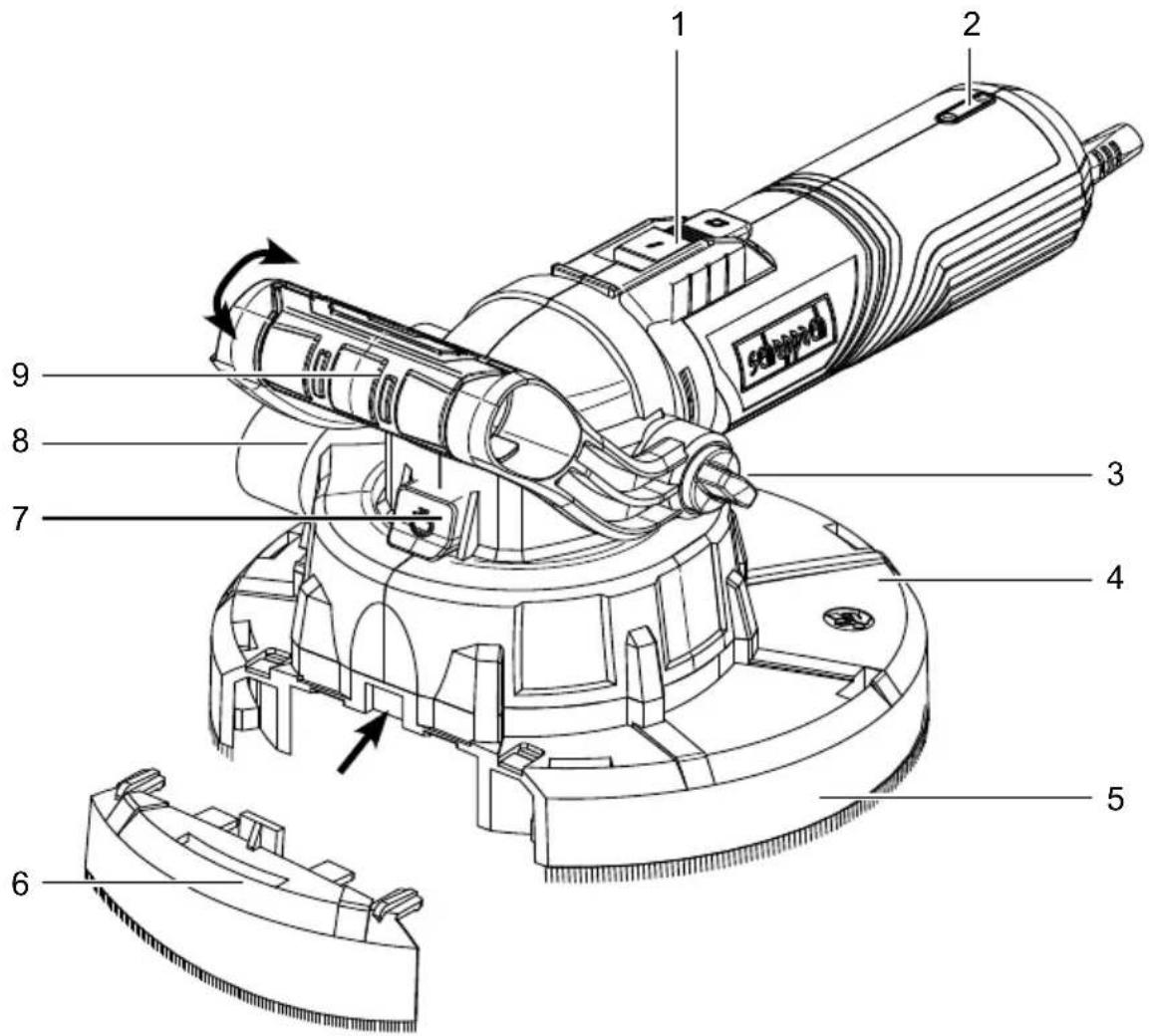
2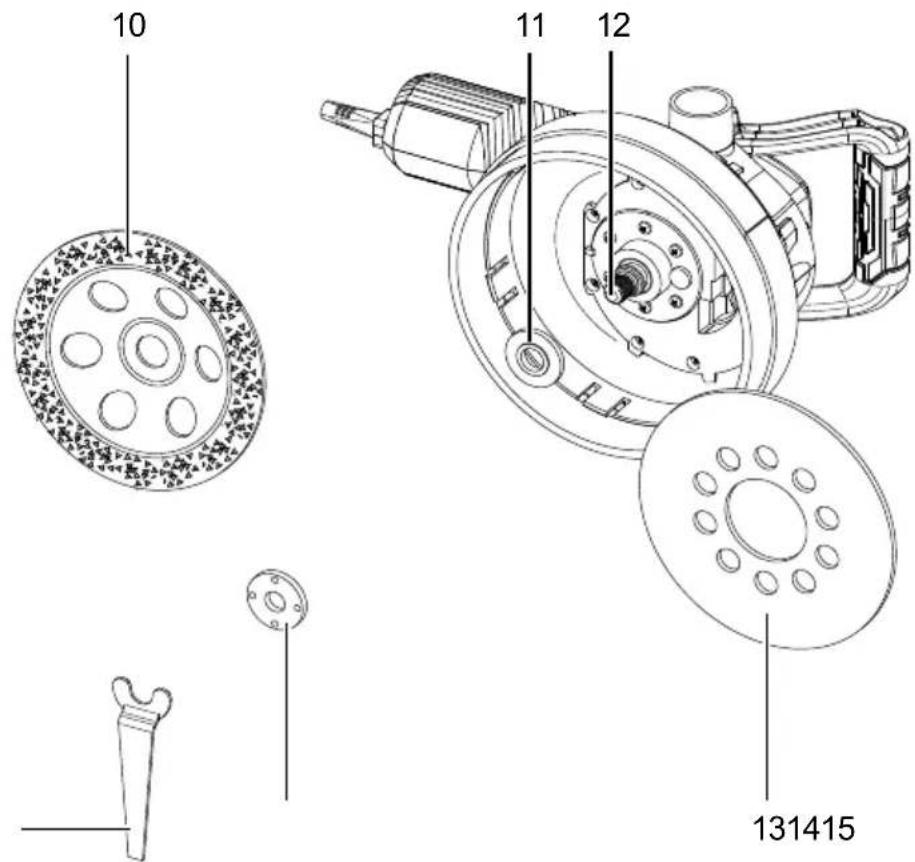
3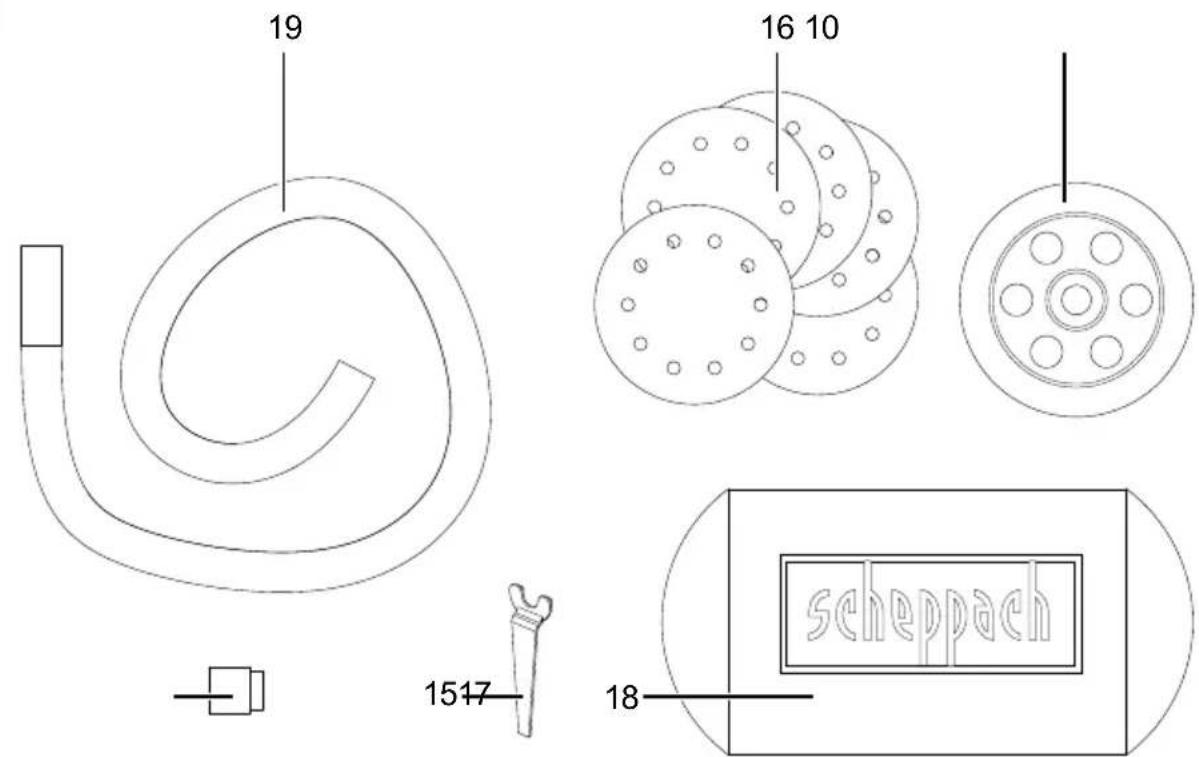
4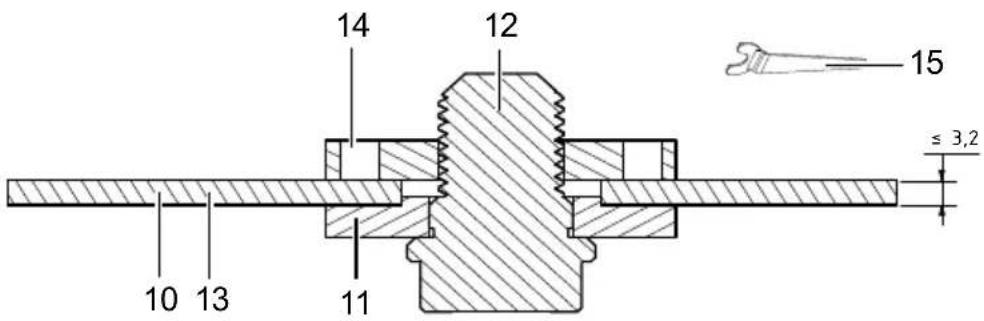
5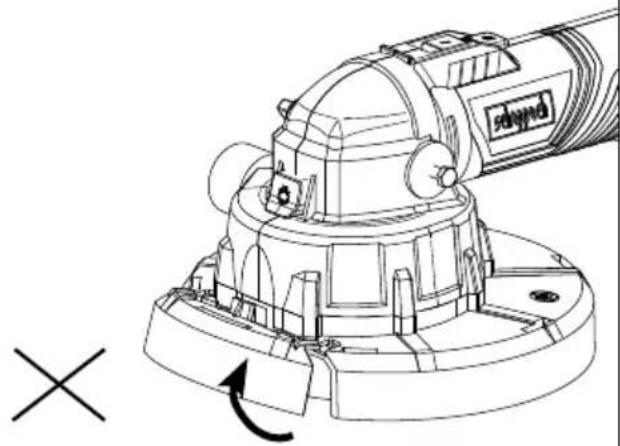
6
Günzburger Straße 69
D-89335 Ichenhausen
Dear Customer
Homepage: https://www.scheppach.com/de/service
Explanation of the symbols on the device
Symbols are used in this manual to draw your attention to potential hazards. The safety symbols and the accompanying explanations must be fully understood. The warnings themselves will not rectify a hazard and cannot replace proper accident prevention measures.
 | Warning - read the instruction manual to reduce the risk of injury. |
 | Wear hearing protection. Excessive noise can result in a loss of hearing. |
 | Wear a dust protection mask. When machining wood and other materials, harmful dust may be generated. Do not machine material containing asbestos! |
 | Wear eye protection. Sparks created during work or fragments, chippings and dust ejected by the device can case sight loss. |
| ⚠ Attention! | We have marked points in these operating instructions that impact your safety with this symbol. |
 | Protection class II |
Table of contents: Page:
- Introduction....23
- Device description 23
- Scope of delivery 23
- Proper use 23
- General safety information 24
- Safety instructions for all applications.... 26
- Additional safety instructions.... 27
- Residual risks 28
- Technical data.... 29
- Unpacking 29
- Before commissioning 29
- Working instructions....30
- Operation....31
- Electrical connection 31
- Cleaning and maintenance.... 32
- Storage 32
- Disposal and recycling....32
- Troubleshooting 33
- Declaration of conformity 267
1. Introduction
Manufacturer:
Scheppach GmbH
Günzburger Straße 69
D-89335 Ichenhausen
Dear Customer
We hope your new tool brings you much enjoyment and success.
Note:
In accordance with the applicable product liability laws, the manufacturer of this device assumes no liability for damage to the device or caused by the device arising from:
- Improper handling, • Non-compliance with the operating manual,
- Repairs carried out by third parties, unauthorised specialists. • Installing and replacing non-original spare parts • Application other than specified
- Failure of the electrical system in the event of the electrical regulations and VDE provisions 0100, DIN 57113 / VDE0113 not being observed
Please consider:
Read through the complete text in the operating manual before installing and commissioning the device.
The operating manual is intended to help the user to become familiar with the machine and take advantage of its application possibilities in accordance with the recommendations.
The operating manual includes important instructions for safe, proper and economic operation of the device, for avoiding danger, for minimising repair costs and downtimes, and for increasing the reliability and extending the service life of the device.
In addition to the safety instructions in this operating manual, you must also observe the regulations applicable to the operation of the device in your country.
Keep the operating manual package with the machine at all times and store it in a plastic cover to protect it from dirt and moisture. They must be read and carefully observed by all operating personnel before starting the work.
The device may only be used by personnel who have been trained to use it and who have been instructed with respect to the associated hazards.
The required minimum age must be observed.
In addition to the safety instructions in this operating manual and the separate regulations of your country, the generally recognised technical rules relating to the operation of such machines must also be observed.
We accept no liability for accidents or damage that occur due to a failure to observe this manual and the safety instructions.
2. Device description (Fig. 1)
- ON/OFF switch
- Speed adjustment buttons (+/-)
- Protection and extraction cover
- Brush rim
- Cover segment
- Spindle lock button
- Extraction port
- Additional grip
- Carbide cup wheel
- Receptacle flange
- Grinding spindle
- Grinding wheel
- Clamping nut
- Two-hole assembly key
- Sandpaper
- Adapter (dust extraction)
- Dust bag
- Extraction hose
- Wing screws for additional handle adjustment
3. Scope of delivery
• 1 wall, floor and ceiling machining system • 1m vacuum hose (extendable to 3.5m) - 1 dust bag (25 L) • 1 adapter (dust extraction) - 6x sandpaper (2x 40 - 80 - 120 each) • 1 carbide cup wheel (YG8) • 1 two-hole assembly key • 1 operating manual
4. Proper use
The intended use of this power tool includes the following activities:
• Dry grinding of coatings. - Removal of paint, wallpaper and adhesive residues. - Removal of tile adhesive and dry carpet adhesive residues from hard substrates (hard plaster, concrete).
- Dry grinding and smoothing of concrete, plaster and screed. • Perforating wallpaper on hard substrates. • Grinding of filled drywall.
- Smoothing of formwork transitions and roughening of concrete surfaces.
- Dry grinding of walls and ceilings indoors and outdoors. • Dry surface sanding of metal, stone and wood.
The machine may only be used in the intended manner. Any use beyond this is improper. The user/operator, not the manufacturer, is responsible for damages or injuries of any type resulting from this.
An element of the intended use is also the observance of the safety instructions, as well as the assembly instructions and operating information in the operating manual.
Persons who operate and maintain the machine must be familiar with it and must be informed about potential dangers.
In addition, the applicable accident prevention regulations must be strictly observed.
Other general occupational health and safety-related rules and regulations must be observed. The liability of the manufacturer and resulting damages are excluded in the event of modifications of the machine.
The machine may only be operated with original parts and original accessories from the manufacturer.
The safety, operating and maintenance specifications of the manufacturer, as well as the dimensions specified in the technical data, must be observed.
Please observe that our equipment was not designed with the intention of use for commercial or industrial purposes. We assume no guarantee if the equipment is used in commercial or industrial applications, or for equivalent work.
The device is intended for use by adults. Children over the age of 16 may use the tool except under supervision. The manufacturer is not liable for damage caused by an improper use or incorrect operation of this device.
5. General safety information
⚠ WARNING! Read all safety information, instructions, illustrations and technical data for this electric tool.
Failure to follow all instructions listed below may result in electric shock, fire and/or serious injury.
Save all warnings and instructions for future reference.
The term "power tool" used in the safety instructions refers to mains-powered electrical tools (with a mains cable) and battery-powered electrical tools (without a mains cable).
1) Workplace safety
a) Keep work area clean and well lit. Disorganised and unlit work areas can result in accidents.
b) Do not operate power tools in explosive atmospheres, such as in the presence of flammable liquids, gases or dust. Power tools create sparks which may ignite the dust or fumes.
c) Keep children and bystanders away while operating a power tool. Distractions may cause you to lose control of the device.
2) Electrical safety
a) Power tool plugs must match the outlet. Never modify the plug in any way. Do not use any adapter plugs with earthed (grounded) power tools. Unmodified plugs and matching outlets will reduce risk of electric shock.
b) Avoid body contact with earthed or grounded surfaces, such as pipes, radiators, ranges and refrigerators. There is an increased risk of electric shock if your body is earthed or grounded.
c) Do not expose power tools to rain or wet conditions. Water entering a power tool will increase the risk of electric shock.
d) Do not use the cable for another purpose, for example, carrying or hanging the power tool or pulling the plug out of the socket. Keep the cable away from heat, oil, sharp edges or moving device parts. Damaged or coiled cables increase the risk of an electric shock.
e) If you work with an electric tool outdoors, only use extension cables that are also permitted for outdoor use. Using an extension cable suitable for outdoor use reduces the risk of an electric shock.
f) If you cannot avoid using the electrical tool in a wet environment, use a fault-current circuit breaker. Use of an RCD reduces the risk of electric shock.
3) Personal safety
a) Always remain attentive, pay attention to what you are doing and be sensible when working with electric tools. Do not use a power tool while you are tired or under the influence of drugs, alcohol or medication. A moment of carelessness when using electrical tools can result in serious injuries.
b) Use personal protective equipment. Always wear eye protection. Wearing personal protective equipment, such as dust masks, anti-slip safety shoes, safety helmet or hearing protection, depending on the type and use of the electric tool, reduces the risk of injuries.
c) Prevent unintentional starting. Make sure the switch is in the off-position before connecting to the power supply, picking up or carrying the electric tool. Keeping your finger on the switch when carrying the electric tool or having the device already switched on when connecting it to the power supply may result in accidents.
d) Remove any adjusting key or wrench before turning the power tool on. A tool or spanner that is located in a rotating device part may result in injuries.
e) Do not overreach. Keep proper footing and balance at all times. This enables better control of the power tool in unexpected situations.
f) Dress properly. Do not wear loose clothing or jewellery. Keep hair, clothing and gloves away from moving parts. Loose clothes, jewellery or long hair can be caught in moving parts.
g) If dust extraction and collection devices can be mounted, make sure that they are connected and used properly. Use of dust collection can reduce dust-related hazards.
h) Do not allow yourself to be lulled into a false sense of security and do not ignore the safety rules for electric tools, even when you have used it many times and have become familiar with it. A careless action can cause severe injury within a fraction of a second.
4) Power tool use and care
a) Do not force the power tool. Use the correct power tool for your application. The correct power tool will do the job better and safer at the rate for which it was designed.
b) Do not use the power tool if the switch does not turn it on and off. Any power tool that cannot be controlled with the switch is dangerous and must be repaired.
c) Remove the plug from the socket before setting the device, changing accessories or putting the device away. Such preventive safety measures reduce the risk of starting the power tool accidentally.
d) Store idle power tools out of the reach of children and do not let people use the device who are not familiar with it or who have not read these instructions. Power tools are dangerous in the hands of untrained users.
e) Maintain the electric tool with care. Check whether moving parts function properly and do not get stuck and whether parts are broken or are damaged and thus adversely affect the electric tool function. Have damaged parts repaired before using the device. Many accidents are caused by poorly maintained power tools.
f) Keep cutting tools sharp and clean. Properly maintained cutting tools with sharp cutting edges are less likely to bind and are easier to control.
g) Use the power tool, accessories and tool bits etc. in accordance with these instructions, taking into account the working conditions and the work to be performed. Use of the power tool for operations different from those intended could result in a hazardous situation.
h) Keep the gripping surfaces dry, clean and free of oil and grease. Slippery handles and grasping surfaces do not allow for safe handling and control of the tool in unexpected situations.
5) Service
a) Have your power tool serviced by a qualified repair person using only identical replacement parts. This will ensure that the safety of the power tool is maintained.
6. Safety instructions for all applications
Common safety instructions for grinding and sandpaper grinding:
a) This electric tool is to be used as a grinder and sandpaper grinder. Read all safety warnings, instructions, illustrations and specifications provided with this power tool. Failure to observe the following instructions may result in electric shock, fire and / or serious injury.
b) This electric tool is not suitable for working with wire brushes, polishing and cut-off grinding. Operations for which the power tool was not designed may create a hazard and cause personal injury.
c) Do not use any accessories that have not been specifically provided or recommended by the manufacturer for this power tool. Just because you can attach the accessories to your power tool does not guarantee they are safe to use.
d) The maximum speed of the accessory tool used must be at least as high as the maximum speed specified for the power tool. Accessories which rotate faster than the maximum permissible rate can break and throw pieces into the air.
e) The external diameter and thickness of the accessory tool used must comply with the dimensions of the power tool. Incorrectly dimensioned accessory tools cannot be sufficiently shielded or controlled.
f) Attachment tools with a thread insert must match the thread of the grinding spindle exactly. For attachment tools that are mounted using a flange, the diameter of the hole on the attachment tool must correspond to the width of the fitting on the flange. Accessory tools that cannot be firmly fitted to the power tool rotate unevenly, vibrate severely and can lead to a loss of control.
g) Never use damaged accessory tools. Before each use, check tools such as grinding discs for chipping and cracks, grinding discs for cracks, wear or heavy wear. If the power tool or the accessory tool in use is dropped, check to see if it is damaged or use an undamaged accessory tool. When you have checked and inserted the accessory tool, ensure that you and any other people in the vicinity remain outside of the level of the rotating accessory tool and allow the tool to rotate at maximum speed for one minute. Damaged accessories usually break during the test period.
h) Wear personal protective equipment. Depending on application, use face shield, safety goggles or safety glasses. Where appropriate, wear a dust mask, hearing protection, protective gloves or a special apron that will keep small grinding and material particles away from you. The eye protection must be capable of stopping flying debris generated by various operations. Dust or breathing masks must filter the dust generated during use. Prolonged exposure to high intensity noise may cause hearing loss.
i) Ensure that other people remain at a safe distance from your workspace. Anyone who enters the workspace must wear personal protective equipment. Fragments of the workpiece or broken accessory tools can fly off and cause injury – even outside the immediate working area.
j) Hold the power tool only by the insulated handles when you are carrying out work in which the accessory tool may come into contact with concealed power cables or the tool's own power cord. Contact with a live wire may make exposed metal parts of the power tool live and could give the operator an electric shock.
k) Keep the power cord away from any rotating accessories. If you lose control of the device, the mains cable can be severed or caught and your hand or arm pulled into the rotating insert tool.
I) Never put the power tool down until the accessory tool being used has come to a complete standstill. The rotating accessory tool can come into contact with the surface and cause you to lose control of the power tool.
m) Do not run the power tool while carrying it at your side. Accidental contact of your clothing with the rotating attachment part could lead to an injury.
n) Clean the ventilation slits of your power tool regularly. The engine fan draws dust into the housing and a strong accumulation of metal dust can cause electrical hazards.
o) Never use the power tool in the vicinity of inflammable materials. Sparks can ignite such materials.
p) Do not use any accessory tools which require liquid coolant. The use of water or other liquid coolants may lead to an electric shock.
Kick-back and corresponding safety instructions
Kick-back is the sudden reaction resulting from a caught or jammed rotating insert tool, such as a grinding disc, grinding wheel, wire brush, etc. Catching or jamming results in the rotating insert tool stopping abruptly.
As a result, an uncontrolled electric tool is accelerated against the direction of rotation of the tool attachment at the blocking point.
For example, if a grinding disc catches or jams in the workpiece, the edge of the grinding disc that plunges into the workpiece can get caught, causing the grinding disc to break away or kick back. The wheel may either jump toward or away from the operator, depending on direction of the wheel's movement at the point of pinching. Abrasive wheels may also break under these conditions.
Kickback is the result of incorrect or deficient use of the electrical tool. It can be prevented by suitable precautionary measures, as described in the following.
a) Hold the power tool firmly in both hands and position your body and arms so they can absorb the force of a kickback. Always use the additional handle, if available, so that you have the maximum possible control over the kickback force or reaction forces at full speed. By taking adequate precautions, the operator can stay in control of the kickback and reaction forces. b) Never hold your hand close to a rotating accessory tool. The accessory tool could jump out of your hand if there is a kickback. c) Avoid having any part of your body in the region in which the power tool is likely to move in event of a kickback. The kickback will force the power tool in the opposite direction to the direction of rotation of the sanding disc at the blockage. d) Take special care when working near corners, sharp edges, etc. Avoid allowing the accessory tool to bounce back from the workpiece or jam. The rotating tool attachment tends to jam at corners, sharp edges or when it bounces back. This causes a loss of control or kick-back. e) Do not use chains or toothed saw blades. Such accessories often cause a kickback or loss of control over the power tool.
Special safety instructions for grinding:
a) Only use the grinding bodies approved for your electric tool and the protective cover provided for these grinding bodies. Grinding bodies that are not intended for the electric tool cannot be adequately shielded and are unsafe.
b) Cranked grinding discs must be mounted so that their grinding surface does not protrude above the plane of the protective cover edge. An improperly mounted grinding disc that protrudes above the level of the protective cover edge cannot be adequately shielded. c) The protective cover must be securely attached to the electric tool and, for maximum safety, adjusted so that the smallest possible part of the grinding body is open and facing the operator. The protective cover helps to protect the operator from fragments, accidental contact with the grinding body and sparks that could ignite clothing. d) Grinding bodies may only be used for the recommended applications. For example: Never grind on the side surfaces of a cutting wheel. Cutting wheels are designed to remove material with the edge of the disc. Lateral forces on this grinding body can break it. e) Always use undamaged clamping flanges of the correct size and shape for the grinding disc selected by you. Suitable flanges support the grinding disc and reduce the danger of the grinding disc breaking. Flanges for cutting wheels may differ from flanges for other grinding discs. f) Do not use worn grinding discs from large electric tools. Grinding discs for larger electric tools are not designed for the higher speeds of smaller electric tools and can break.
Additional safety instructions for sandpaper grinding
a) Do not use excessively oversized sanding disc paper. Follow manufacturers recommendations, when selecting sanding paper. Sanding sheets that protrude beyond the grinding wheel can cause injuries as well as jamming, tearing of the sanding sheets or kick-back.
7. Additional safety instructions
- Use the appropriate detection devices in order to detect hidden supply lines or consult the local utility company. Contact with electrical lines can result in fire and electric shock. Damage to a gas line can lead to an explosion. Penetrating a water pipe causes property damage or may cause an electric shock.
- Unlock the on/off switch and move it to the off position if the power supply is interrupted, e.g. by a power failure or unplugging the mains plug. This prevents an uncontrolled restart.
- Only use the electric tool for dry grinding. Water entering a power tool will increase the risk of electric shock.
- Only run the electric tool against the workpiece when it is switched on and only switch it off after you have lifted it off the workpiece. The electric tool may move suddenly.
• Make sure that no persons are endangered by flying sparks. Remove combustible materials from the vicinity. When grinding metals, flying sparks occur.
- Do not use worn, torn or heavily clogged grinding tools. Damaged grinding tools can tear, be thrown away and injure someone.
- Do not use cutting or grinding discs or cup brushes. The electric tool is not suitable for use with these insert tools. There is a danger of injury!
- Always use the supplied suction hose and a suitable dust extraction unit when operating the electric tool. Using a dust extraction unit can reduce hazards caused by dust.
- Attention: Risk of fire! Avoid overheating the grinding material and the grinder. Always empty the dust tank before work breaks. Grinding dust in the dust bag, microfilter, paper bag (or in the filter bag or filter of the vacuum cleaner) can self-ignite under unfavourable conditions, such as flying sparks when grinding metals.
There is a particular danger if the grinding dust is mixed with paint, polyurethane residues or other chemical substances and the sanding material is hot after working for a long time.
- Hold the electrical tool firmly with both hands and ensure firm footing. It is safer to guide the electrical tool with two hands.
- Wear hearing protection, safety goggles, dust mask and gloves if necessary. Use at least a particle filtering half mask of class FFP 2 as a dust mask.
- Use a dust extraction unit when machining stone. The vacuum cleaner must be permitted to extract stone dust. The use of these devices reduces dust hazards.
- Do not touch insert tools until they have cooled down. The insert tools become very hot when working.
- Wear protective gloves when changing the insert tools. Insert tools become warm during prolonged use.
- Do not machine materials that release hazardous substances, e.g. beech wood or oak wood dust, rock dust or asbestos. These substances are considered carcinogenic.
• Inform yourself about the valid regulations/laws regarding the handling of dusts hazardous to health in your country.
- Never touch the grinding tool when it is running. There is a danger of injury.
- If necessary, use scaffolding to work on. When working on a ladder, it is not possible for you to have a firm footing.
Warning! This power tool generates an electromagnetic field during operation. This field can impair active or passive medical implants under certain conditions. In order to prevent the risk of serious or deadly injuries, we recommend that persons with medical implants consult with their physician and the manufacturer of the medical implant prior to operating the power tool.
8. Residual risks
The machine has been built according to the state-of-the-art and the recognised technical safety requirements. However, individual residual risks can arise during operation.
• Health hazard due to electrical power, with the use of improper electrical connection cables.
• Furthermore, despite all precautions having been met, some non-obvious residual risks may still remain.
- Residual risks can be minimised if the "Safety information" and the "Proper use" together with the operating manual as a whole are observed.
- Avoid accidental starting of the machine: the operating button may not be pressed when inserting the plug in an outlet.
- Keep your hands away from the work area, when the machine is in operation.
9. Technical data
Nominal voltage: 230 V~
| Nominal frequency: 50 Hz | |
| Power consumption: 1050 W | |
| Nominal speed (oscillation rate) n: | 410 - 1900 rpm |
| Thread dimension: M14 | |
| Grinding disc diameter: 180 mm | |
| Protection class: II | |
| Weight: 4 kg | |
Device emissions values:
| Sound pressure level LPA : | 90.53 dB(A) |
| Sound power level LWA : | 101.53 dB(A) |
| Uncertainty K | 3 dB(A) |
Hand-arm vibration:
| Surface grinding ah | 4.211 m/s 2 |
| Uncertainty K: | 1.5 m/s 2 |
Technical changes reserved!
Noise and vibration
⚠ Warning: Noise can have serious effects on your health. If the machine noise exceeds 85 dB (A), please wear suitable hearing protection.
Note: The vibration level specified in these instructions has been measured based on a standardised measurement procedure and can be used for unit comparison.
The specified vibration emission value can also be used for an initial estimation of the exposure.
⚠ Warning!
The vibration level will vary depending on the use of the electric tool and may in some cases be higher than the value specified in these instructions.
The vibration load could be underestimated if the electric tool is regularly used in such a way. Try to minimize stress from vibrations as low as possible. Some examples of means for reducing the vibration stress are wearing gloves while using the tool and limiting work time.
In doing so, all parts of the operating cycle must be taken into account (such as times in which the electric tool is switched off or times in which it is switched on, but is not running under a load).
10. Unpacking
- Open the packaging and carefully remove the device.
- Remove the packaging material, as well as the packaging and transport safety devices (if present).
- Check whether the scope of delivery is complete.
- Check the device and accessory parts for transport damage. In the event of complaints the carrier must be informed immediately. Later claims will not be recognized.
- If possible, keep the packaging until the expiry of the warranty period.
• Familiarize yourself with the product by means of the operating instructions before using for the first time.
- With accessories as well as wearing parts and replacement parts use only original parts. Replacement parts can be obtained from your dealer.
- When ordering please provide our article number as well as type and year of manufacture for your equipment.
⚠ WARNING!
The device and the packaging material are not children's toys! Do not let children play with plastic bags, films or small parts! There is a danger of choking or suffocating!
11. Before commissioning
Warning!
Unplug the mains plug from the socket before carrying out any work on the device!
Caution!
Wear protective gloves when changing tools. There is a danger of injury if the insert tools are touched.
Depending on the material to be machined and the desired removal of the surface, different insert tools are available.
Note: Do not put the device down without the insert tool (grinding wheel, carbide cup wheel, etc.) mounted. The brush rim (5) may bend and be damaged.
11.1 Changing sanding sheets
The surface of the grinding wheel (13) is made of a Velcro fabric so that you can attach sanding sheets (16) with Velcro quickly and easily.
- Before fitting a new sanding sheet (16), remove dirt and dust from the grinding wheel (13), e.g. with a brush.
- Place the sanding sheet (16) flush against the edge of the grinding wheel (13). Then place the sanding sheet on the grinding wheel (13) and press it firmly. Make sure that the suction holes on the sanding sheet (16) and grinding wheel (13) match.
- To remove the sanding sheet (16), lift it sideways and pull it off the grinding wheel (13).
11.2 Fitting/replacing the insert tool (Fig. 2, 4)
△ WARNING! Only operate the spindle locking button (7) when the grinding spindle (12) is stationary. Otherwise the device may be damaged.
- Only use carbide cup wheels (10) with a flat grinding surface.
- Clean the grinding spindle (12) and all parts to be mounted.
- To clamp and release the insert tool, press the spindle lock button (7) to lock it. To attach the insert tool, place the mounting flange (11) on the grinding spindle (12).
- Place the desired insert tool on the grinding spindle (12).
- Screw on the clamping nut (14) and tighten it with the two-hole assembly key (15).
NOTE: Make sure that the collar of the clamping nut (14) points outwards.
11.3 Fitting the dust extraction unit
Dusts from materials such as paint containing lead, some types of wood, minerals and metal can be harmful to health. Touching or inhaling the dust can cause allergic reactions and/or respiratory diseases in the user or persons in the vicinity.
Certain dusts such as oak or beech dust are considered carcinogenic, especially in combination with additives for wood treatment (chromate, wood preservatives). Material containing asbestos may only be processed by specialists.
Always use a dust extraction unit. Operate the electric tool either with the dust bag (18) or a vacuum cleaner of dust class M. Make sure that the work area is well-ventilated.
- It is recommended to wear respirators with filter class P2.
- Avoid kinking the suction hose (19).
Observe the regulations applicable in your country for the materials to be machined.
- Connect the inlet side of the suction hose (19) onto the suction port (8).
- Now connect the outlet side of the suction hose (19) to the dust bag (18). Connect the outlet side of the suction hose (19) onto the suction port of the dust bag (18).
- To dismantle the suction hose (19), pull the suction hose (19) off the suction socket (8).
11.4 Fitting the adapter for third-party extraction
- If necessary, connect the dust extraction adapter to the suction port.
- Connect an approved dust extraction unit.
NOTE: When working with wood or materials that generate dust that is hazardous to health, the device must be connected to a suitable, tested extraction device.
11.5 Adjusting the additional grip
The inclination of the additional grip (9) can be adjusted. This is used to achieve a more favourable working posture of the guide hand during certain applications (e.g. when grinding close to the edge).
- Loosen the two wing screws and tilt the additional grip to the desired working position.
- Retighten the wing screws.
12. Working instructions
⚠ Attention!
Always make sure the device is fully assembled before commissioning!
⚠ WARNING!
Unplug the mains plug from the socket before carrying out any work on the device!
Wait until the device has come to a standstill before setting it down.
The removal rate and the surface quality are essentially determined by the choice of grinding tool, the preselected speed level and the contact pressure.
Only perfect grinding tools provide good grinding performance and protect the device.
12.1 Grinding
- Hold the device firmly with both hands and ensure firm footing. It is safer to guide the device with two hands.
- Connect your extraction system (own or third-party extraction).
- With third-party extraction: If possible, work with the remote switch-off or automatic start/stop function of the vacuum cleaner. The vacuum cleaner switches on automatically and switches off again with a time delay to remove residual dust from the vacuum hose.
- Switch the device on. Place it with the entire grinding surface on the surface to be machined. Move it over the workpiece with moderate pressure.
- Ensure even contact pressure to increase the service life of the insert tools.
- Excessively increasing the contact pressure does not lead to a higher removal rate, but to greater wear of the device and the insert tool.
- Lift the device from the surface.
- For in-house extraction: Let the electric tool run for a few more seconds to remove any remaining dust from the suction hose (19).
12.2 Grinding close to the edge (Fig. 5, 6)
A cover segment (6) of the protection and extraction bonnet (4) can be removed for grinding close to the edge. This allows the insert tool to reach closer to floor, wall and ceiling edges as well as existing installations such as pipes. The adjacent surfaces can thus be precisely machined.
Expect dust to be generated during this work, as the protective and extraction cover (4) is no longer closed.
- Pull the cover segment (6) forwards out of the protection and extraction cover (4). • Machine the areas near the edges.
- Put the cover segment (6) back on the extraction cover (4) until it clicks into place.
13. Operation

Direction of rotation of the tool!
13.1 Switching on
To switch on the device, slide the on/off switch (1) forward.
To lock the on/off switch (1), press the on/off switch (1) down at the front until it clicks into place.
13.2 Switching off
To switch off the electric tool, release the on/off switch (1).
If it is locked, press the on/off switch (1) in the rear area briefly and then release it.
13.3 Adjusting the speed
Before starting work, set the speed to suit the application. Use a low speed for coarse grinding work, increase the speed for fine work.
- Adjust the speed by pressing the buttons (2).
- Press the + button (2) to increase the speed.
- Press the – button (2) to decrease the speed.
NOTE: The insert tool rotates after it has been switched off. Wait until the insert tool has come to a standstill before putting the device down.
14. Electrical connection
The electrical motor installed is connected and ready for operation. The connection complies with the applicable VDE and DIN provisions.
The customer's mains connection as well as the extension cable used must also comply with these regulations.
Damaged electrical connection cable
The insulation on electrical connection cables is often damaged.
This may have the following causes:
- Pressure points, where connection cables are passed through windows or doors.
- Kinks where the connection cable has been improperly fastened or routed.
- Places where the connection cables have been cut due to being driven over.
- Insulation damage due to being ripped out of the wall outlet. • Cracks due to the insulation ageing.
Such damaged electrical connection cables must not be used and are life-threatening due to the insulation damage.
Check the electrical connection cables for damage regularly. Ensure that the connection cables are disconnected from electrical power when checking for damage.
Electrical connection cables must comply with the applicable VDE and DIN provisions. Only use connection cables of the same designation.
The printing of the type designation on the connection cable is mandatory.
Connection type X
If the mains connection cable of this device is damaged, it must be replaced by a special connection cable which can be obtained from the manufacturer or its service department.
For single-phase AC motors, we recommend a fuse rating of C 16A or K 16A for machines with a high starting current (from 3000 watts)!
15. Cleaning and maintenance
⚠ WARNING!
Switch off the device and pull out the mains plug before carrying out any work on the device.
- Keep protective devices, air vents and the motor housing as free of dust and dirt as possible. Rub the device clean with a clean cloth or blow it off with compressed air at low pressure. • We recommend that you clean the device directly after every use.
- Clean the device at regular intervals using a damp cloth and a little soft soap. Do not use any cleaning products or solvents; they could attack the plastic parts of the device. Make sure that no water can penetrate the device interior. Water entering a power tool will increase the risk of electric shock.
The device has no further internal parts that require maintenance.
Empty dust bag
To ensure optimum dust extraction, empty the dust bag (18) in good time.
- Open the zip of the dust bag (18).
- Shake out the dust bag (18) over a suitable waste container.
Service information
With this product, it is necessary to note that the following parts are subject to natural or usage-related wear, or that the following parts are required as consumables.
Wearing parts*: Carbon brushes, switch
* may not be included in the scope of supply!
Connections and repairs
Connections and repair work on the electrical equipment may only be carried out by electricians.
Please provide the following information in the event of any queries:
• Type of current for the motor • Data of machine type plate
Spare parts and accessories can be obtained from our service centre. To do this, scan the QR code on the cover page.
16. Storage
Store the device and its accessories in a dark, dry and frost-free place that is inaccessible to children. The optimum storage temperature lies between 5 and 30 °C. Store the power tool in its original packaging. Cover the power tool to protect it from dust or moisture. Store the operating manual with the power tool.
17. Disposal and recycling
Notes for packaging


The packaging materials are recyclable. Please dispose of packaging in an environmentally friendly manner.
Notes on the electrical and electronic equipment act [ElektroG]
![SCHEPPACH CGP1200 - Notes on the electrical and electronic equipment act [ElektroG] - 1](/content/2026/04/739599/images/9d84892b8adf12a0b1cf910c87265fac141005fdd158e8f9d5fff5f8d6b7d415.jpg)
Waste electrical and electronic equipment does not belong in household waste, but must be collected and disposed of separately!
- Old batteries or rechargeable batteries that are not permanently installed in the old unit must be removed before handing them in! Their disposal is regulated by the battery act.
- Owners or users of electrical and electronic devices are legally obliged to return them after use.
- The end user is responsible for deleting their personal data from the old device being disposed of!
- The symbol of the crossed-out dustbin means that waste electrical and electronic equipment must not be disposed of with household waste.
- Waste electrical and electronic equipment can be handed in free of charge at the following places:
- Public disposal or collection points (e.g. municipal works yards)
- Points of sale of electrical appliances (stationary and online), provided that dealers are obliged to take them back or offer to do so voluntarily.
- Up to three waste electrical devices per type of device, with an edge length of no more than 25 centimetres, can be returned free of charge to the manufacturer without prior purchase of a new device from the manufacturer or taken to another authorised collection point in your vicinity.
- Further supplementary take-back conditions of the manufacturers and distributors can be obtained from the respective customer service.
- If the manufacturer delivers a new electrical appliance to a private household, the manufacturer can arrange for the free collection of the old electrical appliance upon request from the end user. Please contact the manufacturer's customer service for this. • These statements only apply to devices installed and sold in the countries of the European Union and which are subject to the European Directive 2012/19/EU. In countries outside the European Union, different regulations may apply to the disposal of waste electrical and electronic equipment.
18. Troubleshooting
The following table shows fault symptoms and describes remedial measures in the event of your machine failing to work properly. If you cannot localise and rectify the problem with this, please contact your service workshop.
| Fault Possible cause Remedy | ||
| Power tool does not start Power | supply interrupted Check power supply | by connecting another power tool |
| Power cord or plug defective Have an electrician check the tool | ||
| Other electrical defect of the electric tool | Have an electrician check the tool | |
| Power tool does not operate with full power | Extension cord too long and/or cross-section too small | Use extension cord with permissible length and/or adequate cross-section |
| Power supply (e.g. generator) voltage is too low | Connect power tool to an appropriate power supply | |
| Poor operation results | Accessory worn out | Have accessory replaced |
| Sanding plate worn out | Have sanding plate replaced | |
| Considerable dust formation | Brush edge worn out | Have brush edge replaced |
| Dust extraction not connected/ switched on | Connect / switch on dust extraction | |
Günzburger Straße 69
D-89335 Ichenhausen
Dear customer,
Günzburger Straße 69
D-89335 Ichenhausen
Dear Customer,
Günzburger Straße 69
D-89335 Ichenhausen
Dear Customer,
Günzburger Straße 69
D-89335 Ichenhausen
Dear Customer,
Günzburger Straße 69
D-89335 Ichenhausen
Dear Customer,
Günzburger Straße 69
D-89335 Ichenhausen
Dear Customer,
Günzburger Straße 69
D-89335 Ichenhausen
Dear customer,
Günzburger Straße 69
D-89335 Ichenhausen
Dear customer,
Günzburger Straße 69
D-89335 Ichenhausen
Dear customer,
Günzburger Straße 69
D-89335 Ichenhausen
Dear customers,
Günzburger Straße 69
D-89335 Ichenhausen
Dear customer,
We wish you much joy and success in working with your new device.
Note:
Günzburger Straße 69
D-89335 Ichenhausen
Dear customer!
Günzburger Straße 69
D-89335 Ichenhausen
Dear customer,
Günzburger Straße 69
D-89335 Ichenhausen
Dear customer!
Günzburger Straße 69
D-89335 Ichenhausen
Dear customer!
Günzburger Straße 69
D-89335 Ichenhausen
Dear Customer
Günzburger Straße 69
D-89335 Ichenhausen
Dear Customer,
EC Declaration of Conformity

Annex IV
Notified Body:
Notified Body No.:
Certificate No.:
2016/1628/EU
Emission. No:
Standard references:
EN 60745-1:2009/A11:2010; EN 60745-2-3:2011+A2+A11+A12+A13:2015; EN 55014-1:2017/A11:2020;
EN 55014-2:2015; EN IEC 61000-3-2:2019; EN 61000-3-3:2013/A1:2019
This declaration of conformity is issued under the sole responsibility of the manufacturer.
The object of the declaration described above fulfils the regulations of the directive 2011/65/EU of the European Parliament and Council from 8th June 2011, on the restriction of the use of certain hazardous substances in electrical and electronic equipment.
Subject to change without notice
Documents registrar: Ann-Katrin Bloching
Günzburger Str. 69, D-89335 Ichenhausen
EC Declaration of Conformity
Standard references:
EN 60745-1:2009/A11:2010; EN 60745-2-3:2011+A2+A11+A12+A13:2015; EN 55014-1:2017/A11:2020;
EN 55014-2:2015; EN IEC 61000-3-2:2019; EN 61000-3-3:2013/A 1:2019
This declaration of conformity is issued under the sole responsibility of the manufacturer.
The object of the declaration described above fulfils the regulations of the directive 2011/65/EU of the European Parliament and Council from 8th June 2011, on the restriction of the use of certain hazardous substances in electrical and electronic equipment.
Subject to change without notice
Documents registrar: Ann-Katrin Bloching
Günzburger Str. 69, D-89335 Ichenhausen
EC Declaration of Conformity
Standard references:
EN 60745-1:2009/A11:2010; EN 60745-2-3:2011+A2+A11+A12+A13:2015; EN 55014-1:2017/A11:2020;
EN 55014-2:2015; EN IEC 61000-3-2:2019; EN 61000-3-3:2013/A1:2019
This declaration of conformity is issued under the sole responsibility of the manufacturer.
The object of the declaration described above fulfils the regulations of the directive 2011/65/EU of the European Parliament and Council from 8th June 2011, on the restriction of the use of certain hazardous substances in electrical and electronic equipment.
Subject to change without notice
Documents registrar: Ann-Katrin Bloching
Günzburger Str. 69, D-89335 Ichenhausen
Garantie DE
Apparent defects must be notified within 8 days from the receipt of the goods. Otherwise, the buyer's rights of claim due to such defects are invalidated. We guarantee for our machines in case of proper treatment for the time of the statutory warranty period from delivery in such a way that we replace any machine part free of charge which provably becomes unusable due to faulty material or defects of fabrication within such period of time. With respect to parts not manufactured by us we only warrant insofar as we are entitled to warranty claims against the upstream suppliers. The costs for the installation of the new parts shall be borne by the buyer. The cancellation of sale or the reduction of purchase price as well as any other claims for damages shall be excluded.
Garantie FR
Apparent defects must be notified within 8 days from the receipt of the goods. Otherwise, the buyer's rights of claim due to such defects are invalidated. We guarantee for our machines in case of proper treatment for the time of the statutory warranty period from delivery in such a way that we replace any machine part free of charge which provably becomes unusable due to faulty material or defects of fabrication within such period of time. With respect to parts not manufactured by us we only warrant insofar as we are entitled to warranty claims against the upstream suppliers. The costs for the installation of the new parts shall be borne by the buyer. The cancellation of sale or the reduction of purchase price as well as any other claims for damages shall be excluded.
Záruka CZ
Apparent defects must be notified within 8 days from the receipt of the goods. Otherwise, the buyer's rights of claim due to such defects are invalidated. We guarantee for our machines in case of proper treatment for the time of the statutory warranty period from delivery in such a way that we replace any machine part free of charge which provably becomes unusable due to faulty material or defects of fabrication within such period of time. With respect to parts not manufactured by us we only warrant insofar as we are entitled to warranty claims against the upstream suppliers. The costs for the installation of the new parts shall be borne by the buyer. The cancellation of sale or the reduction of purchase price as well as any other claims for damages shall be excluded.
EE Warranty



- CGP
- DEAR CUSTOMER
- EXPLANATION OF THE SYMBOLS ON THE DEVICE
- TABLE OF CONTENTS: PAGE
- INTRODUCTION
- MANUFACTURER
- NOTE
- PLEASE CONSIDER
- DEVICE DESCRIPTION (FIG. 1)
- SCOPE OF DELIVERY
- PROPER USE
- GENERAL SAFETY INFORMATION
- SAFETY INSTRUCTIONS FOR ALL APPLICATIONS
- COMMON SAFETY INSTRUCTIONS FOR GRINDING AND SANDPAPER GRINDING
- KICK-BACK AND CORRESPONDING SAFETY INSTRUCTIONS
- SPECIAL SAFETY INSTRUCTIONS FOR GRINDING
- ADDITIONAL SAFETY INSTRUCTIONS FOR SANDPAPER GRINDING
- ADDITIONAL SAFETY INSTRUCTIONS
- RESIDUAL RISKS
- TECHNICAL DATA
- NOISE AND VIBRATION
- ⚠ WARNING
- UNPACKING
- BEFORE COMMISSIONING
- WARNING
- CAUTION
- CHANGING SANDING SHEETS
- FITTING/REPLACING THE INSERT TOOL (FIG. 2, 4)
- FITTING THE DUST EXTRACTION UNIT
- FITTING THE ADAPTER FOR THIRD-PARTY EXTRACTION
- ADJUSTING THE ADDITIONAL GRIP
- WORKING INSTRUCTIONS
- ⚠ ATTENTION
- GRINDING
- GRINDING CLOSE TO THE EDGE (FIG. 5, 6)
- OPERATION
- SWITCHING ON
- SWITCHING OFF
- ADJUSTING THE SPEED
- ELECTRICAL CONNECTION
- DAMAGED ELECTRICAL CONNECTION CABLE
- CONNECTION TYPE X
- CLEANING AND MAINTENANCE
- EMPTY DUST BAG
- SERVICE INFORMATION
- CONNECTIONS AND REPAIRS
- STORAGE
- DISPOSAL AND RECYCLING
- NOTES FOR PACKAGING
- NOTES ON THE ELECTRICAL AND ELECTRONIC EQUIPMENT ACT [ELEKTROG]
- TROUBLESHOOTING
- DEAR CUSTOMERS
- EC DECLARATION OF CONFORMITY
- STANDARD REFERENCES
- GARANTIE DE
- GARANTIE FR
- ZÁRUKA CZ
- EE WARRANTY
Brand : SCHEPPACH
Model : CGP1200
Category : Sander