
TC-20B - Paint gun Vevor - Free user manual and instructions
Find the device manual for free TC-20B Vevor in PDF.
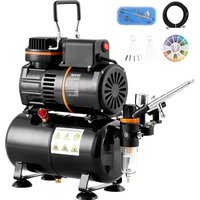


| Brand | Vevor |
| Model | TC-20B |
| Product Type | Airbrush Kit with Compressor |
| Compressor Type | Piston, oil-free |
| Voltage (US) | 120 V, 60 Hz |
| Voltage (EU/UK/AU) | 220-240 V, 50 Hz |
| Power | 1/6 HP |
| Air Flow Rate | 23-25 L/min |
| Air Tank Capacity | 3.5 L |
| Nozzle Size | 0.3 mm |
| Cup Volume | 9 ml |
| Main Functions | Dual cooling fan, automatic stop at 4 bar, restart at 3 bar, adjustable pressure, low noise |
| Thermal Protection | Yes (automatic reset) |
| Duty Cycle | 20 minutes continuous operation, 15 minutes cooling |
| Intended Use | Airbrush painting (indoor only) |
| Maintenance and Cleaning | Clean immediately after each use; drain the tank; lubricate threaded connections |
| Safety | Wear safety goggles and dust mask; do not use in explosive atmosphere; unplug before maintenance |
| Spare Parts | Nozzle, needle, cup, air hose (available from manufacturer) |
| Repairability | Replaceable parts by qualified technician (needle, nozzle, bearings) |
| General Information | Original user manual; technical support at www.vevor.com/support |
Frequently Asked Questions - TC-20B Vevor
User questions about TC-20B Vevor
0 question about this device. Answer the ones you know or ask your own.
Ask a new question about this device
Download the instructions for your Paint gun in PDF format for free! Find your manual TC-20B - Vevor and take your electronic device back in hand. On this page are published all the documents necessary for the use of your device. TC-20B by Vevor.
USER MANUAL TC-20B Vevor
Technical Support and E-Warranty Certificate
www.vevor.com/support
Airbrush Set
TC-20B
We continue to be committed to provide you tools with competitive price. "Save Half", "Half Price" or any other similar expressions used by us only represent estimate of savings you might benefit from buying certain tools with us compared to top brands and does not necessarily mean to cover all categories of tools offered. We kindly remind you to verify carefully when you are placing an order with us that you are actually saving half in comparison with the top major brands.
Model: TC-20B
NEED HELP? CONTACT US!
Have product questions? Need technical support? Please feel free to contact us:
Technical Support and E-Warranty Certificate www.vevor.com/support
This is the original instruction. Please read all manual instructions carefully before operating. VEVOR reserves a clear interpretation of the user manual. The appearance of the product shall be subject to the product you received. Please forgive us that we won't inform you if there are any technology or software updates on our product.
 | Warning - To reduce the risk of injury, the user must r instructions manual carefully. |
 | Warning- Be sure to wear eye protectors when using th product. |
 | Warning- Be sure to wear dust masks when using this |
 | This symbol, placed before a safety comment, indicates of precaution, warning, or danger. Ignoring this warning r lead to an accident. To reduce the risk of injury, fire, c electrocution, please always follow the recommendation sh below. |
 | Indoor Use Only |
 | CORRECT DISPOSALThis product is subject to the provision of european Dire 2012/19/EU. The symbol showing a wheelie bin crossed indicates that the product requires separate refuse collect the European Union. This applies to the product and all accessories marked with this symbol. Products marked as may not be discarded with normal domestic waste, but i taken to acollection point for recycling electrical and elec devices. |
INSTRUCTIONS
Thank you very much for choosing this Airbrush Set.
- Please read all of the instructions before using it. The information will help you achieve the best possible results.
The products carried in this catalog may be different in color than the item.
WARNING:
- Operate in a safe work environment. Keep your work area clean,
and free of distractions.
- Use as intended only.
- This is not a toy, not for use by children.
- Clean the airbrush immediately after use. Delayed or inadequate cleaning will permanently clog the airbrush.
A. FEATURES
- Two cooling fans can achieve long-term continuous operation without overheating, protecting the air pump. Much safer, thermally protected!
- Piston type, oil free
- It can start with pressure, continuous working, powerful.
- Much safer, thermally protected!
- Low noise
- Auto stop function: stops at 4 bar, auto starts at 3 bar.
- Pressure-adjustable.
B. SPECIFICATIONS
| US specifications:Model: TC-20BVoltage: 120VFrequency: 60HzPower: 1/6HPAir Flow 23-25 L/MINCapacity of Air storage tank: 3.5 LDimension of nozzle: 0.3mmVolume of cup: 9ML | UK/EU/AU specifications:Model: TC-20BVoltage: 220-240VFrequency: 50HzPower: 1/6HPAir Flow 23-25 L/MINCapacity of Air storage tank: 3.5 LDimension of nozzle: 0.3mmVolume of cup: 9ML |
C. SAFETY
- Do not use the compressor for any purpose other than the one it has been designed for.
- Do not process any fluid other than air.
- Do not operate the compressor in explosive atmospheres, such as in the presence of flammable liquids, gases, or dust.
- Always make sure the unit is unplugged from the electrical supply before performing any service, maintenance, or cleaning.
- Do not expose this unit to rain or moisture.
- Do not allow children or other untrained people to use or play with the compressor.

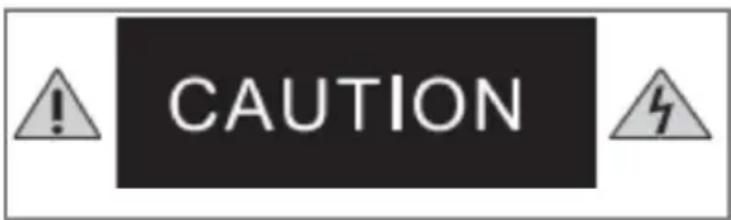

- To avoid the risk of burns, be aware that after extensive use of the compressor, some parts can become very hot. Allow the compressor to cool down before touching it.
- Do not leave the compressor unattended while it is running.
D. INSTALLATION
- After removing the compressor from its packaging, carefully check it for any damage caused during shipping.
- Install the compressor on a flat surface of suitable size, in a dry area with good ventilation, where the temperature is not likely to rise above 94°F (35°C).
- Insert the power cord into a grounded outlet. Be sure the electric rating is proper for the appliance (refer to the data label), and that the line is protected and equipped with a ground line.
- Connect one end of the air hose to the air outlet of the compressor.
- After taking the compressor out of its packaging, please check it carefully for any damages due to shipping.
- Install the compressor on a flat surface in a suitable size, dry, with good ventilation, where the temperature is not likely to rise above 94 degrees Fahrenheit (35 degrees Centigrade).
- Insert the power cord into a grounded outlet. Be sure the electric rating is proper for the appliance (refer to the data label), and that the line is protected and equipped with a ground line.
- Connect one end of the air hose to the air outlet of the compressor.
E. HOW TO SPRAY
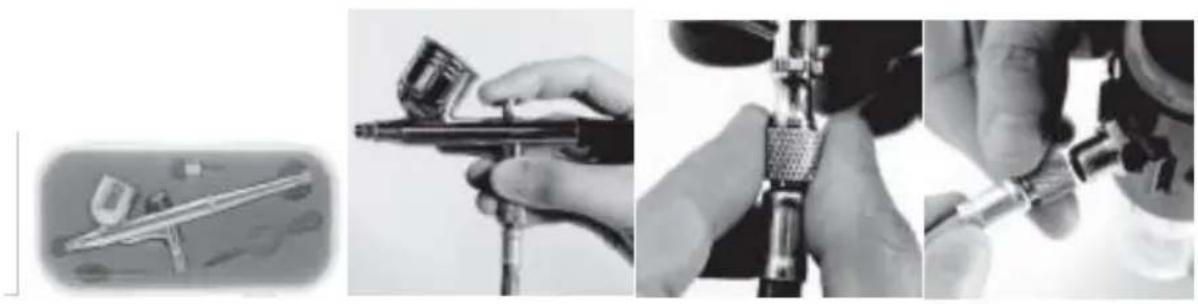
- Turn on the compressor.
- Fill fluid in the cup after thinning appropriately.
- Press down on the airbrush trigger to release air from the nozzle.
Slowly and gently draw back on the trigger to release the paint from the needle. The air will atomize the paint and create a fine spray.
- Continue to move the trigger back slowly to achieve the consistency needed for your spray technique.

- The spray pattern is in accordance with the distance between the surface and the airbrush. Keep the distance from the workpiece at about 5", depending on the airflow and paint type. For very delicate work, you may reduce the distance up to 1" from the workpiece.
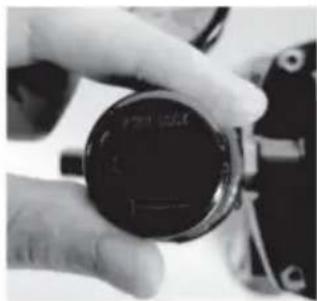
If you need a smaller pressure and gentler airflow, you can reduce the outlet air pressure on the pressure regulator when the compressor is in auto stop (clock at 4 bar). Operation by picture, pressure adjust range 4-0 bar.
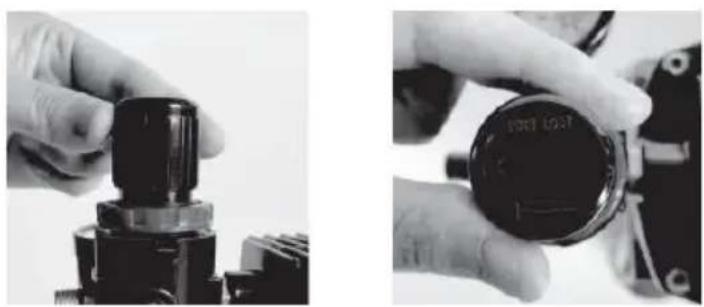
- To avoid paint buildup, start moving the airbrush before pressing the
trigger. When finished with the stroke, release the trigger while still moving the airbrush. Doing this will produce a smoother finish. Do not stop the airbrush while spraying. If the airbrush stops even briefly while spraying, paint can build up and run down the workpiece.
- When finished using the compressor, turn its power switch off. Release any remaining air. Air hose fittings and compressor body may get hot. Allow fittings to cool before disconnecting, or wear gloves to prevent burns.
- Perform maintenance on the compressor according to the instructions on the following pages.
- Clean the airbrush thoroughly IMMEDIATELY after EVERY use, according to instructions on the following pages.
Note: Do not use the compressor continuously for longer than 20 minutes. Allow the compressor to cool down for 15 minutes after every 20 minutes working cycle. The motor is equipped with a thermal protector with automatic reset.
F. HOW TO MIX PAINT FOR AIRBRUSH
Warning: The airbrush shall be filled with special paint and diluted accordingly. Do not use normal paint like lacquer and nail polish directly; the nozzle will be blocked and cannot be used anymore. Most paints designed for airbrushes do not need to be thinned. And other paint is mixed with thinner/reducer. Each paint type requires a specific thinner/reducer. We suggest to thin paint according to the manufacturer's directions and mix thoroughly. Or refer to the following steps:
Step 1. Choose your paint. Different projects call for different paint, so select the right paint for the job.
Step 2. Match the thinner/reducer to your paint.
| You can use one or multiple following when thinning water-based airbrush paints: | The Manufactured Reducer (Water-Based)Distilled Water (But don’t use a lot)Airbrush Acrylic Medium (Ether by it or along side the others listed above) |
| You can use one of the follow when thinning solvent-based airbrush paints: | •The Manufactured Reducer (Solvent-Based)• Mineral Spirits• Lacquer Thinner |
Tip: Water colors, Tempera and acrylic paints can usually be thinned with distilled water. Enamel paints are solvent based, and are generally thinned with mineral spirits. Lacquer paints are solvent based, and are thinned with lacquer thinner.
Step 3. Pour the needed amount of paint into a mixing cup.
Step 4. Determine the mixing ratio. The ratio of thinner to paint depends on the brand of paint and the surface you're painting. Most paints will have thinning instructions on the can that include the recommended thinner to paint ratio.
Step 5. Add the proper ratio of thinner to the amount of paint in the cup. If the paint you are using does not have any instructions, generally you need to start with a ratio of two parts of paint to one part thinner. If the paint is still too thick, add more thinner until you achieve the desired consistency. Conversely, if the paint is too thin, add more paint to the cup. Then thin the paint to a watery consistency, until it flows like milk.
Step 7. Pour the thinned paint through a paint strainer into a second cup. This step is optional, but ensures that there is no dirt or debris in the paint.
Tip: Test the mixture on a scrap piece of material before beginning your project.
Warning: Follow any manufacturer's safety instructions that may be included with the paint, and use a little common sense. Solvent-based paints and thinners/reducers are flammable, so keep them away from flames. Use solvent-based paints in a well-ventilated area, and wear a respirator if needed.
Step 5. Add the proper ratio of thinner to the amount of paint in the cup.
If the paint you are using does not have any instructions, generally you need to start with a ratio of two parts of paint to one part thinner. If the paint is still too thick, add more thinner until you achieve the desired consistency. Conversely, if the paint is too thin, add more paint to thicken it up. Then thin the paint to a watery consistency, until it flows like milk.
Step 6. Slowly stir the mixture with a mixing stick until the paint is thoroughly mixed.
Step 7. Pour the thinned paint through a paint strainer into a second cup. This step is optional, but ensures that there is no dirt or debris in the paint.
Tip: Test the mixture on a scrap piece of material before beginning your project.
Warning: Follow any manufacturer's safety instructions that may be included with the paint, and use a little common sense. Solvent-based paints and thinners/reducers are flammable, so keep them away from open flames. Use solvent-based paints in a well-ventilated area, and wear a respirator if needed.
G. HOW TO CLEAN AIRBRUSH
- Empty the jar and clean it with solvent.
- Turn on the compressor and connect the airbrush.
- Refill the cup with water or solvent, then block the needle cover with your finger and press the operation lever. The air flows backward into the airbrush to clean the paints remaining in the airbrush.
- Disconnect the airbrush from the compressor.
- Remove the nozzle and needle and soak them in solvent until clean. Use an old toothbrush and toothpicks to remove any paint.
CAUTION: Do not immerse the airbrush.
Note: Do not use metal objects to clean the nozzle to prevent damage to the passages. If the needle is bent, have it replaced by a qualified technician. 6. Use solvent to wipe down the airbrush body.
- Lubricate the airbrush after cleaning. A non-silicon oil or a light lubricant may be used on threaded connections before storing.
H. INSPECTION AND MAINTENANCE
Compressor
Note: These procedures are in addition to the regular checks and maintenance required to operate the compressor and other air-operated tools.
- BEFORE EVERY USE, inspect the general condition of the compressor. Check for:
- loose screws,
- misalignment or bending of moving parts, -damaged air supply hose,
- cracked or broken parts,
- any other condition that may affect its safe operation.
2. AFTER EVERY USE
a. Drain the water trap.
- With the compressor running, drain the moisture by loosening the bottom of the drain valve. The moisture will be forced out.
- Turn off and disconnect the compressor from its power source.
- Close the drain valve. b. Wipe the compressor with a piece of clean cloth.
Airbrush
Note: These procedures are in addition to the regular checks and maintenance required to operate the compressor and other air-operated tools.
- BEFORE EVERY USE, inspect the general condition of the tool. Check for:
- bent needles,
- loose screws,
- misalignment or bending of moving parts, -clogged nozzle,
- cracked or broken parts,
- any other condition that may affect its safe operation.
- AFTER EVERY USE, clean the airbrush, according to the following instructions.
I. TROUBLESHOOTING
Airbrush
| Problem | Possible Causes | Likely Solutions |
| Poor Paint Atomization | 1. Low paint level.2. Paint not properly thinned Clogged nozzle.4. Loose/damaged needle. | 1. Refill the airbrush with pa2. Thin paint.3. Clean nozzle.4. Adjust or replace the nee |
| Will Not Spray | No pressure at the airbrush. | Check the air hoses. |
| Over spray (Paint Spraying Further Than Intended) | 1. Improper application speec2. Improper distance from Work piece. | 1. Move moderately and par to the subject.2. Adjust the distance from intended object. |
| Nozzle Leakage | 1. Dirty nozzle.2. Worn or damaged nozzle | 1. Clean the nozzle.2. Replace the nozzle and/o needle. |
| Air Leaking from Nozzle | 1. Dirty air valve/seat.2. Sticky air valve.3. Damaged air valve spring4. Worn/damaged air valve/s | 1. Clean the air valve/seat.2. Lubricate the air valve/sea3. Replace the air valve spr4. Replace the air valve. |
| Follow all safety precautions whenever diagnosing or servicing the tool.Disconnect the air supply before servicing the tool. | ||
Compressor
| Problem | Possible Causes | Likely Solutions |
| The Motor Does Not Wo | 1. No electrical power.2. Damaged power cord.3. The electrical wiring within unit is defective.4. The power switch is defe | 1. Plug the power cord into a working, grounded, electrical out2. Have a qualified service technician replace the power co3. Have a qualified service technician- replace the electrical wiring.4. Have a qualified service technicianre- place the power switch. |
| The Motor Runs, but it Makes Irregular or Knock Noises. | 1. The bearing is loose or damaged. 2. The screws in connection rod are loose. | 1. Have a qualified service technician replace the bearing.2. Tighten the screws, or repla them if necessary. |
| Not Enough Pressure Wh Spraying or Painting. | 1. Loose air connection(s).2. The air hose is damaged3. The screws on the cylind cover are loose. | 1. Check all the air connection and tighten them if necessary.2. Replace the air hose.3. Tighten the screws. |
| Poor Spray Pattern. | 1. Loose air connection(s).2. The paint is too thick.3. The airbrush nozzle is plu or dirty. | 1. Check all the air connection and tighten them if necessary.2. Add paint thinner and mix thoroughly.3. Clean or change the nozzle |
| Motor Runs Properly, but Air Pressure or Lack of Delivery. | 1. The valve plate is loose of place.2. The retainer ring is dama after excessive use at high pressure. | 1. Open the front cover and n sure the valve plate is in the proper position. Tighten the scr if necessary.2. Have a qualified service technician replace the retainer |
Address: Shuangchenglu 803nong11hao1602A-1609shi, baoshanqu, shanghai 200000 CN.
Imported to AUS: SIHAO PTY LTD, 1 ROKEVA STREETEASTWOOD NSW 2122 Australia
Imported to USA: Sanven Technology Ltd., Suite 250, 9166 Anaheim Place, Rancho Cucamonga, CA 91730
| EC | REP |
E-CrossStu GmbH
Mainzer Landstr.69, 60329 Frankfurt am Ma
| UK | REP |
YH CONSULTING LIMITED.
C/O YH Consulting Limited Office 147, Centurion H
London Road. Staines-upon-Thames. Surrey. TW18 4
VEVOR®
TOUGH TOOLS, HALF PRICE
Technical Support and E-Warranty Certificate www.vevor.com/support
VEVOR®
TOUGH TOOLS, HALF PRICE
E. HOW TO SPRAY
C/O YH Consulting Limited Office 147, Centurion House, London Road, Staines-upon-Thames, Surrey, TW18 4AX
VEVOR®
TOUGH TOOLS, HALF PRICE
NEED HELP? CONTACT US!
E. HOW TO SPRAY
C/O YH Consulting Limited Office 147, Centurion House, London Road, Staines-upon-Thames, Surrey, TW18 4AX
VEVOR®
TOUGH TOOLS, HALF PRICE
NEED HELP? CONTACT US!
E. HOW TO SPRAY
I. TROUBLESHOOTING
Airbrush
C/O YH Consulting Limited Office 147, Centurion House, London Road, Staines-upon-Thames, Surrey, TW18 4AX
VEVOR®
TOUGH TOOLS, HALF PRICE
Technical support and e-warranty certificate www.vevor.com/support
VEVOR®
TOUGH TOOLS, HALF PRICE
NEED HELP? CONTACT US!
E. HOW TO SPRAY
C/O YH Consulting Limited Office 147, Centurion House, London Road, Staines-upon-Thames, Surrey, TW18 4AX
VEVOR®
TOUGH TOOLS, HALF PRICE
E. HOW TO SPRAY
G. HOW TO CLEAN THE AIRBRUSH
C/O YH Consulting Limited Office 147, Centurion House,
London Road, Staines-upon-Thames, Surrey, TW18 4AX
VEVOR®
TOUGH TOOLS, HALF PRICE
E. HOW TO SPRAY
Imported into AUS: SIHAO PTY LTD, 1 ROKEVA STREET EASTWOOD
New South Wales 2122 Australia
NEED HELP? CONTACT US!
E. HOW TO SPRAY
Imported into AUS: SIHAO PTY LTD, 1 ROKEVA STREET EASTWOOD NSW 2122 Australia
C/O YH Consulting Limited Office 147, Centurion House, London Road, Staines-upon-Thames, Surrey, TW18 4AX
VEVOR®
TOUGH TOOLS, HALF PRICE
- AIRBRUSH SET
- NEED HELP? CONTACT US
- INSTRUCTIONS
- WARNING
- FEATURES
- SPECIFICATIONS
- SAFETY
- INSTALLATION
- HOW TO SPRAY
- HOW TO MIX PAINT FOR AIRBRUSH
- HOW TO CLEAN AIRBRUSH
- INSPECTION AND MAINTENANCE
- COMPRESSOR
- AFTER EVERY USE
- AIRBRUSH
- TROUBLESHOOTING
- VEVOR®
- TOUGH TOOLS, HALF PRICE
- HOW TO CLEAN THE AIRBRUSH
Brand : Vevor
Model : TC-20B
Category : Paint gun