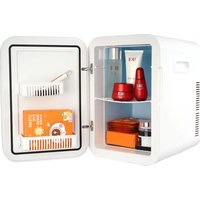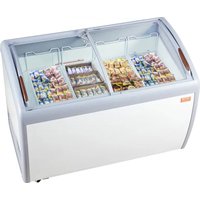
RI-360A - Fridge Vevor - Free user manual and instructions
Find the device manual for free RI-360A Vevor in PDF.


User questions about RI-360A Vevor
0 question about this device. Answer the ones you know or ask your own.
Ask a new question about this device
Download the instructions for your Fridge in PDF format for free! Find your manual RI-360A - Vevor and take your electronic device back in hand. On this page are published all the documents necessary for the use of your device. RI-360A by Vevor.
USER MANUAL RI-360A Vevor
Technical Support and E-Warranty Certificate www.vevor.com/support
DISPALY FREEZER MANUAL
We continue to be committed to provide you tools with competitive price. "Save Half", "Half Price" or any other similar expressions used by us only represent estimate of savings you might benefit from buying certain tools with us compared top brands and doses not necessarily mean to cover all categories of tools offered are kindly reminded to verify carefully when you are placing an order with us actually saving half in comparison with the top major brands.
NEED HELP? CONTACT US!
Have product questions? Need technical support? Please feel fr contact us:
Technical Support and E-Warranty Certificate www.vevor.com/support
This is the original instruction, please read all manual instruction carefully before operating. VEVOR reserves a clear interpretation user manual. The appearance of the product shall be subject to product you received. Please forgive us that we won't inform you there are any technology or software updates on our product.
 | Warning-To reduce the risk of injury, user must read instructions manual carefully. |
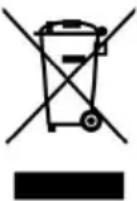 | Correct DisposalThis product is subject to the provision of European D 2012/19/EC. The symbol showing a wheelie bin crossed through indicates that the product requires separate refu collection in the European Union. This applies to the p and all accessories marked with this symbol. Products as such may not be discarded with normal domestic w must be taken to a collection point for recycling electri electronic devices |
Display freezer manual
i. The main purpose
This equipment is used for storage and display of frozen food.
This appliance is intended to be used in household and similar application such as -staff kitchen areas in shops, offices and other working environments:
- farm houses and by clients in hotels, motels and other residential environments;
- Catering and similar non-retail applications.
ii.Installation and debugging
1) Unpack all packages before using the showcase. Don't bend it over than 60^ while moving it.
2) The showcase should be installed in the environment of good ventilator cool and dry and without corrosive gas. It should not be installed close to heat sources or directly under the sunlight. The space more than 10cm between the wall of the front and the back of the showcase should allowed. When installing, the universal wheels should be padded well. As to make the showcase be level and stable, or it will cause vibration
3) When initial operation, the refrigerator should run emptily about one before storing food in it.
4) Before placing food into the freezer, adjust the temperature control to the lowest point (highest number) and let it run until the temperature of the cabinet decreases to 0^ F. Put the food in, and after 12 hours adjust temperature control to the normal point.
5) The thermostat could adjust the temperature inside the showcase. We you turn the knob in clockwise. The bigger the figure, the lower the temperature. Generally, the position of “4” is suitable. “0” position stands stopping operation. “Max” position will be operating not continually as compressor won’t stop (no cycle). Turn the temperature control to the “5” when temperature inside is stable for ice cream and similar produce.
6) Never store flammable, explosive or corrosive products in the freezer and keep the freezer away from such materials.
7) If power is cut off, wait at least 5 minutes before turning on again damage to the compressor.
8) To save energy, the door should not be frequently opened for left for a long time.
9) The surface and the inside of the showcase should be dry and clear. Long term moisture with cause the showcase rust slowly. (There will some stains on the surface.)
10) Periodical cleaning is suggested for your reference. Generally, 30-45 days once is best. When cleaning, it is best to wipe the inside and surface of the showcase with the soft cloth with neutral soap or dete
iii. Use and operation
TEMPERATURE CONTROLS
1) These freezers have a manual control system to regulate the temperature inside the freezer. Before placing any food in the freezer set the freezer the highest setting and let it run until the temperature inside the freezer reaches 0° F. Once the internal temperature reaches 0° F you can be loading the product into the freezer. Once the product is inside the freezer is suggested to wait 12 hours before you adjust the temperature to the
normal desired setting. Setting “4” is the recommended setting for the freezer.
2)The temperature settings for the chest freezers range from MIN to This will give you an internal operating temperature range of - 15° F When you turn the thermostat control knob clockwise to a higher nun this will lower the internal temperature of the freezer. Turning the knc counter-clockwise will raise the internal temperature of the freezer.
3)NOTE: Setting the temperature control to the coldest setting may cause the evaporator coil to freeze and ice up resulting in non-optimal operation conditions over time.
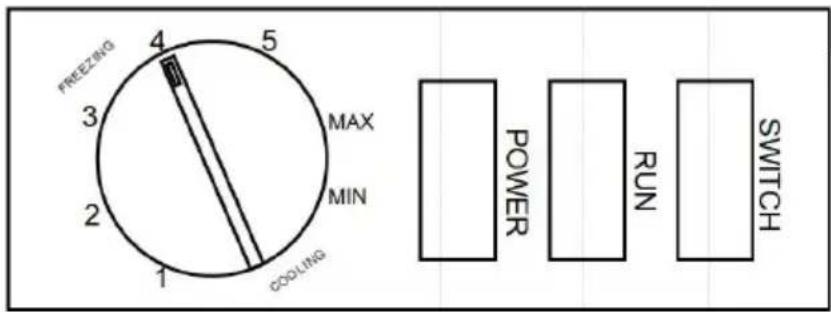
text_image
FREEZING 4 5 3 MAX 2 MIN 1 COOLING POWER RUN SWITCHFood Storage
1) Do not fill the freezer full of products. You should leave space between items and the inner surface of the cabinet, so as to keep good ventilation cold air and freeze evenly. Do not put in any bottled or canned beverage with freezing point above the temperature in the cabinet when it is but zero.
2) For foods that should be moisture-free or lose water easily, wrap th with hermetical food bags or fresh films before putting in the cabinet sake of avoiding smell-mixing and reducing frosting.
3) Storage of volatile and combustible gases, liquids such as strong all strong acids, petrol ,etc. is forbidden.
4) Never put hot food directly in the freezer. Food should be cold or before placing it inside.
5) The appliance is intended exclusively for the storage and/or display packaged foods only.
6) beverage products that are not potentially hazardous foods, such as soda (pop), beer, and wine.
5. Things to note
1) During the transportation of the machine, the tilt is not allowed to 45 degrees.
2) The power supply voltage requires rated voltage and must be reliable grounded; it cannot share the same socket with other electrical applia
3) There should be enough space of more than 200mm on the side of inlet and outlet air grille to ensure heat dissipation of the machine.
4) Dust the machine condenser regularly, and the interval should not exceed 3 months
5) When the machine is working, do not touch your hands directly with refrigerant to prevent frostbite.
6) Do not use the machine directly in a place exposed to direct sunlight, it will directly affect the cooling effect.
7) After use, unplug the power supply and clean the machine. The su can be wiped with a wet towel; it is strictly forbidden to rinse it dire water.
8) If the machine malfunctions and alarms, please contact a professional find out the cause before using it.
9) The maximum loading of each type of shelf is 8kg.
The ambient temperature and humidity conditions of the show case cl class following the tab below
| Test room climate class | Dry bulb temperature °C | Relative Humidity % | Dew point °C | Water vapour mass in dry air g/kg |
| 0 | 20 | 50 | 9.3 | 7.3 |
| 1 | 16 | 80 | 12.6 | 9.1 |
| 8 | 23.9 | 55 | 14.3 | 10.2 |
| 2 | 22 | 65 | 15.2 | 10.8 |
| 3 | 25 | 60 | 16.7 | 12.0 |
| 4 | 30 | 55 | 20.0 | 14.8 |
| 6 | 27 | 70 | 21.1 | 15.8 |
| 5 | 40 | 40 | 23.9 | 18.8 |
| 7 | 35 | 75 | 30.0 | 27.3 |
| NOTE the water vapour mass dry air is one of the main point influencing the performance and the energy consumption of the cabinets. Therefore, the order of the climate class in the table based on the water vapour mass column. See also Annex B lab and store conditions. | ||||
iv.Common faults and troubleshooting methods
| Fault | reason | Method of exclusion |
| The indicator is no on. The compresso doses not start. | The plug isn't connect to the socket really. | Replug it. |
| no power | Connect the socket with power. | |
| The indicator is on ,but the compressor doesn't work and buzzes only | The power voltage is low. | Put a power-regulate more than 1000W power together. |
| The compressor stops a minute after start,and restart after a few minuters,and so repeatedly. | The power voltage is high. | |
| The compressor works normally,but the temperature in the cabinet lowers too slowly. | The door is opened to frequently. | Reduce open times. |
| The food in the cabin is too much,and placed improperly. | Place foods properly keep place between them for ventilation of cold air | |
| The frost film is too t | Take out foods | |
| The surface of the | Stop and clean the | |
| condenser is too dirty. | condenser. | |
| The door seals badly. | Adjust the door seal. | |
| The noise is too I | The freezer is placed unstably. | Place it stably. |
| The fixing of the freeze is loose. | Tighten the fixing. | |
| there's contact between pipes. | Separate them. |
The following are not faults:
1) When the freezer is working or after stopping for a while, the refriger the pipes is cycling and gives out "running water" sounds.
2) The surface temperature of the compressor may be up 70^ C\~ 80^ C, it is working.
3) The back side of step freezer gives out heat.
4) In rainy season, the outer surface of the cabinet may have dew, wh makes no defects on normal use. Just dry it with a piece of cloth.
5)The protective film on the inner tank is to avoid damage during production purpose. Don't worry about peeling it off. It's okay to tear when you use it.
v.Packing List
| No. | Item | Qty | Remark |
| 1 | Display freezer | 1 set | |
| 2 | Manual | 1 pcs | |
| 3 | thermometer | 1 pcs | |
| 4 | Key | 2 pcs |
\* WARNING
Attention: To ensure safety, the power plug must be pulled out before cleaning. All safety precautions must be followed. Dispose of properly accordance with Federal or local regulations. Risk of fire or explosion to puncture of refrigerant tubing. Follow handling instructons carefully.
DANGER: Risk of fire or explosion. Flammable refrigerant R290/R600a used. To be repaired only by trained service personnel. Do not use mechanical devices to defrost refrigerator. Do not puncture refrigerant tubing.
1) This appliance is not intended for use by persons (including children with reduced physical, sensory or mental capabilities, or lack of exper and knowledge, unless they have been given supervision or instruction concerning use of the appliance by a person responsible for their saf
2) Children should be supervised to ensure that they do not play with appliance.
3) Cleaning and user maintenance shall not be made by children with supervision.
4) Do not store explosive substances such as aerosol cans with a flammable propellant in this appliance.
5) If the supply cord is damaged, it must be replaced by the manufacturing service agent or a similarly qualified person in order to avoid a risk.
6) Keep ventilation openings, in the appliance enclosure or in the built-structure, clear of obstruction.
7) Do not use mechanical devices or other means to accelerate the defrosting process, other than those recommended by the manufacturer
8) Do not damage the refrigerant circuit.
9) Do not use electrical appliances inside the food storage compartment the appliance, unless they are of the type recommended by the manufacturer.
10) The appliance shall not be installed in public corridors or lobbies.
11) Please according to local regulations regarding disposal of the appliance for its flammable gas. Before you scrap the appliance, please take off the doors to prevent children trapped
12) the appliance shall be installed in accordance with national wiring regulations
13) The appliance is to be installed in accordance with the Safety Sta for Refrigeration Systems, ANSI/ASHRAE 15.
14) Do not use means to accelerate the defrosting process or to clear
other than those recommended by the manufacturer.
15) The appliance shall be stored in a room without continuously operating ignitionsources (for example: open flames, an operating gas appliance of an operating electric heater.
16) Do not pierce or burn. Be aware that refrigerants may not contain odour.
17) The appliance shall be stored in a well-ventilated area where the size corresponds to the room area as specified for operation;
18) The appliance shall be stored in a room without continuously operating open flames (for example an operating gas appliance) and ignition so (for example an operating electric heater).
19) The appliance shall be stored so as to prevent mechanical damage from occurring.
20) Check that cabling will not be subject to wear, corrosion, excessive pressure, vibration, sharp edges, or any other adverse environmental effects. The check shall also take into account the effects of aging of continual vibration from sources such as compressors or fans.
21) Before carrying out Decommissioning procedure, it is essential that technician is completely familiar with the equipment and all its detail. It recommended good practice that all refrigerants are recovered safely. I to the task being carried out, an oil and refrigerant sample shall be case analysis is required prior to re-use of recovered refrigerant. It is essential that electrical power is available before the task is commenced. When removing refrigerant from a system, either for servicing or decommissioning, it is recommended good practice that all refrigerants removed safely.
22) The recovery equipment shall be in good working order with a set of instructions concerning the equipment that is at hand and shall be used for the recovery of all appropriate refrigerants including, when applicable, FLAMMABLE REFRIGERANTS. The recovered refrigerant shall be returned to the refrigerant supplier in the correct recovery cylinder, and relevant waste transfer note arranged. Do not mix refrigerants in recover units and especially not in cylinders
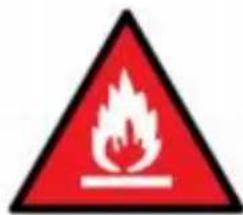
text_image
Warning sign with flame symbol and warning symbol, commonly used in safety or hazard prevention contextWarning: Risk of fire / flammable materials, taking care to avoid caufire by igniting flammable material.
VEVOR®
TOUGH TOOLS, HALF PRICE
Technical Support and E-Warranty Certificate
www.vevor.com/support
VEVOR®
TOUGH TOOLS, HALF PRICE
text_image
Warning sign with flame symbol and warning symbol, commonly used in safety or hazard prevention contexttext_image
Warning sign with flame symbol and warning symbol, commonly used in safety or hazard prevention contextwww.vevor.com/support
VEVOR®
TOUGH TOOLS, HALF PRICE
text_image
Warning sign with flame symbol inside red triangle, indicating hazardous hazard or safetyelettronica www.vevor.com/support
VEVOR®
TOUGH TOOLS, HALF PRICE
text_image
Warning sign with flame symbol and warning symbol, commonly used in safety or hazard prevention contexttext_image
Warning sign with flame symbol and warning symbol, commonly used in safety or hazard prevention contextHULP NODIG? NEEM CONTACT MET ONS OP!
text_image
Warning sign with flame symbol inside red triangle, indicating hazardous hazard or safetygarantiecertificaat www.vevor.com/support
VEVOR®
TOUGH TOOLS, HALF PRICE
text_image
Warning sign with flame symbol and warning symbol, commonly used in safety or hazard prevention contextwww.vevor.com/support