SS-24405 - Oven Sogo - Free user manual and instructions
Find the device manual for free SS-24405 Sogo in PDF.


| Product Type | Gas oven with grill function |
| Brand and Model | Sogo SS-24405 |
| External Dimensions (W x D x H) | 500-600 mm x 565-630 mm x 855 mm |
| Power Supply | 220-240 V AC / 380-415 V AC, 50/60 Hz |
| Total Power | Variable by model: up to 2200 W (turbo), 2000 W (grill) |
| Compatible Gas Types | Natural gas (G20/G25) and LPG (G30/G31) |
| Number of Hob Burners | 4 to 5 burners (wok, rapid, semi-rapid, auxiliary, optional electric plate) |
| Oven Functions | Static cooking, fan-assisted, grill, grill + fan, defrost, rotisserie |
| Oven Temperature Range | 40 °C to 240 °C |
| Timer | Mechanical, 0-90 minutes |
| Interior Light | G9 or E14 lamp, 15-25 W, 220-240 V AC |
| Safety | Flame failure device (FFD) on burners, hinge lock, overheating protection |
| Material and Finish | Steel, glass door |
| Cleaning and Maintenance | Optional catalytic liners, manual cleaning with soft cloth, no steam cleaner |
| Spare Parts and Repairability | Injectors, lamps, grids, door glass, catalytic liners; replacement by authorized service |
| Included Accessories | Metal grid, tray, drip pan, chicken rotisserie spit |
| Country of Manufacture | Turkey |
| Warranty and After-Sales Service | Imported by Sanysan Appliances S.L., Spain; after-sales service: sogosat@servicruz.es |
Frequently Asked Questions - SS-24405 Sogo
User questions about SS-24405 Sogo
0 question about this device. Answer the ones you know or ask your own.
Ask a new question about this device
Download the instructions for your Oven in PDF format for free! Find your manual SS-24405 - Sogo and take your electronic device back in hand. On this page are published all the documents necessary for the use of your device. SS-24405 by Sogo.
USER MANUAL SS-24405 Sogo
natural_image
Exterior view of a white SOGO kitchen oven with four gas stove covers and open door (no text or symbols visible)
Descarga tu manual Download your manual Téléchargez votre manuel Baixe seu manual Laden Sie Ihr Handbuch herunter Scarica il tuo manuale Stáhněte si manuál Download din manual Prenesite svoj priročnik Preuzmite svoj priručnik Pobierz swoją instrukcję Descärcați manualul dvs Descàrrega el teu manual
Declaration of conformity, Responsibility of Electronic products disposal, Importers Details and After-sales service on the last pages.
Accesorios:
natural_image
Pure geometric diagram of a square frame with evenly spaced dots, no text or symbols present.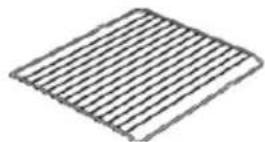
Figura 1 Figura 2
natural_image
Illustration of a hand pressing down on a control panel with buttons and dials (no text or symbols visible)Figura 6
natural_image
Illustration of a hand pressing a button on an electronic control panel (no text or symbols visible)Figura 7
natural_image
Line drawing of an open laptop with internal components and a fan (no text or symbols)Figura 12
natural_image
Technical line drawing of an open industrial oven with internal components (no text or symbols)Figura 13
natural_image
Line drawing of an open laptop with internal components and ventilation slots (no text or symbols)Figura 14
natural_image
Technical line drawing of an open laptop with internal air vent and ventilation slots (no text or symbols)5. INSTRUCCIONES DE USO
Panel de control:
natural_image
Technical line drawing of a mechanical component with internal fan and housing (no text or symbols)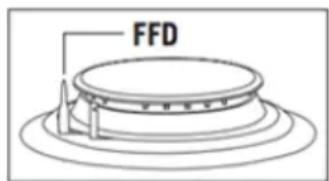
natural_image
Two-panel diagram showing a cooking pan with a lid and a side panel, both marked with X and check symbols (no text or labels)natural_image
Four black silhouette icons showing cooking pots, one with steam rising, others with steam rising (no text or symbols)natural_image
Simple circular diagram with surrounding geometric shapes and a small arc, no text or symbols present.natural_image
Illustration of a hand placing a small object into a circular container (no text or symbols)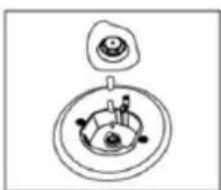
natural_image
Simple line drawing of a mechanical or biological component with no text or symbols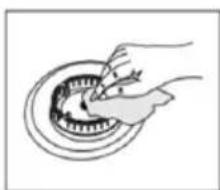
natural_image
Illustration of a hand using a tool to clean or watch a circular object (no text or symbols visible)natural_image
Diagram of a mechanical assembly with arrows indicating direction (no text or symbols)Figura 15
natural_image
Technical line drawing of a mechanical assembly with no visible text or symbolsFigura 16
natural_image
Illustration of a mechanical assembly with stacked components and an upward arrow (no text or symbols)Figura 17
natural_image
Line drawing of a door frame with a grid inside, showing hands adjusting the interior (no text or symbols)natural_image
Pure electrical circuit lines without any symbolsnatural_image
Line drawings of three different kitchen appliances: a front-loading oven, a closed door, and a second portable oven (no text or symbols present)Our objective is to make this product provide you with the best output which is manufactured in our modern facilities in a careful working environment, in compliance with total quality concept.
Therefore, we suggest you to read the user manual carefully before using the product and, keep it permanently at your disposal.
Note: This user manual is prepared for more than one model. Some of the features specified in the manual may not be available in your appliance.
All our appliances are only for domestic use, not for commercial use. Products marked with (*) are optional.
"THIS APPLIANCE SHALL BE INSTALLED IN ACCORDANCE WITH THE REGULATIONS FORCE AND ONLY USED IN A WELL-VENTI-LATED SPACE. READ THE INSTRUCTIONS BEFORE INSTALLING OR USING THIS APPLIANCE"
"Conforms with the WEEE Regulations."
1. IMPORTANT:
• Always read the instruction book carefully before using.
- This manual can be downloaded from our web page www.sogo.es
- Keep these instructions for future reference.
2. Safety Instructions:

General Instructions / Precautions:
- Please read this Instructions Manual carefully. Only by this way you can use the appliance safely and in a correct manner.
- This appliance is intended for cooking. It should not be used for other purposes like heating a room.
- Ensure that the oven door is completely closed after putting food inside the oven.
- CAUTION: Cooking process shall be supervised. Cooking process shall always be supervised.
- This device has been designed for household use only.
- The appliance is not suitable for use with an external timer or a separate remote-control system.
- Oven handle is not a towel drier. Do not hang towels, etc. on the oven handle.
• After each use, check if the unit is turned off. - It is important to place the wire grill and tray properly on the wire
racks and/or correctly place the tray on the rack. Place the grill or tray between two rails and make sure it is balanced before putting food on it.
- Against the risk of touching the oven heater elements, remove excess parts of the baking paper that hang over from the accessory or container.
- When the door is open, do not place any heavy object on the door or allow children to sit on it. You may cause the oven to overturn or the door hinges to be damaged.
- Do not use abrasive cleaners or sharp metal scrapers to clean the glass as the scratches that may occur on the surface of the door glass may cause the glass to break.
- Oven supply can be disconnected during any construction work at home. After completing the work, re-connecting the oven shall be done by authorized service.
- Turn off the appliance before removing the safeguards. After cleaning, install the safeguards according to instructions.
- Cable fixing point shall be protected.
- Please don't cook the food directly on the tray / grid. Please put the food into or on appropriate tools before putting them in the oven.
- Installation and repair should always be performed by “AUTHO-RIZED SERVICE”. Manufacturer shall not be held responsible for operations performed by unauthorized persons.

Restrictions to avoid personal injury.
- Touching the heating elements should be avoided.
- While placing food to or removing food from the oven, etc., always use heat resistant oven gloves.
- Do not use the product in states like medicated and/or under influence of alcohol which may affect your ability of judgement.
- User shall be careful when cleaning gas burners. It may cause personal injuries.
- Food can spill when foot of oven is dismantled or gets broken, be careful. It may cause personal injuries.
- During usage, the internal and external surfaces of the oven get hot. As you open the oven door, step back to avoid the hot vapour coming out from the interior. There is risk of burning.
- Upper cover of the oven can be closed for a reason, then cookware can trip over. Step back to avoid the hot food coming on you. There is risk of burning.

Restrictions on use while poor condition or breakdown.
- If the appliance is faulty or has a visible damage, do not operate the appliance.
- ATTENTION: If the glass of the appliance is broken, turn off any heating element immediately and disconnect the appliance from power source, do not use the appliance.
- If the appliance is faulty or has a visible damage, do not operate the appliance.

Restrictions when use with children.
- Keep children below the age of 8 and pets away when operating.
WARNING: The accessible parts may be hot while using the Keep away from children.
- Children under 8 years of age should be kept away, if they cannot be monitored continuously.
- Children must not play with the appliance. Cleaning or user maintenance of the appliance shall not be performed by children unless they are older than 8 years and supervised by adults.
- Keep the appliance and its power cord away from children less than 8 years old.
- Do not put objects that children may reach on the appliance.
- The packaging materials are dangerous for children. Keep packaging materials away from the reach of children.
- This device can be used by children over 8 years of age, people with physical, hearing or mental challenges or people with lack of experience or knowledge; as long as control is ensured or information is provided regarding the dangers.

Important Warnings.
- WARNING: Fire hazard; do not store the materials on the cooking surface.
- WARNING: The appliance and its accessible parts are hot during operation.
- WARNING: Don't use oven and grill burners at same time.
• To clean the appliance, do not use steam cleaners. - NEVER try to put out the fire with water. Only shut down the device circuit and then cover the flame with a cover or a fire blanket.
- Put curtains, tulles, paper or any flammable (ignitable) material away from the appliance before starting to use the appliance. Do not put ignitable or flammable materials on or in the appliance.
- Do not heat closed cans and glass jars. The pressure may lead jars to explode.
- Do not place the oven trays, plates or aluminium foils directly on the oven base. The accumulated heat may damage the base of the
oven.
- Be careful when using alcohol in your foods. Alcohol will evaporate at high temperatures and may catch fire to cause a fire if it comes in contact with hot surfaces.
- Do not use the appliance with its front door glass removed or broken.
- Do not place the appliance on a surface covered with carpets. Electric parts get overheated since there will be no ventilation from below. This will cause failure of the appliance.
- User should not handle the oven by himself.
- User should not dislocate the resistance during cleaning. It may cause an electric shock.
- Do not remove ignition switches from the appliance. Otherwise, live electric cables can be accessed. It may cause an electric shock.
- To prevent overheating, the appliance should not be installed behind of a decorative cover.
- Hot surface, leave for cooling before closing the cover.
- Ask your local gas supplies about the phone numbers for emergencies related to gas and the measures to be taken upon gas odour is detected.
- Gas should burn well in gas products. Well burning gas can be understood from blue flame and continuous burning. If gas does not burn sufficiently, carbon monoxide (CO) can be generated. Carbon monoxide is a colourless, odourless and very toxic gas; even small amounts have lethal effect.
Instructions while using the device.
- Keep the ventilation channels open.
- Do not touch the plug with wet hands. Do not pull the cord to plug off, always hold the plug.
- Do not place heavy objects when oven door is open, risk of toppling.
- Never use it at higher oven temperatures than the maximum usage temperature indicated on your baking paper. Do not place the baking paper on the base of the oven.
- Place the baking paper together with the food into a pre-heated oven by putting it inside a cooker or on an oven accessory (tray, wire grill etc.).
- Do not place metal utensils such as knife, fork, spoon on the surface of the appliance, since they will get hot.
Electrical Safety:
- Plug the appliance in a grounded socket protected by a fuse conforming to the values specified in the technical specifications chart.
- Have an authorized electrician set grounding equipment. Our company shall not be responsible for the damages that shall be incurred due to using the product without grounding according to local regulations.
- The circuit breaker switches of the oven shall be placed so that end user can reach them when the oven is installed.
- The power supply cord (the cord with plug) shall not contact the hot parts of the appliance.
- If the power supply cord (the cord with plug) is damaged, this cord shall be replaced by the manufacturer or its service agent or equally qualified personnel to prevent a hazardous situation.
- Never wash the product by spraying or pouring water on it! There is a risk of electrocution.
- WARNING: To avoid electric shock, ensure that the device circuit is open before changing the lamp.
- WARNING: Cut off all supply circuit connections before accessing the terminals.
- WARNING: If the surface is cracked, turn off the appliance to avoid risk of electric shock.
- Do not use cut or damaged cords or extension cords other than the original cord.
- Make sure that there is no liquid or humidity in the outlet where the product plug is installed.
- The rear surface of the oven also heats up when the oven is operated. Electrical connections shall not touch the rear surface, otherwise the connections may be damaged.
- Do not tighten the connecting cables to the oven door and do not run them over hot surfaces. If the cord melts, this may cause the oven to short circuit and even a fire.
- Unplug the unit during installation, maintenance, cleaning and repair.
- If the power supply cable is damaged, it must be replaced by its manufacturer or authorized technical service or any other personnel qualified at the same level, in order to avoid any dangerous situation.
- Make sure the plug is inserted firmly into wall socket to avoid sparks.
- Do not use steam cleaners for cleaning the appliance, otherwise electric shock may occur.
- An omni polar switch capable to disconnect power supply is required for installation. Disconnection from power supply shall be pro-
vided with a switch or an integrated fuse installed on fixed power supply according to building code.
- Appliance is equipped with a type "Y" cord cable.
- Fixed connections shall be connected to a power supply enabling omni polar disconnection. For appliances with over voltage category below III, disconnection device shall be connected to fixed power supply according to wiring code.
Gas Safety:
- This appliance is not connected to burning products evacuation apparatus. This appliance must be connected and installed according to the installation regulations in force. Conditions regarding ventilation must be considered.
- When a gas cooking appliance is used; humidity, heat and burning products are generated in the room. First of all, make sure the kitchen is well ventilated when operating the appliance and maintain natural ventilation openings or install a mechanical ventilation equipment.
- After using the appliance heavily for an extended period of time, additional ventilation may be required. For example, open a window or adjust a higher speed for mechanical ventilation, if any.
- Before positioning the appliance, make sure local network conditions (gas type and gas pressure) meets appliance requirements.
- The mechanism cannot be run for longer than 15 seconds. If the burner is not on after 15 seconds, stop the mechanism and wait for at least one minute before trying to ignite the burner again.
- All kinds of operations to be performed on gas installation must be performed by authorized and competent people.
- This appliance is adjusted for natural gas (NG). If you have to use your product with a different gas type, you have to apply to authorized service centre for the conversion.
- For proper operation, hood, gas pipe and clamp should be replaced periodically according to manufacturer recommendations and when required.
- Gas should burn well in gas products. Well burning gas can be understood from blue flame and continuous burning. If gas does not burn sufficiently, carbon monoxide (CO) can be generated. Carbon monoxide is a colourless, odourless and very toxic gas; even small amounts have lethal effect.
- Ask your local gas supplies about the phone numbers for emergencies related to gas and the measures to be taken upon gas odour is detected.
What To Do When Gas Odour Is Detected:
- Do not use naked flame, and do not smoke.
- Do not operate any electrical switch. (For example: lamp switch or doorbell).
- Do not use telephone or mobile phone.
- Open the doors and windows.
- Close all valves on the appliances that utilize gas and the gas counters.
- Call fire brigade from a telephone outside the home.
- Check all hoses and their connections against leaks. If you still smell gas, leave the house and warn your neighbours.
- Do not enter into the house until authorities clarify it is safe.
Intended Use:
- This product is designed for home use. Commercial use of the appliance is not permitted.
- This appliance may only be used for cooking purposes. It shall not be used for other purposes like heating a room.
- This appliance shall not be used to heat plates under the grill, drying clothes or towels by hanging them on the handle or for heating purposes.
- The manufacturer assumes no responsibility for any damage due to misuse or mishandling.
- Oven part of the unit may be used for thawing, roasting, frying and grilling food.
- Operational life of the product you have purchased is 10 years. This is the period for which the spare parts required for the operation of this product as defined is provided by the manufacturer.
3. TECHNICAL SPECIFICATIONS
| Specification 50x55 50x60 60x60 | |||
| Outer width 500 mm 500 mm 600 | mm | ||
| Outer depth 565 mm 630 mm 630 | mm | ||
| Outer height 855 mm 855 mm 855 | mm | ||
| Lamp power 15-25 W | |||
| Bottom heating element 1000 W | 1000 W 1200 W | ||
| Top heating element 800 W 800 W | 1000 W | ||
| Turbo heating element ---- | 1800 W 2200 W | ||
| Grill heating element | 1500 W 1500 W 2000 W | ||
| Supply voltage | 220-240 V AC / 380-415V AC 50/60 Hz | ||
| Hot plate 145 mm * | 1000 W | ||
| Hot plate 180 mm * | 1500 W | ||
| Hot plate rapid 145 mm * | 1500 W | ||
| Hot plate rapid 180 mm * | 2000 W | ||
WARNING: For the modification to be done by authorized service, this table should be considered. Manufacturer may not be held responsible for any problems rising because of any faulty modification.
WARNING: In order to increase the product quality, the technical specifications may be changed without prior notice.
WARNING: The values provided with the appliance or its accompanying documents are laboratory readings in accordance with the respective standards. These values may differ depending on the use and ambient conditions.
| Burner | G20,20 mbar G25,25 mbar | G20,25 mbar | G20,13 mbar | ||||
| Specification | Gas natural | Gas natural | Gas natural | ||||
| Wok Burner | Injector | 1,40 | mm | 1,28 | mm | 1,60 | mm |
| Gas flow | 0,333 | m^3/h | 0,333 | m^3/h | 0,333 | m^3/h | |
| Power | 3,50 | kW | 3,50 | kW | 3,50 | kW | |
| Rapid Burner | Injector | 1,15 | mm | 1,10 | mm | 1,45 | mm |
| Gas flow | 0,276 | m^3/h | 0,276 | m^3/h | 0,276 | m^3/h | |
| Power | 2,90 | kW | 2,90 | kW | 2,90 | kW | |
| Semi-Rapid Burner | Injector | 0,97 | mm | 0,92 | mm | 1,10 | mm |
| Gas flow | 0,162 | m^3/h | 0,162 | m^3/h | 0,162 | m^3/h | |
| Power | 1,70 | kW | 1,70 | kW | 1,70 | kW | |
| Auxiliary Burner | Injector | 0,72 | mm | 0,70 | mm | 0,85 | mm |
| Gas flow | 0,96 | m^3/h | 0,96 | m^3/h | 0,96 | m^3/h | |
| Power | 0,95 | kW | 0,95 | kW | 0,95 | kW | |
| Grill Burner Injector 1 | 1,00 mm 0,92 mm | 1,35 mm | |||||
| Gas flow 0,196 m3/h 0,196 m3/h 0,196 m3/h | |||||||
| Power 2,00 kW 2,00 kW 2,00 kW | |||||||
| Oven Burner | Injector 1,10 mm 1,00 mm 1,50 mm | ||||||
| Gas flow 0,235 m3/h 0,235 m3/h 0,235 m3/h | |||||||
| Power 2,50 kW 2,50 kW 2,50 kW | |||||||
| Burner | G30,28-30 mbar G31,37 mbar | G30,50 mbar | G30,37 mbar | ||||
| Specification | LPG | LPG | LPG | ||||
| Wok Burner | Injector 0,96 mm 0,76 mm 0,96 mm | ||||||
| Gas flow 254 g/h 254 g/h | 254 g/h | ||||||
| Power 3,50 kW 3,50 kW 3,50 kW | |||||||
| Rapid Burner | Injector 0,85 mm 0,75 mm 0,85 mm | ||||||
| Gas flow | 211 | g/h | 211 | g/h | 211 | g/h | |
| Power 2,90 kW 2,90 kW 2,90 kW | |||||||
| Semi-Rapid Burner | Injector 0,65 mm 0,60 mm 0,65 mm | ||||||
| Gas flow 124 g/h 124 g/h | 124 g/h | ||||||
| Power 1,70 kW 1,70 kW 1,70 kW | |||||||
| Auxiliary Burner | Injector 0,50 mm 0,43 mm 0,50 mm | ||||||
| Gas flow | 69 | g/h | 69 | g/h | 69 | g/h | |
| Power 0,95 kW 0,95 kW 0,95 kW | |||||||
| Grill Burner Injector 0,70 mm 0,60 mm 0,65 mm | |||||||
| Gas flow 145 g/h 145 g/h | 145 g/h | ||||||
| Power 2,00 kW 2,00 kW 2,00 kW | |||||||
| Oven Burner | Injector 0,75 mm 0,65 mm 0,70 mm | ||||||
| Gas flow 182 g/h 182 g/h | 182 g/h | ||||||
| Power 2,50 kW 2,50 kW 2,50 kW | |||||||
WARNING: Diameter values written on the injector are specified without a comma. For example; The diameter of 1,70 mm is specified as 170 on the injector.
Power consumption in Off mode: 0.0W
Power consumption in Stand by mode: 0.0W
Time after which the product enters into off mode: 0 min.
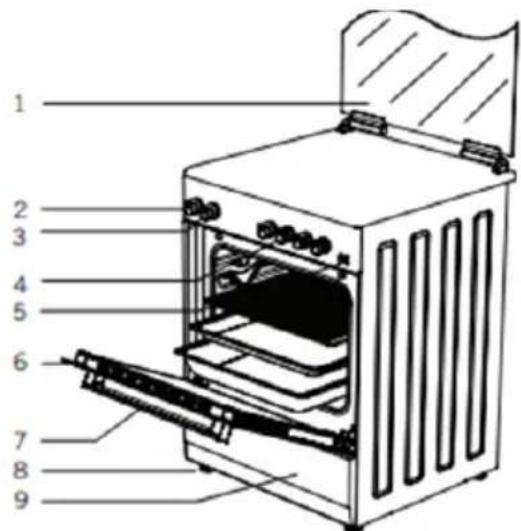
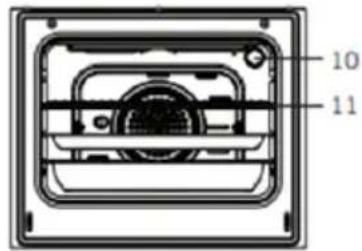
4. PARTS DESCRIPTION
- Glassdoor (Sheet metal door).
- Termostatsetting.
3.OvenSetting. - Cooker section control switches.
- Push button lighter*.
- Door.
- Handle.
- Plastic leg.
- Lower cabinet door.
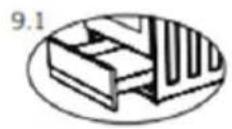
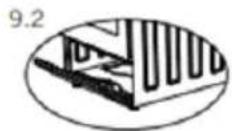
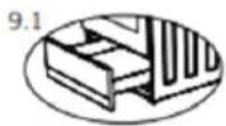
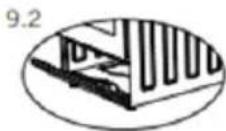
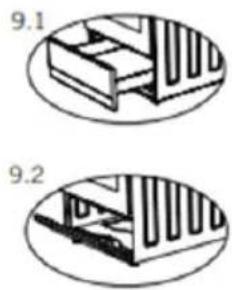
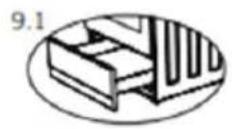
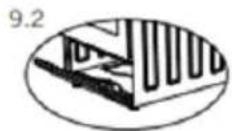
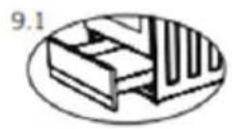
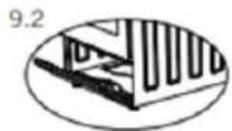
9.1. Drawer*
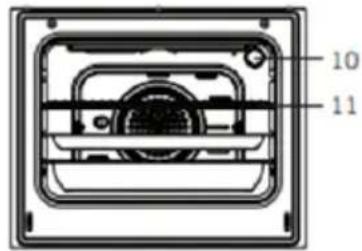
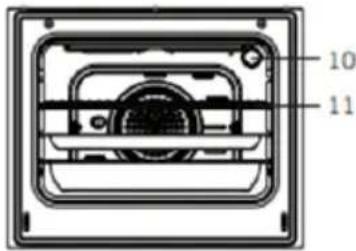
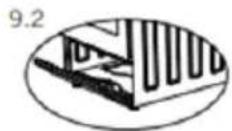
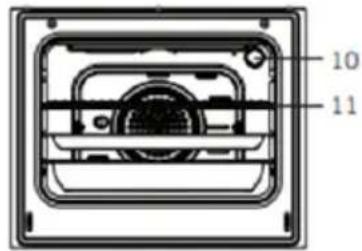
9.2. Flap door*. - Lamp.
- Grill.
- Large burner.
- Middle burner.
- Auxiliary burner.
- Work burner*.
- Hot plate*
(∅ 145mm or ∅185mm).
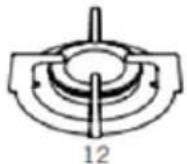
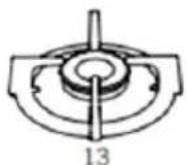
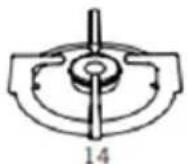
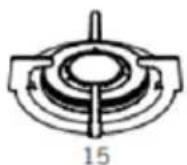
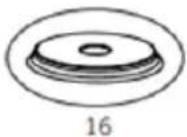
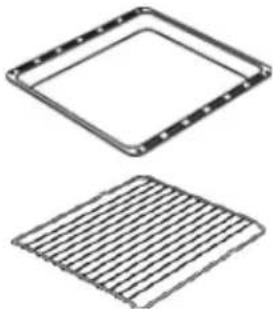
Accessories:
1- Tray / Glass tray: Used for pastry (cookie, biscuit etc.), frozen foods.
2-Wire grill: Used for roasting or placing foods to be baked, roasted and frozen into desired rack.
natural_image
Two technical diagrams showing a square plate and a grid-patterned rectangular structure (no text or symbols)INSTALLATION OF YOUR OVEN: Electrical Connection
- Your oven requires 16 or 32 Ampere fuse according to the appliance's power. If necessary, installation by a qualified electrician is recommended.
- Your oven is adjusted in compliance with 220-240V AC/380-415V AC 50/60Hz.electric supply. If the mains are different from this specified value, contact your authorized service.
- Electrical connection of the oven should only be made by the sockets with earth system installed in compliance with the regulations. If there is no proper socket with earth system in the place where the oven will be placed, immediately contact a qualified electrician. Manufacturer shall never be responsible from the damages that will arise because of the sockets connected to the appliance with no earth system. If the ends of the electrical connection cable are open, according to the appliance type, make a proper switch installed in the mains by which all ends can be disconnected in case of connecting / disconnecting from / to the mains.
- If your electric supply cable gets defective, it should definitely be replaced by the authorized service or qualified electricians in order to avoid from the dangers.
- Electrical cable should not touch the hot parts of the appliance.
- Please operate your oven in dry atmosphere.
ELECTRICAL CONNECTION SCHEME
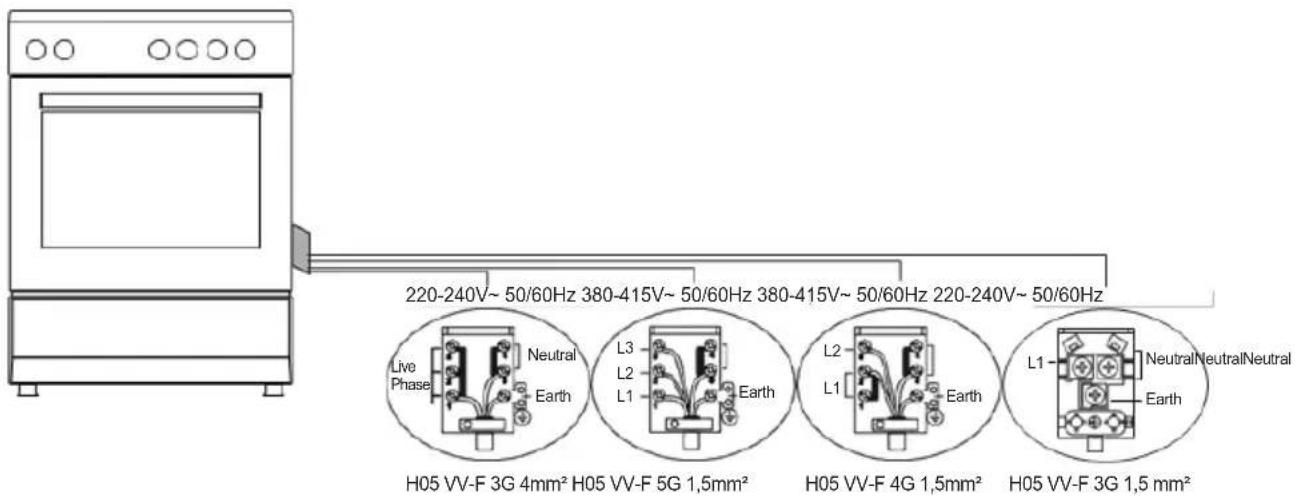
Check if the electrical installation is proper to bring the appliance in operating condition. If electricity installation is not suitable, call an electrician and plumber to arrange the utilities as necessary. Manufacturer shall not be held responsible for damages caused by operations performed by unauthorized persons.
WARNING: It is customer's responsibility to prepare the location the product shall be placed on and also to have the electrical installation prepared.
WARNING: The rules in local standards about electrical installations shall be followed during product installation.
WARNING: Check for any damage on the appliance before installing it. Do not have the product installed if it is damaged. Damaged products cause a risk for your safety.
Right Place For Installation And Important Warnings:
Appliance feet should not stay on soft surfaces such as carpets. The kitchen floor shall be durable to carry the unit weight and any other kitchenware that may be used on the oven.
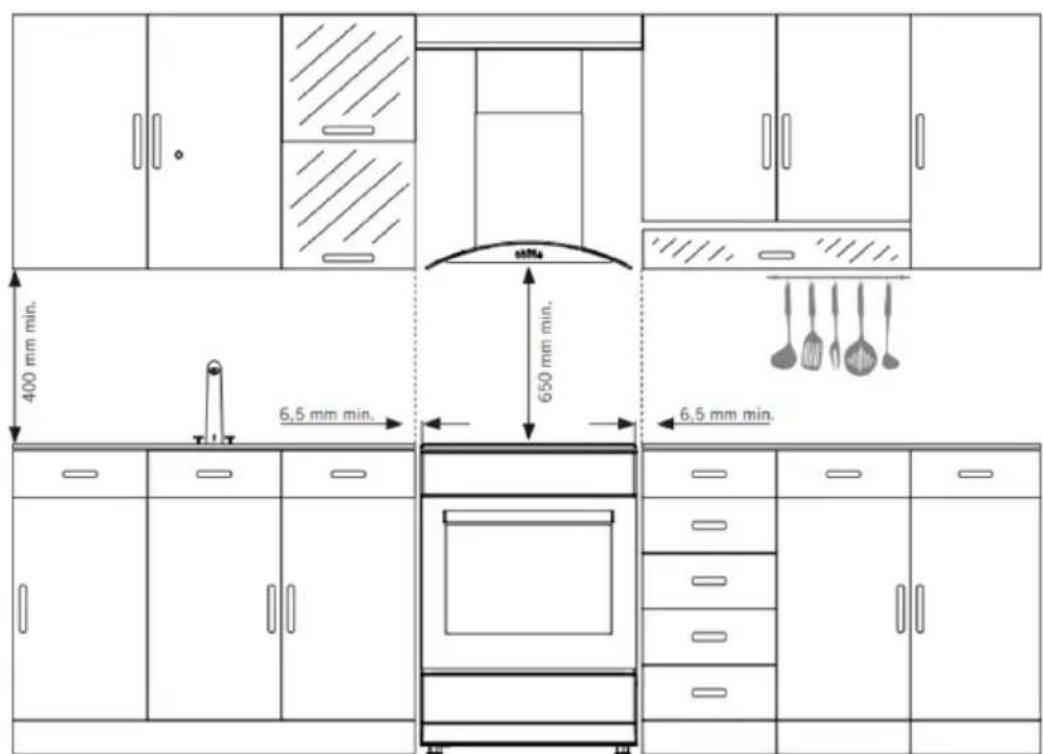
Appliance should be used with a clearance of minimum 400 mm over the upper hob surfaces, and 6.5 mm from side surfaces inside a kitchen furniture.
The appliance is suitable for use on both side walls, without any support, or without being installed in a cabinet. If a hood or aspirator will be installed above the cooker, follow the instructions of the manufacturer for height of mounting. (min. 650 mm).
WARNING: The kitchen furniture near the appliance must be heat resistant.
WARNING: Do not install the appliance beside refrigerators or coolers.
Heat radiated by the appliance increases the energy consumption of cooling devices.
WARNING: Do not use the door and/or handle to carry or move the appliance.
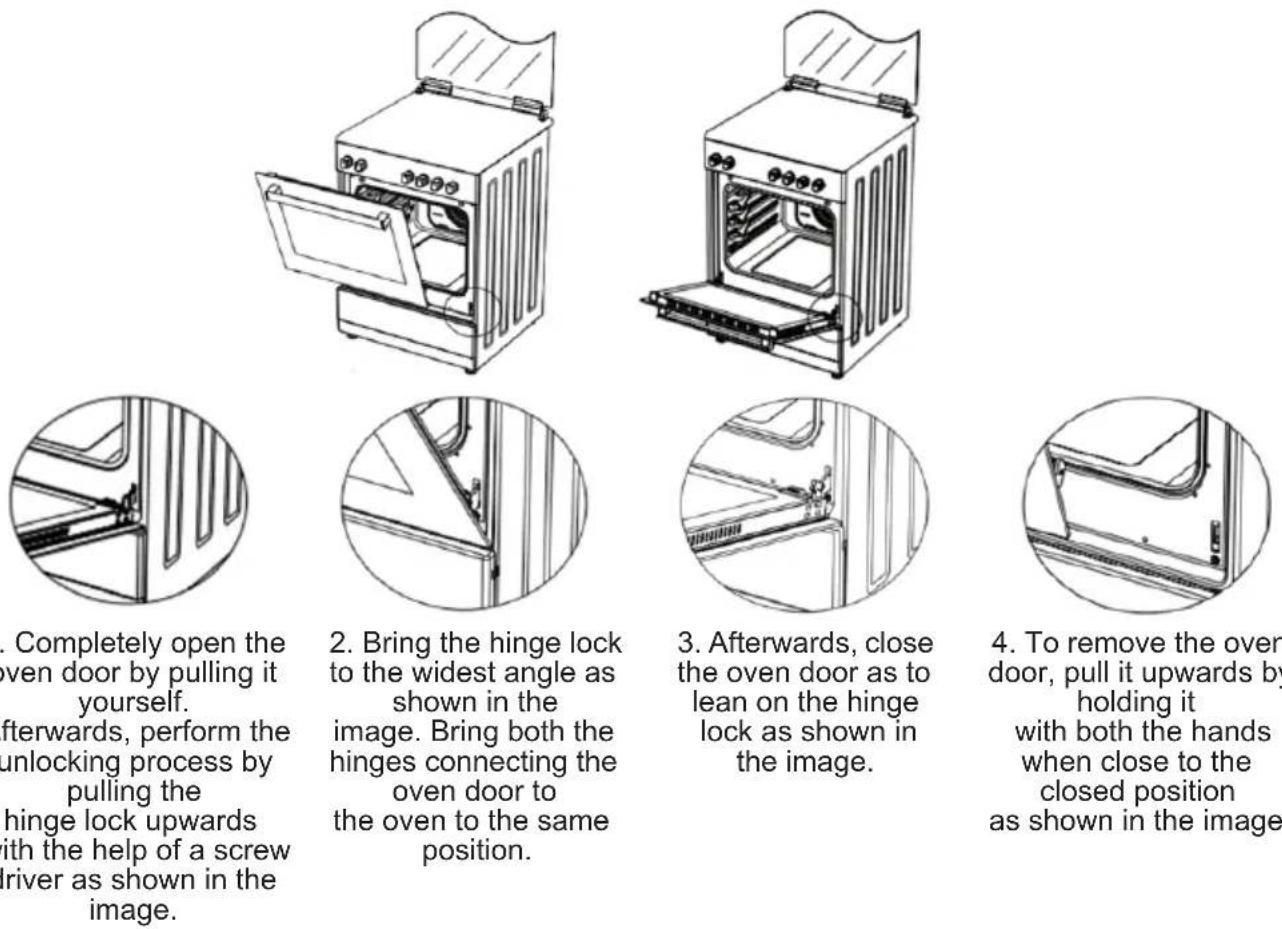
Installation of the Oven Door:
-
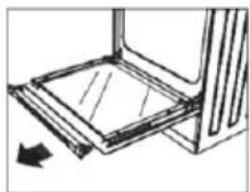
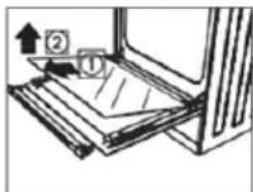
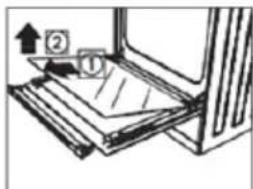
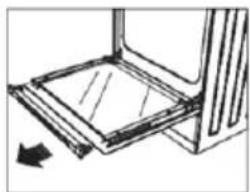
Completely open the oven door by pulling it yourself. Afterwards, perform the unlocking process by pulling the hinge lock upwards with the help of a screw driver as shown in the image.
-
Bring the hinge lock to the widest angle as shown in the image. Bring both the hinges connecting the oven door to the oven to the same position.
-
Afterwards, close the oven door as to lean on the hinge lock as shown in the image.
-
To remove the oven door, pull it upwards by holding it with both the hands when close to the closed position as shown in the image.
Note: In order to re-place the oven door, perform the above-mentioned steps in reverse.
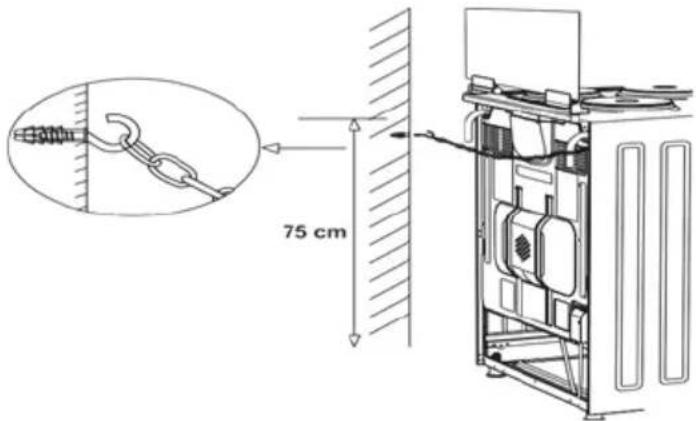
Chain Lashing Illustration
Before using the appliance, in order to ensure safe use, be sure to fix the appliance
to the wall using the chain and hooked screw supplied. Ensure that the hook is screwed into the wall securely.
Gas Connection:
WARNING: Before starting any work related with gas installation, turn off gas supply. Risk of explosion. Please operate your oven in dry atmosphere.
- Fit the clamp to the hose. Push one of the hoses until it goes to the end of the pipe.
- For the sealing control; ensure that the buttons in the control panel are closed, but the gas cylinder is open. Apply some soap bubbles to the connection. If there is gas leakage, there will be foaming in the soaped area.
- The oven should be using a well ventilation place and should be install on flat ground.
- Re-inspect the gas connection.
- When placing your oven to its location, ensure that it is at the counter level. Bring it to the counter
level by adjusting the feet if necessary.
- Do not make gas hose and electrical cable of your oven go through the heated areas, especially through the rear side of the oven. Do not move gas connected oven. Since the forcing shall loosen the hose, gas leakage may occur.
- Please use flexible hose for gas connection.
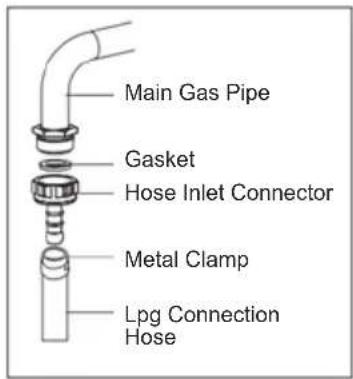
For LPG connection
For LPG (cylinder) connection, affix metal clamp on the hose coming from LPG cylinder. Affix an edge of the hose-on-hose inlet connector behind the appliance by pushing to end through heating the hose in boiled water. Afterward, bring the clamp towards end section of the hose and tighten it with screwdriver. The gasket and hose inlet connector required for connection is as the picture shown below.
Note: The regulator to be affixed on LPG cylinder should have 300 mm SS feature.
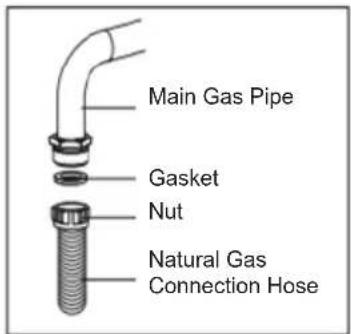
For Natural Gas connection
WARNING: Natural gas connection should be done by authorized service. For natural gas connection, place gasket in the nut at the edge of natural gas connection hose. To install the hose on main gas pipe, turn the nut. Complete the connection by making gas leakage control.
Gas hose passage way:
Connect the appliance to the gas piping tap in shortest possible route and in a way that ensure no gas leakage will occur. In order to carry on a tightness and sealing safety check ensure that the knobs on the control panel are closed and the gas cylinder is open.
WARNING: While performing a gas leakage check, never use any kind of lighter, match, cigarette or similar burning substance.
Apply soap bubble on the connection points. If there is any kind of leakage then it will cause bubbling. While inserting the appliance in place ensure that it is on the same level with the worktop.
If required adjust the legs inorder the make level with the worktop. Use the appliance on a level surface and in a well ventilated environment.
WARNING: Before placing the appliance, check that the local distribution conditions (gas type and pressure) conform to the product settings.
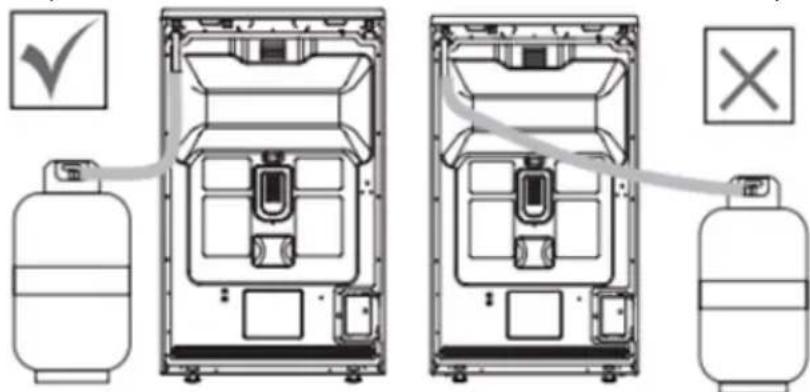
Figure 1 Figure 2
Nozzle change Operation:
- Please use driver with special head for removed and install nozzle as. (figure 3)
- Please remove nozzle (figure 4) from burner with special nozzle driver and install new nozzle. (figure 5).

Figure 3 Figure 4 Figure 5
Ventilation of room:
The air needed for burning is received from room air and the gases emitted are given directly in room. For safe operation of your product, good room ventilation is a precondition. If no window or room to be utilized for room ventilation is available, additional ventilation should be installed. However, room has a door opening outside, it is no needed to vent holes.
| Room size Ventilating | opening |
| Smaller than 5 m^3 | min. 100 cm^2 |
| Between 5 m^3 - 10 m^3 | min. 50 cm^2 |
| Bigger than 10 m^3 | no need |
| In basement or cellar min. 65 cm ^2 | |
Reduced gas flow rate setting for hob taps
- Ignite the burner that is to be adjustment and turn the knob to the reduced position.
- Remove the knob from the gas tap.
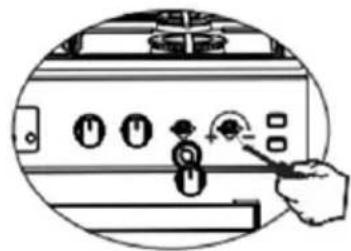
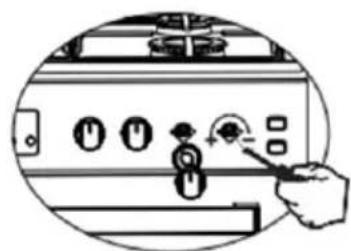
- Use an appropriately sized screwdriver to adjust the flow rate adjustment screw. For LPG (butane-pro pane) turn the screw clockwise. For the naturel gas, you should turn the screw counterclockwise once. "The normal length of a straight flame in the reduced position should be 6-7 mm."
- If the flame is higher then the desired position, turn the screw clockwise. If it is smaller turn anticolockwise.
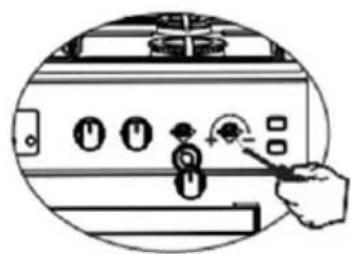
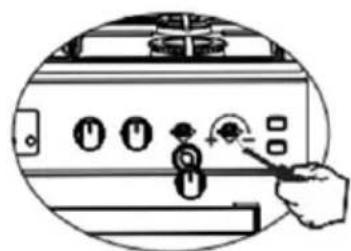
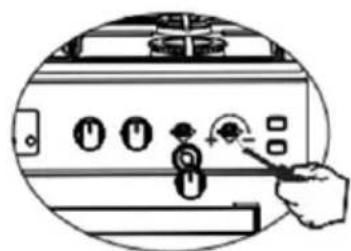
- For the last control, bring the burner both to high-flame and reduced positions and check whether the flame is on or off. Depending on the type of gas tap used in your appliance the adjustment screw position may vary. To adjust your oven acc. to the gas type, make the adjustment for reduced flame carefully by turning with a small screwdriver as shown below on the screw in the middle of the gas cocks as well as nozzle changes. (figure 6 and 7).
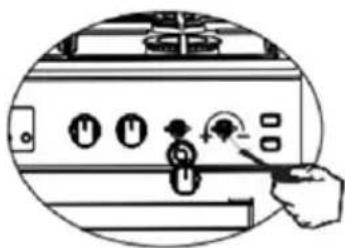
natural_image
Illustration of a hand pressing down on a control panel with buttons and dials (no text or symbols visible)Figure 6
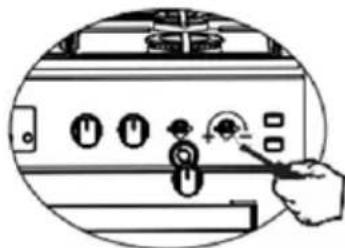
natural_image
Diagram of a hand pressing a button on a control panel with buttons and indicators (no text or symbols present)Figure 7
Removal of the lower and upper burner and installation of the injector to the gas oven: Removal of the upper burner:
With the help of a screw driver, remove the screw as shown in figure 8. As shown in figure 9, remove the burner from its place by pulling it to yourself. As shown in figure 10, remove the injector in the bearing with a socket wrench. In order to re-place the burner, apply the removal process reversely.
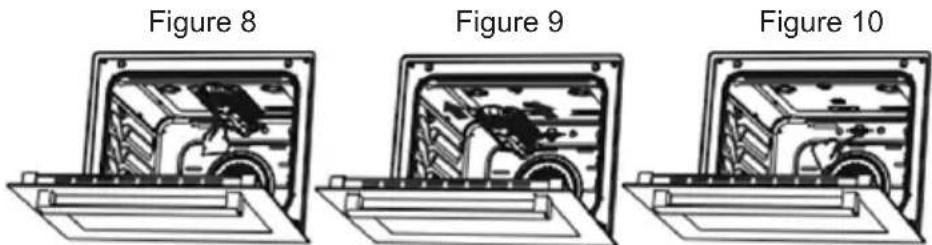
Removal of the lower burner:
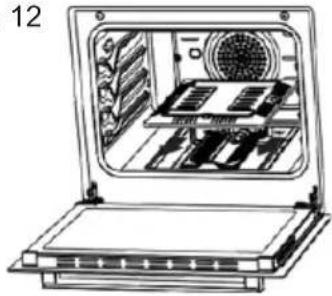
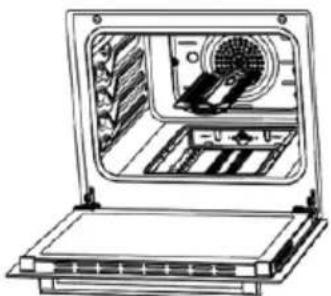
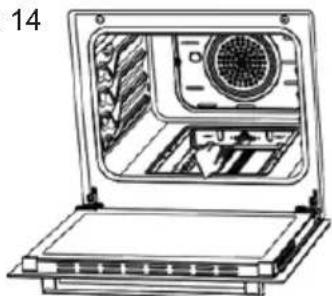
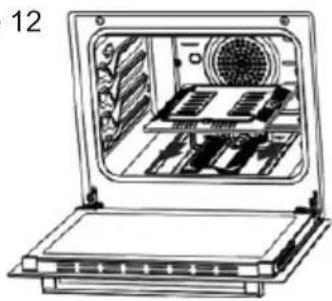
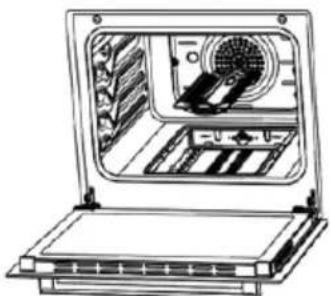
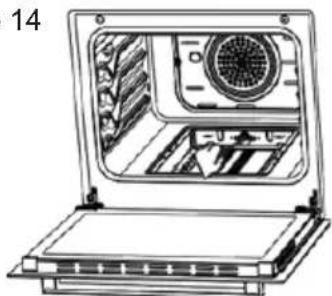
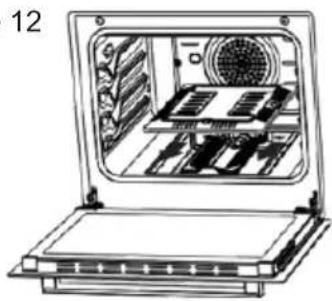
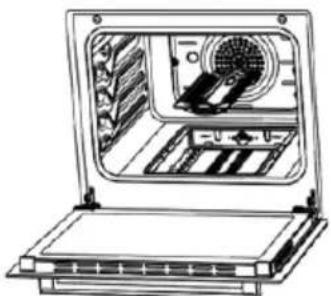
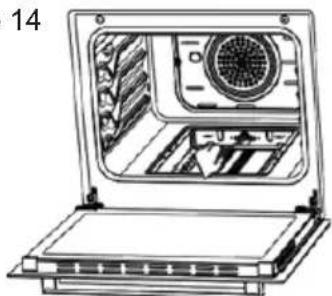
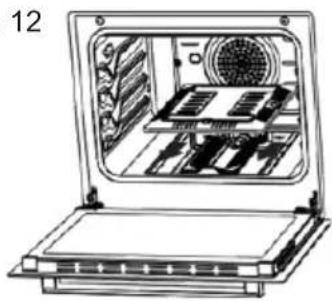
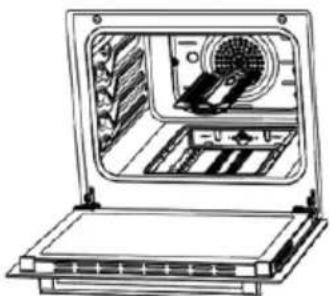
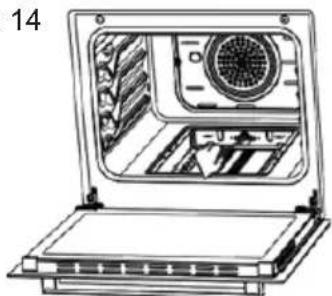
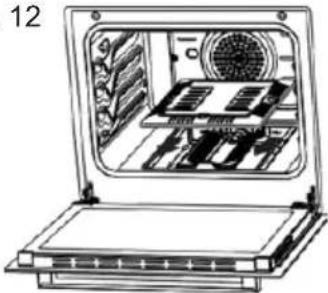
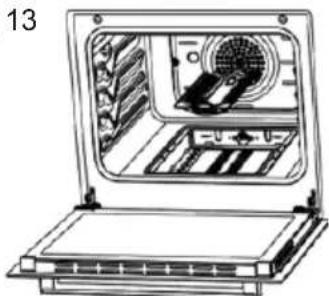
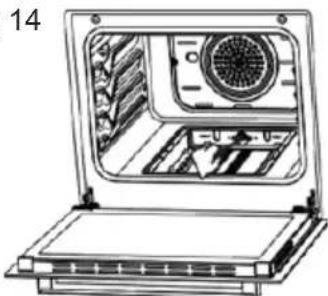
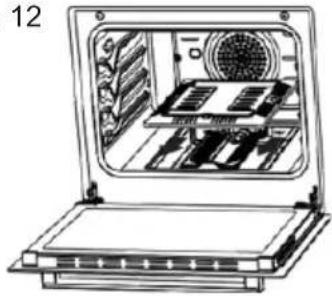
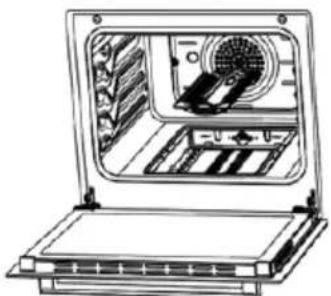
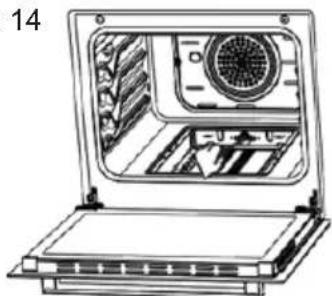
The lower burner door has been fixed with two screws. As shown in figure 11, remove it with the help of a screw driver. Remove the door by pulling upwards as shown in figure 12. Remove the burner from its place by pulling it to yourself as shown in figure 13. As shown in figure 14, remove the injector in the bearing with a socket wrench. In order to replace the burner, apply the removal process reversely.
Figure 11
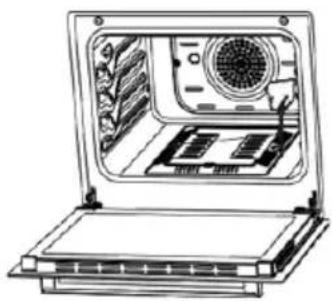
natural_image
Line drawing of an open laptop with internal components (no text or symbols)Figure 12
natural_image
Line drawing of an open laptop with internal components and ventilation slots (no text or symbols)Figure 13
natural_image
Technical line drawing of an open laptop with internal components (no text or symbols)Figure 14
natural_image
Technical line drawing of an open laptop with internal air vent and ventilation slots (no text or symbols)5. INSTRUCTIONS FOR USE
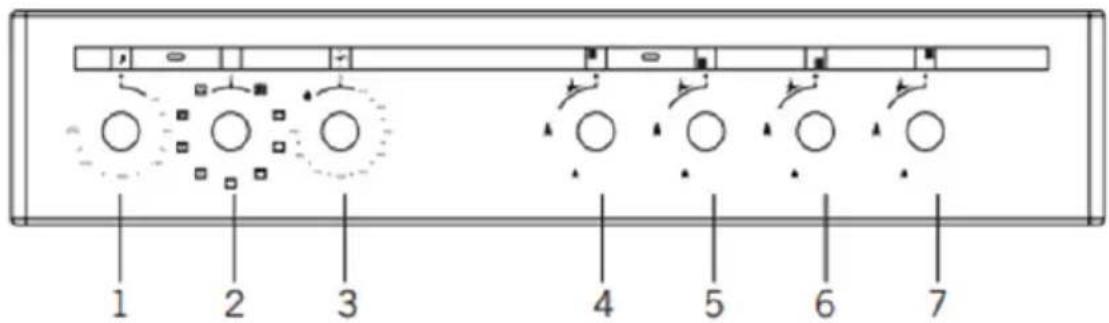
Control Panel:
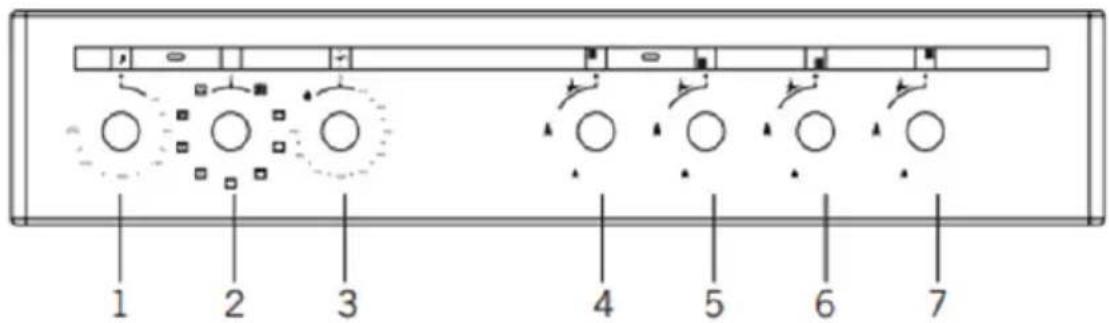
1- Thermostat.
5- Front left heater.
2- Function selection button.
6- Front right heater.
3- Mechanical timer.
7- Rear right heater.
4- Rear left heater.
WARNING: The control panel above is only for illustration purposes. Consider the control panel on your device.
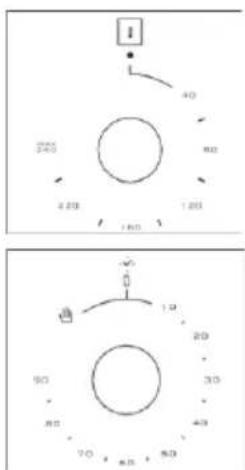
Thermostat: Used for determining the cooking temperature of the dish to be cooked in the oven. After placing the food inside the oven, turn the switch to adjust desired temperature setting between 40-240 °C. For cooking temperatures of different food, see cooking table.
Mechanical timer*: Used for determining the period for cooking in the oven. When adjusted time is expired, power to heaters is turned off and an audible warnig signal is emitted. Mechanical timer can be adjusted to desired period between 0-90 minutes. For cooking periods, see cooking tables.
How to Use Oven:
Using Oven Burner
- If your oven equipped with burners that operates with gas, appropriate knob should be used in order to ignite the burners. Some models have automatic ignition from the knob; it is easy to ignite the burner by turning the knob. Also, burners can be ignited by pressing the ignition button or they can be ignited with a match or a lighter.
- Do not continuously operate the igniter for more than 15 seconds. If the burner does not ignite, wait minimum one minute before trying again. If the burner is extinguished for any reason, close the gas control valve and wait a minimum of one minute before trying again.
Using Oven Heating Elements:
- When your oven is operated first time, an odour will be spread out which will be sourced from using the heating elements. In order to get rid of this, operate it at 240 °C for 45-60 minutes while it is empty.
- Oven control knob should be positioned to desired value; otherwise, oven does not operate.
- Kinds of meals, cooking times and thermostat positions are given in cooking table. The values given in the cooking table are characteristic values and were obtained as a result of the tests performed in our laboratory. You can find different flavours suitable for your taste depending on your cooking and using habits.
- You can make chicken revolving in your oven by means of the accessories.
- Cooking times: The results may change according to the area voltage and material having different quality, amount and temperatures.
- During the time when cooking is being performed in the oven, the lid of the oven should not be opened frequently. Otherwise circulation of the heat may be imbalanced and the results may change.
Using the Grill:
- When you place the grill on the top rack, the food on the grill shall not touch the grill.
- You can preheat for 5 minutes while grilling. If necessary, you may turn the food upside down.
- Food shall be in the center of the grill to provide maximum air flow through the oven.
To turn the Grill ON:
- Place the function button over the grill symbol.
- Then, set it to the desired grill temperature.
To turn the Grill OFF:
- Set the function button to the OFF position.
WARNING: Keep the oven door closed while grilling. (electrical grill with thermostat)
WARNING: Keep the oven door opened while grilling. (gas and electric grill without thermostat).
Using The Chicken Roasting:
Place the spit on the frame. Slide turn spit frame into the oven at the desired level. Locate a dripping pan through the bottom in order to collect the fast. Add some water in dripping pan for easy cleaning. Do not forget to remove plastic part from spit. After grilling, screw the plastik handle to the skewer and take out the food from oven.
How to use Cooker:
Using gas burners
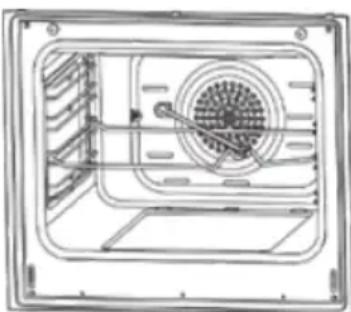
Flame cut-off safety device (FFD) *; operates instantly when safety mechanism activates due to overflown liquid over upper hobs.
natural_image
Technical line drawing of a mechanical or electrical component with internal fan and housing (no text or symbols)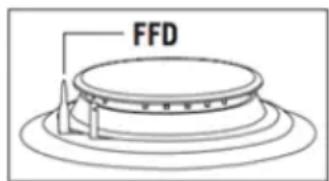
-
The valves controlling the gas cookers have special security mechanism. In order to light the cooker always press on the switch forward and bring it to flame symbol by turnin counter clockwise. All of the lighters shall operate and the cooker you controlled shall light only. Keep the switch pressed until ignition i performed. Press on the lighter button and turn the knob counter clockwise.
-
Do not continuously operate the igniter for more than 15 seconds. If the burner does not ignite, wait minimum one minute before try again.
-
In models with gas security system, when flame of the cooker is extinguished, control valve cuts off the gas automatically. For operate the burners with gas security system you must press the knob and turn counter-clock-wise. After the ignition you must wait nearly 5-10 second for gas security systems activation. If the burner is extinguished for of the any reason, close the gas control valve and wait a minimum of one minute before trying again.
-
Closed. Fully open. Half open.
-
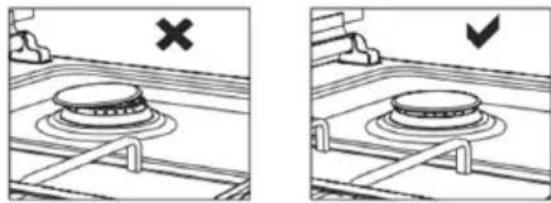
Before operating your hob please make sure that the burner caps are well positioned. The right placement of the burner caps are shown as below.
natural_image
Two-panel diagram showing a circular object on a platform with cross marks and a checkmark, no text or symbols present.Using Hot Plates:
| Level 1 Level | Level 2 Level 3 Level | Level 4 Level | Level 5 Level 6 | |||
| ∅80 mm 200 W 250 W 450 W --- --- --- | ||||||
| ∅145 mm 250 W 750 W 1000 W --- --- --- | ||||||
| ∅180 mm 500 W 750 W 1500 W --- --- --- | ||||||
| ∅145 mm rapid 500 W 1000 W 1500 W --- --- --- | ||||||
| ∅180 mm rapid 850 W 1150 W 2000 W --- --- --- | ||||||
| ∅145 mm 95 W 155 W 250 W 400 W 750 W 1000 W | ||||||
| ∅180 mm 115 W 175 W 250 W 600 W 850 W 1500 W | ||||||
| ∅145 mm rapid 135 W 165 W 250 W 500 W 750 W 1500 W | ||||||
| ∅180 mm rapid 175 W 220 W 300 W 850 W 1150 W 2000 W | ||||||
| ∅220 mm 220 W 350 W 560 W 910 W 1460 W 2000 W | ||||||
-
Electric hotplates have standard of 6 temperature levels. (as describe herein above)
-
When using first time, operate your electric hotplate in position 6 for 5 minutes. This will make the agent on your hotplate which is sensitive to heat get hardened by burning.
-
Use flat bottomed saucepans which fully contact with the heat as much as you can, so that you can use the energy more productively.
Pot Sizes:
| 50*55 50*60 60*60 | |||
| Small burner | 12-18 cm | 12-18 cm | 12-18 cm |
| Normal burner | 18-20 cm | 18-20 cm | 18-20 cm |
| Big burner | 22-24 cm | 22-26 cm | 22-26 cm |
| WOK burner | 24-28 cm | --- 24-26 cm | |
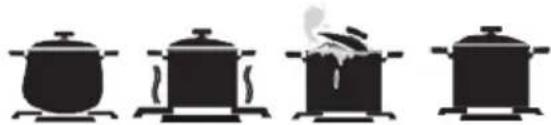
natural_image
Four black-and-white illustrations of cooking pots: a pot, a pot with steam rising, a pot with steam dropping, and a pot (no text or symbols)Incorrect Incorrect Incorrect Correct
Program Types:
Function Button: Used for determining the heaters to be used for cooking the dish to be cooked in the oven. Heater program types in this button and their functions are described below. All heater types and program types consisting of these heaters may not be available at all models.
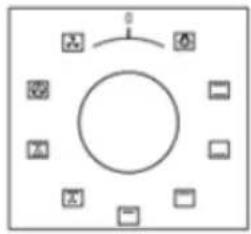
natural_image
Simple circular diagram with surrounding geometric shapes and a small arc on top (no text or symbols) | Roast chicken Fan |  | |
 | Lower and upper heating elements |  | Turbo heating and fan |
 | Lamp Lower-upper heating element |  | and fan |
 | Lower heating element and fan | [Gri fan] | |
 | Grill and roast chicken Grill |  | |
 | Grill and lamp Upper heating element |  | |
 | Electrical timer Lower heating element |  | |
 | Flame Ignition lighter |  |
WARNING: All heater types and program types consisting of these heaters may not be available at all models.
Cooking Time Table:
WARNING: Oven must be preheated for 10 minutes before placing the food in it.
| Foods Cooking function Temperature | (°C) | Rack position | Cooking duration (min.) | |
| Cake (Tray / Mold) Static | / Static+Fan 170-180 | 2 35-45 | ||
| Small cakes | Static / Turbo+Fan 170 | -180 2 25-30 | ||
| Patty | Static / Static+Fan 180 | -200 2 35-45 | ||
| Pastry | Static | 180-190 2 25-30 | ||
| Cookie | Static | 170-180 3 20-25 | ||
| Apple pie | Static / Turbo+Fan 180 | -190 2 50-70 | ||
| Sponge cake | Static | 200/150 * | 2 20-25 | |
| Pizza | Static+Fan | 180-200 3 20-30 | ||
| Lasagna | Static | 180-200 2 25-40 | ||
| Meringue Static 100 2 60 | ||||
| Chicken Static+Fan / | Turbo+Fan | 180-190 2 45-50 | ||
| Grilled chicken ** Grill 200-220 4 25-30 | ||||
| Grilled fish ** | Grill+Fan 200-220 4 25-30 | |||
| Sirloin steak ** Grill+Fan Max. 4 15-20 | ||||
| Grilled meat balls ** | Grill Max. | 4 20-25 | ||
* Without pre-heating. Half of the cooking should be 200°C and then second half should be 150°C.
** During the half of cooking, meal should be turned around.
5. CLEANING AND MAINTENANCE:
- Disconnect the plug supplying electricity for the oven from the socket.
- While oven is operating or shortly after it starts operating, it is extremely hot. You must avoid touching from heating elements.
- Never clean the interior part, panel, lid, trays and all other parts of the oven by the tools like hard brush, cleaning mesh or knife. Do not use abrasive, scratching agents and detergents.
- After cleaning the interior parts of the oven with a soapy cloth, rinse it and then dry thoroughly with a soft cloth.
- Clean the glass surfaces with special glass cleaning agents.
- Do not clean your oven with steam cleaners.
- Before opening the upper lid of the oven, clean spilled liquid off the lid. Also, before closing the lid, ensure that the cooker table is cooled enough.
- Never use inflammable agents like acid, thinner and gasoline when cleaning your oven.
- Do not wash any part of your oven in dishwasher.
- In order to clean the front glass lid of the oven; remove the fixing screws fixing the handle by means of a screwdriver and remove the oven door. Than clean and rinse it thoroughly. After drying, place the oven glass properly and re-install the handle.
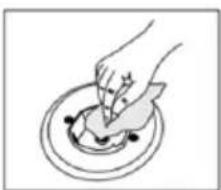
natural_image
Illustration of a hand pressing down on a circular object with dots, no text or symbols present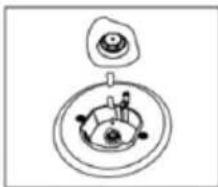
natural_image
Simple line drawing of a mechanical or electrical component with no text or symbols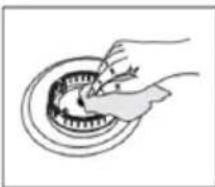
natural_image
Illustration of a hand using a tool to clean or wash a circular object (no text or symbols visible)Cleaning and Maintenance of Oven's Front Door Glass:
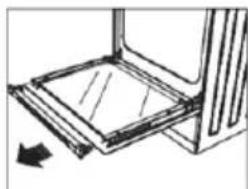
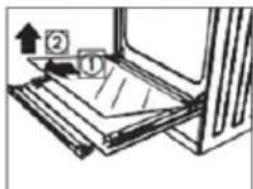
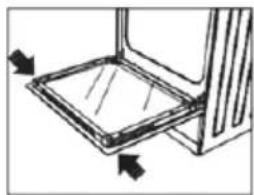
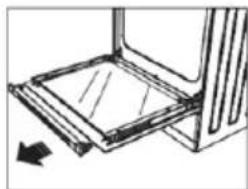
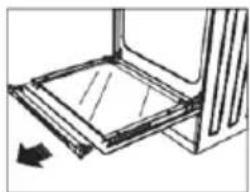
Remove the profile by pressing the plastic latches on both left and right sides as shown in figure 15 and pulling the profile towards yourself as shown in figure 16. Then remove the inner-glass as shown in figure 17. If required, middle glass can be removed in the same way. After cleaning and maintenance are done, remount the glasses and the profile in reverse order. Make sure the profile is properly seated in its place.
natural_image
Diagram of a square frame mounted on a vertical support structure, with arrows indicating direction (no text or symbols)Figure 15
natural_image
Technical line drawing of a mechanical assembly with no visible text or symbolsFigure 16
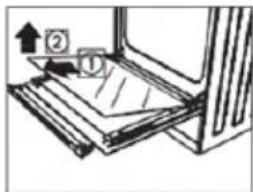
Figure 17
If required, middle glass can be removed in the same way. After cleaning and maintenance are done, remount the glasses and the profile in reverse order. Make sure the profile is properly seated in its place.
Catalic Walls\*:
Catalytic walls are located on the left and the right side of cavity under the guides. Catalytic walls banish the bad smell and obtain the best performance from the cooker.
Cata- lytic walls also absorb oil residue and clean your oven while it's operating.
Removing the catalytic walls
In order to remove the catalytic walls; the guides must be pulled out. As soon as the guides are pulled out, the catalytic walls will be released automatically. The catalytic walls must be changed after 2-3 years.
Rack Positions:
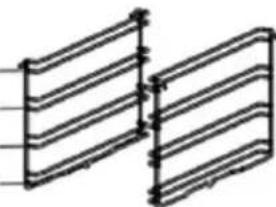
It is important to place the wire grill into the oven properly.
Do not allow wire rack to touch rear wall of the oven.
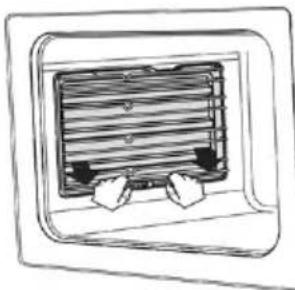
Rack positions are shown in the next figure. You may place a deep tray or a standard tray in the lower and upper wire racks.
natural_image
Simple line drawing of a heating element inside a frame, showing heat distribution and cooling mechanism (no text or symbols)Rack 4
Rack 3
Rack 2
Rack 1
natural_image
Pure electrical circuit lines without any symbolsInstalling and removing wire racks:
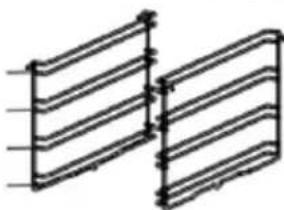
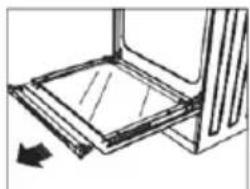
To remove wire racks, press the clips shown with arrows in the image above, first remove the lower, and then the upper side from installation location. To install wire racks; reverse the procedure for removing wire rack.
Changing The Oven Lamp:
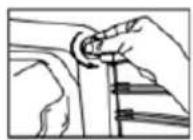
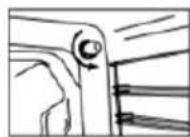
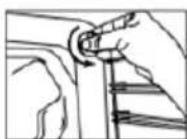
To avoid electric shock, ensure that the appliance circuit is open before changing the lamp. (having circuit open means the power is off). First disconnect the power of the appliance and ensure that appliance is cold. Remove the glass protection by turning as indicated in the image.
If you have difficulty in turning, then using plastic gloves that will help you in turning. Then remove the lamp by turning, install the new lamp with the same specifications. Reinstall the glass protection, plug the power cable of appliance into electrical socket and complete replacement. Now you can use your oven.
Type G9 Lamp Type E14 Lamp
220-240 V, AC
15-25 W
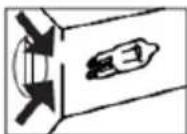
220-240 V, AC
15 W
Warning: This product contains a light source of energy efficiency class G.
Using the Grill Deflector Sheet(Optional):
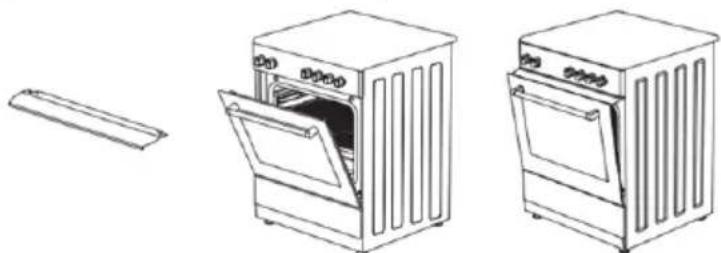
- A safety panel is designed to protect the control panel and the buttons when the oven is in grill mode (as shown in the first image below).
- Please use this safety panel in order to avoid the heat to damage control panel and the buttons when the oven is grill mode.
WARNING: Accessible parts may be hot when the grill in use. Young children should be kept away.
- Place the safety panel under control panel by opening the oven front cover glass. (second image).
- And then secure the safety panel in between oven and front cover by gently closing the cover. (third image)
- It is important for cooking to keep the cover open in specified distance when cooking in grill mode.
- Safety panel will provide an ideal cooking circumstance while protecting control panel and buttons.
WARNING: If the cooker has the "closed grill functioned" option with thermostat, you can keep the oven door closed during operation; in this case the grill deflector sheet will be unnecessary.
natural_image
Line drawings of three different kitchen appliances: a front-loading oven, an open door, and a second portable oven (no text or symbols present)Troubleshooting:
You may solve the problems you may encounter with your product by checking the following points before calling the technical service.
Check Points:
In case you experience a problem about the oven, first check the table below and try out the suggestions.
| N°. | Problem Possible cause | What to do | ||
| 1 Oven does not Operate Power | supply not available Check for power supply | |||
| Gas supply not available. Check if main gas valve is open. | ||||
| 2 Oven stops during cooking | Plug comes out from the wall socket | Re-install the plug into wall socket. | ||
| 3 Turns off during coo-king | Too long continuous operation Let the oven cool down after long cooking cycles | |||
| More than one plugs in a wall socket | Use only one plug for each wall socket. | |||
| 4 Oven door is not opening properly | Food residues jammed between the door and internal cavity | Clean the oven well and try to re-open the door. | ||
| 5 Lighter not operating Tips or body of ignition plugs are clogged | Clean tips or body of ignition plugs of gas burner | |||
| Gas burner pipes are clogged. Clean gas burner pipes. | ||||
| 6 Electric shock when touching the oven | No proper grounding Make sure power supply is grounded properly. | |||
| Ungrounded wall socket is used | ||||
| 7 Water dropping Water or steam may generate rate under certain conditions depending on the food being cooked. This is not a fault of the appliance. | Let the oven cool down and than wipe dry with a dish cloth. | |||
| 8 Steam coming out from a crack on oven door | ||||
| 9 Water remaining inside the oven. | ||||
| 10 Oven does not heat Oven door is open Close the door and restart. | ||||
| 11 Smoke coming out during operation | When operating the oven for the first time. | Smoke comes out from the heaters. This is not a fault. After 2-3 cycles, there will be no more smoke. | ||
| Food on heater. Let the oven to cool down and clean food residues from the heater. | ||||
| 12 When operating the oven burnt or plastic odour coming out. | Plastic or other not heat resistant accessories are being used inside the oven. | At high temperatures, use suitable glassware accessories. | ||
| 13 Oven does not cook well | Oven door is opened frequently during cooking. | Do not open oven door frequently, if the food you are cooking does not require turning. If you open the door frequently internal temperature drops and therefore cooking result will be influenced. | ||
| 14 Internal light is dim or does not operate. | Foreign object covering the lamp during cooking. | Clean internal surface of the oven and check again. | ||
| Lamp might be failed. Replace with a lamp with same specifications. | ||||
Handling Rules:
- Do not use the door and/or handle to carry or move the appliance.
2.Carry out the movement and transportation in the original packaging. - Pay maximum attention to the appliance while loading/unloading and handling.
- Make sure that the packaging is securely closed during handling and transportation.
5.Protect from external factors (such as humidity, water, etc.) that may damage the packaging. - Be careful not to damage the appliance due to bumps, crashes, drops, etc. while handling and transporting and not to break or deform it during operation.
Recommendations for Energy Savings:
Following details will help you use your product ecologically and economically.
- Use dark coloured and enamel containers that conduct the heat better in the oven.
- As you cook your food, if the recipe or the user manual indicates that pre-heating is required, pre-heat the oven.
- Do not open the oven door frequently while cooking.
- Try not to cook multiple dishes simultaneously in the oven. You may cook at the same time by placing two cookers on the wire rack.
- Cook multiple dishes successively. The oven will not lose heat.
- Turn off the oven a few minutes before the expiration time of cooking. In this case, do not open the oven door.
- Defrost the frozen food before cooking.
Environmental Friendly Disposal:
Dispose of packaging in an environmentally-friendly manner.
This appliance is labelled in accordance with European Directive 2012/19/EU concerning used electrical and electronic appliances (waste electrical and electronic equipment - WEEE).
The guideline determines the frame work for the return and recycling of used appliances as applicable throughout to the EU.
Package Information:
Packaging materials of the product are manufactured from recyclable materials in accordance with our National Environment Regulations. Do not dispose of the packaging materials together with the domestic or other wastes. Take them to the packaging material collection points designated by the local authorities.
Cher utilisateur,
natural_image
Two circular diagrams showing mechanical components with no visible text or symbols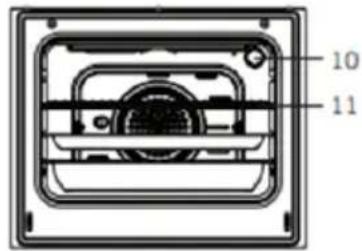
Accessoires :
natural_image
Two technical illustrations of a square plate and a grid-patterned rectangular panel (no text or symbols)natural_image
Line drawing of an open oven with lid open, showing internal components and ventilation slots (no text or symbols)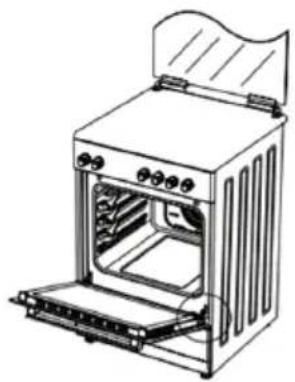
natural_image
Line drawing of an open oven with lid and side panel (no text or symbols)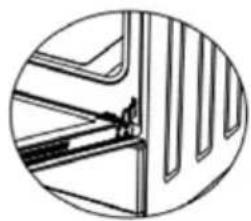
natural_image
Cross-sectional diagram of a vehicle showing structural components and frame (no text or labels)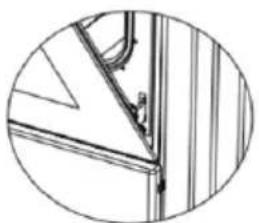
natural_image
Close-up of a mechanical component with diagonal lines and a small protrusion (no visible text or symbols)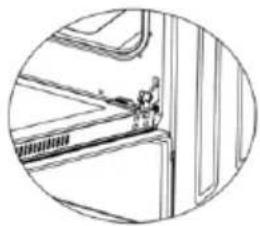
natural_image
Circular sketch of a vehicle interior with a person standing near the window (no text or symbols)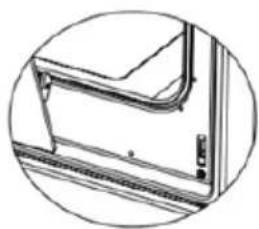
natural_image
Cross-sectional diagram of a door frame with no visible text or symbolsFigure 1 Figure 2
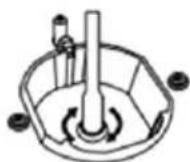
Figure 3 Figure 4 Figure 5
natural_image
Illustration of a hand pressing down on a control panel with buttons and dials (no text or symbols visible)Figure 6
natural_image
Illustration of a hand pressing a button on an electronic control panel (no text or symbols visible)Figure 7
natural_image
Line drawing of an open laptop with internal components (no text or symbols)Figure 12
natural_image
Line drawing of an open laptop with internal components and ventilation slots (no text or symbols)Figure 13
natural_image
Technical line drawing of an open laptop with internal components (no text or symbols)Figure 14
natural_image
Technical line drawing of an open laptop with internal air vent and ventilation slots (no text or symbols)5. MODE D'EMPLOI
natural_image
Technical line drawing of a mechanical component with internal fan and housing (no text or symbols)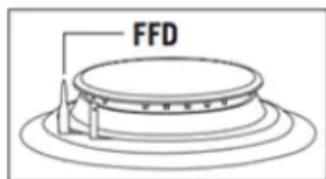
natural_image
Simple line drawing of a circular object on a platform with a cross symbol (no text or labels)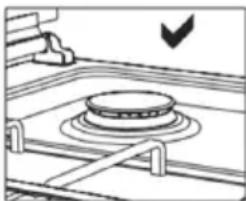
natural_image
Simple line drawing of a stove burner with a circular vent and heating elements (no text or symbols)| Niveau 1 Niveau 2 Niveau 3 Niveau 4 | Niveau 5 Niveau 6 | |||||
| ∅80 mm 200 W 250 W 450 W --- --- --- | ||||||
| ∅145 mm 250 W 750 W 1000 W --- --- --- | ||||||
| ∅180 mm 500 W 750 W 1500 W --- --- --- | ||||||
| ∅145 mm rapide | 500 W | 1000 W | 1500 W | --- | --- | --- |
| ∅180 mm rapide | 850 W | 1150 W | 2000 W | --- | --- | --- |
| ∅145 mm 95 W | 155 W | 250 W 400 W | 750 W 1000 W | |||
| ∅180 mm 115 W | 175 W | 250 W 600 W | 850 W 1500 W | |||
| ∅145 mm rapide | 135 W 165 W | 250 W 500 W | 750 W 1500 W | |||
| ∅180 mm rapide | 175 W 220 W | 300 W 850 W | 1150 W | 2000 W | ||
| ∅220 mm 220 W 350 W 560 W | 910 W 1460 W | 2000 W | ||||
natural_image
Four identical black-and-white illustrations of cooking pots, showing different cooking methods (no text or symbols)Incorrect Incorrect Incorrect Correct
natural_image
Simple circular diagram with surrounding geometric shapes and a small arc, no text or symbols present.natural_image
Illustration of a hand pressing down on a circular object with a small object inside (no text or symbols)
natural_image
Simple line drawing of a mechanical or biological component with no text or symbols
natural_image
Illustration of a hand using a tool to clean or wash a circular object (no text or symbols visible)natural_image
Diagram of a mechanical assembly with arrows indicating direction (no text or symbols)Figure 15
natural_image
Technical line drawing of a mechanical assembly with a base plate and directional arrow (no text or symbols)Figure 16
natural_image
Diagram of a mechanical assembly with numbered components and an upward arrow (no text or symbols)Figure 17
natural_image
Illustration of a door handle with hands installing or adjusting a grid (no text or symbols)Support 4 Support 3 Support 2 Support 1
natural_image
Pure electrical circuit lines without any symbolsnatural_image
Line drawings of three different kitchen appliances: a front-loading oven, a closed door, and a second portable oven (no text or symbols present)Dépannage :
Acessórios:
natural_image
Simple line drawing of a square frame with evenly spaced dots (no text or symbols)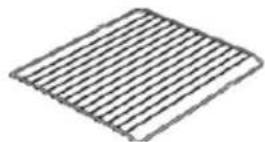
Figura 1 Figura 2
natural_image
Diagram of a hand pressing a button on a control panel (no text or symbols visible)Figura 6
natural_image
Diagram of a hand pressing a button on an electrical control panel (no text or symbols visible)Figura 7
natural_image
Line drawing of an open laptop with internal components and ventilation grille (no text or symbols)Figura 12
natural_image
Line drawing of an open laptop with internal components and ventilation slots (no text or symbols)Figura 13
natural_image
Line drawing of an open laptop with internal air fan and ventilation slots (no text or symbols)Figura 14
natural_image
Technical line drawing of an open laptop with internal air vent and ventilation slots (no text or symbols)natural_image
Technical line drawing of a mechanical component with internal fan and housing (no text or symbols)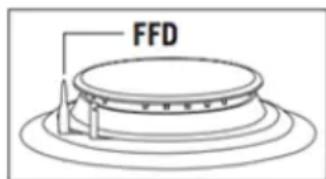
natural_image
Two-panel diagram showing a cooking pan with a lid and a valve, no text or symbols present.natural_image
Four black-and-white illustrations of cooking pots on stovels, with one being stirred and others placed on a pot (no text or symbols)natural_image
Simple circular diagram with surrounding geometric shapes and a small arc, no text or symbols present.natural_image
Illustration of a hand using a tool to clean or brush a circular object (no text or symbols)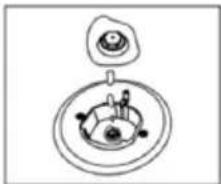
natural_image
Simple line drawing of a biological or mechanical structure with no text or symbols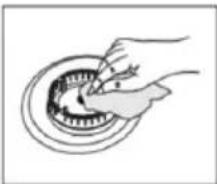
natural_image
Illustration of a hand using a tool to clean or inspect a circular mechanical component (no text or symbols visible)natural_image
Diagram of a mechanical assembly with arrows indicating direction (no text or symbols)Figura 15
natural_image
Technical line drawing of a mechanical assembly with no visible text or symbolsFigura 16
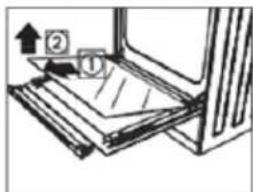
Figura 17
natural_image
Illustration of a door handle with hands installing or adjusting a grid (no text or symbols)natural_image
Pure electrical circuit lines without any symbols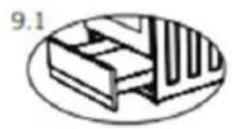
Zubehör:
natural_image
Simple line drawing of a square frame with evenly spaced dots (no text or symbols)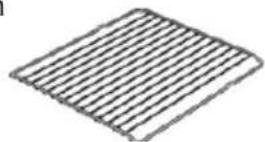
natural_image
Diagram of a control panel with buttons and a hand pointing to the right (no text or symbols)Abbildung 6
natural_image
Illustration of a hand pressing a button on an electrical control panel (no text or symbols visible)Abbildung 7
natural_image
Diagram of an open laptop with internal components and a screen, showing no text or symbolsAbbildung 12
natural_image
Illustration of an open laptop with internal components and a screen (no text or symbols visible)Abbildung 13
natural_image
Line drawing of an open laptop with internal components and a fan (no text or symbols)Abbildung 14
natural_image
Technical line drawing of an open laptop with internal components (no text or symbols)natural_image
Technical line drawing of a mechanical component with internal fan and housing (no text or symbols)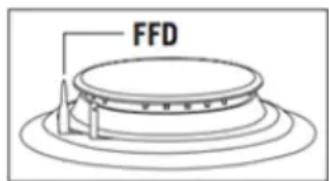
natural_image
Two-panel diagram showing a cooking pan with a lid and a side panel, both marked with X and check symbols (no text or labels)| Stufe 1 Stufe 2 Stufe 3 Stufe 4 Stufe 5 Stufe 6 | |||||
| ∅80 mm 200 W 250 W 450 W --- --- | |||||
| ∅145 mm 250 W 750 W 1000 W --- --- --- | |||||
| ∅180 mm 500 W 750 W 1500 W --- --- --- | |||||
| ∅145 mm schnel 500 W 1000 W 1500 W --- --- | |||||
| ∅180 mm schnel 850 W 1150 W 2000 W --- --- --- | |||||
| ∅145 mm 95 W 155 W 250 W 400 W 750 W 1000 W | |||||
| ∅180 mm 115 W 175 W 250 W 600 W 850 W 1500 W | |||||
| ∅145 mm schnel 135 W 165 W 250 W 500 W 750 W 1500 W | |||||
| ∅180 mm schnel 175 W 220 W 300 W 850 W 1150 W 2000 W | |||||
| ∅220 mm 220 W 350 W 560 W 910 W 1460 W 2000 W | |||||
natural_image
Four black silhouette icons showing cooking pots on stovels, with one being cooked and others remaining in place (no text or symbols)natural_image
Simple circular diagram with surrounding geometric shapes and a small arc on top (no text or symbols)natural_image
Illustration of a hand using a tool to clean or brush a circular object (no text or symbols)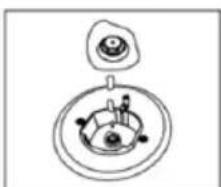
natural_image
Simple line drawing of a mechanical or biological component with no text or symbols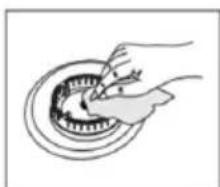
natural_image
Illustration of a hand turning a circular mechanical component (no text or symbols)natural_image
Diagram of a mechanical assembly with arrows indicating direction (no text or symbols)Abbildung 15
natural_image
Technical line drawing of a mechanical assembly with no visible text or symbolsAbbildung 16
natural_image
Illustration of a printer or printer with stacked sheets and a paper clip, no visible text or symbolsAbbildung 17
natural_image
Line drawing of a door with a grating and two hands adjusting the grille (no text or symbols)Rack-Positionen:
natural_image
Pure electrical circuit lines without any symbolsnatural_image
Line drawings of three different kitchen appliances: a front-loading oven, a closed door, and a second portable oven (no text or symbols present)Fehlersuche:
Accessori:
natural_image
Simple line drawing of a square frame with evenly spaced dots (no text or symbols)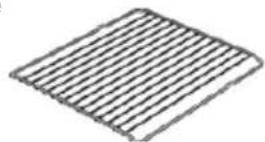
Figura 1 Figura 2
natural_image
Illustration of a hand pressing down on a control panel with buttons and dials (no text or symbols visible)Figura 6
natural_image
Illustration of a hand pressing a button on an electrical control panel (no text or symbols visible)Figura 7
natural_image
Line drawing of an open laptop with internal components and a fan (no text or symbols)Figura 12
natural_image
Technical line drawing of an open industrial oven with internal components (no text or symbols)Figura 13
natural_image
Line drawing of an open laptop with internal components and ventilation slots (no text or symbols)Figura 14
natural_image
Technical line drawing of an open laptop with internal air vent and ventilation slots (no text or symbols)5. ISTRUZIONI PER L'USO
natural_image
Technical line drawing of a mechanical component with internal fan and housing (no text or symbols)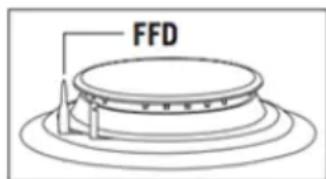
natural_image
Two identical diagrams showing a plate being heated by a switch, with no text or symbols present.| Livello 1 Livello 2 Livello 3 Livello 4 Livello 5 Livello 6 | |||||
| ∅80 mm 200 W 250 W 450 W --- --- | |||||
| ∅145 mm 250 W 750 W 1000 W --- --- --- | |||||
| ∅180 mm 500 W 750 W 1500 W --- --- --- | |||||
| ∅145 mm rapido 500 W 1000 W 1500 W --- --- | |||||
| ∅180 mm rapido 850 W 1150 W 2000 W --- --- | |||||
| ∅145 mm 95 W 155 W 250 W 400 W 750 W 1000 W | |||||
| ∅180 mm 115 W 175 W 250 W 600 W 850 W 1500 W | |||||
| ∅145 mm rapido 135 W 165 W 250 W 500 W 750 W 1500 W | |||||
| ∅180 mm rapido 175 W 220 W 300 W 850 W 1150 W 2000 W | |||||
| ∅220 mm 220 W 350 W 560 W 910 W 1460 W 2000 W | |||||
natural_image
Simple diagram with a central circle and surrounding rectangular shapes (no text or symbols)natural_image
Illustration of a hand placing a small object into a circular container (no text or symbols)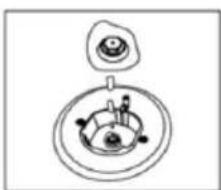
natural_image
Simple line drawing of a mechanical or biological component with no text or symbols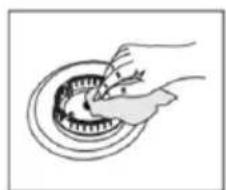
natural_image
Illustration of a hand using a tool to clean or inspect a circular object (no text or symbols visible)natural_image
Diagram of a mechanical assembly with arrows indicating direction (no text or symbols)Figura 15
natural_image
Technical line drawing of a mechanical assembly with a base plate and directional arrow (no text or symbols)Figura 16
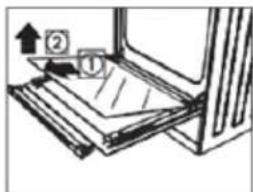
Figura 17
natural_image
Line drawing of a door frame with a grid inside, hands adjusting the interior (no text or symbols)Posizioni del rack:
natural_image
Pure electrical circuit lines without any symbolsnatural_image
Line drawings of three different kitchen appliances: a front-loading oven, an open door, and a second portable oven (no text or symbols present)DÉCLARATION DE CONFORMITÉ
DECLARATION OF CONFORMITY
This device complies with the Gas Appliances Regulation Directive (GAR) (EU) 2016/426/AB related to appliances that burn gaseous fuels. This device complies with EU Low Voltage Directive 2014/35/EC. Electromagnetic Compatibility Directive 2014/30/EU. Directive 2015/863/EU on the restriction of the use of certain hazardous substances in electrical. Directive 2009/125/EC on the eco-design requirements applicable to energy-related products.
This symbol on the product or on the packaging indicates that this product can't be disposed as normal rubbish or household waste. All the electrical, electronic equipment's and battery-operated units must recycle in proper manner and according to the local municipal laws. You can recycle them by taking them to government authorized disposal centres or specialized bins which you can find in any nearby big super markets, electronics or electro domestics products stores or malls who have these types of facilities available.
Designed by: SOGO based on European quality standards Imported by: Sanysan Appliances S.L, NIF: B98753056, C/ Barcas 2, 2, 46002 Valencia, Spain Product manufactured in Türkiye. After-sales service: sogosat@servicruz.es / 0034 911 084 833