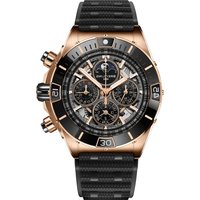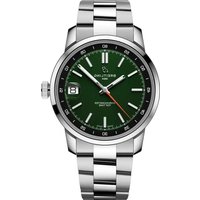
Premier B19 Datora 42 - Watch Breitling - Free user manual and instructions
Find the device manual for free Premier B19 Datora 42 Breitling in PDF.


| Brand | Breitling |
| Model | Premier B19 Datora 42 |
| Product type | Manual winding chronometer wristwatch |
| Movement | Manufacture caliber B19, manual winding |
| Power reserve | Approximately 70 hours |
| Case diameter | 42 mm |
| Water resistance | 10 bars (100 meters) - estimated |
| Main functions | Hours, minutes, seconds, chronograph (60 s, 30 min), date, day, month, year, moon phases, tachymeter, solar compass |
| Case material | Stainless steel |
| Strap material | Genuine leather or metal (depending on version) |
| Crystal | Anti-reflective sapphire |
| Power source | Mechanical (manual winding) |
| Dimensions (without strap) | 42 mm diameter, thickness approximately 14 mm (estimate) |
| Care and cleaning | Rinse with fresh water after contact with salt or chlorinated water; avoid chemicals |
| Safety | Do not operate crown or pushers underwater; avoid shocks, magnetic fields, and extreme temperatures (0-50°C) |
| Repairability | Authorized Breitling after-sales service |
| Certification | COSC chronometer (certified) |
| Warranty | 2 years (standard) |
| Country of manufacture | Switzerland |
| Moon phase function | Yes, adjustable via corrector |
| Tachymeter function | Graduation on dial for average speed measurement |
| Solar compass function | Usable in both hemispheres |
Frequently Asked Questions - Premier B19 Datora 42 Breitling
User questions about Premier B19 Datora 42 Breitling
0 question about this device. Answer the ones you know or ask your own.
Ask a new question about this device
Download the instructions for your Watch in PDF format for free! Find your manual Premier B19 Datora 42 - Breitling and take your electronic device back in hand. On this page are published all the documents necessary for the use of your device. Premier B19 Datora 42 by Breitling.
USER MANUAL Premier B19 Datora 42 Breitling
Up-to-date user manuals are available on breitling.com under SERVICE section.
VOTRE CHRONOMÈTRE BREITLING
A chronometer is a high-precision instrument that has successfully passed the entire battery of tests imposed by COSC (Swiss Official Chronometer Testing Institute), a neutral and independent body which individually tests each movement according to the prescriptions in force.
The certification test for wristwatches with sprung balance oscillators, according to standard ISO 3159, consists of observing each movement for 15 days and 15 nights, in 5 positions and at 3 different temperatures (8°C, 23°C, 38°C). In order to earn the prestigious chronometer label, a movement's performances must meet 7 very strict criteria, including a daily variation in rate ranging between only -4/+6 seconds.
The term "chronometer" should not be confused with that of "chronograph", which is a complicated watch fitted with an additional mechanism for measurement of the duration of an event. A chronograph is not necessarily chronometer-certified, but all Breitling chronographs bear the much-coveted title of "chronometer".
PREPARATION FOR USE
WINDING - TIME-SETTING
This being a manufacture caliber, adjustments can be performed at any time with no risk of damaging the mechanism. In case you would like to set time backwards, please ensure to go back to 3 o'clock [PM] to ensure optimal synchronization.
The functions are corrected by turning the crown or pressing the correctors with a blunt point, making sure to follow the order below:
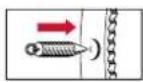
- Wind the watch by approximately 55 clockwise turns of the crown.

- Time: Pull the crown out to position 3. Turn the hands clockwise, until the date & day changes at midnight. Then move the hands forward to the desired time.
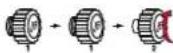
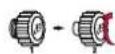
- Year, Month & date: Determine the type of year using the calendar available on Breitling.com. Push the crown back to position 2. Turn it clockwise, passing each date (1 to 31) and thus each month (JAN to DEC), until the year indicator displays the correct year, continue turning the crown clockwise until the desired month is set up. Continue turning the crown clockwise until the desired date is set up.
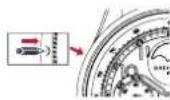
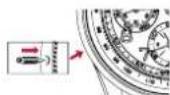
- Moon phase: Press corrector 1, situated at 10 o'clock, until the full moon appears in the center of the window. Determine the date of the last full moon using a lunar calendar (available on Breitling.com). Press the corrector again by the number of days elapsed since the last full moon. Check if the moon placement on the watch matches the lunar calendar.
- Day: Press corrector 2, situated at 8 o'clock, until the desired day is indicated.
- Push the crown back to the position 1.
USING THE CHRONOGRAPH
I. MEASURING A SINGLE SHORT TIME
-
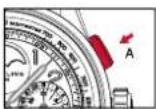
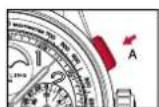
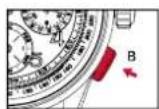
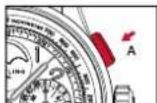
Press pushpiece A to start the chronograph. Hand 2 keeps track of the measured time in seconds.
-
Stop the measurement by pressing pushpiece A once more. The measurement is made in minutes [totalizer 1], seconds and 14 of a second [hand 2].
-
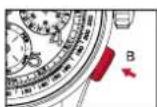
Reset the chronograph to zero by pressing pushpiece B.
II. MEASURING AN INTERRUPTED SHORT TIME
-
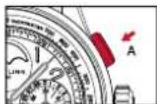
Press pushpiece A to start the chronograph. Hand 2 shows the measurement in seconds.
-
To interrupt the measurement, press pushpiece A once more. To restart the time measurement, press pushpiece A. This procedure makes it possible to add up several short times.
-
The chronograph is reset to zero by pressing pushpiece B, once the final measurement has been stopped.
SPECIAL CHARACTERISTICS

THE TACHOMETER
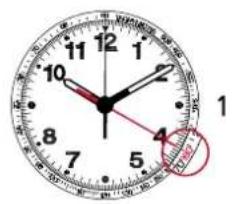
The tachometer is the graduation on the dial or flange of your Breitling chronograph enabling you to determine average speeds or hourly productivity rate, based on an observation period of less than 60 seconds.
1. Average speed
Using the chronograph to measure the time required to cover a kilometer or a mile. The final position of the second hand indicates the average speed. If it takes 20 seconds to cover 1 km or 1 mile, the scale respectively indicates an average speed of 180 km/h or 180 miles/h.
2. Hourly productivity rate
Measuring the time required to produce 1 unit. If the chronograph is stopped at 40 seconds, the tachometric scale indicates 90, corresponding to an hourly productivity rate of 90 units.


SUN COMPASS
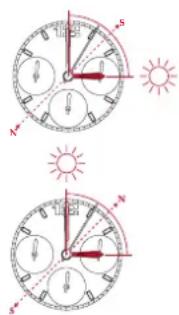
Your Breitling chronometer may be used as a sun compass, thus enabling you to determine North and South. For regions that have instated daylight saving time, subtract one hour when aligning the watch.
In the Northern Hemisphere
Point the hour hand precisely towards the sun. In relation to the watch dial, the point located midway between the current time and 12 o'clock indicates South, North being exactly opposite.
In the Southern Hemisphere
Point the hour-marker located at 12 o'clock on the dial precisely towards the sun. In relation to the watch dial, the point located midway between the current time and 12 o'clock indicates North, South being exactly opposite.
MAINTENANCE
Your Breitling chronometer is a sophisticated instrument which is constantly subjected to a wide variety of stresses and strains. Within a very small volume, a large number of components contribute to handling all the functions. Their mechanical action inevitably leads to a certain amount of wear and tear, which may be controlled by maintenance consisting of relubrication and replacing worn components. Like any precision measurement instrument, your watch must be regularly maintained in order to function at its highest level of potential: the frequency of this operation varies according to actual use. Breitling or your authorized retailer will be happy to handle the procedure.
WATER RESISTANCE
The movement of your chronometer is protected by a complex case fitted with gaskets to ensure its water resistance. Under the influence of various external agents - perspiration, chlorinated or salt water, cosmetics, fragrances or dust - these gaskets gradually deteriorate. That is why water resistance cannot be permanently guaranteed. If used intensively in water, we recommend having an annual water resistance check conducted. In any event, such an appraisal must be done every two years. This operation, which takes only a few minutes, may be conducted by a Breitling authorized maintenance centre, or by an authorized retailer (www.breitling.com).
Breitling models are water-resistant to varying degrees. The extent of the water resistance, expressed in metres [M], is a standard value and does not indicate an absolute immersion depth. The crown and pushpieces must not under any circumstances be operated under water or when the watch is wet. The table below indicates the conditions in which your watch may reasonably be used, according to its degree of water resistance:
| ACTIVITIES / DEGREE OF WATER RESISTANCE | 3 bar/30 M/100 FT | 5 bar/50 M/165 FT | 10 bar/100 M/330 FT | 50 bar/500 M/1650 FT+ |
| Splashing | √ | √ | √ | √ |
| Shower, swimming, surface water sports | √ | √ | √ | |
| Water-skiing, dives, snorkelling | √ | √ | ||
| Diving | √ |
If your watch is equipped with a screw-lock crown, ensure that this is locked before any use in water. This also applies to screw-lock pushpieces.
USEFUL TIPS
Breitling genuine leather straps are crafted with the most refined materials and represent extremely high-quality products. Like all objects in natural skin (shoes, gloves, etc.), their length of life varies considerably, according to the conditions in which they are worn. In particular, water, cosmetics and perspiration accelerate the ageing process. A metal or
synthetic Breitling bracelet is thus better suited to activities involving frequent contact with water or moisture.
Breitling metal cases and bracelets are made from the fi nest alloys and guarantee sturdiness and wearer comfort. Regular cleaning by rinsing and brushing in clean water will keep your watch shiny. This operation is strongly recommended after each immersion in salty or chlorinated water. For watches fi tied with a leather strap, the same advice applies, as well as avoiding getting the strap wet.
WHAT TO AVOID
Like any valuable objects, Breitling chronometers deserve special care. It is important to protect them from jarring and knocks by hard objects, and not to expose them to chemical products, solvents, dangerous gases, or magnetic fields. Moreover, your Breitling chronometer is designed to run smoothly at temperatures ranging between 0°C and 50°C.
IHR BREITLING-CHRONOMETER
MANUTENZIONE
MANUTENÇÃO
メンテナンス
保养须知
This booklet is completely made from residues of sugar cane instead of wood. The paper is biodegradable, compostable, and recyclable.