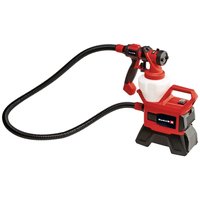
GE-WS 18/150 Li - Paint spray EINHELL - Free user manual and instructions
Find the device manual for free GE-WS 18/150 Li EINHELL in PDF.


User questions about GE-WS 18/150 Li EINHELL
0 question about this device. Answer the ones you know or ask your own.
Ask a new question about this device
Download the instructions for your Paint spray in PDF format for free! Find your manual GE-WS 18/150 Li - EINHELL and take your electronic device back in hand. On this page are published all the documents necessary for the use of your device. GE-WS 18/150 Li by EINHELL.
USER MANUAL GE-WS 18/150 Li EINHELL
EN Operating instructions Cordless Chemical Sprayer
natural_image
Exterior view of a modern spray sprayer with black handle and attached hose (no visible text or symbols)7

natural_image
Close-up of a black industrial tool with a metallic shaft and threaded end, showing a curved arrow indicating rotation (no text or symbols visible)-2-
natural_image
Close-up of a white mechanical component with a metallic chain and a textured grip, showing a directional arrow (no text or symbols)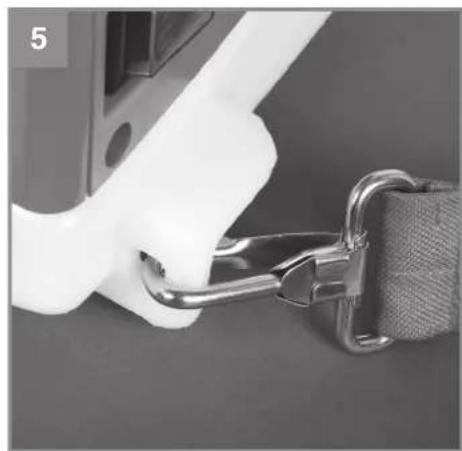
natural_image
Close-up of a white plastic clip holding a metal clip attached to a black textured strap (no text or symbols visible)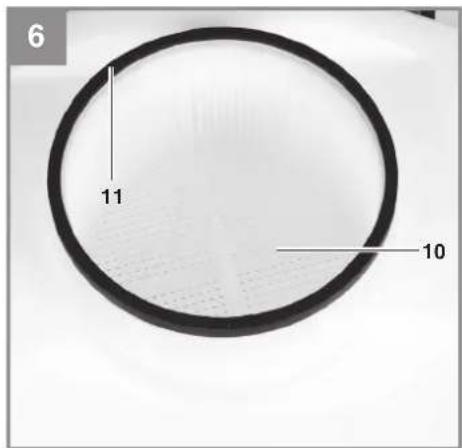
text_image
6 11 10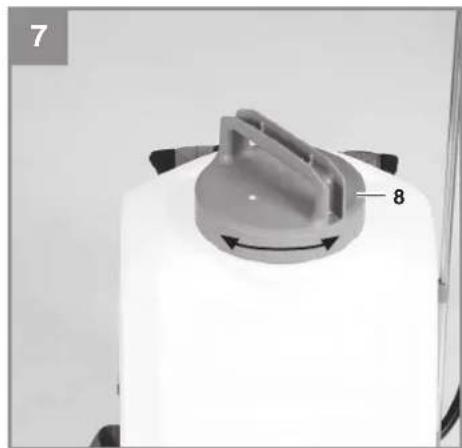
natural_image
Close-up of a white plastic container with a handle and labeled part '8' (no text or symbols on the object itself)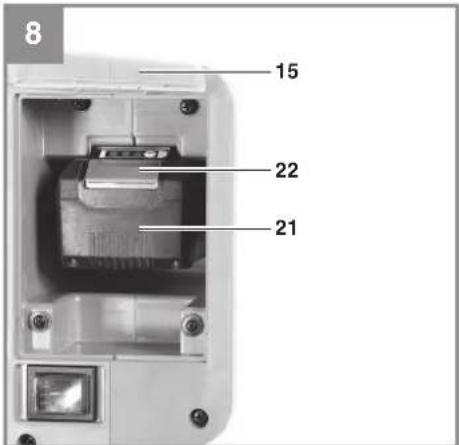
text_image
8 15 22 21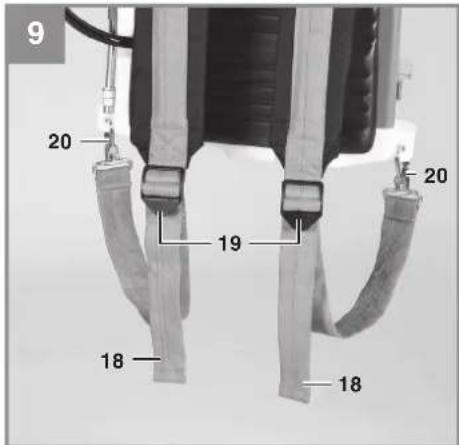
text_image
9 20 19 18 18 20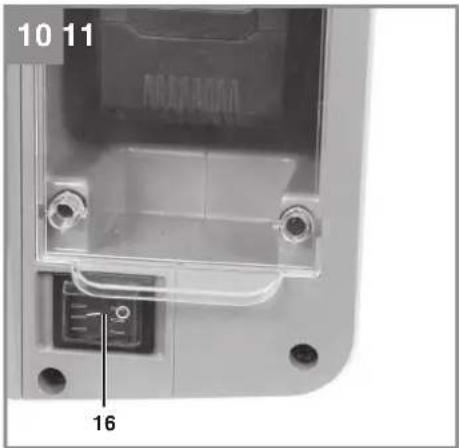
natural_image
Close-up of a device casing showing internal components and a labeled connector (no readable text or symbols)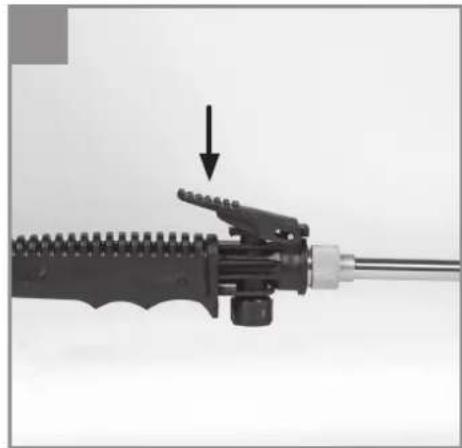
natural_image
Close-up of a mechanical tool with a spring and lever assembly, showing a downward arrow indicating a process (no text or symbols visible)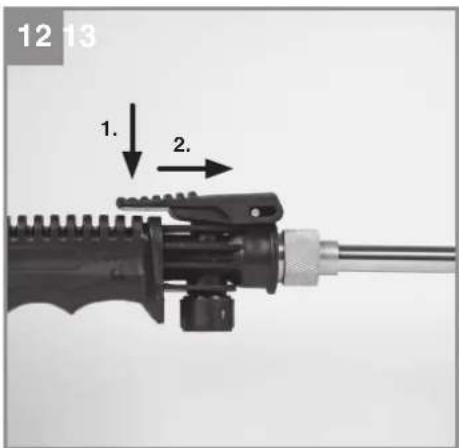
text_image
12 13 1. 2.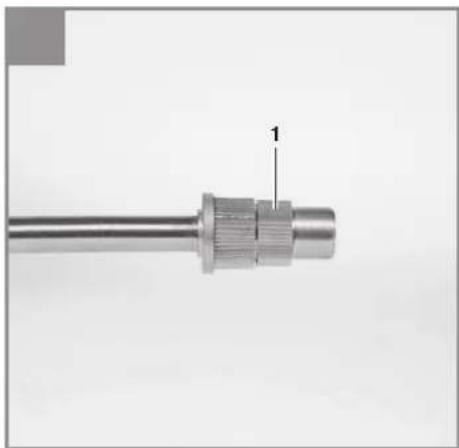
natural_image
Close-up of a metallic mechanical shaft with threaded end and labeled component '1' (no text or symbols beyond label)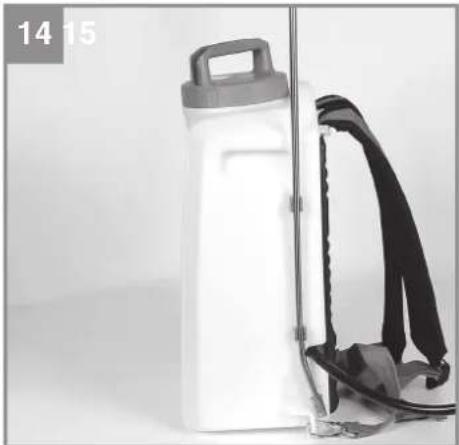
natural_image
Exterior view of a spray sprayer with black straps and handle (no text or symbols visible)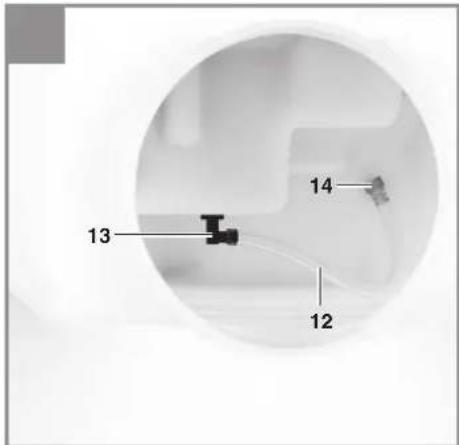
text_image
13 12 14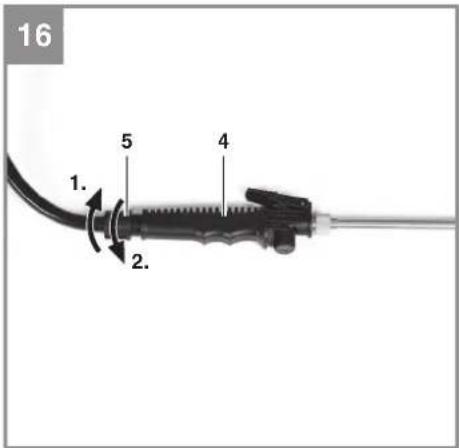
text_image
16 1. 2. 5 4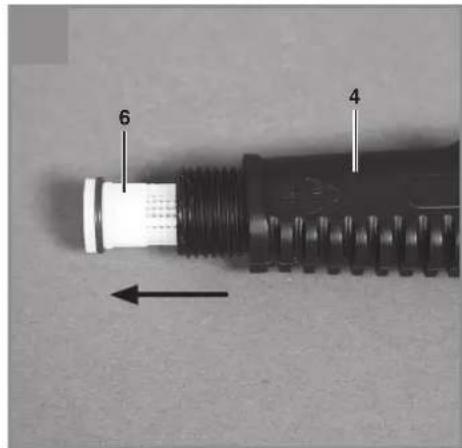
text_image
6 4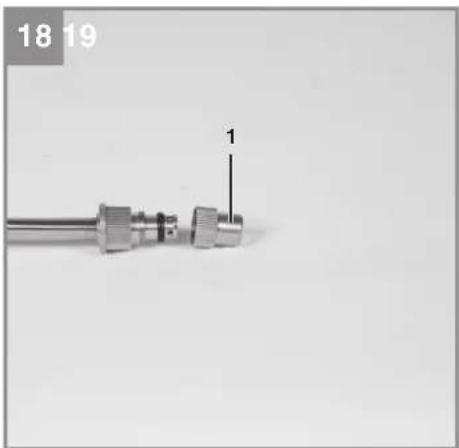
natural_image
Close-up of a metallic mechanical component with a labeled arrow pointing to a corner detail (no text or symbols on the object itself)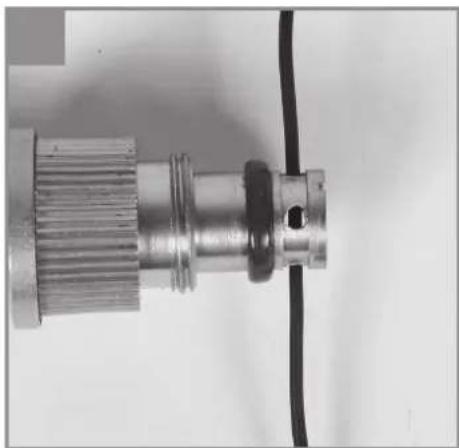
natural_image
Close-up of a metallic mechanical component with threaded shaft and mounting bracket, connected to a black cable (no visible text or symbols)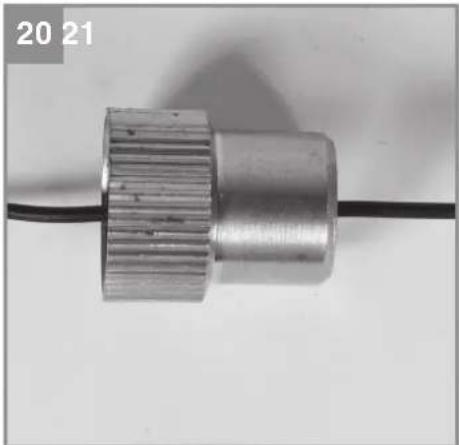
natural_image
Close-up of a metallic mechanical component with a black cable, labeled '20 21' in the top-left corner (no other text or symbols visible)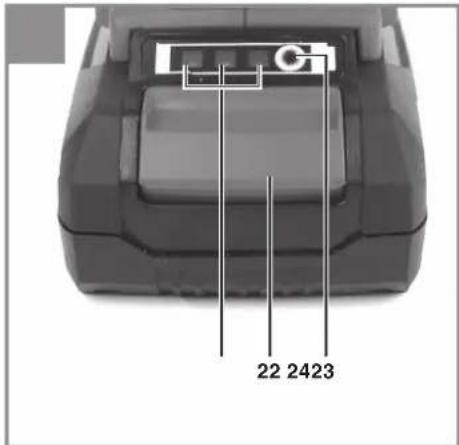
text_image
G 22 2423EN


Danger! - Read the operating instructions to reduce the risk of injury.
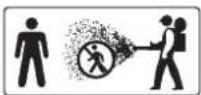
Keep bystanders and animals away while you are spraying.


Wear a breathing mask, safety goggles, protective gloves and protective clothing suitable for the spray solution being used.

Do not leave the equipment in the sunshine.

Protect the equipment from freezing temperatures.

Do not use in the rain. Protect from dampness!

Store the batteries only in dry rooms with an ambient temperature of 50^ F to 104^ F (+10°C to +40°C). Place only fully charged batteries in storage (charged at least 40%).
-6-
EN
DANGER!
When using the equipment, a number of safety precautions must be observed to avoid injuries and damage. Please read the complete operating instructions and safety information with due care. Keep these operating instructions in a safe place so that the information is available at all times. If you give the equipment to any other person, hand over these operating instructions and the safety information as well. We cannot accept any liability for damage or accidents which arise due to failure to follow these instructions and the safety information.
1. Safety information
DANGER!
Read all the safety information and instructions. Failure to adhere to the safety information and instructions set out below may result in electric shock, fire and/or serious injury. Keep all the safety information and instructions in a safe place for future use.
- Wear suitable protective gloves while spraying, filling, emptying and cleaning. Certain solutions require personal protective equipment or additional safety measures. Observe the information provided by the manufacturer of the liquid.
• Never remove any existing safety devices. - Do not spray any toxic substances. Note the safety data sheets for chemical substances and preparation. Contact the manufacturer if in doubt.
Children are not allowed to use this equipment. Children should be supervised so that they do not play with the equipment. Children are not allowed to carry out cleaning or maintenance. This equipment is not allowed to be used by people with limited physical, sensory or mental capacities or by those with insufficient knowledge or experience unless they are supervised or instructed by a person who is responsible for them.
General safety information for power tools
The term “power tool” used in the safety regulations refers to power tools operated from the mains power supply (with a power cable) and to battery operated power tools (without a power cable).
1) Work area safety
a) Keep work area clean and well lit. Cluttered and dark areas invite accidents.
b) Do not operate power tools in explosive atmospheres, such as in the presence of fl ammable liquids, gases or dust. Power tools create sparks which may ignite the dust or fumes.
c) Keep children and bystanders away while operating a power tool. Distractions can cause you to lose control.
2) Electrical safety
a) Power tool plugs must match the outlet. Never modify the plug in any way. Do not use any adapter plugs with earthed (grounded) power tools. Unmodified plugs and matching outlets will reduce risk of electric shock.
b) Avoid body contact with earthed or grounded surfaces such as pipes, radiators, ranges and refrigerators. There is an increased risk of electric shock if your body is earthed or grounded.
c) Do not expose power tools to rain or wet conditions. Water entering a power tool will increase the risk of electric shock.
d) Do not abuse the cord. Never use the cord for carrying, pulling or unplugging the power tool. Keep cord away from heat, oil, sharp edges or moving parts. Damaged or entangled cords increase the risk of electric shock.
e) When operating a power tool outdoors, use an extension cord suitable for outdoor use. Use of a cord suitable for outdoor use reduces the risk of electric shock.
f) If operating a power tool in a damp location is unavoidable, use a ground fault circuit interruptor (GFCI) protected supply. Use of an GFCI reduces the risk of electric shock.
3) Personal safety
a) Stay alert, watch what you are doing and use common sense when operating a power tool. Do not use a power tool while you are tired or under the influence of drugs, alcohol or medication. A moment of inattention while operating power tools may result in serious personal injury.
b) Use personal protective equipment. Always wear eye protection. Protective equipment such as dust mask, non-skid
EN
safety shoes, hard hat, or hearing protection used for appropriate conditions will reduce personal injuries.
c) Prevent unintentional starting. Ensure the switch is in the Off -position before connecting to power source and/or BATTERY pack, picking up or carrying the tool. Carrying power tools with your finger on the switch or energizing power tools that have the switch on invites accidents.
d) Remove any adjusting key or wrench before turning the power tool on. A wrench or a key left attached to a rotating part of the power tool may result in personal injury.
e) Do not overreach. Keep proper footing and balance at all times. This enables better control of the power tool in unexpected situations.
f) Dress properly. Do not wear loose clothing or jewellery. Keep your hair, clothing and gloves away from moving parts. Loose clothes, jewelry or long hair can be caught in moving parts.
g) If devices are provided for the connection of dust extraction and collection facilities, ensure these are connected and properly used. Use of these devices can reduce dust related hazards.
h) Do not let familiarity gained from frequent use of tools allow you to become complacent and ignore tool safety principles. A careless action can cause severe injury within a fraction of a second.
4) Power tool use and care
a) Do not force the power tool. Use the correct power tool for your application. The correct power tool will do the job better and safer at the rate for which it was designed.
b) Do not use the power tool if the switch does not turn it on and off. Any power tool that cannot be controlled with the switch is dangerous and must be repaired.
c) Disconnect the plug from the power source and/or remove the battery pack, if detachable, from the power tool before making any adjustments, changing accessories, or storing power tools. Such preventive safety measures reduce the risk of starting the power tool accidentally.
d) Store idle power tools out of the reach of children and do not allow persons unfamiliar with the power tool or these instructions to operate the power tool.
Power tools are dangerous in the hands of untrained users.
e) Maintain power tools and accessories. Check for misalignment or binding of moving parts, breakage of parts and any other condition that may affect the power tool's operation. If damaged, have the power tool repaired before use. Many accidents are caused by poorly maintained power tools.
f) Keep cutting tools sharp and clean. Properly maintained cutting tools with sharp cutting edges are less likely to bind and are easier to control.
g) Use the power tool, accessories and tool bits etc., in accordance with these instructions and in the manner intended for the particular type of power tool, taking into account the working conditions and the work to be performed. Use of the power tool for operations different from intended could result in a hazardous situation.
h) Keep handles and grasping surfaces dry, clean and free from oil and grease. Slippery handles and grasping surfaces do not allow for safe handling and control of the tool in unexpected situations.
5) Battery tool use and care
a) Recharge only with the charger specified by the manufacturer. A charger that is suitable for one type of battery pack may create a risk of fi re when used with another battery pack.
b) Use power tools only with specifically designated battery packs. Use of any other battery packs may create a risk of injury and fire.
c) When battery pack is not in use, keep it away from other metal objects, like paper clips, coins, keys, nails, screws or other small metal objects that can make a connection from one terminal to another. Shorting the battery terminals together may cause burns or a fi re.
d) Under abusive conditions, liquid may be ejected from the battery; avoid contact. If contact accidentally occurs, fl ush with water. If liquid contacts eyes, additionally seek medical help. Liquid ejected from the battery may cause irritation or burns.
e) Do not use a BATTERY pack or tool that is damaged or modified. Damaged or modified batteries may exhibit unpredictable
EN
behavior resulting in fire, EXPLOSION or risk of injury.
f) Do not expose a BATTERY pack or tool to fire or excessive temperature. Exposure to fire or temperature above 266^ F ( 130^ C) may cause explosion.
g) Follow all charging instructions and do not charge the BATTERY pack or tool outside the temperature range specified in the instructions. Charging improperly or at temperatures outside the specified range may damage the BATTERY and increase the risk of fi re.
6) Service
a) Have your power tool serviced by a qualified repair person using only identical replacement parts. This will ensure that the safety of the power tool is maintained.
b) Never service damaged BATTERY packs.
Service of BATTERY packs should only be performed by the manufacturer or authorized service providers.
Additional safety instructions
We pay a great deal of attention to the design of every battery pack to ensure that we supply you with batteries which feature maximum power density, durability and safety. The battery cells have a wide range of safety devices. Each individual cell is initially formatted and its electrical characteristic curves are recorded.
These data are then used exclusively to be able to assemble the best possible battery packs. Despite all the safety precautions, caution must always be exercised when handling batteries. The following points must be obeyed at all times to ensure safe use. Safe use can only be guaranteed if undamaged cells are used. Incorrect handling can cause cell damage.
Caution! Analyses confirm that incorrect use and poor care are the main causes of the damage caused by high performance batteries.
Information about the battery
- The battery pack supplied with your cordless tool is not charged. The battery pack has to be charged before you use the tool for the first time.
-
For optimum battery performance avoid low discharge cycles. Charge the battery pack frequently.
-
Store the battery pack in a cool place, ideally at 59°F (15°C) and charged to at least 40%.
- Lithium-Ion batteries are subject to a natural ageing process. The battery pack must be replaced at the latest when its capacity falls to just 80% of its capacity when new. Weakened cells in an aged battery pack are no longer capable of meeting the high power requirements and therefore pose a safety risk.
- Do not throw battery packs into an open fire. There is a risk of explosion!
- Do not ignite the battery pack or expose it to fire.
- Do not exhaustively discharge batteries. Exhaustive discharge will damage the battery cells. The most common cause of deep discharge is lengthy storage or non-use of partly discharged batteries. Stop working as soon as the performance of the battery falls noticeably or the electronic protection system triggers. Place the battery pack in storage only after it has been fully charged.
- Protect batteries and the tool from overloads. Overloads will quickly result in overheating and cell damage inside the battery housing without this overheating actually being apparent externally.
- Avoid damage and shocks. Replace batteries which have been dropped from a height of more than one meter or which have been exposed to violent shocks without delay, even if the housing of the battery pack appears to be undamaged. The battery cells inside the battery may have suff ered serious damage. In this respect, please also read the waste disposal information.
- If the battery pack suffers overloading and overheating, the integrated protective cut-off will switch off the equipment for safety reasons. Caution! Do not press the ON/OFF switch any more if the protective cut-off has actuated. This may damage the battery.
- Use only original battery packs. The use of other batteries may result in injuries, explosion and a fire risk.
- Protect your rechargeable battery against moisture, rain and high humidity. Moisture, rain and high humidity can cause dangerous cell damage. Never charge or work with batteries which have been exposed to moisture, rain or high humidity – replace them immediately.
- If your equipment is fitted with a detachable battery, remove the battery for safety reasons after you have finished your work.
EN
Information on chargers and the charging process
- Please check the data marked on the rating plate of the battery charger. Be sure to connect the battery charger to a power supply with the voltage marked on the rating plate. Never connect it to a different mains voltage.
- Protect the battery charger and its cable from damage and sharp edges. Have damaged cables repaired without delay by a qualified electrician.
- Keep the battery charger, batteries and the cordless tool out of children's reach.
- Do not use damaged battery chargers.
- Do not use the supplied battery charger to charge other cordless tools.
- In heavy use the battery pack will become warm. Allow the battery pack to cool to room temperature before commencing with the charging.
- Do not over-charge batteries. Do not exceed the maximum charging times. These charging times apply only to discharged batteries. Frequent insertion of a charged or partly charged battery pack will result in over-charging and cell damage. Do not leave batteries in the charger for more than 48 hours.
- Never use or charge batteries if you suspect that the last time they were charged was more than 12 months previously. There is a high probability that the battery pack has already suffered dangerous damage (exhaustive discharge).
- Charging batteries at a temperature below 50^ F ( 10^ C) will cause chemical damage to the cell and may cause a fire.
- Do not use batteries which have heated during the charging process, as the battery cells may have suffered dangerous damage.
- Do not use batteries which have suffered curvature or deformation during the charging process or which show other non-typical symptoms (gassing, hissing, cracking,...)
- Never fully discharge the battery pack (recommended depth of discharge max. 80%) A complete discharge of the battery pack will lead to premature ageing of the battery cells.
- Never charge the batteries unsupervised.
Protection from environmental influences
- Wear suitable work clothes. Wear safety goggles.
- Protect your cordless tool and the battery charger from moisture and rain. Moisture and rain can cause dangerous cell damage.
- Do not use the cordless tool or the battery charger near vapors and infl ammable liquids.
- Use the battery charger and cordless tools only in dry conditions and an ambient temperature of 50^ F to 104^ F ( 10^ C to 40^ C).
- Do not keep the battery charger in places where the temperature is liable to reach over 104^ F ( 40^ C). In particular, do not leave the battery charger in a car that is parked in the sunshine.
- Protect batteries from overheating. Overloads, over-charging and exposure to direct sunlight will result in overheating and cell damage. Never charge or work with batteries which have been overheated – replace them immediately if possible.
- Storage of batteries, battery chargers and cordless tools. Store the charger and your cordless tool only in dry places with an ambient temperature of 50^ F to 104^ F ( 10^ C to 40^ C). Store the Lithium-Ion rechargeable battery in a cool and dry place at 50^ F to 68^ F ( 10^ C to 20^ C). Protect them from humidity and direct sunlight! Place only fully charged batteries in storage (charged at least 40%).
- Prevent the Lithium-Ion battery pack from freezing. Battery packs which were stored below 32^ F ( 0^ C) for more than 60 minutes must be disposed of.
- When handling batteries beware of electrostatic charge: Electrostatic discharges cause damage of the electronic protection system and the battery cells. Avoid electrostatic charging and never touch the battery poles.
Battery Caution + Disposal
Disposal
Should your appliance need replacement after extended use, do not dispose of it with the household refuse, but in an environmentally safe way.
Waste produced by electrical machine items should not be handled like normal household rubbish. Please recycle where recycle facilities exist. Check with your local authority or retailer for recycling advice.
EN
Always dispose of your battery pack according to federal, state, provincial and local regulations. Contact a recycling agency in your area for recycling locations.
CAUTION! Even discharged battery packs contain some energy. Before disposing, use electrical tape to cover the terminals to prevent the battery pack from shorting, which could cause a fire or explosion.
⚠ WARNING! To reduce the risk of injury or explosion, never burn or incinerate a battery pack even if it is damaged, dead, or completely discharged. When burned, toxic fumes and materials are emitted into the surrounding atmosphere.
-
Batteries vary according to device. Consult your manual for specific information.
-
Install only new batteries of the same type in your product (where applicable).
-
Failure to insert batteries in the correct polarity, as indicated in the battery compartment or manual, may shorten the life of the batteries or cause batteries to leak.
-
Do not mix old and new batteries.
-
Do not mix Alkaline, Standard (Carbon-Zinc), or Rechargeable (Nickel Cadmium, Nickel Metal Hydride, or Lithium-Ion) batteries.
-
Do not dispose of batteries in fire.
-
Batteries should be recycled or disposed of as per state, provincial and local guidelines.
When shipping or disposing of batteries and cordless tools, always ensure that they are packed individually in plastic bags to prevent short circuits and fi res.
Safety instructions for cordless chemical sprayers
- WARNING! Danger to health! Pesticides, weed killers and liquid fertilizers can present a danger to health if not used properly.
- Be aware of all risks emanating from the material to be sprayed. Note all labels on the container of the material to be sprayed and the information supplied by the manufacturer of the material.
- Do not spray any substances whose risk potential is not known.
- Wear suitable personal protective clothing, such as a protective mask.
- Avoid contact with the spray solution. Note the information on the spray container. Consult a doctor if necessary.
• Pesticides may only be sprayed in outdoor
areas that are used for agricultural, forestry, or horticultural purposes. Never spray pesticides in or in the direct vicinity of open bodies of water (including coastal waters).
• Take suitable measures to keep the equipment out of the reach of children.
- The chemical sprayer is not designed to spray liquids that exceed the maximum permitted operating temperature of 40^ C. Acidic, caustic, and flammable liquids whose flash point is below 55^ C and impregnating agents may also not be used.
- Important! Atomized flammable liquids with a flash point, more than 55°C are also highly combustible.
- Do not use your mouth to blow out plugged nozzles or other small parts.
- Only use a suitable nozzle wire or cleaning agent to clean plugged nozzles.
- Always follow the chemical manufacturer's instructions when mixing and working with spray solutions.
- Only fill the tank with as much spray liquid as required.
- Do not allow the liquid to escape or splash back when filling. Close the spray container securely.
- If using a different measuring container than the measuring jug or a funnel to fill the tank, clean and rinse it out thoroughly after use. If mixing the spray materials in a separate container, rinse out the mixing container when empty.
- Never spray persons, animals, or into bodies of water!
- Always wear protective clothing when spraying pesticides and insecticides to avoid direct contact with the tiny droplets that form.
- Do not eat, smoke, or drink while working with pesticides.
- When filling the tank from a building water supply system, exercise caution if you submerge the hose into the spray solution.
- Only fill the tank with water from a lake or pond if you are legally authorized to do so and if all associated contamination can be avoided.
- Note the direction of the wind and never spray against it. Avoid accidentally spraying areas you do not want to treat.
- Thoroughly clean your hands and face after you have finished your work.
- If you have not used the chemical sprayer for an extended period of time, check it for possible damage prior to reusing it.
EN
• Immediately replace defective parts.
• Use only original replacement parts.
- Do not leave the equipment (filled or empty) in direct sunlight.
- Before placing the equipment in winter storage, thoroughly clean and dry it out so that it is not damaged by frost.
- We will not be liable for any damage that results from improper repairs and/or improper handling of the equipment (e.g. using the equipment in ways for which it was not intended).
- Opening the equipment or performing maintenance work on it is only permitted when the container is depressurized.
- Note the safety data sheets for chemical substances and preparations. Pesticides include - but are not limited to - herbicides, insecticides, fungicides and growth regulators as well as materials that are intended to be used in conjunction with these agents in order to modify their properties or effects.
- At the beginning of each season and at least once a month during regular use, check the equipment for proper sealing and functionality of all parts (in operation and at rest).
- Important note: Heavy stresses caused by the way in which the equipment is used (including transport to the place of use and storage during non-use), ambient influences (at the place of use and the storage place when it is not in use), poor maintenance and care may cause it to suffer premature wear. You should therefore check that the equipment is in safe and working order, or that there are at least no obvious signs of damage before use. Have an expert check whether the equipment can continue to be used safely, particularly when defects affecting safety occur.
SAVE THESE INSTRUCTIONS
2. Layout and items supplied
2.1 Layout
-
Adjustable spray head
-
Spray tube
-
Release lever
-
Spray gun handle
-
Union nut
-
Filter
-
Hose
-
Tank lid
-
Tank
-
Filling strainer
-
Seal
-
Suction hose
-
Pump connection
-
Intake filter
-
Rechargeable battery cover fl ap
-
On/Off switch
-
Harness
-
End of harness
-
Harness release mechanism
-
Fastening hooks for the harness
-
Battery (not supplied)
-
Pushlock button
-
Battery capacity indicator
-
Battery capacity indicator button
2.2 Items supplied
Please check that the article is complete as specified in the scope of delivery. If parts are missing, please contact our service center or the store where you made your purchase at the latest within 5 work days after purchasing the article and upon presentation of a valid bill of purchase.
- Open the packaging and take out the equipment with care.
- Remove the packaging material and any packaging and/or transportation braces (if present).
- Check to see if all the items are supplied.
- Inspect the equipment and accessories for transport damage.
- If possible, keep the packaging until the end of the guarantee period.
Danger!
The equipment and packaging material are not toys. Do not let children play with plastic bags, plastic sheets and small parts. There is a risk of choking and suffocating!
Chemicalsprayer
- Spraytube
EN
• Original operating instruction with safety information
Separately available accessories
18V 1.5Ah PXC Lithium-Ion battery
18V 2.0Ah PXC Lithium-Ion battery
18V 2.5Ah PXC Lithium-Ion battery
18V 3.0Ah PXC Lithium-Ion battery
18V 4.0Ah PXC Lithium-Ion battery
18V 3.0Ah PXC Plus Lithium-Ion battery
18V 4.0Ah PXC Plus Lithium-Ion battery
18V 5.2Ah PXC Plus Lithium-Ion battery
18V 4.0Ah/6.0Ah PXC Plus Lithium-Ion battery
18V 5.0Ah/8.0Ah PXC Plus Lithium-Ion battery
18V PXC Dual Port Fast Charger
18V PXC Fast Charger
Contact your local retailer for more specific models of batteries and charger available in your area. You can also explore battery + charger options at Einhell.com.
3. Intended use
This chemical sprayer is designed exclusively for spraying the following solutions outdoors and in well ventilated greenhouses.
Water
- Pesticides
- Weedkillers
- Natural oils dissolved in water (e.g..neem oil, rapeseed oil)
• Fertilizers dissolved in water
The solution to be sprayed must be approved by its manufacturer for distribution using a spraying unit. Arrange to be shown how to use the unit safely if you are not familiar with it.
Liquids to be sprayed, particularly natural oils dissolved in water, must have a water-like consistency. Liquids of greater viscosity cannot be sprayed, or only with lesser power.
Only liquid fertilizers, weed killers and pesticides that are approved by the local licensing authority in the country of use may be sprayed. At the time of manufacture, no harmful effects on the materials used are known to be caused by these approved substances or natural oils dissolved in water. The fertilizers, pesticides and weed killers are only allowed to be sprayed in the concentrations specified by the manufacturer of
the spray solutions. If in doubt, please contact the relevant manufacturer.
The chemical sprayer is not designed to be used with foodstuffs or to spray liquids that exceed the maximum permitted operating temperature of 104^ F ( 40^ C). Similarly, it is prohibited to spray acidic, caustic and flammable liquids whose flash point is below 131^ F ( 55^ C), as well as impregnating agents, disinfectant, paints, varnishes, grease, glazes and synthetically manufactured oils.
Important! Atomized flammable liquids with a flash point in excess of 131^ F ( 55^ C) are also highly combustible.
Never use the chemical sprayer
as a flame gun
• for storing liquids
• for substances with unknown risk.
The equipment is allowed to be used only for its prescribed purpose. Any other use is deemed to be a case of misuse. The user/operator and not the manufacturer will be liable for any damage or injuries of any kind resulting from such misuse.
Please note that our equipment has not been designed for use in commercial, trade or industrial applications. Our warranty will be voided if the equipment is used in commercial, trade or industrial businesses or for equivalent purposes.
4. Technical data
Power supply: 18V=
Pump type: ...... Membrane pump
Tank capacity approx.: 4.5 Gal.
Max. filling quantity: 4 Gal.
Delivery rate, Q: 14 - 27 Gal./h
Spray pressure: 65 PSI
Nozzle ∅: 0.07"
Optimal spray distance: ....1.6 ft.
Technical residual volume: 3.4 fl oz
Maximum permitted
operating temperature: 104°F (40°C)
Spray tube length with connection/nozzle: .....2 ft.
Weight (Tool only): 9.7 lbs
EN
Reduce noise generation and vibration to a minimum!
• Use only equipment that is in perfect condition.
- Maintain and clean the equipment regularly.
• Adapt your way of working to the equipment.
• Do not overload the equipment.
• Have the equipment checked if necessary.
- Switch off the equipment when not in use.
- Wear gloves.
CAUTION!
Residual risks
Even if you use this electric power tool in accordance with the instructions, certain residual risks cannot be eliminated. The following hazards may arise in connection with the equipment's construction and layout:
- Lung damage if no suitable protective dust mask is used.
- Damage to hearing if no suitable ear protection is applied.
- Health damage caused by hand-arm vibrations if the equipment is used over a longer period or is not properly guided and maintained.
Limit the operating time.
All stages of the operating cycle must be considered (for example, times in which the electric tools are switched off and times in which the tool is switched on but operates without load).
Danger!
This electric power tool generates an electromagnetic fi eld during operation. Under certain circumstances this fi eld may actively or passively impede medical implants. To reduce the risk of serious or fatal injuries, we recommend persons with medical implants to consult their doctor and the manufacturer of the medical implant prior to using the equipment.
5. Before starting the equipment
Warning!
Switch the equipment off and remove the battery before carrying out any assembly work.
5.1 Assembling the spray tube and hose (fi g. 3)
Screw the spray tube onto the spray gun handle.
Important! Always check the hose connections. Any leaks must be remedied immediately and the equipment must not be used until this has been done.
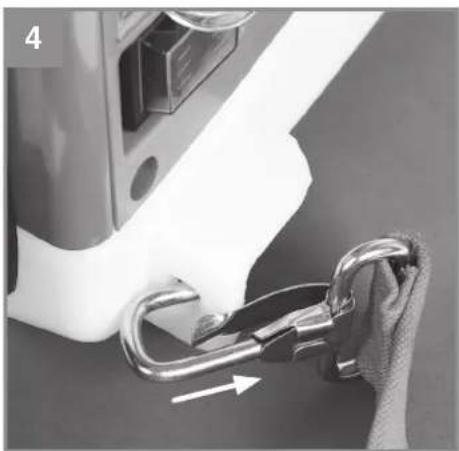
5.2 Fitting the harness (Fig. 4 - 5)
Attach the fastening hooks for the harness (20) to the container on the left and right sides (also see Fig. 9).
5.3 Preparing spray solution and fi lling the container (Fig. 6-7)
Switch off the equipment and remove the battery.
Note:
Always follow the manufacturer's instructions when mixing spray solutions. Fill the tank only with the amount of solution you intend to use.
- Observe the quantities to be used as listed by the manufacturer of the solution.
- Spray solution must have a water-like consistency.
- The spray container can be filled with a maximum 4 Gallons of liquid.
- Pesticides must only be prepared outdoors and never in living quarters, stables, or storage rooms for food and animal feed.
- Spray solutions can be prepared in a separate container and mixed thoroughly before being filled into the container of the chemical sprayer.
- If you intend to use organic spray solutions, they must be filtered prior to filling the sprayer.
- The solution must always be filled in through the filling strainer situated in the tank (10).
- Clean the equipment immediately after each use. This is the only way to keep the liquid-carrying parts clean and prevent clogging. Clogged components can lead to defects.
- Place the chemical sprayer on a level surface. Unscrew the tank lid (8) from the tank. On the inside of the tank lid you will see measuring ranges with 5ml, 10ml and 25ml contents.
EN
- Pour the amount of liquid (e.g. water) specified by the solution manufacturer into the spray container. If the spray solution has not been prepared ready for spraying, add the measured quantity of concentrated additive and close the container carefully.
- If you have not already done so, mix the concentrated additive with the water (or other liquid) by shaking the chemical sprayer.
- Apply the name of the spray solution you are using to the spray solution tank (e.g. by means of a sticker).
5.4 Installing the battery (Fig. 8) Note:
- The equipment is supplied without a battery and without a charger.
- The cover flap closes by itself and is held in position by magnets.
Open and hold the cover flap (15). Push the battery into the battery mount provided. Make sure that the pushlock button (22) engages as soon as the battery has been pushed in all the way. To remove the battery, proceed in the reverse order.
5.5 Using the harness (Fig. 9)
Slip the harness over your shoulders and adjust the length of the harness so that you can work without fatigue. To do so, pull on the two ends of the harness to shorten it (18) or on the two harness release mechanisms to extend it (19).
Note: Should the fastening hooks for the harness (20) come off, attach them back in position again as shown in Figs. 4-5.
6. Operation
WARNING!
Check the equipment for damage before you use it. Never use the equipment if it is damaged.
- Check the tank for damage each time before and after using the equipment.
- Check the hose and all screw connections for damage and leaks each time before and after using the equipment.
6.1 Switching on (Fig. 10)
After inserting the battery, switch the equipment on by turning the On/Off switch to the "I" position (16).
6.2 Switching off (Fig. 10)
Switch the equipment off by turning the On/Off switch to the "0" position (16).
6.3 Spraying
WARNING!
Note the attached leaflet with the safety instructions.
- Do not use a very wide jet when spraying plants or other objects directly.
- When the trigger lever on the spray gun handle is pressed, recoil forces can occur suddenly, in the worst case scenario causing the spray tube to point towards the body. Always keep tight hold of the spray gun handle.
- Perform spraying only when the tank is vertical or upright.
6.3.1 Switching spraying on/off
• To spray, press the trigger lever on the spray gun handle (Fig. 11).
- The spray jet will stop when you let go of the trigger lever.
- If the trigger lever is pressed and then pushed forward (Fig. 12), this locks the lever. The equipment continues spraying until the trigger lever is pulled back again and released.
Notes!
-
If the integrated pump contains too little spray solution or none at all, it will run after the chemical sprayer is switched on. Press the trigger lever on the spray gun handle for several seconds. The pump will fill up and spray solution will be ejected irregularly. Once the spray solution is ejected evenly, the pump will switch off upon releasing the trigger lever and will switch on again upon pressing the lever.
-
If there is too little spray solution in the spray solution container, the pump will suck in too little spray solution (see section 1) and will continue to run upon releasing the trigger lever. Top up with spray solution (see section 5.3).
-
The suction hose is inside the tank on the right-hand side. To empty the tank as far as possible during spraying, bend slightly forwards and a little to the right.
EN
6.3.2 Adjusting the spray jet (Fig. 13)
The spray jet can be adjusted on the nozzle from a single jet to a wide spray (fi ne mist) for larger areas.
- Pause the spraying process.
-
Turn the adjustable spray head counterclockwise to make the jet narrower until it is a single jet (1).
-
Turn the adjustable spray head clockwise to make the jet wider (1).
6.4 Transport
Clip the spray tube to the side of the tank (Fig. 14) or to the tank lid (Fig. 1). Take care that the spray head does not touch the ground. Transport the equipment by the tank lid or by means of the harness.
6.5 After use
Never leave spray solution in the tank. Follow the instructions in section 7.
- Check the tank for damage each time before and after using the equipment.
- Check the hose and all screw connections for damage and leaks each time before and after using the equipment.
6.6 Charging the Lithium-Ion battery (not included)
The corresponding instructions can be found in the original operating instructions for your charger.
6.7 Battery capacity indicator (Fig. 21 / item 23)
Press the battery capacity indicator switch (24). The battery capacity indicator (23) shows the charge status of the battery using 3 LEDs.
All 3 LEDs lit:
The battery is fully charged.
2 or 1 LED(s) lit:
The battery has an adequate remaining charge.
1 LED fl ashing:
The battery is empty, recharge the battery.
All LEDs fl ashing:
The temperature of the battery is too low. Remove the battery from the device and leave it at room temperature for a day. If the error occurs again, this means that the battery has been completely depth discharged and is defective. Remove the battery from the device. Never use or charge a defective battery.
7. Cleaning and maintenance
Hazard!
Always pull out the battery pack before starting any cleaning work. Never use fl ammable solvents to clean the equipment.
• Use only original replacement parts.
- You must arrange for an authorized customer service center to carry out any maintenance and repair work that is not listed below.
- Unless stipulated otherwise, we recommend that you arrange for the manufacturer to check the equipment every 2 years.
7.1 Cleaning (outside)
We recommend that you clean the device immediately each time you have finished using it.
- Keep all safety devices, air vents and the motor housing free of dirt and dust as far as possible. Wipe the equipment with a clean cloth or blow it with compressed air at low pressure.
- Clean the equipment regularly with a moist cloth and some soft soap. Do not use cleaning agents or solvents; these could attack the plastic parts of the equipment. Ensure that no water can seep into the device. The penetration of water into an electric tool increases the risk of an electric shock.
7.2 Cleaning the inside of the container (Fig. 6-7)
After use, clean the equipment and leave the container open to dry. Note the cleaning instructions in the directions for use that came with the chemical in addition to these cleaning instructions.
Remove any remaining liquid from the tank through the container's filler opening and store
EN
the liquid properly for subsequent use or dispose of it in accordance with the applicable regulations.
- Unscrew the tank lid (8) from the tank.
- Remove the filling strainer (10) and clean it with ample water as required.
- Tilt the tank forward and empty it completely.
- Reinsert the filling strainer (10) in the tank opening. Make sure that the seal (11) is correctly seated.
- Screw the tank lid (8) back on the tank.
- Shake the chemical sprayer vigorously several times.
- Spray the contents onto the area just treated or an area reserved for this purpose.
- Repeat this process.
- The container can now be drained through the filler opening as described above.
- Allow the tank to dry out completely. Before you use the tank again, re-insert the fl lling strainer and screw the tank lid back onto the tank.
7.3 Cleaning the intake fi Iter (Fig. 15)
Clean the intake filter in the tank at least once a year, ideally after the winter break or when there are problems (see section 10). Proceed as follows:
- Empty the tank as described in 7.2.
- Pull the suction hose (12) with intake filter off the pump connection (13).
- Rinse the suction hose and clean the intake filter (14) with a brush in clear water.
- Refi t the suction hose (12) to the pump connection (13) and make sure that the intake filter extends to the bottom of the tank. Only then can the tank be properly emptied during spraying.
7.4 Cleaning the filter element in the handle (Fig. 16-17)
Clean the fi iter element in the handle at least once a year, ideally after the winter break or when there are problems (see section 10). Proceed as follows:
- Unscrew the union nut (5) from the handle (4).
- Pull the filter (6) out of the handle (4) and clean it with a brush in clear water.
- Re-insert the filter (6).
- Screw the union nut (5) securely back onto the handle (4).
7.5 Cleaning the nozzle and the adjustable spray head
Clean the nozzle and the adjustable spray head at least once a year, ideally after the winter break or when there are problems (see section 10). Never blow out the nozzle or the spray head directly using your mouth. Proceed as follows:
- Turn the adjustable spray head counterclockwise as far as it will go (Fig. 18).
- Clean the exposed nozzle (Fig. 19) and the hole in the spray head (Fig. 20) of residue using a thin wire.
- Flush the nozzle and spray head with clear water.
- Allow the nozzle and spray head to dry.
7.6 Maintenance
There are no other parts inside the equipment which require maintenance.
8. Disposal and recycling
The equipment is supplied in packaging to prevent it from being damaged in transit. The raw materials in this packaging can be reused or recycled. The equipment and its accessories are made of various types of material, such as metal and plastic. Never place defective equipment in your household refuse. The equipment should be taken to a suitable collection center for proper disposal. If you do not know the whereabouts of such a collection point, you should ask in your local council offices.
9. Storage and transport
9.1 Storage
Store the equipment and its accessories out of children's reach in a dark and dry place at above freezing temperature. The ideal storage temperature is between 41°F and 86°F (5°C and 30°C). Keep the electric tool in its original packaging.
Equipment must always be stored completely dry and clean.
EN
9.2 Transport
- Switch off the equipment and remove the battery.
• Fit the shipping protectors, if any. - Protect the machine from damage and the strong vibrations that can occur particularly when transporting in vehicles.
- The spray lance can be kept in the holder (Fig. 14) or on the tank lid (Fig. 1).
The reprinting or reproduction by any other means, in whole or in part, of documentation and papers accompanying the products is strictly subject to the express consent of Einhell Germany AG.
Subject to technical changes.
EN
10. Troubleshooting guide
| Problem Possible cause Solution | ||
| The motor does not start. | a) Equipment not switched on.b) Connections on motor loose.c) Battery not correctly inserted. | a) Turn On/Off switch to “I” (see section 6.).b) Have the equipment checked by a customer service workshop.c) Remove battery and reinsert (see section 5.4). |
| The equipment does not spray, or only sprays at reduced power, even though the tank is full. | a) Nozzle completely or partly clogged.b) The intake fi liter in the tank is completely or partly soiled.c) The fi liter element in the handle is completely or partly soiled.d) Liquid too viscous and therefore unsuitable. | a) Clean the nozzle (see section 7.2).b) Clean the intake fi liter (see section 7.3).c) Clean the fi liter element (see section 7.4).d) Remove liquid, clean equipment and container (see section 7.). |
| Too much spray mist. | a) Distance from object is too great.b) Spray width too great. | a) Reduce spraying distance.b) Reduce spray width (see section6.3.2). |
| Motor stops suddenly. | Battery spent. Insert a charged battery (see section 5.4). | |
FR