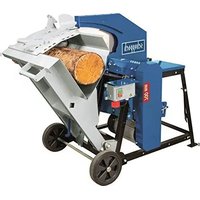
kw 7.0 - Saw SCHEPPACH - Free user manual and instructions
Find the device manual for free kw 7.0 SCHEPPACH in PDF.


User questions about kw 7.0 SCHEPPACH
0 question about this device. Answer the ones you know or ask your own.
Ask a new question about this device
Download the instructions for your Saw in PDF format for free! Find your manual kw 7.0 - SCHEPPACH and take your electronic device back in hand. On this page are published all the documents necessary for the use of your device. kw 7.0 by SCHEPPACH.
USER MANUAL kw 7.0 SCHEPPACH
natural_image
Mechanical device with black housing and white frame, no visible text or symbolskw 7.0
kwz 7.0
kw-ze 7.0
| D | WippkreissägeOriginal-Anleitung |
| GB | Firewood rocker circular sawTranslation from the original instruction manual |
| FR | Scie à bûches à chevaletTraduction des instructions d'origine |
Inhaltsverzeichnis
Günzburger Straße 69
D-89335 Ichenhausen
Verehrter Kunde,
text_image
Technical diagram showing three different mechanical or industrial setups with labeled components and directional arrows indicating flow or movement.natural_image
Close-up of a mechanical bracket with a labeled arrow pointing to a joint detail (no text or symbols present)Wippensperre
natural_image
Close-up of a hand holding a cylindrical tool with an arrow, mounted on a metal frame (no visible text or symbols)Transportgriff
natural_image
Close-up of a mechanical assembly with a cylindrical component inserted into a housing (no visible text or symbols)Schleppertransport
natural_image
Technical line drawing of a soldering iron with a pin and handle (no text or symbols)natural_image
Technical line drawing of a mechanical assembly with no visible text or symbols13. Inbetriebnahme
natural_image
Close-up of a mechanical assembly with a coiled spring and metal components (no visible text or symbols)natural_image
Mechanical assembly component with labeled section A, showing internal components and mounting brackets (no readable text or symbols beyond label)natural_image
Mechanical assembly with metal frame and labeled component A (no readable text or symbols)text_image
NOT AOLT EMERGENCY STOP 1natural_image
Technical line drawing of a mechanical assembly with no visible text or symbolsnatural_image
Technical line drawing of a mechanical assembly with a black arrow pointing to a component (no text or symbols present)natural_image
Close-up of a metallic industrial component with a curved duct and mounting base, no visible text or symbolsnatural_image
Close-up of a metallic mechanical component with a circular vent and mounting bracket (no visible text or symbols)Abb.3
natural_image
Close-up of a mechanical agricultural machine with a blade and handle (no visible text or symbols)Abb.4
natural_image
Mechanical assembly diagram showing a bracket with labeled component '1' (no readable text or symbols)natural_image
Close-up of a mechanical assembly with chains and a hand adjusting components (no visible text or symbols)Abb.6
natural_image
Close-up of a metallic industrial machine with a central fan and control panel (no visible text or symbols)- Introduction......21
- Safety instructions ...... 21
- Use only as authorized....22
- Other risks......23
- Training of the operator....24
- Technical Data....24
- Scope of delivery 25
- Assembly......25
- Setting-up and adjustment 25
- Transport of the machine....26
- Electrical Connection....27
- Tractor attachment (at kwz 7.0 and kw-ze 7.0)....28
- Commissioning....28
- Handling the protection cage 29
- Sawing operation....29
- Maintenance and service 31
- Exchange of saw blade .... 33
- Troubleshooting....35
- Disposal and recycling......35
1. Introduction
Manufacturer:
Günzburger Straße 69
D-89335 Ichenhausen
Dear client,
We hope you enjoy your new firewood circular saw and wish you success with it.
INFORMATION:
The manufacturer of this tool is, according to the current product liability law, not liable for damages caused to or by this tool because of:
- incorrect usage,
- failure to observe the manual,
• repairs by third parties, not authorized specialists, - fitting and exchange of non-original exchange parts,
- non-intended use,
- falling out of the electrical installations because of inobservance of the electrical Rules and VDE-Regulations 0100, DIN 57113 / VDE0113.
We recommend that you:
Read the entire operating instructions before assembling and implementing.
This instruction manual should make it easier for you to get to know your machine and to use its range of applications as intended.
The manual contains important information on how to work with the machine in a secure, correct and efficient way, and how you can avoid risks, save repair costs, reduce down time and increase the reliability and life span of the machine.
Apart from the safety rules mentioned in these operating instructions, you should implicitly pay attention to the valid regulations of your country for the use of the machine.
Keep the manual, in a plastic cover protected against dirt and humidity, with the machine. They should be read and observed carefully by every member of staff before starting to work. Only people instructed on how to use the machine and informed about the possible risks, should be allowed to use it. The required minimum age is to be adhered to.
Besides the safety instructions in this manual and the special regulations of your country the recognized technical rules for the operation of wood processing machines need to be observed.
General instructions
- After unpacking please check all parts for possible damage during transport. In case of complaints the driver needs to be contacted as soon as possible.
- Complaints coming in later will not be recognized as such.
- Familiarize yourself with the machine by means of the operating instructions before implementing it.
- In case of replacing worn or exchange parts, as for accessories, only use original parts. You can obtain exchange parts at the specialized dealer.
- Upon ordering, please specify our article n°'s as well as type and year of construction of the tool.
2. Safety instructions
- In these operation instructions we have indicated positions that concern your safety, with this mark: △
• Take due note of all this information before and while working with the saw. - Do not lose these safety regulations.
- When equipment is not being used it should be kept in a dry, closed place out of childrens reach.
- Keep mounted attachments sharp and clean to enable you to work well and safely.
- Pay attention to - What you do. Always work in accordance with the regulations. Do not use the tool when you are tired.
- Do not use tools that do not allow to turned on and off the switch.
- Warning! The use of other tools and accessories may put you at risk of injury.
- Warning: Always unplug the power plug or remove the spark plug connector prior to starting any of the maintenance work described in this manual.
- Give these safety regulations to all persons who work on the machine.
- Caution! Hands and fingers may be injured on the rotating saw blade.
- Do not leave the saw in the rain and never use it in damp or wet conditions.
- Provide good lighting.
- Do not saw near flammable liquids or gases.
- Wear suitable work clothes! Loose garments or jewelry may become caught up in the rotating saw blade.
- Non-slip shoes are recommended when working outdoors.
- Wear a hair net if you have long hair.
- Avoid abnormal working postures.
- Operators must be at least 16 years of age.
- Keep children away from the machine when the motor is running.
- Keep your workplace clean of wood scrap and any unnecessary objects.
- An untidy work area invites accidents.
- Do not allow other persons, especially children, to touch the tool. Keep them out of your work area.
- Persons working on the machine should not be distracted.
- Note the direction of rotation of the motor and saw blade. Use only blades whose permissible maximum speed is not lower than the maximum spindle speed of the circular saw and of the material to be cut.
- After you have switched off the motor, never slow down the saw blade by applying pressure to its side.
- Only fit blades which are well sharpened and have no cracks or deformations.
- Only use saw blades that are recommended by the manufacturer, comply with EN 847-1.
- Faulty saw blades must be replaced immediately.
- Never use saw blades which do not comply with the data specified in this manual.
- Never dismantle the machines safety devices or render them inoperative.
- If the table insert is worn, replace it.
- Always stand to the side of the saw blade when working with the saw.
- Never load the machine so much that it cuts out.
- Make sure that off-cuts do not catch on the saw blade crown.
- Never remove loose splinters, chips or jammed pieces of wood when the saw blade is running.
- To rectify faults or remove jammed pieces of wood, always switch off the machine first. - Pull out the mains plug or remove the tractor ignition key -
- If the sawing gap is worn, replace the table insert. Turn off the machine and pull out the mains plug or remove the tractor ignition key.
- Carry out retooling work, adjustments, measurements and cleaning jobs only when the motor is switched off. - Pull out the mains plug or remove the tractor ignition key -
- Before switching on, make sure that all keys and wrenches have been removed from the tool.
- Switch off the motor and pull out the mains plug, or remove the tractor ignition key when leaving the workplace.
- Refit all guards and safety devices immediately after you have completed any repairs or maintenance work.
- Be sure to observe the safety information and operating and maintenance instructions issued by the manufacturer, as well as the dimensions listed in the Technical Data.
- It is imperative to observe the accident prevention regulations in force in your area as well as all other generally recognized rules of safety.
- Make sure you stand squarely and keep your balance at all times.
- Check the tool for damage!
- Each time before re-using the tool, carefully check that the guards or any slightly damaged parts are working as intended.
- Check that the moving parts are in good working order, that they do not jam, and that no parts are damaged. Make sure that all parts are fitted correctly and that all other operating conditions are properly fulfilled.
- Unless otherwise stated in the operating instructions, damaged safety devices and parts must be repaired or replaced by an authorized service center.
- This tool conforms to the applicable safety regulations. Repairs may only be performed by a specialist using original spare parts. Otherwise accidents could occur.
- If necessary, wear suitable personal protection equipment. This could consist of:
- Ear plugs to prevent the risk of damaging your hearing;
- A breathing mask to avoid the risk of inhaling hazardous dust.
- Always wear gloves when handling saw blades and rough materials. Whenever practicable, saw blades must be carried in a container.
- The operator must be informed about the conditions that influence the generation of noise (for example saw blades designed to reduce noise emissions, caring for blades and the machine).
- Faults on the machine or its guards, safety devices and blade must be reported to the person in charge as soon as they are discovered.
- Use only the transport devices to move the machine. Never use the guards for handling and moving the machine.
- All operators must receive proper training in the use, adjustment and operation of the machine.
- Do not saw any materials that contain foreign bodies such as wires, cables or ties.
- Only use sharp saw blades.
Warning! This electric tool generates an electromagnetic field during operation. This field can impair active or passive medical implants under certain conditions. In order to prevent the risk of serious or deadly injuries, we recommend that persons with medical implants consult with their physician and the manufacturer of the medical implant prior to operating the electric tool.
3. Use only as authorized
The firewood circular saw is designed exclusively with the offered tool for the processing of wood.
The machine corresponds to the valid EC guideline.
- The log saw is constructed as 1-man-operating stand and is only to be used in outdoor locations.
- The log saw is a portable circular saw. It is only applicable to cross cut firewood with a feeding rocker according to the technical specifications.
- The saw is constructed solely for cross cutting of firewood with max. 1 meter length.
- Regardless of the diameter of the wood only 1 work piece is to be put on the rocker.
- Observe all safety and hazard notes on the machine and ensure they are kept complete and in a legible condition.
- The machining range and surrounding areas of the machine must be clear of interfering foreign matter to prevent accidents occurring.
- Workpieces must be completely free of foreign objects, i.e. nails or screws.
- The machine must only be used in technically perfect condition in accordance with its designated use and the instructions set out in the operating manual, and only by safety-conscious persons who are fully aware of the risks involved in operating the machine. Any functional disorders, especially those affecting the safety of the machine, should therefore be rectified immediately.
- The manufacturer's safety instructions, operating instructions and maintenance instructions as well as the dimensions given in the technical data must be observed.
- The applicable accident prevention regulations and other generally accepted safety regulations must be complied with.
- The machine may only be used, maintained, and operated by persons familiar with it and instructed in its operation and procedures. Arbitrary alterations to the machine release the manufacturer from all responsibility for any resulting damages.
- The machine may only be used with original accessories and original tools made by the manufacturer.
- Any other use exceeds authorization. The manufacturer is not responsible for any damages resulting from unauthorized use; risk is the sole responsibility of the operator.
- Only use saw blades that comply with the European standard DIN EN 847-1.
- Ensure adequate lighting.
- Make sure that the machine is secure on the ground when installing the machine.
- The area around the machine must be free of trip hazards.
- The machine may only be operated outdoors without exhaust.
4. Other risks
The machine has been built using modern technology in accordance with recognized safety rules. Some remaining hazards, however, may still exist.
- The rotating saw blade can cause injuries to fingers and hands if the work piece is incorrectly fed.
- Danger to health from wood dusts or wood chips.
• Always wear personal protective equipment such as eye protection and dust mask. - Noise can be a health hazard. The permitted noise level is exceeded when working. Be sure to wear personal protective gear such as ear protection.
- Hazardous current, when using improper electrical connections.
- Even when all safety measures are taken, some remaining hazards which are not yet evident may still be present.
- Remaining hazards can be minimized by following the instructions in "Safety Precautions", "Proper Use" and in the entire operating manual.
- Defective saw blades can cause injuries. Regularly inspect the structural integrity of saw blades.
- The operating instructions supplied with the special accessories must be observed and carefully read when Scheppach special accessories are used.
text_image
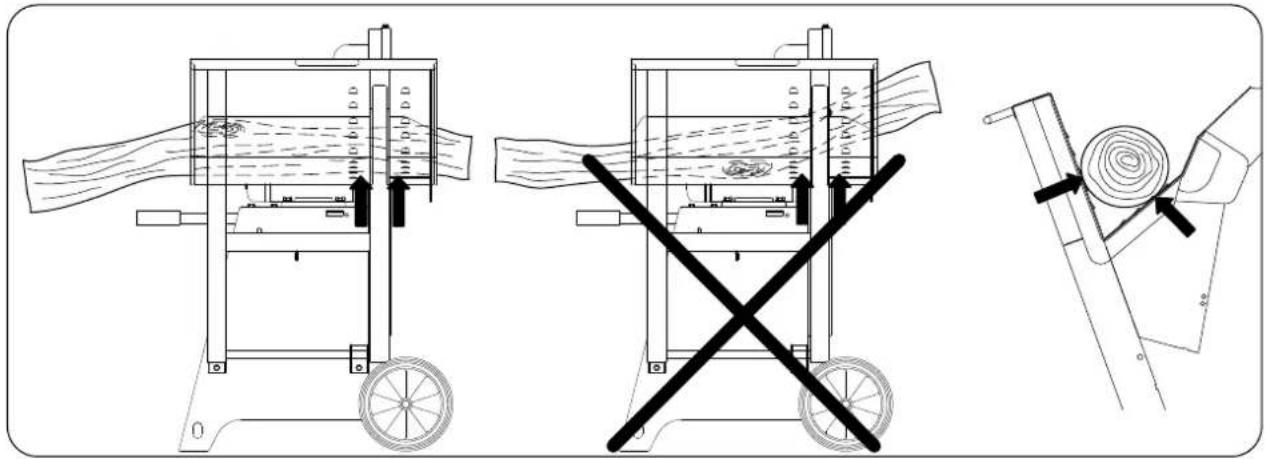
Technical diagram showing three mechanical device configurations with labeled dimensions and cross-sectional view indicators.Attention: risk of accident!
The wood must always be seated on both sides of the saw blade on the v-block of the rocker. (see arrows)
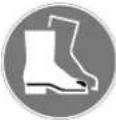 | Caution Danger of accidents!Wear safety shoes. |  | Caution Danger of accidents!To wear ear protection.Wear safety glasses. |
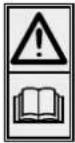 | Accident risk!Before commissioning instruction manual read. | 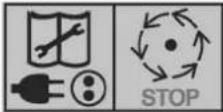 | Attention!Tool continues to run after power disconnected!Before any maintenance, cleaning or repair work, disconnect the unit from the power supply!During Cardan shaft operation, park the tractor and remove the ignition key! |
5. Training of the operator
- Forward the safety instructions to all people working on or with this machine.
• People running the machine should not be distracted. - Keep children away from the to the net connected machine.
- Wear tight fitting clothes. Take off jewelry, rings and wristwatches.
- Observe all safety and hazard warnings on the machine and keep it in readable condition.
- Be careful at work: Danger of damaging finger(s) and hand(s) by the rotating cutting tool.
- Regular pauses must be observed during operation.
- Safety shoes and protective clothing must be worn during operation.
- The minimum age for the operating person is 18 years. Trainees should be minimum 16 years of age, but are only allowed to work with the machine under supervision.
6. Technical Data
| kw 7.0 kwz 7.0 kw-ze 7.0 | |||||
| Article Number 1905115902 1905115903 1905115904 1905115905 | |||||
| Construction measurements: | |||||
| Total length | mm | 1060 | 1410 | 1500 | |
| Total width | mm | 820 | 900 | 900 | |
| Total height mm | 1150 | ||||
| Rocker support | mm | 735 | |||
| Saw blade ø | mm | 700 | |||
| Idle speed motor | 1/min | 1380 | 1400 | - | 1380 |
| Cutting speed saw blade | m/sec | 51 | 51 | 51 | 51 |
| Weight | kg | 152 | 156 | 171 | 217 |
| Power unit | |||||
| Motor | V/Hz | 380 - 420 / 50 | 380 - 420 / 50 | Cardan shaft | 380 - 420 / 50 Cardan shaft |
| Input power P1 | kW | 5,2 | 7,5 | - | 5,2 |
| Output power P2 | kW | 4,0 | 6,0 | - | 4,0 |
| Operating mode S6 / 40% 6 / 40% -6 / 40% | |||||
| Rated current A 16 16 - 16 | |||||
| Cardan shaft speed | 1/min | - | - | 540 | 540 |
| Work information | |||||
| Cutting height Spar | max. mm | 250 | |||
| min. mm | 60 | ||||
| Turning cut max. mm | 260 | ||||
| Piece of wood | max. mm | 370 x 250 | |||
| Reserve technical changes! | |||||
Specific noise values
The according to the EN 23746 for the sound pressure level resp. EN 31202 (correction factor k3 after supplement A.2 from EN 31204 calculated) for the sound pressure level on the working site ascertained noise emission value amounts under the foundations of ISO 7904 supplement a performed working conditions to.
| Sound pressure level in dB | kw 7.0 | kwz 7.0 | kw-ze 7.0 |
| Idle L_WA / Processing L_WA | 93 / 99 | 93 / 99 | 93 / 99 |
| Sound pressure level on working site in dB | |||
| Idle LqAeq / Processing LqAeq | 86 / 91 | 86 / 91 | 86 / 91 |
The specified values are emission values and therefore should not at the same time be reliable working site values. Although there is a correlation between emission and immersion levels, it cannot unfailingly be derived if extra precautions need to be taken or not. Factors, which influence the actual available immersion value on working site, include the peculiarities of working area, other sources of noise, e.g. the number of machines and other adjoining processes. The allowed working values could vary from country to country. However, the information should qualify the user, to be able to make an estimation of the dangers and risks.
7. Scope of delivery
- Rocker circular saw
- Allen key or open-end wrench
- Operating instructions
8. Assembly
The machine is supplied completely assembled them, and is therefore ready to use.
9. Setting-up and adjustment
- Please pay attention that your rocker circular saw is set up stable and on a leveled floor.
• The workplace must be well lit. - There should be no obstacles to the machine.
10. Transport of the machine
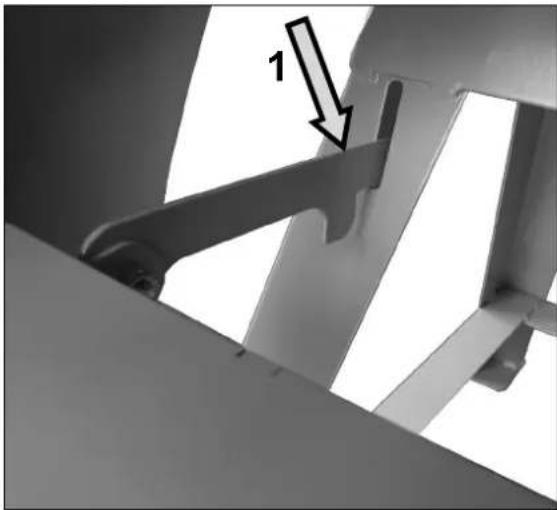
natural_image
Close-up of a mechanical lever mechanism with a labeled component (1) and directional arrow, no readable text or symbols present.Rocker lock
- To transport the swivel log saw, latch the swivel lock in position (1).
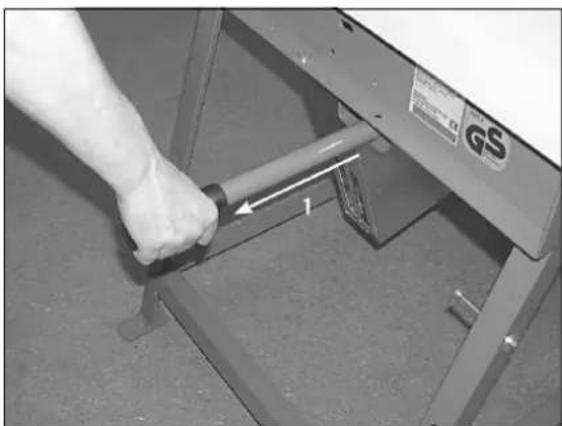
natural_image
Hand holding a cylindrical object with an arrow, next to a mechanical device labeled 'GS' (no visible text or symbols on the object itself)Transport handle
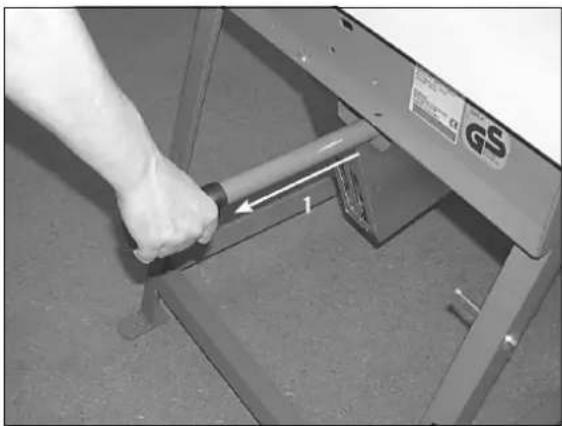
- Remove the handle (1).
To ensure safe transport, subsequently turn the handle (locking mechanism through screw head in the transport handle).
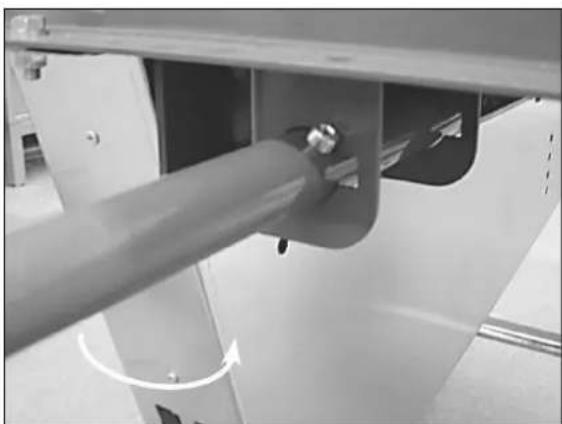
natural_image
Close-up of a mechanical assembly with a cylindrical component and rotating arrow (no visible text or symbols)Tractor attachment
- Cardan shaft operation must be switched off when transporting the circular saw.
⚠️ Transport on public highways
Attention! When driving on public roads, it is necessary to observe the German road traffic act (StVZO) paragraph 53, 53b and 54 regarding attachments. If an attachment protrudes more than 1m to the rear beyond the tail lights of a tractor vehicle, the end must be made readily recognisable with warning signs. If visibility conditions require it, additional tail lights and reflectors must also be fitted.
If an attachment protrudes more than 40cm beyond the limiting lights or tail lights, the front and rear must be made readily recognisable with warning signs. If visibility conditions require it, additional limiting lights, tail lights and reflectors are also necessary.
Attachments must be made safe with lighting equipment if the tractor unit is concealed by the attachment. It is necessary to ensure that front ballast is installed when transporting a machine with an agricultural tractor, if this is required according to the load table for the tractor. The transport speed must not exceed 6km/h.
11. Electrical Connection
The electrical motor installed is connected and ready for operation. The connection complies with the applicable VDE and DIN provisions. The customer's mains connection as well as the extension cable used must also comply with these regulations.
Check electrical connection cables regularly for damage. Ensure that the connecting cable is not attached to the mains when you are checking it.
Electrical connecting cables must correspond to the relevant VDE and DIN regulations. Only use connecting cables with the code H 07 RN.
The type designation must be printed on the connecting cable by regulation.
Faulty electrical connecting cables
Insulation damage often occurs at electrical connecting cables.
Causes include:
- Pinch points when connecting cables are run through window or door gaps.
- Kinks resulting from incorrect attachment or laying of the connection cable.
- Cuts resulting from running over the connecting cable.
- Insulation damage resulting from forcefully pulling out of the wall socket.
- Cracks through aging of insulation.
Such defective electrical connection cables must not be used as the insulation damage makes them extremely hazardous.
Three-phase motor 400 V/50 Hz
Mains voltage 400 Volt / 50 Hz.
Mains voltage and extension cables must be 5-lead = 3 P + N + SL. - (3/N/PE).
Extension cables must have a minimum cross-section of 1.5 mm^2 ( ≤ 25m ).
Extension cables must have a minimum cross-section of 2.5 mm^2 (> 25m) .
The mains connection is protected with a 16 A slow-blow fuse. The RCD breaker must have a 30 mA trip rating.
When connecting to the mains or in the event of the machine being moved to another location, the turning direction must be checked. It may be necessary to change the polarity.
Turn pole inverter in the machine socket.
Motor-brake appliance
The brake slows down the motor of the saw shaft within 10 seconds.
The electrical braking is interrupted after maximum 14 seconds.
In case the braking takes more than 10 seconds the machine should not be used again, as the brake is defective. The machine implicitly needs to be disconnected from the power supply. Only an electronic specialist should be instructed to repair this malfunction.
Operating mode / Switch-on duration
The electrical motor is dimensioned for operating mode S6 - 40 %.
S6 = pass operation with load exposure
40% = related to 10 min. 4min. load; 6min. pass operation
If the motor is overloaded, it automatically switches off because a thermostat protects the motor against overloading. After a cool-down period (time varies) the motor can be switched on again.
Check electrical connection
- Switch on the machine with the power switch, the motor runs up.
Attention!
Check the direction of rotation!
- Three-phase AC motors must be checked for their direction of rotation in the event of a new connection or change of location. If necessary, the direction of rotation must be changed with the phase inverter (Fig. A)
- Upon switching off the saw shaft is slowed down within 10 seconds.
Changing of rolling direction
Fig. A
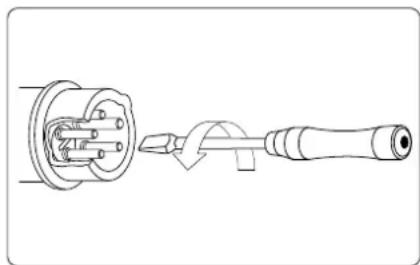
natural_image
Technical line drawing of a mechanical assembly with a tool and component (no text or symbols)⚠️ Connections and repairs of the electrical equipment should only be carried out by an electrical specialist.
In case you have further questions, please specify the following:
- Motor manufacturer; Current type of the motor
• Type of current for the motor
• Information of the machine type label
• Information of the switch type label
If you send the motor back, always return the complete power unit with electro-control. △
12. Tractor attachment (at kwz 7.0 and kw-ze 7.0)
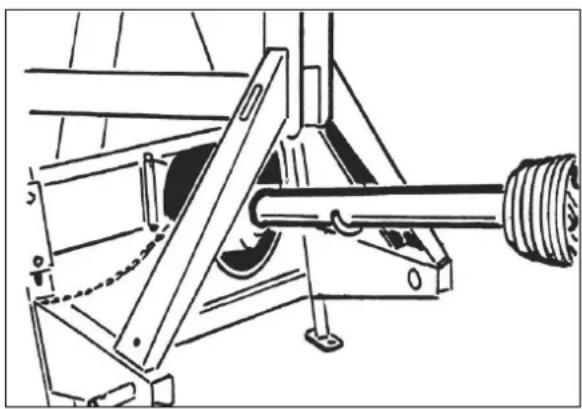
- Attach the circular saw to the 3-point hydraulics of the tractor in a longitudinal direction and couple with the Cardan shaft for cutting firewood.
- No persons are permitted to stand between the tractor and attachment.
- During operation, secure the Cardan shaft with the chain to prevent spinning.
- Switch off the tractor and remove the ignition key when leaving the workplace.
- Hang the Cardan shaft in the holder after uncoupling from the tractor.
- Use the correct Cardan shaft. We recommend the scheppach Cardan shaft W110, art. no. 05018101.
natural_image
Technical line drawing of a mechanical assembly with no visible text or symbols13. Commissioning
- Before commissioning observe the safety notes.
- All safety and auxiliary installations must be fitted.
- Check the rocker, which must return to the initial position independently. Check the saw blade for perfect fit and the correct direction of rotation.
- Functional check before start of work.
- To operate the saw, press the on / off switch. During Cardan shaft operation, start the tractor engine and the Cardan shaft drive.
- The saw is constructed solely for the cross cutting of firewood with max. 1 meter length.
- Regardless of the wood diameter, put only one piece with min. ∅ 60 mm on the rocker.
- Use both hands to swing the rocker to the saw blade.
- Then place the rocker in the initial position.
- The wood to be sawn must not be fixed by hand.
- After the complete standstill of the saw, pull the mains plug. During Cardan shaft operation, park the tractor and remove the ignition key!
- Only carry out conversion, adjustment, measurement and cleaning work with the engine switched off. During Cardan shaft operation, park the tractor and remove the ignition key!
The kw 7.0 / kwz 7.0, kw-ze 7.0 provides maximum safety thanks to its enclosed sawing area..
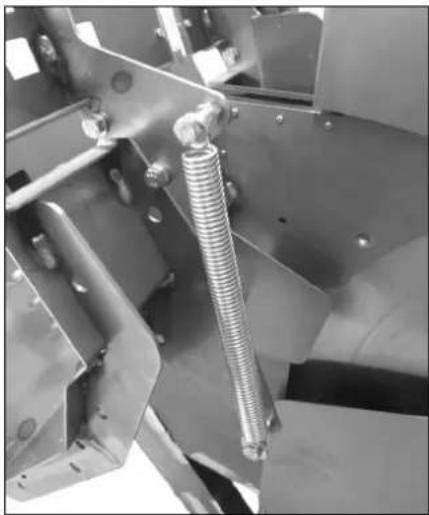
Cut off the cable ties on the tension springs. Open the protective cover (1) and mount the tension springs as displayed in the image.
natural_image
Close-up of a mechanical assembly with a coiled spring and metal components (no visible text or symbols)14. Handling the protection cage
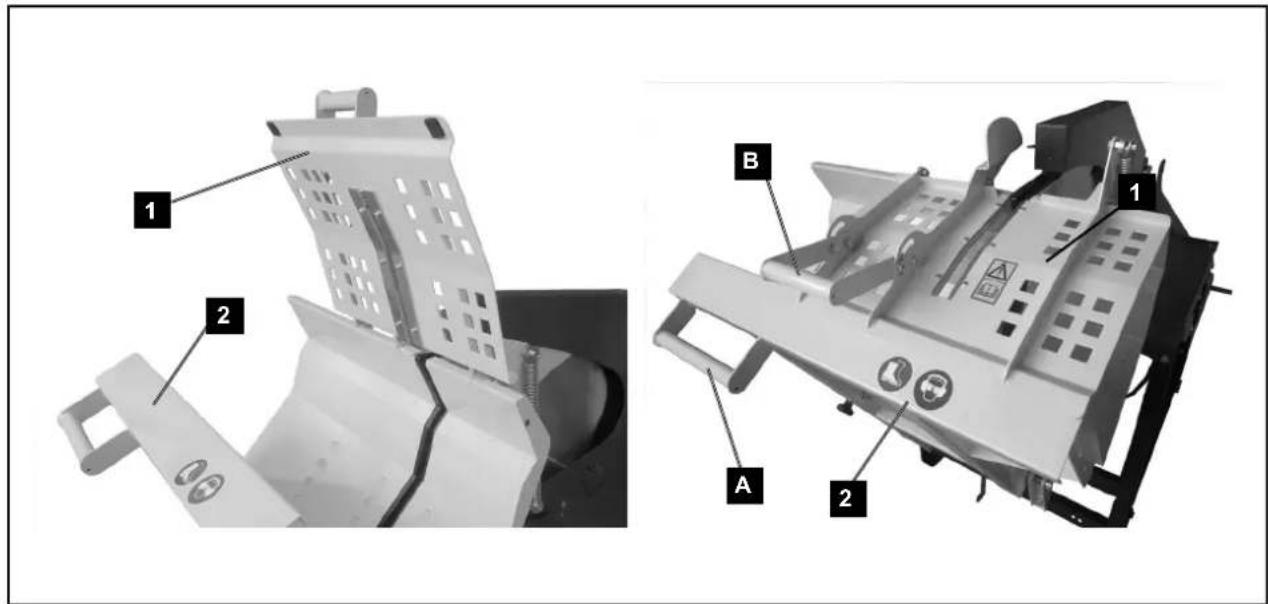
- Open the protective cover (1).
- Insert the material to be cut.
- Close the protective cover (1).
- Swivel the rocking frame (2) with hand grip (A) or (B) to the saw blade and saw through the material to be cut.
- Swivel the rocking frame (2) back and open the protective cover.
- Add more material to be cut and close the protective cover again.
text_image
1 2 B 1 A 215. Sawing operation
1 After the machine has been switched on, wait until the saw blade has reached full speed.
2 Put the wood on the rocker.
3 Take hold of both handle bars of the rocker with both hands and lead it evenly to the saw blade; thus the saw blade is revealed.
4 Push the rocker evenly to ensure the engine speed does not drop.
5 Remove the wood from the rocker after it has returned to the initial position and the saw blade is covered. Then place the next workpiece.
Attention!
- Do not leave the machine unattended during operation.
- Switch the machine off and remove the mains plug or take out the ignition key when stopping work.
Working with the kw-ze 7.0
Fig.1
natural_image
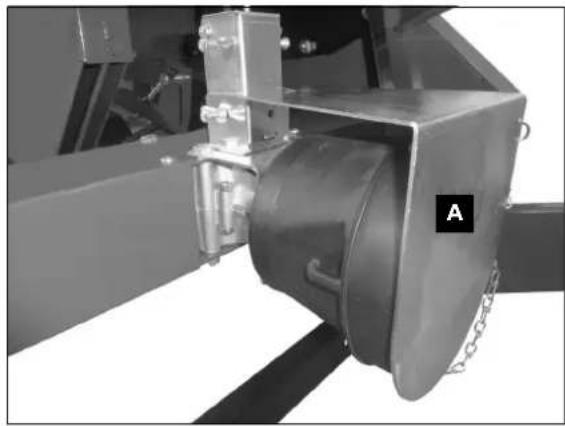
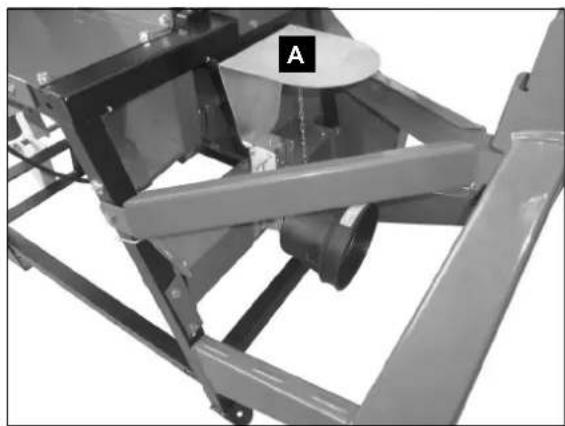
Mechanical assembly component with labeled section A, showing internal components and mounting brackets (no readable text or symbols beyond label)During electrical operation, slide the protective cover (A) into the lowest position so that the electric drive is activated. (Fig.1)
Fig. 2 During Cardan shaft operation, lock the protective cover in the
natural_image
Mechanical assembly with metal frame and labeled component A (no readable text or symbols)top position. Remove the mains plug. (Fig.2)
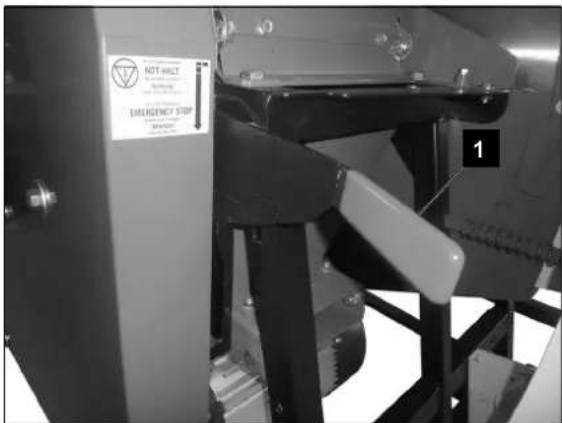
⚠ Attention! Emergency stop only for Cardan shaft operation (Fig. 3-4)
Fig.3
text_image
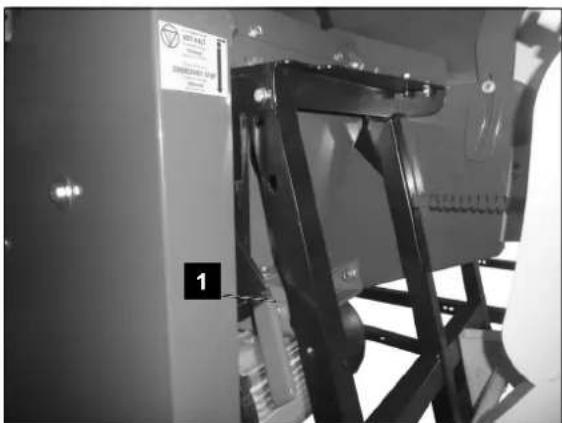
ADT.AHLET EMERGENCY STOP 1In case of danger in Cardan shaft operation, release the emergency stop lever (1) lightly to the left and slide down. This stops the saw blade and the Cardan shaft runs on. Then switch off the Cardan shaft on the tractor immediately! (Otherwise very high wear on the drive!)
Attention! Do not use the emergency stop to switch off the saw in normal operation. (Otherwise very high wear on the drive!)
Fig. 4
text_image
1End of work
- Switch off the drive on the On/Off switch or tractor.
- Wait until the blade has completely stopped.
- Unplug the mains plug or ignition key.
- Observe general maintenance instructions.
- Place the jack in the transport position and secure it with the locking lever.
16. Maintenance and service
⚠ Perform maintenance, modification, adjustment and cleaning work only with the engine switched off and the mains plug or spark plug connector is unplugged.
- Keep the manual at the machine.
- Keep machine clean.
- Wear protective goggles when cleaning.
Before undertaking any maintenance or checking work, the working area must be cleaned. Keep the necessary tools within the reach of your hand.
The intervals mentioned herein are based on normal conditions of use. An excessive use of the machine shortens the intervals accordingly.
Clean the panels, screens and control levers with a soft cloth. The cloth should be dry or slightly humid with a neutral cleaning agent. Do not use any solvents like alcohol or benzene as they could damage the surfaces.
Keep oils and lubricants out of reach of unauthorised persons. Read through the instructions on the containers carefully and follow them closely. Avoid direct contact with the skin and wash off thoroughly after use.
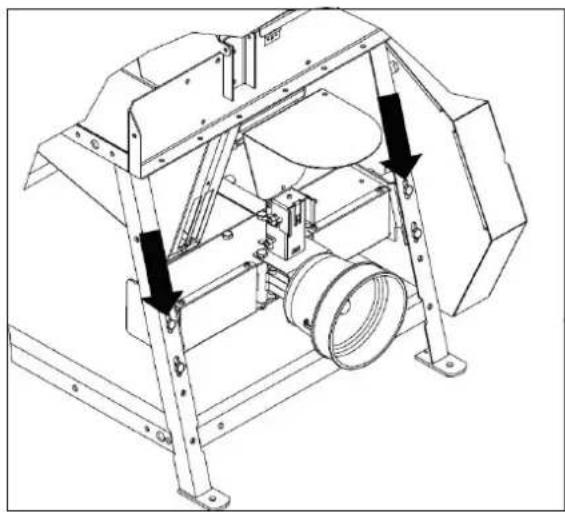
Check the V-belt tension after the first hour of operation and every time before starting up. To do so, undo the T-screw on the motor bracket. Press the bracket down and tighten the T-screw again.
All ball bearings are lifetime lubricated. The circular saw blade is a wearing part and must be checked every time before starting up. Only a well-sharpened, correctly set saw blade delivers good cutting results. Occasional greasing of the saw blade is recommended.
If signs of wear appear in the swivel saw slit, the swivel parts must be replaced.
Additional maintenance work with Cardan shaft operation
Fig.5 Tightening the V-belt (Fig. 5)
natural_image
Technical line drawing of a mechanical assembly with no visible text or symbols- Undo the hexagonal screws and press the gear unit down evenly. The gear unit must be adjusted parallel.
- Tighten hexagon screws firmly.
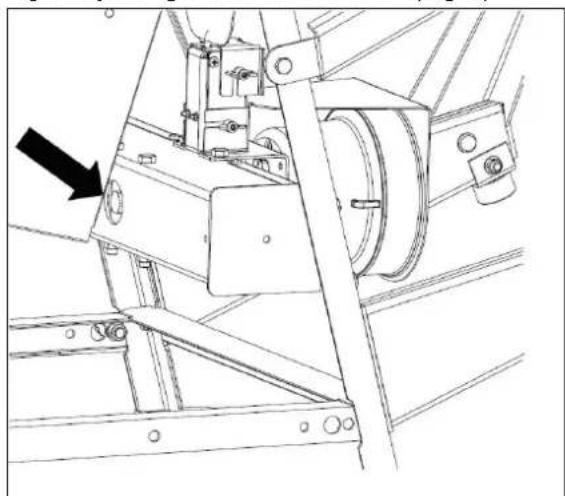
Fig.6 Replacing the transmission oil (Fig. 6)
natural_image
Technical line drawing of a mechanical assembly with a black arrow pointing to a component (no text or symbols present)- Replace the transmission oil annually.
• Use SAE 90 transmission oil.
• The capacity is 0.35 litres.
• Figure 6 shows the angular transmission oil filler plug.
- Dispose of used oil in an environmentally friendly manner.
⚠️ Check all safety devices after maintenance and cleaning work.
Maintenance
Turn the engine off and let the engine cool down. Pull out the mains plug or remove the tractor ignition key.
Check the general condition of the machine. Be careful with loose screws, misaligned or moving parts, breakage of parts, and any other condition that could interfere with safe operation.
Remove any foreign objects and other materials that have accumulated on the saw blade and the unit. Clean the machine after each use. Then use a high-quality and thin fluid machine oil to lubricate all moving parts.
△ Never use a “pressure washer” to clean your unit. Water can penetrate tight areas of the machine and its transmission case and cause damage to spindles, gears, bearings, or the engine. The use of pressure washers will result in shortened life and reduce serviceability.
Experienced craftsmen can perform minor repairs on the machine itself.
-
Check the saw blade regularly. Use only well-sharpened, crack-free and not distorted saws. Use only tools that comply with the European standard EN 847-1.
• Exchange immediately rocker that run out. -
Check all safety installations after each maintenance and cleaning activities.
- Ensure that there are no tools or other materials on or in the machine before putting it into operation.
- Remove possible sawdust blockages at the discharge.
Service information
Please note that the following parts of this product are subject to normal or natural wear and that the following parts are therefore also required for use as consumables.
Wear parts*: sawblade; seesaw inserts
* Not necessarily included in the scope of delivery!
17. Exchange of saw blade
natural_image
Close-up of a metallic industrial machine component with mounting bracket and control panel (no visible text or symbols)Wait until stationary and allow to cool down!
The exchange of the saw blade can only be undertaken in firewood cut position.
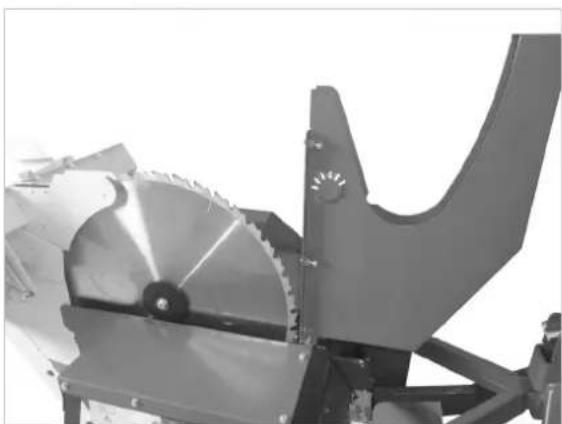
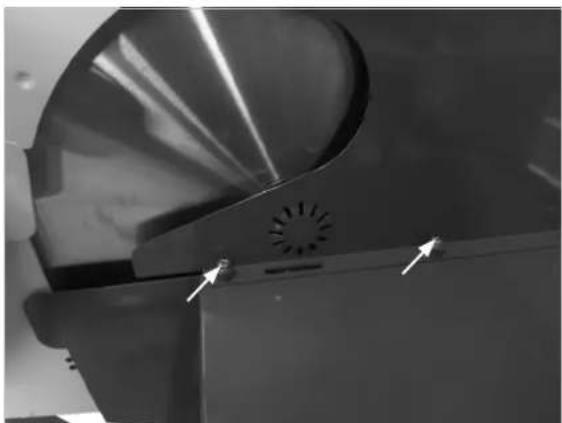
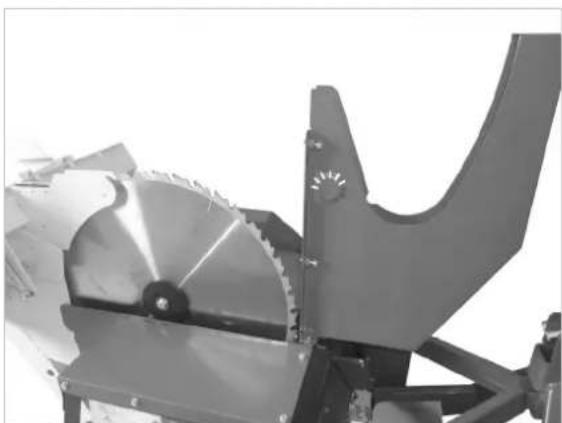
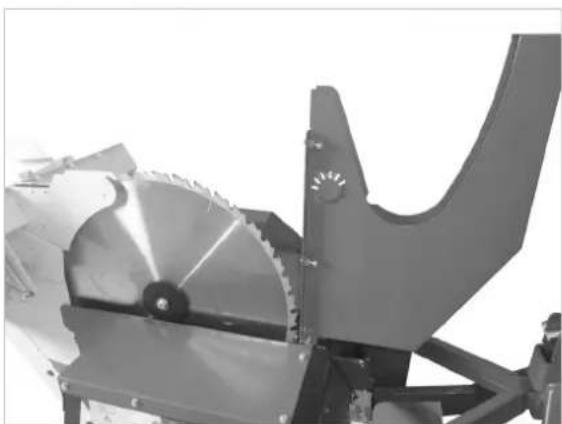
Undo the protective hood on the left and right with 2 hexagon screws respectively, until the screws turn freely unhindered. Now fold open the protective hood.
(Fig. 1; 2; 3)
Fig.2
natural_image
Close-up of a mechanical component with a circular opening and a ventilation grille, showing no visible text or symbols.Fig.3
natural_image
Close-up of a mechanical tool or machine component with a metallic blade and curved handle (no visible text or symbols)Fig.4
natural_image
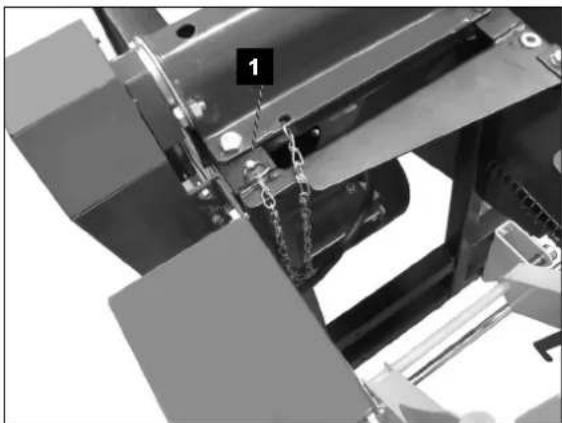
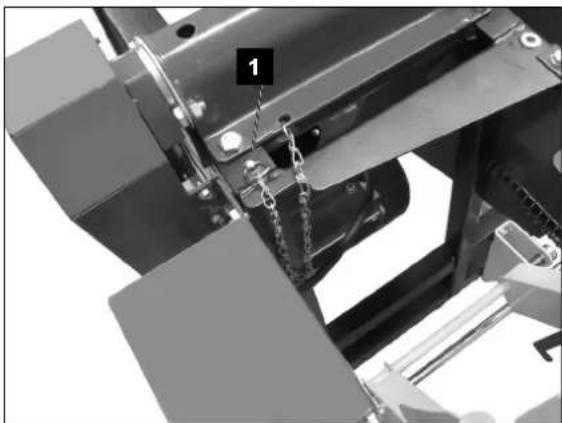
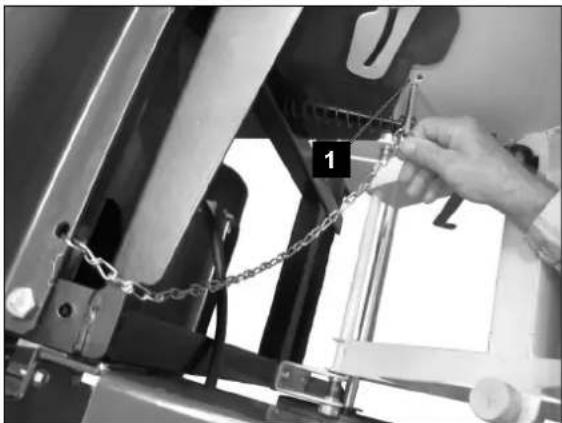
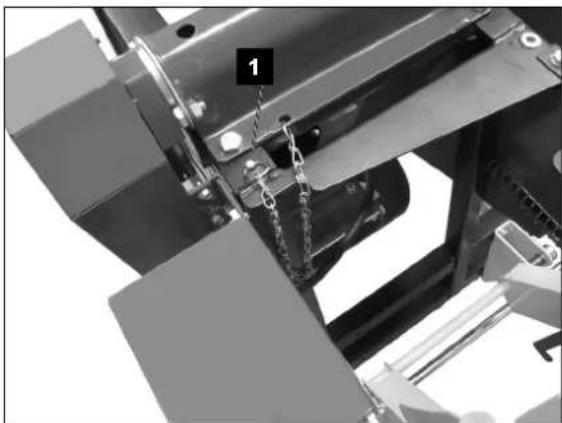
Mechanical assembly diagram showing a bracket with labeled component '1' (no readable text or symbols)To lock the saw blade into place, insert the locking pin (1) (located in the frame, see Fig. 4) through the corresponding opening on the saw blade guard (fig. 5). To do this, insert the pin completely and straight into the hole. Use the corresponding hole (depending on the saw blade type) so that the pin is at the lowest point (bottom of the tooth).
Fig.5
natural_image
Close-up of a hand adjusting a mechanical component with chains and a numbered label (1), no visible text or symbols.Fig.6
natural_image
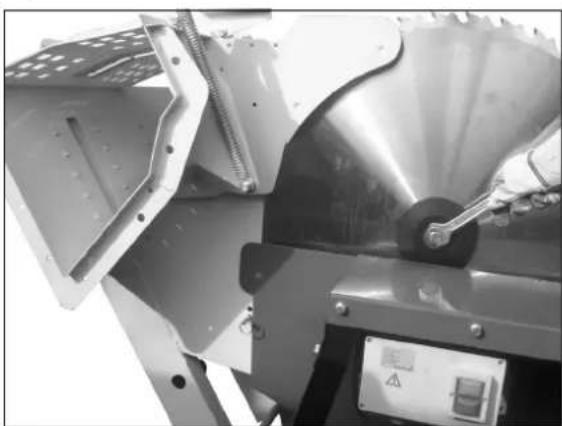
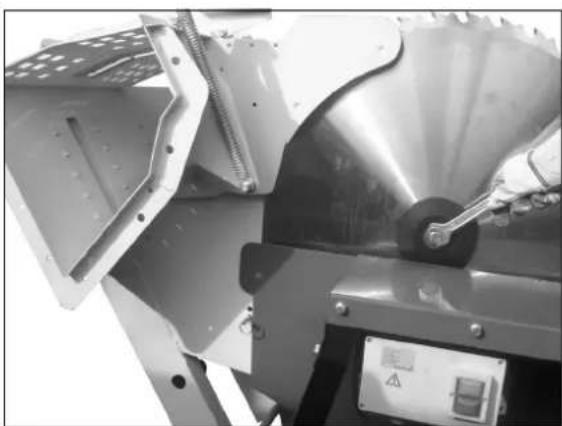
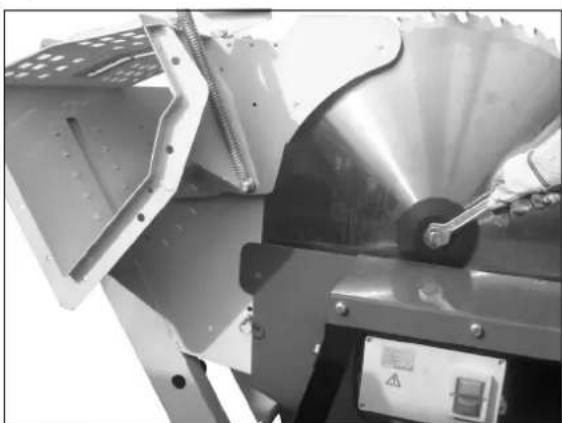
Industrial machine component with metallic blades and a handle, no visible text or symbolsLoosen the saw blade with the supplied open-end spanner / Allen wrench (2). (Fig. 6)
Remove the saw blade flange.
Insert the new saw blade.
Mount the saw blade flange again and tighten the clamp screw. Remove the locking pin.
Lower the saw blade guard and screw tight.
Attention! When installing the saw blade, pay attention to the correct direction of rotation!
18. Troubleshooting
| Problem Possible Cause Help | ||
| Saw blade is loose after the motor is switched off | 1. Fixing nut not tight enough | 1. Tighten fixing nut; right-hand thread |
| Burnt areas on the cutting surface | 1. Blunt saw blade2. Incorrect saw blade | 1. Sharpen/replace saw blade2. Replace saw blade |
| Motor does not start 1. Mains fuse blown2. Extension cable defective3. Connection to the motor or switch not OK4. With the kw-ze 7.0: Protective cover not mounted on Cardan shaft guard | 1. Check mains fuse2. Check extension cable, do not continue to use defective cables, have them repaired by a professional.3. Have this checked by an electrician.4. Mount protective cover on Cardan shaft guard cap. | |
| Incorrect motor rota-tion direction | Incorrect connection Turn phase | |
| Motor not supplying power, switches itself off automatically | 1. Overload due to blunt saw blade2. Thermal protection tripped | 1. Insert sharpened saw blade.2. Switch back on again after cool-down time |
| Decreasing saw power at full speed | Belt loose Retighten belt | |
⚠️ Electrotechnical maintenance works should only be carried out by an electronics technician!
19. Disposal and recycling
On removal of the machine the local legal regulations have to be abided by.
Please contact the manufacturer in case of disposal.
Old devices must not be disposed of with household waste!
This symbol indicates that this product must not be disposed of together with domestic waste in compliance with the Directive (2012/19/EU) pertaining to waste electrical and electronic equipment (WEEE). This product must be disposed of at a designated collection point. This can occur, for example, by handing it in at an authorised collecting point for the recycling of waste electrical and electronic equipment. Improper handling of waste equipment may have negative consequences for the environment and human health due to potentially hazardous substances that are often contained in electrical and electronic equipment. By properly disposing of this product, you are also contributing to the effective use of natural resources. You can obtain information on collection points for waste equipment from your municipal administration, public waste disposal authority, an authorised body for the disposal of waste electrical and electronic equipment or your waste disposal company.
Table des matières
Günzburger Straße 69
D-89335 Ichenhausen
Cher client,
text_image
Technical diagram showing three mechanical device configurations with labeled dimensions and cross-sectional view indicators.Risque d'accident!
natural_image
Close-up of a mechanical bracket with a labeled arrow pointing to a specific part (no text or symbols present)Blocage du chevalet
- Pour transporter la scie, bloquez le chevalet en position (1).
natural_image
Close-up of a hand holding a cylindrical object with an arrow, next to a metal frame (no visible text or symbols)natural_image
Close-up of a mechanical component with a rotating shaft and adjustment knob (no visible text or symbols)natural_image
Technical line drawing of a mechanical component with a tool inserted into a housing (no text or symbols)natural_image
Technical line drawing of a mechanical assembly with no visible text or symbols13. Miss en service
natural_image
Close-up of a mechanical assembly with a coiled spring and metal components (no visible text or symbols)natural_image
Mechanical assembly component with labeled section A, showing internal components and mounting brackets (no readable text or symbols beyond label)natural_image
Mechanical assembly with metal frame and labeled component A (no readable text or symbols)text_image
NOT AMOUNT EMERGENCY STOP 1natural_image
Close-up of industrial machinery components with no visible text or symbolsFin du travail
natural_image
Technical line drawing of a mechanical assembly with no visible text or symbolsnatural_image
Technical line drawing of a mechanical assembly with no visible text or symbolsnatural_image
Close-up of a metallic industrial component with a curved duct and mounting base, no visible text or symbolsnatural_image
Close-up of a metallic mechanical component with a circular vent and mounting bracket (no visible text or symbols)Fig.3
natural_image
Close-up of a mechanical agricultural machine with a blade and handle (no visible text or symbols)Fig.4
natural_image
Mechanical assembly diagram showing a bracket with labeled component '1' (no readable text or symbols)natural_image
Close-up of a mechanical assembly with chains and a hand adjusting components (no visible text or symbols)Fig.6