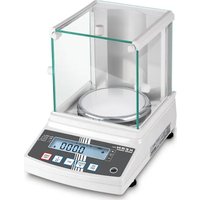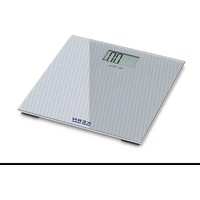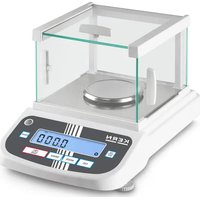
ADB 600-C3 - Scale Kern - Free user manual and instructions
Find the device manual for free ADB 600-C3 Kern in PDF.


| Product type | Electronic precision balance |
| Brand | Kern |
| Model | ADB 600-C3 |
| Maximum capacity | 600 ct (120 g) |
| Readability | 0.001 ct |
| Reproducibility | 0.002 ct |
| Linearity | ±0.004 ct |
| Stabilization time | 4 seconds |
| Warm-up time | 8 hours |
| Weighing units | g, oz, ct, lb |
| Applications | Simple weighing, parts counting, percentage determination |
| Weighing pan | Stainless steel, Ø 90 mm |
| Draft shield | Yes, glass |
| Leveling | By foot screws and bubble level |
| Interface | RS232C |
| Power supply | AC adapter 100-240V, 50/60Hz, 2.0A (output DC 12V, 2A) |
| Ambient conditions | +10°C to +30°C, humidity 20-85% non-condensing |
| Adjustment | External with calibration weight 100 g (E2) |
| Parts counting | Reference quantities: 10, 20, 50, 100, 1000 pieces |
| Display | LCD with backlight |
| Protection | Overload indicated by "E" |
| Cleaning | Soft cloth with mild soap, avoid liquids |
| Warranty | According to manual conditions |
Frequently Asked Questions - ADB 600-C3 Kern
User questions about ADB 600-C3 Kern
0 question about this device. Answer the ones you know or ask your own.
Ask a new question about this device
Download the instructions for your Scale in PDF format for free! Find your manual ADB 600-C3 - Kern and take your electronic device back in hand. On this page are published all the documents necessary for the use of your device. ADB 600-C3 by Kern.
USER MANUAL ADB 600-C3 Kern
KERN ADB-A / ADB-C / ADJ
Version 3.4
2022-04
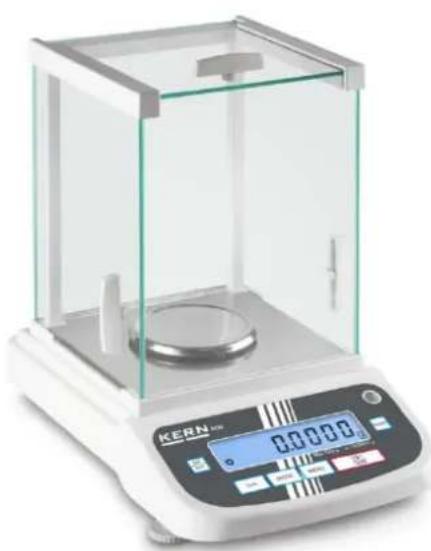
natural_image
Digital laboratory balance with transparent casing and digital display (no visible text or symbols)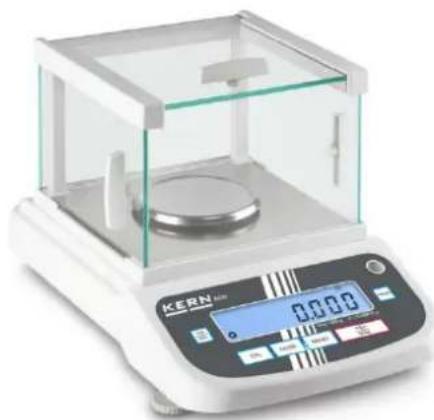
natural_image
Digital KENN instrument with transparent glass casing and digital display (no visible text or symbols on the device body)GB Further language versions you will find online under www.kern-sohn.com/manuals
Pos. Bezeichnung
natural_image
Transparent plastic wrap wrapped in plastic over a mechanical component, placed on white foam blocks (no text or symbols visible)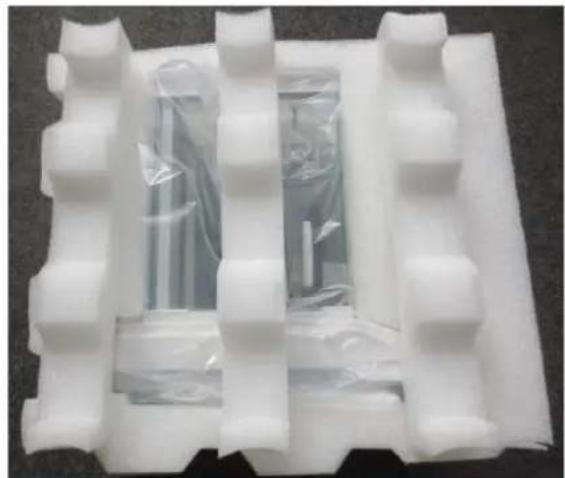
natural_image
White plastic mechanical component with internal components and wrapped parts (no visible text or symbols)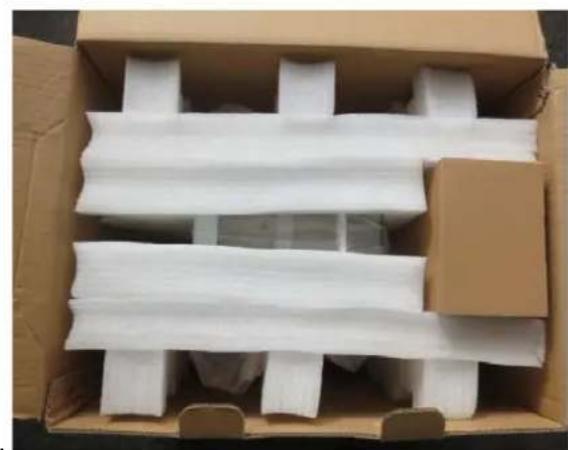
natural_image
Open cardboard box containing multiple white paper strips, no text or symbols visiblenatural_image
Two circular diagrams with concentric rings and a cross symbol, no text or labels present
Pin 5: Signal ground
Baud-Rate
1200 / 2400 / 4800 / 9600 wählbar
Parität
Operating instructions Analytical balance
Contents
1 Technical data.... 3
2 Declaration of Conformity....4
3 Device overview 5
3.2 Keyboard overview....6
3.3 Overview of display....7
4 Basic Information (General)....8
4.1 Intended use 8
4.2 Improper Use 8
4.3 Warranty 8
4.4 Monitoring of Test Resources....9
5 Basic Safety Precautions....9
5.1 Pay attention to the instructions in the Operation Manual 9
5.2 Personnel training 9
6 Transport and storage....9
6.1 Testing upon acceptance 9
6.2 Packaging / return transport 9
7 Unpacking, Setup and Commissioning 11
7.1 Installation Site, Location of Use.... 11
7.2 Unpacking, checking and installation....12
7.3 Levelling 12
7.4 Electric power supply 13
7.5 Initial Commissioning 13
7.6 Connection of peripheral devices.... 13
8 Adjustment....14
8.1 ADJ Models.... 14
8.2 Models ADB 15
9 Basic Operation 17
9.1 Start-up.... 17
9.2 Switch into stand-by mode.... 17
10 Applications 20
11 Menu 23
11.1 Navigation in the menu....23
11.2 Menu overview 25
12 RS232C-interface 26
12.1 Technical data.... 26
12.2 Interface cable 27
12.3 Interface parameters 27
12.3.1 Baud rate....27
12.3.2 Output condition 28
12.4 Sample protocols (KERN YKB-01N) 28
13 Servicing, maintenance, disposal 29
14 Instant help....30
14.1 Error messages 30
1 Technical data
| KERN | ADB 100-4 | ADB 200-4 | ADB 600-C3 |
| Product no. / type | ADB 100-4A | TADB 220-4-B | ADB 600-C3 |
| Default weighing unit g g ct | |||
| Readability (d) | 0,0001 g | 0,0001 g | 0,001 ct |
| 0,0001 g | |||
| Weighing range (max) | 120 g | 220 g | 600 ct |
| 120 g | |||
| Reproducibility | 0,0002 g | 0,0002 g | 0,002 ct |
| 0,0002 g | |||
| Linearity | ± 0.0004 g | ± 0.0004 g | ± 0.004ct |
| ± 0,0004 g | |||
| Recommended adjusting weight not supplied (class) | 100 g (E2) | 200 g (E2) | 100 g (E2) |
| Adjustment points | 100 g | 100 g | 100 g |
| - | 200 g | - | |
| Stabilization time | 4 sec. | ||
| Warm-up time | 8 h | ||
| Weighing Units | g, oz, ct, lb | ||
| Smallest part weight for piece counting | 1 mg (under laboratory conditions) | ||
| 10 mg (under normal conditions) | |||
| Reference quantities at piece counting | 10, 20, 50,100, 1000 | ||
| Weighing plate, stainless steel | ø 90 mm | ||
| Dimensions Housing (B x D x H) mm | 230 x 310 x 330 | 230 x 310 x 230 | |
| Net weight (kg) | 4,4 | 3,8 | |
| Permissible ambient condition | +10°C to +30°C | ||
| Humidity of air | 20 ~ 85 % relative (not condensing) | ||
| Power supply unit Input voltage | AC 100 - 240 V, 50-60 Hz 2,0 A | ||
| Balance Input voltage | DC 12 V, 2 A | ||
| Interface | RS232C | ||
| KERN | ADJ 100-4 | ADJ 200-4 | ADJ 600-C3 |
| Product no. / Type | TADJ 100-4-A | TADJ 220-4-B | TADJ 600-C3-A |
| Default weighing unit | g | g | ct |
| Readability (d) | 0,0001 g | 0,0001 g | 0,001 ct |
| 0,0001 g | |||
| Weighing range (max) | 120 g | 220 g | 600 ct |
| 120 g | |||
| Reproducibility | 0,0002 g | 0,0002 g | 0,002 ct |
| 0,0002 g | |||
| Linearity | ± 0.0004 g | ± 0.0004 g | ± 0.004ct |
| ± 0,0004 g | |||
| Adjusting weight internal | |||
| Stabilization time | 4 sec | ||
| Warm-up time | 8 h | ||
| Weighing Units | g, oz, ct, lb | ||
| Smallest part weight for piece counting | 1 mg (under laboratory conditions) | ||
| 10 mg (under normal conditions) | |||
| Reference quantities at piece counting | 10, 20, 50,100, 1000 | ||
| Weighing plate, stainless steel | ø 90 mm | ||
| Dimensions Housing (B x D x H) mm | 230 x 310 x 330 230 x 310 x 230 | ||
| Net weight (kg) | 4,9 | 3,8 | |
| Permissible ambient condition | +10°C to +30°C | ||
| Humidity of air | 20 ~ 85 % relative (not condensing) | ||
| Power supply unit Input voltage | AC 100 - 240 V, 50 - 60 Hz 2,0 A | ||
| Balance Input voltage | DC 12 V, 2A | ||
| Interface | RS232C | ||
2 Declaration of Conformity
To view the current EC/EU Declaration of Conformity go to:
www.kern-sohn.com/ce
3 Device overview
3.1 Components
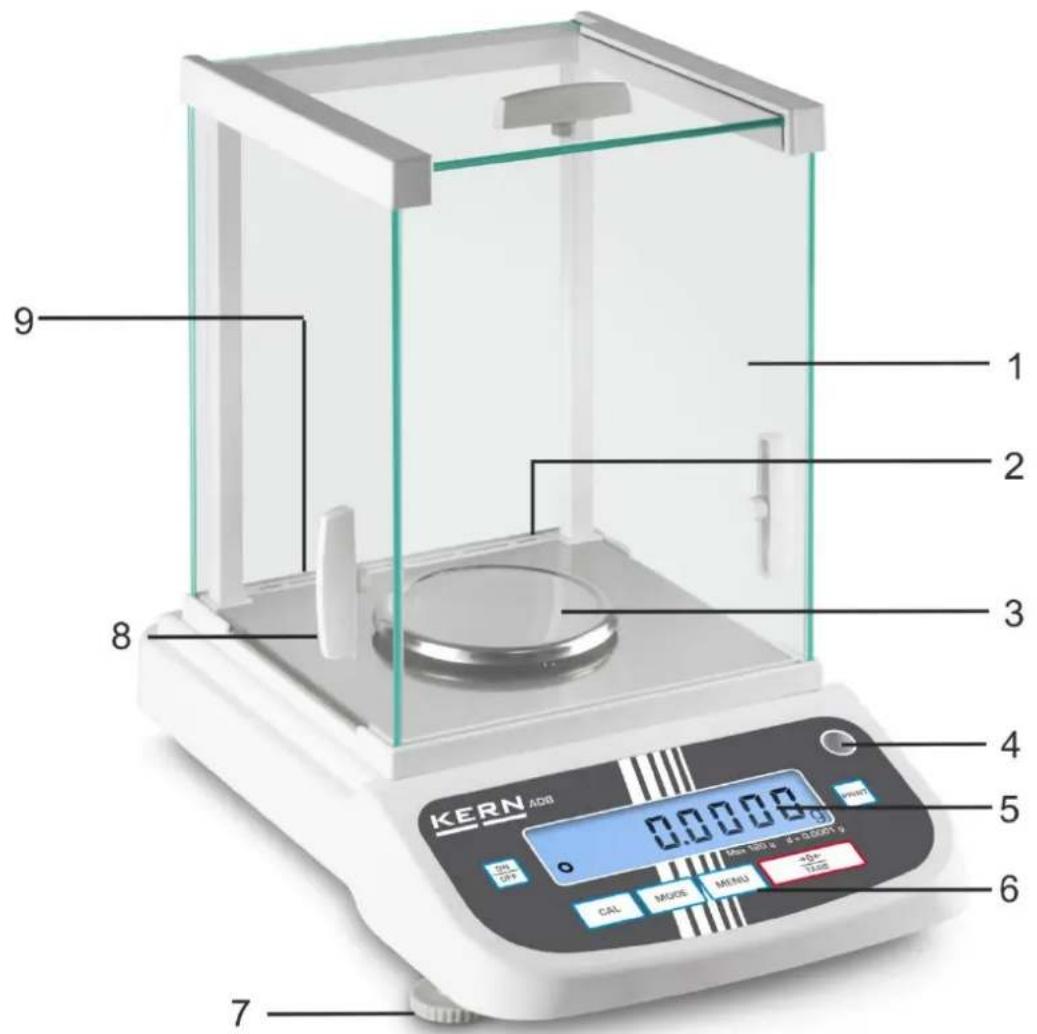
Pos. Designation
1 Glass windshield
2 Interface RS 232
3 Weighing pan
4 Bubble level
5 Display
6 Keyboard
7 Foot screws
8 Handle for operation of the side windshield doors
9 Mains adapter connection
3.2 Keyboard overview
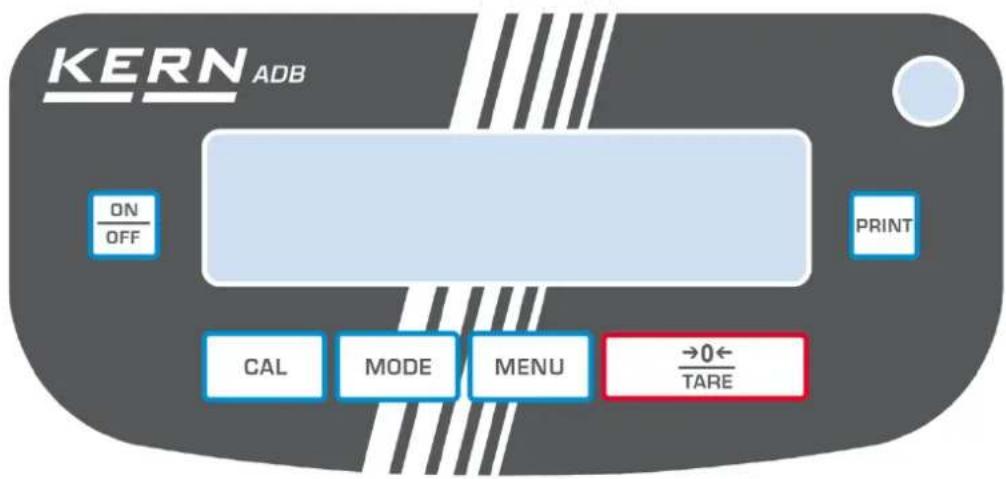
| Key Designation Function | ||
 | ON/OFF key | ➢ Turn on/off➢ Exit menu |
 | CAL key | ➢ Adjustment |
 | TARE key | ➢ Taring➢ Zeroing➢ Save setting |
 | MODE key | ➢ Switch-over weighing unit➢ Selecting an application |
 | MENU key | ➢ How to save the reference➢ Switch on/off background illumination of display(keep the button pressed for a long time) |
 | PRINT key | ➢ Change setting in the menu➢ Print out the displayed value |
3.3 Overview of display
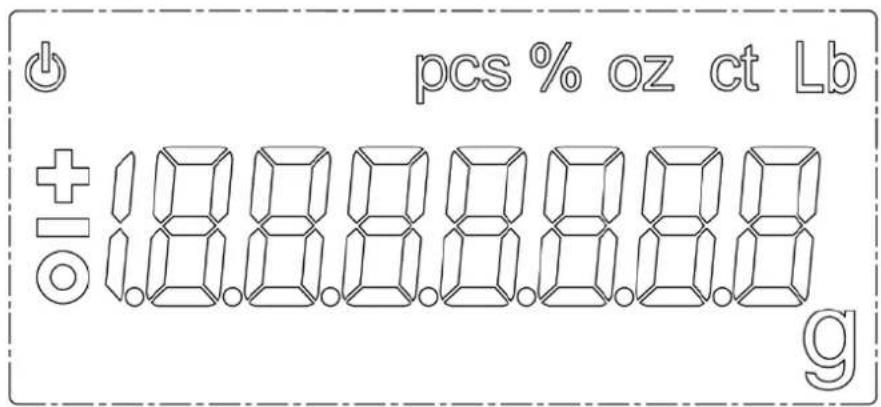
| Display Description | |
| O | Stability display |
| ∅ | The balance is in stand-by mode |
| g | Weighing unit [Gram] |
| ct | Weighing unit [Carat] |
| lb | Weighing unit [Pound] |
| oz | Weighing unit [Ounce] |
| Pcs | Application parts counting |
| % | Application percentage determination |
4 Basic Information (General)
4.1 Intended use
The balance you purchased is intended to determine the weighing value of material to be weighed. It is intended to be used as a “non-automatic balance”, i.e. the material to be weighed is manually and carefully placed in the centre of the weighing pan. As soon as a stable weighing value is reached the weighing value can be read.
4.2 Improper Use
Do not use balance for dynamic add-on weighing procedures, if small amounts of goods to be weighed are removed or added. The “stability compensation” installed in the balance may result in displaying an incorrect measuring value! (Example: Slowly draining fluids from a container on the balance.)
Do not leave permanent load on the weighing pan. This may damage the measuring system.
Impacts and overloading exceeding the stated maximum load (max) of the balance, minus a possibly existing tare load, must be strictly avoided. Balance may be damaged by this.
Never operate balance in explosive environment. The serial version is not explosion protected.
The structure of the balance may not be modified. This may lead to incorrect weighing results, safety-related faults and destruction of the balance.
The balance may only be used according to the described conditions. Other areas of use must be released by KERN in writing.
4.3 Warranty
Warranty claims shall be voided in case
• Our conditions in the operation manual are ignored
- The appliance is used outside the described uses
• The appliance is modified or opened
- Mechanical damage or damage by media, liquids, natural wear and tear
- The appliance is improperly set up or incorrectly electrically connected
• The measuring system is overloaded
4.4 Monitoring of Test Resources
In the framework of quality assurance the measuring-related properties of the balance and, if applicable, the testing weight, must be checked regularly. The responsible user must define a suitable interval as well as type and scope of this test. Information is available on KERN's home page (www.kern-sohn.com with regard to the monitoring of balance test substances and the test weights required for this. In KERN's accredited DKD calibration laboratory test weights and balances may be calibrated (return to the national standard) fast and at moderate cost.
5 Basic Safety Precautions
5.1 Pay attention to the instructions in the Operation Manual

Carefully read this operation manual before setup and commissioning, even if you are already familiar with KERN balances.
5.2 Personnel training
The appliance may only be operated and maintained by trained personnel.
6 Transport and storage
6.1 Testing upon acceptance
When receiving the appliance, please check packaging immediately, and the appliance itself when unpacking for possible visible damage.
6.2 Packaging / return transport

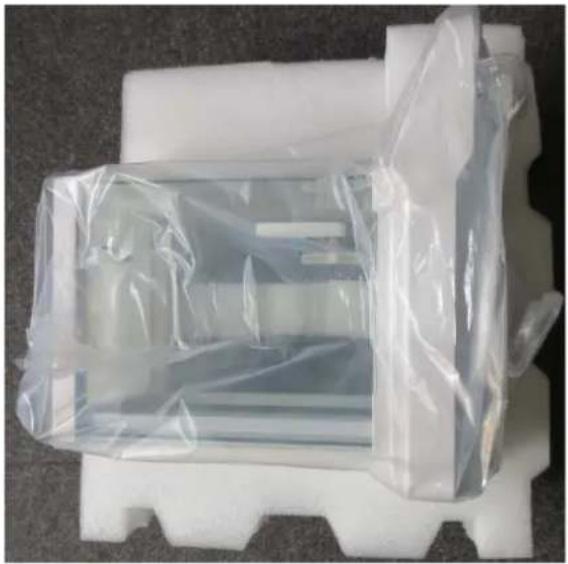
Keep all parts of the original packaging for a possibly required return.
→ Only use original packaging for returning.
Prior to dispatch disconnect all cables and remove loose/mobile parts.
⇒ Pack weighing plate + accessories and power supply unit separately.
→ Secure glass windshield against slipping (e.g. using an adhesive strip).
→ Secure all parts against shifting and damage as depicted.
natural_image
Transparent plastic bag wrapped in a white foam base, containing a transparent cylindrical object (no visible text or symbols)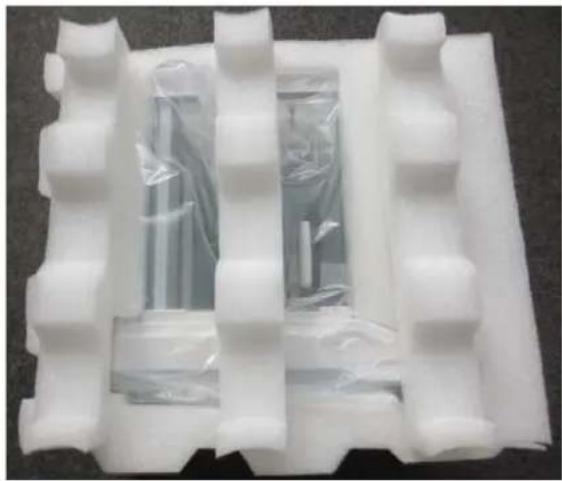
natural_image
Close-up of a white plastic component with a transparent internal structure, no visible text or symbols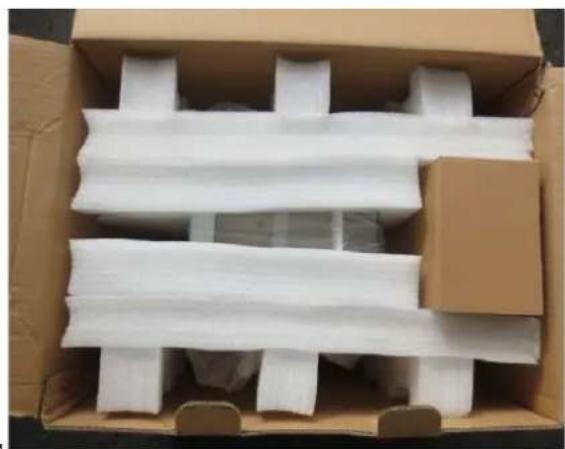
natural_image
Open cardboard box containing white plastic sheets, no visible text or symbols7 Unpacking, Setup and Commissioning
7.1 Installation Site, Location of Use
The balances are designed in a way that reliable weighing results are achieved in common conditions of use.
You will work accurately and fast, if you select the right location for your balance.
On the installation site observe the following:
- Place the balance on a firm, level surface;
- Avoid extreme heat as well as temperature fluctuation caused by installing next to a radiator or in the direct sunlight;
- Protect the balance against direct draughts due to open windows and doors;
- Avoid jarring during weighing;
- Protect the balance against high humidity, vapours and dust;
- Do not expose the device to extreme dampness for longer periods of time. Non-permitted condensation (condensation of air humidity on the appliance) may occur if a cold appliance is taken to a considerably warmer environment. In this case, acclimatize the disconnected appliance for ca. 2 hours at room temperature.
- Avoid static charge of goods to be weighed or weighing container.
If electro-magnetic fields or static charge occur, or if the power supply is unstable major deviations on the display (incorrect weighing results) are possible. In that case, the location must be changed.
7.2 Unpacking, checking and installation
Open packaging and remove all parts carefully.
Verify that there has been no damage and that all packing items are present.
Scope of delivery / serial accessories
• Balance
- Mains adapter
- Operating instructions

Prior to any installation and assembly works, the balance must be separated from the mains supply.
→ Install the balance at the intended workplace.
The right place is decisive for the accuracy of the weighing results of high-resolution analytic balances (see chap. 7.1).
→ Remove the transportation lock (only models ADJ)
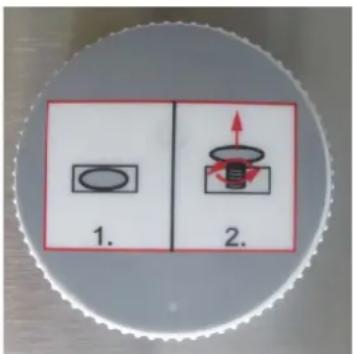
→ Put the following parts upon in the right order
- Carrier of weighing plate
- Weighing pan
7.3 Levelling
⇒ Level balance with foot screws until the air bubble of the water balance is in the prescribed circle.
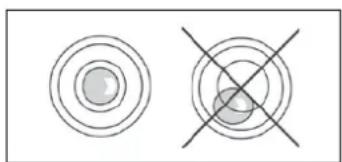
natural_image
Two concentric circles with a central shaded region and an X-shaped cross, no text or symbols present.i Check levelling regularly.
7.4 Electric power supply

Select a country-specific mains plug.

Check, whether the voltage acceptance on the scales is set correctly. Do not connect the scales to the power grid unless the information on the instrument (sticker) matches the local mains voltage.
Only use KERN original mains adapter. Using other makes requires consent by KERN.

Important:
Prior to commissioning check the mains cable for damage.
Make sure that the mains adapter will not be in touch with liquids.
The mains plug must be accessible at any time.
Connect the mains adapter to the connecting socket on the backside of the balance and to the power mains.
The display unit lights up. As soon as the balance is supplied with energy, the indicator [+] is displayed.
[Non-Text]

The error message
indicates that the balance was disconnected from power supply without pressing the ON/OFF button. Remedy:
Press ON/OFF. The device will carry out a display test.
The balance is ready for weighing once the weight indication appears.
7.5 Initial Commissioning
In order to obtain exact results with the electronic balances, your balance must have reached the operating temperature (see warming up time chap. 1). During this warming up time the balance must be connected to the power supply (mains, accumulator or battery).
The accuracy of the balance depends on the local acceleration of gravity. Strictly observe hints in chapter Adjustment.
7.6 Connection of peripheral devices
Before connecting or disconnecting of additional devices (printer, PC) to the data interface, always disconnect the balance from the power supply.
With your balance, only use accessories and peripheral devices by KERN, as they are ideally tuned to your balance.
8 Adjustment
As the acceleration value due to gravity is not the same at every location on earth, each balance must be coordinated - in compliance with the underlying physical weighing principle - to the existing acceleration due to gravity at its place of location (only if the balance has not already been adjusted to the location in the factory). This adjustment process must be carried out for the first commissioning, after each change of location as well as in case of fluctuating environment temperature. To receive accurate measuring values it is also recommended to adjust the balance periodically in weighing operation. Observe stable environmental conditions. A warming up time (see chapter 1) is required for stabilization. Ensure that there are no objects on the weighing pan.
8.1 Models ADJ
8.1.1 Automatic adjustment using a built-in weight
i Menu setting
Automatic adjustment is performed:
• having detected a change in temperature by 2^ C from the previous adjustment,
- a defined time interval has elapsed, selectable 2, 3, 4, 6, 8 hours (C7-0 – C7-4, see chapter 11.2).
Procedure:
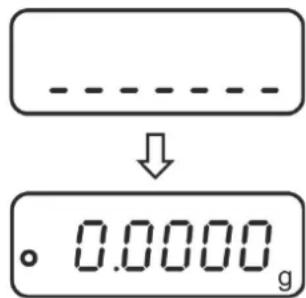
In case of the adjustment error (e.g. object on the plate) the following error message will be displayed:
8.1.2 Manual initiation of internal adjustment

Menu setting
Execution:
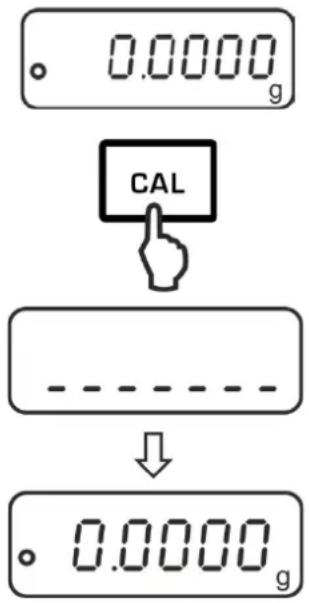
flowchart
graph TD
    A["0.0000 g"] --> B["CAL"]
    B --> C["0.0000 g"]
Press CAL button in the weighing mode.
The adjustment is carried out automatically.
After the successful adjustment the scales will be automatically switched back to the weighing mode.
In case of the adjustment error (e.g. object on the plate) the following error message will be displayed:
8.2 Models ADB

- Carry out adjustment as near as possible to the balance's maximum weight (required adjustment weight see chap. 1). Info about adjustment weights can be found on the Internet at: http://www.kern-sohn.com
- Observe stable environmental conditions. Stabilisation requires a certain warm-up time.
- Ensure that there are no objects on the weighing pan.
- Ensure menu setting
, see chap. 11.2 - In the ADB 200-4A model, adjustment is possible using a 100 g weight, but this is not the best way in terms of measurement technique.
- For the ADB 600-C3 models, remember that the selected weighing unit is [gram].
Procedure:

flowchart
graph TD
    A["0.0000g"] --> B["CAL"]
    B --> C["CAL 100"]
    C --> D["CAL"]
    D --> E["CAL in"]
    E --> F["CAL ..."]
    F --> G["CAL do"]
    G --> H["CAL ..."]
    H --> I["CAL UP"]
    I --> J["CAL ..."]
    J --> K["0.0000g"]
Press CAL in the weighing mode.
The device will display the value of the required adjustment weight (e.g. 100 g).
In the ADB 200-4A model, select
Press CAL again, you will see the indication
No objects may be left on the weighing plate.
Wait until the
When the adjustment is successfully completed, you will see the
Remove the adjustment weight, the balance will be switched back to the weighing mode.
9 Basic Operation
9.1 Start-up
As soon as the balance is supplied with energy, the indicator [] is displayed.
To switch on press the ON/OFF key.
The balance carries out a display test.
As soon as the weight display appears, the balance is ready for weighing.
9.2 Switch into stand-by mode
Press ON/OFF key, the display disappears
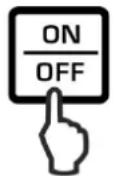
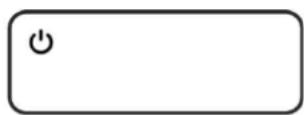
The power symbol [ ] will be displayed.

In stand-by mode the balance is ready for operation immediately after switching-on without warm-up time.
To switch off the balance completely, disconnect the cable from the mains.
The balance starts in the mode, in which it has been switched off.
9.3 Zeroing
In order to obtain optimal weighing results, reset to zero the balance before weighing.
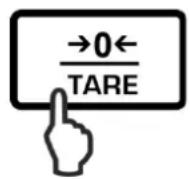
Unload the balance.
Press the TARE key.
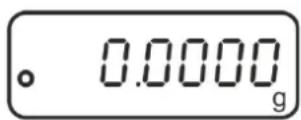
Wait until the zero display appears.
9.4 Sample weighing
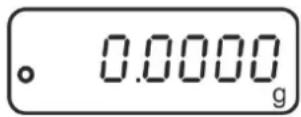
Place the goods to be weighed and close the windshield.

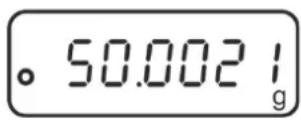
Wait for stability display

Read weighing result.
i
Overload warning
Overloading exceeding the stated maximum load (max) of the device, minus a possibly existing tare load, must be strictly avoided. This could damage the instrument.
Exceeding the maximum load is indicated by the display „E“. Unload weighing system or reduce preload.
9.5 Unit Conversion
By repeatedly pressing of the MODE key the weighed value can be switched over to the available weighing and application units.
$$ \mathrm{g} \Leftrightarrow \mathrm{oz} \Leftrightarrow \mathrm{ct} \Leftrightarrow \mathrm{lb} \Leftrightarrow \mathrm{Pcs} \Leftrightarrow \% $$
9.6 Weighing with tare
The dead weight of any weighing container may be tared away by pressing a button, so that the following weighing procedures show the net weight of the goods to be weighed.
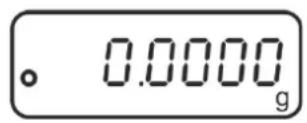
Set balance to zero
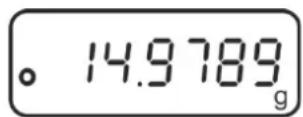
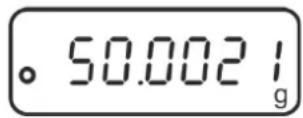
Deposit empty weighing container. The result is displayed.
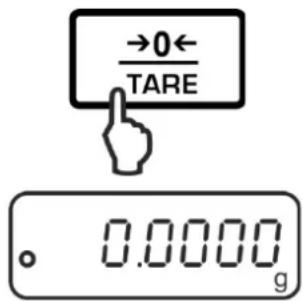
Wait for stability display, then press the TARE key
The zero display appears.
Weigh the material, the net weight will be indicated.

- When the balance is unloaded the saved taring value is displayed with negative sign.
- To delete the stored tare value, remove load from weighing pan and press the TARE key.
10 Applications
10.1 Parts counting
Before the balance can count parts, it must know the average part weight (i.e. the reference). Proceed by putting on a certain number of the parts to be counted. The balance determines the total weight and divides it by the number of parts, the so-called reference quantity. Counting is then carried out on the basis of the calculated average piece weight.
![.[2---0] PRINT . [2---4]](/content/2026/04/698054/images/31117f63a38d67cae404c543e03fa868bf4c74424b9c702a1b9a6c0feeb3879c.jpg)
1. Select the reference piece number
In weighing mode call up menu item „C2“, see chap. 11.1
Select the desired reference number of pieces using the PRINT key, see chap. 11.2.
Confirm setting by pressing the TARE key.
Exit menu using ON/OFF key: Confirm query „SAVE“ by pressing the TARE key.
The balance returns automatically into weighing mode
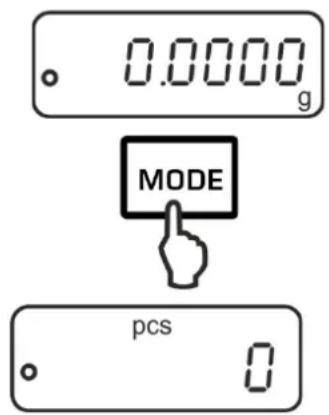
2. Call application
Press the MODE key repeatedly until „Pcs“ is displayed.
3. Set to zero/taring
Press the TARE key to set the balance to zero or to tare when using a weighing container.
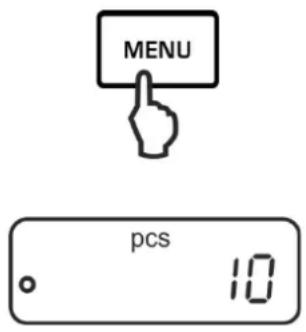
4. Weigh-in reference parts
Place as many counted pieces to add-up as required by the set reference piece number.
Press the MENU key to save the reference whereupon the weighing scale automatically calculates an average weight per part.
Remove reference weight. The balance is now in parts counting mode and counts all units on the weighing plate.
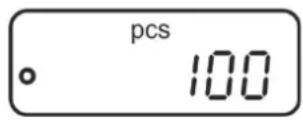
5. Count the items
Place load on pan and read the number of pieces.
6. Switch-over display between number of items and weight
Use the MODE key to switch-over the display to the available units, see chap. 9.5
Sample protocol (KERN YKB-01N)
100 pcs s
7. Printing
The display value will be printed out by connecting an optional printer and pressing the PRINT key (factory setting).

- Take care of the minimum weight of the piece (see chap. 1 „Technical data“).
- The reference weight will remain stored even after the weighing balance was turned off until the reference is reset.
10.2 Percent determination
Percentage calculation facilitates weight display in percent related to a reference weight equivalent to 100 %.
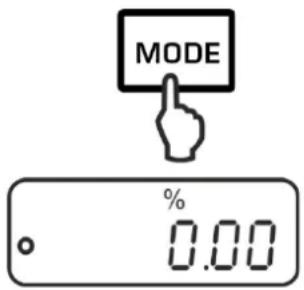
1. Call application
Press the MODE key several times until „%“ is displayed.
2. Set to zero/taring
Press the TARE key to set the balance to zero or to tare when using a weighing container.
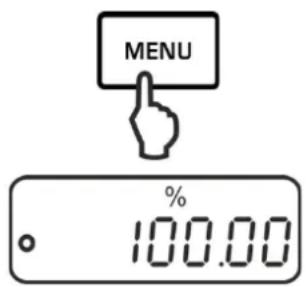
3. Reference setting (100 % value)
Put a reference weight which corresponds to 100 %. Store reference by pressing the MENU key.
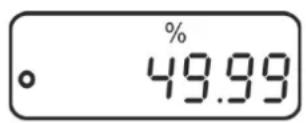
Remove reference weight.
4. Percent determination
Place goods to be weighed on balance. The weight of the sample is displayed in percentage in terms of the reference weight.
5. Switch-over the display between percentage and weight
Use the MODE key to switch-over the display to the available units, see chap. 9.5
Sample protocol (KERN YKB-01N)
49.99 % s
6. Printing
The displayed value will be printed out by connecting an optional printer and pressing the PRINT key (factory setting).
The reference weight (100 %) will remain stored even after the weighing balance was turned off until the reference is reset.
11 Menu
11.1 Navigation in the menu
1. | Access to menu
In weighing mode print first the MENU key, then the PRINT key. The first menu item „C1“ showing the current setting will be displayed.
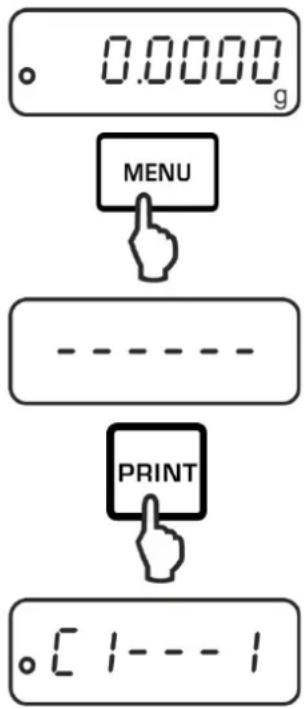
flowchart
graph TD
    A["0.0000g"] --> B["MENU"]
    B --> C["---"]
    C --> D["PRINT"]
    D --> E["1---1"]
2. Select menu items
Press the TARE key to select the individual menu items showing the current settings one by one.
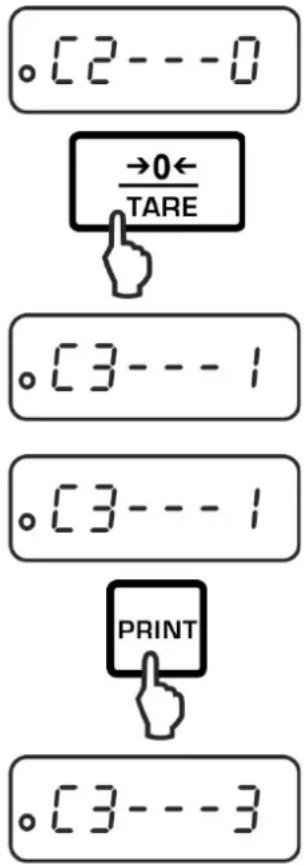
flowchart
graph TD
    A[".C2---0"] --> B["→0←/TARE"]
    B --> C[".C3---1"]
    C --> D[".C3---1"]
    D --> E["PRINT"]
    E --> F[".C3---3"]
3. | Change settings
Press the PRINT key to change the setting of a selected menu item. Each time the PRINT key is pressed the next setting will be displayed.
4. How to save settings and to exit the menu
→ Confirm setting with TARE key, the next menu item will be displayed. Either carry out more settings or exit and save menu (see step 4 or 5)
⇒ Press the ON/OFF key, „SAVE“ will be displayed.
→ Any changes carried out are stored by pressing the TARE key. The balance returns automatically into weighing mode.
5. Cancel
⇒ Press again the ON/OFF key, no changes will be saved. The balance returns automatically into weighing mode.

flowchart
graph TD
    A["->0←/TARE"] --> B[".4---3"]
    B --> C["ON/OFF"]
    C --> D["SAVE---"]
    D --> E["->0←/TARE"]
    E --> F["5--END"]
    F --> G["0.0000g"]
    G --> H["ON/OFF"]
    H --> I["5--END"]
    I --> J["0.0000g"]
11.2 Menu overview
| Menu item | Settings | Description |
| Adjustment mode | C1 - 0 | Automatic internal adjustment (ADJ models) |
| C1 - 1 | External adjustment (ADB models: always use this setting)Note: At the models with internal adjustment weight the adjustment with external weight is not recommended.. | |
| C1 - 2 | Manual internal adjustment (ADJ models) | |
| Reference quantity | C2 - 0* | 10 |
| C2 - 1 20 | ||
| C2 - 2 50 | ||
| C2 - 3 100 | ||
| C2 - 4 1000 | ||
| Automatic zero point correction | C3 - 0 | No Zerot Tracking |
| C3 - 1* | 1D Zero-point Tracking | |
| C3 - 2 | 2D Zero-point Tracking | |
| C3 - 3 | 3D Zero-point Tracking | |
| C3 - 4 | 4D Zero-point Tracking | |
| C3 - 5 | 5D Zero-point Tracking | |
| C3 - 6 Not documented | ||
| Baud rate | C4 - 0 | 1200 |
| C4 - 1* | 2400 | |
| C4 - 2 | 4800 | |
| C4 - 3 9600 | ||
| Data output | C5 - 0 | Automatic output of stable weighing values |
| C5 - 1 | Via remote control command W (w) | |
| C5 - 2 Continuous data output | ||
| C5 - 3* | Output for stable and instable weighing values after pressing PRINT key | |
| Sound by pressing the button | C6 - 0 switched on | |
| C6 - 1* | switched off | |
| Automatic internal adjustment interval (only ADJ models) | C7 - 0* | 2 hours |
| C7 - 1 | 3 hours | |
| C7 - 2 4 hours | ||
| C7 - 3 6 hours | ||
| C7 - 4 8 hours | ||
| Filter | C8 - 0* | Low interference degree |
| C8 - 1 | Medium interference degree | |
| C8 - 2 | High interference degree | |
| C8 - 3 Not documented | ||
* = factory setting
12 RS232C-interface
For the connection of a peripheral device (printer, computer) the balance is as per series equipped with a RS232C-interface.
The following conditions must be met to provide successful communication between the weighing balance and the peripheral devices.
- Connect balance using a suitable cable with the interface of the peripheral device. Faultless operation requires an adequate KERN interface cable.
- Communication parameters (baud rate, bits and parity) of balance and peripheral device must match.
This data exchange is asynchronous using ASCII - Code.
12.1 Technical data
Connection
9 pin d-subminiature bushing
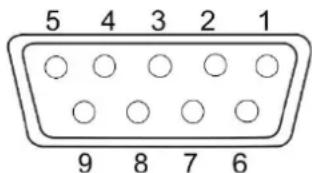
Pin 2: Receive data
Pin 3: Transmit data
Pin 5: Signal ground
Baud rate
1200 / 2400 / 4800 / 9600 optional
Parity
8 bits, no parity / 1 stop bit / 1 start bit
12.2 Interface cable
| Balance 9-poles | PC 9-poles | |
| 2 3 | ||
| 3 2 | ||
| 5 5 | ||
| Balance 9-poles | Printer 9-poles | |
| 2 3 | ||
| 3 2 | ||
| 5 5 |
12.3 Interface parameters
12.3.1 Baud rate
In this menu point the data transfer is adapted to different RS232C-peripheral devices. The baud rate determines the speed of the data transfer via the serial interface. For a faultless data transfer, balance and peripheral device must be set to the same value.
![.[4---1] PRINT . [4---3]](/content/2026/04/698054/images/13c496d6471200cafafc10dd415447c134b509ce3798e8e800187ae23f20b8ee.jpg)
Call up menu item „C4“, see chap. 11.1
Use the PRINT key to select the desired setting.
Options:
C4 - 0 1200 Baud
C4 - 1 2400 baud
C4 - 2 4800 baud
C4 - 3 9600 baud
Save / back to weighing mode, see chap. 11.1
12.3.2 Output condition
The data transfer type is determined in this menu item
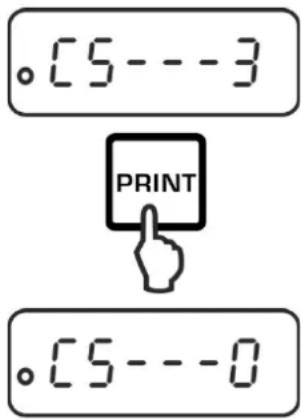
Call up menu item „C5“, see chap. 11.1
Use the PRINT key to select the desired setting.
Options:
C5 - 0 Automatic output of stable weighing values
C5 - 1 Via remote control command W (w)
C5 - 2 Continuous data output
C5 - 3 Output for stable and instable weighing values after pressing PRINT key
Save / back to weighing mode, see chap. 11.1
12.4 Sample protocols (KERN YKB-01N)
+ 10.0000 g SS
Stable/positive weighing value
- 10.0000 g SD
Instable/negative weighing value
12.5 Remote control instructions
| Command Terminator | Function | |||
| ASCII | Hex | |||
| O | 4F | 0D | 0A | Function such as ON/OFF key |
| T | 54 | 0D | 0A | Function such as TARE key |
| C | 43 | 0D | 0A | Function such as CAL key |
| M | 4D | 0D | 0A | Function such as MODE key |
| W | 57 | 0D | 0A | Function such as PRINT key |
| w | 77 | 0D | 0A | Function such as PRINT key |
13 Servicing, maintenance, disposal

Before any maintenance, cleaning and repair work disconnect the appliance from the operating voltage.
13.1 Cleaning
Please do not use aggressive cleaning agents (solvents or similar agents), but a cloth dampened with mild soap suds. Ensure that no liquid penetrates into the device. Polish with a dry soft cloth.
Loose residue sample/powder can be removed carefully with a brush or manual vacuum cleaner.
Spilled weighing goods must be removed immediately.
13.2 Servicing, maintenance
⇒ The appliance may only be opened by trained service technicians who are authorized by KERN.
→ Before opening, disconnect from power supply.
13.3 Disposal
Disposal of packaging and appliance must be carried out by operator according to valid national or regional law of the location where the appliance is used.
14 Instant help
In case of an error in the program process, briefly turn off the balance and disconnect from power supply. The weighing process must then be restarted from the beginning.
Help:
Fault Possible cause
The displayed weight does not glow.
- The balance is not switched on.
- The mains supply connection has been interrupted (mains cable not plugged in/faulty).
• Power supply interrupted.
The displayed weight is permanently changing
- Draught/air movement
- Table/floor vibrations
- Weighing pan has contact with other objects.
- Electromagnetic fields / static charging (choose a different location / switch off interfering device if possible)
The weighing result is obviously incorrect
• The display of the balance is not at zero
- Adjustment is no longer correct.
• The balance is on an uneven surface.
• Great fluctuations in temperature.
• Warm-up time was ignored.
- Electromagnetic fields / static charging (choose a different location / switch off interfering device if possible)
14.1 Error messages
| E Weighing range exceeded; the set load exceeds the weighing range. Unload the balance. | |
| —E | Weighing range exceeded, e.g. weighing plate not installed. |
| CAL-no | Adjustment error. |
Table des matières
Nº Dénomination
natural_image
Three-panel photo showing a transparent plastic-wrapped box, a close-up of a mechanical component, and an open cardboard box filled with white sheets (no text or symbols visible)natural_image
Two circular diagrams with concentric rings and intersecting lines, no text or symbols present
Avertissement surcharge
Pin 5: Signal ground
Taux de baud
1200 / 2400 / 4800 / 9600 en option
Parité