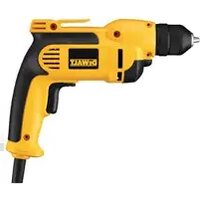
DWD112S - Drill DEWALT - Free user manual and instructions
Find the device manual for free DWD112S DEWALT in PDF.


| Product Type | Professional Drill |
| Brand | DeWALT |
| Model | DWD112S |
| Rated Voltage | 230 V |
| Output Power | 701 W |
| No-load Speed | 0 to 2,500 min-1 |
| Drilling Capacity (steel/wood/concrete) | 10 mm / 25 mm / 13 mm |
| Maximum Torque | 10.9 Nm |
| Chuck Capacity | 10 mm |
| Chuck Type | Keyless Automatic |
| Weight | 1.83 kg |
| Sound Pressure Level | 83 dB(A) (uncertainty 3 dB) |
| Sound Power Level | 94 dB(A) (uncertainty 3 dB) |
| Vibration (drilling) | 13 m/s2 (uncertainty 1.5 m/s2) |
| Power Supply | Mains, 230 V, 10 A |
| Variable Speed | Yes, by trigger |
| Forward/Reverse | Yes, slide switch |
| Continuous Lock | Yes, lock button |
| Double Insulation | Yes (Class II) |
Frequently Asked Questions - DWD112S DEWALT
User questions about DWD112S DEWALT
0 question about this device. Answer the ones you know or ask your own.
Ask a new question about this device
Download the instructions for your Drill in PDF format for free! Find your manual DWD112S - DEWALT and take your electronic device back in hand. On this page are published all the documents necessary for the use of your device. DWD112S by DEWALT.
USER MANUAL DWD112S DEWALT
DWD112 DWD112S DWD115S
English (original instructions) 19
Figure 3
natural_image
Line drawing of hands using a power tool (no text or symbols visible)Figure 4
natural_image
Illustration of hands holding a cylindrical device with a curved arrow indicating rotation (no text or symbols)Figure 5 Figure 6
natural_image
Diagram of a pipe connection with a cylindrical component and a meshed connector (no text or symbols)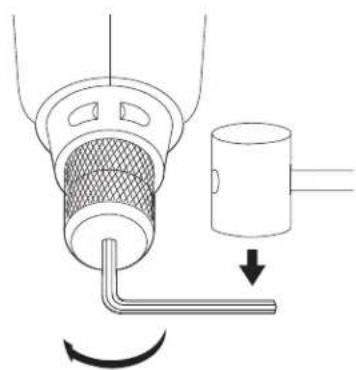
natural_image
Diagram of a mechanical device with a cylindrical component and a curved pipe, showing no text or symbols.Figure 7
natural_image
Diagram showing a mechanical component with a cylindrical part and a curved arrow indicating rotation or force (no text or symbols)Figure 8
natural_image
Diagram of a mechanical device with rotating shaft and connecting rod, showing motion direction (no text or symbols)OMSTYRBART BOR MED VARIABEL HASTIGHED DWD112, DWD112S, DWD115S
Tillykke!
DWD112, DWD112S, DWD115S
DWD112, DWD112S, DWD115S
D-65510, Idstein, Germany
29.07.2009

VARIABLE SPEED REVERSIBLE DRILL DWD112, DWD112S, DWD115S
Congratulations!
You have chosen a DEWALT tool. Years of experience, thorough product development and innovation make DEWALT one of the most reliable partners for professional power tool users.
Technical data
| DWD112 | DWD112S | DWD115S | |||
| Voltage | V | 230 | |||
| Type | 1 | 1 | 1 | ||
| Power output | W | 701 | 701 | 701 | |
| No load speed | min ^-1 | 0-2,500 | 0-2,500 | 0-2,500 | |
| Maximum drilling range | |||||
| steel/wood/concrete mm | 10/25/13 | 10/25/13 | 10/25/13 | ||
| Torque | Nm | 10.9 | 10.9 | 10.9 | |
| Chuck spindle | |||||
| thread size | UNF | 1/2"x20 | 1/2"x20 | 1/2"x20 | |
| Maximum chuck | |||||
| capacity | mm | 10 | 10 | ||
| Weight | kg | 1.9 | 1.83 | ||
| L_PA (sound pressure) | dB(A) | 83 | 83 | 83 | |
| K_PA (sound pressure uncertainty) | dB(A) | 3 | 3 | 3 | |
| L_WA (sound power) | dB(A) | 94 | 94 | 94 | |
| K_WA (sound power uncertainty) | dB(A) | 3 | 3 | 3 | |
Vibration total values (triax vector sum) determined according to EN 60745:
Vibration emission value a_n Screwdriving without Impact
| a_hD = | m/s2 | 13 | 13 | 13 |
| Uncertainty K = | m/s2 | 1.5 | 1.5 | 1.5 |
The vibration emission level given in this information sheet has been measured in accordance with a standardised test given in EN 60745 and may be used to compare one tool with another. It may be used for a preliminary assessment of exposure.

WARNING: The declared vibration emission level represents the main applications of the tool. However if the tool is used for different applications, with different accessories or poorly maintained, the vibration emission may
differ. This may significantly increase the exposure level over the total working period.
An estimation of the level of exposure to vibration should also take into account the times when the tool is switched off or when it is running but not actually doing the job. This may significantly reduce the exposure level over the total working period.
Identify additional safety measures to protect the operator from the effects of vibration such as: maintain the tool and the accessories, keep the hands warm, organisation of work patterns.
230
| Fuses: | ||
| Europe | 230 V tools | 10 Amperes, mains |
| U.K. & Ireland | 230 V tools | 13 Amperes, in plugs |
Definitions: Safety Guidelines
The definitions below describe the level of severity for each signal word. Please read the manual and pay attention to these symbols.

DANGER: Indicates an imminently hazardous situation which, if not avoided, will result in death or serious injury.

WARNING: Indicates a potentially hazardous situation which, if not avoided, could result in death or serious injury.

CAUTION: Indicates a potentially hazardous situation which, if not avoided, may result in minor or moderate injury.
NOTICE: Indicates a practice not related to personal injury which, if not avoided, may result in property damage.

Denotes risk of electric shock.

Denotes risk of fire.
ENGLISH
EC-DeclarationofConformity
MACHINERY DIRECTIVE

DWD112, DWD112S, DWD115S
DEWALT declares that these products described under "technical data" are in compliance with: 98/37/EC (until Dec. 28, 2009), 2006/42/EC (from Dec. 29, 2009), EN 60745-1, EN 60745-2-1.
These products also comply with Directive 2004/108/EC. For more information, please contact DEWALT at the following address or refer to the back of the manual.
The undersigned is responsible for compilation of the technical file and makes this declaration on behalf of DEWALT.
Horst Grossmann
Vice President Engineering and Product Development
D-65510, Idstein, Germany
29.07.2009

WARNING: To reduce the risk of injury, read the instruction manual.
General Power Tool Safety Warnings

WARNING! Read all safety warnings and instructions Failure to follow the warnings and instructions may result in electric shock, fire and/or serious injury.
SAVE ALL WARNINGS AND INSTRUCTIONS FOR FUTURE REFERENCE
The term "power tool" in the warnings refers to your mains-operated (corded) power tool or battery-operated (cordless) power tool.
1) WORK AREA SAFETY
a) Keep work area clean and well lit.
Cluttered or dark areas invite accidents.
b) Do not operate power tools in explosive atmospheres, such as in the presence of flammable liquids, gases or dust. Power tools create sparks which may ignite the dust or fumes.
c) Keep children and bystanders away while operating a power tool. Distractions can cause you to lose control.
2) ELECTRICAL SAFETY
a) Power tool plugs must match the outlet. Never modify the plug in any way. Do not use any adapter plugs with earthed (grounded) power tools. Unmodified plugs and matching outlets will reduce risk of electric shock.
b) Avoid body contact with earthed or grounded surfaces such as pipes, radiators, ranges and refrigerators. There is an increased risk of electric shock if your body is earthed or grounded.
c) Do not expose power tools to rain or wet conditions. Water entering a power tool will increase the risk of electric shock.
d) Do not abuse the cord. Never use the cord for carrying, pulling or unplugging the power tool. Keep cord away from heat, oil, sharp edges or moving parts. Damaged or entangled cords increase the risk of electric shock.
e) When operating a power tool outdoors, use an extension cord suitable for outdoor use. Use of a cord suitable for outdoor use reduces the risk of electric shock.
f) If operating a power tool in a damp location is unavoidable, use a residual current device (RCD) protected supply. Use of an RCD reduces the risk of electric shock.
3) PERSONAL SAFETY
a) Stay alert, watch what you are doing and use common sense when operating a power tool. Do not use a power tool while you are tired or under the influence of drugs, alcohol or medication. A moment of inattention while operating power tools may result in serious personal injury.
b) Use personal protective equipment. Always wear eye protection. Protective equipment such as dust mask, non-skid safety shoes, hard hat, or hearing protection used for appropriate conditions will reduce personal injuries.
c) Prevent unintentional starting. Ensure the switch is in the off position before connecting to power source and/or battery pack, picking up or carrying the tool. Carrying power tools with your finger on the switch or energising power tools that have the switch on invites accidents.
d) Remove any adjusting key or wrench before turning the power tool on. A wrench or a key left attached to a rotating part of the power tool may result in personal injury.
e) Do not overreach. Keep proper footing and balance at all times. This enables better control of the power tool in unexpected situations.
f) Dress properly. Do not wear loose clothing or jewellery. Keep your hair, clothing and gloves away from moving parts. Loose clothes, jewellery or long hair can be caught in moving parts.
g) If devices are provided for the connection of dust extraction and collection facilities, ensure these are connected and properly used. Use of dust collection can reduce dust-related hazards.
4) POWER TOOL USE AND CARE
a) Do not force the power tool. Use the correct power tool for your application. The correct power tool will do the job better and safer at the rate for which it was designed.
b) Do not use the power tool if the switch does not turn it on and off. Any power tool that cannot be controlled with the switch is dangerous and must be repaired.
c) Disconnect the plug from the power source and/or the battery pack from the power tool before making any adjustments, changing accessories, or storing power tools. Such preventive safety measures reduce the risk of starting the power tool accidentally.
d) Store idle power tools out of the reach of children and do not allow persons unfamiliar with the power tool or these instructions to operate the power tool. Power tools are dangerous in the hands of untrained users.
e) Maintain power tools. Check for misalignment or binding of moving parts, breakage of parts and any other condition that may affect the power tool's operation. If damaged, have the power tool repaired before use. Many accidents are caused by poorly maintained power tools.
f) Keep cutting tools sharp and clean. Properly maintained cutting tools with sharp cutting edges are less likely to bind and are easier to control.
g) Use the power tool, accessories and tool bits etc., in accordance with these instructions taking into account the
working conditions and the work to be performed. Use of the power tool for operations different from those intended could result in a hazardous situation.
5) SERVICE
a) Have your power tool serviced by a qualified repair person using only identical replacement parts. This will ensure that the safety of the power tool is maintained.
Additional Specific Safety Rules for Drills
- Wear ear protectors. Exposure to noise can cause hearing loss.
- Use auxiliary handles supplied with the tool. Loss of control can cause personal injury.
- Hold power tool by insulated gripping surfaces only, when performing an operation where the cutting accessory may contact hidden wiring or its own cord. Cutting accessory contacting a "live" wire may make exposed metal parts of the power tool "live" and shock the operator.
- Use clamps or other practical way to secure and support the workpiece to a stable platform. Holding the work by hand or against your body is unstable and may lead to loss of control.
- Wear safety goggles or other eye protection. Drilling operations cause chips to fly. Flying particles can cause permanent eye damage.
- Bits and tools get hot during operation. Wear gloves when touching them.
- Keep handles dry, clean, free from oil and grease. it is recommended to use rubber gloves. This will enable better control of the tool.
ResidualRisks
The following risks are inherent to the use of drills:
- Injuries caused by touching the rotating parts or hot parts of the tool.
In spite of the application of the relevant safety regulations and the implementation of safety devices, certain residual risks cannot be avoided. These are:
- Impairment of hearing
– Risk of squeezing fingers when changing accessories.
– Health hazards caused by breathing dust developed when working in wood.
ENGLISH
– Risk of personal injury due to flying particles.
– Risk of personal injury due to prolonged use.
Markings on Tool
The following pictograms are shown on the tool:

Read instruction manual fore use.
DATE CODE POSITION (FIG. 1)
The Date Code (f), which also includes the year of manufacture, is printed into the housing.
Example:
2009 XX XX
Year of Manufacture
Package Contents
The package contains:
1 Drill
1 Chuck key (DWD112)
1 Instruction manual
1 Exploded drawing
- Check for damage to the tool, parts or accessories which may have occurred during transport.
• Take the time to thoroughly read and understand this manual prior to operation.
Description (fi g. 1)
WARNING: Never modify the power tool or any part of it. Damage or personal injury could result.
a. Variable speed trigger switch
b. Lock-on button
c. Forward/reverse button
d. Chuck
e. Main handle
INTENDED USE
These heavy-duty V.S.R. drills are designed for professional drilling.
DO NOT use under wet conditions or in presence of flammable liquids or gases.
These heavy-duty drills are professional power tools.
DO NOT let children come into contact with the tool. Supervision is required when inexperienced operators use this tool.
Electrical Safety
The electric motor has been designed for one voltage only. Always check that the power supply corresponds to the voltage on the rating plate.

Your DEWALT tool is double insulated in accordance with EN 60745; therefore no earth wire is required.
If the supply cord is damaged, it must be replaced by a specially prepared cord available through the DEWALT service organization.
Mains Plug Replacement (U.K. & Ireland Only)
If a new mains plug needs to be fitted:
• Safely dispose of the old plug.
- Connect the brown lead to the live terminal in the plug.
- Connect the blue lead to the neutral terminal.

VG: No connection is to be made to the earth terminal.
Follow the fitting instructions supplied with good quality plugs. Recommended fuse: 13 A.
Using an Extension Cable
If an extension cable is required, use an approved extension cable suitable for the power input of this tool (see technical data). The minimum conductor size is 1 mm^2 ; the maximum length is 30 m.
When using a cable reel, always unwind the cable completely.
ASSEMBLY AND ADJUSTMENTS
WARNING: To reduce the risk of injury, turn unit off and disconnect machine from power source before installing and removing accessories, before adjusting or changing set-ups or when making repairs. Be sure the trigger switch is in the OFF position. An accidental start-up can cause injury.
OPERATION
Instructions for Use

WARNING: Always observe the safety instructions and applicable regulations.
WARNING: To reduce the risk of serious personal injury, turn tool off and disconnect tool from power source before making any
adjustments or removing/installing attachments or accessories.
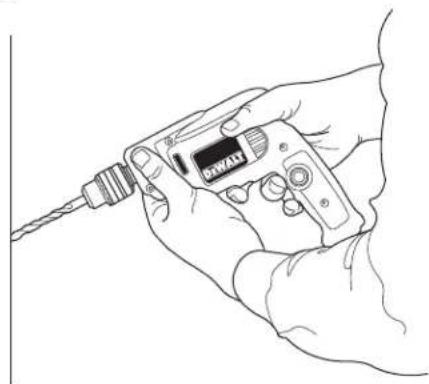
Proper Hand Position (fi g. 1, 3)

IG: To reduce the risk of serious personal injury, ALWAYS use proper hand position as shown in figure 3.

WARNING: To reduce the risk of serious personal injury, ALWAYS hold securely in anticipation of a sudden reaction.
Proper hand position requires one hand under the the housing, with the other hand on the main handle (e).
Switches (fi g. 1, 2)
To start the drill, depress the trigger switch; to stop the drill, release the trigger.
A variable speed trigger switch (a) permits speed control—the farther the trigger is depressed, the higher the speed of the drill.
For continuous operation, press and hold the variable speed switch, move the lock-on button (b) up, then release the switch.
NOTE: Use lower speeds for starting holes without a center punch, drilling in metal or plastics, driving screws or drilling ceramics. Higher speeds are better for drilling wood and composition boards and using abrasive and polishing accessories.
The forward/reverse lever (c) is used for withdrawing bits from tight holes and removing screws. It is located above the trigger switch. To reverse the motor, release the trigger switch FIRST and then push the lever to the right. After any reversing operations, return lever to forward position.
To stop continuous operation, press the switch briefly and release it. Always switch the tool off when work is finished and before unplugging.
Drilling

NG: To reduce the risk of
personal injury, ALWAYS ensure workpiece is anchored or clamped firmly. If drilling thin material, use a wood "back-up" block to prevent damage to the material.
-
Use sharp drill bits only. For WOOD, use twist drill bits, spade bits, power auger bits, or hole saws. For METAL, use steel twist drill bits or hole saws.
-
Always apply pressure in a straight line with the bit. Use enough pressure to keep drill biting, but do not push hard enough to stall the motor or deflect the bit.
-
Hold tool firmly with both hands to control the twisting action of the drill.
-
IF DRILL STALLS, it is usually because it is being overloaded or improperly used. RELEASE TRIGGER IMMEDIATELY, remove drill bit from work, and determine cause of stalling. DO NOT CLICK TRIGGER ON AND OFF IN AN ATTEMPT TO START A STALLED DRILL — THIS CAN DAMAGE THE DRILL.
-
To minimize stalling or breaking through the material, reduce pressure on drill and ease the bit through the last fractional part of the hole.
-
Keep the motor running when pulling the bit back out of a drilled hole. This will help prevent jamming.
-
With variable speed drills there is no need to center punch the point to be drilled. Use a slow speed to start the hole and accelerate by squeezing the trigger harder when the hole is deep enough to drill without the bit skipping out.
DRILLING IN METAL
Start drilling with slow speed and increase to full power while applying firm pressure on the tool. A smooth even flow of metal chips indicates the proper drilling rate. Use a cutting lubricant when drilling metals. The exceptions are cast iron and brass which should be drilled dry.
NOTE: Large [5/16" (8 mm) to 1/2" (13 mm)] holes in steel can be made easier if a pilot hole [5/32" (4 mm) to 3/16" (5 mm)] is drilled first.
DRILLING IN WOOD
Start drilling with slow speed and increase to full power while applying firm pressure on the tool. Holes in wood can be made with the same twist drills used for metal. These bits may overheat unless pulled out frequently to clear chips from the flutes. Work that is apt to splinter should be backed up with a block of wood.
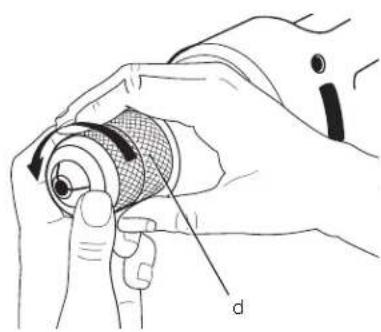
Keyless Chuck – DWD112S, DWD115S (fi g. 4–6)
The DWD112S and the DWD115S feature a keyless chuck (d) for greater convenience. To insert a drill bit or other accessory, follow the steps listed below.
ENGLISH
- Grasp the rear half of the chuck with one hand and use your other hand to rotate the front half counterclockwise, as shown in Figure 4. Rotate far enough so that the chuck opens sufficiently to accept the desired accessory.
- Insert the bit or other accessory about 3/4" (19 mm) into the chuck and tighten securely by holding the rear half of the chuck and rotating the front portion in the clockwise direction. When the chuck is nearly tightened, you will hear a clicking sound. After 4–6 clicks, the chuck is securely tightened around the accessory.
- To release the accessory, repeat step 1 listed above.

WARNING: Do not attempt to tighten drill bits (or any other accessory) by gripping the front part of the chuck and turning the tool on. Damage to the chuck and personal injury may result.
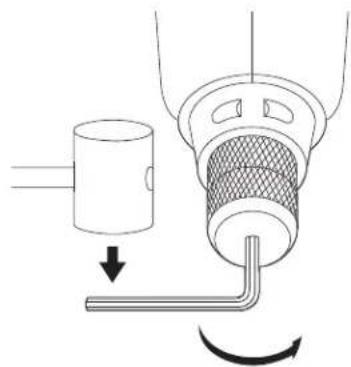
KEYLESS CHUCK REMOVAL (FIG. 5)
Tighten the chuck around the shorter end of a hex key (not supplied) of 1/4" (6 mm) or greater size. Using a soft hammer or piece of wood, strike the longer end in the counterclockwise direction. This will loosen the chuck so that it can be unscrewed by hand.
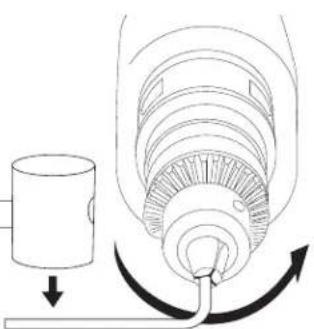
KEYLESS CHUCK INSTALLATION (FIG. 6)
Screw the chuck on by hand as far as it will go. Tighten the chuck around the shorter end of a 1/4" (6 mm) or larger hex key (not supplied) strike the longer end in the clockwise direction with a soft hammer.
Keyed Chuck - DWD112 (fi g. 7, 8)
The DWD112 features a keyed chuck (d). To insert a drill bit or other accessory, follow the steps listed below.
- Open the chuck jaws by turning collar by hand and insert the shank of the bit about 3/4" (19 mm) into chuck. Tighten the chuck collar by hand.
- Place chuck key in each of the three holes, and tighten in clockwise direction. It's important to tighten chuck with all three holes.
To release the bit, turn the chuck counterclockwise in just one hole, then loosen the chuck by hand.
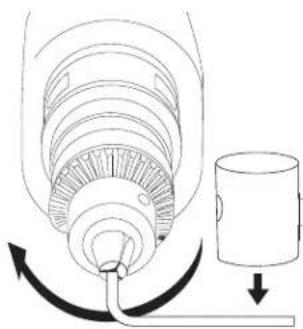
REMOVAL OF KEYED CHUCK (FIG. 7)
Tighten the chuck around the shorter end of a hex key (not supplied) of 1/4" (6 mm) or greater size. Using a soft hammer, strike the key sharply in the
counterclockwise direction when viewed from the front of the tool. This will loosen the chuck so that it can be removed by hand.
KEYED CHUCK INSTALLATION (FIG. 8)
Screw the chuck on by hand as far as it will go. Insert the shorter end of a hex key (not supplied) of 1/4" (6 mm) or greater size and strike it in the clockwise direction with a soft hammer.
MAINTENANCE
Your DEWALT power tool has been designed to operate over a long period of time with a minimum of maintenance. Continuous satisfactory operation depends upon proper tool care and regular cleaning.

IG: To reduce the risk of injury, turn unit off and disconnect machine from power source before installing and removing accessories, before adjusting or changing set-ups or when making repairs. Be sure the trigger switch is in the OFF position. An accidental start-up can cause injury.
Motor Brushes
DEWALT uses an advanced brush system which automatically stops the drill when the brushes wear out. This prevents serious damage to the motor. New brush assemblies are available at authorized DEWALT service centers. Always use identical replacement parts.

Lubrication
Your power tool requires no additional lubrication.

Cleaning

WARNING: Blow dirt and dust out of the main housing with dry air as often as dirt is seen collecting in and around the air vents. Wear approved eye protection and approved dust mask when performing this procedure.

IG: Never use solvents or other harsh chemicals for cleaning the non-metallic parts of the tool. These chemicals may weaken the materials used in these parts. Use a cloth dampened only with water and mild
soap. Never let any liquid get inside the tool; never immerse any part of the tool into a liquid.
Optional Accessories

WARNING: Since accessories, other than those offered by DEWALT, have not been tested with this product, use of such accessories with this tool could be hazardous. To reduce the risk of injury, only DEWALT, recommended accessories should be used with this product.
Consult your dealer for further information on the appropriate accessories.
Protecting the Environment
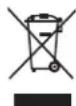
Separate collection. This product must not be disposed of with normal household waste.
Should you find one day that your DEWALT product needs replacement, or if it is of no further use to you, do not dispose of it with household waste. Make this product available for separate collection.

Separate collection of used products and packaging allows materials to be recycled and used again. Re-use of recycled materials helps prevent environmental pollution and reduces the demand for raw materials.
Local regulations may provide for separate collection of electrical products from the household, at municipal waste sites or by the retailer when you purchase a new product.
DEWALT provides a facility for the collection and recycling of DEWALT products once they have reached the end of their working life. To take advantage of this service please return your product to any authorised repair agent who will collect them on our behalf.
You can check the location of your nearest authorised repair agent by contacting your local DEWALT office at the address indicated in this manual. Alternatively, a list of authorised DEWALT repair agents and full details of our after-sales service and contacts are available on the Internet at:
www.2helpU.com.
GUARANTEE
DEWALT is confident of the quality of its products and offers an outstanding guarantee for professional users of the product. This guarantee statement is in addition to and in no way prejudices your contractual rights as a professional user or your statutory rights as a private non-professional user. The guarantee is valid within the territories of the Member States of the European Union and the European Free Trade Area.
• 30 DAY NO RISK SATISFACTION GUARANTEE •
If you are not completely satisfied with the performance of your DEWALT tool, simply return it within 30 days, complete with all original components, as purchased, to the point of purchase, for a full refund or exchange. The product must have been subject to fair wear and tear and proof of purchase must be produced.
• ONE YEAR FREE SERVICE CONTRACT •
If you need maintenance or service for your DEWALT tool, in the 12 months following purchase, it will be undertaken free of charge at an authorised DEWALT repair agent. Proof of purchase must be produced. Includes labour. Excludes accessories and spare parts unless failed under warranty.
• ONE YEAR FULL WARRANTY •
If your DEWALT product becomes defective due to faulty materials or workmanship within 12 months from the date of purchase, DEWALT guarantees to replace all defective parts free of charge or – at our discretion – replace the unit free of charge provided that:
• The product has not been misused;
- The product has been subject to fair wear and tear;
• Repairs have not been attempted by unauthorised persons;
• Proof of purchase is produced;
- The product is returned complete with all original components.
If you wish to make a claim, contact your seller or check the location of your nearest authorised DEWALT repair agent in the DEWALT catalogue or contact your DEWALT office at the address indicated in this manual. A list of authorised DEWALT repair agents and full details of our after-sales service is available on the Internet at:
www.2helpU.com.
ESPAÑOL
TALADRO REVERSIBLE DE VELOCIDAD VARIABLE DWD112, DWD112S, DWD115S
¡Enhorabuena!
DWD112, DWD112S, DWD115S
DWD112, DWD112S, DWD115S
DWD112, DWD112S, DWD115S
OMKEERBARE BOOR MET VARIABELE SNELHEID DWD112, DWD112S, DWD115S
DWD112, DWD112S, DWD115S
Vice President Engineering and Product Development
DEWALT, Richard-Klinger-Straße 11, D-65510, Idstein, Duitsland
29.07.2009

WAARSCHUWING! Lees alle

REVERSERBAR DRILL MED VARIABEL HASTIGHET DWD112, DWD112S, DWD115S
Gratulerer!
DWD112, DWD112S, DWD115S
1) SIKKERHET PÅ ARBEIDSPLASSEN
DWD112, DWD112S, DWD115S
PORAKONE, NOPEUTTA VOI SÄÄTÄÄ JA SUUNNAN VAIHTAA DWD112, DWD112S, DWD115S
Onnittelut!
DWD112, DWD112S, DWD115S
Vice President Engineering and Product Development
DEWALT, Richard-Klinger-Strasse 11,
D-65510, Idstein, Germany
29.07.2009

DWD112, DWD112S, DWD115S
DATUMKODPLACERING (FIG. 1)
INSTALLERING AV NYCKLAD CHUCK (FIG. 8)
DEĞİŞKEN HIZLI ÇİFT YÖNLÜ MATKAP DWD112, DWD112S, DWD115S
Tebrikler!
DWD112, DWD112S, DWD115S
DWD112, DWD112S, DWD115S

- OMSTYRBART BOR MED VARIABEL HASTIGHED DWD112, DWD112S, DWD115S
- Tillykke!
- DWD112, DWD112S, DWD115S
- VARIABLE SPEED REVERSIBLE DRILL DWD112, DWD112S, DWD115S
- Congratulations!
- Definitions: Safety Guidelines
- ENGLISH
- EC-DeclarationofConformity
- General Power Tool Safety Warnings
- SAVE ALL WARNINGS AND INSTRUCTIONS FOR FUTURE REFERENCE
- 1) WORK AREA SAFETY
- 2) ELECTRICAL SAFETY
- 3) PERSONAL SAFETY
- 4) POWER TOOL USE AND CARE
- 5) SERVICE
- Additional Specific Safety Rules for Drills
- ResidualRisks
- Markings on Tool
- DATE CODE POSITION (FIG. 1)
- Package Contents
- Description (fi g. 1)
- INTENDED USE
- Electrical Safety
- Mains Plug Replacement (U.K. & Ireland Only)
- Using an Extension Cable
- ASSEMBLY AND ADJUSTMENTS
- OPERATION
- Instructions for Use
- adjustments or removing/installing attachments or accessories.
- Proper Hand Position (fi g. 1, 3)
- Switches (fi g. 1, 2)
- Drilling
- NG: To reduce the risk of
- DRILLING IN METAL
- DRILLING IN WOOD
- Keyless Chuck – DWD112S, DWD115S (fi g. 4–6)
- KEYLESS CHUCK REMOVAL (FIG. 5)
- KEYLESS CHUCK INSTALLATION (FIG. 6)
- Keyed Chuck - DWD112 (fi g. 7, 8)
- REMOVAL OF KEYED CHUCK (FIG. 7)
- KEYED CHUCK INSTALLATION (FIG. 8)
- MAINTENANCE
- Motor Brushes
- Lubrication
- Cleaning
- Optional Accessories
- Protecting the Environment
- GUARANTEE
- • 30 DAY NO RISK SATISFACTION GUARANTEE •
- • ONE YEAR FREE SERVICE CONTRACT •
- • ONE YEAR FULL WARRANTY •
- ESPAÑOL
- TALADRO REVERSIBLE DE VELOCIDAD VARIABLE DWD112, DWD112S, DWD115S
- ¡Enhorabuena!
- OMKEERBARE BOOR MET VARIABELE SNELHEID DWD112, DWD112S, DWD115S
- WAARSCHUWING! Lees alle
- REVERSERBAR DRILL MED VARIABEL HASTIGHET DWD112, DWD112S, DWD115S
- Gratulerer!
- 1) SIKKERHET PÅ ARBEIDSPLASSEN
- PORAKONE, NOPEUTTA VOI SÄÄTÄÄ JA SUUNNAN VAIHTAA DWD112, DWD112S, DWD115S
- Onnittelut!
- DATUMKODPLACERING (FIG. 1)
- INSTALLERING AV NYCKLAD CHUCK (FIG. 8)
- DEĞİŞKEN HIZLI ÇİFT YÖNLÜ MATKAP DWD112, DWD112S, DWD115S
- Tebrikler!
Brand : DEWALT
Model : DWD112S
Category : Drill