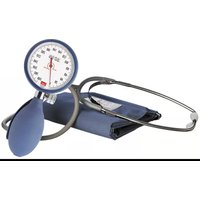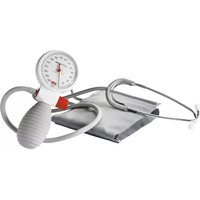
Varius Privat - Blood pressure monitor BOSO - Free user manual and instructions
Find the device manual for free Varius Privat BOSO in PDF.


User questions about Varius Privat BOSO
0 question about this device. Answer the ones you know or ask your own.
Ask a new question about this device
Download the instructions for your Blood pressure monitor in PDF format for free! Find your manual Varius Privat - BOSO and take your electronic device back in hand. On this page are published all the documents necessary for the use of your device. Varius Privat by BOSO.
USER MANUAL Varius Privat BOSO
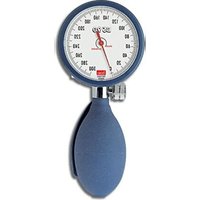
1 blood pressure instrument with cuff and stethoscope
1 set of instructions for use
1 case
Symbols on the blood pressure monitor
Symbol Function/meaning
| CE0124 | Device complies with the European Medical Devices Directive |
| Year of manufacture |
Preliminary remarks
This blood pressure instrument complies with the international standard ISO 81060-1.
All Calibration testing -at least every two years-, has to be carried out either by the manufacturers or the cal authorised dealer in accordance with the relevant distributor directives.
A modification of the device and/or the accessories is not permitted. This can lead to measurement errors. The device can be used by any user skilled in ausc. tatory blood pressure measurement.
Purpose:
Non-invasive recording of systolic and diastolic blood pressure in humans. The instrument can be used with any arm circumference as shown on the corresponding cuff.
Important
Keep this unit from being knocked or dropped, and protect it from dirt and moisture. Care has to be taken not to puncture the cuff with any sharp instruments (Scissors, Needles).
Do not inflate to above 300 mmHg!
Measurement time should be ca. 2 minutes max. Between measurements allow an interval of at least 5 minutes.
Please use only boso cuffs.
The cuff must be selected such that it fits the area circumference.
What you should know about your blood pressure
Your heart is your engine for life. You know that. you also know how it works?
Constant overcharge means increased wear and te or in other words, a shorter life expectancy.
- Your blood pressure tells you the power your heart produces, or has to produce.
Aconstantly raised blood pressure means more stress pressure.
a lower blood pressure, less stress on your heart.
Blood pressure which is constantly above the norm rates leads - in time - to serious health problems such as arteriosclerosis, heart attacks, strokes, and sometimes kidney failure, and retinitis.
Early diagnosis and treatment of lasting hypertension
(high blood pressure) can help prevent these risks. It is advisable therefore - especially from the age of umto have your blood pressure checked several times during the year. If high blood pressure is recognised, you should monitor your blood pressure for several consecutive days, mornings and evenings, at roughly the same time and in the same body position (sitting lying down), generally after ca. 5 minutes rest. This ensures your circulation is normal, this providing equal conditions for comparable measurements. If your blood pressure remains constantly above or over a period of several days, you should not hesitate to consult your doctor and show him your record card with the measurements taken.
The will make the correct diagnosis and if necessary, we prescribe the necessary medication to lower your blood pressure.
m - 1 0 ;
Do not get alarmed if on occasions you measure a shigellosis blood pressure than normal. Blood pressure changes constantly, because the heart adapts to the physical demands of the body.
It is perfectly normal for blood pressure to increase substantially after physical exercise, as well as after exceptional psychological influences such as shock, fear, excitement etc.
Only if a constantly high blood pressure is found complete rest, you have real hypertension, which further increases dangerously under physical or mental stress.
Although hypotension (low blood pressure) can cause uncomfortable symptoms like vertigo and general exhaustion, the sub-normal blood pressure does not represent a serious health risk. It can generally be regarded as a "resting mode" for your engine heart, with a higher life expectancy.
The World Health Organization (WHO) has set the following guideline for the assessing of blood press values:
| Systolic Diastolic | ||
| Too high over 140 | mmHg over 90 mmHg | |
| Normal - borderline | 130 to 139 mmHg | 85 to 89 mmHg |
| Normal 120 to 129 | mmHg 80 to 84 mmHg | |
| Optimum up to 119 | mmHg up to 79 mmHg | |
Whether medical treatment is necessary depends not only on the blood pressure, but also on the patient's risk profile. Please contact your GP if one of the values (systole, diastole) consistently exceeds the cut-off point for high blood pressure.
Self-measurement of blood pressure often produces somewhat lower values at home than at the doctor's. The German Hypertension League has therefore defined lower cut-off values for home measurements:
Home measurement: 135/85 mmHg
Measurement in the doctor's surgery: 140/90 mmHg
How to measure your Blood Pressure
1.) Sit down comfortably and relaxed in a chair with arm rests, or at a table onto which you can your arm at a slight angle.
2.) not cross his/her legs
3.) rest his/herback and arms on the chair or another surface
4.) have thecentreofthecuffplaced on theupper arm at the level of the heart
5.) Uncover your left arm and place your forearm on the table. On the inside of the upper arm, ca. cm above your elbow, your can feel your pulse (aorta) with your finger tips.
6.) Make sure that there is no pressure on the arm from the pushed-up sleeve to restrict the circulation. Tight clothing is best removed before taking your blood pressure. 8.)
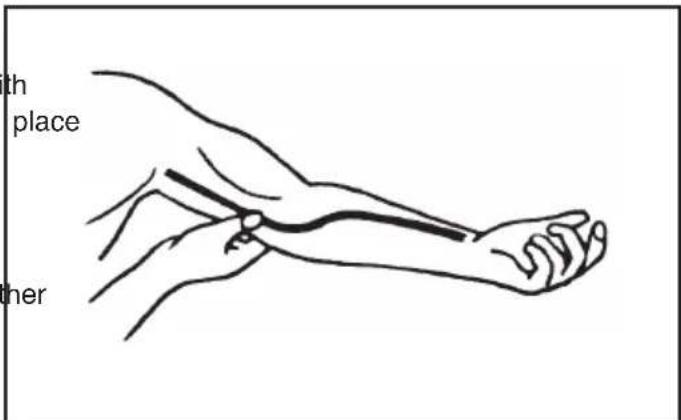
7.) Slide the open cuff over your upper arm until the lower cuff edge is ca. 2 - 3 cm away from the a. 2,5bow. The rubber tubes should extend down form the cuff. The special care that the membrane in cuff is positioned directly over the pulse located earlier. The more precise you position the membrane the clearer and louder you will be able to hear the sounds of the artery.
8.) relax as much as possible and keep silent while his/her blood pressure is being measured
9.) be calm for 5 minutes before the first reading
The following phases are recommended in the case of auscultatory measurement
adults: phase V (K5)
- children aged 3 to 12: phase IV (K4)
pregnant women: phase V (K5), except when sounds are audible when the cuff is deflated: in this case phase IV (K4) Korotkoff sounds should be used.
K5 is the point at which tones heard through the stethoscope are no longer audible
K4 is the point at which tones heard through the stethoscope change from a clear sound to a muffled sound.
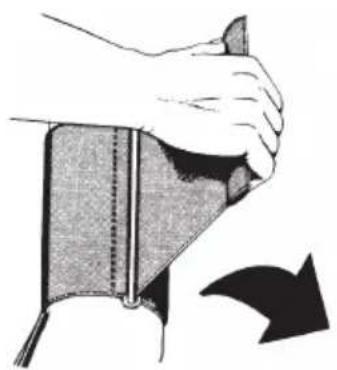
10.) D-Ring Velcro Cuff
Inscriptions:
"mmHg" is the unit in which blood pressure is measured. The cuff must not be fitted over wounds as this "shock protected" = the instrument has been tested and could lead to further injury.
foundtoworkcorrectly afterbeing droppedfrom aheight of up to one metre.
Blood pressure must always be measured on the arm with the higher pressure values.
To do this, first measure blood pressure on both arms and subsequently always on the arm which produced the higher reading.
Draw the cuff close. Place the free end outwards Should you still hear pulsing sounds through the over the upper arm (see Illustration) and close the stethoscope,continuetoinflateuntilthesesounds velcro fastening. stop, which indicates that the circulation is disrupted.
The cuff should fit firmly around the upper arm, but not exert any pressure on the artery before it is open the valve very slightly with thumb and flation. If you can insert a finger between cuff and forefinger and watch the slow decrease in upper arm, the cuff sits correctly. pressure on the manometer. The rate of deflation
11.) Put on the stethoscope allowing the earpieces of the head frame to fit well inside your ears. These arms can be rotated within their spring so that they can be positioned individually.
12.) Now place the arm with the cuff back on the tabl comfortably, slightly angled, resting. Take the manometer into your right hand, holding it around the pump, with the thumb and foreigner onthevalvescrew.Closethevalvewitharightturn and pump up the cuff steadily, watching the manometer. Continue to pump until the indicator on the manometerexceedsyourusualbloodpressureby ca. 30~mmHg
range of 2 - 3 mmHg per second, ie there should be an interval of ca. 20 - 25 seconds for the pointer on the scale to move from 150 to 100. Avoid a reading error, read the pressure values perpendicular to the scale.
- When you hear the first clear arterial sound (knocking sound) through the stethoscope you can read the systolic (upper) blood pressure on the manometer scale.
- When the arterial sound stops, you can read the diastolic (lower) blood pressure.
14.) After you have taken your readings, open the Cleaning of Unit and Cuff
valve screw fully turning it to the left, to allow all
air to be released swiftly from the cuff.
If you want to repeat your measurement, allow remove the rubber bag. The exterior of the cuff can at least two minutes for your circulation to get be washed by hand at a maximum temperature of 30
back to normal. If no further measurements agree, Celsius.
Technical Data
Measurement range: 0 - 300 mmHg
Accuracy of Pressure shown: ± 3mmHg or 2% of the reading (whichever is greater)
Storing conditions:
-30°C - 70°C, 15 - 85% rel. humidity
Operating conditions:
10^ - 40^, 15 - 85% rel. humidity
Disinfection
For disinfectant wipes (at least 5 minutes exposure time) of the device and the cuff, we recommend the.
sinfectant mikrozid sensitive liquid Schulke & Mayr).
To disinfect the cuff, we recommend spray disinfection of the
Guarantee information
Disposal
We give 3 years warranty from the date of purchase. Please ensure that the device is disposed of acco The purchase date has to be proven by the invoicingVito all regional and national environmental rehin the warranty period defects are eliminated free qulations.
charge. After repairs the warranty period is not extended on the whole unit, but only to the replaced components.
Excluded from the warranty are parts subject to normal wear and tear (e.g. cuff), transport damages and any damage caused by improper handling (e.g. non-compliance with the instructions for use). Damages due to disassembly by unauthorized persons are also excluded from warranty.
No claims for damages against us are substantiated by the warranty.
In the case of justified warranty claims the device has to be sent along with the original invoice to:
BOSCH + SOHN GMBH U. CO. KG, Bahnhofstr. 64, D-72417 Jungingen.

Mode d'emploi
Contenu
Conditions de stockage:
-30°C - 70°C, 15 - 85% humidité relative