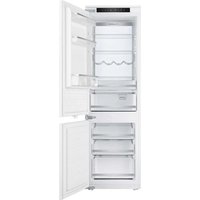
NorFrost HAIL 193 TNF BI 70 - Fridge NODOR - Free user manual and instructions
Find the device manual for free NorFrost HAIL 193 TNF BI 70 NODOR in PDF.


User questions about NorFrost HAIL 193 TNF BI 70 NODOR
0 question about this device. Answer the ones you know or ask your own.
Ask a new question about this device
Download the instructions for your Fridge in PDF format for free! Find your manual NorFrost HAIL 193 TNF BI 70 - NODOR and take your electronic device back in hand. On this page are published all the documents necessary for the use of your device. NorFrost HAIL 193 TNF BI 70 by NODOR.
USER MANUAL NorFrost HAIL 193 TNF BI 70 NODOR
natural_image
Interior view of a fully open refrigerator with open doors and internal compartments (no visible text or symbols)
NODOR
always innovating
ES
MANUAL DE INSTRUÇÕES
DE
GEBRAUCHSANWEISUNG
NorFrost HAIL 193 TNF BI 70
text_image
Labeled diagram of an open refrigerator with numbered parts for identificationnatural_image
Line drawing of a rectangular device with internal curved and straight lines, labeled Fig. 13 (no text or symbols on the diagram itself)NorFrost HAIL 193 TNF BI 70
Integrated fridge freezer
Installation, use and maintenance
Contents:
3 Important information
5 Important notes
5 Before first use
6 Important notes on use of the fridge
7 Important notes on use of the freezer
8 Crisper drawer humidity adjustment
9 Storage
10 Control panel
12 Defrosting the freezer
12 Defrosting the fridge
13 Care and cleaning
14 Troubleshooting
16 Installation preparation
17 Cabinet dimensions
17 Ventilation requirements
18 Installation into the cabinet
19 Reversing the appliance doors
Important
The manufacturer cannot be held responsible for injuries or losses caused by incorrect use or installation of this product. Please note that we reserve the right to invalidate the guarantee supplied with this product following incorrect installation or misuse of the appliance.
This appliance is not designed to be used by people (including children) with reduced physical, sensorial or mental capacity, or who lack experience or knowledge about it, unless they have had supervision or instructions on how to use the appliance by someone who is responsible for their safety.
Under no circumstances should any external covers be removed for servicing or maintenance except by suitably qualified personnel.
Appliance information:
Please enter the details on the appliance rating plate below for reference, to assist ...... in the event of a fault with your appliance and to register your appliance for guarantee purposes.
| Appliance Model | |
| Serial Number | |
EU Declarations of Conformity:
This appliance has been designed, constructed and marketed in compliance with safety requirements of EU Directive 2014/35/EU (Low voltage) and requirements of EU Directive 2014/30/EU (EMC).
This appliance has been manufactured to the strictest standards and complies with all applicable legislation, including Electrical safety (LVD) and Electromagnetic interference compatibility (EMC). Parts intended to come into contact with food conform to 1935/2004/EC.
This refrigeration appliance is intended for use as a built-in appliance.
IMPORTANT INFORMATION FOR CORRECT DISPOSAL OF THE PRODUCT IN ACCORDANCE WITH EC DIRECTIVE 2012/19/EU.
At the end of its working life, the product must not be disposed of as urban waste. The refrigeration system contains insulating gases and refrigerants, which require specialised waste disposal. The valuable materials contained in this appliance can be recycle. It must be taken to a special local authority differentiated waste collection centre or to a dealer providing this service.
Before disposing of an old appliance, remove the door seals etc. to reduce the risk of child entrapment.
Disposing of a household appliance separately avoids possible negative consequences for the environment and health deriving from inappropriate disposal and enables the constituent materials to be recovered to obtain significant savings in energy and resources. As a reminder of the need to dispose of household appliances separately, the product is marked with a crossed-out wheeled dustbin.
Important
- Never store inflammable or explosive items and strong corrosive acids or alkalis in the appliance.
- This is a household appliance, which is produced in accordance with the national standard. It is intended for food storage only, not for storage of blood, medicine and biological products.
- To prevent risk of fire, keep the appliance away from petrol or any other inflammables.
- To prevent risk of electromagnetic interference or other accidents, do not place a microwave oven on top of the refrigerator or use any electric appliance inside the refrigerator.
- Do not allow children to play with or near the appliance.
- The internal surface of freezer compartment is very cold when the appliance is running. Do not touch the surface especially when hands are wet.
- Do not splash water onto the appliance. Keep it away from places of high humidity that may have adverse effect on the electric insulation performance.
- This appliance is designed to be used in ambient temperatures between 10 and 32^ . Use outside of this range may cause the appliance to fail.
Before first use
You must allow the fridge to settle for at least twenty four hours prior to switching the power on.
It is recommended that you clean the interior of the appliance prior to first use, using a solution of bicarbonate of soda and warm water and then thoroughly drying the interior.
The fridge may have an odour to it at first use. This will disappear as the appliance cools.
Please note:
If you switch the appliance off, you should allow five minutes before switching it on again to prevent unnecessary damage to the compressor.
Never store inflammable or explosive items and strong corrosive acids or alkalis in the appliance.
This fridge cools your food by making the inside back of the cavity cold. It is normal for frost to build up on this surface; it then dissipates and drains through a small drain at the bottom, where it evaporates harmlessly.
Fridge use
- Never put liquids in the refrigerator uncovered.
- Never put hot foods in the refrigerator. Warm food should be allowed to cool to room temperature before being put into the refrigerator.
- Nothing should rest against the rear wall of the refrigerator, as this will cause frost and possible condensation problems which will be difficult to remove.
- Make sure food is clean and any extra water is wiped away before putting into the fridge.
-
Wrap or cover food before putting into the fridge. This will help prevent the loss of moisture, keep food fresh and avoid unpleasant odours.
-
Sort foods prior to storing. Any foods to be used soon should be stored at the front of the shelf to prevent deterioration caused by the door being open for prolonged periods.
- Do not overfill the fridge. There should be sufficient space between the foods to allow the cool air to circulate.
- Thawing frozen foods in the fridge compartment will help to keep the temperature low and save energy.
- Never store raw meats on shelves above cooked meats or other produce. This will help to prevent juices from raw meat contaminating other foodstuffs.
Freezer use
• The freezer compartments are designed to store only frozen food.
- Never put hot or warm foods in the freezer, allow them to cool fully before putting them into the freezer.
- Follow the instructions on the food packaging for storage of frozen food. If no information is provided, foods should not be stored for more than three months after the purchase date.
- Store food in small packages (ideally less than 1kg). This reduces the freezing time and improves the quality of the food after thawing.
- Wrap food before putting into the freezer. To stop the wrapping sticking together, ensure it is dry.
- Label the food before freezing with information including type of food and dates of storage and expiry.
- Once food is thawed, it must not be refrozen. Only defrost as much food as is required to prevent wastage.
- Bottled or canned drinks should not be stored in the freezer compartments as they could explode.
- The maximum amount of fresh food that can be frozen within a 24 hour period is 3.8 ~kg for this Model
- Do not attempt to freeze more than the maximum amount.
• To freeze fresh food more quickly, switch on the super freeze function a few hours prior to placing the food in the freezer.
Note: If the appliance does not have a freezer compartment ( * * * *)it is not suitable for freezing foodstuffs.
Crisper drawer humidity adjustment
The crisper drawer within this appliance features a humidity level adjustment slider. Vegetables and similar produce that are subject to wilting (e.g. rocket, spinach leaves, herbs such as basil etc.) should be kept in the crisper drawer and the adjustment slider kept closed (fully to the left - high). By keeping the adjustment slider closed, water vapour is held in the drawer and subsequently greens are kept crisper and fresher for longer.
By contrast, fruits that are susceptible to rotting should be stored in the crisper drawer with the humidity adjustment slider fully open (to the right - low). This will allow gases, emitted by certain produce and that accelerate the rotting process, to exit the crisper drawer. The drawer is marked high and low with vegetable and fruit symbols to aid you.
Storage
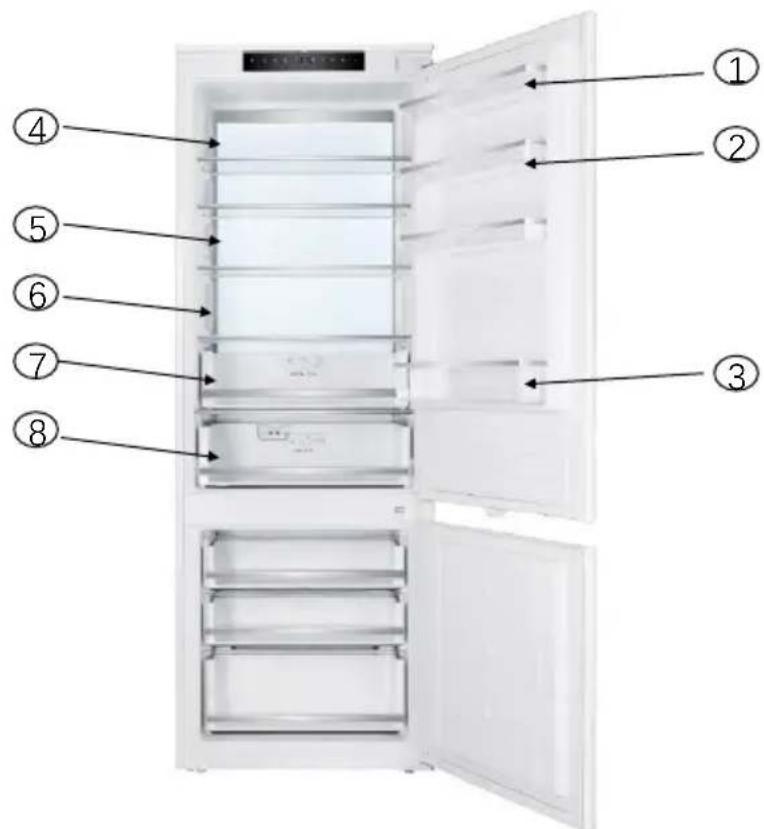
The fridge section is for short term food storage. Although low temperatures can be maintained, extended periods of food storage is not recommended. As the cold air circulates within the fridge, the temperature can vary between the different sections. As such, foods should be stored in different sections according to type. Section 7 is the coldest part of the fridge.
- Butter, cheeses etc.
- Food in jars and bottles
- Drinks, e.g. milk
-
Cooked food
-
Ready meals etc
- Yogurts, preserves etc
- Fruit and vegetables
- Fresh meat and fish
text_image
Labeled diagram of an open refrigerator showing eight numbered compartments and doorsThe fridge shelves can be moved according to the storage requirements within the fridge section. To move the shelf, lift up the rear section and then pull it outwards. To replace, slide the shelf back into the slot, and then lower the rear section.
Control Panel
flowchart
graph TD
    A["A"] --> B["Smart Phone Icon"]
    C["B"] --> D["Water Rose Icon"]
    E["C"] --> F["Light Bulb Icon"]
    G["D"] --> H["Square Box Icon"]
    I["E"] --> J["Light Bulb Icon"]
    K["F"] --> L["Headlight Icon"]
    M["G"] --> N["Snowflake Icon"]
    O["H"] --> P["Power Button Icon"]
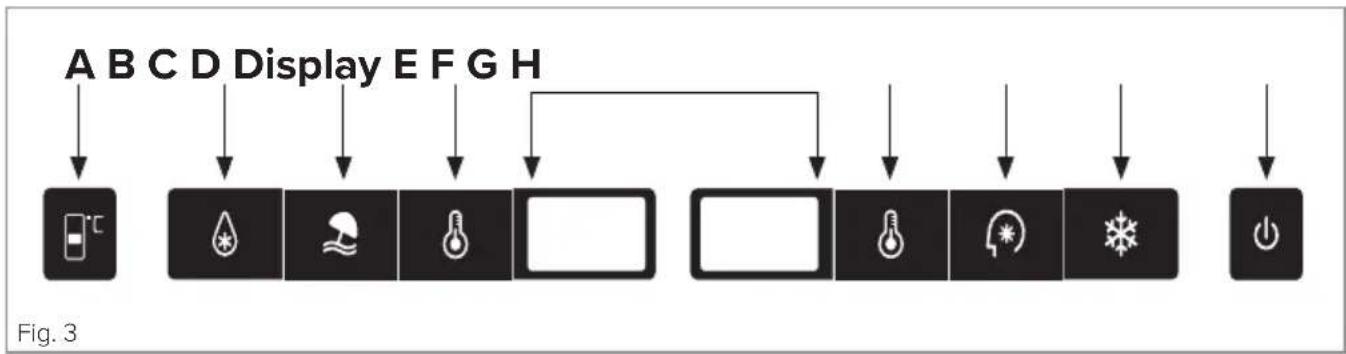
A. Adapt zone temperature adjustment sensor
This button is used to adjust the temperature within the adapt zone. Press this button once to alter the display to show the current temperature in the adapt zone, and then as many times as necessary until the desired level is selected. The settings range from -2°C and 3°C
B. Fast cooling function
Pressing this button will cause the fridge to operate at 2^ C and automatically turns off after 2 and a half hours, during this time the button will be illuminated
C. Holiday function
Pressing this button activates the holiday function and the fridge temperature will operate at 17^ C and the freezer at -18^ C
D. Fridge temperature adjustment
This button is used to adjust the temperature within the fridge. Press this button once to activate adjustment, and then as many times as necessary until the desired level is selected
Display
This is where you can see the current temperature in the fridge (left) and freezer (right)
E. Freezer temperature adjustment
This button is used to adjust the temperature within the freezer. Press this button once to activate adjustment, and then as many times as necessary until the desired level is selected
F. Smart function
This button automatically sets the fridge temperature to 5^ C and the freezer temperature to -18^ C
G. Fast freezing function
Pressing this button automatically starts the freezer working at a temperature of -25°C. After 6 hours the function stops and the temperature will revert back to its previous setting
H. On/off button
Hold this button down for 3 seconds to switch the appliance on or off
Defrosting the freezer
The freezer has a no frost system which is designed to prevent the heavy build up of ice. Under normal use, there should be no need to regularly defrost the freezer system.
To help in times of service or cleaning, the appliance has a forced defrost mode which can be activated by touching and holding sensors A and C in Fig. 3 for approximately 3 seconds. The refrigerator temperature adjustment sensor (A) will flash to confirm that the forced defrost function is active. This function should automatically deactivate once the freezer temperature has reached between 10 and 12°C.
Please note: If you are regularly finding a heavy build up of ice, or pools of water, in the freezer section then it is likely that the door is not sealing properly. This could be due to a defective door seal or an incorrectly fitted, or overly heavy, decor door. For more information see the troubleshooting section on ice on page 14.
Defrosting the fridge
The fridge is self-defrosting. Any water created will run out of the fridge through the channel at the back of the fridge. The defrosted water is collected in the evaporating tray at the back of the appliance and dissipated by evaporation.
Care and cleaning
Always disconnect the appliance from the power supply before any cleaning or maintenance.
The fridge and freezer sections should be cleaned using a solution of bicarbonate of soda and lukewarm water. Do not use abrasive products or detergents. After washing, rinse and dry thoroughly.
Clean the shelves and balconies separately by hand with a mild solution of washing up liquid and water. Do not put them in the dishwasher.
If the appliance is not to be used for prolonged periods of time, unplug and clean the appliance. The doors should be left slightly ajar to prevent the formation of mildew and unpleasant odours.
Troubleshooting
If you have any problems with your appliance, you should check the troubleshooting prior to calling ...Customer Care.
If the appliance is not working, check:
- That there is power to the appliance.
- The house fuses are intact and the fuse in the plug has not blown.
• The fridge has not been turned off (page 10). - The plug socket is functioning fine. To check this, plug another electrical appliance in to see if the socket is faulty.
If the appliance is working, but not very well, check:
• The appliance is not overloaded.
- The thermostat is set to an appropriate temperature.
• The doors are closing properly.
- The cooling system at the rear of the appliance is clean and free of dust, and not touching the rear wall.
- There is enough ventilation at the side and rear walls.
If the appliance is noisy, check:
• The appliance is level and stable.
- The side and rear walls are clear, and there is nothing resting on the appliance.
- Note: The cooling gas in the refrigerator may make a slight bubbling or gurgling noise, even when the compressor is not running.
If the appliance is beeping, check:
- That the doors are closed. An alarm will sound after 60 seconds of a door being open.
If there's water in the base of the refrigerator compartment, check:
- The drain hole at the back of the compartment is clear (page 11).
If ice has formed on the back wall of the fridge:
- It is normal for some ice droplets to form on the back wall of the fridge. This does not constitute a fault with the appliance.
- Ensure that no items inside the fridge are in contact with the back wall.
- Check that there is some resistance when opening the door of the appliance. If it opens at the slightest touch it may mean that the door seal needs to be replaced.
- Check the door seal for any kinks, debris or damage. If you notice any, and are unable to resolve the issue yourself, contact ...
Customer Care so that the seal can be replaced. - This can be due to the decor door(s) not being properly fitted. If you are at all unsure, ask your fitter to check the decor doors.
If excessive ice has formed in the freezer:
- Check that there is some resistance when opening the door of the appliance. If it opens at the slightest touch it may mean that the door seal needs to be replaced.
- Check the door seal for any kinks, debris or damage. If you notice any, and are unable to resolve the issue yourself, contact ... Customer Care so that the seal can be replaced.
- This can be due to the decor door(s) not being properly fitted. If you are at all unsure, ask your fitter to check the decor doors.
If one or more of the LED units within the appliance is not working:
- Contact ... Customer Care to arrange a service visit.
Installation preparation
This appliance must never be installed close to heat sources, e.g. heating elements or cookers, nor in damp places.
Seek the help of another individual, or two, when installing this appliance. This appliance may have sharp edges. Wear adequate PPE for the task and environment.
- To ensure the appliance is level, you should use the height adjustable feet at the front of the appliance.
- The cooling system at the rear of the appliance must not touch the rear wall. The greater the gap, the better.
- The appliance must be installed with adequate ventilation. Ensure that there is clearance above the appliance to allow air to escape and that there is space between the rear of the appliance and the wall.
Ventilation
The main consideration when installing any refrigeration unit into a fitted kitchen is ventilation. The heat removed from the cooling compartment needs to be dissipated into the atmosphere. Incorrect ventilation can lead to premature compressor failure, excessive power consumption, total system failure and may invalidate the warranty provided with the appliance. For products intended to be installed into a tall housing unit, the requirements on the following page need to be met:
An air intake should be provided somewhere in the cabinet run to allow free air in. In this example, a plinth vent is shown underneath the refrigerator.
A cutout should be made in the plinth below the fridge/freezer and this finished neatly using the air vent grille supplied.
Alternatively, a thin section of the plinth can be removed to allow air into the unit (recommended 600mm x 10mm).

text_image
Refrigerator outline Min 30mm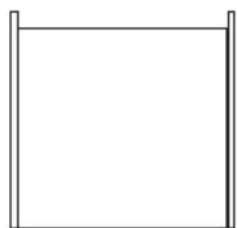
natural_image
Simple line drawing of a rectangular frame with vertical supports (no text or symbols)plan view of rear ventilation gap
The top of the cabinet needs to be vented into the room
Recommended size of vent opening: 500 x 40mm
If the furniture does not allow free air into the room then a plinth vent, or other means of ventilation needs to be provided to ensure a natural flow of air
There should be space at the rear of the cabinet to allow cool air to be drawn over the condenser.
Recommended: 500 x 40mm
Fig. 7
The open channel at the rear is clearly shown. For the correct operation of the appliance it is important that the top of the housing unit is not blocked off. A channel depth of 40-50mm is normal with most units.
A ventilation hole is required in the plinth of the unit; this allows air to
be drawn over the compressor & heat exchange. A decorative grille is supplied with the appliance to finish this vent neatly. Alternatively the required air flow can be achieved by removal of a thin section of plinth (600mm x 10mm minimum).
As a rule, the more air that can get in and out, the better and more efficient the operation of the product.
Installation into the cabinet
To ensure the appliance is level, you should use the height adjustable feet at the front of the appliance. The ventilation system at the bottom of the appliance must not be blocked
Push the appliance carefully into the cavity, make sure the appliance is in the central position of the cavity. Following the steps on the next page to fit the decor door, ensuring the door can be opened and closed properly then tighten the screws on the top, hinge side and the bottom.
Reversing the appliance doors
We recommend you seek the help of another individual to support the doors whilst performing this operation.
- Carefully prise off the white cover caps for the side that you wish to switch the hinges to
- With the door closed remove the hinge caps and the screws from the top hinge attaching the hinge to the door, support the door whilst doing this, then remove the screws from the lower hinge
-
Support the door at the bottom and open the hinges away from the appliance door. Carefully lift the appliance door away, ensuring not to damage the hinges or the door. Place the door somewhere safe where it will not cause or receive damage
-
Repeat steps 1 to 3 for the lower door if necessary
-
With the top hinge open, remove the screws that fix the hinge to the appliance cabinet, do the same with the lower hinge.
-
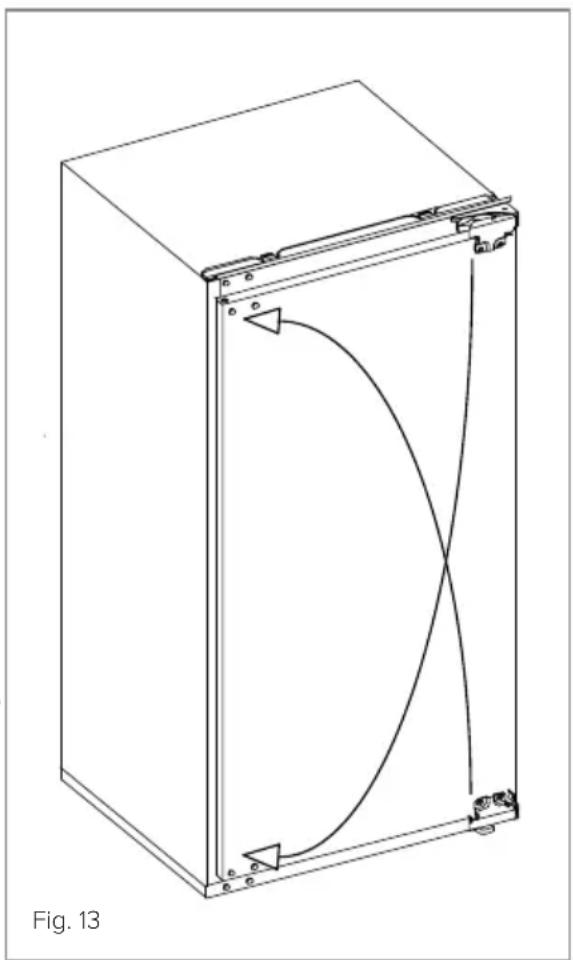
Flip the top hinge 180 degrees and reattach the the hinge on the diagonally opposite corner of the appliance cabinet as shown in fig. 13
-
Swap the previous bottom hinge to the opposite side at the top. Refit the upper door and the “new” top hinge and fix securely to the appliance. Repeat this process for the bottom door if necessary
-
Fit the central cover caps and top hinge cover pieces in place to complete the process.
natural_image
Technical line drawing of a rectangular enclosure with internal curved and straight lines, labeled Fig. 13 (no text or symbols on the diagram itself)NorFrost HAIL 193 TNF BI 70
text_image
Labeled diagram of an open refrigerator showing eight numbered compartments and doorsnatural_image
Line drawing of a rectangular enclosure with internal curved and straight lines, labeled Fig. 13 (no text or symbols on the diagram itself)
text_image
FR FRNorFrost HAIL 193 TNF BI 70
text_image
Labeled diagram of an open refrigerator showing eight numbered compartments and doorsflowchart
graph TD
    A["A"] --> C["Smart Phone Icon"]
    B["B"] --> C
    C --> D["Lightbulb Icon"]
    D --> E["Box Box"]
    E --> F["Lightbulb Icon"]
    F --> G["Lightbulb Icon"]
    G --> H["Power Battery Icon"]
    H --> I["Output"]
    style E fill:#fff,stroke:#000
    style F fill:#fff,stroke:#000
    style G fill:#fff,stroke:#000
    style H fill:#fff,stroke:#000
    subgraph Visor
        E
        F
        G
    end
natural_image
Line drawing of a rectangular device with internal curved and straight lines, labeled Fig. 13 (no text or symbols on the diagram itself)NorFrost HAIL 193 TNF BI 70
text_image
Labeled diagram of an open refrigerator with numbered parts for identificationnatural_image
Line drawing of a rectangular electronic device with internal curved and straight lines, labeled 'Abb. 13' at bottom (no text or symbols on diagram itself)NODOR
www.nodor.es

CATA ELECTRODOMÉSTICOS, S.L.