
303936 - Blood pressure monitor Medicinalis - Free user manual and instructions
Find the device manual for free 303936 Medicinalis in PDF.


User questions about 303936 Medicinalis
0 question about this device. Answer the ones you know or ask your own.
Ask a new question about this device
Download the instructions for your Blood pressure monitor in PDF format for free! Find your manual 303936 - Medicinalis and take your electronic device back in hand. On this page are published all the documents necessary for the use of your device. 303936 by Medicinalis.
USER MANUAL 303936 Medicinalis
text_image
MR Unsafe Do not use this equipment in the MRI scan roomTable of contents
- Deutsch .... 3
- English 25
- Italiano 46
- Français 68
- Español....91

ENG: Latest information, drivers, user manuals and data sheets can be found at www.ganzeinfach.de in our download area.
heatmap
Reference Material: Journal of Hypertension 1999, Vol 17 No.2 | Diastolic blood pressure (mmHg) | Systolic blood pressure (mmHg) | Hypertension Category | | :--- | :--- | :--- | | 80 | 120 | Optimal | | 85 | 130 | Normal | | 90 | 140 | High-normal | | 95 | 160 | Grade 1 hypertension (mild) | | 100 | 180 | Grade 2 hypertension (moderate) | | 105 | 180 | Grade 3 hypertension (severe) | The chart displays a nested contour plot with no explicit numerical values but uses color coding to represent different categories of hypertension severity. The x-axis represents systolic blood pressure in mmHg and the y-axis represents diastolic blood pressure in mmHg. The legend is implicit in the labels above the contour lines.natural_image
Technical line drawing of a mechanical device with no visible text or symbols
Achtung!
text_image
00 00 -mmHg- MEM 00 00 -kPa-natural_image
Simple line drawing of a hand gripping a piece of wood (no text or symbols)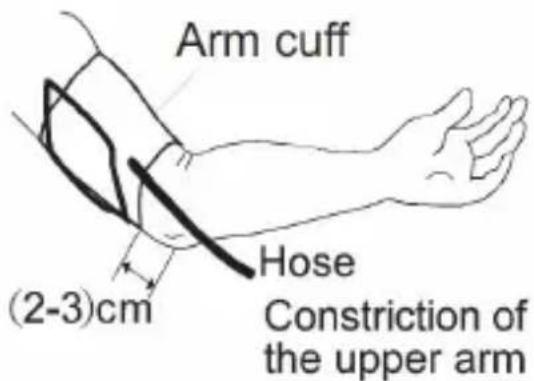
text_image
Arm cuff Hose (2-3)cm Constriction of the upper armnatural_image
Line drawing of a person's leg with a heart symbol placed on the knee, no text or labels presentAuthorized representative: Lotus NL B.V.
Address: Koningin Julianaplein 10, 1e Verd, 2595AA, T he Hague, Netherlands.
Tel: +31645171879 (English), +31626669008 (Dutch)

Important safety instructions
- Read the user manual carefully. Use this device only if you have completely read and understood the user manual.
- Do not use the device near flammable or explosive gas mixes.
- This product is intended for personal use only!
- The device is not suitable for constant monitoring of blood pressure.
- Keep your body, hands and fingers calm during the measurement.
- The device is just a tool for evaluating a patient's condition. A full evaluation of the health condition is only possible if further clinical and professional tests are carried out by a doctor.
- The device is neither suitable for cleaning with liquids nor for sterilisation.
- It should not be operated directly next
to or in combination with other devices.
- The product should not be used with additional parts or attachments, accessories, or other devices which are not described in this manual.
- Never repair the device by yourself in case of malfunction or device error. Stop using the device and contact our customer service.
- The materials used that come in contact with the skin have been tested for compatibility. If you still notice skin irritation or something similar, stop using the device and contact your doctor.
-
The device should not be opened nor repaired, as the proper functioning cannot be guaranteed otherwise. Non-compliance will result in lapse of warranty.
-
Swallowing small parts such as packaging material, battery, battery cover, etc. can lead to suffocation.
- Do not allow children or infants to play with the device!
- Protect it from dust, vibration, moisture and extreme heat.
- The patient has to follow the instructions of the doctor and should not carry out the treatment.
Self-assessment and self-treatment using the measured result, self-diagnosis of measured results and self-treatment are dangerous. - The device should neither be used to evaluate diseases nor for first aid and continuous use.
-
This product can not be used for transporting patients and for surgical treatments.
-
Please press the "ON / OFF" button to end the process, if your arm feels uncomfortable or if the air continues to inflate without stopping.
- Children under the age of 12 should not use the device. If it is used by people aged between 12 and 18, it should be done under the supervision of an adult. Failure to follow the instructions may lead to accidents or problems.
- Use the device only for measuring the blood pressure.
- Do not use mobile phones near the device. Do not use it near magnetic fields.
- Do not use the device during movement.
-
Do not use the device outdoors or in shower rooms!
-
Ensure that the connecting hose is not kinked.
- Do not measure more than two times in a row. Take a break of at least 5 minutes between any two measurements. Otherwise, this can lead to blood extravasation
- Do not measure your blood pressure more than 6 times in a day.
- Do not place the cuff over a wound, since it can result in further injury.
- Do not measure not on the arm, which is on the side of a mastectomy. This could result in injuries.
- Monitor the air pressure value on the LCD display. During measurement, this should not exceed 280 mmHg, otherwise you should switch off the device by pressing the "ON / OFF" button.
- Do not bend the arm cuff or the air
hose using force.
- The main unit should not be bumped or dropped.
- Do not carry out any service and maintenance during operation!
- Switch off the device immediately if it comes into contact with water.
- Use the product only on the upper arm.
- Do not use the device with / or near an MRI, CT or MRI equipment.

text_image
MRMR Unsafe
Do not use this equipment in the MRI scan room
Thank you for choosing a MEDICINALIS product. Please read the following user manual carefully so as to get the most from the product you have purchased.
1. Scope of delivery
• Upper arm blood pressure monitor
- Upper arm cuff
- User manual
2. Technical data
| Power supply | Four 1.5 V batteries, Type AAAalternatively 5V DC via 3.5mm DC coaxial socket |
| Measurement method | Oscillometric measurement |
| Display Digital LED display | |
| Measurement range | Blood pressure: 30-280 mmHgPulse 40-199 Beats/min |
| Accuracy | Static pressure: ±3 mmHgPulse ± 5 % |
| Memory 90 entries per user (User 1 + User 2) | |
| Operating conditions | +5°C~+ 40°C. 15 % RH - 93 % RHAmospheric pressure: 70 kPa-106 kPa |
| Storage conditions | -20°C~+55°C. 0% RH - 93% RHAmospheric pressure: 50 kPa-106 kPa |
| Dimensions (WxHxD) about 93 x 161 x 47mm | |
| Weight approx. 380 g (without batteries) | |
| Classification Type BF | |
| Circumference of upper arm | approx 22-42 cm |
| Features | Automatic shut off after 1 min of inactivityEasy to read LED displayLarge memory capacityCardiac arrhythmia detection |
3. Introduction
The device uses the oscillometric method for measuring blood pressure.
The automatic electronic blood pressure monitor is intended for use by medical professionals or at home for monitoring and display of diastolic, systolic blood pressure and pulse rate in adults. This is done by placing an arm cuff around the left upper arm.
The estimated service life of the product is 5 years.
The product meets the requirements of the electromagnetic compatibility of EN60601-1-2 and safety standards of EN60601-1-1 and performance of IEC 80601-2-30 as defined in the EEC Directive 93/42 / EEC.
4. About blood pressure
4.1. What is blood pressure?
Blood pressure is the pressure of blood in a blood vessel. Systolic pressure is generated when the heart contracts. Diastolic pressure is generated when the heart expands.
A high blood pressure has an adverse effect on your health and life expectancy.
Blood pressure is measured in millimetres of mercury (mmHg).
4.2. What is high blood pressure and how is it controlled?
An unusually high arterial blood pressure, if left uncontrolled, can cause many health problems including stroke and heart attack.
High blood pressure can be controlled by changing the lifestyle, avoiding stress, and with the help of medication under medical supervision.
To prevent high blood pressure or keep it under control, we recommend the following:
- Do not smoke
- Exercise regularly
- Reduce intake of salt and fats
- Undergo regular physical checkups
- Maintain correct weight (ideal weight)
4.3. Why should you measure the blood pressure at home?
The blood pressure measured in a hospital or doctor's clinic can cause anxiety and result in readings which are 25 to 30mmHg higher than those measured at home. Measurement at home reduces the effect of external influences on the blood.
The values measured by the doctor and, in addition, those measured at home, provide more safety and a more accurate and complete blood pressure history.
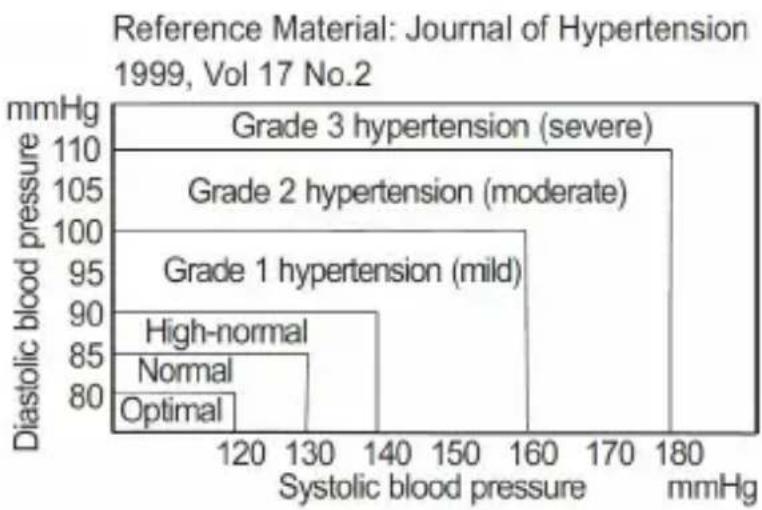
4.4. WHO (World Health Organization) -Blood pressure classification
Standards for assessing high blood pressure, without considering the age, have been established by the World Health Organization (WHO), and are shown in the following diagram.
heatmap
Reference Material: Journal of Hypertension 1999, Vol 17 No.2 | Hypertension Level | Diastolic blood pressure (mmHg) | Systolic blood pressure (mmHg) | | :--- | :--- | :--- | | Optimal | 80 | 120 | | Normal | 85 | 130 | | High-normal | 90 | 140 | | Grade 1 hypertension (mild) | 95 | 160 | | Grade 2 hypertension (moderate) | 100 | 170 | | Grade 3 hypertension (severe) | 110 | 180 |4.5. Blood pressure variations
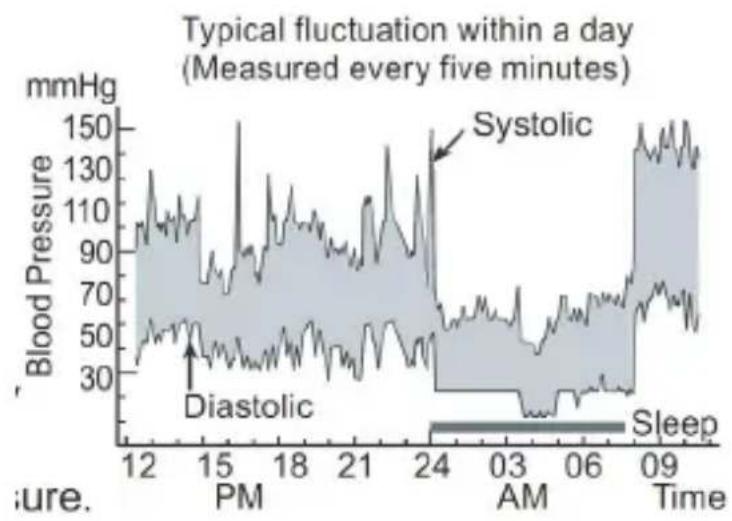
The blood pressure of a person varies a lot daily and seasonally.
It may vary by as much as 30 to 50 mmHg during the day due to various conditions. The variations are even more pronounced in hypertensive individuals.
Normally the blood pressure increases when working or playing and drops to the lowest level during sleep. Hence do not let yourself be overly influenced by the results of a single measurement.
Take the readings every day at the same time following the procedure described in this manual and know your normal blood pressure.
Many measurements provide a more complete picture of the history of blood pressure.
Make sure that you always note the date and time when measuring your blood pressure. Consult your doctor to interpret your blood pressure data.
line
| Time | Blood Pressure (mmHg) | |------|------------------------| | 12 | ~50 | | 15 | ~50 | | 18 | ~50 | | 21 | ~50 | | 24 | ~150 | | 03 | ~30 | | 06 | ~30 | | 09 | ~150 |-
Precau ons before each use
-
If you are taking medication, consult your doctor to determine the best time to measure your blood pressure. Never change a prescribed medication without first consulting your doctor.
- For individuals having irregular or unstable peripheral circulation problems cause by diabetes, liver disease, hardening of the arteries, etc., the blood pressure may vary at the upper arm and the wrist.
-
The measurements can be affected if the device is used near televisions, microwave ovens, X-ray machines, mobile phones or other devices that emit strong electrical fields. To avoid such interferences, use the blood pressure monitor at an adequate distance from such devices or switch off those devices.
-
You should wash your hands before using the device.
- Do not measure on the arm that is using ME devices at the same time for monitoring, as this may lead to loss of function.
- Consult your doctor if the readings are unexpected.
- The readings when measuring at home is probably lower than in the hospital because the mood is usually more relaxed.
-
Cuff pressure range 0 - 299 mmHg
-
Product details
text_image
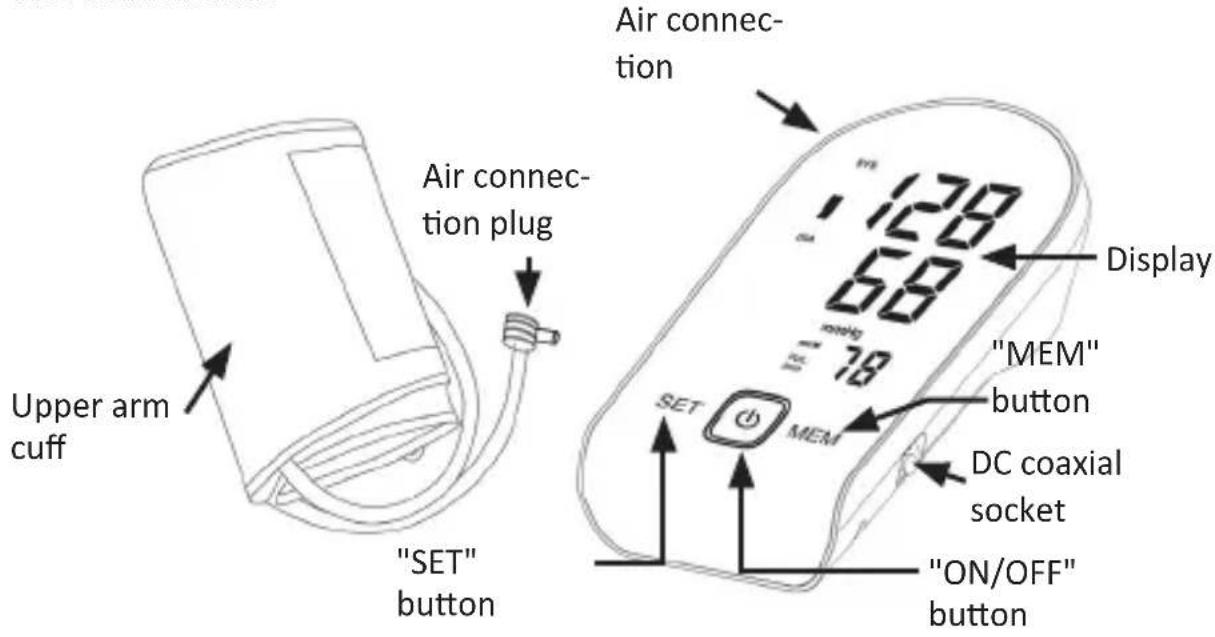
Air connection plug Upper arm cuff "SET" button Air connec- tion Display "MEM" button DC coaxial socket "ON/OFF" button6.1 Display
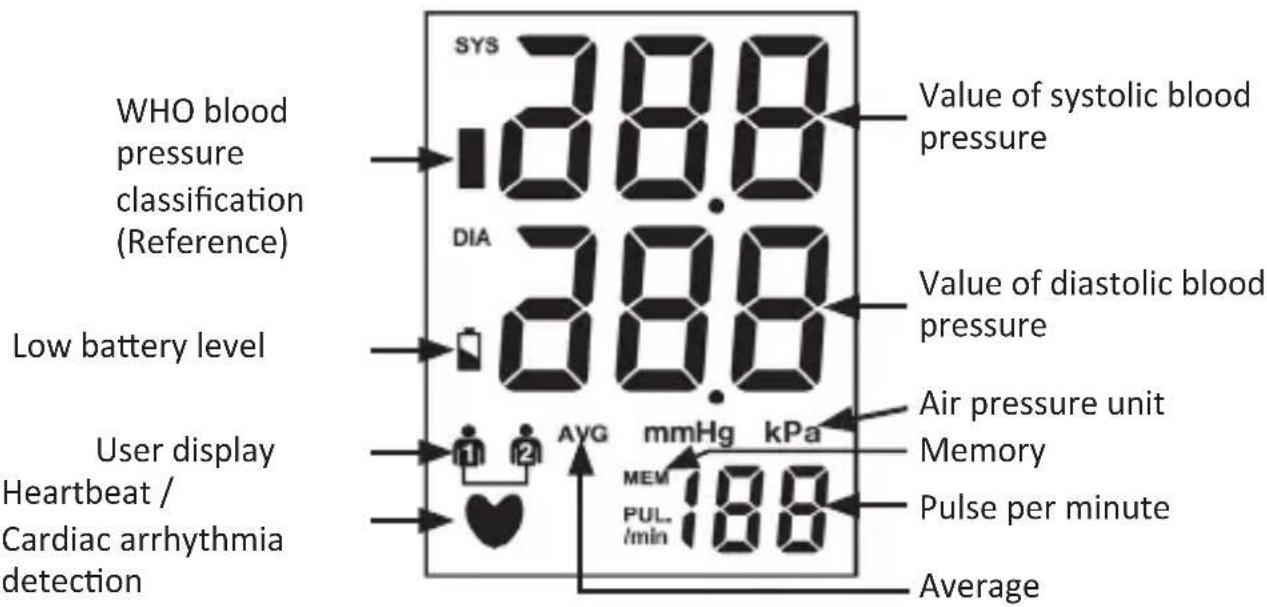
text_image
WHO blood pressure classification (Reference) Low battery level User display Heartbeat / Cardiac arrhythmia detection SYS 38.0 DIA 38.0 1 2 AYG mmHg kPa MEM 180 PUL/min 180 Value of systolic blood pressure Value of diastolic blood pressure Air pressure unit Memory Pulse per minute Average7. Inserting or replacing the batteries
-
Remove the battery cover
-
Remove the old batteries and insert the new one into the battery compartment. Pay attention to the correct polarity of the contacts.
-
Then replace the battery compartment cover
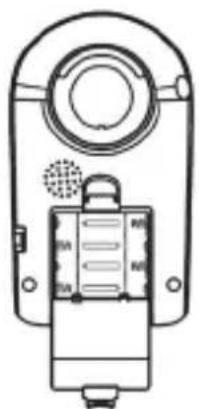
natural_image
Technical line drawing of a mechanical device with no visible text or symbols
Caution!
If the (low battery level) symbol flashes on the display, replace all batteries with new ones. Do not mix old and new batteries. This can reduce the battery life or cause the device to malfunction. The symbol is not displayed if the batteries are completely empty.
- Leaked batteries or those that have been modified, should not be used in the product.
- Prevent the battery from short-circuit at all times.
- Battery life depends on the ambient temperature and can be significantly reduced at low temperatures.
- Leaking batteries can result in malfunction.
- Only use batteries that match with the device specifications.
• Used batteries may leak and damage the main unit. - If you do not intend to use the device for extended periods (about three months or more), then remove the batteries from the battery compartment.
8. Initial use and operation
8.1 Changing the units between mmHg / kPa
The device can show two types of blood pressure display units with "mm Hg" and "kPa".
Press the "ON / OFF" button for 10 seconds to access the settings for changing the unit. Then press the "MEM" button to select between mmHg and kPa. Press the ON/OFF button to exit the menu.
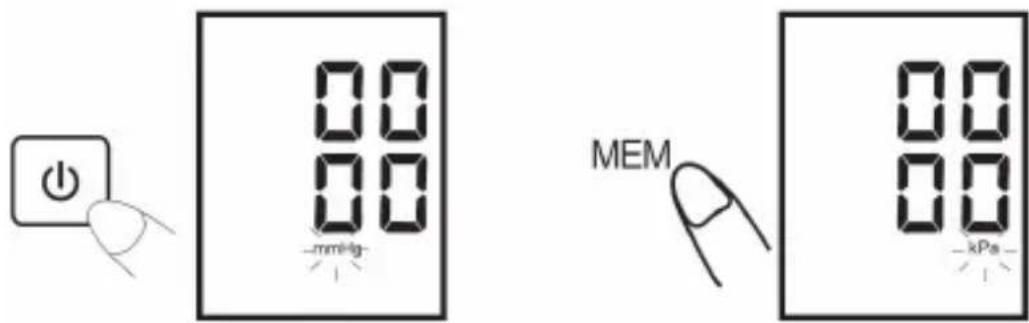
text_image
00 00 - mmHg MEM 00 00 - kPa8.2 WHO (World Health Organization) blood pressure classification
8.3 Placing the cuff on the upper arm
- Make sure that the upper arm cuff fits your upper arm circumference.
- Wrap the upper arm cuff as shown around the upper arm, about 2-3 cm above the elbow. Place the cuff directly on the skin, as clothing may cause weak pulse and result in measurement errors.
- Constricting the upper arm, caused by rolling up a sleeve, can also lead to measurement errors.
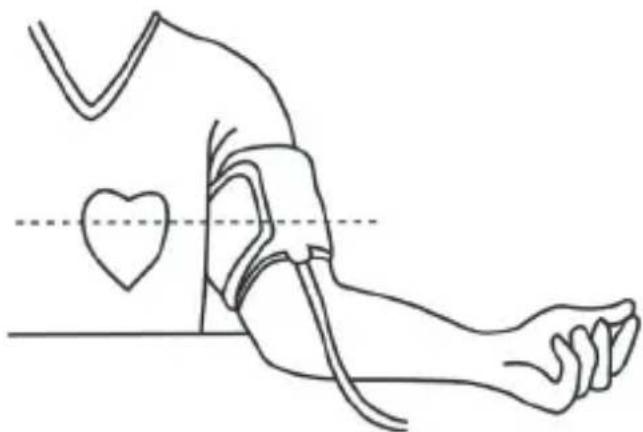
- Wrap the upper-arm cuff so that it is comfortable and not too tight. Place the arm on the table (palm facing upward) so the cuff is at the same level as the heart. Ensure that the hose is not kinked.
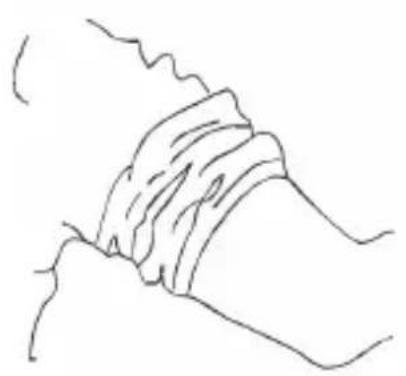
natural_image
Line drawing of a hand gripping a piece of wood (no text or symbols)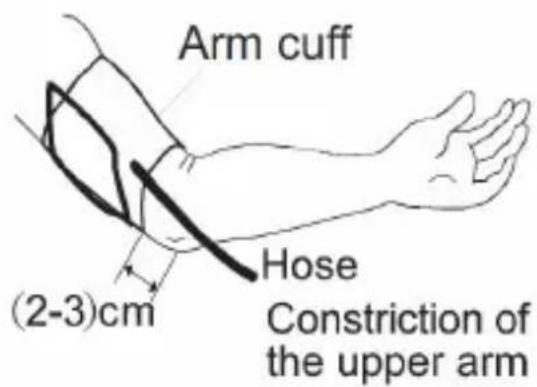
text_image
Arm cuff Hose (2-3)cm Constriction of the upper arm9. Carrying out the measurement
9.1 Carrying out the measurements correctly
The following figure shows the optimal positioning of the cuff:
natural_image
Line drawing of a person's leg with a heart symbol placed on the knee, no text or labels presentTo make the surroundings optimum for the measurement, consider the following points:
- Sit comfortably
- Make sure that your legs are not crossed
- Keep your feet flat on the floor
- Your back and arms should always be supported
- The centre of the cuff should always be at the same level as your heart. Relax as much as possible and do not talk during the measurement.
Measure your blood pressure every day at about the same time.
Do not measure immediately after physical exertion or a bath. Take a break of 20 to 30 minutes before carrying out the measurement.
The readings can be affected under the following conditions:
Within an hour after dinner, after drinking wine, coffee or tea, for example red tea. Or after sport activity and after bathing.
Talking, nervousness, restless mood, bending forward, moving around, changes in the room temperature during measurement, can also change the readings.
9.2 Measuring the blood pressure
-
Wrap the arm cuff to your upper arm as described in the previous section "9.1 Carrying out the measurements correctly".
-
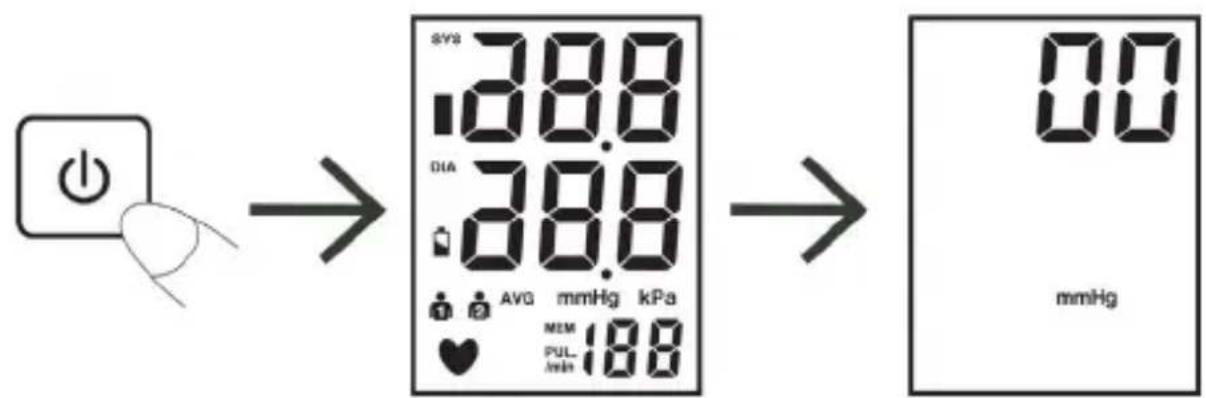
Press the "ON/OFF" button. All the symbols appear for two seconds on the display. Then the display changes to measurement and shows "0" or the last reading.
text_image
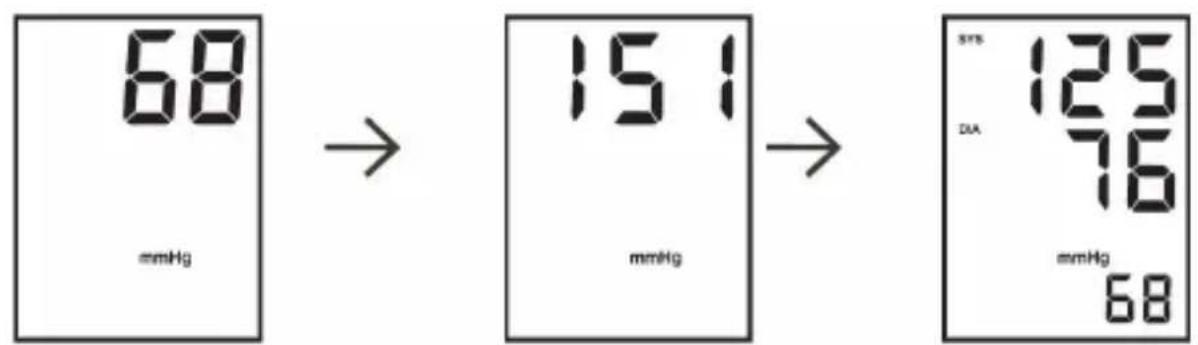
SYS 38.8 DIA 38.8 AVG mmHg kPa MEM PULL Amin 188 00 mmHg- Start the measurement, the cuff is automatically inflated in the belt. The mark (♥)ashes on the LCD. When the measurement is complete, the results appear on the LCD.
text_image
68 mmHg → 15.1 mmHg → SYS 125 76 mmHg 68Note: The heartbeat symbol (❤)ay also indicate a possible Cardiac arrhythmia!
10. Memory function (memory)
The device automatically stores the last 90 readings per user.
10.1 Reading from memory
Press the "MEM" button to view the average values ("AVG") from the memory.
Average value display: the last 3 groups of average values from the memory (values from the memory are displayed regardless of the period).
The memory, which stores the last measurements, is displayed. Press the "MEM" button for the next entry in the memory (up). Press the "SET" button for the previous entry in the memory (down).
10.2. Clearing the memory
Press and hold the "MEM" button for five seconds, the LCD display shows "NO". The entire memory is cleared.
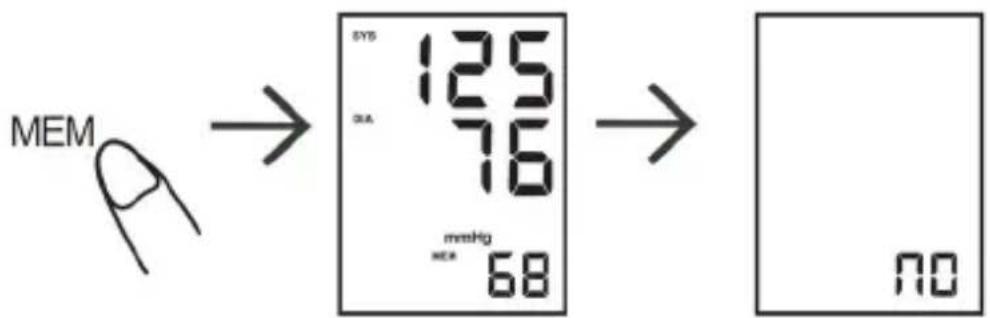
text_image
MEM → 125 76 mVHg 68 → NO11 Cleaning, care and maintenance
Follow the instructions given below to keep the blood pressure monitor in proper condition and to protect it from damage:
- Store the device always in the packaging when it is not being used.
- Do not fold the upper arm cuff too tightly. The fabric fastener may come into contact with the inside of the arm cuff and damage it.
- Clean the monitor and cuff with a soft, dry cloth.
- Do not use any abrasive or aggressive cleaning agents.
Caution!
- Never immerse the device or the components in water.
- Do not expose the monitor to very high or low temperatures. Keep it away from moisture or direct sunlight.
- Keep the device and the components in a clean, safe place.
- Protect the device from strong impact, such as when the device is dropped on the floor.
- Remove the batteries if the device is not being used for three months or longer. Always replace all the batteries simultaneously with new ones.
- This product is designed for use over a long period. However, it is generally advisable to check the device once in two years and calibrate it to ensure proper functioning and performance.
(* Pressure calibration is done by EU officials)
11.2 Changing the battery
If the display of the device indicates low battery, you should immediately replace the batteries. Always pay attention to the correct polarity of the contacts.
If the product is not used for more than a month, remove the batteries from the device to avoid any leakage.
12. Troubleshooting
| Display Error possible | error Troubleshooting | |
| Nothing is displayed when the POWER button is pressed or the battery symbol flashes. | Batteries not inserted Insert the batteries | |
| Batteries are empty Replace the batteries | ||
| The polarity of the batteries is incorrect | Insert the batteries correctly | |
| E1: Can not build up pressure | Check the cuff for holes Replace the cuff | |
| E3: Inflation pressure is too much | Pressure value is more than 299 mmHg | Measure again. If the error still persists, contact our customer service department |
| E2E4: Movement during the measurement | Hand or body is moving too much | Stay calm during the measurement |
| Battery symbol starts glowing | Batteries are low Replace the batteries. | |
| The systolic or diastolic pressure reading is too high | The cuff is not at the same level as the heart. | Maintain the correct position and posture and measure again. Make sure that you do not move too much and the device is positioned correctly. |
| The cuff is not fastened properly. | ||
| The body was moved or you spoke during the measurement. | ||
| The systolic or diastolic pressure reading is too low | The cuff was not at the same level as the heart. | |
| The body was moved or you spoke during the measurement. | ||
14. Safety instructions and disclaimer
Never try to open the device to repair or make modifications. Avoid contact with the mains voltage. The device is free of current only when it is disconnected. Do not short-circuit the product. Please disconnect the power cord when not in use or during storms.
The device is not approved for outdoor use. Therefore please use it only in dry surroundings. Protect it from high humidity, water and snow. Do not expose the device to high temperatures. Do not expose the device to sudden changes in temperature or strong vibrations, as this could damage the electronic components. Check the device for any damage before using it. The device should not be used if it was subject to impact or has been damaged in some other manner. Please com-
ply with the local regulations and restrictions. Do not use the device for purposes other than those described in the user manual.
This product is not a toy. Keep it out of the reach of children or mentally disabled persons. Any repair or modifications to the device, which is not carried out by the original supplier will void any warranty and guarantee claims. The device should only be used by those who have read and understood this user manual. The specifications of the device may be changed without special prior notice.
15. Disposal instructions
In line with the European WEEE directive, electrical and electronic devices should not be disposed of along with domestic waste. Their components have to be separately sent for recycling or disposal, because improper disposal of toxic and dangerous components may permanently damage the environment.
According to the electrical and electronic equipment act (ElektroG), you are obliged (as a consumer) to return (free of charge) all electrical and electronic devices to the manufacturer, the point of sale or public collection points at the end of their service life. The relevant local laws regulate the details in this regard. The symbol displayed on the product, in the user manual or/and on the packaging refers to these regulations. With this manner of sorting, recycling and disposal of used devices, you make an important contribution towards protecting our environment.
16. Instructions for battery disposal
In conjunction with the sale of batteries along with the supply of devices that include batteries, the supplier is obliged to point out the following to the customer: The customer is legally obliged to return used batteries. He can return used batteries which the supplier offers or has offered as new batteries in his assortment free of charge to the supplier's dispatch warehouse (shipping address). The symbols shown on the batteries indicate the following: Pb = battery contains more than 0.004 percent lead by weight, Cd = battery contains more than 0.002 percent cadmium by weight, Hg = battery contains more than 0.0005 percent mercury by weight.
Authorized representative: Lotus NL B.V.
Address: Koningin Julianaplein 10, 1e Verd, 2595AA,
The Hague, Netherlands.
Tel.: +31645171879 (English), +31626669008 (Dutch)

The symbol of the crossed-out dustbin means that the battery may not be disposed of in household waste.

0413
WEEE directive 2012/19/EU WEEE Register no.: DE 67896761
The company WD Plus GmbH hereby certifies that the device 303936/20191028SZ261 complies with the fundamental requirements and all other relevant stipulations of the directive 93/42/EEC. A complete conformity statement can be obtained from: WD Plus GmbH, Wohlenbergstraße 16, 30179 Hannover, https://www.ganzeinfach.de/

text_image
MR Unsafe Do not use this equipment in the MRI scan roomnatural_image
Technical line drawing of a mechanical device with no visible text or symbols
Attenzione!
text_image
00 00 - mmHg MEM 00 00 - kPanatural_image
Line drawing of a hand gripping a piece of wood or metal (no text or symbols)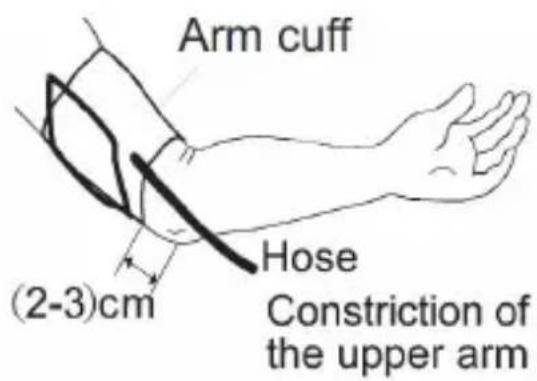
text_image
Arm cuff Hose (2-3)cm Constriction of the upper armnatural_image
Line drawing of a person's leg with a heart symbol placed on the knee, no text or labels presentDo not use this equipment in the MRI scan room
Table des matières
- Deutsch .... 3

ENG: Latest information, drivers, user manuals and data sheets can be found at www.ganzeinfach.de in our download area.
heatmap
Reference Material: Journal of Hypertension 1999, Vol 17 No.2 | Diastolic blood pressure (mmHg) | Systolic blood pressure (mmHg) | Hypertension Category | | :--- | :--- | :--- | | 80 | 120 | Optimal | | 85 | 130 | Normal | | 90 | 140 | High-normal | | 95 | 160 | Grade 1 hypertension (mild) | | 100 | 180 | Grade 2 hypertension (moderate) | | 105 | 180 | Grade 3 hypertension (severe) | The chart displays a nested contour plot with no explicit numerical values but uses color intensity to represent the density or frequency of each category. The x-axis represents systolic blood pressure in mmHg and the y-axis represents diastolic blood pressure in mmHg. The legend is implicit in the labels above the contour lines.natural_image
Technical line drawing of a mechanical device with no visible text or symbols
text_image
00 00 -mmHg MEM 00 00 -kPanatural_image
Line drawing of a hand gripping a piece of wood or metal (no text or symbols)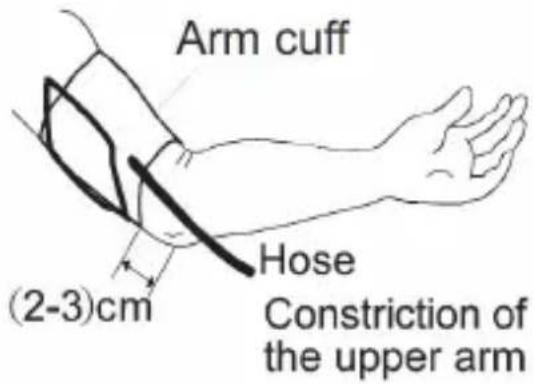
text_image
Arm cuff Hose (2-3)cm Constriction of the upper armnatural_image
Line drawing of a person's leg with a heart symbol placed on the knee, no text or labels presentAuthorized representative: Lotus NL B.V.
Address: Koningin Julianaplein 10, 1e Verd, 2595AA,
The Hague, Netherlands.
Tél.: +31645171879 (English), +31626669008 (Dutch)

Do not use this equipment in the MRI scan room

ENG: Latest information, drivers, user manuals and data sheets can be found at www.ganzeinfach.de in our download area.
natural_image
Technical line drawing of a mechanical device with no visible text or symbols¡Atención!

text_image
00 00 - mmHg MEM 00 00 - kPanatural_image
Line drawing of a hand gripping a piece of wood (no text or symbols)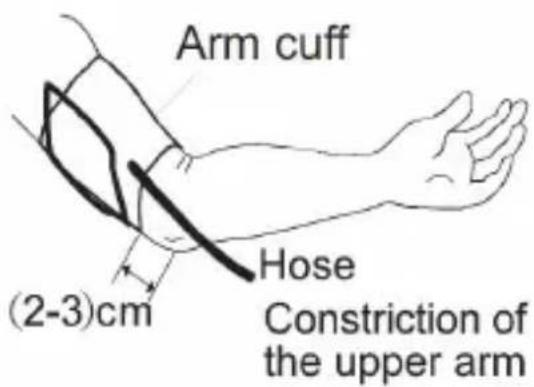
text_image
Arm cuff Hose (2-3)cm Constriction of the upper armnatural_image
Line drawing of a person's leg with a heart symbol placed on the knee, no text or labels presentNOTE 1 At 80 MHz and 800 MHz, the higher frequency range applies.
| Richtlinie und Herstellererklärung - Elektromagnetische Störfestigkeit | |||
| Das Modell WDP-303936 ist für den Einsatz in elektromagnetischer Umgebung vorgesehen. wie unten beschrieben. Der Kunde oder der Benutzer des Modells WDP-303936 sollte Folgendes sicherstellen dass es in einer solchen Umgebung verwendet wird. | |||
| Immunity test | IEC 60601 test level | Compliance level | Electromagnetic environ-ment - guidance |
| Electrostatic discharge(ESD)IEC 61000-4-2 | ±8 kV contact±2 kV, ±4 kV, ±8 kV, ±15 kV air | ±8 kV contact±2 kV, ±4 kV, ±8 kV, ±15 kV air | Floors should be wood, concrete or ceramic tile.If floors are covered with synthetic material, the relative humidity should be at least 30 %. |
| Electrostatic transient/ burstIEC 61000-4-4 | ±2 kV for power supply lines100 kHz repetition frequency ±1 kV for input/output lines | ±2 kV for power supply lines100 kHz repetition frequency ±1 kV for input/output lines | Mains power quality should be that of a typical commercial or hospital environment. |
| Surge IEC 61000-4-5 | ±0.5 kV, ±1kV differential modeline-line | ±0.5 kV, ±1kV differential modeline-line | Mains power quality should be that of a typical commercial or hospital environment. |
| Voltage dips, short interruptions and voltage variations on power supply input linesIEC 61000-4-11 | 0% UT (100% dip in UT) for 0.5 cycle at 0°, 45°, 90°, 135°,180°, 225°, 270°, and 315°0% UT (100% dip in UT) for 1 cycleat 0°70% UT (30% dip in UT) for 25/30 cycles at 0°0% UT(100% dip in UT) for 250/300 cycle at 0° | 0% UT (100% dip in UT)for 0.5 cycle at 0°, 45°, 90°, 135°,180°, 225°, 270°, and 315°0% UT (100% dip in UT) for 1 cycle at 0°70% UT (30% dip in UT) for 25/30 cycles at 0°0% UT(100% dip in UT) for 250/300 cycle at 0° | Mains power quality should be that of a typical commercial or hospital environment. If the user of the Model WDP-303936 product name requires continued operation during power mains interruptions, it is recommended that the Model WDP-303936 be powered from an uninterruptible power supply or a battery. |
| Power frequen-cy (50/60 Hz) magnetic fieldIEC 61000-4-8 | 30 A/m,50/60H 30 A/m,50/60Hz | Power frequency magnetic fields should be at levels characteristic of a typical location in a typical commercial or hospital environment. | |
| NOTE: UT is the a. c. mains voltage prior to application of the test level. | |||
| Richtlinie und Herstellererklärung - elektromagnetische Immunität | |||
| Das Modell WDP-303936 ist für den Einsatz in der unten angegebenen elektromagnetischen Umgebung vorgesehen. Der Kunde oder der Benutzer des Modells WDP-303936 sollte sicherstellen, dass es in einer solchen elektromagnetischen Umgebung verwendet wird. | |||
| Immunity test | IEC 60601 test level | Compliance level | Electromagnetic environment - guidance |
| Conducted RF IEC 61000-4-6 | 3 Vrms 150 kHz to 80 MHz 6 Vrms 150 kHz to 80 MHz outside ISM bandsa | 6 V | Portable and mobile RF communications equipment should be used no closer to any part of the Models WDP-303936, including cables, than the recommended separation distance calculated from the equation applicable to the frequency of the transmitter. Recommended separation distance |
d = [ 3.5V_1 ] d = [ 12V_2 ] d = [ 12E_1 ] 80MHz to 800MHz d = [ 23E_1 ] 800MHz to 2.7GHzWhere P is the maximum output power rating of the transmitter in watts (W) according to the transmitter manufacturer and d is the recommended separation distance in metres(m). Field strengths from fixed RF trans-mitters, as determined by an electromagnetic site survey, a should be less than the com- pliance level in each frequency range b Interference may occur in the vicinity of equipment marked with the following symbol: 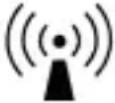 | |||
| Radiated RF IEC 61000-4-3 | 10 V/m 80 MHz to 2.7 GHz | 10 V/m | |
NOTE 2 These guidelines may not apply in all situations. Electromagnetic propagation is affected by absorption and reflection from structures, objects and people.
a The ISM (industrial, scientific and medical) bands between 0,15 MHz and 80 MHz are 6,765 MHz to 6,795 MHz; 13,553 MHz to 13,567 MHz; 26,957 MHz to 27,283 MHz; and 40,66 MHz to 40,70 MHz. The amateur radio bands between 0,15 MHz and 80 MHz are 1,8 MHz to 2,0 MHz, 3,5 MHz to 4,0 MHz, 5,3 MHz to 5,4 MHz, 7 MHz to 7,3 MHz, 10,1 MHz to 10,15 MHz, 14 MHz to 14,2 MHz, 18,07 MHz to 18,17 MHz, 21,0 MHz to 21,4 MHz, 24,89 MHz to 24,99 MHz, 28,0 MHz to 29,7 MHz and 50,0 MHz to 54,0 MHz.
b The compliance levels in the ISM frequency bands between 150 kHz and 80 MHz and in the frequency range 80 MHz to 2,7 GHz are intended to decrease the likelihood that mobile/portable communications equipment could cause interference if it is inadvertently brought into patient areas. For this reason, an additional factor of 10/3 has been incorporated into the formulae used in calculating the recommended separation distance for transmitters in these frequency ranges.
c Field strengths from fixed transmitters, such as base stations for radio (cellular/ cordless) telephones and land mobile radios, amateur radio, AM and FM radio broadcast and TV broadcast cannot be predicted theoretically with accuracy. To assess the electromagnetic environment due to fixed RF transmitters, an electromagnetic site survey should be considered. If the measured field strength in the location in which the Model WDP-303936 is used exceeds the applicable RF compliance level above, the Model WDP-303936 should be observed to verify normal operation. If abnormal performance is observed, additional measures may be necessary, such as re-orienting or relocating the Model WDP-303936.
d Over the frequency range 150 kHz to 80 MHz, field strengths should be less than 10 V/m.
NOTE 2 The ISM (industrial, scientific and medical) bands between 0,15 MHz and 80 MHz are 6,765 MHz to 6,795 MHz; 13,553 MHz to 13,567 MHz; 26,957 MHz to 27,283 MHz; and 40,66 MHz to 40,70 MHz. The amateur radio bands between 0,15 MHz and 80 MHz are 1,8 MHz to 2,0 MHz, 3,5 MHz to 4,0 MHz, 5,3 MHz to 5,4 MHz, 7 MHz to 7,3 MHz, 10,1 MHz to 10,15 MHz, 14 MHz to 14,2 MHz, 18,07 MHz to 18,17 MHz, 21,0 MHz to 21,4 MHz, 24,89 MHz to 24,99 MHz, 28,0 MHz to 29,7 MHz and 50,0 MHz to 54,0 MHz.
NOTE 3 An additional factor of 10/3 has been incorporated into the formulae used in calculating the recommended separation distance for transmitters in the ISM frequency bands between 150 kHz and 80 MHz and in the frequency range 80 MHz to 2,7 GHz to decrease the likelihood that mobile/portable communications equipment could cause interference if it is inadvertently brought into patient areas.
NOTE 4 These guidelines may not apply in all situations. Electromagnetic propagation is affected by absorption and reflection from structures, objects and people.

text_image
MEDICINALIS
text_image
QR code image containing encoded data, no visible human-readable textDOWNLOADS & MANUALS