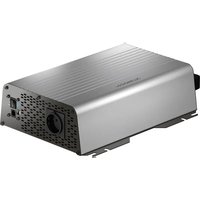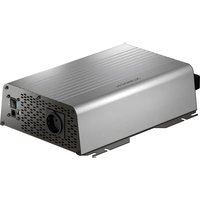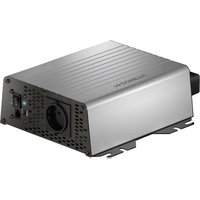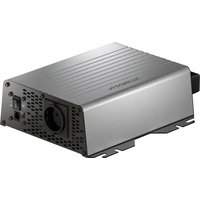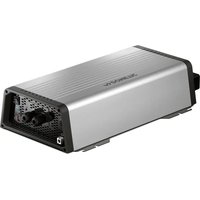
SinePower DSP 2024C - Battery charger DOMETIC - Free user manual and instructions
Find the device manual for free SinePower DSP 2024C DOMETIC in PDF.


| Product type | Sine wave inverter with integrated battery charger |
| Model | SinePower DSP 2024C |
| Brand | Dometic |
| Weight | 7.2 kg |
| Battery input voltage | 24 V DC (range 20-33 V) |
| AC input voltage | 230 V AC (range 180-264 V) |
| Inverter output voltage | 230/240 V AC ±3%, 50/60 Hz |
| Continuous inverter power | 2000 VA |
| Peak inverter power | 4000 VA (2 s) |
| Battery charging current | Programmable: 12.5 / 25 / 37.5 / 50 A |
| Compatible battery types | Lead-acid, Gel, AGM, Lithium-ion |
| Charging characteristic | 4 stages (I-U0-U, conditioning every 12 days) |
| Main functions | Inverter, charger, power sharing, generator function, mains priority |
| Protections | Overvoltage, undervoltage, overtemperature, overload, short circuit, reverse polarity (internal fuse) |
| Display and control | DSP-EM panel with display and rotary knob |
| Ventilation | Temperature and load controlled fan |
| Operating temperature | -20 °C to +60 °C |
| Protection rating | Not specified (dry indoor use) |
| Maintenance and cleaning | Clean with a damp cloth, do not use harsh detergents |
| Delivery contents | Inverter, DSP-EM, DSP-EM connection cable, user manual |
Frequently Asked Questions - SinePower DSP 2024C DOMETIC
User questions about SinePower DSP 2024C DOMETIC
0 question about this device. Answer the ones you know or ask your own.
Ask a new question about this device
Download the instructions for your Battery charger in PDF format for free! Find your manual SinePower DSP 2024C - DOMETIC and take your electronic device back in hand. On this page are published all the documents necessary for the use of your device. SinePower DSP 2024C by DOMETIC.
USER MANUAL SinePower DSP 2024C DOMETIC

2
3

4
5
B

natural_image
Isometric technical drawing of a heat exchanger or cooling unit with mounting points and wiring (no text or symbols)
6
natural_image
Diagram of a device with two rectangular components and directional arrows indicating assembly or movement (no text or symbols)B
C
7
B
D
8
| bk | rd | bk | rd | bk | rd | |||
| EN | Back | Red | NL | Zoon | Racil | PL | Cuany | Cerency |
| DE | Schwarz | Red | DA | Sart | Red | SK | Coma | Corona |
| FR | Nol' | Rouge | SV | Sart | Red | CS | Coma | Corona |
| ES | Neuro | Ruo | NO | Sart | Red | HU | Felete | Pice |
| PT | Froto | Vermicho | FI | Muto | Puncion | |||
| IT | Nero | Rosso | RU | Hecha? | Koachon | |||
9
natural_image
Diagram of an electric vehicle chassis connected to a van, showing wiring and components (no text or symbols)
10
natural_image
Technical line drawing of a rectangular electronic device with internal components (no text or symbols)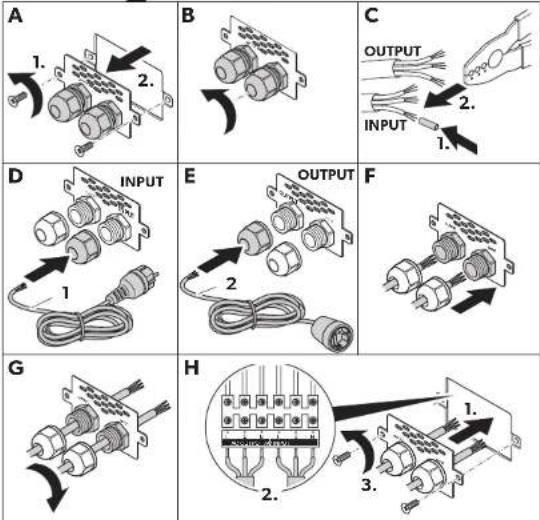
11
12
13

14
15
16
17
18
line
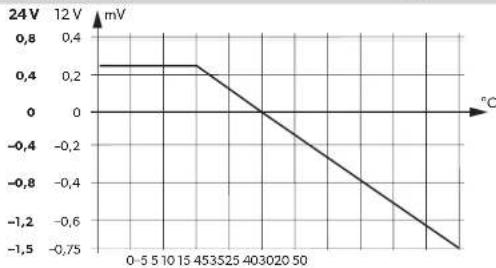
| Temperature (°C) | Voltage (mV) | | :--- | :--- | | 0-5 | 0.3 | | 5-10 | 0.3 | | 10-15 | 0.3 | | 15-20 | 0.3 | | 20-25 | -0.4 | | 25-30 | -0.8 | | 30-35 | -1.2 | | 35-40 | -1.6 | | 40-45 | -2.0 | | 45-50 | -2.4 | | 50-55 | -2.8 | | 55-60 | -3.2 | | 60-65 | -3.6 | | 65-70 | -4.0 | | 70-75 | -4.4 | | 75-80 | -4.8 | | 80-85 | -5.2 | | 85-90 | -5.6 | | 90-95 | -6.0 | | 95-100 | -6.4 | | 100-105 | -6.8 | | 105-110 | -7.2 | | 110-115 | -7.6 | | 115-120 | -8.0 | | 120-125 | -8.4 | | 125-130 | -8.8 | | 130-135 | -9.2 | | 135-140 | -9.6 | | 140-145 | -10.0 | | 145-150 | -10.4 | | 150-155 | -10.8 | | 155-160 | -11.2 | | 160-165 | -11.6 | | 165-170 | -12.0 | | 170-175 | -12.4 | | 175-180 | -12.8 | | 180-185 | -13.2 | | 185-190 | -13.6 | | 190-195 | -14.0 | | 195-200 | -14.4 | | 200-205 | -14.8 | | 205-210 | -15.2 | | 210-215 | -15.6 | | 215-220 | -16.0 | | 220-225 | -16.4 | | 225-230 | -16.8 | | 230-235 | -17.2 | | 235-240 | -17.6 | | 240-245 | -18.0 | | 245-250 | -18.4 | | 250-255 | -18.8 | | 255-260 | -19.2 | | 260-265 | -19.6 | | 265-270 | -20.0 | | 270-275 | -20.4 | | 275-280 | -20.8 | | 280-285 | -21.2 | | 285-290 | -21.6 | | 290-295 | -22.0 | | 295-300 | -22.4 | | 300-305 | -22.8 | | 305-310 | -23.2 | | 310-315 | -23.6 | | 315-320 | -24.0 | | 320-325 | -24.4 | | 325-330 | -24.8 | | 330-335 | -25.2 | | 335-340 | -25.6 | | 340-345 | -26.0 | | 345-350 | -26.4 | | 350-355 | -26.8 | | 355-360 | -27.2 | | 360-365 | -27.6 | | 365-370 | -28.0 | | 370-375 | -28.4 | | 375-380 | -28.8 | | 380-385 | -29.2 | | 385-390 | -29.6 | | 390-395 | -30.0 | | 395-400 | -30.4 | | 400-405 | -30.8 | | 405-410 | -31.2 | | 410-415 | -31.6 | | 415-420 | -32.0 | | 420-425 | -32.4 | | 425-430 | -32.8 | | 430-435 | -33.2 | | 435-440 | -33.6 | | 440-445 | -34.0 | | 445-450 | -34.4 | | 450-455 | -34.8 | | 455-460 | -35.2 | | 460-465 | -35.6 | | 465-470 | -36.0 | | 470-475 | -36.4 | | 475-480 | -36.8 | | 480-485 | -37.2 | | 485-490 | -37.6 | | 490-495 | -38.0 | | 495-500 | -38.4 | | 500-505 | -38.8 | | 505-510 | -39.2 | | 510-515 | -39.6 | | 515-520 | -40.0 | | 520-525 | -40.4 | | 525-530 | -40.8 | | 530-535 | -41.2 | | 535-540 | -41.6 | | 540-545 | -42.0 | | 545-550 | -42.4 | | 550-555 | -42.8 | | 555-560 | -43.2 | | 560-565 | -43.6 | | 565-570 | -44.0 | | 570-575 | -44.4 | | 575-580 | -44.8 | | 580-585 | -45.2 | | 585-590 | -45.6 | | 590-695 | -777 |19

DOMETIC
YOUR LOCAL DEALER dometlc.com/dealer
YOUR LOCAL SUPPORT dometlc.com/contact
A complete list at Domestic companies, which comprise the Domestic Group, can be found in the public filings of DOMETIC GROUP AB. Hanvansgalan 15: SE-17134 Solna Sweden
DOMETIC
ENERGY & LIGHTING
SINEPOWER
natural_image
Technical line drawing of a rectangular electronic device with internal components and ventilation slots (no text or symbols)Sine wave inverter with integrated battery charger
Installation and Operating Manual.....3
Please read this instruction manual carefully before installation and first use, and store it in a safe place. If you pass on the product to another person, hand over this instruction manual along with it.
Table of contents
1 Explanation of symbols....4
2 General safety instructions....4
3 Scope of delivery 8
4 Accessories....8
5 Target group for this manual. 8
6 Intended use 9
7 Technical description 9
8 Fitting the device....15
9 Connecting the device....16
10 Before initial use 19
11 Using the device .....21
12 Cleaning and caring for the device 25
13 Troubleshooting 26
14 Warranty 28
15 Disposal.... 28
16 Technical data 29
1 Explanation of symbols

DANGER!
Safety instruction: Failure to observe this instruction will cause death or serious injury.

WARNING!
Safety instruction: Failure to observe this instruction can cause death or serious injury.

NOTICE!
Failure to observe this instruction can cause material damage and impair the function of the product.

NOTE
Supplementary information for operating the product.
2 General safety instructions
2.1 General safety
The manufacturer accepts no liability for damage in the following cases:
- Faulty assembly or connection
- Damage to the product resulting from mechanical influences and incorrect connection voltage
• Alterations to the product without express permission from the manufacturer - Use for purposes other than those described in the operating manual
Note the following basic safety information when using electrical devices to protect against:
- Electric shock
- Fire hazards
- Injury
2.2 General safety
DANGER!
- In the event of fire, use a fire extinguisher which is suitable for electrical devices.

WARNING!
- Only use the device as intended.
- Ensure that the red and black terminals never come into contact.
- Disconnect the device from the mains:
– Before cleaning and maintenance
- After use
– Before changing a fuse
- If you disassemble the device:
- Detach all connections
-
Make sure that no voltage is present at any of the inputs and outputs
-
The device may not be used if the device itself or the connection cable are visibly damaged.
- If this power cable for this device is damaged, it must be replaced by the manufacturer, customer service or a similarly qualified person in order to prevent safety hazards.
- This device may only be repaired by qualified personnel. Inadequate repairs may cause serious hazards.
- This device can be used by children aged 8 years or over, as well as by persons with diminished physical, sensory or mental capacities or a lack of experience and/or knowledge, providing they are supervised or have been taught how to use the device safely and are aware of the resulting risks.
• Electrical devices are not toys.
Always keep and use the appliance out of the reach of children.
- Children must be supervised to ensure that they do not play with the device.

NOTICE!
- Before start-up, check that the voltage specification on the type plate is the same as that of the power supply.
- Ensure that other objects cannot cause a short circuit at the contacts of the device.
- Never pull the plug out of the socket by the connection cable.
- Store the device in a dry and cool place.
2.3 Safety when installing the device

DANGER!
- Never mount the device anywhere where there is a risk of gas or dust explosion.

CAUTION!
- Ensure that the device is standing firmly. The device must be set up and fastened in such a way that it cannot tip over or fall down.

NOTICE!
- Do not expose the device to a heat source (such as direct sunlight or heating). Avoid additional heating of the device in this way.
- Set up the device in a dry location where it is protected against splashing water.
2.4 Safety when connecting the device electronically

DANGER! Danger of electrocution
- For installation on boats:
If electrical devices are incorrectly installed on boats, corrosion damage might occur. Have the device installed by a specialist (marine) electrician.
- If you are working on electrical systems, ensure that there is somebody close at hand who can help you in emergencies.

WARNING!
- Always use sockets which are grounded and secured by residual current circuit breakers.
- Make sure that the lead has a sufficient cross-section.
- Lay the cables so that they cannot be damaged by the doors or the bonnet.
Crushed cables can lead to serious injury.

CAUTION!
- Lay the cables so that they cannot be tripped over or damaged.

NOTICE!
- Use ductwork or cable ducts if it is necessary to lay cables through metal panels or other panels with sharp edges.
- Do not lay the 230 V mains cable and the 12 V DC cable in the same duct.
- Do not lay the cable so that it is loose or heavily kinked.
- Fasten the cables securely.
- Do not pull on the cables.
2.5 Operating the device safely
DANGER! Danger of electrocution
- Do not touch exposed cables with your bare hands. This applies especially when operating the device from the AC mains.

WARNING!
- Only use the device in closed, well-ventilated rooms.

CAUTION!
• D o not operate the device
- In salty, wet or damp environments
- In the vicinity of corrosive fumes
- In the vicinity of combustible materials
- In areas where there is a danger of explosions.
- Before starting the device, ensure that the power supply line and the plug are dry.
• Always disconnect the power supply when working on the device.
- Please observe that parts of the device may still conduct voltage even if the fuse has blown.
- Do not disconnect any cables when the device is still in use.

NOTICE!
- Make sure the air inlets and outlets of the device are not covered.
- Ensure good ventilation.

No. in

Designation
1 Sine wave inverter with integrated battery charger
2 D S P - E M
3 Connection cable DSP-EM
- Operating manual

Designation Ref. no.
Battery sensor MCA-HS1 9600000101
5 Target group for this manual
The electrical installation (chapter "Connecting the device" on page 16) is intended for professionals who are familiar with the applicable regulations of the country in which the equipment is to be installed and/or used.
All other chapters are intended for the users.
6 Intended use

WARNING!
Never use the device on vehicles where the positive terminal of the battery is connected to the chassis.
The devices with integrated battery charger convert direct current into a 230–240 V AC supply of 50 Hz or 60 Hz:
• 12 V==: DSP1212C, DSP2012C
• 24 V---: DSP1224C, DSP2024C
Additionally the devices can charge the following batteries:
- Lead automotive batteries
- Lead gel batteries
- Maintenance-free batteries
• Absorbed glass mat (AGM) batteries - Lithium ion batteries
Never use the devices to charge other battery types (such as NiCd or NiMH).

WARNING! Danger of explosions
Do not charge batteries with a cell short circuit. The oxyhydrogen they produce can cause explosions.
Do not charge nickel cadmium and non-rechargeable batteries with the charger. The cases of these batteries can burst explosively.
7 Technical description
The devices can be operated wherever a DC connection is available:
• 12 V==: DSP1212C, DSP2012C
• 24 V---: DSP1224C, DSP2024C
The device can be used as follows:
- As a sine wave inverter: the device produces a pure 230 V output voltage
- As a battery charger (4-stage charging characteristic)
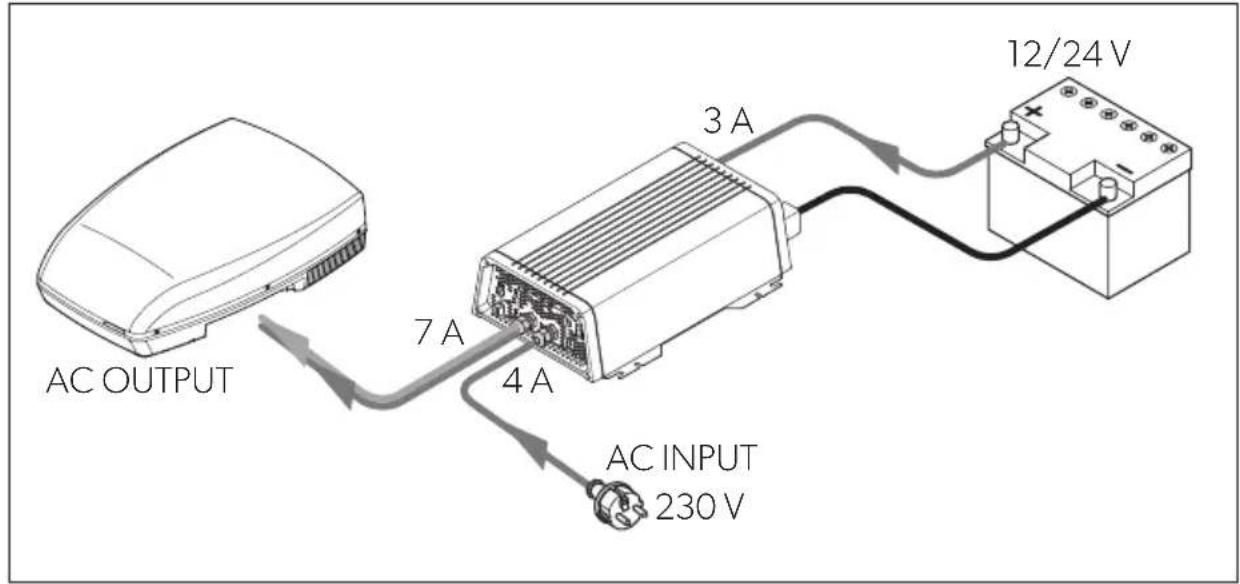
- Power sharing: the device powers a connected load with 230 V and simultaneously charges a battery
- Generator function (mains voltage function): the device supports a 230 V mains voltage by supplementing it with energy from a battery (common power source)
The light-weight and compact construction of this device allows for easy installation in mobile homes, commercial vehicles or motor and sailing yachts.
The output voltage corresponds to the household voltage from the socket (pure sine wave, THD <3%).
Please observe the values for constant output power and peak output power as indicated in chapter "Technical data" on page 29. Never connect devices that have a higher power requirement.

NOTE
Note when connecting devices with an electrical drive (such as power drills and refrigerators), that they often require more power than is indicated on the type plate.
The priority circuit reduces the load on a connected battery by switching the device always to mains operation if AC power grid is connected. The device ensures that a connected load is supplied with voltage:
- In case the AC grid power breaks down or is unstable
- In case the AC grid power does not suffice to supply the connected consumers
The device has various protective mechanisms.
- Overvoltage shutdown: The device shuts itself off when the voltage of the connected DC source exceeds the cut-off value. It restarts when the voltage returns to the restart value.
- Undervoltage shutdown: The device shuts itself off when the voltage of the connected DC source sinks below the cut-off value. It restarts when the voltage rises to the restart value.
- Excess temperature shutdown: The device switches off when the temperature inside the device or the temperature on the cooling element exceeds a cut-off value. It restarts when the temperature falls to the restart value.
- Overloading and short circuit shutdown: The LED on the device indicates an operating fault when an excess load is connected or a short circuit has occurred.

NOTE
The individual values are found in the chapter "Technical data" on page 29.
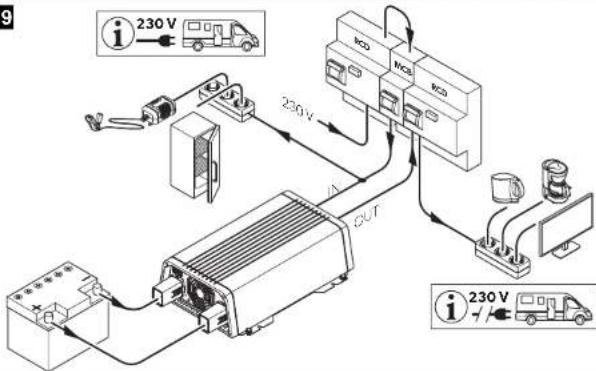
The device is operated in the following network configuration:
• TN network (fig. 19):
The neutral conductor of the AC output is grounded. A safety switch (RCD) must be installed at the device's AC output.
The softstart function allows the connection of loads with high starting current.
The device can be easily controlled using the DSP-EM.
7.1 Control elements device
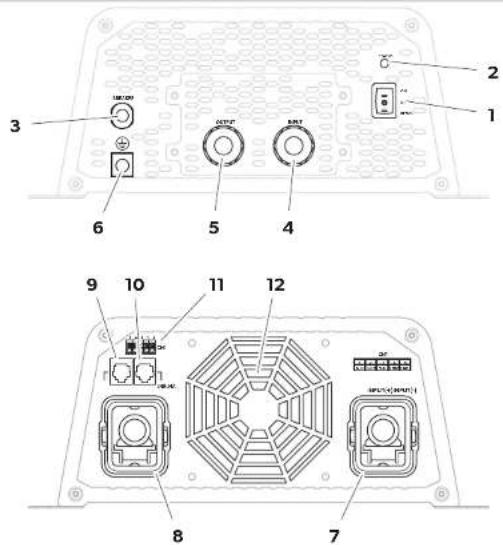
| Item in fig. 2 | Description Explanation | |
| 1 Main switch “ON/OFF/REMO.” | Switches the device on, off or to operation via a remote control(accessory) | |
| 2 Status LED See chapter “Status indications” on page 21 | ||
| 3 Breaker Protects the device from overload.The fuse can be pressed in again once it has triggered. | ||
7.2 Connections
| Item in fig. 2 | Description |
| 4 AC PG fitting | |
| 5 AC PG fitting | |
| 6 Ground terminal (Earthing on the vehicle bodywork) | |
| 7 Positive terminal | |
| 8 Negative terminal | |
| 9 CI/LIN BUS connections (LNA)Battery sensor or temperature sensor connection | |
| 10 DSP-EM connection (LNB) | |
| 11 Connection of remote switch | |
| 12 Fan | |
7.3 Control elements DSP-EM
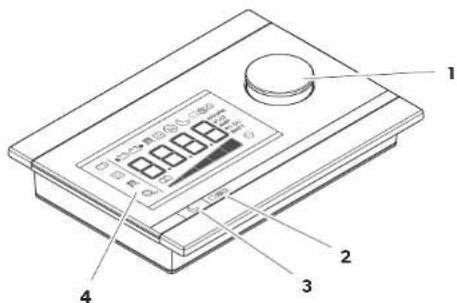
| Item in fig. 3 | Description Explanation | |
| 1 | Selector button | Turn: Navigate through menus or change valuesPress: Select menu items or values |
2 Deactiv  | Inverter function and thus the power supply of the battery to the 230 V consumers. The consumers are supplied exclusively by an external AC power grid, the battery is not discharged via the inverter. | |
| 3 Switches the device's night mode on or off. | ||
| 4 Display Displays values and current statuses of the connected devices. | ||
7.4 Description of functions
The device supports the functions described below.
Power sharing function
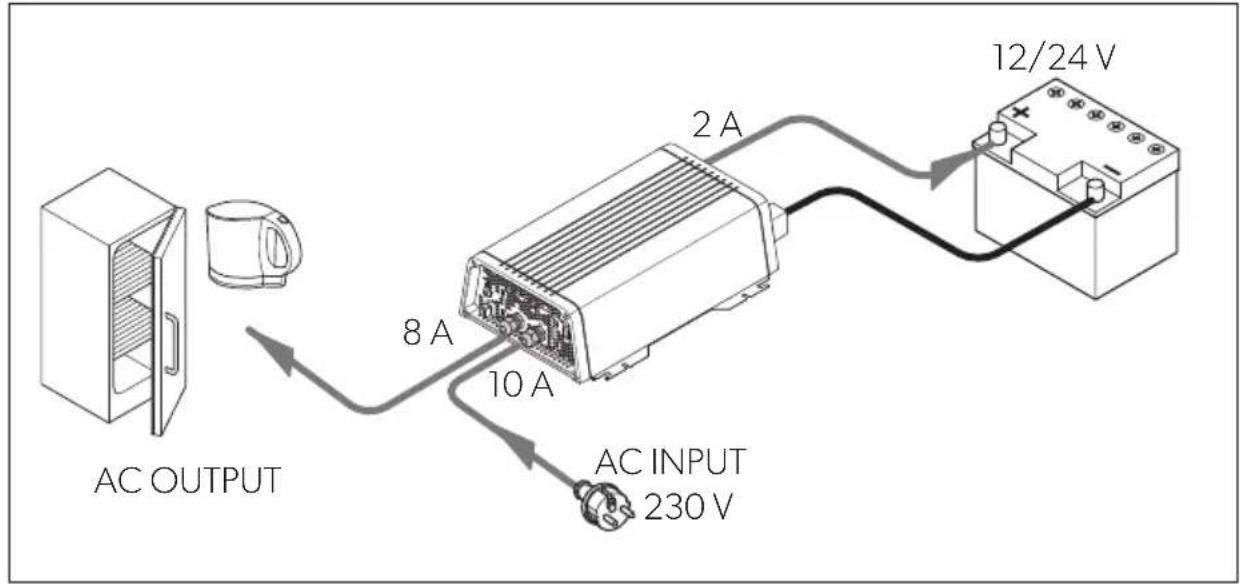
If the load from the connected consumer devices and the battery charging current is higher than the connected 230 V power source, the fuse of the power source would normally blow. In power sharing mode, the device reduces the battery charging current and thus increases the power available for connected consumers.
The power sharing level (current at the 230 V input) can be configured using the DSP-EM. If must be adapted to the fuse of the power source. For example, if it has a 10 A fuse, the power sharing level must also be 10 A.
Example (values for illustration purpose only):

NOTE
Keep in mind that the device only measures the current which flows through the device. If you connect more consumers in parallel, e. g.a refrigerator or an separate charger, this additional load may trip the fuse. In this case, set the power sharing level value below the fuse's value accordingly.
Generator function (external mains power supply)

NOTICE!
Observe the standards that apply in your country to the generator function.
If the load current is greater than the fuse of the connected 230 V power source, the fuse would normally blow. The generator function enables the device to provide additional power, which it takes from the battery.
If the required power falls below the power sharing level, the device recharges the battery.
In generator mode, the 230 V power source and the battery act as a common power source. While doing so, the battery is discharged.
The generator mode can manually be shut off via DSP-EM to ensure that the battery will not be discharged.
If the battery's voltage or capacity does not suffice to support the grid the device is disconnected from the grid and the inverter tries to work in isolated operation.
Example (values for illustration purpose only):
Battery charging function

NOTE
If a battery sensor (accessory) is connected, the device adjusts the voltage according to the measured values.
For this purpose the battery sensor has to be configured with DSP-EM.
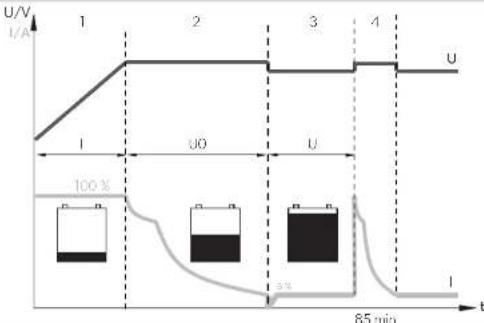
The battery is charging with IUOU characteristics (fig. 17).
1: I phase (bulk)
At the beginning of the charging process, the flat battery is charged with a constant current (100 % charge current) until the battery voltage reaches the charging end voltage. The charging current decreases when the battery has reached this charging level.
2: U0 phase (absorption)
Now the two-stage absorption charging process (U0-Phase) begins, where the charge voltage and duration depend on the size and type of the battery. The voltage remains constant until the minimum charging current (6 % of the set current) or the maximum charging time (10 hours) is reached.
3: U Phase (floating)
The U phase serves to maintain the battery capacity (100 %).
If DC loads are connected, they are powered by the device. Only if the power required exceeds the capacity of the device is this surplus power provided by the battery. The battery is then discharged until the device re-enters the I phase and charges the battery.
4: 12-day conditioning
Every 12 days, the battery charger switches back to phase 3 for 85 min in order to revive the battery. This prevents any fatigue symptoms such as sulphation.
8 Fitting the device
8.1 Tools required
For the electrical connection you will need the following tools:
- DC connection: two flexible connection cables
Determine the necessary thickness from the table in chapter "Fitting the device" on page 15. - AC connection: two 3-phase cables (input and output)
• Housing ground: one cable - Crimping tool
- Cable lugs and conductor sleeves
For fastening you will require the following tools:
• Machine bolts (M4) with washers and self-locking nuts or
- self-tapping screws or wood screws.
8.2 Mounting instructions
When selecting the installation location, observe the following instructions:
- The device can be mounted horizontally or vertically.
- The device must be installed in a place that is protected from moisture.
- The device may not be installed in the presence of flammable materials.
- The device may not be installed in a dusty environment.
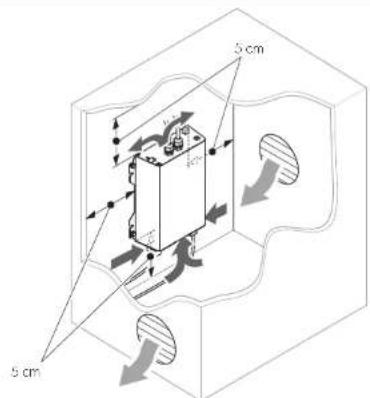
- The place of installation must be well ventilated. A ventilation system must be available for installations in small, enclosed spaces. The minimum clearance around the device must be at least 5 cm (fig. 4).
- The air intake on the underside or the air outlet on the back of the device must remain clear.
- For ambient temperatures higher than 40^ (such as in engine or heating compartments, or direct sunlight), the device may shut down although the connected load is below the rated load (derating).
- The device must be installed on a level and sufficiently sturdy surface.

NOTICE!
Before drilling any holes, make sure that no electrical cables or other parts of the vehicle can be damaged by drilling, sawing and filing.
8.3 Mounting the device
▶ Mount the device as shown (fig. 5).
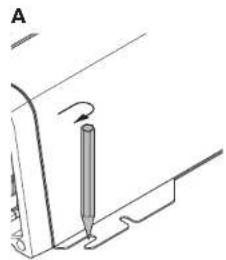
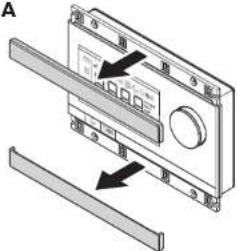
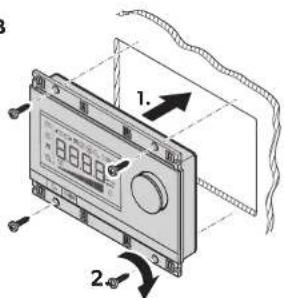
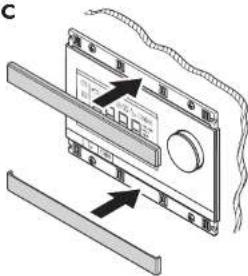
8.4 Mounting the DSP-EM
▶ Mount the DSP-EM as shown (fig. 6).
9 Connecting the device
9.1 General instructions

WARNING!
- The device may only be connected by a qualified workshop. The following information is intended for technicians who are familiar with the guidelines and safety precautions to be applied.
- Never use the device on vehicles where the positive terminal of the battery is connected to the chassis.
-
If you do not fit a fuse to the positive cable, the cables can overload, which might result in a fire.
-
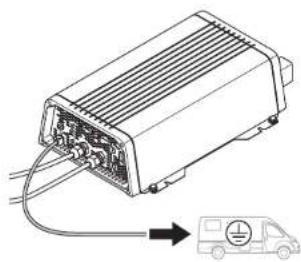
When installed in vehicles or boats, the device must be connected to the chassis or earth.
- When setting up a socket distribution circuit (mains setup), comply with the applicable regulations.
- Only use copper cables.
- Keep the cables for the DC connection as short as possible (<1 m).
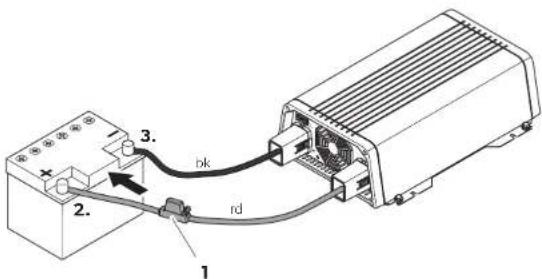
- Keep to the specified cable cross section and fit a cable fuse (fig. 8 1, page 1) as close to the battery as possible on the positive cable (see the table).
| Device | Required cable cross section | Cable fuse |
| DSP1212C 25 mm ^2 >200 A | ||
| DSP1224C 16 mm ^2 >100 A | ||
| DSP2012C 50 mm ^2 >400 A | ||
| DSP2024C | 25 mm ^2 >200 A |
9.2 Connecting the device

WARNING!
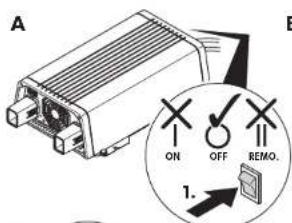
Before connecting the AC output cable, make sure the device is switched off at the main switch.

NOTICE!
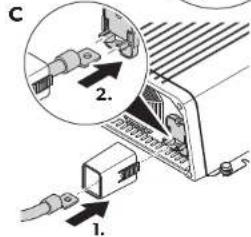
Make sure that you do not reverse the polarity. Incorrect polarity can damage the device.

NOTE
Tighten the nuts and bolts to a maximum torque of 15 Nm. Loose connections may cause overheating.
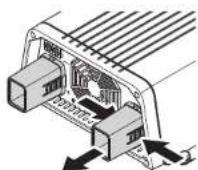
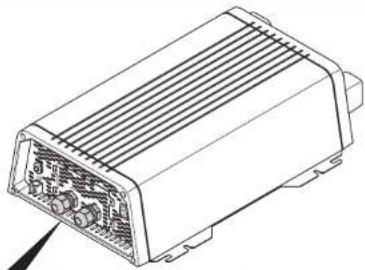
▶Connect the device as shown:
- Connecting the battery: fig. 7 and fig. 8
- Connecting the ground terminal fig. 9
- Connecting the 230 V power cable: fig. 10
- Connecting the 230 V output cable: fig. 10
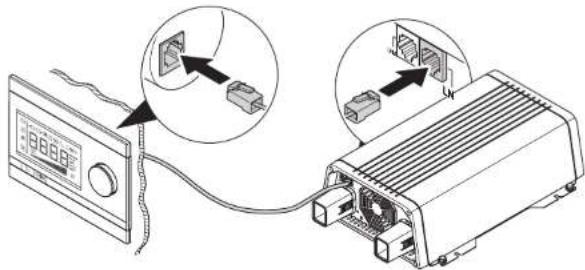
9.3 Connecting the DSP-EM

NOTICE!
Only plug in the connection to the DSP-EM in the remote port. The device can be damaged by connecting it incorrectly.
▶ Connect the DSP-EM as shown (fig. 11).
9.4 Connecting external switch to turn device on and off

NOTE
Use cables with a cable cross section of 0.25 - 0.75 mm ^4 .
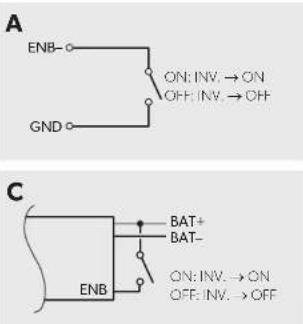
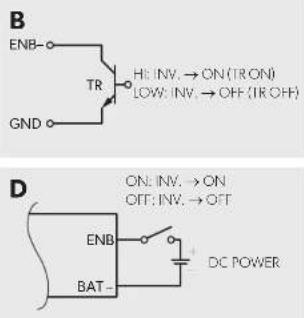
You can use the following as an external switch:
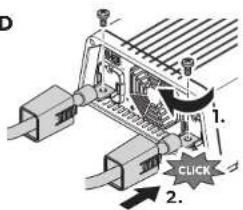
• external switch, voltage supply from the device: fig. 12 A
• Control unit with relay or transistor circuit (TR): fig. 12 B
- external switch with voltage supply from the battery (BAT) of the vehicle: fig. 12C
- external switch with its own voltage supply (DC POWER) e.g. from the ignition: fig. 12D
▶ Set the main switch (fig. 2 1, page 1) to "OFF".
▶ Make sure that the connection for the DSP-EM (fig. 2 10, page 1) is not assigned.
▶ Set the main switch (fig. 2 1, page 1) to "REMO.".
▶Connect the external on/off switch with the connection cable to the terminal (fig. 2 11, page 1).
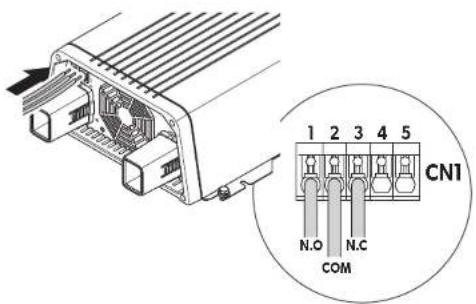
9.5 Connecting a relay
You can install a relay which monitors whether the 230 V input is connected.
Thereby you can, for example, implement an immobiliser so that the vehicle cannot be started when the 230 V input is connected.
▶ Connect the relay as shown (fig. 13):
- NO: normally open contact
- COM: common contact
- NC: normally closed contact
Relay specification:
| Maximum voltage Load | Current consumptionNO NC | ||
| 250 V~Ohmic 0.5A 0.5A | |||
| 12 V/24 V== | Ohmic | 1A | 1A |
10 Before initial use

NOTICE!
The setting of incorrect values may result in malfunctions and damage. Note the Technical Data of the connected devices.

NOTE
If the power source is lost during the initialisation, you have to reset the device to its factory settings (chapter "Reset the device to factory settings" on page 20) and then restart the initialisation.
Before you can use the device, you have to initialise it in the DSP-EM.
▶Switch on the system.
√The number "1" appears on the DSP-EM's display.
Without connected battery sensor
▶ Turn the selector button until the number 8 is displayed.
▶Press the selector button to save the value.
√The display shows the service code "S-12".
▶Turn the selector button to set the battery type:
- 0 : L e a d a c i d
- 1 : G e l
- 2 : A G M
- 3 : e S to r e
- 4 : C u s t o m e r
▶Press the selector button to save the selected value.
√The display shows the service code "S-14".
▶ Turn the selector button to set the maximum charging current in percent (25%, 50%, 75% or 100% of the rated charging current).
▶Press the selector button to save the selected value.
√The display shows the service code "S-15".
▶ Turn the selector button to set the bulk/absorption voltage (13.5 V to 15.0 V in 0,1 V steps).
▶Press the selector button to save the selected value.
√The display shows the service code "S-16".
▶ Turn the selector button to set the floating voltage (12.8 V to 14.3 V in 0,1 V steps).
▶Press the selector button to save the selected value.
√The DSP-EM shuts off.
With connected battery sensor
▶ Turn the selector button until the number 9 is displayed.
▶Press the selector button to save the value.
√The display shows the service code "S-12".
▶Turn the selector button to set the battery type:
| - | 0 : | L | e | a | d | a | c | i | d |
| - | 1 : | G | e | l | |||||
| - | 2 : | A | G | M | |||||
| - | 3 : | e | S | t | o | r | e | ||
| - | 4 : | C | u | s | t | o | m | e | r |
▶Press the selector button to save the selected value.
√The display shows the service code "S-13".
▶ Turn the selector button to set the battery capacity (10 Ah to 249 Ah in 10 Ah steps).
▶Press the selector button to save the selected value.
√The display shows the service code "S-14".
▶ Turn the selector button to set the maximum charging current in percent (25%, 50%, 75% or 100% of the rated charging current).
▶Press the selector button to save the selected value.
√The DSP-EM shuts off.
Reset the device to factory settings
▶Switch on the system.
√The number "1" appears on the DSP-EM's display.
▶ Turn the selector button until the number 35 is displayed.
√The display shows the service code "S-35".
▶Press the selector button to reset the device.
11 Using the device
11.1 Switching on the device
Set the main switch (fig. 1 3, page 1) of the device to the "ON" position. Set the On/Off switch to "OFF" to switch off.
▶The device performs a self-test.
√ After the self-test is completed successfully, the LED lights up blue (fig. 1 2, page 1).
11.2 Status indications
The blue LED (fig. 1 2, page 1) shows the operating condition of the device.
Display Input voltage
Constantly lit Normal mode
Long flash, short interruption Device overheated/Overload
| Quick flash | Overvoltage/Undervoltage |
| Off | Other fault |
The device switches off if:
- The battery voltage drops below 10.5 V (12 V---connection) or 21 V (24 V---connection).
- The battery voltage exceeds 16.5 V (12 V--- connection) or 33 V (24 V--- connection).
• The device is overloaded. - The device overheats.
- An overcurrent occurs at the grid input.
▶ If this happens, shut down the device with the main switch (fig. 1 3, page 1).
▶ Check that the device is sufficiently ventilated and that the ventilation grilles are unimpeded.
▶ Wait 5 – 10 minutes and switch the device on again without any electric consumers.
11.3 Using DSP-EM
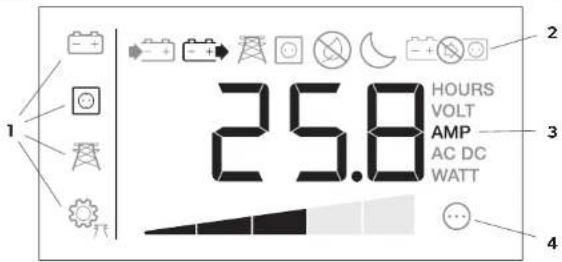
Display
| Item in fig. 14 | Explanation |
| 1 | M e n u s |
| 2 Status displays | |
| 3 Display of values | |
| 4 Display of values as a bar chart | |
Menus
| Symbol Menu Displayed values | ||
 | Battery menu | With battery sensorDuration until the battery is fully loadedCurrent flow at the battery (measured at the battery)Voltage at the battery terminalsBar chart: State of charge of batteryWithout battery sensorBattery charging:Current flow to the inverterVoltage at the battery terminalsBattery discharging:Display shows value "0"Voltage at the battery terminalsBar chart: No indication |
 | AC load menu • Output power | Output current of inverterOutput voltage of inverterBar chart: Percentage output power related to the rated power |
 | AC power supply menu • Current of AC power supplyVoltage of AC power supplyBar chart: Output power of AC power supply | |
Symbol Menu Displayed values

Fuse menu Inverter/charger operation only
• Maximum allowed current of AC power supply Bar chart: No indication
Note: This value can be adjusted (chapter "Changing maximum allowed current of AC power supply" on page 25).

Service menu Skilled personal only
Service guide: dometic.com/manuals
Status displays
Symbol Menu
Battery is charging
Battery is discharging

AC mains power is connected

Inverter is operating
Consumers can be connected

Energy saving mode is switched off

The charger is operating in night mode
Inverter is switched off
The consumers are supplied via the AC power supply.

With battery sensor
Low battery charge
Navigating within the menu
Navigate through the menus as follows:
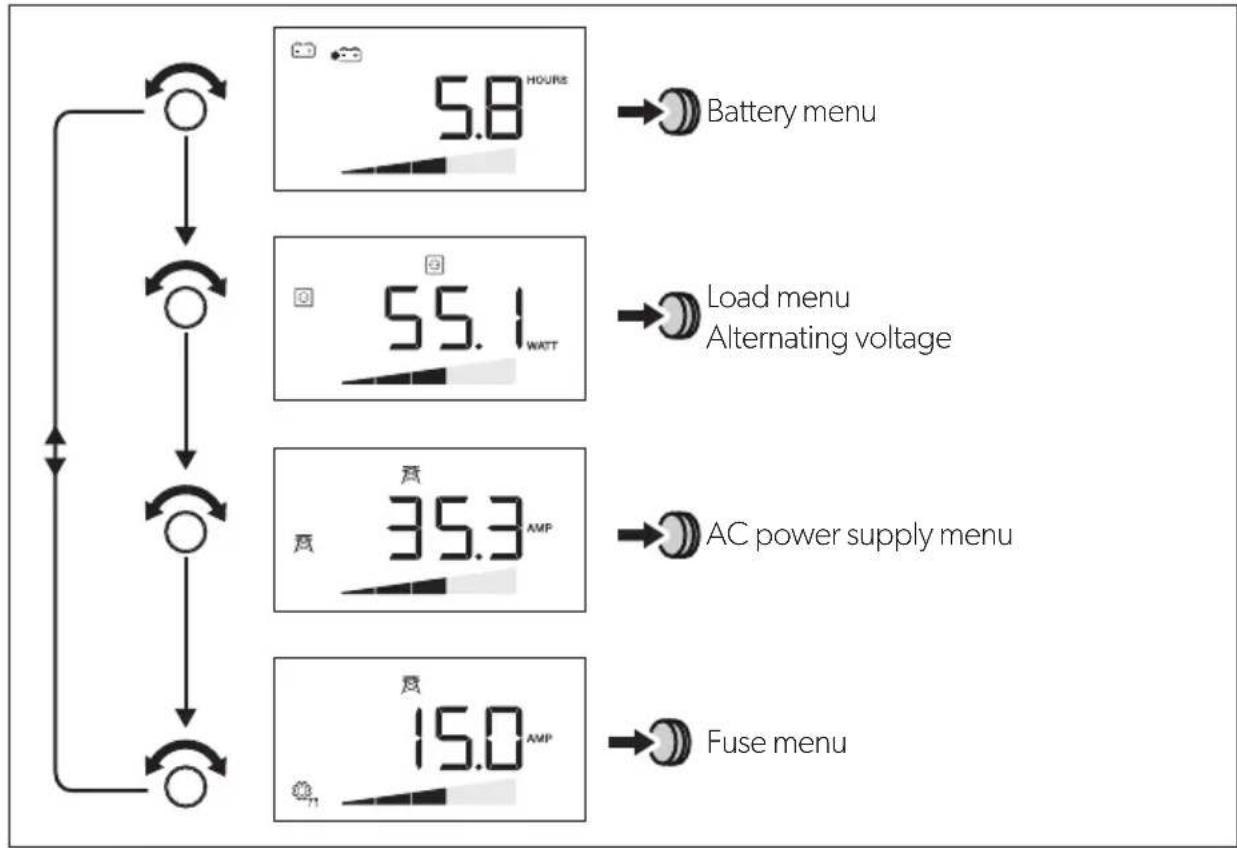
▶ Turn the selector button (fig. 3 1, page 1) to scroll through the menu pages. The selector button can be turned in both directions. When the last menu item has been reached, the display goes back to the first menu item.
√ The symbol of the selected menu(fig. 14 1, page 2) is displayed.
√The first value is displayed.
▶Press the selector button to show the next value.
The following figure shows how you can navigate in the menu:
flowchart
graph TD
    A["Start"] --> B["1 Hour Display"]
    B --> C["2 Hour Display"]
    C --> D["3 Hour Display"]
    D --> E["4 Hour Display"]
    style A fill:#f9f,stroke:#333
    style B fill:#ccf,stroke:#333
    style C fill:#cfc,stroke:#333
    style D fill:#fcc,stroke:#333
    style E fill:#cff,stroke:#333
▶ Press the selector button to show the next value in the current menu (chapter "Menus" on page 22).
Switching the inverter function on/off
If an external AC power grid is connected, you can protect the battery by switching off the device's inverter function. Thereby the consumers are supplied exclusively by the external grid.
▶Press to switch off the inverter function.
▶Press again to switch on the inverter function.
Switching on the display
The display switches off after a defined time.
▶Press the selector button or 📊 to illuminate the display.
Changing maximum allowed current of AC power supply
When the device works in inverter/charger operation the maximum allowed power supply current can be set.
When the device is connected to the AC power supply, the previous power sharing level value is flashing in the DSP-EM's display.
▶Turn the selector button to scroll to the Fuse menu.
√The current value for the maximum power supply current is displayed.
▶Press the selector button.
√The current value flashes.
▶Turn the selector button to change the value.
▶Press the selector button to save the value.
If no input is made for 2 min the previous value is used.
√The display shows the new value.
12 Cleaning and caring for the device

NOTICE!
Do not use sharp or hard objects or cleaning agents for cleaning as these may damage the product.
▶Occasionally clean the product with a damp cloth.
13 Troubleshooting
13.1 Inverter

WARNING!
Do not open the device. You risk sustaining an electric shock by doing this.

NOTE
If you have detailed questions on the specifications of the device please contact the manufacturer (addresses on the back of the instruction manual).
The LED (fig. 2 2, page 1) indicates the fault:
LED display Cause Remedy
| Quick flash Input voltage is too high Check the input voltage and reduce it. | ||
| Input voltage too low The battery needs recharging.Check the cables and connections. | ||
| 2 s lit, short interruption | Overheating Switch off the device and the consumer.Wait 5 to 10 minutes and switch the device on again without any electric consumers.Reduce the load and make sure the device has better ventilation. Then switch the consumer back on. | |
| Excessive load Switch off the device and remove the consumer.Then switch the device back on without the consumer. If no excessive load is now shown, then there is a short circuit in the consumer or the total load was higher than the power specified on the data sheet.Check the cables and connections.Press in the AC breaker in the device by hand. | ||
| Off | Other fault | Contact the service. |
13.2 DSP-EM
If the system detects an error, it switches off independently. The toolbar and the display bar are hidden.
| Source | Error code | Possible cause Possible Solution | |
| DSP E-01 Battery undervoltage Charge the battery. | |||
| E-02 Battery overload Reduce the input voltage. | |||
| E-03 Inverter overload Reduce the connected load. | |||
| E-04 -E-05 | Overheating of device Ensure sufficient air supply at the device. | ||
| E-06 Initialisation error Contact customer service. | |||
| E-07 Uninterrupted power supply is not present | Activate the inverter function (chapter "Switching the inverter function on/off" on page 25).Check the connection to the mains power supply. | ||
| E-09 Under-temperature Contact customer service. | |||
| E-10 Overheating of battery Ensure sufficient air supply at the battery. | |||
| E-11 | Grid input overcurrent | Contact customer service. | |
| E-12 Overvoltage battery | Contact customer service. | ||
| Display | E-16 | CI bus does not respond | Check the BUS cabling of the battery sensor. |
| E-18 DSP-C does not respond | Set the main switch to REMO.Check the BUS cabling of the DSP-C device. | ||
| E-20 Battery charging status too low | Charge the battery. | ||
14 Warranty
The statutory warranty period applies. If the product is defective, please contact the manufacturer's branch in your country (see the back of the instruction manual for the addresses) or your retailer.
For repair and warranty processing, please include the following documents when you send in the device:
• A copy of the receipt with purchasing date
- A reason for the claim or description of the fault
15 Disposal
Place the packaging material in the appropriate recycling waste bins wherever possible.
If you wish to finally dispose of the product, ask your local recycling centre or specialist dealer for details about how to do this in accordance with the applicable disposal regulations.
16 Technical data
The following technical data applies to all devices:
| DSP1212C DSP2012C DSP1224C DSP2024C | ||||
| Ref. no.: 9600002559 9600 | 002561 96000 | 02560 960000 | 2562 | |
| Heat dissipation: temperature and load controlled fan | ||||
| Ambient temperature at operation: | -20 °C to +60 °C | |||
| Ambient temperature for storage: | -30 °C to +70 °C | |||
| Bypass relay: 16 A/250 V~ | ||||
| Bypass switching with voltage synchronisation: | <20 ms | |||
| Air humidity: 0 - 95 %, non-condensing | ||||
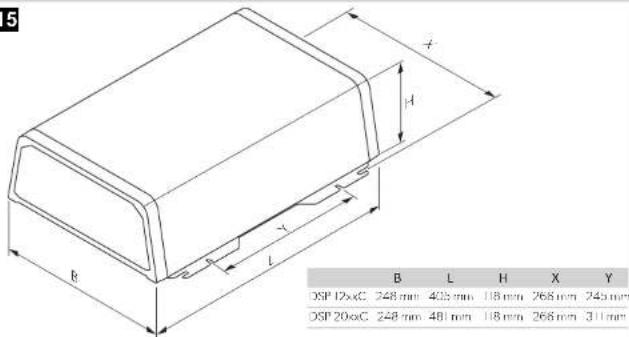
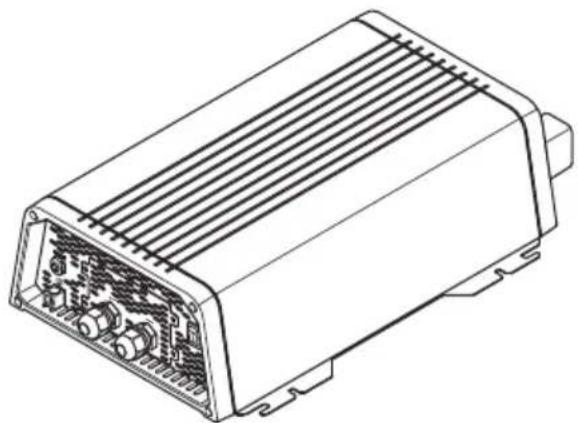
| Dimensions: fig. 15 | ||||
| Weight: | 5.6 kg | 7.2 kg | ||
| Testing/certification: |  | |||
Input data
| DSP1212C | DSP2012C DSP1 | 1224C DSP20 | 24C | |
| Rated input voltage: | 12 V--- | 24 V--- | ||
| Input voltage range: | 10 – 16.5 V--- | 20 – 33 V--- | ||
| Maximum input current: | 132 A | 220 A | 66 A | 110 A |
| Idle current consumption: | 3 A | 4 A | 1.5 A | 2 A |
| Standby current consumption: | <0.3 A | <0.2 A | ||
Output data
| DSP1212C D | SP2012C DSP1 | 1224C DSP20 | 24C | |
| Output voltage: 230/240 V | ±3 % | |||
| Frequency (programmable): | 50/60 Hz ±0.3 Hz | |||
| Constant output power: | 1200 VA | 2000 VA | 1200 VA | 2000 VA |
| Peak power for 2 s: | 2400 VA | 4000 VA | 2400 VA | 4000 VA |
| Maximum inverter AC output current: | 5.3 A 8.7 A | 5.3 A 8.7 A | ||
| AC output current: | 21.3 A | 24.7 A | 21.3 A | 24.7 A |
| Efficiency: | >88 % | >89 % | ||
| Power derating: | 40 W/°C | 60 W/°C | 40 W/°C | 60 W/°C |
| Short circuit protection: | Yes, lpk | |||
| Wave form: | Pure sine wave, maximum 3 % distortion | |||
Protective devices
| 12 V | 24 V | |
| Input: | Overvoltage, undervoltage, reverse polarity (internal fuse) | |
| AC output: | Short circuit, overload | |
| AC input: | 16 A circuit breaker | |
| Temperature: | Shutdown | |
| Battery temperature: | external battery sensor | |
Overvoltage shutdown
| Device | Overvoltage warning | Overvoltage | |
| Shutdown Restart | |||
| DSP1212C, DSP2012C 16 V 16.5 V 15.5 V | |||
| DSP1224C, DSP2024C 32 V 33 V 31 V | |||
Undervoltage shutdown
| Device | Undervoltage warning | Undervoltage | |
| Shutdown Restart | |||
| DSP1212C, DSP2012C 11 V 10.5 V 12.5 V | |||
| DSP1224C, DSP2024C 22 V 21 V 25 V | |||
Temperature compensation with battery sensor
See fig. 18
Input data for charging
| DSP1212C D | SP2012C DSP1 | 1224C | DSP2024C | |
| Rated input voltage: | 230 V~ | |||
| Input voltage range: | 180 – 264 V~ | |||
| Input frequency: | 50/60 Hz | |||
| Input frequency rangeAt 50 Hz: | 47 – 53 Hz | |||
| At 60 Hz: | 57 – 63 Hz | |||
| Rated current (at 230 V): | 3.8 A | 7.5 A | 3.8 A | 7.5 A |
| Efficiency: | >88 % | |||
| Rated input current: | 16 A | |||
| Maximum power correction factor | >0.95 | |||
Output data for charging
| DSP1212C D | SP2012C DSP1 | 1224C DSP20 | 24C | |
| Charging current: 12.5 A/25 | A/37.5 A/50 A | 25 A/50 A/75 A/100 A | 6.25 A/12.5 A/18.75 A/25 A | 12.5 A/25 A/37.5 A/50 A |
| Maximum output voltage: 15 | .4 V 30.8 V | |||
| Reference temperature +20 °C | ||||
| Battery temperature compensation: | ±25 mV/°C ±50 mV/°C | |||
| Temperature compensation range: | -0.75 V - +0.25 V | -1.5 V - +0.5 V | ||
DSP-EM
| DSP-EM | |
| Ref. no.: | 9600002565 |
| Input voltage: | 9 – 35 V== |
| Power consumptionIn display mode:In standby mode: | 170 mA40 mA |
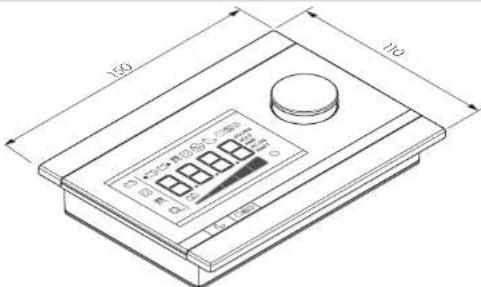
| Dimensions: fig. 16 | |
| Certification: |  |
For the current EU declaration of conformity for your device please refer to the respective product page on dometic.com or contact the manufacturer directly (see back page).
7 Description technique
Clignotement long, brève interruption Appareil surchauffé/surcharge
1 Interruptor principal "ON/OFF/REMO"
2: fase U0 (absorption)
2: fase U0 (absorption)
4 PG-wisselstroomverbinding
5 PG-wisselstroomverbinding
2: U0-fase (absorption)
2: U0-fas (absorption)
3: U-fase (floating)
2: Faza U0 (Absorption)
3: Faza U (Floating)
dometic.com/sales-offices