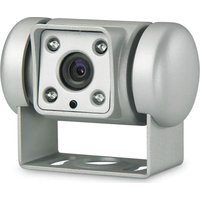
PerfectView CAM 45 NAV - Rear Camera DOMETIC - Free user manual and instructions
Find the device manual for free PerfectView CAM 45 NAV DOMETIC in PDF.


| Product type | Rear view camera |
| Brand | Dometic |
| Model | PerfectView CAM 45 NAV |
| Image sensor | 1/4" CCD |
| Pixels | 250,000 pixels |
| Video standard | PAL, 1 Vpp |
| Sensitivity | < 1 lux / 0 lux with IR LEDs |
| Viewing angle | 120° diagonal, 80° horizontal, 65° vertical |
| Operating voltage | 11 - 16 V |
| Power consumption | 1.2 W |
| Operating temperature | -20 °C to +70 °C |
| Protection type | IP69k |
| Vibration resistance | 6 g |
| Dimensions (with bracket) | 78 x 60 x 50 mm |
| Weight | 0.18 kg |
| Night vision | Integrated IR LEDs |
| Microphone | Built-in microphone for audio transmission |
| Sealing | Waterproof, do not use high-pressure cleaner |
| Mounting | Minimum height 2 m, lens angle 50° relative to vertical axis |
| Delivery contents | Camera, bracket, system cable, mounting hardware, manual |
| Maintenance | Clean with a soft, damp cloth |
| Safety | Do not open the housing, do not pull on cables |
| Warranty | Statutory warranty, contact manufacturer or retailer |
Frequently Asked Questions - PerfectView CAM 45 NAV DOMETIC
User questions about PerfectView CAM 45 NAV DOMETIC
0 question about this device. Answer the ones you know or ask your own.
Ask a new question about this device
Download the instructions for your Rear Camera in PDF format for free! Find your manual PerfectView CAM 45 NAV - DOMETIC and take your electronic device back in hand. On this page are published all the documents necessary for the use of your device. PerfectView CAM 45 NAV by DOMETIC.
USER MANUAL PerfectView CAM 45 NAV DOMETIC
natural_image
Exterior view of a metallic cylindrical device with a central square camera and mounting brackets (no text or symbols visible)CAM45
EN
Rear View Video Camera
Installation and Operating Manual .....9
DE
Rückfahrvideokamera
natural_image
Illustration of a submerged object with hands reaching out, creating a cross symbol (no text or symbols present)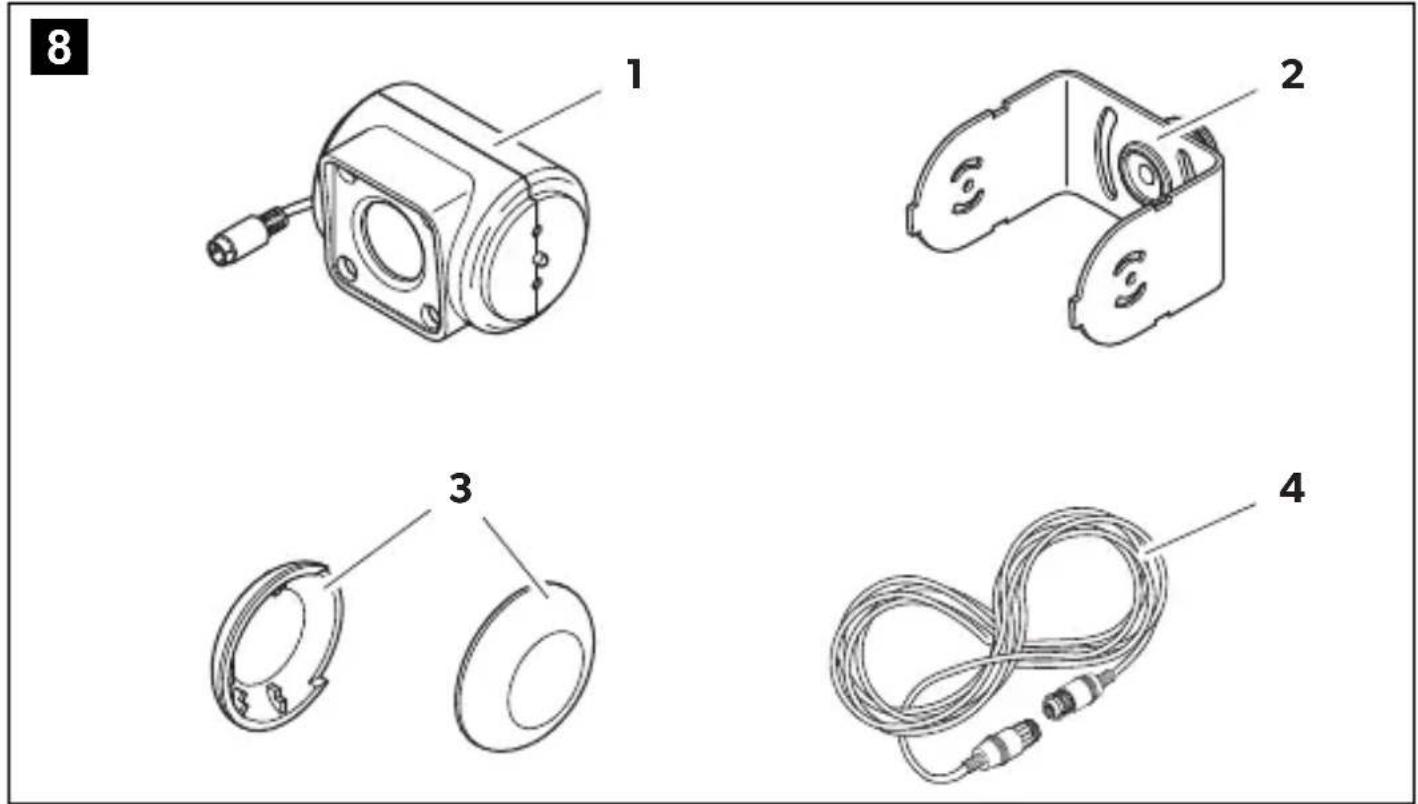
natural_image
Technical line drawing of a mechanical device with a pencil and component, no text or symbols present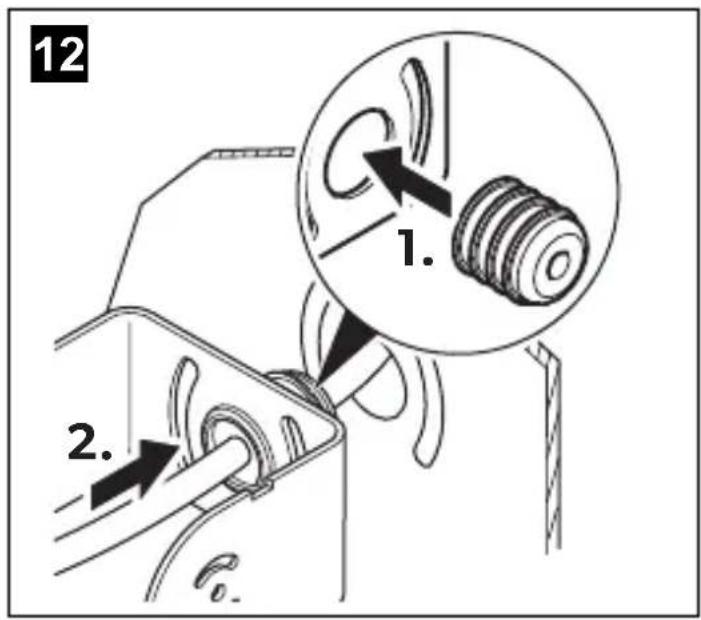
natural_image
Line drawing of a mechanical device with two ports and a rope, no text or symbols present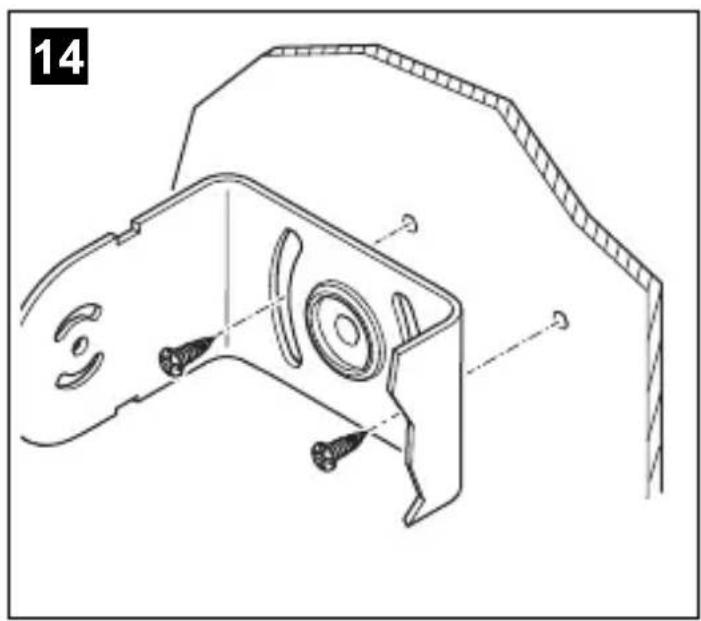
natural_image
Technical line drawing of a mechanical housing assembly with mounting holes and wiring (no text or symbols)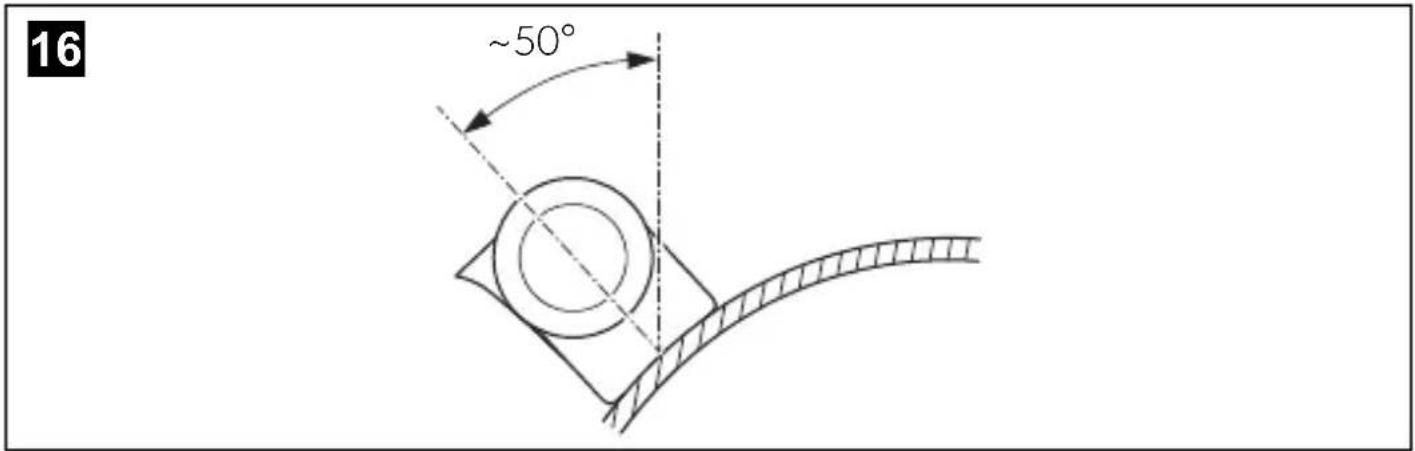
20
Please read this instruction manual carefully before installation and first use, and store it in a safe place. If you pass on the product to another person, hand over this instruction manual along with it.
Table of contents
1 Explanation of symbols....10
2 Safety and installation instructions....10
3 Scope of delivery 12
4 Intended use....12
5 Technical description....13
6 Information on electrical connection....13
7 Fitting the camera....14
8 Cleaning and caring for the camera....17
9 Warranty 18
10 Disposal....18
11 Technical data....19
1 Explanation of symbols

WARNING!
Safety instruction: Failure to observe this instruction can cause fatal or serious injury.

CAUTION!
Safety instruction: Failure to observe this instruction can lead to injury.

NOTICE!
Failure to observe this instruction can cause material damage and impair the function of the product.

NOTE
Supplementary information for operating the product.
2 Safety and installation instructions
Please observe the prescribed safety instructions and stipulations from the vehicle manufacturer and service workshops.
The manufacturer accepts no liability for damage in the following cases:
• Faulty assembly or connection
- Damage to the product resulting from mechanical influences and excess voltage
• Alterations to the product without express permission from the manufacturer
- Use for purposes other than those described in the operating manual
Please note the following:
- To prevent the risk of short circuits, always disconnect the negative terminal of the vehicle's electrical system before working on it.
If the vehicle has an additional battery, its negative terminal should also be disconnected.
- Inadequate supply cable connections could result in short circuits, causing:
- Cable fires
– The airbag being triggered
– Damage to electronic control equipment
– Electrical malfunctions (indicators, brake light, horn, ignition, lights)
- When working on the following cables, only use insulated cable terminals, plugs and flat sockets:
- 30 (direct supply from positive battery terminal)
- 1 5 ( connected positive terminal, behind the battery)
- 31 (return cable from the battery, earth)
-58 (reversing light)
Do not use porcelain wire connectors.
- Use a crimping tool (fig. 1 10, page 3) to connect the cables.
-
Screw the cable when connecting cable 31 (earth).
-
Screw on the cable using a cable terminal and serrated washer to one of the vehicle's earth bolts or
- screw the cable to the bodywork using a cable terminal and a self-tapping screw.
Make sure there is a good earth connection.
If you disconnect the negative terminal of the battery, all data stored in the volatile memories will be lost.
- The following data must be reset, depending on the vehicle equipment options:
- Radio code
- Vehicle clock
- Timer
- On-board computer
- Seat position
You can find instructions for making these settings in the operating manual.
Observe the following installation instructions:
- Secure the parts of the camera which are installed in the vehicle in such a way that they cannot become loose under any circumstances (sudden braking, accidents) and cause injuries to the occupants of the vehicle.
- Secure any parts of the system concealed by the bodywork in such a manner that they cannot be come loose or damage other parts or cables, or impair vehicle functions (steering, pedals, etc.).
- To prevent damage when drilling, make sure there is sufficient space on the other side for the drill head to come out (fig. 2, page 4).
- Deburr all drill holes and treat them with a rust-protection agent.
• Always follow the safety instructions of the vehicle manufacturer.
Some work (e.g. on retention systems such as the AIRBAG etc.) may only be performed by qualified specialists.
Observe the following instructions when working with electrical parts:
- When testing the voltage in electrical cables, only use a diode test lamp (fig. 1 8, page 3) or a voltmeter (fig. 1 9, page 3).
Test lamps with a bulb (fig. 1 12, page 3) consume voltages which are too high and can damage the vehicle's electronic system.
- When making electrical connections, (fig. 3, page 4), ensure that:
– they are not kinked or twisted
– they do not rub on edges
– they are not laid in sharp-edged ducts without protection.
• Insulate all connections.
- Secure the cables against mechanical wear by using cable binders or insulating tape, for example on existing cables.
The camera is watertight. However, the seals on the camera cannot withstand a high-pressure cleaner (fig. 4, page 4). Therefore, you should observe the following instructions when handling the camera:
- People (including children) whose physical, sensory or mental capacities or whose lack of experience or knowledge prevent them from using this product safely should not use it without the supervision or instruction of a responsible person.
- Do not open the camera, as this impairs the leak tightness and the function of the camera (fig. 5, page 4).
- Do not pull at the cables, as this impairs the tightness and the function of the camera (fig. 6, page 4).
- The camera is not suitable for use under water (fig. 7, page 4)!
3 S c o p e o f d e l
No. in fig. 8, page 5 Quantity Description Ref. no.
| 11 Camera 9600000523 | ||||
| 2 | 1 | C with bushing sleeve | a | 9600000571 |
| 3 | 2 | S | i | d |
| 4 | 1 System cable 9102200141 | |||
| - | 1 | Fastening material | - | |
| -1 Installation and operating manual | - | |||
4 l n t e n d e d u s
The CAM45 camera (ref. no. 9600000523) is designed primarily for use in vehicles. It can be used in video systems to observe the space around the vehicle from the driver's seat when, for example manoeuvring or parking.

WARNING!
Danger of personal injury by vehicle.
Reversing video systems are designed merely as an additional aid for reversing, however this does not relieve you of the duty to take proper care when reversing.
5 Technical description
The camera with integrated microphone, which is encased in an aluminium housing, transmits image and sound to a monitor via a cable. The infrared LEDs improve night vision.
The camera transmits the image as if you were looking in the rear-view mirror.
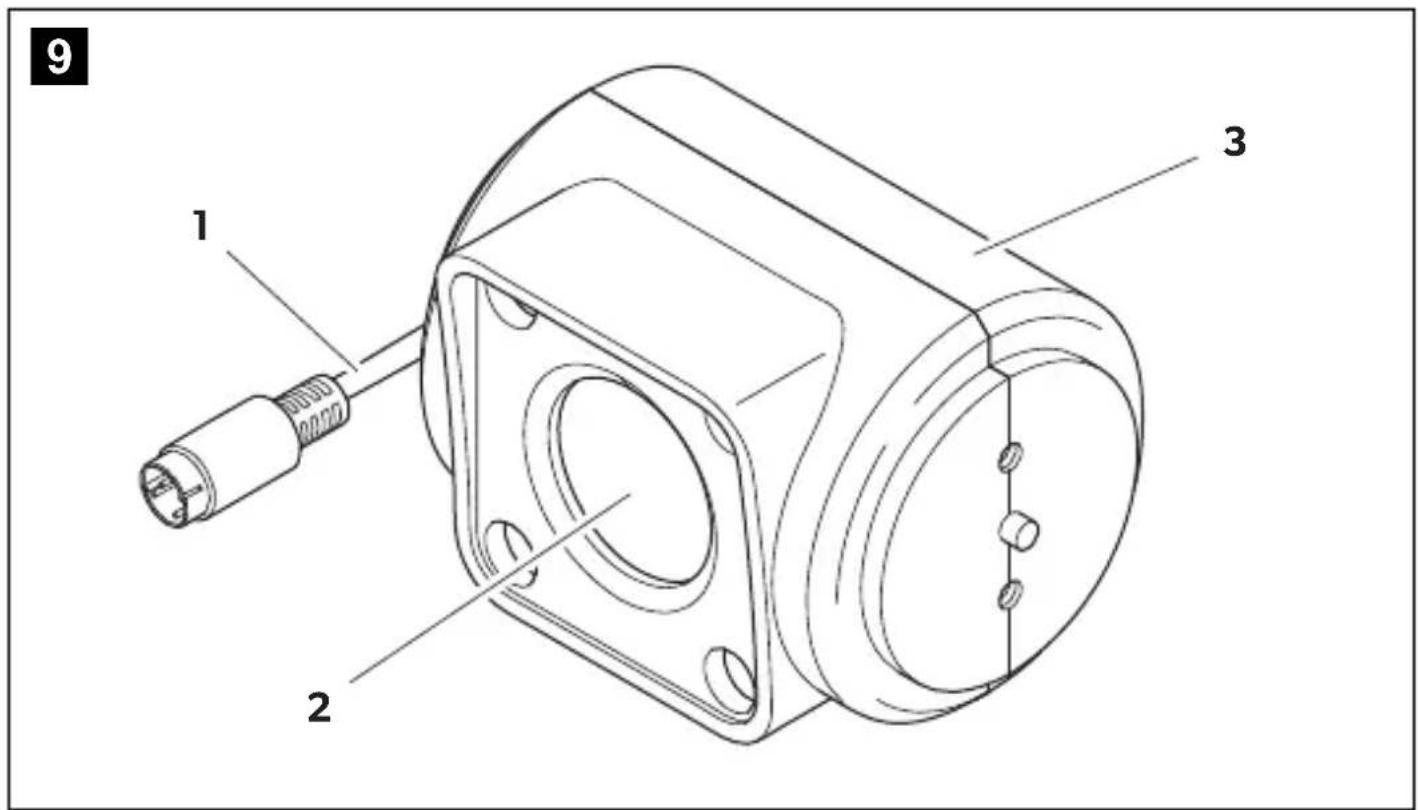
The camera consists of the following elements:
| No. in fig. 9, page 5 | Description | |||||
| 1 | 6 | - | p | i | n | |
| 2 Infrared LEDs | ||||||
| 3 Microphone (rear side) | ||||||
6 Information on electrical connection
6.1 Laying cables

NOTICE! Beware of damage
- When drilling holes, check beforehand that there is sufficient space on the other side for the drill head to come out.
- Cables and connections that are not properly installed will cause malfunctions or damage to components. Correct installation of cables and connections ensures lasting and trouble-free operation of the retrofitted components.
- The cables may not be exposed for long periods to solvents such as benzene, since solvents can damage the cable.
Therefore, please observe the following instructions:
- As far as possible, use original ducts for laying the cables, or other suitable options such as panelling edges, ventilation grilles or dummy plugs. If no openings are available, you must drill holes for the cables. Check beforehand that there is sufficient space on the other side for the drill head to emerge.
- Wherever possible, lay cables inside the vehicle, as they are better protected there than outside.
If you do need to lay a cable outside the vehicle, ensure that it is well fastened (use additional cable ties, insulating tape etc.). - To prevent damage to the cables when laying them, ensure that they are far enough away from hot or moving vehicle components (exhaust pipes, drive shafts, light systems, fans, heaters, etc.). Use corrugated piping or other protective materials to protect against mechanical wear.
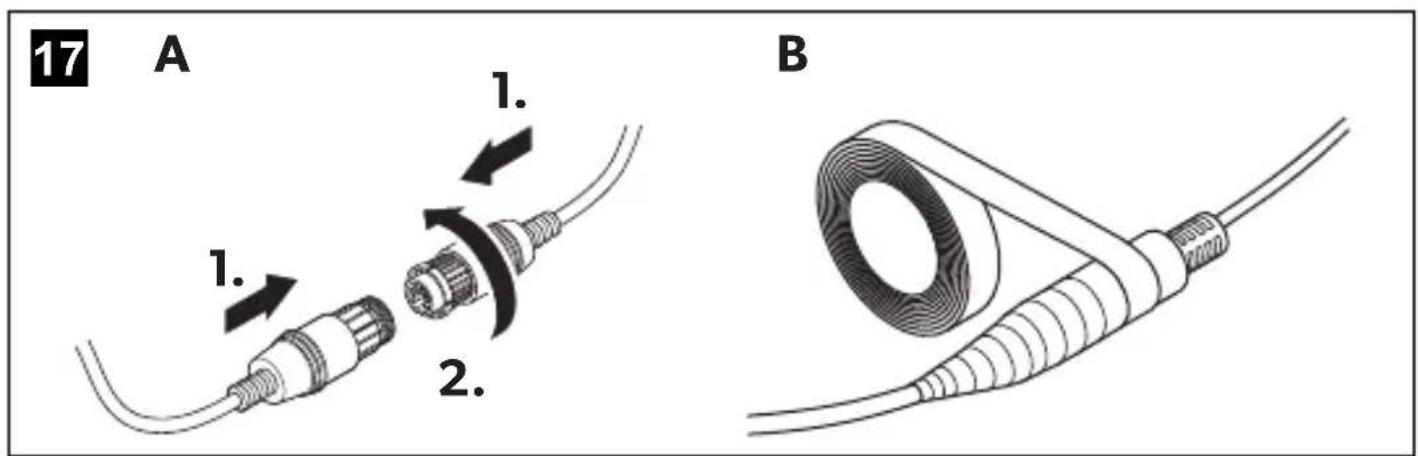
- Screw on the plug connections for the connecting cables to protect them against water penetration (fig. 17, page 7).
- When laying the cables (fig. 3, page 4), make sure:
– they are not kinked or twisted
– they do not rub on edges
– they are not routed in sharp-edged ducts without protection.
- Attach the cables securely in the vehicles to prevent tripping hazards. This can be performed by using cable binders, insulating tape or gluing in place with adhesives.
- Protect every through-hole made in the bodywork against water penetration, e.g. by using a cable with a sealant and by spraying the cable and the cable sleeve with sealant.

NOTE
Only start sealing through-holes when you have completed all installation work on the camera and have laid the required cable lengths.
7 Fitting the camera
7.1 Tools required
For installation and assembly, you will need the following tools:
- Drill bit set (fig. 1 1, page 3)
• Electric drill (fig. 1 2, page 3) - Screwdriver (fig. 1 3, page 3)
- Set of ring or open-ended spanners (fig. 1 4, page 3)
• Measuring ruler (fig. 1 5, page 3) - Hammer (fig. 1 6, page 3)
• Centre punch (fig. 17, page 3)
To establish and test the electrical connection, the following tools are required:
• Diode test lamp (fig. 1 8, page 3) or voltmeter (fig. 1 9, page 3)
• Insulating tape (fig. 1 11, page 3)
• Cable bushing sleeves (optional)
To fasten the cables you may require additional cable binders.
7.2 Fitting the camera

CAUTION!
Select a location for the camera and attach it firmly enough so that it cannot under any circumstances fall off and injure bystanders (e.g. by being knocked off by branches brushing over the roof of the vehicle).

NOTE
If installing the camera alters the vehicle height or the length specified in the vehicle documents, your vehicle must be inspected by the appropriate authorities. This authority must note any such changes your vehicle documents.
Observe the following installation instructions:
- To provide a suitable viewing angle, the camera must be attached at a height of at least 2 m. Ensure that you have a firm place from which to work when mounting the camera.
- Make sure that the installation location of the camera is sufficiently firm (e.g. to prevent the camera from being knocked down by branches that may brush the roof of the vehicle).
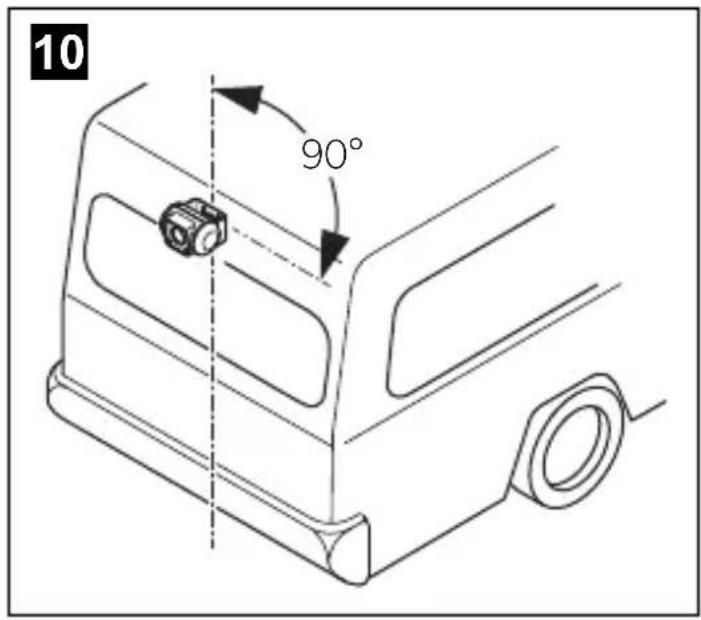
- Mount the camera bracket horizontally and in the middle of the rear of the vehicle (fig. 10, page 6).
-
The most secure type of attachment is with screws fitted through the body (not included in scope of delivery). Please observe the following instructions:
-
There must be sufficient space behind the chosen installation location to be able to carry out the mounting procedure.
- Suitable measures must be taken to prevent water penetrating through any holes made (e.g. by using screws and sealant and/or spraying the outer attachment parts with sealant).
-
The location on the body where you wish to attach the camera must be rigid enough to allow the camera to be tightly fastened.
-
Check beforehand that there is sufficient space on the other side for the drill head to come out (fig. 2, page 4).
• If you are not sure about the location you have chosen, ask your vehicle manufacturer or dealer.

NOTE
We recommend greasing the threads of the bolts to prevent corrosion.
To perform the installation, proceed as follows:
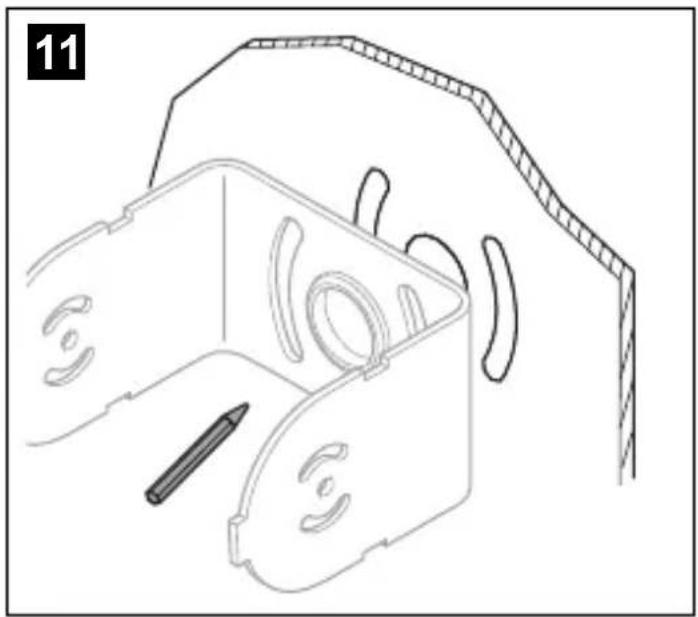
▶ Hold the camera at the chosen location and mark at least two different points for the drill holes and the duct for the connection cable (fig. 11, page 6).
Using a hammer and centre punch, gently pre-punch the previously marked points to prevent the drill head from slipping off.
Creating a through-hole for the camera connection cable (fig. 12, page 6)

NOTE
If possible, use available openings, such as ventilation grilles, to feed the connection cables through. If there are no existing ducts, you must drill a hole of ∅ 16 mm.

NOTICE! Beware of damage
Check beforehand that there is sufficient space on the other side for the drill head to come out.
▶ Drill a hole with a ∅ 16 mm at the previously marked duct.
▶ Deburr all drill holes that have been made in the sheet metal and apply rust-protection.
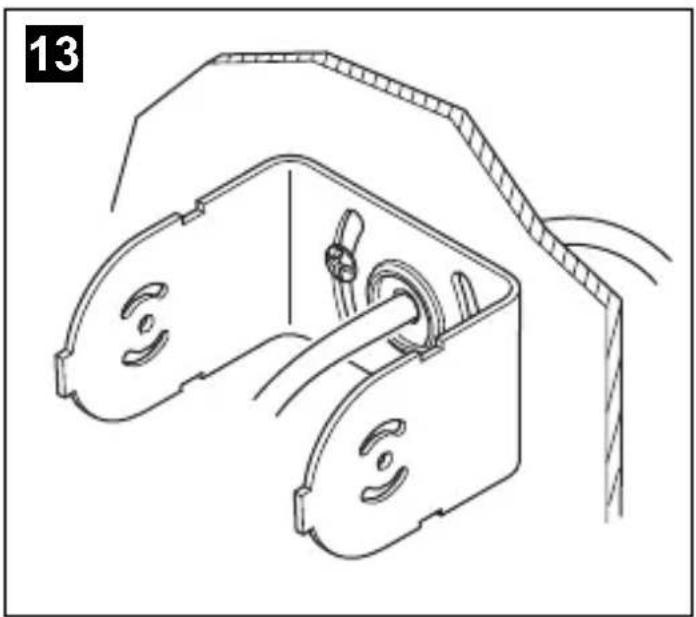
Screw on camera using self-tapping screws (fig. 13, page 6)

NOTICE! Beware of damage
Self-tapping screws may only be fastened to steel metal with a minimum thickness of 1.5 mm.
▶ Drill the holes, with a ∅ of 4 mm, at each of the markings.
▶Deburr all drill holes and apply rust-protection.
▶ Screw on the camera bracket using 5 x 20 mm self-tapping screws.
Fitting the camera

NOTICE! Beware of damage
Only use the screws supplied to mount the camera. Longer screws will damage the camera.
▶Guide the camera cable into the vehicle interior.
▶Slide the camera into the camera bracket.
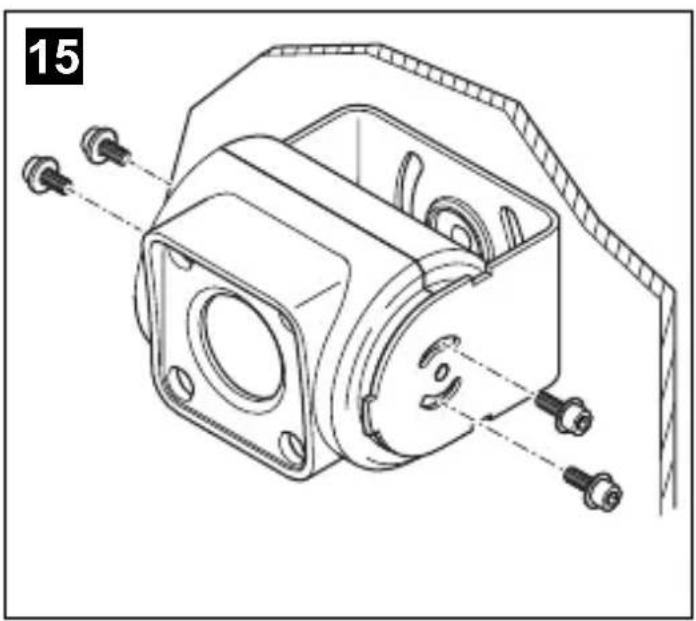
▶ Fasten the camera loosely using the two screws M3 x 6 mm in the slots (fig. 15, page 6).
▶ Provisionally align the camera, so that the lens is at an angle of approx. 50^ to the vertical axis of the vehicle (fig. 16, page 7).
Establishing the electrical connection for the camera

NOTE
- Lay the camera cable so that, should you need to remove the camera, you can access the plug connection between the camera and the extension cable easily. This greatly facilitates the disassembly.
- To minimise corrosion in the plug, apply a small amount of grease, such as pin grease, in one of the plugs.
▶Insert the camera cable plug into the socket for the extension cable.
▶ Screw on the plug connection of the connecting cables to protect against water penetration (fig. 17, page 7).
Aligning the camera

NOTE
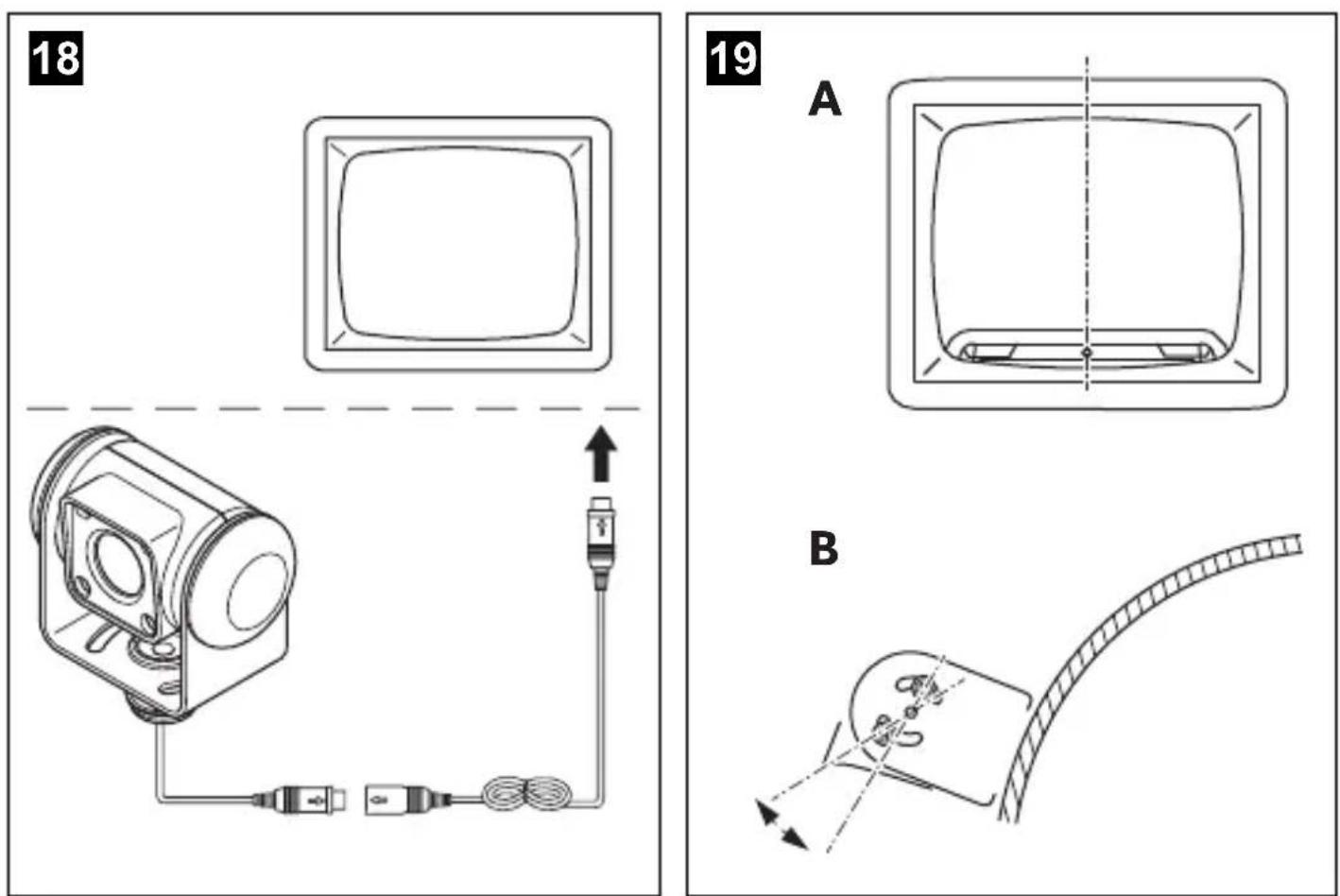
To do this you must first install and electrically connect a monitor (see schematic connection diagram fig. 18, page 7).
▶Align the camera using the image on the monitor to help you:
The monitor image should show the rear or the bumper of the vehicle at the bottom edge of the screen. The middle of the bumper should be in the middle of the screen (fig. 19, page 7).
▶Check the function of the camera after you have connected it to a monitor.
Fastening the camera
▶Tighten the two fastening screws in the slots on the monitor bracket.
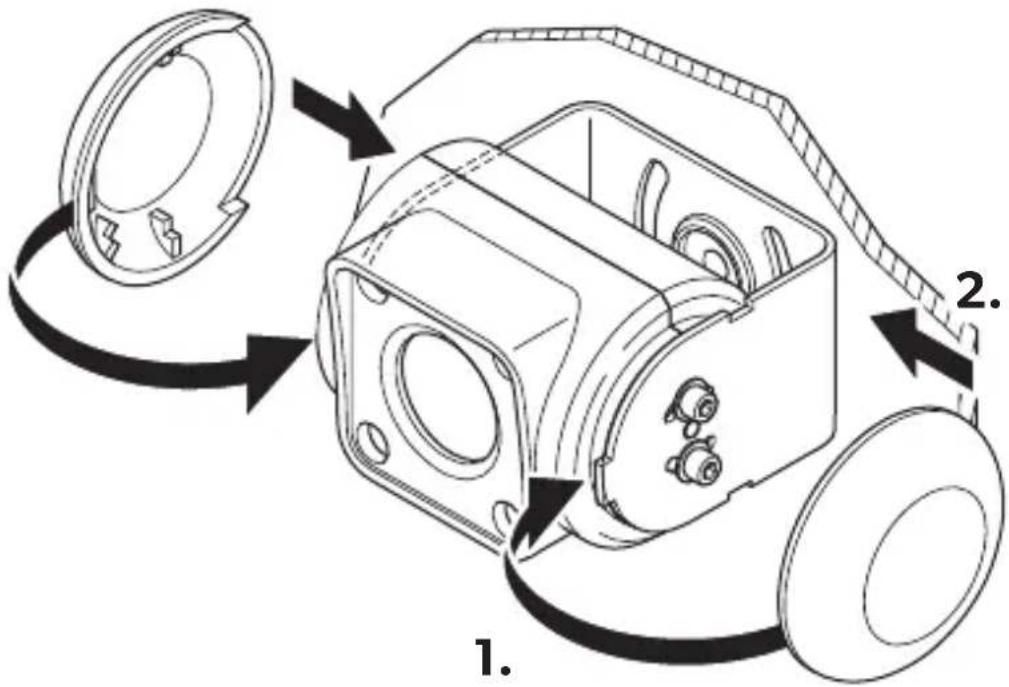
▶ Fit side covers into place (fig. 20, page 8).
8 Cleaning and caring for the camera

NOTICE! Beware of damage
Do not use any sharp or hard objects for cleaning since they may damage the device.
▶Clean the camera with a soft, damp cloth from time to time.
9 W a r r a n t y
The statutory warranty period applies. If the product is defective, please contact the manufacturer's branch in your country (see the back of the instruction manual for the addresses) or your retailer.
For repair and guarantee processing, please send the following items:
- Defect components
• A copy of the receipt with purchasing date
• A reason for the claim or description of the fault
10 Disposal
Place the packaging material in the appropriate recycling waste bins wherever possible.
If you wish to finally dispose of the product, ask your local recycling centre or specialist dealer for details about how to do this in accordance with the applicable disposal regulations.
11 Technical data
| PerfectView CAM45 | |
| Ref. no.: 9600000523 | |
| Image sensor: 1/4" CCD | |
| Pixels: Approx. 250000 pixels | |
| Video standard: PAL, 1 Vpp | |
| Sensitivity: <1 Lux / 0 Lux with infrared LEDs | |
| Viewing angle: Approx. 120° diagonal | Approx. 80° horizontalApprox. 65° vertical |
| Operating voltage: 11 to 16 V--- | |
| Consumption: 1.2 W | |
| Operating temperature: -20 °C to +70 °C | |
| Protection class: IP69k | |
| Vibration resistance: 6g | |
| Dimensions W x H x D(with bracket): | 78 x 60 x 50 mm |
| Weight: | Approx. 0.18 kg |
| Certification: |  |
5 Description technique
dometic.com/sales-offices


- CAM45
- Rear View Video Camera
- Rückfahrvideokamera
- Table of contents
- Explanation of symbols
- WARNING!
- CAUTION!
- NOTICE!
- NOTE
- Safety and installation instructions
- Please observe the prescribed safety instructions and stipulations from the vehicle manufacturer and service workshops.
- Technical description
- Information on electrical connection
- Laying cables
- NOTICE! Beware of damage
- Fitting the camera
- Tools required
- Fitting the camera
- Creating a through-hole for the camera connection cable (fig. 12, page 6)
- Screw on camera using self-tapping screws (fig. 13, page 6)
- Fitting the camera
- Establishing the electrical connection for the camera
- Aligning the camera
- Fastening the camera
- Cleaning and caring for the camera
- W a r r a n t y
- Disposal
- Description technique
Brand : DOMETIC
Model : PerfectView CAM 45 NAV
Category : Rear Camera