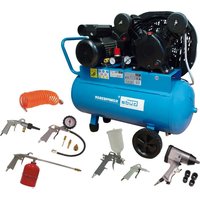
380/10/50 KR 15 TLG - Compressor Güde - Free user manual and instructions
Find the device manual for free 380/10/50 KR 15 TLG Güde in PDF.


| Product type | Air compressor |
| Brand | Güde |
| Model | 380/10/50 KR 15 TLG |
| Maximum pressure | 10 bar |
| Starting pressure | 8 bar |
| Tank capacity | 50 L |
| Suction flow rate | 380 L/min |
| Motor power | 2.0 kW |
| Power supply | 230 V ~ 50 Hz |
| Oil type | Special compressor oil |
| Oil volume | Approx. 0.3 L |
| Noise level (LWA) | 97 dB(A) |
| Weight | Approx. 35 kg |
| Dimensions (L x W x H) | 60 x 40 x 70 cm |
| Transmission type | V-belt drive |
| Number of cylinders | 1 |
| Thermal protection | Yes, thermal switch |
| Safety valve | Yes |
| Pressure gauges | 2 (tank pressure and reduced pressure) |
| Quick coupling | Yes |
| Transport wheels | Yes |
| Handle | Yes |
| Air filter | Yes, washable |
| Condensate drain | Yes, drain valve |
| Warranty | 2 years |
Frequently Asked Questions - 380/10/50 KR 15 TLG Güde
User questions about 380/10/50 KR 15 TLG Güde
0 question about this device. Answer the ones you know or ask your own.
Ask a new question about this device
Download the instructions for your Compressor in PDF format for free! Find your manual 380/10/50 KR 15 TLG - Güde and take your electronic device back in hand. On this page are published all the documents necessary for the use of your device. 380/10/50 KR 15 TLG by Güde.
USER MANUAL 380/10/50 KR 15 TLG Güde
Original Operating Instructions
COMPRESSOR SET
Français FR 17
Please read carefully the following Operating Instructions before putting the appliance into operation
A.V. 2 Any reprints, even partial, are subject to approval. Technical changes reserved.
Illustrative pictures! Translation of original operating instructions.
| GB | Do you have any technical questions? Any claim? Do you need any spare parts or operating instructions? We will quickly help you and without needless bureaucracy at our home page www.guide.com in the Service part. Please help us be able to help you. In order to be able to identify your appliance in case of claim, we need the serial No., Order No. and year of production. All this data can be found on the type label. Please enter the data below for future reference. | ||
| Serial No.: Order No.: Year of production: | |||
| Tel.: +49 (0) 79 04 / 700-360 | Fax: +49 (0) 79 04 / 700-51999 | E-Mail: support@ts.guide.com | |
Machine marking:
Product safety:
| CE | |
| Product corresponds to appropriate norms of the European Community. |
Prohibitions:
| Pulling on the cord prohibited | Not to be used when raining |
| Compressor does not take into operation without protective cover | Druck nicht über das Sicherheitsventil ablassen |
Warning:
| ! | |
| Warning/Attention | Warning against dangerous electric voltage |
| Warning hot surfaces Beware of automatic start | |
Instructions:
| Please read the operating instructions before use | Use earphones |
Environment protection:
| PAP | |
| Proper waste disposal. | Packing cardboard material may be delivered to collecting centres designed thereto. |
| Any damaged or liquidated electric or electronic devices must be delivered to appropriate collection centre. |
Package:
| J | IH |
| Protect against humidity This side up | |
| Interseroh Transportation per Year 2018 | |
| Interseroh-Recycling |
Technical specification:
| Network connector Weight | |
| Engine power Suction | |
| effective delivery quantity Maximum Pressure | |
| Boiler Content Noise level | |
| Condensation drain on a regular basis |
Device Description (Fig. 1)
- ON/OFF switch
- Pressure control valve knob
- Pneumatic
- Pressure control valve air gauge
- Air jet air gauge
- Handle
- Leg
- Travelling
- Bleeder
- Safety valve
- Throat for oil adding
-
Air Filter
-
Sight glass
- Overload protection
- Oil drain screw
Delivery
Operating Instructions
Warranty card
COMPRESSOR SET 380/10/50 KR 15 TLG
Oil gauge or oil plug
Wheels with bolts
Wheels with screws
Rubber damper with screws
Air filter
EC Declaration of Conformity
We,
Güde GmbH & Co. KG
Birkichstrasse 6
74549 Wolpertshausen
Germany
hereby declare the conception and construction of the below-mentioned devices correspond - at the type of construction being launched - to appropriate basic safety and hygienic requirements of EC Directives.
In case of any change to devices not discussed
with us the Declaration expires.
Marking of devices:
COMPRESSOR SET 380/10/50 KR 15 TLG
Order No. 71175
Relevant EC directives:
2006/42/EG
2006/96/EG
2004/108/EG
2000/14/EG
Applied harmonized standards:
EN1012-1
EN 60204-1
EN 60335-1
EN 55014-1:2006
EN 55014-2/A1::2001
EN 61000-3-2:2006
EN 61000-3-3/A2:2005
Certification place:
TUV SUD Product Service GmbH
Ridlerstrasse 65; D-80339 München
Date/Producer signature: 7.06.2010

Signed by: Mr Arnold,
Managing
Technical Documentation: J. Burkle FBL; QS
Guarantee
The guarantee solely covers inadequacies caused by material defect or manufacturing defect.
Original payment voucher with the sales date needs to be submitted for any claim in the guarantee period.
The guarantee does not cover any unauthorised use
such as appliance overloading, use of violence, damage as a result of any unauthorised interference or caused by foreign items. Failing to follow the operating and assembly instructions and common wear are also not included in the guarantee.
General Safety Instructions
It is necessary to read these operating instructions before first use of the machine. If there are any doubts as far as machine connection and handling are connected please contact the manufacturer (servicing department).
IN ORDER TO ENSURE HIGH SAFETY LEVEL PLEASE
FOLLOW THESE INSTRUCTIONS CAREFULLY:
Attention: Operate with current protector only!
- Keep your workplace clean and tidy. Disorder at the workplace and on the work-table increases risk of accident and injury.
- Pay attention to conditions of environment you are working in. Do not use electric tools and devices in a humid or wet environment. Ensure sufficient lighting. Do not expose electric tools to rain or high air humidity. Do not switch the electric tools on in environments with flammable liquids or inflammable gases.
- Do not allow unauthorised persons to get to the machine. Keep visitors and spectators, especially children and handicapped persons, in a safety distance from your workplace.
- Ensure safe storage of tools. Tools and equipment you do not need must be stored at an elevated place, if possible, so that they were not accessible to unauthorized persons.
Always use correct equipment for all works.
Do not use e.g. small tools or accessories for works that need to be executed by heavy equipment. Use tools solely for purposes for which they have been designed. Do not overburden the device!
Pay attention to the electric cable.
Do not pull the cable. Pull the connector plug only when pulling out of socket. Protect the cable against heat sources, oil and sharp edges.
Prevent from unintentional switching on.
Make always sure the switch on the device was in the off position before connector plug is plugged in.
Use special extension cables at outdoor works.
For outdoor works you need special extension cables suitable for such works and with appropriate marking.
- Stay concentrated at all times. Pay attention to what you are doing.
Use common sense. Do not use the electric equipment when you are tired.
- Pay attention to damaged parts. Check the device before use. Are any parts damaged? In case of small damage please consider whether the device is really capable of perfect and safe working.
- Protect yourself against electric shocks.
Prevent any contact of your body with earthed objects, e.g. water piping, heating elements, cookers and fridges.
Use approved parts only. Always use only identical spare parts at maintenance and repairs. Spare parts are available in an authorised service centre.
- WaDirector
Any use of accessories and extensions not explicitly recommended in these operating instructions may result in a threat to persons and objects.
As soon as the compressor is permanently fitted in a room, expert inspections must periodically be carried out!
Safety Instructions for First Putting the Machine into Operation
- Caution! To be operated with RCD (residual current device) only!
- Caution! The compressor may only be put into operation with appropriate wheels and rubber dampers.
-
Check the oil level before you put the appliance into operation for the first time and every time afterwards (for that, see the "Oil filler neck" and "Oil level inspection").
-
Caution! Never switch the compressor off or on through the mains plug. The button must always be pressed, otherwise the depressurising process is not activated. The compressor is not depressurised even in case of short power outage so the compressor may become a source of danger.
- The compressor may not be fitted in a vehicle for business purposes without prior inspection by an expert!
- When used for business purposes, the compressor must be inspected by an expert before first start-up (in accordance with the operational safety notice, section17 Article 25). This inspection must be provided by the compressor supplier.
- Caution! Appropriate warning or protective devices must be installed for installation to automatic appliances in case of power outage, compressor malfunction or failure (e.g. at a feed line).
- Never aim the air current at body holes as that could cause fatal injuries!
- Caution! It is necessary to hold the pressure hose to prevent injuries caused by uncontrolled motion when opening the quick-acting coupling!
- Turn the switch (1) off, empty the air nozzle and disconnect the compressor from the electric power supply when you finish working. Do not leave the compressor switched on over night as it could become a source of danger.
- Never run the compressor unattended.
- The compressor must be always disconnected before any adjustment or maintenance.
Always wear protective glasses and hearing protection aids Always wear protective glasses and corresponding sight and hearing protection aids. Never aim with compressed air beam at your body or other persons or animals. Impurity may be accelerated to a great extent by air flow and thus become a dangerous shot.
Always use protective equipment against electric shock Never use the compressor near water or in a humid environment. - Put properly the compressor out of operation
- Disconnect the compressor from power source and release all pressure from the air jet before repair, inspection, maintenance, cleaning or replacement of construction parts.
- Unintentional switching on
- Do not transfer the compressor when connected to power source or when the air jet is under pressure. Before connecting the compressor to power source make sure the pressure transducer switch is in the OFF position.
- Proper compressor storage
- When the compressor is not in use it is necessary to disconnect it from power source, store it at a dry place protected against climatic influences. Keep it out of reach of children.
- Working clothes
- Do not wear wide clothes or jewellery as they can get caught by machine parts.
- Careful compressor maintenance
- It is necessary to follow the lubrication instructions (see the throat for oil adding and oil level inspection in the "Handling" chapter).
- It is necessary to follow instructions concerning protective cover in the air filter described in the "Handling" chapter.
Check regularly the power cord. If damaged it needs to be repaired or replaced in the service repair centre. Make sure there is no outer visible damage of the compressor. In case of need, please contact the nearest repair centre.
- Outdoor use
- If use the compressor outside it is allowed to use extension cables designed for outdoor use and with appropriate marking only.
Attention: It is necessary to use a cable with sufficient cross section (min. of 1.5mm2 ); at cables longer than 10 m there may be starting problems at unfavourable temperatures. - Attention
- Work considerably and use common sense. Do not use the compressor if you are tired, impaired or intoxicated with drugs causing tiredness.
- Check faulty and untight construction parts
- If there has been any damage to any protective device or other constructional elements it is necessary to check the compressor before restarting in order to ensure its safe operation.
All damaged constructional elements need to be repaired in the customer service centre or replaced as described in the operating instructions of the device. - Correct compressor using
Follow all instructions mentioned in these operating instructions at operating the compressor. Prevent children or persons not familiarised with the manner of working of the compressor from using it. - Keep the cowl screen clean
Keep the engine cowl screen clean. Clean the screen regularly if you operate the compressor in an environment with severe pollution. - Operate the compressor at rated voltage
Operate the compressor at voltage specified on the type label. If the compressor is operated at voltage higher than the specified rated voltage inadmissible engine overheating may occur. - Do not let the device running unattended
- Do not use the compressor when faulty
If there are any strange sounds, strong vibrations at the compressor or it seems to be faulty in other way it needs to be stopped immediately. Have the reason identified at the nearest repair centre. - Do not clean the plastic parts with solvents
Solvents, such as petrol, thinners, engine oil or other substances containing alcohol, may damage the plastic parts of the machine. Therefore do not clean those parts with such substances but use soap suds or other - suitable liquids instead. - Use original spare parts only
When using spare parts of other manufacturers claim arising from the guarantee expires and compressor working failures may occur. Original spare parts are available at authorised dealers. - Do not make any alterations to the compressor
Do not make any alterations to the compressor. If the compressor needs to be repaired please contact the customer service centre. Any non-approved alteration may negatively influence the compressor output; it may also cause serious injuries if made by persons without necessary technical skills. - Do not touch any hot compressor parts
Do not touch any cables, engine or other constructional elements of the compressor in order not to get burnt. - Never keep the device switched on unattended, it could become source of danger.
If you execute repairs or service of safety or protective devices of the machine these parts must be immediately reassembled after works are finished.
It is necessary to know both regulations for prevention of injuries valid at the place of device using and generally accepted safety rules. - Safety device functioning needs to be checked before using the device. Make sure functioning of parts with seemingly slight damage is really all right.
Unless otherwise provided in these operating instructions, the damaged parts and safety devices need to be repaired or replaced in an authorised service centre. -
Have the damaged switches replaced in an authorised service centre.
-
This device corresponds to all appropriate safety regulations. Repairs may only be executed by qualified electricians in authorised service repair centres while using original spare parts. Failing to observe this regulation may lead to an accident.
Emergency Action
Apply the first aid adequate to the injury and get qualified medical assistance as quickly as possible. Protect the injured person from more accidents and calm him/her down.
For the sake of eventual accident, in accordance with DIN 13164, a workplace has to be fitted with a first-aid kit. It is essential to replace any used material in the first-aid kit immediately after it has been used. If you seek help, state the following pieces of information:
- Accident site
- Accident type
- Number of injured persons
- Injury type(s)
Using the appliance as designated
The compressor has exclusively been designed for the production and accumulation of compressed air. The compressed air is only suitable for pneumatic tools /appliances/ of a machine. Any other use is conflict with the compressor designation.
Residual Dangers
Direct electric contact
A faulty cable or faulty connector plug may lead to a fatal accident caused by electric current.
Have always the faulty cables and connector plugs replaced at a specialist. Use the device at a connector equipped with current protector (RCD) only.
Indirect electric contact
Injury by parts of the machine that are live or by faulty constructional elements of the machine.
Always pull the connector plug out of socket at maintenance works. Operate with current protector only.
Insufficient local lighting
Insufficient lighting represents a high safety risk.
Always ensure sufficient lighting at work with this device.
Disposal
Instructions for disposal result from icons on the device, or more precisely, on the package. Description of each meaning can be found in the "Marking" chapter.
Operating Staff Requirements
The operating staff must thoroughly read the operating instructions before using the machine.
Qualification
No additional qualification is needed for using the device apart from detailed training by a person with expert knowledge.
Minimum Age
The device may only be operated by persons that have reached 16 years of age.
An exception includes device use by juveniles within job preparation for purpose of reaching skills under instructor's supervision.
Training
Appropriate training is only needed for device use. No special training is necessary.
Transportation and Storage
- If the device is stored for a longer period of time it needs to be thoroughly cleaned and stored so that it was not accessible to unauthorized persons.
- The compressor must never be stored or transported laying or under pressure!
- Pressure in the air jet may be reduced at compressed air cooling.
Assembly / First Putting into Operation
If the compressor is supplied without wheels assemble it with a screw wrench according to pic. 2. The sequence of screws, nuts and washers is evident from pic. 2. In case of need, a rubber foot also needs to be screwed on. Jointing materials, such as screws, nuts, etc. are included in the supply.
Transport stopper of the oil tank needs to be exchanged for throat for oil adding and correct oil level needs to be ensured (see the "Handling Throat for Oil Adding and Oil Level Inspection" chapter) before putting the compressor into operation)
Check the oil level at every startup (pic. 3).
Handling
The compressor may be put into operation after reading and understanding the general safety instructions and safety instructions. Proceed as follows:
Switching the appliance on
- Connect the compressor power cord to the electrical network.
Pull the switch (1) up. - The compressor is fitted with an automatic pressure switch that switches the compressor off after reaching the upper operating pressure and switches it automatically on again when air is needed again. Switching pressure 6 bar, max. pressure 8 bar.
Operating pressure control
- The operating pressure can be set in an easy way. If turning the knob (2) in the + direction, the operating pressure increases. If turning in the - direction, the operating pressure decreases. The operating pressure can be fixed by tightening the lock ring.
- The compressor is fitted with an automatic safety valve that releases pressure in case of overpressure. The air nozzle can be depressurized manually by pulling the ring on the valve (10).
Switching the appliance off
- The compressor must always be switched off by the switch (1) and when you do not intend to use the appliance then disconnect it from mains.
Remove the transport oil peg, add oil to the neck and make sure there is appropriate oil level, using the oil gauge included in the supply.
The filter insert should be cleaned from time to time. Remove the foam filter. It can be cleaned by warm soap water solution. Dry the foam filter and refit it.
Throat for Oil Adding and Oil Level Inspection
Transport stopper needs to be exchanged for throat for oil adding and correct oil level needs to be ensured before putting the compressor into operation.
Check the oil level at every startup!!!
Oil change
Since arriving on the piston can chip, it is absolutely necessary after the first 10 hours of operation to carry out an oil change. We recommend that you are our compressor (SKU:40056). Later, depending on the operation of the compressor, all 100 to 200 hours of operation an oil change place. In order to carry out oil changes, open the drain screw (13) and begin the process of waste oil in a suitable container. Observe strictly the rules for disposal of waste oil and dispose of it properly in a waste oil collection center. Unscrew the drain screw is now firmly back on and fill oil up to the mark on the dipstick In winter we recommend a lubricity oils to start during the cold season to help!
Air-pressure switch:
The compressor is equipped with an automatic air-pressure switch that will switch the compressor off after reaching the upper limit of the operating pressure and switch it on again when air is needed. Starting pressure of 8 bar, max. pressure of 10 bar.
Inspections and Maintenance
Pull the connector plug out of socket before each work on the machine. If you are not going to use the device for a longer period of time we recommend dropping a few oil drops at the place of air filter insertion so that walls of cylinders were lubricated at next compressor switching on.
- Use a damp cloth for cleaning of plastic parts. Do not use cleaners, solvents or sharp objects.
- Clean the air holes and mobile parts with a soft brush off the settled dust after each use.
- Regularly paint all metal parts with oil.
After each use
clean the air holes and mobile parts off dust.
Regularly
paint metal parts with oil (universal oil) check whether all screws are tightened.
-
Regularly (once a month at least) release the condensed fluid from the air jet; failing to observe this regulation may lead to guarantee for rusting through expiry - apart from that, the compressor is maintenance-free. (The condensed fluid may be brown-coloured due to surface layer from the air jet)
-
Pull the connector plug out of socket!
- At low pressure in the air jet open the bleeder (9) (max. of 1 bar) and completely empty the condensed fluid (use a suitable container)
- Close the valve.
Air filter
Sometimes it is necessary to clean the filter bed. For that purpose remove the air filter cover screw and remove the foam filter. Wash it in warm soap water solution. Let the foam filter dry and reinsert it to its place. Now assemble the air filter cover again.
Fuse against overheating:
- If the compressor is loaded by a technical defect or possibly also by continuing operation, the power feed will be automatically interrupted by a thermo-switch. If such situation occurs it is advisable to disconnect the compressor from the mains and let it cooled down for approx. 5 minutes. If the compressor does not start after certain period of operation, let it cooled down for additional 3 minutes.
V-belt
Check regularly the V-belt tension.
If the V-belt needs to be tightened, proceed as follows:
- Unscrew the 4 engine screws.
- Tighten the V-belt by pushing the engine away off the unit.
- When the V-belt is tightened, the engine screws must be tightened again.
- It is necessary to make sure that both pulleys match each other.
Protection against overheating
If the compressor is overloaded by e.g. long-term operation, current supply is automatically interrupted by the thermal switch. The compressor is recommended to be disconnected and the engine cooled down for app. 5 minutes.
Risk of injury! The compressor may automatically get started after cooling down (app. 5 minutes).
Engine overloading protection
If the engine overloading protection is activated when the appliance is in operation, the appliance has a defect. Please notify the service department of Gude or an electrical professional.
Important instructions
Appliance depressurising does not work
The depressurising process is disabled by unplugging the appliance or decreasing the voltage in the system when the compressor is switched on.
Depressurising process reactivation:
Switch the compressor off by the ON/OFF button. The appliance is depressurised. Connect the plug and switch the compressor on by the ON/OFF button.
WARNING:
There may be relatively high values of the build-up current at compressors with a capacity exceeding 2.0kW . These values may activate the protective power switches in your household installation system. It is no defect! In such a case, please contact an electrical professional who will provide appropriate protection.
| Fault Cause Remedy | |||
| A | Compressor does not start after switching on | Pressure in the air receiver is higher than switch-on pressure | Release the pressure from the air receiver so that the pressure switch switches automatically |
| Faulty feeding Have the power feeding checked by an authorized person | |||
| Circuit breaker of the motor interrupts the power feed | |||
| Faulty pressure switch Have the pressure switch replaced by an authorized person | |||
| B | Compressor shortly starts or buzzes at the reach of the switch-on pressure and then switches off automatically | Electric cable is longer than permitted or is of too small cross-section | Check the length and cross-section of the electric cable |
| C | Compressor runs without stop | Suction filter is contaminated heavily Clean or replace the suction filte r | |
| Pneumatic tool has too high air consumption Check the air consumption of the pneumatic tool; contact authorized reseller | |||
| Leak at the compressor Locate the leak, notify Güde service | |||
| Too much condensing water in air receiver Drain the condensing water | |||
| Leaky pneumatic piping Check the pneumatic piping, seal the leak | |||
| Mud-discharge valve is open or missing Close or insert it | |||
| D | In operation the relief valve under the pressure switch releases the pressurized air | Leaky relief valve Clean or replace the relief valve | |
| E | After switch-off pressure is reached the relief valve under the pressure switch releases the pressurized air until the switch-on pressure is reached | Insert of the non-return valve is leaky or faulty | Clean or replace the insert of the non-return valve |
| F | Compressor switches on frequently | Non-return valve is damaged Replace the non-return valve | |
| Too much condensation water in the air receiver | Drain the condensation water | ||
| Compressor is overloaded | |||
| G | Safety valve blows off | Pressure in the air receiver is higher than set-up switch-off pressure | Have the pressure switch readjusted /replaced by an authorized person (Güde Service) |
| Safety valve is faulty | Replace the safety valve or contact Güde Service | ||
| H | Compressor heats too much | Intake air is insufficient | Make sure that sufficient intake and outlet of the air is guaranteed (minimum distance from a wall 40 cm) |
| Cooling ribs at the cylinder (cylinder head) are dirty | Clean the cooling ribs at the cylinder (cylinder head) | ||
| Too long period of use | Switch off the compressor | ||
| The oil level rises without oil being added | Condensation water accumulates in oil | Compressor is overdesigned, notify the Güde Service | |
| High air humidity | Replace the oil | ||
| J | Compressor is overheated and it switches off | Compressor is overloaded | Notify the Güde Service |
| Compressor is faulty | Notify the Güde Service | ||
| Compressor has under voltage | Notify the Güde Service | ||
| Ambient temperature 35°C | Notify the Güde Service | ||
Maintenance Table
| Maintenance periods are valid for normal operating conditions; in case of extreme operating conditions the maintenance periods are shortened correspondingly. | |||||
| Actions Periods Date Date Date Date | |||||
| Intake suction filter check · cleaning · replacement | Weekly every 50 hours of operation, min. once a year | ||||
| Cleaning of reverse valve and insert Yearly | |||||
| Oil level check Daily or more precisely before | every putting into operation | ||||
| Oil replacement 1. replacement of mineral oil of synthetic oil | after 50 hours of operation once a year every two years | ||||
| Filling up/adding the oil | As required | ||||
| Draining the condensation water from air receiver | After every use | ||||
| Draining the condensation water from pressure reducing valve of the filter | After every use | ||||
| Filter insert cleaning As required | |||||
| Compressor cleaning As required | |||||
| Screwing check | First time after 10 hrs. of operation, subsequently every 500 hrs. of operation | ||||
FR

Lieudecertification:
TUV SUD Product Service GmbH
Ridlerstrasse 65; D-80339 München
Contact electrolyte indirect
| Interseroh Interseroh Interseroh-Recycling |
Beveiling against oververhitting
| interseroh Interseroh Recycling | |
| Interseroh-Recycling |
Dati tecnici:
- MACHINE MARKING
- DEVICE DESCRIPTION (FIG. 1)
- DELIVERY
- EC DECLARATION OF CONFORMITY
- MANAGING
- GUARANTEE
- GENERAL SAFETY INSTRUCTIONS
- IN ORDER TO ENSURE HIGH SAFETY LEVEL PLEASE
- FOLLOW THESE INSTRUCTIONS CAREFULLY
- ATTENTION: OPERATE WITH CURRENT PROTECTOR ONLY
- SAFETY INSTRUCTIONS FOR FIRST PUTTING THE MACHINE INTO OPERATION
- EMERGENCY ACTION
- USING THE APPLIANCE AS DESIGNATED
- RESIDUAL DANGERS
- DIRECT ELECTRIC CONTACT
- INDIRECT ELECTRIC CONTACT
- INSUFFICIENT LOCAL LIGHTING
- DISPOSAL
- OPERATING STAFF REQUIREMENTS
- QUALIFICATION
- MINIMUM AGE
- TRAINING
- TRANSPORTATION AND STORAGE
- ASSEMBLY / FIRST PUTTING INTO OPERATION
- HANDLING
- SWITCHING THE APPLIANCE ON
- OPERATING PRESSURE CONTROL
- SWITCHING THE APPLIANCE OFF
- THROAT FOR OIL ADDING AND OIL LEVEL INSPECTION
- OIL CHANGE
- AIR-PRESSURE SWITCH
- INSPECTIONS AND MAINTENANCE
- AFTER EACH USE
- REGULARLY
- AIR FILTER
- FUSE AGAINST OVERHEATING
- V-BELT
- PROTECTION AGAINST OVERHEATING
- ENGINE OVERLOADING PROTECTION
- IMPORTANT INSTRUCTIONS
- APPLIANCE DEPRESSURISING DOES NOT WORK
- DEPRESSURISING PROCESS REACTIVATION
- WARNING
- MAINTENANCE TABLE
- CONTACT ELECTROLYTE INDIRECT
- BEVEILING AGAINST OVERVERHITTING
Brand : Güde
Model : 380/10/50 KR 15 TLG
Category : Compressor